
A well-organized truck bed can make camping and overlanding more efficient, but loose gear, stacked storage bins, and hard-to-reach equipment can quickly turn a pickup into a cluttered cargo space. Truck bed drawer systems offer a more structured solution by keeping tools, recovery equipment, and camping essentials organized in accessible compartments while preserving a usable surface above the storage area. However, not every system provides the same layout, capacity, or level of protection.
In this guide, we compare five truck bed storage options: the DECKED Drawer System XF4, ARB Roller Drawer RD1355, WorkLoad FleetPro Dual Roll-Out System, WEATHER GUARD PACK RAT, and LEER NexStor Drawer System. They represent different approaches, from full dual-drawer platforms to individual heavy-duty pull-out units. We examine their verified specifications, construction, load ratings, vehicle fitment, installation requirements, and practical limitations to help you identify which design best suits your pickup and the equipment you carry. Whether you are building a dedicated overlanding setup or improving everyday truck storage, the right choice starts with understanding these differences.
As an Amazon Associate I earn from qualifying purchases.
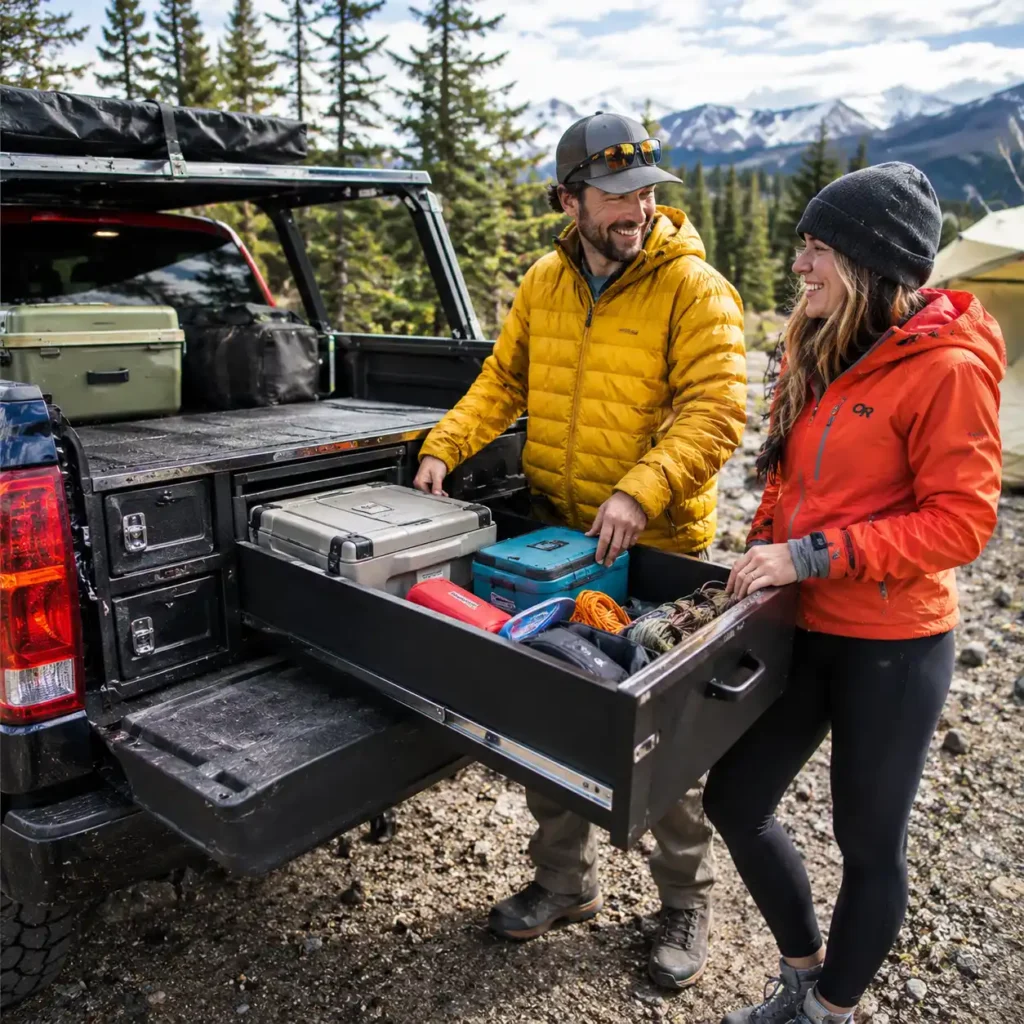
Table of Contents
Quick Answer: What Are the Best Truck Bed Drawer Systems for Camping and Overlanding?
The best truck bed drawer system for camping and overlanding is one that matches your pickup’s exact bed configuration, provides practical access to frequently used gear, and offers enough load capacity for the equipment you plan to carry. For owners who want a complete dual-drawer platform with a usable cargo surface above it, the DECKED Drawer System XF4 is a strong option for compatible Ford F-150 models with a 5.5-foot bed.
Before choosing a system, compare its external dimensions, installed weight, drawer configuration, and manufacturer-published load ratings. Drawer payload and upper-deck capacity are separate specifications, and neither should be confused with your truck’s remaining payload capacity. Vehicle fitment also matters: a system that appears to fit based on its dimensions is not necessarily approved for your exact model year, bed length, or existing accessories.
A full drawer platform can make camping and overlanding equipment easier to organize and access, but it also adds permanent weight and reduces the available vertical cargo space in the truck bed. If you regularly transport tall or oversized loads, or need to keep the bed adaptable for different jobs, a single-drawer or removable storage arrangement may be more practical.
Why You Can Trust This Guide
Choosing a truck bed drawer system involves more than comparing prices or advertised load capacities. Vehicle fitment, system weight, drawer dimensions, construction materials, installation requirements, and the distinction between drawer payload and top-deck capacity can all affect whether a particular setup is suitable for your pickup. That is why this guide uses a specification-led evaluation process rather than relying on marketing claims or unverified performance statements.
Our research focuses on manufacturer documentation and product-specific information. We examine official product specifications, fitment information, installation instructions, warranty details, and available technical documentation. Amazon listings are also reviewed to identify the exact models and configurations being compared, but manufacturer information takes priority when a listing contains inconsistent dimensions, weights, model numbers, or capacity figures.
We also distinguish between products that serve different storage purposes. The DECKED, WorkLoad, and LEER systems provide dual-drawer configurations with an upper storage surface, while the ARB RD1355 and WEATHER GUARD PACK RAT are individual pull-out drawer units. Treating these designs as identical would produce a misleading comparison, so we evaluate each product according to its actual construction and intended function.
We do not claim hands-on testing or personal field experience with these products. Instead, our assessment is based on documented specifications, technical comparisons, vehicle compatibility considerations, and an examination of each system’s practical advantages and limitations for camping and overlanding. Where a manufacturer does not publish a particular measurement or rating, we identify that information as unavailable rather than estimating it.
The same approach applies to the wider vehicle setup. Drawer systems are only one part of an organized pickup configuration, and their compatibility with other equipment matters. For example, choosing a suitable truck bed rack for an overlanding setup may require checking available mounting space, system height, and the intended cargo arrangement.
Our goal is to give you a technically grounded comparison that makes the differences between these five systems clear, highlights important fitment and payload considerations, and helps you choose storage that matches your truck and the way you travel.
How We Evaluate Truck Bed Drawer Systems

To compare truck bed drawer systems fairly, we look beyond advertised capacity and construction materials. A system may offer substantial storage but add considerable weight, reduce usable bed height, or require a vehicle-specific installation. Another may provide a strong individual drawer without the upper platform found in larger dual-drawer configurations. Our evaluation therefore focuses on the characteristics that determine how well each design fits a pickup used for camping, overlanding, and everyday equipment storage.
We assess each product using the following criteria.
1. Vehicle Compatibility and Fitment
We examine the manufacturer’s stated vehicle applications, model years, bed lengths, and installation requirements. Compatibility is particularly important for vehicle-specific systems such as the DECKED XF4 and LEER NexStor. We also consider whether existing bed accessories, covers, liners, or racks could affect installation or clearance. A product is not considered a confirmed fit simply because its advertised dimensions appear close to those of a truck bed.
2. Storage Configuration and Usable Space
We identify whether a product provides two independent drawers, one wide pull-out drawer, or a modular storage arrangement. Where available, we compare internal drawer dimensions and published storage volume rather than relying exclusively on external measurements. Drawer layout, access, and the amount of bed space occupied are also considered because they influence what equipment can be stored and how easily it can be retrieved.
3. Weight and Load Capacity
We distinguish between the empty weight of the system, the rated payload of its drawers, and the load capacity of an upper platform. These figures describe different things and should not be treated as interchangeable. We also consider the additional weight the system places on the pickup when assessing its suitability for camping equipment and other cargo. The truck’s own payload and axle limits remain the controlling restrictions.
4. Construction Materials and Hardware
We examine the documented materials used in the drawer body, frame, slides, fasteners, and upper surface. These details help explain the differences between the DECKED composite-and-steel construction, the aluminum WorkLoad and LEER designs, and the steel ARB and WEATHER GUARD units. We also consider published information about drawer slides, locking mechanisms, surface finishes, and components that may require maintenance.
5. Weather Protection and Security
Open pickup beds expose stored equipment to rain, dust, road spray, and changing temperatures. We therefore examine the manufacturer’s stated protection claims, sealing arrangements, and locking features. We distinguish weather resistance from waterproof construction and avoid assuming that a locked drawer provides complete theft protection. Sensitive equipment may still require additional protective cases or dry storage.
6. Installation, Removal, and Vehicle Integration
We compare documented mounting methods, drilling requirements, removal options, and compatibility considerations. A system designed for relatively permanent installation serves a different purpose from one intended to be detached when the pickup bed is needed for other cargo. We also consider how the system interacts with tonneau covers, truck caps, racks, and other bed accessories when reliable compatibility information is available.
7. Warranty, Documentation, and Overall Value
We review the manufacturer’s published warranty and the availability of product-specific technical information. We also consider whether the system’s design and documented capabilities justify its intended role. Price alone does not determine value: a modular drawer, a professional steel unit, and a complete dual-drawer platform serve different storage requirements and should be evaluated accordingly.
Our comparison is based on manufacturer specifications, installation documentation, and available product information—not personal field testing. When a specification is missing, unclear, or inconsistent between a retailer and the manufacturer, we do not fill the gap with an estimate. We identify the limitation so readers can make decisions using the information that is actually available.
Using these criteria allows us to compare the five selected products according to their real configurations and intended applications, rather than presenting a misleading ranking based on a single capacity figure or marketing claim.
Who Should Consider a Truck Bed Drawer System for Camping and Overlanding?
A truck bed drawer system is most useful when a pickup carries a relatively consistent set of equipment and the owner needs to access that gear without unloading the entire bed. For camping and overlanding, this often means keeping recovery equipment, tools, cooking supplies, spare parts, and smaller essentials organized in dedicated compartments. However, the benefits depend on how the truck is used, how much cargo it carries, and whether the owner can accommodate the system’s permanent footprint and weight.
Truck Owners Who Keep Camping Gear in Their Pickup
Drawer systems make particular sense for owners who regularly use the same pickup for weekend camping trips, extended overlanding routes, or outdoor activities. Instead of packing loose equipment into several containers before every departure, they can keep frequently used items organized and ready between trips.
This arrangement can be especially practical for carrying recovery straps, basic tools, tire-repair equipment, first-aid supplies, cooking accessories, and other items that are easier to retrieve from separate compartments. A flat upper platform on compatible dual-drawer systems can also provide a surface for additional cargo, although its load rating must be considered separately from the drawer capacity and the truck’s payload limit.
Overlanders Who Need Consistent Gear Organization
For overlanders who travel with a relatively established equipment setup, drawers can reduce the need to rearrange cargo every time they need one particular item. Recovery equipment can stay in one compartment, maintenance tools in another, and smaller camping supplies in designated storage areas.
This is particularly relevant when the truck also carries a rooftop tent, camping equipment, or a canopy-based setup. A well-planned storage layout can make frequently used items easier to reach and help keep the remaining cargo area more orderly.
The important distinction is that a drawer system should support an existing equipment plan rather than dictate one. Owners should first establish what they need to carry and how often they need access to it.
Pickup Owners Who Carry Tools and Outdoor Equipment Every Day
Some truck owners use the same vehicle for work during the week and camping or outdoor activities on weekends. If the equipment they carry remains relatively consistent, a drawer system can provide a dedicated place for tools, accessories, and smaller items while leaving the upper surface available for other cargo.
This arrangement may be useful for contractors, outdoor professionals, hunters, anglers, and other owners who regularly transport equipment that benefits from organized storage. It is less compelling when the truck frequently carries bulky or unusually shaped loads that require the full depth of the bed.
Owners Building a Dedicated Truck Camping Setup
A drawer system can also suit owners who are developing a more permanent truck camping arrangement. When combined with a compatible bed cover or canopy, the storage area can become part of a larger setup for carrying cooking equipment, recovery gear, camping supplies, and other essentials.
However, the complete layout needs to be considered before purchasing the drawers. Owners should account for the available space above the system, access to stored equipment, the position of any refrigerator or other accessories, and the room required for sleeping arrangements if the truck bed is also used as a sleeping area.
A drawer system is not automatically the best foundation for every truck camping build. Its suitability depends on the dimensions of the bed and the way the owner intends to use the remaining space.
Who May Be Better Off Without a Drawer System?
A permanent drawer installation is not necessarily a good investment for every pickup owner. Some use patterns make a simpler storage arrangement more practical.
Owners who regularly carry tall or bulky cargo: A raised storage platform reduces the available vertical space in the truck bed. This can become inconvenient when transporting large equipment, building materials, furniture, or other oversized items.
Drivers who frequently switch between different types of cargo: If the truck alternates between work equipment, household loads, recreational gear, and occasional camping trips, a fixed drawer layout may limit flexibility.
Occasional campers: Owners who take only a few camping trips each year may not benefit enough from permanent storage to justify the system’s purchase price, weight, and installation requirements.
Pickup owners with limited payload capacity: The drawer system itself adds weight before any camping equipment or other cargo is loaded. Owners who already carry heavy accessories should calculate their remaining payload before committing to the installation.
Drivers who need the entire bed for other purposes: Some owners depend on the full cargo area for hauling, loading, or transporting equipment. A permanent platform and drawer arrangement may interfere with those requirements.
For these users, portable containers and dedicated storage trunks may offer a more adaptable way to organize camping equipment without committing to a fixed installation. The guide to choosing camping storage trunks covers another approach to keeping gear contained and easier to manage.
Quick Summary: Our Top Picks
Choosing the right truck bed drawer system for camping and overlanding involves more than comparing storage capacity or advertised load ratings. Drawer configuration, construction, vehicle fitment, access, and the amount of usable truck bed space remaining all affect how practical a system will be. These five options represent different approaches to truck bed storage, including full dual-drawer platforms and individual heavy-duty pull-out units. The specifications below are based on available manufacturer documentation and product listings, not independent load testing.
1. DECKED Drawer System XF4 — Best Overall
The DECKED Drawer System XF4 is a full-size dual-drawer platform designed for the 2015-current Ford F-150 with a 5-foot-6-inch bed. Its short-bed configuration measures approximately 65 × 71.6 × 12.2 inches and weighs about 208 pounds. The two drawers are each rated for a 200-pound payload, while the upper deck supports up to 2,000 pounds when evenly distributed. Its high-density polyethylene construction, galvanized steel subframe, and full-extension drawer slides provide a substantial storage platform for organizing camping and recovery equipment. Exact compatibility should be confirmed against the truck’s model year and bed configuration before purchase.
Best for: F-150 owners looking for an established dual-drawer storage platform with substantial upper-deck capacity and dedicated compartments for camping and overlanding gear.
2. ARB Roller Drawer RD1355 — Best Modular Single Drawer
The ARB Roller Drawer RD1355 is a single steel pull-out drawer rather than a complete dual-drawer platform. It measures approximately 53.4 × 19.9 × 12.2 inches externally, weighs about 94.1 pounds, and has a manufacturer-listed drawer load rating of 275 pounds. Its key-lockable design, anti-roll-back feature, and sealed dust- and water-resistant bearing arrangement make it a practical option for storing tools, recovery equipment, and smaller camping essentials. The RD1355 can also form part of a modular ARB storage arrangement, allowing owners to build a configuration around their available truck bed space.
Best for: Truck owners who prefer a modular storage layout and need one dedicated, lockable pull-out drawer rather than a full-width dual-drawer platform.
3. WorkLoad FleetPro Dual Roll-Out System — Best Heavy-Duty Dual Drawer System
The WorkLoad FleetPro combines two lockable roll-out drawers in an aluminum storage unit measuring 54 × 40 × 11 inches and weighing approximately 145 pounds. Its construction includes stainless steel edging, commercial-grade black carpet, carpet-lined drawer interiors, side wings, and integrated top tie-down points. The manufacturer lists a total capacity of 1,000 pounds, although the available product information does not separately establish individual drawer and upper-platform load ratings. A no-drill installation design and a passenger-side top slide add flexibility to the layout, but buyers should verify the system’s dimensions against their truck bed before ordering.
Best for: Owners who want a compact-footprint dual-drawer system with lockable storage, aluminum construction, and a manufacturer-listed 1,000-pound total capacity.
4. WEATHER GUARD PACK RAT 338-5-04 — Best Professional Heavy-Duty Drawer Unit
The WEATHER GUARD PACK RAT 338-5-04 is a wide, single-drawer storage unit built around a heavy-duty steel construction. Its external dimensions are approximately 48 × 39.75 × 13 inches, and its listed weight is about 295 pounds. The drawer has a 425-pound load rating, while the upper surface is rated for a separately specified 2,000-pound load. Features include a factory-installed 1KEY ULTRALOCK system, adjustable dividers, anti-skid strips, and an ARMOR TUF powder-coat finish. Its substantial steel construction and limited lifetime warranty make it a strong candidate for owners who prioritize professional-grade equipment storage, although its weight should be included in the truck’s payload calculations.
Best for: Pickup owners who need one wide, lockable steel drawer with a high individual drawer rating and a separately rated upper load surface.
5. LEER NexStor Drawer System — Best Removable Aluminum Drawer System
The LEER NexStor uses a lightweight aluminum construction with two integrated drawers and 50/50 sliding deck components. Its fast-detaching design allows owners to remove the system when they need to recover more of the truck bed’s cargo space, while its no-drill installation approach is intended for compatible vehicle applications. The selected listing identifies compatibility with 2017–2025 Ford F-150 models equipped with a 5.5-foot bed, but buyers should confirm the exact configuration through LEER’s fitment information. The available manufacturer documentation does not establish a verified system weight, drawer load rating, or upper-deck load rating, so these figures should not be assumed from other drawer systems.
Best for: F-150 owners who want a removable aluminum dual-drawer arrangement with sliding deck sections and the flexibility to regain truck bed space when needed.
Before purchasing, confirm the exact vehicle fitment, including model year and bed length, and compare the system’s dimensions with the available cargo area. Pay particular attention to the difference between drawer capacity, upper-deck capacity, and the truck’s remaining payload. These are separate specifications and should not be treated as interchangeable. A suitable system should provide the storage arrangement you need without compromising the truck’s other cargo, camping, or overlanding requirements.
Truck Bed Drawer Systems Compared: Dimensions, Weight, and Load Capacity
Comparing truck bed drawer systems side by side makes it easier to identify which design offers the right balance of storage, structural capacity, and vehicle compatibility. Although these five options serve a similar purpose, they differ significantly in configuration, materials, overall weight, and available load ratings. The table below summarizes their key specifications, including separate drawer and upper-platform capacities wherever the manufacturer provides them. This distinction matters because a drawer’s rated capacity is not interchangeable with the load rating of the surface above it or the pickup’s total payload.
| Model | Configuration | Construction | Installation / Removal | Main Design Advantage |
|---|---|---|---|---|
| DECKED Drawer System XF4 | Dual full-length drawers with upper deck | HDPE panels, galvanized steel frame, stainless steel hardware | Vehicle-specific installation | Two-level storage with a 2,000 lb upper-deck payload rating |
| ARB Roller Drawer RD1355 | Single pull-out drawer | Steel | Modular installation | Compact, lockable drawer with 275 lb drawer load rating |
| WorkLoad FleetPro Dual Roll-Out | Two lockable roll-out drawers, side wings and passenger-side top slide | Aluminum, commercial-grade carpet, stainless steel edging | No-drill installation | Manufacturer-listed 1,000 lb capacity |
| WEATHER GUARD PACK RAT 338-5-04 | One full-width drawer with internal compartments | Heavy-duty steel | Floor-mounted installation | 425 lb drawer rating and 2,000 lb top-load rating |
| LEER NexStor Drawer System | Two drawers with two 50/50 sliding deck sections | T6 aluminum and high-strength metal | No-drill installation; fast-detaching design | Removable modular storage platform |
The 5 Best Truck Bed Drawer Systems for Camping and Overlanding
The following truck bed drawer systems offer different storage configurations for camping, overlanding, and everyday truck use. We compare five selected models based on verified specifications, construction, load capacity, vehicle compatibility, and practical features. Each option has distinct advantages and limitations, helping you identify the right storage solution for your pickup and equipment.
1. DECKED Drawer System XF4
Award: Best Overall

The DECKED Drawer System XF4 is a full-width dual-drawer storage platform designed for compatible Ford F-150 pickups with a 5-foot-6-inch bed. Its combination of two independently accessible drawers, a heavy-duty upper deck, and a galvanized steel support frame makes it a strong overall option for organizing camping equipment, recovery gear, and tools. Each drawer has a manufacturer-listed payload capacity of 200 pounds, while the upper deck supports up to 2,000 pounds when the load is evenly distributed. However, its approximately 208-pound system weight, permanent installation footprint, and vehicle-specific fitment are important considerations before purchase.
Overview
The DECKED Drawer System XF4 is designed to convert the open cargo area of a compatible Ford F-150 into a two-level storage arrangement. Two full-length drawers sit beneath a raised deck, allowing owners to keep smaller equipment and frequently used supplies organized below while retaining a usable surface for larger cargo above.
The XF4 configuration is intended for Ford F-150, F-150 Raptor, and F-150 Lightning models from 2015 onward with a 5-foot-6-inch bed, according to DECKED’s current fitment information. The system measures approximately 65 inches long, 71.6 inches wide, and 12.2 inches high, with a listed weight of about 208 pounds. Each drawer has an internal volume of approximately 158 liters and extends about 43 inches when opened. These dimensions are relevant when planning access around a tailgate, bed cover, or other installed truck accessories.
The system uses high-density polyethylene (HDPE) panels supported by a galvanized steel frame, with stainless steel hardware and cast aluminum handles. Its two drawers provide separate storage areas for equipment such as recovery straps, hand tools, cooking accessories, and smaller camping supplies. The upper deck can support additional cargo, but its 2,000-pound evenly distributed rating must not be confused with the 200-pound payload rating of each drawer.
Key Features
Dual Full-Length Drawers for Organized Storage
The XF4 includes two separate drawers beneath a full-width upper deck. This arrangement allows owners to divide equipment into dedicated storage areas rather than stacking everything in the truck bed or relying entirely on removable containers.
For a camping setup, one drawer could be allocated to recovery equipment and vehicle tools, while the other could hold cooking accessories, lighting, or general campsite supplies. The actual organization depends on the dimensions of the equipment being carried and the available internal drawer space.
Each drawer has a manufacturer-listed payload capacity of 200 pounds. This is the maximum stated load for an individual drawer, not a combined 400-pound rating for the upper platform.
Heavy-Duty Upper Deck with a 2,000 lb Load Rating
The upper deck is rated for an evenly distributed payload of up to 2,000 pounds. This creates a usable cargo surface above the drawers, allowing owners to carry additional equipment without occupying the internal storage compartments.
For vehicle-based camping, this layout can be useful when transporting storage bins, camping accessories, or other compatible cargo above the drawer system. However, the rating applies to an evenly distributed load and should not be interpreted as permission to place the same weight at a single concentrated point.
The truck’s own payload rating also remains the controlling limit for the complete vehicle. The weight of the drawer system, passengers, accessories, and all other cargo must be included in the overall payload calculation.
HDPE Construction with a Galvanized Steel Frame
DECKED uses high-density polyethylene for the main system panels, supported by a galvanized steel frame. Stainless steel hardware and cast aluminum handles complete the published construction specification.
The combination provides a rigid platform with polymer storage components and a metal supporting structure. This construction is intended for demanding truck storage applications, where the system must accommodate both equipment inside the drawers and additional cargo on the upper surface.
DECKED describes its new drawer systems as weatherproof, with enhanced protection against dust, snow, and moisture. However, the manufacturer acknowledges that small amounts of fine dust or moisture may still enter under certain conditions. The system should therefore not be treated as an airtight or fully waterproof storage enclosure.
Full-Extension Access and 43-Inch Drawer Travel
The short-bed full-size DECKED system provides approximately 43 inches of drawer extension. This allows users to pull the storage compartments toward the tailgate rather than reaching deep into the truck bed to retrieve equipment.
The drawers measure approximately 61.4 inches long, 18.4 inches wide, and 8.4 inches high internally. Each provides around 158 liters of storage volume.
These measurements help buyers assess whether their equipment will fit inside the drawers. Taller items, bulky recovery equipment, and some larger camping accessories may need to be carried on the upper deck or in a separate storage arrangement.
Integrated Organization Accessories
The selected Amazon listing for the XF4 bundle includes several storage accessories intended to make the drawers easier to organize. The advertised package includes a Payloader 32, D-Co Case Halfrack 32, Drawerganizer, dividers, stash bins, and D-rings.
These accessories can help separate smaller items and reduce the need to leave loose equipment inside the drawers. However, package contents may differ between listings and configurations, so buyers should confirm the accessories included with the exact ASIN before ordering.
Tailgate-Dependent Drawer Security
The DECKED system is designed so that locking the truck’s tailgate secures both drawers. This provides an additional level of security for equipment stored beneath the upper deck.
The security arrangement depends on the vehicle’s tailgate and locking configuration. Owners should confirm that their specific F-150 configuration supports the intended operation and should not assume that the drawer system provides an independent locking mechanism for each compartment.
Technical Specifications
| Specification | Details |
|---|---|
| Brand | DECKED |
| Model | Drawer System XF4 |
| Product Type | Full-size dual-drawer truck bed storage system |
| Compatible Vehicle | Ford F-150, F-150 Raptor, and F-150 Lightning |
| Supported Model Years | 2015-current, subject to fitment verification |
| Bed Length | 5 ft 6 in |
| Overall Dimensions | 65 × 71.6 × 12.2 in |
| System Weight | Approx. 208 lb |
| Number of Drawers | 2 |
| Drawer Internal Dimensions | 61.4 × 18.4 × 8.4 in per drawer |
| Drawer Volume | Approx. 158 L per drawer |
| Drawer Extension | Approx. 43 in |
| Drawer Payload | 200 lb per drawer |
| Upper Deck Payload | 2,000 lb, evenly distributed |
| Main Construction | High-density polyethylene (HDPE) |
| Support Frame | Galvanized steel |
| Hardware | Stainless steel |
| Handles | Cast aluminum |
| Weather Protection | Weatherproof design; limited dust or moisture intrusion may still occur |
| Drawer Security | Secured through the truck’s locked tailgate |
| Warranty | Lifetime warranty, subject to manufacturer terms and exclusions |
| Amazon ASIN | B0CLMJ194G |
Specification Note: Dimensions, system weight, drawer capacity, and upper-deck payload are based on DECKED’s published full-size short-bed technical specifications. The selected XF4 configuration must be confirmed against the vehicle fitment guide. Weatherproof does not mean airtight or completely waterproof.
Pros and Cons
Pros
Two full-length drawers provide separate storage compartments.
Manufacturer-listed 200-pound payload capacity for each drawer.
Upper deck supports up to 2,000 pounds when evenly distributed.
HDPE construction with a galvanized steel support frame.
Approximately 158 liters of storage volume per drawer.
Full-width upper surface remains available for additional cargo.
Tailgate locking secures both drawers.
Multiple organization accessories are included with the selected Amazon bundle.
Lifetime warranty, subject to applicable terms and exclusions.
Cons
The system weighs approximately 208 pounds before adding cargo.
Designed for specific vehicle and bed-length configurations rather than universal installation.
The 12.2-inch platform height reduces the available vertical cargo space.
Internal drawer height of approximately 8.4 inches limits the size of items stored underneath.
The upper-deck rating applies to evenly distributed loads, not concentrated point loads.
Weatherproofing does not guarantee completely dust-free or waterproof storage.
Installation occupies a substantial portion of the truck bed and reduces flexibility for some hauling tasks.
Who Should Consider This System?
The DECKED Drawer System XF4 is particularly relevant to Ford F-150 owners who use their pickup regularly for camping, overlanding, or outdoor work and want a permanent storage arrangement for equipment that stays with the vehicle.
Its dual-drawer configuration can be useful for separating recovery equipment, tools, cooking accessories, and smaller camping supplies. The upper platform also provides a separate cargo surface for compatible equipment, allowing owners to build a more organized truck camping setup without placing every item inside the drawers.
It may also suit owners who carry a consistent selection of tools and outdoor equipment throughout the year. Instead of repeatedly packing and unpacking separate storage containers, they can keep frequently used items organized in the same compartments.
However, this system is less suitable for owners who regularly need the full vertical height of their truck bed or frequently transport oversized cargo. Its weight and permanent footprint should also be considered by drivers who already carry heavy accessories or have limited remaining payload capacity.
What to Verify Before Buying
Confirm that the truck is a compatible Ford F-150, F-150 Raptor, or F-150 Lightning.
Verify that the vehicle has the required 5-foot-6-inch bed configuration.
Check the exact model year and vehicle configuration using DECKED’s official fitment guide.
Confirm compatibility with the existing bedliner, tonneau cover, tailgate accessories, and other installed equipment.
Measure the available truck bed space and check whether the 12.2-inch platform height leaves enough room for planned cargo.
Account for the system’s approximately 208-pound weight when calculating the remaining vehicle payload.
Keep the 200-pound drawer rating separate from the 2,000-pound evenly distributed upper-deck rating.
Confirm the accessories included with Amazon ASIN B0CLMJ194G, since package contents may differ from standard configurations.
Review the current warranty terms and installation instructions before purchase.
Our Assessment
The DECKED Drawer System XF4 earns the Best Overall position in this comparison because it combines two substantial storage compartments, a high-capacity upper deck, and a vehicle-specific design for compatible Ford F-150 pickups. Its published specifications provide useful information for buyers planning a dedicated camping or overlanding storage arrangement, particularly the 158-liter capacity of each drawer and the separately rated upper platform.
Its main trade-offs are the approximately 208-pound system weight, the 12.2-inch reduction in available bed height, and the need to confirm exact vehicle compatibility. These limitations make it less attractive for owners who regularly transport tall or bulky cargo or need to preserve maximum flexibility in the truck bed.
Based on its documented construction, storage configuration, load ratings, and available organization accessories, the XF4 is a strong overall choice for compatible F-150 owners who want a permanent dual-drawer platform for camping and overlanding. It is not a universal solution, but for the intended vehicle and use case, its combination of storage and upper-deck functionality makes it the most balanced option in this selection.
Related Guide: A drawer system can provide a stable upper surface for additional vehicle-camping equipment. If you plan to carry a powered cooler as part of your setup, explore our guide to portable camping refrigerators to compare storage capacity, power requirements, and vehicle-camping considerations.
2. ARB Roller Drawer RD1355
Award: Best Modular Single Drawer

The ARB Roller Drawer RD1355 is a heavy-duty, single-drawer storage unit designed for pickup trucks and other vehicle storage applications. Unlike full-width dual-drawer platforms, this model provides one deep pull-out compartment that can be incorporated into a modular storage arrangement. Its steel construction, lockable closure, anti-roll-back mechanism, and sealed bearings make it a practical option for keeping tools, recovery equipment, and selected camping essentials organized and accessible. However, its single-drawer configuration and vehicle-specific installation requirements are important considerations before buying.
Overview
The RD1355 belongs to ARB’s Outback Solutions modular drawer range. The system is designed to let vehicle owners combine different drawer sizes and components to create a storage layout suited to their available space. ARB describes more than 200 possible configurations across the range, making modularity one of its main advantages.
This particular model is a single roller drawer, measuring approximately 53.4 inches long, 19.9 inches wide, and 12.2 inches high. Its internal storage compartment measures 49.4 × 17.1 × 9.8 inches, providing a relatively deep space for equipment that would otherwise be stored in loose bags or containers. The drawer weighs approximately 94.1 pounds, which should be included when calculating the remaining payload available for passengers, accessories, and cargo.
The RD1355 uses a steel construction and has a gray commercial-carpet finish. The carpeted surface helps protect stored equipment from direct contact with the drawer’s metal interior. Its design is intended for on-road and off-road applications, with an anti-rattle configuration intended to reduce unwanted movement during vehicle travel.
One important distinction is that the RD1355 is not a complete two-drawer truck-bed platform. It is an individual drawer module. Buyers who need a full-width storage deck, two separate compartments, or a load-bearing upper surface should compare it with systems specifically designed for those purposes.
Key Features
Modular Storage Configuration
The RD1355 is part of ARB’s modular Outback Solutions range. Individual components can be combined with other compatible modules to create a storage arrangement for a pickup, SUV, trailer, or other suitable application. This approach can be useful when a single drawer is sufficient or when the storage layout may need to change over time.
The modular design does not mean that every component will fit every vehicle without additional work. Available space, mounting arrangements, and compatible installation components must be checked before purchase.
Steel Construction and Carpeted Finish
The drawer uses a steel construction designed for demanding vehicle-storage applications. Its gray commercial-carpet finish provides a protective interior surface for tools, recovery accessories, and camping equipment.
For buyers carrying metal tools or other heavy items, the steel construction is a practical advantage. However, the unit’s own weight of approximately 94.1 pounds is a meaningful consideration, particularly in pickups with limited remaining payload.
Anti-Roll-Back Mechanism
ARB includes a self-locking anti-roll-back system designed to hold the drawer in place when fully extended. This helps prevent the drawer from rolling closed unexpectedly, including when the vehicle is parked on an incline.
This feature is particularly useful when accessing equipment on uneven camping or off-road parking surfaces. It should not, however, be confused with a mechanism that locks the drawer in its extended position for security.
Lockable Push-Pull Closure
The RD1355 features key-lockable push-pull slam-shut latches. This arrangement allows the drawer to close securely and provides a locking point for stored equipment.
The lock is useful for discouraging casual access, but buyers should not interpret a lockable drawer as a guarantee that the entire vehicle or its contents are theft-proof. Overall security also depends on how the drawer is mounted and the security of the vehicle itself.
Sealed, Dust- and Water-Resistant Bearings
ARB specifies fully sealed bearings designed to resist dust and water exposure. This is relevant for vehicles regularly used on gravel roads, dusty trails, and outdoor routes where storage components are exposed to harsher conditions than ordinary indoor drawers.
The bearing protection should not be interpreted as a claim that the complete drawer is waterproof or airtight. Equipment that must remain completely dry should still be packed in suitable protective cases or dry bags.
Technical Specifications
| Specification | Details |
|---|---|
| Brand | ARB |
| Model | Roller Drawer RD1355 |
| Part Number | RD1355 |
| Configuration | Single roller drawer |
| External Dimensions | 53.4 × 19.9 × 12.2 inches |
| Internal Dimensions | 49.4 × 17.1 × 9.8 inches |
| Weight | 94.1 lb |
| Drawer Load Rating | 275 lb |
| Construction | Steel |
| Finish | Gray commercial carpet |
| Drawer Lock | Key-lockable push-pull slam-shut latch |
| Drawer Retention | Self-locking anti-roll-back mechanism |
| Bearings | Sealed, dust- and water-resistant |
| Warranty | 3 years |
Specification Note: The 275 lb load rating is the stated rating for the RD1355 model. ARB’s broader product-range description mentions higher ratings for certain other drawer configurations, but those figures should not be applied to this specific model. The RD1355 specification also does not establish a separate upper-deck load rating for a complete truck-bed platform.
Pros and Cons
Pros
Steel construction suited to demanding vehicle-storage applications.
Modular design allows integration with compatible ARB storage components.
Key-lockable push-pull closure provides an additional layer of storage security.
Anti-roll-back mechanism helps keep the drawer extended during access.
Sealed bearings are designed to resist dust and water exposure.
Relatively deep internal compartment for organizing tools and outdoor equipment.
Three-year manufacturer warranty.
Cons
Single-drawer configuration provides less compartment separation than dual-drawer systems.
Its 94.1 lb weight reduces the vehicle’s available payload.
Vehicle compatibility and mounting requirements must be checked before installation.
The drawer is not a complete upper-deck storage platform.
Dust- and water-resistant bearings do not make the entire unit waterproof.
Who Should Consider This System?
The ARB Roller Drawer RD1355 is worth considering for pickup owners who prefer a modular storage arrangement rather than a complete dual-drawer platform. Its single-compartment design can work well for organizing recovery equipment, tools, vehicle accessories, and camping supplies that need to remain accessible during trips.
It may also suit owners who already use compatible ARB storage components and want to expand their existing setup. The ability to combine modules offers more flexibility than purchasing a fixed, all-in-one drawer platform.
For dedicated overlanding builds, the RD1355 can provide an organized storage compartment for frequently used equipment. However, buyers planning to carry a refrigerator, large storage containers, or bulky camping gear on top of a full-length deck should evaluate a complete drawer-and-platform system instead.
What to Verify Before Buying
Before ordering the RD1355, check the following points:
Vehicle compatibility: Confirm that the drawer’s dimensions and mounting arrangement are suitable for your specific pickup, bed configuration, or storage area. Do not assume that a universal fit is guaranteed.
Available installation components: Check whether the selected setup requires a vehicle-specific floor kit, mounting hardware, or additional compatible ARB modules.
Internal storage dimensions: Compare the 49.4 × 17.1 × 9.8-inch internal compartment with the equipment you intend to carry.
Payload allowance: Account for the drawer’s 94.1 lb weight and keep the 275 lb drawer load rating separate from the vehicle’s overall payload limit.
Storage protection: Remember that sealed bearings are designed to resist dust and water, but the complete drawer should not be treated as a waterproof storage container.
Product configuration: Confirm that the listing is for the RD1355 single drawer and not a different ARB size or a multi-component configuration.
Our Assessment
The ARB Roller Drawer RD1355 is a practical choice for buyers who value modularity and want a single lockable storage compartment rather than a complete dual-drawer platform. Its steel construction, 275 lb drawer rating, anti-roll-back mechanism, and sealed bearings give it a useful combination of storage capacity and functional features for vehicle-based travel.
Its main limitation is also its defining characteristic: it is one drawer, not a full truck-bed storage system. Buyers who need a large flat upper surface or multiple independent compartments may find a complete dual-drawer design more suitable. For those who want to build or expand a modular vehicle-storage arrangement, however, the RD1355 offers a more adaptable alternative.
Related Guide: For a more organized vehicle-based camping setup, see our guide to how to pack a car for camping, which covers practical ways to arrange camping equipment and make better use of available cargo space.
3. WorkLoad FleetPro Dual Roll-Out System
Award: Best Heavy-Duty Dual Drawer System

The WorkLoad FleetPro Dual Roll-Out System is a heavy-duty storage solution designed for pickup trucks and SUVs that need organized, accessible cargo storage. Its aluminum structure, two lockable pull-out drawers, side extensions, and integrated tie-down points create a practical combination of enclosed storage and additional cargo space. With an overall listed capacity of 1,000 pounds and a system weight of approximately 145 pounds, the FleetPro is aimed at users who carry substantial equipment and want a more structured alternative to loose storage bins or conventional truck toolboxes.
Overview
The FleetPro takes a different approach from modular single-drawer units. Instead of providing one large pull-out compartment, it uses two separate rolling drawers to divide tools, camping equipment, recovery accessories, and other cargo into more manageable storage areas.
The system measures approximately 54 × 40 × 11 inches and weighs around 145 pounds. Its relatively compact footprint makes it suitable for selected pickup-bed and SUV cargo-area configurations, although the available installation space must be checked before ordering.
The main structure is made from high-grade aluminum, with stainless-steel edging and black commercial-grade automotive carpet. The carpet covers the exterior surfaces and drawer interiors, helping protect equipment from direct contact with harder surfaces while reducing the potential for rattling and abrasion during vehicle travel.
Both drawers are lockable and operate on heavy-duty roller guides. This arrangement allows equipment to be accessed from the rear without requiring the user to climb into the truck bed or move other cargo first. The system also includes side wings designed to create a fuller bed-surface installation, a passenger-side top slide, and integrated top tie-down points.
One of the FleetPro’s main advantages is its combination of enclosed storage and upper-level utility. However, its stated 1,000-pound capacity should be interpreted carefully. The manufacturer does not separately identify the allowable load for each drawer or provide a distinct upper-deck load rating. Buyers should confirm the applicable load limits and installation requirements before placing heavy equipment on the system.
Key Features
Dual Lockable Roll-Out Drawers
The FleetPro includes two independently accessible pull-out drawers, providing separate compartments for equipment that would otherwise be mixed together in the truck bed.
This configuration can help organize camping supplies, recovery gear, tools, and smaller accessories. Separating equipment into two compartments also makes it easier to keep frequently used items apart from supplies that are needed less often.
Both drawers are lockable, providing an additional level of protection when the vehicle is parked or travelling. The locking feature should not be treated as a guarantee against theft, since overall security also depends on vehicle security and how the storage system is installed.
Heavy-Duty Aluminum Construction
The system uses a high-grade aluminum structure with stainless-steel edging. Aluminum offers a useful balance between structural strength and weight, particularly when compared with heavier all-steel storage units.
At approximately 145 pounds, the FleetPro is not a lightweight accessory. Its weight must be included in the vehicle’s payload calculation before additional camping equipment, tools, passengers, and other accessories are loaded.
Carpeted Exterior and Drawer Interiors
The black commercial-grade automotive carpet provides a finished surface across the system and its drawer interiors. This helps reduce direct contact between stored equipment and the underlying structure, while also limiting noise caused by items moving against hard surfaces.
For camping and overlanding use, the carpeted interior can be useful when storing equipment that may otherwise become scratched or damaged during transport. However, carpet is not a substitute for waterproof cases or protective storage bags when carrying moisture-sensitive equipment.
Side Wings and Passenger-Side Top Slide
The FleetPro includes side wings intended to support a full bed-surface installation in compatible pickup configurations. These extensions help create a more continuous upper surface around the storage unit.
A passenger-side top slide adds another accessible storage or cargo-management area. This feature provides additional utility beyond the two main drawers, although buyers should verify the exact usable space and configuration for their vehicle.
Integrated Tie-Down Points
The system includes top tie-down points for securing additional cargo above the drawer assembly. These can be useful when carrying larger camping equipment or other items that do not need to be stored inside the drawers.
The tie-down points should be used according to the manufacturer’s installation and load guidance. Their presence does not establish a separate load rating for the upper surface.
No-Drill Installation
WorkLoad advertises a no-drill installation design. This may simplify installation for owners who want to avoid drilling into the vehicle during setup.
However, no-drill installation should not be interpreted as universal, tool-free compatibility with every pickup or SUV. The manufacturer provides vehicle-fit information and an installation guide, so buyers should confirm the intended vehicle application and mounting requirements before purchase.
Technical Specifications
| Specification | Details |
|---|---|
| Brand | WorkLoad Upfit Equipment |
| Model | FleetPro Dual Roll-Out System |
| SKU | WL-002-BLCKM |
| Configuration | Two roll-out drawers |
| External Dimensions | 54 × 40 × 11 inches |
| Weight | 145 lb |
| Listed Capacity | 1,000 lb |
| Construction | High-grade aluminum |
| Edging | Stainless steel |
| Exterior Finish | Black commercial-grade automotive carpet |
| Drawer Interiors | Carpet-lined |
| Drawer Locks | Both drawers lockable |
| Drawer Guides | Heavy-duty rollers and guides |
| Additional Features | Side wings, passenger-side top slide, top tie-down points |
| Installation | Advertised no-drill installation |
| Vehicle Applications | Selected trucks and SUVs |
Specification Note: WorkLoad lists a total system capacity of 1,000 lb but does not separately specify the load rating for each drawer or provide an independent upper-deck capacity in the available product information. Do not interpret this figure as 1,000 lb per drawer. Confirm the manufacturer’s applicable loading guidance before carrying heavy equipment.
Pros and Cons
Pros
Two separate lockable drawers provide organized, enclosed storage.
Aluminum construction offers a balance between strength and system weight.
Carpet-lined drawer interiors help protect stored equipment.
Side wings support a fuller upper-surface installation in compatible trucks.
Passenger-side top slide adds another useful cargo-management feature.
Integrated tie-down points provide options for securing additional cargo.
Advertised no-drill installation can simplify vehicle setup.
Cons
At approximately 145 lb, the system uses a meaningful portion of the vehicle’s available payload.
Its 54 × 40-inch footprint requires careful vehicle and cargo-area measurement.
The manufacturer does not separately publish drawer-by-drawer load ratings.
A distinct upper-deck load rating is not provided in the available specifications.
Carpeted surfaces are not equivalent to waterproof or sealed storage.
Buyers must verify vehicle compatibility and mounting requirements before ordering.
Who Should Consider This System?
The WorkLoad FleetPro is worth considering for pickup owners and SUV users who regularly carry a combination of tools, camping equipment, recovery accessories, and other substantial cargo. Its two-drawer arrangement is particularly useful when equipment needs to be separated into different compartments rather than stored together in one large drawer.
It may also suit overlanders who want enclosed storage for smaller equipment while keeping additional cargo accessible on the upper surface. The tie-down points and side extensions provide useful options for organizing a more developed vehicle-based setup.
Professional users, contractors, and fleet operators may also appreciate the lockable drawers and aluminum construction. For camping applications, the same features can help keep frequently used equipment organized and accessible throughout a trip.
However, buyers who prioritize a lightweight setup, need a larger continuous storage platform, or require clearly documented individual drawer and deck load ratings may want to compare other systems before making a decision.
What to Verify Before Buying
Before ordering the FleetPro, check the following points:
Vehicle compatibility: Confirm that the 54 × 40-inch footprint and mounting arrangement suit your specific pickup bed or SUV cargo area.
Available cargo space: Measure the usable area, including any wheel-well restrictions, bed accessories, and existing mounting hardware.
Installation requirements: Review WorkLoad’s installation guide and confirm how the no-drill mounting system applies to your vehicle.
Load capacity: The listed 1,000 lb capacity is not identified as a per-drawer rating. Confirm the manufacturer’s loading guidance for the complete system and its individual components.
Upper-surface use: Check whether the intended cargo arrangement is supported by the manufacturer’s load specifications. Do not assume the upper surface has a separate 1,000 lb rating.
Payload allowance: Include the system’s approximate 145 lb weight when calculating the remaining vehicle payload.
Weather protection: The carpeted construction should not be treated as a waterproof enclosure. Use suitable protective containers for equipment that must remain dry.
Drawer access: Confirm that the rear of the vehicle provides sufficient clearance for both drawers to extend fully.
Our Assessment
The WorkLoad FleetPro Dual Roll-Out System stands out for combining two lockable drawers, aluminum construction, side extensions, and additional cargo-management features in one assembly. Its configuration is particularly relevant to users who need separate storage compartments and want to keep frequently used equipment accessible without rearranging the entire truck bed.
Its main strengths are organization and versatility rather than a clearly documented set of independent load ratings. The advertised 1,000-pound capacity is useful as a reference, but the absence of separate drawer and upper-deck ratings means buyers should verify the intended loading arrangement before carrying heavy equipment.
For pickup owners, overlanders, and professional users who need two enclosed storage compartments in a relatively compact system, the FleetPro is a compelling option to compare. Those who need a fully documented load-bearing platform should obtain clarification from WorkLoad before purchase.
Related Guide: A well-organized storage system is only part of an efficient vehicle camping setup. Our guide to choosing the right power stations for vehicle camping explains how to select portable power for refrigerators, lighting, charging equipment, and other electrical essentials.
4. WEATHER GUARD PACK RAT 338-5-04
Award: Best Professional Heavy-Duty Drawer Unit

The WEATHER GUARD PACK RAT 338-5-04 is a heavy-duty steel drawer unit designed for pickup trucks and cargo vans that need secure, organized storage for tools and equipment. Unlike dual-drawer systems, it uses one wide pull-out drawer with adjustable dividers, allowing users to organize a substantial amount of equipment within a single compartment. Its 425-pound drawer capacity, 2,000-pound evenly distributed top-load rating, and 1KEY ULTRALOCK security system make it particularly relevant to professional users and truck owners who prioritize durability and accessible storage.
Overview
The PACK RAT 338-5-04 is part of WEATHER GUARD’s professional-grade PACK RAT storage range. It is designed to mount on the vehicle floor, providing a pull-out storage compartment while leaving a usable surface above the unit for additional cargo.
This model measures approximately 48 × 39.75 × 13 inches and weighs around 295 pounds. Its wide, low-profile design provides a substantial storage area without using the full vertical height of a pickup bed. However, its considerable weight is an important consideration for vehicle payload calculations and installation planning.
The unit uses heavy-duty steel construction, with 14-gauge steel for the top and sides and 12-gauge steel skids. This combination is intended to withstand demanding working environments where storage equipment may be exposed to heavy tools, repeated loading, and regular vehicle movement.
A key distinction is that the 338-5-04 has one full-width pull-out drawer, not multiple independently sliding drawers. Its internal organization is provided by permanent and removable partitions, narrow dividers, and wide dividers. This makes it possible to create separate storage areas for tools, recovery accessories, and smaller equipment without requiring a separate drawer for each category.
The system also has two distinct load ratings. The drawer supports up to 425 pounds of evenly distributed cargo, while the upper surface has a separate 2,000-pound evenly distributed load rating. These figures describe different parts of the unit and should not be treated as interchangeable.
Key Features
Heavy-Duty Steel Construction
The PACK RAT 338-5-04 uses a reinforced steel structure designed for professional storage applications. Its top and sides are made from 14-gauge steel, while the skids use heavier 12-gauge steel.
This construction is intended to provide durability under demanding working conditions. It is particularly relevant for contractors, tradespeople, and vehicle owners who regularly transport heavy tools or equipment.
The trade-off is weight. At approximately 295 pounds, the unit consumes a substantial portion of a pickup’s available payload before any tools or camping equipment are added.
One Wide Pull-Out Drawer
The system uses one full-width pull-out drawer measuring approximately 39 inches wide, 45 inches deep, and 8.5 inches high internally.
Its wide configuration provides space for larger tools and equipment that may be difficult to organize in narrow individual compartments. The drawer is designed for extended access, allowing users to reach stored items without climbing into the truck bed.
Unlike a dual-drawer system, however, it does not provide two separate pull-out compartments. Buyers who prefer independent access to different equipment groups should consider whether the single-drawer layout suits their storage needs.
Adjustable Dividers and Internal Organization
The PACK RAT 338-5-04 includes a combination of permanent and removable dividers to create smaller storage compartments inside the main drawer.
The manufacturer lists one permanent partition, two removable partitions, 12 narrow dividers, and three wide dividers. This arrangement allows users to configure the available space around the equipment they carry.
For professional applications, the dividers can help separate hand tools, power-tool accessories, measuring equipment, and smaller supplies. For vehicle-based camping, the same approach can help keep recovery accessories, repair tools, and other compact equipment organized.
425 lb Drawer Capacity
The drawer has a manufacturer-rated load capacity of 425 pounds, evenly distributed. This rating is relevant when carrying heavy tools and equipment inside the storage compartment.
It is important to distinguish this figure from the unit’s upper-surface rating. The 425-pound rating applies to the pull-out drawer itself, not to the entire vehicle or the cargo carried above the unit.
Users should also distribute cargo appropriately rather than concentrating the full load in one small area.
2,000 lb Upper-Surface Load Rating
The upper surface has a separate load rating of 2,000 pounds, evenly distributed. This provides additional utility for vehicle owners who need to carry cargo above the storage unit.
The rating applies to the PACK RAT’s top surface under the manufacturer’s stated loading conditions. It does not increase the vehicle’s own payload or towing capacity, and it should not be interpreted as permission to exceed the pickup manufacturer’s limits.
1KEY ULTRALOCK Security System
The 338-5-04 uses WEATHER GUARD’s 1KEY ULTRALOCK system. This factory-installed locking arrangement is designed to work with compatible WEATHER GUARD equipment using the same key system.
For professional users, this can simplify access management when several compatible storage products are installed on one vehicle. The lock adds a security feature to the drawer, although it should not be considered a guarantee against theft or a substitute for securing the vehicle itself.
ARMOR TUF Powder-Coat Finish
The exterior has a black ARMOR TUF powder-coat finish designed to resist wear and weather exposure.
The coating helps protect the steel structure during regular outdoor use. However, the finish does not make the complete unit waterproof or airtight, so moisture-sensitive equipment should still be stored in suitable protective containers when necessary.
Anti-Skid Strips and Full-Width Handle
The upper surface includes anti-skid strips intended to improve traction for cargo and users working around the vehicle. The full-width ergonomic handle provides a broad gripping area for opening the drawer, including when it contains equipment.
These details support everyday usability, particularly in work environments where the drawer may be accessed repeatedly throughout the day.
Technical Specifications
| Specification | Details |
|---|---|
| Brand | WEATHER GUARD |
| Product Line | PACK RAT |
| Model | 338-5-04 |
| Configuration | One full-width pull-out drawer |
| External Dimensions | 48 × 39.75 × 13 inches |
| Weight | 295 lb |
| Drawer Dimensions | 45 × 39 × 8.5 inches |
| Drawer Capacity | 425 lb, evenly distributed |
| Top Load Capacity | 2,000 lb, evenly distributed |
| Construction | Steel |
| Steel Gauge | 14-ga top and sides; 12-ga skids |
| Finish | Black ARMOR TUF powder coat |
| Locking System | 1KEY ULTRALOCK |
| Internal Organization | 1 permanent partition, 2 removable partitions, 12 narrow dividers, 3 wide dividers |
| Drawer Count | 1 |
| Mounting Location | Vehicle floor |
| Country of Origin | USA |
| Warranty | Limited lifetime |
Specification Note: The 425 lb drawer rating and 2,000 lb top-load rating are separate manufacturer specifications. Both refer to evenly distributed loads. The product’s approximately 295 lb weight must also be included when calculating the vehicle’s remaining payload.
Pros and Cons
Pros
Heavy-duty steel construction with 14-gauge top and sides and 12-gauge skids.
One wide pull-out drawer provides substantial storage space.
425 lb drawer capacity supports heavy equipment when evenly distributed.
Separate 2,000 lb upper-surface load rating.
Adjustable partitions and dividers allow customized internal organization.
1KEY ULTRALOCK system provides factory-installed drawer security.
ARMOR TUF powder-coat finish is designed for outdoor use.
Limited lifetime manufacturer warranty.
Cons
Approximately 295 lb of system weight reduces the vehicle’s available payload.
One drawer does not provide the independent access offered by dual-drawer systems.
Its wide footprint requires careful measurement before installation.
Heavy construction may make installation more difficult and may require additional assistance or lifting equipment.
The drawer’s load rating does not increase the vehicle’s payload capacity.
Weather-resistant construction should not be treated as fully waterproof storage.
Who Should Consider This System?
The WEATHER GUARD PACK RAT 338-5-04 is particularly suitable for professional users who carry heavy tools and need a secure, organized storage compartment in a pickup or cargo van. Contractors, technicians, tradespeople, and other mobile workers may benefit from its wide drawer, adjustable internal dividers, and substantial load ratings.
It can also suit serious overlanding and vehicle-camping builds where a pickup is used to transport heavy recovery equipment, tools, and other accessories. The upper-surface rating may be useful when the vehicle’s storage layout requires cargo to be carried above the drawer unit.
However, this is not necessarily the best choice for every camping setup. Its 295-pound weight is substantial, and its single-drawer configuration may be less convenient for users who want separate compartments with independent access. Campers carrying lighter equipment or prioritizing removable storage may find an aluminum or modular drawer system more appropriate.
What to Verify Before Buying
Before ordering the PACK RAT 338-5-04, check the following points:
Vehicle compatibility: Confirm that the 48 × 39.75-inch footprint and 13-inch height fit the available truck-bed or cargo-van space.
Mounting requirements: Review the manufacturer’s installation instructions and confirm the required mounting points and hardware for your vehicle.
Installation assistance: At approximately 295 pounds, the unit may require additional people or suitable lifting equipment during installation.
Payload allowance: Include the full unit weight and all stored cargo when calculating the vehicle’s remaining payload.
Drawer loading: Keep the 425-pound drawer rating separate from the 2,000-pound upper-surface rating. Both are specified for evenly distributed loads.
Internal organization: Check whether the included dividers and compartment layout are suitable for the tools and equipment you intend to store.
Vehicle access: Confirm that the drawer can extend sufficiently at the rear of the vehicle without interference from the tailgate, bumper, or other accessories.
Product identification: Verify that the listing is for model 338-5-04. WEATHER GUARD offers several PACK RAT configurations with different dimensions and compartment arrangements.
Our Assessment
The WEATHER GUARD PACK RAT 338-5-04 is a professional-grade storage unit designed around strength, security, and a large accessible drawer. Its reinforced steel construction, 425-pound drawer capacity, 2,000-pound upper-surface rating, and adjustable internal dividers make it a strong option for users who regularly carry substantial equipment.
Its main limitation for camping and overlanding is its considerable weight and single-drawer configuration. It is less focused on lightweight recreational storage than systems built around modular aluminum components or removable dual drawers.
For pickup owners who prioritize heavy-duty construction and organized tool storage, the PACK RAT 338-5-04 deserves serious consideration. For lighter camping setups, however, its weight and professional-work-oriented design may be more than necessary.
Related Guide: If you carry equipment that needs protection from rain, mud, and moisture during vehicle-based trips, our guide to choosing the best camping dry bags explains what to look for in waterproof storage for outdoor gear.
5. LEER NexStor Drawer System
Award: Best Removable Aluminum Drawer System

The LEER NexStor Drawer System is designed for truck owners who want organized, accessible storage without permanently committing their pickup bed to a fixed drawer platform. Its dual-drawer layout, two 50/50 sliding deck sections, lightweight aluminum construction, and no-drill installation make it a flexible option for work trucks, camping setups, and overlanding builds. One of its most useful features is the fast-detaching design, which allows the complete system to be removed when the full truck bed is needed for larger cargo.
Overview
The LEER NexStor combines two storage drawers with a pair of sliding deck sections arranged in a 50/50 configuration. This design provides enclosed storage underneath while retaining additional usable surface area above the drawers.
Unlike systems that rely on a permanently installed platform, NexStor is designed around flexibility. Its no-drill installation avoids unnecessary permanent modifications to compatible truck beds, while the fast-detaching arrangement allows owners to remove the system when transporting bulky equipment, materials, or other cargo that requires the full bed.
The system uses lightweight aluminum construction with additional high-strength metal components. LEER describes the design as weather-resistant, with smooth-sliding drawers and non-slip surfaces intended to help keep stored equipment more controlled during transport.
Another advantage is compatibility with selected LEER truck caps, racks, and tonneau covers. This allows owners to combine drawer storage with other truck-bed accessories when building a more complete vehicle setup. However, compatibility depends on the specific truck, bed configuration, and accessories installed.
One important limitation concerns drawer operation. LEER states that the drawers and sliding sections do not lock in place when extended. Users should therefore operate them carefully, particularly when the vehicle is parked on uneven ground, and secure cargo appropriately before driving.
The Amazon listing selected for this guide identifies the system as compatible with 2017–2025 Ford F-150 models equipped with a 5.5-foot bed. Because LEER’s own vehicle selector may display a different bed-length designation, buyers should confirm the exact vehicle application through the manufacturer’s current fitment system before ordering.
Key Features
Dual-Drawer Storage Configuration
The NexStor includes two separate pull-out drawers designed to keep tools, camping equipment, and other cargo organized beneath the sliding deck sections.
The dual-drawer arrangement provides more separation than a single wide pull-out compartment. Owners can dedicate one drawer to recovery equipment or tools and use the other for camping supplies, vehicle accessories, or frequently needed items.
Both drawers are accessed from the tailgate area, allowing users to retrieve equipment without having to move everything stored above the system. This is particularly useful when a pickup carries a mixture of outdoor gear and everyday cargo.
50/50 Sliding Deck Design
A defining feature of the NexStor is its two-part sliding deck arrangement. The 50/50 configuration divides the upper surface into separate sections, allowing each side to be moved independently.
This design provides additional flexibility when accessing stored equipment or managing cargo above the drawers. LEER also describes the sliding sections as removable, adding another layer of versatility for users who occasionally need a different truck-bed layout.
However, the sliding sections should not be confused with a conventional load-rated fixed platform. LEER does not provide a separate upper-deck load rating in the published specifications reviewed for this guide.
Lightweight Aluminum Construction
LEER uses lightweight aluminum construction to reduce unnecessary vehicle weight while providing a durable storage structure. The manufacturer’s product information also identifies high-strength metal components as part of the system.
This approach is relevant to pickup owners who want the benefits of organized drawer storage without choosing a substantially heavier all-steel unit.
The exact system weight is not independently confirmed in the available LEER specifications. The Amazon listing reports an item weight of approximately 198.4 pounds, but buyers should treat that as marketplace-listed information rather than a manufacturer-confirmed installed weight.
No-Drill Installation
The NexStor is designed to install without drilling into compatible truck beds. This helps avoid permanent modifications and may be particularly attractive to owners who want to preserve the original condition of their pickup.
LEER provides vehicle-specific installation instructions for different truck applications. The installation uses mounting brackets and hardware appropriate to the selected configuration, so no-drill should not be interpreted as tool-free or universally compatible.
Before ordering, buyers should check the correct installation guide for their vehicle and confirm that the mounting arrangement matches the truck’s factory mounting points.
Fast-Detaching Design
One of the strongest reasons to consider the NexStor is its removable configuration. When a pickup is needed for larger cargo, the system can be detached to restore more of the original truck-bed space.
This is useful for owners whose vehicles serve multiple purposes. A pickup might carry organized camping equipment during a trip but need to transport furniture, building materials, or bulky outdoor gear at another time.
The ability to remove the system makes NexStor more adaptable than storage platforms intended to remain permanently installed. However, the time and effort required for removal will depend on the vehicle-specific installation and the assistance available.
Non-Slip Surfaces and Weather-Resistant Design
LEER describes the NexStor as having non-slip surfaces and weather-resistant protection. These features are intended to help control cargo movement and protect equipment from ordinary truck-bed exposure.
For camping and overlanding applications, this can be useful when carrying tools, recovery accessories, and outdoor equipment that may encounter dust, road spray, and changing weather conditions.
Weather-resistant does not mean waterproof or airtight. Moisture-sensitive electronics, clothing, and other equipment should still be stored in suitable protective cases or dry bags.
Compatibility with LEER Truck Accessories
The NexStor is designed to work with selected LEER caps, racks, and tonneau covers. This gives owners more options when combining enclosed storage with overhead cargo capacity or additional weather protection.
Compatibility should always be checked against the exact truck, bed length, and accessory model. The presence of a general compatibility statement does not guarantee that every cap, rack, or tonneau cover can be installed together without restrictions.
Technical Specifications
| Specification | Details |
|---|---|
| Brand | LEER |
| Model | NexStor Drawer System |
| Part Number | 28000003 |
| Configuration | Dual-drawer system |
| Deck Design | Two 50/50 sliding sections |
| Construction | Lightweight aluminum with high-strength metal components |
| Installation | No-drill installation on compatible applications |
| Removal | Fast-detaching design |
| Drawer Count | 2 |
| Surface | Non-slip sliding surfaces |
| Weather Protection | Weather-resistant design |
| Extended Drawer Locking | Drawers and slides do not lock when extended |
| Accessory Compatibility | Selected LEER caps, racks, and tonneau covers |
| Warranty | 3-year limited warranty |
| Amazon-Listed Fitment | 2017–2025 Ford F-150, 5.5 ft bed |
| Amazon-Listed Item Weight | Approximately 198.4 lb |
Specification Note: LEER does not publish independently confirmed overall dimensions, individual drawer load ratings, or a separate upper-deck load rating in the product specifications reviewed for this guide. The approximately 198.4 lb weight comes from the Amazon listing and should not be treated as a manufacturer-confirmed installed weight. Confirm the exact vehicle fitment through LEER’s current selector before purchase.
Pros and Cons
Pros
Two separate drawers provide organized storage for tools and outdoor equipment.
50/50 sliding deck sections add flexibility when accessing cargo.
Aluminum construction avoids the weight of a comparable all-steel system.
No-drill installation helps preserve the original truck bed.
Fast-detaching design allows the system to be removed when full bed space is needed.
Non-slip surfaces help control equipment during transport.
Compatible with selected LEER caps, racks, and tonneau covers.
Three-year limited manufacturer warranty.
Cons
Manufacturer-confirmed overall dimensions and load ratings are not available in the published specifications reviewed.
Drawers and sliding sections do not lock in place when extended.
Exact vehicle fitment must be checked carefully, particularly where bed-length descriptions differ.
Weather-resistant construction does not mean fully waterproof storage.
The Amazon-listed weight of approximately 198.4 lb is not independently confirmed by LEER.
Buyers may need to check compatibility with existing truck-bed accessories before installation.
Who Should Consider This System?
The LEER NexStor is worth considering for pickup owners who need organized storage but do not want a permanently installed drawer platform. Its fast-detaching design is particularly useful for vehicles that alternate between camping trips, work duties, and everyday hauling.
For camping and overlanding, the two drawers can help separate recovery equipment, tools, cooking accessories, and other supplies. The sliding deck sections provide additional flexibility when managing cargo above the storage compartments.
It may also suit owners who already use LEER truck caps, racks, or tonneau covers and want to integrate drawer storage into an existing vehicle setup.
However, buyers who regularly transport very heavy equipment should pay particular attention to the missing published load ratings. Those who need a fully documented upper-platform capacity or drawers that lock when extended may be better served by another system.
What to Verify Before Buying
Before ordering the NexStor, check the following points:
Exact vehicle fitment: Confirm the year, make, model, and bed length using LEER’s current fitment selector. Do not rely solely on the Amazon listing’s bed-length description.
Part number: Verify that the selected listing corresponds to the NexStor configuration identified by part number 28000003.
Overall dimensions: Obtain the exact installed dimensions for the vehicle-specific version before planning the available cargo space.
System weight: Confirm the actual shipping and installed weights. The approximately 198.4 lb figure is listed by Amazon and is not independently confirmed by LEER.
Load ratings: Ask LEER for the applicable drawer and sliding-deck load limits before carrying heavy equipment.
Extended-position operation: Remember that the drawers and sliding sections do not lock in place when extended. Use them carefully and avoid relying on them as secured work platforms.
Accessory compatibility: Check the exact combination of LEER cap, rack, or tonneau cover you intend to use.
Installation requirements: Review the vehicle-specific installation guide and confirm the mounting brackets and hardware supplied with the selected version.
Weather protection: Use additional protective storage for equipment that must remain completely dry.
Our Assessment
The LEER NexStor stands out because it combines dual-drawer storage with removable sliding deck sections. Its no-drill installation and fast-detaching design make it particularly attractive to pickup owners who want organized storage without permanently sacrificing the flexibility of their truck bed.
Its aluminum construction and compatibility with selected LEER accessories add to its appeal, especially for owners building a more integrated vehicle setup. The ability to remove the complete system is a meaningful advantage for trucks that regularly switch between camping, work, and general hauling.
The main drawback is the lack of independently confirmed load ratings and overall dimensions in the available manufacturer specifications. The fact that the drawers and slides do not lock when extended is another practical limitation that buyers should understand before purchase.
For users who prioritize removable storage, flexible cargo access, and a dual-drawer configuration, the NexStor is a compelling option. Those who need published heavy-duty load ratings or a fixed platform for consistently carrying substantial cargo should compare its specifications carefully with the other systems in this guide.
Related Guide: Drawer systems help organize larger vehicle loads, but smaller camping supplies also need a practical storage strategy. Our guide to how to store camping gear covers ways to organize, protect, and maintain outdoor equipment between trips.
How to Choose the Right Truck Bed Drawer System

Choosing the right truck bed drawer system starts with understanding how you use your pickup and what you need to store. A setup designed for tools carried every day may not be the best choice for camping equipment, recovery gear, or overlanding supplies. Some systems provide two long drawers beneath a raised platform, while others use a single heavy-duty drawer or a modular pull-out configuration. The best option is not necessarily the largest or strongest one; it is the system that provides the right balance of accessible storage, usable bed space, load capacity, and practical functionality for your specific needs.
Before comparing individual products, consider the following factors.
Decide Between a Drawer System, Cargo Slide, and Truck Toolbox
Although these storage solutions serve similar purposes, they solve different problems. Understanding their differences helps prevent choosing a system that does not match the way you use your truck.
Truck bed drawer systems provide enclosed compartments beneath a raised platform. They are useful for organizing smaller equipment, tools, recovery gear, and camping supplies while keeping frequently used items accessible from the tailgate. Many designs also provide a flat upper surface for additional cargo. However, the platform reduces the available vertical space in the truck bed and adds permanent or semi-permanent weight.
Cargo slides use a retractable platform that brings stored equipment closer to the tailgate. They are particularly useful for accessing heavy coolers, generators, storage boxes, or other bulky items without climbing into the bed. Unlike drawer systems, most cargo slides do not divide or organize equipment into enclosed compartments. You still need separate containers or storage solutions to keep smaller items organized.
Truck toolboxes provide a dedicated enclosed storage compartment, commonly mounted across the front of the bed or along its sides. They can be a practical choice for tools and equipment that do not require full-length drawer access. However, their position and dimensions may reduce the available cargo area, and they generally do not provide the same combination of under-deck storage and usable upper platform as a full-bed drawer system.
For camping and overlanding, a drawer system is worth considering when organized, protected storage is a priority and you want to keep equipment accessible without unloading everything above it. A cargo slide may be more appropriate when the main problem is reaching heavy cargo, while a toolbox can be sufficient when you only need one enclosed compartment.
Some truck owners combine storage solutions, but compatibility, available bed space, total weight, and mounting requirements should be checked before planning a combined setup.
Choose the Right Drawer Configuration and Storage Layout
Truck bed drawer systems are not all built around the same storage arrangement. The number of drawers, their dimensions, extension length, and internal layout determine what equipment you can carry and how easily you can retrieve it.
A dual-drawer system typically divides the storage area into two long compartments. This arrangement is useful when you want to separate equipment by purpose—for example, keeping recovery gear in one drawer and cooking or camping supplies in the other. Dividers and organizers can make this layout more practical, particularly when carrying smaller accessories that might otherwise move around during travel.
A single wide drawer provides one larger storage compartment rather than two separate sections. It may be more convenient for longer or wider equipment, depending on the drawer’s internal dimensions. However, without dividers or additional organizers, smaller items can become mixed together.
A modular drawer system offers another approach. Individual drawers or storage units can be arranged to suit the available space and the equipment being carried. This can be useful for pickup owners who do not need a full-width platform or want to build their storage setup gradually.
Do not judge storage capacity by the external dimensions alone. Check the actual internal drawer length, width, and depth, along with the opening size and extension distance. A drawer may have substantial internal volume but still be inconvenient if the equipment you need cannot pass through its opening or if the drawer does not extend far enough for easy access.
Think about the largest items you intend to store before choosing a configuration. Recovery straps, tool cases, cooking equipment, electrical accessories, and camping supplies can have very different storage requirements.
Match Storage Capacity to the Equipment You Carry
A high-capacity drawer system is not automatically the most practical choice. The important question is whether its usable storage space matches your regular equipment.
Start by identifying the items that will remain in the truck between trips and those that you load only when preparing for a particular journey. Frequently used equipment should be stored where it can be reached easily, while less frequently needed items can occupy deeper or less accessible compartments.
Consider these practical requirements:
Recovery equipment: Straps, shackles, gloves, and smaller recovery accessories benefit from dedicated compartments that keep them together.
Camping supplies: Cooking accessories, lighting, repair kits, and other frequently used items are easier to manage when separated from tools and vehicle equipment.
Electrical equipment: Portable power accessories and charging cables need a storage arrangement that protects them from unnecessary movement and contact with heavier cargo.
Larger equipment: Coolers, generators, water containers, and bulky storage boxes may be better suited to the upper platform or a cargo slide rather than a drawer.
Also consider how the drawers open and whether their contents remain accessible when the truck is parked close to another vehicle, a wall, or other obstacles. A long drawer extension can be useful, but the available space behind the tailgate determines how much of that extension you can actually use.
Evaluate Construction and Practical Design
The materials and hardware used in a drawer system affect its weight, structural characteristics, maintenance requirements, and suitability for regular use.
Steel systems are commonly selected for heavy-duty storage applications where a rigid metal enclosure and substantial load ratings are important. Aluminum systems can provide a lighter alternative, although their actual strength and load limits depend on the design, material thickness, reinforcement, and construction. Composite or high-density polyethylene components can also be used in drawer platforms and housings, sometimes in combination with a metal support frame.
Look beyond the main material. Drawer runners, locking mechanisms, handles, mounting hardware, seals, and internal surfaces all contribute to the system’s everyday usability. A drawer that is difficult to operate when loaded or has limited internal organization may be less convenient than its headline specifications suggest.
Pay particular attention to whether the manufacturer provides clearly defined ratings for the drawer itself and the upper platform. These are different load-bearing areas and should not be treated as interchangeable specifications.
Detailed weather protection, security, material durability, and maintenance considerations are covered separately in this guide.
Consider Overall Value, Not Just the Purchase Price
The initial purchase price is only one part of the cost of a truck bed drawer system. Depending on the design, you may also need mounting accessories, dividers, internal organizers, protective mats, tie-downs, or other equipment to make the system work for your setup.
Check what is included in the package and what must be purchased separately. Two systems with similar advertised prices may offer different levels of functionality once optional accessories are considered.
Warranty coverage and the availability of replacement parts are also worth reviewing, particularly for a system intended to remain installed in your truck for years. A clearly documented warranty, accessible installation instructions, and manufacturer support can add practical value beyond the initial specifications.
Ultimately, choose a system based on the storage configuration you need, the equipment you carry, and the compromises you are prepared to accept. A full-width dual-drawer platform may be ideal for a dedicated overlanding setup, while a single pull-out drawer or modular unit may provide a better balance for a truck that still needs to carry a variety of everyday cargo.
Truck Bed Fitment, Payload, and Installation: What to Check Before Buying
Before purchasing a truck bed drawer system, confirm that it fits your exact pickup configuration, does not exceed the vehicle’s available payload, and can be installed without interfering with existing equipment. A system that appears to match the length and width of your truck bed may still be incompatible because of differences in bed shape, wheel-well clearance, mounting points, or factory accessories. Checking these details before ordering can prevent costly fitment problems and avoid compromising the usable cargo space of your pickup.
Verify Compatibility with Your Exact Truck Configuration
Start with the manufacturer’s fitment guide or vehicle selector. Check the truck’s make, model, model year, cab configuration where relevant, and exact bed length. Do not rely on a product description that simply says it fits a particular truck brand or a nominal bed size.
Even pickups from the same manufacturer can have different bed dimensions and interior contours across model generations and trim packages. Manufacturers such as DECKED design certain drawer systems for specific vehicle and bed combinations rather than treating similar measurements as interchangeable.
Before ordering, verify:
Bed length and width: Confirm the actual fitment designation, not just a general description such as a 5.5-foot or 6.5-foot bed.
Wheel-well clearance: Check whether the system is designed around the truck’s wheel-well shape and the available space between them.
Bed shape and factory features: Some systems are incompatible with particular bed designs, molded storage compartments, or vehicle-specific equipment.
Tailgate clearance: Make sure the drawers can open far enough to provide practical access. A system may fit inside the bed but leave insufficient clearance for convenient use.
Bed liners: Confirm whether the system works with spray-in liners, drop-in plastic liners, or carpet-style bed mats. These are not necessarily interchangeable from a fitment perspective.
Existing accessories: Check compatibility with tonneau covers, camper shells, bed racks, factory tie-downs, lighting kits, and other installed equipment.
For example, DECKED specifies that its systems are designed around particular vehicle configurations. Its compatibility guidance also distinguishes between spray-in liners, which are generally supported, and drop-in liners or BedRug-style mats, which may need to be removed.
If a manufacturer does not list your exact vehicle configuration, do not assume that a similar-sized system will fit. Ask the manufacturer to confirm compatibility before purchasing.
Calculate the Effect on Your Truck’s Available Payload
A drawer system adds weight to the vehicle before you load any camping equipment into it. This is especially important for full-size drawer platforms and heavy-duty steel storage units, which can weigh several hundred pounds.
The vehicle’s payload rating is the maximum weight it is designed to carry, including occupants, cargo, and additional equipment. The manufacturer’s rating for a drawer system is a separate specification and does not increase the truck’s payload capacity.
To estimate the remaining payload after installation, use this basic calculation:
Available payload after installation = Vehicle’s rated payload − Occupants − Drawer system weight − Other added equipment − Remaining cargo
For example, consider a pickup with a rated payload of 1,500 lb and a drawer system weighing 200 lb. If the occupants and other permanently carried equipment together weigh 450 lb, the estimated payload remaining for additional cargo is 850 lb.
This is an illustrative calculation, not a recommendation to load a vehicle to its theoretical limit. The actual available capacity must be checked against the truck’s certification label, owner’s manual, and applicable axle and tire load limits.
Also remember that accessories installed after the vehicle leaves the factory can reduce the available payload. Bed racks, camper shells, rooftop tents, auxiliary batteries, water tanks, and other equipment all contribute to the total vehicle weight.
Understand the Difference Between Drawer Capacity and Vehicle Payload
A drawer system can have several different load ratings. These figures describe different parts of the product and should never be treated as interchangeable.
Drawer capacity: The maximum load permitted inside an individual drawer. On a dual-drawer system, check whether the rating applies to each drawer or to both combined.
Upper-deck or platform capacity: The load the top surface can support. Some manufacturers specify that this load must be distributed evenly across the platform.
Vehicle payload: The maximum additional weight the pickup can carry according to its vehicle rating. This includes the drawer system itself, passengers, and all cargo.
For instance, DECKED publishes separate ratings for its drawers and upper platform, and specifies that platform loads must be distributed evenly. WEATHER GUARD also distinguishes between the load capacity of an individual PACK RAT drawer and the load rating of its upper surface on applicable models.
These distinctions matter when planning an overlanding setup. A platform rated for a substantial load does not mean the truck can safely carry that same additional weight. The vehicle’s own payload and axle limits remain controlling.
For the five systems compared in this guide, use the manufacturer-verified specifications in the comparison table as the starting point. Where a manufacturer does not publish a separate rating, do not assume that the capacity is unlimited or infer it from another model in the product range.
Check Installation Requirements Before Ordering
Installation requirements vary considerably between drawer systems. Some are designed for straightforward owner installation using existing tie-down points, while others require additional brackets, replacement mounting hardware, or drilling into the truck bed.
Before purchasing, review the installation instructions for the exact product and vehicle combination. Check whether the installation requires:
Drilling new holes or modifying existing mounting points.
Removing factory tie-downs or replacing them with supplied hardware.
Additional brackets, fasteners, or vehicle-specific mounting kits.
Two people to lift and position the assembled system.
Special tools, torque specifications, or adjustments during installation.
Do not assume that a product described as no-drill will fit every truck without modification. The requirement depends on the specific system and vehicle configuration. DECKED, for example, identifies vehicle combinations that use existing tie-down points and others that require additional mounting provisions. Its installation documentation also specifies different procedures for particular truck applications.
If drilling is required, follow the manufacturer’s instructions precisely. Incorrectly positioned holes or unsuitable fasteners can compromise mounting security and may create corrosion or water-ingress issues. If you are not comfortable carrying out the installation, use a qualified installer familiar with truck bed accessories.
Consider How the System Will Affect Other Truck Accessories
A drawer system becomes part of the truck’s overall storage layout, so compatibility with other equipment deserves attention before installation.
A tonneau cover or camper shell may have limited clearance above the drawer platform. Bed racks can require specific mounting positions, while factory tie-downs or cargo-management features may become inaccessible after the system is installed. Some combinations of drawer systems and fifth-wheel or gooseneck towing equipment may also be unsuitable because of structural supports or mounting interference.
Check the following before finalizing your setup:
Whether the tonneau cover or camper shell closes properly above the installed platform.
Whether bed racks and crossbars can still use their intended mounting points.
Whether factory tie-downs remain accessible or need replacement mounting hardware.
Whether the system interferes with trailer hitch equipment or other bed-mounted accessories.
Whether the tailgate can close fully and the drawers can be opened without obstruction.
If you plan to change your truck’s setup later, consider that as well. A drawer system that works with your current tonneau cover may not be compatible with a different cover, rack, or camper shell.
Complete a Fitment Checklist Before Buying
Before placing an order, confirm the following details with the product manufacturer or an authorized dealer:
The exact make, model, year, and bed length are listed as compatible.
The system clears the wheel wells and fits the truck bed’s interior shape.
The tailgate, tonneau cover, camper shell, and other accessories remain functional.
The system’s own weight has been included in your payload calculation.
Drawer and upper-platform load ratings are clearly understood.
Required mounting hardware, drilling, and installation tools are known.
The manufacturer confirms compatibility with any existing bed liner or cargo-management equipment.
A little preparation can make a significant difference. The right drawer system should fit the truck as intended, preserve enough usable cargo space, and stay within the vehicle’s weight limits. If any important fitment detail remains uncertain, obtain written confirmation from the manufacturer before ordering rather than relying on approximate dimensions or assumptions.
Weather Resistance, Security, and Long-Term Durability
Truck bed drawer systems are regularly exposed to conditions that can affect both the storage compartments and the equipment inside them. Rain, road spray, dust, mud, temperature changes, vibration, and repeated loading can all influence how well a system performs over time. For camping and overlanding, these factors matter because recovery equipment, tools, electrical accessories, and other supplies may remain inside the truck between trips.
However, not all drawer systems provide the same level of protection. Weather-resistant construction, sealed bearings, protective coatings, and locking mechanisms address different problems. Understanding these differences helps you evaluate what a system can realistically protect against and where additional precautions may be necessary.
Weather Resistance: Understand What the Manufacturer Actually Promises
One of the most important distinctions when comparing drawer systems is the difference between weather-resistant, water-resistant, and waterproof construction.
A weather-resistant drawer system is generally designed to reduce the amount of rain, moisture, dust, and other environmental contaminants that reach stored equipment. However, this does not automatically mean that every compartment is completely sealed against water or fine particles.
For example, DECKED describes its current drawer systems as having enhanced weatherproofing, with closeout panels designed to reduce dust and snow intrusion. The manufacturer also acknowledges that small amounts of airborne dust, fine snow, or moisture may still enter under certain conditions. High-pressure washing can create additional exposure because the system is not sealed airtight.
This distinction is particularly important for camping equipment. A system that keeps ordinary rain and road spray away from stored gear may still allow moisture or fine dust to enter during prolonged exposure, pressure washing, or demanding off-road conditions.
When evaluating weather protection, look for the following features:
Drawer seals and weatherstripping: These help reduce the entry of water, dust, and debris around drawer openings.
Closeout panels: These limit the amount of airborne dust and moisture circulating around exposed areas of the storage system.
Protected bearings and runners: Sealed bearing assemblies help protect moving components from contamination and premature wear.
Drainage provisions: Where applicable, drainage points can help manage water that reaches areas not intended to remain completely dry.
Protective finishes: Powder-coated or otherwise protected surfaces can help reduce corrosion on exposed metal components.
Do not assume that a manufacturer’s weather-resistance claim applies equally to every component. Drawer compartments, storage bins, upper platforms, bearings, and electrical accessories may have different levels of protection.
Dust, Water, and Mud Protection During Overlanding
Off-road travel introduces additional challenges that are not always encountered during ordinary road use. Dust can circulate around the tailgate and bed openings, while water and mud may reach the drawer system from underneath, around seals, or through exposed gaps.
A system designed for regular pickup use may therefore require additional care when used on dusty trails, wet access roads, or extended overlanding trips.
ARB, for example, specifies fully sealed, dust- and water-resistant bearings for its Roller Drawer range. This is an important durability feature because the bearing assemblies are directly involved in drawer movement. However, the manufacturer’s bearing specification should not be interpreted as proof that the entire drawer compartment is waterproof.
For sensitive equipment, consider using smaller protective cases or dry bags inside the drawers. This is particularly sensible for electronics, first-aid supplies, documents, batteries, and other items that could be damaged by moisture or fine dust.
After driving through muddy or dusty conditions, inspect the drawer openings and accessible moving components. Remove accumulated debris and follow the manufacturer’s cleaning and maintenance instructions. Avoid directing high-pressure water at seals, bearings, and drawer openings unless the manufacturer explicitly permits it.
Locking Mechanisms and Theft Protection
Security is another important consideration, especially when a truck carries expensive tools, recovery equipment, or camping accessories.
Most truck bed drawer systems use some form of locking mechanism, but their actual security features vary. A keyed lock, a self-locking drawer latch, and a system that relies on a locked tailgate are not necessarily equivalent.
For example, ARB Roller Drawers use key-lockable push-pull latches and an anti-roll-back mechanism that helps keep an extended drawer from rolling closed on an incline. These features improve access control and operating safety, but the anti-roll-back mechanism should not be confused with an anti-theft lock.
WEATHER GUARD PACK RAT takes a more heavy-duty approach, using reinforced steel construction and its 1KEY ULTRALOCK-compatible locking system. The manufacturer positions this design for professional equipment storage, where resistance to unauthorized access is an important consideration.
DECKED systems have a different security arrangement. The manufacturer explains that the locked tailgate can restrict access to the drawers, while optional keyed locks provide an additional locking option. Buyers should check the exact accessories included with their selected system rather than assuming that a separate lockset comes standard.
Before choosing a system, check:
Whether the drawers have integrated keyed locks or require optional accessories.
Whether locking the tailgate also restricts access to the drawer handles.
Whether the locking mechanism secures each drawer independently.
Whether the latches remain securely engaged during vibration and off-road travel.
Whether replacement keys, lock cylinders, or compatible security accessories are available.
A lockable drawer system can make stored equipment less accessible to opportunistic theft, but it should not be treated as a guarantee against forced entry. Avoid leaving valuable equipment visible or relying on the drawer lock as the only security measure when the vehicle is unattended.
Construction Materials, Corrosion Resistance, and Structural Wear
The materials used in a drawer system influence its weight, structural characteristics, resistance to environmental exposure, and maintenance requirements.
Steel construction is commonly used in heavy-duty drawer units designed for tools and professional equipment. WEATHER GUARD PACK RAT, for example, uses reinforced steel components and a protective ARMOR TUF powder-coat finish. Its construction is intended for demanding storage applications where a rigid metal housing and substantial load ratings are important.
Steel can provide a robust structure, but protective coatings and maintenance still matter. Scratches, damaged coating, trapped moisture, and accumulated road debris can create conditions that encourage corrosion. Inspect exposed areas periodically, particularly around mounting points, edges, and hardware.
Aluminum construction can provide a lighter alternative to steel, depending on the thickness, reinforcement, and overall design. However, aluminum systems are not automatically more durable in every application. Drawer runners, joints, fasteners, locking components, and mounting hardware remain important parts of the overall structure.
High-density polyethylene (HDPE) and composite materials offer different characteristics. DECKED uses HDPE panels combined with a galvanized steel subframe. This construction combines a molded polymer exterior with a supporting metal structure. The manufacturer selected HDPE for its durability and resistance to environmental exposure.
Regardless of the primary material, pay attention to the components that experience repeated movement and contact:
Drawer runners and bearing assemblies.
Handles, latches, and locking cylinders.
Mounting brackets and fasteners.
Protective coatings and exposed metal edges.
Drawer floors and internal surfaces.
Seals and weatherstripping around openings.
These components can influence long-term usability just as much as the main housing material.
Vibration, Drawer Movement, and Routine Maintenance
Camping and overlanding can expose drawer systems to repeated vibration, uneven surfaces, and frequent opening and closing. A system that operates smoothly on a paved road may require more attention after extended travel over corrugated tracks or rough terrain.
Anti-rattle construction, secure mounting hardware, suitable drawer runners, and reliable latches all contribute to consistent operation. ARB specifically identifies its anti-rattle design as a feature intended for both on-road and off-road use. Its sealed bearing assemblies and stainless steel runners are also designed to support drawer operation in demanding environments.
Routine inspection should include:
Checking mounting hardware for looseness according to the manufacturer’s recommended maintenance schedule.
Inspecting drawer runners and accessible bearings for dirt or accumulated debris.
Checking seals and weatherstripping for damage, displacement, or excessive wear.
Testing locks, handles, and latches to confirm that they engage correctly.
Inspecting exposed metal surfaces for scratches, coating damage, or corrosion.
Removing debris from drawer interiors and keeping moving components clean.
Use only cleaning products and lubricants approved by the manufacturer. Some materials, seals, and bearing assemblies may be affected by unsuitable chemicals or excessive lubrication.
Warranty coverage is also worth checking before purchase. Compare the stated warranty period, covered components, exclusions, and conditions for normal wear, improper installation, or modifications. A long warranty does not necessarily cover every moving part or damage caused by misuse.
What These Differences Mean for the Five Systems in This Guide
The five selected systems use different approaches to weather protection, security, and construction. Their advertised features should be evaluated according to the specific protection they provide rather than grouped together under a general claim of durability.
DECKED Drawer System XF4: Uses HDPE panels over a galvanized steel subframe. Its enhanced weatherproofing and closeout panels are designed to reduce dust and moisture intrusion, but the manufacturer does not describe the drawers as airtight. Optional keyed locks should be distinguished from the tailgate-based access restriction.
ARB Roller Drawer RD1355: Uses steel construction, key-lockable latches, anti-rattle design, stainless steel runners, and sealed dust- and water-resistant bearings. These features support drawer operation and protection in demanding conditions, but sealed bearings do not mean the complete drawer compartment is waterproof.
WorkLoad FleetPro Dual Roll-Out System: Uses an aluminum structure with a carpeted finish and stainless steel edging. The product is described as weather-resistant rather than waterproof, so sensitive equipment should receive additional protection when stored for extended periods in wet conditions.
WEATHER GUARD PACK RAT 338-5-04: Uses heavy-gauge steel construction, an ARMOR TUF powder-coat finish, and a 1KEY ULTRALOCK-compatible security system. Its reinforced structure and locking design are intended for demanding professional storage applications. Its weather protection should still be understood in terms of the manufacturer’s stated sealing features rather than assumed to be completely waterproof.
LEER NexStor Drawer System: Uses lightweight aluminum construction with a weather-resistant, non-slip finish and a removable design. One important security limitation is that the drawers and sliding decks do not lock in the extended position. This should be considered when evaluating access and use on uneven ground.
The best choice depends on what you need to protect. If security is the main priority, examine the locking mechanism and housing construction. If your truck regularly travels through dusty or wet environments, focus on seals, closeout panels, bearing protection, and the manufacturer’s actual weather-resistance limitations. If long-term durability matters most, evaluate the entire assembly—including runners, hardware, mounting points, and protective finishes—not just the primary material.
No drawer system should be assumed to provide complete protection against water, dust, theft, or wear unless the manufacturer explicitly documents that capability for the specific product and component.
How to Organize a Truck Bed Drawer System for Camping and Overlanding

A truck bed drawer system provides dedicated storage space, but its usefulness depends on how that space is organized. Without a consistent layout, drawers can quickly become crowded with loose equipment, mixed supplies, and items that are difficult to locate when needed. For camping and overlanding, an effective arrangement should keep essential equipment accessible, separate different types of gear, and make loading and unloading more predictable.
The most practical approach is to organize storage around three considerations: what each item is used for, how frequently it is needed, and how it should be protected during travel. A consistent layout also makes it easier to check supplies before leaving and return equipment to the correct place after each trip.
Separate Recovery Equipment from Camping Supplies
For a dual-drawer system, one practical arrangement is to dedicate one drawer to vehicle equipment and the other to camping supplies. This reduces the chance of mixing dirty recovery gear with cooking equipment, clothing, or other items that should remain clean.
A vehicle and recovery drawer can hold:
Recovery straps, soft shackles, and rated recovery accessories.
Tire repair supplies and tire pressure tools.
Gloves, basic hand tools, and a compact tool kit.
Air compressor accessories and inflation equipment.
Spare hardware and vehicle-specific maintenance items.
A separate camping drawer can hold:
Cooking utensils, plates, and compact kitchen accessories.
Headlamps, lanterns, and spare lighting equipment.
Camp repair kits and small accessories.
Personal hygiene supplies and other frequently used essentials.
Compact camp equipment that does not require separate bulky storage.
This arrangement is not a fixed rule. If your trips involve more cooking equipment than recovery gear, adjust the space accordingly. The objective is to create clear storage zones that match the equipment you actually carry.
For a single wide drawer, the same separation can be achieved with removable dividers, smaller storage bins, or labeled containers. This helps prevent different categories of equipment from becoming mixed together.
Arrange Equipment by How Frequently You Need It
The location of an item inside a drawer matters almost as much as the drawer in which it is stored. Equipment that may be needed quickly should be easy to reach without removing other cargo.
A useful arrangement divides stored gear into three access levels:
Immediate-access equipment: Keep items you may need during a roadside stop or while setting up camp near the drawer opening. Examples include gloves, a flashlight, tire pressure tools, a first-aid kit, and frequently used recovery accessories.
Regular-use equipment: Store cooking utensils, lighting accessories, repair supplies, and other items used during most camping trips in clearly defined sections that are easy to reach.
Occasional-use equipment: Place spare parts, backup tools, seasonal accessories, and less frequently needed supplies farther inside the drawer or in less accessible compartments.
Avoid placing emergency equipment underneath heavy storage bins or equipment that must be unloaded first. A drawer should make important gear easier to retrieve, not create another layer of cargo that needs to be moved.
Use Dividers, Storage Bins, and Labels
Long truck bed drawers can hold substantial amounts of equipment, but open compartments allow smaller items to move around during travel. Dividers and storage containers help create separate sections and reduce unnecessary movement.
Consider using:
Adjustable dividers: Separate tools, recovery accessories, and camping equipment within a larger drawer.
Small storage bins: Group related items such as repair supplies, cooking utensils, and electrical accessories.
Protective cases: Keep fragile equipment, electronics, and precision tools separated from heavier cargo.
Non-slip liners: Help reduce movement and protect drawer surfaces from scratches.
Labels: Identify the contents of containers or drawer sections so equipment can be found without opening every box.
Choose containers that fit the actual internal dimensions of your drawers. Oversized bins can waste available space or prevent the drawer from closing properly. Before purchasing organizers, measure the usable internal length, width, and depth rather than relying on the external dimensions of the drawer system.
It is also worth avoiding excessive subdivision. Too many small containers can make equipment harder to access and reduce the usable space available for larger items.
Keep Clean and Dirty Equipment Separate
Camping and overlanding equipment often returns from a trip covered in mud, dust, moisture, or sand. Storing these items alongside clean supplies can make the entire drawer harder to maintain.
If your system has two drawers, consider using one for clean equipment and the other for items that are more likely to become dirty. For example, recovery straps, muddy gloves, tire tools, and vehicle maintenance accessories can be stored separately from cooking utensils, clothing, and bedding accessories.
For a single-drawer setup, use removable containers or washable bags to create separate storage zones.
Additional precautions include:
Allow wet equipment to dry before placing it in enclosed storage for extended periods.
Use separate bags or containers for muddy recovery straps and dirty gloves.
Keep food-related equipment away from fuel, oils, lubricants, and vehicle maintenance supplies.
Store damp clothing and towels in suitable ventilated or dedicated wet-gear bags rather than leaving them in a closed drawer.
Clean containers periodically to prevent accumulated dirt and odors.
This arrangement helps keep the main storage area cleaner and makes post-trip maintenance easier.
Store Heavy Equipment Securely and Distribute the Load
Drawer systems are designed to carry equipment, but how that equipment is arranged still matters. Heavy tools, recovery accessories, and other dense items should be stored securely rather than left loose inside a drawer.
Keep heavier equipment low and prevent it from sliding when the vehicle accelerates, brakes, or travels over uneven ground. Use suitable dividers, fitted cases, or retention straps where appropriate.
When arranging equipment, consider:
Placing dense items in stable positions rather than stacking them on top of lighter supplies.
Keeping heavy equipment away from fragile electronics and delicate accessories.
Securing containers so they cannot slide toward the drawer opening.
Avoiding concentrated loads that exceed the manufacturer’s rating for an individual drawer.
Considering the combined weight of the drawer system, stored equipment, passengers, and other vehicle accessories.
Remember that drawer capacity and vehicle payload are separate limits. A drawer may be rated to carry a particular load, but that does not mean the pickup can safely carry that amount in addition to its other occupants and cargo.
Plan the Upper Platform and the Space Above the Drawers
Many truck bed drawer systems provide a flat upper platform that can support additional cargo. This creates another useful storage area, but it should be organized with the same attention to accessibility and load distribution as the drawers themselves.
Depending on the system and vehicle configuration, the upper surface may be suitable for:
Secured storage boxes and larger camping containers.
A compatible portable refrigerator or cooler.
Camp chairs and other bulky equipment.
Additional cargo that needs to remain accessible from the bed.
Compatible racks or other vehicle-specific accessories.
Before placing equipment on the platform, check its published load rating and any restrictions on load distribution. Secure cargo using the manufacturer’s approved tie-down points or suitable vehicle-rated restraints. Do not assume that the platform’s maximum rating applies to concentrated loads or that the truck’s remaining payload is sufficient for everything being carried.
Also leave enough clearance to access the drawers and operate the tailgate. Stacking too much equipment above the drawer openings can undermine the main advantage of a pull-out storage system.
Create a Repeatable Pre-Trip and Post-Trip Routine
A consistent storage layout is easier to maintain when equipment is returned to the same location after every trip. This also makes it simpler to identify missing supplies before departure.
Before a trip:
Check that essential recovery equipment and vehicle tools are present.
Confirm that cooking and lighting supplies are complete.
Inspect stored equipment for damage, moisture, or contamination.
Make sure heavy items and storage containers are secured.
Confirm that drawers close and lock correctly.
Check that the total cargo weight remains within the vehicle’s limits.
After a trip:
Remove wet, muddy, or contaminated equipment for cleaning and drying.
Replenish consumable supplies and replace used items.
Inspect recovery gear and tools before returning them to storage.
Remove accumulated dirt from drawer interiors and containers.
Return equipment to its designated location.
Check the drawer runners, latches, and accessible mounting hardware for visible problems.
A repeatable routine prevents the storage system from gradually turning into a collection of miscellaneous equipment.
Example Storage Layout for a Two-Drawer Camping Setup
The following example provides a starting point for a pickup used for weekend camping and occasional overlanding. Adjust the arrangement according to your equipment, drawer dimensions, and travel requirements.
| Storage Area | Suggested Equipment |
|---|---|
| Drawer 1: Vehicle and Recovery | Recovery straps, shackles, gloves, tire repair kit, compressor accessories, basic tools |
| Drawer 2: Camping and Kitchen | Cooking utensils, lighting, camp accessories, repair supplies, compact kitchen equipment |
| Upper Platform | Secured cooler, storage boxes, chairs, or other bulky cargo |
| Dedicated Protective Cases | Electronics, first-aid supplies, sensitive accessories, and items requiring additional protection |
This layout keeps vehicle-related equipment separate from camping supplies while leaving the upper platform available for larger items. It is not necessary to follow this exact arrangement; the best configuration is the one that reflects your regular trips and allows you to retrieve important equipment without unloading other cargo.
A well-organized truck bed drawer system should make every trip easier to prepare for and manage. By assigning storage zones, prioritizing access, securing heavy equipment, and maintaining a consistent layout, you can get more practical use from the available space without turning the drawers into overloaded compartments.
Frequently Asked Questions About Truck Bed Drawer Systems
How Much Weight Can a Truck Bed Drawer System Hold?
Load capacity depends on the specific system and its design. Some manufacturers publish separate ratings for individual drawers and the upper platform. For example, DECKED rates its full-size drawers at up to 200 lb per drawer and its upper deck at up to 2,000 lb when the load is evenly distributed. WEATHER GUARD specifies a 425 lb capacity for each PACK RAT drawer on applicable models. Always check the manufacturer’s ratings for the exact system you are considering, including any restrictions on load distribution.
Are Truck Bed Drawer Systems Waterproof?
Not necessarily. Most systems are designed to provide weather resistance rather than complete waterproof protection. Seals, closeout panels, protective coatings, and covered drawer openings can help reduce exposure to rain, dust, and road spray, but small amounts of moisture or fine particles may still enter. Sensitive equipment should be stored in additional protective cases or dry bags, particularly during extended wet or dusty trips.
Do Truck Bed Drawer Systems Work with a Tonneau Cover?
Many drawer systems can be used with a tonneau cover, but compatibility depends on the drawer platform’s height, the cover’s design, and available clearance. Some retractable covers or specific cover models may interfere with the storage system. Check the drawer manufacturer’s compatibility information and measure the available space before purchasing. Do not assume that a system will work with every hard or soft tonneau cover.
Are Truck Bed Drawer Systems Universal?
No. Many full-size drawer systems are designed for specific truck makes, models, model years, and bed lengths. Differences in wheel-well spacing, bed contours, tailgate design, and mounting points can prevent a system from fitting another pickup, even when the advertised dimensions appear similar. Always use the manufacturer’s vehicle fitment guide rather than relying on bed length alone.
Can You Install a Truck Bed Drawer System Yourself?
Yes, many systems are designed for owner installation using standard hand tools and the supplied mounting hardware. However, installation time and difficulty vary by manufacturer and vehicle configuration. Some systems use existing factory tie-down points, while others require replacement brackets or drilling. Because drawer assemblies can be heavy and awkward to position, having a second person available is often advisable. Follow the installation instructions for the exact model.
Do Truck Bed Drawer Systems Work with Bed Liners?
Compatibility depends on the type of bed liner and the drawer system. Spray-in bed liners are supported by many manufacturers because they generally preserve the original shape of the truck bed. Thick drop-in plastic liners and carpet-style bed mats may interfere with mounting points, dimensions, or clearance. Some systems require these liners to be removed before installation. Always check the manufacturer’s specific requirements.
Do Truck Bed Drawers Reduce Your Truck's Payload Capacity?
Yes. A drawer system adds weight to the vehicle, reducing the payload available for passengers, camping equipment, tools, and other cargo. For example, a system weighing 200 lb uses 200 lb of the truck’s available payload before anything is stored inside it. The drawer system’s own load rating does not increase the vehicle’s payload limit. Check the truck’s certification label and account for all occupants, accessories, and cargo when calculating the remaining capacity.
Can You Use a Truck Bed Drawer System with a Fifth-Wheel or Gooseneck Hitch?
Not every system is compatible with fifth-wheel or gooseneck towing equipment. Some full-width drawer platforms use structural supports or mounting arrangements that occupy the same space required by an in-bed hitch. Compatibility therefore depends on the specific drawer design and truck configuration. Check both manufacturers’ documentation before combining these accessories, and do not modify a drawer system to accommodate a hitch unless the manufacturer explicitly approves the modification.
Are Truck Bed Drawer Systems Better Than Toolboxes?
It depends on what you need to store. Drawer systems are generally more suitable for organizing multiple categories of tools, camping supplies, and smaller equipment in separate compartments. They can also provide a flat upper platform for additional cargo. A traditional truck toolbox may be a simpler and less expensive option when you primarily need one enclosed storage compartment. Compare the available space, security features, weight, and accessibility before choosing between them.
Can You Remove a Truck Bed Drawer System When It Is Not Needed?
Some systems are designed to be removable, while others are intended for longer-term installation. Removal requirements depend on the mounting hardware, system weight, and vehicle-specific installation. Even when removal is straightforward, the assembly may be too heavy or bulky for one person to handle safely. Check the manufacturer’s removal instructions before purchasing if you expect to switch frequently between a dedicated storage setup and an open truck bed.
Final Verdict: Which Truck Bed Drawer System Should You Choose?
Choosing a truck bed drawer system is ultimately a decision about how you want to use your pickup. A full-width storage platform can make camping equipment easier to organize, while a modular drawer or removable system may preserve more flexibility for everyday cargo. The most suitable option depends on your storage priorities, vehicle configuration, available payload, and willingness to dedicate part of the truck bed to permanent or semi-permanent storage.
Overall Recommendation
For pickup owners building a dedicated camping or overlanding setup, a complete dual-drawer platform is often the most practical starting point. It creates separate storage compartments, provides a usable upper surface, and makes it easier to maintain a consistent equipment layout.
Among the systems compared in this guide, the DECKED Drawer System XF4 offers the most complete combination of these features. Its two drawers, upper platform, documented load ratings, and included organization accessories make it a strong overall choice when the vehicle-specific fitment and additional weight are acceptable.
However, a full-width platform is not necessary for every pickup. The additional weight and reduced vertical cargo space can be significant disadvantages for owners who regularly transport tall or bulky equipment.
When a Different Configuration Makes More Sense
A different storage arrangement may be more appropriate depending on how you use your truck:
If you need one dedicated pull-out compartment rather than a complete storage platform, a modular single-drawer arrangement may be sufficient.
If your priority is two roll-out drawers with a substantial published combined capacity, compare systems designed around that configuration rather than assuming all dual-drawer platforms offer equivalent storage.
If you regularly carry heavy professional tools and prioritize reinforced steel construction and locking security, a dedicated industrial drawer unit may be more suitable than a camping-oriented platform.
If you frequently switch between an organized storage setup and an open truck bed, a removable aluminum system can offer greater flexibility, provided its documented specifications and locking limitations meet your requirements.
These alternatives demonstrate why the highest load rating, lowest weight, or largest storage volume should not determine the purchase on its own. The complete configuration must suit your intended use.
Three Things to Confirm Before Making Your Decision
Before ordering any truck bed drawer system, give particular attention to three factors.
Vehicle compatibility: Confirm the exact make, model year, bed length, mounting requirements, and compatibility with existing accessories. Similar-looking truck beds are not necessarily interchangeable.
Remaining payload: Include the weight of the drawer system, passengers, racks, covers, water, batteries, and all other equipment in your vehicle’s payload calculation. A product’s published drawer or platform capacity does not increase the pickup’s rated carrying capacity.
Actual storage requirements: Identify the equipment you regularly carry and determine whether you need two separate drawers, one wide compartment, a removable unit, or simply easier access to cargo. Consider the internal dimensions and usable drawer opening rather than relying exclusively on external measurements or advertised storage volume.
The Final Buying Decision
The right truck bed drawer system should improve organization without creating unnecessary compromises in vehicle capacity, cargo flexibility, or everyday usability.
For a dedicated camping and overlanding build, a full-width dual-drawer platform is a compelling solution. For mixed everyday and recreational use, a smaller or removable configuration may be more practical. For professional equipment storage, construction, security, and clearly documented load ratings should take priority.
Compare the specifications against your actual vehicle and equipment requirements, verify any uncertain details with the manufacturer, and choose the configuration that solves your storage problems rather than simply offering the most impressive specifications.
A well-chosen drawer system should make your truck easier to organize, load, and use on every trip.
About the Author
Anthony — Founder of CampComfortGuide
Anthony is the founder of CampComfortGuide, a resource dedicated to helping campers and outdoor enthusiasts make informed decisions about camping equipment and outdoor gear.
His editorial approach focuses on researching product specifications, reviewing manufacturer documentation, comparing available options, and identifying the practical advantages and limitations of different products. Rather than relying on marketing claims alone, he emphasizes accurate product information, relevant technical details, and transparent comparisons to help readers understand what they are buying.
Through CampComfortGuide, Anthony aims to make outdoor gear research more accessible and help readers choose equipment that fits their vehicles, activities, budgets, and camping requirements.