
Choosing the best truck bed racks for overlanding involves more than finding a sturdy frame for your pickup. The right system must match your truck’s bed dimensions, support the intended cargo, and provide a secure mounting platform for gear such as recovery boards, storage cases, and rooftop tents when the rack is designed for that purpose. Compatibility becomes even more important if you use a tonneau cover, because some rack systems work with specific covers while others require different mounting arrangements or leave no room for a cover at all.
In this guide, we compare five truck bed rack options for overlanding, focusing on construction, adjustability, load capacity, vehicle fit, installation requirements, and practical limitations. We also explain which details to verify before buying, so you can avoid paying for a system that does not fit your truck or support your planned setup. Whether you are building a budget-friendly adventure rig or investing in a more versatile overlanding platform, the goal is to help you choose a rack that fits your vehicle, equipment, and intended use.
As an Amazon Associate I earn from qualifying purchases.

Table of Contents
Why You Can Trust CampComfortGuide
Choosing overlanding equipment requires more than comparing product photos and advertised features. A truck bed rack must fit your vehicle, support the equipment you intend to carry, and work with your existing setup. At CampComfortGuide, our goal is to help readers evaluate these practical requirements before spending money on a system that may not suit their needs.
We Focus on Practical Buying Criteria
Our comparisons prioritize the factors that can make a meaningful difference after purchase: vehicle fitment, stated load capacity, mounting requirements, construction, adjustability, accessory compatibility, and overall value. We also consider the limitations of each design, because a feature that benefits one truck owner may be a disadvantage for another.
We Distinguish Specifications From Assumptions
Product descriptions and manufacturer specifications are important starting points, but they should not be treated as interchangeable across models. Load ratings, supported vehicle configurations, included hardware, and tonneau-cover compatibility must be checked for the exact product and setup. When a detail cannot be established reliably, it should not be presented as a confirmed feature.
We Explain Trade-Offs, Not Just Advantages
A useful buying guide should help readers understand what they gain and what they may have to sacrifice. A rack may offer greater adjustability but require additional components; another may suit a particular truck configuration but limit access to a tonneau cover. We aim to make these distinctions clear so readers can compare products against their own requirements.
Our Goal Is an Informed Purchase
There is no single truck bed rack that is ideal for every pickup, cargo load, and overlanding setup. CampComfortGuide is designed to help readers narrow their options, identify important compatibility questions, and make a more informed decision using the available product information.
Before purchasing, always verify the latest specifications and fitment guidance with the manufacturer and the current retailer listing. Vehicle configurations and product availability can change, and the final setup must comply with the applicable load limits of both the rack and the vehicle.
How We Evaluated the Best Truck Bed Racks for Overlanding
Choosing the best truck bed racks for overlanding requires more than comparing prices or looking at how rugged a rack appears. A suitable system must fit the pickup, accommodate the intended cargo, and provide a mounting configuration appropriate for the equipment you plan to carry. For this comparison, we focus on manufacturer specifications, stated compatibility, construction, adjustability, installation requirements, and the practical trade-offs buyers should understand before ordering.
Vehicle Fit and Mounting Compatibility
Fitment is one of the first things to verify. Truck bed racks are not universally interchangeable, even when two products look similar. Bed length, mounting points, vehicle model year, cab configuration, and existing accessories can all affect installation. We give particular attention to whether a rack is designed for specific pickups or marketed as a more broadly compatible system.
Tonneau-cover compatibility deserves separate consideration. Some racks work with particular covers or mounting systems, while others require the cover to be removed or cannot be installed alongside it. Buyers should confirm compatibility for the exact rack, truck, and cover combination rather than relying on a general claim that a product is adjustable or universal. If your setup includes a rooftop tent, our guide on How to Mount a Rooftop Tent Safely explains why mounting requirements, load limits, and correct installation matter.
Load Capacity and Intended Use
A rack’s stated load capacity must be interpreted in context. Manufacturers may specify different limits for a stationary vehicle and a moving vehicle, and these figures are not interchangeable. The rack’s own rating also does not override the pickup manufacturer’s limits for the bed, mounting points, or overall vehicle payload.
We therefore consider the published load ratings and the type of cargo each system is intended to carry. Recovery boards, storage cases, long equipment, and rooftop tents place different demands on a rack. Before buying, check the relevant manufacturer’s documentation for the exact configuration and calculate the combined weight of the rack, mounting hardware, and cargo. Never assume a rack is suitable for a rooftop tent unless the manufacturer explicitly supports that application.
Construction, Adjustability, and Installation
Materials, frame design, finish, mounting hardware, and adjustment options all influence how practical a rack will be for regular overlanding. A heavier-duty construction may appeal to buyers carrying substantial equipment, while an adjustable system can offer more flexibility when cargo dimensions or clearance requirements change. However, adjustability alone does not guarantee greater strength or universal fitment.
Installation also affects the overall value. Buyers should check what hardware is included, whether drilling is required, what tools are needed, and whether additional crossbars or accessories must be purchased separately. Our guide to Best Crossbars for Roof Racks provides further context on choosing compatible load-carrying components.
Price, Features, and Real-World Trade-Offs
Finally, we compare the features offered at each price level. A more expensive rack may provide a specialized mounting system, greater adjustment flexibility, or compatibility with a wider accessory ecosystem, but those advantages matter only if they suit your vehicle and intended setup. A less expensive option may be sufficient for lighter cargo, provided its documented ratings and fitment meet your requirements.
The goal is not to declare one design universally superior. It is to identify what each candidate offers, what limitations buyers should investigate, and which use cases each system may suit. Product-specific claims about dimensions, load ratings, included components, and vehicle compatibility should always be checked against the current manufacturer documentation and the exact product listing before purchase.
Who Should Buy a Truck Bed Rack for Overlanding (And Who Shouldn't)

A truck bed rack can make an overlanding setup more versatile, but it is not the right investment for every pickup owner. The main question is whether you need an elevated, organized mounting platform for your equipment—and whether your truck can accommodate the rack you have in mind.
Who Should Consider a Truck Bed Rack?
A truck bed rack is worth considering if you regularly carry bulky equipment that would otherwise occupy valuable bed space or be difficult to secure. Depending on the rack’s design and approved accessories, it may provide mounting points for recovery boards, storage cases, long gear, or a compatible rooftop tent.
It can also help separate equipment into more practical zones. For example, keeping selected items above the bed may leave room underneath for camping supplies, recovery equipment, or other essentials. This can be particularly useful for extended trips when organization matters as much as cargo capacity.
A rack may be a good fit if you:
Carry bulky overlanding gear: You need dedicated mounting space for equipment that is awkward to store inside the truck bed.
Want a modular vehicle setup: You plan to add compatible accessories over time and prefer a system designed to support them.
Need to preserve some bed space: An elevated mounting arrangement may free up part of the cargo area, depending on the rack and equipment installed.
Have verified vehicle compatibility: The rack’s mounting system, load limits, and dimensions match your specific pickup and intended use.
If you are planning a complete adventure vehicle build, our guide to How to Build a Vehicle Camping Setup can help you consider the rack alongside the rest of your equipment rather than as an isolated purchase.
Who Should Skip a Truck Bed Rack?
A truck bed rack may be unnecessary if you carry only a small amount of camping gear and can secure it safely inside the bed. In that situation, a rack can add cost, weight, installation work, and additional hardware without providing enough practical benefit.
You should also reconsider a purchase if:
You need unrestricted access to your tonneau cover: Some rack systems are incompatible with certain covers or interfere with how they open. Confirm the exact combination before buying.
Your cargo does not require elevated mounting: If your equipment fits securely in the bed, a rack may offer little advantage.
Your truck’s load limits are already a concern: The rack and its cargo contribute to the vehicle’s overall load. Check the manufacturer’s limits for the truck, mounting points, and rack.
You want to install a rooftop tent without verified approval: Not every truck bed rack is designed or rated for rooftop-tent use. Do not rely on appearance, generic load figures, or another owner’s setup as proof of compatibility.
You frequently need a completely clear bed: A permanent or bulky rack may make certain loading tasks more difficult, depending on its design.
The Bottom Line: Buy for Your Actual Setup
The best reason to buy a truck bed rack is to solve a specific cargo, storage, or mounting problem—not simply to make a pickup look more adventure-ready. Before comparing prices, identify what you intend to carry, check the dimensions and mounting requirements of your truck, and establish whether a tonneau cover or rooftop tent needs to remain part of the setup.
Once those requirements are clear, it becomes much easier to compare the available racks on fitment, load capacity, adjustability, installation, and value.
Quick Summary: Best Truck Bed Racks for Overlanding
Not every truck bed rack is designed for the same overlanding setup. Some prioritize adjustability and modular accessories, while others focus on a particular mounting configuration, cargo requirements, or compatibility with specific pickup models. The right choice depends on your truck, the equipment you plan to carry, and whether you need to retain access to a tonneau cover.
The five truck bed racks below represent different options to investigate when comparing overlanding systems. Before choosing a winner in each category, verify the exact product configuration, manufacturer specifications, vehicle fitment, and included components.
1. VEVOR Overland Truck Bed Rack
Award: Best Budget-Oriented Candidate
Why:
The VEVOR rack is worth comparing if you want to explore a more affordable approach to mounting overlanding equipment on a pickup. Before buying, check the supported truck configuration, mounting requirements, published load ratings, and whether the design accommodates your planned accessories. Its overall value depends on the complete setup required for your vehicle.
2. Yakima OverHaul HD
Award: Best Premium Modular-Rack Candidate
Why:
The Yakima OverHaul HD is a premium system to consider when evaluating an adjustable rack setup. Its suitability depends on the required mounting components, the configuration of your truck, and the accessories you intend to use. Confirm which components are included in the listing and check the applicable load limits before comparing its total cost with other systems.
3. Thule Xsporter Pro
Award: Best Adjustable-Rack Candidate
Why:
The Thule Xsporter Pro is worth investigating if you need a pickup rack with an adjustable configuration for carrying equipment of different sizes. The key considerations are the exact version, available adjustment range, mounting requirements, and compatibility with your vehicle. Check the current product listing carefully so you know whether the necessary mounting hardware and crossbars are included.
4. Hooke Road Universal Overland HD Truck Bed Rack
Award: Best Overlanding-Focused Candidate
Why:
This Hooke Road rack is a candidate for buyers assembling a dedicated overlanding cargo system. Before choosing it, verify the manufacturer’s supported vehicle configurations, construction details, load ratings, and accessory compatibility. Its practical value will depend on whether the rack accommodates your intended equipment without creating clearance or installation problems.
5. Hooke Road 12.3-Inch High Overland Bed Rack
Award: Best Low-Profile-Height Candidate
Why:
This separate Hooke Road configuration is worth comparing if its stated height and mounting arrangement suit your truck and cargo requirements. Check the exact dimensions, vehicle fitment, tonneau-cover compatibility, and intended applications. Do not assume that its height makes it suitable for every pickup bed or rooftop-tent setup.
Which Truck Bed Rack Should You Choose?
Start by confirming that a rack fits your exact pickup and supports the equipment you intend to carry. Then compare the verified load ratings, mounting requirements, adjustability, tonneau-cover compatibility, and total installed cost. A rack that appears inexpensive may require additional components, while a premium system may offer features you do not actually need.
If you also carry bulky equipment on longer trips, our guide to Best Rooftop Cargo Boxes for Camping Gear can help you compare alternative storage options for your vehicle. Before choosing a rack, verify its load limits, mounting requirements, and compatibility with your specific truck and intended cargo.
Comparison Table: Best Truck Bed Racks for Overlanding
| Model | Best For | Material | Load Capacity | Adjustability | Tonneau Compatibility |
|---|---|---|---|---|---|
| VEVOR Universal Overland Rack | Budget-conscious buyers | Steel | 900 lb static; dynamic rating not verified | Width and length adjustable | No |
| Yakima OverHaul HD | Premium modular setups | Aluminum | 500 lb on-road / 300 lb off-road; 800 lb static | Height adjustable (19–30 in) | Selected covers with compatible Tonneau Kit |
| Thule Xsporter Pro 500XT | Adjustable multi-sport cargo setups | Aluminum | 450 lb at position 15 or lower; 250 lb at position 29 (full height) | Height adjustable | Not confirmed for the standard configuration |
| Hooke Road Universal Overland HD (QT.10019) | Overlanding setups with an open truck bed | Confirm exact configuration | 800 lb on-road / 500 lb off-road | Width adjustable | No |
| Hooke Road 12.3-Inch High Overland Bed Rack | Low-profile rooftop-tent setups, subject to compatibility verification | High-tensile steel | 400 lb dynamic / 800 lb static | Width adjustable (54.3–65 in) | No |
Best Truck Bed Racks for Overlanding: In-Depth Reviews
1. VEVOR Overland Truck Bed Rack — Best Budget-Oriented Option

The VEVOR Overland Truck Bed Rack is a budget-oriented option for pickup owners who want to carry camping equipment above the truck bed without investing in a premium modular rack system. Its steel construction, adjustable frame, and slotted side panels provide a practical platform for organizing compatible overlanding gear, including cargo cases and other accessories. However, its vehicle fitment, mounting requirements, and lack of tonneau-cover compatibility make it a better choice for some truck setups than others.
Best for: Budget-conscious overlanders with a compatible pickup, a bed-track mounting setup, and no need to retain a tonneau cover.
Key Specifications
Construction: Steel frame with a corrosion-resistant coating
Model: VEVOR 1103
Adjustable width: 49.2–67.9 inches
Adjustable length: 44.7–56.9 inches
Height: 20.5 inches
Product weight: Approximately 106.9 lb
Advertised load rating: Up to 900 lb static
Tonneau-cover compatibility: Not compatible with tonneau covers in the referenced configuration
Installation: Bed-track mounting is supported; direct drilling may be required for certain setups
Vehicle fitment: The manufacturer lists Toyota Tacoma model years 2005–2023 for this version. Confirm the exact vehicle, model year, bed configuration, and mounting hardware against the current product listing before ordering.
Specifications are based on the manufacturer’s information for model 1103. Confirm the current listing and installation instructions before purchase.
What We Like
Adjustable frame dimensions. The rack’s adjustable width and length offer some flexibility when matching it to a compatible truck bed. This is useful when planning where to position cargo, although the adjustment range alone does not guarantee vehicle compatibility.
Steel construction. The steel frame offers a substantial structure for carrying compatible equipment. Its protective coating is intended to resist corrosion, but long-term durability will still depend on coating condition, maintenance, installation quality, and exposure to weather.
Multiple accessory-mounting points. Slotted sections on the side panels and upper structure provide options for securing compatible accessories. Before adding mounts or equipment, check the attachment method and make sure the accessory is supported by the rack’s design.
A straightforward cargo-carrying concept. For overlanders who mainly need extra space above the bed for suitable gear, this rack provides a relatively simple alternative to more elaborate modular systems.
Pros and Cons
Pros
Adjustable frame dimensions for greater setup flexibility
Steel construction with a protective coating
Slotted side panels and upper sections for compatible accessories
A budget-oriented alternative to more expensive rack systems
Cons
The referenced configuration is incompatible with tonneau covers
Fitment and mounting requirements must be checked for the exact truck
The 900 lb rating is static, not a verified on-road or off-road dynamic rating
At approximately 106.9 lb, the rack itself uses a meaningful portion of the truck’s available payload
Compatibility with a rooftop tent should not be assumed without confirmation of the rack’s permitted loading and mounting requirements
Load Capacity: What the 900 lb Rating Actually Means
VEVOR advertises a maximum static load capacity of 900 lb. This figure should not be interpreted as permission to carry 900 lb while driving, particularly over rough terrain. The specifications reviewed for this model do not establish a separate dynamic load rating for on-road or off-road travel.
If you intend to carry heavy equipment, calculate the complete load, including the rack, accessories, mounting hardware, and cargo. The truck’s payload limit and the restrictions of the mounting points must also be respected. The lowest applicable rating governs the setup.
For rooftop-tent use, obtain explicit confirmation that the rack and its mounting arrangement support the intended tent and its loads. Do not rely on the 900 lb static figure alone to establish suitability for a tent while driving or when occupied.
Fitment and Tonneau-Cover Compatibility
Fitment is one of the most important considerations with this VEVOR rack. The manufacturer lists the referenced model for Toyota Tacoma trucks from 2005 through 2023, but buyers should verify the precise bed configuration, mounting arrangement, and model-year compatibility before ordering. Listings for related configurations may specify additional vehicles; do not assume that their fitment information applies to this exact rack.
The manufacturer also states that this configuration is not suitable for tonneau covers. If you need to keep your truck bed covered and secure when the rack is installed, this is a significant limitation—not a minor accessory issue. A rack specifically designed to work with your cover may be a better choice.
Installation also deserves attention. The rack supports bed-track mounting, while other arrangements may require drilling. Confirm the installation method for your truck before purchase, and follow the supplied instructions rather than assuming that the included hardware will fit every bed.
Who Should Consider the VEVOR Overland Truck Bed Rack?
This rack is worth considering if you want an adjustable steel cargo platform, your pickup is explicitly compatible, and you do not need a tonneau cover. It may suit a relatively straightforward overlanding setup focused on carrying compatible equipment above the bed.
It is a less suitable choice if retaining a tonneau cover is essential, if you need a verified dynamic load rating for heavy equipment, or if your build depends on a rooftop tent whose mounting and loading requirements have not been confirmed. Buyers seeking extensive modular adjustments should also compare the features and complete-system costs of more configurable alternatives.
Final Verdict
The VEVOR Overland Truck Bed Rack is a practical budget candidate for the right truck and the right use case. Its adjustable dimensions, steel construction, and accessory-mounting points make it worth considering for basic overlanding cargo needs. Its limitations, however, matter: tonneau-cover incompatibility narrows its appeal, fitment must be checked carefully, and the advertised 900 lb static rating does not establish a safe dynamic carrying capacity.
Our recommendation: Consider this VEVOR rack if affordability and a straightforward cargo platform are your priorities. Before buying, confirm the exact vehicle fitment and mounting method, and do not choose it for rooftop-tent use or heavy loads without verifying the relevant load ratings and compatibility.
2. Yakima OverHaul HD — Best Premium Adjustable Truck Bed Rack

The Yakima OverHaul HD is a premium adjustable truck bed rack designed for pickup owners who need a versatile cargo platform for overlanding, work, and outdoor travel. Its aluminum towers offer adjustable crossbar height, integrated tie-down points, and compatibility with Yakima accessories, including mounts designed for rooftop tents and other outdoor equipment. Unlike simpler fixed-height racks, the OverHaul HD can be configured to accommodate different cargo profiles, from bulky adventure gear to longer loads that need additional clearance above the cab.
However, the system requires a larger initial investment, and the standard towers-only package does not include the crossbars needed to complete the rack. Buyers should also confirm vehicle fitment and whether their bed rails or tonneau cover require an additional mounting kit before ordering.
Best for: Overlanders who want a premium, height-adjustable rack system, need flexibility for different types of cargo, and are prepared to purchase the required crossbars and any vehicle-specific hardware.
Key Specifications
Construction: Engineered aluminum with a durable powder-coat finish
Product configuration: Four adjustable rack towers; crossbars sold separately
Adjustable height: 19–30 inches
Maximum on-road load rating: Up to 500 lb
Maximum off-road load rating: Up to 300 lb
Static load rating: Up to 800 lb, according to the manufacturer’s installation instructions
Product weight: Approximately 59.5 lb for the towers-only package
Crossbars required: Yakima HD Bars in a compatible length, sold separately
Tonneau-cover compatibility: Compatible with select covers when the required Tonneau Kit 1 is used
Bed-track compatibility: Additional track hardware may be required, depending on the truck
Accessory compatibility: Compatible Yakima mounts for equipment such as rooftop tents, kayaks, bikes, and other outdoor gear
These are manufacturer-listed maximum ratings for the rack system. The permitted load can be lower depending on the vehicle, mounting configuration, crossbar spacing, accessories, and vehicle manufacturer’s limits.
What We Like
Adjustable height for different cargo configurations. The crossbar height can be set between 19 and 30 inches, giving the rack more flexibility than a fixed-height design. A lower configuration can reduce the overall profile, while a higher setup can create additional clearance for longer loads. The appropriate position depends on the cargo, truck, and installation requirements.
A strong on-road and off-road rating. Yakima specifies a maximum carrying rating of 500 lb on-road and 300 lb off-road. The separate ratings are useful because rough-terrain travel places different demands on a rack and its mounting system. These are maximum system ratings, not a guarantee that every truck can carry those loads.
Lightweight aluminum construction. The engineered aluminum towers are finished with a durable powder coating. Compared with a similarly sized steel structure, aluminum can help limit the rack’s own weight, leaving more of the truck’s payload available for passengers, camping equipment, and other cargo.
A versatile accessory platform. Integrated tie-down points and T-slot-compatible mounting options help accommodate compatible accessories. For an overlanding build that may evolve over time, this can be useful when changing how equipment is carried between trips.
Removable towers. Yakima’s QuickChange attachment system is designed to make removing and reinstalling the towers easier when the rack is not needed. This adds flexibility for owners who use their pickup for everyday driving as well as outdoor travel.
Pros and Cons
Pros
Adjustable height from 19 to 30 inches
Manufacturer-rated capacity of up to 500 lb on-road and 300 lb off-road
Aluminum construction with a powder-coated finish
Compatible with selected tonneau covers using the required adapter kit
Supports compatible Yakima accessories, including rooftop-tent mounts
Removable tower design for more flexible everyday use
Cons
Premium price compared with basic truck bed racks
HD crossbars must be purchased separately
Some bed-track installations require an additional kit
Tonneau-cover compatibility depends on the exact cover and the required adapter
The permitted load may be lower for a particular vehicle or mounting configuration
Load Capacity: On-Road, Off-Road, and Static Ratings
Yakima lists three distinct load figures for the OverHaul HD system: up to 500 lb on-road, 300 lb off-road, and 800 lb static. These ratings describe different loading conditions and should not be treated as interchangeable.
The 500 lb on-road rating is the manufacturer’s stated maximum for the system during road travel, while the 300 lb off-road rating is the stated maximum for off-road use. The 800 lb (363 kg) static rating applies to a stationary setup under the manufacturer’s specified conditions; it is not permission to carry that amount while driving.
The installation instructions also warn that the maximum ratings can be reduced by vehicle limitations and by a crossbar spread of less than 36 inches. Check the current instructions and vehicle fit guide for the exact configuration before loading the rack.
For rooftop-tent use, Yakima lists compatible tent mounts among the system’s supported accessories. Nevertheless, the final setup must meet the requirements of the specific tent, mounting hardware, crossbars, rack, and vehicle. Confirm the complete system’s permitted dynamic and static loads rather than relying on the rack’s headline rating alone.
Fitment and Tonneau-Cover Compatibility
The OverHaul HD is designed for a range of common pickup-bed configurations, but fitment is not universal. Before buying, check Yakima’s approved vehicle fit list for the truck’s make, model, model year, and bed configuration.
The towers-only package includes four towers, not a complete crossbar system. Yakima HD Bars in a compatible length are required and sold separately. Depending on the truck, a bed-track kit may also be necessary.
Tonneau-cover compatibility is another important consideration. Yakima supports selected covers when used with the appropriate Tonneau Kit 1, but this does not mean the OverHaul HD works with every hard cover, retractable cover, or soft tonneau. Verify the exact cover model and adapter requirements before purchasing.
This modular approach is an advantage for buyers who want a tailored setup, but it also increases the total cost and makes pre-purchase compatibility checks essential.
Who Should Consider the Yakima OverHaul HD?
The Yakima OverHaul HD is worth considering if you want a premium rack with adjustable height, need to carry different types of equipment, and value a system that can be configured with compatible accessories. It is particularly relevant for overlanders who expect their cargo setup to change between everyday use, road trips, and off-road travel.
It may be less attractive if your priority is the lowest possible purchase price, if you want a complete rack without buying additional crossbars, or if you need a simple fixed-height structure. Buyers with a tonneau cover should confirm compatibility before committing, as the correct adapter may add cost and not every cover is supported.
Final Verdict
The Yakima OverHaul HD stands out for its adjustable height, aluminum construction, and clearly differentiated on-road and off-road load ratings. Its modular design gives overlanders flexibility to configure a pickup for different equipment, while compatibility with selected tonneau covers can make it suitable for some covered-bed setups.
The trade-off is cost and complexity: the towers-only package requires separate crossbars, and some trucks need additional mounting hardware. Our recommendation: Choose the OverHaul HD if adjustability, accessory compatibility, and a premium modular system justify the added expense. Before ordering, confirm vehicle fitment, crossbar requirements, tonneau-cover compatibility, and the load limits for your exact setup.
3. Thule Xsporter Pro — Best for Adjustable Height and Long Cargo

The Thule Xsporter Pro is designed for pickup owners who regularly carry equipment that does not fit neatly inside the truck bed. Its height-adjustable load bars can be positioned for easier loading or raised to support longer items while leaving room for other gear underneath. That flexibility makes it worth considering for overlanding trips that involve bulky equipment, outdoor sports gear, or a changing mix of cargo.
The rack combines an aluminum frame with integrated locking hardware and aerodynamic features intended to reduce wind noise and drag. Its main appeal is versatility rather than a low purchase price. Before choosing it for an overlanding build, however, check the permitted load for your exact setup and confirm that the rack fits your truck. Tonneau-cover compatibility should not be assumed.
Best for: Pickup owners who carry long or bulky equipment and want adjustable crossbar height without drilling into the truck bed.
Key Specifications
Construction: Corrosion-resistant, high-strength aluminum
Maximum load capacity by height: Up to 450 lb (204 kg) at position 15 or lower; up to 250 lb (113 kg) at position 29 (full height)
Height adjustment: Adjustable load-bar positions for different cargo requirements
Installation: Designed for installation without cutting or drilling
Locking system: Four One-Key lock cylinders included
Load-bar features: Aerodynamic bars with integrated AirTrip and WindDiffuser technologies
Cargo accessories: Compatible Thule carriers and accessories
Tonneau-cover compatibility: Not established for the standard Xsporter Pro; verify the exact rack and cover combination before purchase
Specifications above refer to the standard Thule Xsporter Pro 500XT. Other products in the Xsporter family have different dimensions and load ratings. Confirm the exact model and current fit guide before ordering.
What Makes It Useful
Height adjustment that serves a practical purpose. The load bars can be raised or lowered to suit the cargo. A lower position can make loading and unloading easier for equipment such as bikes or boards, while a higher position can help support longer items without occupying the full length of the bed. The useful configuration depends on the equipment being carried and the clearance available on the truck.
Space for other gear in the bed. By carrying suitable equipment above the main cargo area, the rack can leave room for storage boxes, recovery equipment, and camping supplies below. This can be helpful when packing for an overlanding trip, although the final arrangement must keep all cargo securely restrained and within the truck’s payload limits.
Aluminum construction and corrosion resistance. Thule uses high-strength aluminum and stainless-steel hardware in this system. These materials are intended to resist corrosion, an important consideration for equipment exposed to rain, road spray, and outdoor storage. Regular inspection is still necessary, especially around mounting points and hardware.
Integrated security and load management. The included One-Key lock cylinders secure the rack to the truck, while tool-free load stops help restrain oversized cargo. These features make the system more convenient to use, but they do not replace appropriate tie-downs or the need to secure long loads at the front and rear as directed in the installation instructions.
Attention to airflow. Thule’s AirTrip and WindDiffuser features are designed to redirect or disturb airflow around the bars, with the aim of reducing wind noise and drag. Actual noise and fuel consumption will depend on the vehicle, rack position, speed, and cargo.
Pros and Cons
Pros
Adjustable load-bar height for different cargo types
Aluminum construction with corrosion-resistant hardware
Maximum load rating varies by height: up to 450 lb at position 15 or lower, and 250 lb at position 29 (full height)
Included locking system and tool-free load stops
Designed to install without cutting or drilling
Compatible with Thule carriers and accessories
Cons
Premium-priced compared with basic truck bed racks
Vehicle-specific fitment must be confirmed
Tonneau-cover compatibility should not be assumed
The 450 lb rating does not override the truck manufacturer’s limits
The aerodynamic features cannot guarantee a particular reduction in noise or fuel consumption
Load Capacity and Overlanding Use
Thule specifies a maximum load of 450 lb (204 kg) when the Xsporter Pro 500XT is set at position 15 or lower. At position 29, its full-height setting, the maximum load is reduced to 250 lb (113 kg). These limits depend on rack height and must not be treated as interchangeable. The lower applicable limit among the rack, mounting hardware, accessories, truck bed rails, and vehicle must always be followed.
For overlanding, consider not only the total weight but also how the load is distributed and restrained. Heavy or bulky cargo can affect vehicle handling, and rough terrain places additional demands on mounting hardware. Follow the manufacturer’s installation instructions, check the truck’s payload limit, and secure long loads at the front and rear as directed.
If you plan to carry a rooftop tent, do not rely on the 450 lb figure alone. Confirm that the specific tent, mounting hardware, crossbar arrangement, and vehicle are approved for the intended use. The standard rack’s advertised capacity does not by itself establish suitability for every rooftop-tent setup.
Fitment and Tonneau-Cover Compatibility
The Xsporter Pro is designed to fit a range of pickup trucks, but compatibility depends on the vehicle and bed configuration. Use Thule’s fit guide to check the make, model, model year, and bed before purchasing. Bed liners may also affect installation and may require modifications, as noted in the manufacturer’s instructions.
Tonneau-cover compatibility deserves particular attention. The standard Xsporter Pro should not be treated as compatible with every hard, soft, or retractable cover. Thule has offered other systems in the broader truck-rack family with different mounting arrangements, but their compatibility cannot be transferred to the 500XT. If keeping a tonneau cover is essential, verify the exact combination with the manufacturer’s fit guide before buying.
Who Should Consider the Thule Xsporter Pro?
This rack is a sensible candidate for pickup owners who regularly transport long or bulky gear and value being able to adjust the bar height between trips. It may suit a mixed-use truck that carries outdoor equipment during the weekend and other loads during the week.
It is less compelling if your main priority is the lowest price, if you need a confirmed tonneau-compatible setup, or if your overlanding build depends on a rooftop tent without verified system compatibility. Buyers who mainly carry fixed-size camping boxes may also find that a simpler rack meets their needs at a lower cost.
Final Verdict
The Thule Xsporter Pro earns consideration for its adjustable load bars, aluminum construction, integrated locks, and cargo-handling features. Its strongest use case is a pickup that needs to carry changing combinations of long or bulky equipment while keeping the bed available for other gear.
Its limitations are equally important: fitment must be checked, the advertised 450 lb capacity is not permission to exceed vehicle limits, and tonneau-cover compatibility needs confirmation for the exact setup. Our recommendation: Consider the Xsporter Pro if adjustable height and convenient cargo handling matter more than keeping the initial cost low. If a tonneau cover or rooftop tent is central to your build, confirm compatibility before choosing this model.
4. Hooke Road Universal Overland HD Truck Bed Rack — Best for Adjustable Cargo Mounting

The Hooke Road Universal Overland HD Truck Bed Rack is designed for pickup owners who want more than a pair of crossbars. Its adjustable side bars, integrated tie-down points, and T-slot mounting options provide a flexible framework for organizing overlanding equipment around the truck bed. The system is intended for a range of common pickups, but “universal” does not mean that every truck can accept it without checking the mounting arrangement.
Hooke Road lists a maximum load rating of 800 lb on-road and 500 lb off-road for its Universal Ladder Rack configuration. It is designed for trucks without factory utility tracks, with separate mounting arrangements needed for some vehicles. The main limitation is that this configuration is not compatible with tonneau covers. That makes it a more suitable candidate for open-bed setups than for builds where covered storage is essential.
Best for: Pickup owners who need an adjustable cargo-mounting system, want to organize accessories around the bed, and do not need to retain a tonneau cover.
Key Specifications
Product: Hooke Road Universal Overland HD Truck Bed Rack
Manufacturer part number: QT.10019
Product weight: Approximately 88 lb
Advertised maximum on-road load rating: Up to 800 lb
Advertised maximum off-road load rating: Up to 500 lb
Cargo management: Four adjustable bed-side bars and integrated tie-down points
Accessory mounting: T-slot attachments for compatible mounts
Installation: Bolt-on mounting arrangement; verify the correct hardware for the truck
Factory utility tracks: Designed for common trucks without factory utility tracks; Toyota and Nissan applications may require a separate adapter kit
Tonneau-cover compatibility: Not compatible with tonneau covers in this configuration
Specifications refer to Hooke Road’s Universal Ladder Rack configuration, part QT.10019. Confirm that the current product listing and supplied hardware match the exact version you intend to purchase.
What Makes It Worth Considering
Adjustable side bars for flexible cargo placement. The rack uses four adjustable bed-side bars to create additional mounting positions around the truck bed. This can be useful when carrying a mix of camping equipment, recovery gear, and other accessories that need their own mounting locations. The final arrangement still needs to preserve access to the bed and keep the load properly secured.
A practical accessory-mounting layout. T-slot attachments make it possible to add compatible mounts without treating the rack as a fixed set of crossbars. Integrated tie-down points also provide places to secure suitable cargo with straps. Before adding accessories, confirm their compatibility and the load limits of the specific mounting points.
Separate ratings for road and off-road use. Hooke Road lists different maximum ratings for on-road and off-road travel. This distinction matters for overlanding because a rack that carries a load on smooth roads may face different demands on uneven terrain. The advertised figures should be treated as system limits, not as a guarantee that every truck and mounting configuration can carry the maximum.
A bolt-on approach. The system is designed around bolted mounting hardware rather than requiring a custom-built rack. However, installation is still vehicle-dependent. Owners should identify the correct mounting arrangement before ordering, particularly if their truck has factory bed tracks or a non-standard bed configuration.
Pros and Cons
Pros
Adjustable side bars for organizing cargo and compatible accessories
T-slot mounting options and integrated tie-down points
Advertised load ratings of up to 800 lb on-road and 500 lb off-road
A bolt-on installation approach
Suitable for some common pickup configurations without factory utility tracks
Cons
Not compatible with tonneau covers in this configuration
Some Toyota and Nissan applications require a separate adapter kit
“Universal” fitment still requires vehicle-specific checks
The rack itself weighs approximately 88 lb, reducing the payload available for cargo
Accessory compatibility and the limits of individual mounting points must be verified
Load Capacity and Overlanding Use
Hooke Road advertises a maximum capacity of 800 lb on-road and 500 lb off-road for this rack configuration. These are separate limits for different operating conditions and should not be combined or interpreted as permission to carry the higher figure over rough terrain.
The truck’s payload rating remains a separate constraint. Include the rack, mounting hardware, accessories, cargo, and passengers when assessing the vehicle’s available capacity. The lowest applicable limit—whether set by the truck, rack, mounting hardware, or accessory—takes precedence.
For rooftop-tent use, the advertised rack capacity alone is not enough to establish compatibility. Confirm the requirements of the specific tent and mounting system, including the permitted loads while driving and when stationary. If the manufacturer cannot confirm the complete setup, do not assume that the rack is suitable for that application.
Fitment and Tonneau-Cover Compatibility
The Universal Ladder Rack configuration is intended for common pickups without factory utility tracks. Hooke Road notes that Toyota and Nissan trucks with factory utility tracks require a special mounting adapter. The correct hardware therefore depends on the truck’s bed design, not just its make and model.
The tonneau-cover limitation is more straightforward: this configuration is listed as incompatible with tonneau covers. If you need to keep a hard, soft, or retractable cover installed, choose a rack system specifically approved for that cover rather than assuming an adapter will solve the issue.
Before ordering, verify the exact part number, mounting kit, bed configuration, and installation instructions. This is particularly important when comparing similar Hooke Road products, because their mounting systems and specifications are not necessarily interchangeable.
Who Should Consider the Hooke Road Universal Overland HD?
This rack may suit owners who want adjustable mounting positions for outdoor equipment and have a compatible pickup with an open bed. Its accessory-oriented design is useful for builds that need to carry several types of gear and benefit from having dedicated tie-down and mounting points.
It is a weaker fit for trucks that must retain a tonneau cover, for buyers who want guaranteed universal fitment without additional hardware checks, or for builds that depend on a rooftop tent without confirmed load compatibility. If the truck has factory utility tracks, verify the required adapter before comparing the total cost with competing systems.
Final Verdict
The Hooke Road Universal Overland HD is worth considering when adjustable cargo mounting and accessory organization matter more than keeping the bed covered. Its side bars, T-slot options, and separate on-road and off-road load ratings give it a clear purpose for certain overlanding setups.
The trade-offs are fitment complexity and the lack of tonneau-cover compatibility. Our recommendation: Consider this model for a compatible open-bed pickup where flexible accessory mounting is a priority. Before buying, verify the exact part number and mounting kit, check the vehicle’s payload limit, and confirm the suitability of any heavy cargo or rooftop-tent setup.
5. Hooke Road 12.3-Inch High Overland Bed Rack — Best for Heavy-Duty Midsize Truck Setups

The Hooke Road 12.3-Inch High Overland Bed Rack is a steel cargo platform built for midsize pickups that need room for overlanding equipment without placing every accessory inside the bed. Its side panels feature elongated mounting slots for compatible gear, while the adjustable width allows the rack to accommodate several specified truck-bed configurations. With a fixed 50-inch length and a relatively low 12.3-inch profile above the bed rails, it offers a more compact alternative to taller rack systems.
This model is aimed at owners who want a sturdy, accessory-oriented rack rather than a lightweight, highly modular premium system. The important trade-offs are its substantial weight, vehicle-specific fitment, and lack of tonneau-cover compatibility. It can be a practical foundation for an open-bed overlanding build, but buyers should confirm the mounting arrangement and load limits before adding heavy equipment.
Best for: Midsize pickup owners who need a steel rack with adjustable width, accessory-mounting points, and a clearly specified dynamic load rating.
Key Specifications
Construction: High-tensile steel with a textured black powder-coated exterior and an internal E-coating
Height: 12.3 inches above the truck bed rails
Fixed length: 50 inches
Adjustable width: 54.3–65 inches
Advertised dynamic load capacity: Up to 400 lb
Advertised static load capacity: Up to 800 lb
Product weight: Approximately 116 lb
Accessory mounting: Slotted side panels and upper mounting points
Installation: Bolt-on design; mounting requirements vary by vehicle
Vehicle fitment: Listed for Toyota Tacoma with a 5-foot bed (2005–2025), Ford Ranger (2019–2025), and Jeep Gladiator JT (2020–2026). Selected Chevrolet Colorado and GMC Canyon applications from 2015–2022 require separately sold auxiliary mounting brackets.
Tonneau-cover compatibility: Not compatible with tonneau covers
Specifications reflect the manufacturer’s current listing for this version. Confirm model year, bed length, mounting hardware, and vehicle compatibility before ordering.
What Makes This Rack Different
A defined fit for midsize pickups. Rather than claiming compatibility with every truck, Hooke Road identifies several specific midsize platforms. That makes fitment easier to assess, provided the buyer checks the exact bed length and model year. Colorado and Canyon owners should pay particular attention to the auxiliary-bracket requirement, which adds both cost and an extra step before installation.
Adjustable width without a variable-length frame. The rack spans 54.3–65 inches in width, while its length remains fixed at 50 inches. This distinction matters when planning a setup: width adjustment helps accommodate the specified truck-bed dimensions, but it does not make the rack suitable for every bed length.
Steel construction for a permanent cargo setup. The steel frame is finished with an exterior powder coating and an internal E-coating intended to protect against corrosion. This is useful for equipment exposed to rain, mud, and road spray, although the coating should be inspected periodically for chips or damage, particularly around fasteners and mounting points.
Mounting slots for practical accessories. The side panels and upper structure provide attachment points for compatible accessories such as lights, tool mounts, and selected cargo carriers. These mounting locations can help keep frequently used equipment accessible, but the accessory’s own mounting requirements and load limits still apply.
A moderate rack height. At 12.3 inches above the bed rails, the rack is designed to provide mounting space without the tall profile of some elevated systems. Whether that height works for a particular rooftop tent, cargo case, or other accessory depends on its dimensions and mounting arrangement.
Pros and Cons
Pros
Steel construction with a dual-layer protective finish
Adjustable width from 54.3 to 65 inches
Separate advertised dynamic and static load ratings
Accessory-mounting slots along the sides and top
Bolt-on installation design
Fitment information for several popular midsize pickups
Cons
Not compatible with tonneau covers
Fixed 50-inch length limits the bed configurations it can accommodate
Approximately 116 lb of rack weight uses part of the truck’s payload
Some Chevrolet Colorado and GMC Canyon applications require additional brackets
Not a universal fit despite the adjustable width
Dynamic vs. Static Capacity: Choosing the Right Load
Hooke Road lists a dynamic load rating of 400 lb and a static rating of 800 lb for this rack. The dynamic figure applies to the specified moving-vehicle use, while the higher static figure applies when the vehicle is stationary under the manufacturer’s stated conditions. They are not interchangeable.
For an overlanding build, use the dynamic rating when assessing equipment carried during travel, and do not treat the static figure as permission to drive with 800 lb on the rack. The truck’s own payload limit, the mounting hardware, and the requirements of any accessory may impose lower limits. The most restrictive applicable rating governs the setup.
A rooftop tent requires additional care. Although Hooke Road lists rooftop tents among possible accessories, buyers should confirm that the exact tent and mounting arrangement are approved for the intended use. Check the dynamic requirements for travel, the static requirements when occupied, and the permitted loading of the crossbars and vehicle. The rack’s headline capacity alone does not establish that every tent setup is suitable.
Fitment and Tonneau-Cover Compatibility
This rack is designed for specified midsize pickup configurations, including the Toyota Tacoma with a 5-foot bed, Ford Ranger, and Jeep Gladiator JT. It is not a universal solution for every version of these vehicles. Check the manufacturer’s fitment list for the exact model year and bed configuration before purchase.
For the listed Chevrolet Colorado and GMC Canyon applications, Hooke Road specifies that auxiliary mounting brackets are sold separately. Factor those brackets into the total cost and confirm that the correct kit is available for your truck.
The tonneau-cover restriction is straightforward: this version is not designed to work with a tonneau cover. If you need to keep the bed covered for weather protection or secure storage, another rack specifically approved for your cover will be a better match. Do not assume that the addition of different hardware will make this configuration compatible.
Who Should Consider the Hooke Road 12.3-Inch Rack?
This model is worth considering if you own one of the specified midsize pickups, prefer steel construction, and want dedicated mounting points for overlanding accessories. Its fixed length and adjustable width can work well for a defined truck-bed setup where the cargo layout is unlikely to change dramatically.
It is a less suitable choice if you need a tonneau cover, want a rack that can adjust in both length and width, or are trying to minimize the weight added to your vehicle. Buyers planning to carry a rooftop tent or other heavy equipment should verify the complete system’s ratings rather than relying on the rack’s maximum capacity alone.
Final Verdict
The Hooke Road 12.3-Inch High Overland Bed Rack is a purpose-built option for midsize pickups that need a steel cargo platform with accessory-mounting points. Its adjustable width and separate dynamic and static load ratings make it easier to evaluate for a specific build, while the relatively low profile may suit owners who do not need a tall rack.
Its limitations are significant enough to check before buying: the rack is heavy, the length is fixed, selected vehicles require additional brackets, and tonneau covers are not supported. Our recommendation: Consider this model if your truck is explicitly listed as compatible and you want a durable, open-bed setup for organized overlanding gear. Confirm the required mounting hardware, vehicle payload, and accessory compatibility before placing an order.
How to Choose the Right Truck Bed Rack for Overlanding
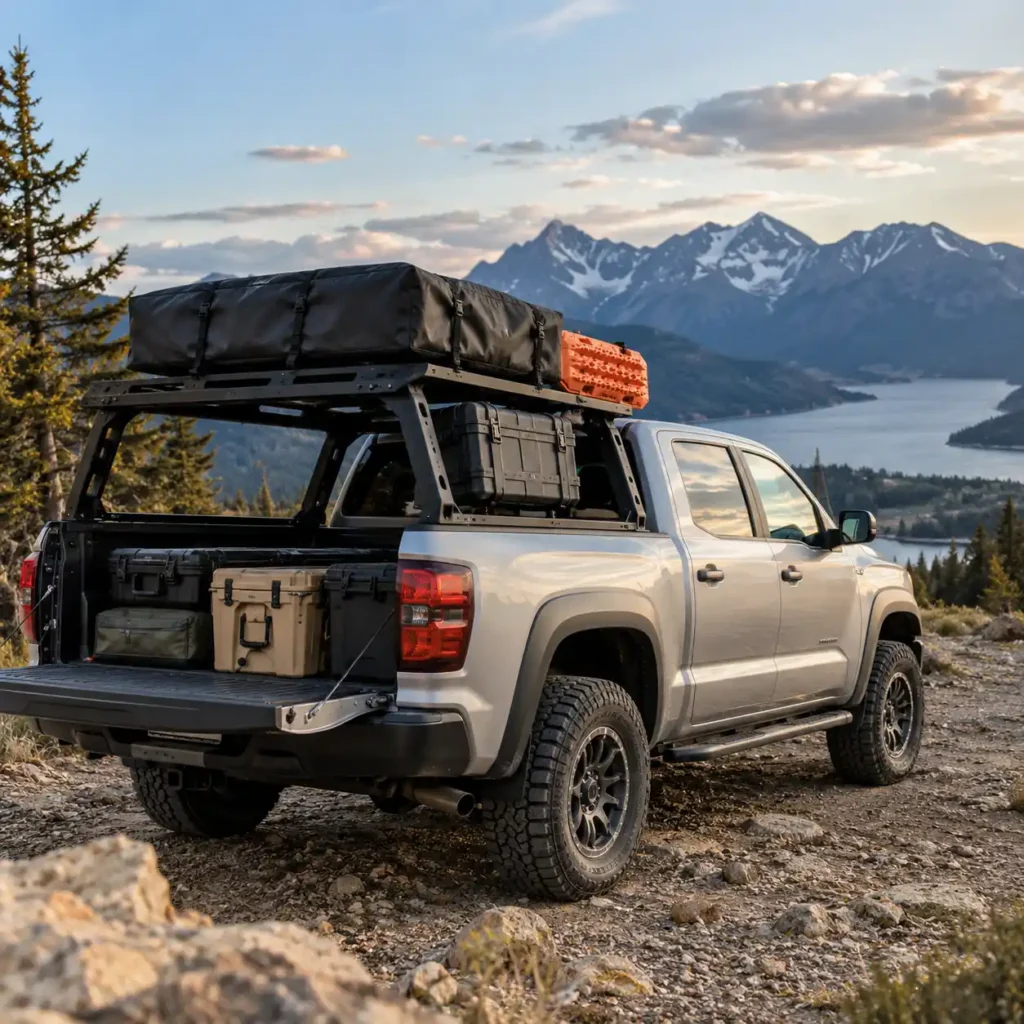
Choosing among truck bed racks for overlanding starts with your truck and the equipment you plan to carry. A rack that works well for a lightweight camping setup may not be suitable for a rooftop tent, heavy recovery gear, or a truck that needs to retain its tonneau cover. Before comparing prices and accessories, check the following factors to narrow your options to systems that fit your vehicle and intended use.
1. Check Your Truck’s Fitment and Bed Dimensions
Start with the truck’s make, model year, bed length, and mounting configuration. Some racks are designed for specific midsize pickups, while others use adjustable frames or vehicle-specific mounting kits. Adjustable width does not automatically make a rack compatible with every truck.
Check whether your bed has factory utility tracks, stake pockets, or another mounting arrangement. Also verify whether the installation requires additional brackets, track kits, or drilling. These details can affect the total cost and determine whether the rack can be installed as intended.
Before ordering, confirm the exact vehicle and bed configuration in the manufacturer’s fit guide. Do not rely solely on a marketplace listing that describes a product as universal.
2. Understand Dynamic and Static Load Ratings
Load capacity is one of the most important specifications when selecting an overlanding rack. However, a single maximum-weight figure can be misleading if it does not identify the loading condition.
Dynamic load capacity refers to the permitted load while the vehicle is moving, subject to the manufacturer’s specified conditions.
Static load capacity refers to the permitted load when the vehicle is stationary under the specified conditions.
The static rating is not permission to carry the same weight while driving. Off-road travel may also have a lower permitted load than normal road use. For example, Yakima lists separate maximum on-road and off-road ratings for its OverHaul HD system, while Hooke Road publishes distinct dynamic and static ratings for its 12.3-inch midsize rack.
Include the rack, mounting hardware, accessories, and cargo when calculating the load carried by the truck. The vehicle’s payload limit and the ratings of the rack, mounts, crossbars, and accessories must all be respected. The lowest applicable limit governs the setup.
3. Decide Whether You Need a Tonneau Cover
If you want to protect equipment from rain, dust, or opportunistic theft, decide how important a tonneau cover is before choosing a rack. Not all systems can be installed alongside a cover, and compatibility with one cover does not guarantee compatibility with another.
There are three practical approaches:
Rack without a tonneau cover: This can suit open-bed setups where easy access to cargo and external accessory mounting are priorities.
Rack designed for a compatible cover: Some systems work with selected hard covers or integrated T-slot rails, sometimes with an additional mounting kit.
Rack and cover selected together: If you need both, verify the exact rack, cover, mounting hardware, and load restrictions as a complete system.
Do not assume that a soft, folding, or retractable cover can support a rack simply because the dimensions appear to fit. The mounting points must be designed for the loads involved. If retaining your cover is essential, choose a manufacturer-approved combination and check whether an adapter is required.
4. Verify Rooftop-Tent and Accessory Compatibility
A rack with a high advertised load capacity is not automatically suitable for every rooftop tent. Compatibility depends on the tent’s mounting requirements, the crossbars and brackets used, the rack’s permitted loads, and the vehicle’s own limits.
Before buying, confirm the following:
The rack manufacturer permits the intended accessory and mounting arrangement.
The crossbars and mounts are suitable for the equipment’s weight and dimensions.
The complete system meets the applicable dynamic requirements while driving and static requirements when stationary.
The installed equipment does not exceed the vehicle’s payload or other relevant limits.
The same principle applies to recovery boards, jacks, fuel or water containers, awnings, and storage cases. Check the accessory’s mounting instructions and secure it using an approved attachment method. External equipment should not obstruct visibility, vehicle lights, or access to essential truck functions.
If a rooftop tent is central to your build, compare the rack with the tent manufacturer’s requirements and our guide to [Best Rooftop Tents for Camping] before making a final decision.
5. Compare Rack Height, Adjustability, and Construction
Rack height affects how equipment sits above the bed, how easily you can load it, and whether it clears other parts of your setup. A lower rack may suit a compact cargo arrangement, while an adjustable-height system can accommodate different loads. The right choice depends on the equipment, the truck’s dimensions, and the overall configuration.
Also consider how much adjustability you genuinely need. A fixed-length rack with adjustable width may be sufficient for a consistent setup. If you frequently carry different types of equipment, adjustable crossbar height or modular mounting points may offer more value.
Steel and aluminum each have trade-offs. Steel systems can provide a substantial frame, but their weight reduces the payload available for cargo. Aluminum can reduce rack weight, although material alone does not determine strength, durability, or suitability for a particular load. Examine the complete system, including its mounting hardware, finish, and manufacturer’s specifications.
Finally, check whether the listed package includes crossbars, locks, mounting brackets, and any required adapters. A rack that appears cheaper initially may cost more once the necessary components are added.
6. Calculate the Total Cost Before Buying
Compare complete, installation-ready systems rather than headline prices alone. Depending on the rack, you may need to purchase crossbars, vehicle-specific mounting kits, tonneau adapters, or accessory mounts separately.
Your total cost may include:
The rack or tower system
Required crossbars
Vehicle-specific brackets or track kits
Tonneau-cover adapters, if supported
Mounts for tents or other accessories
Professional installation, if required
A premium system can be worthwhile if its adjustability and accessory compatibility match your plans. A simpler rack may be better value if you only need a platform for a small selection of equipment. The goal is to pay for capabilities you will actually use, not for features that do not suit your truck or travel style.
The bottom line: Choose a truck bed rack by working outward from your vehicle, load requirements, and equipment. Confirm fitment first, establish the correct load limits, and decide whether a tonneau cover or rooftop tent is essential. Once those requirements are clear, comparing construction, adjustability, accessories, and total cost becomes much more straightforward.
Common Truck Bed Rack Buying Mistakes
Choosing a truck bed rack for overlanding is not just about finding a strong frame at a reasonable price. The wrong system can create fitment problems, limit access to the truck bed, or require additional hardware that was not included in the original budget. Before ordering, watch out for these common mistakes.
1. Assuming a Universal Rack Fits Every Pickup
A rack described as universal may still support only certain bed dimensions, mounting points, or vehicle configurations. Adjustable width does not guarantee compatibility with every model year, bed length, or factory rail system.
How to avoid it: Check the manufacturer’s fitment guide for your exact truck, model year, and bed configuration. Confirm whether you need separate brackets, a track kit, or a different mounting arrangement.
2. Confusing Static and Dynamic Load Capacity
A rack’s highest advertised load figure may refer to a stationary vehicle rather than driving conditions. Treating a static rating as an on-road or off-road limit can lead to an incorrectly configured setup.
How to avoid it: Look for clearly identified dynamic, static, on-road, and off-road ratings where applicable. Follow the manufacturer’s instructions and respect the lowest limit imposed by the rack, mounts, accessories, and vehicle.
3. Buying a Rack Before Checking Tonneau-Cover Compatibility
Some truck bed racks cannot be installed with a tonneau cover, while others require a specific adapter or work only with selected cover models. Discovering this after purchase can mean returning the rack or replacing part of the setup.
How to avoid it: If keeping the cover is important, verify the exact rack-and-cover combination before buying. Include the cost of any approved adapter in your budget, and do not assume that a cover’s rails are designed to support a rack.
4. Assuming Every Rack Can Support a Rooftop Tent
A high load rating does not automatically mean a rack is suitable for a rooftop tent. The tent, crossbars, mounting hardware, rack, and vehicle must all be compatible with the intended installation and loading conditions.
How to avoid it: Check the tent manufacturer’s mounting requirements and obtain confirmation that the complete rack system is suitable. Verify the applicable dynamic rating for travel and static rating when parked. If compatibility is not documented, do not assume the combination is safe.
5. Ignoring the Rack’s Own Weight
A heavy rack reduces the payload remaining for passengers, camping equipment, recovery gear, and other cargo. This can matter when a pickup is already carrying a rooftop tent, drawer system, water, or other heavy accessories.
How to avoid it: Include the rack and all installed hardware when calculating the truck’s total load. Check the vehicle’s payload limit rather than evaluating the rack’s capacity in isolation.
6. Comparing Prices Without Checking What’s Included
Two racks may appear similarly priced while offering very different packages. One may include crossbars and mounting hardware, while another may supply only the towers or frame. Vehicle-specific adapters and accessory mounts can increase the final cost.
How to avoid it: Compare complete setups. Confirm whether crossbars, locks, brackets, tonneau adapters, and other required components are included or sold separately. Factor in installation costs where applicable.
7. Overlooking Installation Requirements
Not every rack installs in the same way. Some use existing bed tracks or mounting points, while others may require additional brackets or drilling. A rack that cannot be installed correctly with the truck’s existing configuration may be unsuitable, even if its dimensions appear to fit.
How to avoid it: Read the installation instructions before ordering. Confirm the mounting method, required tools, any drilling requirements, and whether the supplied hardware is intended for your specific truck.
8. Choosing More Adjustability Than You Need
An adjustable rack can be valuable if you regularly change cargo configurations, but extra adjustment features may add cost and complexity. A simpler system may be sufficient for a consistent setup that carries the same type of equipment on most trips.
How to avoid it: Decide what you plan to carry before paying for additional features. Prioritize the adjustments, mounting points, and accessories that support your actual use rather than choosing the most elaborate design by default.
The bottom line: The best way to avoid a costly rack-buying mistake is to verify compatibility before comparing prices. Confirm your truck’s fitment, understand the load ratings, check tonneau-cover and rooftop-tent requirements, and calculate the cost of every component needed to complete the setup. A rack that meets those requirements is a better investment than one chosen on price or advertised capacity alone.
Truck Bed Rack vs. Roof Rack: Which Is Better for Overlanding?
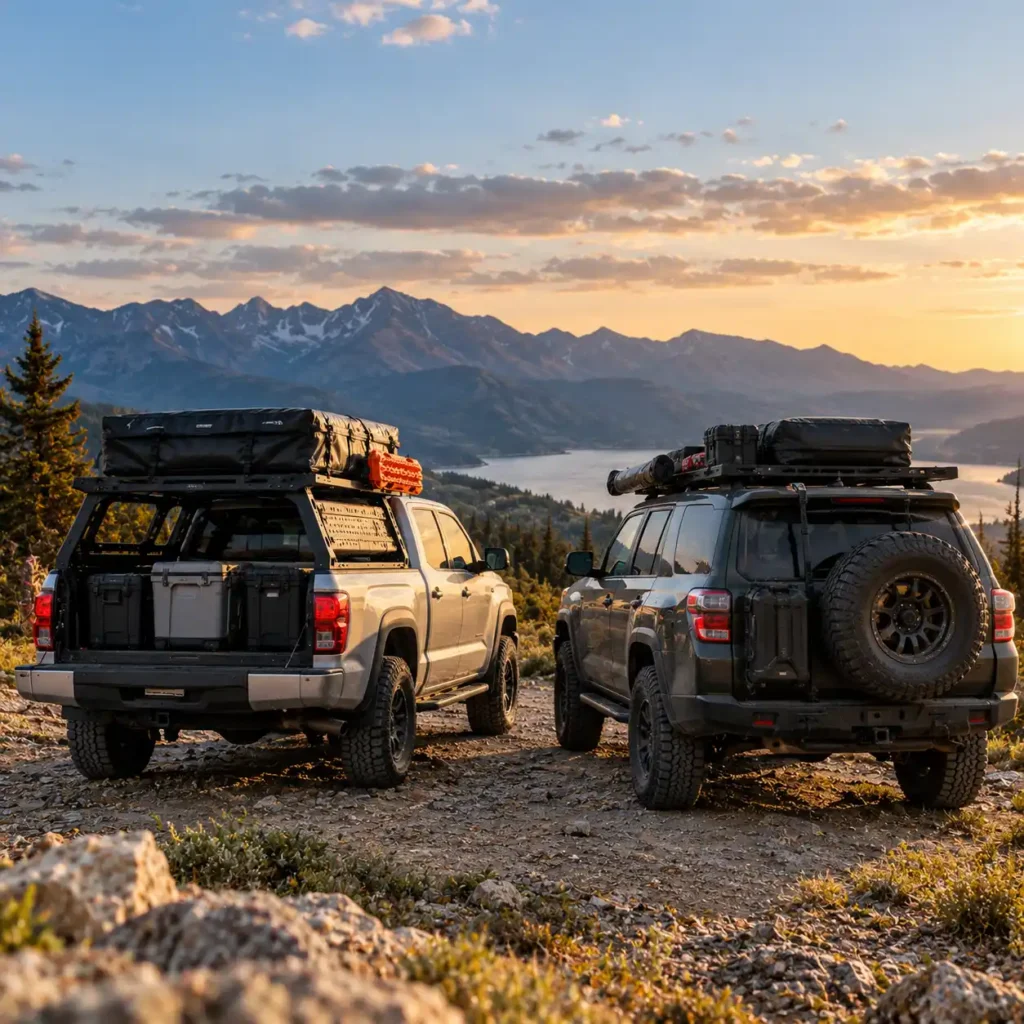
A truck bed rack and a roof rack both create extra space for outdoor equipment, but they serve different purposes. A roof rack carries cargo above the cab, while a truck bed rack mounts over the pickup bed. The right option depends on what you need to carry, how you use your truck, and whether you want to keep the bed open for other gear.
For many pickup-based overlanding builds, a bed rack is a natural starting point. A roof rack can be the better choice when preserving the entire truck bed is more important or when you need a cargo platform on an SUV instead.
Key Differences at a Glance
| Feature | Truck Bed Rack | Roof Rack |
|---|---|---|
| Mounting Location | Above the pickup bed | Above the cab or vehicle roof |
| Vehicle Compatibility | Pickups with a suitable bed and mounting points | Compatible pickups, SUVs, and other vehicles |
| Cargo Access | Equipment can often be reached from the sides of the bed | Tall vehicles may require extra effort to load and unload |
| Bed Storage | Uses space above the bed; access depends on rack design | Leaves the truck bed unobstructed |
| Rooftop Tent Use | Possible with an approved rack and compatible mounting system | Possible with an approved roof rack and compatible mounting system |
| Tonneau-Cover Compatibility | Depends on the specific rack and cover | Usually not a direct concern for the truck bed, although vehicle-specific roof fitment still matters |
| Main Consideration | Bed dimensions, mounting points, cargo layout, and payload | Roof load limits, mounting points, vehicle height, and payload |
When a Truck Bed Rack Makes More Sense
A bed rack is worth considering when you want to organize camping equipment above the pickup bed while keeping the main cargo area available for storage. Depending on the design, it can provide mounting locations for approved accessories such as recovery boards, cargo cases, awnings, or a rooftop tent.
This arrangement can be especially useful when the truck bed already holds drawers, coolers, water containers, or other supplies. The rack creates another mounting level, although the final setup must still allow safe access to the cargo and keep all equipment securely attached.
A bed rack may also suit owners who prefer not to place additional cargo on the cab roof. However, the rack transfers loads through its mounting points into the truck bed structure, so the bed rails and mounting system must be approved for the intended use.
Choose a truck bed rack if: you drive a compatible pickup, want to mount equipment above the bed, and need a more organized truck-based camping setup.
When a Roof Rack Is the Better Choice
A roof rack can be more practical when you want additional cargo capacity without occupying the space above the pickup bed. It is also the natural option for an SUV or another vehicle without a pickup bed.
Roof racks work well for suitable cargo such as lightweight storage bags, recovery boards, and other equipment approved for the specific rack. They can also support rooftop tents when the vehicle, rack, crossbars, and tent are all rated for the intended installation.
The main limitation is the vehicle’s roof-load rating. The permitted load while driving may be substantially different from any stationary rating, and the rack’s own capacity does not override the vehicle manufacturer’s limit. Adding weight high on the vehicle can also affect handling; Ford’s owner guidance, for example, advises keeping roof loads evenly distributed and maintaining a low center of gravity.
Choose a roof rack if: you want to preserve the truck bed for cargo, drive a vehicle without a pickup bed, or need a roof-mounted platform for equipment within the vehicle’s approved load limits.
Can You Use Both a Bed Rack and a Roof Rack?
Yes, provided both systems are compatible with the vehicle and the combined load stays within all applicable limits. Some overlanding setups use a bed rack for one group of equipment and a roof rack for another, but adding a second system is not automatically an improvement.
Two racks add weight, increase the amount of equipment exposed to airflow, and can make loading and access more complicated. Roof-mounted cargo also raises the vehicle’s center of gravity. Even if each rack is individually within its rating, the complete vehicle must remain within its payload and axle limits.
Before combining systems, account for the racks, crossbars, mounts, accessories, cargo, and occupants as applicable. Follow the vehicle and rack manufacturers’ instructions, and avoid adding a second rack simply because mounting space is available.
Final Recommendation: Bed Rack or Roof Rack?
For a pickup-based overlanding build, start by deciding where you want your main cargo to sit. A truck bed rack is a strong candidate when you need an elevated mounting platform above the bed. A roof rack makes more sense when preserving the bed’s full capacity is a priority or when your vehicle does not have a pickup bed.
Neither option is automatically safer or capable of carrying more weight. Fitment, mounting points, dynamic load limits, and the vehicle’s own payload restrictions determine what each setup can safely support. Choose the system that suits your actual equipment and travel plans rather than relying on a single headline load figure.
Frequently Asked Questions About Truck Bed Racks for Overlanding
Do truck bed racks work with tonneau covers?
Some truck bed racks are designed to work with specific tonneau covers, but compatibility depends on the rack’s mounting system and the type of cover. Certain combinations require a dedicated adapter or a cover with integrated mounting rails, while other racks cannot be used with a tonneau cover at all. Check the compatibility information for both products before buying.
How much weight can a truck bed rack hold?
Load capacity varies by rack model, mounting configuration, and vehicle. Some manufacturers publish separate dynamic ratings for driving and static ratings for a stationary vehicle. For example, the Yakima OverHaul HD has manufacturer-listed maximum ratings of 500 lb on-road and 300 lb off-road, while its static rating is 800 lb under the specified conditions. Always follow the limits for your exact setup and the truck’s payload rating.
Can you install a truck bed rack without drilling?
Yes, some truck bed racks use existing bed tracks, stake pockets, or clamp-on mounting points, allowing installation without drilling. Other systems may require drilling or additional vehicle-specific brackets. Check the installation instructions for your truck and rack before purchasing, rather than assuming that every bolt-on system is drill-free.
Can you mount a rooftop tent on a truck bed rack?
A rooftop tent can be mounted on a truck bed rack when the rack, crossbars, mounting hardware, tent, and vehicle are approved for the intended setup. Check both the dynamic load rating for travel and the static rating for stationary use. A rack’s advertised maximum capacity alone does not guarantee compatibility with every rooftop tent.
What is the difference between dynamic and static load capacity?
Dynamic load capacity refers to the permitted load while the vehicle is moving under the manufacturer’s specified conditions. Static load capacity applies when the vehicle is stationary. The static rating is often higher, but it must not be used as the allowable driving load. Off-road limits may also be lower than on-road limits, so check the manufacturer’s ratings for the conditions in which you intend to travel.
Are truck bed racks universal?
No. Even racks marketed as universal may fit only certain bed widths, model years, mounting points, or truck configurations. Some require additional brackets for factory bed tracks or specific vehicle models. Verify the rack’s fit guide using your truck’s make, model year, and bed dimensions before ordering.
Is a truck bed rack better than a roof rack for overlanding?
Neither is universally better. A truck bed rack can provide an elevated platform above a pickup bed while leaving room underneath for suitable cargo. A roof rack can preserve the bed’s storage space and is an option for compatible SUVs as well as pickups. The better choice depends on your vehicle, equipment, mounting requirements, and applicable load limits.
Can You Transfer a Truck Bed Rack to a Different Truck?
Sometimes, but compatibility is not guaranteed. A rack may depend on the truck’s bed width, mounting points, model year, and specific hardware. Even if the new truck is from the same manufacturer, differences in bed dimensions or rail systems can prevent a direct transfer. Check the rack manufacturer’s fit guide for the new vehicle before reusing the system.
Do Truck Bed Racks Increase Wind Noise and Reduce Fuel Economy?
They can. An elevated rack and the equipment mounted on it change airflow around the truck, which may increase wind noise and fuel consumption, particularly at highway speeds. The effect depends on the rack’s height and design, the vehicle, driving speed, and the cargo being carried. Removing the rack or unused accessories when they are not needed may reduce unnecessary aerodynamic drag.
Final Verdict: Which Truck Bed Rack Should You Choose?
The best truck bed rack for overlanding is the one that fits your truck, supports your intended cargo, and works with the rest of your setup. A premium adjustable system may be worth the investment for a versatile build, while a simpler steel rack can make more sense if you need a straightforward platform for camping equipment. Tonneau-cover compatibility, mounting requirements, and verified load ratings should carry more weight in your decision than a headline capacity figure alone.
Here is how the five options in this guide compare by intended use.
Best budget-oriented option: VEVOR Overland Truck Bed Rack. Consider this model if affordability and adjustable dimensions are your priorities. Its advertised 900 lb rating is static, so verify the permitted load while driving before planning a heavy-duty setup. The referenced configuration is not compatible with tonneau covers.
Best premium adjustable system: Yakima OverHaul HD. This is the strongest candidate for buyers who value adjustable height, an established accessory ecosystem, and clearly differentiated on-road and off-road ratings. Remember to budget for the separately sold HD crossbars and any vehicle-specific mounting kit.
Best for adjustable-height cargo handling: Thule Xsporter Pro. Its adjustable load bars are worth considering if you regularly transport long or bulky equipment. Confirm the exact model, vehicle fitment, and permitted load before buying, especially if you intend to carry a rooftop tent.
Best for adjustable accessory mounting on an open bed: Hooke Road Universal Overland HD Truck Bed Rack. This configuration is aimed at buyers who want multiple mounting points for compatible equipment. Check the exact part number and mounting hardware, and choose another system if retaining a tonneau cover is essential.
Best for selected midsize pickups: Hooke Road 12.3-Inch High Overland Bed Rack. Its steel construction, adjustable width, and published dynamic and static ratings make it a candidate for compatible Tacoma, Ranger, and Gladiator configurations. Check the exact model year and bed dimensions, and account for additional brackets where required.
Our Overall Recommendation
If you want a versatile system and can justify the additional cost, start by evaluating the Yakima OverHaul HD. Its adjustable height and published on-road and off-road ratings make it easier to assess against a range of overlanding requirements. It is not automatically the right choice for every truck, however, and the cost of crossbars and mounting hardware should be included in your budget.
For buyers focused on spending less, the VEVOR rack may be worth considering when its fitment and mounting arrangement match the truck. Those who prioritize a specific cargo configuration may find one of the Thule or Hooke Road options more appropriate.
Before placing an order, confirm the manufacturer’s fitment information, distinguish dynamic from static capacity, check tonneau-cover and rooftop-tent compatibility, and calculate the total installed cost. These checks are more useful than choosing a rack solely because it advertises the highest load rating.
The right rack should support the way you actually travel—not force you to compromise on your truck’s storage, load limits, or essential equipment.
Sources
This article uses manufacturer product pages, technical specifications, and installation manuals to verify truck bed rack capacities, dimensions, materials, adjustability, and tonneau-cover compatibility. Specifications may vary by configuration and vehicle, so always confirm the limits and fitment for your exact setup before purchasing or installing a rack.
Yakima OverHaul HD: Official product page | Manufacturer’s installation manual
Thule Xsporter Pro 500XT: Product instruction manual
Hooke Road Universal Ladder Rack (QT.10019): Official product page
Hooke Road 12.3-Inch High Overland Bed Rack: Official product page
Product specifications and compatibility information should be checked against the latest manufacturer documentation before purchase.
About the Author
Anthony — Founder of CampComfortGuide
Anthony founded CampComfortGuide to help campers make informed decisions about outdoor gear through practical advice, product research, and clear comparisons. His focus is on equipment that makes camping more comfortable, organized, and reliable, from essential campsite gear to vehicle-based camping setups.
For this guide to truck bed racks for overlanding, the emphasis is on comparing manufacturer specifications, vehicle fitment requirements, load ratings, mounting options, and tonneau-cover compatibility. The goal is to help readers understand the trade-offs between different rack systems and identify the features that matter most for their own trucks and equipment.
Anthony believes that useful gear recommendations should go beyond product claims. Clear specifications, transparent limitations, and careful comparisons help readers choose equipment that fits their needs rather than paying for features they may never use.
Learn more about our approach to camping gear research on the About CampComfortGuide page.