
Wet boots can make a camping trip uncomfortable, especially after a day of rain, muddy trails, or creek crossings. The best portable boot dryers for camping can help remove moisture between outings, but the right choice depends on where you camp, how wet your footwear gets, and what power sources are available at your campsite.
Not every boot dryer is suitable for off-grid use. Some models connect to a vehicle’s 12V outlet, others require household electricity, and propane-powered designs work without an electrical connection but come with specific outdoor-use and safety requirements. Drying method, portability, heat output, and the condition of your boots also matter when comparing options.
In this guide, we compare five portable boot dryers, including the DryGuy Travel Dry DX, XCMAN Portable Shoe Dryer, PEET Portable Propane Dryer, Everlasting Comfort Forced Air Boot Dryer, and Hedgehog DRIVE. We’ll examine their power requirements, key features, practical limitations, and intended uses to help you choose a model that fits your camping setup.
As an Amazon Associate I earn from qualifying purchases.
Table of Contents
Why You Can Trust This Guide
Choosing a portable boot dryer for camping involves more than comparing advertised drying times or choosing the smallest model. The right option depends on how you camp, which power sources are available, how much moisture your footwear needs to shed, and what the manufacturer recommends for safe use.
For this guide, we compare five specific models: the DryGuy Travel Dry DX, XCMAN Portable Shoe Dryer, PEET Portable Propane Dryer, Everlasting Comfort Forced Air Boot Dryer, and Hedgehog DRIVE. Our assessment focuses on manufacturer-published specifications, product documentation, power requirements, portability, and practical limitations that matter when drying footwear away from home.
We pay particular attention to the difference between 12V vehicle-powered, household-electric, and propane-powered designs. A dryer that works well in a garage may not be suitable for a campsite without electrical hookups. Likewise, a propane-powered model has different operating and safety requirements from an electric unit. We identify these differences rather than treating every portable dryer as an off-grid solution.
We also distinguish documented specifications from manufacturer or retailer claims about drying performance. Actual drying time can vary with the footwear material, how thoroughly the boots are soaked, ambient conditions, and the dryer’s operating setup. Where a specification or package detail cannot be confirmed for the exact model, it should be verified against the current product listing or manufacturer documentation before purchase.
This is a research-based product comparison, not a report of hands-on testing. We do not claim to have personally tested these five dryers or independently measured their drying times. Our recommendations are based on the available product information and how each model’s documented features align with different camping situations.
Our goal is to help you identify a dryer that fits your trip, not simply select a popular product. For broader advice on dealing with damp equipment after wet-weather trips, see our guide to drying camping gear after rain without mold or musty smells.
How We Evaluate and Compare Portable Boot Dryers

Choosing a boot dryer for camping involves more than comparing advertised drying times. A model that works well at home may be impractical at a remote campsite if it needs a household outlet, while a compact unit designed for a vehicle may take longer to dry heavily soaked footwear. We compare the five selected models using their published specifications, manufacturer documentation, stated operating requirements, and practical suitability for different camping setups.
Power Source and Off-Grid Compatibility
Power availability is one of the most important factors for campers. We distinguish between dryers that connect to a vehicle’s 12V outlet, models that require household AC power, and propane-powered options that do not depend on an electrical connection. We also check whether an AC adapter or vehicle adapter is included or whether additional equipment may be needed.
A 12V connection can be useful at a drive-in campsite, but it does not automatically make a dryer suitable for backpacking or use far from a vehicle. Likewise, an electric dryer should not be considered compatible with a portable power station unless its input requirements and the power station’s output have been checked.
Drying Method and Airflow
Boot dryers generally use natural convection, forced-air circulation, or a combination of the two. Convection systems move warmed air through footwear without relying on a fan, while forced-air designs actively circulate air to help remove moisture. Hybrid systems combine elements of both approaches.
We identify the drying method specified for each model and consider how it may suit different situations, from routine overnight drying to footwear that needs attention between days on the trail. The technology alone does not establish which model will dry fastest under every condition.
Drying-Time Claims and Temperature
Advertised drying times are useful reference points, not guarantees. Actual results depend on how wet the boots are, their construction, the thickness of the lining, ambient conditions, and how well air can circulate inside the footwear.
Where a manufacturer publishes a drying-time range or operating temperature, we attribute that information to the manufacturer rather than presenting it as an independently measured result. We also consider temperature controls and the need to follow the footwear maker’s care instructions, particularly for leather, adhesives, waterproof membranes, and insulated liners.
Portability, Weight, and Storage
A camping dryer should fit the way you travel. We consider its dimensions, weight, shape, cable arrangement, and whether the design is easy to pack and store between trips. A compact insert-style dryer may be convenient in a car or gear bag, while a larger freestanding unit may be more appropriate for a powered campsite or a permanent drying area.
Portability is not the same as off-grid capability: a lightweight electric dryer still needs a compatible power source, and a propane model requires space for the unit and its fuel supply.
Footwear Compatibility and Practical Use
We check the types of footwear each product is intended to accommodate, including hiking boots, work boots, shoes, and other compatible items where the manufacturer explicitly identifies them. We avoid assuming that every dryer can handle tall boots, thick insulated liners, gloves, or multiple pairs simply because it is marketed as versatile.
For camping, we also consider whether the design can realistically fit into a travel setup and whether its capacity matches the number of people and pairs of boots that may need drying.
Safety and Operating Limitations
Every model must be considered within its stated operating conditions. We look for relevant restrictions involving power connections, heat exposure, ventilation, fuel, and indoor or outdoor use. Propane-powered equipment requires particular care: a dryer intended for outdoor operation must not be used inside an enclosed tent, vehicle, or other unventilated space.
We do not treat a low advertised temperature, a timer, or a safety feature as permission to ignore the product manual. Users should follow the dryer manufacturer’s instructions and the footwear manufacturer’s care guidance.
Value and Overall Suitability
Finally, we consider what each dryer offers for its intended use: the power source, drying method, portability, stated capacity, operating limitations, and any additional equipment required. Prices and availability can change, so they should be checked against the current listing before purchase.
Our comparisons are based on published product information and research, not hands-on testing of all five dryers. Where specifications are incomplete or conflicting, we avoid presenting uncertain details as established facts.
Quick Answer: Which Portable Boot Dryer Is Best for Camping?
For most car campers, the best choice is an electric dryer that matches the power available during the trip. The PEET Portable Propane Dryer is the option to consider when electrical hookups are unavailable and outdoor operation is practical.
Best Overall for Car Camping: DryGuy Travel Dry DX — A versatile travel option for vehicle-based trips.
Best Compact Fan-and-Heater Design: XCMAN Portable Shoe Dryer — A compact alternative for campers who prefer an electric drying unit.
Best for Campsites Without Electricity: PEET Portable Propane Dryer — Designed for outdoor use with a compatible propane cylinder.
Best Freestanding Option: Everlasting Comfort Forced Air Boot Dryer — Suited to campsites or cabins with adequate electrical power and storage space.
Best Dedicated 12V Option: Hedgehog DRIVE — Designed for use with a compatible vehicle power outlet.
These recommendations are based on published product information, not comparative hands-on testing. For detailed specifications and limitations, see the individual product cards below.
Who Should Consider Portable Boot Dryers for Camping?

A portable boot dryer can be useful when wet footwear is more than a minor inconvenience. After repeated rain, muddy trails, creek crossings, or long days in damp conditions, boots may remain wet long after you return to camp. A suitable dryer can help remove that moisture and make footwear more comfortable to wear again, provided you have a compatible power source and follow the manufacturer’s instructions.
Campers Who Hike on Consecutive Days
If your trip includes several days of hiking, damp boots can become a recurring problem. A portable dryer may help between outings, especially when your footwear gets wet inside from rain, perspiration, or water entering around the collar. Drying time will depend on how saturated the boots are and how much moisture their lining retains.
Car Campers and Road-Trippers
Campers traveling by car have more options because they may be able to use a vehicle’s 12V outlet or an electrical outlet at a powered campsite. Models such as the DryGuy Travel Dry DX and Hedgehog DRIVE are worth considering for vehicle-based trips, but their power requirements differ. Check the exact connection and operating instructions before use.
Campers Visiting Sites Without Electrical Hookups
At remote campsites, the lack of electricity narrows the options considerably. The PEET Portable Propane Dryer is designed for outdoor use with a propane cylinder, so it does not depend on an electrical outlet. However, fuel handling and operating restrictions matter: never run a propane dryer inside a tent, vehicle, or other enclosed space.
Campers Who Regularly Deal With Cold or Damp Conditions
People who camp in wet climates or during colder seasons may benefit from having a reliable way to dry footwear between outings. A dryer can be especially useful when there is little opportunity for boots to air-dry naturally. It should still be treated as one part of a broader gear-care routine, rather than a guarantee that thoroughly soaked boots will be ready in a short time.
Who May Not Need a Boot Dryer?
A dedicated dryer may be unnecessary for occasional fair-weather campers whose footwear rarely becomes wet. Removing the insoles when appropriate, loosening the laces, opening the boots to improve airflow, and allowing them to dry in a sheltered, ventilated place may be sufficient for light dampness.
Whatever method you choose, avoid placing boots directly beside a campfire or using excessive heat. High temperatures can damage leather, adhesives, stitching, and other footwear materials. Follow the boot manufacturer’s care instructions and use a dedicated dryer only within its stated operating limits.
Bottom line: Choose a portable boot dryer if damp footwear is a recurring problem and the model fits your camping setup. If you camp far from electrical power, make the power source and safety requirements your first considerations—not the advertised drying speed.
Quick Summary: Our Top Picks
Choosing the right portable boot dryer for camping comes down to your power source, how much space you have, and how often your footwear gets wet. These five models offer different approaches, from a compact AC/DC travel dryer to a propane-powered option for campsites without electrical hookups. The best choice depends on your setup rather than advertised drying speed alone.
1. DryGuy Travel Dry DX — Best Overall for Car Camping
The DryGuy Travel Dry DX combines convection drying with forced-air circulation in a compact design. Its AC/DC adapter supports use at home or from a compatible 12V vehicle outlet, making it a flexible option for road trips and car-camping weekends. DryGuy lists a weight of approximately 1.25 pounds and a maximum operating temperature of 99°F. It is designed for boots and shoes, not gloves or socks. Remember that a vehicle-powered dryer still needs a suitable power source when you reach camp.
Best for: Car campers who want a compact dryer that supports both household and vehicle power.
2. XCMAN Portable Shoe Dryer — Best for a Compact Fan-and-Heater Design
The XCMAN Portable Shoe Dryer combines an integrated fan and heater in a portable unit intended for footwear such as hiking boots, work boots, rain boots, and shoes. The manufacturer’s product information describes a 12V dryer with an AC converter, allowing use with compatible household power or a suitable 12V source. Before purchasing, verify the exact Amazon package and included adapter, as the power accessories determine how useful it will be away from home.
Best for: Campers who want a compact electric dryer and can confirm access to a compatible power connection.
3. PEET Portable Propane Dryer — Best for Campsites Without Electricity
The PEET Portable Propane Dryer uses thermal convection and a standard 16-ounce propane cylinder, which is sold separately. PEET states that one cylinder provides approximately 60 hours of drying operation, although actual footwear drying time depends on the material and how wet the boots are. The manufacturer says footwear typically dries within a couple of hours. This model is intended for outdoor use only: never operate it inside an enclosed tent, vehicle, or other unventilated space.
Best for: Campers who need a drying option that does not depend on an electrical outlet and can operate it safely outdoors.
4. Everlasting Comfort Forced Air Boot Dryer — 1 Pair — Best for a Freestanding Forced-Air Design
The Everlasting Comfort Forced Air Boot Dryer uses warm-air circulation to help remove moisture from footwear. The version selected for this guide is described as a freestanding design with an adjustable timer of up to 180 minutes. Its larger footprint makes it less convenient to pack than a compact travel dryer, and it requires a suitable electrical outlet. Check the current listing carefully to confirm the exact model, capacity, and included components before ordering.
Best for: Campers staying at powered sites or cabins who prefer a freestanding dryer over a small travel unit.
5. Hedgehog DRIVE Portable Shoe Dryer — Best for Dedicated 12V Vehicle Use
The Hedgehog DRIVE is a compact shoe dryer designed to run from a 12V vehicle power source. The manufacturer lists an 80W rating, a single temperature setting of 105°F, and a claimed drying time of 30–45 minutes. Those figures are manufacturer specifications, not independently verified results, and actual drying time will vary with footwear construction and moisture levels. Confirm the package contents and power requirements before purchase; do not assume that an AC adapter is included.
Best for: Car campers who want a compact 12V dryer and can use it with a compatible vehicle outlet.
Before buying, check the current product listing, exact model number, included adapters, and operating instructions. A dryer advertised for travel may still be unsuitable for a remote campsite without the right power source. For propane equipment, follow the manufacturer’s outdoor-use restrictions. For every model, follow the care instructions for your footwear and avoid excessive heat.
Comparison Table: Portable Boot Dryers at a Glance
| Boot Dryer | Best For | Power Source | Main Trade-Off |
|---|---|---|---|
| DryGuy Travel Dry DX | Car camping and road trips | AC or compatible 12V DC, depending on supplied adapter | Requires a compatible electrical source |
| XCMAN Portable Shoe Dryer | Compact electric drying | Confirm the exact model's supported connections | Verify package contents and adapters |
| PEET Portable Propane Dryer | Remote outdoor campsites | Compatible propane cylinder | Fuel handling and outdoor-only operation |
| Everlasting Comfort Forced Air Boot Dryer – 1 Pair | Powered campsites and cabins | Household electrical power, subject to model specifications | Larger freestanding design |
| Hedgehog DRIVE Portable Shoe Dryer | Vehicle-based camping | Compatible 12V DC outlet | Depends on vehicle power |
Specifications and product features are based on published product information, not comparative hands-on testing. Confirm the exact model and its operating requirements before purchase.
5 Best Portable Boot Dryers for Camping in 2026
The best portable boot dryers for camping can help remove moisture from hiking boots after rainy trails, muddy campsites, and wet-weather adventures. We compare five options by power source, drying method, portability, key features, and safety requirements to help you choose the right boot dryer for your camping setup.
1. DryGuy Travel Dry DX
Award: Best Overall for Car Camping

The DryGuy Travel Dry DX is a compact portable boot dryer designed for campers who need to dry damp footwear without carrying a full-size drying system. Its hybrid design combines convection heat with forced-air circulation, while the included AC/DC adapter supports use with household electricity or a compatible 12V vehicle outlet. This makes it particularly practical for car camping, road trips, and outdoor weekends when you have access to a vehicle.
Unlike larger freestanding dryers, the Travel Dry DX is designed to fit inside most boots and shoes for drying and convenient storage. DryGuy specifies a maximum temperature of approximately 99°F, providing gentle warmth rather than the higher heat associated with some forced-air dryers. The manufacturer also states that the unit is intended for footwear, not gloves or socks.
Its main limitation is power dependence. Although the dryer can operate from a vehicle outlet, it is not a standalone solution for backpacking or remote campsites without a compatible power source. DryGuy’s published drying-time information should also be treated as a guideline: heavily soaked hiking boots may require longer than lightly damp footwear.
Overview
The DryGuy Travel Dry DX is designed to remove moisture from boots and shoes through a combination of gentle heat and moving air. A small integrated fan draws air across the heating elements and directs warm airflow into the toe area, helping moisture escape from the interior of the footwear.
This hybrid approach makes the unit different from simple convection dryers, which rely primarily on warm air rising naturally through the boot. Forced airflow helps circulate air through the footwear, while the relatively low operating temperature is intended to provide gradual drying rather than aggressive heating.
For camping, its main advantage is flexibility between locations. You can use the AC adapter where household power is available or the 12V DC adapter in a compatible vehicle. That can be useful after a wet hike when you are staying at a powered campsite, traveling between destinations, or drying footwear at home before the next trip.
The compact design also makes storage easier than with a larger freestanding dryer. However, its small size does not mean it can dry wet boots without an external power supply. Campers staying at primitive sites should consider whether they have a suitable 12V source or another compatible power arrangement before choosing this model.
DryGuy lists the maximum temperature at approximately 99°F and provides a one-year manufacturer warranty. The manufacturer describes the unit as suitable for many footwear materials, but the care instructions for your particular boots should always take priority. Waterproof membranes, leather, adhesives, and specialized liners can have their own care requirements.
Key Features
Hybrid Convection and Forced-Air Drying
The Travel Dry DX combines natural convection with a fan that moves warm air into the footwear. This design is intended to improve airflow compared with convection-only systems. Actual drying performance depends on the amount of moisture, boot construction, ambient conditions, and how freely air can circulate inside the footwear.
Dual AC/DC Power Compatibility
The supplied AC/DC adapter supports operation from a 120V AC household outlet or a compatible 12V DC vehicle outlet. This is one of the model’s most useful features for car campers because it allows the same dryer to be used at home and on the road. It does not, however, eliminate the need for a suitable power connection at camp.
Gentle Heat at Approximately 99°F
DryGuy specifies a maximum operating temperature of approximately 99°F (37°C). The unit is designed to dry footwear with relatively gentle heat rather than high-temperature heating. This can be useful when caring for boots with sensitive components, but it should not be interpreted as a guarantee that every material is safe under every drying condition.
Compact Design for Travel and Storage
The dryer is designed to fit inside most boots and shoes, making it easier to pack than a full-size freestanding unit. Its portable form is useful for road trips, camping weekends, hiking, and other activities where luggage space is limited.
Designed for Footwear
DryGuy identifies the Travel Dry DX for drying boots and shoes and specifically states that it is not intended for gloves or socks. Buyers who need to dry multiple types of outdoor equipment should not assume that this model can safely or effectively handle every garment.
One-Year Manufacturer Warranty
DryGuy lists a one-year warranty for the Travel Dry DX. Before purchasing, review the current warranty terms and confirm how coverage applies to the seller, purchase location, and intended use.
Technical Specifications
| Specification | Details |
|---|---|
| Brand | DryGuy |
| Product | Travel Dry DX Portable Boot and Shoe Dryer |
| Model | Travel Dry DX |
| Amazon ASIN | B010A5JBPO |
| Dryer Type | Portable electric boot and shoe dryer |
| Drying Method | Hybrid convection and forced-air circulation |
| Power Source | 120V AC household outlet or 12V DC vehicle outlet |
| Power Adapter | AC/DC adapter; verify exact package contents |
| Maximum Temperature | Approximately 99°F (37°C), according to the manufacturer |
| Advertised Drying Time | Approximately 2–5 hours, according to REI; actual time varies |
| Weight | Manufacturer lists approximately 1.25 lb; retailer listings differ |
| Dimensions | Manufacturer and retailer measurements differ; verify the exact product listing |
| Intended Use | Boots and shoes |
| Gloves and Socks | Not recommended by the manufacturer |
| Warranty | One year, according to DryGuy |
| Product Link | View the DryGuy Travel Dry DX on Amazon |
Specification note: DryGuy and retailer listings show differing dimensions and weight measurements for the Travel Dry DX. Confirm the current listing and exact package before purchase. The advertised drying time is a reference, not a guarantee that heavily soaked boots will be dry within five hours.
Pros and Cons
Pros
Supports both 120V AC household power and 12V DC vehicle power.
Combines convection and forced-air circulation.
Compact design fits inside most boots and shoes for convenient storage.
Uses a relatively low maximum operating temperature of approximately 99°F.
Suitable for car camping, road trips, and other vehicle-based outdoor activities.
Can be used at home between camping trips.
Includes a one-year manufacturer warranty, according to DryGuy.
Cons
Requires a compatible electrical power source.
Not a standalone option for remote campsites without electricity or a suitable vehicle connection.
Not intended for drying gloves or socks.
Drying time varies with moisture levels, footwear materials, and environmental conditions.
Published dimensions and weight differ across sources, so buyers should verify the current specifications.
The compact design is intended for footwear rather than large-volume drying of several pairs at once.
Who Should Consider This Dryer?
The DryGuy Travel Dry DX is worth considering for car campers, road-trippers, and hikers who regularly return with damp boots and have access to a suitable electrical connection. Its dual AC/DC power compatibility is especially useful for people who want one compact dryer for both home and vehicle use.
It may be a good fit for weekend camping trips, campground stays, and travel itineraries that combine hiking with driving between locations. Its compact form also makes sense for campers who want to minimize the amount of bulky equipment they carry.
This model is less suitable for backpackers who need a dryer that operates without external power or for campers who routinely need to dry several pairs of heavily soaked boots at once. If your campsite has no electrical hookup and you cannot use a compatible vehicle outlet, consider a different drying method or a model designed for a suitable off-grid setup.
What to Verify Before Buying
Confirm that the product is the DryGuy Travel Dry DX, not the similarly named DryGuy Travel Dry model.
Verify that the package includes the AC/DC adapter needed for your intended power source.
Check that your vehicle provides a compatible 12V DC connection if you plan to dry boots at camp.
Confirm the current dimensions and weight if packing space is important.
Treat the advertised 2–5-hour drying time as an estimate rather than a guaranteed result.
Check whether your footwear manufacturer permits warm-air drying and follow its material-care instructions.
Do not assume the dryer is suitable for gloves, socks, or other garments.
Review the current Amazon listing, seller, package contents, return policy, and warranty terms before ordering.
Our assessment: The DryGuy Travel Dry DX is a strong candidate for car camping because it combines a compact design, hybrid airflow, and AC/DC power compatibility. Its main advantage is flexibility between home and vehicle use, rather than independence from electricity. The key trade-offs are its reliance on a suitable power source and the variable time required to dry heavily soaked footwear. This assessment is based on published specifications and product documentation, not hands-on testing.
Related Guide: An RV camera is just one part of a practical vehicle-based camping setup. Explore our vehicle camping gear guide to see how storage, roof systems, and power equipment fit into a more complete setup.
2. XCMAN Portable Shoe Dryer (SD-3)
Award: Best Compact Dual-Power Option

| The XCMAN Portable Shoe Dryer SD-3 is a compact electric dryer designed for campers who want to dry damp hiking boots, work boots, rain boots, and other compatible footwear at home or on the road. Its design combines a heating element with warm-air circulation, while the supplied AC/DC converter allows it to connect to a household outlet or a compatible 12V vehicle power socket. This dual-power arrangement makes it a practical option for car camping and road trips where a suitable electrical connection is available. |
Measuring approximately 9.8 × 4.5 × 2.9 inches, the unit is relatively compact compared with larger freestanding boot dryers. XCMAN describes the dryer as quiet and suitable for outdoor activities such as camping, hiking, hunting, and skiing. The manufacturer also identifies gloves and ski-boot liners among the compatible items, although suitability depends on the item’s construction and the manufacturer’s care instructions.
The main consideration is that the SD-3 still depends on electricity. Its vehicle connection can be useful at a drive-in campsite, but it does not provide independent off-grid operation. Campers should also pay attention to its published temperature range: XCMAN specifies warm-air temperatures of approximately 105–140°F under free-flow conditions, with temperatures potentially reaching 145°F when the airflow is restricted inside footwear. That makes following the dryer and footwear care instructions particularly important.
Overview
The XCMAN SD-3 is designed to dry footwear by circulating warm air through the interior. Its heating element warms the air, which then moves naturally through the footwear during operation. Although the product description mentions an integrated fan and heater, XCMAN also describes its drying process as warm thermal convection. It is therefore more accurate to distinguish it from models whose product documentation explicitly emphasizes forced-air circulation as the primary drying method.
For campers, one of the model’s main attractions is its dual-power arrangement. The included converter is described as supporting household AC power from 100–240V and a 12V DC vehicle connection. This makes the dryer useful for trips where you may dry footwear at home before departure, use it during a vehicle-based trip, or return to a powered campsite after a wet day outdoors.
The compact dimensions also make the SD-3 easier to pack than a larger freestanding unit. It may be useful for campers who want a dedicated dryer without allocating much storage space to equipment. However, compact dimensions alone do not establish how quickly the unit can dry heavily saturated boots. Thick insulation, waterproof membranes, removable liners, ambient temperature, and the amount of moisture retained inside the footwear can all affect drying time.
XCMAN describes the dryer as suitable for a range of footwear and outdoor gear. Nevertheless, buyers should not interpret broad compatibility claims as permission to apply heat to every material. Before drying leather boots, footwear with glued components, or technical hiking boots with waterproof membranes, check the footwear manufacturer’s instructions and monitor the drying process as recommended.
Key Features
Dual AC/DC Power Compatibility
The XCMAN SD-3 is supplied with an adapter described as converting 100–240V AC household power to 12V DC. The product is also designed for use with a compatible 12V vehicle outlet. This gives car campers more flexibility than a dryer that only connects to a household outlet. Before purchasing, confirm that the exact package includes the necessary adapter and that your intended power source matches the product’s requirements.
Integrated Heating and Warm-Air Circulation
The dryer combines a heating element with a design intended to distribute warm air inside footwear. XCMAN describes the process as thermal convection, in which warm air moves through the item being dried. This can help remove residual moisture, but actual performance depends on footwear construction, moisture levels, ambient conditions, and airflow through the boot.
Published Operating Temperature Range
XCMAN specifies a free-flow air temperature of approximately 105–140°F (about 41–60°C), with temperatures potentially reaching 145°F (about 63°C) when the airflow is restricted inside footwear. These are manufacturer-stated figures, not independent measurements. Because the temperature may rise when airflow is restricted, users should follow the operating instructions and avoid assuming that all footwear materials can tolerate the same heat exposure.
Compact Travel-Friendly Dimensions
The manufacturer’s published dimensions are approximately 9.8 × 4.5 × 2.9 inches. This relatively compact form can make the dryer easier to pack for vehicle-based camping, hiking trips, and travel. Its actual storage convenience will depend on the available space in your gear bag and the adapters you need to carry.
Quiet Operation
XCMAN promotes the SD-3 as an ultra-quiet dryer. This may be useful when drying footwear in a cabin or other accommodation where noise matters. However, the manufacturer does not provide a verified decibel measurement in the specifications reviewed, so a precise noise level cannot be stated.
Compatibility With Selected Footwear and Gear
XCMAN lists winter boots, work boots, rain boots, tennis shoes, ski-boot liners, gloves, and other items among its intended uses. Compatibility does not mean every item should be exposed to heat for the same duration. Always follow the product instructions and the care guidance for the footwear or gear being dried.
Technical Specifications
| Specification | Details |
|---|---|
| Brand | XCMAN |
| Product | Portable Shoe Dryer |
| Model | SD-3 |
| Manufacturer Part Number | SD-3-USA-1, according to product listing information |
| Amazon ASIN | B0BLNL2X1F |
| Dryer Type | Compact electric footwear dryer |
| Drying Method | Warm-air circulation and thermal convection, according to the manufacturer |
| Power Source | 100–240V AC through the supplied converter or compatible 12V DC vehicle power |
| Adapter | AC/DC converter described by the manufacturer; confirm package contents |
| Free-Flow Air Temperature | Approximately 105–140°F (41–60°C), according to XCMAN |
| Temperature With Restricted Airflow | May reach approximately 145°F (63°C), according to XCMAN |
| Dimensions | Approximately 9.8 × 4.5 × 2.9 in |
| Listed Weight | Approximately 0.68 kg (1.5 lb) in product listing information |
| Material | Plastic, according to product listing information |
| Intended Uses | Selected boots, shoes, ski-boot liners, gloves, and other compatible items |
| Warranty | Confirm current manufacturer terms |
| Product Link | View the XCMAN Portable Shoe Dryer on Amazon |
Specification note: These details refer to the XCMAN SD-3 associated with ASIN B0BLNL2X1F. Temperature figures are manufacturer-stated values and may vary with airflow conditions. Confirm the exact model, power adapter, and included components on the current Amazon listing before ordering.
Pros and Cons
Pros
Supports household AC power through the supplied converter and a compatible 12V vehicle connection.
Compact dimensions make it easier to pack than a large freestanding dryer.
Designed for several types of footwear, including hiking boots, work boots, rain boots, and shoes.
Manufacturer lists ski-boot liners and gloves among compatible items.
Published operating temperature information helps buyers understand the intended drying conditions.
Marketed for quiet operation, which may be useful in shared accommodation.
Can be used at home or during vehicle-based trips when a compatible power source is available.
Cons
Requires electricity and is not an independent off-grid drying solution.
The manufacturer does not provide a verified drying-time guarantee for heavily soaked hiking boots in the documentation reviewed.
Warm-air temperatures can reach approximately 145°F under restricted airflow conditions, so material compatibility and operating instructions matter.
A precise noise level is not documented in the sources reviewed.
Adapter and package contents should be verified against the exact listing.
Compact size does not establish that the dryer will handle every boot shape or dry multiple pairs simultaneously.
Who Should Consider This Dryer?
The XCMAN SD-3 is worth considering for car campers, road-trippers, hikers, and outdoor enthusiasts who want a compact dryer that can be used with household or compatible 12V vehicle power. It may be especially convenient for people who need one device for drying footwear at home and during vehicle-based trips.
Its compact dimensions may also appeal to campers who prefer not to carry a larger freestanding dryer. The manufacturer’s stated compatibility with selected boots, shoes, ski-boot liners, and gloves gives it potential uses beyond hiking footwear, provided each item is suitable for the dryer’s operating conditions.
This model is less suitable for backpackers or campers who need a dryer that works without an electrical source. It may also be a poor fit for footwear whose manufacturer prohibits warm-air drying or for users who need a verified drying-time guarantee for heavily saturated boots. In those situations, a different drying method or a model better matched to the intended use may be more appropriate.
What to Verify Before Buying
Confirm that the listing is for the XCMAN SD-3, associated with ASIN B0BLNL2X1F.
Verify that the supplied AC/DC converter is included and supports your intended power source.
Check the requirements of your vehicle’s 12V outlet before planning to use the dryer at camp.
Review the published temperature range and confirm that it is appropriate for your footwear.
Check the footwear manufacturer’s care instructions, particularly for leather, glued components, waterproof membranes, and insulated liners.
Do not assume the advertised temperature guarantees a particular drying time.
Confirm the listed dimensions and weight if storage space is limited.
Review the current Amazon listing for package contents, seller, return policy, and any stated warranty.
Our assessment: The XCMAN SD-3 is a practical compact option for campers who want a dryer that can connect to household power or a compatible 12V vehicle outlet. Its main strengths are its travel-friendly dimensions and dual-power arrangement. The key trade-offs are its dependence on electricity and the need to account for the manufacturer’s stated temperature range when drying technical footwear. This assessment is based on published product specifications and documentation, not hands-on testing.
Related Guide: Properly drying footwear is important, but how you store your equipment between trips matters too. Read our guide to storing camping gear to prevent moisture damage and mildew for practical advice on keeping outdoor equipment clean, dry, and ready for your next adventure.
3. PEET Portable Propane Dryer
Award: Best for Campsites Without Electricity

The PEET Portable Propane Dryer is designed for campers who need to dry wet footwear where electrical outlets are unavailable. Instead of relying on household electricity or a vehicle power connection, it uses a standard 16-ounce propane cylinder to warm air that rises naturally through the footwear. This makes it a distinctive option for remote campsites, hunting trips, and other outdoor stays where access to electrical power is limited.
The dryer uses thermal convection rather than a powered fan. PEET states that one 16-ounce propane cylinder provides approximately 60 hours of drying operation and that footwear typically dries within a couple of hours, depending on its material and moisture level. The propane cylinder is not included, so fuel must be purchased and transported separately.
Its main advantage is independence from electrical power, but that comes with important limitations. The unit is relatively tall compared with compact electric travel dryers, and propane handling requires particular care. PEET explicitly states that this dryer is for outdoor use only. It must never be operated inside an enclosed tent, vehicle, cabin, or other enclosed space.
Overview
The PEET Portable Propane Dryer is built around a simple principle: gently warmed air rises through dedicated air chambers and ports into the footwear, helping moisture escape through thermal convection. Unlike the DryGuy Travel Dry DX and XCMAN SD-3, this model does not depend on an electrical connection to operate.
For camping, that difference can be decisive. At a remote site without a powered hookup, a household-powered dryer may be unusable unless you have a compatible alternative power source. The PEET propane model avoids that electrical requirement, provided you have the correct fuel cylinder and can operate the unit under the manufacturer’s specified outdoor conditions.
The dryer is intended for boots and shoes, including hiking and hunting footwear. PEET also identifies several footwear materials as compatible, including leather, rubber, vinyl, neoprene, canvas, and synthetic materials. However, the footwear manufacturer’s own care instructions should still take priority, particularly for boots with specialized waterproof membranes, glued components, or insulated liners.
PEET lists the unit at approximately 2.5 pounds without the propane cylinder and gives dimensions of 9.5 × 9.5 × 22 inches. This is portable in the sense that it can be transported to a campsite, but it is considerably taller than an insert-style electric dryer. You will also need to account for the separate fuel cylinder and follow the applicable rules for transporting and storing propane.
The most important operating restriction is straightforward: this is an outdoor appliance. Do not use it inside an enclosed tent or vehicle, even if you believe there is some ventilation. Follow the manufacturer’s instructions for cylinder connection, placement, ignition, shutdown, and fuel handling.
Key Features
Operates Without an Electrical Outlet
The PEET Portable Propane Dryer uses propane rather than household AC or vehicle DC power. This makes it an option for campsites without electrical hookups, provided the user has the specified fuel cylinder and a safe outdoor operating location. It is not a battery-powered appliance, and its portability depends partly on transporting the fuel supply.
Thermal Convection Without a Powered Fan
The dryer warms air that rises through its air chambers and drying ports into the footwear. PEET describes this as thermal convection. Because the system does not rely on an electric fan to push air through the boots, its operation differs from forced-air models. The trade-off is that drying time depends on the footwear, moisture level, ambient conditions, and natural airflow through the item.
Approximately 60 Hours of Operation per 16-Ounce Cylinder
PEET states that a standard 16-ounce propane cylinder provides approximately 60 hours of drying operation. This is a manufacturer estimate rather than an independently measured runtime under every condition. Actual operation may vary, and the cylinder is sold separately. Check the product instructions for approved fuel and connection requirements.
Manufacturer-Stated Drying Time of a Couple of Hours
PEET says footwear typically dries within a couple of hours, depending on material and saturation. This is a useful reference point, not a guarantee for heavily soaked hiking boots. Thick insulation, waterproof membranes, wet liners, low ambient temperatures, and the amount of retained moisture can all affect the time required.
Designed for Selected Footwear Materials
PEET lists leather, rubber, vinyl, neoprene, canvas, synthetics, and other materials as suitable for this dryer. This broad compatibility claim may be useful for campers who use different types of outdoor footwear. Nevertheless, always check the instructions for your particular boots and avoid assuming that all constructions can tolerate the same drying conditions.
Portable Freestanding Construction
The unit weighs approximately 2.5 pounds without its fuel cylinder and measures about 9.5 × 9.5 × 22 inches. It can be transported to an outdoor campsite, but its height and the need to carry fuel make it less compact than small electric inserts. Plan for a stable, level operating surface and follow PEET’s placement instructions.
Outdoor-Use Design and Manufacturer Warranty
PEET explicitly states that the propane dryer is intended for outdoor use only. The manufacturer also lists a one-year warranty. Review the current warranty terms and product instructions before use, particularly the sections covering fuel connection, ignition, shutdown, and safe operation.
Technical Specifications
| Specification | Details |
|---|---|
| Brand | PEET |
| Product | Portable Propane Shoe and Boot Dryer |
| Model Name | Propane PEET |
| Manufacturer Part Number | P2000-B, according to available product listing information |
| Amazon ASIN | B001M4ITWY |
| Dryer Type | Portable propane-powered footwear dryer |
| Drying Method | Thermal convection |
| Power Source | Propane; no electrical connection required |
| Fuel | Standard 16-ounce propane cylinder |
| Propane Cylinder Included | No; sold separately |
| Advertised Runtime | Approximately 60 hours per 16-ounce cylinder, according to PEET |
| Advertised Drying Time | Typically a couple of hours, depending on footwear material and saturation |
| Weight | Approximately 2.5 lb without the propane cylinder |
| Dimensions | Approximately 9.5 × 9.5 × 22 in |
| Intended Use | Hiking boots, hunting footwear, shoes, and compatible boots |
| Operating Location | Outdoor use only |
| Warranty | One year, according to PEET |
| Product Link | View the PEET Portable Propane Dryer on Amazon |
Specification note: Runtime and drying-time figures are manufacturer claims, not guarantees. The propane cylinder is sold separately. Confirm the exact model, current package contents, fuel requirements, and instructions before purchasing. The manufacturer expressly restricts this dryer to outdoor use.
Pros and Cons
Pros
Operates without household electricity or a vehicle power outlet.
Designed for remote campsites and other outdoor locations without electrical hookups.
Uses thermal convection rather than an electrically powered fan.
PEET states that one 16-ounce propane cylinder provides approximately 60 hours of operation.
Manufacturer identifies several footwear materials as compatible.
Portable freestanding design can be transported to an appropriate outdoor drying location.
Includes a one-year manufacturer warranty, according to PEET.
Cons
Requires a separate 16-ounce propane cylinder, which is not included.
Must be used outdoors only; it is unsuitable for operation inside an enclosed tent or vehicle.
The 22-inch height makes it less compact than small insert-style dryers.
Fuel must be transported and handled according to the manufacturer’s instructions and applicable rules.
Drying time varies with footwear material, saturation, and ambient conditions.
Not suitable for campers who prefer an electric dryer or cannot safely manage propane equipment.
Who Should Consider This Dryer?
The PEET Portable Propane Dryer is worth considering for campers who regularly stay at remote sites without electrical hookups. It may be especially relevant for hunting camps, vehicle-based wilderness trips, and outdoor stays where wet footwear needs attention but household or vehicle power is unavailable.
It can also suit campers who prefer a dedicated outdoor drying appliance and are comfortable transporting a separate propane cylinder. The advertised runtime may be useful when planning several days of use, although actual fuel consumption depends on operating conditions and the manufacturer’s instructions.
This model is not the right choice for backpackers who prioritize minimal weight and volume, campers who cannot transport propane safely, or anyone who needs to dry footwear inside an enclosed shelter. If your campsite has electrical power, a compact electric model may be easier to manage. If you choose the propane dryer, its outdoor-only restriction must be treated as a non-negotiable safety requirement.
What to Verify Before Buying
Confirm that the product is the PEET Portable Propane Dryer, associated with ASIN B001M4ITWY.
Check that the current listing matches the intended model and package.
Remember that the standard 16-ounce propane cylinder is sold separately.
Verify the manufacturer’s approved fuel and connection requirements.
Read the instructions for cylinder connection, ignition, shutdown, placement, and fuel handling before use.
Ensure that you have a suitable outdoor location and stable, level surface for operation.
Never operate the dryer inside an enclosed tent, vehicle, cabin, or other enclosed space.
Check whether your footwear manufacturer permits the intended drying method.
Treat the advertised runtime and drying time as estimates rather than guaranteed results.
Review the current listing, seller, return policy, and one-year warranty terms before purchasing.
Our assessment: The PEET Portable Propane Dryer fills a specific role in this comparison: it provides a way to dry footwear without relying on electrical power. That makes it a candidate for remote campsites where conventional electric dryers are impractical. Its principal trade-offs are the separate fuel requirement, larger freestanding form, and strict outdoor-use limitation. It is best evaluated as an off-grid outdoor option, not as a general-purpose indoor dryer. This assessment is based on manufacturer documentation and published specifications, not hands-on testing.
Related Guide: Keeping footwear dry is only one part of managing damp equipment during a wet-weather trip. Read our guide to protecting clothing and camping essentials from rain and splashes for practical advice on keeping other gear better protected.
4. Everlasting Comfort Forced Air Boot Dryer – 1 Pair
Award: Best for a Powered Campsite

The Everlasting Comfort Forced Air Boot Dryer is a freestanding electric option for campers who stay at established campgrounds with electrical hookups or use a suitable portable power station. Its warm-air circulation system is designed to move air through footwear, helping remove moisture after wet hikes, rainy days, and muddy campsite conditions.
Unlike compact dryers that fit inside individual shoes, this model has a larger, upright design intended for regular use. That can make it a practical choice for car campers who have enough room to transport it and want to dry hiking boots between outings. However, its size and dependence on electrical power make it less suitable for minimalist backpacking or remote camps without a reliable power source.
Everlasting Comfort describes its boot dryer as a plug-in appliance that circulates warm air to help dry footwear and reduce moisture-related odors. The exact Amazon listing identifies this version as the Forced Air Boot Dryer – 1 Pair. Before purchasing, check the current listing carefully: some descriptions associated with boot dryers can refer to different configurations, and the capacity, timer settings, and included components should match the specific model being sold.
Overview
The Everlasting Comfort Forced Air Boot Dryer is best viewed as a campsite appliance rather than a lightweight travel accessory. Its freestanding frame gives it a dedicated place to stand while drying footwear, while its forced-air design is intended to move warm air through the boot interior instead of relying solely on passive convection.
For camping, the main consideration is access to electricity. This model is most practical at a powered campsite, in an RV with a suitable electrical connection, or at a base camp equipped with a power station that can support the appliance’s electrical demand. It should not be treated as a direct 12V vehicle dryer unless the exact model documentation confirms that capability.
Its larger footprint and reported weight of approximately 7.34 pounds also matter when packing. For a family car-camping trip, that may be an acceptable trade-off for a freestanding design. For backpackers or campers trying to minimize equipment weight, a smaller travel dryer is likely a more practical choice.
Key Features
1. Forced Warm-Air Circulation
The dryer uses warm-air circulation to help remove moisture from boots and shoes. Moving air through the footwear can be useful after wet-weather activities, although actual drying time depends on how saturated the boots are, their construction, and the surrounding conditions.
2. Freestanding Design
The upright construction provides a dedicated drying station rather than requiring a small unit to be placed separately inside each shoe. This may suit a vehicle-based camping setup where storage space and a stable surface are available.
3. Intended for Everyday Footwear
The manufacturer describes its boot dryer for use with work boots, winter boots, hiking boots, athletic shoes, and other footwear. For technical hiking boots, always follow the footwear manufacturer’s care instructions, especially when the boots contain leather, adhesives, or waterproof membranes.
4. Adjustable Timer — Verify the Exact Version
Some product descriptions associated with this model report a timer adjustable up to 180 minutes. Confirm that the timer and its full range are included on the exact Amazon listing you intend to purchase rather than relying on specifications from a different version.
5. Larger Footprint for a Dedicated Drying Area
Reported dimensions are approximately 12.2 × 8.66 × 16.54 inches. This is a substantial appliance compared with compact travel dryers, so it is better suited to a car-camping gear area than to a small backpack.
6. Two-Year Warranty Listed
The product information lists a two-year warranty, and Everlasting Comfort’s warranty page identifies boot dryers among the products covered by its two-year electronics warranty. Review the applicable registration requirements and terms before buying.
Technical Specifications
| Specification | Details |
|---|---|
| Brand | Everlasting Comfort |
| Model name | Forced Air Boot Dryer – 1 Pair |
| Drying method | Forced warm-air circulation |
| Power source | Electrical plug-in; verify the exact voltage and plug requirements |
| Capacity | Listed as one pair in the model name; confirm the exact configuration |
| Dimensions | Approximately 12.2 × 8.66 × 16.54 inches |
| Weight | Approximately 7.34 lb |
| Timer | Up to 180 minutes reported in some product descriptions; verify the listing |
| Intended footwear | Hiking boots, work boots, winter boots, shoes and other compatible footwear |
| Warranty | Two years listed; check applicable terms |
| Amazon ASIN | B08V3L68YN |
Specification note: Dimensions, weight, model name, and warranty are drawn from available product information. Timer details and electrical requirements should be checked against the exact listing and included manual. No independent drying-time test has been conducted for this guide.
Pros and Cons
Pros
Forced warm-air circulation is designed to help remove moisture from footwear.
Freestanding construction suits a dedicated drying area at a powered campsite.
Intended for several common footwear types, including hiking boots.
A timer is reported for this product configuration, allowing users to set a drying period when the feature is present.
The listed two-year warranty offers a defined coverage period, subject to its terms.
Cons
Requires an electrical supply and is not established as a native 12V vehicle-powered dryer.
At approximately 7.34 pounds, it is relatively heavy for a portable camping appliance.
Its dimensions take up more storage space than compact travel models.
The exact capacity, timer range, and electrical specifications need confirmation before purchase.
Manufacturer and seller descriptions do not establish a guaranteed drying time for thoroughly soaked hiking boots.
Who Should Consider This Dryer?
The Everlasting Comfort Forced Air Boot Dryer may be worth considering for:
Car campers at powered sites: A practical fit when electrical hookups are available and transporting a larger appliance is not a problem.
RV campers with compatible power: Useful if the available outlet and electrical system meet the dryer’s requirements.
Campers who regularly return with damp footwear: Forced-air drying can help manage moisture between hikes, provided the unit can be operated according to its instructions.
Families with a dedicated gear area: The freestanding format may be convenient when there is room to set up and store a dryer.
It is a less suitable choice for backpackers, remote campers without electricity, or anyone seeking a lightweight dryer that connects directly to a vehicle’s 12V socket. Those users should prioritize a model specifically designed for their available power source.
What to Verify Before Buying
Before ordering this model for camping, check the following details on the current product page:
Electrical requirements: Confirm the rated voltage, plug type, and power consumption. Do not assume that a portable power station can run the appliance without checking its output capacity and the dryer’s demand.
Exact model and capacity: Make sure the listing is for the one-pair version you want, rather than a different configuration with a similar product name.
Timer controls: Verify whether the particular unit includes an adjustable timer and what the maximum setting is.
Dimensions and packed storage: Allow room for the upright frame in your vehicle or camping storage area.
Warranty terms: Confirm the warranty that applies to your purchase and whether product registration is required.
Footwear compatibility: Follow the boot manufacturer’s instructions for heat exposure. Do not assume that every material can tolerate warm-air drying for the same duration.
Our Assessment
The Everlasting Comfort Forced Air Boot Dryer is the most sensible for campers who prioritize a freestanding electric drying station over compact size. Its warm-air design is intended to help remove moisture from everyday footwear, and its larger construction may be acceptable for a powered campsite or RV setup.
Its main limitation is the power requirement. Unlike a dryer designed specifically for a 12V vehicle outlet or a propane-powered model intended for outdoor use, this appliance depends on compatible electrical power. That makes it less versatile for off-grid camping, and its size and weight are worth considering before packing it.
Our verdict: Consider this model if you have reliable electrical power at camp and enough storage space for a full-size dryer. If your priority is a compact setup for unpowered campsites, compare it with the DryGuy Travel Dry DX or Hedgehog DRIVE instead.
Related Guide: If you also rely on powered equipment during off-grid trips, our best portable power stations for camping guide compares portable power options for camping needs. Check each device’s power requirements before deciding whether a portable station fits your setup.
5. Hedgehog DRIVE Portable Shoe Dryer
Award: Best for Dedicated 12V Vehicle Use

The Hedgehog DRIVE Portable Shoe Dryer is designed for people who want to dry damp footwear using a vehicle’s 12V power outlet. Its compact design makes it easy to pack for road trips, car camping, hiking weekends, and other outdoor activities where wet shoes or gloves can become uncomfortable between outings.
Unlike larger freestanding dryers, the DRIVE consists of two small drying units intended to fit inside footwear. The manufacturer specifies 80W of power and a 12V DC connection, with a one-meter power cable. This setup is particularly convenient for vehicle-based camping because it does not require a campground electrical hookup, provided a compatible 12V outlet is available.
Hedgehog advertises a drying time of approximately 30–45 minutes, but this is a manufacturer claim rather than an independently verified result. The time needed to dry footwear will vary with the amount of moisture, boot construction, airflow, and ambient conditions. For campers, the main attraction is portability and vehicle-powered operation—not a guarantee that thoroughly soaked hiking boots will be dry within a single short cycle.
Overview
The Hedgehog DRIVE is a compact electric dryer intended for shoes, boots, and gloves. It uses a self-regulating PTC heating element and a high-speed motor to circulate warm air inside the item being dried. The manufacturer lists a motor speed of 13,000 RPM and an 80W power rating.
For camping, its biggest advantage is the ability to use a compatible 12V DC vehicle outlet. This can be useful after a wet hike or when returning to the car with damp footwear. It is especially relevant to road-trippers and car campers who want a dryer that takes up little space and does not depend on a powered campsite.
The unit is not a standalone off-grid appliance: it still needs a suitable electrical source. Hedgehog’s instructions recommend keeping the vehicle engine running during use to help prevent the vehicle battery from becoming depleted. That recommendation matters when drying footwear at a campsite, particularly if the vehicle will remain parked for an extended period.
The manufacturer describes the dryer as operating at a single setting of approximately 105°F. Its instruction manual separately lists a maximum temperature inside shoes of 131°F (55°C). These figures describe different aspects of the product documentation and should not be treated as interchangeable. Follow the supplied instructions and the footwear manufacturer’s care guidance, especially for leather boots, adhesives, and waterproof membranes.
Key Features
12V DC Vehicle Power
The Hedgehog DRIVE is designed for a 12V DC vehicle outlet. This makes it a natural fit for car camping and road trips where a compatible socket is available. It should not be connected directly to a 24V outlet: the manufacturer’s instructions warn that doing so can damage the device and create a safety hazard. Check your vehicle’s outlet specifications before use.
Compact, Lightweight Design
Hedgehog lists the pair of drying units at approximately 8.5 ounces, with each unit measuring about 5.75 × 3 × 3 inches. This compact format is easier to store in a glove compartment, gear bag, or camping storage bin than a full-size freestanding dryer.
80W Power Rating
The manufacturer specifies 80W of power. This gives buyers a useful figure when checking whether a vehicle outlet or other compatible power setup can support the dryer. Power consumption still matters during camping trips, particularly if the vehicle engine is switched off.
PTC Heating Element
The instruction manual identifies a self-regulating PTC heater. The product page describes a single heat setting of approximately 105°F, while the manual lists a maximum temperature inside shoes of 131°F (55°C). Follow the operating instructions rather than assuming the dryer maintains one identical temperature under all conditions.
High-Speed Motor and Warm-Air Circulation
Hedgehog lists a motor speed of 13,000 RPM and describes the DRIVE as using quiet airflow to dry and warm footwear. These are manufacturer specifications and descriptions; they do not establish a guaranteed drying time for every boot type or moisture level.
Automatic Overheat Protection
The instruction manual lists automatic overheat protection. This is a useful safety feature, but it does not replace correct operation. Keep the airflow path clear, use the dryer as directed, and avoid covering or obstructing the units.
Optional AC Adapter on Certain Versions
Hedgehog documentation indicates that a wall power adapter may be included depending on the purchased version or configuration. The core dryer is specified for 12V DC input. If you want to use it at home or at a powered campsite, confirm that the exact package includes a suitable approved adapter; do not connect it directly to household mains power.
Technical Specifications
| Specification | Details |
|---|---|
| Brand | Hedgehog Dryer |
| Product | Hedgehog DRIVE Portable Shoe Dryer |
| Amazon ASIN | B0GQ6MRN8S |
| Power source | 12V DC vehicle outlet |
| Power rating | 80W |
| Motor speed | 13,000 RPM |
| Heating element | Self-regulating PTC |
| Advertised heat setting | Approximately 105°F, according to the manufacturer |
| Maximum temperature inside shoes | 131°F (55°C), according to the instruction manual |
| Advertised drying time | Approximately 30–45 minutes; manufacturer claim |
| Pair weight | Approximately 8.5 oz |
| Dimensions per unit | Approximately 5.75 × 3 × 3 in |
| Power cable length | Approximately 1 m |
| Overheat protection | Automatic, according to the instruction manual |
| Wall adapter | Included only with certain versions or configurations; verify before buying |
| Intended uses | Shoes, boots, and gloves |
| Product link | View the Hedgehog DRIVE on Amazon |
Specification note: These details are based on Hedgehog’s product information and available instruction manual. The advertised drying time is not an independent test result. Check the current Amazon listing for the exact model, package contents, and whether a wall adapter is included.
Pros and Cons
Pros
Designed specifically for a compatible 12V DC vehicle outlet.
Compact units and low listed pair weight make it easy to pack.
An 80W rating helps buyers assess compatibility with their intended power source.
PTC heating element and automatic overheat protection are identified in the manufacturer’s documentation.
Suitable for vehicle-based camping, road trips, and outdoor activities where footwear needs drying between outings.
Can also warm footwear, according to the manufacturer.
Cons
Requires a suitable electrical source and is not an independent off-grid dryer.
The manufacturer recommends running the vehicle engine during use to help prevent battery depletion.
Must not be connected directly to a 24V vehicle outlet.
The advertised 30–45-minute drying time is not guaranteed for heavily saturated or insulated boots.
A wall adapter may not be included with every version.
The small design may not provide the same drying arrangement as a larger freestanding unit for bulky footwear.
Who Should Consider This Dryer?
The Hedgehog DRIVE is worth considering for:
Car campers and road-trippers: Its 12V connection is useful when a compatible vehicle outlet is available.
Hikers who drive to trailheads: It provides a compact option for managing damp footwear after a hike, subject to safe access to power.
Campers with limited storage space: The small units are easier to pack than a larger upright dryer.
Travelers who also dry gloves or shoes: The manufacturer identifies these among the product’s intended uses.
It is less suitable for backpackers who have no electrical source, campers seeking a propane-powered solution, or anyone who needs a dryer that can operate for long periods without considering vehicle battery use. It is also not the right choice for a 24V outlet unless an appropriate, certified step-down solution is used in accordance with the manufacturer’s instructions.
What to Verify Before Buying
Vehicle voltage: Confirm that your intended outlet supplies 12V DC. Do not plug the dryer directly into a 24V outlet.
Adapter inclusion: Check whether the specific package includes a compatible wall adapter if you want to use the dryer away from your vehicle.
Vehicle battery use: Read the operating instructions and account for the manufacturer’s recommendation to keep the engine running during use.
Drying-time expectations: Treat the advertised 30–45 minutes as a manufacturer claim, not a guarantee for wet hiking boots.
Footwear material compatibility: Follow the boot manufacturer’s care instructions, particularly for leather, glued components, insulation, and waterproof membranes.
Cable and storage requirements: Check that the one-meter cable and unit dimensions suit your vehicle and intended setup.
Current listing details: Verify the exact product, package contents, seller, and return terms before ordering.
Our assessment: The Hedgehog DRIVE is a strong fit for campers who want a compact dryer specifically designed for vehicle-powered use. Its low listed weight, small dimensions, and 12V connection make it convenient for car camping and road trips. However, it still depends on electrical power, and battery management is important when using it away from a powered campsite. Its advertised drying time should be treated as a manufacturer estimate, not a promise that every pair of wet boots will dry in under an hour.
Our verdict: Choose the Hedgehog DRIVE if compact storage and 12V vehicle compatibility are your main priorities. For campers who want to dry footwear at home and at camp using different power sources, compare its package options carefully with the DryGuy Travel Dry DX and XCMAN SD-3.
Related Guide: For other equipment that can support trips away from mains power, explore our best solar chargers for car camping guide. It covers portable charging options for compatible devices and accessories; check each product’s output and your equipment’s power requirements before relying on it in your setup.
How to Choose a Portable Boot Dryer for Camping

The right portable boot dryer depends on your camping style, available power, and the type of footwear you need to dry. A compact 12V model may be ideal for a road trip, while a propane-powered dryer can serve campers who stay away from electrical hookups. If you camp at established sites with reliable electricity, a larger plug-in model may be more practical.
Before buying, compare these six factors.
1. Choose a Power Source That Matches Your Campsite
Start with the power available during your trip. Check the dryer’s specified input requirements and make sure your intended power source can support them.
Vehicle power: Confirm the required voltage, outlet compatibility, and any operating instructions for vehicle use.
Household electricity: Check the appliance’s voltage, wattage, and plug requirements before using it at a powered campsite or cabin.
Portable power stations: Compare the dryer’s power demand with the station’s rated output and available capacity.
Propane: Confirm the required cylinder and follow the manufacturer’s fuel-handling and outdoor-use instructions.
A portable dryer is not automatically suitable for off-grid use. Choose a model that matches the power source you can reliably and safely access.
2. Understand the Drying Method
Boot dryers generally use one of two main approaches: forced-air circulation or passive thermal convection. Some products combine heating elements with airflow, so check the manufacturer’s description rather than relying on the product name alone.
Forced-air dryers use a fan or blower to move air through footwear. They may be useful when you want active airflow, but performance depends on the design, temperature, boot construction, and moisture level.
Convection dryers use warm air that circulates naturally. These designs often have fewer moving parts and can operate quietly, although drying may take longer than some users expect.
Neither method guarantees a particular drying time for every pair of boots. A lightly damp shoe is different from a waterproof hiking boot saturated after hours of rain. Thick insulation, removable liners, and limited airflow can all affect the result.
For camping, prioritize a dryer with clear operating instructions and a drying method appropriate for your footwear. If you regularly use insulated or technical hiking boots, material compatibility should matter more than an advertised speed alone.
3. Check Temperature and Footwear Compatibility
A dryer should remove moisture without exposing your boots to unsuitable heat. This matters particularly for leather footwear, glued soles, insulated boots, and shoes with waterproof membranes.
Before buying, check:
The manufacturer’s stated operating temperature and any maximum-temperature warning.
Whether the dryer is approved for the type of footwear you own.
Whether the instructions require a minimum clearance around air outlets or recommend a specific operating position.
Whether the footwear manufacturer permits heated drying.
Whether the dryer has a timer, temperature control, or overheat protection, if those features are important to you.
Do not assume that a lower advertised temperature means a dryer is suitable for every material. Follow both sets of instructions: those supplied with the dryer and those provided by the footwear manufacturer.
Avoid placing wet boots directly beside a campfire, wood stove, radiator, or other intense heat source. High heat can damage leather and weaken adhesives. For a simple alternative, remove the insoles, open the boots wide, and let them air-dry in a ventilated place. A fan can help improve airflow without exposing the footwear to intense heat.
4. Consider Weight, Size, and Storage
Portability means different things to different campers. A dryer that fits easily into a car’s storage compartment may still be too heavy or bulky for a backpacking trip.
Think about where you will carry and use the device:
Backpacking: Minimize weight and avoid carrying a dryer unless its benefits justify the extra load. Air-drying and spare socks may be more practical.
Car camping: A larger unit may be acceptable because it travels in your vehicle rather than on your back.
Road trips: Compact dryers with a suitable vehicle power connection can be convenient between stops.
RV camping: A larger electric model may be practical if your electrical supply supports it and you have enough storage space.
Check the packed dimensions, cable length, adapter size, and number of separate components—not just the dryer itself. A compact appliance can still require extra storage space for its power supply and cables.
5. Treat Advertised Drying Times as Estimates
Manufacturers sometimes advertise drying times measured under particular conditions. These figures are useful for comparing product claims, but they should not be treated as guaranteed results in the field.
Actual drying time depends on several variables:
How much water the footwear has absorbed.
Whether the boots are insulated or have thick liners.
Whether the insoles can be removed and dried separately.
The temperature and humidity around the dryer.
The amount of airflow through the footwear.
Whether the product is designed for passive convection or active airflow.
A dryer advertised for quick drying may still need substantially longer when boots are thoroughly soaked. If you regularly hike in wet conditions, plan for drying to take longer than the shortest advertised estimate.
For best results, remove loose dirt, shake out excess water, take out removable insoles, and open the boot tongue to improve ventilation. Follow the dryer instructions and check the footwear periodically rather than assuming that a timer setting guarantees complete dryness.
6. Compare Total Cost and Practical Value
The purchase price is only one part of a boot dryer’s value. A less expensive model may be sufficient for occasional car camping, while a more specialized unit may better match frequent wet-weather trips.
Consider the following before deciding:
Power accessories: Does the package include the adapter or cable needed for your intended power source?
Fuel costs: A propane-powered model requires compatible fuel, which may be sold separately.
Capacity: Confirm whether the dryer is designed for one pair at a time and whether its shape fits your footwear.
Warranty and support: Check the current warranty terms and the process for obtaining replacement parts or support.
Storage requirements: A large dryer may be inconvenient if your vehicle is already packed tightly.
Safety instructions: Make sure the product can be operated safely in the environment where you intend to use it.
The best choice is the model that matches your actual camping setup—not necessarily the one with the most features or the shortest advertised drying time.
Bottom line: For vehicle-based camping, start by checking 12V compatibility and storage size. For campsites without electricity, consider whether a properly rated propane model suits your needs and whether you can use it safely outdoors. If you have a reliable electrical supply, a plug-in dryer may offer more flexibility in size and design. Whatever you choose, prioritize footwear compatibility, safe operation, and realistic expectations about drying time.
Common Boot-Drying Mistakes to Avoid While Camping
A portable boot dryer can help manage wet footwear, but using it incorrectly can damage boots or create unnecessary safety risks. These are the most common mistakes to avoid when drying hiking boots at a campsite.
1. Placing Boots Too Close to a Campfire
Direct heat may seem like the fastest way to dry wet boots, but it can damage leather, deform synthetic materials, and weaken the adhesives that hold footwear together. Avoid placing boots directly beside a campfire, wood stove, radiator, or other intense heat source.
Instead, open the boots to improve airflow and dry them in a ventilated area away from direct heat. If you use a boot dryer, follow its instructions and the footwear manufacturer’s care guidance.
2. Using a Dryer Inside an Enclosed Tent
Never operate a propane-powered boot dryer inside a tent, vehicle, or enclosed cabin when its manufacturer specifies outdoor use only. These appliances involve combustion and must be used in accordance with their safety instructions.
Electric dryers also require appropriate ventilation, a suitable power source, and protection from water. Do not assume that a device is safe to operate inside a tent simply because it does not burn fuel. Check the manual and never use an appliance in conditions outside its intended operating environment.
3. Assuming Every Boot Can Tolerate the Same Heat
Leather hiking boots, insulated winter boots, synthetic trail shoes, and footwear with waterproof membranes may respond differently to heat. A temperature setting that works for one pair may not be appropriate for another.
Check the footwear manufacturer’s drying instructions before using a heated dryer. If the dryer has adjustable temperature settings, use only a setting permitted for your footwear. Do not leave boots exposed to heat longer than the instructions recommend.
4. Leaving the Insoles Inside
Moisture can remain trapped between the insole and the boot’s interior, even when the outside feels dry. Leaving the insoles in place can slow drying and allow dampness to persist where airflow is limited.
Whenever the footwear design permits, remove the insoles and dry them separately. Loosen the laces and open the tongue to improve air circulation inside the boot.
5. Trusting the Advertised Drying Time Too Much
A manufacturer’s drying-time estimate is not a guarantee that every boot will be completely dry within that period. A lightly damp shoe may dry much faster than a thick, insulated hiking boot soaked after a full day of rain.
Check the footwear periodically and allow additional time when necessary. If you are planning a multi-day hiking trip, carrying spare socks and allowing time for drying can be more reliable than depending on a single short drying cycle.
6. Packing Wet Boots Into a Sealed Bag
Putting damp footwear into an airtight bag or storage container traps moisture instead of allowing it to escape. This can contribute to lingering odors and makes it harder for the boots to dry.
If you need to transport wet boots, keep them separate from dry clothing and other equipment where possible. Once you reach camp, remove excess dirt, open the footwear, and let it dry in a well-ventilated place. Avoid storing boots for an extended period until they are thoroughly dry.
7. Ignoring the Power Requirements
A portable boot dryer is only useful if you can power it safely. A 12V vehicle model, a household plug-in dryer, and a propane-powered unit have different requirements and limitations.
Before use, verify the required voltage, power draw, compatible outlet, and any restrictions in the manual. Avoid draining a vehicle battery by running an appliance for extended periods with the engine off, and never connect a 12V dryer directly to a 24V outlet unless the manufacturer explicitly supports that configuration.
For propane models, use only the specified fuel supply and follow the manufacturer’s outdoor-use instructions. Do not modify the fuel connection or improvise a gas supply.
A Safer Routine for Drying Boots at Camp
After a wet hike, use this simple routine:
Brush off mud and dirt without damaging the boot’s materials.
Remove the insoles and loosen the laces.
Shake out excess water and improve airflow by opening the boots.
Use a compatible boot dryer according to its operating instructions, or allow the footwear to air-dry in a ventilated location.
Check the boots and insoles before wearing them again; allow more time if moisture remains.
Once dry, store the footwear in a clean, dry, ventilated place.
Remember: A boot dryer should help remove moisture without exposing your footwear or campsite to unnecessary heat or electrical and fuel hazards. Safe operation and following the manufacturer’s instructions matter more than achieving the shortest possible drying time.
Electric vs. Propane Boot Dryers: Which Is Better for Camping?
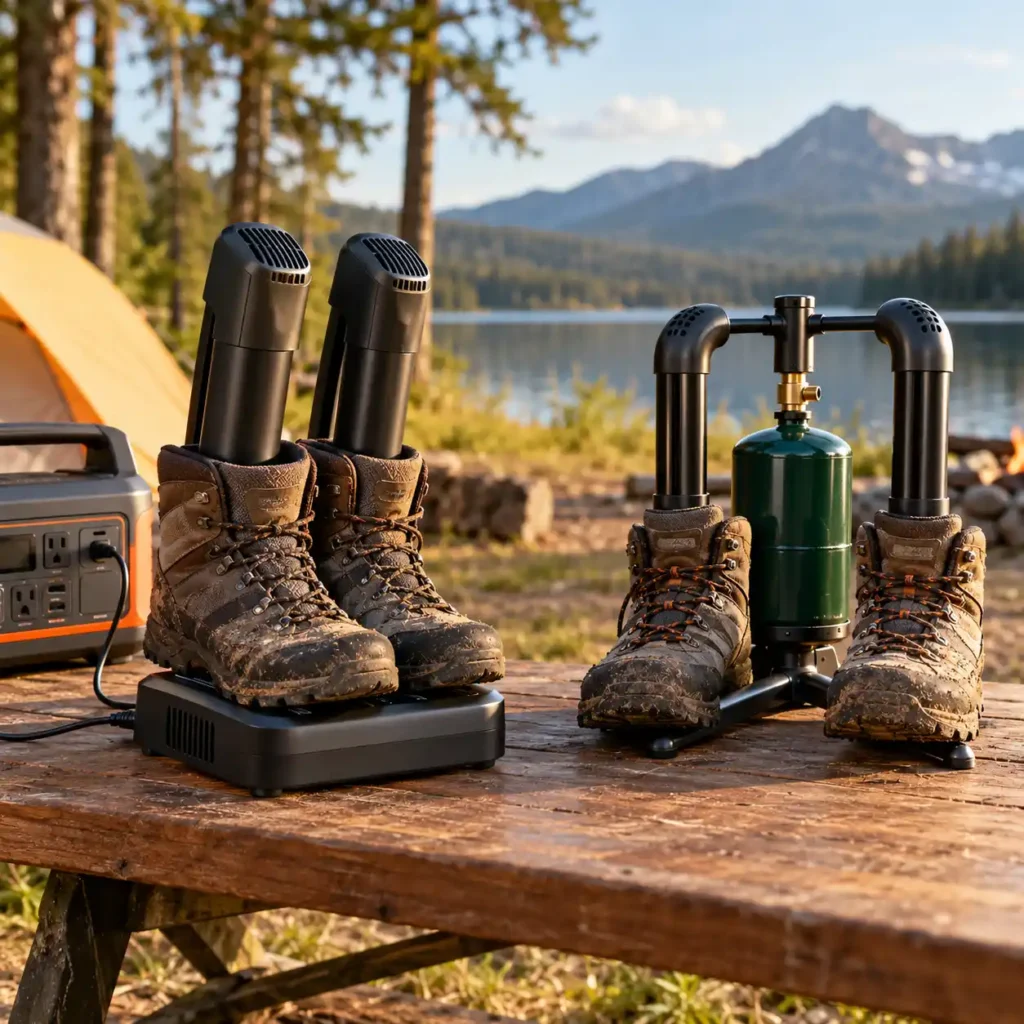
The best boot dryer for camping depends largely on your power supply and where you plan to use it. Electric models are generally more convenient at powered campsites or during car camping, while a propane-powered dryer can be an option when electrical hookups are unavailable. However, portability alone does not make a dryer suitable for every off-grid trip. Check its power requirements, operating instructions, and safety limitations before choosing.
Electric Boot Dryers: Best for Powered Campsites and Car Camping
Electric boot dryers are a practical choice when you have access to a compatible power source. Depending on the model, that may mean a household AC outlet, a vehicle’s 12V DC connection, or a suitable portable power station. These options are not interchangeable, so confirm the exact voltage, wattage, connector, and power requirements of the dryer before connecting it.
Several models in this guide serve different camping setups:
DryGuy Travel Dry DX: A travel-oriented option with AC and compatible 12V DC power support, making it worth considering for road trips and car camping.
XCMAN Portable Shoe Dryer (SD-3): A compact design intended for use with its specified power setup. Check the included converter and connection requirements before relying on it at a campsite.
Hedgehog DRIVE: A compact 12V vehicle-powered option for trips where a compatible vehicle connection is available.
Everlasting Comfort Forced Air Boot Dryer: A larger forced-air design better suited to setups with compatible electrical power and enough space for the unit.
Advantages of electric dryers
Convenient at powered campsites: You can use a compatible electrical supply without carrying a separate fuel cylinder.
Options for vehicle travel: Some models support 12V DC power, which can be useful during car camping and road trips.
Different sizes and designs: Compact travel units are easier to pack, while larger forced-air models may suit more permanent campsite setups.
No propane fuel required: Electric models avoid the need to carry and handle a propane cylinder.
Potential drawbacks
Power access is essential: A household-powered model will not work at an unpowered campsite unless you have a suitable compatible power source.
Battery capacity matters: A portable power station must support the dryer’s electrical requirements for the intended operating period. Check both output capacity and available energy.
Connections must be compatible: Never assume that a USB port, vehicle socket, adapter, or power station can operate a dryer simply because the plug fits.
Weather protection matters: Keep electrical equipment and connections protected from rain, standing water, and damp ground in accordance with the manufacturer’s instructions.
Best electric option for your camping setup
For car camping, a compact model with confirmed 12V compatibility may be the most convenient choice. If you stay at campsites with electrical hookups, a household-powered dryer may offer more flexibility. For remote camping, check the full power requirements before packing an electric dryer; an unsuitable power source can make it unusable when you need it.
Propane Boot Dryers: Best for Campsites Without Electricity
A propane-powered dryer can be useful when you camp far from electrical hookups. The PEET Portable Propane Dryer uses thermal convection to circulate warmed air through footwear and operates with a compatible 16-ounce propane cylinder, sold separately.
Advantages of propane dryers
No electrical outlet required: The dryer uses its specified propane fuel source rather than household or vehicle electricity.
Useful for remote camping: It may suit outdoor campsites where electrical hookups are unavailable.
No electrical cable needed for operation: This can simplify setup away from powered facilities.
Portable design: The PEET propane model is intended for footwear drying where electricity is unavailable.
Potential drawbacks
Fuel must be available: You need a compatible propane cylinder, which adds weight and bulk to your camping equipment.
Outdoor-only operation: PEET specifies that its propane dryer is for outdoor use only. Never operate it inside an enclosed tent, vehicle, or cabin.
Fuel handling requires care: Follow the supplied instructions and use only the specified fuel connection. Do not modify the gas supply.
Drying time varies: Results depend on footwear material, moisture level, and operating conditions. Advertised drying estimates are not guarantees for every situation.
Best propane option from this guide
The PEET Portable Propane Dryer is worth considering if you regularly camp without electricity and have a suitable open outdoor area for safe operation. It is not appropriate if you need to dry footwear inside a tent or vehicle.
Electric vs. Propane: Side-by-Side Comparison
| Factor | Electric Boot Dryer | Propane Boot Dryer |
|---|---|---|
| Power source | Household electricity, compatible 12V vehicle power, or a suitable power station, depending on model | Specified propane cylinder |
| Needs an electrical outlet | Yes, unless the model supports another compatible electrical source | No |
| Needs fuel | No propane fuel required | Yes |
| Best camping setup | Powered campsites, car camping, road trips, and compatible RV setups | Remote outdoor campsites without electricity |
| Portability | Varies from compact travel units to larger freestanding dryers | Portable, but the fuel cylinder adds to packed equipment |
| Indoor or tent use | Only if the exact appliance is approved for the environment and operated according to its instructions | PEET's propane model is for outdoor use only |
| Main consideration | Confirm voltage, wattage, power compatibility, and water protection | Confirm fuel compatibility and follow outdoor-use and fuel-safety instructions |
Which Type Should You Choose?
Choose an electric boot dryer if you usually stay at powered campsites, travel by car, or already carry a power source that meets the dryer’s requirements. A compact 12V model may be convenient when your vehicle is available and the connection is compatible.
Choose a propane boot dryer if you regularly camp in remote locations without electricity and can operate it safely in an open outdoor area. Account for the fuel cylinder and follow the manufacturer’s operating instructions.
If you backpack and have neither electricity nor a practical way to carry a propane appliance, a powered dryer may not justify the extra weight. Removing the insoles, loosening the laces, opening the boots, and allowing them to air-dry in a ventilated location may be the more practical approach.
How to Dry Boots Safely at a Campsite

Wet hiking boots can become uncomfortable on a multi-day camping trip, especially when you need to put them on again the following morning. The goal is to remove moisture without damaging the footwear or creating a safety hazard around your campsite.
A portable boot dryer can help, but the best results come from combining appropriate drying equipment with good airflow and basic footwear care.
Step 1: Remove Mud and Excess Water
Start by brushing off mud, sand, and debris from the boots. If the footwear is heavily wet, gently shake out excess water and wipe the exterior with a suitable cloth.
Avoid aggressive cleaning or scrubbing that could damage the materials. If your boots need washing, follow the footwear manufacturer’s cleaning instructions before beginning the drying process.
Step 2: Remove the Insoles and Open the Boots
Loosen the laces and open the tongue as far as the design allows. Remove the insoles if they are removable, then dry them separately.
This creates more space for air to circulate inside the footwear and helps moisture escape from areas that might otherwise remain damp. Do not force removable components out if the footwear is not designed for them to be removed.
Step 3: Choose a Suitable Drying Location
Place the boots in a dry, ventilated area away from direct heat. Keep them away from campfires, wood stoves, and other intense heat sources that can damage leather, synthetic materials, or adhesives.
If rain continues, choose a sheltered location where air can still circulate. Avoid sealing wet footwear inside a bag or storage container while it dries.
Step 4: Use the Right Drying Method
Choose a drying method that matches your equipment, footwear, and campsite.
With an electric boot dryer: Check the required power source and follow the manufacturer’s instructions for temperature, placement, and operating time. Keep electrical connections protected from water.
With a 12V vehicle-powered dryer: Confirm that the vehicle outlet matches the device’s voltage and power requirements. Follow the manufacturer’s guidance on vehicle battery use.
With a propane-powered dryer: Use the appliance only in the environment specified by its manufacturer. The PEET Portable Propane Dryer is intended for outdoor use only; never operate it inside a tent, vehicle, or enclosed cabin.
Without a powered dryer: Leave the boots open in a ventilated place and allow them to air-dry. A fan can improve airflow if a suitable, safe power source is available.
Do not improvise electrical connections or modify a propane appliance’s fuel supply.
Step 5: Check the Boots Before Wearing Them Again
Do not rely on the advertised drying time alone. Check the boot interior, the toe area, and the insoles for remaining moisture. Thick insulation and waterproof construction can make footwear take longer to dry than expected.
If the boots are still damp, continue drying them using the method permitted by the manufacturer. Avoid increasing the heat beyond the recommended setting to speed up the process.
If you are camping for several consecutive days, carrying an extra pair of socks and allowing additional drying time can make wet-weather hiking more manageable.
Step 6: Store the Footwear Only When It Is Dry
Once the boots and insoles are dry, put the insoles back in if appropriate, loosen the laces for storage, and keep the footwear in a clean, dry place.
If you need to transport wet boots before they are completely dry, separate them from dry clothing and sleeping equipment where possible. Reopen them for ventilation as soon as you can.
A Few Extra Tips for Multi-Day Camping
Pack spare socks so you can change into a dry pair while your boots dry.
If the insoles become wet, remove them as soon as practical rather than leaving them trapped inside the boots.
Allow extra drying time in cool, humid, or rainy conditions.
Follow the care instructions for leather, waterproof membranes, insulated liners, and glued footwear.
Keep drying equipment away from standing water and follow its safety instructions every time you use it.
The key takeaway: Safe boot drying is about managing moisture, not applying as much heat as possible. Remove excess water, improve airflow, use compatible equipment, and check that the footwear is dry before storing it for an extended period.
Frequently Asked Questions About Portable Boot Dryers for Camping
Can you use a boot dryer while camping?
Yes, if the dryer matches your campsite’s available power source and operating conditions. A 12V vehicle-powered model can work for car camping, an electric dryer can be used where compatible electricity is available, and a propane-powered model can operate without an electrical outlet. Always follow the manufacturer’s instructions and keep electrical equipment protected from water.
How long does a boot dryer take to dry hiking boots?
Drying time depends on the dryer type, boot material, and amount of moisture. PEET states that its fan-free thermal-convection dryers typically take around 4–8 hours or overnight to dry most footwear. Fan-assisted models may work faster, but heavily soaked or insulated hiking boots can take longer. Treat advertised drying times as estimates rather than guarantees.
Are boot dryers safe for leather hiking boots?
A boot dryer may be suitable for leather hiking boots when its temperature and drying method comply with the footwear manufacturer’s care instructions. Avoid excessive heat, campfires, radiators, and other intense heat sources, which can dry out leather and weaken adhesives. Remove the insoles when possible and allow air to circulate through the boots.
Can you use a boot dryer without electricity?
Yes. A propane-powered model such as the PEET Portable Propane Dryer works without an electrical outlet when connected to its specified propane cylinder. However, it must be operated according to the manufacturer’s instructions and outdoors only. If you do not have electricity or a suitable fuel source, air-drying with good ventilation is a practical alternative.
Can you run a propane boot dryer inside a tent?
No. The PEET Portable Propane Dryer is intended for outdoor use only. Do not operate it inside a tent, vehicle, enclosed cabin, or other enclosed space. Combustion appliances can create serious fire and carbon monoxide hazards. Follow the product’s instructions and operate it only in an appropriate outdoor location.
Can a boot dryer damage waterproof hiking boots?
It can if the footwear is exposed to unsuitable heat or used contrary to its care instructions. Waterproof membranes, leather, synthetic materials, and glued components can have different temperature tolerances. Check the boot manufacturer’s guidance and the dryer’s instructions before use. Do not assume that every heated dryer is suitable for every waterproof boot.
What is the best way to dry boots while camping without a boot dryer?
Brush off mud, shake out excess water, loosen the laces, and remove the insoles if they are removable. Open the boots in a dry, ventilated location away from direct heat. You can loosely stuff them with absorbent paper and replace it whenever it becomes damp; a fan can also help improve airflow when a suitable power source is available. Avoid campfires, radiators, and other intense heat sources.
Final Verdict
The best portable boot dryer for camping is the one that fits your actual trip rather than the one with the most impressive advertised drying time.
For regular car camping, start with an electric model suited to the power available in your vehicle or at your campsite. If you frequently camp without electrical hookups, the PEET Portable Propane Dryer is worth considering—but only if you can follow its outdoor-use requirements. Campers who prioritize a compact setup should compare the travel-oriented electric models, while those with a permanent powered campsite may prefer a freestanding design.
If you rarely encounter wet footwear or travel without a practical power source, basic drying methods may be enough. Remove the insoles when appropriate, open the boots to improve airflow, and allow them to dry in a ventilated place.
Before purchasing, verify the exact product listing, included accessories, and manufacturer instructions. Since this guide is based on published product information rather than comparative hands-on testing, it does not establish that one model dries every type of boot faster or more effectively than the others.
About the Author
The CampComfortGuide team creates practical camping guides to help outdoor enthusiasts choose gear that fits their needs, travel style, and budget. Our buying guides compare product specifications, manufacturer information, power requirements, and practical considerations to help readers make informed decisions.
For this guide, we examined portable boot dryers for camping with a focus on drying methods, power sources, portability, footwear compatibility, and safe operation. Product assessments are based on available documentation and published specifications rather than claims of hands-on testing.
Our goal is to make camping gear research clearer, more useful, and easier to apply to real-world outdoor trips.