
Getting stuck in mud, sand, or a rutted trail can quickly turn a camping or overlanding trip into a difficult recovery situation. The challenge becomes even greater when you are traveling alone, exploring remote campsites, or driving far from the nearest road assistance. In these conditions, having the right recovery equipment in your vehicle can make a meaningful difference. Portable vehicle recovery winches offer one way to move a stuck vehicle when traction alone is not enough and a suitable anchor point is available.
Unlike permanently mounted winches, portable models are designed to be carried and deployed when needed, although their weight, power source, mounting requirements, and operating methods vary considerably. Some connect to a vehicle’s 12V electrical system, while others use a separate battery or a capstan-style pulling mechanism. These differences matter when choosing equipment for a camping vehicle: a winch that works well for one recovery setup may not be compatible with another vehicle or suitable for a particular terrain.
In this guide, we compare five portable recovery winches worth examining for camping and overlanding: Winch2Go, SuperHandy, SINOKING, VEVOR, and Nilight. We look at their published pulling capacities, power requirements, rope systems, portability, included components, and practical recovery considerations. We also explain what to check before buying, so you can evaluate whether a particular model fits your vehicle and the type of trips you take. If you are preparing a complete vehicle-based campsite, our guide to building a practical vehicle camping setup can help you plan how recovery equipment fits alongside your other essential gear.
A portable winch is not a universal recovery solution. Safe operation depends on using correctly rated equipment, approved vehicle recovery points, a suitable anchor, and the manufacturer’s instructions. Understanding these limitations before heading off-grid is just as important as comparing specifications.
As an Amazon Associate I earn from qualifying purchases.
Table of Contents
Why We Can Trust This Guide
Choosing a portable vehicle recovery winch is a decision that deserves careful research. The right equipment depends on your vehicle, recovery requirements, power source, terrain, and the conditions in which you plan to travel. A product’s advertised pulling capacity alone does not establish whether it is suitable for recovering a particular vehicle.
At CampComfortGuide, our goal is to help readers make informed camping and overlanding gear decisions through careful product research, specification comparisons, and practical buying guidance. For this guide, we examine five selected portable winches using the available product information, published specifications, manufacturer documentation where available, and details provided in the current product listings.
Our approach focuses on five principles:
Product-specific research: We examine the exact models selected for this comparison rather than substituting similar products or relying on specifications from unrelated versions.
Specification accuracy: We distinguish published pulling capacity, power requirements, rope type, and included equipment. When a detail cannot be confirmed, we identify it as unverified rather than presenting an estimate as fact.
Practical camping and overlanding relevance: We consider portability, power availability, setup requirements, and the intended recovery scenarios that may arise on remote roads and off-road trails.
Balanced comparisons: We consider both potential advantages and limitations. A higher advertised pulling capacity does not automatically make one winch the better choice for every vehicle or recovery situation.
Safety-conscious guidance: We emphasize compatible recovery points, suitable anchoring equipment, correct rigging, and manufacturer instructions. A portable winch should never be treated as a substitute for properly rated recovery equipment or safe operating procedures.
A note about testing and recommendations: This guide is based on product research and available documentation, not a claim that CampComfortGuide has independently field-tested all five winches. Manufacturer specifications are identified as published claims, and product recommendations are based on the evidence available for each model. Where information is incomplete, we make that limitation clear.
Some product details, configurations, prices, and availability may change. We therefore recommend checking the current product listing and manufacturer’s instructions before purchasing or using any recovery equipment.
Our aim is straightforward: provide a useful, transparent comparison that helps you understand what each portable winch offers, what to verify before buying, and whether it fits your vehicle-based camping or overlanding plans.
Quick Answer: Which Portable Vehicle Recovery Winch Is Best?
The best portable vehicle recovery winch depends on your vehicle, recovery requirements, available power, and the type of terrain you expect to encounter. There is no single model in this comparison that can be recommended for every 4×4, SUV, or overlanding setup.
Among our five selected products, the VEVOR 6000 lbs Synthetic Rope Box-Style Winch is worth considering if you want a portable 12V electric winch with a higher advertised pulling capacity than the Winch2Go 4000lb model. However, its suitability depends on confirming the exact configuration, vehicle compatibility, electrical requirements, and recovery-point ratings.
The Winch2Go 4000lb Winch with Synthetic Rope is another portable 12V option, but its advertised 4,000 lb capacity makes it particularly important to check the intended vehicle weight and recovery demands before buying.
The SuperHandy Cordless Brushless Capstan Winch is different from conventional drum-style electric winches. Its separate battery-powered capstan design may appeal to buyers who want to avoid a direct vehicle power connection, but its published single-line and double-line pulling figures must be assessed according to the actual rope arrangement and intended application.
The SINOKING Portable Universal Synthetic Free-Spool Winch and Nilight Electric Winch with Synthetic Rope should also be considered, but their exact specifications and selected configurations need further verification before we can make a responsible recommendation.
Our Quick Recommendation
For a higher advertised capacity in a portable 12V box-style design: Consider the VEVOR 6000 lbs model, subject to compatibility and specification checks.
For a lower-capacity portable 12V kit: Examine the Winch2Go 4000lb model and verify whether its rating is appropriate for your vehicle.
For a cordless capstan design: Consider the SuperHandy, provided its operating arrangement and pulling capacity match the intended task.
For the SINOKING and Nilight models: Verify the exact product variant, rated line pull, power requirements, and included equipment before deciding.
One important point: a winch is not necessarily the first recovery item every camper or overlander should buy. Traction boards, a suitable shovel, and properly rated recovery equipment may be more useful for many common soft-ground situations. A winch becomes particularly relevant when you travel alone or encounter terrain where driving or traction aids cannot free the vehicle.
Before choosing any model, compare its specifications with your vehicle’s actual loaded weight, approved recovery points, power system, and the manufacturer’s operating requirements. A higher advertised pulling capacity does not automatically mean a safer or more suitable recovery setup.
Why We Selected These Portable Vehicle Recovery Winches
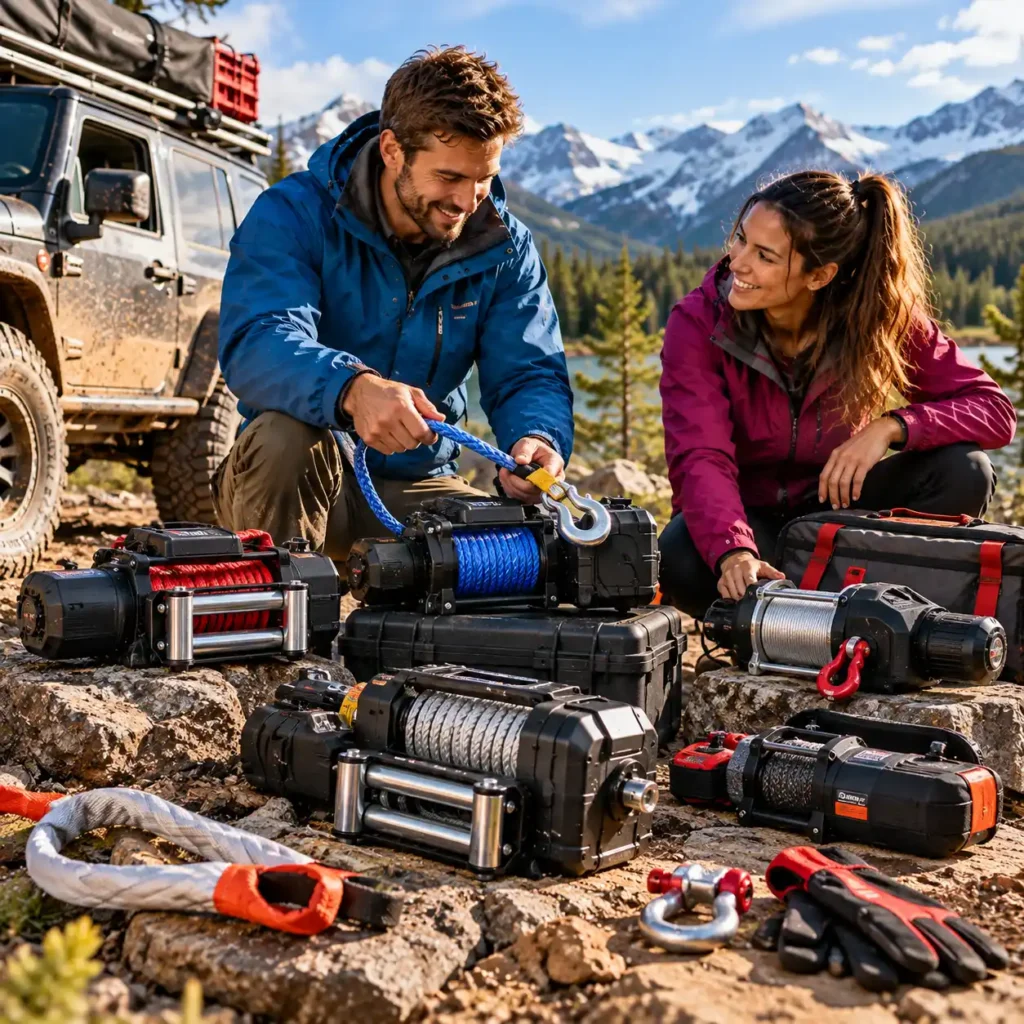
The portable winch market includes several different designs, power systems, and pulling capacities. Rather than treating every portable pulling device as interchangeable, we selected five specific models for this comparison to examine how different approaches to portability and vehicle recovery may fit camping and overlanding needs.
Our shortlist includes the Winch2Go 4000lb Winch with Synthetic Rope, SuperHandy Cordless Brushless Capstan Winch, SINOKING Portable Universal Synthetic Free-Spool Winch, VEVOR 6000 lbs Synthetic Rope Box-Style Winch, and Nilight Electric Winch with Synthetic Rope.
These products were selected to create a comparison of different portable winch configurations, including conventional electric designs and a cordless capstan system. They also provide an opportunity to examine important differences in power requirements, rope arrangements, portability, and setup considerations.
Our selection is based on the following considerations:
Different winch designs: The shortlist includes more than one winch architecture, allowing readers to understand why a conventional electric winch and a capstan-style system should not automatically be evaluated in the same way.
Portable equipment considerations: We focus on products marketed as portable or movable recovery equipment, where storage, transport, power connections, and setup requirements matter alongside pulling capacity.
Synthetic rope configurations: Each selected product is identified by a listing that specifies synthetic rope. We consider the available rope information while recognizing that rope length, diameter, construction, and rated strength must be checked for the exact configuration.
Different advertised capacities: The selected models provide an opportunity to examine how manufacturers present pulling capacity and why those figures must be assessed in relation to vehicle weight, line arrangement, and operating conditions.
Camping and overlanding relevance: We consider whether the equipment’s design and requirements could make it practical to carry and deploy during vehicle-based trips, rather than evaluating it solely as a workshop or industrial pulling tool.
Why these five products?
The Winch2Go 4000lb model represents a portable 12V electric winch kit. The SuperHandy cordless brushless capstan winch introduces a different approach to pulling, using a separate battery system rather than a conventional vehicle-powered drum arrangement. The SINOKING model adds a portable free-spool configuration to the comparison, while the VEVOR 6000 lbs box-style winch provides another 12V electric format. The Nilight electric winch completes the shortlist with a separate synthetic-rope electric winch option.
This is a selected product comparison, not a claim that these are the five highest-performing portable winches available on the market. We also do not assume that every model is suitable for every 4×4, SUV, truck, or recovery situation. Actual suitability depends on verified specifications, vehicle weight, attachment compatibility, power requirements, and the manufacturer’s operating instructions.
Our purpose is to examine what each product offers, identify what buyers should verify, and explain where the differences matter before choosing recovery equipment for a camping or overlanding vehicle.
How We Evaluate and Compare Portable Vehicle Recovery Winches
Not all portable winches are designed in the same way, and their advertised pulling capacities do not tell the whole story. A useful comparison must consider how each unit operates, where it gets its power, how it connects to a vehicle or anchor point, and whether its design matches the intended recovery task.
For this guide, we assess the five selected models using a consistent set of criteria. We focus on published product information and manufacturer documentation where available, while distinguishing confirmed specifications from details that still require verification. We do not present manufacturer claims as independent test results.
Pulling Capacity and Intended Application
We examine each model’s advertised pulling capacity and the type of pulling arrangement used to achieve it. Capacity figures must be interpreted carefully: a single-line rating, a double-line arrangement, and a capstan system do not necessarily describe equivalent operating conditions.
We also consider the intended application. A winch suitable for moving a relatively light load may not have sufficient capacity or the required configuration for recovering a heavier 4×4. Vehicle weight, terrain resistance, slope, recovery geometry, and equipment ratings all affect the demands placed on a recovery system.
Power Source and Electrical Requirements
Power availability is particularly important when traveling away from established campsites and roads. We examine whether a model uses a vehicle’s 12V electrical system, a separate rechargeable battery, or another power arrangement.
For electric models, relevant considerations include voltage compatibility, power connections, cable requirements, and the manufacturer’s operating instructions. For cordless equipment, battery availability, compatibility, charging requirements, and expected operating limitations also matter.
A portable winch is only practical when its power system can support the intended use.
Winch Design and Operating Mechanism
We distinguish between conventional drum-style electric winches and capstan-style systems because they operate differently.
A drum winch winds its rope around a rotating drum, while a capstan system pulls a rope through a rotating mechanism. These designs have different rope-handling arrangements and setup requirements. Their advertised capacities should therefore not be compared without considering the operating configuration.
We also examine features such as free-spool operation where the product documentation provides sufficient information.
Rope Type and Recovery Components
All five selected products are identified as synthetic-rope models, but that description alone is not enough to establish the suitability of a complete recovery setup.
Where specifications are available, we examine rope length, diameter, construction, attachment hardware, fairlead design, and included accessories. We also distinguish between components supplied with the product and equipment that may need to be purchased separately.
Rope condition, compatibility, and manufacturer-approved replacement requirements are important considerations for safe operation.
Portability, Weight, and Storage
A portable recovery winch should be practical to transport and deploy. We consider the available information about product dimensions, weight, carrying cases, mounting arrangements, cables, batteries, and other components that affect the complete package.
We do not assume that a product is easy to carry simply because its manufacturer describes it as portable. The total equipment package and the preparation required before use matter just as much as the winch body itself.
Vehicle Compatibility and Mounting Requirements
We examine how each model is intended to connect to a vehicle, recovery point, or suitable anchor arrangement. Where documentation provides relevant information, we consider mounting hardware, connection requirements, and compatibility limitations.
A universal or portable description does not guarantee compatibility with every vehicle. Buyers must verify the winch manufacturer’s requirements and the vehicle manufacturer’s approved recovery points before use.
Controls, Included Equipment, and Practical Limitations
Control arrangements and supplied accessories can affect how convenient a winch is to operate. We look for information about wired or wireless controls, cables, hooks, connectors, mounting equipment, and other included components.
We also identify missing information and potential limitations. If a product listing does not clearly establish a particular feature, we do not assume that it is included.
Safety Information and Manufacturer Guidance
Finally, we consider the safety information available for each product. This includes operating instructions, rated attachment requirements, rope inspection, anchoring considerations, and any stated restrictions on use.
A winch’s advertised capacity does not establish the safe working limit of every component in a recovery setup. The winch, rope, connectors, recovery points, anchor equipment, and attachment hardware must all be appropriate for the intended operation.
Our Comparison Approach
We use these criteria consistently across all five selected products, but we do not force every model into an identical category. Differences in winch architecture, power source, and intended application are part of the comparison.
When information is confirmed, we report it. When specifications are unclear or unavailable, we identify what buyers should verify before purchasing. This approach allows readers to compare the selected models without confusing advertised performance with independently verified capability.
Who Should Consider a Portable Vehicle Recovery Winch?
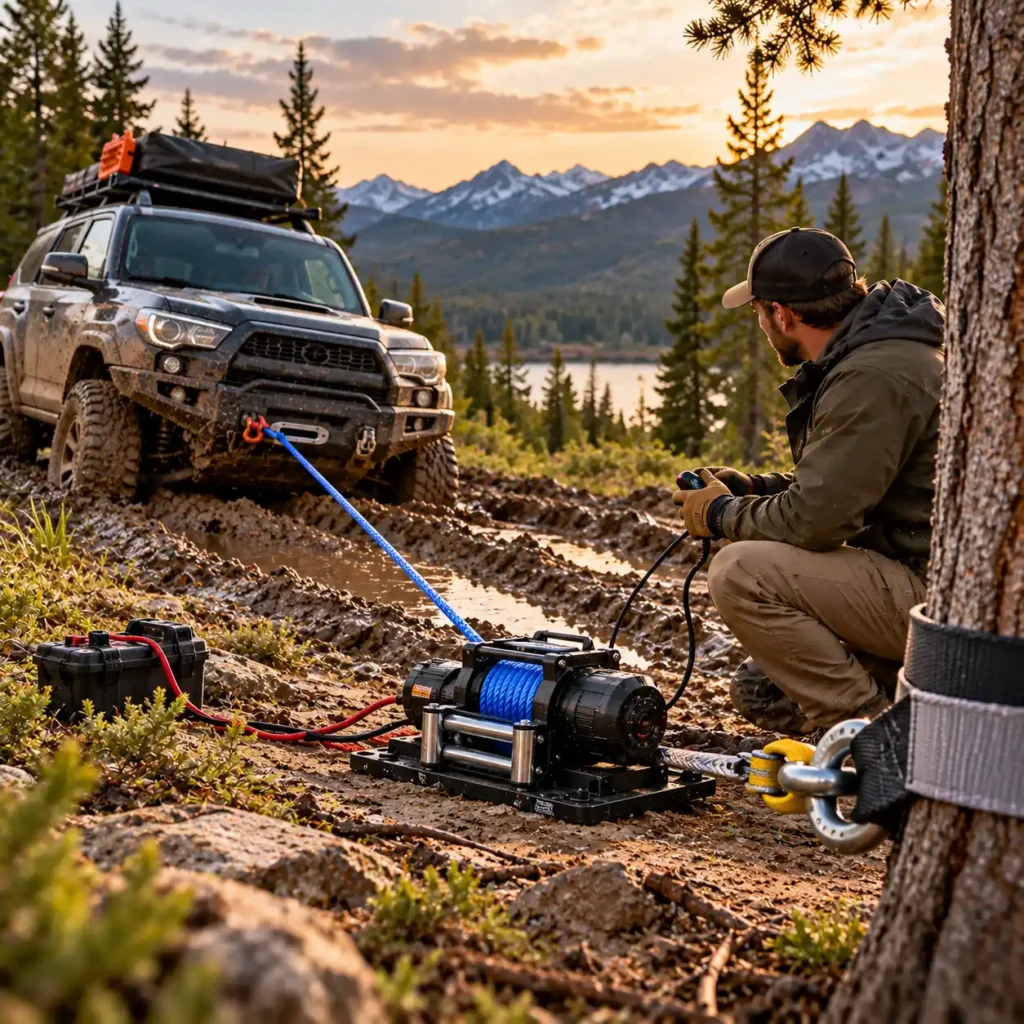
A portable vehicle recovery winch can be a useful addition to a camping or overlanding setup, but it is not essential for every driver. Whether it makes sense depends on where you travel, how often you drive off-road, whether you travel alone, and what recovery equipment your vehicle already carries.
Unlike traction boards or a shovel, a winch can pull a vehicle toward a suitable anchor point when driving out under its own power is no longer practical. However, it also requires compatible equipment, an appropriate anchor, and the knowledge to operate it safely.
Solo Overlanders Traveling in Remote Areas
Drivers who regularly travel alone through remote areas have one of the strongest reasons to consider a portable recovery winch. Without a second vehicle nearby, a conventional vehicle-to-vehicle recovery may not be possible.
A suitable winch can provide another self-recovery option when the vehicle becomes stuck in deep mud, uneven terrain, or a difficult trail section. This is particularly relevant on routes where waiting for another vehicle or professional recovery assistance could take considerable time.
However, a winch still needs a suitable anchor. In open terrain without trees, rocks, or another appropriate anchoring solution, carrying a winch does not automatically solve the recovery problem.
4×4 and SUV Owners Exploring Difficult Trails
Owners of capable 4×4 vehicles and SUVs who regularly explore challenging trails may benefit from carrying a winch as part of a more complete recovery system.
Deep ruts, steep sections, muddy tracks, and uneven ground can create situations in which available traction is insufficient. A properly matched winch may help recover a vehicle when other methods are unsuitable or unsuccessful.
The important consideration is vehicle compatibility. Buyers should compare the winch’s rated pulling capacity with the vehicle’s weight and recovery requirements, while also checking approved recovery points, mounting arrangements, and power requirements.
Campers Traveling Beyond Established Campsites
Some camping trips involve long stretches of unpaved roads, remote forest access routes, sandy tracks, or muddy approaches to isolated campsites. Drivers who regularly encounter these conditions may want more recovery options than a basic roadside emergency kit provides.
A portable winch may be worth considering when the vehicle and intended recovery setup are compatible. Its usefulness will depend on the terrain, available anchor points, and the type of equipment carried alongside it.
For occasional trips on maintained gravel roads or established campsites, however, a winch may be unnecessary additional weight and expense.
Overlanders Who Want a Portable Alternative to a Permanently Mounted Winch
A permanently mounted winch is not always practical for every vehicle. Some owners prefer to avoid a dedicated winch bumper, permanent installation, or the additional weight associated with a fixed recovery system.
A portable model may offer an alternative, particularly when the manufacturer provides a suitable mounting and connection arrangement for the intended vehicle.
Before choosing one, check how the unit attaches, whether additional mounting hardware is required, how it receives power, and whether the complete setup can be deployed safely. Portability alone does not guarantee compatibility with multiple vehicles.
Drivers Who Travel in Groups but Want Additional Recovery Options
Traveling with other capable vehicles provides additional recovery possibilities, including appropriate vehicle-to-vehicle recovery equipment. Nevertheless, some groups also carry a winch to handle situations where another vehicle cannot safely reach the stuck vehicle or where a controlled pulling arrangement is more appropriate.
A winch can therefore complement a group recovery kit rather than replace it. Its value depends on the terrain, the available recovery vehicles, and the equipment and skills of the group.
Who Probably Does Not Need a Winch Yet?
A portable recovery winch may not be the best first purchase for every camper or beginner overlander.
If most of your trips involve established campsites, maintained forest roads, or relatively easy gravel tracks, you may get more practical value from basic recovery equipment first.
Consider prioritizing:
Traction boards for situations where the tires can regain grip and drive the vehicle out.
A suitable shovel for clearing mud, sand, or snow around the tires and under the vehicle.
A properly rated recovery strap or kinetic recovery rope for compatible vehicle-to-vehicle recovery situations.
Rated shackles and approved recovery points that are compatible with the equipment and intended recovery method.
A tire deflator and compressor if adjusting tire pressure is appropriate for the terrain and your vehicle.
These tools address different recovery situations and do not replace one another. A winch is a more specialized option, particularly useful when independent pulling capability is needed and a suitable anchor is available.
The Bottom Line
A portable vehicle recovery winch is most worth considering for drivers who regularly travel alone, explore remote off-road routes, or encounter terrain where basic traction aids may not be sufficient.
For occasional campers and beginners who mainly use established roads, a well-chosen basic recovery kit is often a more sensible starting point. The best equipment choice is the one that matches your actual routes, vehicle, recovery requirements, and ability to use it safely.
Quick Summary: Our Top Picks
The five portable vehicle recovery winches in this guide differ in design, pulling capacity, power requirements, and setup. Some use conventional 12V electric winch systems, while the SuperHandy uses a cordless capstan mechanism. These differences matter when choosing recovery equipment for camping and overlanding, particularly when considering vehicle compatibility and the type of recovery work required.
1. Winch2Go 4000lb Winch with Synthetic Rope
Worth considering for: Buyers looking for a portable 12V electric winch kit with a 4,000 lb advertised single-line pulling capacity.
The Winch2Go is supplied as a portable recovery system rather than just a standalone winch unit. Its published specifications identify a 12V DC electric motor, synthetic rope, integrated mounting plate, and accessories including straps, shackles, a snatch block, and a handheld remote. Buyers should check the complete kit weight and confirm that the advertised capacity is appropriate for their vehicle and intended recovery conditions.
2. SuperHandy Cordless Brushless Capstan Winch
Worth considering for: Buyers who need a cordless capstan winch for lighter outdoor pulling tasks and want a battery-powered alternative to conventional 12V systems.
SuperHandy uses a 48V brushless motor and a capstan-style pulling mechanism, with a published pulling force of 1,000 lb in a single-rope arrangement and up to 2,000 lb with a double-rope setup. The package information identifies a rechargeable battery, charger, low-stretch rope, and tree strap. Its limited advertised pulling capacity and different operating design mean it should not automatically be treated as a replacement for a conventional vehicle recovery winch.
3. SINOKING Portable Universal Synthetic Free-Spool Winch
Worth considering for: Buyers comparing portable free-spool winch designs.
The SINOKING model adds another portable winch configuration to this comparison, but the exact technical specifications and included equipment require further confirmation against the selected product listing. Before purchasing, verify its rated line pull, power source, rope dimensions, mounting arrangement, and supplied accessories. These details are essential for determining whether it is suitable for your vehicle and recovery requirements.
4. VEVOR 6000 lbs Synthetic Rope Box-Style Winch
Worth considering for: Buyers looking for a portable 12V electric winch in a box-style recovery configuration.
VEVOR advertises a 6,000 lb rated pulling capacity and a 12V DC power system. Its published product information also identifies synthetic rope, a portable protective case, wired and wireless remote controls, and recovery accessories. The box-style arrangement may simplify equipment storage and transport, but buyers should account for the complete package weight, electrical requirements, and vehicle attachment compatibility before choosing it.
5. Nilight Electric Winch with Synthetic Rope
Worth considering for: Buyers comparing a conventional 12V electric winch with synthetic rope for vehicle recovery.
Nilight offers an electric winch configuration intended for off-road vehicle recovery, with synthetic rope and remote-control options identified in available product information. However, this ASIN is associated with multiple capacity variants in some listings. Buyers must confirm the selected size, rated pulling capacity, mounting dimensions, rope specifications, and included components rather than relying on specifications from a different variant.
What Matters Most Before You Buy
For vehicle recovery during camping and overlanding, start by checking the winch’s rated pulling capacity against your vehicle’s weight and the demands of the terrain. Then confirm the power source, mounting arrangement, approved recovery points, rope specifications, and compatibility of every component in the recovery system.
Pay particular attention to the difference between conventional drum winches and capstan systems. Their advertised pulling figures and operating arrangements are not directly interchangeable. Also check the complete package weight and whether additional recovery accessories are required.
These are preliminary product-selection notes based on available specifications, not a hands-on performance ranking. The most suitable choice depends on verified product configuration, vehicle compatibility, recovery requirements, and the manufacturer’s operating instructions.
Comparison Table: 5 Portable Vehicle Recovery Winches in 2026
The five portable vehicle recovery winches below differ in their design, power requirements, and advertised pulling capacity. This comparison highlights the main characteristics identified for each selected model. Where an exact specification or product configuration has not been reliably confirmed, we recommend checking the current listing before making a purchase decision.
| Model | Winch Design | Power Source | Advertised Pulling Capacity | Key Consideration |
|---|---|---|---|---|
| Winch2Go 4000lb | Portable drum-style electric winch | 12V DC | 4,000 lb | Complete portable kit with synthetic rope and recovery accessories; confirm the exact rope variant. |
| SuperHandy Cordless Brushless Capstan | Cordless capstan winch | 48V battery system | 1,000 lb single-line; up to 2,000 lb double-line | Different operating mechanism; not directly comparable with conventional drum winches. |
| SINOKING Portable Universal Free-Spool | Portable electric free-spool winch | Verify selected configuration | Verify selected configuration | Confirm rated line pull, voltage, rope dimensions, and included equipment. |
| VEVOR 6000 lbs Box-Style | Portable box-style electric winch | 12V DC | 6,000 lb advertised | Check complete package weight, mounting arrangement, and electrical requirements. |
| Nilight Electric Winch with Synthetic Rope | Electric drum-style winch | Verify selected configuration | Verify selected variant | Confirm the exact capacity, voltage, rope specifications, and mounting dimensions. |
Important Comparison Notes
Pulling capacity: The advertised figures are not automatically equivalent. A capstan winch and a conventional drum winch use different pulling arrangements, so their ratings must be interpreted in context.
Power requirements: A 12V winch needs a suitable electrical supply and compatible connections. A cordless model depends on its own battery system.
Rope configuration: Confirm the rope material, diameter, length, and rated strength for the exact product variant.
Portability: Consider the complete kit, including cables, batteries, mounting hardware, and accessories, rather than evaluating only the winch itself.
Vehicle compatibility: Check the manufacturer’s mounting requirements and your vehicle’s approved recovery points before using any model.
Before buying: Product listings can contain multiple configurations under one product family. Always verify that the selected variant matches the specifications you are comparing. A higher advertised pulling capacity does not, by itself, establish that a winch is suitable for your vehicle or a particular recovery situation.
The 5 Best Portable Vehicle Recovery Winches for Camping and Overlanding in 2026
Choosing a portable vehicle recovery winch requires more than comparing advertised pulling capacities. Different models use different winch mechanisms, power sources, rope configurations, and mounting arrangements, all of which affect their suitability for off-road vehicle recovery. In this section, we examine five selected portable winches: Winch2Go, SuperHandy, SINOKING, VEVOR, and Nilight. Each model is assessed individually, with attention to its published specifications, practical features, portability, recovery compatibility, and potential limitations. The goal is to help campers and overlanders understand how these options differ and which equipment may better match their vehicle, available power, and intended recovery conditions.
1. Winch2Go 4000lb Portable Electric Winch with Synthetic Rope
Award: Best Complete Portable Recovery Kit

The Winch2Go 4000lb is a portable electric recovery winch designed for drivers who want a complete pulling system without permanently installing a winch on their vehicle. Its enclosed carry-case design brings the winch, synthetic rope, battery connection cables, remote control, and several recovery accessories together in one package. With a manufacturer-rated single-line pulling capacity of 4,000 lb and a 12V DC power system, it offers a different approach to vehicle recovery than a conventional bumper-mounted winch.
Overview
A conventional vehicle winch is usually installed on a dedicated mounting plate or bumper and remains attached to the vehicle between trips. The Winch2Go takes a different approach: the winch is housed in a portable case and can be transported separately, then connected to a suitable 12V DC power source when required.
This design is particularly relevant to overlanders who do not want a permanent winch installation but still want to carry an electric pulling system. The case also keeps several important recovery components together, reducing the need to assemble a basic kit from separately purchased accessories.
According to Superwinch’s product documentation, the synthetic-rope version has a rated single-line pulling capacity of 4,000 lb. It uses a 1.4 HP permanent-magnet motor, a three-stage planetary gearbox, and a cam-action free-spool clutch. The manufacturer specifies a 40-foot synthetic rope measuring 7/32 inches in diameter, together with a wired handheld remote and quick-connect battery cables.
One important distinction is that the Winch2Go is not a permanently mounted, vehicle-specific winch. Before using it for off-road recovery, you must establish a suitable mounting and anchoring arrangement, confirm the compatibility of the vehicle’s recovery points, and provide an appropriate 12V power source. Its portable format does not eliminate the need for correctly rated recovery equipment.
For camping and overlanding, the main appeal is the complete-kit approach. Instead of carrying only a winch body, you get a collection of accessories intended to support a pulling setup. However, at approximately 41 lb for the synthetic-rope version, it is portable in the sense that it can be carried and stored separately, not necessarily lightweight enough for effortless handling.
Key Features
Portable Winch-in-a-Case Design
The Winch2Go is built around an enclosed carrying case with an integrated winch mounting plate. This makes it easier to store the equipment in a vehicle and transport it between trips without committing to a permanent bumper installation.
For overlanders who use different vehicles or prefer to keep the front of their vehicle free of additional equipment, this arrangement may be appealing. The trade-off is that the winch must be positioned and secured appropriately before operation. Buyers should study the manufacturer’s installation instructions rather than assume the case itself can be attached to any convenient vehicle component.
4,000 lb Rated Single-Line Pulling Capacity
Superwinch specifies a rated single-line pulling capacity of 4,000 lb. This is the manufacturer’s stated rating, not a guarantee that the winch can recover every vehicle weighing less than 4,000 lb.
Actual recovery demands depend on vehicle weight, terrain resistance, slope, tire condition, and the geometry of the pulling arrangement. A vehicle stuck in deep mud or positioned on an incline can require substantially more pulling force than one moving across firm, level ground.
The manufacturer also documents the use of a snatch block, which changes the mechanical advantage of a pulling arrangement. This does not mean that the winch itself has a new 8,000 lb single-line rating. The complete rigging system must be configured and rated correctly.
12V DC Electric Motor and Quick-Connect Power Cables
The Winch2Go uses a 1.4 HP (1.0 kW) motor operating on 12V DC. The package includes 10-foot quick-connect battery cables designed to connect the winch to a compatible power source.
This is a useful arrangement for vehicle-based travel because it avoids the need for a separate 48V battery platform. However, the electrical requirements should not be underestimated. Manufacturer documentation specifies approximately 220 amps of current draw at the rated load.
That means the power source, connections, cable condition, and operating procedure matter. A standard accessory socket should not be assumed to provide sufficient current. Follow the manufacturer’s battery connection instructions and use an appropriate 12V source.
40-Foot Synthetic Rope
The synthetic-rope version is specified with a 40-foot rope measuring 7/32 inches in diameter. It uses a hawse fairlead integrated into the baseplate.
Synthetic rope is a practical alternative to steel wire rope for portable recovery equipment because it is generally easier to handle and does not have the same wire-strand characteristics. Nevertheless, it requires proper inspection and protection from abrasion, sharp edges, contamination, and excessive heat.
The rope should be inspected before and after recovery operations. Damaged or compromised rope should not be used, even if the winch motor and other components appear to be functioning normally.
Three-Stage Planetary Gearbox and Free-Spool Clutch
The manufacturer specifies a three-stage planetary gearbox with a 166:1 gear ratio. A cam-action clutch control knob allows the drum to be disengaged for free-spooling, making it possible to pull out the rope manually before connecting it to the load.
The automatic mechanical and dynamic braking system is another important part of the winch design. These mechanisms control the load during operation, but they do not remove the need to follow the manufacturer’s instructions for handling and securing the rope.
Complete Recovery Accessory Package
One of the Winch2Go’s main selling points is its included equipment. The manufacturer lists two heavy-duty 8-foot straps rated at 4,000 lb, three 4,000 lb D-shackles, an 8,000 lb snatch block, a 1/4-inch clevis hook, and a pair of heavy-duty winch gloves.
The kit also includes a 12-foot wired handheld remote and the 10-foot quick-connect battery cables.
Having these components together can make equipment organization easier, but buyers should not assume that every supplied accessory is suitable for every recovery configuration. Check the ratings, intended uses, compatibility, and condition of each component before putting the system under load.
Technical Specifications
| Specification | Details |
|---|---|
| Brand | Superwinch |
| Product | Winch2Go 4000 |
| Synthetic-Rope Part Number | 1140232 |
| Amazon ASIN | B0166H2V0C — selected listing; verify exact variant |
| Winch Type | Portable 12V electric winch |
| Rated Single-Line Pull | 4,000 lb |
| Motor | 1.4 HP / 1.0 kW permanent-magnet motor |
| Power Source | 12V DC |
| Current Draw at Rated Load | Approximately 220 A |
| Gearbox | Three-stage planetary |
| Gear Ratio | 166:1 |
| Clutch | Cam-action free-spool |
| Braking System | Automatic mechanical and dynamic |
| Rope Material | Synthetic |
| Rope Length | 40 ft |
| Rope Diameter | 7/32 in |
| Fairlead | Integrated hawse fairlead |
| Remote Control | 12 ft wired handheld remote |
| Battery Cables | 10 ft quick-connect cables |
| Winch Hook | 1/4-inch clevis-pinned latch hook |
| Included Straps | Two 8 ft straps, rated at 4,000 lb each |
| Included Shackles | Three D-shackles, rated at 4,000 lb each |
| Snatch Block | 8,000 lb rating |
| Winch Weight | Approximately 41 lb (synthetic-rope version) |
| Dimensions | 20.1 × 7.6 × 12 in |
| Mechanical Warranty | Limited lifetime |
| Electrical Warranty | Limited 2 years |
Specification note: The technical figures above are based on Superwinch product documentation for part number 1140232. The Amazon ASIN must be checked against this manufacturer part number to ensure that the selected listing is the synthetic-rope version. Confirm current warranty terms and package contents before purchase.
Pros and Cons
Pros
Portable case design avoids requiring a permanently installed bumper winch.
Manufacturer-rated 4,000 lb single-line pulling capacity.
Synthetic rope supplied in the 40-foot configuration.
12V DC operation with included quick-connect battery cables.
Complete accessory package includes straps, D-shackles, a snatch block, gloves, and remote control.
Three-stage planetary gearbox and cam-action free-spool clutch.
Integrated hawse fairlead and wired handheld remote.
Manufacturer lists a limited lifetime mechanical warranty and a limited two-year electrical warranty.
Cons
Approximately 41 lb, making it relatively heavy for a kit that must be carried and positioned manually.
Requires a suitable 12V power source capable of supporting high current demand.
Does not provide the convenience of a permanently mounted, vehicle-ready winch.
Requires a suitable mounting and anchoring arrangement before operation.
A 4,000 lb rated single-line pull may be insufficient for some vehicle recovery situations.
Synthetic rope requires regular inspection and protection from abrasion and damage.
The exact Amazon ASIN-to-manufacturer-part-number match still needs confirmation.
Who Should Consider This Winch?
The Winch2Go is worth considering for vehicle campers and overlanders who want to carry a portable electric winch without permanently modifying their vehicle. Its case-based design and supplied recovery accessories may be particularly useful to drivers who prefer keeping their recovery equipment together as one transportable kit.
It may also appeal to owners of vehicles that do not have a dedicated winch bumper or mounting plate. Instead of installing a conventional front-mounted winch, they can transport the Winch2Go separately and deploy it when a suitable recovery arrangement is available.
The 12V power system is another relevant consideration for people who already operate a 12V vehicle electrical system. However, the substantial current demand means that compatibility must be confirmed before use. A suitable power source and properly connected cables are essential.
This model is less suitable for buyers who expect a lightweight recovery tool, want the convenience of a permanently mounted winch, or regularly encounter demanding recovery situations that require a higher-capacity system. Drivers with heavier vehicles should carefully assess the actual recovery requirements rather than relying on the advertised 4,000 lb figure alone.
What to Verify Before Buying
Confirm that Amazon ASIN B0166H2V0C corresponds to Superwinch part number 1140232, the synthetic-rope version.
Check that the selected package includes the 40-foot synthetic rope rather than the separate steel-rope configuration.
Verify the 4,000 lb rated single-line pulling capacity in the current product documentation.
Confirm the included 12V battery cables and their connection requirements.
Check whether your intended 12V power source can support the manufacturer’s current requirements.
Verify the two 8-foot straps, three D-shackles, snatch block, clevis hook, gloves, and wired remote are included in the selected package.
Review the winch’s mounting and anchoring instructions before planning to use it with your vehicle.
Confirm that your vehicle has approved recovery points suitable for the intended pulling direction and load.
Check the complete kit dimensions and weight to ensure it fits your available vehicle storage space.
Review the manufacturer’s rope inspection, maintenance, and operating instructions.
Confirm the warranty terms applicable to your country and purchase channel.
Our Assessment
The Winch2Go 4000lb stands out in this comparison because it approaches portability as a complete recovery-kit concept rather than simply making a conventional winch easier to move. Its enclosed case, synthetic rope, 12V power connection, wired remote, and collection of supplied accessories give it a distinct identity among portable recovery options.
Its strongest potential advantage is the convenience of carrying several recovery components together without permanently installing a winch on the vehicle. For campers and overlanders who want a separate electric pulling system available when needed, that approach is worth considering.
The main trade-offs are its weight, substantial electrical demand, and the need to establish a suitable mounting and anchoring arrangement. Its 4,000 lb single-line rating also needs to be assessed against the vehicle and recovery conditions rather than treated as a universal vehicle-weight recommendation.
Our verdict: The Winch2Go is a potentially useful choice for buyers who value a complete portable 12V recovery kit and understand its setup requirements. It is not a universal substitute for a permanently mounted, higher-capacity off-road winch. Confirming the exact synthetic-rope configuration against the Amazon listing is essential before purchasing.
Related Guide: A portable recovery kit is only useful when you can reach it quickly and keep its heavier components properly secured during travel. Our guide to organizing camping gear inside your vehicle for easier access explains how to plan cargo placement, keep essential equipment accessible, and avoid burying important gear beneath larger camping supplies.
2. SuperHandy Cordless Brushless Capstan Winch
Award: Best Cordless Capstan Winch for Light-Duty Pulling

The SuperHandy Cordless Brushless Capstan Winch is a battery-powered portable winch designed for outdoor pulling tasks, including selected light-duty off-road recovery applications. Its 48V brushless motor, capstan mechanism, and 100-foot low-stretch rope offer a different approach to portable recovery compared with conventional 12V drum winches. With an advertised pulling force of 1,000 lb on a single line and up to 2,000 lb with a suitable double-line pulley arrangement, it is best suited to users who need cordless pulling capability rather than a high-capacity primary recovery winch.
This model earns its place in this category because it combines a cordless 48V power system with a portable capstan design and an included rope-and-battery package. Its main advantage is operational flexibility: it does not need a direct electrical connection to the vehicle battery. However, its pulling capacity is substantially lower than that of many dedicated automotive recovery winches, so this award reflects its particular design and use case rather than overall vehicle-recovery capability.
Overview
The SuperHandy Cordless Brushless Capstan Winch differs from conventional portable vehicle winches in both its power source and pulling mechanism. Instead of using a 12V connection and winding the rope around a storage drum, it operates from a removable 48V lithium-ion battery and pulls through a rotating capstan. The rope wraps around the capstan to create friction, while the operator controls the free end of the rope during the pulling process.
The GUO076-New model is advertised with a single-line pulling force of 1,000 lb. SuperHandy also describes a potential pulling force of up to 2,000 lb when the rope is doubled using an appropriate pulley arrangement. That higher figure should not be interpreted as the winch’s standard single-line capacity: the pulley system changes the mechanical advantage and is not included in the basic advertised package.
The cordless configuration makes the unit potentially useful for outdoor work where a conventional vehicle-battery connection is inconvenient. Nevertheless, its relatively modest rated pulling force limits its role in vehicle recovery. It may be worth considering for lighter pulling tasks and carefully assessed recovery situations, but owners of heavy SUVs, trucks, and fully equipped overlanding vehicles should not assume that it can replace a properly rated automotive winch.
Key Features
48V Brushless Electric Motor
The winch uses a 48V DC brushless motor with a published output of 1,296W. Brushless construction eliminates the motor brushes found in conventional brushed designs, while the manufacturer also identifies steel gearing as part of the drive system. This configuration is intended for portable outdoor pulling applications without the need for a gasoline engine or a direct 12V vehicle connection.
Capstan Pulling Mechanism
A capstan winch works differently from a conventional drum winch. The rope is wrapped around the rotating capstan, and friction between the rope and the drum transfers the pulling force. The rope is not stored by winding it onto a conventional winch drum.
This design can accommodate a longer working rope and allows the operator to control the free end during a pull. However, it also requires the correct number of rope wraps, suitable rope tension, and familiarity with the manufacturer’s operating instructions. Buyers accustomed to standard automotive drum winches should understand this difference before choosing the SuperHandy.
1,000 lb Single-Line Pulling Capacity
The manufacturer’s published single-line pulling force is 1,000 lb. This is the most important figure to consider when evaluating the winch for a particular task. It should not be confused with the higher figure advertised for a doubled-rope arrangement.
For vehicle recovery, the required pulling force depends on vehicle weight, terrain, slope, tire resistance, and the recovery arrangement. A 1,000 lb rating should therefore not be assumed sufficient for recovering a typical full-size 4×4 from difficult terrain.
Up to 2,000 lb with a Double-Line Arrangement
SuperHandy advertises up to 2,000 lb of pulling force when the rope is doubled using a suitable block-and-tackle or pulley arrangement. This setup can increase mechanical advantage, but it also requires additional correctly rated recovery equipment and a suitable anchor arrangement.
The pulley system is not included in the standard package according to the manufacturer’s product information. Buyers should account for the additional equipment and understand that the actual pulling performance depends on the configuration and its mechanical losses.
48V 2Ah Lithium-Ion Battery
The cordless power system uses a 48V 2Ah lithium-ion battery. The manufacturer specifies that this winch is compatible with the 2Ah battery and is not compatible with its 48V 4Ah battery. This is an important purchasing detail: do not assume that a higher-capacity battery from another SuperHandy product will work with this model.
The battery-powered design avoids the need to connect the winch directly to the vehicle’s electrical system. However, the available operating time under load should be considered when planning remote recovery work.
100-Foot Low-Stretch Rope
The package is listed with a 100-foot low-stretch rope. This provides a longer working line than many compact portable pulling tools and can be useful when the anchor point and load are separated by a greater distance.
The manufacturer’s listing identifies the rope as low-stretch. Buyers should still confirm the exact rope specifications and inspect it before use. Rope condition, compatibility, and rated strength are essential parts of the complete recovery system.
Outdoor Operating Capability
SuperHandy describes the winch as suitable for applications including forestry, hunting, landscaping, off-road use, and light construction. The manufacturer also states that the equipment is designed to operate in temperatures as low as -30°C.
These claims make the unit relevant to outdoor users who need a portable pulling tool in different environments. They do not, however, remove the need to follow the operating instructions or to assess whether the winch is appropriately rated for a particular vehicle-recovery situation.
Technical Specifications
| Specification | Details |
|---|---|
| Brand | SuperHandy |
| Model | GUO076-New |
| Product Type | Cordless capstan winch |
| Motor | 48V DC brushless |
| Motor Output | 1,296W |
| Single-Line Pulling Force | 1,000 lb |
| Double-Line Pulling Force | Up to 2,000 lb with suitable pulley arrangement |
| Power Source | 48V lithium-ion battery |
| Included Battery | 48V 2Ah |
| 48V 4Ah Battery Compatibility | Not compatible |
| Rope Length | 100 ft |
| Rope Type | Low-stretch rope |
| Rope Diameter | 3/8 in. listed in product documentation |
| Pulling Speed | 26 ft/min advertised by manufacturer |
| Gear Construction | Steel gears |
| Operating Temperature | Down to -30°C, according to manufacturer |
| Product Weight | Approximately 27 lb |
| Product Dimensions | 11 × 13 × 11 in. |
| Listed Package Components | Winch, 2Ah battery, charger, rope, and tree strap |
| Manufacturer | GCM |
Specifications are based on the manufacturer’s product information and documentation associated with the GUO076 model. The double-line pulling figure requires a suitable pulley arrangement; it is not the standard single-line rating. Package contents and specifications should be checked against the exact Amazon listing before purchase.
Pros and Cons
Pros
Cordless 48V operation does not require a direct connection to the vehicle battery.
Brushless motor rated at 1,296W.
Capstan mechanism provides an alternative to conventional drum-style winches.
Advertised single-line pulling force of 1,000 lb, with up to 2,000 lb using a suitable double-line arrangement.
Includes a 100-foot low-stretch rope.
The listed package includes a 48V 2Ah battery and charger.
Manufacturer states an operating capability in temperatures as low as -30°C.
Suitable for a range of outdoor pulling applications beyond vehicle recovery.
Cons
The 1,000 lb single-line rating is relatively low for recovering many full-size SUVs and trucks.
The 2,000 lb figure requires a separate pulley arrangement and should not be treated as the standard winch capacity.
The 48V 2Ah battery has a specific compatibility restriction and cannot be replaced with the manufacturer’s 48V 4Ah battery.
Battery runtime under sustained heavy load may limit longer recovery operations.
Capstan operation requires correct rope handling and familiarity with the manufacturer’s instructions.
It is not a direct substitute for a higher-capacity 12V automotive recovery winch.
Who Should Consider This Winch?
The SuperHandy Cordless Brushless Capstan Winch may appeal to campers, outdoor workers, hunters, and overlanders who need a portable pulling tool for lighter tasks. Its cordless configuration is particularly relevant when the operator needs to position the equipment away from the vehicle or does not want to depend on a direct 12V battery connection.
It may also be worth considering for users who already understand capstan winch operation and have a clear use for a compact battery-powered pulling system. The 100-foot rope and included battery make the package more self-contained than a winch that requires a separate power supply and rope purchase.
For vehicle owners, however, the key question is whether the advertised pulling capacity matches the vehicle and the terrain. A lightweight vehicle on relatively firm ground presents a different recovery requirement from a heavy SUV buried in deep mud or facing a steep, slippery incline. The SuperHandy should only be considered where the calculated pulling requirement and complete rigging arrangement remain within the equipment’s rated limits.
What to Verify Before Buying
Before ordering the SuperHandy Cordless Brushless Capstan Winch, check the following details on the current Amazon listing:
Exact model: Confirm that the listing is for GUO076-New and matches ASIN B0CMK273RJ.
Battery included: Check that the package includes the 48V 2Ah battery and charger.
Battery compatibility: The manufacturer states that this model is not compatible with its 48V 4Ah battery. Do not assume that other SuperHandy batteries will work.
Pulling configuration: Distinguish the 1,000 lb single-line rating from the advertised 2,000 lb double-line arrangement.
Pulley equipment: Confirm which components are included and which must be purchased separately for a double-line setup.
Rope specifications: Verify the rope length, diameter, material, and rated strength in the current product documentation.
Package contents: Confirm that the rope, tree strap, battery, and charger are included in the exact variant being sold.
Operating procedure: Read the capstan rope-wrapping, anchoring, and control instructions before using the equipment.
Vehicle suitability: Calculate the expected recovery load rather than selecting the winch based only on the vehicle’s curb weight or the maximum advertised figure.
Our Assessment
The SuperHandy Cordless Brushless Capstan Winch occupies a distinct position among the portable winches in this guide. Its main selling point is not maximum pulling capacity, but the combination of a cordless 48V power system, a brushless motor, a capstan mechanism, and a long working rope.
That combination can make sense for users who need a portable pulling tool for outdoor work and lighter recovery applications. The 1,000 lb single-line rating, however, is a significant limitation when the intended use is recovering heavier camping and overlanding vehicles. Although the manufacturer advertises up to 2,000 lb with a double-line arrangement, this requires suitable additional rigging and does not turn the unit into a conventional 2,000 lb single-line automotive winch.
For that reason, we would not position the SuperHandy as the primary recovery choice for a heavy 4×4, truck, or SUV regularly driven through deep mud, sand, or steep off-road terrain. It is a more specialized option for buyers who value cordless operation and understand the limits of a capstan system.
Its place in this comparison is justified by its distinctive design and portability, not by a claim that it offers the strongest or most versatile vehicle-recovery performance.
Related Guide:
A portable winch is only useful as part of a properly planned vehicle setup. Recovery equipment needs to remain accessible, securely stored, and compatible with the other gear carried on an overlanding trip. Our guide to choosing and organizing essential vehicle camping gear explains how storage, roof systems, and off-grid power fit together when building a practical vehicle-based camping setup.
3. SINOKING Portable Universal Synthetic Free-Spool Winch
Award: Best Drill-Powered Portable Winch for Light-Duty Pulling

The SINOKING Portable Universal Synthetic Free-Spool Winch is a compact, drill-powered pulling tool designed for lighter outdoor applications, including ATV loading, trailer work, farm tasks, and selected utility pulling situations. Unlike conventional electric recovery winches, it uses a compatible portable power drill as its drive source rather than an integrated motor and dedicated battery or a direct 12V vehicle connection. The selected Amazon listing advertises a 1,500 lb single-line pulling capacity, a 40-foot synthetic rope, a free-spool clutch, and a universal drill connection.
This model earns its place in this category because it offers a simple alternative for users who already carry a suitable cordless or corded drill and need occasional pulling assistance. Its compact format and drill-powered design can be useful for lighter jobs where a conventional vehicle winch would be unnecessarily large. However, its 1,500 lb advertised capacity and dependence on a compatible drill make it a specialized utility tool rather than a primary recovery solution for heavy camping and overlanding vehicles.
Overview
The SINOKING Portable Universal Synthetic Free-Spool Winch takes a different approach to portable pulling equipment. Instead of using an integrated electric motor, a built-in battery, or a vehicle’s 12V electrical system, it is powered by a separate portable drill connected to the winch’s drive shaft. This arrangement removes the need for a dedicated winch power system, but it also means that the drill itself becomes an essential part of the equipment setup.
The selected Amazon listing identifies the product as a 1,500 lb portable drill winch with a universal drill connection, a 40-foot synthetic rope, and a free-spool clutch. It also describes a mounting base that can be secured when required, along with front and rear hooks and a 360-degree swivel hook for different connection arrangements. The advertised pulling capacity is 1,500 lb on a single line.
One practical advantage is that the winch does not require a separate integrated battery or complicated vehicle wiring. Users who already own a compatible drill may find this arrangement convenient for moving equipment, loading an ATV, handling trailer-related tasks, or performing other controlled pulling jobs.
For vehicle recovery, however, the limitations are important. The winch depends on the drill’s compatibility and performance, and its advertised 1,500 lb pulling capacity is relatively low for many full-size SUVs and trucks. It should not be treated as a replacement for a properly rated automotive recovery winch when travelling through deep mud, loose sand, or demanding off-road terrain.
Key Features
1,500 lb Single-Line Pulling Capacity
The selected product listing advertises a maximum single-line pulling capacity of 1,500 lb. This figure defines the basic pulling capability of the unit and should be considered before choosing it for any recovery-related task.
The rating is more appropriate for lighter utility pulling than for demanding vehicle recovery. A vehicle’s actual recovery requirements depend on its weight, terrain, slope, tire resistance, and the complete rigging arrangement. Buyers should not assume that a 1,500 lb rating is sufficient simply because the vehicle itself weighs less than that figure.
Drill-Powered Operation
The winch uses a separate portable drill as its power source. This eliminates the need for an integrated motor, dedicated winch battery, or direct connection to a vehicle’s 12V electrical system.
The drill-powered configuration can be convenient for users who already carry compatible tools for outdoor work, farming, or trailer-related tasks. However, the drill is not included in the advertised package, so buyers must have a suitable drill available before the winch can be operated.
Universal 5/16-Inch Drill Connection
The Amazon product listing describes a universal 5/16-inch drill fitment intended to work with compatible standard portable drills. This connection allows the drill to drive the winch mechanism through its shaft.
Compatibility should not be assumed for every cordless drill. Buyers need to check the drill’s chuck capacity, torque characteristics, operating limitations, and the manufacturer’s instructions before connecting it to the winch.
40-Foot Synthetic Rope
The selected Amazon listing specifies a 40-foot synthetic rope measuring 1/5 inch in diameter. Synthetic rope is generally lighter and easier to handle than comparable steel cable, which can make it convenient for a compact portable pulling tool.
The rope’s exact material, rated strength, and compatibility with the winch should still be confirmed in the current product documentation. Its condition should also be inspected before each use, particularly after exposure to abrasion, dirt, moisture, or sharp edges.
Free-Spool Clutch
The built-in free-spool clutch allows the rope to be pulled out manually during setup without driving the winch mechanism. This can reduce preparation time by making it easier to position the rope between the winch and the load before beginning a pull.
For users working with trailers, equipment, or outdoor loads, this feature can make initial rigging more convenient. The clutch must be operated according to the manufacturer’s instructions and should never be treated as a substitute for correct load control.
Mounting Base and Hook Configuration
The product listing describes a mounting base that can be secured when required, together with an integrated fairlead and several connection points. The listed accessories include a front hook, rear rigging hook, and 360-degree swivel hook.
These components provide flexibility when positioning the winch and connecting it to a suitable load or anchor point. Their individual working load limits should be confirmed before use, and every component in the pulling system must be appropriately rated for the intended application.
Compact Portable Design
The SINOKING drill winch is designed as a compact pulling tool rather than a permanently installed vehicle accessory. Its relatively small form factor can make storage and transportation easier for users who need occasional pulling assistance without carrying a conventional automotive winch.
Its portability is particularly relevant for farm work, trailer use, ATV loading, and other lighter outdoor applications. However, compact dimensions do not increase the unit’s rated pulling capacity or make it suitable for every type of off-road recovery.
Technical Specifications
| Specification | Details |
|---|---|
| Brand | SINOKING |
| Product Name | Portable Universal Synthetic Free-Spool Winch |
| Model | DW1500, as identified in the product listing |
| ASIN | B0GVDN5X36 |
| Product Type | Portable drill-powered winch |
| Advertised Pulling Capacity | 1,500 lb |
| Pulling Configuration | Single-line |
| Power Source | Compatible portable drill |
| Drill Included | No |
| Drill Connection | 5/16 in., according to the selected Amazon listing |
| Rope Length | 40 ft, according to the selected Amazon listing |
| Rope Type | Synthetic rope |
| Rope Diameter | 1/5 in., according to the selected Amazon listing |
| Clutch | Free-spool clutch |
| Mounting | Integrated mounting base |
| Listed Accessories | Synthetic rope, integrated fairlead, front hook, rear rigging hook, and 360-degree swivel hook |
| Product Weight | Approximately 14.15 lb, according to marketplace product information |
| Product Dimensions | Approximately 8.3 × 9.13 × 8.07 in., according to marketplace product information |
| Manufacturer | SINOKING |
Important specification note: The selected Amazon listing describes a 40-foot rope and a 5/16-inch drill connection. The manufacturer’s SINOKING DW1500 page lists a 12-meter cable and an 8mm drive shaft. These details do not match exactly. Confirm the specifications of ASIN B0GVDN5X36 and the supplied product documentation before publication or purchase. The drill is not included.
Pros and Cons
Pros
Compact design is convenient for storage and transportation.
Advertised 1,500 lb single-line pulling capacity for lighter utility applications.
Drill-powered operation avoids a dedicated winch battery or direct 12V vehicle connection.
Free-spool clutch allows manual rope payout during setup.
The selected listing includes a 40-foot synthetic rope.
Mounting base provides an option for securing the unit during suitable pulling tasks.
Listed hook configuration offers several connection options.
May be useful for ATV loading, trailer work, farm tasks, and general outdoor pulling.
Cons
The 1,500 lb advertised capacity is limited for recovering many full-size SUVs and trucks.
Requires a compatible portable drill, which is not included.
Performance depends on the drill’s suitability and operating limits.
The drill-powered arrangement is different from a conventional self-contained electric recovery winch.
The exact rope and drive-shaft specifications differ between the Amazon listing and the manufacturer’s DW1500 page.
The listed accessories and their individual working load limits should be verified.
Not an appropriate substitute for a higher-capacity primary vehicle recovery winch.
Who Should Consider This Winch?
The SINOKING Portable Universal Synthetic Free-Spool Winch may suit campers, farmers, ATV owners, trailer users, and outdoor workers who occasionally need a compact pulling tool. Its drill-powered design can be useful for people who already carry a compatible portable drill and prefer not to maintain a separate winch battery or vehicle wiring setup.
It may also be worth considering for lighter equipment movement, loading an ATV onto a suitable trailer, or other controlled pulling tasks where the advertised 1,500 lb capacity is appropriate. The free-spool clutch and compact construction can make the equipment easier to position and store between uses.
For overlanders and 4×4 owners, the decision requires more caution. This model should not be selected as the primary recovery winch for a heavy SUV, pickup truck, or fully equipped camping vehicle. Its pulling capacity is limited compared with dedicated automotive recovery systems, and the requirement for a compatible drill introduces another factor that must be considered during a remote recovery situation.
For demanding off-road travel, a properly rated 12V recovery winch or another purpose-built recovery system is generally a more appropriate choice. The SINOKING is better understood as a portable utility pulling tool with selected light-duty recovery applications.
What to Verify Before Buying
Before ordering the SINOKING Portable Universal Synthetic Free-Spool Winch, check the following details on the current Amazon listing:
Exact product: Confirm that the listing matches ASIN B0GVDN5X36 and identifies the product as the 1,500 lb DW1500 drill winch.
Drill compatibility: Verify the required drive-shaft connection and make sure your drill can accommodate it safely.
Drive-shaft specification: The Amazon listing describes a 5/16-inch connection, while the manufacturer’s DW1500 page lists an 8mm drive shaft. Confirm the actual supplied specification.
Rope length: The selected Amazon listing advertises 40 feet, while the manufacturer’s DW1500 page lists 12 meters. Confirm which rope is included with the exact ASIN.
Rope strength: Check the rope’s material, rated strength, and suitability for the intended pulling task.
Drill requirements: Review the manufacturer’s recommendations for drill type, torque, speed, and operating limits. Do not assume that every cordless drill is suitable.
Included accessories: Confirm whether the mounting base, fairlead, front hook, rear rigging hook, and swivel hook are included in the exact package.
Accessory ratings: Check the working load limits of all hooks, mounting components, and other rigging equipment.
Vehicle suitability: Calculate the expected recovery force for your vehicle and terrain. Do not rely on the 1,500 lb headline rating alone.
Our Assessment
The SINOKING Portable Universal Synthetic Free-Spool Winch offers a different kind of portability from the other models in this comparison. Instead of carrying a dedicated battery or connecting a winch to the vehicle’s electrical system, users operate it with a separate compatible drill. This makes it an interesting option for occasional utility pulling and lighter outdoor tasks.
Its advertised 1,500 lb single-line pulling capacity, 40-foot synthetic rope, and free-spool clutch provide a useful combination for selected applications such as ATV loading, trailer work, farm tasks, and moving equipment. However, its drill-powered design and relatively limited pulling capacity restrict its usefulness as a primary vehicle recovery solution.
Another important consideration is the specification discrepancy between the selected Amazon listing and the manufacturer’s DW1500 product page. Until the exact rope and drive-shaft details are confirmed, buyers should avoid assuming that every published specification refers to the same supplied configuration.
For CampComfortGuide readers, the SINOKING is best viewed as a compact, drill-powered utility winch rather than a conventional off-road recovery winch. It may be a practical addition to a suitable outdoor tool kit, but owners of heavier camping and overlanding vehicles should prioritize a purpose-built recovery system with a pulling capacity matched to their vehicle and expected terrain.
Related Guide:
A portable pulling tool is easier to use when the rest of your vehicle equipment is properly organized and accessible. Keeping recovery accessories, straps, tools, and other essential gear in dedicated storage helps prevent them from getting buried beneath camping supplies during a trip. Our guide to choosing camping storage trunks for organized vehicle gear explains how to separate equipment into practical storage zones and keep important items easier to reach when you need them.
4. VEVOR 6000 lbs Synthetic Rope Box-Style Winch
Award: Best for a Portable Electric Steam Sauna with Adjustable Controls

The VEVOR 6000 lbs Synthetic Rope Box-Style Winch is a portable 12V electric recovery system built around a conventional drum winch housed in a protective carrying case. Its 3.9 HP motor, 166:1 gear ratio, and advertised 6,000 lb rated line pull provide considerably more pulling capacity than the cordless and drill-powered models earlier in this comparison. The package also includes a 49.2-foot synthetic rope, wired and wireless controls, and two recovery straps, making it a more complete option for users who need a portable electric winch rather than a standalone pulling tool.
This model earns its place in the category because its box-style construction keeps the winch components and accessories together while allowing the equipment to be transported between vehicles or work locations. The combination of 12V operation, dual remote controls, and a 6,000 lb rated line pull makes it particularly relevant to ATV and selected UTV recovery tasks. However, portability should not be confused with universal vehicle compatibility: the required electrical supply, actual recovery load, and anchoring arrangement must all be suitable for the intended vehicle.
Overview
The VEVOR 6000 lbs Synthetic Rope Box-Style Winch is designed for users who want the pulling capability of a conventional electric winch without permanently installing it on a vehicle. The winch unit is housed in a portable case, with organized terminal connections and included accessories intended to simplify transport and setup.
At its core is a 12V DC electric winch with a published 3.9 HP motor and a 166:1 gear reduction ratio. VEVOR specifies a rated line pull of 6,000 lb and equips the unit with a 49.2-foot synthetic rope measuring 1/4 inch in diameter. The rope runs through an integrated fairlead, while a clevis hook provides the connection to suitable recovery equipment.
One of the more practical aspects of this package is its dual-control arrangement. The wireless remote is listed with a 98.4-foot operating range, while the wired controller provides an alternative for closer operation. Two 9.84-foot straps are also included, giving users additional flexibility when establishing a suitable connection or anchor arrangement.
The box-style format makes this model easier to transport and store than a bare winch assembly, although the complete package weighs approximately 36.2 lb. It is therefore portable equipment, but not an especially lightweight accessory that can be carried without considering its size and weight.
VEVOR identifies this particular product as a pulling solution for ATV and selected UTV applications. Owners of larger 4×4 vehicles should evaluate the actual recovery requirements carefully rather than assuming that the advertised 6,000 lb rating makes it suitable for every off-road situation.
Key Features
6,000 lb Rated Line Pull
The winch has an advertised rated line pull of 6,000 lb (2,721 kg). This provides a substantially higher published pulling capacity than the 1,000–2,000 lb cordless capstan rating of the SuperHandy and the 1,500 lb drill-powered rating of the SINOKING.
However, the rated line pull is not a vehicle weight limit or a guarantee that the winch can recover a vehicle weighing 6,000 lb from any terrain. Actual recovery loads can increase considerably with mud resistance, soft ground, slopes, obstacles, and the angle of the pull. The required capacity should be calculated for the vehicle and expected recovery conditions.
12V DC Electric Motor
Unlike the battery-powered SuperHandy or drill-operated SINOKING, the VEVOR uses a conventional 12V DC electric winch motor. This makes it compatible in principle with suitable 12V vehicle power systems, provided the battery, cables, connectors, and electrical setup can support the current required during operation.
The manufacturer lists a 3.9 HP motor. Buyers should pay particular attention to the power connection and cable requirements before use, as an electric winch operating under heavy load can draw substantial current. VEVOR’s product information indicates a maximum current draw of approximately 240–250A at the rated pulling load.
166:1 Gear Reduction Ratio
The winch uses a 166:1 gear reduction ratio. The gearing is designed to convert motor rotation into the torque required to pull a load through the drum and synthetic rope.
This is an important part of the winch’s mechanical configuration, but the ratio should not be interpreted as a direct measure of recovery speed or overall performance. Actual pulling speed depends on load, electrical supply, and operating conditions.
49.2-Foot Synthetic Rope
The supplied synthetic rope measures 49.2 feet (15 m) in length and 1/4 inch (6 mm) in diameter. This provides a useful working reach for positioning the winch relative to a suitable anchor point.
Synthetic rope is generally lighter and easier to handle than comparable steel cable. It still requires careful inspection and protection from abrasion, sharp edges, excessive heat, and incorrect spooling. VEVOR also advises using the specified 1/4-inch replacement rope rather than a thicker alternative, which could reduce drum capacity or interfere with the fairlead and housing.
Wireless and Wired Remote Controls
The package includes two control options. The wireless remote is advertised with a range of 98.4 feet, allowing the operator to control the winch from a greater distance. The wired remote has a listed cable length of 6.2 feet and provides an alternative when a direct physical connection is preferred.
Having both options is useful because wireless controls depend on battery condition and signal availability, while a wired controller provides a separate operating method. The operator should always maintain a safe position with a clear view of the recovery operation and follow the manufacturer’s control instructions.
Box-Style Portable Housing
The winch is supplied in a portable box-style configuration intended to keep the equipment organized during transport and storage. VEVOR lists a polypropylene carrying case and an aluminum-alloy main winch assembly.
This arrangement is different from a permanently mounted winch that remains attached to a bumper or mounting plate. It can be useful when the same equipment needs to be moved between suitable vehicles or stored when not in use. However, the case should not be mistaken for a certified structural recovery anchor: the winch must be secured and operated using the manufacturer’s specified mounting and connection arrangements.
IP55 Protection and Outdoor-Oriented Construction
VEVOR lists an IP55 protection rating for the control box and describes the unit as designed for outdoor use. The enclosure is intended to provide protection against dust ingress and water exposure under the conditions defined by that rating.
IP55 does not mean that the complete winch can be submerged or operated underwater. Electrical connections, the control system, rope, and mechanical components still require appropriate care after exposure to mud, rain, and moisture.
Technical Specifications
| Specification | Details |
|---|---|
| Brand | VEVOR |
| Product Type | Portable box-style electric winch |
| ASIN | B0H573PZDM |
| Rated Line Pull | 6,000 lb / 2,721 kg |
| Motor | 12V DC electric motor |
| Motor Power | 3.9 HP |
| Gear Ratio | 166:1 |
| Power Source | 12V DC electrical supply |
| Maximum Current Draw | Approximately 240–250A at rated load |
| Rope Type | Synthetic rope |
| Rope Length | 49.2 ft / 15 m |
| Rope Diameter | 1/4 in / 6 mm |
| Wireless Remote Range | 98.4 ft / 30 m |
| Wired Remote Cable | 6.2 ft / 1.9 m |
| Included Recovery Straps | 2 × 9.84 ft / 3 m |
| Main Winch Material | Aluminum alloy |
| Carrying Case Material | Polypropylene (PP) |
| Protection Rating | IP55, as specified for the control box |
| Product Weight | 36.2 lb / 16.4 kg |
| Product Dimensions | 17.5 × 14.8 × 5.9 in / 445 × 375 × 150 mm |
| Listed Accessories | Wireless remote, wired remote, fairlead, clevis hook, two straps, and portable case |
Specifications are based on the VEVOR product information associated with ASIN B0H573PZDM. The IP55 rating applies to the specified control box, not necessarily every component of the complete assembly. Confirm the included accessories and electrical connection requirements against the exact listing before purchase.
Pros and Cons
Pros
Advertised 6,000 lb rated line pull provides greater capacity than the cordless and drill-powered models in this comparison.
Conventional 12V DC electric winch design.
3.9 HP motor and 166:1 gear reduction ratio.
Includes a 49.2-foot synthetic rope.
Both wireless and wired remote controls are supplied.
Wireless remote has an advertised range of 98.4 feet.
Two 9.84-foot recovery straps are included.
Box-style carrying case keeps the equipment together for transport and storage.
Aluminum-alloy main winch assembly.
IP55-rated control box, according to VEVOR.
Cons
The complete package weighs approximately 36.2 lb, so it is portable but not particularly lightweight.
Requires a suitable 12V electrical supply capable of supporting substantial current draw.
Maximum current draw is listed at approximately 240–250A under rated load, making battery and cable suitability important.
The box-style configuration still requires a suitable anchoring and securing arrangement during operation.
VEVOR primarily positions this specific model for ATV and selected UTV applications; suitability for heavier vehicles must be assessed separately.
IP55 protection does not make the complete winch waterproof or suitable for submersion.
Synthetic rope requires regular inspection and protection from abrasion and incorrect handling.
Who Should Consider This Winch?
The VEVOR 6000 lbs Box-Style Winch is worth considering for ATV owners and users of selected UTVs who need a portable electric recovery system with more pulling capacity than compact cordless or drill-powered alternatives. Its 12V motor, dual remote controls, synthetic rope, and included straps make it a relatively complete package for outdoor pulling and recovery tasks.
It may also appeal to owners who do not want a permanently installed winch but still need a conventional electric winch mechanism that can be transported and connected when required. The carrying case helps keep the main components together, while the two control options offer flexibility during operation.
For larger off-road vehicles, the decision is less straightforward. A 6,000 lb rated line pull should not automatically be treated as sufficient for a full-size SUV or truck, particularly when the vehicle is heavily equipped or travelling through deep mud, sand, or steep terrain. Buyers should assess the vehicle’s gross weight, expected recovery resistance, anchor points, electrical supply, and complete rigging system before selecting this model.
The weight and dimensions also matter. At approximately 36.2 lb, this is better suited to vehicle-based transport than to situations where minimal cargo weight is a priority.
What to Verify Before Buying
Before ordering the VEVOR 6000 lbs Synthetic Rope Box-Style Winch, check the following details on the current Amazon listing:
Exact product configuration: Confirm that the listing matches ASIN B0H573PZDM and describes the portable box-style 6,000 lb model, not a conventional permanently mounted VEVOR winch.
Power requirements: Confirm that the 12V electrical system and battery can support the winch’s substantial current demand.
Power cables and connectors: Check the supplied cable length, connector type, terminal arrangement, and whether the included leads suit your intended setup.
Rope specifications: Verify the 49.2-foot length and 1/4-inch diameter. Use only a compatible replacement rope of the manufacturer’s specified dimensions.
Remote controls: Confirm that both the wireless and wired controllers are included and check the wireless remote’s stated operating range.
Recovery straps: Check that both 9.84-foot straps are supplied and verify their individual working load limits before using them in a recovery system.
Anchoring and securing: Review the manufacturer’s instructions for positioning and securing the portable winch. Do not assume that the carrying case itself provides a suitable recovery anchor.
Protection rating: Understand that the stated IP55 rating applies to the control box and does not permit submersion of the complete unit.
Vehicle compatibility: Compare the winch’s rated line pull with the calculated recovery requirement of your vehicle and the terrain where you expect to use it.
Our Assessment
The VEVOR 6000 lbs Synthetic Rope Box-Style Winch is the most conventional electric recovery system among the portable models covered so far. Its 12V motor, drum-based design, synthetic rope, and dual remote controls make it more comparable to a traditional automotive winch than the cordless SuperHandy or drill-powered SINOKING.
Its strongest advantage is the combination of a 6,000 lb rated line pull and a portable package that includes several useful accessories. Rather than purchasing a bare winch and assembling a separate collection of components, buyers receive a system designed to be transported and prepared for use as a complete unit.
The trade-off is that this is not a lightweight cordless accessory. It needs a suitable 12V power source, draws substantial current under heavy load, and must be secured correctly before operation. Its advertised pulling capacity also needs to be considered in the context of the vehicle and recovery conditions rather than treated as a universal rating for off-road vehicles.
For CampComfortGuide readers, this model is particularly relevant to ATV and selected UTV owners looking for a portable electric recovery system. Owners of larger 4×4 vehicles should compare the calculated recovery requirement with the winch’s rated line pull and verify that the electrical and anchoring arrangements are suitable before relying on it for remote self-recovery.
Related Guide:
A portable recovery winch is only one part of a properly equipped overlanding vehicle. Roof-mounted equipment, cargo storage, and other accessories all affect how much weight the vehicle carries and how that load is distributed. Our guide to planning a safe and practical vehicle roof setup for camping explains how to assess roof systems, load limits, and equipment placement before adding more gear to your vehicle.
5. Nilight Electric Winch with Synthetic Rope
Award: Best Heavy-Duty 12V Winch Option in This Comparison

The Nilight Electric Winch with Synthetic Rope is a conventional 12V electric recovery winch designed for trucks, SUVs, Jeeps, and other off-road vehicles. Its synthetic rope, planetary gear system, sealed construction, and wired and wireless control options make it a more traditional automotive recovery solution than the cordless SuperHandy or drill-powered SINOKING. The product family includes higher-capacity configurations advertised at 12,000 lb and 13,500 lb, placing it in a different capacity category from the lighter portable pulling tools in this guide.
This model earns this category distinction because its conventional 12V architecture and high-capacity configurations are aimed at more demanding vehicle-recovery applications. However, there is an important purchasing detail: available marketplace information does not consistently identify ASIN B0DFHF1TZB with the same capacity variant. Some listings associate it with a 13,500 lb version, while another identifies it as a 12,000 lb configuration. The exact rating must therefore be confirmed on the selected Amazon variant before this card is treated as a definitive specification profile.
Overview
Unlike the previous three models, the Nilight uses a conventional vehicle-powered electric winch arrangement. It is designed to be mounted to a suitable vehicle or recovery platform and connected to a 12V electrical system. This makes it fundamentally different from a self-contained box-style winch: the installation requires a compatible mounting location, appropriate electrical connections, and sufficient battery capacity.
Nilight offers several synthetic-rope winch configurations, including models advertised at 9,500 lb, 12,000 lb, and 13,500 lb. The higher-capacity versions use a 12V motor, a three-stage planetary gear system, and a synthetic rope. The 13,500 lb version is listed with a 6.5 HP motor, a 265:1 gear reduction ratio, and a 9 mm × 24 m synthetic rope. The 12,000 lb configuration is also advertised with a 6.5 HP motor and a similar rope specification.
The selected Amazon ASIN, B0DFHF1TZB, is associated with conflicting capacity information across marketplace sources. For that reason, the specifications below distinguish between features documented for the Nilight product family and details that still need confirmation against the exact Amazon variant.
The main attraction is its conventional recovery-winch design. For owners of suitable trucks and off-road vehicles, a properly matched Nilight configuration may provide considerably more pulling capacity than the smaller portable tools reviewed earlier. The trade-off is that this is not a ready-to-use standalone recovery package: mounting compatibility, wiring, battery capacity, and the selected winch rating all need to be considered before installation.
Key Features
High-Capacity 12V Electric Winch Configurations
Nilight offers several winch versions with different rated line pulls. The product family includes configurations advertised at 9,500 lb, 12,000 lb, and 13,500 lb. These ratings are not interchangeable, and buyers must confirm which version is selected before comparing the product with other recovery equipment.
The distinction matters because the required pulling capacity depends on the vehicle’s gross weight, terrain, recovery angle, and resistance from mud, sand, or obstacles. A higher advertised rating provides more capacity on paper, but it does not remove the need to select the correct model for the vehicle and recovery conditions.
12V DC Motor
The higher-capacity Nilight configurations use a 12V DC electric motor. The manufacturer lists a 6.5 HP motor for its 12,000 lb and 13,500 lb versions.
This conventional electrical arrangement is familiar to owners of trucks, Jeeps, and off-road vehicles equipped for recovery. However, the motor requires a suitable power supply, correctly sized cables, and secure electrical connections. Buyers should review the installation instructions and electrical requirements rather than assuming that any 12V battery will support sustained winch operation.
Three-Stage Planetary Gear System
The higher-capacity configurations use a three-stage planetary gear system. The manufacturer lists a 265:1 gear reduction ratio for its 12,000 lb and 13,500 lb models.
This gearing arrangement is designed to provide the mechanical reduction required for high pulling forces. The exact gear ratio should still be checked against the selected variant, especially when comparing different Nilight capacity options.
Synthetic Winch Rope
The 12,000 lb and 13,500 lb versions are listed with a 9 mm × 24 m synthetic rope, equivalent to approximately 3/8 inch × 79 feet.
Synthetic rope is lighter and generally easier to handle than comparable steel cable. It also requires a different inspection and maintenance routine. Abrasion, contamination, incorrect spooling, and damage to individual rope strands can compromise its condition, so regular inspection is essential.
Wired and Wireless Remote Controls
Nilight lists both wired and wireless operating options for its higher-capacity winch configurations. The 13,500 lb version is advertised with a wireless remote range of approximately 98 feet, together with a wired controller.
Having two control methods gives the operator an alternative if the wireless controller is unavailable or its battery is depleted. During recovery, the operator should remain outside the danger zone, maintain a clear view of the operation, and follow the manufacturer’s instructions for remote use.
Water-Resistant Construction
Nilight advertises an IP68 protection rating for its 12,000 lb and 13,500 lb winch configurations. The manufacturer also describes a sealed motor and protective housing intended to resist moisture and corrosion.
The IP68 claim should be interpreted according to the manufacturer’s stated test conditions. It does not mean that the complete winch installation is immune to damage from prolonged water exposure, mud, poor maintenance, or incorrectly sealed electrical connections.
Vehicle-Mounting Configuration
Unlike the VEVOR box-style winch, the Nilight is a conventional mounting-based winch. The installation requires a suitable mounting plate or bumper with a compatible bolt pattern and sufficient structural strength.
This is an important difference for buyers looking for portable recovery equipment. Although the winch can be removed and transferred if the mounting arrangement permits, it is not supplied as the same type of self-contained carrying-case system as the VEVOR.
Technical Specifications
| Specification | Details |
|---|---|
| Brand | Nilight |
| Product Type | 12V electric vehicle recovery winch |
| ASIN | B0DFHF1TZB |
| Capacity Associated with ASIN | Conflicting marketplace information: 12,000 lb or 13,500 lb |
| Power Source | 12V DC |
| Motor Power | 6.5 HP, listed for 12,000 lb and 13,500 lb versions |
| Gear System | Three-stage planetary gear system |
| Gear Ratio | 265:1, listed for higher-capacity versions |
| Rope Type | Synthetic rope |
| Rope Length | 79 ft / 24 m, listed for 12,000 lb and 13,500 lb versions |
| Rope Diameter | 3/8 in / 9 mm, listed for higher-capacity versions |
| Remote Controls | Wired and wireless, depending on selected configuration |
| Wireless Remote Range | Approximately 98 ft, listed for the 13,500 lb version |
| Protection Rating | IP68, claimed for the higher-capacity configurations |
| Mounting | Vehicle-mounted winch configuration |
| Main Housing | Cast aluminum construction, according to manufacturer information |
| Exact Product Weight | Must be confirmed for the selected Amazon variant |
| Exact Package Contents | Must be confirmed for ASIN B0DFHF1TZB |
Important specification note: The ASIN B0DFHF1TZB is associated with both 12,000 lb and 13,500 lb capacity descriptions in different marketplace sources. The motor, gear ratio, rope, and protection details above refer to Nilight’s published higher-capacity configurations and must not be assumed to describe the exact Amazon variant until its selected size is confirmed. Do not publish a single definitive pulling-capacity figure for this ASIN without checking the live product selection.
Pros and Cons
Pros
Conventional 12V electric winch design for vehicle-recovery applications.
Nilight offers high-capacity configurations advertised at 12,000 lb and 13,500 lb.
Higher-capacity versions use a 6.5 HP motor.
Three-stage planetary gear system.
Synthetic rope provides lighter handling than comparable steel cable.
Wired and wireless control options are available.
Manufacturer advertises IP68 protection for its higher-capacity configurations.
Suitable for consideration by owners of trucks, Jeeps, SUVs, and other vehicles with compatible mounting systems.
Cons
The exact pulling capacity associated with ASIN B0DFHF1TZB is not consistently reported across marketplace sources.
It requires a suitable mounting plate or bumper rather than offering a self-contained box-style portable setup.
Installation requires appropriate 12V electrical connections and sufficient battery capacity.
The complete package contents and exact weight must be checked against the selected variant.
A higher advertised pulling capacity does not guarantee suitability for every vehicle or recovery condition.
Synthetic rope requires regular inspection and protection from abrasion and incorrect handling.
The mounting pattern must be checked carefully before purchase to avoid compatibility problems.
Who Should Consider This Winch?
The Nilight Electric Winch with Synthetic Rope is worth considering for owners of trucks, Jeeps, SUVs, and other off-road vehicles who want a conventional 12V recovery system rather than a cordless or drill-powered pulling tool.
Its higher-capacity configurations are more relevant to demanding vehicle-recovery applications than the smaller SuperHandy and SINOKING models. The wired and wireless controls, synthetic rope, and planetary gear system also make it a more familiar option for drivers who already have a suitable winch mounting location and electrical setup.
This model is particularly relevant to owners who intend to install a recovery winch on a compatible front bumper or mounting plate. It may also suit vehicles that regularly travel on remote trails where a permanently installed recovery system is more practical than carrying a separate portable unit.
However, this is not the most straightforward choice for someone who wants a winch that can simply be taken out of a storage compartment and connected when needed. Installation and electrical compatibility are part of the purchase decision. Buyers should also confirm the selected capacity variant before comparing it with the vehicle’s recovery requirements.
What to Verify Before Buying
Before ordering the Nilight Electric Winch with Synthetic Rope, check the following details on the current Amazon listing:
Exact capacity variant: Confirm whether the selected configuration is rated at 12,000 lb or 13,500 lb. Do not rely on the general product title alone.
ASIN and selected size: Make sure ASIN B0DFHF1TZB corresponds to the exact capacity shown in the product selection and order summary.
Motor specifications: Verify the motor rating for the selected version rather than transferring specifications from another Nilight model.
Rope dimensions: Confirm whether the supplied rope is 9 mm × 24 m and check that it matches the manufacturer’s documentation for the selected configuration.
Mounting pattern: Compare the winch’s bolt pattern with your bumper, mounting plate, or recovery platform.
Electrical requirements: Check the recommended cable gauge, power connections, battery requirements, and maximum current draw.
Remote controls: Confirm whether both wired and wireless controllers are included and check the wireless operating range.
Fairlead and accessories: Verify that the correct fairlead, hook, control box, mounting bolts, and other required components are included.
Protection rating: Confirm which components are covered by the stated IP68 rating and follow the manufacturer’s installation and maintenance instructions.
Vehicle suitability: Match the selected winch capacity to the vehicle’s weight, expected terrain, and recovery method. Do not use the advertised capacity as a substitute for a proper recovery-load assessment.
Our Assessment
The Nilight Electric Winch occupies a different role from the other products in this comparison. It is a conventional vehicle-mounted 12V recovery system, not a cordless pulling tool or a portable box-style winch. Its higher-capacity configurations, synthetic rope, planetary gearing, and dual control options make it relevant to owners who want a more traditional off-road recovery installation.
Its strongest advantage is the availability of higher-rated configurations. The 12,000 lb and 13,500 lb versions offer a substantially different capacity range from the compact SuperHandy and SINOKING models. For drivers who regularly explore challenging trails, a correctly selected and properly installed winch of this type may be a more appropriate recovery solution than a light-duty portable pulling device.
The main issue with this particular Amazon product reference is variant identification. Because ASIN B0DFHF1TZB is associated with conflicting capacity descriptions, the exact rating must be confirmed before the product can be compared accurately with other models. This is not a minor specification detail: the capacity affects vehicle suitability, installation planning, and the overall value of the purchase.
For CampComfortGuide readers, the Nilight is best considered by owners who are prepared to install a conventional 12V recovery winch and verify every aspect of the selected configuration. It may be a strong option within the correct capacity class, but the exact Amazon variant must be established before making a final recommendation.
Related Guide:
A vehicle recovery winch is only one part of preparing for remote camping trips. Knowing where to keep recovery straps, tools, emergency supplies, and other frequently used equipment can make a difference when you need to reach them quickly. Our guide to organizing campsite zones and keeping essential gear accessible explains how to arrange equipment around practical activity areas and reduce unnecessary searching when setting up or managing a campsite.
How to Choose a Portable Vehicle Recovery Winch
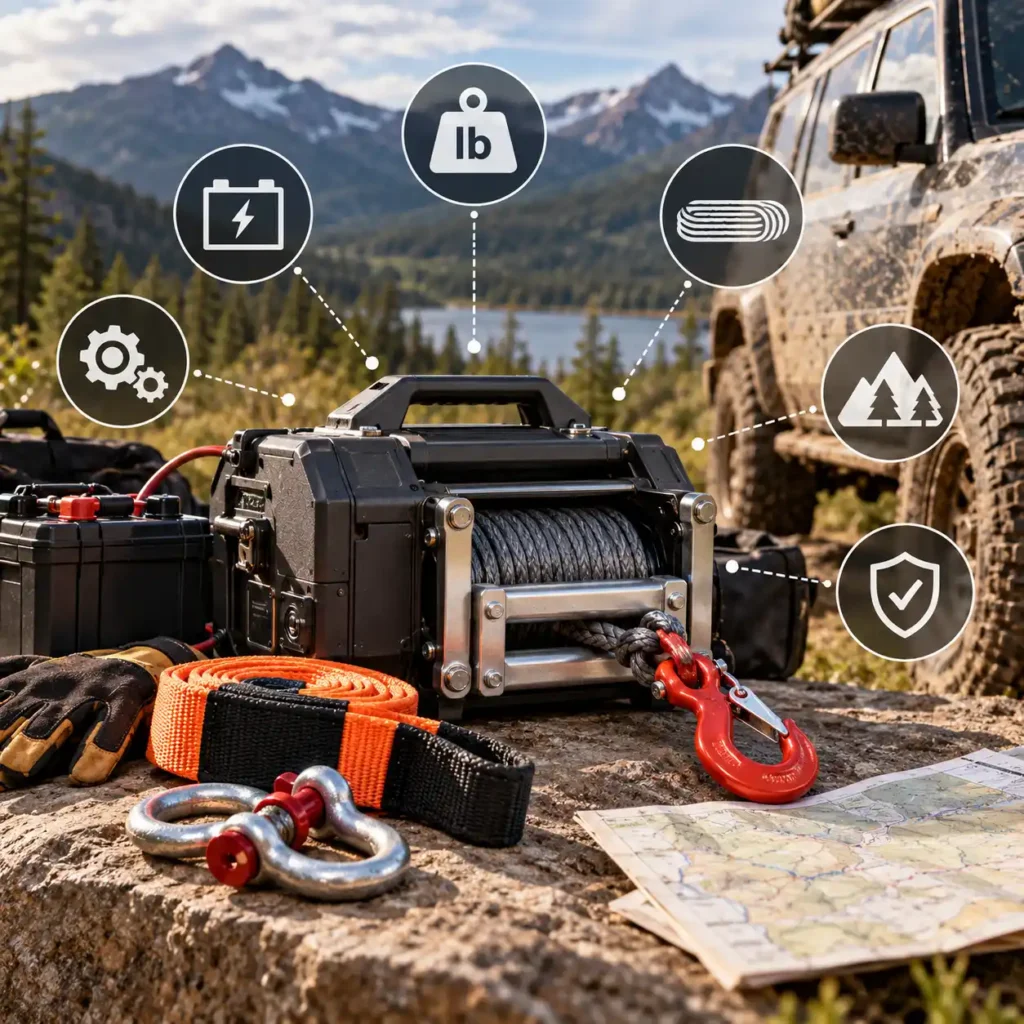
Choosing a portable vehicle recovery winch involves more than comparing the pulling capacities printed on product listings. The right equipment must match your vehicle’s loaded weight, expected terrain, power availability, recovery method, and storage requirements. A compact cordless winch may be convenient for occasional light-duty pulling, while a conventional 12V electric model may be more appropriate for a heavier vehicle that regularly travels on challenging off-road routes.
Before purchasing, evaluate the following factors to determine which type of portable winch is suitable for your camping or overlanding setup.
1. Calculate the Required Pulling Capacity
Start with the vehicle’s actual operating weight rather than its advertised curb weight. Include passengers, fuel, camping equipment, recovery gear, roof racks, bumpers, spare tires, and other accessories normally carried during a trip.
A widely used starting guideline for vehicle recovery is to select a winch with a rated line pull of at least 1.5 times the vehicle’s Gross Vehicle Weight Rating (GVWR). For example, a vehicle with a GVWR of 6,000 lb would require a winch rated for at least 9,000 lb under this guideline.
This is a starting point, not a guarantee that the winch will handle every recovery. Deep mud, soft sand, steep gradients, and a vehicle resting against obstacles can increase the force required considerably. The winch manufacturer’s specifications and the actual recovery conditions must guide the final decision.
Another detail worth understanding is that a conventional drum winch generally produces its highest rated line pull on the first rope layer around the drum. As additional layers accumulate, the effective pulling capacity decreases. Do not assume that the headline capacity remains unchanged throughout the entire rope length.
2. Choose the Right Winch Design
Portable winches use different mechanisms, and their operating methods are not interchangeable. Consider how the equipment will be powered, positioned, and connected to the load.
Portable Drum-Style Electric Winches
These use a motor and rotating drum to wind the rope during a pull. They may operate from a 12V vehicle electrical system or another specified power source. Their operating principle is similar to that of conventional vehicle-mounted recovery winches, although portable versions may use a carrying case or detachable mounting arrangement.
The VEVOR 6000 lbs model in our comparison is an example of a box-style drum winch. It offers a more conventional electric winching arrangement but requires a suitable 12V power supply and a properly secured operating position.
Cordless Capstan Winches
Capstan models pull rope through friction around a rotating drum rather than storing the entire working rope on a conventional winch drum. Some use removable battery systems, allowing operation without a direct connection to the vehicle’s electrical system.
The SuperHandy model reviewed above illustrates this design. Its cordless configuration offers positioning flexibility, but its pulling capacity and operating procedure make it more suitable for selected light-duty applications than demanding recovery of a heavy 4×4.
Drill-Powered Winches
These use a compatible portable drill to drive the winch mechanism. They can be compact and convenient for occasional pulling tasks, particularly when the user already carries suitable power tools.
The SINOKING model is an example of this arrangement. Before choosing this type, check the drill connection, torque requirements, operating instructions, and pulling capacity. A drill-powered utility winch should not automatically be treated as a substitute for a dedicated automotive recovery system.
3. Check the Power Source and Electrical Requirements
A winch may have sufficient advertised pulling capacity but still be unsuitable if its power requirements cannot be met in the field.
For a 12V electric model, check the required battery capacity, maximum current draw, cable gauge, connection type, and manufacturer’s wiring instructions. High-capacity electric winches can draw substantial current under load, so an ordinary accessory socket is not an appropriate substitute for the specified power connection.
Battery-powered models require a different assessment. Check battery voltage, capacity, compatibility, charging arrangements, and expected operating limitations. Do not assume that batteries from other products within the same brand will work unless the manufacturer confirms compatibility.
For drill-powered models, verify that your drill is suitable for the specified drive connection and operating requirements. The drill’s availability does not automatically mean it can safely deliver the required torque.
If you regularly travel away from established roads, consider how you will recharge batteries or maintain a reliable power supply when a recovery takes longer than expected.
4. Compare Synthetic Rope and Steel Cable
The rope is a critical part of the recovery system. Portable vehicle winches commonly use synthetic rope, while some conventional winches are available with steel cable.
Synthetic Rope
Synthetic rope is generally lighter and easier to handle than comparable steel cable. It can also be more convenient to carry and store in a camping vehicle. However, it needs protection from abrasion, sharp edges, excessive heat, chemical contamination, and UV exposure.
Inspect the rope regularly for cuts, worn sections, damaged fibers, and other signs of deterioration. Follow the manufacturer’s cleaning, storage, and replacement instructions.
Steel Cable
Steel cable is generally more resistant to certain forms of abrasion and heat, but it is heavier and can develop kinks, broken wires, and corrosion. Damaged strands can injure hands, so suitable gloves and careful inspection are essential.
Neither material is maintenance-free. Choose the rope type that matches the winch design, intended environment, and manufacturer’s recommendations. Never replace a supplied rope with a different diameter or construction without confirming compatibility.
5. Evaluate Mounting and Anchor Compatibility
A winch needs a secure and appropriately rated attachment arrangement. This is particularly important with portable equipment because the winch may not have the permanent mounting structure found on a professionally installed vehicle recovery system.
Check whether the model requires a mounting plate, vehicle-specific bracket, structural anchor, or another specified attachment method. Confirm that the mounting surface and all connecting components are suitable for the expected load.
Do not attach a recovery winch to decorative bumper sections, luggage racks, roof bars, tow points of unknown rating, or other components that have not been approved for the intended pulling force.
The same principle applies to the anchor point. A strong winch connected to an unsuitable anchor does not create a safe recovery system. The winch, mounting hardware, rope, hook, shackles, straps, and anchor must all be compatible with the planned operation.
6. Consider Rope Length, Controls, and Included Accessories
The advertised pulling capacity is only one part of the product specification. Practical details can affect how easily the equipment can be positioned and operated.
Before buying, compare:
Rope length: Make sure the supplied rope provides sufficient working reach for the situations you expect to encounter.
Remote controls: Wired and wireless controls offer different operating arrangements. Check their compatibility, cable length, and advertised wireless range.
Fairlead: Confirm that the fairlead is suitable for the rope material and diameter.
Hooks and connectors: Check their ratings and compatibility with the rest of the recovery equipment.
Straps: Identify whether the supplied straps are intended for anchoring, tree protection, or another specific purpose. Do not assume that every strap is suitable for vehicle recovery.
Pulley block: A correctly rated snatch block can provide mechanical advantage in a double-line arrangement, but it requires an appropriate anchor and suitable rigging.
Carrying and storage: Consider the complete package weight, dimensions, and whether the equipment can be secured inside your vehicle.
A package with several accessories is not automatically a better purchase. The important question is whether the supplied components are suitable for the intended recovery method and have clearly stated ratings.
7. Match the Winch to Your Terrain and Travel Style
Your usual destinations should influence the type of recovery equipment you choose.
For maintained forest roads, firm tracks, and occasional light pulling tasks, a compact portable tool may be sufficient for the work you actually expect to perform. However, frequent travel through deep mud, loose sand, steep trails, or remote areas places greater demands on the complete recovery system.
Consider how often you travel alone, how far you are from assistance, whether your vehicle is heavily equipped, and whether a recovery winch is intended to be your primary self-recovery tool or an additional piece of equipment.
For heavier vehicles and demanding routes, a properly rated conventional electric winch may be more appropriate than a small cordless or drill-powered model. A portable format should never take priority over sufficient capacity, compatible mounting, and reliable operation.
8. Understand the Limits of the Complete Recovery System
A winch does not operate independently of the other equipment in a recovery setup. Every component must be appropriate for the load and the chosen pulling arrangement.
Before purchasing, consider whether you also need:
A correctly rated snatch block for suitable double-line pulls.
A tree-saver or anchor strap designed for the intended application.
Rated shackles or compatible recovery connectors.
A suitable line damper where recommended by the recovery equipment manufacturer.
Protective gloves and other appropriate personal protective equipment.
A shovel and traction boards to reduce resistance before winching.
A suitable storage arrangement that protects the rope and keeps recovery accessories accessible.
A snatch block can change the mechanical advantage of a pulling arrangement, but it does not make an undersized or incorrectly installed winch safe. The anchor, connectors, mounting structure, and rope must all be suitable for the resulting loads.
The manufacturer’s instructions should always take priority over general buying guidelines. If the required pulling force, anchor rating, or installation method is uncertain, do not attempt the recovery until the setup has been assessed by someone qualified to do so.
Final Buying Consideration
The best portable vehicle recovery winch is not necessarily the model with the largest number in its product title or the most accessories in the box. It is the one whose rated capacity, operating mechanism, power source, mounting arrangement, and complete recovery system match the vehicle and the conditions in which it will be used.
For lighter outdoor pulling, a compact cordless or drill-powered option may be practical. For more demanding vehicle recovery, prioritize a properly rated electric winch with a compatible power and mounting arrangement. In either case, verify the exact product configuration before ordering and never use advertised pulling capacity as the only measure of suitability.
What Terrain Can a Portable Recovery Winch Handle?
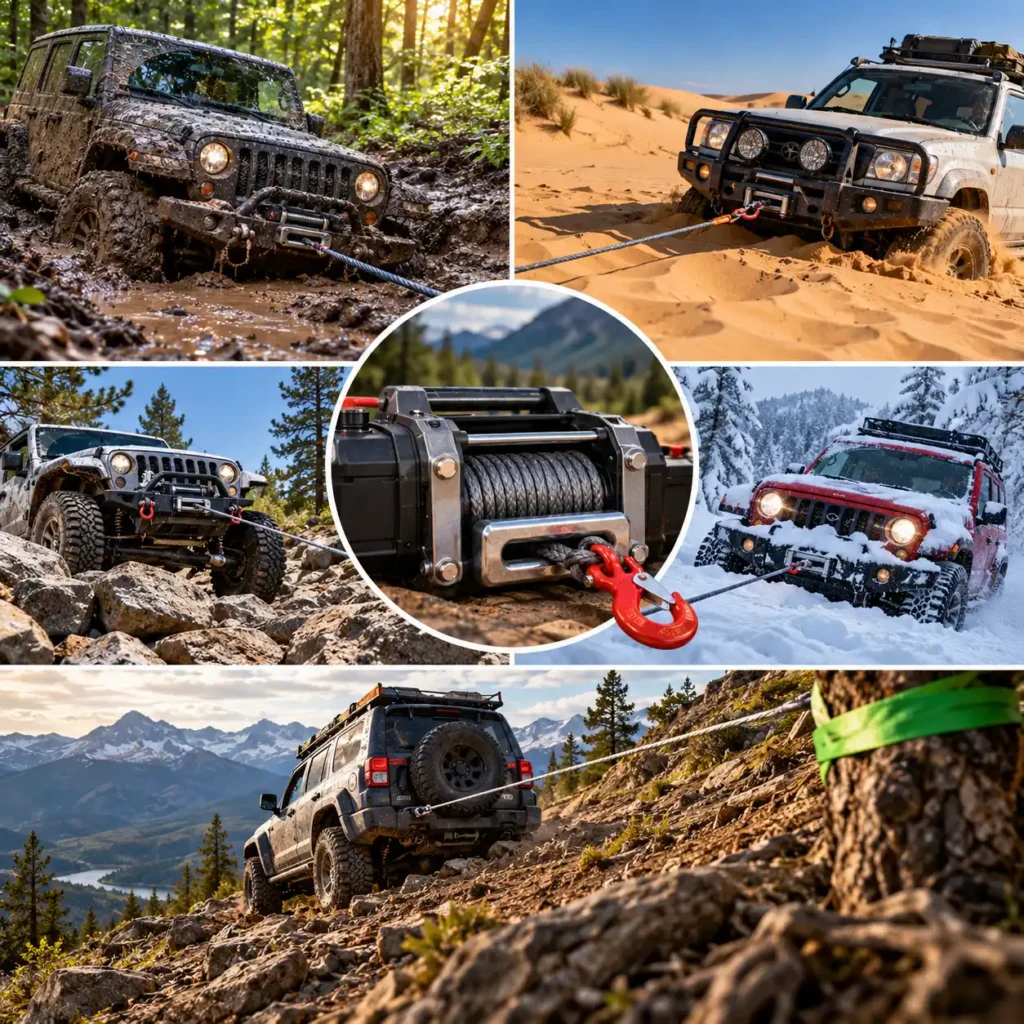
A portable vehicle recovery winch can provide valuable assistance when a 4×4, SUV, ATV, or other off-road vehicle becomes stuck away from paved roads. However, the difficulty of a recovery depends heavily on the surface beneath the tires, the vehicle’s position, and the resistance created by the surrounding terrain.
Pulling a vehicle across firm ground is very different from extracting it from deep mud or loose sand. The same winch may perform adequately in one situation and prove unsuitable in another. Understanding these differences helps drivers recognize when portable recovery equipment may be useful and when additional preparation or a more capable recovery system is necessary.
1. Muddy Trails and Soft Ground
Mud is one of the more demanding environments for vehicle recovery. As tires lose traction and sink into soft ground, resistance increases. Deep ruts can also leave the vehicle resting against the surrounding soil, making it harder to move even when the wheels are no longer spinning.
A properly rated portable winch may help pull a vehicle toward firmer ground, provided there is a suitable anchor point and the complete recovery setup can handle the expected load.
Before applying winch tension, consider whether some of the resistance can be reduced. Removing mud from around the tires, clearing obstacles, and using traction boards where appropriate may help the vehicle move with less pulling force.
What to consider:
Depth and consistency of the mud.
Whether the vehicle is resting on its underbody.
The distance to a suitable anchor point.
The condition of the rope and recovery connections.
Whether the winch has sufficient rated capacity for the expected load.
Deep mud can create substantial resistance. A compact cordless or drill-powered winch should not be assumed capable of recovering a heavily equipped SUV simply because its advertised pulling capacity appears close to the vehicle’s weight.
2. Loose Sand and Dune Terrain
Sand recovery presents a different challenge. Instead of gripping a firm surface, tires can dig into loose material and create additional resistance as the vehicle attempts to move forward or backward.
This is particularly relevant when driving on beaches, desert tracks, and sandy access roads. A vehicle that becomes bogged down may require more than a simple pulling attempt, especially if its chassis or differential is resting on the sand.
Before using a winch, reduce tire pressure only within the limits appropriate for the vehicle and tires, clear accumulated sand around the wheels, and consider using traction boards to establish a more stable path.
A winch can provide additional pulling assistance when a suitable anchor is available. However, open sandy areas may offer few reliable natural anchor points. A dedicated ground anchor may be required, and it must be suitable for the expected load and installed according to its manufacturer’s instructions.
What to consider:
How deeply the tires have sunk.
Whether the vehicle is resting on its underbody.
Availability of a suitable anchor.
The possibility of reducing resistance with traction boards.
Whether the winch and complete rigging system are rated for the recovery.
For frequent travel across dunes or remote sandy terrain, recovery equipment should be selected as part of a broader preparation plan rather than relying on a portable winch alone.
3. Gravel Roads and Loose Stones
Gravel roads are generally less demanding than deep mud or loose sand, but recovery conditions can still vary considerably. Loose stones may reduce tire traction, particularly on steep sections, while uneven surfaces can leave a vehicle positioned awkwardly against rocks or road edges.
A portable winch may be useful when a vehicle needs controlled assistance toward a more stable section of the trail. However, a gravel surface does not automatically make a recovery straightforward. The vehicle’s position, slope, and available anchor points remain important.
Pay particular attention to loose stones around the tires and under the vehicle. Moving obstacles away from the intended path may reduce resistance and help prevent additional damage during recovery.
What to consider:
Whether the vehicle is stuck because of lost traction or a physical obstacle.
Stability of the proposed anchor point.
Loose rocks that could move under tension.
The direction of the intended pull.
Whether the rope can be routed without contacting sharp edges.
Gravel can also increase abrasion risk. Protect synthetic rope from sharp stones and inspect it carefully after a recovery operation.
4. Snow, Ice, and Frozen Trails
Snow-covered roads and frozen trails can create difficult recovery conditions, especially when a vehicle loses traction on an incline or becomes buried in accumulated snow.
The level of resistance depends on snow depth, moisture content, temperature, and whether the vehicle is resting on packed or loose snow. Ice introduces another complication: tires may slide even when the vehicle is not deeply stuck.
A portable winch can provide controlled pulling assistance if a suitable anchor is available. Nevertheless, winching on snow and ice requires careful attention to vehicle movement, anchor stability, and the direction of the pull.
Before using the winch, clear snow from around the tires and underneath the vehicle where possible. Traction boards may help establish a path, while suitable winter recovery equipment can reduce the need for a prolonged pull.
What to consider:
Depth and condition of the snow.
Whether the vehicle is resting on compacted snow or ice.
Stability of the anchor in frozen ground.
Whether the vehicle may slide sideways during recovery.
Temperature-related limitations specified by the winch and battery manufacturers.
Do not assume that frozen ground always provides a secure anchor. Snow-covered or partially thawed surfaces can conceal weak soil, loose objects, and unsuitable attachment points.
5. Steep Slopes and Uneven Off-Road Trails
Steep terrain can increase the force required to move a vehicle, particularly when gravity acts against the direction of travel. Uneven trails may also create additional resistance if the tires lose contact with the ground or the vehicle becomes caught against rocks and obstacles.
A winch may assist with controlled movement on a slope, but this type of recovery requires particular care. The direction of the pull, anchor position, vehicle stability, and potential sideways movement all need to be assessed before tension is applied.
A winch should never be used to compensate for an unstable anchor or an unsuitable recovery angle. Side loading, sudden movement, and incorrectly positioned equipment can create serious hazards.
What to consider:
Steepness and direction of the slope.
Whether the vehicle could slide sideways or roll.
Stability and rating of the anchor point.
Rope alignment and potential contact with obstacles.
Whether a qualified recovery operator is needed.
If the vehicle is positioned at risk of rolling or sliding down a slope, do not attempt an improvised recovery. A more controlled recovery plan may require specialist equipment and experienced assistance.
6. Rocky Trails and Obstacle-Filled Terrain
Rocky trails can create recovery problems even when the surface itself is firm. A vehicle may become high-centered on a rock, lose traction while climbing an obstacle, or become trapped between uneven sections of the trail.
In these situations, the difficulty is not always the lack of traction. The vehicle may be physically resting against an obstacle, creating additional resistance that cannot be solved simply by increasing pulling force.
Before winching, inspect the vehicle’s position and identify what is preventing movement. Removing loose obstacles or changing the intended direction of travel may help, provided this can be done safely.
Synthetic rope requires particular protection in rocky environments. Sharp edges can damage fibers, while incorrect routing may expose the rope to abrasion during the pull.
What to consider:
Whether the vehicle is high-centered or mechanically obstructed.
Sharp rock edges near the intended rope path.
The direction in which the vehicle can move safely.
Anchor stability and recovery-point ratings.
Whether additional recovery equipment is needed to control the movement.
A higher-capacity winch is not automatically the answer to every rocky-trail recovery. The obstruction, vehicle position, and recovery geometry must be understood before pulling.
Can One Portable Winch Handle Every Type of Terrain?
No single portable winch should be assumed suitable for every off-road environment. A model designed for lighter pulling tasks may be useful on a relatively firm trail but inadequate when a heavy vehicle becomes deeply embedded in mud or sand.
The differences between the five products reviewed in this guide are particularly important:
Winch2Go 4000lb: A conventional 12V portable drum-style winch with a higher advertised pulling capacity than the cordless and drill-powered models.
SuperHandy Cordless Brushless Capstan Winch: A battery-powered capstan system intended for lighter pulling applications.
SINOKING Portable Universal Synthetic Free-Spool Winch: A drill-powered pulling tool with a more limited advertised capacity.
VEVOR 6000 lbs Box-Style Winch: A portable 12V drum-style electric winch with a higher advertised line pull and a carrying-case configuration.
Nilight Electric Winch: A conventional 12V vehicle-mounted winch option, with the exact capacity dependent on the selected variant.
These differences affect where each model may be appropriate. The intended terrain, vehicle weight, available power, anchoring arrangement, and recovery method should all be considered together.
Final Terrain Consideration
Terrain determines how much resistance a vehicle may encounter during recovery, but the surface alone does not tell you whether a particular winch is suitable. Vehicle position, slope, ground conditions, anchor stability, and the complete rigging system can change the demands of a recovery significantly.
For camping and overlanding, the most practical approach is to prepare for the conditions you are likely to encounter. Carry suitable traction equipment, inspect recovery accessories regularly, identify appropriate recovery points, and understand the operating limitations of your winch before travelling into remote areas.
A portable winch can be a valuable part of an off-road recovery setup, but it should never be treated as a guarantee that a vehicle can be extracted safely from every type of terrain.
Common Portable Winch Buying Mistakes to Avoid
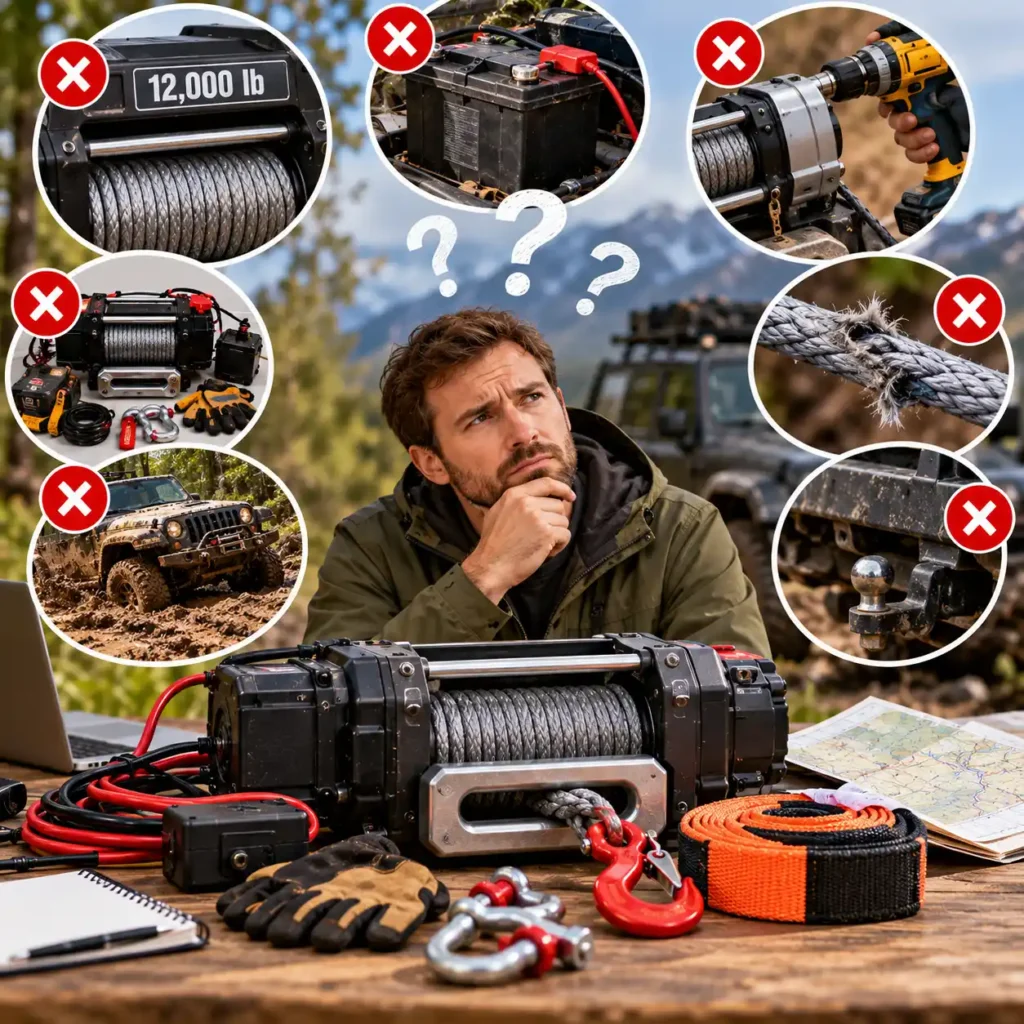
Buying a portable vehicle recovery winch without checking its actual specifications can lead to expensive mistakes. Two products may advertise similar pulling capacities but operate in completely different ways, require different power sources, or have very different mounting requirements. A winch that looks suitable in an online listing may also prove impractical once its weight, accessories, and installation requirements are taken into account.
Before choosing a model for camping or overlanding, watch out for these common purchasing mistakes.
1. Choosing a Winch Based Only on Its Advertised Pulling Capacity
A large number on a product title can make a winch look more capable than it really is. However, rated line pull is only one part of the specification, and it does not automatically establish whether the equipment is suitable for a particular vehicle.
The actual recovery requirement depends on the vehicle’s loaded weight, terrain, slope, obstacles, and resistance from the ground. A winch advertised at 6,000 lb, for example, should not automatically be considered suitable for every vehicle weighing less than 6,000 lb.
Buyers should also check whether the advertised figure refers to a single-line pull or a double-line configuration using a pulley. These are different arrangements and should never be presented as equivalent ratings.
How to avoid this mistake: Calculate the vehicle’s loaded weight, consider the conditions in which it will be used, and compare the manufacturer’s rated line pull with the expected recovery requirements. Treat headline capacity as a starting point, not a complete buying decision.
2. Confusing a Portable Winch with a Self-Contained Recovery System
The word portable can describe several different product designs. It does not necessarily mean that a winch contains everything needed to operate independently.
Some models require a direct 12V electrical connection, others use a removable battery, and drill-powered versions depend on a compatible external tool. Their operating requirements are therefore very different.
The five products in this guide illustrate the distinction:
Winch2Go: A portable 12V drum-style winch.
SuperHandy: A cordless 48V capstan winch.
SINOKING: A drill-powered pulling tool.
VEVOR: A 12V drum winch supplied in a box-style carrying case.
Nilight: A conventional vehicle-mounted 12V electric winch.
Assuming that all five can be taken out of storage and operated in the same way would be a significant purchasing mistake.
How to avoid this mistake: Identify exactly how the winch is powered, positioned, connected, and secured before ordering. Check whether it is a self-contained package or requires additional equipment and installation.
3. Ignoring Power Requirements and Battery Compatibility
A winch can have an appropriate pulling rating but still be unsuitable if the available power source cannot support its operation.
High-capacity 12V electric winches can draw substantial current under load. Their electrical requirements may include dedicated battery connections, specified cable sizes, suitable connectors, and a compatible vehicle electrical system.
Battery-powered models have different limitations. Buyers need to check battery voltage, capacity, compatibility, charging arrangements, and operating restrictions.
Drill-powered equipment introduces another potential problem: not every portable drill is suitable for driving a winch mechanism. The required connection and operating characteristics must match the manufacturer’s instructions.
How to avoid this mistake: Read the electrical or power-source specifications before comparing prices. Check battery compatibility and charging requirements, or confirm that your existing drill meets the winch manufacturer’s requirements. Never assume that a standard vehicle accessory socket or an unrelated battery will provide a suitable power connection.
4. Buying the Wrong Product Variant
This is particularly important when purchasing through Amazon. Product families often contain several visually similar models with different pulling capacities, rope lengths, motor specifications, and included accessories.
A product title or main image may represent the entire product family rather than the exact configuration selected in the order.
The Nilight model in this guide demonstrates why this matters: the marketplace information associated with the selected ASIN has conflicting 12,000 lb and 13,500 lb capacity descriptions. These figures cannot simply be treated as interchangeable.
How to avoid this mistake:
Check the exact ASIN and selected product variant.
Confirm the pulling capacity displayed for that specific configuration.
Compare the product description with the manufacturer’s model information.
Check the rope dimensions and motor specifications.
Review the contents of the selected package.
Make sure the order summary reflects the configuration you intended to buy.
Never assume that specifications from another product in the same listing apply to the variant you are purchasing.
5. Overlooking Mounting and Anchoring Requirements
A portable winch still needs a suitable way to transfer pulling force to the vehicle or another load. The mounting arrangement and anchor point are structural parts of the recovery system, not minor accessories.
Some winches require a dedicated mounting plate or vehicle-specific bracket. Others use a portable base or an arrangement specified by the manufacturer.
A carrying case, luggage rack, decorative bumper section, or ordinary towball should never be assumed to provide a suitable recovery attachment point.
An incorrectly selected mounting system can compromise the entire operation, even when the winch itself has sufficient rated capacity.
How to avoid this mistake: Check the mounting instructions, bolt pattern, structural requirements, and approved recovery points before purchase. Confirm that the anchor, mounting hardware, and connecting equipment are rated for the intended application.
6. Assuming That All Synthetic Ropes Are Interchangeable
Synthetic rope is often selected because it is lighter and easier to handle than steel cable. However, not every synthetic rope is suitable for every winch.
Rope diameter, length, construction, rated strength, drum capacity, and fairlead compatibility all matter. A replacement rope that looks similar may not meet the manufacturer’s requirements.
Using an unsuitable rope can affect spooling, increase wear, or compromise the recovery system.
How to avoid this mistake: Check the exact rope specifications required by the winch manufacturer. Use approved replacement rope and compatible fairlead components. Do not substitute general-purpose utility rope for a winch-rated recovery line.
Regular inspection is also essential. Cuts, abrasion, damaged fibers, contamination, and heat damage can make synthetic rope unsuitable for further use.
7. Underestimating the Weight and Storage Space Required
A product described as portable is not necessarily lightweight or compact enough for every camping vehicle.
The VEVOR box-style winch, for example, weighs approximately 36.2 lb as listed by the manufacturer. That may be manageable in a vehicle-based setup, but it is a different proposition from carrying a small drill-powered tool.
Buyers sometimes compare the dimensions of the winch itself without considering the complete package. Battery chargers, cables, remotes, straps, hooks, and other accessories also occupy storage space.
How to avoid this mistake: Check the complete package weight and dimensions, not just the winch body. Decide where the equipment will be stored, how it will be secured during travel, and whether it can be accessed without unloading essential camping gear.
8. Treating Included Accessories as Proof of a Complete Recovery Kit
A product may arrive with straps, hooks, shackles, remotes, or other accessories. However, the presence of these components does not automatically mean that they are appropriate for every recovery application.
Different straps serve different purposes. A tree-protection strap, for example, should not be confused with a kinetic recovery strap. Similarly, a hook or connector must have an appropriate rating and be compatible with the rest of the system.
A pulley block can provide mechanical advantage in a suitable double-line arrangement, but it also changes the loads applied to the anchor and connecting components.
How to avoid this mistake: Check the intended purpose and working load limit of every accessory. Identify which components are actually included and which need to be purchased separately. Make sure the complete recovery arrangement is compatible with the winch manufacturer’s instructions.
9. Ignoring Duty Cycle and Operating Limitations
Electric recovery winches are not necessarily designed for continuous operation. Prolonged pulling under heavy load can generate substantial heat in the motor and electrical components.
A buyer who focuses only on maximum pulling capacity may overlook the manufacturer’s duty-cycle restrictions, recommended cooling periods, and operating limits.
Battery-powered models also have limitations related to available energy and sustained load. Their advertised motor power does not establish how long they can maintain a particular pulling force.
How to avoid this mistake: Read the operating manual before purchasing. Check the specified duty cycle, thermal protection, cooling requirements, and any restrictions on continuous operation. Do not assume that a higher-capacity winch can operate indefinitely at its maximum rating.
10. Waiting Until an Emergency to Learn How the Winch Works
A recovery situation on a remote trail is a poor time to discover that the rope is routed incorrectly, the controls are unfamiliar, or the mounting arrangement is unsuitable.
Different winch designs have different operating procedures. A drum winch, capstan winch, and drill-powered pulling tool should not be treated as interchangeable equipment.
Incorrect rope handling, unsuitable attachment points, and poorly planned recovery arrangements can create serious hazards.
How to avoid this mistake: Read the manufacturer’s instructions and become familiar with the specific equipment before travelling. Inspect the winch, controls, rope, mounting hardware, and accessories. Where appropriate, practise basic setup and operation in a controlled environment with suitable training and supervision.
Never stand in the path of a tensioned rope, place hands near moving components, or exceed the manufacturer’s load limits. Use appropriate protective equipment and keep bystanders clear of the recovery area.
Final Buying Advice
The most expensive mistake is choosing a winch that does not match the vehicle or the way it will actually be used. A high advertised pulling capacity cannot compensate for an inadequate power supply, unsuitable mounting system, incompatible rope, or incorrectly rated recovery accessories.
Before placing an order, verify the exact model and variant, calculate the expected recovery requirements, check every power and mounting requirement, and understand what is included in the package. A carefully selected winch is more useful than a higher-rated product that cannot be operated or installed correctly in your vehicle.
For camping and overlanding, reliability comes from the complete recovery setup rather than one specification printed on a product page.
Portable Winch Setup, Recovery Safety & Maintenance
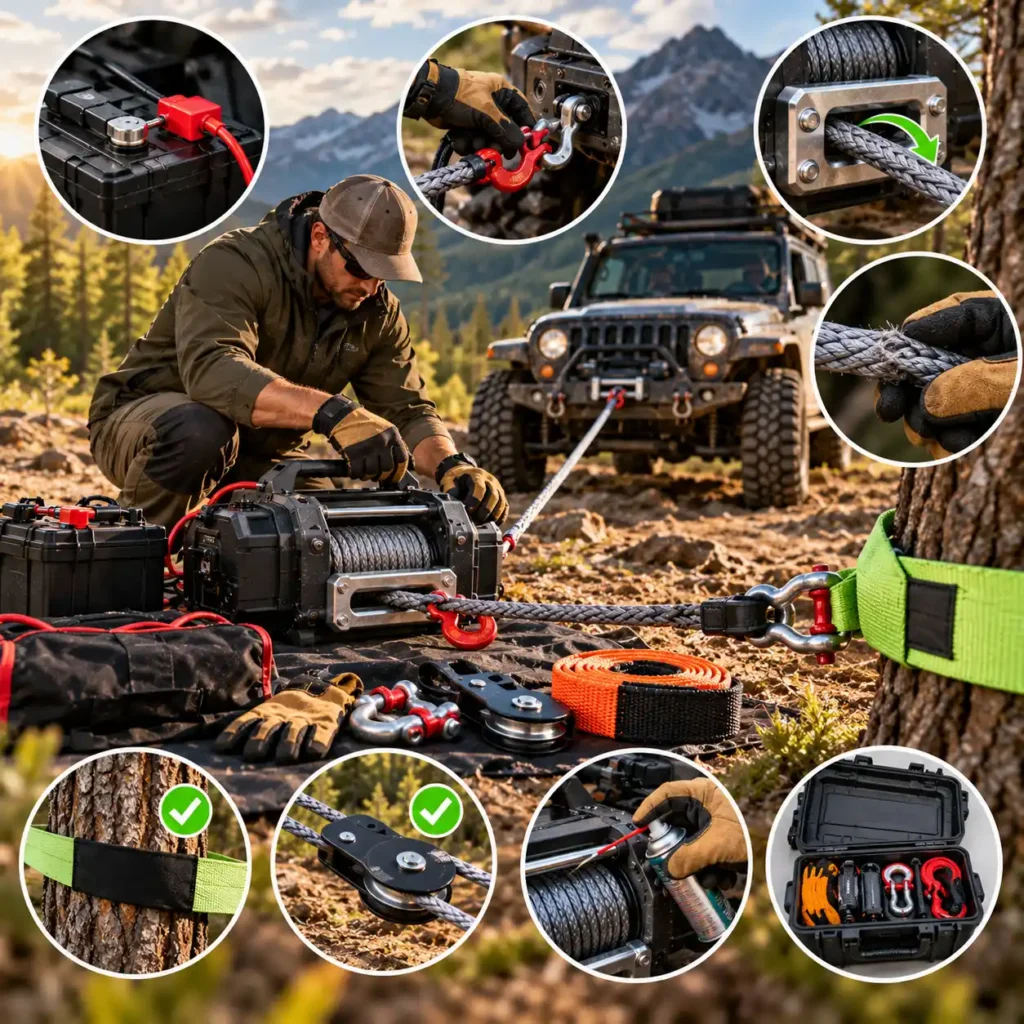
A portable vehicle recovery winch needs more than sufficient pulling capacity to operate reliably. Its mounting arrangement, power connections, rope condition, anchor point, and recovery accessories all influence the safety and effectiveness of a recovery operation.
For camping and overlanding, preparation is particularly important because equipment may remain stored for extended periods before being needed on a remote trail. A winch that has not been inspected, tested, or maintained may not perform as expected when a vehicle becomes stuck.
The following practices cover the main stages of preparing, operating, inspecting, and storing portable recovery equipment.
1. Inspect the Winch Before Installation or Use
Before connecting a portable winch, examine the complete unit and its accessories. Look for visible damage, loose components, corrosion, worn connections, and signs of previous impact.
Pay particular attention to:
Winch housing: Check for cracks, deformation, damaged covers, and loose fasteners.
Rope or cable: Look for cuts, abrasion, broken strands, flattened sections, corrosion, or other visible damage.
Hooks and connectors: Inspect latches, attachment points, pins, and locking mechanisms.
Fairlead: Check for sharp edges, deformation, or damage that could affect rope movement.
Remote controls: Inspect buttons, cables, connectors, and battery condition where applicable.
Electrical components: Look for damaged insulation, loose terminals, corrosion, and exposed wiring.
Mounting hardware: Confirm that brackets, bolts, and connection points are in suitable condition.
Do not operate equipment with damaged components or uncertain load ratings. Replace defective parts with manufacturer-approved or correctly rated alternatives.
2. Prepare the Power Supply and Connections
The correct power setup depends on the winch design. A conventional 12V electric winch, cordless capstan winch, and drill-powered model have different operating requirements.
For 12V electric winches, follow the manufacturer’s wiring instructions and use the specified cables, connectors, and battery arrangements. High-current models can place substantial demands on the electrical system, so unsuitable wiring or improvised connections should never be used.
For battery-powered equipment, check the battery charge, compatibility, terminals, and condition. Carrying a spare battery is only useful if the manufacturer confirms that the additional battery is compatible with the particular model.
For drill-powered winches, verify the drive connection and drill requirements before operation. Do not force an incompatible drill into the coupling or assume that a more powerful drill automatically makes the setup suitable.
Before travelling, make sure you know how the winch receives power and what additional equipment is required to operate it.
3. Select a Suitable Mounting and Anchor Point
A winch must be connected to a structurally suitable mounting arrangement and an appropriate anchor. Both are essential parts of the recovery system.
Depending on the model, the winch may require a dedicated mounting plate, a specified portable base, or another manufacturer-approved arrangement. The anchor must also be suitable for the expected load.
Natural objects such as trees should never be assumed to provide a reliable anchor simply because they appear large. Their condition, root structure, ground stability, and the suitability of the attachment arrangement all matter.
When using a tree as an anchor, use an appropriate tree-protection strap rather than wrapping a winch rope or cable directly around the trunk. Never attach recovery equipment to an unverified bumper, luggage rack, roof bar, or ordinary towing accessory.
The winch manufacturer’s instructions should determine the approved mounting and anchoring arrangements. If the strength or suitability of an attachment point is uncertain, do not use it.
4. Prepare the Recovery Area Before Applying Tension
A recovery should be planned before the winch is operated. Assess the vehicle’s position, the direction of the intended pull, the condition of the ground, and the location of everyone nearby.
Where possible, reduce unnecessary resistance before attempting to move the vehicle. Clearing loose material around the tires, removing suitable obstacles, and using traction boards may help reduce the force required.
Before starting, consider:
Whether the vehicle is stable and unlikely to roll or slide unexpectedly.
Whether the intended pulling direction is appropriate.
Whether the anchor and all connections are suitable.
Whether the rope can move without contacting sharp edges.
Whether the recovery area is clear of bystanders.
Whether the operator has a clear view of the equipment and vehicle.
If the vehicle is positioned on a dangerous slope, is at risk of rolling, or is trapped in a situation that requires specialist recovery equipment, avoid an improvised winching attempt.
5. Follow Safe Winching Practices
Winch operation involves stored mechanical energy. A tensioned rope, cable, hook, or connector can create a serious hazard if a component fails or the load moves unexpectedly.
Always follow the operating manual for the exact model. General safety practices include:
Keep Clear of the Tensioned Line
Never stand directly in front of, behind, or close to a tensioned rope or cable. Keep passengers and bystanders away from the recovery area, including locations where a failed component could travel.
Use Appropriate Personal Protective Equipment
Wear suitable protective gloves when handling recovery rope, hooks, and connectors. Follow the manufacturer’s recommendations for additional protective equipment.
Avoid Sudden Shock Loads
Do not use abrupt acceleration or sudden movements to increase pulling force. Shock loading can place excessive stress on the winch, rope, anchor, and connecting hardware.
Monitor the Entire Recovery
The operator should maintain a clear view of the operation and stop if the rope begins to bunch, move incorrectly, or contact an obstacle. Unusual noises, excessive heat, electrical problems, or unexpected vehicle movement are reasons to stop and reassess the setup.
Respect Duty-Cycle Restrictions
Electric winches are not necessarily designed for continuous operation at high loads. Follow the manufacturer’s specified operating periods and cooling intervals. Do not continue pulling if the motor or electrical components show signs of overheating.
Never Exceed Rated Limits
The winch, rope, hook, straps, pulley, mounting hardware, and anchor must all be suitable for the intended load. The capacity of the complete system is limited by its components, not just the number printed on the winch housing.
6. Protect Synthetic Rope During Recovery
Synthetic rope is convenient for portable recovery equipment, but it needs careful handling. Abrasion, sharp edges, contamination, heat, and incorrect spooling can reduce its service life.
Before and after use, inspect the rope for:
Cuts, fraying, or damaged fibers.
Flattened or unusually worn sections.
Discoloration or signs of heat exposure.
Embedded dirt, sand, or other abrasive material.
Knots, twists, or irregular spooling.
Damage near the hook connection or termination point.
Use a compatible fairlead and follow the manufacturer’s rope-routing instructions. Avoid dragging synthetic rope over sharp rocks or metal edges.
If the rope shows damage that could compromise its strength, remove it from service and replace it according to the manufacturer’s recommendations. Do not attempt to restore a damaged recovery rope with improvised repairs.
7. Clean and Inspect the Winch After Use
Off-road recovery equipment is often exposed to mud, sand, water, and dust. These materials can accumulate around the rope, drum, fairlead, housing, and electrical connections.
After a recovery operation, clean the equipment according to the manufacturer’s instructions. Remove loose dirt and inspect areas where mud or sand may interfere with moving components.
For synthetic rope, use only an approved cleaning method. Allow it to dry as recommended before storage. Avoid aggressive chemicals, excessive heat, and cleaning methods that could damage the rope fibers.
Also check the following:
The rope has been spooled correctly.
Hooks and connectors have no visible damage.
Electrical terminals are clean and secure.
Remote controls and cables remain in good condition.
The housing and mounting hardware have not been damaged.
No unusual wear has developed during the recovery.
If the winch has been exposed to significant water, mud, or an unusually heavy load, consult the manufacturer’s inspection and maintenance instructions before returning it to service.
8. Store Recovery Equipment Correctly
Proper storage helps protect the winch between camping and overlanding trips. The equipment should be kept clean, dry, and protected from unnecessary impact or contamination.
A suitable storage arrangement should:
Protect synthetic rope from prolonged sunlight and abrasion.
Keep hooks, straps, shackles, and connectors together.
Prevent the winch from moving around inside the vehicle.
Protect electrical cables and remote controls from damage.
Keep batteries within the manufacturer’s recommended storage conditions.
Separate wet or dirty recovery equipment from clean camping supplies.
Do not leave a portable winch unsecured in the cargo area. A heavy piece of recovery equipment can become dangerous during sudden braking or an accident.
Battery-powered models also require attention during longer storage periods. Follow the manufacturer’s instructions for battery charge level, temperature, charging intervals, and storage conditions.
9. Maintain a Recovery Equipment Inspection Routine
A winch should not be inspected only when it is needed. Regular checks help identify problems before a remote trip.
A practical maintenance routine can include:
| Inspection Item | What to Check |
|---|---|
| Before each trip | Rope condition, hooks, connectors, housing, controls, and mounting hardware |
| Before operation | Power supply, battery charge, anchor arrangement, rope routing, and recovery area |
| After recovery | Rope damage, mud or sand contamination, electrical connections, and unusual wear |
| After wet or muddy use | Cleaning, drying, corrosion inspection, and component condition |
| During extended storage | Battery condition, rope protection, moisture, and secure equipment storage |
| According to the manual | Manufacturer-specified servicing, replacement intervals, and inspections |
Keep the manufacturer’s manual with your recovery equipment or save a digital copy that can be accessed without an internet connection.
Final Safety and Maintenance Consideration
A portable recovery winch is only as dependable as the condition of its components and the quality of the recovery setup. Regular inspections, correct power connections, suitable mounting and anchoring, careful rope handling, and proper storage all contribute to reliable operation.
For camping and overlanding, the best time to discover a problem with recovery equipment is at home, before leaving for a remote trail. Do not wait until a vehicle becomes stuck to check whether the winch, battery, rope, controls, and accessories are ready for use.
Frequently Asked Questions About Portable Vehicle Recovery Winches
What size winch do I need for a 4x4 vehicle?
The required winch capacity depends on the vehicle’s loaded weight, recovery conditions, and the type of winch. A common starting point for a conventional vehicle-mounted recovery winch is a rated pulling capacity of approximately 1.5 times the vehicle’s gross vehicle weight. However, this is a guideline, not a universal guarantee of safe recovery performance. Mud, steep inclines, deep sand, and other high-resistance conditions can substantially increase the pulling force required. Always check the manufacturer’s recommendations and the ratings of the complete recovery system.
Is a 4,000 lb portable winch enough to recover an SUV?
Not necessarily. A 4,000 lb winch may be useful for lighter utility tasks, trailers, or selected recovery situations, but its single-line rating does not automatically make it suitable for recovering a typical SUV. A vehicle’s actual recovery load can be considerably higher than its static weight, particularly when it is deeply stuck or pulling uphill. For a full-size SUV or 4×4, a properly rated vehicle-recovery winch is generally a more appropriate choice than assuming a compact 4,000 lb unit will be sufficient.
Can a portable winch recover a vehicle stuck in deep mud?
A portable winch can assist with a mud recovery, but success depends on its pulling capacity, the vehicle’s resistance, the anchor point, and the recovery configuration. Deep mud can create substantial suction around the tires and underbody, making the vehicle much harder to move than its weight alone suggests. A snatch block can provide mechanical advantage when used with correctly rated equipment, although it also reduces line speed and does not eliminate the need for adequate capacity. Before winching, clear packed mud where possible and assess whether the anchor and recovery points can safely withstand the load.
Can I power a 12V portable winch using my car battery?
Yes, many 12V electric winches are designed to operate from a suitable vehicle battery. However, compatibility involves more than simply matching the voltage. High-capacity winches can draw several hundred amps under heavy load, so battery condition, cable gauge, connection quality, and the vehicle’s electrical system all matter. Some demanding recovery applications may require an auxiliary battery or a dedicated power arrangement. Follow the winch manufacturer’s wiring instructions, use correctly rated cables, and never substitute improvised connections for the specified electrical setup.
What is the difference between a capstan winch and a drum winch?
A drum winch winds its rope or cable around a rotating drum. Its pulling capacity, line speed, and rope arrangement depend on the winch design and the amount of rope remaining on the drum. A capstan winch works differently: the rope wraps around a rotating capstan drum, while the operator manages the free end of the line. This design can be useful for pulling over longer distances without storing the entire rope on a drum. However, capstan and drum winches should not be compared solely by their advertised pulling figures. Their operating methods, intended applications, and recovery capabilities are different.
Is synthetic winch rope better than steel cable?
Synthetic rope is generally lighter and easier to handle than steel cable of comparable application, making it attractive for portable recovery equipment. It also avoids some of the handling problems associated with damaged or kinked steel cable. However, synthetic rope needs protection from abrasion, sharp edges, excessive heat, and prolonged UV exposure. Steel cable has different maintenance requirements and can be more resistant to certain types of abrasion, but it is heavier and may develop dangerous broken strands. Neither option is automatically safer in every situation: inspect the line regularly and follow the manufacturer’s replacement criteria.
Can I use a cordless drill winch to recover a stuck car?
A drill-powered winch should not automatically be treated as a vehicle-recovery winch. Compact models with ratings around 1,500 lb are generally better suited to light-duty pulling tasks, such as moving equipment or assisting with selected trailer and utility applications. Their capacity, drive mechanism, duty cycle, and intended use may not be appropriate for extracting a stuck SUV or 4×4. Before considering one for vehicle recovery, verify the manufacturer’s permitted applications and all load ratings. A drill-powered design is not a substitute for a properly rated recovery system.
Do I need a snatch block when using a portable winch?
A snatch block is not required for every recovery, but it can be a valuable part of a properly equipped winching system. Used in a suitable double-line configuration, it can provide mechanical advantage and reduce the load on the winch. It can also help redirect the pulling line when the recovery layout permits it. The block, shackles, straps, anchor, and other connected components must all have appropriate working load limits. Remember that a pulley arrangement changes the forces and line travel involved; it does not make an undersized or incorrectly anchored winch safe.
Can I use a portable winch without a tree or another fixed anchor point?
A winch needs a suitable, secure anchor point to generate a controlled pulling force. A tree is one possible option, but only if it is healthy, sufficiently strong, and protected with a correctly rated tree-trunk protector. Other possibilities include an appropriately engineered vehicle anchor, a suitable ground anchor, or another approved recovery point. The anchor must be capable of withstanding the expected load and pulling direction. Never attach a winch to an ordinary tow ball, an unverified bumper component, or a convenient object simply because it appears strong.
Is a 6,000 lb portable winch suitable for a full-size 4x4?
A 6,000 lb rating should not be assumed sufficient for recovering a full-size 4×4. Many conventional vehicle-mounted recovery winches intended for larger 4×4 vehicles have substantially higher rated capacities. The correct choice depends on the vehicle’s loaded weight, the manufacturer’s guidance, the recovery conditions, and the winch’s actual configuration. A 6,000 lb box-style model may be more appropriate for selected ATV or UTV applications than for a heavy SUV or full-size off-road vehicle. Check the exact model’s specifications rather than relying on the headline capacity alone.
How often should I inspect and maintain a portable winch?
Inspect the winch before and after use, especially following a demanding recovery. Check the rope or cable for abrasion, cuts, deformation, or other damage; examine the hook, fairlead, mounting hardware, electrical connections, and remote controls; and look for signs of overheating or water ingress. Clean and dry the equipment according to the manufacturer’s instructions before storage. Electric winches also need cooling periods during operation because they are generally designed for intermittent rather than continuous heavy-duty use. Follow the maintenance schedule in the product manual and replace damaged components before the next recovery.
Final Verdict: Which Portable Recovery Winch Should You Choose?
Choosing a portable vehicle recovery winch is not simply a matter of selecting the highest pulling-capacity figure. The five models in this guide represent different approaches to portable pulling equipment, and their practical value depends on how you intend to use them. A compact cordless capstan, a drill-powered utility winch, and a 12V box-style recovery unit serve different purposes. Treating them as interchangeable could lead to an unsuitable purchase.
The most important distinction is between equipment designed for general pulling tasks and a winch intended to recover a vehicle under substantial load. A model may be convenient to transport and easy to store without having the capacity, mounting arrangement, or power system required for demanding off-road recovery.
For buyers who want a self-contained 12V system, the Winch2Go and VEVOR box-style designs deserve attention, but they address different vehicle and load requirements. The Winch2Go package offers a compact recovery-oriented configuration, while the VEVOR model provides a higher advertised pulling rating in a larger box-style format. Neither should be selected without confirming the exact product variant, vehicle compatibility, and the ratings of the included recovery components.
The SuperHandy cordless capstan offers a different advantage: it avoids the need for a direct 12V vehicle connection and is easier to position for suitable light-duty pulling tasks. Its lower rated pulling force, however, places clear limits on its role in vehicle recovery. The SINOKING drill-powered model is even more specialized. Its compact format may appeal to users who need occasional utility pulling, but it should not be mistaken for a conventional 4×4 recovery winch.
The Nilight model represents another important distinction. It is a conventional 12V electric winch rather than a self-contained portable box-style unit. Its suitability depends on the installation, power supply, and exact capacity variant. The conflicting capacity information associated with the selected Amazon listing makes verification particularly important before purchase.
The Most Important Buying Consideration
Before choosing any of these products, establish the actual recovery requirements of your vehicle. Consider its fully loaded weight, the terrain you travel, the likelihood of deep mud or steep inclines, and whether you have suitable recovery points and anchors. Also account for the complete system: rope, hook, fairlead, straps, shackles, snatch block, electrical connections, and mounting equipment.
A winch’s advertised pulling capacity is only one part of that assessment. The ratings of the other components and the manufacturer’s operating instructions must also support the intended application.
Our Final Recommendation
For occasional equipment movement and light-duty pulling, a compact cordless or drill-powered model may offer the portability you need. For more substantial recovery applications, prioritize a properly rated 12V recovery system with a suitable mounting arrangement and verified specifications. Do not choose a lower-capacity portable winch simply because it is lighter, cheaper, or advertised as suitable for off-road use.
Ultimately, the right purchase is the one that matches your vehicle, recovery conditions, and operating requirements—not necessarily the model with the most impressive headline specification. If the product listing, manufacturer documentation, or included components leave important questions unanswered, resolve those uncertainties before relying on the winch in the field.
About the Author
CampComfortGuide Editorial Team
The CampComfortGuide Editorial Team researches camping equipment, vehicle-based travel gear, and practical outdoor solutions to help readers make informed purchasing decisions. Our editorial approach focuses on product specifications, manufacturer documentation, equipment compatibility, real-world use cases, and the limitations that matter when choosing outdoor gear.
For this guide, we compared portable vehicle recovery winches by their advertised pulling capacity, power source, construction, portability, rope configuration, and intended applications. Product specifications and listing details were reviewed to identify important differences between compact utility winches and equipment designed for vehicle recovery.
Our goal is to provide clear, practical information that helps campers and overlanders select equipment suited to their vehicles, travel conditions, and recovery requirements.