
A campground power pedestal may look perfectly normal, but the electricity coming from it is not always as predictable as it should be. Low voltage, excessive voltage, wiring faults, reverse polarity, and other shore-power problems can put your RV appliances and electrical system at risk. A proper electrical management system helps detect these conditions before bad power reaches your rig.
That makes choosing the right RV electrical management systems for camping about more than comparing surge ratings or buying the most expensive unit. A basic surge protector may warn you about certain problems, while a full EMS can monitor incoming shore power and automatically disconnect your RV when dangerous electrical conditions are detected.
In this guide, we compare five RV electrical management systems designed for real campground use, covering both 30A and 50A RV hookups and different budgets and feature priorities. We look beyond headline specifications to examine protection capabilities, diagnostics, portability, smart monitoring, durability, and which type of RV setup each model actually makes sense for.
The goal is simple: help you choose the right level of electrical protection for your RV camping setup without paying for features you do not need—or saving money where it could leave your RV exposed.

Table of Contents
Quick Answer
The best RV electrical management systems for camping are designed to do more than absorb electrical surges. A full EMS can monitor incoming campground shore power and disconnect your RV when it detects dangerous conditions such as low or high voltage, wiring faults, or other power problems.
For most RV campers, the right choice comes down to three questions: Do you have a 30A or 50A RV? Do you want portable or hardwired protection? And do you need smart monitoring or just automatic protection? A 30A and 50A system are not interchangeable, so your RV’s actual shore-power service should determine which model you buy.
In this guide, we compare five RV electrical management systems for camping across different price points and use cases, including portable 30A and 50A units, smart monitoring, automatic shutdown, and full protection against common campground electrical faults.
For most campers, a full EMS is the better choice than a basic surge-only protector when automatic shutdown and protection from sustained voltage or wiring problems are priorities. The extra protection matters because campground power can fail in ways that a surge-only device may only indicate—or not address at all.
Why You Can Trust This Guide
Choosing an RV electrical management system is not simply a matter of finding the unit with the highest surge rating or the longest feature list. The important question is how well the system protects an RV when connected to unpredictable campground shore power. That means looking at voltage monitoring, wiring-fault detection, automatic shutdown, amperage compatibility, weather resistance, diagnostics, and long-term practicality.
For this guide, we evaluated the five selected models using manufacturer specifications, product documentation, current market information, owner feedback, and the electrical protection features that matter most for real campground use. We also considered how each model fits different RV electrical setups, including 30A and 50A service, portable connections, and campers who want basic protection versus more advanced monitoring.
We do not treat manufacturer marketing claims as proof of real-world performance. Where products offer similar protection, we look at the details that can actually change the buying decision—such as fault detection, automatic power disconnection, display and diagnostic information, smart monitoring, portability, replacement components, warranty coverage, and price.
That approach matters because the current RV EMS market contains both genuinely comprehensive electrical management systems and simpler surge-protection devices that are sometimes grouped together under the same “RV surge protector” label. The distinction is important: a full EMS is designed to monitor incoming shore power and disconnect the RV when unsafe electrical conditions are detected, rather than simply absorbing transient surges.
Our goal is not to recommend the most expensive RV electrical management system. It is to identify which model makes the most sense for a particular RV camping setup, budget, and level of protection.
What Makes This Guide Different?
RV electrical management systems can look remarkably similar at first glance. Most have a weather-resistant housing, a 30A or 50A connection, surge protection, and some form of electrical fault monitoring. The important differences only become clear when you look at how each system behaves in an actual campground situation.
That is the approach we take in this guide. Instead of treating every RV EMS as another collection of specifications, we focus on the decisions that matter once you arrive at a campsite: 30A or 50A service, portable installation, protection from low and high voltage, campground wiring faults, diagnostic information, smart monitoring, and the level of protection you actually need.
We also separate features that improve protection from features that mainly improve convenience. A Wi-Fi connection, app monitoring, or replaceable surge module can be valuable, but they do not automatically mean a system provides better fundamental electrical protection. Conversely, a less expensive model may be the better choice when it already provides the protection your RV requires.
Most importantly, we do not rank these systems simply from most expensive to least expensive. Each recommendation is designed around a specific camping situation, so a reader can quickly determine which RV electrical management system makes the most sense for their own RV, campground routine, and budget.
That makes this guide less about choosing the most impressive device on paper—and more about choosing the right electrical protection for the way you actually camp.
How We Selected the Products
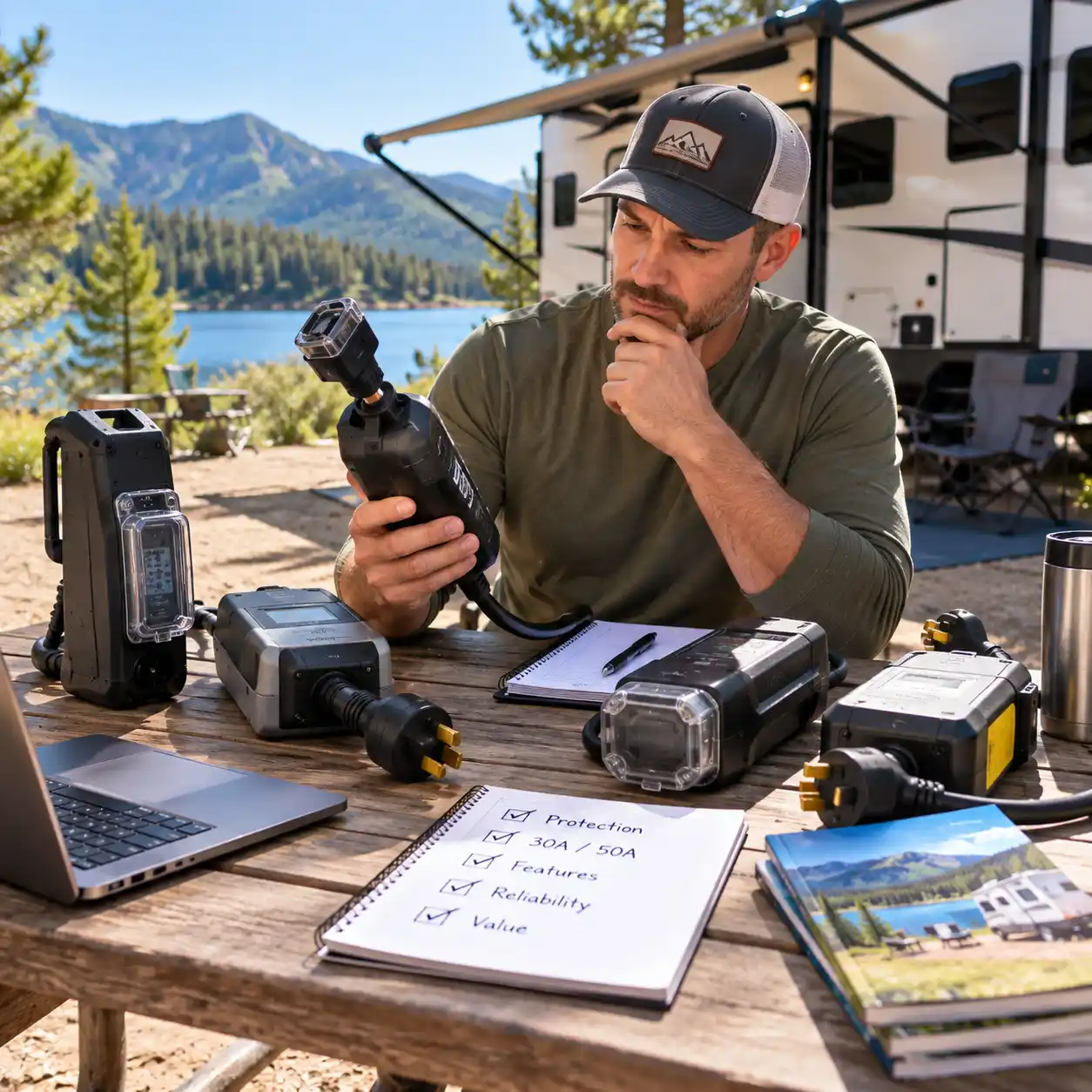
Choosing the best RV electrical management systems for camping requires looking beyond surge ratings and price. The five models in this guide were selected to represent the most useful combinations of 30A and 50A compatibility, electrical protection, diagnostics, monitoring, portability, and overall value for campground use.
We focused first on the protection features that can make a meaningful difference when an RV is connected to shore power, including low- and high-voltage monitoring, wiring-fault detection, surge protection, and automatic power disconnection. These are the functions that distinguish a full EMS from a basic surge-only device.
We then looked at how each model fits different camping situations. A weekend camper who wants a straightforward portable unit has different priorities from an RV owner who wants smart monitoring, a higher-capacity 50A system, or more detailed electrical diagnostics. Current RV buying guides also consistently separate these decisions by 30A vs. 50A, portable vs. hardwired, and basic surge protection vs. full EMS.
Price was another important part of the selection. Rather than filling the list with five nearly identical premium units, we chose products that occupy different positions in the market, allowing the comparison to answer a more useful question: which system gives you the protection and features you actually need without paying for capabilities you will never use?
Finally, we considered manufacturer documentation, current product information, owner feedback, and the way each device is intended to function in real campground environments. The result is a five-model lineup designed around different RV camping needs, not simply a ranking based on the most impressive specifications.
Who Should Buy an RV Electrical Management System for Camping?
An RV electrical management system is worth considering for campers who regularly connect their RV to campground shore power and want protection that goes beyond a basic surge-only device. The biggest benefit is not simply handling a sudden electrical surge—it is monitoring the incoming supply for conditions such as abnormal voltage and wiring faults and disconnecting the RV when the power is unsafe.
This category makes the most sense for several types of RV campers:
Campers who use powered campgrounds frequently. If your RV routinely moves from one campground pedestal to another, you are repeatedly connecting your electrical system to shore-power infrastructure that can vary from site to site. An EMS provides a layer of protection each time you plug in.
RV owners with expensive or electrically sensitive equipment. Air conditioners, refrigerators, converters, inverter-chargers, televisions, computers, and other onboard electronics can make electrical problems considerably more expensive than the cost of a good EMS. Sustained low voltage is particularly important because a simple surge-only protector is not designed to address it.
Campers who want automatic protection rather than a warning alone. Some devices primarily indicate that a problem exists, while a full EMS can monitor the incoming supply and disconnect power when a dangerous condition is detected. That distinction is one of the most important things to understand before buying.
30A and 50A RV owners who want protection matched to their electrical service. Your RV’s shore-power connection determines which class of EMS you need. Choosing the correct amperage is not an optional specification to compare after the purchase—it is the starting point for selecting a compatible unit.
A full EMS is less compelling for someone who rarely uses electrical hookups or normally camps without shore power. In those situations, the value of campground power protection may not justify carrying and purchasing a dedicated device.
The simplest rule is this: if your RV regularly plugs into campground electricity, an EMS becomes much more relevant; if you rarely use shore power, its benefits are correspondingly smaller.
Quick Summary: Our Top RV Electrical Management System Picks
If you do not have time to read the full guide, the five picks below give you the shortest path to the right RV electrical management system for camping based on your RV’s electrical service, protection needs, and preferred features.
There is no single EMS that is best for every camper. A straightforward 30A system may be the smarter choice when you want dependable automatic protection without paying for connected features, while a 50A model makes more sense for larger RVs with higher-capacity shore power. Smart systems become more attractive when remote monitoring, mobile alerts, or a replaceable surge module are important to you.
Our picks are therefore based on different RV camping needs, not simply a ranking from first to fifth.
Progressive Industries EMS-PT30X
Award: Best Overall 30A
Why It Won:
The Progressive Industries EMS-PT30X offers one of the strongest combinations of full EMS protection, straightforward operation, detailed diagnostics, and reasonable cost in the 30A category. It is particularly appealing for campers who want comprehensive electrical protection without paying extra for Wi-Fi or app-based monitoring. Current comparisons continue to position the PT30X as a value-focused full EMS rather than a basic surge protector.Choose This If:
- You have a 30A RV shore-power connection.
- You want full EMS protection without smart monitoring.
- You prefer reading electrical information directly from the unit.
- You want strong protection without moving into premium pricing.
Best For:
- 30A travel trailers
- Smaller motorhomes
- Frequent campground campers
- Buyers who prioritize protection over connected features
Progressive Industries EMS-PT50X
Award: Best 50A Value
Why It Won:
The EMS-PT50X brings the same straightforward Progressive approach to 50A RV electrical service, making it a strong choice for campers who want full EMS protection without paying for a smart monitoring platform. It is the logical step up for larger RVs that use 50A shore power and need protection matched to that electrical service.Choose This If:
- Your RV uses a 50A shore-power connection.
- You want full EMS protection without an app.
- You prefer a portable system that can move between campsites.
- You want to keep the purchase focused on electrical protection rather than extra connectivity.
Best For:
- 50A Class A motorhomes
- Fifth wheels
- Larger travel trailers
- Campers looking for strong 50A value
Hughes Autoformers Power Watchdog PWD30EPOW
Award: Best Smart 30A EMS
Why It Won:
The Power Watchdog PWD30EPOW takes the core EMS concept and adds Wi-Fi and Bluetooth monitoring, mobile reporting, automatic emergency power-off, and a replaceable surge module. Its biggest advantage is not simply a higher specification number—it is the additional information and control available when you want to keep an eye on your RV’s electrical supply remotely.Choose This If:
- You have a 30A RV.
- You want remote monitoring from your phone.
- You leave your RV connected at a campground for extended periods.
- You value a replaceable surge module.
Best For:
- 30A RV owners who want smart monitoring
- Campers with extended campground stays
- RVers who want mobile alerts
- Buyers willing to pay more for connected features
Hughes Autoformers Power Watchdog PWD50EPOW
Award: Best Smart 50A EMS
Why It Won:
The PWD50EPOW brings Power Watchdog’s smart monitoring approach to 50A RV electrical service, combining full EMS protection with connected monitoring and a replaceable surge module. It is aimed at larger RV owners who want more visibility and control rather than simply the lowest-cost way to protect their shore-power connection.Choose This If:
- Your RV uses 50A shore power.
- You want Wi-Fi or Bluetooth monitoring.
- You value remote visibility into campground power.
- You prefer a replaceable surge module instead of replacing the complete unit after a major surge event.
Best For:
- 50A Class A motorhomes
- Fifth wheels
- Full-time and extended-stay RV campers
- Buyers who want premium monitoring features
Southwire Surge Guard 34931
Award: Best Diagnostics-Focused Alternative
Why It Won:
The Southwire Surge Guard 34931 stands out by combining portable RV electrical protection with a strong emphasis on electrical fault detection and diagnostics. Southwire’s full-protection systems are designed to respond to conditions including voltage problems, wiring faults, reverse polarity, open neutral, overheating, and miswired pedestals, making this an appealing alternative for campers who want detailed protection beyond surge-only coverage.Choose This If:
- You want more than basic surge protection.
- Detailed electrical fault information matters to you.
- You frequently move between campground pedestals.
- You prefer Southwire’s approach to RV electrical protection and monitoring.
Best For:
- Frequent campground campers
- RV owners who prioritize diagnostics
- Campers who want broad fault monitoring
- Buyers comparing Progressive and Hughes with Southwire
Compare the Best RV Electrical Management Systems at a Glance
Choosing between these systems becomes much easier when the differences are placed side by side. The most important starting point is your RV’s 30A or 50A shore-power service, followed by the type of protection, monitoring features, and overall level of convenience you expect at the campground.
The table below focuses on the specifications and features that can actually change a buying decision. Rather than giving extra weight to headline surge ratings alone, we emphasize service compatibility, EMS protection, monitoring, portability, and the features that distinguish one model from another.
| Model | 30A / 50A | EMS | Smart Monitoring | Portable | Best For |
|---|---|---|---|---|---|
| Progressive Industries EMS-PT30X | 30A | Yes | No | Yes | Best Overall 30A |
| Progressive Industries EMS-PT50X | 50A | Yes | No | Yes | Best 50A Value |
| Hughes Power Watchdog PWD30EPOW | 30A | Yes | Wi-Fi & Bluetooth | Yes | Best Smart 30A |
| Hughes Power Watchdog PWD50EPOW | 50A | Yes | Wi-Fi & Bluetooth | Yes | Best Smart 50A |
| Southwire Surge Guard 34931 | 30A | Yes | Wireless / App | Yes | Best Diagnostics |
One of the clearest patterns is that the Progressive Industries models prioritize straightforward EMS protection, while the Hughes Power Watchdog models add connected monitoring and other convenience features. Southwire takes a different approach with a strong emphasis on electrical fault detection and diagnostics.
The most important rule is simple: match the EMS to your RV’s shore-power service before comparing anything else. A 30A RV needs a 30A-compatible system, while a 50A RV needs a 50A system designed for that service. The two electrical configurations should not be treated as interchangeable.
The detailed reviews below explain where each model earns its place, where it falls short, and which type of RV camper should actually spend the extra money on its additional features.
The 5 Best RV Electrical Management Systems for Camping in 2026
1. Progressive Industries EMS-PT30X
Award: Best Overall 30A
The Progressive Industries EMS-PT30X is our Best Overall choice for campers with a 30A RV because it focuses on the part of campground power protection that matters most: monitoring incoming shore power and disconnecting the RV when electrical conditions become unsafe. Rather than adding smart features simply for the sake of connectivity, it concentrates on comprehensive electrical management, on-unit diagnostics, and straightforward portable operation.
For RV campers who move between campgrounds, the EMS-PT30X is particularly compelling because every new electrical pedestal becomes an unknown variable. The unit checks the incoming 30A / 120V supply for conditions including low or high voltage, wiring faults, polarity problems, frequency issues, and other potentially damaging electrical conditions before allowing power to reach the RV. Its documented protection package, digital display, and portable design have made it one of the most established 30A EMS choices in the RV market.
Its biggest strength is not a headline specification such as surge-joule capacity. It is the combination of full EMS functionality, detailed electrical diagnostics, automatic shutdown, and long-term value in a relatively straightforward package. The absence of Wi-Fi or app monitoring is a real limitation for some buyers, but it also means you are not paying for connected features that may have little value if you simply want dependable shore-power protection at the campground.

Quick Verdict
The Progressive Industries EMS-PT30X is one of the strongest choices for a 30A RV camper who wants comprehensive campground electrical protection without turning the system into a connected smart device. It monitors incoming shore power, performs a startup electrical check before supplying the RV, and can disconnect power when the incoming supply falls outside its programmed safety limits.
The unit is built around a 30A / 120V RV electrical system and provides 1,790 joules of surge protection along with monitoring for several common campground electrical faults. Its digital display provides useful information at the pedestal, allowing you to see electrical conditions and identify why the EMS has refused or interrupted power.
One of the most technically interesting aspects of the EMS-PT30X is its staged response to high voltage. Progressive documents different response times depending on how far the voltage rises above the normal range rather than treating every overvoltage event as identical. That is an unusually useful piece of information when evaluating an EMS because the device’s core job is deciding when power should be disconnected, not simply advertising a large surge rating.
The trade-off is that the EMS-PT30X has no Wi-Fi, Bluetooth, or mobile app monitoring. You need to read its information at the electrical pedestal itself. For a camper who values simple, dedicated protection, that is perfectly reasonable; for someone who wants to monitor campground voltage from inside the RV, a smart EMS such as the Hughes Power Watchdog is the more natural alternative.
Camp Snapshot
| Category | Progressive Industries EMS-PT30X |
|---|---|
| RV Service | 30A / 120V |
| Maximum Power | 3,600W |
| Surge Protection | 1,790 joules |
| System Type | Full portable EMS |
| Voltage Protection | Low and high voltage monitoring |
| Electrical Fault Monitoring | Open ground • Open neutral • Reverse polarity • Frequency • Miswired conditions |
| Automatic Shutdown | Yes |
| Display | Digital diagnostic display |
| Smart Monitoring | No |
| Portable Design | Yes |
| Best For | 30A RV campers who want comprehensive shore-power protection without smart connectivity |
Why We Chose It
The EMS-PT30X earned the Best Overall 30A position because it solves the most important problem in this category without unnecessarily complicating the solution.
When you arrive at a campground, you generally have no practical way to know whether the pedestal is delivering clean, correctly wired power simply by looking at it. The EMS-PT30X sits between that pedestal and the RV’s shore-power cord, checks the incoming electrical supply, and prevents power from reaching the RV when the monitored conditions are outside its acceptable range. That makes the device useful not only during dramatic surge events, but during the much less obvious voltage and wiring problems that can occur at campground hookups.
The second reason we selected it is the quality of the diagnostic approach. Many shoppers naturally compare joule ratings first, but an EMS is ultimately a monitoring and decision-making device. The PT30X reports electrical information through its digital display and uses defined thresholds and response times for different abnormal conditions. Progressive’s documented staged high-voltage response is especially notable: the system reacts differently to moderately elevated voltage and to much more severe overvoltage conditions instead of relying on one simplistic cutoff.
That makes the PT30X particularly attractive for campers who want to know why power has been rejected, not simply that something went wrong. If the campground pedestal has a wiring fault or voltage problem, the diagnostic information can help distinguish an issue with the campground supply from a problem inside the RV.
There is also a practical ownership advantage in keeping the system deliberately simple. The PT30X has no app, no subscription-dependent monitoring layer, and no requirement to configure a wireless ecosystem before using it. You connect it to the pedestal, allow it to complete its electrical checks, and then connect the RV. The roughly two-minute startup sequence is part of the designed testing and delay process rather than a malfunction.
That simplicity does come with a clear compromise: you have to be physically near the EMS to see its information. Hughes’ Power Watchdog models are more attractive when remote monitoring is a priority because they add Wi-Fi/Bluetooth connectivity and mobile reporting. But those additions address monitoring convenience rather than changing the basic role of the EMS, which is why we still see the Progressive as the stronger choice for the camper who wants dependable protection first.
Finally, the PT30X has something that matters for a piece of equipment intended to stay with you across many camping seasons: a lifetime warranty, although current documentation and reviews indicate that warranty eligibility depends on conditions such as being the original owner and purchasing through an authorized seller. That makes the purchase more attractive, but it is important not to treat the warranty as unconditional.
Check today’s price and latest customer reviews on Amazon.

Living With It at Camp
The Progressive Industries EMS-PT30X is designed to become part of your normal RV arrival routine rather than something you use only when a problem occurs. At a campground, the sequence is simple: connect the EMS to the 30A pedestal, let it complete its electrical checks, and then connect your RV’s shore-power cord. The system monitors the incoming supply continuously while your RV remains connected.
That initial wait is important to understand before your first trip. The EMS-PT30X takes roughly two minutes to complete its startup testing before supplying power to the RV. The delay can feel excessive when you have just arrived on a hot afternoon and want to start the air conditioner immediately, but it is part of the system’s protection process rather than a defect. The unit evaluates the pedestal before allowing your RV to receive power and also uses a delay when restoring power after an interruption.
Once the RV is powered, the main advantage is that the EMS is watching for conditions that can remain dangerous even when there is no dramatic electrical surge. A campground pedestal can have low voltage, excessive voltage, an open neutral, an open ground, reverse polarity, or other wiring problems. The EMS-PT30X is designed to detect these conditions and disconnect the RV when its programmed protection thresholds are reached.
The digital display becomes particularly useful when something goes wrong. Instead of discovering that the RV has no power and having to guess whether the campground pedestal, the shore-power cord, or the RV itself is responsible, the EMS can provide diagnostic information at the point of connection. That makes it useful as both a protection device and a campground power diagnostic tool.
There is also a subtle advantage to the Progressive approach that becomes apparent over repeated trips. Its high-voltage protection is not documented as one simple on/off threshold. Progressive specifies different response times at 132V, 140V, and 156V, while its low-voltage protection disconnects when voltage remains below 104V for more than six seconds. That graduated response is unusual enough to be worth considering when comparing EMS units on technical behaviour rather than headline surge numbers.
The trade-off becomes clear when you compare it with the Hughes Power Watchdog models in this guide. The Progressive gives you the information at the pedestal, while the Hughes system adds Wi-Fi/Bluetooth connectivity and remote monitoring. In other words, the PT30X prioritizes the fundamentals of electrical protection and physical diagnostics; it does not try to turn your EMS into a smart-home accessory.
One practical consideration is weather exposure. The PT30X uses a weather-resistant Lexan housing, but recent reviews and owner reports have highlighted concerns around moisture entering near the cord-entry area. That does not make the unit unsuitable for campground use, but it does mean that proper connection, storage, and protection from prolonged water exposure should be part of normal ownership rather than an afterthought.
For a camper who moves from campground to campground, that combination is compelling: plug in, let the EMS evaluate the pedestal, read the diagnosis when necessary, and let the system handle abnormal electrical conditions without requiring a phone, app, or subscription.
CampComfortGuide Assessment
| Evaluation Category | Editorial Assessment |
|---|---|
| Electrical Protection | ★★★★★ Full EMS protection with low- and high-voltage monitoring, wiring-fault detection, and automatic power disconnection. |
| Campground Diagnostics | ★★★★★ The on-unit digital display provides useful fault information directly at the pedestal. |
| Ease of Use | ★★★★★ Simple portable connection once the startup diagnostic delay is understood. |
| Voltage Management | ★★★★★ Published protection thresholds include a graduated high-voltage response rather than a single cutoff point. |
| Smart Monitoring | ★★☆☆☆ No Wi-Fi, Bluetooth, or remote app monitoring. |
| Portability | ★★★★☆ Well suited to vehicle-based camping, although it is substantially larger than a basic surge-only protector. |
| Long-Term Value | ★★★★★ Strong feature set for a dedicated 30A EMS, supported by a manufacturer lifetime-warranty program subject to its terms. |
Who Should Buy This
The Progressive Industries EMS-PT30X is an especially strong choice for:
- 30A RV owners who regularly connect to campground shore power.
- Campers who want full EMS protection rather than surge-only protection.
- RVers who prefer straightforward equipment without Wi-Fi, Bluetooth, or app-dependent features.
- Campers who value on-device diagnostics and want to know why a campground pedestal has been rejected.
- Frequent travelers who connect to many different campground electrical pedestals during the year.
- Buyers who would rather spend their money on core protection than on remote-monitoring features.
Who Should Skip This
The EMS-PT30X is the wrong choice for a few specific situations.
Skip it if your RV uses 50A shore power. The electrical service has to match the EMS you purchase, so a 50A RV should use a properly matched 50A system rather than trying to adapt a 30A EMS to the job.
It is also not the best choice if remote monitoring is one of your main priorities. The PT30X cannot send voltage information or fault notifications to your phone. The Power Watchdog models are more appropriate when connected monitoring is worth paying extra for.
You should also think twice about it if you frequently buy used electrical equipment. Progressive’s lifetime warranty has meaningful conditions, including original-owner and authorized-seller requirements, so the warranty should not be treated as automatically transferable with a second-hand unit.
Finally, if you rarely use campground shore power at all, the value proposition changes. An EMS provides the most benefit when your RV is repeatedly exposed to campground electrical pedestals; for predominantly dry camping, there is much less opportunity to use the device.
Final Verdict
The Progressive Industries EMS-PT30X earns our Best Overall 30A award because it concentrates on the job an RV electrical management system is actually supposed to perform: evaluate campground shore power, identify dangerous electrical conditions, and protect the RV before those conditions become an expensive problem.
Its strongest advantage is not its 1,790-joule surge rating. It is the depth of the overall EMS system: low- and high-voltage protection, multiple wiring-fault checks, digital diagnostics, automatic disconnection, and a documented graduated response to increasingly severe high-voltage conditions.
The limitations are equally clear. There is no Wi-Fi or Bluetooth monitoring, the startup diagnostic cycle requires patience, and weather-exposure concerns mean owners should take care with the connection and storage of the unit. Its warranty is also not as simple as the words “lifetime warranty” might suggest, so buying from an authorized seller and retaining documentation matters.
For the right buyer, those trade-offs are easy to accept. If you own a 30A RV, use campground shore power regularly, and want serious electrical protection without paying extra for smart connectivity, the EMS-PT30X remains one of the most convincing choices in the category.
Check today’s price and latest customer reviews on Amazon.
Related Guide:
If you are building a vehicle-based camping power system that also needs to work away from campground shore power, our guide to Best Portable Power Stations for Vehicle Camping Setup covers battery-powered options for off-grid trips and mobile RV setups. The two products solve different power problems: an EMS protects the RV from campground shore power, while a portable power station provides stored electricity when shore power is unavailable. The vehicle-camping guide explains how portable battery power fits into a larger campsite setup.
2. Progressive Industries EMS-PT50X
Award: Best 50A Value
The Progressive Industries EMS-PT50X is our Best 50A Value choice for RV campers who need full electrical management for a larger shore-power system but do not need Wi-Fi or app-based monitoring. It takes the straightforward protection philosophy of the PT30X and applies it to the more demanding 50A RV electrical service, giving larger motorhomes, fifth wheels, and high-load travel trailers a portable EMS designed specifically for their shore-power configuration.
The reason we give it the Best 50A Value award is not simply because it is the 50A version of a popular 30A model. A 50A RV hookup operates as a 120/240V split-phase system with two 120V legs, so the EMS has to monitor a more complex electrical supply than a standard 30A RV connection. The PT50X is designed around that arrangement and monitors both legs for abnormal conditions before allowing unsafe power to continue into the RV.
Its combination of 3,580 joules of surge protection, comprehensive fault detection, automatic shutdown, digital diagnostics, and portable campground-ready operation gives it a strong position for RV owners who want serious protection without paying a premium for connected features. At the same time, its larger size and lack of remote monitoring make it less attractive to campers who prioritize portability above all else or want to watch electrical conditions from inside the RV.

Quick Verdict
The Progressive Industries EMS-PT50X is the straightforward choice for a 50A RV camper who wants full electrical management without paying extra for an app, Wi-Fi, or Bluetooth ecosystem. It is built specifically for 50A / 120–240V RV shore power and provides protection across the more complex two-leg electrical configuration used by larger RVs.
The most important difference between the PT50X and a typical 30A EMS is not simply the higher amperage number. A 50A RV service provides two 120V legs, and the EMS-PT50X is designed to monitor that supply accordingly. Progressive documents protection across line-to-neutral, neutral-to-ground, line-to-line, and line-to-ground relationships, along with low- and high-voltage monitoring, helping the system detect faults that may not be obvious from the campground pedestal itself.
The unit also doubles as a useful diagnostic tool. Its integrated display provides voltage and fault information at the pedestal, so when the EMS refuses to energize the RV, you have more information than simply “the power does not work.” The system’s documented low-voltage protection, for example, shuts the RV down when AC voltage remains below 104V for more than six seconds and begins a timed reconnection sequence once the voltage returns to an acceptable range.
The main compromise is convenience rather than protection. The PT50X is a relatively substantial portable device, and it has no Wi-Fi or Bluetooth remote monitoring. You have to read its display at the campground pedestal rather than checking voltage from inside the RV. For buyers who want a dependable, dedicated 50A EMS and prefer spending their budget on core electrical protection, that trade-off is reasonable. For buyers who specifically want mobile monitoring, the Hughes Power Watchdog PWD50EPOW later in this guide is the more feature-rich alternative.
Camp Snapshot
| Category | Progressive Industries EMS-PT50X |
|---|---|
| RV Service | 50A / 120–240V |
| Maximum Power | 12,000W |
| Surge Protection | 3,580 joules |
| System Type | Full portable EMS |
| Electrical Configuration | Two-leg 50A RV service |
| Voltage Protection | Low and high voltage monitoring |
| Fault Monitoring | Open neutral • Open ground • Reverse polarity • Frequency • Other monitored pedestal faults |
| Automatic Shutdown | Yes |
| Display | Digital diagnostic display |
| Smart Monitoring | No |
| Portable Design | Yes |
| Warranty | Limited lifetime warranty program, subject to manufacturer terms |
| Best For | 50A RV campers who want comprehensive shore-power protection without smart connectivity |
Why We Chose It
The EMS-PT50X earns its place in this guide because it solves a very specific problem well: protecting a higher-capacity RV electrical system when the rig is connected to campground shore power.
A 50A hookup is not simply a larger version of a 30A connection. The service uses two 120V legs, and a fault affecting one side can create a very different situation from a problem on the other. That is why the PT50X is built to monitor the electrical relationships within the 50A supply rather than treating the incoming power as one simple circuit. Its documentation specifies protection across multiple line-to-neutral, line-to-line, neutral-to-ground, and line-to-ground conditions.
That distinction becomes especially important for the type of RVs that normally use 50A service. Larger Class A motorhomes, fifth wheels, and high-demand travel trailers may have multiple air conditioners, residential refrigerators, induction cooking equipment, electric water heating, and other substantial electrical loads. The point of the EMS is not to create more available power; it is to make sure the power already coming from the pedestal is within safe limits before those loads are allowed to use it.
The PT50X also gives you considerably more surge capacity than the 30A PT30X, with a published 3,580-joule rating. However, we would not make the mistake of presenting those joules as the sole reason to buy the 50A model. For an EMS, the ability to identify abnormal voltage and wiring conditions and disconnect the RV is at least as important as the surge-absorption figure printed on the box.
Another reason the PT50X stands out is its integrated diagnostics. The display gives the camper useful information about the incoming electrical supply and reports fault codes when a condition falls outside the system’s acceptable operating range. This turns the device into something more useful than a passive protective component: it can help you determine whether an apparently dead campground hookup is actually an electrical problem at the pedestal.
The low-voltage behaviour is particularly relevant to RV camping. Progressive’s documentation specifies an automatic shutdown when the AC line remains below 104V for more than six seconds, followed by a timed reconnection process after voltage recovers. That matters because low voltage is not the kind of problem most campers can identify by looking at a campground pedestal, yet it can become especially important when high-demand RV equipment is running.
The PT50X also occupies an interesting middle ground in the current market. Premium smart EMS products such as the Hughes Power Watchdog add remote monitoring, app connectivity, and other convenience-oriented features. The Progressive takes the opposite route: put the emphasis on electrical management first, keep the interface at the pedestal, and avoid making connectivity part of the purchase decision.
That is precisely why we consider it Best 50A Value rather than Best Premium. You are paying for a serious 50A EMS and its protection capabilities, not for a collection of smart features that may or may not matter during your camping trips.
And there is one final practical advantage worth mentioning: the PT50X is portable. A camper can move it from one campground pedestal to the next instead of relying on a permanently installed EMS. For RVers who travel frequently and use different campsites throughout the year, that portability means the same protection system can follow the RV wherever the next campground happens to be.
The overall picture is therefore quite clear: the PT50X is not the smallest, smartest, or most feature-heavy 50A EMS. It is a focused protection system for campers who want the electrical-management fundamentals done properly without paying extra for connected technology.
Check today’s price and latest customer reviews on Amazon.

Living With It at Camp
The Progressive Industries EMS-PT50X makes the most sense when a 50A RV moves frequently between campgrounds and you want the same electrical protection routine at every stop. Because it is a portable EMS, you can carry it with the RV, connect it directly to the campground pedestal, allow the diagnostic sequence to run, and then connect the RV’s 50A shore-power cord.
The first thing new owners notice is the startup delay. The EMS does not immediately energize the RV simply because the pedestal appears to have power. It performs its initial checks and uses a delay before allowing electricity through. That can feel inconvenient after a long drive, especially when you arrive at a campsite on a hot day and want to start the air conditioner immediately, but the waiting period is part of the protection process. Current reviews and owner reports consistently identify this as normal behaviour rather than a defect.
Once the RV is connected, the PT50X continuously monitors the incoming electrical supply. This becomes particularly valuable with a 50A system because the RV is dealing with two 120V legs rather than a single 30A circuit. The display lets you see the electrical condition at the pedestal, while the EMS can interrupt power when a monitored condition falls outside its protection limits. That makes the unit useful not only as a protective device but also as a diagnostic checkpoint before you commit the RV’s appliances to campground power.
One of the strongest everyday benefits is what happens when campground voltage starts becoming unstable under load. A pedestal may look completely normal when you arrive, yet voltage can deteriorate later when many RVs are running air conditioners at the same time. The PT50X is designed to react to low voltage rather than waiting for a dramatic surge event. That is important for larger RVs because high-demand equipment can remain connected for hours at a time, making sustained voltage problems more relevant than a single visible power spike.
The digital display also gives the PT50X a practical advantage over simpler surge-only devices. When the system refuses to pass power, you have information to work with rather than simply discovering that the RV has no electricity. For frequent campground travelers, that diagnostic feedback can turn an uncertain situation into a much clearer decision: wait, move to another pedestal, or ask campground staff to correct the electrical problem.
There is, however, a trade-off that becomes more noticeable with repeated use: the PT50X is a substantial portable unit. Several current reviews describe its size and weight as a downside compared with smaller surge protectors. That matters less for a fifth wheel or Class A motorhome with generous storage than it does for a camper who is constantly trying to reduce the amount of equipment carried between trips.
The unit is also exposed to the same campground environment as the pedestal itself. Rain, condensation, heat, and long periods outdoors are part of the real ownership equation. Recent reviews and owner-feedback analyses have specifically raised moisture exposure and connection-heat concerns, so the best practice is to follow the manufacturer’s connection guidance carefully and avoid treating an outdoor electrical device as something that can simply be left unattended without regard to weather or connection quality.
Another point worth understanding is security. A portable EMS sits outside the RV at the pedestal, which means it can be forgotten, moved, or stolen. The PT50X includes a locking provision, and that is a genuinely useful camping feature rather than a specification that exists only on paper. A simple lock can make sense during longer campground stays, particularly when you leave the RV for several hours.
The PT50X deliberately does not try to solve every problem through a smartphone. There is no Wi-Fi or Bluetooth monitoring built into this model, so the electrical information remains available at the unit itself. That makes its ownership experience simpler than a connected EMS, but it also creates a clear dividing line between this model and the Hughes Power Watchdog options later in the guide. The Progressive is fundamentally about portable 50A electrical protection and diagnostics; the Hughes models add remote visibility for campers who want to monitor their RV’s electrical supply from a phone.
For a 50A RV owner, that combination creates a fairly straightforward camping routine: check the pedestal with the EMS, let it complete its test, connect the RV, and leave the system monitoring the supply while you camp. It is not the smallest or smartest solution in the category, but its job is very clear—and for many larger RVs, that simplicity is exactly what makes it attractive.
CampComfortGuide Assessment
| Evaluation Category | Editorial Assessment |
|---|---|
| Electrical Protection | ★★★★★ A comprehensive 50A EMS designed to monitor incoming campground power and disconnect the RV when unsafe conditions are detected. |
| 50A Monitoring | ★★★★★ Designed for the two-leg 50A RV electrical configuration, making it particularly suitable for larger RV electrical systems. |
| Diagnostics | ★★★★★ The integrated display gives useful information when the campground pedestal does not provide acceptable power. |
| Ease of Use | ★★★★★ Once the initial diagnostic delay is understood, the portable connection process is straightforward. |
| Portability | ★★★★☆ Portable enough for regular RV travel, but its substantial size and weight make it less attractive to minimalist campers. |
| Smart Features | ★★☆☆☆ No Wi-Fi, Bluetooth, or mobile monitoring. |
| Long-Term Value | ★★★★★ A strong choice for buyers who want to spend their budget on core 50A EMS protection rather than connected features. |
Who Should Buy This
The Progressive Industries EMS-PT50X is a strong fit for:
- RV owners with a 50A shore-power connection.
- Class A motorhome and fifth-wheel owners who regularly use powered campgrounds.
- Campers who want a full EMS rather than a basic surge protector.
- RVers who want electrical diagnostics available directly at the campground pedestal.
- Frequent travelers who connect to many different campground power pedestals throughout the year.
- Buyers who prefer a proven, straightforward portable EMS without paying extra for smartphone monitoring.
- Campers who want substantial surge protection combined with continuous voltage and electrical-fault monitoring.
Who Should Skip This
The PT50X is not the right fit for every RV camper.
Skip it if your RV uses 30A shore power. A 30A system needs a properly matched 30A EMS; the PT50X is designed for 50A service.
It is also a weaker choice if remote monitoring is a major priority. There is no built-in Wi-Fi or Bluetooth connection, so you cannot rely on a phone app to check the system while sitting inside the RV or away from the campsite. Hughes’ Power Watchdog models are better suited to that use case.
You may also prefer another model if you are highly sensitive to equipment size and weight. The PT50X is a serious portable EMS, not a tiny plug-in accessory, and that bulk becomes more noticeable when storage space is limited.
Finally, it is not the best choice for campers who rarely connect to campground shore power. The value of a portable EMS comes primarily from repeated exposure to campground electrical pedestals; if your trips are mostly dry camping, the device will spend much of its life stored away.
Final Verdict
The Progressive Industries EMS-PT50X earns our Best 50A Value award because it gives larger RVs the protection they actually need without forcing buyers into a premium smart-monitoring ecosystem.
Its biggest strength is the balance between full EMS functionality, 50A-specific electrical monitoring, automatic shutdown, useful diagnostics, and price. The 3,580-joule surge rating is substantial, but the more important feature is the broader protection system around it: the unit monitors incoming shore power and can prevent unsafe campground electricity from reaching the RV.
There are real compromises. The PT50X is bulky, it requires patience during its startup testing, it has no remote monitoring, and recent owner-feedback analyses indicate that moisture and connection-related issues deserve attention rather than being ignored.
Even with those limitations, the overall proposition is unusually clear. A 50A RV owner who wants serious shore-power protection, useful pedestal diagnostics, and a portable system without paying extra for connected features is getting exactly what they need.
For that reason, the EMS-PT50X remains one of the strongest value-oriented 50A RV electrical management systems for campground use.
Check today’s price and latest customer reviews on Amazon.
If you are putting together a complete vehicle-based camping setup, our guide to How to Build a Vehicle Camping Setup explains how power, sleeping, storage, and other essential systems fit together into one practical campsite. It can be especially useful when deciding where an RV electrical management system belongs within the larger camping setup.
3. Hughes Autoformers Power Watchdog PWD30EPOW
Award: Best Smart 30A EMS
The Hughes Autoformers Power Watchdog PWD30EPOW is the 30A RV electrical management system for campers who want more than automatic protection at the campground pedestal. Its main advantage is the combination of full electrical protection with built-in Wi-Fi and Bluetooth monitoring, allowing you to check voltage, amperage, wattage, fault conditions, and power status from a smartphone. The Gen II model also adds Emergency Power Off, a replaceable surge module, a lockable connection bay, and improved weather protection, making it particularly appealing for RV owners who want visibility as well as protection.

Quick Verdict
The PWD30EPOW stands out because it turns a portable 30A EMS into a connected monitoring system rather than leaving you dependent on the display at the campground pedestal. When plugged into shore power, it monitors the incoming electrical supply and can automatically disconnect the RV when it detects conditions outside its protection limits.
Its built-in Wi-Fi and Bluetooth are the main reason to choose this model over a simpler 30A EMS. Through the mobile app, you can monitor electrical conditions in real time, review detected faults, track energy consumption, and receive notifications when a problem occurs. That can be particularly useful during longer campground stays when you do not want to repeatedly walk outside to inspect the electrical connection.
The PWD30EPOW also includes Emergency Power Off, which provides automatic shutdown when a serious electrical problem is detected. Hughes specifies automatic shutdown when voltage falls below 104V or rises above 132V, with power automatically restored after conditions remain stable for at least 90 seconds. The replaceable surge module is another practical advantage because a major surge does not necessarily mean replacing the entire EMS.
This is not the most straightforward choice for every 30A camper. The connected features add value primarily when you will actually use smartphone monitoring, fault notifications, and remote power control. Campers who simply want reliable automatic protection without smart functionality may find the Progressive EMS-PT30X more focused and easier to justify.
Camp Snapshot
| Feature | Hughes PWD30EPOW |
|---|---|
| Service | 30A / 120V |
| Surge Protection | 2,400 joules |
| EMS Protection | Yes |
| Automatic Shutdown | Yes, EPO |
| Voltage Protection | Below 104V / Above 132V |
| Smart Monitoring | Built-in Wi-Fi & Bluetooth |
| Remote Power Control | Yes |
| Surge Module | Replaceable |
| Portability | Yes |
| Best For | 30A RV campers who want smart monitoring |
Why We Chose It
The biggest reason we included the PWD30EPOW is that it addresses a different problem from a conventional portable EMS: knowing what is happening with your RV’s electrical supply even when you are not standing beside the pedestal. For a camper who spends several days or weeks at one campground, that extra visibility can be much more useful than another small increase in a headline surge-protection number.
The built-in Wi-Fi and Bluetooth system gives the PWD30EPOW a distinctly different ownership experience. Instead of relying only on the unit’s physical indicators, you can use the mobile app to see electrical information such as voltage, amperage, and wattage and receive fault notifications. The Gen II model also supports remote cutting and restoring of power, which adds another layer of convenience for campers who regularly leave the campsite while the RV remains connected to shore power.
We also like the Emergency Power Off function because the smart features do not replace the core purpose of an EMS. The system is still designed to protect the RV automatically when incoming power becomes unsafe. That means the PWD30EPOW can serve as both a monitoring tool and an active protection device rather than simply functioning as a remote electrical meter.
The replaceable surge module is another important part of the design. Surge protection components can be sacrificed during a serious electrical event, and Hughes allows the module to be replaced rather than forcing you to discard the entire portable EMS. For frequent RV travelers, that can make the unit more practical over the long term.
The Gen II redesign also improves the physical side of campground use. The lockable connection bay, illuminated receptacle area, side-entry connection design, and improved weather protection are small details, but they matter when an EMS spends its life outside next to an RV electrical pedestal. These features make the PWD30EPOW feel more purpose-built for repeated campground use rather than simply being a smart electronic accessory.
There is, however, an important trade-off. The PWD30EPOW is most compelling when you actually want its connected features. A camper who has no interest in Wi-Fi monitoring, mobile notifications, energy tracking, or remote power control is paying for functionality that may remain unused. That is why we position this model as the Best Smart 30A EMS, rather than as the universal best 30A option for every RV.
Check today’s price and latest customer reviews on Amazon.

Living With It at Camp
The PWD30EPOW is designed around a simple campground routine: connect the EMS between the 30A pedestal and your RV, let it test the incoming power, and allow the unit to energize the RV only after the supply passes its checks. That initial verification is important because the Watchdog does not simply pass campground electricity through immediately; it checks the connection before supplying power to the RV.
Once the connection is active, the biggest difference compared with a conventional portable EMS is what happens after you walk away from the pedestal. With the Power Watchdog Gen II app, you can monitor electrical conditions from your phone rather than relying entirely on the information displayed on the unit outside. This is particularly useful during longer stays, bad weather, or situations where the RV is connected while you are away from the campsite.
The smart monitoring also makes the PWD30EPOW easier to use as an ongoing diagnostic tool. Instead of discovering a power problem only after an appliance stops working, you can see changes in the incoming electrical supply and receive an alert when the Watchdog detects a fault or disconnects the RV. That does not eliminate the need to investigate the campground pedestal or contact campground management when a problem occurs, but it gives you much better visibility into what happened.
The automatic shutdown system is equally important. Hughes specifies protection for abnormal voltage conditions, with the unit disconnecting the RV when incoming voltage drops to 104V or below or rises to 132V or higher. After a shutdown, the Watchdog continues monitoring the supply and can restore power after the required delay once conditions are acceptable. This behavior makes the unit useful not only as a surge protector but as an active barrier between questionable campground power and the RV’s electrical system.
There is also a practical advantage when the surge-protection module eventually sacrifices itself. The PWD30EPOW uses a replaceable Gen II surge module, so a protection event does not automatically mean replacing the entire EMS. Hughes sells the replacement module separately, and keeping one available can make sense for campers who travel frequently and do not want a failed surge component to leave them without their normal protection.
The main ownership trade-off is complexity. The PWD30EPOW gives you considerably more information than a basic portable EMS, but getting the full benefit requires setting up the correct Gen II app and Wi-Fi connection. The current Gen II system uses a dedicated app and requires a 2.4 GHz Wi-Fi connection for Wi-Fi setup. Bluetooth can still be used for the initial connection and communication, so the unit remains functional even when you do not use the app.
Its outdoor design also fits the realities of campground use, but that does not mean it should be treated as maintenance-free. The connection, cable, housing, and pedestal interface should still be checked regularly for damage, contamination, loose connections, or signs of overheating. Smart monitoring is an additional layer of information, not a substitute for sensible shore-power hookup practices.
CampComfortGuide Assessment
| Category | Rating | Our Assessment |
|---|---|---|
| Electrical Protection | 5/5 | Full 30A protection with automatic shutdown for dangerous electrical conditions. |
| Smart Monitoring | 5/5 | Built-in Wi-Fi and Bluetooth provide detailed monitoring and mobile notifications. |
| Diagnostics | 5/5 | Useful electrical information and fault reporting without requiring constant trips to the pedestal. |
| Automatic Shutdown | 5/5 | Emergency Power Off provides active protection when incoming power becomes unsafe. |
| Portability | 4/5 | Portable and designed for campground connections, but not as simple or minimal as a basic EMS. |
| Replaceable Surge Module | 5/5 | A replaceable module can extend the useful life of the unit after a surge event. |
| Ease of Use | 4/5 | Straightforward at the pedestal, but smart features require app setup and compatible Wi-Fi. |
| Long-Term Value | 5/5 | Strong value for campers who will actually use remote monitoring, alerts, and the replaceable protection module. |
Who Should Buy This
The Hughes PWD30EPOW makes the most sense for RV campers who want full EMS protection and real-time electrical visibility from a smartphone. It is especially well suited to people who spend several nights at powered campgrounds, travel frequently between different campgrounds, or want to know what is happening with the RV’s shore power without having to physically inspect the pedestal.
It is also a strong choice for RV owners who regularly leave their vehicle connected while they are away from the campsite. The ability to receive fault notifications and check electrical conditions remotely gives this model a practical advantage over a conventional EMS that only reports information at the pedestal.
The replaceable surge module also makes the PWD30EPOW attractive to long-term RV owners. Frequent campground use means repeated exposure to different shore-power environments, and having a replaceable protection component can make the investment easier to justify over several years of travel.
This model is particularly appropriate for campers who enjoy having more data available rather than simply plugging in and forgetting about the electrical connection. The app can provide useful information about power consumption and electrical conditions, making the EMS part of the broader process of understanding how the RV uses campground electricity.
Who Should Skip This
The PWD30EPOW is not the best fit for every 30A camper.
The biggest reason to skip it is simple: you do not care about smart monitoring. If your priority is only automatic electrical protection and you have no interest in Wi-Fi, Bluetooth, mobile notifications, energy information, or remote monitoring, the additional cost of the Power Watchdog may not deliver enough practical benefit. In that situation, the Progressive EMS-PT30X is a more straightforward alternative.
You should also skip this model if your RV uses 50A shore power. The PWD30EPOW is a 30A EMS and should not be treated as a substitute for a properly matched 50A electrical management system. Larger Class A motorhomes, fifth wheels, and other 50A RVs should look at a dedicated 50A model instead.
This is also a less compelling purchase for campers who rarely use campground electricity. If most of your trips are off-grid and shore-power connections are unusual, carrying a feature-rich portable EMS may not make sense compared with the needs of someone who connects to campground power on nearly every trip.
Finally, campers who prefer the simplest possible ownership experience may find the connected functionality unnecessary. The PWD30EPOW is at its best when its smart features are part of your camping routine rather than simply features you never open.
Final Verdict
The Hughes Autoformers Power Watchdog PWD30EPOW earns our Best Smart 30A EMS award because it combines the core protection expected from a full RV electrical management system with connected monitoring that genuinely changes how you interact with campground power.
Its strongest advantages are the combination of automatic electrical protection, Emergency Power Off, built-in Wi-Fi and Bluetooth, mobile monitoring, fault notifications, and the replaceable Gen II surge module. Those features make it especially useful for frequent 30A RV campers who want more information and control than a traditional portable EMS provides.
The main limitation is also the reason this model is not our overall 30A winner: you pay a premium for smart functionality. Campers who do not intend to use the app may get better value from a simpler EMS that focuses entirely on electrical protection and diagnostics.
For the right user, however, the PWD30EPOW offers an excellent combination of protection and convenience. It is particularly compelling for longer campground stays, frequent RV travel, and anyone who wants to monitor their RV’s shore power without repeatedly checking the pedestal by hand.
Our verdict: Choose the PWD30EPOW when smart monitoring, remote visibility, automatic protection, and long-term replaceability are important parts of your RV camping setup. Choose a simpler 30A EMS when you want dependable protection without the connected features.
Check Price on Amazon:
Check today’s price and latest customer reviews on Amazon.
If you are planning a broader power system for your vehicle-based campsite, our guide to What Size Portable Power Station Do I Need explains how to match portable power capacity to your actual camping loads and runtime requirements. It can be useful when deciding how campground shore power protection fits alongside battery-based power for a more complete vehicle camping setup.
4. Hughes Autoformers Power Watchdog PWD50EPOW
Award: Best Smart 50A EMS
The Hughes Autoformers Power Watchdog PWD50EPOW is built for RV owners who need the protection of a full 50A electrical management system but also want the convenience of connected monitoring. Designed for larger RVs with 50A shore power, it combines automatic protection, dual-line electrical monitoring, built-in Wi-Fi and Bluetooth, Emergency Power Off, and a replaceable surge module in one portable system.
For larger motorhomes, fifth wheels, and high-demand travel trailers, the main advantage is not simply having more electrical capacity than a 30A EMS. A 50A RV can place substantially greater demands on campground power, and the PWD50EPOW is designed around that higher-capacity electrical service while giving the owner detailed information about what is happening at the pedestal. This makes it particularly attractive to campers who want to monitor their RV’s power from inside the vehicle or remotely rather than relying only on a physical display outside.

Quick Verdict
The PWD50EPOW is the smart 50A counterpart to the PWD30EPOW, but the larger electrical service makes it a particularly important option for high-demand RVs. It is designed to handle up to 12,000 watts on a 50A service and provides protection against abnormal voltage and campground wiring problems before those conditions can reach the RV.
Its core function is a full electrical management system rather than a simple surge protector. The unit continuously evaluates the incoming shore power and can disconnect the RV when it detects unsafe conditions. Hughes specifies over- and under-voltage protection at 132V and 104V, respectively, along with a 90-second delay before power is restored after an interruption.
The PWD50EPOW also provides surge protection rated at 4,800 joules and monitors the 50A connection across its electrical lines. Additional checks include reverse polarity and voltage-on-ground conditions, helping identify campground electrical problems that may not be obvious when you first arrive at a site.
What separates this model from a more conventional 50A EMS is its connected functionality. Built-in Wi-Fi and Bluetooth allow the unit to communicate with a smartphone, providing access to electrical information and fault notifications. That makes it possible to monitor campground power without constantly returning to the pedestal, which can be particularly valuable when a large RV is running multiple electrical loads.
The Emergency Power Off function adds another important layer of protection. Instead of simply warning that the campground supply has become unsafe, the Watchdog is designed to disconnect power to the RV when protection thresholds are exceeded. Once conditions return to an acceptable range, the system can restore power after the required delay.
Another useful feature is the replaceable surge module. A serious electrical event can consume the surge-protection component, but the PWD50EPOW is designed so that the protection module can be replaced instead of requiring the entire EMS to be discarded. For a high-capacity RV owner planning years of travel, that can make a meaningful difference to long-term ownership value.
The PWD50EPOW is also built for outdoor campground use. Its weather-resistant housing is rated IP65, and the physical design is intended to remain connected at an outdoor shore-power pedestal rather than being treated as an indoor electronic accessory. That matters for a portable EMS that may be exposed to changing weather throughout an RV trip.
Camp Snapshot
| Feature | Hughes PWD50EPOW |
|---|---|
| Service | 50A RV shore power |
| Maximum Power | 12,000 watts |
| Surge Protection | 4,800 joules |
| EMS Protection | Yes |
| Automatic Shutdown | Yes, EPO |
| Voltage Protection | Below 104V / Above 132V |
| Smart Monitoring | Built-in Wi-Fi & Bluetooth |
| Electrical Checks | Reverse polarity and voltage-on-ground |
| Surge Module | Replaceable |
| Outdoor Rating | IP65 |
| Best For | 50A RV owners who want smart monitoring |
Why We Chose It
The PWD50EPOW earns its place in this guide because it solves two problems at the same time: protecting a high-capacity RV from problematic campground electricity and making that electrical supply easier to monitor.
The first distinction is the 50A service itself. This is not simply a larger version of a 30A EMS with a higher number printed on the housing. A 50A RV service is designed for substantially greater electrical demand, making the correct 50A EMS important for larger RVs that may operate air conditioning, refrigeration, cooking equipment, battery charging systems, entertainment equipment, and other electrical loads at the same time.
That higher capacity is reflected in the PWD50EPOW’s 12,000-watt maximum and 4,800-joule surge rating. More importantly, the unit is designed to evaluate the incoming shore-power conditions and disconnect the RV when those conditions fall outside its protection limits. That distinction keeps the focus on the actual EMS function rather than treating surge capacity as the only meaningful specification.
We also selected it because the smart monitoring is more useful on a large RV than it may initially appear. With a high-demand electrical system, knowing that the pedestal is supplying acceptable voltage is only part of the picture. Being able to monitor the electrical load and receive fault information through the connected system gives the owner a clearer understanding of what the RV is drawing and whether the shore-power connection is behaving normally.
The built-in Wi-Fi and Bluetooth make this particularly useful for campers who spend long periods at powered sites. You can monitor the electrical connection without repeatedly going outside to inspect the EMS, and the connected system can report problems when the unit disconnects the RV because of an unsafe condition.
Another reason we included the PWD50EPOW is its combination of automatic protection and replaceable surge hardware. The EMS is intended to take action automatically when a serious electrical problem occurs, while the replaceable surge module addresses the longer-term reality that surge-protection components can eventually be sacrificed during a major event.
The unit also includes several diagnostic checks that are important when connecting to unfamiliar campground infrastructure. Reverse polarity and voltage-on-ground checks can help identify wiring conditions that should be resolved before the RV remains connected. This is particularly valuable for travelers who regularly move between different parks and cannot assume every pedestal is in equally good condition.
Its outdoor construction further supports the use case. The IP65 rating is appropriate for a device designed to remain outside at the campground power pedestal, while the portable format avoids the complexity of installing a hardwired system inside the RV.
We do not consider the PWD50EPOW the automatic best choice for every 50A RV, however. The smart functionality is its main differentiator, and that comes with additional complexity compared with a straightforward portable 50A EMS. A camper who wants nothing more than automatic electrical protection and physical diagnostics may not benefit enough from the connected features to justify choosing this model.
For the right owner, though, the combination is compelling: high-capacity 50A protection, automatic shutdown, detailed monitoring, smartphone connectivity, outdoor construction, and a replaceable surge module. That makes the PWD50EPOW particularly well suited to larger RVs where electrical demand is high and the owner wants more control over the shore-power connection.
Check today’s price and latest customer reviews on Amazon.

Living With It at Camp
The PWD50EPOW works best for campers who treat shore power as something worth monitoring throughout the entire stay, not just something to check once when they arrive. After the initial connection, the EMS continues watching the incoming supply while the RV is connected, so its value extends beyond the first pedestal test.
That matters more with a 50A RV because the electrical system may be supporting multiple high-demand appliances at the same time. Instead of discovering a problem only after an air conditioner stops running or another appliance behaves unexpectedly, the Power Watchdog gives you a way to see the electrical conditions developing at the campground connection.
This is where the smart functionality becomes genuinely useful rather than simply being an extra feature on the specification sheet. You can check voltage, amperage, and wattage through the connected monitoring system without going outside to read the EMS. During a long stay, that can help you understand whether the pedestal is supplying stable power and how heavily the RV is loading the connection.
The remote monitoring is particularly valuable when the RV remains connected while you are away. A conventional portable EMS can disconnect the RV when it detects an unsafe condition, but a connected system can also tell you that the event occurred. That difference can save time when you return to the campsite because you already have a clearer indication that the electrical supply—not necessarily the RV itself—was responsible for the interruption.
The replaceable surge module is another practical ownership advantage. A major surge can consume the protection component, but the PWD50EPOW does not necessarily become a complete loss when that happens. For RV owners who travel frequently and expect to keep their EMS for years, replacing the affected module is a more useful long-term design than treating the entire device as disposable.
The portable format also keeps the system flexible. You can install it at the campground pedestal when you arrive and remove it when you leave, without permanently modifying the RV’s electrical system. That makes it particularly appropriate for owners who want premium 50A protection but do not want a hardwired installation.
There is a trade-off, however. The PWD50EPOW is most valuable when you actually use its connected features. Campers who want nothing more than automatic 50A protection and clear local diagnostics may get better value from the Progressive EMS-PT50X, which provides full EMS protection without adding app-dependent functionality. The Hughes makes more sense when remote monitoring and additional electrical information are part of the reason you are buying it.
CampComfortGuide Assessment
| Category | Rating | Our Assessment |
|---|---|---|
| Electrical Protection | 5/5 | Full 50A EMS protection with automatic shutdown for unsafe campground power conditions. |
| Smart Monitoring | 5/5 | Built-in connected monitoring provides useful electrical information without requiring a trip to the pedestal. |
| Diagnostics | 5/5 | Strong combination of electrical readings and fault information for troubleshooting campground power. |
| Automatic Shutdown | 5/5 | Active EMS protection disconnects the RV when qualifying electrical problems are detected. |
| Portability | 4/5 | Portable and practical for campground use, although the smart 50A hardware is larger than a basic protector. |
| Replaceable Surge Module | 5/5 | A replaceable protection module improves long-term ownership value after a significant surge event. |
| Ease of Use | 4/5 | Physical hookup is straightforward, but the smart features add setup and app requirements. |
| Long-Term Value | 5/5 | Strong for frequent 50A RV travelers who will actively use monitoring and benefit from the replaceable module. |
Who Should Buy This
The PWD50EPOW is best suited to 50A RV owners who want more than basic electrical protection. It makes particular sense for larger Class A motorhomes, fifth wheels, and high-demand travel trailers that regularly use campground shore power.
It is especially attractive for frequent travelers and extended-stay campers who want to monitor voltage and electrical load without repeatedly checking the pedestal. The remote notification capability also has real value when the RV remains connected while you are away from the campsite.
Who Should Skip This
Skip the PWD50EPOW when you have a 30A RV or when smart monitoring is not important to you. Its premium features make less sense for an owner who simply wants dependable 50A EMS protection and does not need app-based monitoring.
It is also not the best fit for campers who rarely use powered campgrounds. In that situation, a less feature-heavy solution may better match the way you actually camp.
Final Verdict
The Hughes Autoformers Power Watchdog PWD50EPOW is our Best Smart 50A EMS because its strongest advantage is not simply higher capacity or surge protection. It gives a 50A RV owner substantially more visibility into campground power while still providing active EMS protection.
The combination of automatic shutdown, smart monitoring, remote notifications, and a replaceable surge module makes it particularly compelling for frequent RV travelers and longer campground stays. The Progressive EMS-PT50X remains the better choice for campers who want straightforward protection without connected features, but the Power Watchdog earns its place when monitoring and convenience are part of the buying decision.
Our verdict: Choose the PWD50EPOW when you have a 50A RV and will genuinely use smart monitoring. For campers who want a simpler, non-connected EMS, choose the Progressive EMS-PT50X instead.
Check Today’s Price and Latest Customer Reviews on Amazon
Related Guide:
Our guide to 5 Best Camping Generators explains where generator power fits into a camping power system when campground shore power is unavailable, limited, or unreliable. It is a useful companion for RV owners who want to understand their alternatives to depending entirely on a campground pedestal.
5. Southwire Surge Guard 34931
Award: Best Diagnostics-Focused Alternative
The Southwire Surge Guard 34931 is a 30A portable RV electrical management system built around detailed campground diagnostics rather than smart-home-style connectivity. It provides full protection against common shore-power problems, including surges, open ground, open neutral, reverse polarity, low and high voltage, frequency abnormalities, overheating at the plug or receptacle, and miswired campground pedestals. Its LCD display continuously provides voltage and amp-draw information, giving you useful electrical data directly at the campsite.

Quick Verdict
The 34931 is the product in this lineup we would choose for a camper who wants detailed local diagnostics and comprehensive protection without making smartphone monitoring the main reason to buy an EMS.
Southwire rates the 34931 for 30A, 120V RV service with a maximum 3,600-watt load and 2,450 joules of surge suppression. More importantly, it is designed as a full-protection portable system rather than a surge-only device. The unit checks the campground connection and continuously monitors the electrical supply while the RV is powered.
Its diagnostic coverage is one of its strongest points. The 34931 can identify conditions such as open ground, open neutral, reverse polarity, low or high voltage, frequency problems, overheating at the plug or receptacle, and a miswired pedestal. This gives the camper much more information than a simple indicator that says power is either present or absent.
The system also uses an LCD display to show voltage and amp draw, so the information is available directly on the EMS without requiring a phone or an internet connection. That makes the 34931 particularly appealing to campers who prefer physical controls and an at-a-glance view of the campground power connection.
Southwire specifies protection against low voltage below 102V and high voltage above 132V, helping the EMS disconnect the RV when the incoming supply moves outside its specified range. The unit can automatically restore power once the electrical supply returns to acceptable conditions.
The wireless capability is different from the Hughes models in this guide. The 34931 supports communication with Southwire’s mobile system and is compatible with the optional Surge Guard 40301 wireless LCD display. That means wireless monitoring is available, but the product’s core value does not depend on using a smartphone. Its physical diagnostics remain central to the way the unit is used.
Camp Snapshot
| Feature | Southwire Surge Guard 34931 |
|---|---|
| Service | 30A / 120V |
| Maximum Power | 3,600 watts |
| Surge Protection | 2,450 joules |
| EMS Protection | Yes |
| Automatic Shutdown | Yes |
| Voltage Protection | Low / High Voltage |
| Diagnostics | LCD voltage & amp display |
| Wiring Protection | Open ground, open neutral, reverse polarity, miswired pedestal |
| Frequency Protection | Yes |
| Wireless Compatibility | Surge Guard app / optional 40301 display |
| Best For | 30A campers who prioritize diagnostics |
Why We Chose It
We included the Southwire Surge Guard 34931 because it gives this comparison a genuinely different option rather than another variation of the Progressive or Hughes approach.
The Progressive models in this guide emphasize straightforward EMS protection, while the Hughes Power Watchdog models make connected monitoring a central part of the ownership experience. The Southwire takes a different position: it puts comprehensive diagnostics and direct electrical information at the center of the product.
That distinction matters when you are troubleshooting campground power. A campground pedestal can have a wiring problem, an abnormal voltage condition, or another fault that is not obvious when you first arrive. The 34931 is designed to identify several of these conditions before continuing to supply the RV, giving you a much clearer indication of what is wrong.
The LCD display is particularly useful in this context. Voltage and amp-draw information are available directly on the unit, so you can evaluate the electrical connection without opening an app, establishing a wireless connection, or depending on a phone. For campers who prefer simple physical diagnostics, that can be a meaningful advantage.
We also like the breadth of the protection system. Southwire’s 34931 documentation specifically includes protection against low and high voltage, open ground, open neutral, reverse polarity, miswired pedestals, overheating at the plug or receptacle, and frequency abnormalities. That broad coverage is what allows us to classify it as a diagnostics-focused EMS alternative, rather than simply another portable surge protector.
Another useful detail is the startup and reset behavior. The unit performs an initial verification sequence before supplying power and incorporates a longer reset delay for the RV’s air-conditioning system. That is a practical protection feature because an HVAC compressor is one of the more significant electrical loads in a typical RV and should not be repeatedly restarted immediately after an interruption.
The 34931 also provides an interesting middle ground for campers who want wireless capability but do not want a smart EMS to depend entirely on an app. Southwire supports the unit with its wireless communication system and optional 40301 display, while the primary EMS still provides local information through its own LCD screen.
We consider that a sensible design choice for campground use. Wireless features can improve convenience, but they should not be the only way to understand whether your RV is receiving safe power. With the 34931, the essential diagnostic information remains available at the physical unit.
The model’s portable format is another reason it fits this guide. You can use it at different campgrounds without making permanent changes to the RV’s electrical system. That is particularly useful for frequent travelers who want to inspect every unfamiliar shore-power connection before allowing the RV’s electrical system to rely on it.
The main limitation is that the 34931 does not offer the same smart-first experience as the Hughes Power Watchdog models. Its wireless communication is useful, but the product is fundamentally oriented around the physical EMS and its diagnostics. Campers looking for sophisticated remote monitoring, app-centered energy tracking, or the broader connected experience of the Hughes models may prefer one of those alternatives.
For everyone else, the 34931 offers a strong combination of protection, diagnostics, and practical campground usability. It earns its place here because it gives 30A RV owners another legitimate buying path: choose detailed electrical information and broad fault detection without making connected features the main focus of the system.
Check Today’s Price and Latest Customer Reviews on Amazon

Living With It at Camp
The Southwire Surge Guard 34931 is easiest to appreciate when you use it as a diagnostic tool before and during every campground hookup. Connect it to the 30A pedestal, allow the EMS to check the incoming power, and use the built-in display to confirm that the electrical supply is acceptable before relying on it for the RV.
That diagnostic-first approach is the main difference between this model and the smart Hughes units above it. The 34931 does not require an app to provide the information that matters most at the campsite. Voltage and amp draw are available directly on the unit, while the system also checks for wiring and power-quality problems that can make a campground connection unsafe.
The protection continues after startup. The 34931 is designed to disconnect the RV when it detects conditions such as low or high voltage, open ground, open neutral, reverse polarity, frequency problems, or excessive heat at the plug or receptacle. That makes the display useful not only when you first arrive but also when you are trying to understand why the EMS has interrupted power later in your stay.
One practical advantage is the clarity this gives you when a campsite has a questionable pedestal. Instead of simply knowing that the RV is not receiving power, you can use the system’s diagnostic information to identify the general nature of the electrical problem. That can make the next step much easier: checking the connection, moving to another pedestal, or contacting campground staff.
The 34931 also includes a startup sequence and reset delay designed to prevent immediate reconnection after a power interruption. That matters for RV air conditioners and other equipment that can be sensitive to rapid cycling. The EMS therefore works as an active part of the shore-power connection rather than only as a surge barrier.
Although the 34931 supports wireless communication, we would not buy it primarily for that feature. Its real strength is that the essential diagnostic information remains available locally. That makes it a particularly good match for campers who prefer a physical display and straightforward campsite troubleshooting over an app-centered ownership experience.
The weather-resistant portable design also fits frequent campground use. You can move the EMS from one campsite to another without permanently installing anything inside the RV, while the lock ring helps secure the unit at the pedestal. For a portable electrical-management device that may remain outside throughout a trip, those details add practical value.
CampComfortGuide Assessment
| Category | Rating | Our Assessment |
|---|---|---|
| Electrical Protection | 5/5 | Comprehensive 30A protection covering major campground power and wiring problems. |
| Campground Diagnostics | 5/5 | Excellent local diagnostics with direct voltage, amp-draw, and fault information. |
| Ease of Use | 5/5 | Straightforward portable setup with essential information available without an app. |
| Automatic Shutdown | 5/5 | Automatically disconnects the RV when qualifying electrical problems are detected. |
| Wireless Features | 4/5 | Wireless communication is useful, but it is less central to the experience than with Hughes Power Watchdog models. |
| Portability | 4/5 | Well suited to repeated campground hookups and portable use. |
| Long-Term Value | 5/5 | Strong choice for 30A campers who prioritize broad protection and dependable diagnostics. |
Who Should Buy This
The Southwire Surge Guard 34931 is best for 30A RV campers who want detailed electrical diagnostics without making a smartphone app the center of the system.
It is particularly useful for frequent campground travelers who regularly encounter different shore-power pedestals and want immediate information about voltage, amp draw, wiring faults, or other electrical problems. It also makes sense for RV owners who prefer seeing critical information directly on the device.
This model is a strong middle-ground choice when you want more diagnostic capability than a basic surge protector provides but do not need the full smart-monitoring experience offered by the Hughes Power Watchdog models.
Who Should Skip This
Skip the 34931 if you have a 50A RV. This model is designed for 30A service, so a properly matched 50A EMS is required for larger RV electrical systems.
It is also less attractive when remote monitoring is your highest priority. The Hughes PWD30EPOW and PWD50EPOW offer a more complete connected experience, including app-based monitoring and notifications.
Finally, campers who rarely use campground shore power may not get enough use from a dedicated portable EMS to justify carrying one on every trip.
Final Verdict
The Southwire Surge Guard 34931 earns our Best Diagnostics-Focused Alternative award because it combines broad electrical protection with unusually useful information at the campground pedestal itself.
Its biggest strength is not one headline specification. It is the way the system combines fault detection, voltage and amp monitoring, automatic shutdown, wiring diagnostics, overheating protection, and a physical display into one portable 30A EMS.
That makes it an especially practical choice for campers who frequently move between campgrounds and want to know what is happening with unfamiliar shore-power connections before those problems reach the RV.
The Hughes PWD30EPOW is the better choice when smart monitoring and remote notifications are the priority. The Progressive EMS-PT30X remains the stronger straightforward option for campers who want a simpler full EMS. But for someone who places a premium on local diagnostics and practical campground troubleshooting, the Southwire 34931 is a very strong alternative.
Our verdict: Choose the Southwire 34931 when detailed campground diagnostics, direct electrical readings, and broad 30A protection matter more to you than having the most advanced app-based monitoring system.
Check Today’s Price and Latest Customer Reviews on Amazon
Related Guide
Our guide to 5 Best Camping Water Containers can be useful when you are building a complete campground setup around longer stays. Reliable water storage becomes just as important as dependable shore power when your RV is being used as a self-contained base camp.
How to Choose the Right RV Electrical Management System for Camping
Choosing an RV electrical management system starts with your RV’s actual electrical setup, not with the brand or the number of surge-protection joules. The most important decision is matching the EMS to your shore-power service and deciding how much protection and monitoring you genuinely need.
A good way to narrow the market quickly is to answer five questions: Is your RV 30A or 50A? Do you want a full EMS or only surge protection? Do you prefer a portable or hardwired system? Do you need smart monitoring? And which campground conditions are you most concerned about?
30A or 50A: Match the EMS to Your RV
The first requirement is simple: your EMS must match your RV’s shore-power service.
A 30A RV normally uses a single 120V hot leg and provides up to 3,600 watts. This service is common on smaller travel trailers, many Class C motorhomes, and other RVs with more modest electrical demands.
A 50A RV uses two 120V hot legs and can provide up to 12,000 watts of total available power. This configuration is common on larger Class A motorhomes, fifth wheels, and RVs with multiple air conditioners or heavier electrical loads.
The difference matters because a 30A EMS is not a substitute for a 50A EMS. The two systems are designed for different electrical configurations, and choosing by convenience, price, or physical similarity can leave part of a 50A RV’s electrical system without the protection it needs.
The easiest way to confirm your service is to look at the RV’s shore-power cord and plug. Do not choose an EMS based only on the size of your RV or the number of appliances you have. Match the EMS to the electrical service the RV is actually designed to use.
Full EMS vs. Basic Surge Protection
The next decision is whether you need a full Electrical Management System or only a basic surge protector.
A surge-only device is primarily designed to react to transient voltage spikes. That can be useful protection, but it does not address many of the campground electrical problems that can affect an RV.
A full EMS goes further by monitoring incoming shore power for conditions such as low voltage, high voltage, wiring faults, polarity problems, frequency abnormalities, and other electrical conditions. Depending on the model, it can automatically disconnect the RV when the incoming power falls outside acceptable limits.
For most campers who regularly use campground shore power, a full EMS is the more complete solution because campground electrical problems are not limited to sudden surges. Low voltage, miswired pedestals, and other sustained electrical faults can also create problems for RV equipment.
The important point is that a higher surge rating does not automatically make one EMS better than another. Look first at what the system detects and what it does when a problem occurs.
Portable vs. Hardwired EMS
Portable and hardwired systems solve the same basic problem in different ways.
A portable EMS connects between the campground pedestal and the RV’s shore-power cord. You carry it with the RV and install it every time you connect to shore power. The main advantage is flexibility: it can be moved between RVs, inspected directly at the pedestal, and replaced without modifying the RV’s internal electrical system.
A hardwired EMS is installed permanently inside the RV. Once installed, it remains part of the electrical system and does not need to be connected separately at every campsite.
For most campers buying their first EMS, portable protection is the simpler starting point. It avoids permanent installation and makes the device easy to use across different camping trips. A hardwired system becomes more attractive when you want permanent installation, prefer not to handle an external EMS at every campground, or own an RV that will be used extensively for long-term travel.
The choice is therefore less about which design is universally better and more about how you want to interact with the electrical protection system during your trips.
What Features Matter Most in an RV Electrical Management System?
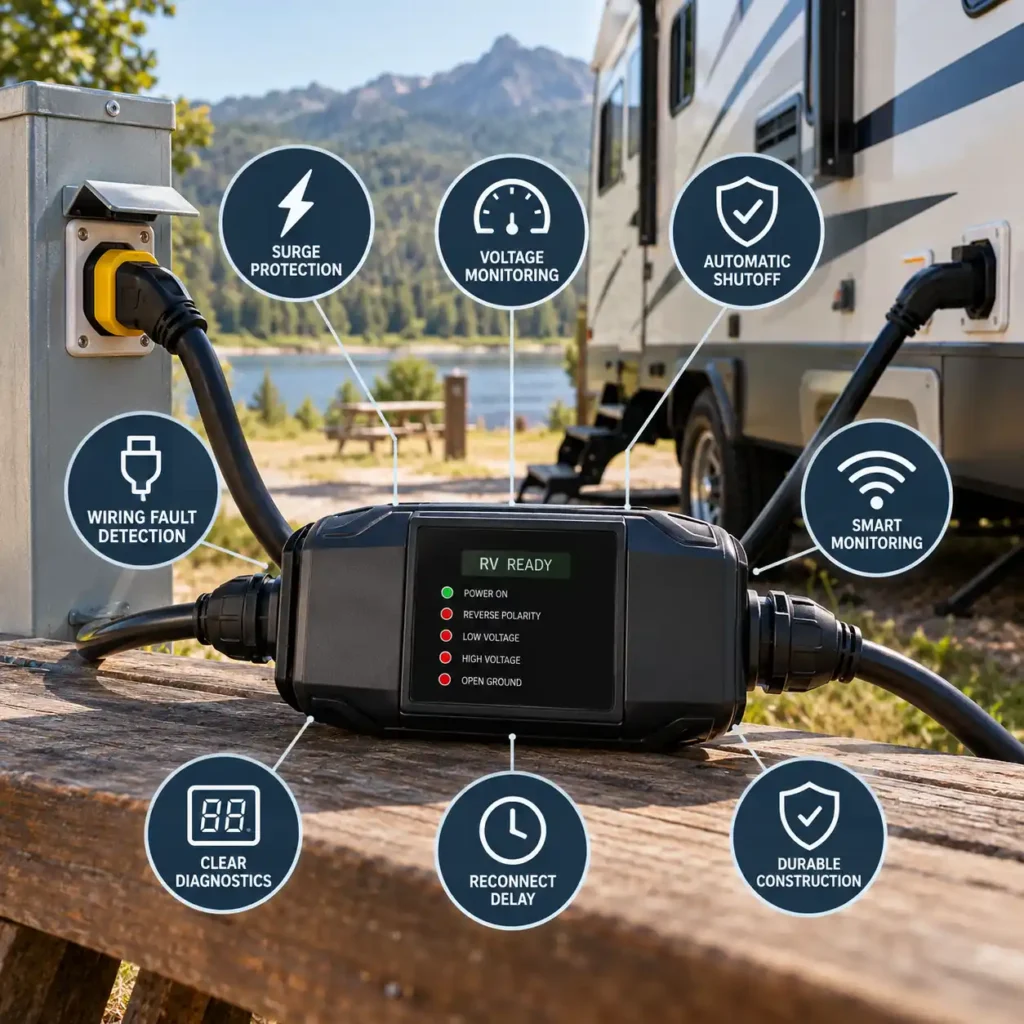
Not every specification on an RV electrical management system deserves equal weight. A higher surge rating may look impressive, but it does not necessarily tell you how well an EMS handles the electrical problems most likely to matter at a campground. When comparing models, focus first on the protection functions and operating behavior that can actually affect your RV.
Low- and High-Voltage Protection
Voltage monitoring is one of the most important reasons to choose a full EMS instead of a basic surge protector.
Low voltage can occur when campground electrical infrastructure is heavily loaded, particularly when many RVs are using air conditioning during hot weather. An EMS that detects sustained undervoltage can disconnect the RV before equipment continues operating under unfavorable conditions.
High voltage is less common but can be considerably more damaging. A good EMS should detect excessive voltage and prevent it from reaching the RV’s electrical system.
The important specification is therefore not simply whether a product says “voltage protection.” Look at the actual shutdown thresholds and how the system behaves when voltage moves outside its acceptable range.
Wiring-Fault Detection
A campground pedestal can have a wiring problem even when it appears completely normal.
Full EMS units may check for conditions such as open ground, open neutral, reverse polarity, incorrect wiring, or other pedestal faults. This is an important distinction from surge-only protection because these problems are not solved simply by absorbing a voltage spike.
For frequent campground travelers, wiring-fault detection is one of the most useful features to have because every new campsite creates another shore-power connection that needs to be trusted.
Automatic Shutdown and Restart Delay
An EMS is most useful when it can take action without waiting for the RV owner to notice a problem.
Automatic shutdown disconnects the RV when the incoming power falls outside the system’s protection limits. This is particularly important for campers who may be inside the RV, asleep, or away from the campsite when an electrical problem develops.
The restart delay matters as well. After a power interruption, the EMS should not immediately reconnect the RV the moment voltage returns. A controlled delay gives the electrical supply time to stabilize and can help protect equipment such as RV air conditioners from rapid cycling.
Surge Protection
Surge protection still matters, but it should be considered alongside the EMS’s other capabilities rather than treated as the single most important specification.
Joule ratings indicate how much surge energy the protection components are designed to absorb, but a higher number does not automatically mean that one EMS provides better overall protection. An EMS with strong surge protection but no low-voltage or wiring-fault shutdown would leave important campground hazards unaddressed.
For that reason, compare the complete protection system first and use the surge rating as one part of the decision.
Diagnostics and Display Information
A useful EMS should tell you more than whether the RV is receiving power.
A digital display or clear fault indication can help identify voltage problems, wiring errors, current draw, or the reason the EMS has disconnected the RV. This becomes particularly valuable when you arrive at an unfamiliar campground and the pedestal does not behave as expected.
For campers who prefer a simple physical setup, local diagnostics can also be more useful than advanced wireless functionality. You should not have to depend on a smartphone just to determine whether a campground connection is safe.
Smart Monitoring
Wi-Fi, Bluetooth, mobile notifications, and remote monitoring are convenience features that can become genuinely useful for some RV owners.
They are particularly valuable for extended stays or situations where the RV remains connected while you are away. Instead of discovering an electrical interruption after returning to the campsite, you may be able to receive an alert and see what happened through the connected system.
However, smart monitoring should not be confused with better fundamental protection. A connected EMS is not automatically safer than a non-connected EMS. The underlying electrical protection functions should come first; smart features should be evaluated according to how much they improve your actual camping routine.
Replaceable Surge Components
Some EMS models use replaceable surge-protection modules rather than requiring the entire device to be replaced after a major surge event.
This is mainly a long-term ownership consideration. It does not necessarily make one EMS more protective during a single electrical event, but it can reduce replacement costs after the protection components have done their job.
For frequent RV travelers who expect to own the same EMS for many years, this feature can be worth paying more for. For occasional campers, it may have much less influence on the buying decision.
Weather Resistance and Physical Security
A portable EMS spends much of its working life outside the RV, often attached directly to an exposed campground pedestal. Weather resistance therefore matters more than it might for ordinary indoor electronics.
Also consider how securely the EMS connects to the pedestal. Locking provisions can reduce the chance of accidental disconnection or theft, while a well-designed connection area can make setup easier in poor weather or after dark.
These physical details will not make up for weak electrical protection, but they can make a substantial difference to daily usability when you use the EMS frequently.
Which Features Should You Prioritize?
For most RV campers, the priority order is straightforward: correct 30A or 50A compatibility first, full EMS protection second, automatic shutdown and useful diagnostics next, and smart features according to personal preference.
That approach keeps the buying decision focused on protection rather than marketing numbers. Once the essential electrical functions are covered, features such as Wi-Fi monitoring, replaceable surge modules, portability, and additional diagnostics can determine which model offers the best fit for your particular camping style.
How to Use an RV Electrical Management System Safely at a Campground
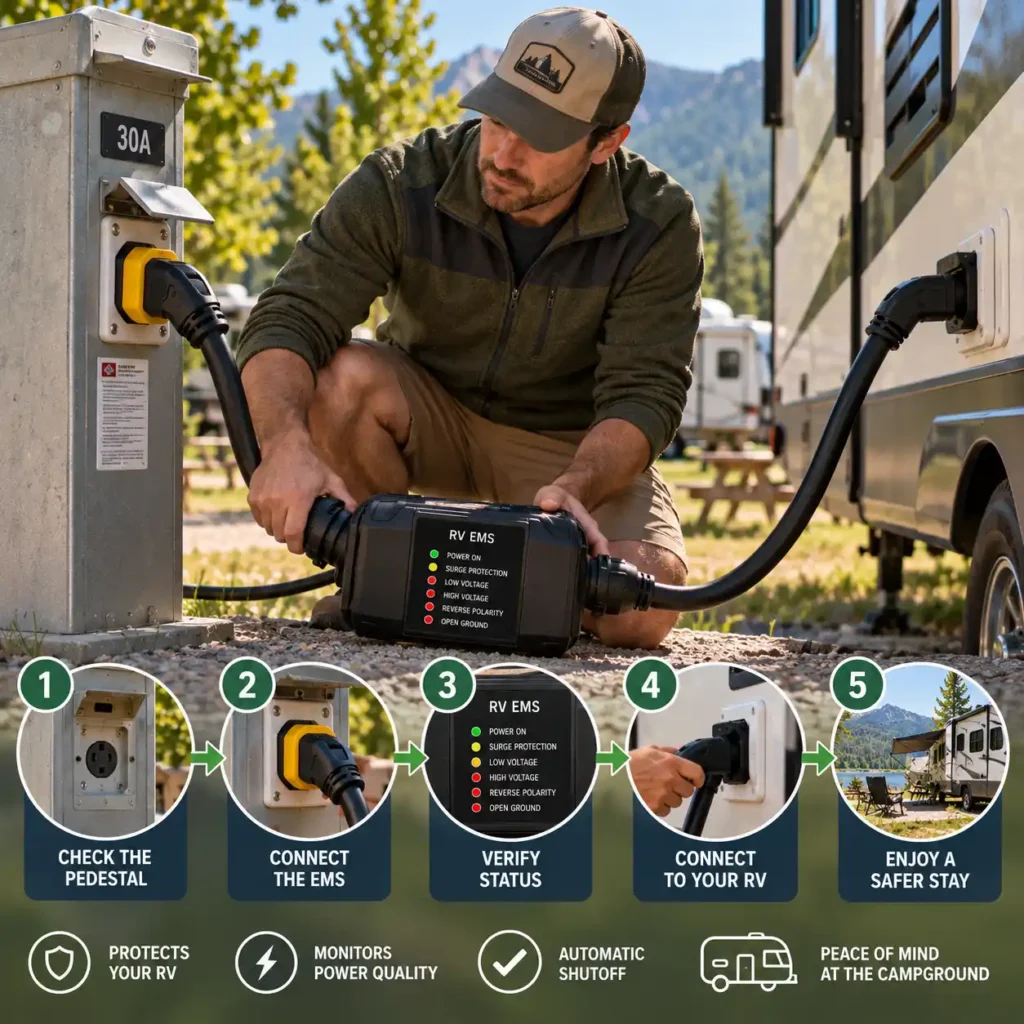
An RV electrical management system is designed to protect your RV from problematic shore power, but it works best when it is used as part of a proper campground hookup routine. The EMS should be treated as a protection and monitoring layer, not as a reason to ignore a damaged pedestal, overheated connection, or repeated electrical fault.
Check the Pedestal Before Connecting the RV
Before connecting your RV’s shore-power cord, inspect the campground pedestal for visible damage, loose parts, discoloration, melted plastic, or signs of overheating around the receptacle.
If the pedestal looks damaged or the connection appears unsafe, do not rely on the EMS to make a poor physical connection safe. Ask campground staff for another site or have the pedestal inspected before connecting your RV.
Connect the EMS Before the RV
For a portable EMS, connect the unit to the campground pedestal first and allow it to complete its initial electrical checks before connecting the RV’s shore-power cord.
This sequence gives the EMS an opportunity to identify wiring or power-quality problems before the RV is connected to the incoming supply. It also makes the EMS the first electrical component between the campground pedestal and the RV.
Match the EMS to Your RV’s Shore Power
Always use a 30A EMS with a 30A RV service and a 50A EMS with a 50A RV service.
Adapters can change the physical connection, but they do not change the electrical capacity or configuration of the RV. A 30A EMS should not be treated as equivalent protection for a 50A RV simply because an adapter allows the plugs to connect.
Treat Repeated Shutdowns as a Warning
If the EMS repeatedly disconnects the RV because of low voltage or another electrical fault, do not simply keep resetting it.
Repeated shutdowns can indicate that the campground supply is outside the safe operating range. During periods of heavy campground demand, low voltage can become more likely, particularly when many RVs are running air conditioners at the same time.
The correct response is to identify the cause, reduce your own electrical load when appropriate, move to a different pedestal or site when available, or contact campground management. The EMS is doing its job when it refuses to continue supplying unsafe power.
Do Not Bypass the EMS
Avoid bypassing the EMS simply because it has disconnected the RV.
A shutdown is a protection event that should be understood before power is restored. Repeatedly forcing the connection back on without resolving the underlying condition removes the protection that the EMS was purchased to provide.
This is especially important when the interruption involves abnormal voltage, wiring faults, or repeated campground power instability.
Inspect the Connection During Long Stays
An EMS does not eliminate the need for occasional visual inspection.
During an extended stay, check the shore-power cord, plug, EMS connection, and campground receptacle for unusual heat, discoloration, looseness, or physical damage. An electrical connection can develop a mechanical or thermal problem even when the incoming voltage appears normal.
The safest approach is to combine automatic EMS protection with sensible campground hookup practices, rather than expecting the EMS to compensate for every electrical or physical problem at the campsite.
What an EMS Can and Cannot Do
An RV electrical management system can monitor and react to electrical conditions within the functions it is designed to detect. It cannot repair a defective campground pedestal, correct damaged wiring, fix an RV’s internal electrical fault, or make an undersized connection capable of supplying more power.
That distinction is important when troubleshooting. If an EMS disconnects repeatedly, the goal should not be to defeat the shutdown. The goal is to determine why the system is detecting a problem and then correct the underlying condition.
For most RV campers, this makes the EMS part of a simple three-step process: inspect the pedestal, connect the EMS first, and investigate any repeated shutdown rather than bypassing it.
Common Mistakes When Buying an RV Electrical Management System
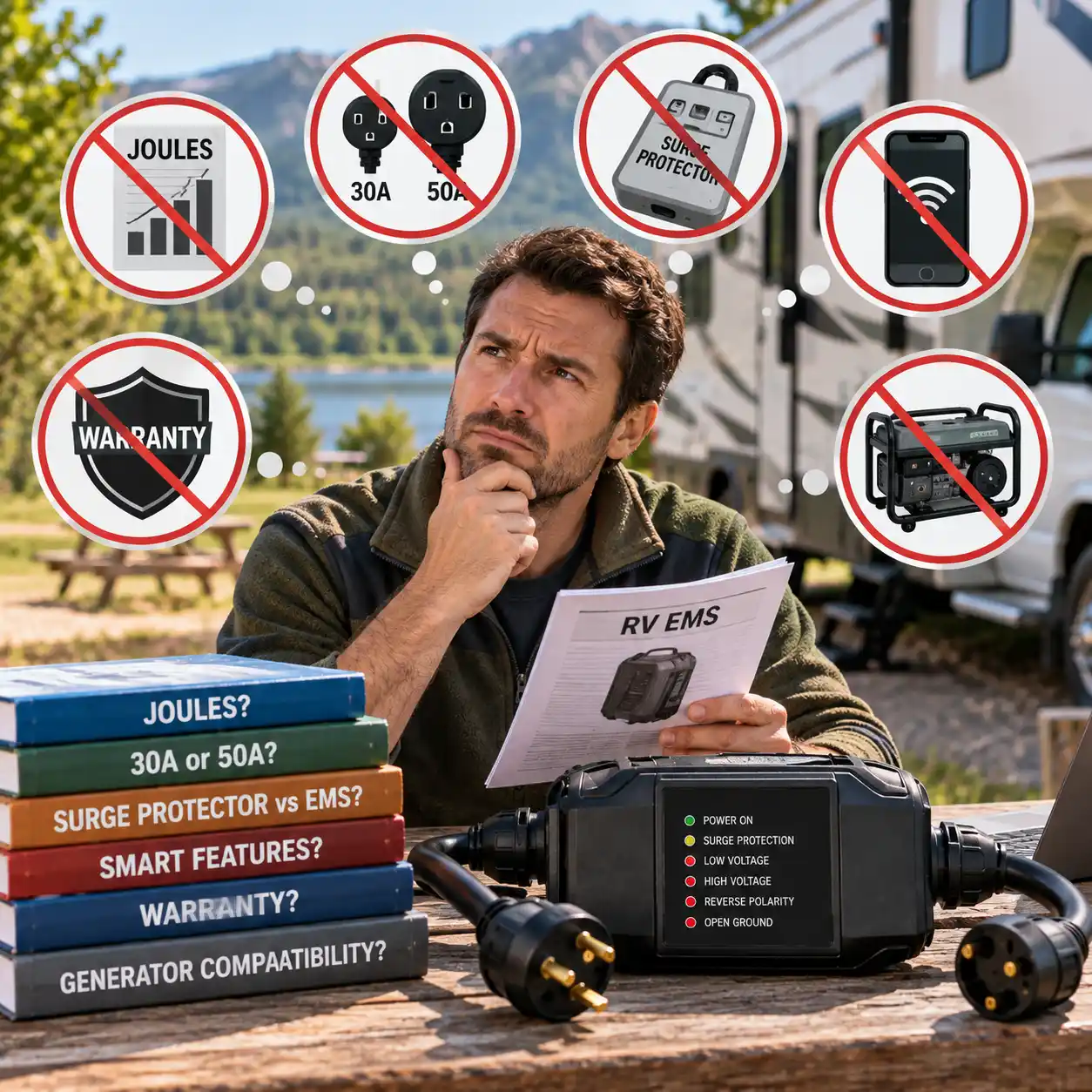
Choosing an RV electrical management system is easier when you know which specifications and marketing claims can lead you in the wrong direction. Most buying mistakes happen because shoppers compare the wrong numbers, confuse different types of electrical protection, or choose features that do not match the way they actually camp.
Buying by Joule Rating Alone
A higher joule rating can look like a better form of protection, but it should never be the primary reason to choose one EMS over another.
Joules describe the surge-energy capacity of the protection components. They do not tell you whether the system can detect low voltage, high voltage, reverse polarity, an open neutral, an open ground, or another campground wiring problem.
For that reason, compare the EMS’s complete protection system first and treat the joule rating as one supporting specification.
Choosing the Wrong Amperage
A 30A and 50A EMS are designed for different RV electrical services.
Your RV’s shore-power connection should determine which version you buy. A 30A model should not be selected simply because it costs less, and a 50A model should not be selected merely because it appears more powerful.
Adapters can change the physical plug configuration, but they do not turn a 30A EMS into a complete 50A protection system. Start with the RV’s actual shore-power service before comparing brands or features.
Buying a Surge Protector When You Need an EMS
The terms “surge protector” and “EMS” are often used interchangeably in RV product listings, but they describe different levels of protection.
A basic surge protector is primarily concerned with transient voltage spikes. A full EMS adds monitoring and automatic disconnection for conditions such as sustained low or high voltage and campground wiring faults.
For frequent campground users, this distinction can matter more than the difference between two products with similar surge ratings.
Paying for Smart Features You Will Not Use
Wi-Fi, Bluetooth, app monitoring, energy tracking, and remote notifications can be useful, but they do not automatically make an EMS better at its fundamental job.
Smart features make the most sense when you want to monitor the RV while inside the coach or away from the campsite. If your priority is simply automatic protection and clear local diagnostics, a non-connected EMS may offer better value.
This is one reason the Hughes Power Watchdog models in our lineup serve a different buyer than the Progressive units. The connected functionality is useful only when it matches the way you camp.
Ignoring the Reconnect Delay
Shutdown protection gets most of the attention, but the restart behavior matters too.
After a power interruption, an EMS should give the campground supply time to stabilize before reconnecting the RV. That delay can be particularly important for air-conditioning compressors and other equipment that should not be restarted immediately after an interruption.
When comparing models, look at both the shutdown thresholds and what happens after the fault clears.
Assuming an EMS Fixes Bad Campground Power
An EMS can identify and respond to electrical problems, but it cannot repair a defective campground pedestal.
If the same site repeatedly triggers low-voltage shutdowns, wiring-fault protection, or another recurring error, repeatedly resetting the EMS is not a solution. The underlying campground connection needs to be investigated, the electrical load may need to be reduced, or a different pedestal or site may be necessary.
The EMS should be treated as a protective barrier, not as a device that makes unsafe power acceptable.
Choosing Based on Warranty Length Alone
A long warranty can be valuable, but the headline duration is not enough to evaluate long-term value.
Pay attention to what the warranty actually covers, whether replacement parts are available, and whether the surge-protection components are replaceable. Two EMS units can advertise strong warranty coverage while offering very different ownership experiences after a major electrical event.
A replaceable surge module can be particularly useful for frequent travelers because the entire EMS does not necessarily have to be replaced after the protection component has sacrificed itself.
Buying More EMS Than Your Camping Style Requires
The most expensive EMS is not automatically the best choice.
A frequent 50A RV traveler may benefit from advanced monitoring, while an occasional 30A camper may prefer a straightforward portable unit with strong diagnostics and automatic shutdown. A camper who rarely uses campground shore power has yet another set of priorities.
The right choice is therefore the system that provides the protection you need for the electrical service you actually use, without paying for features that will have little practical value.
Frequently Asked Questions About RV Electrical Management Systems
Do I really need an RV electrical management system?
For RV owners who regularly use campground shore power, a full EMS provides more protection than a basic surge-only device. In addition to transient surges, a full EMS can monitor conditions such as low or high voltage and certain campground wiring faults, then disconnect the RV when the incoming power is outside the system’s safe operating range.
Campers who rarely use shore power have less exposure to campground electrical problems, so the value of a dedicated EMS is lower.
What is the difference between an RV surge protector and an EMS?
A basic surge protector is primarily designed to protect against short-duration voltage spikes. An EMS goes further by monitoring the incoming electrical supply and responding to conditions such as low voltage, high voltage, reverse polarity, open ground, open neutral, frequency problems, or other faults supported by the particular model.
For regular campground use, the important difference is that a full EMS can actively disconnect the RV when unsafe power is detected rather than simply suppressing a transient surge.
Do I need a 30A or 50A RV EMS?
Match the EMS to your RV’s shore-power service. A 30A RV should use a 30A EMS, while a 50A RV should use a 50A EMS.
A 30A RV typically has a single 120V supply with a maximum of about 3,600 watts. A 50A RV uses two 120V legs and has substantially more available power. The amperage rating is therefore not simply a measure of how powerful the EMS is; it corresponds to the electrical configuration the RV is designed to use.
Can I use a 50A EMS with a 30A campground pedestal?
In some setups, yes, provided the adapter and the EMS are specifically compatible with that configuration. The important limitation is that the RV is still receiving only what the 30A campground supply can provide.
A 30A pedestal provides approximately 3,600 watts at 120V, so a 50A RV connected through an appropriate adapter must manage its electrical loads accordingly. Always follow the EMS manufacturer’s instructions for adapter use because individual units can behave differently when one leg of a 50A supply is unavailable.
Does an RV EMS protect against low voltage?
A full EMS can, provided low-voltage protection is one of its specified functions. This is one of the most important differences between a full EMS and a basic surge-only protector.
Low campground voltage can occur when electrical demand is high, especially when many RVs are running air conditioners at the same time. An EMS can monitor the incoming voltage and disconnect the RV when it falls below its specified protection threshold.
Why does an RV EMS wait before restoring power?
The delay gives the campground power time to stabilize before the RV is reconnected. It can also help protect air-conditioning compressors and other equipment from being restarted immediately after a power interruption.
The exact delay varies by model. Some systems use a fixed delay, while others have different behavior depending on the detected fault and product design. What matters is that the EMS does not immediately reconnect the RV the instant the incoming voltage returns.
What should I do if my RV EMS keeps shutting off the power?
Do not repeatedly bypass or reset the EMS without finding out why it is disconnecting the RV.
Check the displayed fault or diagnostic information first. The system may be detecting low voltage, high voltage, reverse polarity, an open ground, an open neutral, or another electrical problem. If the same fault continues, reduce electrical demand when appropriate, contact campground management, or request another pedestal or site.
Repeated shutdowns are a reason to investigate the power supply, not a reason to disable the protection.
Is a portable or hardwired RV EMS better?
Neither design is universally better.
A portable EMS is easy to install, can be moved between suitable RVs, and does not require modifying the RV’s electrical system. Its disadvantage is that the unit remains outside at the campground pedestal and needs to be secured.
A hardwired EMS stays inside the RV and is always connected, which improves convenience and protects the device from outdoor exposure and theft. The trade-off is permanent installation and less flexibility if you change RVs.
How many joules should an RV EMS have?
Joule rating should be considered, but it should not be the only buying criterion.
A higher joule rating indicates greater surge-energy capacity, but it does not tell you whether the EMS detects low voltage, high voltage, wiring faults, or other campground problems. A model with a lower joule rating but comprehensive EMS protection can therefore provide more useful overall protection than a surge-only device with a much larger headline number.
Look at the complete protection system first, then use the joule rating as one part of the comparison.
Can I use an RV EMS with a generator?
Potentially, but generator compatibility depends on the EMS and the generator’s electrical configuration.
Some portable generators use a floating-neutral configuration, which can cause certain RV EMS units to report an open-ground condition even when the generator is operating as designed. Do not assume that a campground-oriented EMS will work identically with every generator. Check the EMS and generator manufacturer’s instructions before connecting them.
An RV EMS should never be used to bypass or mask a genuine generator wiring or output problem.
Is an RV EMS still useful at a newer campground?
Yes. A newer campground does not guarantee that every electrical connection will always be trouble-free.
The purpose of an EMS is to verify the actual electrical conditions reaching the RV rather than relying solely on the age or appearance of the campground infrastructure. Even when a pedestal looks new, an EMS can provide an additional layer of protection against abnormal voltage and wiring problems.
What is the best RV electrical management system for camping?
There is no single best EMS for every RV because the correct choice depends first on whether the RV uses 30A or 50A shore power and then on how much monitoring and convenience the owner wants.
For a straightforward 30A system, the Progressive EMS-PT30X is our Best Overall 30A pick. The Progressive EMS-PT50X is our Best 50A Value. The Hughes Power Watchdog models are better suited to campers who specifically want smart monitoring, while the Southwire Surge Guard 34931 is a strong option for 30A users who place extra value on local diagnostics.
The best system is therefore the one that matches your RV’s electrical service and your actual camping priorities rather than simply the model with the longest feature list.
Final Verdict: Which RV Electrical Management System Is Best for Camping?
After comparing the five models, the Progressive Industries EMS-PT30X remains our Best Overall choice for 30A RV camping because it focuses on the protection functions that matter most without adding smart features that every camper may not need.
For 50A RV owners, the Progressive Industries EMS-PT50X is the better value choice when straightforward full EMS protection and campground diagnostics are the priority. Its 50A-specific design makes it a more appropriate solution for larger RV electrical systems than simply choosing a higher-priced 30A model.
The Hughes Power Watchdog PWD30EPOW and PWD50EPOW are better suited to campers who specifically want smart monitoring. Their connected features become more useful during extended campground stays, when remote electrical monitoring, notifications, and additional visibility into the RV’s power usage provide a practical advantage.
The Southwire Surge Guard 34931 is the strongest alternative for 30A campers who place a high value on local diagnostics. Its physical display and broad campground fault detection make it particularly useful for travelers who want detailed electrical information without making app-based monitoring the center of the system.
Which RV Electrical Management System Is Best for Most Campers?
For most RV owners, the right choice starts with the shore-power service rather than the brand.
A 30A RV should begin with the Progressive EMS-PT30X, Hughes PWD30EPOW, or Southwire 34931, depending on whether you prioritize straightforward protection, smart monitoring, or diagnostics. A 50A RV should narrow the choice to the Progressive EMS-PT50X or Hughes PWD50EPOW.
The important point is that you do not need the most feature-rich EMS to get meaningful protection. A well-designed full EMS that matches your RV’s electrical service and automatically responds to unsafe campground power can be a better investment than a more expensive model whose additional features you never use.
The Most Important Thing to Get Right
The most important decision is not the highest joule rating, the longest feature list, or the most advanced app. It is choosing an EMS that matches your RV’s electrical service and provides the level of protection you actually need at the campground.
A full EMS is most valuable when it can detect problems such as unsafe voltage or wiring faults and automatically disconnect the RV rather than leaving you to discover the problem after an appliance has already been affected.
That is why our recommendations are based on overall system fit rather than a single specification. The best RV electrical management system is the one that protects your particular RV, matches the way you use campground shore power, and gives you useful features without unnecessary complexity.
The CampComfortGuide Promise
Our product guides are built around the decisions campers have to make before buying and using gear. That means looking beyond product specifications and explaining how important features translate into real campground use.
For RV electrical management systems, that means considering 30A and 50A compatibility, full EMS protection, voltage monitoring, campground wiring faults, automatic shutdown, diagnostics, smart monitoring, portability, and long-term ownership value.
Our recommendations are therefore tied to specific RV camping situations rather than presented as a universal ranking. We explain not only which products stand out, but also where their advantages matter and when a simpler or different option may be the better choice.
That approach is designed to help you choose the right level of electrical protection for your RV before you connect to the next campground pedestal.