
The best camping water container can make the difference between a smooth camping trip and a surprisingly frustrating one.
Hi, I’m Anthony.
A few years ago, during a four-day car camping trip in Montana, I brought a budget water container that seemed like a great deal. It held plenty of water, fit neatly in the back of the SUV, and had thousands of positive reviews online.
Everything looked fine until the second morning.
The spigot started dripping.
By the end of the trip, I had a damp storage bin, a wet camp kitchen tote, and far less drinking water than I expected. The container never completely failed, but it created enough small problems that I spent more time managing water than enjoying the campsite.
That experience taught me something most campers eventually learn: a camping water container is one of the most overlooked pieces of gear at camp, right up until it starts leaking.
A good water container should do more than simply hold water.
It should:
carry comfortably,
pour cleanly,
resist leaks,
survive rough transport,
and remain easy to clean after dozens of trips.
Unfortunately, many containers look nearly identical online while performing very differently in real-world camping conditions.
Over the past several years, I’ve used water containers during family campground trips, remote forest campsites, weekend car camping adventures, and extended road trips where reliable water storage wasn’t optional.
What I’ve found is that spigot quality, handle design, and overall durability usually matter far more than an extra gallon of capacity.
If you’re building a more efficient campsite overall, our guide to Car Camping Essentials Checklist covers several other gear upgrades that make cooking, cleaning, and daily campsite routines significantly easier.
In this guide, I’ll break down the camping water containers that performed best in real-world use, explain where each model shines, and help you avoid the containers most likely to leak, crack, or become frustrating after only a few trips.
As an Amazon Associate, we earn from qualifying purchases.
Table of Contents
Why Water Storage Matters More Than Most Campers Think
Most campers spend a lot of time researching tents, coolers, sleeping systems, and cooking gear.
Water storage rarely gets the same attention.
That usually changes after the first major problem.
A leaking container can soak gear. A poorly designed spigot can waste gallons of clean water. A container that’s difficult to carry often ends up being left in the vehicle, creating constant trips back and forth across the campsite.
None of these issues sound serious on paper.
At camp, they become annoying very quickly.
The reality is that water affects almost every part of daily campsite life.
You need it for:
- drinking,
- cooking,
- making coffee,
- washing dishes,
- brushing teeth,
- basic hygiene,
- and emergency cleanup.
When your water system works properly, you barely think about it.
When it doesn’t, you’re reminded of it all day long.
Another factor many new campers underestimate is how quickly water consumption adds up. A couple spending a summer weekend at a campground can easily use several gallons per day without realizing it.
Add hot weather, kids, pets, or more elaborate camp meals, and water demands increase even faster.
That’s why experienced campers often focus on reliability and usability before capacity alone.
A seven-gallon container isn’t very useful if the handle is uncomfortable or the spigot constantly leaks.
Likewise, a rugged container that lasts for years becomes a poor investment if cleaning it feels like a chore after every trip.
The best camping water containers balance four things:
- durability,
- leak resistance,
- carrying comfort,
- and easy dispensing.
Those are the qualities that separate containers campers love from containers that end up forgotten in the garage after one season.
If campsite organization is a priority, our guide to How to Organize a Campsite covers several practical systems that make water access, cooking, and daily camp routines much more efficient.
How We Evaluated the Best Camping Water Containers
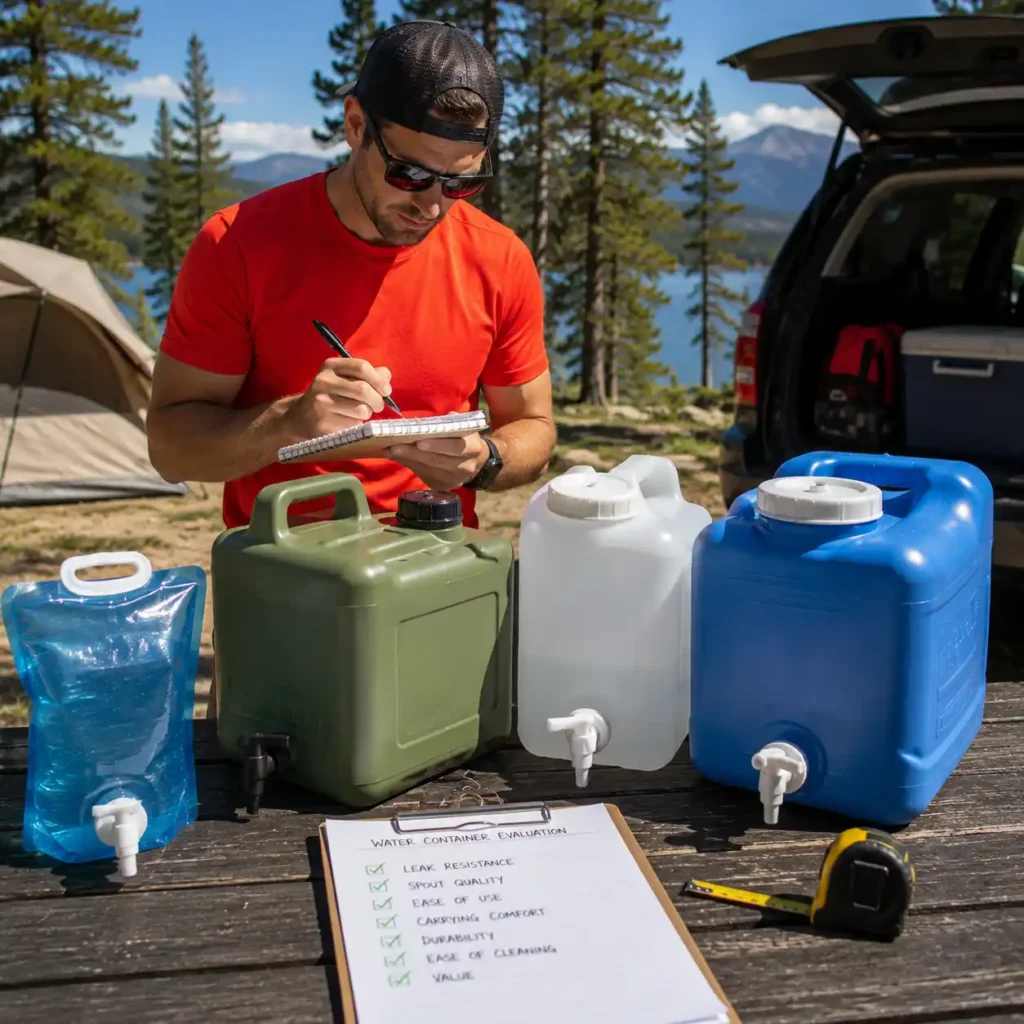
Not all camping water containers fail in the same way.
Some leak around the spigot.
Others become difficult to carry once they’re full.
And some are nearly impossible to clean properly after a few trips.
To separate genuinely useful containers from disappointing ones, we focused on the factors that matter most during real camping use.
Leak Resistance & Spigot Reliability
A water container’s first job is simple: keep water where it belongs.
We paid close attention to:
- spigot design,
- seal quality,
- drip prevention,
- and overall leak resistance during transport and daily campsite use.
Because even a small leak becomes a major annoyance over a multi-day camping trip.
Carrying Comfort
A seven-gallon container can weigh more than 55 pounds when full.
That’s why handle design matters.
We evaluated:
- grip comfort,
- balance,
- carrying stability,
- and overall ease of transport between vehicles, campsites, and water sources.
Ease of Filling & Dispensing
Some containers are easy to fill but frustrating to use.
Others pour smoothly but become difficult to refill at campground water stations.
We looked at:
- fill opening size,
- flow rate,
- dispensing control,
- and everyday usability around camp.
Durability & Long-Term Reliability
Camping gear gets dropped, dragged, packed tightly, and exposed to heat, dirt, and rough handling.
We favored containers that felt capable of surviving years of regular camping rather than a single season.
Because durability matters far more than flashy features once you’re actually at camp.
Cleaning & Maintenance
This category is often overlooked.
A container that’s difficult to clean can quickly develop odors, residue buildup, or mold issues.
We evaluated:
- cleaning access,
- opening size,
- interior reach,
- and overall maintenance requirements.
For long-term camping use, easy cleaning is every bit as important as leak resistance.
Value for Money
The most expensive container isn’t automatically the best choice.
We compared performance, durability, usability, and overall design to determine which models delivered the strongest value for typical campers.
The goal wasn’t to find the cheapest option.
The goal was to identify the containers most campers would still be happy using several years from now.
How We Tested Camping Water Containers
Camping water containers can seem very similar when you compare them online.
In actual use, the differences become much more obvious.
To better understand how each container performed, we focused on the situations most campers encounter during regular campground and car camping trips.
We paid particular attention to the issues that tend to cause frustration after the first few outings rather than during the first few minutes of use.
Our testing focused on:
- transporting full containers between vehicles and campsites,
- dispensing water for cooking and dishwashing,
- refilling containers at campground water stations,
- storing containers inside vehicles during travel,
- cleaning containers after multi-day trips,
- and evaluating long-term durability during repeated handling.
We also compared how easy each container was to use when completely full.
Many models feel comfortable when empty but become awkward once they are carrying five to seven gallons of water.
That’s where handle design, weight distribution, and overall ergonomics start to matter.
Another area we examined closely was spigot performance.
A water container may look excellent on a product page, but a poorly designed spigot can quickly become the weakest part of the entire system.
We looked for:
- smooth water flow,
- leak resistance,
- ease of operation,
- and consistency over repeated use.
Cleaning was another important factor.
Containers that are difficult to clean often develop odors, residue buildup, or mold problems over time.
Because of that, we favored designs that provided better interior access and required less effort to maintain.
Most importantly, we approached these products from the perspective of ordinary campers rather than survivalists or expedition travelers.
The goal was simple:
Find the camping water containers that make everyday campsite life easier, cleaner, and more reliable.
If you’re building a complete camp kitchen setup, our guide to 5 Best Portable Camping Sinks in 2026 pairs especially well with the water storage systems featured in this review.
What Actually Matters in a Camping Water Container
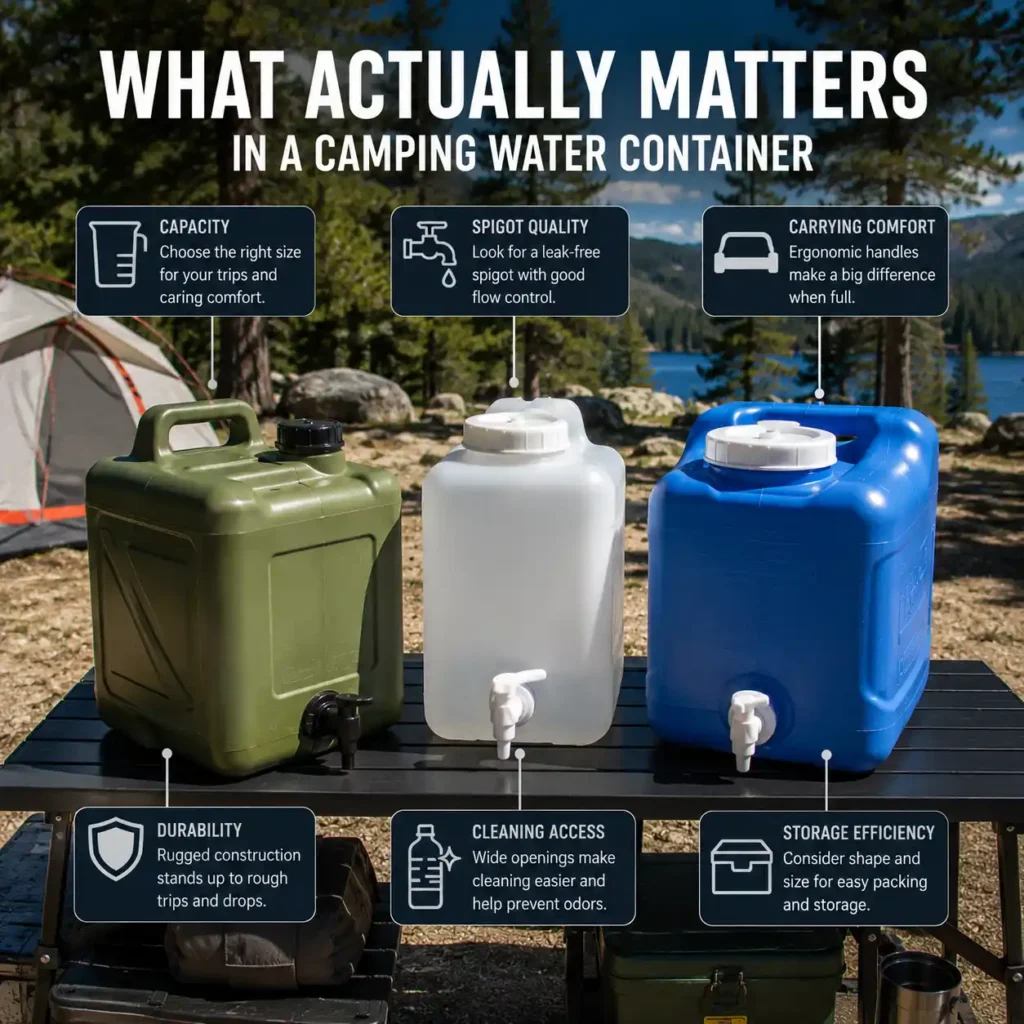
A lot of camping water containers look nearly identical online.
Most hold water.
Most have a handle.
Most include some type of spigot.
Yet after a few camping trips, some become campsite favorites while others end up collecting dust in the garage.
The difference usually comes down to a handful of practical details.
Capacity
Bigger isn’t always better.
A full seven-gallon container can weigh nearly 60 pounds.
For many campers, that becomes difficult to carry comfortably, especially when walking between water stations and campsites.
That’s why the right capacity depends on how you camp, not simply how much water a container can hold.
Spigot Quality
Few things become annoying faster than a leaking spigot.
A good spigot should:
- provide consistent flow,
- shut off cleanly,
- resist accidental drips,
- and remain reliable after repeated use.
Many otherwise excellent containers lose points because of poorly designed dispensing systems.
Carrying Comfort
This is one of the most overlooked buying factors.
A container may look sturdy and durable, but if the handle digs into your hand or feels awkward when fully loaded, you’ll notice it every time you move it.
Experienced campers often prioritize comfort and balance over maximum capacity.
Durability
Camping gear gets dropped.
It gets packed tightly inside vehicles.
It gets exposed to heat, dirt, mud, and rough handling.
The best containers are designed to handle years of abuse without developing cracks, leaks, or damaged fittings.
Cleaning Access
Many campers don’t think about cleaning until after the trip.
That’s usually when problems start.
Containers with small openings can be difficult to wash properly, making residue buildup much more likely over time.
A wide opening often makes maintenance significantly easier.
Storage Efficiency
Space matters during car camping.
Some containers stack neatly.
Others fit better in cargo systems, camp kitchens, or organized storage bins.
A container that’s easy to pack often becomes easier to live with throughout the entire camping season.
At the end of the day, reliability matters more than extra features.
The best camping water container isn’t necessarily the largest, most expensive, or most heavily advertised model.
It’s the one that consistently delivers clean water without creating new problems around camp.
Why You Can Trust This Review
Camping water containers are easy to overlook until they become the source of a problem.
A leaking spigot, an uncomfortable handle, or a container that’s difficult to clean can turn a simple camping trip into a frustrating experience surprisingly quickly.
That’s why this review focuses on practical campsite use rather than manufacturer specifications alone.
Over the years, I’ve used camping water containers during:
- family campground trips,
- multi-day car camping weekends,
- national forest campsites,
- road-trip camping adventures,
- and extended outdoor stays where reliable water storage was essential.
Throughout those trips, I learned that real-world usability often matters far more than advertised features.
The containers featured in this guide were evaluated based on the things campers actually deal with:
- carrying heavy water loads,
- dispensing water for cooking,
- washing dishes,
- maintaining hygiene,
- transporting containers in vehicles,
- and cleaning them after repeated use.
I also paid close attention to the small details that many product pages never mention:
- spigot reliability,
- handle comfort,
- stability when full,
- ease of maintenance,
- and long-term durability.
Because the best camping water container isn’t the one with the longest feature list. It’s the one that continues working properly trip after trip.
My goal isn’t to recommend the most expensive option.
It’s to help campers choose equipment that performs reliably in real camping conditions and provides the best overall value for the money.
If you’re building a complete campsite system, our guide to Camping Food Storage Guide pairs especially well with the water storage solutions featured in this review.
Quick Summary: Best Camping Water Containers
Not every camping water container is designed for the same type of camper. Some prioritize durability and long-term reliability, while others focus on portability, storage efficiency, or maximizing water capacity for larger groups.
These are the containers that stood out most during our evaluation process based on leak resistance, carrying comfort, dispensing performance, durability, cleaning access, and overall campsite usability.
Award: Best Overall Camping Water Container
Why: The Aqua-Tainer delivers the strongest balance of capacity, usability, leak resistance, and overall value. Its integrated spigot, stackable design, and campground-friendly size make it one of the most practical water containers for typical camping trips.
Best for:
- car camping
- family campgrounds
- weekend camping trips
- general campsite use
Scepter 5 Gallon Water Container
Award: Best Heavy-Duty Camping Water Container
Why: The Scepter is built for campers who prioritize durability above everything else. Its rugged construction, military-style design, and excellent long-term reliability make it one of the toughest water containers available.
Best for:
- overlanding
- rough terrain travel
- long-term use
- durability-focused campers
Igloo 6 Gallon Camping Water Container
Award: Best for Family Camping
Why: The Igloo combines generous capacity with simple operation and dependable campsite performance. It works particularly well for larger groups that need consistent access to water throughout the day.
Best for:
- family camping
- group campsites
- campground stays
- extended weekends
WaterStorageCube Collapsible Water Container
Award: Best Collapsible Camping Water Container
Why: The WaterStorageCube offers impressive storage efficiency while remaining lightweight and easy to transport. When empty, it occupies a fraction of the space required by traditional rigid containers.
Best for:
- limited vehicle space
- minimalist camping
- backup water storage
- occasional camping trips
Coleman 5 Gallon Water Carrier
Award: Best Budget Camping Water Container
Why: The Coleman remains one of the most affordable ways to add dependable water storage to a campsite. It lacks some premium features but delivers solid performance at an accessible price.
Best for:
- beginner campers
- budget-conscious buyers
- occasional camping
- campground use
Camping Water Container Comparison Table
The camping water containers below stood out for their durability, leak resistance, carrying comfort, and overall campsite usability.
While each model serves a slightly different purpose, all five earned a place on this list based on real-world camping performance.
| Product | Capacity | Material | Best For | Our Rating |
|---|---|---|---|---|
| Reliance Aqua-Tainer 7 Gallon | 7 Gallons | BPA-Free Plastic | Best Overall | 9.5/10 |
| Scepter 5 Gallon Water Container | 5 Gallons | HDPE Plastic | Best Heavy-Duty Option | 9.4/10 |
| Igloo 6 Gallon Camping Water Container | 6 Gallons | BPA-Free Plastic | Best for Family Camping | 9.2/10 |
| WaterStorageCube Collapsible Container | 5.3 Gallons | Food-Grade PE | Best Collapsible Option | 8.9/10 |
| Coleman 5 Gallon Water Carrier | 5 Gallons | BPA-Free Plastic | Best Budget Pick | 8.8/10 |
The comparison table provides a quick overview, but specifications only tell part of the story.
Below, we’ll look at how each camping water container performed in real camping conditions and where it fits best.
The 5 Best Camping Water Containers in 2026
1. Reliance Aqua-Tainer 7 Gallon
Award: Best Overall Camping Water Container
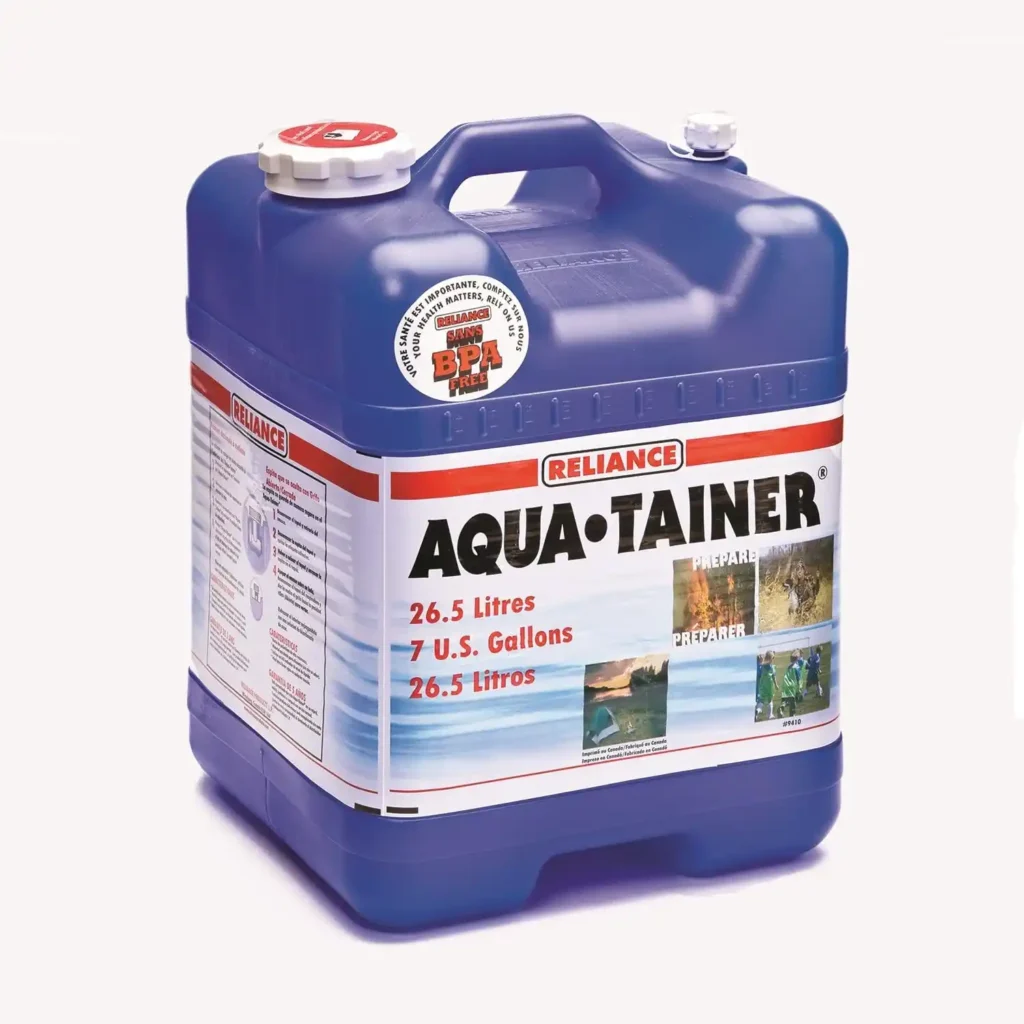
The Reliance Aqua-Tainer has been a campground favorite for years, and after extensive use, it’s easy to understand why.
It isn’t the most rugged water container on the market, nor is it the most expensive. What it does exceptionally well is balance capacity, convenience, portability, and value better than almost any competing option.
For most campers, that’s exactly what matters.
The seven-gallon capacity provides enough water for weekend trips without becoming unnecessarily bulky, while the molded handle design makes transportation more manageable than many larger containers.
Perhaps its biggest advantage is simplicity.
There are no complicated components, unnecessary accessories, or features that feel designed primarily for marketing purposes.
Best For
- car camping
- family campground trips
- weekend camping
- camp kitchen setups
- general campsite water storage
Specifications
- Capacity: 7 Gallons
- Material: BPA-Free Plastic
- Weight (Empty): 1.6 lbs
- Integrated Spigot: Yes
- Stackable Design: Yes
What I Like
The built-in spigot provides smooth water flow and is easy to use for cooking, dishwashing, and filling bottles around camp.
The rectangular design also stores efficiently inside vehicles and works particularly well alongside organized camp kitchen systems.
I also appreciate the balance between capacity and practicality.
Many larger containers become awkward once full, while the Aqua-Tainer remains manageable for most campers.
Another advantage is value.
Few camping water containers offer as much everyday usability for the price.
What Could Be Better
The plastic construction is durable enough for normal camping use but does not feel as indestructible as heavy-duty military-style containers.
The spigot should also be checked periodically during transport to ensure it remains tightened properly.
Neither issue is a dealbreaker, but they are worth mentioning.
Why I Chose It
The Reliance Aqua-Tainer earned the Best Overall award because it solves the problems most campers actually encounter.
It carries enough water for typical camping trips, stores efficiently, dispenses water easily, and remains affordable for nearly any camping budget.
Most importantly, it consistently performs well without adding unnecessary complexity to campsite life.
The Trade-Off
You give up some long-term ruggedness compared to premium heavy-duty containers.
In exchange, you get better value, lower weight, easier handling, and excellent overall practicality.
Final Verdict
For the majority of campers, the Reliance Aqua-Tainer remains one of the smartest camping water container purchases available today.
It isn’t the toughest model in this guide, but its combination of capacity, usability, and value makes it the container I would recommend first to most campers.
Availability and pricing are subject to change. Check Amazon for the most current information.
2. Scepter 5 Gallon Water Container
Award: Best Heavy-Duty Camping Water Container
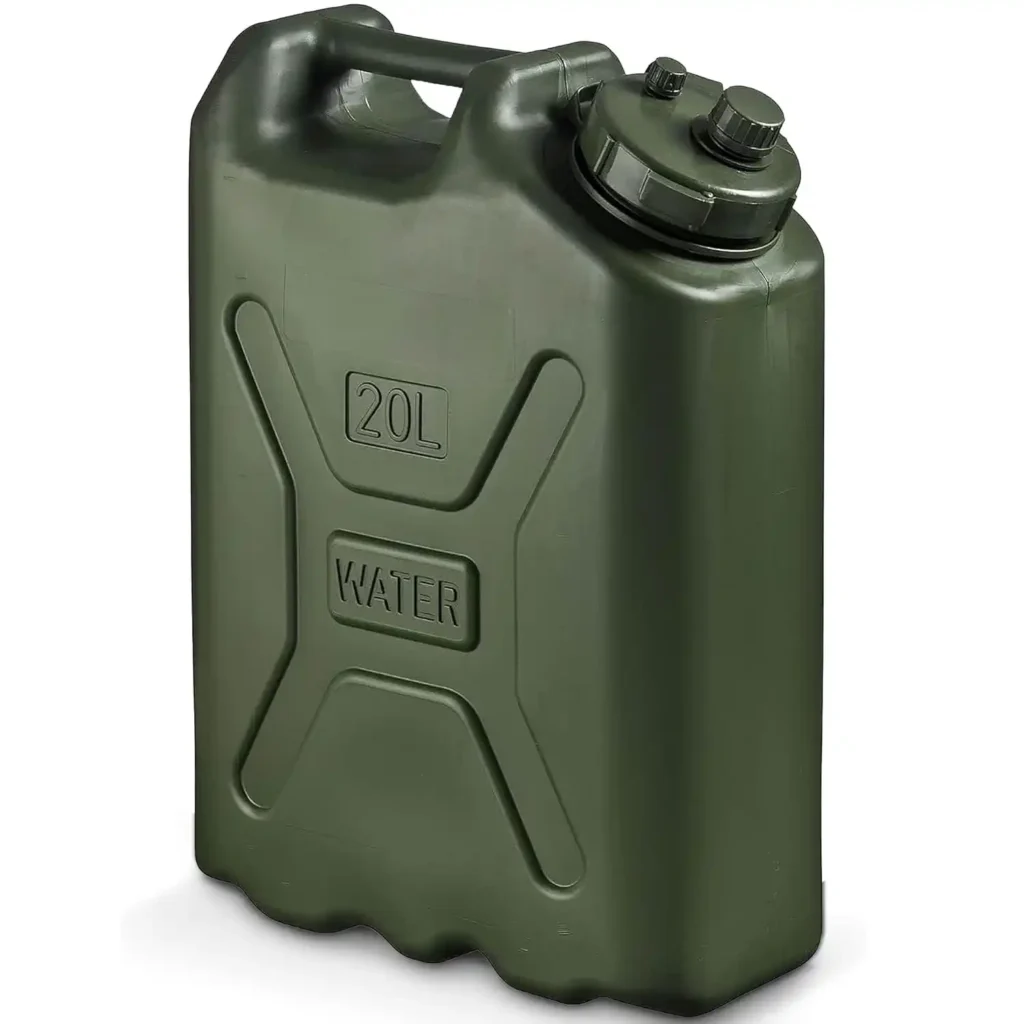
If durability is your top priority, few camping water containers have a reputation as strong as the Scepter.
Originally inspired by military-style water storage systems, this container is designed for campers who regularly travel rough roads, camp in remote areas, or simply want equipment that can handle years of hard use.
Compared to many traditional camping water jugs, the Scepter feels noticeably more rugged from the moment you pick it up.
The thicker construction inspires confidence, especially when transporting a full container in the back of a vehicle over uneven terrain.
While it sacrifices some convenience compared to lighter alternatives, it makes up for that with outstanding long-term durability.
Best For
- overlanding
- off-road travel
- remote camping
- long-term use
- durability-focused campers
Specifications
- Capacity: 5 Gallons
- Material: HDPE Plastic
- Weight (Empty): 2.6 lbs
- Integrated Spigot: No (varies by model)
- Military-Style Design: Yes
What I Like
The first thing that stands out is durability.
The thick walls, reinforced construction, and overall build quality feel substantially stronger than many standard camping water containers.
The handle design is also excellent.
Even when fully loaded, the container remains relatively comfortable to carry and feels well-balanced during transport.
I also appreciate the confidence it provides when traveling on rough roads.
Many lightweight containers feel vulnerable when packed tightly with camping gear.
The Scepter rarely gives that impression.
This is one of the few containers in this category that genuinely feels built for years of abuse.
What Could Be Better
The added durability comes with a trade-off.
It’s heavier than most competing containers and takes up more space than some campers may prefer.
Certain versions also require purchasing a separate spigot accessory, which can increase the overall cost.
For casual campground campers, that may feel unnecessary.
Why I Chose It
The Scepter earned the Best Heavy-Duty award because no other container in this guide offers the same combination of ruggedness, reliability, and long-term durability.
For campers who prioritize equipment that lasts, it stands in a category of its own.
The Trade-Off
You give up some convenience, lower weight, and compactness.
In return, you get one of the toughest camping water containers currently available.
Final Verdict
The Scepter is not the best choice for every camper.
However, if your camping style includes rough travel, remote locations, or frequent outdoor use throughout the year, it’s one of the most dependable water storage solutions you can buy.
For durability-focused campers, this is the container I’d choose before almost anything else in this category.
Prices and availability may change over time. We recommend checking Amazon for the latest product details and customer reviews before purchasing.
3. Igloo 6 Gallon Camping Water Container
Award: Best for Family Camping
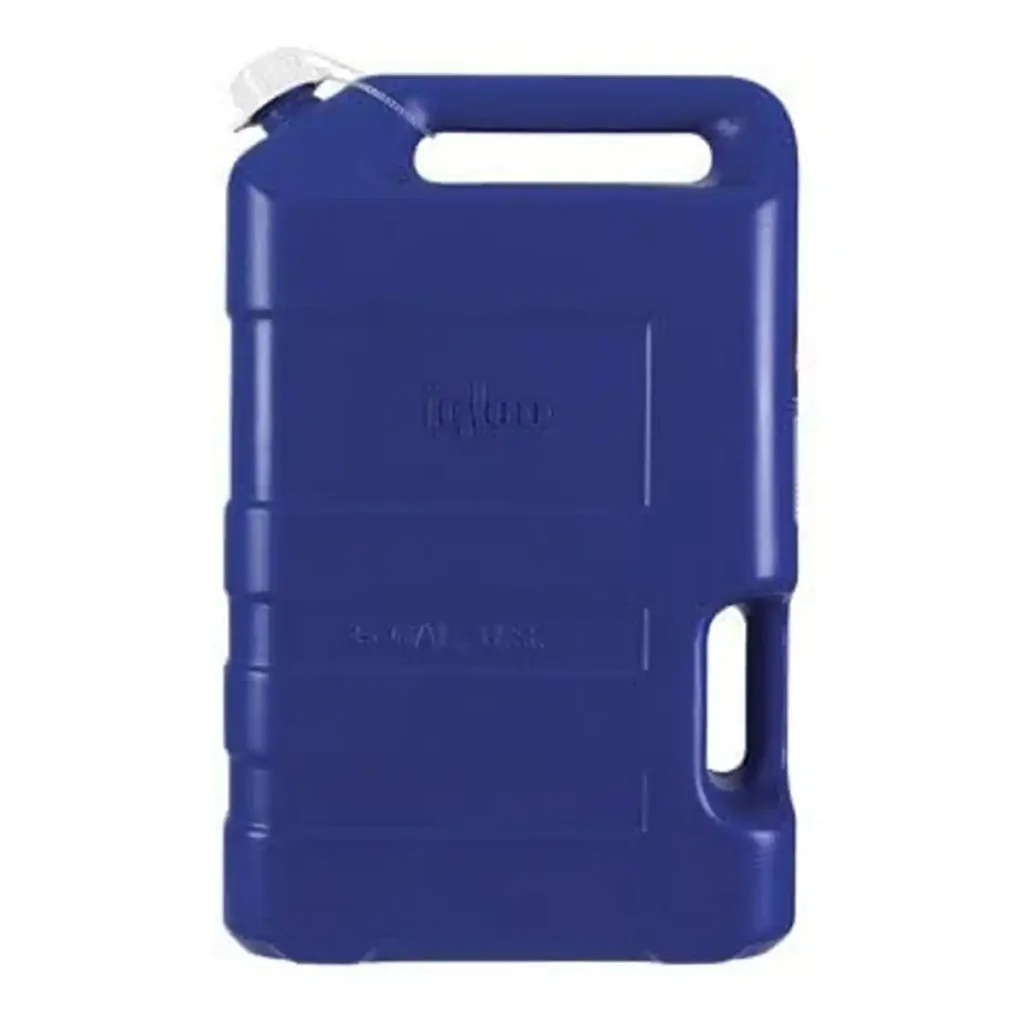
The Igloo 6 Gallon Water Container has been a campground staple for decades, and it’s still one of the most practical options for families and larger camping groups.
While it lacks some of the ruggedness of premium heavy-duty containers, it makes up for that with simplicity, capacity, and ease of use.
For family camping, those qualities often matter more.
The larger capacity helps reduce trips to campground water stations, which becomes especially useful when multiple people are sharing the same water supply for drinking, cooking, and basic campsite chores.
Its straightforward design also makes it easy for everyone at camp to use, including children and first-time campers.
Best For
- family camping
- larger camping groups
- campground stays
- extended weekend trips
- camp kitchens with higher water usage
Specifications
- Capacity: 6 Gallons
- Material: BPA-Free Plastic
- Weight (Empty): 2.0 lbs
- Integrated Spigot: Yes
- Reinforced Carry Handle: Yes
What I Like
The biggest advantage is convenience.
Six gallons provides a substantial amount of water without becoming excessively bulky, making it a practical middle ground between portability and capacity.
The push-button spigot is also easy to operate and works well for filling water bottles, cooking pots, and dishwashing stations around camp.
I also appreciate how familiar and user-friendly the design feels.
There is very little learning curve, which makes it particularly useful for family camping setups.
For campers who simply want dependable water access without overthinking the system, the Igloo performs extremely well.
What Could Be Better
The construction is solid but not as rugged as the Scepter.
Repeated rough handling, heavy impacts, or years of hard off-road use may eventually show more wear than premium heavy-duty containers.
The larger footprint can also take up more cargo space compared to some competing options.
Why I Chose It
The Igloo earned the Best for Family Camping award because it balances capacity, simplicity, and everyday usability exceptionally well.
Families often use significantly more water than solo campers or couples, and the extra capacity becomes surprisingly valuable during longer campground stays.
The Trade-Off
You gain additional capacity and ease of use but sacrifice some durability compared to the toughest containers in this guide.
For most family campers, that’s a worthwhile trade.
Final Verdict
The Igloo 6 Gallon Water Container remains one of the easiest camping water containers to recommend for family camping.
It’s practical, easy to use, widely available, and capable of handling the water demands that naturally come with larger groups.
Prices and availability may change over time. We recommend checking Amazon for the latest product details and customer reviews before purchasing.
4. WaterStorageCube Collapsible Water Container
Award: Best Collapsible Camping Water Container
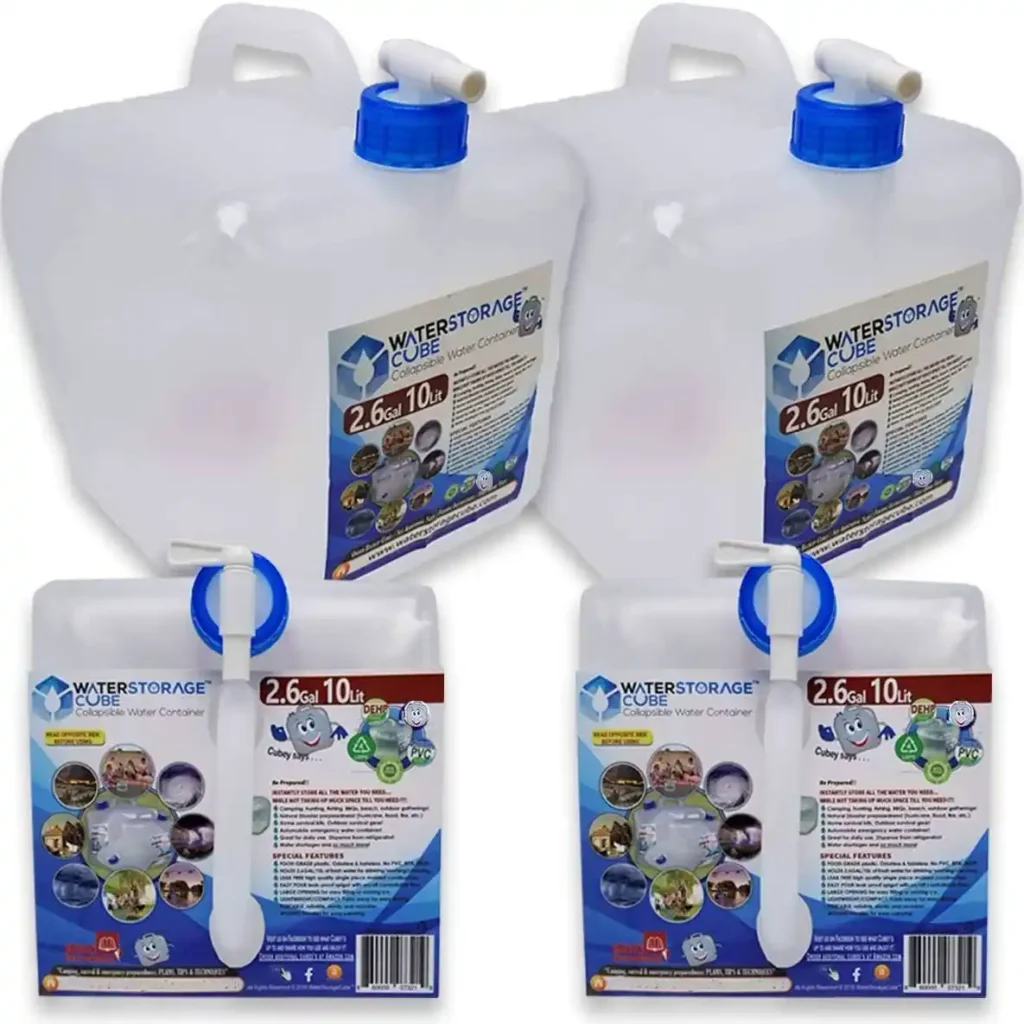
Not every camper needs a large rigid water container.
For campers with limited storage space, smaller vehicles, or occasional camping schedules, a collapsible design often makes much more sense.
That’s where the WaterStorageCube stands out.
Unlike traditional hard-sided containers, it folds down when empty, taking up only a fraction of the storage space required by most camping water jugs.
For car campers already trying to fit coolers, camp chairs, tents, and cooking gear into a packed vehicle, that advantage becomes surprisingly valuable.
While it isn’t designed to replace heavy-duty water containers for every situation, it performs remarkably well for weekend camping trips and general campsite use.
Best For
- limited cargo space
- compact vehicles
- occasional camping
- backup water storage
- lightweight camping setups
Specifications
- Capacity: 5.3 Gallons
- Material: Food-Grade PE
- Weight (Empty): 0.6 lbs
- Collapsible Design: Yes
- Integrated Spigot: Yes
What I Like
The biggest advantage is storage efficiency.
When empty, the WaterStorageCube folds nearly flat, making it one of the easiest camping water containers to store between trips.
It’s also extremely lightweight compared to rigid alternatives.
The integrated spigot works surprisingly well for basic campsite tasks, and the transparent design makes it easy to monitor remaining water levels throughout the day.
I also like how versatile it can be.
For campers who only need extra water capacity occasionally, it solves a problem without creating new storage headaches at home.
What Could Be Better
Durability is the obvious compromise.
While the material is stronger than it looks, it cannot match the impact resistance of rigid HDPE containers.
Sharp objects, rough handling, and repeated abuse will shorten its lifespan much faster than premium hard-sided models.
The carrying experience is also less comfortable when fully loaded.
Why I Chose It
The WaterStorageCube earned the Best Collapsible award because it delivers something most traditional containers cannot: meaningful space savings.
For many campers, storage limitations matter just as much as water capacity.
This design addresses that challenge exceptionally well.
The Trade-Off
You gain portability and compact storage but sacrifice some long-term durability.
For occasional campers and weekend trips, that’s often a very reasonable trade.
Final Verdict
The WaterStorageCube is one of the smartest choices for campers who prioritize space efficiency.
It won’t replace a heavy-duty container for demanding use, but for weekend camping, backup water storage, and compact vehicle setups, it performs far better than many campers expect.
Prices and availability may change over time. We recommend checking Amazon for the latest product details and customer reviews before purchasing.
5. Coleman 5 Gallon Water Carrier
Award: Best Budget Camping Water Container
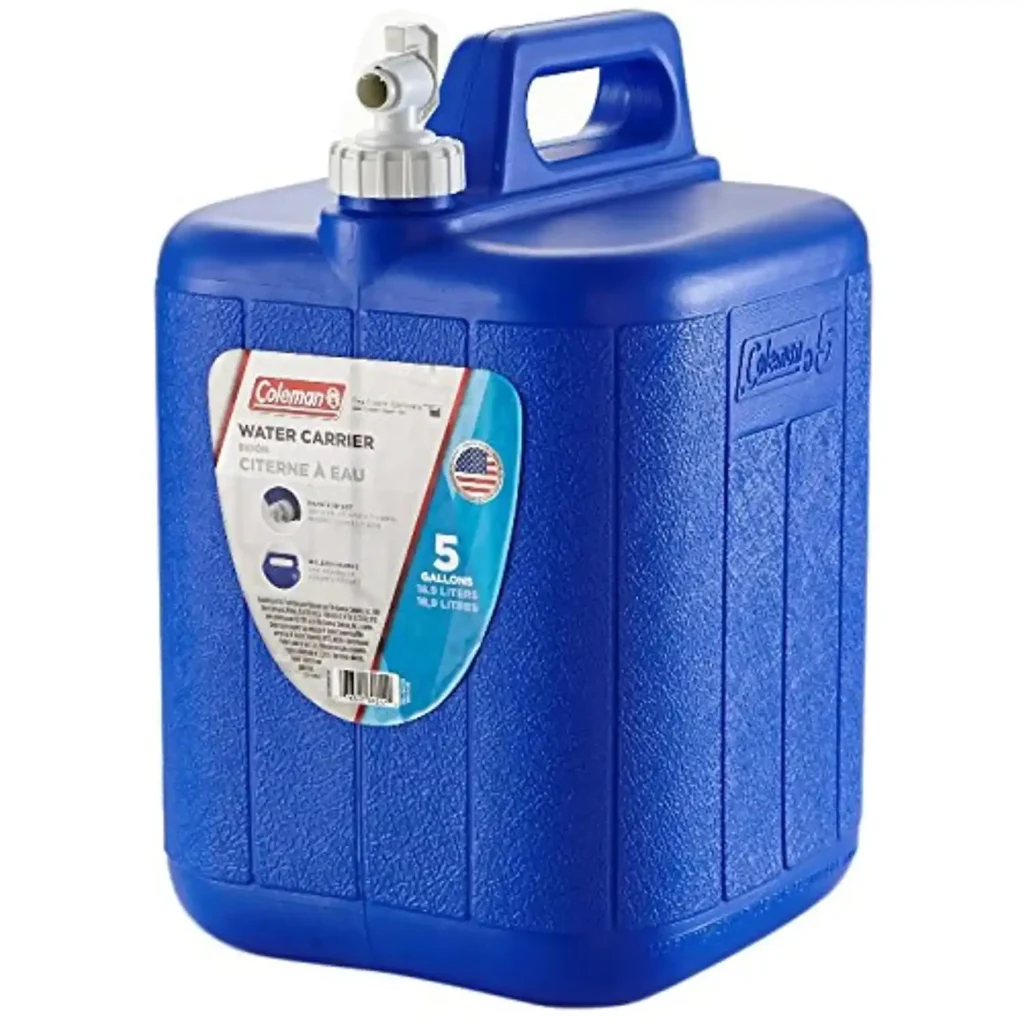
Finding a budget-friendly camping water container is easy.
Finding one that’s affordable while still being dependable is a little harder.
That’s where the Coleman 5 Gallon Water Carrier continues to stand out.
It has been a popular choice among casual campers for years because it focuses on the basics. It carries enough water for most weekend trips, remains lightweight, and costs noticeably less than many premium alternatives.
For campers who only head outdoors a few times each year, that’s often all that’s needed.
While it doesn’t offer the rugged construction of the Scepter or the storage efficiency of the WaterStorageCube, it delivers solid everyday performance at a price that’s difficult to ignore.
Best For
- budget-conscious campers
- beginner campers
- occasional camping trips
- campground camping
- weekend getaways
Specifications
- Capacity: 5 Gallons
- Material: BPA-Free Plastic
- Weight (Empty): 1.2 lbs
- Integrated Spigot: Yes
- Molded Carry Handle: Yes
What I Like
The biggest advantage is value.
For a relatively small investment, campers get a reliable water storage solution from a brand that’s been trusted in the outdoor industry for decades.
The container is lightweight, easy to carry, and simple to use around camp.
The integrated spigot works well for filling bottles, rinsing cookware, and handling basic campsite tasks.
I also appreciate that replacement parts and compatible accessories are generally easy to find.
For occasional campers, it’s difficult to justify spending significantly more when the Coleman handles the fundamentals so well.
What Could Be Better
The construction is noticeably lighter than some of the premium containers in this guide.
While perfectly adequate for normal camping use, it isn’t designed for years of heavy abuse, rough overlanding routes, or demanding off-road travel.
The spigot is functional but lacks the refined feel of higher-end models.
Why I Chose It
The Coleman earned the Best Budget award because it provides the strongest balance of affordability and practicality.
Many inexpensive containers feel disposable.
The Coleman remains useful long after the first camping season, which isn’t always true in the budget category.
The Trade-Off
You save money and still get dependable performance, but you give up some durability and long-term ruggedness compared to premium options.
For many campers, that’s an easy compromise.
Final Verdict
The Coleman 5 Gallon Water Carrier is proof that a camping water container doesn’t need to be expensive to be effective.
It may not be the most advanced or the most durable model in this guide, but it offers excellent value and remains one of the smartest choices for campers shopping on a budget.
Prices and availability may change over time. We recommend checking Amazon for the latest product details and customer reviews before purchasing.
Camping Water Containers We Considered but Didn't Recommend
Not every camping water container we evaluated earned a spot on our final list.
Several models performed reasonably well in certain areas but fell short when it came to long-term reliability, leak resistance, carrying comfort, or overall campsite usability.
Reliance Rhino-Pak Water Container
The Rhino-Pak offers decent durability and respectable water capacity, but it simply didn’t provide enough advantages over the Aqua-Tainer to justify a recommendation for most campers.
For typical campground use, the Aqua-Tainer remains the stronger overall value.
Generic Military-Style Water Cans
Many military-inspired water containers available online look extremely rugged, but several suffer from inconsistent quality control, poor spigot systems, or uncomfortable carrying designs.
Some performed adequately, while others developed leaks or usability issues much sooner than expected.
Budget Collapsible Water Bags
A number of low-cost collapsible containers initially appeared attractive because of their compact storage size.
However, several models felt too fragile for repeated camping use and raised concerns about long-term durability.
In most cases, the WaterStorageCube provided a much better balance of portability and reliability.
Large 10+ Gallon Water Containers
While larger containers can reduce refill trips, many become impractical once completely full.
Several models we evaluated were simply too heavy and awkward for average campers to move comfortably around a campsite.
For most camping situations, portability and usability matter more than maximum capacity.
Ultimately, the containers that made our final list offered the best combination of durability, leak resistance, carrying comfort, and real-world camping performance rather than simply the longest feature lists.
How to Choose the Right Camping Water Container
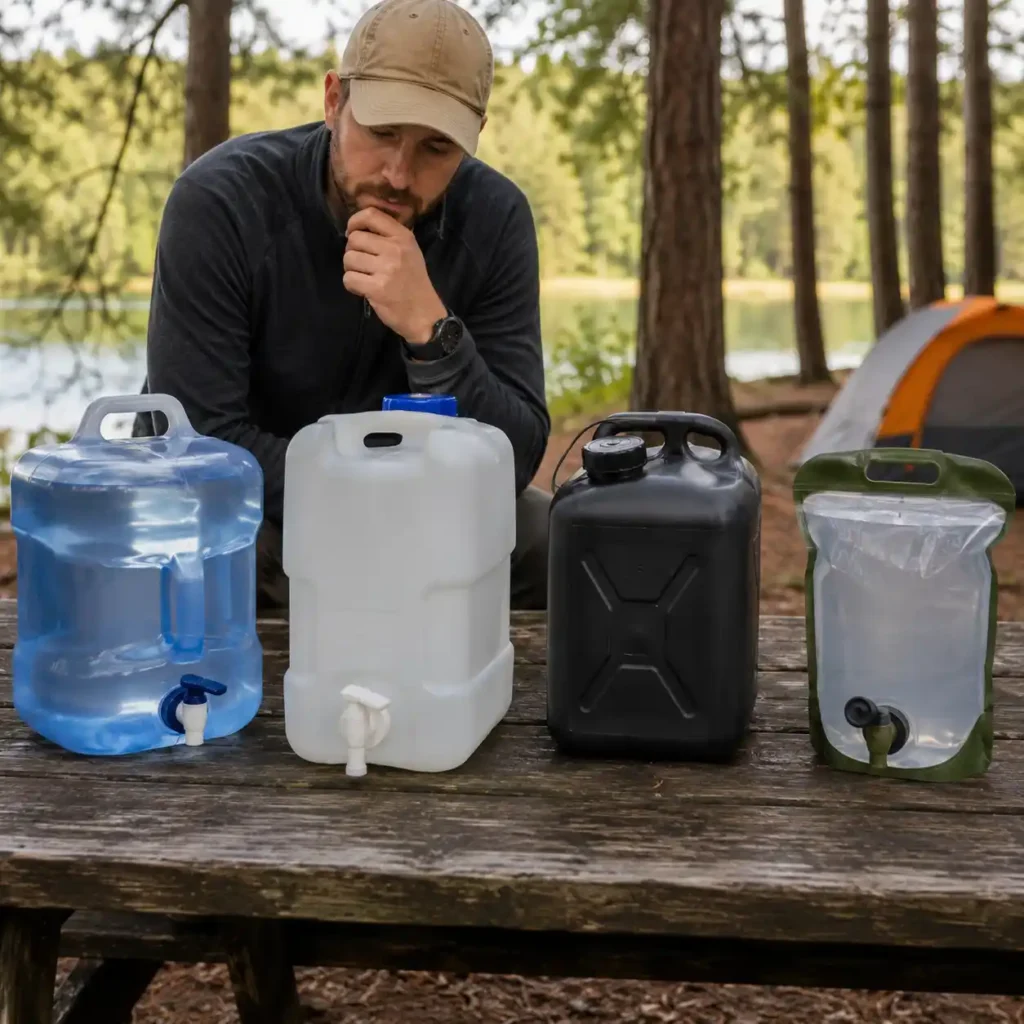
Choosing the right camping water container starts with understanding how you actually camp.
A container that’s perfect for a family campground trip may be completely unnecessary for a solo weekend camper.
The first factor to consider is capacity.
Couples and solo campers can often get by with a 5-gallon container, while larger families may benefit from 6- or 7-gallon models that reduce refill trips throughout the day.
Next, think about durability.
If most of your trips involve established campgrounds and short weekend outings, a standard BPA-free container will usually work well.
If you regularly travel rough roads, overland, or camp in remote locations, durability becomes much more important than saving a few dollars.
Storage space should also influence your decision.
Campers with smaller vehicles often benefit from collapsible designs that can be packed away when not in use.
Larger SUVs, trucks, and trailers typically have enough room for rigid containers that prioritize convenience and long-term durability.
Another factor many buyers overlook is cleaning access.
A container that is difficult to clean can become frustrating surprisingly quickly.
Wide openings and simple designs are often easier to maintain over multiple camping seasons.
Finally, pay close attention to the spigot.
A reliable spigot can make everyday campsite tasks much easier, while a poor one can become a constant source of irritation.
For most campers, choosing a container with a proven track record of leak-free performance is usually the safest long-term investment.
The best camping water container isn’t necessarily the largest or most expensive model.
It’s the one that fits your camping style, vehicle space, and water needs while remaining easy to use trip after trip.
Frequently Asked Questions About Camping Water Containers
What size camping water container do I need?
For most campers, a 5- to 7-gallon container provides the best balance between capacity and portability.
Solo campers and couples can often manage with 5 gallons, while families and larger groups usually benefit from 6- or 7-gallon models that reduce refill trips throughout the day.
Are collapsible water containers good for camping?
Collapsible containers are lightweight, easy to pack, and work well for weekend camping trips. However, they generally aren’t as durable as rigid water containers designed for long-term use.
How often should I clean a camping water container?
Ideally, after every camping trip.
Regular cleaning helps prevent odors, residue buildup, and bacteria growth. Containers with wide openings are typically much easier to clean thoroughly.
What's the best material for a camping water container?
Most quality camping water containers use BPA-free plastic or heavy-duty HDPE plastic.
HDPE containers tend to offer better durability, while BPA-free models are often lighter and more affordable.
How long will water stay fresh inside a camping water container?
When stored properly and kept out of direct sunlight, water can remain usable for several days during a camping trip.
Using clean containers and fresh water before each trip helps maintain the best quality.
Are camping water containers leak-proof?
Not all of them.
Leak resistance depends largely on spigot quality, lid design, and overall construction. That’s one reason why choosing a proven container is often worth the extra investment.
Is a 7-gallon water container too heavy for camping?
A full 7-gallon container can weigh close to 60 pounds.
Many campers find this manageable for short distances, but those who frequently carry water long distances may prefer smaller containers or multiple lower-capacity options.
Can I use a camping water container for drinking water?
Yes, provided the container is designed for potable water storage.
Always verify that the manufacturer specifically states the container is safe for drinking water before using it for hydration.
Camping Water Storage Tips
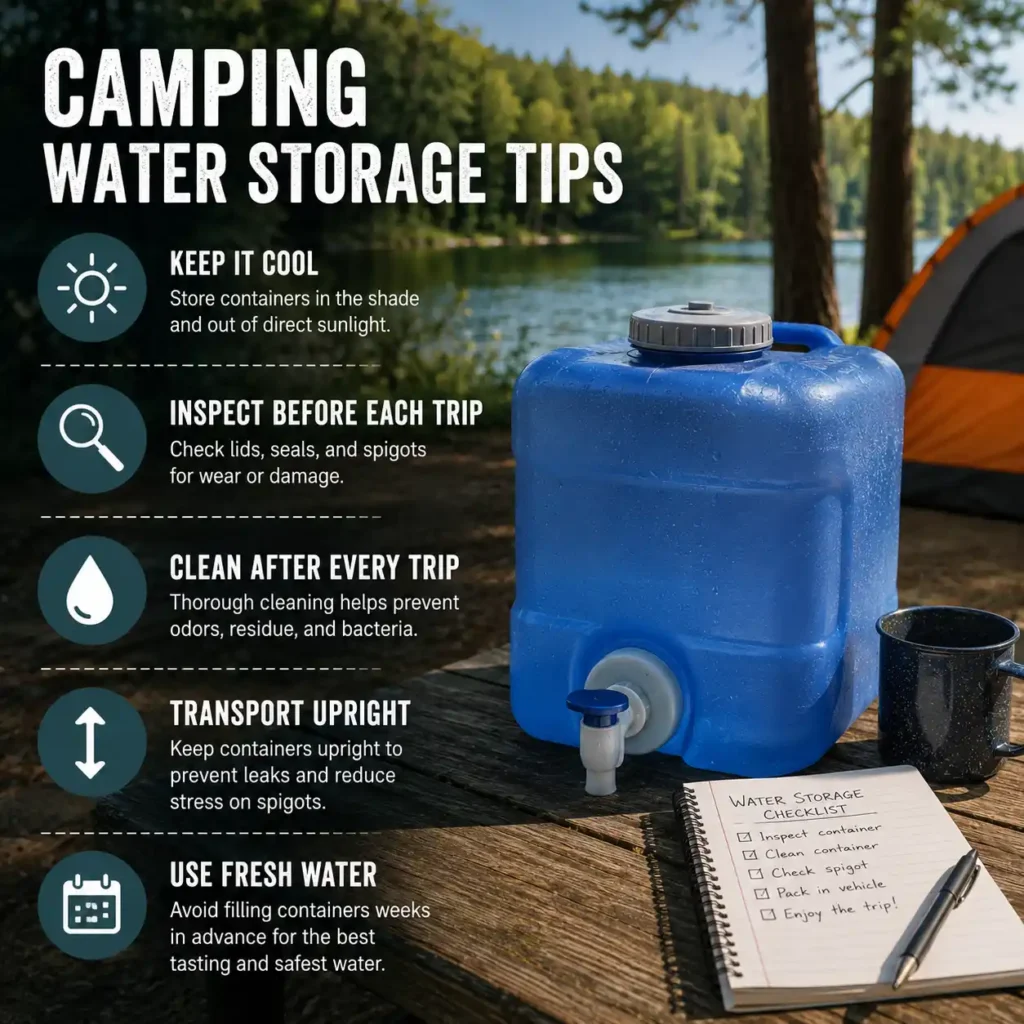
Even the best camping water container will perform better when paired with a few simple water storage habits.
Whenever possible, keep water containers in the shade rather than direct sunlight. This helps keep drinking water cooler and reduces heat exposure during hot summer camping trips.
Before each trip, inspect the lid, seals, and spigot for signs of wear or damage. A small leak is much easier to fix at home than at a campsite.
It’s also a good idea to clean containers thoroughly after every trip, even if they appear clean. Regular maintenance helps prevent odors, residue buildup, and long-term performance issues.
During transport, keep containers upright whenever possible. This reduces stress on spigots and helps prevent accidental leaks inside vehicles.
Finally, avoid filling containers weeks before a trip. Fresh water and a clean container provide the best overall experience for drinking, cooking, and campsite use.
A few minutes of preparation can help prevent many of the most common water storage problems campers encounter.
Final Verdict
After comparing durability, leak resistance, carrying comfort, ease of cleaning, and overall campsite usability, one thing became clear: the best camping water container is the one that matches the way you actually camp.
For most campers, the Reliance Aqua-Tainer 7 Gallon remains the strongest overall choice thanks to its excellent balance of capacity, convenience, reliability, and value.
Campers who prioritize maximum durability will likely appreciate the rugged construction of the Scepter 5 Gallon Water Container, while families may find the Igloo 6 Gallon Water Container better suited to their higher daily water demands.
Those with limited storage space should take a close look at the WaterStorageCube, and budget-conscious campers will continue to find excellent value in the Coleman 5 Gallon Water Carrier.
The good news is that every container featured in this guide is capable of providing reliable water storage for camping.
The key is choosing the model that best fits your camping style, vehicle space, and typical water usage.
A dependable water container may not be the most exciting piece of camping gear you’ll own, but it’s one of the items you’ll appreciate every single day at camp.
About the Author
Anthony is a lifelong camper and outdoor gear enthusiast who has spent years testing camping equipment across campgrounds, national forests, mountain lakes, and remote outdoor destinations throughout the United States.
His reviews focus on practical field experience, long-term durability, and real-world campsite performance rather than marketing claims or manufacturer specifications.
When not testing gear, Anthony enjoys camping, fishing, hiking, and exploring new outdoor destinations with family and friends.