
Most advice on how to sleep comfortably while camping focuses on gear — better sleeping bags, thicker pads, more insulation.
But here’s the problem:
Most people still sleep badly.
Hi, I’m Anthony.
After years of camping in different conditions, I realized something most guides miss — sleep outdoors doesn’t fail because of gear.
It fails because of how that gear is used.
Cold nights, sore backs, and restless sleep usually come down to three things:
— heat loss into the ground
— poor support and pressure points
— trapped moisture inside your tent
Fix those, and your sleep improves immediately.
Ignore them, and no upgrade will help.
In this guide, I’ll show you how to sleep comfortably while camping using real-world setups that actually work — not just gear lists, but systems that hold up in real conditions.
This is for campers who want to wake up rested — not just survive the night.
On one fall trip, I used a high-end sleeping bag but a thin pad on cold ground — and still woke up freezing at 3 AM.
That’s when it became obvious: warmth doesn’t come from above. It comes from what’s under you.
As an Amazon Associate, we earn from qualifying purchases.
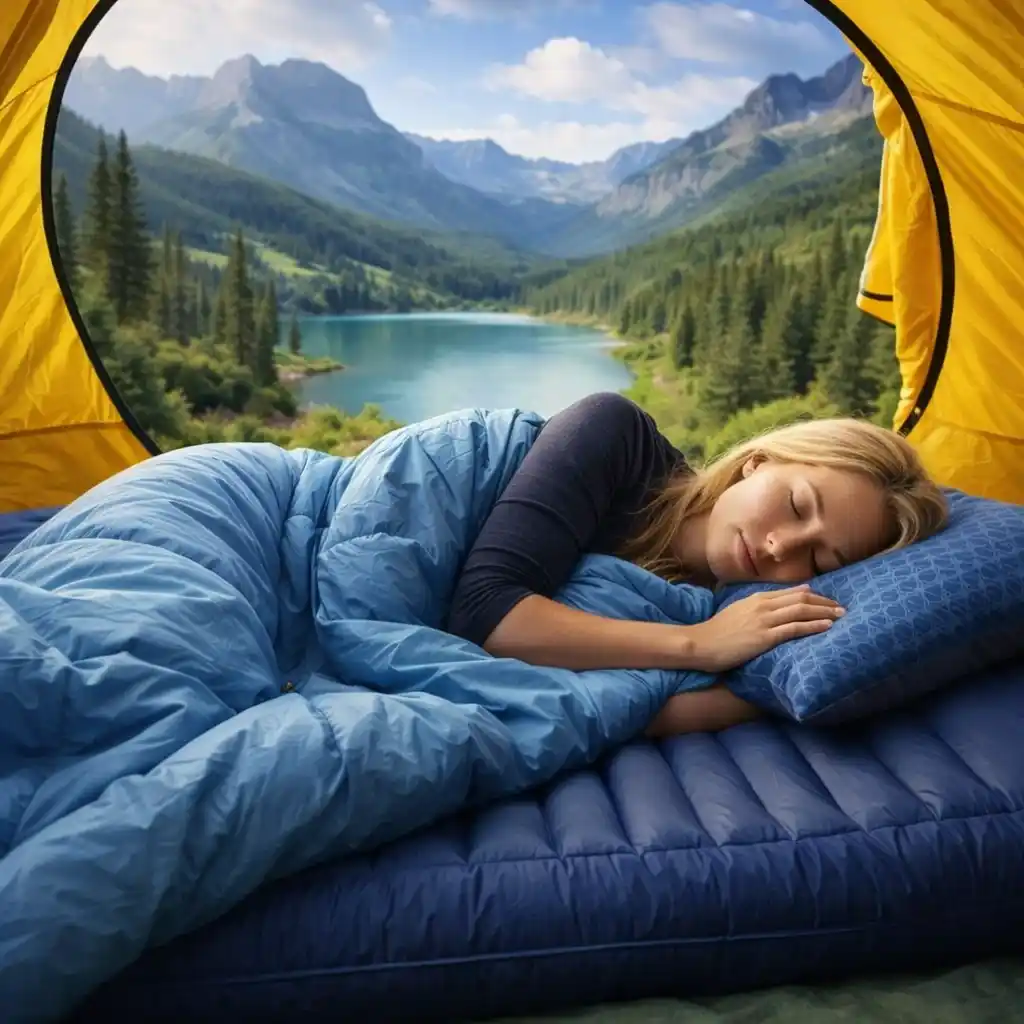
How to Sleep Comfortably While Camping (Quick Answer)
To sleep comfortably while camping, you need to fix the three things that actually disrupt sleep outdoors: heat loss, poor support, and moisture.
— insulate yourself from the ground (your sleeping pad matters more than your sleeping bag)
— use a sleeping bag that matches real nighttime temperatures, not just ratings
— keep your body aligned to reduce muscle tension and pressure points
— control moisture and airflow to prevent dampness
— eliminate uneven surfaces and hard contact points
Comfort doesn’t come from one piece of gear — it comes from a system where each part supports the others.
If one part fails, your sleep fails.
Jump to your problem:
— Cold at night → fix ground insulation
— Back or hip pain → fix support and pad thickness
— Waking up damp → improve airflow and moisture control
— Can’t fall asleep → fix pressure points and positioning
If you fix only one thing — fix your sleeping pad first.
What Most Campers Get Wrong About Sleeping Comfort
Most campers try to fix sleep by upgrading their sleeping bag.
That rarely works.
Because the real problem isn’t insulation on top — it’s heat loss, pressure, and moisture underneath.
Until those are fixed, better gear won’t change your sleep.
Most Common Reasons You Can’t Sleep While Camping (And What’s Actually Causing It)
Most sleep problems outdoors come from predictable system failures — not random discomfort.
1. Heat Loss to the Ground
Even in mild conditions, your body continuously transfers heat into the ground through conduction.
Without proper insulation underneath you, your body cools down all night — regardless of how warm your sleeping bag is.
This is the #1 reason campers wake up cold.
Most campers underestimate how important insulation is. To understand how it actually works, see What is Camping R-Value? The Ultimate Guide to Sleeping Warm (2026).
2. Poor Support and Pressure Points
Sleeping on a thin pad or uneven surface creates concentrated pressure on hips, shoulders, and lower back.
Your body constantly adjusts to relieve pressure — which prevents deep sleep.
3. Misalignment of the Body
If your spine isn’t supported, your muscles stay slightly engaged all night.
This leads to stiffness, soreness, and fragmented sleep.
4. Moisture and Condensation
Moisture builds up inside your tent from breathing and temperature differences.
Damp air and fabrics reduce insulation performance and create a cold, clammy feeling.
Condensation is one of the biggest hidden causes of poor sleep. Learn how to manage it in How to Stop Condensation in a Tent: 7 Tips to Stay Dry (2026).
5. Incorrect Sleeping Bag Temperature Rating
A bag that’s too cold leads to heat loss.
A bag that’s too warm causes sweating — which creates moisture and later makes you cold.
Both scenarios reduce sleep quality.
Sleeping bag ratings are often misunderstood. Learn how they actually work in Why Sleeping Bags Lose Warmth Over Time (And How to Fix It).
Real Sleep Problems (And What Actually Fixes Them)
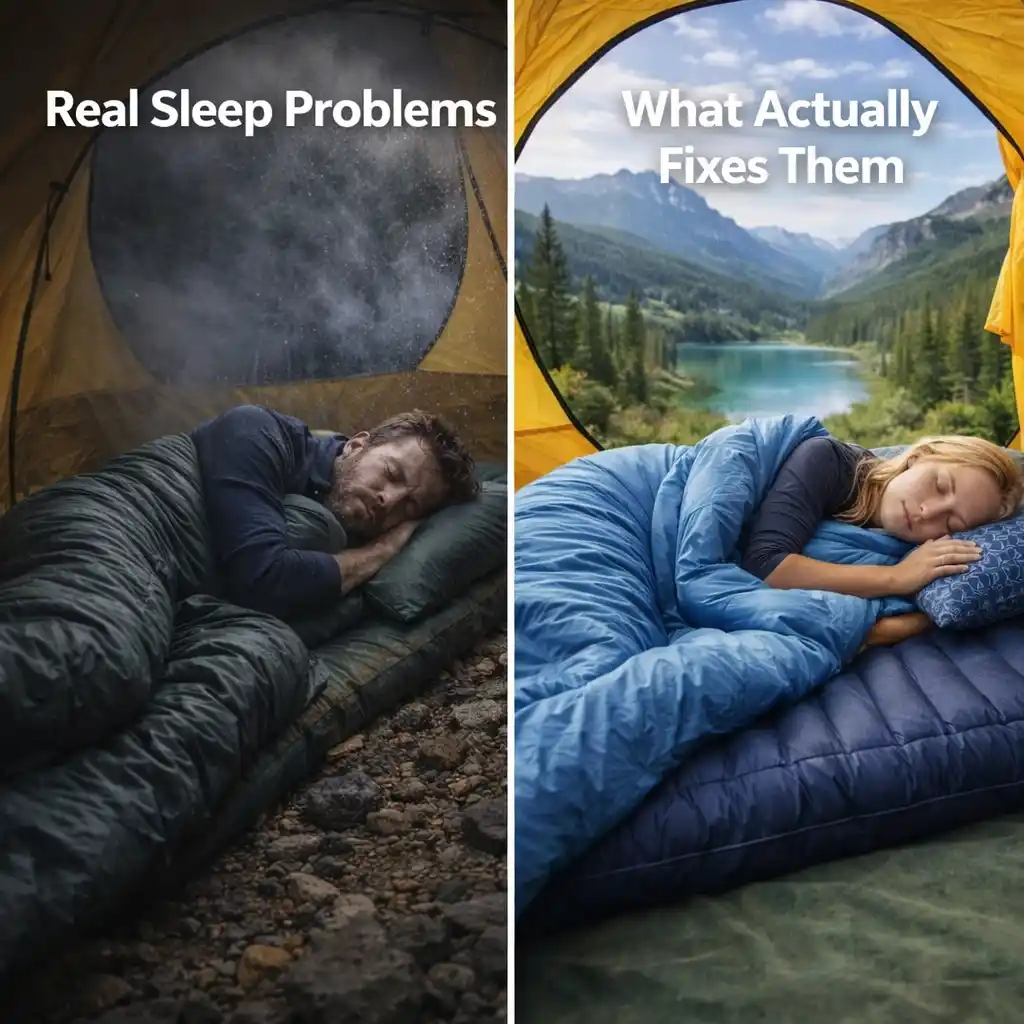
Cold even inside a sleeping bag?
Your pad isn’t insulating enough. Most cold comes from below, not above.
Waking up with hip or back pain?
Your pad is too thin or too firm. Side sleepers need more cushioning than they think.
Sleeping bag feels warm but still uncomfortable?
Your body position is off — not your gear.
Waking up damp or clammy?
That’s condensation, not sweat. Ventilation matters more than warmth here.
Can’t fall asleep at all?
Your setup is physically uncomfortable — your body won’t relax under tension.
What You Actually Need for Comfortable Sleep (And What Actually Makes a Difference)
Most campers bring a lot of gear — but still sleep badly.
That’s because comfort doesn’t come from quantity. It comes from having the right components doing the right job.
Core system (non-negotiable):
— Insulated sleeping pad (R-value matters most)
This is your primary barrier against heat loss. Without it, nothing else compensates.
— Sleeping bag matched to real temperatures (not marketing ratings)
Too cold = wake up. Too warm = sweat → moisture → cold later.
— Proper head and neck support
Poor alignment leads to constant micro-adjustments and disrupted sleep.
— Flat, stable sleeping surface
Even small slopes or debris create pressure points over time.
— Dry environment
Moisture reduces insulation efficiency and comfort faster than cold alone.
Optional — but high impact:
— Sleeping cot → improves airflow + reduces pressure points
— Ventilation setup → prevents condensation buildup
— Layering system → adapts to temperature changes overnight
Key insight:
You don’t need more gear — you need fewer weak points in your system.
Choosing the right pad makes the biggest difference. See 5 Best Camping Mattresses & Sleeping Mats for Car Camping in 2026.
What Actually Matters More Than Gear (The System Behind Good Sleep)
Before you upgrade your gear, you need to understand what actually creates comfort.
Because gear doesn’t fix problems — it only supports a system.
Comfort comes from four interacting factors:
— Insulation (heat retention from the ground)
Without this, your body continuously loses heat.
— Support (spine alignment and stability)
Your muscles should relax — not compensate for bad positioning.
— Pressure distribution
Uneven load leads to pain and constant repositioning.
— Dryness (moisture control)
Moisture reduces insulation performance and creates discomfort faster than temperature.
Most campers focus on gear upgrades.
But if these four aren’t working together — no upgrade will fix your sleep.
That’s why people buy better gear… and still wake up tired.
This is the difference between a setup that “should work” — and one that actually does in real conditions.
Why Sleeping Pads Matter More Than Sleeping Bags (The Biggest Mistake Campers Make)
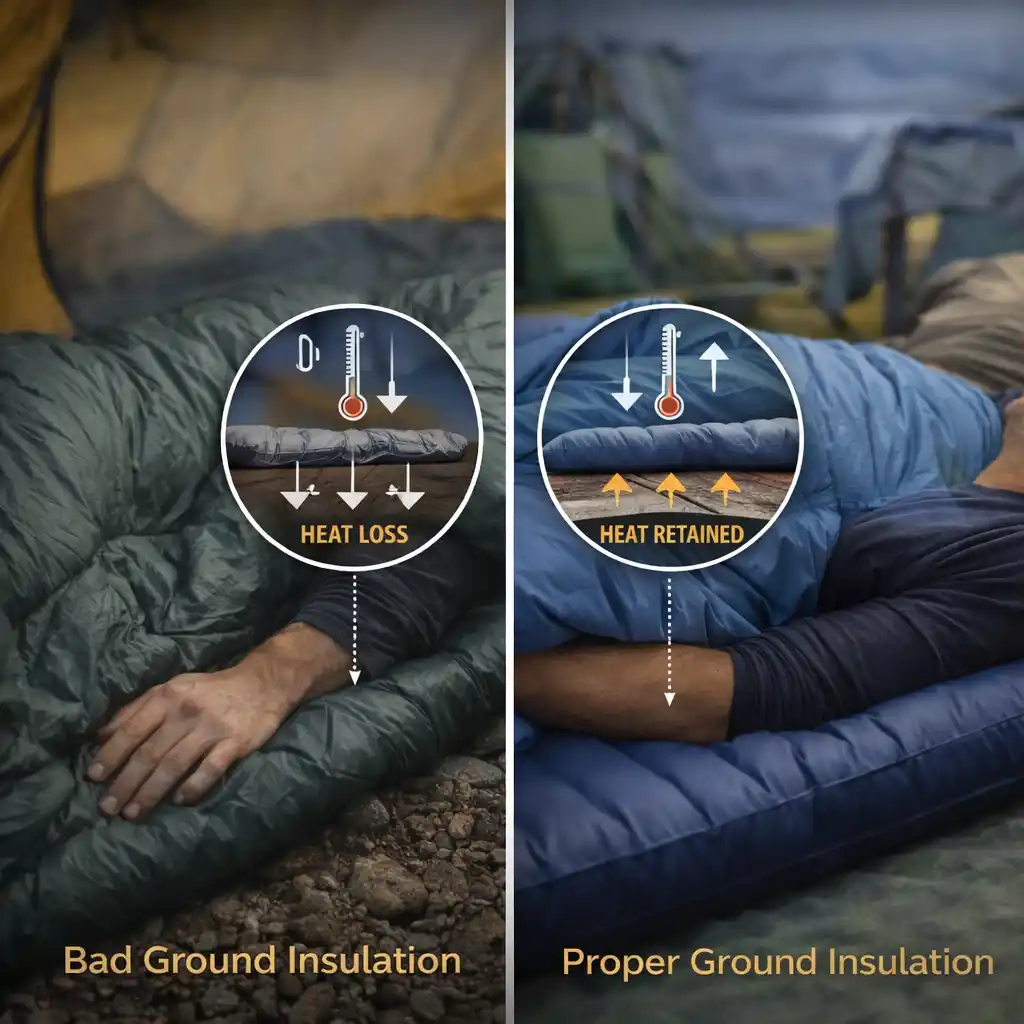
Most campers think warmth comes from their sleeping bag.
It doesn’t.
A sleeping bag traps heat — but it cannot stop heat from leaving your body into the ground.
When you lie down, the insulation under your body compresses.
That means the ground becomes the main source of heat loss.
This is why people feel cold even inside “warm” sleeping bags.
The real function of a sleeping pad is:
— to create a thermal barrier
— to reduce conductive heat loss
— to maintain consistent body temperature
What this means in practice:
— A high-quality pad + average sleeping bag = comfortable sleep
— A premium sleeping bag + poor-quality pad = cold night
If you fix only one thing in your sleep system — fix your pad.
Because it’s not the most visible piece of gear.
But it’s the one doing the most work.
For cold ground conditions, insulation becomes critical — see 5 Best Sleeping Pads for Cold Ground in 2026 (High R-Value, Winter Tested).
How to Set Up a Comfortable Sleeping System
1️⃣ Clear and level your ground
Even small rocks create pressure points over time.
2️⃣ Choose the right insulation
If the ground is cold, your pad matters more than your sleeping bag.
3️⃣ Adjust firmness of your pad
Too hard = pressure points
Too soft = poor support
4️⃣ Align your body position
Keep your spine neutral — especially if you sleep on your side.
5️⃣ Control airflow inside the tent
Ventilation prevents condensation buildup that ruins comfort.
Most sleep problems are setup problems — not gear problems.
How to Stay Warm While Sleeping (What Actually Works)
Staying warm at night isn’t about adding more insulation on top — it’s about preventing heat loss below you.
Most campers make the same mistake: they upgrade their sleeping bag but ignore the ground. That’s where the majority of heat loss happens.
What actually works:
— Use a sleeping pad with sufficient R-value for the conditions
— Keep your body dry — moisture kills insulation efficiency
— Insulate extremities (head and feet lose heat fastest)
— Avoid compressing your sleeping bag — it reduces its ability to trap heat
Key insight:
If you’re cold at night, your problem is almost always underneath you — not above you.
If you’re camping in extreme conditions, your full setup matters — see 5 Best Winter Sleeping Bags for Extreme Cold in 2026 (Tested at Sub-Zero).
How to Reduce Pressure Points and Pain (Proper Support Setup)
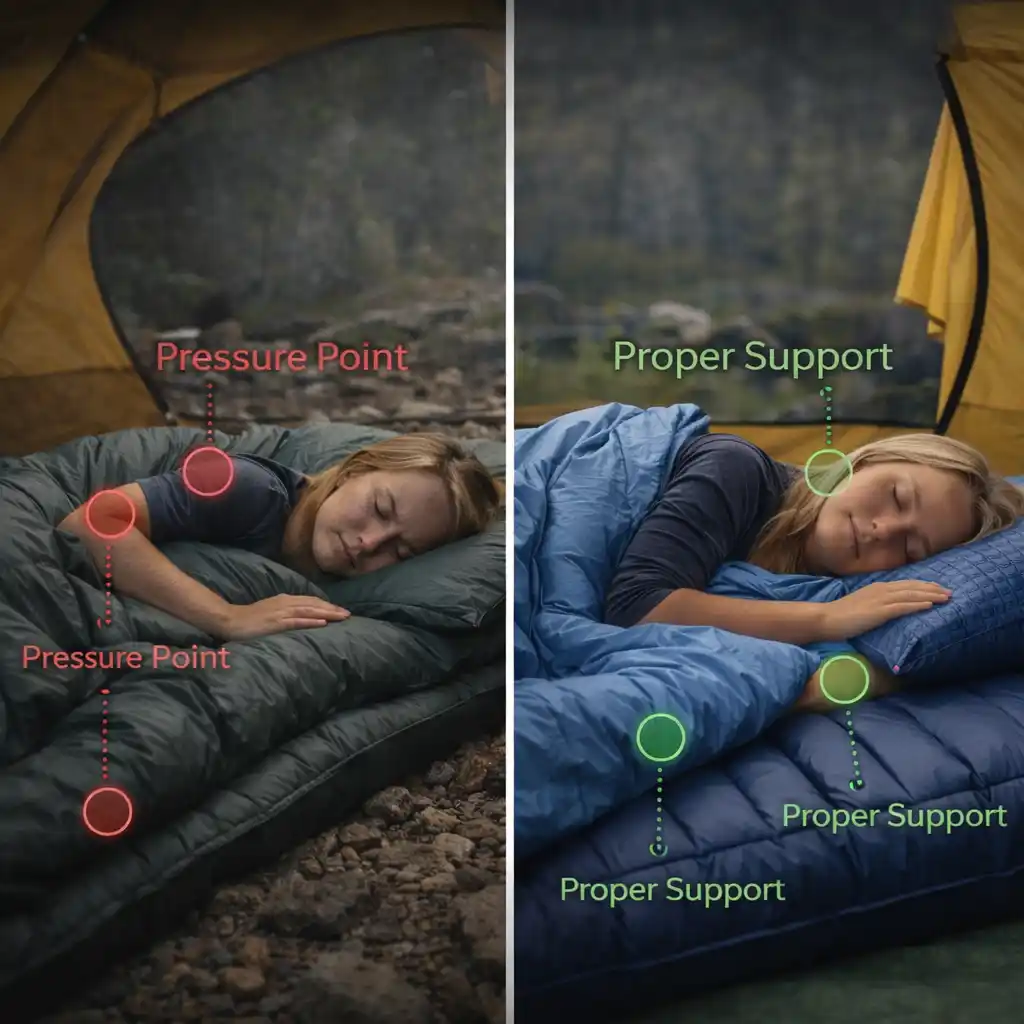
Discomfort at night isn’t random — it’s caused by uneven pressure distribution.
If your hips, shoulders, or lower back hurt, your sleeping system isn’t supporting your body properly.
What actually matters:
— Side sleepers need thicker pads to prevent hip compression
— Back sleepers need consistent, even support across the spine
— Hard contact points between your body and the ground must be eliminated
Most people try to “get used to it.”
That doesn’t work.
If you wake up sore, your setup is wrong — not your tolerance.
If you still wake up sore, upgrading your setup can help — see 5 Best Camping Cots for Adults in 2026 (Sleep Off the Ground).
How to Stay Dry (And Why It Matters More Than You Think)
Moisture is one of the most underestimated factors in sleep quality outdoors.
You don’t need heavy rain to get wet — condensation inside your tent is often enough to make your gear damp overnight.
And once moisture is present, everything gets worse:
— insulation loses effectiveness
— fabrics feel cold
— comfort drops fast
What actually works:
— Ventilate your tent to allow airflow
— Keep wet gear outside your sleeping area
— Use proper ground insulation to prevent moisture transfer
Key insight:
A dry setup matters more than a warm one.
Dampness is what turns a manageable night into a miserable one.
For official outdoor sleep and safety recommendations, check the guidelines from the National Park Service
If you’re camping in wet conditions, setup becomes even more critical — see 10 Tips for Camping in the Rain: How to Stay Dry & Happy (2026).
Sleep Setup vs Problems (What Actually Works)
| Problem | Solution | When to Use | Effectiveness | Limitation |
|---|---|---|---|---|
| Cold at night | Insulated sleeping pad | Cold ground or low temps | Very High | Wrong R-value |
| Back pain | Thicker pad or cot | Side sleepers / hard ground | High | Bulk |
| Condensation | Ventilation | Humid or closed tent | High | Weather dependent |
| Neck pain | Proper pillow | Back or side sleepers | Medium | Positioning |
Mistakes That Ruin Your Sleep at Camp
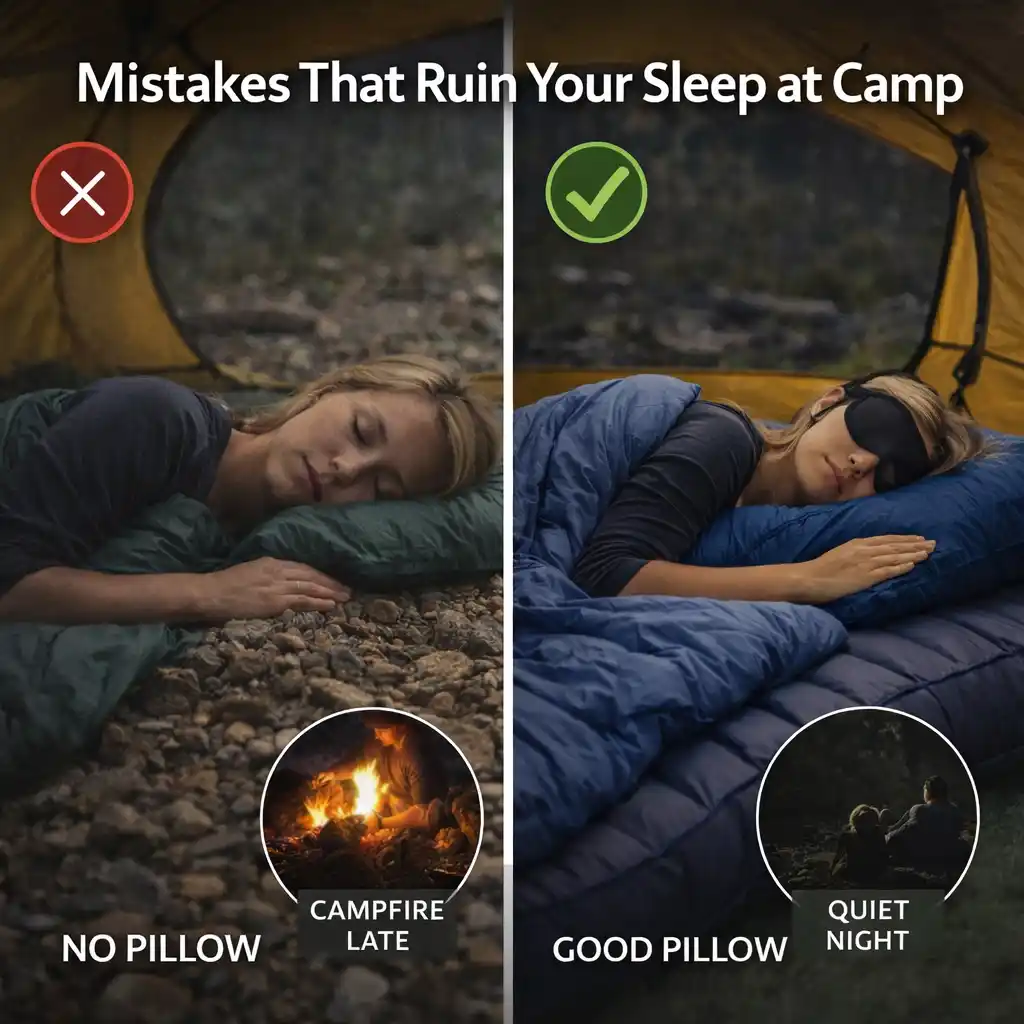
— sleeping directly on the ground
— using the wrong temperature bag
— ignoring moisture
— poor ground preparation
— relying on “toughing it out”
Most campers try to fix sleep by adding more gear.
That rarely works.
Comfort comes from fixing the system — not stacking equipment.
If you’re uncomfortable — something is wrong in your system.
Pro Tips Most Campers Don’t Know
These are the small adjustments that separate “getting through the night” from actually sleeping well outdoors.
✔ Adjust pad firmness — don’t just inflate it fully
A slightly softer pad distributes pressure better and reduces hip and shoulder pain, especially for side sleepers.
✔ Control heat loss from below, not above
Most campers try to stay warm with thicker sleeping bags. In reality, heat loss happens through the ground — fix your insulation first.
✔ Elevate your head slightly — but keep your spine neutral
Too much elevation strains your neck. Too little creates tension. Small adjustments make a big difference overnight.
✔ Your sleep system should move with your body
Rigid setups feel uncomfortable over time. Flexible materials and correct positioning reduce micro-movements that wake you up.
✔ Dryness matters more than warmth
A slightly cool but dry setup is more comfortable than a warm but damp one. Moisture is what makes nights feel miserable.
✔ Don’t wait for discomfort to fix your setup
The best sleep setups are adjusted before problems appear — not after you wake up cold or sore.
Most long-lasting comfort outdoors doesn’t come from better gear — it comes from better setup decisions.
What Matters Most (Priority Order)
If you fix these in the right order, your sleep improves immediately. If you don’t — nothing else will compensate.
1. Insulation from the ground
This is the foundation. Without it, your body continuously loses heat — even in mild conditions.2. Support and alignment
Your spine needs to stay neutral. Poor support leads to constant micro-adjustments and disrupted sleep.3. Dryness and moisture control
Condensation and dampness reduce insulation efficiency and create discomfort faster than temperature alone.4. Temperature control (sleeping bag & layers)
Only matters once insulation and dryness are handled. Most people focus on this first — which is a mistake.Most campers get this backwards — and that’s exactly why they sleep badly.
When Good Sleep Isn’t Possible
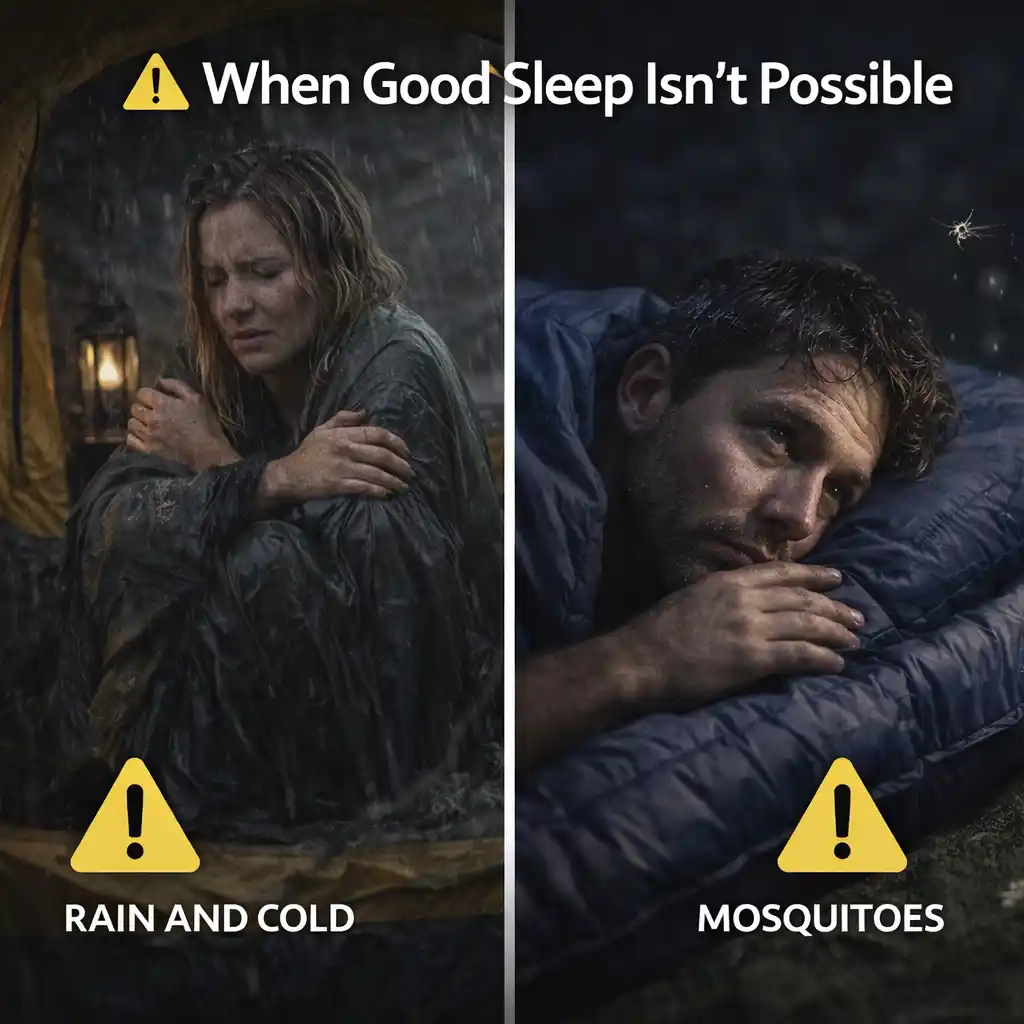
There are situations where no setup or trick will fully fix your sleep — only reduce the discomfort.
— Extreme cold without proper insulation
If your sleeping pad and bag aren’t rated for the conditions, your body will lose heat faster than it can generate it.
— Wet or saturated environment
Once your gear or tent environment becomes damp, insulation performance drops dramatically.
— Poor terrain (rocks, slopes, uneven ground)
No sleeping pad can fully compensate for unstable or uneven surfaces over a full night.
— Incorrect gear for your sleep style
Side sleepers on thin pads or restless sleepers on unstable setups will struggle no matter what.
At that point, you’re not optimizing comfort — you’re managing discomfort.
The goal isn’t perfection — it’s minimizing what wakes you up.
In these conditions, your tent choice can make a big difference — see 5 Best 4-Season Tents for Extreme Weather in 2026 (Storm-Proven).
FAQ: Sleeping Comfortably While Camping
How do you sleep comfortably while camping?
To sleep comfortably while camping, focus on insulation, support, and dryness. Use an insulated sleeping pad, choose the right sleeping bag, and set up your sleeping area properly.
Why do I feel cold at night while camping?
You feel cold because your body loses heat to the ground. Without proper insulation underneath, even a warm sleeping bag won’t keep you comfortable.
What is the most important gear for sleeping comfortably?
The most important gear is a sleeping pad. It provides insulation from the ground and determines overall comfort more than a sleeping bag.
How thick should a sleeping pad be for camping?
Side sleepers should use pads 3–4 inches thick to reduce pressure points. Back sleepers can use thinner pads with proper support.
How can I avoid back pain while camping?
Use a thicker sleeping pad or cot and keep your body aligned. Uneven ground and poor support are the main causes of back pain.
Why do I wake up damp inside my tent?
This is usually caused by condensation, not sweat. Poor ventilation traps moisture inside the tent, making your sleeping environment damp.
How do I stay warm while sleeping in a tent?
Use a high R-value sleeping pad, wear dry base layers, and keep your head and feet insulated. Staying dry is just as important as staying warm.
Can I sleep directly on the ground without a pad?
You can, but it will be uncomfortable and cold. The ground pulls heat from your body and creates pressure points that disrupt sleep.
What temperature sleeping bag do I need?
Choose a sleeping bag rated slightly lower than the expected nighttime temperature. This gives you a comfort buffer.
How do I sleep better in hot weather camping?
Ventilate your tent, use a lighter sleeping bag or liner, and avoid trapping heat inside your shelter.
Is a camping pillow necessary?
Not required, but it significantly improves comfort. Proper neck support helps you stay asleep longer.
How do I fall asleep faster while camping?
Focus on physical comfort first — eliminate pressure points, stay warm, and ensure proper support. Discomfort is the main reason people can’t fall asleep outdoors.
Final Verdict
Sleeping comfortably while camping isn’t about buying more gear — it’s about fixing the system your body depends on.
Most campers don’t have a gear problem.
They have a setup problem.
Most bad nights outdoors come down to three things: heat loss to the ground, poor support, and trapped moisture. If those aren’t solved, no sleeping bag, pillow, or “upgrade” will make a real difference.
The biggest shift most campers need to make is this:
Stop trying to improve comfort by adding gear — and start fixing the cause of discomfort.
Once your insulation, support, and setup are dialed in, everything changes. You fall asleep faster, wake up less, and actually recover overnight instead of just getting through it.
A good sleep system doesn’t feel “luxury.”
It feels invisible — because nothing is bothering you.
If your current setup isn’t working, choosing the right gear matters — see Best Camping Tents for Every Type of Camper in 2026.
Quick Decision Guide
— Cold at night? → your insulation is failing → upgrade your sleeping pad first
— Waking up sore? → your support is wrong → fix pad thickness or firmness
— Feeling damp or clammy? → poor airflow → improve ventilation, not warmth
— Can’t fall asleep? → discomfort issue → fix setup, not gear
If you’re uncomfortable, the problem isn’t random — it’s one of these four.
Bottom Line
You don’t need luxury to sleep well outdoors.
You need:
— insulation that stops heat loss
— support that keeps your body aligned
— a setup that removes pressure points
Most campers think comfort comes from “better gear.”
It doesn’t.
It comes from understanding how your body interacts with the ground — and fixing the weak points in that system.
Do that, and your tent stops feeling like a compromise —
and starts feeling like a place you can actually rest.
— Anthony