
Best personal locator beacons help campers, hikers, and backcountry travelers send an emergency distress alert when they are beyond cell phone coverage and need rescue assistance. These devices use the 406 MHz Cospas-Sarsat satellite system to transmit distress signals, while built-in GNSS receivers provide positioning data to help rescue authorities locate the person in need. Unlike satellite messengers, traditional personal locator beacons are designed primarily for emergency alerts rather than two-way messaging or routine location sharing, and they do not require a monthly subscription. In this guide, we compare five personal locator beacons for camping, examining their positioning systems, battery performance, waterproof protection, activation features, and key limitations to help you choose the right emergency beacon for your outdoor activities.
As an Amazon Associate I earn from qualifying purchases.
Table of Contents
Quick Answer: Which Personal Locator Beacon Is Best for Camping?
The best personal locator beacon for camping depends on how you travel and what you need from an emergency device. For most campers and hikers, the key considerations are carrying weight, emergency-alert feedback, and whether the beacon will also be used around boats or coastal waters.
Use these priorities to narrow down your choice:
For lightweight hiking and backpacking: Prioritize a compact, lightweight beacon that is easy to carry and keep accessible throughout the trip.
For additional feedback after activation: Look for a model with Return Link Service (RLS) and a display that provides information about the beacon’s status. RLS confirms that the distress alert has been received; it does not confirm that rescuers have been dispatched.
For boating and coastal activities: Consider a beacon with Automatic Identification System (AIS), which can provide an additional locating signal to nearby vessels equipped with compatible AIS receivers.
For a straightforward emergency setup: Focus on reliable 406 MHz distress signaling, suitable positioning capabilities, battery condition, and correct country-specific programming rather than paying for features you may not need.
Before buying, verify that the exact unit can be registered in your country and that its battery remains within the manufacturer’s permitted service period. Imported and marketplace-listed devices may have regional programming restrictions.
A PLB is designed for emergency distress alerts, not routine messaging or two-way communication. If you need regular contact, location sharing, or the ability to exchange messages, a satellite communicator may be a better fit.
Why You Can Trust This Guide
Choosing a personal locator beacon is a safety decision, not simply a matter of comparing prices or counting features. A device must be compatible with the satellite distress-alert system, suitable for your intended activities, and properly registered for the country in which it will be used. That is why this guide focuses on verifiable product information and practical differences rather than marketing claims.
Our comparison is based on several important principles:
Manufacturer specifications: We use official product information and technical documentation to identify each beacon’s supported signals, positioning capabilities, battery specifications, waterproof rating, and additional features.
Independent product research: We consider established outdoor and marine equipment reviews to understand how experienced reviewers evaluate portability, ease of activation, durability, and practical usability. We distinguish independent review findings from manufacturer claims.
Emergency signaling technology: We examine the role of 406 MHz distress transmission, GNSS positioning, and 121.5 MHz homing signals, as well as model-specific features such as Return Link Service (RLS) and Automatic Identification System (AIS).
Registration and regional compatibility: We highlight the importance of beacon coding, national registration requirements, and compatibility with the country where the device will be operated. This is particularly important when purchasing imported or US-programmed models.
Practical buying considerations: We look beyond headline specifications to consider battery replacement intervals, operational duration, carrying options, waterproof protection, and the maintenance required to keep a beacon ready for an emergency.
We do not present manufacturer specifications as independent field-test results, and we do not claim to have personally tested these five devices. Where a feature or regional requirement needs additional confirmation, we identify it rather than making assumptions.
The goal is to give campers a clear, evidence-based comparison so they can understand what each beacon offers, recognize its limitations, and make a more informed decision before heading into areas without reliable mobile coverage.
How We Evaluate Personal Locator Beacons
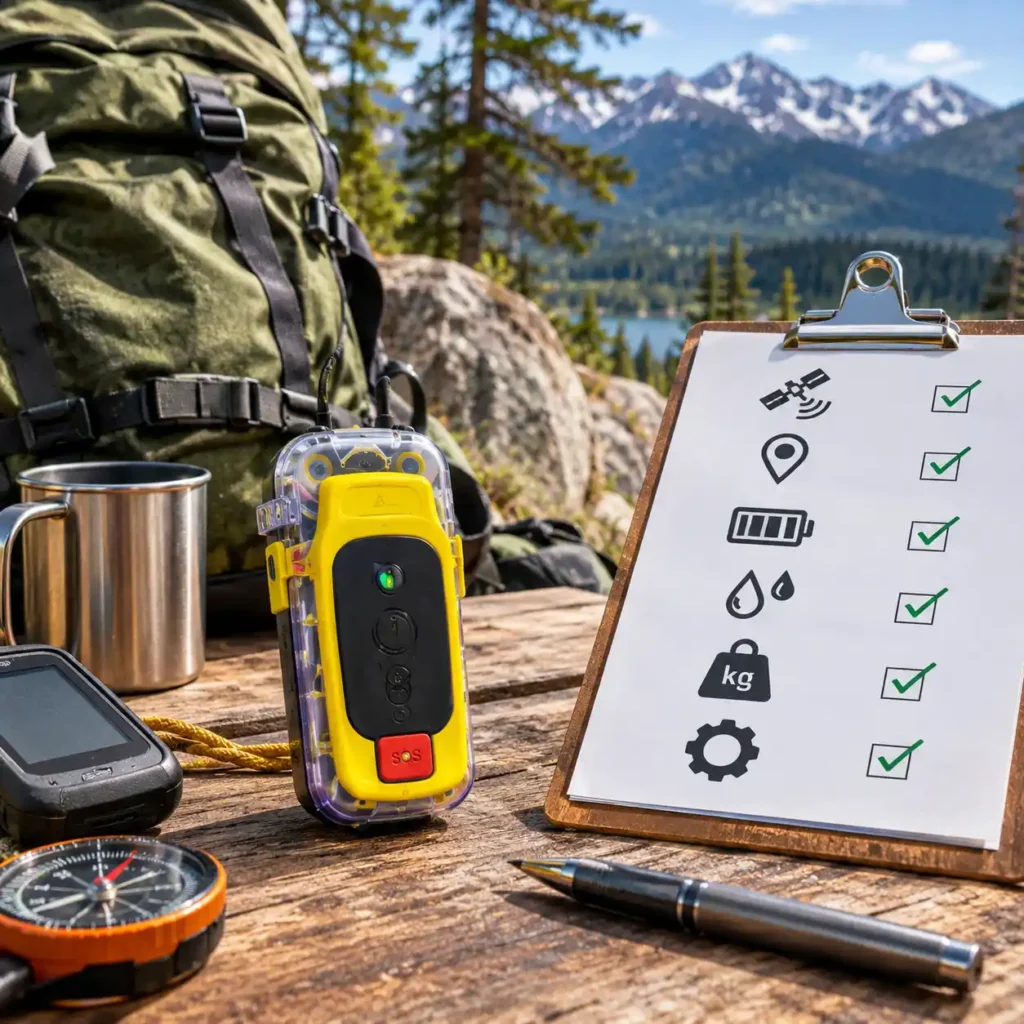
Not all personal locator beacons offer the same combination of features, and a longer specification list does not automatically make one model better than another. For camping and outdoor travel, the most important considerations are whether a beacon can transmit an emergency distress alert, provide useful location information, remain operational in demanding conditions, and be maintained correctly throughout its service life.
To compare the five selected models consistently, we focus on the following criteria.
1. Satellite Distress Signaling and Positioning
A PLB’s primary purpose is to transmit an emergency distress alert through the 406 MHz Cospas-Sarsat satellite system. We examine the supported distress-signaling capabilities and whether the device incorporates GNSS or GPS positioning to provide location coordinates to rescue authorities.
We also consider the role of the 121.5 MHz homing signal, which can help search-and-rescue teams locate a beacon during the final stages of a rescue operation.
2. Return Link Service (RLS) and Additional Locating Features
Some beacons provide capabilities beyond conventional distress transmission. Return Link Service can provide an indication that the distress alert has been received by the satellite system. This feedback can be valuable in an emergency, although it does not mean that rescue teams have already arrived or that assistance is guaranteed.
We also examine AIS functionality where available. For example, the ACR ResQLink AIS PLB-450 includes AIS alerting in addition to its satellite distress capabilities. This feature is particularly relevant to marine environments, where nearby vessels equipped with compatible AIS receivers may be able to detect the alert.
3. Battery Life and Operational Duration
Battery performance has two important aspects: the battery’s replacement interval or service life before activation, and the minimum operating duration after the beacon is activated.
We compare the manufacturer’s stated battery specifications and operational endurance rather than treating these figures as interchangeable. We also consider battery replacement requirements, expiration dates, and the importance of periodic maintenance.
4. Size, Weight, and Carrying Options
A beacon is only useful when it is accessible during an emergency. We therefore consider the device’s dimensions, weight, carrying arrangements, and attachment options.
For backpackers and hikers, a compact design may be particularly valuable. For other campers, ease of access, secure attachment, and the ability to operate the device without unnecessary handling may matter more than a small difference in weight.
5. Waterproof Protection and Outdoor Durability
Camping equipment may be exposed to rain, splashes, wet clothing, mud, and accidental drops. We review the manufacturer’s stated waterproof protection and relevant construction details to understand whether each beacon is suitable for the intended environment.
Waterproof ratings should always be interpreted according to the manufacturer’s specified test conditions. A waterproof rating alone does not establish that a device floats or is suitable for every marine application.
6. Registration, Programming, and Regional Compatibility
Registration is an essential part of owning and operating a PLB. We consider whether the beacon’s programming and registration requirements are compatible with the country where the owner intends to use it.
This deserves particular attention when buying imported or US-programmed models. A product listing that identifies a beacon as suitable for US registration should not automatically be interpreted as confirmation that the same unit can be registered in another country.
7. Ease of Activation and Practical Operation
In a genuine emergency, a beacon must be straightforward to access and activate. We examine the manufacturer’s operating instructions, protective covers, activation controls, antenna deployment, and self-test procedures.
We also consider whether the device provides useful status information and whether its operating instructions are clear enough for users to understand before an emergency occurs.
Our comparison prioritizes verified manufacturer specifications, documented technical capabilities, and practical ownership considerations. We do not assign invented laboratory scores or claim independent field-test results. Where specifications differ by regional version or require confirmation, we identify those limitations rather than assuming that every listing represents an identical configuration.
Who Should Consider a Personal Locator Beacon?
A personal locator beacon is worth considering if your outdoor activities take you beyond reliable mobile coverage and you want a dedicated emergency device that can alert search-and-rescue authorities when a life-threatening situation occurs. Unlike equipment designed for routine communication, a PLB is intended for one primary purpose: transmitting a distress signal and helping rescuers determine your location.
Remote Campers and Backcountry Travelers
Campers who travel into remote forests, mountain regions, deserts, and other areas without dependable cellular coverage may benefit from carrying a PLB. If an accident, serious injury, or other emergency makes it impossible to reach help by phone, a properly registered and operational beacon provides a dedicated way to transmit a distress alert.
This can be particularly relevant for people who camp far from established roads, populated areas, or regularly traveled trails.
Backpackers and Long-Distance Hikers
Backpackers and hikers often prioritize lightweight equipment, especially on multi-day trips where every additional item contributes to their overall pack weight. A compact PLB can provide an emergency signaling option without requiring a messaging subscription or routine interaction with a communications network.
For these users, device weight, carrying arrangements, access during an emergency, and battery readiness are important considerations. A beacon should be securely carried where it can be reached when needed, rather than left buried inside a backpack.
Solo Campers and Independent Adventurers
People who travel alone may have fewer immediate opportunities to receive assistance from companions if something goes wrong. A PLB can provide an additional emergency-safety measure when solo camping, hiking, or exploring remote locations.
However, carrying a beacon does not eliminate the risks of traveling alone. Sharing your itinerary, checking weather conditions, understanding the terrain, and following appropriate safety procedures remain essential.
Hunters, Anglers, and Remote Outdoor Workers
Hunters, anglers, and people working outdoors may spend extended periods away from roads and populated areas. Depending on the location and activity, a PLB can be a useful emergency device when ordinary mobile communication is unavailable.
For anglers and boaters, models with additional marine-oriented capabilities may deserve closer consideration. For example, AIS functionality on the ACR ResQLink AIS PLB-450 may provide an additional locating option in environments where nearby vessels have compatible AIS receivers.
Who May Need More Than a PLB?
A PLB is not the right standalone solution for everyone. It is designed primarily for emergency distress signaling, not everyday communication.
You may need a satellite communicator instead, or alongside a PLB, if you want to:
Send and receive routine messages while outside cellular coverage.
Share your location with family or other contacts during a trip.
Receive weather updates and other information in remote areas.
Communicate with someone before a situation becomes a life-threatening emergency.
Exchange messages with emergency responders when the device and service support that capability.
The distinction is important: a PLB is an emergency beacon, not a general-purpose communication device. Your choice should depend on whether your priority is a dedicated distress alert, regular communication, or both.
Ultimately, a personal locator beacon makes the most sense for outdoor users who want a dedicated emergency signaling device and understand its limitations. Before purchasing one, make sure its programming, registration requirements, battery condition, and operating instructions are appropriate for the country and activities in which you intend to use it.
Quick Summary: Our Top Picks
Choosing the right personal locator beacon for camping depends on your outdoor activities, preferred features, carrying requirements, and the country where you intend to register the device. Some models offer additional feedback after a distress alert, while others prioritize compact dimensions or provide extra locating capabilities for marine environments.
Here is a closer look at the five personal locator beacons selected for this guide.
1. ACR ResQLink View RLS PLB-435 — Best for Return Link Service Feedback
The ACR ResQLink View RLS PLB-435 is worth considering if you want a dedicated emergency beacon with a display and Return Link Service (RLS). Its RLS capability provides an indication that the distress alert has been received by the satellite system, giving the user additional feedback after activation. The display also distinguishes this model from more basic beacon designs.
Best for: Campers and hikers who value Return Link Service feedback and a display showing device information.
2. Ocean Signal rescueME PLB1 — Best for a Compact Carrying Setup
The Ocean Signal rescueME PLB1 is a compact personal locator beacon designed for users who want emergency signaling capability in a small, lightweight package. Its size makes it particularly relevant to backpackers and hikers who pay close attention to the weight and space taken up by their equipment. Check the battery expiry information and the manufacturer’s operating-duration specifications before purchasing.
Best for: Backpackers and hikers who prioritize a compact, lightweight emergency beacon.
3. ACR ResQLink AIS PLB-450 — Best for Additional Marine Locating Capabilities
The ACR ResQLink AIS PLB-450 combines satellite distress signaling with additional locating capabilities, including Automatic Identification System (AIS), Return Link Service (RLS), and NFC connectivity. Its AIS functionality makes it particularly relevant to people who combine camping with boating, coastal activities, or other marine environments where nearby vessels may be equipped to receive AIS alerts.
Best for: Outdoor users who spend time on the water and want a PLB with additional AIS locating functionality.
4. Jotron Tron SA20 PLB — Best for Buyers Considering a Dedicated Emergency Beacon
The Jotron Tron SA20 is a dedicated personal locator beacon from a manufacturer with an established background in maritime safety equipment. It may be worth considering for buyers comparing conventional emergency beacon options. However, the exact programming of the Amazon-listed version and its compatibility with the intended country’s registration requirements should be confirmed before purchase.
Best for: Buyers considering a dedicated PLB who can verify the unit’s regional programming and registration eligibility.
5. 4 — Best for a Conventional PLB Setup
The McMurdo FastFind 220 is another dedicated emergency beacon to consider when comparing established PLB designs. Before ordering, pay particular attention to the exact product version, battery condition, expiry or replacement status, and country-specific programming. These details are especially important when purchasing a beacon through an international marketplace.
Best for: Buyers looking for a conventional emergency beacon who can confirm its condition, programming, and registration compatibility.
Before purchasing any personal locator beacon, verify the exact model number, country-specific programming, registration requirements, and battery status. Also review the manufacturer’s operating instructions and make sure you understand how to activate the beacon correctly. A PLB is an emergency distress-signaling device, so its suitability depends not only on its advertised features but also on whether it can be properly registered, maintained, and used in your intended location.
Compare the Best Personal Locator Beacons for Camping
The five personal locator beacons in this guide share the same primary purpose: transmitting an emergency distress alert through the Cospas-Sarsat satellite system. However, they differ in weight, positioning technology, additional locating features, battery specifications, and waterproof protection.
The comparison below highlights the most useful specifications to consider before choosing a model.
| Personal Locator Beacon | Weight | Positioning | Additional Features | Operational Duration | Battery Life / Replacement | Waterproof Protection |
|---|---|---|---|---|---|---|
| ACR ResQLink View RLS PLB-435 | 148 g | GPS and Galileo | Digital display, RLS, buoyant design | 28 hours | Replace after 5 years or emergency use | 5 m for 1 hour; 10 m for 10 minutes |
| Ocean Signal rescueME PLB1 | 116 g | 66-channel GPS | 121.5 MHz homing signal, strobe, optional flotation pouch | 24+ hours | 7-year replacement interval | 15 m |
| ACR ResQLink AIS PLB-450 | 190 g | GPS, Galileo, and GLONASS | AIS, RLS, NFC, optional flotation pouch | 24+ hours | 6 years from manufacture or 5 years after being placed into service | 10 m for 1 hour |
| Jotron Tron SA20 PLB | 150 g | GPS, Galileo, and GLONASS | NFC, visible and infrared lights, floating Category 2 design | More than 24 hours | 11-year stated battery lifetime | IPX7: 1 m for 1 hour |
| McMurdo FastFind 220 | 152 g | 72-channel GPS | 121.5 MHz homing signal, SOS flash, supplied buoyancy pouch | More than 24 hours at -20°C | 6-year battery life; replacement through a service center | 10 m for 5 minutes |
Specifications are based on manufacturer documentation and available technical product information. Battery replacement intervals and operational duration are separate measurements. Waterproof ratings have different test conditions and should not be interpreted as directly equivalent.
Key Differences at a Glance
Lowest weight: The Ocean Signal rescueME PLB1 weighs 116 g, making it the lightest model in this comparison.
Return Link Service: Both ACR models include RLS, which provides feedback that the distress alert has been received by the satellite system.
AIS capability: The ACR ResQLink AIS PLB-450 is the only model in this selection with AIS alerting.
Longest stated battery lifetime: The Jotron Tron SA20 lists an 11-year battery lifetime. Always check the manufacturing date and the exact unit’s battery information.
Longest specified operational duration: The ACR ResQLink View RLS PLB-435 is rated for 28 hours of operation.
Buoyancy: The ACR ResQLink View RLS has a buoyant design. Other models have different flotation arrangements, so check whether a flotation pouch is included or needs to be purchased separately.
Important Compatibility and Buying Considerations
The specifications in this table do not establish that every version of each beacon can be registered in every country. PLBs are programmed with country-specific identification information, and registration must comply with the requirements of the relevant national authority.
This is particularly important when purchasing the Jotron Tron SA20 or McMurdo FastFind 220 through an international marketplace. Confirm the programming of the exact unit, its registration eligibility, and whether the battery is still within its permitted service period.
For the ACR models, also distinguish between the US-programmed and other regional versions. The product model number alone does not confirm the programming of the individual unit being sold.
The 5 Best Personal Locator Beacons for Camping in 2026
1. ACR ResQLink View RLS PLB-435
Award: Best for Return Link Service Feedback

The ACR ResQLink View RLS PLB-435 is designed for outdoor users who want a dedicated emergency beacon with additional feedback during a distress event. Its combination of 406 MHz satellite distress signaling, GPS and Galileo positioning, Return Link Service (RLS), and a live digital display distinguishes it from more basic personal locator beacons. The buoyant construction, compact dimensions, and subscription-free operation also make it suitable for camping, hiking, boating, and other activities beyond reliable cellular coverage.
Overview
A personal locator beacon needs to do more than transmit an emergency signal. It must also provide useful location information, remain accessible when needed, and operate reliably in demanding outdoor conditions. The ACR ResQLink View RLS addresses these requirements with a manually activated distress beacon designed to communicate through the Cospas-Sarsat satellite system.
Once activated, the device transmits a 406 MHz distress signal containing its unique identification information. Its multi-constellation receiver uses GPS and Galileo GNSS to determine the user’s position, while the 121.5 MHz homing signal can help search-and-rescue teams locate the beacon during the final stages of a rescue operation.
One of the model’s main distinguishing features is Return Link Service. When the applicable satellite system and regional service support it, RLS provides confirmation that the distress alert has been received by the satellite system. The integrated digital display adds another layer of feedback by showing GPS coordinates and beacon status. This confirmation does not mean that rescue personnel have been dispatched or that assistance has already arrived.
The PLB-435 weighs approximately 148 g (5.3 oz) and measures 11.48 × 5.16 × 3.78 cm. ACR specifies an operational life of 28 hours and a battery replacement interval of five years or after emergency use, whichever occurs first. The beacon is buoyant and has a stated waterproof rating of 5 m for one hour or 10 m for ten minutes.
For campers and hikers, the main appeal is the combination of dedicated emergency signaling, positioning information, and RLS feedback in a relatively compact device. However, it remains an emergency beacon rather than a satellite communicator: it is not designed for routine messaging, continuous location sharing, or two-way conversations.
Key Features
406 MHz Cospas-Sarsat Distress Signaling
The ResQLink View RLS PLB-435 uses a 406 MHz transmitter to send an emergency distress alert through the Cospas-Sarsat satellite system. This is the central function of the device and the reason it belongs in a dedicated emergency-safety kit for remote outdoor activities.
When activated in a genuine life-threatening emergency, the beacon transmits its identification information to the satellite-based search-and-rescue system. The alert can then be processed by the relevant rescue coordination authorities.
The device also incorporates a 121.5 MHz homing signal. This is intended to help search-and-rescue teams locate the beacon more precisely when they are approaching the reported position.
GPS and Galileo GNSS Positioning
The PLB-435 uses a multi-constellation positioning receiver supporting GPS and Galileo GNSS. Satellite positioning allows the beacon to include location information in its distress transmission, helping rescue authorities establish where assistance may be required.
For campers exploring remote trails, mountain areas, and locations without mobile coverage, accurate positioning is an important part of emergency signaling. However, the beacon should be activated and operated according to the manufacturer’s instructions, with its antenna positioned toward the sky and unobstructed as far as possible.
Return Link Service and Digital Display
Return Link Service is one of the main reasons to consider the ResQLink View RLS over a more basic PLB. It provides an indication that the distress alert has been received by the satellite system.
The integrated digital display provides additional information, including GPS coordinates and beacon status. This can help users understand the device’s status after activation rather than relying only on a basic indicator light.
It is important to understand the limits of this feature. RLS confirms receipt of the distress message; it does not confirm that a rescue team has been dispatched, that rescuers know the user’s exact immediate circumstances, or that assistance is guaranteed. RLS availability can also depend on regional service support and beacon programming.
Buoyant Construction and Waterproof Protection
ACR describes the ResQLink View RLS as a buoyant personal locator beacon. Its construction is intended to provide flotation, which may be useful during activities near water or when a device is accidentally dropped overboard.
The manufacturer specifies waterproof protection at 5 m for one hour and 10 m for ten minutes. These are stated test conditions, not an indication that the beacon can transmit while submerged. The antenna must remain above the water and have a suitable view of the sky for satellite communication.
For ordinary camping, this level of protection offers reassurance against exposure to wet outdoor conditions. For water-based activities, users should still follow the manufacturer’s instructions for carrying and deploying the beacon.
28-Hour Operational Life
ACR specifies an operational life of 28 hours for the PLB-435. This refers to the stated operating duration after activation, not the battery’s shelf life or the interval before battery replacement.
The manufacturer specifies battery replacement after five years or following emergency use, whichever occurs first. Owners should check the replacement date marked on the actual unit and follow the manufacturer’s maintenance and testing instructions.
This distinction matters because a beacon with an unexpired battery replacement date must still be maintained correctly and checked according to its operating manual.
Compact Design and Carrying Options
At approximately 148 g, the ResQLink View RLS is compact enough to be carried as part of a hiking or camping safety kit. Its dimensions are 11.48 × 5.16 × 3.78 cm, and ACR includes a multifunction clip system for different carrying arrangements.
A PLB should be carried where it can be accessed quickly in an emergency. Storing it deep inside a backpack may make activation unnecessarily difficult when time and physical condition are critical.
The carrying arrangement should also allow the antenna to be deployed correctly and the beacon to be positioned with a clear view of the sky.
Technical Specifications
| Specification | Details |
|---|---|
| Brand | ACR Electronics |
| Product | ResQLink View RLS Personal Locator Beacon |
| Model Number | PLB-435 |
| Amazon ASIN | B0B4318FYC |
| Distress Satellite System | Cospas-Sarsat |
| Distress Frequency | 406 MHz |
| Homing Frequency | 121.5 MHz |
| Positioning | GPS and Galileo GNSS |
| Return Link Service | Yes |
| Digital Display | Yes |
| Display Information | GPS coordinates and beacon status |
| Activation | Manual |
| Weight | 148 g (5.3 oz) |
| Dimensions | 11.48 × 5.16 × 3.78 cm |
| Operational Life | 28 hours |
| Battery Replacement | After 5 years or emergency use, whichever occurs first |
| Battery Type | Lithium manganese dioxide (LiMnO₂) |
| Buoyant | Yes |
| Waterproof Rating | 5 m for 1 hour; 10 m for 10 minutes |
| Visible Strobe | Yes |
| Infrared Strobe | Yes |
| Subscription Required | No |
| Warranty | 5 years, subject to manufacturer’s terms |
Specification note: Specifications are based primarily on ACR manufacturer information and product documentation. Battery replacement timing and operational life are separate measurements. Confirm the programming, approval status, battery replacement date, and included accessories of the exact unit before purchasing.
Pros and Cons
Pros
406 MHz distress signaling through the Cospas-Sarsat satellite system.
GPS and Galileo GNSS positioning.
Return Link Service provides feedback that the distress alert has been received.
Digital display shows GPS coordinates and beacon status.
121.5 MHz homing signal supports final-stage search-and-rescue locating.
Buoyant construction and visible and infrared strobe lights.
Manufacturer-specified operational life of 28 hours.
No monthly or annual subscription required.
Cons
Does not support routine messaging or two-way communication.
RLS functionality depends on regional service support and compatible programming.
More expensive and feature-rich than basic PLB designs may be unnecessary for buyers who do not need the display or RLS feedback.
The battery must be replaced after five years or emergency use, whichever occurs first.
Waterproof construction does not mean the beacon can transmit while submerged.
Country-specific programming and registration compatibility must be confirmed before purchase.
Who Should Consider This PLB?
The ACR ResQLink View RLS PLB-435 is worth considering for campers, hikers, backpackers, and other outdoor users who want a dedicated emergency beacon with additional status information. Its GPS and Galileo positioning, 406 MHz distress transmission, and 121.5 MHz homing signal provide the core capabilities expected from a modern PLB.
It may be particularly appealing to people who value Return Link Service. The feedback that a distress alert has been received by the satellite system can provide useful information during an emergency, while the digital display offers access to coordinates and beacon status.
The buoyant construction also makes the model relevant to users who combine camping with boating, paddling, fishing, or other activities near water. Its carrying clip system gives owners several options for keeping the beacon accessible.
However, this model may be more than necessary for someone who only wants a basic emergency beacon and does not consider RLS feedback or a digital display important. It is also not the right standalone device for users who need regular messages, location sharing, or two-way communication while travelling.
What to Verify Before Buying
Confirm that the product is the ACR ResQLink View RLS PLB-435, model PLB-435, ASIN B0B4318FYC.
Check whether the selected unit is programmed for the country where you intend to register it.
Confirm that the relevant national authority accepts the beacon’s programming and registration configuration.
Check the battery replacement date and confirm that the unit has not exceeded its permitted battery service period.
Verify that the product is new and that the package includes the expected multifunction clip and accessories.
Confirm the availability of RLS functionality in the intended operating region.
Review the manufacturer’s activation, self-test, maintenance, and emergency-use instructions.
Understand that the beacon must be positioned with its antenna above water and a suitable view of the sky during operation.
Our Assessment
The ACR ResQLink View RLS PLB-435 stands out in this comparison because it combines conventional satellite distress signaling with Return Link Service and a live digital display. These features make it a strong option for outdoor users who want more feedback from their emergency beacon than a basic model provides.
Its 148 g weight, buoyant construction, GPS and Galileo positioning, and 28-hour stated operational life make it suitable for a wide range of outdoor activities, including remote camping and hiking. The display and RLS capability are meaningful differentiators, although they do not replace the need to understand the beacon’s operating limitations and registration requirements.
The main consideration is whether those additional features justify the purchase for your particular activities. If you value RLS feedback and visible device information, the PLB-435 deserves serious consideration. If you only need basic emergency signaling, a simpler model may be sufficient.
This assessment is based on manufacturer specifications and technical documentation, not independent hands-on field testing.
Related Guide:
A personal locator beacon can alert search-and-rescue authorities during a life-threatening emergency, but it does not replace a dedicated navigation device. If you also want reliable off-grid positioning, route planning, and waypoint navigation on remote trails, explore our guide to the best handheld GPS devices for hiking and camping.
2. Ocean Signal rescueME PLB1
Award: Best for a Compact Carrying Setup

The Ocean Signal rescueME PLB1 is designed for outdoor users who want a dedicated emergency beacon without adding unnecessary weight or bulk to their equipment. Weighing approximately 116 g, it combines 406 MHz satellite distress signaling, GPS positioning, a 121.5 MHz homing signal, and a high-intensity strobe in a compact housing. Its small dimensions and straightforward manual activation make it particularly relevant to backpackers, hikers, and campers who prioritize portability when choosing emergency equipment.
Overview
Carrying emergency equipment becomes particularly important when hiking or camping beyond reliable mobile coverage. A personal locator beacon provides a dedicated way to alert search-and-rescue authorities during a life-threatening emergency, without relying on a mobile phone connection or a commercial messaging subscription.
The Ocean Signal rescueME PLB1 performs this function through the Cospas-Sarsat satellite system. When activated, it transmits a 406 MHz distress signal containing the beacon’s identification information and GPS-derived location. The 121.5 MHz homing signal provides an additional locating aid for search-and-rescue teams approaching the reported position.
One of the PLB1’s main advantages is its compact construction. The manufacturer lists dimensions of approximately 77 × 51 × 32.5 mm and a weight of 116 g. This makes it one of the lighter options in this comparison and a practical candidate for backpackers who want to keep their emergency equipment compact.
The device also includes a retractable antenna, a protective activation cover, a high-intensity LED strobe, and a mounting clip. Its battery has a stated replacement interval of seven years and provides more than 24 hours of operational life under the manufacturer’s specified conditions. The beacon is waterproof to 15 m.
An important distinction concerns flotation. The standard PLB1 does not float independently. An optional flotation pouch is available, but users should follow Ocean Signal’s instructions for securing the beacon because the pouch does not guarantee that the device will float in its operating position.
For campers and hikers, the rescueME PLB1 is primarily attractive because it delivers essential emergency signaling capabilities in a lightweight package. It does not provide routine messaging, two-way communication, or continuous location sharing.
Key Features
406 MHz Cospas-Sarsat Satellite Distress Signaling
The rescueME PLB1 transmits an emergency distress alert on the 406.040 MHz frequency through the Cospas-Sarsat satellite system. This is the device’s primary function and the basis of its role as an emergency beacon.
After activation, the distress transmission includes the beacon’s unique identification information and available position data. The alert is relayed through the satellite-based search-and-rescue infrastructure to the appropriate rescue coordination authorities.
The system is designed for genuine emergencies where immediate assistance may be required. The PLB should therefore be activated only in accordance with the manufacturer’s instructions and applicable emergency-use guidance.
66-Channel GPS Positioning
Ocean Signal specifies a 66-channel GPS receiver for the rescueME PLB1. The positioning system determines the beacon’s location so that coordinates can be included in its emergency distress transmission.
For backpackers and campers travelling through remote forests, mountain regions, and other areas without dependable mobile coverage, GPS positioning is an important part of emergency signaling.
The beacon should be positioned according to the operating instructions, with its antenna fully deployed and a clear view of the sky whenever possible. Dense overhead cover, terrain, and other obstructions can affect satellite reception.
121.5 MHz Homing Signal
In addition to its 406 MHz satellite distress transmission, the rescueME PLB1 incorporates a 121.5 MHz homing signal.
This signal is intended to help search-and-rescue teams locate the beacon more precisely as they approach the reported position. It serves a different purpose from the 406 MHz transmission: the satellite alert initiates the emergency notification process, while the homing signal can assist with final-stage locating.
This is a useful feature for a dedicated emergency beacon, particularly when an incident occurs in difficult terrain where finding the exact location may be challenging.
Compact and Lightweight Construction
Portability is one of the strongest reasons to consider the rescueME PLB1. The manufacturer lists a weight of approximately 116 g and dimensions of 77 × 51 × 32.5 mm.
For backpackers and hikers, a compact beacon can be easier to incorporate into an existing equipment setup without taking up much space. The supplied mounting clip also provides an option for keeping the device accessible rather than storing it deep inside a backpack.
The PLB1 is also designed with a retractable antenna and a protective cover over the activation controls. These features help protect the device during normal carrying and reduce the likelihood of accidental activation.
Seven-Year Battery Replacement Interval
Ocean Signal specifies a seven-year battery replacement interval for the rescueME PLB1. The battery is a lithium manganese dioxide type and is designed to provide more than 24 hours of operation under the manufacturer’s specified conditions.
The seven-year figure refers to the battery replacement interval, not the operating duration after activation. These are separate specifications and should not be confused when comparing PLBs.
Battery replacement is not a user-serviceable procedure. Ocean Signal states that the beacon should be returned to an authorized battery replacement center when the battery reaches its replacement date or after emergency activation.
Before purchasing, check the expiry information on the actual unit. A new-looking device may still have a battery that is approaching its replacement date.
Waterproof Protection to 15 Metres
The rescueME PLB1 is specified as waterproof to a depth of 15 m at the manufacturer’s stated test conditions. This protection is relevant to users who may encounter heavy rain, wet equipment, accidental immersion, or water-based outdoor activities.
However, waterproof protection should not be confused with flotation. The standard beacon does not float on its own, and the optional flotation pouch must be used according to the manufacturer’s instructions.
The beacon also needs its antenna positioned correctly above the water with a suitable view of the sky when transmitting an emergency signal.
High-Intensity Strobe and Retractable Antenna
The PLB1 includes a high-intensity LED strobe light with a stated output of approximately 1 candela. The light can provide a visual locating aid in low-light conditions.
Its retractable antenna is another practical feature. It remains protected during normal carrying and must be deployed correctly when the beacon is activated.
The protective cover over the activation controls also helps reduce the risk of accidental operation while the device is being carried in a backpack or attached to other equipment.
Technical Specifications
| Specification | Details |
|---|---|
| Brand | Ocean Signal |
| Product | rescueME PLB1 Personal Locator Beacon |
| Model | PLB1 |
| Product Code | 730S-01261 |
| Amazon ASIN | B07TXQYTTN |
| Distress Satellite System | Cospas-Sarsat |
| Distress Frequency | 406.040 MHz |
| Homing Frequency | 121.5 MHz |
| Positioning | GPS |
| GPS Receiver | 66-channel |
| Activation | Manual |
| Antenna | Retractable |
| Weight | 116 g (4.1 oz) |
| Dimensions | 77 × 51 × 32.5 mm |
| Operational Life | More than 24 hours at -20°C |
| Battery Replacement Interval | 7 years |
| Battery Type | Lithium manganese dioxide (LiMnO₂) |
| Waterproof Rating | 15 m |
| Strobe Light | High-intensity LED, approximately 1 candela |
| Flotation | Optional flotation pouch; standard beacon is not independently buoyant |
| Subscription Required | No |
| Operating Temperature | -20°C to +55°C |
| Storage Temperature | -30°C to +70°C |
Specification note: Specifications are based on Ocean Signal’s official product information and user manual. Battery replacement timing and operational duration are separate measurements. The optional flotation pouch is not the same as an inherently buoyant beacon. Confirm the exact product version, battery expiry date, included accessories, and regional programming before purchasing.
Pros and Cons
Pros
Lightweight construction at approximately 116 g.
Compact dimensions suitable for hiking and backpacking equipment.
406 MHz distress signaling through the Cospas-Sarsat satellite system.
GPS positioning with a 66-channel receiver.
121.5 MHz homing signal for final-stage search-and-rescue locating.
More than 24 hours of stated operational life.
Seven-year battery replacement interval.
Waterproof protection to 15 m.
High-intensity LED strobe and retractable antenna.
No subscription or activation fees for satellite distress signaling.
Cons
Does not support routine messaging or two-way communication.
No Return Link Service feedback.
No integrated digital display.
The standard beacon is not independently buoyant.
The flotation pouch is an additional accessory and must be used according to the manufacturer’s instructions.
Battery replacement must be carried out through an authorized service center.
The actual battery expiry date must be checked before purchase.
Who Should Consider This PLB?
The Ocean Signal rescueME PLB1 is worth considering for backpackers, hikers, and campers who prioritize a lightweight emergency beacon. Its compact dimensions and 116 g weight make it particularly suitable for equipment setups where space and carried weight matter.
It may also appeal to outdoor users who want straightforward emergency signaling without additional features such as a digital display, Return Link Service, or AIS. The combination of 406 MHz distress transmission, GPS positioning, and a 121.5 MHz homing signal provides the essential capabilities expected from a dedicated PLB.
The device can also be relevant to users who combine hiking with occasional boating or other activities near water, provided they understand its flotation limitations and use an appropriate flotation accessory when required.
However, this model may be less appealing to buyers who specifically want confirmation that their distress alert has been received. Unlike the ACR ResQLink View RLS PLB-435, the rescueME PLB1 does not provide Return Link Service feedback or an integrated digital display.
It is also not suitable as a standalone communication solution for people who want to exchange messages, share their location regularly, or maintain routine contact while travelling outside mobile coverage.
What to Verify Before Buying
Confirm that the product is the Ocean Signal rescueME PLB1, product code 730S-01261, Amazon ASIN B07TXQYTTN.
Check the exact battery expiry or replacement date marked on the unit.
Confirm that the beacon is new, unused, and has not previously been activated.
Verify the country-specific programming and registration eligibility for the country where you intend to operate it.
Check whether the optional flotation pouch is included or must be purchased separately.
Confirm that the mounting clip, protective cover, and other expected accessories are included.
Review the manufacturer’s instructions for antenna deployment, activation, testing, and battery replacement.
Understand that the standard PLB1 does not float independently without the appropriate accessory.
Confirm the current warranty terms and authorized battery replacement arrangements.
Our Assessment
The Ocean Signal rescueME PLB1 stands out for its compact and lightweight construction. At approximately 116 g, it is the lightest model in this five-device comparison, while still offering the core capabilities expected from a dedicated personal locator beacon.
Its 406 MHz satellite distress transmission, GPS positioning, 121.5 MHz homing signal, waterproof housing, and more than 24 hours of stated operational life make it a practical option for hikers and backpackers who want emergency signaling without carrying a larger device.
Its main limitations are the absence of Return Link Service, an integrated digital display, and independent buoyancy. These are not necessarily disadvantages for every buyer, but they are important differences when comparing it with more feature-rich models.
For outdoor users who value low weight and straightforward emergency signaling, the rescueME PLB1 is a strong candidate. Those who want additional feedback after activation or more advanced locating features may prefer one of the other models in this guide.
This assessment is based on manufacturer specifications and technical documentation, not independent hands-on field testing.
Related Guide: Choosing a reliable emergency beacon is only one part of preparing for a safer outdoor trip. Your campsite location also matters, particularly when considering access, surrounding hazards, weather exposure, and practical emergency options. Read our guide on how to choose a safe and suitable campsite before setting up your next camping trip.
3. ACR ResQLink AIS PLB-450
Award: Best for Additional Marine Locating Capabilities

The ACR ResQLink AIS PLB-450 is designed for outdoor users who want more than conventional satellite distress signaling, particularly those who spend time on the water. It combines 406 MHz Cospas-Sarsat emergency transmission with an AIS locating signal, Return Link Service (RLS), and Near Field Communication (NFC). Its multi-constellation GNSS receiver supports GPS, Galileo, and GLONASS, while its compatibility with selected inflatable life jackets provides an additional activation option for marine applications.
Overview
A personal locator beacon used around water may need to support more than one way of alerting potential rescuers. The ACR ResQLink AIS PLB-450 addresses this requirement by combining global satellite distress signaling with an additional AIS locating signal intended for nearby vessels equipped with compatible AIS receivers.
Its primary emergency function uses a 406 MHz transmission through the Cospas-Sarsat satellite system. The beacon also transmits a 121.5 MHz homing signal to assist search-and-rescue teams during the final stages of locating an activated device.
The distinguishing feature is AIS, or Automatic Identification System. When the PLB is activated, its AIS transmission can appear as a distress target on compatible AIS displays aboard nearby vessels within VHF radio range. This provides an additional local locating channel alongside the satellite-based distress alert. However, AIS detection depends on suitable receiving equipment being within range; it does not guarantee that another vessel will receive the alert or provide assistance.
The PLB-450 also includes Return Link Service, which provides feedback that the distress message has been received by the satellite system. Its NFC capability allows users to access beacon information and self-test records through a compatible smartphone and the ACR product application.
The device weighs approximately 190 g and measures 20 × 3.6 × 2.2 cm according to ACR’s product specifications. It provides more than 24 hours of operational life and has a battery replacement requirement of six years from manufacture or five years after being placed into service, whichever occurs first, or following emergency use.
One important consideration is flotation. The standard PLB-450 is not independently buoyant. A separate flotation pouch is available, and the device is designed to integrate with compatible personal flotation devices (PFDs), including selected inflatable life jackets.
For campers who also kayak, fish, paddleboard, or travel by boat, the ResQLink AIS offers additional marine-oriented locating capabilities. For land-based backpacking alone, however, its AIS functionality may provide less practical value than its additional weight and specialized features suggest.
Key Features
406 MHz Cospas-Sarsat Satellite Distress Signaling
The ResQLink AIS PLB-450 transmits an emergency distress alert on the 406 MHz frequency through the Cospas-Sarsat satellite system. This remains the primary emergency communication function of the device.
When activated, the beacon sends its unique identification information and available position data to the satellite-based search-and-rescue infrastructure. The alert can then be relayed to the appropriate rescue coordination authorities.
The device also incorporates a 121.5 MHz homing signal. This provides an additional locating aid for search-and-rescue teams as they approach the reported position.
The AIS capability described below supplements this satellite distress function; it does not replace it.
AIS Locating Signal for Nearby Vessels
AIS is the most distinctive feature of the PLB-450. The beacon transmits an AIS distress signal on 161.975 MHz and 162.025 MHz, allowing compatible AIS receivers aboard nearby vessels to detect its emergency location.
This can be particularly useful during boating, fishing, kayaking, and other marine activities. A nearby vessel equipped with a compatible AIS display may be able to see the activated beacon as a distress target and use the displayed position to approach the location.
The important distinction is that AIS provides local locating capability, not global satellite coverage. Its usefulness depends on the presence of compatible AIS-equipped vessels within radio range. In remote areas without nearby receiving vessels, the 406 MHz Cospas-Sarsat transmission remains the primary means of alerting rescue authorities.
For users who spend substantial time on the water, having both satellite distress signaling and AIS locating capability provides an additional emergency-safety option.
GPS, Galileo, and GLONASS Positioning
The PLB-450 uses a multi-constellation GNSS receiver supporting GPS, Galileo, and GLONASS.
Using multiple satellite navigation systems provides the beacon with access to several positioning constellations when determining its location. The resulting position information is incorporated into the emergency signaling process to help identify where assistance may be required.
For users operating around coastlines, lakes, rivers, and remote marine areas, accurate positioning is particularly important because an emergency location may be difficult to describe using landmarks or ordinary mobile communication.
As with other GNSS-equipped PLBs, positioning performance depends on satellite reception and the operating environment. The antenna must be deployed and positioned according to the manufacturer’s instructions.
Return Link Service (RLS)
The ResQLink AIS includes Return Link Service, which provides feedback to the user that the distress message has been received by the satellite system.
This is an important distinction from basic PLBs that do not offer RLS. Following activation, the beacon can provide an indication through its status light when the applicable satellite service confirms receipt of the distress alert.
RLS does not mean that a rescue team has already been dispatched or that assistance is guaranteed. It confirms receipt of the distress message by the relevant satellite system, not the completion of a rescue operation.
For people operating in remote marine environments, this additional feedback can be a useful feature during a serious emergency.
NFC Smartphone Connectivity
Another distinguishing feature is Near Field Communication (NFC). The PLB-450 can communicate with a compatible smartphone through the ACR product application when the phone is placed near the beacon.
The application provides access to useful device information, including battery status, self-test records, GNSS test results, and related beacon data.
This can help owners monitor the condition of their emergency equipment and review its test history. It is an equipment-management feature rather than a communication service: NFC does not turn the PLB into a satellite messenger or provide routine two-way messaging.
Integration with Compatible Inflatable Life Jackets
The ResQLink AIS is designed to integrate with selected personal flotation devices, including compatible inflatable life jackets.
When correctly installed with a compatible life-jacket inflation system, the beacon can support semi-automatic activation associated with inflation of the jacket. It can also be activated manually.
This integration is particularly relevant to boating and other marine activities where users may wear an inflatable PFD rather than carry a separate beacon in a backpack.
Compatibility must be checked carefully. Not every inflatable life jacket supports this installation, and the device must be fitted according to ACR’s instructions. Incorrect installation may prevent the intended activation sequence from working properly.
More Than 24 Hours of Operational Life
ACR specifies more than 24 hours of operational life for the PLB-450 under the manufacturer’s stated conditions.
Its non-rechargeable lithium battery has a replacement requirement of six years from the date of manufacture or five years after the beacon is placed into service, whichever occurs first, or after emergency use.
These figures describe different aspects of battery performance. The operational-life specification refers to how long the beacon is designed to operate after activation, while the replacement schedule determines when the battery service must be carried out.
Before purchasing, check the actual manufacturing and battery information for the individual unit. This is particularly important when buying through an international marketplace, where stock may have been manufactured or stored for some time.
Waterproof Protection and Optional Flotation
The manufacturer specifies waterproof protection to 10 m for one hour. This makes the PLB-450 suitable for demanding marine environments when used according to its instructions.
However, the standard device is not independently buoyant. A separate flotation pouch is available, and compatible PFD integration provides another carrying arrangement for users who intend to use the beacon on the water.
Waterproof protection and flotation are different properties. A waterproof device may remain operational after immersion under specified conditions without necessarily floating or maintaining the correct antenna position for transmission.
For emergency operation, the antenna must be deployed correctly and positioned above the water with a suitable view of the sky.
Technical Specifications
| Specification | Details |
|---|---|
| Brand | ACR Electronics |
| Product | ResQLink AIS Personal Locator Beacon |
| Model Number | PLB-450 |
| ACR Product Number | 2933 |
| Amazon ASIN | B0BVGGN83Z |
| Distress Satellite System | Cospas-Sarsat |
| Satellite Distress Frequency | 406 MHz |
| AIS Frequencies | 161.975 MHz and 162.025 MHz |
| Homing Frequency | 121.5 MHz |
| Positioning | GPS, Galileo, and GLONASS GNSS |
| Return Link Service | Yes |
| AIS Locating Signal | Yes |
| NFC Connectivity | Yes |
| Smartphone Application | ACR Product App |
| Activation | Manual or semi-automatic with compatible life-jacket integration |
| Weight | 190 g (0.42 lb) |
| Dimensions | 20 × 3.6 × 2.2 cm |
| Operational Life | More than 24 hours at -20°C |
| Battery Replacement | 6 years from manufacture or 5 years after placement into service, whichever occurs first, or after emergency use |
| Battery Type | Non-rechargeable lithium iron disulfide (Li/FeS₂) |
| Waterproof Rating | 10 m for 1 hour |
| Buoyant | No; optional flotation pouch available |
| Strobe Light | Visible and infrared |
| Operating Temperature | -20°C to +55°C |
| Storage Temperature | -30°C to +70°C |
| Subscription Required | No |
| Warranty | 5 years, subject to manufacturer’s terms |
Specification note: Specifications are based on ACR manufacturer information and technical documentation. The standard PLB-450 is not independently buoyant; the flotation pouch is an additional accessory. Battery replacement timing and operational duration are separate measurements. Confirm the exact product configuration, country programming, approvals, battery status, and included accessories before purchasing.
Pros and Cons
Pros
Combines 406 MHz Cospas-Sarsat distress signaling with an additional AIS locating signal.
GPS, Galileo, and GLONASS multi-constellation positioning.
Return Link Service provides feedback that the distress message has been received.
NFC connectivity allows access to beacon information and test records through a compatible smartphone.
121.5 MHz homing signal supports final-stage search-and-rescue locating.
Compatible with selected inflatable life-jacket integration systems.
Visible and infrared strobe lights.
More than 24 hours of stated operational life.
Waterproof protection to 10 m for one hour.
No subscription required for satellite distress signaling.
Cons
Heavier than the other two models reviewed so far, at approximately 190 g.
AIS functionality is most useful around compatible AIS-equipped vessels within radio range.
The standard beacon is not independently buoyant.
The flotation pouch is an additional accessory.
Compatible life-jacket integration requires correct installation and verification.
NFC requires a compatible smartphone and application.
Does not provide routine satellite messaging or two-way communication.
Battery replacement timing must be checked carefully on the individual unit.
Who Should Consider This PLB?
The ACR ResQLink AIS PLB-450 is particularly relevant to people who combine camping with boating, fishing, kayaking, paddleboarding, or other activities on or near the water.
Its main advantage is the combination of satellite distress signaling and AIS locating capability. If an emergency occurs within range of nearby vessels equipped with compatible AIS receivers, the additional AIS signal may help those vessels detect the beacon and identify its location.
It may also suit boaters who want a PLB that can integrate with a compatible inflatable life jacket. The option of manual or semi-automatic activation can be useful in marine situations where wearing a properly configured PFD is part of the normal safety setup.
The RLS feature provides additional feedback after activation, while NFC connectivity helps owners monitor battery information and review self-test records. These capabilities make the PLB-450 more specialized than a basic emergency beacon.
For backpackers and campers who spend most of their time inland, however, the AIS feature may not justify the additional weight and cost. In areas without nearby AIS-equipped vessels, its local locating capability offers less practical value. A lighter PLB may be a more suitable choice for land-based hiking and camping.
What to Verify Before Buying
Confirm that the product is the ACR ResQLink AIS, model PLB-450, ACR product number 2933, Amazon ASIN B0BVGGN83Z.
Verify the exact country programming of the individual beacon and confirm that it can be registered with the relevant national authority.
Check the battery manufacturing date and the applicable replacement deadline.
Confirm whether the selected package includes the optional flotation pouch or whether it must be purchased separately.
If you intend to install the beacon in an inflatable life jacket, verify compatibility with the exact PFD model.
Confirm the installation components and follow ACR’s instructions for semi-automatic activation.
Check that your intended marine operating environment has a reasonable possibility of nearby AIS-equipped vessels if AIS locating is one of your main reasons for purchasing this model.
Confirm that the ACR smartphone application and NFC functionality are compatible with your phone.
Review the manufacturer’s activation, self-test, maintenance, and emergency-use instructions.
Verify the current warranty terms and the exact accessories included in the Amazon package.
Our Assessment
The ACR ResQLink AIS PLB-450 is the most marine-oriented model among the first three devices in this comparison. Its combination of 406 MHz satellite distress signaling, AIS locating, Return Link Service, and NFC connectivity gives it a distinctive role for users who spend significant time on the water.
The AIS capability is its main differentiator. It creates an additional opportunity for nearby vessels with compatible equipment to detect an activated beacon, while the Cospas-Sarsat system continues to provide the primary satellite-based distress alert. The RLS and NFC features add useful feedback and equipment-management functions.
The main trade-offs are its higher weight, lack of independent buoyancy, and dependence on compatible nearby AIS receivers for the additional local locating benefit. These factors make it less compelling for backpackers whose activities are almost entirely land-based.
For campers who also boat, fish, kayak, or paddleboard, the ResQLink AIS PLB-450 deserves serious consideration. For users focused exclusively on hiking and remote land-based camping, a lighter and simpler beacon may offer a better balance.
This assessment is based on manufacturer specifications and technical documentation, not independent hands-on field testing.
Related Guide: Keeping clothing, electronics, and other essential equipment protected from water is an important part of preparing for kayaking, coastal camping, and wet-weather outdoor trips. Our guide to the best camping dry bags for rain, kayaking, and wet weather explains how to choose waterproof storage for different outdoor conditions.
4. Jotron Tron SA20 PLB
Award: Best for RLS Feedback and Multi-Constellation GNSS Support

The Jotron Tron SA20 is a compact personal locator beacon designed for emergency use in remote outdoor and marine environments. It combines 406 MHz Cospas-Sarsat distress signaling with GPS, Galileo, and GLONASS positioning, a 121.5 MHz homing signal, and Return Link Service (RLS). Its additional NFC connectivity and visible and infrared locator lights give it a distinctive feature set among dedicated emergency beacons.
For campers and hikers, the main appeal is the combination of a 150 g carrying weight, more than 24 hours of emergency operating time, and feedback indicating that the distress alert has been received. However, its sealed, non-replaceable battery and country-specific programming are important considerations before buying.
Overview
The Jotron Tron SA20 is intended to provide an emergency signaling option when conventional communication networks are unavailable. Once activated, it transmits a distress alert on the 406 MHz frequency through the Cospas-Sarsat satellite system. Its integrated GNSS receiver supports GPS, Galileo, and GLONASS to determine the beacon’s position.
The device also transmits a 121.5 MHz homing signal, which can help search-and-rescue teams locate the beacon during the final stage of a rescue. Another distinguishing feature is Return Link Service, which provides feedback through the Galileo system when the distress signal has been received and the location determined.
At approximately 150 g, the Tron SA20 is compact enough to carry in an outdoor safety kit. It is rated IPX7 for immersion up to 1 meter for 1 hour and is designed to float if dropped into water, although it does not meet the Category 1 buoyancy requirement.
Key Features
406 MHz Cospas-Sarsat Distress Signaling
The Tron SA20 uses the internationally recognized 406 MHz distress frequency and is approved for operation through the Cospas-Sarsat satellite system.
When activated, it transmits an emergency alert containing beacon identification and positioning information. This allows the distress message to enter the international search-and-rescue system without relying on cellular coverage or a paid messaging subscription.
GPS, Galileo, and GLONASS Positioning
The integrated GNSS receiver supports three satellite navigation constellations: GPS, Galileo, and GLONASS.
Using multiple positioning systems gives the beacon access to more than one satellite constellation when determining its location. The resulting position information is incorporated into the emergency distress transmission.
Return Link Service (RLS)
The Tron SA20 supports Return Link Service through the Galileo GNSS system.
RLS provides feedback to the beacon when the distress signal has been successfully received and the location determined. This gives the user an additional indication that the emergency transmission has reached the satellite search-and-rescue infrastructure.
It is important to understand what this feature does not confirm: an RLS acknowledgment is not proof that rescuers have been dispatched or that assistance is already approaching.
121.5 MHz Homing Signal
In addition to its satellite distress transmission, the Tron SA20 includes a 121.5 MHz homing transmitter.
This signal is intended to help search-and-rescue personnel identify the beacon’s location during the final approach using compatible direction-finding equipment. It complements the 406 MHz satellite alert rather than replacing it.
NFC Smartphone Connectivity
The integrated Near-Field Communication (NFC) feature allows users to read beacon status information with a compatible smartphone.
This provides a convenient way to access device information locally. NFC is not a satellite communication function and does not allow routine messaging, live location sharing, or two-way communication.
Visible and Infrared Locator Lights
The Tron SA20 includes both a visible LED and an infrared LED to assist with visual location during rescue operations.
The visible light can help make the beacon easier to identify in low-light conditions. The infrared light is intended for use by rescue personnel equipped with compatible night-vision equipment.
Battery Life and Emergency Operating Time
Jotron specifies an 11-year battery lifetime and more than 24 hours of emergency operating time for the Tron SA20.
These specifications describe different things. The battery lifetime refers to the period before the battery reaches its expiry date, while the operating time refers to how long the activated beacon can continue transmitting under the manufacturer’s specified conditions.
The batteries are sealed and cannot be replaced separately. When the battery reaches its expiry date, the entire beacon must be replaced. Jotron also recommends replacing the device after activation.
Compact, Waterproof, and Floating Design
The Tron SA20 weighs approximately 150 g and measures 90 × 65 × 30 mm, making it a relatively compact option for an emergency kit.
Its IPX7 protection rating is specified for immersion to a maximum depth of 1 meter for up to 1 hour. The beacon is also approved as Category 2 and floats if dropped into water. However, it does not have sufficient buoyancy to meet Category 1 requirements.
Technical Specifications
| Specification | Details |
|---|---|
| Manufacturer | Jotron |
| Model | Tron SA20 PLB |
| Part Number | 104500 |
| Distress Frequency | 406 MHz |
| Satellite System | Cospas-Sarsat |
| Homing Frequency | 121.5 MHz |
| GNSS Support | GPS, Galileo, GLONASS |
| MEOSAR Support | Yes |
| Return Link Service (RLS) | Yes |
| NFC Connectivity | Yes |
| Locator Lights | Visible LED and infrared LED |
| Activation | One-hand activation |
| Battery Lifetime | 11 years stated battery life |
| Total Battery Lifetime | 12.5 years from date of manufacture, as stated in the brochure |
| Battery Type | Sealed lithium metal |
| Battery Replacement | Not user-replaceable; replace the entire beacon at expiry |
| Emergency Operating Time | More than 24 hours |
| Weight | 150 g |
| Dimensions | 90 × 65 × 30 mm |
| Waterproof Rating | IPX7 |
| Maximum Water Immersion | 1 m for up to 1 hour |
| Buoyancy | Category 2; floats if dropped into water |
| Operating Temperature | -20°C to +55°C |
| Storage Temperature | -30°C to +70°C |
| Warranty | 5-year limited manufacturer warranty |
Specifications are based on Jotron’s product brochure and operation manual. The stated battery lifetime should not be confused with the remaining battery life of an individual unit. Check the expiry label on the actual beacon.
Pros and Cons
Pros
406 MHz Cospas-Sarsat emergency distress signaling.
GPS, Galileo, and GLONASS positioning support.
Return Link Service provides feedback after successful distress-signal reception.
121.5 MHz homing signal for search-and-rescue direction finding.
NFC connectivity for local device-status information.
Visible and infrared locator lights.
More than 24 hours of specified emergency operating time.
Compact 150 g design.
Floats if dropped into water.
Cons
The sealed battery cannot be replaced separately.
The entire beacon must be replaced when the battery reaches its expiry date.
The IPX7 rating specifies immersion up to 1 meter, rather than deeper-water protection.
Category 2 buoyancy does not meet the Category 1 requirement.
NFC does not provide routine satellite messaging or two-way communication.
The country programming of the selected Amazon listing must be checked before registration outside the United States.
Who Should Consider This PLB?
The Jotron Tron SA20 is worth considering for outdoor users who want a dedicated emergency beacon with RLS feedback and support for multiple GNSS constellations.
It may suit:
Remote-area campers and hikers: Those who travel beyond cellular coverage and want a dedicated satellite distress beacon.
Solo outdoor travelers: Those who value RLS feedback as an additional indication that their distress transmission has been received.
Backpackers: Those who want a compact device weighing approximately 150 g.
Coastal and marine users: Those who need an emergency beacon suitable for both land-based and maritime applications.
Buyers who prefer a beacon with a replaceable battery or a higher buoyancy category should compare these specifications carefully before making a decision.
What to Verify Before Buying
Before purchasing the Jotron Tron SA20, check the following details:
Country programming: The selected Amazon listing is presented as a US-programmed version. If you intend to register the beacon in another country, confirm whether the seller can supply the correct programming or arrange reprogramming.
Registration compatibility: Make sure the beacon’s programmed country code is compatible with the national registration authority where you intend to register it.
Battery expiry date: Check the expiry label on the actual unit. The advertised battery lifetime does not necessarily represent the remaining service life of the device being sold.
Battery replacement policy: The battery is sealed and cannot be replaced separately. The whole beacon must be replaced at expiry.
RLS functionality: Confirm that the specific unit supports Return Link Service.
Package contents: Check that the carrying pouch, neckband with whistle, signal mirror, and quick guide are included.
Our Assessment
The Jotron Tron SA20 is a feature-rich personal locator beacon that combines standard 406 MHz emergency signaling with multi-constellation GNSS positioning, Return Link Service, NFC connectivity, and both visible and infrared locator lights.
Its strongest advantages are the additional RLS feedback, compact 150 g construction, and more than 24 hours of specified emergency operating time. These features make it a compelling option for outdoor users who want more than basic distress signaling.
The main trade-off is the sealed battery. Unlike devices with a replaceable battery, the Tron SA20 must be replaced as a complete unit when its battery reaches the expiry date. Buyers should also pay attention to the Category 2 buoyancy rating and the exact country programming of the unit.
Overall, the Jotron Tron SA20 is a strong candidate for campers and hikers who value RLS feedback, multiple GNSS constellations, and a compact emergency beacon, provided its battery expiry and registration compatibility meet their requirements.
Related Guide: A personal locator beacon is designed to send an emergency distress alert, but it does not replace communication between members of an outdoor group. If you camp with family or travel with other people, our guide to the best walkie talkies for camping explains how two-way radios can help maintain short-range group communication when everyone is within radio range.
5. McMurdo FastFind 220
Award: Best for a Straightforward Emergency Beacon with GPS and Galileo

The McMurdo FastFind 220 is a compact personal locator beacon designed to alert search-and-rescue authorities when a life-threatening emergency occurs in a remote location. It combines 406 MHz Cospas-Sarsat distress signaling with GPS and Galileo positioning, a 121.5 MHz homing transmitter, and a high-brightness SOS light. Its simple three-stage manual activation and included buoyancy pouch make it a practical option for outdoor users who want a dedicated emergency device without routine messaging features.
Weighing approximately 152 g, the FastFind 220 is easy to carry in a backpack or emergency kit. It provides more than 24 hours of transmission at -20°C and has a stated six-year battery storage life from the date of manufacture. However, buyers should pay particular attention to the battery expiry date, professional battery servicing requirements, and US-specific programming of the Amazon listing.
Overview
The McMurdo FastFind 220 is designed as a last-resort emergency signaling device for people traveling beyond reliable cellular coverage. When activated, it transmits a 406 MHz distress signal containing its unique identification and available positioning information through the Cospas-Sarsat satellite system.
Its integrated GPS and Galileo receiver helps determine the user’s location, while a secondary 121.5 MHz homing transmitter allows search-and-rescue teams to locate the beacon during the final stage of a rescue operation. The device also includes a flashing SOS light to help attract attention once rescuers are nearby.
The FastFind 220 uses a straightforward three-stage activation process and a protected antenna that deploys when the beacon is activated. Its housing is specified for immersion to 10 meters for up to 5 minutes. The device itself does not float, so the supplied buoyancy pouch is important when using it around water.
Key Features
406 MHz Cospas-Sarsat Emergency Signaling
The FastFind 220 transmits an emergency distress alert on the 406.031 MHz frequency through the Cospas-Sarsat satellite system.
Each beacon has a unique identification number programmed at the factory or by an authorized dealer. This identification allows the emergency alert to be associated with the registered beacon and its owner information.
The 406 MHz transmission is the primary emergency signaling function. It is designed to notify the international search-and-rescue infrastructure without requiring cellular service or a paid satellite messaging subscription.
GPS and Galileo Positioning
The FastFind 220 includes a dual-constellation GNSS receiver supporting GPS (L1) and Galileo (E1).
The receiver uses a 72-channel design with a ceramic patch antenna to acquire positioning information for the emergency transmission. Access to both constellations provides additional satellite positioning capability compared with a GPS-only receiver.
However, obtaining a position fix can be more difficult in locations with dense tree cover, steep-sided canyons, or an obstructed view of the sky. The manufacturer recommends keeping the GPS area of the beacon unobstructed during operation.
121.5 MHz Homing Signal
In addition to the 406 MHz distress transmission, the FastFind 220 sends a 121.5 MHz homing signal.
This secondary transmission helps search-and-rescue personnel locate the beacon during the final approach using compatible direction-finding equipment. It complements the satellite distress alert by providing a signal that can be used for local homing.
Three-Stage Manual Activation
The FastFind 220 uses a three-stage manual activation process designed to reduce the risk of accidental operation.
The antenna is protected by a safe-stow arrangement and deploys when the device is activated. A plastic anti-tamper seal must be broken during activation and cannot be reset by the user.
The first emergency alert is transmitted approximately 50 seconds after activation, allowing a short opportunity to switch the device off if it has been activated accidentally. The beacon should only be activated in a genuine emergency involving grave and imminent danger to life.
High-Brightness LED and SOS Flash
The FastFind 220 includes a high-brightness indicator light and a flashing SOS light.
The SOS light uses a Morse-code flash pattern and is designed to help attract attention when rescuers are within visual range. It provides an additional locating aid, particularly in low-light conditions.
Battery Life and Emergency Operating Duration
McMurdo specifies a six-year battery storage life from the date of manufacture and more than 24 hours of continuous transmission at -20°C.
These specifications describe two different aspects of battery performance. The six-year figure refers to the stated storage life before the battery reaches its expiry date, while the 24-hour figure describes the minimum specified operating duration during emergency transmission.
The battery is not intended for user replacement. Battery replacement and servicing must be carried out through an appropriate service centre. The beacon also records battery usage through its internal microprocessor, which helps assess battery condition.
Waterproof Housing and Buoyancy Pouch
The FastFind 220 is designed for immersion to a depth of 10 meters for up to 5 minutes.
However, the beacon itself does not float. Its Category 2 buoyancy classification means that it must be kept in the supplied buoyancy pouch when flotation is required.
The manufacturer’s instructions also emphasize that an activated beacon must be kept above the water. Direct contact with seawater can significantly reduce transmission range, so the flotation pouch should not be treated as permission to leave the transmitting device submerged.
Technical Specifications
| Specification | Details |
|---|---|
| Manufacturer | McMurdo |
| Model | FastFind 220 |
| Part Number | 91-001-220A-C |
| Distress Frequency | 406.031 MHz |
| Satellite System | Cospas-Sarsat |
| Homing Frequency | 121.5 MHz |
| GNSS Receiver | GPS (L1) + Galileo (E1) |
| GNSS Channels | 72-channel receiver |
| Return Link Service | No |
| Activation | Manual, three-stage |
| Antenna | Protected safe-stow antenna |
| Indicator Light | High-brightness LED |
| SOS Light | Morse-code flashing pattern |
| Battery Type | Lithium manganese |
| Battery Storage Life | 6 years from date of manufacture |
| Battery Replacement | Authorized service centre |
| Emergency Operating Duration | More than 24 hours at -20°C |
| Battery Usage Monitoring | Internal microprocessor |
| Weight | 152 g |
| Dimensions | 106 × 47 × 34 mm |
| Waterproof Rating | Immersion to 10 m for 5 minutes |
| Buoyancy | Category 2; does not float without supplied buoyancy pouch |
| Operating Temperature | -20°C to +55°C |
| Storage Temperature | -30°C to +70°C |
| Warranty | 1 year, with up to 4 additional years after online registration, subject to terms |
Specifications are based on the McMurdo FastFind 220 product datasheet and user manual. Check the model number, battery expiry date, and included accessories on the individual listing before purchase.
Pros and Cons
Pros
406 MHz Cospas-Sarsat emergency distress signaling.
GPS and Galileo positioning support.
121.5 MHz homing transmitter for search-and-rescue direction finding.
Simple three-stage manual activation.
Protected antenna that deploys during activation.
High-brightness LED and Morse-code SOS flashing light.
More than 24 hours of specified emergency operating time at -20°C.
Compact 152 g design.
Waterproof to 10 meters for up to 5 minutes.
Buoyancy pouch included with the listed package.
No subscription required.
Cons
The beacon does not float without its supplied buoyancy pouch.
The battery requires replacement through a service centre rather than by the user.
The six-year battery storage life is measured from the manufacturing date, not the date of purchase.
It does not include Return Link Service.
Its GPS and Galileo receiver may have difficulty obtaining a position fix under dense tree cover or in steep-sided terrain.
The selected Amazon listing is programmed for US registration and may not be suitable for registration in another country without reprogramming.
Who Should Consider This PLB?
The McMurdo FastFind 220 is worth considering for outdoor users who want a straightforward emergency beacon with GPS and Galileo positioning, a secondary homing signal, and a simple manual activation process.
It may suit:
Remote-area campers: Those who travel beyond cellular coverage and want a dedicated emergency distress device.
Hikers and backpackers: Those looking for a compact 152 g beacon that can be carried in a backpack or emergency kit.
Outdoor users on a budget: Those who want core PLB emergency signaling without paying for additional features such as RLS or AIS.
Coastal and water-based users: Those who need a waterproof beacon and are prepared to use the supplied buoyancy pouch correctly.
Buyers who want Return Link Service, a beacon that floats without an additional pouch, or a user-replaceable battery should compare the FastFind 220 with the other models in this guide.
What to Verify Before Buying
Before purchasing the McMurdo FastFind 220, check the following details:
Country programming: The selected Amazon listing is programmed for US registration. If you intend to register the beacon in another country, confirm whether an authorized service provider can reprogram it with the correct country code.
Registration compatibility: Make sure the beacon’s programmed identification is compatible with the national authority where you intend to register it. The device may function internationally, but its programmed country code determines the initial search-and-rescue contact point.
Battery expiry date: The stated six-year storage life begins at the manufacturing date, not the date you buy the device. Ask the seller about the actual battery expiry date.
Battery servicing: Battery replacement requires an appropriate service centre. Check whether service is available in your country before purchasing.
Buoyancy pouch: Confirm that the supplied buoyancy pouch is included and undamaged. The beacon itself will not float without it.
Model identification: Check that the rear label identifies the correct FastFind 220 model. The manufacturer warns that different model numbers may require different user documentation.
Package contents: Verify that the beacon, buoyancy pouch, and relevant documentation are included.
Our Assessment
The McMurdo FastFind 220 is a straightforward personal locator beacon built around the essential functions needed for emergency distress signaling. Its 406 MHz Cospas-Sarsat transmission, GPS and Galileo positioning, 121.5 MHz homing signal, and SOS light provide a practical set of emergency-location features without adding routine communication functions.
Its strongest advantages are its simple activation process, compact 152 g construction, and specified operating duration of more than 24 hours at -20°C. The included buoyancy pouch is useful for water-based activities, provided it is used correctly and the beacon is kept above water during transmission.
The main limitations are the absence of Return Link Service, the non-floating design without the pouch, and the need for professional battery replacement. The six-year storage-life specification also makes the actual battery expiry date particularly important when buying an older or long-stored unit.
Overall, the McMurdo FastFind 220 is a reasonable option for buyers who want a dedicated emergency beacon with essential satellite distress and positioning functions. However, its US programming and battery condition should be confirmed before purchase, especially if the device will be registered or used outside the United States.
Related Guide: A personal locator beacon can summon search-and-rescue assistance in a life-threatening emergency, but it is only one part of a broader outdoor safety setup. A properly equipped first aid kit helps you deal with injuries while waiting for assistance or managing less serious incidents yourself. Our guide to the best camping first aid kits for outdoor emergencies explains what to look for when choosing a kit for camping and backcountry trips.
How to Choose the Best Personal Locator Beacon for Camping

Choosing a personal locator beacon for camping involves more than comparing weight, battery life, or waterproof ratings. A PLB is an emergency safety device, so the most important considerations are reliable distress signaling, accurate positioning, registration compatibility, and the ability to operate the beacon correctly when an emergency occurs.
The right model depends on where you camp, how you carry your emergency equipment, and whether you need additional features such as Return Link Service (RLS) or AIS. The following factors can help you compare personal locator beacons and identify the features that matter most for your outdoor activities.
1. Check the 406 MHz Cospas-Sarsat Compatibility
The 406 MHz distress transmission is the primary function of a personal locator beacon. When activated, a PLB sends an emergency alert through the Cospas-Sarsat satellite system, allowing the alert to reach the appropriate search-and-rescue authorities.
When comparing models, confirm that the device is designed and approved for operation within the Cospas-Sarsat system. Also check that the beacon has a unique identification code and can be registered with the appropriate national authority.
Do not choose a PLB based solely on additional features such as NFC, AIS, or a digital display. These may provide useful capabilities, but they do not replace the fundamental requirement for a functioning 406 MHz emergency transmitter.
2. Compare GPS and GNSS Positioning Capabilities
A PLB with an integrated GNSS receiver can include position coordinates in its distress transmission. This can help search-and-rescue authorities determine where assistance is needed.
Some models support GPS only, while others use multiple satellite navigation constellations, such as GPS, Galileo, or GLONASS.
Multi-constellation support can provide access to additional positioning satellites, but it does not guarantee a position fix in every environment. Dense forest, deep valleys, steep-sided canyons, and other obstructions can interfere with satellite reception.
For camping and hiking in remote terrain, consider:
Whether the beacon includes an integrated GNSS receiver.
Which satellite navigation constellations it supports.
Whether the manufacturer specifies positioning performance or acquisition conditions.
How the antenna and GPS receiver should be positioned during activation.
A multi-constellation receiver is a useful advantage, but correct beacon placement and an unobstructed view of the sky remain important.
3. Decide Whether Return Link Service Is Important
Return Link Service (RLS) is an additional feature available on selected PLBs. It uses the Galileo satellite navigation system to provide feedback when the distress alert has been received and its position determined by the search-and-rescue infrastructure.
For someone activating a beacon in a remote location, this acknowledgment can provide valuable reassurance that the distress transmission has reached the relevant system.
However, RLS has an important limitation: it does not confirm that rescuers have been dispatched, that a rescue operation has started, or that help will arrive within a particular timeframe.
If receiving this additional feedback is important to you, check that the exact PLB model supports RLS. Not every 406 MHz beacon includes this capability.
4. Understand AIS and 121.5 MHz Homing Features
Some personal locator beacons include additional locating technologies intended to help search-and-rescue teams or nearby vessels identify the user’s position.
AIS (Automatic Identification System) is particularly relevant to marine activities. An AIS-equipped PLB can transmit a local alert that may be received by compatible AIS equipment on nearby vessels. This is an additional locating capability, not a replacement for the 406 MHz Cospas-Sarsat distress transmission.
AIS is generally less relevant for campers who spend most of their time inland. Its usefulness depends on the presence of nearby vessels equipped with compatible AIS receivers and within receiving range.
A 121.5 MHz homing transmitter serves a different purpose. It provides a signal that compatible direction-finding equipment can use to help search-and-rescue personnel locate the activated beacon during the final approach.
When comparing PLBs, distinguish between these functions:
406 MHz: sends the primary satellite distress alert.
AIS: provides an additional local locating signal for compatible AIS-equipped vessels.
121.5 MHz: helps rescuers home in on an activated beacon using direction-finding equipment.
These technologies serve different roles, so a model with more features is not automatically the best choice for every camping situation.
5. Compare Battery Life and Emergency Operating Duration
Battery specifications are particularly important when purchasing a PLB because the device may remain unused for years before an emergency occurs.
Manufacturers typically provide two different types of battery information:
Battery life or expiry interval: How long the battery is expected to remain within its specified service period before replacement or device servicing is required.
Operational duration: How long the beacon is designed to continue transmitting after activation under the manufacturer’s specified test conditions.
Do not confuse these figures. A beacon advertised with a long battery life does not necessarily provide a longer emergency transmission period than another model.
Before buying, check:
The manufacturer’s stated battery expiry or replacement interval.
The actual expiry date of the individual unit.
The minimum emergency operating duration.
Whether the battery is user-replaceable or requires professional servicing.
Whether activation or testing affects the remaining battery service life.
This is especially important when buying older stock or a beacon that may have spent a considerable period in storage. The manufacturing date and battery expiry label are more useful than relying on a general product-page claim.
6. Check Waterproof Protection and Buoyancy
Camping equipment can be exposed to rain, wet ground, river crossings, and accidental immersion. A PLB should therefore have water protection appropriate for the environments in which you intend to use it.
However, waterproofing and buoyancy are separate characteristics.
A waterproof rating describes the conditions under which the device is designed to resist water ingress. Buoyancy indicates whether the beacon floats when dropped into water.
Some PLBs float independently, while others require a dedicated flotation pouch. If a model relies on an optional or supplied pouch, confirm that it is compatible with the beacon and included in the package.
Pay attention to:
The specified immersion depth and duration.
Whether the beacon floats without additional accessories.
Whether a flotation pouch is supplied or sold separately.
Whether the manufacturer provides specific instructions for operating the beacon in or near water.
For coastal camping, kayaking, boating, or wet-weather activities, these details can be particularly important.
7. Consider Weight, Dimensions, and Carrying Method
A personal locator beacon should be accessible when needed, not buried at the bottom of a backpack.
For backpackers and hikers, weight and dimensions can influence how comfortably the device fits into an everyday emergency kit. A compact beacon may be easier to carry consistently, while a slightly larger model may offer a display or additional locating features.
Before choosing, consider:
Total device weight, including any carrying accessories.
Dimensions and compatibility with your backpack or safety kit.
Whether a carrying pouch, clip, or lanyard is supplied.
How quickly the device can be accessed in an emergency.
Whether the activation controls are protected against accidental operation.
The most important point is to follow the manufacturer’s carrying instructions. A PLB should be stored where it can be reached quickly and where its antenna can be deployed correctly when required.
8. Verify Country Programming and Registration Requirements
A PLB is not simply a device that can be purchased and used without registration. Its unique identification code is associated with a country-specific registration record, which provides search-and-rescue authorities with information about the beacon and its registered owner.
This makes country programming an important purchasing consideration, especially when ordering from an international marketplace.
Before purchasing, confirm:
Which country the beacon is programmed for.
Whether the device can be registered with the national authority in your country.
Whether reprogramming is available through the manufacturer or an authorized service provider.
Whether registration requires specific documentation or proof of ownership.
Whether the beacon’s identification details match the registration information.
A PLB programmed for one country may not be immediately suitable for registration in another. Do not assume that an international Amazon listing is automatically compatible with your local registration requirements.
After purchasing, complete the appropriate registration process before taking the beacon into the field. Keep the registration details and emergency contact information up to date.
9. Understand the Difference Between a PLB and a Satellite Communicator
A personal locator beacon and a satellite communicator are designed for different communication needs.
A PLB is primarily an emergency distress device. It is activated when a serious emergency requires search-and-rescue assistance. Conventional PLBs do not provide routine two-way messaging, everyday location sharing, or regular communication with family and friends.
A satellite communicator, on the other hand, may support two-way messages, location tracking, check-in functions, and interactive SOS services, depending on the model and subscription.
Consider a PLB if your main requirement is a dedicated emergency distress signal. Consider a satellite communicator if you also need regular contact with people outside cellular coverage.
Some outdoor travelers choose to carry both devices because they serve different purposes. The decision depends on the remoteness of the trip, communication requirements, budget, and personal emergency plan.
Final Buying Considerations
| Buying Consideration | What to Look For |
|---|---|
| Emergency Signaling | 406 MHz Cospas-Sarsat compatibility |
| Positioning | Integrated GPS or multi-constellation GNSS |
| Distress Feedback | Return Link Service (RLS), if desired |
| Additional Locating | 121.5 MHz homing and AIS where relevant |
| Battery | Expiry date, replacement interval, and operating duration |
| Water Protection | Verified immersion rating and buoyancy |
| Portability | Weight, dimensions, and carrying accessories |
| Registration | Correct country programming and registration eligibility |
| Communication Needs | Whether a separate satellite communicator is also necessary |
The best personal locator beacon for camping is not necessarily the model with the longest feature list. It is the one that meets the technical and registration requirements for your location, can be carried and accessed correctly, and provides the emergency signaling capabilities you need.
PLB vs. Satellite Communicator: What's the Difference?
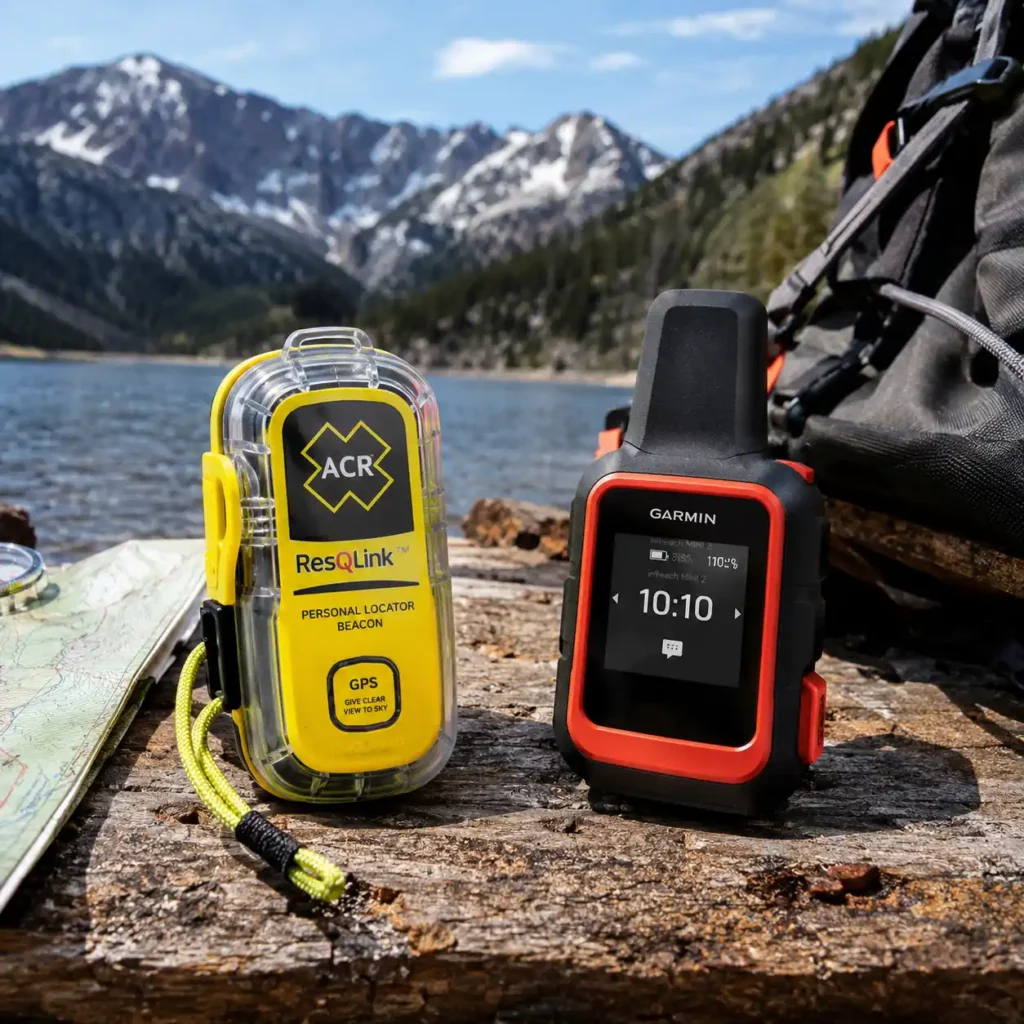
Personal locator beacons (PLBs) and satellite communicators are both designed to provide a way to request help when cellular coverage is unavailable. However, they serve different purposes and should not be treated as interchangeable devices.
A PLB is primarily an emergency distress beacon. It sends a dedicated 406 MHz alert through the Cospas-Sarsat satellite system to notify search-and-rescue authorities when a serious emergency occurs.
A satellite communicator is designed for broader off-grid communication. Depending on the device and service plan, it can support two-way messaging, location sharing, check-ins, weather updates, and interactive SOS functions.
Understanding these differences helps determine which device is more appropriate for your camping trips, hiking routes, and remote outdoor activities.
PLB vs. Satellite Communicator: Key Differences
| Feature | Personal Locator Beacon (PLB) | Satellite Communicator |
|---|---|---|
| Primary Purpose | Emergency distress signaling | Off-grid communication and emergency assistance |
| Emergency Network | Cospas-Sarsat | Device-specific commercial satellite network |
| Emergency Signal | 406 MHz distress transmission | SOS alert through the provider's satellite service |
| Two-Way Messaging | No | Available on supported devices |
| Routine Location Sharing | No | Available on supported devices |
| Check-In Messages | No | Available on supported devices |
| Interactive SOS | No routine two-way interaction | Available on supported services |
| GPS/GNSS Positioning | Available on many modern models | Available on most dedicated outdoor models |
| Subscription | Generally no subscription required | Often requires a subscription or service plan |
| Battery Considerations | Long standby life and specified emergency transmission duration | Depends on messaging frequency, tracking settings, and device model |
| Registration | National beacon registration is required | Account and device registration with the service provider |
| Best Suited For | Dedicated emergency distress signaling | Regular communication and emergency assistance outside cellular coverage |
Features vary by model and service provider. Always check the specifications and service requirements of the exact device before purchasing.
When Should You Choose a PLB?
A personal locator beacon is a suitable choice when your main priority is having a dedicated emergency distress device.
Consider a PLB if you:
Regularly camp or hike in remote areas where mobile networks are unavailable.
Want a device specifically designed to transmit an emergency distress alert.
Do not need routine messaging or location sharing.
Prefer not to pay for an ongoing satellite communication subscription.
Want a dedicated emergency beacon that can remain in your safety kit until needed.
A PLB is particularly relevant for solo hikers, remote-area campers, and outdoor travelers whose main concern is being able to alert rescue authorities during a life-threatening emergency.
However, a PLB does not provide routine communication with family or friends. It should also be registered correctly and carried in accordance with the manufacturer’s instructions.
When Should You Choose a Satellite Communicator?
A satellite communicator is generally more appropriate when you need to stay in contact with other people throughout your trip, rather than only having an emergency signaling option.
Consider a satellite communicator if you:
Want to send and receive messages beyond cellular coverage.
Need to share your location with family or other group members.
Want to send regular check-in messages during a multi-day trip.
Prefer to communicate about changing plans, weather conditions, or route adjustments.
Want an interactive SOS service where supported by the device and provider.
For example, a camper traveling through a remote region may want to send a message to someone at home confirming arrival at a campsite. A PLB cannot provide this type of routine communication, while a compatible satellite communicator can.
The trade-off is that satellite communicators often require a paid service plan. Their battery consumption also depends on how frequently messaging, tracking, and other functions are used.
Can You Carry Both a PLB and a Satellite Communicator?
Yes. Some outdoor travelers choose to carry both devices because they provide different capabilities.
A satellite communicator can handle everyday off-grid messaging and location sharing, while a PLB provides a dedicated emergency distress signaling option through the Cospas-Sarsat system.
This combination may be useful for:
Solo backpacking trips in remote terrain.
Multi-day expeditions beyond cellular coverage.
Extended camping trips where regular communication is important.
Outdoor activities where an independent emergency signaling device is part of the safety plan.
Carrying both devices does not remove the need for proper trip planning, emergency procedures, and registration. Each device should be charged or maintained according to its manufacturer’s instructions and carried where it can be accessed quickly.
Which Device Is Better for Camping?
The better choice depends on what you expect your emergency and communication equipment to do.
| Camping Situation | More Suitable Option | Reason |
|---|---|---|
| Remote camping with no need for routine messaging | PLB | Dedicated emergency distress signaling |
| Solo hiking with a focus on emergency preparedness | PLB | Provides a dedicated way to alert search-and-rescue authorities |
| Multi-day backpacking with regular check-ins | Satellite Communicator | Supports off-grid messaging and location sharing |
| Camping with family who want location updates | Satellite Communicator | Can share location and send messages on supported devices |
| Extended remote expedition | Both | Combines routine communication with a dedicated PLB distress beacon |
| Outdoor travel where subscription costs are a concern | PLB | Generally operates without an ongoing satellite messaging subscription |
Our Recommendation
If your primary requirement is a dedicated emergency distress signal, a personal locator beacon is a logical choice. It is designed specifically to alert the Cospas-Sarsat search-and-rescue system when a serious emergency occurs.
If you also need regular communication, location sharing, and two-way messaging, a satellite communicator offers capabilities that a conventional PLB does not provide.
For some remote outdoor activities, carrying both devices can provide a broader set of safety and communication options. The decision should reflect the remoteness of your destination, the duration of your trip, your communication needs, and your emergency plan.
If you are considering a satellite communicator as an alternative or complementary device, read our detailed guide to off-grid satellite communicators for camping to compare messaging, tracking, SOS services, and other features.
PLB Registration, Programming, and Legal Requirements
Buying a personal locator beacon is only the first step. Before carrying a PLB on a camping or backpacking trip, you must make sure it is correctly programmed, registered with the appropriate national authority, and ready for use in the country where you live or travel. These details matter because a 406 MHz beacon transmits a unique identification code that helps search and rescue authorities identify the device and access its registration information.
Why PLB Registration Matters
Every 406 MHz PLB has a unique identification number, commonly called a Hex ID, UIN, or Beacon ID. This code is transmitted when the beacon is activated and allows rescue coordination authorities to identify the registered device.
Registration connects that identification code with important information, such as:
The owner’s name and contact details
Emergency contact information
The beacon manufacturer and model
Other information requested by the relevant national registration authority
Keeping these details accurate can help rescue authorities verify an alert and obtain useful information about the beacon owner. Registration is not a substitute for the distress signal itself, but it provides an important additional layer of information during an emergency. NOAA explains the purpose of beacon registration and its role in search and rescue operations.
PLB Programming and Country Codes
A 406 MHz PLB is programmed with a country-specific identification code. This code determines which national authority is responsible for its registration.
For this reason, the country where you purchase a beacon is not necessarily the country where it should be registered. A PLB purchased through Amazon.com, for example, may be supplied with a US-coded identification number. Buyers living in another country should not assume that the device can simply be registered with their local authority without checking its programming.
Before purchasing, verify:
Which country code is programmed into the beacon
Whether the beacon can be registered with the authority responsible for your country
Whether the manufacturer or an authorized service centre can reprogram it if necessary
Whether any additional national requirements apply to PLB ownership and use
The beacon’s Hex ID can help identify its country coding. If you are unsure, ask the manufacturer or seller to confirm the programming before ordering.
Registering a US-Coded PLB
In the United States, 406 MHz personal locator beacons coded for the US are registered through the NOAA SARSAT Beacon Registration Database. Registration is required for US-coded beacons, and owners must update their records when relevant information changes.
The registration process requires the beacon’s identification number and basic owner information. Emergency contact details are also important because they may help authorities verify an alert and establish whether an emergency response is necessary.
Official registration resource: NOAA SARSAT Beacon Registration.
Important for international buyers: NOAA’s database accepts only beacons programmed with eligible US country codes. If your PLB has a different country code, you must contact the national authority associated with that code rather than assuming NOAA can register it.
What International Buyers Should Check
If you live outside the United States or plan to use your PLB primarily in another country, confirm the registration requirements before buying an Amazon US model.
In particular, check whether the beacon’s existing country code is accepted by the appropriate national registration authority. If it is not, ask the manufacturer whether the model can be reprogrammed and whether the procedure requires an authorized service centre.
Do not rely solely on the fact that a PLB uses the internationally recognized Cospas-Sarsat 406 MHz distress system. International satellite coverage does not automatically mean that every beacon can be registered under any country’s national system.
Final Pre-Purchase Checklist
| What to Check | Why It Matters |
|---|---|
| Country code | Identifies the national registration authority associated with the beacon |
| Hex ID / UIN | Provides the unique identification number required for registration |
| Registration eligibility | Confirms that the beacon can be registered through the appropriate authority |
| Reprogramming options | Determines whether the beacon can be adapted if its existing country code is unsuitable |
| Emergency contacts | Gives rescue authorities additional information if the beacon is activated |
| Registration updates | Keeps owner and contact information accurate |
Our Recommendation: Before ordering any PLB from Amazon.com, confirm its country programming and registration compatibility with your intended country of use. This is particularly important for international buyers considering US-market versions of the Jotron Tron SA20 or McMurdo FastFind 220. A correctly selected and registered beacon is an essential part of responsible emergency preparedness.
How to Carry and Maintain a Personal Locator Beacon

A PLB should be secured in a location that remains accessible while you are wearing your backpack or outdoor clothing. Avoid burying it deep inside a pack, where you may struggle to retrieve it during an emergency.
For backcountry camping and hiking, consider these practical guidelines:
Keep it within reach: Attach the beacon to an accessible shoulder strap, chest strap, or another suitable mounting point.
Secure the device: Use the manufacturer’s supplied clip, attachment system, or lanyard to reduce the risk of losing it.
Protect the activation controls: Position the beacon so that clothing, backpack straps, and other equipment cannot accidentally operate its activation mechanism.
Check the antenna deployment: Make sure the antenna can be extended fully without being obstructed by other equipment.
Follow the mounting instructions: If attaching a PLB to a life jacket or other safety equipment, follow both the beacon and equipment manufacturers’ instructions.
The exact carrying method depends on the model. For example, the Ocean Signal rescueME PLB1 includes a mounting clip, but its manufacturer also recommends securing the beacon with its lanyard when attached to a life jacket.
How to Position a PLB During an Emergency
Correct positioning can help the beacon obtain a satellite position and transmit its distress signal as intended.
When activating a PLB on land:
Move to an open area with as clear a view of the sky as possible.
Deploy the antenna completely according to the manufacturer’s instructions.
Position the beacon as specified in its manual, keeping the antenna upright where required.
Keep the GPS/GNSS antenna area clear of obstructions.
Leave the beacon operating and follow its status indicators and instructions.
Avoid placing the device underneath dense vegetation, inside a tent, or beneath equipment that could obstruct satellite reception. If possible, move away from steep terrain or other obstacles that significantly restrict the view of the sky.
When using a PLB near or on water, follow the model-specific instructions carefully. Some compact PLBs are not designed to float or operate submerged. The Ocean Signal rescueME PLB1, for example, should be kept above the water when activated and requires its optional flotation pouch to float.
Battery Checks and Self-Testing
Battery condition is one of the most important maintenance considerations for any PLB. A beacon may have a long storage or replacement interval, but that does not eliminate the need to check its expiry date and condition.
Before an outdoor trip:
Check the battery expiry or replacement date printed on the beacon.
Inspect the casing, antenna, attachment points, and activation controls.
Perform the manufacturer’s recommended self-test.
Check the test result and indicator lights against the user manual.
Confirm that the device has not been activated previously without the required battery replacement or service.
Some PLBs offer additional GPS testing, while others provide only basic electronic self-testing. Follow the testing schedule and procedures specified for your exact model. Do not assume that every beacon has the same test functions or recommended testing frequency.
Important: A self-test does not replace the manufacturer’s battery replacement requirements. For example, the Ocean Signal rescueME PLB1 requires battery replacement after its marked expiry date or following any emergency activation, even if the activation was brief. Battery replacement must be performed by an authorized service centre rather than by the owner.
Cleaning and Long-Term Storage
Most PLBs require relatively little routine maintenance, but proper storage helps protect the device and its battery.
Use the following precautions:
Clean the exterior with a damp cloth when necessary.
Dry the device thoroughly after cleaning.
Avoid solvents and aggressive cleaning products unless specifically approved by the manufacturer.
Keep the antenna mechanism free from dirt and obstructions.
Store the beacon within the temperature limits stated in its manual.
Avoid prolonged exposure to excessive heat, direct sunlight, or conditions outside the specified storage range.
Keep the device in a secure location where it cannot be crushed or accidentally activated.
Do not open a sealed PLB or attempt to replace its battery yourself unless the manufacturer explicitly identifies the procedure as user-serviceable. Unauthorized disassembly can damage the device, compromise its waterproof protection, or invalidate its warranty.
PLB Maintenance Checklist Before Every Trip
| Check | What to Confirm |
|---|---|
| Battery | Expiry date and replacement status |
| Self-test | Test completed according to the manufacturer’s instructions |
| Antenna | Undamaged and able to deploy fully |
| Housing | No cracks, damage, or signs of water ingress |
| Attachment | Clip, lanyard, and mounting points secure |
| Activation controls | Accessible and protected against accidental activation |
| Registration | Owner and emergency contact information up to date |
| Accessories | Required mounting or flotation accessories included |
Our Recommendation
Treat your PLB as essential emergency equipment rather than an accessory that can remain forgotten at the bottom of a backpack. Carry it where you can reach it quickly, inspect it before each trip, and follow the manufacturer’s battery, testing, and storage requirements.
A correctly maintained beacon does not guarantee rescue, but it helps ensure that the device is in the intended condition when an emergency occurs. Most importantly, take time to read the user manual and understand the activation procedure before heading into remote terrain.
Common PLB Mistakes to Avoid
A personal locator beacon is designed to summon search and rescue assistance when a person faces a serious emergency. However, owning a PLB does not automatically guarantee that it will work as expected. Incorrect registration, poor storage, improper testing, and mistakes during activation can all reduce its effectiveness.
Understanding these common mistakes before heading into remote terrain can help you use your beacon more confidently and avoid preventable problems.
1. Buying a PLB Without Checking Its Country Programming
One of the most important mistakes is purchasing a beacon without confirming its programmed country code.
A 406 MHz PLB carries a unique identification code associated with a country of registration. A device purchased through Amazon.com may be programmed for the United States, even if the buyer lives elsewhere.
Before purchasing, confirm:
Which country code is programmed into the beacon
Whether the relevant national authority can register it
Whether reprogramming is possible if required
Whether the seller or manufacturer can confirm its configuration
A beacon’s international Cospas-Sarsat compatibility does not mean that its registration can be transferred freely between national systems. <Cite refs={[“turn616896search1″,”turn616896search3″,”turn616896search9”]}/>
2. Failing to Register the Beacon
Another serious mistake is using a PLB without completing its registration.
Although a distress alert can still be detected by the Cospas-Sarsat system when a beacon is unregistered, rescue authorities may not have access to the owner’s registration details. This can make it harder to verify the alert and identify the person who needs assistance.
Register the beacon with the appropriate national authority and keep the following information current:
Owner’s contact details
Emergency contact information
Beacon identification number
Any additional information requested by the registration authority
Update the registration whenever relevant details change. <Cite refs={[“turn616896search0″,”turn616896search7”]}/>
3. Keeping the PLB at the Bottom of a Backpack
A beacon that is difficult to reach may be less useful when an emergency occurs.
If you need to remove several items from your backpack before accessing the PLB, you may lose valuable time or find it difficult to retrieve the device when injured or under pressure.
Carry your beacon in an accessible, secure position, such as a suitable shoulder-strap or chest-strap attachment. Make sure it cannot fall off, become obstructed, or activate accidentally.
Always follow the manufacturer’s carrying and attachment instructions for your specific model.
4. Activating the Beacon Without a Clear View of the Sky
Many PLBs use an internal GNSS receiver to obtain location information from navigation satellite systems. Obstructions can interfere with positioning.
Activating a beacon inside a tent, beneath dense tree cover, or next to steep terrain may make it harder for the device to obtain an accurate satellite position.
When circumstances allow:
Move to an open area.
Deploy the antenna completely.
Position the beacon as directed in its manual.
Keep the antenna and GNSS receiving area unobstructed.
Leave the device operating according to its instructions.
Do not delay an emergency activation simply because conditions are not ideal. If you are in grave and imminent danger, activate the PLB and follow its operating instructions.
5. Testing the PLB by Activating Its Emergency Mode
A PLB should never be tested by simply switching on its normal distress mode.
A live 406 MHz transmission can be interpreted by the Cospas-Sarsat system as a genuine emergency alert and may trigger search and rescue procedures. For routine checks, use only the manufacturer’s designated self-test function.
The self-test is designed to check specified internal functions without generating a normal distress alert. Follow the instructions and testing frequency provided in your model’s user manual. <Cite refs={[“turn616896search2″,”turn616896search6″,”turn616896search8”]}/>
If you accidentally activate a beacon, contact the appropriate rescue coordination authority immediately and explain that the alert was accidental. Do not assume that simply switching the beacon off will cancel the response.
6. Ignoring Battery Expiry and Replacement Requirements
A long battery replacement interval does not mean that a PLB can be stored indefinitely without inspection.
Check the battery expiry or replacement date before every major trip and follow the manufacturer’s service requirements. Some models require battery replacement after emergency activation, even if the beacon was used only briefly.
Do not attempt to replace a sealed battery yourself unless the manufacturer explicitly permits it. Unauthorized servicing can compromise the device’s waterproof protection and reliability.
7. Assuming Every PLB Floats or Is Fully Waterproof
Water resistance and buoyancy are two different specifications.
A beacon may be waterproof to a specified depth but still sink if dropped into water. Some models require an optional or supplied flotation pouch to remain afloat.
Before purchasing, check:
The stated waterproof depth and test duration
Whether the beacon is inherently buoyant
Whether a flotation pouch is included or sold separately
Whether the manufacturer specifies a particular operating position in water
For example, the Ocean Signal rescueME PLB1 is not inherently buoyant and requires its optional flotation pouch for flotation. Do not assume that a waterproof rating means the beacon will float.
8. Assuming a PLB Provides Two-Way Communication
A conventional 406 MHz PLB is designed to transmit a distress alert and help rescue authorities locate the person in danger. It is not a substitute for a satellite communicator with two-way messaging.
Unless a device explicitly supports additional communication functions, do not expect it to send routine messages, receive replies, or provide regular location updates to family members.
If you need regular communication during a remote camping trip, evaluate a satellite communicator separately or consider carrying both devices.
9. Not Reading the User Manual Before a Trip
Emergency equipment is not the right place to learn basic operating procedures for the first time.
Different PLBs have different activation mechanisms, antenna arrangements, indicator lights, self-test procedures, and battery requirements.
Before leaving:
Read the complete user manual.
Identify the activation controls and safety features.
Learn how to deploy the antenna.
Understand the status indicators.
Locate the self-test instructions.
Check the manufacturer’s emergency and accidental-activation guidance.
A few minutes spent learning the device before a trip can prevent confusion when time and visibility are limited.
Common PLB Mistakes: Quick Checklist
| Mistake | Better Practice |
|---|---|
| Buying without checking country coding | Confirm programming and registration eligibility |
| Skipping registration | Register the beacon and update owner details |
| Storing it deep inside a backpack | Carry it in an accessible, secure position |
| Ignoring antenna positioning | Follow the manufacturer’s activation instructions |
| Performing a live test | Use the designated self-test function |
| Ignoring battery expiry | Check replacement dates and service requirements |
| Assuming waterproof means buoyant | Verify flotation and accessory requirements |
| Expecting two-way messaging | Choose a satellite communicator if messaging is needed |
| Learning operation during an emergency | Read the manual and understand the controls beforehand |
Our Recommendation
A personal locator beacon should be treated as life-safety equipment, not simply another outdoor accessory. Check its country programming, complete the correct registration, keep it accessible, and understand its operating limitations before entering remote areas.
The most important principle is simple: know your beacon before you need it. Correct preparation cannot eliminate every risk, but it can help prevent avoidable mistakes when reliable emergency signaling matters most.
Frequently Asked Questions About Personal Locator Beacons
What Is a Personal Locator Beacon (PLB) and How Does It Work?
A personal locator beacon (PLB) is a compact emergency device designed to send a distress alert when someone is in a life-threatening situation in a remote area. When activated, it transmits a digital signal on the 406 MHz frequency to the international Cospas-Sarsat satellite system. The alert is relayed to the appropriate rescue coordination authorities, allowing search and rescue teams to respond. Models with an integrated GNSS receiver can also transmit location information to help rescuers identify the beacon’s position.
Do Personal Locator Beacons Require a Subscription?
No. Standard 406 MHz personal locator beacons do not require a monthly or annual satellite communication subscription. They use the internationally supported Cospas-Sarsat distress alert system rather than a commercial satellite messaging service. However, the owner must complete the required beacon registration, and battery replacement or professional servicing may involve additional costs.
Do PLBs Work Without Cell Phone Coverage?
Yes. A PLB does not depend on cellular networks, mobile data, or Wi-Fi. It sends its emergency distress signal through the Cospas-Sarsat satellite system, making it suitable for remote camping, hiking, and backcountry travel beyond normal mobile coverage. For the best positioning performance, follow the manufacturer’s instructions and give the beacon’s GNSS antenna a clear view of the sky.
Do Personal Locator Beacons Work Worldwide?
406 MHz PLBs are designed to operate through the international Cospas-Sarsat satellite system, which provides global distress alert coverage. However, the availability and speed of a rescue response depend on the location, local search and rescue capabilities, and access to the affected area. Buyers must also ensure that their beacon’s country programming and registration comply with the requirements of the country responsible for the device.
How Long Does a PLB Battery Last?
There are two different battery specifications to consider: the battery’s storage or replacement interval and its operating time after activation. Many modern PLBs are designed to transmit for at least 24 hours under specified test conditions, but battery replacement intervals vary by model. For example, the ACR ResQLink View RLS PLB-435 is specified for up to 28 hours of operating life, while other models in this guide have different battery service intervals. Always check the manufacturer’s specifications and the expiry date printed on your device.
Does a Personal Locator Beacon Have GPS?
Many modern PLBs include an integrated GNSS receiver that obtains location information from navigation satellite systems such as GPS, Galileo, or GLONASS. This position information can be encoded into the 406 MHz distress alert and help rescue authorities locate the beacon more accurately. However, not every model supports the same satellite constellations or positioning features, so check the specifications before buying.
Can You Send Text Messages With a PLB?
No. A conventional personal locator beacon is designed to transmit an emergency distress alert, not ordinary text messages. It cannot normally send routine check-ins, receive replies, or provide two-way communication with family members. If you need messaging, weather updates, or regular location sharing while camping, consider a two-way satellite communicator instead.
Do You Have to Register a Personal Locator Beacon?
Yes. PLB registration requirements depend on the beacon’s country programming and the applicable national regulations. In the United States, US-coded 406 MHz beacons must be registered with NOAA. Registration associates the beacon’s unique identification number with the owner’s contact information and emergency contacts. If you purchase a PLB outside your country of residence, verify that its programming is compatible with your national registration requirements before using it.
Can a PLB Be Used More Than Once?
A PLB can generally be used again after an activation only if it has been inspected and serviced as required by its manufacturer. Emergency activation may require battery replacement or other professional servicing, even if the beacon transmitted for a relatively short time. Never assume that a previously activated PLB is ready for another emergency without checking its service requirements.
How Do You Know If a PLB Distress Signal Has Been Received?
This depends on the beacon’s features. Models equipped with Return Link Service (RLS) can provide an indication that the distress alert has been received and forwarded through the Cospas-Sarsat system to the appropriate authorities. However, this confirmation does not mean that a rescue team has been dispatched or that help is already on its way. PLBs without RLS may not provide this type of confirmation to the user.
Can You Test a Personal Locator Beacon Without Triggering a Rescue Response?
Yes. Most PLBs provide a designated self-test function that checks specific internal components without sending a normal emergency distress alert. Some models also offer a separate GNSS test. Always follow the manufacturer’s testing instructions and never activate the normal SOS function just to check whether the beacon works. An unintended 406 MHz transmission can generate a false distress alert and trigger a search and rescue response.
Is a PLB Better Than a Satellite Communicator for Camping?
It depends on what you need. A PLB is designed primarily for emergency distress signaling and does not require a commercial satellite subscription. A satellite communicator can offer additional functions such as two-way messaging, location sharing, navigation, and weather information, depending on the model and service plan. For campers who only need an emergency beacon, a PLB may be the simpler option. For longer trips where regular communication is important, a satellite communicator may be more practical. Some outdoor users choose to carry both for additional redundancy.
Final Verdict: Choosing a Personal Locator Beacon for Camping
A personal locator beacon is one of those pieces of outdoor safety equipment that you hope never to use. Its value is not measured by how many features it offers or how often you interact with it, but by whether it is ready to transmit a distress alert when an emergency occurs.
That makes the buying decision different from choosing an ordinary camping gadget. Instead of focusing primarily on displays, connectivity, or additional functions, consider the practical requirements that affect emergency use: dependable distress signaling, accessible placement, sufficient operating time, suitable waterproof protection, and a battery that remains within its service life.
There are also trade-offs worth considering. A smaller beacon may be easier to carry but may require additional flotation accessories. A model with AIS can provide an extra locating capability in suitable marine environments, but this feature has limited relevance to most inland camping trips. Return Link Service can provide valuable feedback about distress-alert reception, but it does not confirm that rescuers have been dispatched. More features do not automatically make a beacon the right choice for every outdoor activity.
Before making your final decision, consider the conditions in which you are most likely to use the device. A backpacker covering remote mountain trails may prioritize compact dimensions and convenient attachment. Someone camping near coastal waters may place greater value on marine locating features and flotation. For extended trips, battery replacement requirements and the beacon’s specified operating duration deserve particular attention.
One issue should never be treated as a minor purchasing detail: country programming and registration. A technically compatible 406 MHz beacon is not automatically ready for registration in every country. Confirm the programmed country code, registration eligibility, and any required reprogramming before purchasing, especially when ordering a US-market device from outside the United States.
Ultimately, a PLB should complement your wider outdoor safety plan, not replace it. Carry appropriate navigation equipment, share your itinerary with someone you trust, understand the limitations of your emergency equipment, and learn how to activate your beacon before leaving home.
Our final advice: choose your PLB based on the environment in which you travel, the emergency features you genuinely need, and whether you can carry and maintain it correctly. A simple, properly registered beacon that is accessible and ready for use is far more valuable than a feature-rich device that is unsuitable for your trip or poorly maintained.
About the Author
CampComfortGuide’s editorial team researches camping equipment, outdoor safety gear, and essential products for backcountry travel. Our buying guides are developed using manufacturer specifications, technical documentation, product information, and independent research to help readers make informed purchasing decisions. We focus on practical differences between products, important safety considerations, and the features that matter most in real outdoor situations.