
Weight distribution hitches for travel trailers can help improve towing stability, reduce rear-end sag, and redistribute some of the trailer’s tongue load across the tow vehicle and trailer axles when properly selected and adjusted. If you’re planning longer camping trips, towing in changing weather, or hauling a travel trailer near your vehicle’s rated limits, choosing the right hitch is an important part of building a dependable towing setup.
Not every weight distribution hitch works with every trailer. Gross trailer weight, loaded tongue weight, receiver and vehicle limits, spring-bar capacity, and sway-control design all affect which system is appropriate. Some hitches integrate sway control into the design, while others use a separate friction-control unit. Understanding these differences can help you avoid paying for features you don’t need—or choosing equipment that isn’t correctly matched to your trailer.
In this guide, we compare five weight distribution hitches for travel trailers, examining their rated capacities, sway-control systems, key features, and potential limitations. We’ll also explain what to check before buying and how hitch compatibility fits into your wider towing setup, alongside practical resources such as our guide to building a vehicle camping setup. The goal is to help you narrow down the options based on your actual towing requirements, not simply brand popularity or advertised maximum ratings.
As an Amazon Associate I earn from qualifying purchases.

Table of Contents
Why We Can Trust This Guide
Choosing a weight distribution hitch requires more than comparing product ratings or relying on brand popularity. The right system must match the travel trailer’s loaded weight, actual tongue weight, tow vehicle, receiver hitch, and required sway-control setup. A hitch that looks suitable on paper may still be the wrong choice if its capacity or installation requirements do not match your towing combination.
For this guide, we focus on manufacturer-published specifications, product documentation, stated weight ratings, sway-control design, and compatibility considerations. We compare five specific models—Equal-i-zer 90-00-1000, CURT TruTrack 17601, Fastway e2 94-00-1000, Blue Ox SwayPro BXW1000, and Camco Eaz-Lift Elite 48058—to explain their intended uses and the differences buyers should consider before purchasing.
Our evaluation also accounts for practical details that can affect ownership, including whether sway control is integrated or separate, which components are included, and what buyers should verify about their trailer frame, receiver, and hitch-ball requirements. Where specifications or package contents depend on the exact configuration, we recommend checking the current manufacturer documentation and product listing rather than assuming that similarly named kits are identical.
An important distinction: this is a research-based comparison, not a report of hands-on towing tests. We do not claim to have personally tested these hitches or measured their performance on the road. Our goal is to help readers compare documented features, understand the limitations of each design, and make a more informed decision for their own towing setup.
A weight distribution hitch does not increase the tow vehicle’s rated towing capacity, payload limit, axle ratings, or the trailer’s allowable weight. Always follow the vehicle, receiver, trailer, and hitch manufacturers’ instructions, and confirm that the complete combination is compatible before towing.
How We Evaluate and Compare Weight Distribution Hitches
A weight distribution hitch should be evaluated as part of a complete towing system, not as a standalone accessory. For this comparison, we focus on the specifications that determine whether a hitch is suitable for a particular travel trailer, how its sway-control system works, and what buyers need to verify before ordering.
Our evaluation uses manufacturer specifications, available product documentation, and practical compatibility criteria. We do not claim to have conducted hands-on towing tests, so our assessments distinguish documented product features from real-world performance claims that would require independent testing.
Weight Ratings and Tongue-Weight Capacity
We compare each hitch’s maximum gross trailer weight (GTW) and tongue-weight (TW) ratings. These figures must be considered together: a system rated for a particular trailer weight may not be appropriate if the trailer’s actual loaded tongue weight falls outside the hitch’s specified range.
We give particular attention to loaded tongue weight rather than relying on a trailer’s advertised dry weight. Camping equipment, batteries, propane, water, and other cargo can substantially change the load carried at the hitch.
Sway-Control Design
We examine whether each system incorporates sway control into its weight-distribution design or relies on a separate accessory. Integrated systems can simplify hookup, while separate friction-control devices offer a different approach to managing trailer movement.
We describe the mechanism and its practical implications without claiming that one design always performs better in every towing situation.
Spring-Bar Design and Construction
We compare round-bar and trunnion-bar configurations where relevant, along with the design of the spring bars and their connection to the hitch head and trailer frame. These differences can affect clearance, installation, adjustment, and compatibility with the trailer’s A-frame.
We also consider the intended application of each model rather than assuming that a heavier-rated hitch is automatically the better choice.
Vehicle, Trailer, and Receiver Compatibility
A hitch must be compatible with the tow vehicle, receiver, trailer frame, coupler, and required hitch-ball size. We consider receiver ratings, available rise or drop, mounting clearances, and manufacturer restrictions where the documentation provides that information.
A weight distribution hitch does not increase the tow vehicle’s payload, towing capacity, axle ratings, or the trailer’s allowable weight. The ratings and requirements of the complete towing combination remain controlling.
Included Components and Installation Requirements
We consider which parts are supplied with each model, including the shank, spring bars, mounting brackets, hitch ball, and any separate sway-control hardware. These details matter because two listings that appear similar may differ in included components or configuration.
When package contents, installation requirements, or specifications are unclear, buyers should verify the exact model number and current manufacturer documentation before purchasing. We do not assume that a component is included simply because it appears in a product photograph.
Manufacturer Documentation and Product-Specific Details
Our comparison covers five selected models: Equal-i-zer 90-00-1000, CURT TruTrack 17601, Fastway e2 94-00-1000, Blue Ox SwayPro BXW1000, and Camco Eaz-Lift Elite 48058.
We use published specifications and product documentation to identify each model’s stated capabilities and limitations. If a retailer listing conflicts with the manufacturer’s information, or if a specification cannot be confirmed for the exact model, we flag the uncertainty rather than presenting an unverified figure as fact.
How We Reach Our Recommendations
Our final assessments consider the combination of weight ratings, sway-control design, spring-bar configuration, compatibility requirements, included components, and the needs of different towing setups.
The objective is not to declare one hitch universally best. It is to help readers identify which model deserves closer consideration for their trailer and then verify that it meets the requirements of their specific vehicle, receiver, and loaded towing combination.
Quick Answer: Which Weight Distribution Hitch Is Best?
For many travel trailer owners, the Equal-i-zer 90-00-1000 is a strong starting point because it combines weight distribution with integrated four-point sway control. However, the best choice depends on your trailer’s loaded tongue weight, tow vehicle, receiver limits, and preferred hitch design.
Best overall candidate: Equal-i-zer 90-00-1000 — integrated four-point sway control, rated for up to 10,000 lb GTW and 1,000 lb tongue weight.
Best for integrated two-point sway control: CURT TruTrack 17601 — combines weight distribution and friction-based sway control in one system.
Best round-bar alternative: Fastway e2 94-00-1000 — integrates weight distribution and sway control without a separate sway-control bar.
Best for a chain-based spring-bar system: Blue Ox SwayPro BXW1000 — uses spring bars and rotating latches, with a stated maximum of 10,000 lb towing weight and 1,000 lb tongue weight.
Best traditional kit with separate sway control: Camco Eaz-Lift Elite 48058 — a conventional weight distribution setup supplied with sway-control hardware; verify the exact kit contents before ordering.
These are starting points, not universal rankings. The advertised maximum ratings are not targets: your actual loaded tongue weight must fall within the selected hitch’s permitted range, and every component in the towing setup must remain within its own limits. Manufacturer specifications should be checked against the exact model and current package listing before purchase.
Who Should Consider a Weight Distribution Hitch?
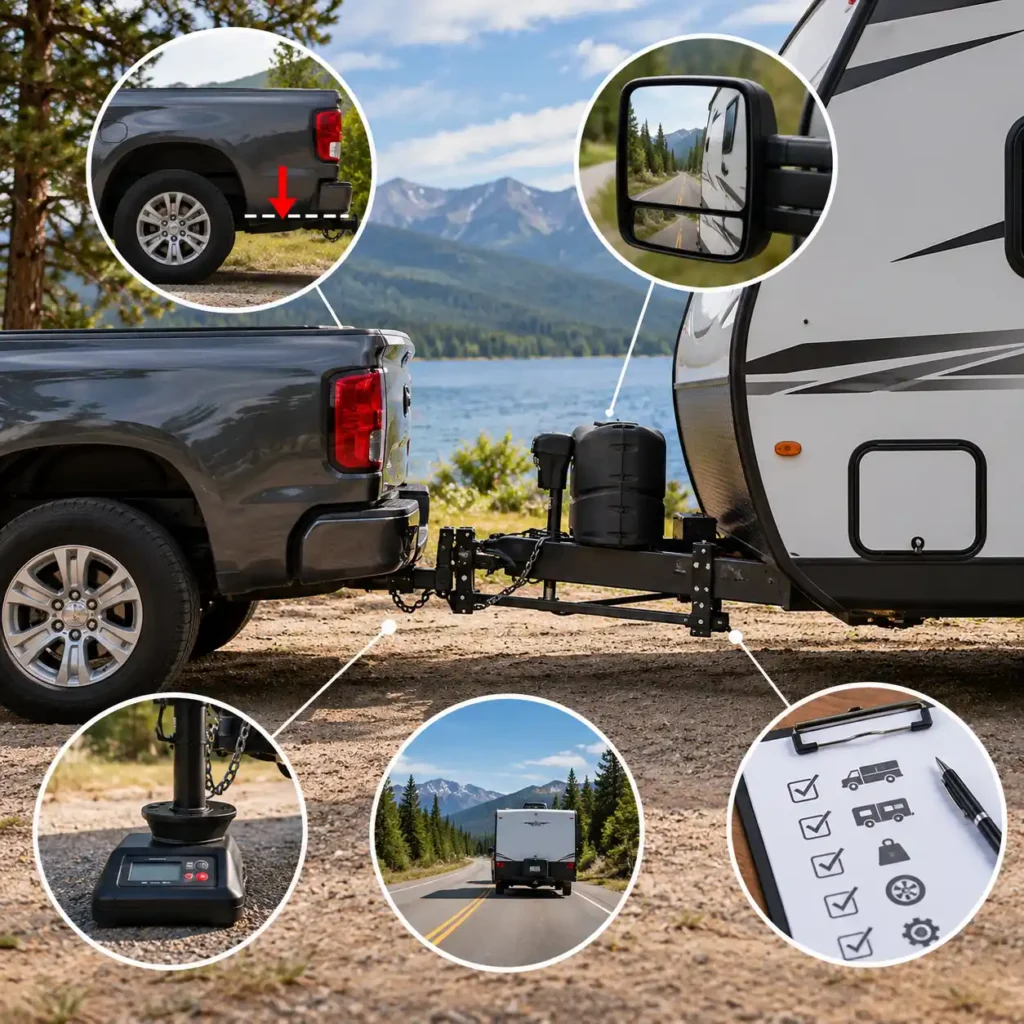
A weight distribution hitch can be a useful upgrade for travel trailer owners who need to manage tongue weight, reduce excessive rear-end sag, and maintain appropriate front-axle loading. When correctly selected and adjusted, it transfers some of the load carried at the hitch across the tow vehicle and trailer axles. However, not every tow vehicle and travel trailer combination requires one. The decision depends on the actual loaded weights, receiver specifications, and the recommendations or restrictions provided by the vehicle and trailer manufacturers.
Travel Trailer Owners Experiencing Excessive Rear-End Sag
If your tow vehicle’s rear suspension drops noticeably after connecting a travel trailer, a weight distribution hitch may help redistribute the load. Before buying one, measure or establish the trailer’s loaded tongue weight and check the vehicle’s payload, axle ratings, and receiver limits. Excessive sag can also indicate an overloaded vehicle or an unsuitable towing setup, neither of which should be addressed simply by installing a different hitch.
Drivers Seeking More Predictable Towing
A properly matched weight distribution system can help restore appropriate front-axle loading and support more predictable steering and handling. This may matter when towing on highways, travelling long distances, or dealing with changing road conditions. However, weight distribution and sway control serve different purposes. The hitch must be correctly adjusted, the trailer properly loaded, and the tires and other towing components maintained according to their manufacturers’ instructions.
Owners of Heavier Travel Trailers
Some vehicles and receiver systems require or recommend a weight distribution hitch for certain trailer loads. Check your vehicle owner’s manual and the receiver’s specifications to determine whether weight distribution is permitted or required for your combination. Never assume that a hitch with a higher advertised capacity makes an overloaded vehicle or trailer safe to tow.
Campers Building a Safety-Focused Towing Setup
A weight distribution hitch is one part of a complete towing system. Drivers should also consider visibility, braking, tire condition, load placement, and the compatibility of every component. For additional guidance on monitoring traffic and the area behind a trailer, see our guide to RV backup camera systems for camping. A camera can improve visibility, but it does not replace correct hitch setup or safe towing practices.
When a Weight Distribution Hitch May Not Be Suitable
A weight distribution hitch cannot compensate for exceeding your tow vehicle’s payload, gross vehicle weight rating, gross combined weight rating, axle ratings, or receiver limits. It also cannot correct every cause of trailer sway or poor handling. If your vehicle or trailer manufacturer prohibits weight distribution equipment for your particular setup, follow that restriction.
Before purchasing: confirm your loaded trailer weight and tongue weight, check the tow vehicle and receiver requirements, and select a hitch whose weight ratings and installation requirements match your complete towing combination.
Quick Summary: Our Top Picks
Choosing the right weight distribution hitch for a travel trailer depends on your loaded tongue weight, trailer frame, tow vehicle, receiver specifications, and preferred sway-control design. These five models offer different approaches, from integrated multi-point sway control to a chain-based spring-bar system and a traditional kit with sway-control hardware.
1. Equal-i-zer 90-00-1000 — Best Overall for Integrated Sway Control
The Equal-i-zer 90-00-1000 combines weight distribution with an integrated four-point sway-control system. It is rated for trailers weighing up to 10,000 pounds gross trailer weight (GTW) and a maximum tongue weight of 1,000 pounds. Its integrated design is worth considering if you want weight distribution and sway control in one system rather than a separate friction-control accessory. Before ordering, confirm that your loaded tongue weight falls within the hitch’s operating range and verify the included components for the exact package.
Best for: Travel trailer owners looking for an integrated weight distribution and four-point sway-control system.
2. CURT TruTrack 17601 — Best for Integrated Two-Point Sway Control
The CURT TruTrack 17601 combines weight distribution with two-point friction-based sway control. The manufacturer specifies a maximum rating of 10,000 pounds GTW and 1,000 pounds tongue weight. Its forged-steel round spring bars and adjustable support brackets are designed to resist lateral trailer movement while helping distribute tongue weight across the towing combination. The kit includes a 2-inch, seven-hole adjustable shank and hitch ball, according to CURT’s product documentation. Buyers should still confirm receiver compatibility, trailer-frame clearance, and the required adjustment for their setup.
Best for: Owners who want integrated two-point sway control with adjustable brackets and a specified 10,000-pound GTW capacity.
3. Fastway e2 Round Bar 94-00-1000 — Best Round-Bar Alternative
The Fastway e2 94-00-1000 combines weight distribution with built-in two-point steel-on-steel friction sway control. It is rated for up to 10,000 pounds of trailer weight and 1,000 pounds of tongue weight. Because the sway-control mechanism is integrated into the hitch, there is no separate friction sway-control bar to connect and remove during normal hookup. This round-bar configuration may suit owners whose trailer-frame layout and ground-clearance requirements accommodate its design. The hitch ball is not included with the standard 94-00-1000 model, so check the package contents before purchasing.
Best for: Travel trailer owners who want integrated sway control in a round-bar hitch without adding a separate sway-control device.
4. Blue Ox SwayPro BXW1000 — Best for a Chain-Based Spring-Bar System
The Blue Ox SwayPro BXW1000 uses spring bars, rotating latches, and a hitch-head design intended to help distribute weight and resist trailer sway. The manufacturer specifies a maximum of 10,000 pounds GTW and 1,000 pounds tongue weight for this configuration, which uses a 2-inch receiver shank. Its chain-based arrangement offers a different approach from the fixed friction brackets used by the Equal-i-zer and Fastway e2 systems. Compatibility deserves particular attention: check the trailer coupler position, frame layout, and any equipment that could interfere with the spring bars or mounting brackets.
Best for: Owners who prefer a chain-based spring-bar system with integrated sway prevention and a 10,000-pound maximum GTW rating.
5. Camco Eaz-Lift Elite 48058 — Best Traditional Kit with Sway-Control Hardware
The Camco Eaz-Lift Elite 48058 is a traditional chain-style weight distribution hitch kit supplied with sway-control hardware. Camco identifies this specific model as a ready-to-tow Elite kit with a 1,000-pound tongue-weight rating and a hitch ball included. Its preassembled components may simplify initial setup compared with a standard kit that requires separate parts. Correct installation and adjustment remain essential, and buyers should confirm that the listing matches model 48058 and includes the specified components.
Best for: Owners who prefer a traditional chain-style hitch kit with sway-control hardware and a hitch ball included.
Before buying, verify the exact model number, loaded tongue weight, gross trailer weight, receiver limits, and trailer-frame compatibility. Maximum ratings are not a substitute for matching the hitch to the actual towing combination. A weight distribution hitch also does not increase your tow vehicle’s payload, towing capacity, or axle ratings.
Comparison Table: Best Weight Distribution Hitches for Travel Trailers
This comparison of weight distribution hitches for travel trailers highlights each model’s weight ratings, sway-control design, included components, and key compatibility considerations. Check the loaded tongue weight of your trailer and the limits specified for your tow vehicle and receiver before choosing a hitch. Maximum ratings alone do not establish compatibility.
| Weight Distribution Hitch | Best For | Max GTW / Tongue Weight | Sway-Control Design | Included Components | Main Consideration |
|---|---|---|---|---|---|
| Equal-i-zer 90-00-1000 | Integrated four-point sway control | 10,000 lb GTW / 1,000 lb tongue weight | Integrated four-point friction sway control | Hitch head, spring bars, adjustable shank, sway-control brackets, and preinstalled 2-5/16-inch hitch ball according to manufacturer documentation | Requires correct bracket positioning and adjustment; confirm loaded tongue weight and trailer-frame clearance. |
| CURT TruTrack 17601 | Integrated two-point sway control | 10,000 lb GTW / 1,000 lb tongue weight | Two-point friction control using rigid support brackets | Hitch head, round spring bars, adjustable shank, support brackets, and 2-5/16-inch hitch ball | Check bracket mounting space and compatibility with the trailer frame. |
| Fastway e2 94-00-1000 | Round-bar design with integrated sway control | 10,000 lb GTW / 1,000 lb tongue weight | Integrated two-point steel-on-steel friction control | Hitch head, round spring bars, adjustable shank, mounting brackets, and installation hardware; hitch ball not included with this model | Requires a separately purchased, appropriately rated hitch ball and correct bracket placement. |
| Blue Ox SwayPro BXW1000 | Chain-based spring-bar system | 10,000 lb GTW / 1,000 lb tongue weight | Integrated sway prevention through the hitch-head design and spring-bar system | Hitch head, spring bars, seven-hole adjustable shank, and rotating-latch brackets; verify the exact package contents before ordering | Check coupler configuration, trailer-frame clearance, and compatibility with the clamp-on brackets. |
| Camco Eaz-Lift Elite 48058 | Traditional chain-style kit with sway-control hardware | 10,000 lb GTW / 1,000 lb tongue weight | Separate adjustable sway-control hardware supplied with this kit | Manufacturer documentation identifies this as an Elite kit with sway control and a hitch ball; confirm all components in the current listing | Verify the trailer-weight rating, mounting requirements, and exact kit contents before purchase. |
Comparison Note: The ratings shown are manufacturer-published maximums, not recommended operating targets. Choose a hitch that matches your trailer’s actual loaded gross trailer weight (GTW) and tongue weight, as well as your tow vehicle, receiver, and trailer-frame requirements. Package contents vary by model, so confirm the exact configuration before ordering. The Camco Eaz-Lift Elite 48058 is rated for up to 10,000 lb GTW and 1,000 lb tongue weight. A weight distribution hitch does not increase your vehicle’s rated towing capacity, payload, or axle limits.
The 5 Best Weight Distribution Hitches for Travel Trailers in 2026
Choosing the best weight distribution hitches for travel trailers starts with matching your trailer’s loaded weight, tongue weight, and towing vehicle limits. Compare these five top-rated hitch systems by sway control, weight capacity, installation requirements, and compatibility to find the right setup for safer, more stable towing.
1. Equal-i-zer 90-00-1000
Award: Best Overall for Integrated Sway Control

The Equal-i-zer 90-00-1000 is a weight distribution hitch designed for travel trailers with a maximum gross trailer weight of 10,000 pounds and a maximum tongue weight of 1,000 pounds. Its integrated four-point sway-control system combines weight distribution with friction-based resistance to trailer sway, making it a strong candidate for owners who want both functions in one hitch rather than a separate friction sway-control bar.
The system uses spring bars and dedicated brackets mounted to the trailer frame. When correctly installed and adjusted, these components help distribute tongue weight across the towing combination while providing resistance to lateral trailer movement. The correct model must be selected according to the trailer’s actual loaded tongue weight, not simply its advertised dry weight or maximum trailer weight rating.
Overview
The Equal-i-zer 90-00-1000 is designed to address two related towing concerns: the effect of tongue weight on the tow vehicle’s axle loading and unwanted trailer sway. Its four-point friction system creates resistance at the hitch head and spring-bar brackets. Unlike conventional weight distribution hitches that rely on a separate friction sway-control bar, the Equal-i-zer integrates sway control into its primary hitch assembly.
This integrated design can simplify the hookup process because there is no separate sway-control bar to attach or remove before ordinary reversing and tight turns. However, the spring bars and brackets still need to be connected, positioned, and adjusted according to the manufacturer’s instructions. The system can also produce friction-related noise during turns, which is a characteristic of its design rather than necessarily an indication of a fault.
According to Equal-i-zer’s official product documentation, the 90-00-1000 kit includes an adjustable shank, hitch head, spring bars, sway-control brackets, installation hardware, and a preinstalled 2-5/16-inch hitch ball. Buyers should still check the exact Amazon listing to confirm that the product being sold matches this model and package configuration.
Key Features
Integrated Four-Point Sway Control
The hitch uses four friction points to help resist trailer sway: two at the spring-bar sockets in the hitch head and two where the spring bars contact the trailer-mounted brackets. This arrangement combines weight distribution and sway resistance within the same system. Its effectiveness depends on correct installation, adjustment, loading, and compatibility with the towing vehicle and trailer.
10,000-Pound Gross Trailer Weight Rating
The 90-00-1000 is rated for a maximum gross trailer weight (GTW) of 10,000 pounds and a maximum tongue weight of 1,000 pounds. Both limits matter when selecting the hitch. A trailer’s loaded tongue weight must fall within the hitch’s permitted operating range, while the tow vehicle, receiver, trailer, and every other towing component must remain within their individual ratings.
Spring Bars Designed for Weight Distribution
The system uses two spring bars measuring approximately 36 inches long and 1-3/8 inches wide, according to the manufacturer’s specifications for this model. When properly tensioned, the bars help transfer some of the load carried at the hitch to the tow vehicle’s front axle and the trailer axles. Correct adjustment is essential; installing a higher-rated hitch does not automatically improve every towing combination.
Adjustable Shank for Hitch-Height Setup
The standard configuration uses an adjustable shank to help position the hitch head at an appropriate height for the towing vehicle and trailer. Manufacturer specifications list a maximum rise of 7 inches and a maximum drop of 3 inches, measured from the top of the receiver opening. Actual fit depends on the vehicle’s receiver height, trailer coupler height, and required adjustment.
Designed for Conventional Hookup and Reversing
Because sway control is integrated into the hitch, the system does not require a separate friction sway-control bar to be disconnected before ordinary backing manoeuvres. This can make routine campsite positioning more convenient. Drivers must still follow the manual’s instructions for hookup, turning clearance, and operation, and should never assume that integrated sway control makes every manoeuvre safe in every condition.
Steel Construction and Manufacturer Support
Equal-i-zer identifies its hitch as a steel system manufactured in the United States and lists a limited lifetime warranty. Warranty coverage and exclusions should be confirmed against the current manufacturer terms. Periodic inspection of fasteners, brackets, spring bars, and other wear points remains necessary, particularly after installation or changes to the towing setup.
Technical Specifications
| Specification | Details |
|---|---|
| Brand | Equal-i-zer |
| Product | Four-Point Sway Control Weight Distribution Hitch |
| Model Number | 90-00-1000 |
| Amazon ASIN | B004TR8F5C |
| Hitch Type | Weight distribution hitch with integrated sway control |
| Maximum Gross Trailer Weight | 10,000 lb |
| Maximum Tongue Weight | 1,000 lb |
| Sway-Control System | Integrated four-point friction sway control |
| Spring-Bar Dimensions | Approximately 36 in long × 1-3/8 in wide |
| Receiver Size | 2 in receiver configuration |
| Maximum Rise | 7 in from the top of the receiver opening |
| Maximum Drop | 3 in from the top of the receiver opening |
| Maximum Trailer Frame Height | 6 in |
| Hitch-Ball Size | 2-5/16 in |
| Hitch Ball Included | Verify the exact Amazon package before purchase |
| Included Components | Hitch head, adjustable shank, two spring bars, two sway-control brackets, snap-up lever, and installation hardware; verify the current package contents |
| Country of Manufacture | United States, according to the manufacturer |
| Warranty | Limited lifetime warranty; confirm current terms |
| Product Link | View the Equal-i-zer 90-00-1000 on Amazon |
Specification note: These specifications apply to the Equal-i-zer 90-00-1000 model. Do not confuse it with other versions in the same product family, which have different weight ratings or may be supplied without a shank. Confirm the exact model number, included components, and current listing before purchase.
Pros and Cons
Pros
Integrated four-point friction sway control.
Combines weight distribution and sway resistance in one system.
Maximum ratings of 10,000 lb GTW and 1,000 lb tongue weight.
No separate friction sway-control bar is required for the integrated system.
Adjustable shank supports different receiver and coupler heights within the specified limits.
Spring-bar and bracket design allows the system to be adjusted for the loaded towing combination.
Manufacturer documentation and installation instructions are available.
Cons
Correct installation and adjustment are essential for the system to work as intended.
Friction contact can produce noise during turns.
Hitch-ball inclusion must be confirmed for the exact package being sold.
The standard model is unsuitable if the loaded tongue weight or trailer weight exceeds its permitted rating.
Bracket placement requires sufficient space and compatibility with the trailer frame.
The hitch does not increase the tow vehicle’s payload, towing capacity, or axle ratings.
Who Should Consider This Hitch?
The Equal-i-zer 90-00-1000 is worth considering for travel trailer owners who want weight distribution and integrated sway control in one assembly. It may suit drivers who regularly tow a compatible trailer and prefer not to manage a separate friction sway-control bar during routine hookup and reversing.
It is particularly relevant when the trailer’s loaded weight and tongue weight fall within the model’s ratings, the tow vehicle and receiver permit weight distribution, and the trailer frame provides the necessary clearance for the mounting brackets. The system should be selected based on measured or reliably calculated loaded weights rather than the trailer’s dry weight alone.
This hitch may be less suitable if the towing combination falls outside its ratings, the trailer frame cannot accommodate the brackets, or the tow vehicle manufacturer prohibits weight distribution for the particular setup. Owners who are unsure about compatibility should confirm the requirements with the vehicle, trailer, and hitch manufacturers before purchasing.
What to Verify Before Buying
Confirm that the product is the Equal-i-zer 90-00-1000, rated for up to 10,000 lb GTW and 1,000 lb tongue weight.
Establish the trailer’s loaded gross weight and actual loaded tongue weight.
Check the tow vehicle’s towing capacity, payload, axle ratings, and owner-manual restrictions.
Verify that the receiver is compatible with weight distribution and is rated for the intended load.
Confirm the required 2-5/16-inch hitch-ball size and whether a suitable ball is included in the exact package.
Check the adjustable shank’s rise and drop limits against the receiver and trailer coupler heights.
Ensure the trailer frame has sufficient space for the sway-control brackets and spring-bar movement.
Read the current installation instructions and warranty conditions.
Confirm the Amazon listing’s model number, package contents, price, and availability before ordering.
Our assessment: The Equal-i-zer 90-00-1000 is a strong overall candidate for compatible travel trailers within its 10,000-pound GTW and 1,000-pound tongue-weight limits. Its main advantage is the integration of weight distribution and four-point friction sway control. The most important buying considerations are correct sizing, vehicle and receiver compatibility, bracket clearance, and verification of the exact package contents. This is a specification-based assessment, not a claim of hands-on road testing.
Related Guide: Planning a complete vehicle-based camping setup also means considering how equipment, storage, and carried loads work together. Read our guide to building a vehicle camping setup step by step for broader setup-planning advice.
2. CURT TruTrack 17601
Award: Best for Integrated Two-Point Sway Control

The CURT TruTrack 17601 is a round-bar weight distribution hitch that combines load distribution with integrated two-point friction sway control. Its rated capacity with the spring bars installed is 8,000–10,000 pounds gross trailer weight (GTW) and 800–1,000 pounds tongue weight (TW). This makes it a candidate for compatible travel trailers whose loaded weights fall within those limits and whose tow vehicle and receiver permit weight distribution.
Unlike conventional chain-style weight distribution systems, the TruTrack 17601 uses adjustable support brackets that hold the spring bars in position and provide friction-based resistance to lateral movement. Its head-tilt adjustment also simplifies setup by eliminating the need for adjustment washers. The system is supplied with a seven-hole, 2-inch adjustable shank and a pre-torqued 2-5/16-inch hitch ball, according to CURT’s product documentation.
Overview
The CURT TruTrack 17601 is designed to help level the tow vehicle and trailer while providing resistance to trailer sway through two integrated friction points. The spring bars help redistribute some of the tongue load across the towing combination, while the fixed support brackets resist the side-to-side movement associated with trailer sway.
The two-point system differs from CURT’s TruTrack four-point models. The 17601 uses round spring bars and passive friction-based sway control; it does not include the additional spring-and-cam mechanism found in the manufacturer’s four-point designs. Buyers should therefore verify the exact model number rather than assuming that all TruTrack hitches use the same sway-control mechanism or weight ratings.
The hitch is supplied as a more complete assembly than versions that require a separately purchased shank and ball. Nevertheless, installation involves setting the hitch-head angle, positioning the support brackets, and adjusting the spring bars for the actual towing combination. The correct setup depends on the vehicle, receiver, trailer coupler height, loaded tongue weight, and manufacturer instructions.
Key Features
Integrated Two-Point Friction Sway Control
The TruTrack 17601 uses two friction points to help resist lateral trailer movement. Its adjustable support brackets hold the round spring bars in a fixed position, creating friction as the trailer moves relative to the tow vehicle. This integrated arrangement avoids the need for a separate friction sway-control bar, although it does not eliminate the need for correct loading, setup, and safe driving practices.
Rated for 8,000–10,000 Pounds GTW
CURT specifies a gross trailer weight range of 8,000–10,000 pounds when the appropriate spring bars are installed. The corresponding tongue-weight range is 800–1,000 pounds. These ratings must be considered together: a trailer may fall below the maximum GTW rating but still be unsuitable if its loaded tongue weight falls outside the permitted range. The limits of the tow vehicle, receiver, trailer, and other components also remain controlling.
Forged-Steel Round Spring Bars
The system uses two forged-steel round spring bars, approximately 35 inches long according to CURT’s product catalog. These bars apply leverage to help distribute tongue weight across the vehicle-trailer combination. The bars must be matched to the intended load and installed as a pair; the rated tongue-weight capacity applies to the pair, not to each bar individually.
Adjustable Seven-Hole Shank
The included 2-inch shank has seven adjustment holes and can be flipped to provide additional positioning options. This helps accommodate different receiver and coupler heights, but it does not guarantee a fit for every vehicle or trailer. Confirm the required rise or drop, receiver dimensions, and the manufacturer’s installation requirements before purchasing.
Head-Tilt Adjustment Without Washers
CURT’s head-tilt adjustment feature is designed to simplify the setup process by removing the need to stack adjustment washers to set the head angle. Correct head angle and spring-bar tension are still essential for appropriate weight distribution. Follow the installation manual and recheck the vehicle and trailer measurements after adjustment.
Pre-Torqued 2-5/16-Inch Hitch Ball
The manufacturer’s documentation identifies a pre-torqued 2-5/16-inch trailer ball as part of the 17601 kit, along with the adjustable shank. This can reduce the need to source these components separately. Confirm the current listing and package contents before ordering, and do not substitute a hitch ball without checking the required specifications and torque instructions.
Technical Specifications
| Specification | Details |
|---|---|
| Brand | CURT |
| Product | TruTrack 2P Round-Bar Weight Distribution Hitch |
| Model Number | 17601 |
| Amazon ASIN | B09MR9WS8F |
| Hitch Type | Weight distribution hitch with integrated two-point sway control |
| Gross Trailer Weight Rating | 8,000–10,000 lb with spring bars installed |
| Tongue Weight Rating | 800–1,000 lb with spring bars installed |
| Maximum GTW Without Spring Bars | 10,000 lb, subject to the manual’s separate 800 lb tongue-weight limit and hitch-ball rating |
| Sway-Control System | Integrated two-point passive friction control |
| Spring-Bar Style | Round, forged steel |
| Spring-Bar Length | Approximately 35 in |
| Receiver Size | 2 in |
| Adjustable Shank | Seven-hole shank; reversible for additional adjustment |
| Hitch-Ball Size | 2-5/16 in |
| Hitch Ball Included | Yes, according to CURT documentation; pre-torqued |
| Included Components | Hitch head, two spring bars, two spring-bar support brackets, adjustable shank, hitch ball, snap-up handle, hitch pin and clip, and installation hardware |
| Finish | Textured black powder coat / carbide powder coat finish, according to manufacturer documentation |
| Material | Carbon steel |
| Warranty | Limited lifetime warranty; one-year finish and one-year parts coverage listed by CURT |
| Product Link | View the CURT TruTrack 17601 on Amazon |
Specification note: These specifications apply to the CURT TruTrack 17601. Do not confuse it with model 17600, which is supplied without the shank and hitch ball, or with other TruTrack versions that have different sway-control designs and weight ratings. Confirm the exact model and current package contents before purchasing.
Pros and Cons
Pros
Integrates weight distribution and two-point friction sway control.
Uses forged-steel round spring bars and adjustable support brackets.
Rated for 8,000–10,000 lb GTW and 800–1,000 lb tongue weight with spring bars installed.
Includes a seven-hole, 2-inch adjustable shank.
Includes a pre-torqued 2-5/16-inch hitch ball, according to CURT documentation.
Head-tilt adjustment eliminates the need for adjustment washers.
Does not require a separate friction sway-control bar for its integrated system.
Manufacturer documentation and installation instructions are available.
Cons
The 800–1,000 lb tongue-weight range must match the actual loaded trailer.
The two-point design differs from CURT’s more advanced four-point TruTrack systems.
Bracket placement requires adequate space on the trailer frame.
Correct installation and adjustment are essential for safe operation.
Friction components and mounting hardware require periodic inspection and maintenance.
The hitch cannot compensate for exceeding vehicle payload, towing capacity, receiver limits, or axle ratings.
Who Should Consider This Hitch?
The CURT TruTrack 17601 is worth considering for owners of compatible travel trailers with a loaded tongue weight of 800–1,000 pounds and a gross trailer weight within the system’s 8,000–10,000-pound range. It is particularly relevant to buyers who want integrated sway control and weight distribution in one assembly without adding a separate friction sway-control device.
Its adjustable shank and head-tilt mechanism may also appeal to owners who need flexibility when matching the hitch to their receiver and trailer coupler height. However, the installation still requires careful measurement, appropriate bracket positioning, and adjustment according to CURT’s instructions.
This model may not be the right choice for lighter trailers whose tongue weight falls below the spring bars’ specified operating range, for trailers exceeding the hitch’s ratings, or for vehicles whose manufacturers prohibit weight distribution. Owners should also compare its two-point friction design with other sway-control systems before deciding which approach best fits their towing requirements.
What to Verify Before Buying
Confirm the exact model number CURT TruTrack 17601.
Check that the loaded trailer weight falls within the 8,000–10,000 lb GTW range when using the spring bars.
Verify that the loaded tongue weight is within the 800–1,000 lb range.
Check the tow vehicle’s towing capacity, payload, axle ratings, and owner-manual restrictions.
Confirm that the receiver is rated for weight distribution and is compatible with the intended load.
Verify the required 2-inch receiver and the fit of the seven-hole adjustable shank.
Measure the trailer coupler height and confirm the required shank adjustment.
Check that the trailer frame provides sufficient clearance for the support brackets.
Confirm that the package includes the pre-torqued 2-5/16-inch hitch ball, shank, spring bars, brackets, and hardware.
Read the current installation instructions, maintenance guidance, and warranty terms.
Check the current Amazon listing for price, availability, seller, and return conditions.
Our assessment: The CURT TruTrack 17601 is a practical candidate for compatible travel trailers whose loaded weights match its 8,000–10,000 lb GTW and 800–1,000 lb tongue-weight ranges. Its main strengths are integrated two-point sway control, forged-steel round spring bars, an adjustable shank, and a manufacturer-documented package that includes the hitch ball. The key limitation is that its spring-bar rating range must genuinely match the trailer; the maximum GTW figure alone is not enough to determine suitability. This assessment is based on manufacturer specifications and product documentation, not hands-on road testing.
Related Guide: How you load and organize a vehicle for a camping trip can affect access to equipment and the way weight is carried. Read our guide to how to pack a car for camping efficiently for practical advice on planning a more organized vehicle setup.
3. Fastway e2 Round Bar 94-00-1000
Award: Best Round-Bar Hitch with Integrated Sway Control
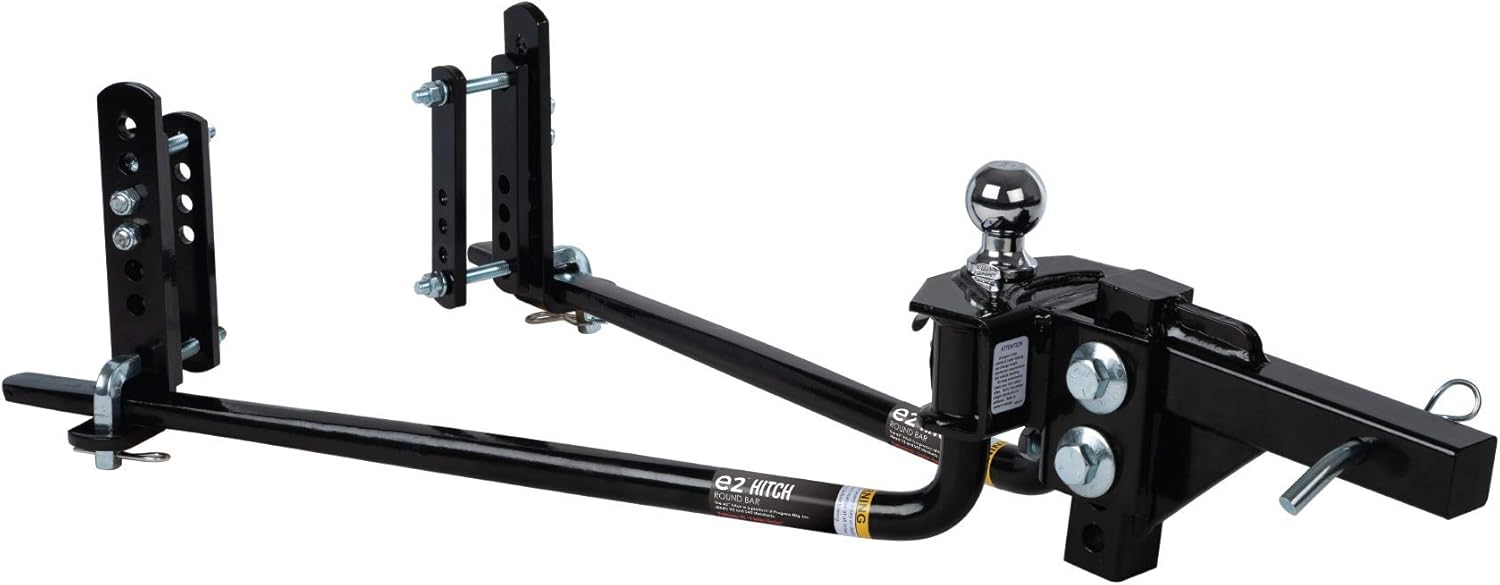
The Fastway e2 Round Bar 94-00-1000 combines weight distribution with an integrated two-point steel-on-steel friction sway-control system. It is rated for a maximum gross trailer weight (GTW) of 10,000 pounds and a maximum tongue weight of 1,000 pounds. Its round-bar design is intended to help redistribute tongue weight while resisting lateral trailer movement, without requiring a separate add-on sway-control bar.
The system includes an adjustable shank, spring arms, rigid sway-control brackets, and installation hardware. One important purchasing detail is that the standard 94-00-1000 package does not include a hitch ball. Fastway sells a related model, the 94-00-1061, with a preinstalled 2-5/16-inch hitch ball, but that is a different configuration. Check the exact model number before ordering.
Overview
The Fastway e2 Round Bar is designed for travel trailer owners who want weight distribution and sway control integrated into a single hitch assembly. Its two spring arms connect to rigid brackets mounted on the trailer frame. As the trailer moves laterally relative to the tow vehicle, the steel-on-steel contact at the brackets creates friction intended to resist sway.
Unlike a conventional setup with a separate friction sway-control bar, the e2 system keeps sway control within the hitch itself. Fastway states that the integrated design does not impose the usual backing, turning, or weather restrictions associated with separate add-on sway-control bars. Drivers must still follow the owner’s manual and ensure the trailer, vehicle, receiver, and hitch are correctly matched and adjusted.
The round-bar configuration includes a seven-hole adjustable shank, with the standard shank providing up to 7 inches of rise and approximately 1 inch of drop according to Fastway’s product information. This differs from the larger drop figures sometimes listed by retailers for other shank configurations. Confirm the actual adjustment range against the supplied shank and the current product documentation before purchase.
Key Features
Integrated Two-Point Steel-on-Steel Sway Control
The e2 uses two rigid brackets to create friction between the brackets and spring arms. This design provides continuous resistance to trailer sway when the hitch is correctly connected. Because sway control is built into the system, there is no separate friction bar to store, attach, or remove for ordinary backing manoeuvres. It does not eliminate sway in every condition, so proper loading and safe driving remain essential.
10,000-Pound Gross Trailer Weight Rating
The 94-00-1000 is rated for a maximum trailer weight of 10,000 pounds and a maximum tongue weight of 1,000 pounds. These are maximum ratings, not a recommendation to tow at the limits. The loaded tongue weight must be appropriate for the selected spring bars, and the vehicle, receiver, trailer, and other towing components must remain within their own ratings.
Round-Bar Spring Arms
The round-bar design uses two spring arms to apply leverage and help distribute tongue weight across the towing combination. This configuration is an alternative to the e2 trunnion-bar design. The choice between them should account for ground clearance, trailer-frame layout, available mounting space, and the manufacturer’s fitment guidance rather than weight ratings alone.
Rigid Brackets for Integrated Sway Resistance
The e2 brackets mount to the trailer frame and support the spring arms during towing. Fastway’s design allows bracket placement to accommodate many common trailer-tongue layouts, including areas near propane tanks and battery boxes, provided the required clearances are maintained. The brackets must be installed at the specified distance from the coupler and secured according to the manual.
Adjustable Shank with Multiple Height Positions
The included adjustable shank provides several mounting positions for matching the hitch head to the trailer coupler height. The standard round-bar kit is documented with a seven-hole shank and up to 7 inches of rise. The usable setup depends on receiver height, trailer coupler height, and the adjustment limits of the supplied components.
No Separate Sway-Control Bar Required
The integrated design reduces the number of separate components that need to be connected during hookup. This can make the routine towing process more straightforward, particularly for owners who frequently set up and break camp. However, the spring arms and brackets still need to be connected correctly, and the hitch must be adjusted for the actual loaded trailer.
Technical Specifications
| Specification | Details |
|---|---|
| Brand | Fastway Trailer Products |
| Product | e2 Round Bar Weight Distribution Hitch |
| Model Number | 94-00-1000 |
| Amazon ASIN | B0071L3IFK |
| Hitch Type | Round-bar weight distribution hitch with integrated sway control |
| Maximum Gross Trailer Weight | 10,000 lb |
| Maximum Tongue Weight | 1,000 lb |
| Sway-Control System | Integrated two-point steel-on-steel friction control |
| Spring-Bar Style | Round bar |
| Receiver Size | 2 in |
| Adjustable Shank | Standard seven-hole shank |
| Shank Rise | Up to 7 in, according to Fastway documentation |
| Shank Drop | Approximately 1 in with the standard round-bar shank; verify the supplied configuration |
| Hitch-Ball Size | 2-5/16 in, where specified for the compatible setup |
| Hitch Ball Included | No, not with model 94-00-1000 |
| Included Components | Hitch head, two spring arms, two sway-control brackets, adjustable shank, snap-up lever, spacer washers, hitch pin and clip, and installation hardware; verify the exact package |
| Construction | Steel |
| Finish | Black finish; confirm current product documentation |
| Warranty | Limited 10-year warranty, according to manufacturer product information; confirm current terms |
| Product Link | View the Fastway e2 Round Bar 94-00-1000 on Amazon |
Specification note: These specifications refer to the Fastway e2 Round Bar 94-00-1000. Do not confuse it with model 94-00-1061, which has a preinstalled hitch ball, or with the e2 trunnion-bar models. Confirm the exact model, shank configuration, and package contents before purchasing.
Pros and Cons
Pros
Combines weight distribution and integrated two-point sway control.
Rated for up to 10,000 lb GTW and 1,000 lb tongue weight.
Uses rigid brackets to provide steel-on-steel friction sway resistance.
Does not require a separate add-on sway-control bar.
Round-bar configuration offers an alternative to trunnion-bar designs.
Includes an adjustable shank and mounting hardware in the standard configuration.
Integrated design avoids the need to remove a separate friction sway-control bar for ordinary backing.
Cons
The hitch ball is not included with model 94-00-1000 and must be purchased separately.
The loaded trailer tongue weight must match the spring-bar rating.
Bracket placement requires adequate space and correct installation on the trailer frame.
The standard shank’s rise and drop range may not suit every tow vehicle and trailer combination.
Steel-on-steel friction can produce operating noise.
The hitch cannot compensate for exceeding vehicle payload, towing capacity, receiver limits, or axle ratings.
Who Should Consider This Hitch?
The Fastway e2 Round Bar 94-00-1000 is worth considering for owners of compatible travel trailers with a loaded tongue weight and gross trailer weight that fall within its specified limits. Its integrated two-point sway-control system may appeal to drivers who want to avoid the extra hookup steps associated with a separate friction sway-control bar.
The round-bar configuration may be suitable when its ground clearance, spring-arm layout, and bracket positioning work with the trailer frame. Owners should check the available mounting space around propane tanks, battery boxes, and other equipment on the trailer tongue before purchasing.
This hitch may be less suitable if the trailer’s loaded tongue weight falls outside the appropriate range, the standard shank cannot provide the required height adjustment, or the trailer frame does not allow correct bracket installation. Buyers who want a kit with a preinstalled hitch ball should compare the separate 94-00-1061 model rather than assuming the ball is included in the 94-00-1000 package.
What to Verify Before Buying
Confirm that the listing is for Fastway e2 Round Bar 94-00-1000.
Check that the loaded trailer weight does not exceed 10,000 lb GTW.
Verify that the loaded tongue weight is within the appropriate range and does not exceed 1,000 lb.
Confirm that the tow vehicle and receiver permit weight distribution and meet all relevant ratings.
Measure the receiver and trailer coupler heights to establish the required shank adjustment.
Verify the standard shank’s rise and drop range for the exact package.
Check that the trailer frame provides sufficient space for the sway-control brackets.
Purchase a compatible, appropriately rated hitch ball separately; the 94-00-1000 does not include one.
Follow the manufacturer’s instructions for bracket positioning, spring-arm setup, and final torque.
Confirm the current Amazon listing, package contents, return conditions, and warranty terms.
Our assessment: The Fastway e2 Round Bar 94-00-1000 is a strong candidate for owners who want a round-bar weight distribution hitch with integrated two-point sway control. Its 10,000 lb GTW and 1,000 lb tongue-weight ratings cover a range of compatible travel trailer setups, but the actual loaded tongue weight and installation geometry determine suitability. The principal buying consideration is that the standard 94-00-1000 package does not include a hitch ball. This assessment is based on manufacturer specifications and product documentation, not hands-on road testing.
Related Guide: If you are preparing a tow vehicle for longer camping trips, choosing the right equipment is only part of the planning process. Our guide to the best camping generators for reliable power at camp compares portable power options for campers who need electricity away from hookups.
4. Blue Ox SwayPro BXW1000
Award: Best for Chain-Based Weight Distribution and Sway Prevention

The Blue Ox SwayPro BXW1000 is a weight distribution hitch that uses spring bars, chains, and rotating latches to help distribute tongue weight and resist trailer sway. This configuration is rated for a maximum gross trailer weight (GTW) of 10,000 pounds and a maximum tongue weight of 1,000 pounds. Its design differs from friction-based systems such as the Equal-i-zer and Fastway e2, relying on the hitch head’s centering action and the spring-bar assembly to help control trailer movement.
The BXW1000 includes a standard hitch head, a seven-hole adjustable shank for a 2-inch receiver, 1,000-pound-rated spring bars, and clamp-on rotating latch brackets. It is designed for trailers with a coupler welded on top of the frame, provided the trailer tongue has sufficient clearance for the rotating latches and related hardware. Check these mounting requirements carefully before purchasing, particularly if the tongue has cross-members, propane tanks, battery boxes, or other obstructions.
Overview
The Blue Ox SwayPro BXW1000 combines weight distribution with a chain-based spring-bar arrangement. Once the spring bars are connected to the rotating latches, tension in the system helps redistribute some of the tongue load across the towing combination. The hitch head uses a caster design intended to help keep the trailer centered behind the tow vehicle, providing sway prevention without the conventional steel-on-steel friction pads used by some competing systems.
One practical distinction is the rotating-latch arrangement. The chains connect to brackets clamped onto the trailer frame, and the latches are rotated to establish the required tension. Blue Ox describes this design as supporting quick setup and allowing backing without disconnecting the spring bars, subject to the manufacturer’s operating instructions and the geometry of the towing combination.
The standard BXW1000 uses a seven-hole shank and is intended for a conventional top-mounted trailer coupler. It should not automatically be treated as suitable for every trailer tongue layout. If the coupler is mounted underneath the frame, or if cross-members and other equipment obstruct the latch mechanism, a different SwayPro configuration may be required.
Key Features
Chain-Based Spring-Bar System
The SwayPro uses spring bars connected to chains and rotating latch brackets. When correctly tensioned, the bars help redistribute tongue weight and support appropriate loading across the tow vehicle and trailer axles. The chain-based design offers a different setup approach from the rigid friction brackets used by the Equal-i-zer and Fastway e2 systems.
10,000-Pound Gross Trailer Weight Rating
Blue Ox specifies a maximum gross towing weight of 10,000 pounds for the BXW1000, paired with spring bars rated for a maximum tongue weight of 1,000 pounds. These figures describe the model’s maximum ratings, not a guarantee that every trailer below 10,000 pounds is compatible. The actual loaded tongue weight, vehicle payload, receiver rating, axle limits, and other manufacturer restrictions must all be checked.
Caster-Style Hitch Head for Sway Prevention
Blue Ox identifies the caster in the SwayPro hitch head as a mechanism that helps center the trailer behind the tow vehicle. The manufacturer describes the system as providing sway prevention without the conventional friction-based sway-control components used in other designs. Actual towing behavior still depends on correct setup, trailer loading, road conditions, and the condition of the complete towing system.
Rotating Latches with Clamp-On Brackets
The BXW1000 uses rotating latches attached to clamp-on brackets on the trailer frame. This arrangement allows the spring-bar chains to be tensioned during hookup. Correct bracket placement and secure installation are essential, and the frame must provide enough space for the latch mechanism to operate without interfering with other equipment.
Seven-Hole Adjustable Shank
The standard kit includes a seven-hole shank for a 2-inch receiver. The multiple adjustment positions help accommodate different receiver and coupler heights, but they do not guarantee a fit for every towing combination. Measure the receiver height and loaded trailer coupler height, then verify the required rise or drop against the current manufacturer documentation.
Designed for Quiet Operation and Backing
Blue Ox describes the SwayPro as a quiet sway-prevention system and states that the spring bars can remain connected during backing. These are manufacturer-described design characteristics rather than independent comparative test results. Always follow the installation manual and verify turning clearance before reversing or manoeuvring in confined areas.
Technical Specifications
| Specification | Details |
|---|---|
| Brand | Blue Ox |
| Product | SwayPro Weight Distributing Hitch |
| Model Number | BXW1000 |
| Amazon ASIN | B000GAO0A0 |
| Hitch Type | Weight distribution hitch with integrated sway prevention |
| Maximum Gross Trailer Weight | 10,000 lb |
| Maximum Tongue Weight | 1,000 lb |
| Sway-Control Design | Caster-style hitch head with chain-based spring-bar system |
| Spring-Bar Rating | 1,000 lb tongue weight, for the matched pair |
| Spring-Bar Style | Spring bars with chains and rotating latch brackets |
| Receiver Size | 2 in |
| Adjustable Shank | Standard seven-hole shank |
| Trailer Coupler Configuration | Designed for a coupler welded on top of the trailer frame |
| Brackets | Clamp-on rotating latch brackets |
| Hitch Ball | Verify whether the exact retail package includes the required ball |
| Included Components | Hitch head, 1,000 lb spring bars, seven-hole shank, clamp-on rotating latches, and associated installation hardware; verify exact package contents |
| Construction | Steel |
| Finish | Powder coat over e-coat, according to manufacturer documentation |
| Warranty | Limited lifetime warranty subject to manufacturer conditions |
| Product Link | View the Blue Ox SwayPro BXW1000 on Amazon |
Specification note: These specifications apply to the Blue Ox SwayPro BXW1000 with a seven-hole shank. Other SwayPro models use different shank lengths, spring-bar ratings, or coupler configurations. Confirm the exact model, hitch-ball requirements, and package contents before ordering.
Pros and Cons
Pros
Combines weight distribution and integrated sway prevention in one system.
Rated for up to 10,000 lb GTW and 1,000 lb tongue weight.
Chain-based spring-bar arrangement offers an alternative to friction-bracket systems.
Caster-style hitch head is designed to help center the trailer.
Includes a seven-hole adjustable shank for a 2-inch receiver.
Rotating latches and clamp-on brackets support tension adjustment during hookup.
Manufacturer states that the spring bars can remain connected during backing, subject to the manual.
Steel construction with a powder-coat-over-e-coat finish.
Cons
Trailer-frame layout must accommodate the clamp-on rotating latch brackets.
The standard BXW1000 is intended for a top-mounted coupler; other coupler configurations may require a different model.
The 1,000 lb tongue-weight rating must match the actual loaded tongue weight.
The hitch cannot compensate for exceeding vehicle payload, towing capacity, receiver limits, or axle ratings.
The exact hitch-ball inclusion and other package details should be verified with the seller.
Correct installation and adjustment are essential for safe operation.
Who Should Consider This Hitch?
The Blue Ox SwayPro BXW1000 is worth considering for travel trailer owners who prefer a chain-based spring-bar system and want weight distribution with integrated sway prevention. It may suit a compatible trailer with a top-mounted coupler, a loaded tongue weight within the system’s rating, and enough space on the frame for the rotating latch brackets.
The design may also appeal to owners who want to avoid a separate friction sway-control bar and prefer the SwayPro’s chain-tensioning arrangement. Its seven-hole shank offers several positioning options for a standard 2-inch receiver, although the available adjustment must be checked against the vehicle and trailer dimensions.
This model may be unsuitable if the trailer tongue has cross-members, propane equipment, batteries, or other obstructions that prevent correct bracket installation. Owners of trailers with an underslung coupler should investigate a purpose-built SwayPro variant rather than assuming the standard BXW1000 will fit.
What to Verify Before Buying
Confirm the exact model number Blue Ox SwayPro BXW1000.
Check that the loaded trailer weight does not exceed 10,000 lb GTW.
Verify that the loaded tongue weight is appropriate for the 1,000 lb spring-bar rating.
Check the tow vehicle’s towing capacity, payload, axle ratings, and manufacturer restrictions.
Confirm that the receiver is rated for weight distribution and is compatible with the intended load.
Verify that the trailer coupler is mounted on top of the frame, as required for this configuration.
Inspect the trailer tongue for cross-members, propane tanks, battery boxes, and other possible obstructions.
Measure receiver and coupler heights and confirm that the seven-hole shank offers the required adjustment.
Confirm the hitch-ball size, shank requirements, and exact package contents with the current Amazon listing.
Follow the manufacturer’s instructions for bracket installation, chain tension, spring-bar connection, and maintenance.
Review the warranty terms and current seller conditions before ordering.
Our assessment: The Blue Ox SwayPro BXW1000 is a strong candidate for compatible travel trailers within its 10,000 lb GTW and 1,000 lb tongue-weight limits. Its defining feature is the chain-based spring-bar system paired with a caster-style hitch head and rotating latch brackets. The most important buying consideration is physical compatibility with the trailer tongue, especially coupler position and bracket clearance. This assessment is based on manufacturer specifications and product documentation, not hands-on road testing.
Related Guide: Safe towing is only one part of a well-planned camping trip. Once you arrive, an organized campsite makes it easier to access equipment and keep essential areas clear. Read our guide to how to organize a campsite efficiently for practical ideas on arranging your camping space.
5. Camco Eaz-Lift Elite 48058
Award: Best Traditional Hitch Kit with Separate Sway Control

The Camco Eaz-Lift Elite 48058 is a round-bar weight distribution hitch kit designed for travel trailer owners who prefer a traditional chain-style setup with a separate, adjustable sway-control device. According to the manufacturer’s documentation, this configuration is rated for a maximum gross trailer weight (GTW) of 10,000 pounds and a maximum tongue weight of 1,000 pounds. It also includes a 2-5/16-inch hitch ball and preassembled components intended to reduce setup time.
Unlike the Equal-i-zer, CURT TruTrack, Fastway e2, and Blue Ox SwayPro systems in this comparison, the Eaz-Lift Elite 48058 uses an external friction sway-control unit. The device can be adjusted manually and unclamped when required by the manufacturer’s instructions, including for certain tight manoeuvres. Buyers should understand this distinction because its hookup procedure and operating considerations differ from those of hitches with integrated sway control.
Overview
The Eaz-Lift Elite 48058 combines a round-bar weight distribution hitch with an adjustable external sway-control device. Its spring bars and chains help redistribute tongue weight across the towing combination, while the separate friction unit is designed to dampen trailer sway caused by factors such as wind, passing vehicles, and changes in road conditions.
One practical feature is its ready-to-tow configuration. Camco’s product documentation describes the hitch ball and sway-control ball as preinstalled and torqued to specification, with the U-bolts and chain package preinstalled on the spring bars. This can reduce the amount of initial assembly required, although the hitch still needs to be installed, measured, and adjusted for the particular tow vehicle and trailer.
Because sway control is external rather than fully integrated into the hitch’s spring-bar mechanism, owners must follow the manufacturer’s instructions for connecting, adjusting, and disengaging the device. The sway-control unit may need to be unclamped for certain tight turns or reversing manoeuvres. This makes correct operation and understanding the manual especially important when using the hitch at campsites or in confined spaces.
Key Features
10,000-Pound Gross Trailer Weight Rating
The model 48058 is rated for a maximum gross trailer weight of 10,000 pounds and a maximum tongue weight of 1,000 pounds when used with its weight-distribution spring bars. These figures must be evaluated together with the loaded trailer weight, actual tongue weight, tow vehicle payload, receiver rating, and axle limits. A trailer below the maximum GTW can still be unsuitable if its tongue weight is outside the system’s permitted range.
Round-Bar Spring Bars and Chain Adjustment
The hitch uses round spring bars connected to chains, allowing the load distribution to be adjusted through the chain-link arrangement. When properly tensioned, the spring bars help redistribute some of the load carried at the hitch. Correct adjustment is important for maintaining appropriate axle loading and a suitable towing attitude. The spring bars must be used as a matched pair with the correct rating.
Separate Adjustable Friction Sway Control
The included sway-control unit uses friction to resist unwanted lateral movement between the tow vehicle and trailer. Its adjustment can be changed using the device’s clamp mechanism, according to the manufacturer’s instructions. Because the sway-control unit is separate from the weight-distribution assembly, owners need to understand when it must be connected, adjusted, or disengaged.
Ready-to-Tow Components
Camco identifies the 48058 as a ready-to-tow Elite kit. Its documentation lists the 2-5/16-inch hitch ball and sway-control ball as preinstalled and torqued to specification, with U-bolts and the chain package installed on the spring bars. This can make initial setup more convenient than purchasing a standard hitch and separate sway-control components individually. Confirm the actual retail package before ordering.
Universal Spring-Bar Arrangement
The manufacturer describes the Elite spring bars as interchangeable for use on either side of the hitch. This can simplify replacement and assembly when the correct matching components are used. Owners should follow the manual’s instructions for spring-bar selection, lubrication, and installation rather than assuming all Eaz-Lift bars are interchangeable across every rating.
Adjustable Shank and Hitch-Head Positioning
The hitch uses an adjustable shank and ball mount to help match the tow vehicle’s receiver height to the trailer coupler. Correct positioning helps establish the intended towing geometry, but the available adjustment depends on the supplied shank and its configuration. Measure the receiver and trailer coupler heights before purchasing, and verify the required rise or drop against the manufacturer’s documentation.
Technical Specifications
| Specification | Details |
|---|---|
| Brand | Camco / Eaz-Lift |
| Product | Eaz-Lift Elite Weight Distribution Hitch Kit with Sway Control |
| Model Number | 48058 |
| Amazon ASIN | B005SB6S3Y |
| Hitch Type | Round-bar weight distribution hitch with separate sway-control device |
| Maximum Gross Trailer Weight | 10,000 lb |
| Maximum Tongue Weight | 1,000 lb |
| Sway-Control System | External, adjustable friction sway control |
| Spring-Bar Style | Round bars with chain adjustment |
| Receiver Size | 2 in; verify the supplied shank configuration |
| Hitch-Ball Size | 2-5/16 in |
| Hitch Ball Included | Yes, according to manufacturer documentation |
| Preassembled Components | Hitch ball, sway-control ball, U-bolts, and chain package, according to manufacturer documentation |
| Included Components | Round-bar weight distribution hitch, spring bars, chains, adjustable shank and ball mount, separate sway-control unit, hitch ball, and mounting hardware; verify the current package contents |
| Construction | Steel components |
| Finish | Confirm the current product documentation and listing |
| Warranty | Verify the current manufacturer’s warranty terms |
| Product Link | View the Camco Eaz-Lift Elite 48058 on Amazon |
Specification note: These specifications apply to the Camco Eaz-Lift Elite 48058 kit with a 1,000 lb tongue-weight rating and 10,000 lb maximum GTW. Do not confuse it with model 48069, which has a higher weight rating. Retail listings may contain inconsistent specifications, so confirm the exact model number and package contents before purchasing.
Pros and Cons
Pros
Combines weight distribution with a separate adjustable sway-control device.
Rated for up to 10,000 lb GTW and 1,000 lb tongue weight.
Includes a 2-5/16-inch hitch ball according to manufacturer documentation.
Preassembled components can reduce initial assembly work.
Round spring bars and chain adjustment provide a traditional weight-distribution setup.
External sway control can be adjusted according to the towing requirements.
Interchangeable spring-bar design offers flexibility when replacing correctly rated components.
Cons
Uses a separate sway-control device that requires its own hookup and adjustment.
The sway-control unit may need to be disengaged for certain tight turns or reversing manoeuvres, as specified in the manual.
The trailer frame and hitch geometry must accommodate the spring bars, chains, and sway-control mounting points.
Correct setup and adjustment remain essential for safe operation.
The maximum ratings do not override tow vehicle, receiver, payload, or axle limits.
Current retailer listings should be checked carefully because similar Eaz-Lift models have different ratings.
Who Should Consider This Hitch?
The Camco Eaz-Lift Elite 48058 is worth considering for travel trailer owners who prefer a traditional round-bar weight distribution hitch and want a kit supplied with a separate adjustable sway-control device. Its ready-to-tow configuration may appeal to buyers who value preassembled components, an included hitch ball, and a familiar chain-adjustment arrangement.
It may be suitable for a compatible trailer whose loaded gross weight and tongue weight fall within the model’s specified limits, provided the tow vehicle and receiver permit weight distribution. Owners should also have enough space on the trailer frame for the spring-bar chains and the separate sway-control mounting points.
This hitch may be less convenient for drivers who prefer an integrated sway-control system with fewer separate hookup steps. Those who frequently reverse into tight campsites should understand the manufacturer’s instructions for disengaging or adjusting the sway-control unit before manoeuvring. The external device must never be treated as a substitute for correct loading, suitable speed, or safe driving.
What to Verify Before Buying
Confirm that the listing is for Camco Eaz-Lift Elite 48058.
Confirm that the loaded trailer weight and actual tongue weight are within the hitch’s 10,000 lb GTW and 1,000 lb tongue-weight limits.
Establish the loaded trailer weight and actual tongue weight.
Check the tow vehicle’s towing capacity, payload, axle ratings, and owner-manual restrictions.
Confirm that the receiver permits weight distribution and is rated for the intended load.
Verify that the supplied shank provides the required rise or drop.
Check clearance for the round spring bars, chains, and separate sway-control device.
Confirm that the package includes the 2-5/16-inch hitch ball, sway-control unit, mounting hardware, and other required components.
Review the instructions for sway-control adjustment, tight turns, reversing, and maintenance.
Confirm current warranty terms, price, seller, availability, and return conditions before ordering.
Our assessment: The Camco Eaz-Lift Elite 48058 is a reasonable candidate for owners who want a traditional chain-style weight distribution system with a separate adjustable sway-control device. Its 10,000 lb GTW and 1,000 lb tongue-weight ratings, preassembled components, and included hitch ball are useful buying considerations. Its main trade-off is the additional hookup and operating procedure associated with external sway control. Suitability depends on actual loaded weights, installation geometry, and compatibility with the complete towing combination. This assessment is based on manufacturer documentation, not hands-on road testing.
Related Guide: For other equipment that can support trips away from mains power, explore our best solar chargers for car camping guide. It covers portable charging options for compatible devices and accessories; check each product’s output and your equipment’s power requirements before relying on it in your setup.
How to Choose a Weight Distribution Hitch
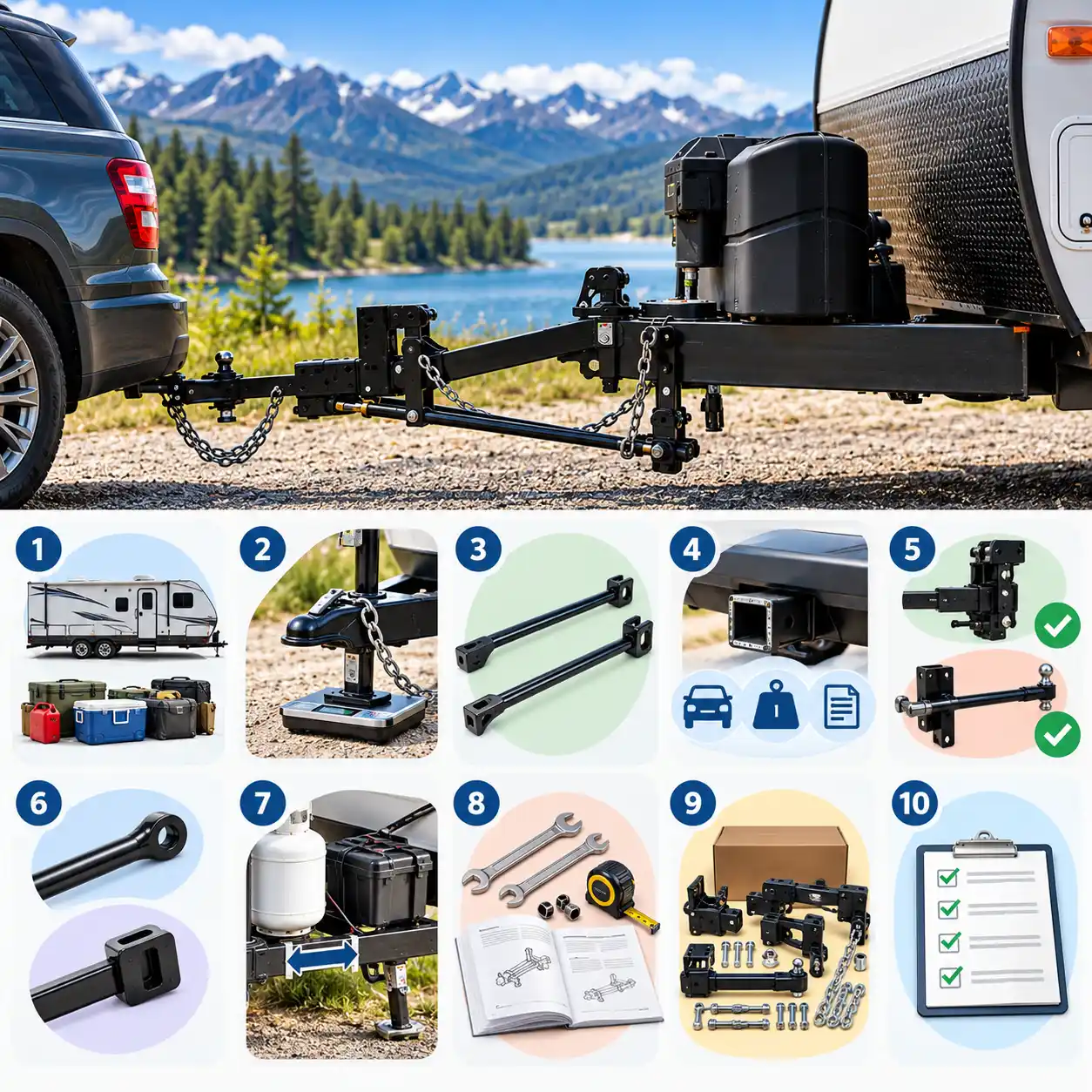
Choosing the right weight distribution hitch for a travel trailer starts with understanding your actual towing requirements. The correct system must match the trailer’s loaded weight, tongue weight, tow vehicle, receiver, and trailer-frame configuration. You should also consider whether you want integrated sway control or a separate friction-control device. A higher-rated hitch is not automatically the better choice if its spring bars are unsuitable for your loaded trailer.
1. Determine Your Loaded Trailer Weight
Start with the trailer’s actual weight when prepared for a typical camping trip, rather than relying only on its advertised dry weight. Camping equipment, food, clothing, batteries, propane, water, and other supplies can add substantial weight after the trailer leaves the dealership.
Gross trailer weight (GTW) refers to the total loaded weight of the trailer. Compare this figure with the hitch’s maximum GTW rating, but remember that the tow vehicle, receiver, trailer axles, tires, and other components have their own limits.
Whenever possible, weigh the loaded trailer using appropriate scales. This gives you a more reliable starting point for selecting a weight distribution hitch than estimating the total load from the manufacturer’s brochure.
2. Measure the Actual Tongue Weight
Tongue weight (TW) is the downward force the loaded trailer applies to the hitch ball. It is one of the most important factors when selecting spring bars because the bars must be appropriate for the tongue load they are intended to distribute.
For many conventional travel trailers, tongue weight is commonly around 10–15% of the total loaded trailer weight. However, the correct target depends on the trailer manufacturer’s requirements, and this general range should not replace the specified guidance for your particular trailer.
For example, a travel trailer weighing 7,000 pounds when loaded might have a tongue weight of approximately 700–1,050 pounds if it falls within that general range. This is an illustration, not a universal specification or a recommendation to use any particular hitch.
Measure tongue weight with the trailer loaded as it will normally travel. If you change the position of batteries, water, camping equipment, or other cargo, the tongue weight can change as well. A hitch that appears suitable when the trailer is empty may not be correctly matched once it is ready for a trip.
3. Match the Spring-Bar Rating to Your Tongue Weight
Weight distribution hitches are available with different spring-bar ratings. The selected rating should accommodate the actual loaded tongue weight in accordance with the manufacturer’s specified operating range.
Avoid choosing spring bars solely because their maximum rating is higher than the trailer’s estimated tongue weight. A system that is poorly matched to the actual load may be difficult to adjust correctly and may not deliver the intended weight-distribution characteristics.
When comparing products, look for both the maximum gross trailer weight and the tongue-weight rating. Some manufacturers specify a range for tongue weight rather than one maximum figure. Check whether the stated ratings apply with the spring bars installed and whether the selected configuration is appropriate for your measured load.
If the trailer’s tongue weight changes substantially between trips, ask the hitch manufacturer whether the chosen spring-bar configuration is suitable for those different loading conditions.
4. Check Your Tow Vehicle and Receiver Ratings
The weight distribution hitch must be compatible with the tow vehicle and receiver. Before buying, review the vehicle owner’s manual and the receiver manufacturer’s specifications.
Check these limits carefully:
Maximum towing capacity: the maximum trailer weight permitted for the vehicle under the specified conditions.
Payload capacity: the amount of weight the vehicle can carry, including occupants, cargo, and applicable hitch loads.
Gross Vehicle Weight Rating (GVWR): the maximum permitted loaded weight of the tow vehicle.
Gross Combined Weight Rating (GCWR): the maximum permitted combined weight of the loaded tow vehicle and trailer.
Gross Axle Weight Ratings (GAWR): the maximum permitted load on each axle.
Receiver ratings: the permitted tongue weight and trailer weight, including any separate limits for weight-carrying and weight-distributing configurations.
Use the most restrictive applicable rating when determining whether your towing combination is suitable. A weight distribution hitch does not increase the manufacturer’s towing capacity, payload, axle ratings, or gross vehicle weight limits.
Also confirm that the vehicle manufacturer permits weight distribution equipment. Some vehicles have specific restrictions, and certain suspension or hitch designs may not be compatible with a weight distribution system.
5. Decide Whether You Need Integrated Sway Control
Weight distribution and sway control serve related but different purposes. Weight distribution helps redistribute some of the tongue load across the tow vehicle and trailer axles. Sway control is designed to resist unwanted side-to-side trailer movement.
Some weight distribution hitches integrate sway control into their design. Others use a separate friction-control device that must be connected and adjusted independently.
Integrated systems can simplify routine hookup because there is no separate sway-control bar to attach. However, the specific mechanism, installation requirements, and operating restrictions vary by model. A separate friction device can be suitable for some towing setups, but it introduces additional steps and may need to be disengaged for certain manoeuvres according to its manual.
Choose the system that fits your trailer, driving requirements, and preferred hookup procedure. Do not assume that every integrated system works in the same way or that any sway-control design can compensate for incorrect trailer loading.
6. Choose Between Round-Bar and Trunnion-Bar Designs
Round-bar and trunnion-bar weight distribution hitches use different spring-bar attachment designs. The distinction can affect ground clearance, hitch-head geometry, installation, and compatibility with the trailer frame.
Round-bar designs generally use bars that extend from the lower portion of the hitch head. Depending on the trailer and tow vehicle, their position may affect clearance around the receiver, trailer tongue, or ground.
Trunnion-bar systems use spring bars with shaped ends that fit into the hitch head. Depending on the specific model, this arrangement can provide a different clearance profile and mounting geometry.
Neither design is automatically best for every travel trailer. Check the hitch manufacturer’s fitment instructions, available clearance, spring-bar rating, and required adjustment range before choosing between them.
7. Verify Trailer-Frame and Coupler Compatibility
A hitch must physically fit the trailer’s A-frame or tongue. Mounting brackets, spring bars, chains, and sway-control components need sufficient clearance to operate as intended.
Before purchasing, inspect the area around the coupler for propane tanks, battery boxes, storage compartments, cross-members, and other equipment. These items can restrict bracket placement or interfere with spring-bar movement.
Also check whether the trailer coupler is mounted on top of or underneath the frame. Some hitch systems are designed for a specific coupler arrangement, and other configurations may require a different model or additional manufacturer-approved components.
Confirm the hitch-ball size, receiver size, shank dimensions, and available rise or drop. A hitch with the correct weight ratings is still unsuitable if it cannot be installed and adjusted correctly on the actual vehicle and trailer.
8. Consider the Installation and Adjustment Requirements
Weight distribution hitches require more setup than simply attaching a trailer to a ball mount. The hitch head, spring bars, mounting brackets, and any sway-control components must be installed and adjusted according to the manufacturer’s instructions.
Before buying, review the installation manual and determine whether you have the tools, space, and experience required for the setup. Some systems use chains and rotating latches, while others use rigid brackets or separate friction-control hardware.
After installation, verify the trailer’s attitude, the tow vehicle’s front-axle loading, and the relevant measurements specified by the manufacturer. Do not rely solely on whether the vehicle appears level. Different vehicles and hitch systems have different adjustment procedures and target measurements.
If you are unfamiliar with weight distribution setup, consider having a qualified towing or RV professional inspect the installation and verify the loaded towing combination.
9. Compare Included Components and Total Cost
The advertised price does not always represent the complete cost of a weight distribution hitch. Some kits include the adjustable shank, hitch ball, spring bars, brackets, and mounting hardware. Others require one or more of these components to be purchased separately.
Check the exact model number and package contents before ordering. Two listings for products in the same product family can have different spring-bar ratings, included shanks, hitch balls, or other accessories.
When comparing prices, account for any additional parts needed for a compatible installation. Also review the warranty, replacement-part availability, installation instructions, and maintenance requirements. These factors can be more important over time than a small difference in the initial purchase price.
10. Avoid Choosing a Hitch by Maximum Rating Alone
A high maximum GTW rating does not automatically make a weight distribution hitch the best choice for your travel trailer. The system must be suitable for the actual loaded tongue weight, fit the trailer frame, work with the tow vehicle and receiver, and meet the manufacturers’ installation requirements.
Before making your final decision, confirm these five essentials:
The loaded trailer weight is within the hitch’s permitted rating.
The actual tongue weight matches the selected spring-bar range.
The tow vehicle and receiver permit the intended weight-distribution setup.
The hitch fits the trailer frame, coupler, and required mounting geometry.
The sway-control design and installation procedure suit your towing requirements.
Final buying advice: Choose a weight distribution hitch based on measured loads and confirmed compatibility, not brand popularity or the largest number printed on the product listing. A properly matched and adjusted system can help manage tongue-weight distribution and, where equipped, resist trailer sway. It cannot make an overloaded or incompatible towing combination safe.
Common Weight Distribution Hitch Buying Mistakes to Avoid
Choosing a suitable weight distribution hitch is only the first step. Problems can still arise when owners overlook installation instructions, combine incompatible components, or assume that sway-control equipment removes the need for careful towing practices. Avoid these common mistakes after selecting a hitch.
1. Mixing Components from Different Hitch Systems
Spring bars, hitch heads, brackets, and other components are not automatically interchangeable between brands or model families. Using parts that appear to fit can create an incompatible setup or prevent the system from working as designed. Use only components approved for the specific hitch model and follow the manufacturer’s compatibility guidance.
2. Skipping Model-Specific Installation Instructions
Weight distribution hitches use different bracket arrangements, tensioning methods, adjustment procedures, and fastener requirements. Do not rely on instructions for a similar-looking model or assume that a previous installation method applies to a new hitch. Follow the manual supplied for the exact system, including its torque specifications and adjustment sequence.
3. Assuming Sway Control Prevents Every Sway Event
Integrated or separate sway-control equipment can help resist unwanted trailer movement, but neither guarantees that sway will never occur. Speed, wind, passing traffic, tire condition, and trailer loading can still affect stability. If sway develops, reduce speed gradually when safe and investigate the cause rather than relying on the hitch to compensate for it.
4. Ignoring Inspection and Maintenance
Wear, loose fasteners, damaged chains, bent brackets, corrosion, or worn friction surfaces can affect hitch operation. Inspect the system at the intervals specified by its manufacturer and before towing if damage or unusual wear is suspected. Lubricate only the designated points and use the recommended products; some friction surfaces must remain free of lubricant.
5. Forgetting Operating Restrictions During Turns and Reversing
Some systems allow ordinary backing with the hitch connected, while separate sway-control devices or particular configurations may require adjustment or disengagement for tight manoeuvres. Never assume that all designs operate in the same way. Check the exact manual for turning clearance, reversing procedures, and any restrictions before entering a campsite or negotiating a tight space.
Final reminder: A properly selected hitch still needs compatible components, correct installation, regular inspection, and operation according to its manufacturer’s instructions. If the setup behaves unexpectedly or you are unsure whether it has been adjusted correctly, stop and have it checked by a qualified towing or RV professional before continuing.
Weight Distribution Hitch vs. Sway Control Hitch
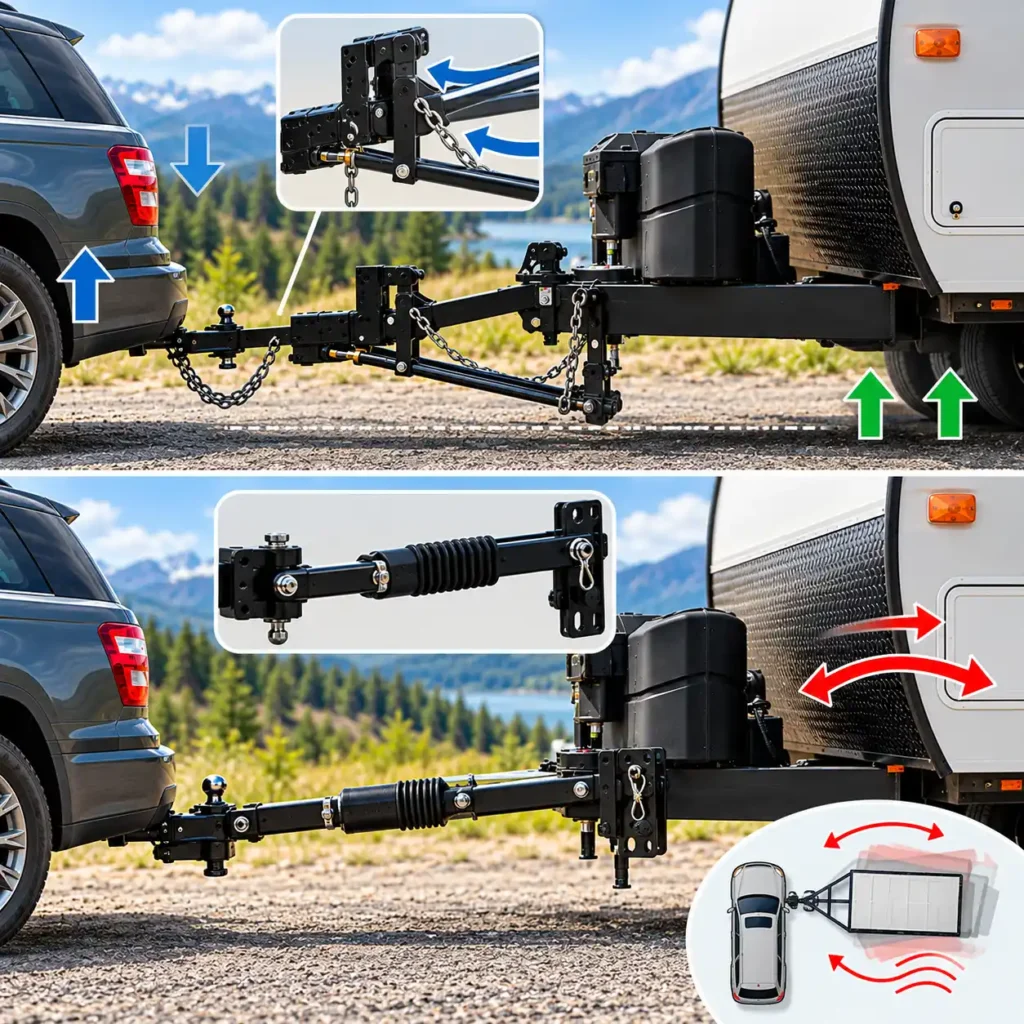
A weight distribution hitch and a sway-control system serve two different functions. Weight distribution helps redistribute hitch-related load across the tow vehicle and trailer axles, while sway control helps resist unwanted side-to-side trailer movement. Some systems combine both functions in one assembly; others use a separate sway-control device.
Understanding this distinction helps explain what each system is designed to do and why the two functions are not interchangeable.
What Does a Weight Distribution Hitch Do?
A conventional weight distribution hitch uses a hitch head and spring bars to apply leverage between the tow vehicle and trailer. When correctly installed and adjusted, it helps redistribute the load carried at the hitch and can reduce excessive rear-end sag.
Its primary purpose is load distribution, not sway control by itself. Whether a particular weight distribution hitch also resists sway depends on its design.
What Does a Sway-Control System Do?
A sway-control system is designed to resist lateral movement of the trailer relative to the tow vehicle. Different systems achieve this in different ways, including friction-based mechanisms, integrated hitch designs, and other model-specific mechanical arrangements.
Sway control can help manage unwanted trailer movement, but it cannot eliminate every cause of sway. Trailer loading, road conditions, wind, speed, and the condition of the towing equipment still affect stability.
Integrated vs. Separate Sway Control
Integrated sway control: The sway-control mechanism is built into a compatible weight distribution hitch. This combines both functions in one assembly and can reduce the need to connect a separate sway-control device. Examples in this guide include the Equal-i-zer and Fastway e2 systems, although their mechanisms differ.
Separate sway control: A standalone device works alongside a weight distribution hitch to provide additional resistance to trailer movement. The Camco Eaz-Lift Elite 48058 kit reviewed in this guide uses a separate adjustable friction sway-control device. Its connection and operating procedures differ from those of integrated systems.
Key Differences at a Glance
| Feature | Weight Distribution | Sway Control |
|---|---|---|
| Primary purpose | Helps redistribute hitch-related load across axles | Helps resist side-to-side trailer movement |
| Helps reduce rear-end sag | Yes, when correctly installed and adjusted | Not its primary function |
| Resists trailer sway | Only if the design includes sway-control capability | Yes, this is its intended function |
| Requires spring bars | Typically, in conventional weight distribution systems | Depends on the system design |
| Can be a separate device | Not typically described this way | Yes |
| Can both functions be combined? | Yes, in compatible integrated systems | Yes, when built into a weight distribution hitch |
Can Weight Distribution and Sway Control Work Together?
Yes. A compatible hitch can provide both load distribution and sway resistance. The practical difference is whether sway control is integrated into the hitch or supplied by a separate device. These designs have different hookup procedures and operating requirements, so the exact manufacturer instructions matter.
Neither function makes an unsuitable towing setup safe, and sway-control equipment cannot guarantee that sway will never occur. If trailer sway develops, reduce speed gradually when safe and investigate the cause before continuing.
The bottom line: Weight distribution manages the effects of hitch load on the towing combination; sway control is designed to resist lateral trailer movement. Some hitches combine both functions, while others require a separate device. They address different aspects of towing stability and should not be treated as interchangeable.
GTW vs. Tongue Weight: Understanding Hitch Weight Ratings
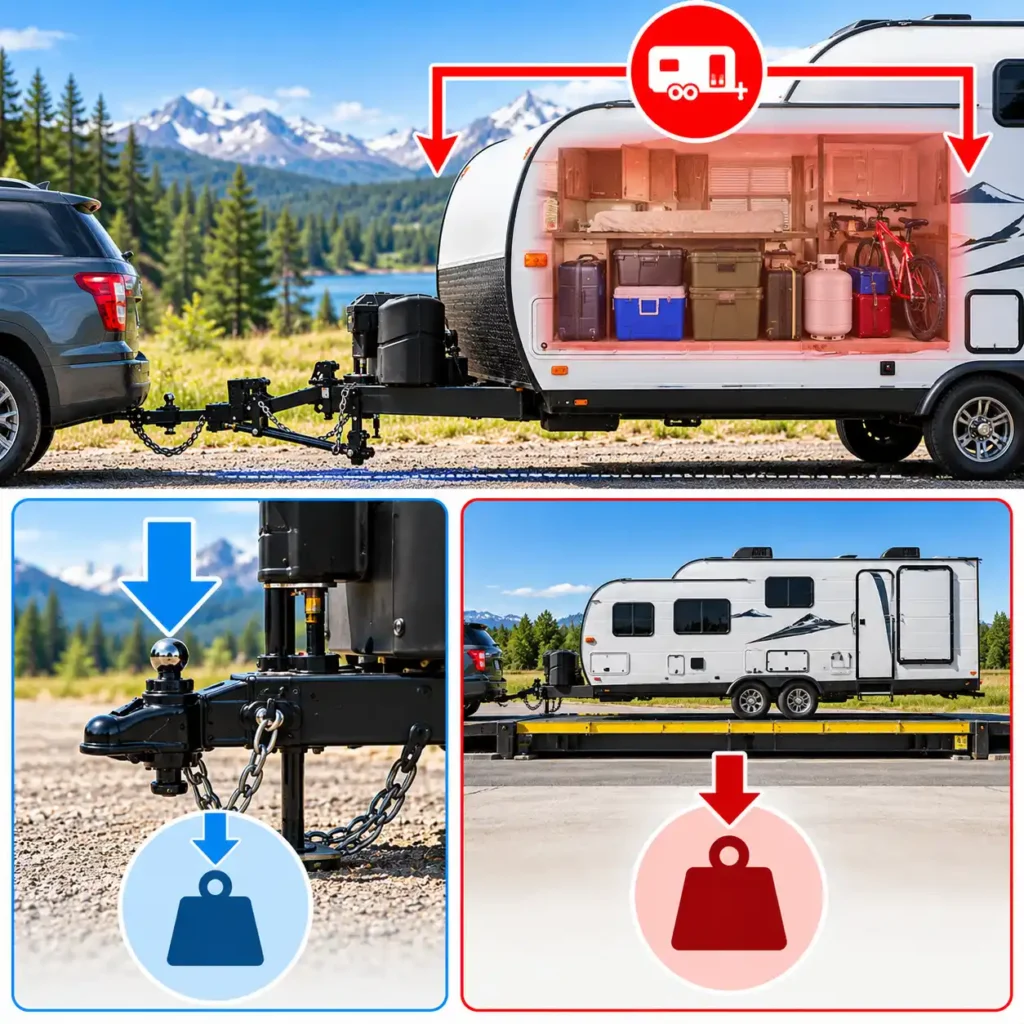
Understanding gross trailer weight (GTW) and tongue weight (TW) is essential when choosing weight distribution hitches for travel trailers. These measurements describe different aspects of your towing load, and confusing them can lead to selecting a hitch that is unsuitable for your actual setup.
What Is Gross Trailer Weight (GTW)?
Gross trailer weight is the total weight of the fully loaded trailer at the time it is towed. It includes the trailer itself, cargo, water, propane, equipment, and other items carried inside or on the trailer.
When comparing weight distribution hitches, check the manufacturer’s maximum GTW rating. Your loaded trailer must remain within the hitch’s permitted range and the towing limits of your vehicle, receiver, and trailer.
Do not use the trailer’s unloaded or dry weight as a substitute for its actual loaded weight. The difference can be significant once supplies and travel equipment are added.
What Is Tongue Weight (TW)?
Tongue weight is the downward force the loaded trailer applies to the hitch connection. For a conventional travel trailer, it is an important factor in towing stability and in selecting the correct spring-bar rating.
Tongue weight changes with cargo placement, tank levels, and other loading conditions. Moving equipment forward or backward can alter the load carried at the hitch, so a published estimate may not reflect your actual setup.
Measure tongue weight with the trailer loaded as it will be towed, using an appropriate method or a suitable scale. Follow the trailer and hitch manufacturers’ instructions when measuring and preparing the towing combination.
GTW vs. Tongue Weight: The Key Differences
| Specification | Gross Trailer Weight (GTW) | Tongue Weight (TW) |
|---|---|---|
| What it measures | Total loaded trailer weight | Downward load applied at the hitch |
| Common unit | Pounds (lb) | Pounds (lb) |
| Changes with cargo | Yes | Yes, particularly with cargo placement |
| Used to check | Hitch and trailer weight capacity | Spring-bar selection and hitch loading |
| How to determine it | Weigh the loaded trailer | Measure the loaded trailer's hitch load |
| Why it matters | Prevents exceeding applicable weight ratings | Helps match the hitch to the actual tongue load |
How Much Tongue Weight Should a Travel Trailer Have?
A commonly used starting guideline for conventional travel trailers is a tongue weight of approximately 10–15% of the loaded trailer weight. This is a general guideline, not a universal specification: the trailer manufacturer may specify a different range, and the tow vehicle, receiver, and hitch requirements must also be satisfied.
For example, a trailer weighing 7,000 lb when loaded might have a tongue weight in the range of 700–1,050 lb under that guideline. The actual value must be measured, and the permitted range for every component must be checked.
Example: Estimating Tongue Weight
Illustrative calculation using a 7,000 lb loaded trailer and a 10–15% guideline.
Loaded trailer weight
7,000 lb
At 10% tongue weight
700 lb
At 15% tongue weight
1,050 lb
The example does not establish the correct tongue weight for a specific trailer. Follow the manufacturer’s requirements and verify actual measurements.
How to Interpret GTW and Tongue Weight Ratings
GTW and tongue weight describe different loads, so one rating cannot substitute for the other. GTW is the total loaded trailer weight; tongue weight is the downward load applied at the hitch connection. A weight distribution hitch must be evaluated using the ratings and operating ranges specified for that particular model.
The 10–15% tongue-weight figure discussed above is a general guideline for conventional travel trailers, not a universal requirement. Follow the trailer manufacturer’s guidance and use actual measurements where possible.
Why Both Measurements Matter
A trailer can be within a hitch’s maximum GTW rating while its tongue weight falls outside the system’s specified operating range. Likewise, suitable hitch ratings do not override the tow vehicle’s payload, GVWR, GCWR, axle ratings, or receiver restrictions.
Use the GTW and tongue-weight figures for their intended purposes, and keep in mind that changing cargo or tank levels can affect the loaded measurements.
The bottom line: GTW describes the total loaded trailer weight; tongue weight describes the downward load at the hitch. They are related but distinct measurements, and both are needed to understand the weight ratings of a towing setup.
Weight Distribution Hitch Installation, Setup & Maintenance
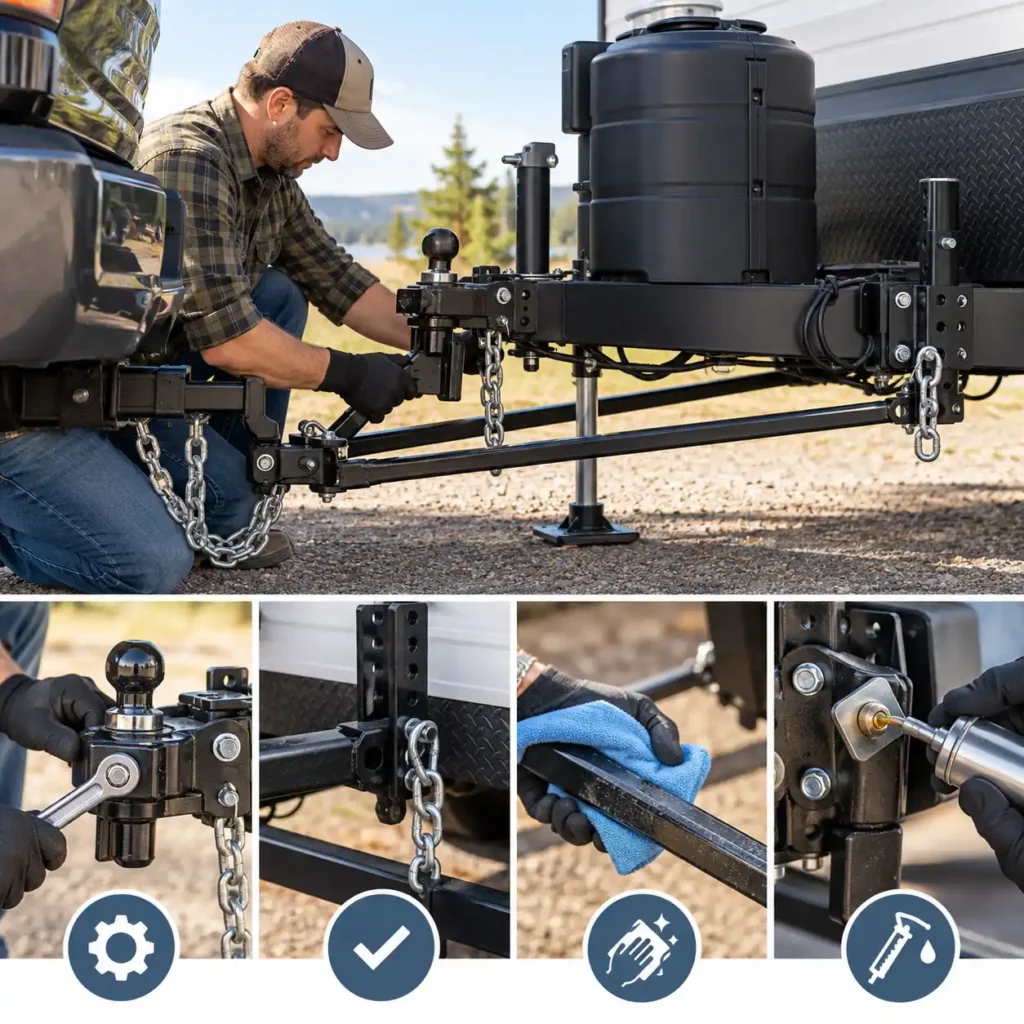
Proper weight distribution hitch installation, adjustment, and maintenance are essential for reliable towing performance. Even a correctly rated hitch may not work as intended if the spring bars are improperly adjusted, the brackets are incorrectly positioned, or the system is not maintained according to the manufacturer’s instructions.
Before installation, read the instructions supplied with your specific hitch and confirm that the tow vehicle manufacturer permits the use of weight distribution equipment for your towing configuration.
How to Install a Weight Distribution Hitch
Although installation procedures vary by model, most conventional weight distribution hitches follow a similar sequence.
1. Prepare the tow vehicle and trailer
Park on firm, level ground, secure the trailer, and follow the manufacturer’s safety procedures before working around the hitch. Load the trailer as it will be used for travel, because cargo placement affects tongue weight and the final adjustment.
2. Check the hitch components
Confirm that the hitch head, shank, spring bars, brackets, fasteners, and other required components are present and compatible. Verify that the hitch ball has the correct diameter and that the ball, shank, and receiver meet the applicable specifications.
3. Position the hitch head and brackets
Install the shank and hitch head according to the manufacturer’s instructions. Position the spring-bar brackets or other attachment hardware at the specified locations on the trailer frame. Required clearances and mounting methods vary between designs, so do not assume that the same measurements apply to every hitch.
4. Connect the trailer and install the spring bars
Couple the trailer securely to the tow vehicle, then install the spring bars and connect them to their designated brackets or attachments. Use the supplied hardware and specified procedures. Some systems require specialized tools or particular precautions when applying spring-bar tension.
5. Adjust the system
Set the hitch head angle, bracket position, and spring-bar tension as directed by the manufacturer. The goal is to achieve the prescribed weight distribution and vehicle stance without exceeding any component’s rating. Do not rely on visual appearance alone to determine whether the setup is correct.
6. Complete the safety checks
Verify that the hitch is fully coupled, retaining pins and clips are installed, fasteners are tightened to the specified torque, and safety chains and electrical connections are properly arranged. Confirm that the trailer jack is fully raised and that no component interferes with turning or other permitted movements.
How to Adjust a Weight Distribution Hitch
Correct adjustment depends on the specific hitch design, the loaded trailer, and the tow vehicle. The procedure should follow the manufacturer’s instructions rather than a universal number of chain links, spring-bar tension, or head-angle setting.
During setup, pay particular attention to the following:
Vehicle stance: Compare the tow vehicle’s front and rear ride heights with the manufacturer’s prescribed measurements. Do not automatically aim to make the vehicle perfectly level.
Front-axle load: Where required, use the specified measurement or weighing procedure to verify appropriate load restoration on the front axle.
Spring-bar tension: Use the adjustment method specified for the hitch. Excessive or insufficient tension can result in an incorrect setup.
Loaded tongue weight: Confirm that the measured tongue weight falls within the hitch and spring-bar operating ranges.
Trailer clearance: Check that the spring bars, brackets, chains, and other components have the required clearance during permitted turns and articulation.
Fastener torque: Tighten hardware to the manufacturer’s specified values and recheck it according to the prescribed schedule.
If the vehicle’s handling, ride height, or steering feel changes unexpectedly after installation, stop and reassess the setup before continuing the trip. A qualified towing professional can help verify the measurements and adjustment when necessary.
Weight Distribution Hitch Maintenance Checklist
Regular inspection helps identify wear, loose hardware, corrosion, and other problems before they affect towing. The exact maintenance schedule and lubrication requirements depend on the model.
| Component | What to Check | Maintenance Action |
|---|---|---|
| Hitch head and shank | Cracks, deformation, corrosion, or unusual movement | Inspect regularly and replace damaged components |
| Spring bars | Bends, cracks, excessive wear, or damaged attachment points | Follow manufacturer inspection criteria; replace defective bars |
| Brackets and fasteners | Looseness, damage, or shifting | Check and tighten to the specified torque |
| Chains and retaining hardware | Wear, deformation, damaged links, or missing clips | Inspect and replace damaged parts |
| Friction surfaces | Contamination, abnormal wear, or damage | Clean or service only as instructed for the specific system |
| Hitch ball and coupler | Wear, secure coupling, and correct fit | Inspect and maintain according to their manufacturers' instructions |
| Electrical connections and safety chains | Damage, secure attachment, and correct routing | Repair or replace defective components and verify connections |
Lubrication: Follow the Hitch Manufacturer’s Instructions
One important maintenance mistake is assuming that every moving or friction surface should be lubricated. Some hitch components require grease at specified contact points, while certain sway-control friction surfaces must remain clean and free of grease to function as intended.
Use only the lubrication products and locations specified in the manual for your model. Applying lubricant to a surface that relies on friction can affect its operation.
When Should You Inspect the Hitch?
Inspect the system before towing and periodically during ownership, following the manufacturer’s schedule. Additional checks are sensible after installation, adjustment, unusual noise, significant impact, or a change in the towing configuration.
Pay attention to warning signs such as:
New or unusual clunking, grinding, or squeaking.
Loose brackets, missing retaining clips, or shifting hardware.
Visible cracks, bent components, or abnormal wear.
Unexpected changes in vehicle stance or towing behavior.
Difficulty coupling, releasing, or adjusting the system.
Some operating noise may be normal for particular friction-based designs. However, do not dismiss new or worsening noises without checking the manufacturer’s troubleshooting guidance.
Installation and Maintenance Checks
Before towing, confirm that the hitch is installed and adjusted according to the instructions for the exact model. Pay particular attention to vehicle and receiver compatibility, specified fastener torque, correct lubrication points, and the condition of the spring bars, brackets, and retaining hardware.
Do not tow with cracked, bent, loose, or otherwise damaged components. If the trailer’s loading or towing configuration changes, reassess the setup as directed by the manufacturer.
Some friction-based hitches produce normal operating noise, but new or worsening noises, shifting hardware, or unexpected changes in handling warrant inspection before continuing the trip.
When to Seek Professional Help
If the hitch cannot be adjusted within the manufacturer’s specified range, the tow vehicle’s front axle cannot be restored as prescribed, the trailer frame presents mounting problems, or towing stability remains poor, consult the hitch manufacturer or a qualified towing professional.
A weight distribution hitch is one part of the towing system. Correct installation cannot compensate for an overloaded vehicle, unsuitable tires, poor trailer loading, or incompatible equipment.
The bottom line: Install and adjust a weight distribution hitch according to the exact model’s instructions, verify the loaded towing setup, and inspect the system regularly. Correct adjustment and model-specific maintenance help the hitch perform as intended and support safer, more predictable towing.
Frequently Asked Questions About Weight Distribution Hitches
1. Do I Need a Weight Distribution Hitch for My Travel Trailer?
You may need a weight distribution hitch if your trailer’s loaded weight, tongue weight, or towing configuration calls for one under the tow vehicle or receiver manufacturer’s requirements. It can also help address excessive rear-end sag and restore appropriate front-axle loading when correctly selected and adjusted. Check your vehicle owner’s manual, receiver ratings, and trailer specifications before deciding.
2. Does a Weight Distribution Hitch Increase Towing Capacity?
No. A weight distribution hitch does not increase your tow vehicle’s rated towing capacity, payload, GVWR, or axle ratings. Some receiver hitches have different weight ratings for weight-carrying and weight-distributing configurations, but you must verify that the receiver is specifically rated for weight distribution. Always follow the lowest applicable rating in your towing setup.
3. Does a Weight Distribution Hitch Reduce Tongue Weight?
No. A weight distribution hitch does not eliminate or reduce the trailer’s actual tongue weight. Instead, its spring bars help redistribute the load across the tow vehicle’s axles and the trailer axles. The tongue weight still matters when checking payload limits and selecting the correct spring-bar rating.
4. How Much Tongue Weight Should a Travel Trailer Have?
A commonly used starting guideline for conventional travel trailers is approximately 10–15% of the fully loaded trailer weight. However, the correct range depends on the trailer manufacturer’s specifications and the requirements of the complete towing setup. Measure the actual tongue weight with the trailer loaded for travel rather than relying only on its published dry weight.
5. How Do I Choose the Right Weight Distribution Hitch Size?
Choose a hitch by checking both the loaded gross trailer weight (GTW) and the actual tongue weight. The hitch’s rated capacity must accommodate the trailer, and the spring bars must be suitable for the measured tongue weight within the manufacturer’s specified operating range. Also verify the receiver, tow vehicle, trailer frame, and coupler compatibility before purchasing.
6. Can a Weight Distribution Hitch Prevent Trailer Sway?
No. A weight distribution hitch may improve towing stability, and models with integrated sway control are designed to help resist unwanted trailer movement. However, no hitch guarantees that sway will never occur. Trailer loading, tongue weight, tire condition, speed, crosswinds, and passing vehicles can all affect stability.
7. Why Does My Truck Still Sag With a Weight Distribution Hitch?
Continued rear-end sag can result from incorrect hitch adjustment, unsuitable spring-bar ratings, excessive tongue weight, or loads that exceed the vehicle’s limits. Check the loaded tongue weight, hitch setup, receiver ratings, and vehicle payload. Follow the manufacturer’s prescribed front-axle load restoration procedure rather than adjusting the hitch solely to make the vehicle look level.
8. Can You Back Up With a Weight Distribution Hitch?
It depends on the hitch design and the manufacturer’s instructions. Some weight distribution systems permit reversing while connected, while certain separate friction sway-control devices must be disconnected before backing or making particular tight turns. Check the manual for your exact model before maneuvering, especially on steep driveways or uneven transitions.
9. Can You Use a Weight Distribution Hitch With Surge Brakes?
Compatibility depends on the specific weight distribution system and surge-brake arrangement. Some systems can interfere with the movement needed to activate surge brakes, and certain hitch or sway-control combinations are not approved for this application. Confirm compatibility in the hitch and trailer-brake manufacturers’ documentation before installation.
10. Do All Weight Distribution Hitches Include Sway Control?
No. Some weight distribution hitches have integrated sway control, while others primarily provide load distribution or are designed to work with a compatible separate sway-control device. Check the exact model and package contents before purchasing. Do not assume that every hitch marketed for weight distribution includes a sway-control mechanism.
11. How Often Should You Inspect a Weight Distribution Hitch?
Inspect the hitch before towing and maintain it according to the manufacturer’s schedule. Check spring bars, brackets, fasteners, chains, retaining clips, and other components for damage, looseness, corrosion, or unusual wear. Follow the model-specific lubrication instructions, because some friction surfaces must remain free of grease. Stop using damaged components until they have been properly repaired or replaced.
12. Can You Transfer a Weight Distribution Hitch to a Different Truck or Trailer?
Sometimes, but compatibility and adjustment must be checked again. A different tow vehicle, receiver, trailer frame, coupler, loaded trailer weight, or tongue weight can change the requirements of the setup. Verify that every component is approved for the new combination and follow the manufacturer’s installation and adjustment procedures before towing.
Final Verdict: Which Weight Distribution Hitch Should You Choose?
The right weight distribution hitch is the one that fits your actual towing setup, not simply the model with the highest advertised capacity or the longest feature list. Before making a final decision, confirm the loaded trailer weight, measured tongue weight, tow vehicle and receiver requirements, and the manufacturer’s installation restrictions.
For many travel-trailer owners, the most important consideration is finding a compatible system that can be adjusted correctly and maintained without unnecessary complexity. The following checks can help you make a confident final decision.
Prioritize Compatibility Over Extra Features
Start with the requirements of your tow vehicle, receiver, and trailer. A hitch that looks suitable on paper may still be inappropriate if its spring-bar range, mounting arrangement, or operating requirements do not match your combination.
If your vehicle manufacturer restricts weight distribution equipment, follow that guidance rather than assuming a hitch can be installed safely.
Consider Long-Term Ownership
The purchase price is only one part of the decision. Consider the cost of any separately required components, the availability of replacement parts, the maintenance schedule, and how easily you can follow the manufacturer’s adjustment procedure.
An integrated system may offer a convenient package, while a more modular arrangement may suit owners who prefer separate components. The better choice depends on verified compatibility and the practical requirements of your setup.
Verify the Setup Before Your First Trip
After installation, confirm that the hitch has been adjusted according to the manufacturer’s instructions. Check the vehicle’s prescribed front-axle load restoration, verify that all components are secured, and ensure that the trailer and tow vehicle remain within their applicable weight ratings.
If you experience persistent sway, unusual handling, excessive sag, or difficulty adjusting the hitch correctly, investigate the underlying problem before continuing to tow.
Make the Decision Based on Your Towing Needs
Use the five products compared in this guide as candidates to evaluate against your measured weights, equipment compatibility, operating preferences, and total installed cost. Before ordering, verify the exact model number, included components, current specifications, and any restrictions in the manufacturer’s documentation.
Ultimately, a well-matched weight distribution hitch is part of a properly configured towing system—not a substitute for correct loading, suitable equipment, or responsible driving. Confirm the numbers, follow the installation instructions, and choose the system that meets your actual requirements.
About the Author
The CampComfortGuide Editorial Team creates research-based guides to camping equipment, towing accessories, and outdoor gear. Our content focuses on comparing product specifications, understanding compatibility requirements, and helping readers make informed purchasing decisions. For this guide, we reviewed manufacturer documentation, weight ratings, hitch features, and key towing considerations to explain how to evaluate weight distribution hitches for travel trailers. We aim to provide practical, clearly explained information so readers can compare available options and verify that their chosen equipment meets their towing needs.