
How to organize a campsite sounds simple — until you arrive, unpack your gear, and everything turns into chaos within minutes.
Hi, I’m Anthony.
After years of camping — from quick weekend trips to longer stays — I’ve learned one thing the hard way: most campsite problems don’t come from missing gear, but from poor organization and lack of structure.
You can bring all the right equipment and still end up with:
- clutter everywhere
- no clear cooking space
- gear getting lost or dirty
- constant frustration moving things around
And here’s what most guides don’t explain:
In this guide, I’ll break down not just what works, but what consistently fails in real campsite setups.
Campsite organization isn’t about being neat.
It’s about creating a functional system that makes everything easier.
I’ve had setups where everything felt effortless — cooking, relaxing, sleeping — and others where even simple tasks became annoying because nothing had a place.
The difference wasn’t gear.
It was layout, zones, and flow.
This guide will show you how to organize a campsite step by step — so your setup feels clean, efficient, and actually comfortable to live in.
As an Amazon Associate, we earn from qualifying purchases.
Table of Contents
How to Organize a Campsite (Quick Answer)
The best way to organize a campsite efficiently is to divide it into functional zones — sleeping, cooking, storage, and relaxation — and arrange your gear so everything has a clear place.
A well-organized campsite layout improves comfort, saves time, and prevents clutter.
Here’s a simple system that works in real conditions:
- Sleeping zone → tent placement, bedding, and personal items
- Cooking zone → stove, food prep area, and kitchen gear
- Storage zone → bins, coolers, and frequently used equipment
- Relaxation zone → chairs, table, lighting, and open space
👉 The biggest mistake: setting up randomly instead of creating zones.
Without structure, even a small campsite quickly becomes messy and inefficient.
Quick Reality Check:
Most campsites don’t feel messy at the start.
They become messy because small decisions stack up — placing one item “just for now,” skipping zone planning, or unpacking too quickly.
👉 If your campsite feels chaotic, it’s usually not a gear problem — it’s a setup problem.
How to Organize a Campsite Step by Step
If you’re wondering how to organize a campsite efficiently, the key is to follow a clear setup process instead of unpacking everything at once.
Here’s a step-by-step method that works in real conditions:
Step 1: Choose and assess your campsite layout
Look for flat ground, natural wind protection, and enough space to separate zones.
Step 2: Set up your tent first (sleeping zone)
Create your base before unpacking other gear.
Step 3: Define your zones before unloading everything
Decide where your cooking, storage, and relaxation areas will go.
Step 4: Set up your storage area immediately
Keep bins, coolers, and gear in one controlled location.
Step 5: Build your cooking zone
Place your stove and food prep area on stable, safe ground.
Step 6: Finish with your relaxation zone
Add chairs, table, and lighting last.
👉 The key takeaway:
A structured setup process prevents clutter before it starts.
👉 Pro insight:
In most real-world setups, the first 5 minutes determine how organized your campsite will stay for the entire trip.
If you skip planning and start unpacking immediately, it’s almost impossible to fully recover from the initial chaos.
Why Most Campsites Become Messy
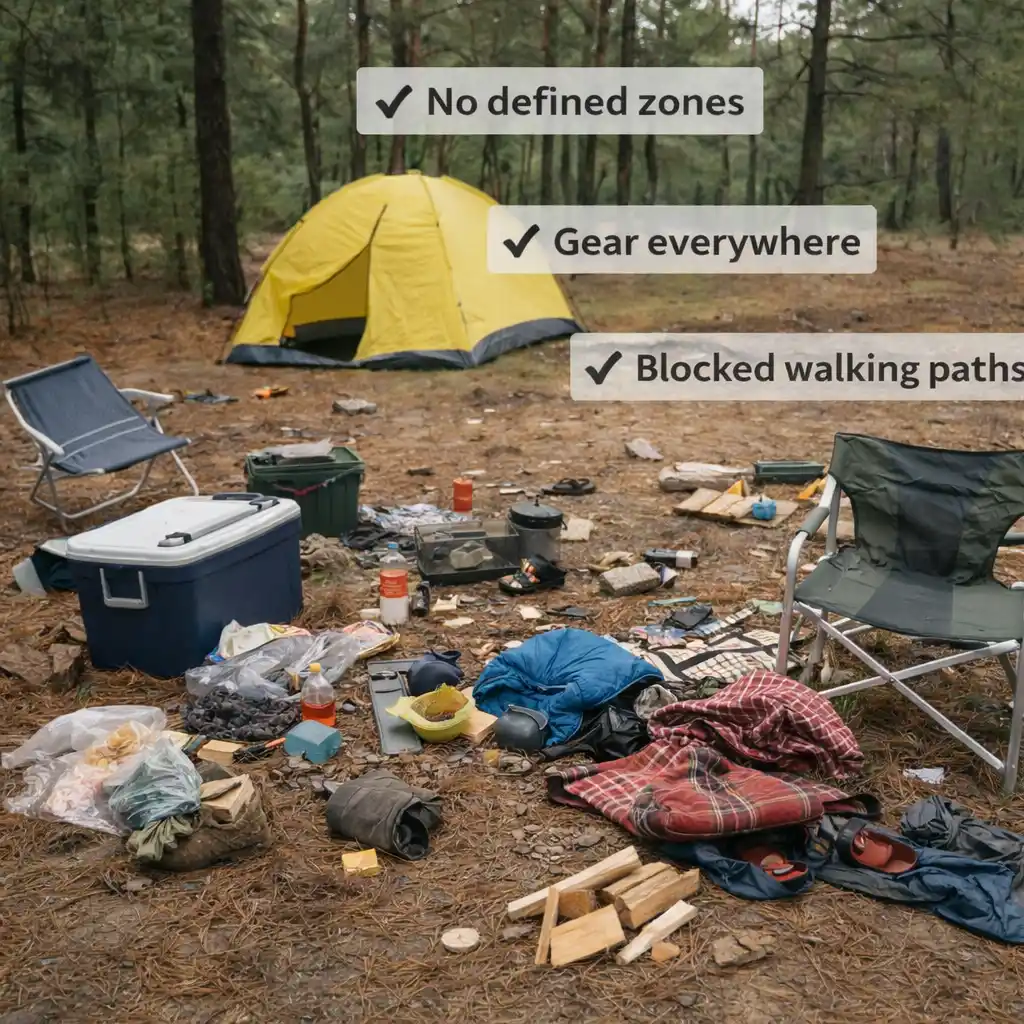
Most campsites don’t become messy because of too much gear.
They become messy because there’s no system behind the setup.
👉 What most campers get wrong:
- No defined zones → everything gets placed “where it fits”
- No clear layout → walking paths get blocked and clutter builds fast
- Gear without a designated place → items constantly move and get lost
- Mixing functions → cooking, relaxing, and storage all overlap
- No setup plan → decisions are made on the fly
This is why even a small amount of gear can feel overwhelming.
And it gets worse over time.
At first, your campsite looks fine.
But after a few hours:
- items start piling up
- surfaces get cluttered
- you can’t find what you need quickly
👉 The real problem isn’t organization.
It’s the lack of structure from the beginning.
Top-ranking guides usually suggest “keeping things tidy” or “using storage bins.”
But that doesn’t fix the root issue.
Without a layout and zone system, any campsite will eventually become chaotic — no matter how organized you try to be.
Real Campsite Problems (What Actually Goes Wrong)
Most campsite guides explain how things should work.
But real campsites don’t fail in theory — they fail in small, practical ways.
Here’s what actually happens in real conditions:
You unpack too early → and lose control of space immediately
Once gear hits the ground without structure, it spreads fast.
Your cooking area slowly expands
Food, trash, utensils — everything starts taking over nearby space.
“Temporary placement” becomes permanent clutter
You put something down “just for a minute” — and it stays there all day.
Shared spaces break down in group setups
Without clear zones, everyone starts placing gear wherever it’s convenient.
Weather makes everything worse
Rain, mud, or wind quickly turn a messy campsite into a stressful one.
👉 The key insight:
Campsites don’t become messy at once — they break down gradually.
And without a system, it’s almost impossible to recover once that process starts.
The Campsite Zoning System (How to Set Up a Functional Layout)
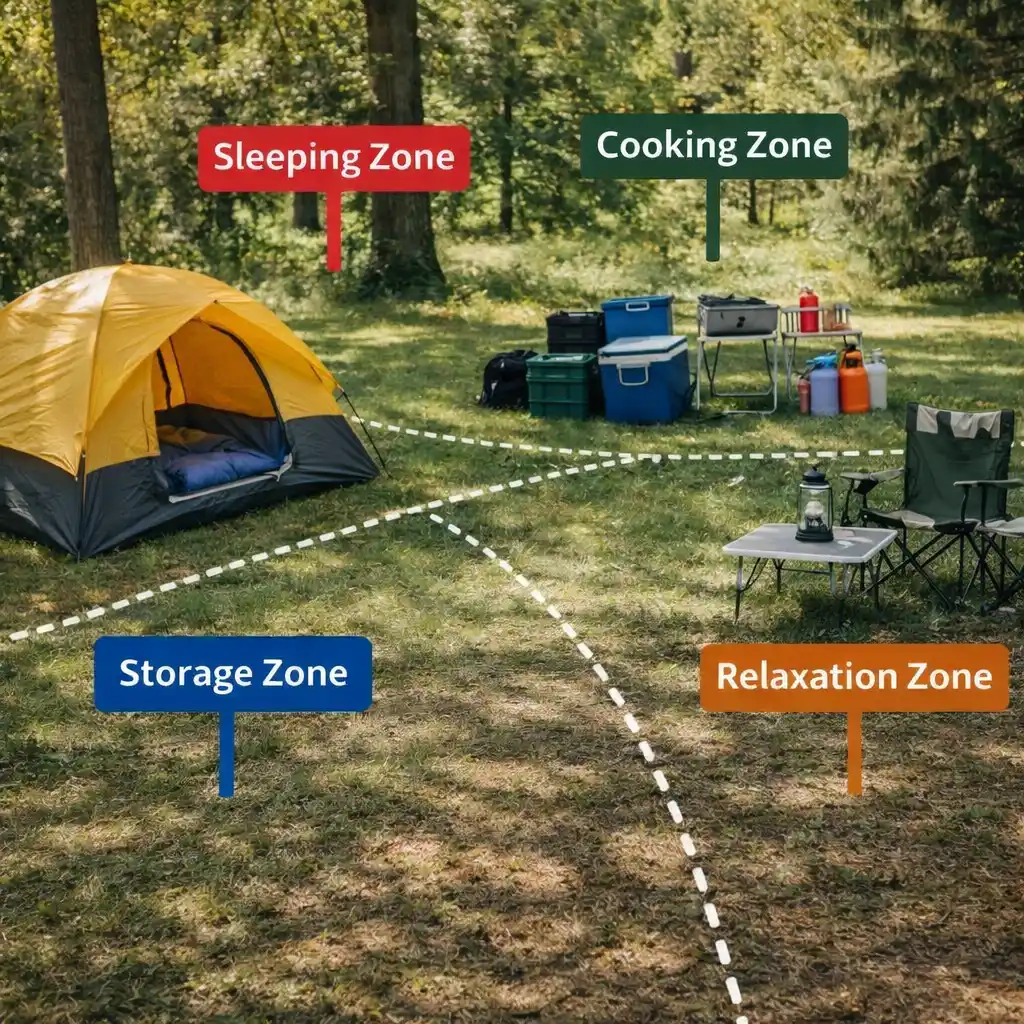
The easiest way to organize a campsite is to stop thinking in terms of gear — and start thinking in terms of zones.
A well-organized campsite works like a small living space, where each area has a clear purpose.
👉 This is what creates order, flow, and comfort.
1. Sleeping Zone (Your Base Area)
This is your most important space.
👉 It should be:
- quiet
- clean
- protected from wind and moisture
Place your tent on flat ground, slightly away from high-traffic areas.
Keep only essential items inside:
- sleeping gear
- headlamp
- personal items
A comfortable sleeping setup also depends on proper insulation and support (see 5 Best Camping Mattresses & Sleeping Mats for Car Camping in 2026).
👉 The goal: rest without disruption
2. Cooking Zone (Functional & Safe)
Your cooking area should be separate from your sleeping space.
👉 Set it up:
- on stable, level ground
- away from flammable materials
- with enough space for movement
Keep everything within reach:
- stove
- cookware
- food prep area
Having a reliable cooking setup makes this much easier (see 5 Best Camping Stoves for Car Camping in 2026).
👉 The goal: efficient and safe cooking without clutter
3. Storage Zone (Where Everything Has a Place)
This is where most campsites fail.
Without a dedicated storage area, gear spreads everywhere.
👉 Use:
- bins or containers
- a consistent spot for frequently used items
- vertical space if possible
If your setup feels chaotic, proper organization tools can make a huge difference (see 5 Best Camping Kitchen Organizers & Chuck Boxes in 2026).
Keep this zone central but out of the way.
👉 The goal: easy access without visual chaos
4. Relaxation Zone (Comfort & Space)
This is your “living area”.
👉 Set it up:
- near your tent, but not blocking movement
- with chairs, table, and lighting
- with enough open space to move freely
Comfortable seating plays a big role in how usable this space feels (see 5 Best Camping Chairs for Bad Backs in 2026).
👉 The goal: a place to sit, eat, and unwind
How to Arrange the Zones (Flow Matters)
The key is not just having zones — but how they connect.
👉 A simple layout that works:
- sleeping zone → slightly separated
- cooking zone → downwind if possible
- storage zone → central access
- relaxation zone → open and accessible
Avoid crossing paths between zones unnecessarily.
👉 The key takeaway:
An organized campsite isn’t about having less gear — it’s about giving everything a clear place within a system.
Campsite Layout Examples (How to Set It Up in Real Life)
Understanding zones is one thing.
Actually setting them up in real conditions is where most campers struggle.
Here are simple campsite layout examples you can use depending on your setup:
Small Campsite (Minimal Space Setup)
When space is limited, organization becomes even more important.
👉 Layout approach:
- Sleeping zone → tent at the back or edge of the site
- Cooking zone → compact setup near one side
- Storage zone → centralized (bins, cooler, gear)
- Relaxation zone → small seating area near the tent
👉 Key idea:
Keep everything tight, but clearly separated.
Avoid spreading gear — that’s what creates clutter fast.
Standard Campsite (Balanced Setup)
This is the most common scenario.
👉 Layout approach:
- Sleeping zone → slightly separated, quieter area
- Cooking zone → near a table or flat surface
- Storage zone → between cooking and relaxation
- Relaxation zone → open space with chairs and table
👉 Key idea:
Create flow between zones without overlap.
You should be able to move naturally:
sleep → cook → relax → access gear
Car Camping Setup (Extended Comfort)
With a vehicle, you get more flexibility — and more chances to create chaos if you’re not organized.
👉 Layout approach:
- Sleeping zone → tent or car sleeping setup near the vehicle
- Storage zone → trunk or organized bins in/around the car
- Cooking zone → side of the vehicle (easy access to gear)
- Relaxation zone → open space facing away from the car
👉 Key idea:
Use your vehicle as a storage hub, not a dumping area.
Group Campsite (Multiple People)
More people = more complexity.
👉 Layout approach:
- Sleeping zone → separate tents grouped together
- Cooking zone → shared central area
- Storage zone → organized per person or shared bins
- Relaxation zone → large open space for everyone
👉 Key idea:
Define boundaries early — or chaos builds fast.
👉 The key takeaway:
There’s no perfect layout — but every good campsite follows the same principle: clear zones, logical flow, and no overlap.
👉 Pro tip:
Always leave buffer space between zones.
Most campers place zones too close together — which leads to overlap, clutter, and constant adjustments.
Even an extra 1–2 feet between zones can dramatically improve how your campsite feels and functions.
Organized vs Disorganized Campsite (Why It Matters)
At first glance, campsite organization might seem like a small detail.
But the difference between an organized and disorganized setup affects everything — from comfort to safety.
Here’s how they compare in real conditions:
❌ Disorganized campsite:
– gear scattered across the ground
– no clear cooking or storage space
– constant searching for items
– higher risk of accidents and damage
– frustration builds throughout the trip
✅ Organized campsite:
– clear zones for each activity
– easy access to essential gear
– smooth movement between areas
– safer cooking and storage setup
– more time to relax and enjoy the experience
👉 The key difference isn’t effort.
It’s structure.
An organized campsite removes friction — and that’s what makes the biggest impact on your overall experience.
Common Campsite Organization Mistakes
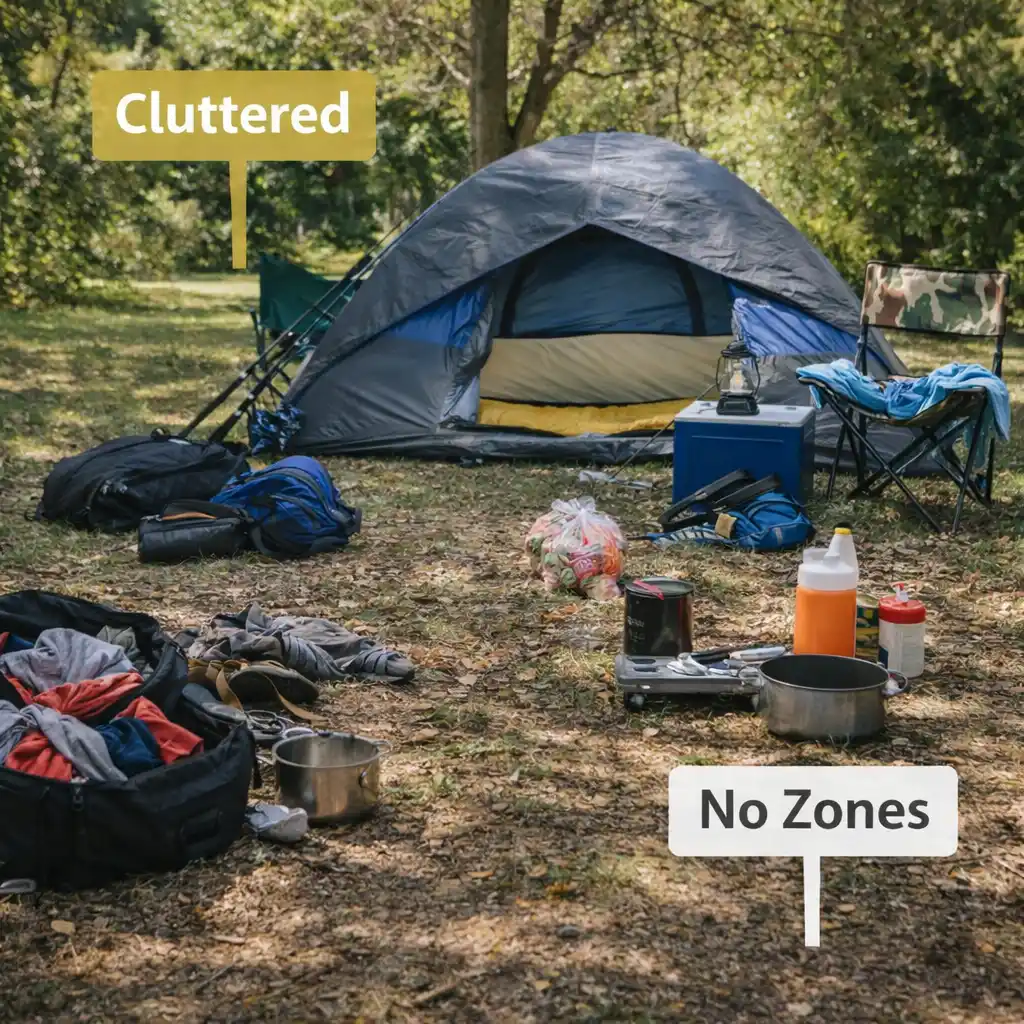
Even with the right gear, many campsites still end up messy and inefficient.
Why?
Because small mistakes break the entire setup.
Here are the most common ones:
Setting up without a plan
Most people arrive and start unpacking randomly.
👉 What happens:
- gear gets scattered
- no clear layout forms
- everything feels disorganized from the start
Fix:
Take 2–3 minutes to plan your zones before unloading anything.
Mixing all zones together
Cooking, sleeping, storage — all in one space.
👉 What happens:
- clutter builds quickly
- movement becomes awkward
- important items get buried
Fix:
Keep each function separate. Even small spacing makes a big difference.
Letting gear pile up
Without a dedicated place, items start stacking everywhere.
👉 What happens:
- you can’t find things
- surfaces become unusable
- the campsite feels chaotic
Fix:
Give every item a “home” — even temporary.
Blocking natural movement paths
Poor layout creates friction.
👉 What happens:
- you walk around gear constantly
- you trip over items
- everything feels inconvenient
Fix:
Leave open space between zones and think about how you move through the site.
Overcomplicating the setup
Too many items = too much management.
👉 What happens:
- setup takes longer
- organization breaks down faster
- more things get in the way
Fix:
Bring what you need — not everything you own.
Ignoring cleanup during the trip
Even a good setup falls apart without maintenance.
👉 What happens:
- clutter builds over time
- organization disappears
- the campsite becomes stressful
Fix:
Reset your space regularly — especially after cooking or activity.
👉 The key takeaway:
A campsite doesn’t become messy all at once — it breaks down step by step through small mistakes.
Fix those, and everything else becomes easier.
🛠️ 1-Minute Fix:
If your campsite already feels messy, don’t try to reorganize everything.
Start with just one thing:
👉 Clear a single zone (usually the storage area) and reset it completely.
Once one zone works, the rest becomes much easier to fix.
A full setup checklist can also help prevent these issues from the start (see Car Camping Essentials Checklist: The Ultimate Guide for Families (2026)).
Practical Setup Tips for an Organized Campsite
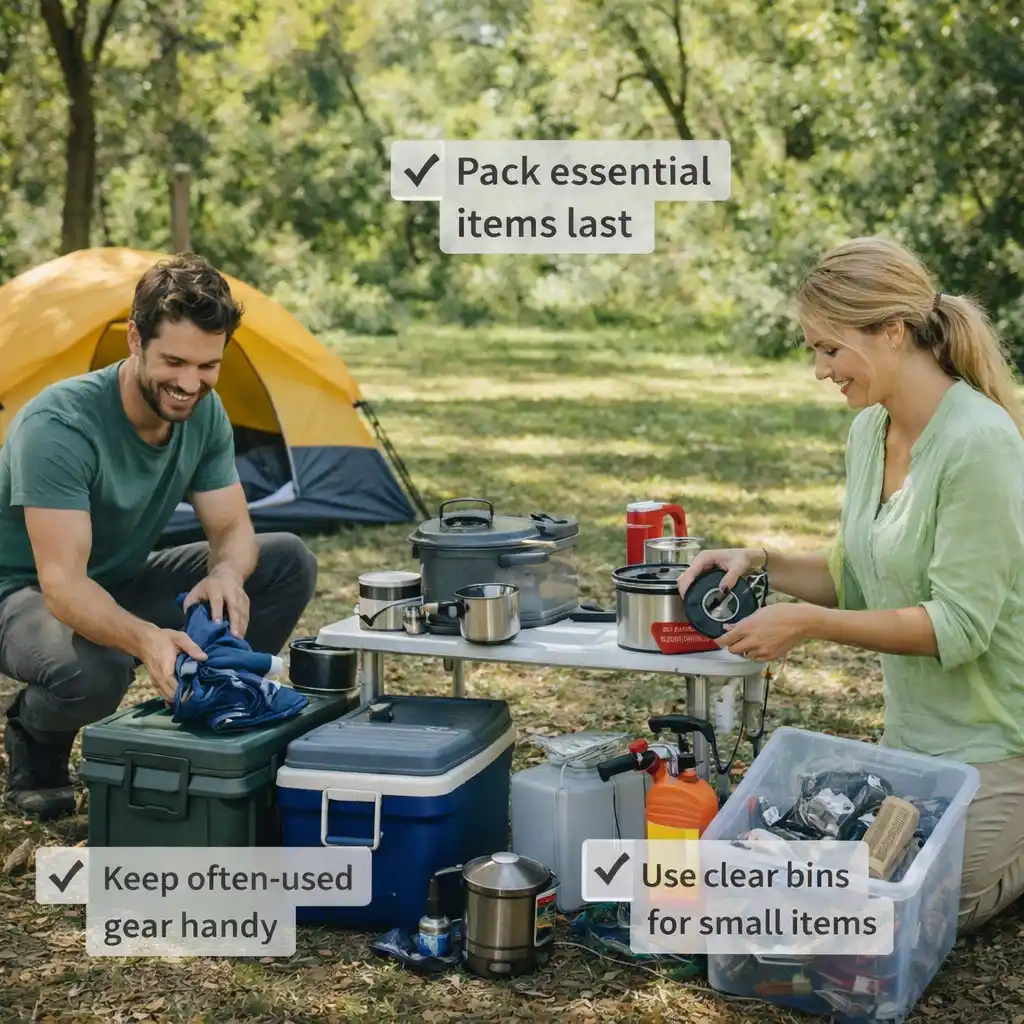
Once your zones are set, small details make a big difference.
These simple tips help keep your campsite clean, efficient, and easy to manage:
Set up in the right order
Don’t unpack everything at once.
👉 Follow this sequence:
- Sleeping zone (tent first)
- Storage zone (bins, gear placement)
- Cooking zone (stove, food area)
- Relaxation zone (chairs, table)
👉 This prevents chaos from the start.
Keep frequently used items accessible
Some items get used constantly.
👉 Keep them within easy reach:
- headlamp
- water
- snacks
- multitool
👉 The goal: less searching, more flow
Use containers and grouping
Loose gear creates clutter fast.
👉 Group items by function:
- cooking gear
- food supplies
- personal items
👉 Even simple bins make a huge difference.
Create a “drop zone”
This is a small area for quick-use items.
👉 Use it for:
- keys
- phones
- small gear
- daily essentials
👉 This prevents items from getting lost.
Keep the ground clear
Visual clutter starts at ground level.
👉 Avoid:
- loose gear on the ground
- random placement
👉 A clean ground = a clean-looking campsite
Reset your campsite regularly
Even the best setup breaks down over time.
👉 Do quick resets:
- after cooking
- before sleep
- in the morning
👉 This keeps your system working.
Think in terms of flow, not perfection
Your campsite doesn’t need to look perfect.
👉 It needs to work.
Focus on:
- easy movement
- clear access
- simple organization
👉 The key takeaway:
A well-organized campsite isn’t about effort — it’s about small systems that work together.
Small Adjustments That Make a Big Difference
Once your campsite is set up, small changes can dramatically improve comfort and organization:
Face your tent entrance toward your main zone
This reduces unnecessary movement.
Keep your cooking area slightly downwind
Prevents smoke and odors from spreading.
Use natural boundaries (trees, rocks)
They help define zones without extra effort.
Keep lighting centralized, not scattered
Improves visibility and reduces clutter.
Minimize “dead space”
Empty, unused areas often turn into clutter zones.
👉 These small adjustments are what separate an average campsite from a highly functional one.
Campsite Organization Checklist (Quick Setup Guide)
Use this quick checklist to keep your campsite organized from the start:
✔ Choose flat, dry ground
✔ Set up your tent first
✔ Define sleeping, cooking, storage, and relaxation zones
✔ Keep gear grouped by function
✔ Use bins or designated storage areas
✔ Keep frequently used items accessible
✔ Leave clear walking paths
✔ Avoid placing gear directly on the ground
✔ Reset your campsite daily
👉 This simple checklist helps you stay organized without overthinking your setup.
Campsite Organization FAQ (What People Actually Ask)
❓ How do you organize a campsite efficiently?
The most efficient way to organize a campsite is to divide it into zones — sleeping, cooking, storage, and relaxation — and assign every item a specific place.
This prevents clutter, improves movement, and makes daily tasks faster and easier.
❓ What is the best campsite layout?
The best campsite layout separates key functions while keeping everything accessible.
A simple structure:
- sleeping area slightly separated
- cooking area on stable ground
- storage in a central location
- relaxation area open and uncluttered
This creates flow without overlap.
❓ How do I keep my campsite from getting messy?
Campsites get messy when there’s no system.
To prevent this:
- assign a place for every item
- avoid leaving gear on the ground
- reset your setup regularly
Small habits prevent clutter from building up.
❓ Where should you place your tent in a campsite?
Place your tent on flat, dry ground away from high-traffic areas.
Avoid:
- low spots where water collects
- areas too close to cooking zones
- uneven or rocky surfaces
This improves both comfort and organization.
❓ How do you organize camping gear without bins?
You can stay organized without bins by grouping items and assigning fixed locations.
For example:
- cooking gear in one area
- personal items in another
- frequently used items kept accessible
The key is consistency, not containers.
❓ What are the most common campsite setup mistakes?
The biggest mistakes include:
- setting up without a plan
- mixing all zones together
- letting gear pile up
- blocking movement paths
These small issues quickly turn into major clutter.
❓ How do you organize a small campsite?
In small spaces, organization matters more.
Keep zones compact but separate, and avoid spreading gear.
Focus on:
- minimal items
- clear layout
- efficient use of space
❓ How can I make my campsite more comfortable?
Comfort comes from layout, not just gear.
A well-organized campsite:
- reduces stress
- improves movement
- makes daily tasks easier
Even simple changes in setup can make a big difference.
❓ Why does my campsite always feel cluttered?
Because there’s no defined structure.
Without zones and assigned spaces, gear naturally spreads and overlaps.
Clutter isn’t about having too much — it’s about lacking organization.
Final Verdict: What Actually Makes a Campsite Work
If you know how to organize a campsite properly, everything becomes easier — from cooking to relaxing.
Most campers think organization is about keeping things neat.
It’s not.
A well-organized campsite is about creating a system that makes everything easier to use.
You can have the best gear and still feel frustrated if:
- nothing has a clear place
- zones overlap
- movement feels awkward
- you constantly search for items
And at the same time, even a simple setup can feel comfortable and efficient when everything is structured properly.
👉 The key principles are simple:
- Divide your campsite into clear zones
- Give every item a specific place
- Keep movement paths open and natural
- Reset your setup regularly
If you take one thing from this guide, it’s this:
A campsite doesn’t become organized by accident — it works because it’s designed that way.
Camping becomes more enjoyable when your setup supports you instead of slowing you down.
According to Leave No Trace Center for Outdoor Ethics, organizing your campsite properly helps reduce environmental impact and keeps outdoor spaces safe for everyone.
You spend less time searching, adjusting, and fixing things — and more time actually relaxing.
👉 Final takeaway:
If you want to organize a campsite efficiently, don’t focus on gear — focus on structure.
Once your layout works, everything else becomes easier.
That’s what turns camping from frustrating to effortless.