
Portable induction cooktops can make camping meals feel much closer to cooking at home — but only when your campsite has enough electrical power to support them. Unlike propane burners, induction cooktops need a reliable 120V power source, such as an RV hookup, campground outlet, generator, or a properly sized battery-and-inverter system.
For RV and powered car camping, that tradeoff can be worthwhile. Induction gives you fast, precise heat without an open flame, while the compact countertop design makes it easy to store when the cooking is finished. The bigger question is not simply which cooktop has the highest wattage — it is which model fits your available power, cookware, cooking style, and campsite setup.
In this guide, we compare five portable induction cooktops for camping that cover different needs, from the versatile Duxtop 8100MC to lower-power options for limited electrical circuits and a two-burner model for campers who want to prepare multiple dishes at once.
Table of Contents
Quick Answer
The best portable induction cooktop for camping depends primarily on how much electrical power you have available and how you plan to cook.
- Best Overall: Duxtop 8100MC — A well-balanced 1800W single-burner cooktop for RVs and powered car-camping setups.
- Best for Limited Power: NuWave Flex Precision Induction Cooktop — Its 600W, 900W, and 1400W settings make it easier to work with lower-power electrical systems.
- Best for Precise Control: Duxtop 9600LS — Offers 20 power levels and 20 temperature settings for campers who want finer control over cooking.
- Best Value: Secura 9100MC — A straightforward 1800W option that delivers the core benefits of induction without the extra features of more advanced models.
- Best for Two-Burner Cooking: Duxtop 9620LS Double — Provides two cooking zones while sharing a maximum of 1800W, making it useful when you need to cook multiple dishes at once.
The key point: portable induction is best suited to powered campsites, RV hookups, generators, or adequately sized battery-and-inverter systems. If you regularly camp without reliable AC power, a propane stove remains the more practical primary cooking solution.
Why You Can Trust This Guide
Choosing an induction cooktop for camping is different from choosing one for a home kitchen. A model that looks excellent on a countertop may be a poor fit for an RV electrical system, campground hookup, generator, or portable power station.
For this guide, we focused on the factors that matter most outdoors: power requirements, adjustable wattage, cooking control, portability, electrical compatibility, and practical RV and car-camping use. We also compared single-burner and two-burner designs so the recommendations cover different camping setups rather than simply ranking five similar cooktops.
The five models were selected from established portable induction cooktops that fit the camping and RV use case. Their specifications, including power output, dimensions, controls, temperature ranges, and electrical requirements, were checked against manufacturer and product documentation before making the recommendations.
We do not present these models as personally tested in every camping environment. Our recommendations are based on verified specifications, documented features, manufacturer information, and camping-specific decision factors.
Most importantly, we did not treat maximum wattage as the deciding factor. The best induction cooktop for camping is the one that matches the power available at your campsite and the way you actually cook.
How We Selected the Best Portable Induction Cooktops for Camping
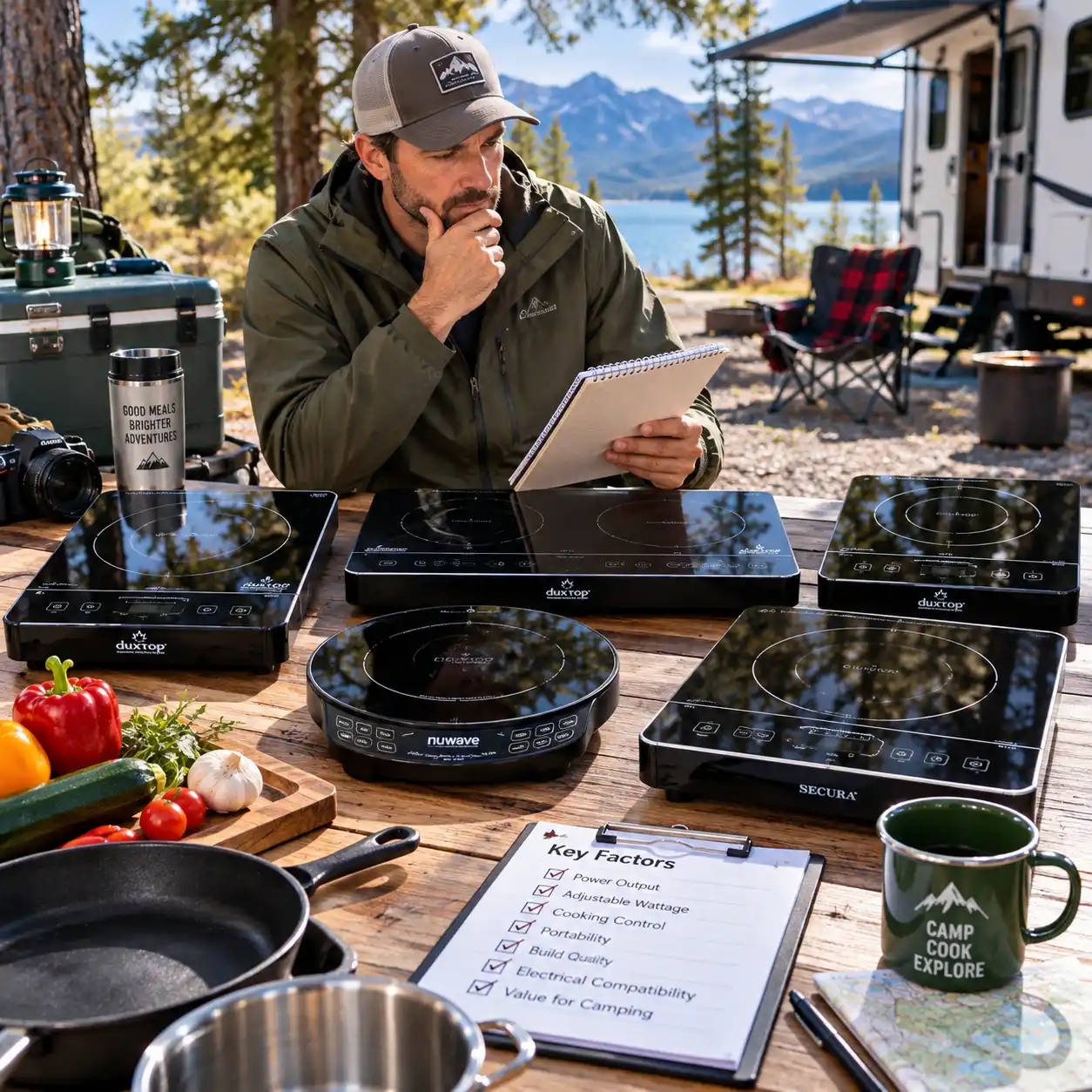
We selected these portable induction cooktops based on the factors that matter most when cooking at a campsite, RV, or powered car-camping setup. Rather than ranking models by wattage alone, we looked at how each cooktop fits into a real camping kitchen.
Our evaluation focused on electrical requirements, adjustable power, cooking control, portability, cooking capacity, and overall value. We also considered how practical each model is for different camping situations, including standard RV hookups, powered campsites, generators, and battery-and-inverter systems.
Power availability received particular attention because an 1800W induction cooktop can place a significant load on a 120V electrical system. Models with lower power settings can therefore be more useful when electrical capacity is limited, while two-burner designs can make sense for campers who regularly prepare multiple dishes at once.
We also checked cookware compatibility, physical dimensions, controls, temperature and power settings, and manufacturer specifications to distinguish meaningful differences between otherwise similar portable cooktops.
The result is a five-model lineup where each recommendation has a specific purpose — from the best all-around option to the best choice for limited power, precise cooking, value, and two-burner meal preparation.
Who Is This Guide For?
This guide is designed for campers who have reliable access to 120V AC power and want a compact cooking solution without relying on an open flame.
It is particularly useful for:
- RV campers using campground or RV electrical hookups.
- Car campers staying at powered campsites.
- Campers using a generator with enough continuous output.
- Campers with a portable power station and inverter system capable of supplying the required AC power.
- Anyone who wants more precise, controlled cooking for meals such as pasta, sauces, eggs, rice, vegetables, or one-pan dishes.
It is not intended for completely off-grid campers who have no suitable AC power source. Portable induction cooktops in this category are not 12V appliances, so they cannot simply be connected directly to a typical vehicle battery or 12V outlet.
If your camping setup already includes dependable AC power, induction can be an excellent alternative to a traditional propane burner. The five models below are chosen to cover different power limitations, cooking requirements, and camping setups.
What Makes a Good Portable Induction Cooktop for Camping?
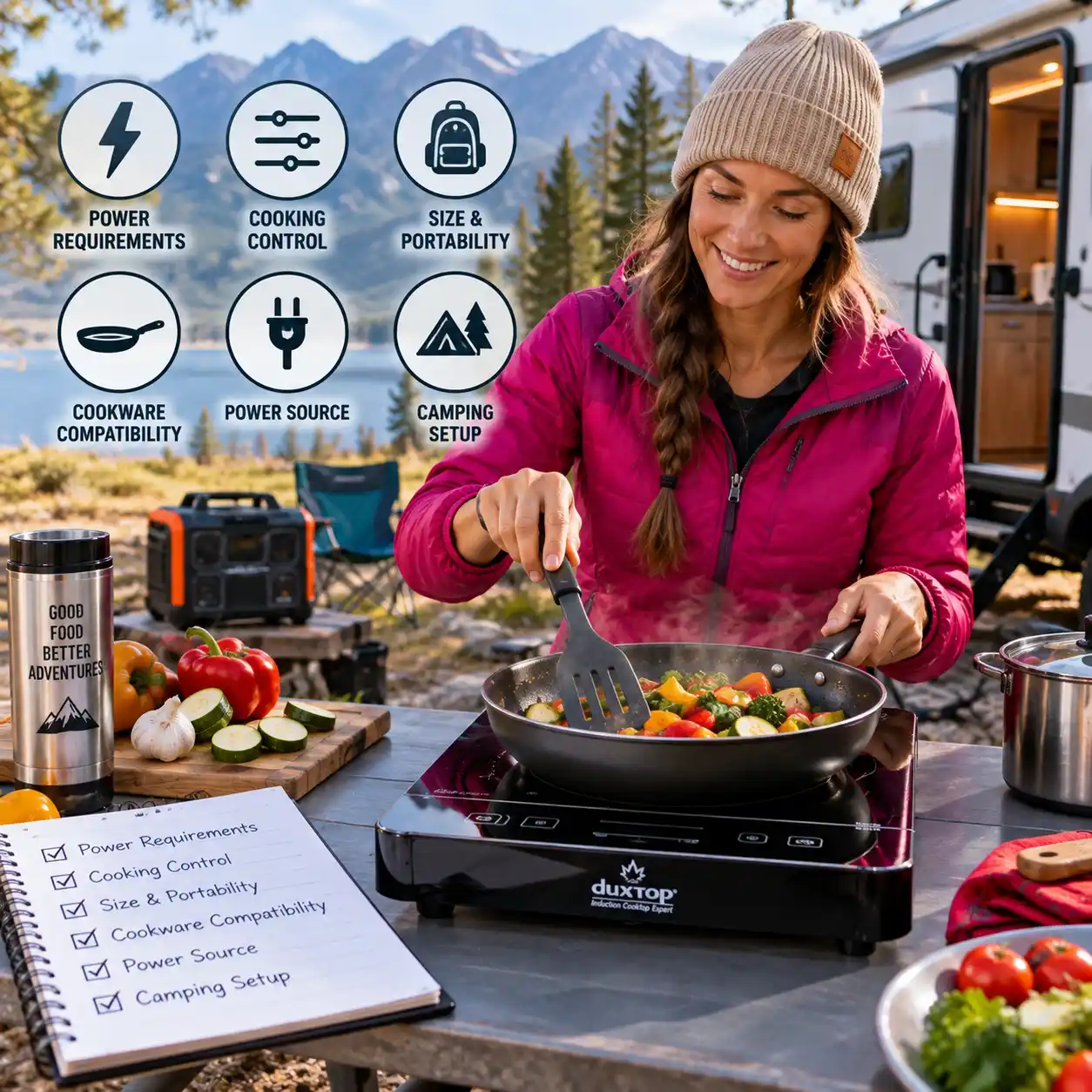
When choosing a portable induction cooktop for camping, maximum wattage is only part of the equation. The right model needs to work with the electrical system you actually have at the campsite while remaining practical to transport, store, and use outdoors.
Power Requirements
Most portable induction cooktops in this guide operate from a standard 120V AC supply. An 1800W model can place a substantial load on a campground circuit, generator, or inverter system, so available electrical capacity matters before you choose a high-powered cooktop.
For lower-power electrical setups, adjustable wattage can be especially useful. A cooktop that can operate at reduced power gives you more flexibility when sharing a limited circuit with other appliances.
Cooking Control
Induction cooktops vary considerably in how precisely you can adjust heat. Basic models may provide straightforward power settings, while more advanced units offer numerous power levels and temperature settings.
For camping, precise control is useful when cooking foods that need gentle, consistent heat rather than simply boiling water or heating a pan quickly.
Size and Portability
A camping cooktop should be compact enough to transport and store without becoming another bulky piece of kitchen equipment. Single-burner models are generally the easiest to pack, while double-burner designs provide more cooking capacity at the cost of significantly more countertop and storage space.
Cookware Compatibility
Induction cooking requires magnetic cookware. Your favorite camping pots and pans may not automatically work with an induction burner.
A simple magnet test is a practical way to check compatibility: if a magnet attaches firmly to the bottom of the cookware, it is generally suitable for induction cooking.
Power Source and Camping Setup
Before buying, consider where the electricity will come from:
- RV or campground hookup: An excellent match for a 120V portable induction cooktop.
- Generator: Works when the generator can continuously provide the cooktop’s required load.
- Portable power station: Requires an AC inverter capable of handling the cooktop’s power demand.
- Unpowered campsite: A portable induction cooktop is generally not the right primary cooking option unless you bring an appropriately sized battery-and-inverter system.
This last point is particularly important: portable induction cooktops are not 12V appliances. They need AC power, so an off-grid setup must be designed around the cooktop’s electrical requirements rather than simply plugging it into a vehicle outlet.
Quick Summary: Our Top Portable Induction Cooktop Picks
If you do not have time to read the full guide, the five picks below give you the shortest path to the right portable induction cooktop for your camping setup.
There is no single model that is best for every camper. An 1800W single-burner cooktop may be the better choice for a typical RV or powered campsite, while a lower-power model can make more sense when you are working with a limited electrical circuit. Campers who want finer cooking control may prefer a more advanced model, while a two-burner cooktop can be more useful when preparing multiple dishes at the same time.
Our picks are therefore based on different camping needs, not simply a ranking from first to fifth.
Duxtop 8100MC
Award: Best Overall
Why It Won:
The Duxtop 8100MC offers a strong combination of 1800W cooking power, compact single-burner design, and straightforward operation. It is a particularly well-balanced choice for campers who have dependable 120V power and want one induction cooktop that can handle everyday campsite cooking without unnecessary complexity.
Choose This If:
- You want one induction cooktop for most powered camping situations.
- You regularly camp with RV hookups or at powered campsites.
- You want full 1800W capability in a relatively compact package.
- You prefer a simple single-burner design for everyday meals.
Best For:
- RV camping
- Powered car camping
- Couples and small groups
- Campers who want the best all-around option
NuWave Flex Precision Induction Cooktop
Award: Best for Limited Power
Why It Won:
The NuWave Flex stands out because it gives campers more flexibility when electrical capacity is limited. Its 600W, 900W, and 1400W power settings allow you to reduce the electrical load rather than being locked into the higher consumption of a typical 1800W cooktop.
Choose This If:
- Your campsite or RV electrical system has limited available power.
- You want the option to cook at 600W or 900W when necessary.
- You use a generator or battery-and-inverter system with tighter power limits.
- You want a compact cooktop that is easier to accommodate in a constrained electrical setup.
Best For:
- Limited-power RV setups
- Generator camping
- Battery-and-inverter systems
- Campers who need adjustable power
Duxtop 9600LS
Award: Best for Precise Control
Why It Won:
The Duxtop 9600LS is the choice for campers who care more about fine heat adjustment than simply having maximum output. With 20 power levels and 20 temperature settings, it gives you considerably more control when moving between simmering, gentle cooking, and higher-heat tasks.
Choose This If:
- You want finer control over cooking temperature.
- You regularly prepare meals that require careful heat adjustment.
- You prefer touch controls and a more advanced interface.
- You want an 1800W cooktop with more control options than a basic model.
Best For:
- RV kitchens
- Detailed campsite cooking
- Campers who cook sauces, eggs, rice, and other heat-sensitive foods
- Users who prioritize control over simplicity
Secura 9100MC
Award: Best Value
Why It Won:
The Secura 9100MC provides the core capabilities of a full-size portable induction burner without pushing you toward the more feature-heavy models. Its 200–1800W output, 15 power settings, and 15 temperature settings make it a capable choice for campers who want strong everyday performance while keeping the purchase focused on the essentials.
Choose This If:
- You want a capable 1800W induction cooktop without paying for advanced features.
- You prefer straightforward controls and a conventional single-burner format.
- You want a practical option for RV or powered campsite cooking.
- Value matters more to you than having the most sophisticated control system.
Best For:
- Budget-conscious campers
- RV camping
- Powered car camping
- Buyers looking for a practical 1800W alternative
Duxtop 9620LS Double
Award: Best for Two-Burner Cooking
Why It Won:
The Duxtop 9620LS Double is the specialist option for campers who need two cooking zones in one unit. It provides substantially more cooking flexibility than a single burner, although its two zones share a maximum of 1800W total power rather than providing 1800W to each burner independently.
Choose This If:
- You regularly prepare two dishes at the same time.
- You have enough countertop and storage space for a larger cooktop.
- You want two induction cooking zones without carrying two separate appliances.
- You understand that the available power is dynamically shared between the burners.
Best For:
- Larger RV kitchens
- Family camping
- Multi-dish meal preparation
- Campers who prioritize cooking capacity over minimum size
The Short Version
If you only remember five things from this section:
Duxtop 8100MC is the safest all-around choice for most powered campers.
NuWave Flex is the specialist choice when electrical power is limited and adjustable wattage matters.
Duxtop 9600LS is the better choice when precise cooking control is a priority.
Secura 9100MC is the value option for campers who want capable 1800W performance without paying primarily for premium controls.
Duxtop 9620LS Double is the right choice when two cooking zones are more important than minimum size and weight.
Portable Induction Cooktops for Camping: Quick Comparison
Choosing among the best portable induction cooktops for camping comes down to more than maximum wattage. The table below compares the five selected models by power, cooking zones, dimensions, controls, and their strongest camping use case, making it easier to match a cooktop to your RV, car-camping, or limited-power setup.
| Portable Induction Cooktop | Award | Power | Cooking Zones | Dimensions | Controls | Best For |
|---|---|---|---|---|---|---|
| Duxtop 8100MC | Best Overall | 1800W | 1 | 11.5 × 13 × 2.5 in | Push button | RV & powered car camping |
| NuWave Flex Precision | Best for Limited Power | 1400W | 1 | 10 × 12 × 2 in | Touch | Limited electrical power |
| Duxtop 9600LS | Best for Precise Control | 1800W | 1 | 11.4 × 14 × 2.5 in | Touch | Precise campsite cooking |
| Secura 9100MC | Best Value | 200–1800W | 1 | 11.4 × 14 × 2.5 in | Digital controls | Budget-conscious campers |
| Duxtop 9620LS Double | Best for Two-Burner Cooking | 1800W total | 2 | 23.9 × 14.2 × 2.4 in | Touch | Multi-dish cooking |
Important: The 1800W rating of the Duxtop 9620LS Double is its maximum combined output. The two cooking zones share available power, so it should not be treated as a 3600W two-burner cooktop.
Best Portable Induction Cooktops for Camping
The five portable induction cooktops below are not interchangeable, even though several of them share the same 1800W maximum output. Their differences become much more important once you consider available electrical power, cooking control, countertop space, and the way you prepare meals at camp.
We have deliberately given each model a distinct role. The Duxtop 8100MC is the balanced choice for everyday powered camping, while the NuWave Flex is better suited to situations where electrical capacity is more limited. The Duxtop 9600LS focuses on precise adjustment, the Secura 9100MC keeps the feature set practical and value-oriented, and the Duxtop 9620LS Double is designed for campers who need two cooking zones.
The detailed reviews below explain not only what each cooktop offers, but why that particular model earned its place in this lineup.
1. Duxtop 8100MC — Best Overall
Best Overall
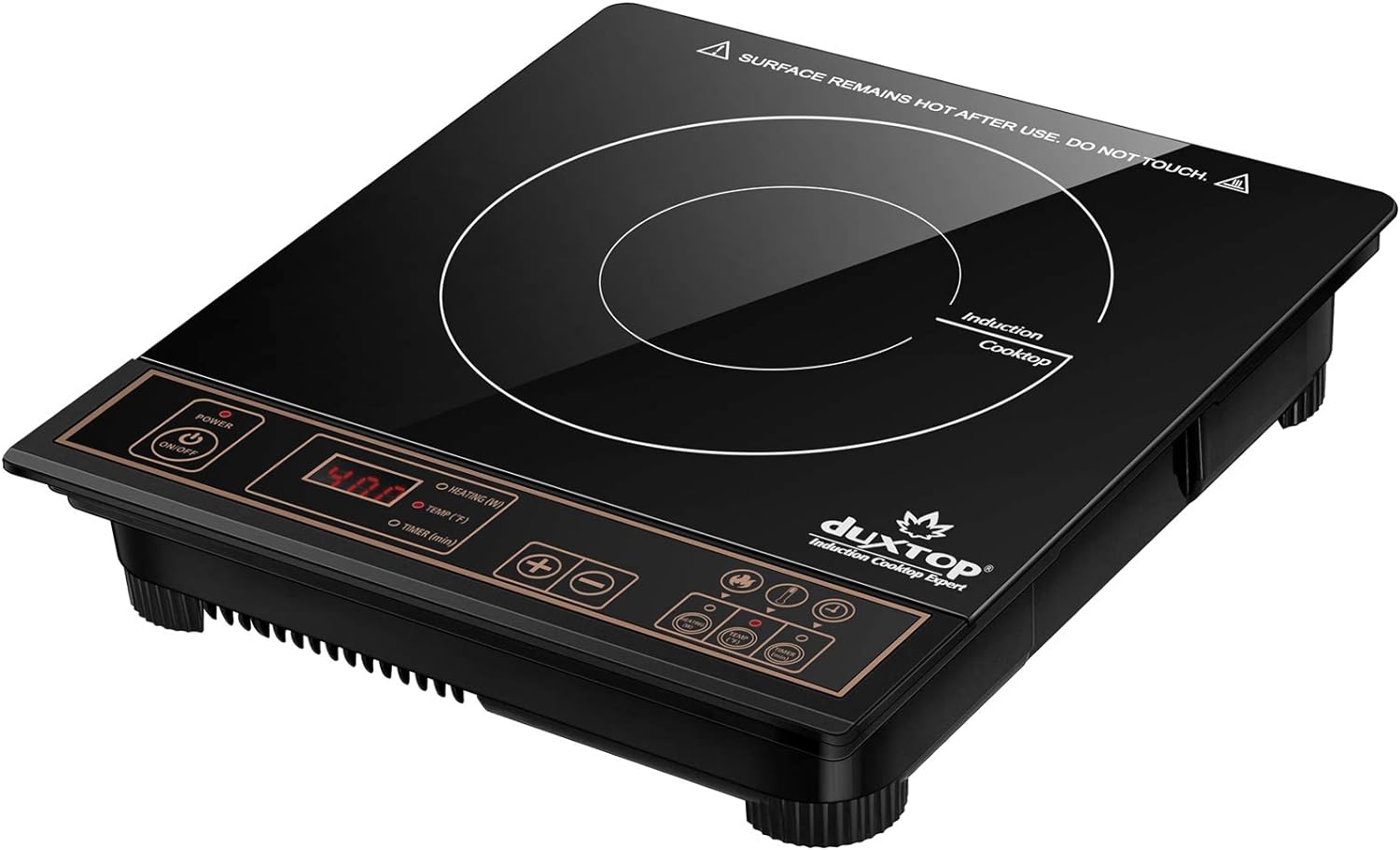
The Duxtop 8100MC is our Best Overall choice because it delivers the combination that matters most for typical powered camping: full 1800W output, a compact single-burner format, and straightforward operation.
At 11.5 × 13 × 2.5 inches, it is small enough to fit naturally into an RV kitchen or car-camping cooking setup without taking over the available workspace. Its 120V electrical requirement also matches the type of AC power available at many powered campsites and RV hookups.
Quick Verdict
The Duxtop 8100MC is the most balanced choice in this lineup for campers who want a conventional portable induction cooktop for everyday meals. Its 1800W output gives it the cooking capacity expected from a full-power countertop burner, while its relatively compact footprint keeps it practical for RV and car-camping kitchens.
The reason it earns our Best Overall award is not simply the 1800W rating. It is the combination of useful cooking power, compact dimensions, a single-burner design, and simple controls. For a camper with dependable 120V AC power, there is little reason to choose a more specialized model unless a specific requirement—such as limited electrical capacity, finer temperature control, or two-burner cooking—matters more.
The main limitation is also straightforward: the 8100MC is an AC-powered cooking appliance, not an off-grid 12V solution. Campers using a battery-and-inverter system need to make sure that system can supply the cooktop’s electrical demand before relying on it as their primary cooking surface.
Camp Snapshot
| Category | Duxtop 8100MC |
|---|---|
| Camping Style | RV Camping • Powered Car Camping • Campsite Cooking |
| Cooktop Type | Portable Induction Cooktop |
| Power Output | 1800W |
| Voltage | 120V |
| Cooking Zones | 1 |
| Dimensions | 11.5" × 13" × 2.5" |
| Controls | Push Button |
| Material | Glass |
| Primary Strength | Balanced power, portability, and straightforward operation |
| CampComfortGuide Verdict | Best Overall |
Why We Chose It
The 8100MC wins because it occupies the mainstream camping use case unusually well.
There are situations where a different cooktop makes more sense. The NuWave Flex is more appropriate when reducing electrical consumption is a priority. The Duxtop 9600LS is aimed at campers who want more detailed cooking control. The 9620LS Double makes sense when two cooking zones are worth the additional size. But none of those specialized advantages are automatically more useful than having a simple, capable 1800W burner.
That distinction matters when choosing equipment for a camping kitchen. A cooktop does not need to offer every possible feature to be useful. For many RV and powered car-camping setups, the priority is having one dependable cooking surface that provides enough power without demanding excessive storage space.
The 8100MC fits that role well. Its 11.5 × 13-inch footprint gives you a usable cooking surface while keeping the appliance relatively easy to pack alongside other kitchen equipment. At only 2.5 inches high, it is also a low-profile piece of gear rather than another bulky appliance competing for storage space.
The 1800W maximum output is particularly useful when you have adequate AC power available. It gives the 8100MC the capacity to handle the normal range of campsite cooking tasks without positioning the model as a deliberately low-power alternative. That makes it a natural fit for campers whose electrical setup is already designed around conventional 120V appliances.
The simplicity of the controls is another part of the appeal. The 8100MC uses push-button controls, rather than making the cooking experience dependent on a more elaborate touch interface. For a product that may be unpacked, used outdoors, cleaned, and stored repeatedly, that straightforward approach has practical value.
Most importantly, the 8100MC does not require you to organize your entire cooking system around one particular feature. It is not trying to be the smallest cooktop, the most sophisticated cooktop, or a two-burner replacement. It is simply a compact 1800W induction burner designed to handle everyday cooking, which is exactly what makes it our strongest all-around recommendation.
Check today’s price and latest customer reviews on Amazon.

Living With It at Camp
The 8100MC makes the most sense once you stop looking at it as a countertop appliance and consider how it fits into the rest of a camping kitchen.
For an RV camper with a 120V hookup, the setup is straightforward. The cooktop can take the place of a traditional indoor-style burner for breakfast, lunch, or dinner, while the relatively shallow profile makes it easier to put away when the cooking is finished. That is useful in an RV or compact camp kitchen where the same countertop often has to serve several purposes throughout the day.
For car campers at a powered campsite, the equation is similar, although storage becomes more important. At 11.5 × 13 × 2.5 inches, the 8100MC does not require a dedicated cooking station or a large storage compartment. It can travel with the rest of your kitchen equipment and come out when you have access to a suitable AC outlet.
There is also a practical difference between using induction and managing a conventional flame-based stove. The induction surface does not produce an open flame, and there is no propane burner to position or regulate. Heat is delivered through compatible cookware, which makes the cooking process feel more like using a compact indoor cooktop than a traditional camping stove.
The trade-off is electrical rather than mechanical. At its maximum 1800W output, the 8100MC can draw significant power from a campsite circuit, generator, or inverter. If your RV is already running a refrigerator, air conditioner, coffee maker, or other high-draw equipment, you need to consider the total electrical load rather than looking at the cooktop in isolation.
That is where the 8100MC differs from the NuWave Flex later in this guide. The NuWave gives you explicit 600W and 900W options for situations where reducing consumption matters. The 8100MC is better understood as the full-power mainstream choice: use it when your electrical setup can comfortably support an 1800W induction burner.
Cookware is another consideration before the first trip. Induction requires compatible magnetic cookware, so this cooktop should be paired with pots and pans designed for induction. If you are building a camping kitchen from scratch, checking cookware compatibility before the trip is much easier than discovering at the campsite that your favorite camping pan will not heat.
For campers who already have suitable cookware and dependable AC power, the 8100MC fits naturally into a vehicle-based cooking routine. It gives you a familiar single-burner cooking surface without adding a large appliance to the gear list, which is a big part of why this otherwise straightforward model works so well.
CampComfortGuide Assessment
| Evaluation Category | Editorial Assessment |
|---|---|
| Camping Practicality | ★★★★★ A straightforward single-burner format that fits naturally into RV and powered car-camping kitchens. |
| Portability | ★★★★★ Its compact 11.5 × 13 × 2.5-inch footprint makes it easy to transport and store with other camping kitchen gear. |
| Cooking Performance | ★★★★★ The 1800W maximum output provides the power expected from a full-size portable induction burner. |
| Ease of Use | ★★★★★ Push-button controls keep the operation straightforward without adding unnecessary interface complexity. |
| Power Flexibility | ★★★☆☆ Best suited to campers with dependable AC capacity; it lacks the dedicated lower-wattage operating modes found on the NuWave Flex. |
| Storage & Transport | ★★★★★ The low-profile single-burner design is practical for RV storage and vehicle-based camping. |
| Overall Value | ★★★★★ A well-balanced choice for campers who want a capable 1800W induction cooktop without moving into a specialized design. |
Who Should Buy This
- Campers who want one dependable portable induction cooktop for everyday powered camping.
- RV travelers with access to a suitable 120V electrical hookup.
- Car campers who regularly use powered campsites.
- Campers who want a full 1800W single-burner rather than a deliberately low-power model.
- Buyers who prefer straightforward push-button operation over a more elaborate control system.
- Campers who already own, or are prepared to buy, induction-compatible cookware.
Who Should Skip This
- Campers who regularly use low-capacity electrical systems and need to operate below 1800W.
- Off-grid campers without a suitable AC power source or properly sized inverter system.
- Buyers who specifically want two cooking zones in one appliance.
- Campers who prioritize advanced temperature and power control over simplicity.
- Anyone whose normal camping setup cannot safely support the cooktop’s electrical demand.
Final Verdict
The Duxtop 8100MC earns Best Overall because it gets the fundamentals right without forcing the camper into a specialized use case.
It provides 1800W of cooking power in a compact single-burner format, takes up relatively little storage space, and uses straightforward controls. For an RV or powered car-camping setup with adequate 120V AC capacity, that combination covers a very large portion of what campers actually need from an electric cooking surface.
Its limitations are equally clear. This is not the model to choose when electrical power is your primary constraint, nor is it the best option for campers who need two burners or unusually fine control. Its 1800W capability is an advantage only when your electrical system can support it.
For the camper who wants to bring one portable induction burner to camp, plug it into a suitable AC source, and use it for normal everyday meals, the 8100MC is the most balanced choice in this lineup.
For those reasons, we rate the Duxtop 8100MC as our Best Overall portable induction cooktop for camping.
Check today’s price and latest customer reviews on Amazon.
Related Guide
If you are building a powered camping kitchen around this type of appliance, our 5 Best Portable Power Stations guide can help you evaluate the battery-and-inverter side of the setup.
2. NuWave Flex Precision Induction Cooktop
Best for Limited Power
The NuWave Flex Precision Induction Cooktop is our Best for Limited Power choice because it gives campers a practical way to use induction cooking without committing to a full 1800W electrical load. Its 1400W maximum output is significantly easier to accommodate when you’re working with a limited campground circuit, smaller generator, or portable power station.
The Flex also keeps the physical footprint compact. Measuring approximately 10 × 12 × 2 inches, it takes up less counter space than many full-power single-burner cooktops, making it particularly well suited to smaller RV kitchens, compact camping tables, and vehicle-based setups where every inch matters.

Quick Verdict
The main reason to choose the NuWave Flex is its 1400W ceiling and selectable 600W, 900W, and 1400W power levels. That gives you more flexibility when the available electrical supply is the limiting factor. You can cook at the lower settings rather than automatically demanding the maximum output from a campsite circuit or battery-inverter setup.
Its compact design is another strong point for camping. At roughly 10 × 12 × 2 inches, the Flex is easy to store and leaves more room for food preparation around the cooking area. The 6.5-inch heating coil also makes it a sensible match for the smaller pans commonly used in compact camping kitchens.
The tradeoff is straightforward: you give up some maximum heating power compared with an 1800W model. For campers who regularly need very fast boiling or high-output cooking, that difference matters. But when electrical capacity is the priority, the lower maximum draw can be more useful than having extra wattage you cannot comfortably supply.
Camp Snapshot
| Feature | NuWave Flex Precision Induction Cooktop |
|---|---|
| Best For | Limited-power RV and camping setups |
| Power | 1400W maximum |
| Power Settings | 600W, 900W, 1400W |
| Temperature Range | 100–500°F |
| Temperature Adjustment | 5°F increments |
| Heating Element | 1 |
| Heating Coil | 6.5 inches |
| Controls | Touch |
| Dimensions | 10 × 12 × 2 inches |
| Voltage | 120V |
Why We Chose It
The Flex earns this position for a reason that is easy to overlook when comparing induction cooktops: maximum wattage is part of campsite compatibility.
An 1800W cooktop can be an excellent performer, but its full output represents a substantial electrical demand. That can become inconvenient when several other appliances are running from the same RV or campground circuit. The NuWave Flex gives you a lower-power alternative while retaining the basic advantages of induction cooking.
Its three defined power levels are especially useful in this context. The 600W setting can handle lower-demand cooking tasks, while 900W provides a middle ground for everyday cooking. The full 1400W setting is available when you need more heat and have enough electrical capacity to use it.
The temperature controls also make the Flex more than simply a low-wattage burner. Its range of 100–500°F, adjustable in 5°F increments, gives you fine control for tasks that benefit from more precise heat management rather than simply running the element at maximum power.
Portability is another reason it fits the camping category well. The slim 2-inch profile and relatively small 10 × 12-inch footprint make it easier to pack alongside cookware and other kitchen equipment. For an RV or car-camping setup where the cooktop needs to be put away between meals, that compact form is a genuine practical advantage.
The important limitation is that 1400W is still AC power. This is not a 12V camping cooktop, and lowering the maximum wattage does not make it suitable for an unsupported off-grid setup. You still need a compatible 120V AC source, whether that comes from campground power, an RV hookup, a generator, or a properly sized inverter and battery system.
For campers who have AC power but need to manage how much of it the cooking appliance consumes, that distinction makes the Flex particularly compelling.
Check today’s price and latest customer reviews on Amazon.

Living With It at Camp
The NuWave Flex makes the most sense when your camping setup has enough AC power for induction cooking, but not necessarily enough capacity to make an 1800W cooktop the comfortable choice. In an RV, the 1400W maximum gives you more room to manage other electrical loads at the same time, particularly when you’re cooking while other appliances are running.
For powered car camping, the same principle applies. A campsite outlet or generator can supply the cooktop, while the lower selectable settings give you an option to reduce the electrical demand for slower cooking. That makes the Flex easier to integrate into a modest electrical setup than a cooktop that is designed around maximum 1800W output.
The compact size is also noticeable once the cooking area gets busy. The Flex occupies relatively little counter or table space, leaving room for a cutting board, ingredients, or a second piece of cookware. When the meal is finished, its slim profile is easy to store with the rest of your camp kitchen equipment.
The touch controls and fine 5°F temperature increments are particularly useful for cooking tasks where maintaining a consistent temperature matters. Instead of treating the cooktop simply as an on/off heat source, you can make smaller adjustments as the meal progresses.
There is, however, an important boundary to its camping usefulness. The Flex still requires 120V AC power. It does not connect directly to a 12V vehicle outlet, so it should not be considered a solution for a completely off-grid campsite without an AC power source. If you’re relying on a portable power station, the station and its inverter need to be capable of supporting the cooktop’s electrical requirements.
Cookware compatibility is another requirement that remains unchanged with a lower-power induction model. The pan or pot needs a magnetic, induction-compatible base. A simple magnet test on the bottom of the cookware is an easy way to check before leaving home.
Overall, the Flex fits a specific but important camping scenario: you want the clean, controlled cooking of induction, but your electrical system makes a 1400W ceiling more attractive than an 1800W burner.
CampComfortGuide Evaluation
| Category | Rating | CampComfortGuide Assessment |
|---|---|---|
| Camping Practicality | ★★★★★ | Very well suited to powered RV and car-camping kitchens. |
| Portability | ★★★★★ | Compact dimensions make storage and transport easy. |
| Cooking Performance | ★★★★☆ | 1400W provides capable everyday cooking, with less maximum output than 1800W models. |
| Ease of Use | ★★★★★ | Touch controls and fine temperature adjustment make heat management straightforward. |
| Power Flexibility | ★★★★★ | 600W, 900W, and 1400W settings are useful when electrical capacity is limited. |
| Storage & Transport | ★★★★★ | Thin, compact design fits easily into a vehicle-based camp kitchen. |
| Overall Value | ★★★★☆ | A strong choice for campers who specifically benefit from its lower-power design. |
Who Should Buy This
The NuWave Flex Precision Induction Cooktop is an excellent choice for campers who want induction cooking but need to pay close attention to available electrical power.
It’s an especially strong fit if you:
- Camp in an RV where multiple appliances share the same electrical supply.
- Use a portable power station with a moderate inverter.
- Camp at powered sites but want to keep your cooking load below 1800W.
- Prefer a compact cooktop that is easy to store between trips.
- Want precise temperature adjustment for everyday camping meals.
- Mainly cook for one or two people rather than preparing very large meals.
Who Should Skip This
The Flex is not the best match for every camping kitchen.
If you regularly cook large pots of food, boil large quantities of water, or simply want the fastest heating available from a single burner, an 1800W model will give you more headroom.
It is also the wrong choice for completely off-grid campers who do not have a suitable 120V AC power source. The lower 1400W maximum makes power management easier, but it does not turn the cooktop into a 12V appliance.
And if your main priority is having two cooking zones at once, a single-burner model like the Flex will naturally be limiting.
Final Verdict
The NuWave Flex Precision Induction Cooktop earns our Best for Limited Power award because it approaches camping induction from a different angle: instead of maximizing electrical output, it gives you useful cooking performance while making power management easier.
The combination of 600W, 900W, and 1400W settings is particularly valuable in an RV or vehicle-based setup where the cooktop shares power with other equipment. Add the compact 10 × 12 × 2-inch footprint and precise 5°F temperature adjustments, and the Flex becomes a very practical choice for campers who value efficiency and control.
It is not the most powerful cooktop in this guide, and that is precisely the point. For campers whose electrical system makes 1800W inconvenient, the Flex can be the better tool because its capabilities are better aligned with the limits of the campsite.
Ready to check today’s price and customer reviews?
Before You Buy
Before choosing a lower-power induction cooktop for camping, check the electrical system you plan to use with it. A 1400W appliance still requires a capable 120V AC supply, and a portable power station must have an inverter that can handle the cooktop’s demand.
It is also worth checking your camping cookware before the trip. Induction requires compatible magnetic cookware, so a quick magnet test on the bottom of your pots and pans can tell you whether they will work with the Flex.
Check today’s price and latest customer reviews on Amazon.
Related Guide:
If you’re deciding between induction and traditional camp cooking, our guide to Propane vs. Butane Camping Stove explains the practical differences between common fuel-based cooking systems. It can help you decide whether an electrical induction setup or a conventional camping stove better matches the way you camp.
3. Duxtop 9600LS
Best for Precise Control
The Duxtop 9600LS is our Best for Precise Control because it is designed for campers who care less about simply having an induction burner and more about being able to fine-tune exactly how that burner behaves.
With 20 power levels ranging from 100W to 1800W and 20 temperature settings from 100°F to 460°F, the 9600LS gives you considerably more adjustment than a basic induction cooktop. That makes it particularly useful for meals where maintaining a controlled temperature matters, whether you are gently simmering a sauce, keeping food warm, or moving quickly into higher-heat cooking.
Its 11.4 × 14 × 2.5-inch footprint remains practical for an RV countertop or a larger camping table, while the single-burner layout keeps the design relatively easy to store and transport.

Quick Verdict
The 9600LS stands out when control is more important than simplicity. Its 20 power levels let you make much smaller adjustments than a cooktop with only a handful of preset power options, while the 20 temperature settings provide another way to approach cooking depending on the task.
That range gives the cooktop a particularly broad operating window. At the lower end, you can work with gentle heat for delicate cooking and warming. At the upper end, the full 1800W output is available when you need to bring cookware up to temperature more quickly.
The result is a cooktop that feels more like a precision cooking tool than a basic portable burner. For campers who prepare meals that require different heat levels throughout the cooking process, that flexibility can be more valuable than simply choosing the smallest or cheapest model.
The 9600LS does, however, retain the electrical requirements of a full-size 1800W induction cooktop. It operates from 120V power and can place a substantial load on a campsite electrical system, generator, or inverter. Its appeal is therefore strongest for RV and powered camping setups where adequate AC power is already part of the plan.
Camp Snapshot
| Feature | Duxtop 9600LS |
|---|---|
| Best For | Campers who want precise cooking control |
| Maximum Power | 1800W |
| Power Levels | 20 settings, 100–1800W |
| Temperature Settings | 20 settings, 100–460°F |
| Heating Element | 1 |
| Controls | Touch |
| Dimensions | 11.4 × 14 × 2.5 inches |
| Voltage | 120V |
Why We Chose It
The 9600LS earns its place by giving the cook more room between the extremes of low and high heat.
For camping, that matters when a meal involves several different stages. A pot may need strong heat initially, followed by a controlled simmer. A sauce may need to stay warm without continuing to boil. Water may need to remain at a steady temperature while another part of the meal is prepared. Having 20 power levels and 20 temperature settings makes those transitions easier to manage.
The 100–1800W power range is especially useful because it covers both ends of the cooking spectrum. You are not locked into running the burner at high output simply because the cooktop is capable of it. When the recipe calls for less heat, the available settings allow you to dial the power back accordingly.
The temperature range of 100–460°F adds a second layer of control. Some campers will naturally prefer working with power levels, while others find temperature-based settings more intuitive. Having both gives the 9600LS broader appeal for different cooking styles.
Its physical design also remains practical despite the additional controls. At 2.5 inches thick, it is still a relatively slim countertop appliance, and the 11.4 × 14-inch footprint is reasonable for an RV kitchen or vehicle-based camp kitchen where a stable cooking surface is available.
We also like that the 9600LS does not sacrifice maximum output in pursuit of precision. When conditions allow it, the cooktop can still deliver the full 1800W available from a standard 120V setup. That gives it a useful combination of fine adjustment for controlled cooking and high output when speed matters.
For campers who treat cooking as an important part of the trip rather than simply a way to heat food, that combination makes the 9600LS particularly compelling.
Check today’s price and latest customer reviews on Amazon.

Living With It at Camp
The Duxtop 9600LS is the kind of cooktop that makes more sense once you start thinking about the actual meals you prepare at camp rather than simply comparing maximum wattage.
For an RV kitchen, its broad range of power and temperature settings gives you the ability to move between very different cooking tasks without relying on a small number of preset steps. You can start with higher heat to bring a pan or pot up to temperature, then make much smaller adjustments as the food cooks.
That flexibility is particularly useful when cooking meals with several stages. A sauce can be brought up to heat and then reduced to a controlled simmer. Water can be kept hot without maintaining the same output used for boiling. Foods that are easy to scorch can be handled with lower, more deliberate heat instead of relying on trial and error.
The 9600LS also works well when your camping kitchen becomes a regular part of the trip. Its 11.4 × 14-inch footprint provides a stable cooking surface without requiring the space of a two-burner appliance, and the 2.5-inch profile makes storage relatively straightforward in an RV or vehicle.
At the same time, this is still a full-power 1800W induction cooktop. In a powered campsite or RV, that means you should consider what else is operating on the same circuit before selecting the highest power levels. If you’re using a generator or portable power station, the same principle applies: the available AC output needs to be sufficient for the load.
The cookware requirement is equally important. The 9600LS uses induction heating, so your pots and pans need a magnetic base. A simple magnet test before the trip can quickly confirm whether your existing cookware is compatible.
For campers who enjoy cooking rather than simply heating food, the difference is meaningful. The 9600LS gives you enough adjustment to make the cooking process itself more controlled, while still retaining the high-output capability expected from a full-size 1800W portable induction cooktop.
CampComfortGuide Evaluation
| Evaluation Category | Our Assessment |
|---|---|
| Cooking Control | Outstanding adjustment with 20 power levels and 20 temperature settings. |
| Cooking Performance | Full 1800W output provides strong heating capability for everyday camping meals. |
| Temperature Precision | 100–460°F range gives excellent flexibility for simmering, warming, and higher-heat cooking. |
| Ease of Use | Touch controls provide direct access to a wide range of cooking settings. |
| Portability | Compact single-burner design remains practical for RVs and vehicle-based camping. |
| Camping Versatility | Well suited to powered campsites, RV hookups, generators, and capable inverter systems. |
| Overall Value | A strong investment for campers who will actually use its extensive cooking controls. |
Who Should Buy This
The Duxtop 9600LS is an excellent choice for campers who want their portable induction cooktop to provide more than basic on-and-off cooking.
It’s an especially strong fit if you:
- Enjoy preparing complete meals while camping.
- Regularly cook foods that require careful temperature management.
- Want both extensive power-level and temperature-level adjustment.
- Have reliable 120V AC power at camp.
- Use an RV, powered campsite, generator, or appropriately sized inverter system.
- Prefer a single burner with a strong combination of precision and maximum output.
Who Should Skip This
The 9600LS may be more cooktop than you need if your camping meals are limited to simple boiling, reheating, or occasional frying.
It is also not the obvious choice for campers whose primary concern is minimizing electrical demand. The full 1800W capability is useful, but it requires a suitable 120V power source and enough available capacity in your electrical setup.
If compactness and low power consumption are more important than extensive cooking control, the NuWave Flex is a more appropriate choice. And if you regularly prepare two dishes simultaneously, a double-burner model will make more sense.
Final Verdict
The Duxtop 9600LS earns our Best for Precise Control award because it gives campers unusually fine control over both power and temperature without giving up the ability to reach 1800W when the cooking task calls for it.
Its 20 power levels, 20 temperature settings, broad temperature range, and practical single-burner design make it particularly well suited to campers who take their cooking seriously. It is a strong fit for an RV kitchen or powered campsite where the available electrical supply can comfortably support it.
If your priority is having the greatest control over how your food cooks, rather than simply finding the smallest or least expensive induction burner, the 9600LS is the model to consider.
Ready to check today’s price and customer reviews?
Before You Buy
Before choosing the Duxtop 9600LS, make sure your camping electrical setup can comfortably accommodate an 1800W, 120V appliance. This is especially important in an RV or when using a portable power station, where other equipment may be drawing power from the same system.
Also confirm that the cookware you plan to take camping is induction-compatible. A magnet that sticks to the bottom of the pot or pan is a quick way to check compatibility before your trip.
Check today’s price and latest customer reviews on Amazon.
Related Guide:
If you are building an electrical cooking setup for an RV or vehicle-based campsite, our guide to What Size Portable Power Station Do I Need? can help you determine how much battery and inverter capacity you may need before adding a high-power appliance such as an induction cooktop.
4. Secura 9100MC
Best Value
The Secura 9100MC is our Best Value choice because it gives campers the core capabilities of a full-size 1800W induction cooktop without making the purchase primarily about premium features.
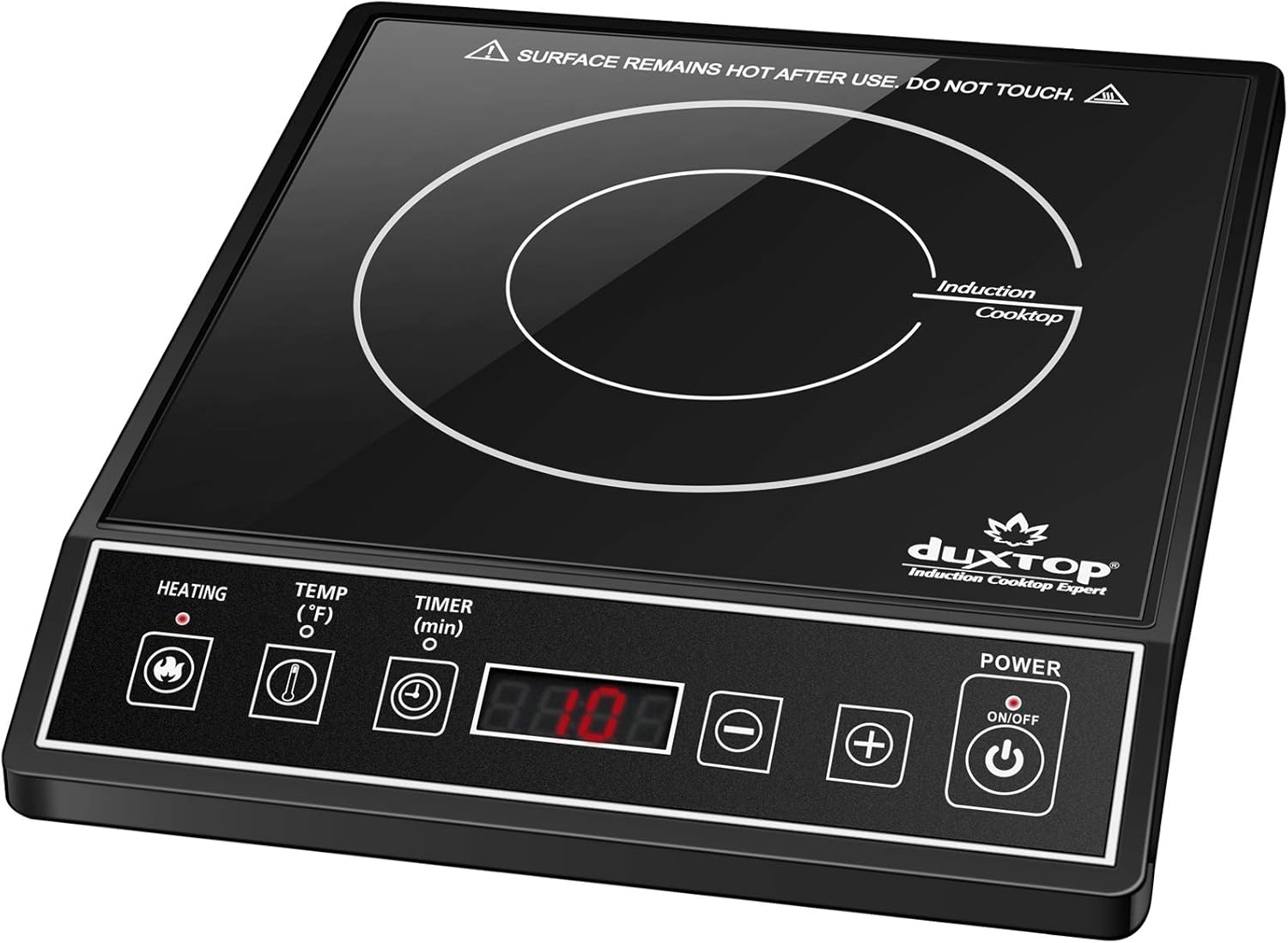
For an RV or powered car-camping kitchen, it offers a useful combination of adjustable power, temperature control, a full-size single cooking zone, and a compact countertop format. Its power range extends from 200W to 1800W, with 15 power settings, while the temperature range runs from 140°F to 460°F across 15 settings.
That makes the 9100MC particularly appealing to campers who want enough control for everyday cooking but do not need the extensive 20-level adjustment of the Duxtop 9600LS. At 11.4 × 14 × 2.5 inches and about 5 pounds 12 ounces, it also remains practical to move between home storage and a campsite kitchen.
Quick Verdict
The Secura 9100MC is a straightforward choice for campers who want full 1800W induction cooking and useful adjustability without paying primarily for advanced controls.
Its 15 power levels cover a broad 200–1800W range, giving you enough flexibility to reduce heat for slower cooking or increase output when you need faster heating. The 15 temperature settings, covering 140–460°F, provide a separate way to manage cooking when working from a target temperature is more useful than simply selecting a power level.
The physical design also suits the realities of vehicle-based camping. At 11.4 × 14 × 2.5 inches, it has a familiar single-burner countertop footprint that works well on an RV counter or a stable camping table. Its weight of approximately 5 pounds 12 ounces keeps it manageable when packing and unpacking the cooking area.
The main appeal is balance. The 9100MC does not try to be the smallest cooktop, the most feature-rich model, or a two-burner replacement. Instead, it provides a solid set of cooking controls and full 1800W capability in a format that makes sense for campers looking for good overall value.
Camp Snapshot
| Feature | Secura 9100MC |
|---|---|
| Best For | Campers looking for strong overall value |
| Maximum Power | 1800W |
| Power Range | 200–1800W |
| Power Levels | 15 settings |
| Temperature Range | 140–460°F |
| Temperature Settings | 15 settings |
| Heating Element | 1 |
| Controls | Digital controls |
| Dimensions | 11.4 × 14 × 2.5 inches |
| Weight | 5 lb 12 oz |
| Voltage | 120V |
Why We Chose It
The Secura 9100MC stands out because it gets the fundamentals right.
For many campers, there is little benefit in paying extra for a long list of advanced features if the cooktop already provides the power range and temperature adjustment needed for everyday meals. The 9100MC offers 15 settings in each category, which is enough to give the cook a meaningful degree of control without making the interface the central feature of the appliance.
Its 200–1800W power range is particularly useful. The lower end gives you room for gentler cooking, while the upper end provides the same 1800W ceiling found on the higher-powered models in this guide. That makes the 9100MC capable of handling everything from lower-heat cooking to tasks where faster heating is desirable.
The 140–460°F temperature range adds another practical option. Depending on what you are preparing, selecting a temperature can be more intuitive than working through power levels. Having both approaches available makes the cooktop adaptable to different recipes and cooking habits.
We also consider its size a good fit for camping. The 11.4 × 14-inch footprint provides a reasonably generous cooking surface without moving into the larger dimensions of a two-burner unit. At 2.5 inches thick, it can be stored in an RV cabinet or packed into a vehicle without requiring a dedicated large compartment.
The 5-foot power cord is another small but useful detail for a campsite kitchen. It gives you some flexibility in positioning the cooktop relative to the available outlet, although the electrical circuit itself still needs to be appropriate for an appliance capable of drawing up to 1800W.
Ultimately, the Secura 9100MC is about getting the important parts of an induction cooktop in place without overcomplicating the decision. For a camper who wants a capable single burner, useful heat adjustment, and full 1800W output, that is a compelling value proposition.
Check today’s price and latest customer reviews on Amazon.
Living With It at Camp
The Secura 9100MC is well suited to the kind of camping kitchen where the cooktop stays in regular rotation rather than being brought along only for occasional use.
In an RV, its 15 power levels give you enough room to adjust cooking without making the controls unnecessarily complicated. You can use lower settings for simmering or keeping food warm and move toward the higher levels when you need to heat a pan or bring water to a boil.
That flexibility is also useful on a camping table. The 11.4 × 14-inch footprint provides a stable cooking area while leaving enough surrounding space for ingredients and preparation. Once the meal is finished, the 2.5-inch-thick body can be stored with the rest of the camp kitchen without requiring the dedicated space that a larger two-burner appliance would need.
The 9100MC’s 5-foot cord is another practical detail for campsite use. It gives you some freedom when positioning the cooktop relative to the available outlet, although the electrical circuit still needs to be suitable for an appliance capable of drawing up to 1800W.
For campers using a generator or portable power station, the same consideration applies. The cooktop can provide up to 1800W, so the available AC output needs to be adequate, particularly if other appliances are operating at the same time.
Where the Secura becomes especially attractive is in everyday use. You get a broad enough range of settings to cook different meals without having to learn a complicated system, while the single-burner format keeps the appliance easy to position and store.
As an induction cooktop, it also keeps the cooking area free from an open flame. That can be convenient inside an RV kitchen and on a stable outdoor cooking table, provided the appliance is used with a suitable 120V AC power source and compatible cookware.
CampComfortGuide Evaluation
| Evaluation Category | Our Assessment |
|---|---|
| Cooking Performance | Full 1800W output provides plenty of capability for everyday camping meals. |
| Power Adjustment | 15 power settings across 200–1800W provide useful flexibility for different cooking tasks. |
| Temperature Control | 15 temperature settings from 140–460°F provide solid control without unnecessary complexity. |
| Portability | Reasonably compact for an 1800W single-burner cooktop and manageable at 5 lb 12 oz. |
| Ease of Use | Straightforward digital controls make it approachable for regular camping use. |
| Camping Versatility | A good fit for RVs, powered campsites, generators, and suitable battery-inverter systems. |
| Overall Value | Excellent balance of cooking capability, adjustability, size, and price-conscious design. |
Who Should Buy This
The Secura 9100MC is a strong choice for campers who want a capable 1800W induction cooktop without making advanced features the main reason for the purchase.
It’s an especially good fit if you:
- Want a dependable single-burner cooktop for an RV or car-camping kitchen.
- Need full 1800W cooking capability.
- Want useful power and temperature adjustment without an overly elaborate control system.
- Prefer a reasonably compact cooktop that is still large enough for everyday cookware.
- Use campground AC power, an RV hookup, a generator, or a suitable portable power station.
- Want to keep the purchase focused on practical cooking performance and overall value.
Who Should Skip This
The Secura 9100MC may not be the best option if your main priority is maximum control over every cooking stage. The Duxtop 9600LS offers more power and temperature settings for campers who want finer adjustment.
It is also not the right choice for anyone looking for a low-power induction solution specifically. Although the 9100MC can operate at lower settings, its maximum 1800W output still makes electrical capacity an important consideration.
And if you routinely prepare two dishes simultaneously, a single cooking zone will be a more significant limitation than any difference in controls or price.
Final Verdict
The Secura 9100MC earns our Best Value award by delivering the fundamentals that matter most in a camping induction cooktop: full 1800W capability, useful adjustment, practical dimensions, and straightforward operation.
It doesn’t need to compete by offering the most elaborate feature set. Instead, it provides enough control for a wide variety of camping meals while remaining compact enough for an RV or vehicle-based kitchen.
For campers who want a capable single-burner induction cooktop and would rather spend their money on the equipment they actually need at camp, the 9100MC is one of the most balanced choices in this guide.
Ready to check today’s price and customer reviews?
Before You Buy
Before taking the Secura 9100MC camping, make sure your planned power source can support a 120V appliance drawing up to 1800W. This is particularly important when using a portable power station or generator alongside other electrical equipment.
You should also confirm that your cookware is induction-compatible before the trip. A magnet test on the bottom of your pots and pans is a quick way to identify suitable cookware.
Check today’s price and latest customer reviews on Amazon.
Related Guide
If you want to simplify meal preparation at camp, our guide to 5 Best Camping Cookware Sets can help you choose compatible pots and pans for a portable induction cooktop. The right cookware is especially important with induction because the cooking surface requires a magnetic base to work properly.
5. Duxtop 9620LS Double
Best for Two-Burner Cooking
The Duxtop 9620LS Double is our Best for Two-Burner Cooking because it gives campers something the other models in this guide cannot: two induction cooking zones in one countertop appliance.
That makes it particularly useful for RV kitchens and larger vehicle-based camps where preparing an entire meal on a single burner becomes restrictive. You can work with two pots or pans at the same time, allowing one dish to simmer while another cooks instead of having to rotate cookware between separate cooking stages.
The important detail, however, is how those two zones share power. The 9620LS has a maximum combined output of 1800W. The left zone can provide up to 1800W and the right zone up to 1000W, but the cooktop dynamically manages the available power between them. It is therefore a two-zone cooking solution, not two independent 1800W burners.

Quick Verdict
The 9620LS Double changes the way you can organize a campsite meal. Instead of treating the cooking area as a single burner and waiting for one dish to finish before starting the next, you have two induction zones available at the same time.
For an RV, that can be especially useful when preparing a more complete dinner. One pan can handle the main course while a second pot works on vegetables, rice, pasta, or a sauce. At a larger car-camping setup, the same arrangement can make meal preparation more efficient when several people are eating.
Its power-sharing system is the key consideration. The left zone is capable of 100–1800W, while the right zone operates from 100–1000W, but the cooktop’s total available power is limited to 1800W. When the left side is demanding higher output, the system automatically manages what is available to the second zone.
That means the 9620LS is best understood as a two-zone cooking platform with a shared 1800W power budget. You gain simultaneous cooking, but you do not gain 3600W of combined heating power.
The physical footprint is naturally larger than the single-burner models. At approximately 23.9 × 14.2 × 2.4 inches, it needs a wider countertop, camping table, or dedicated RV cooking surface. For campers who have that space, however, the additional cooking zone can be far more useful than the compact dimensions of a single burner.
Camp Snapshot
| Feature | Duxtop 9620LS Double |
|---|---|
| Best For | Two-burner cooking at camp |
| Maximum Combined Power | 1800W total |
| Left Cooking Zone | 100–1800W |
| Right Cooking Zone | 100–1000W |
| Power Levels | Left: 20 settings • Right: 10 settings |
| Temperature Range | 100–460°F |
| Heating Elements | 2 |
| Controls | Touch |
| Dimensions | 23.9 × 14.2 × 2.4 inches |
| Weight | 12 lb 7.7 oz |
| Voltage | 120V |
Why We Chose It
The reason to choose the Duxtop 9620LS Double is simple: two cooking surfaces change what is possible during meal preparation.
A single burner works perfectly well when camping meals are uncomplicated. But once you start preparing a main dish alongside a side, breakfast for several people, or a meal that involves both a pot and a frying pan, the ability to cook simultaneously becomes much more valuable.
The 9620LS gives you that flexibility while keeping the entire cooking system within one appliance. There is no need to pack two separate induction burners, find two suitable locations, or manage two separate power cords.
The power-sharing design deserves particular attention. The left zone provides the greater range, with up to 1800W available, while the right zone reaches 1000W. The cooktop then manages the combined electrical demand so that the total remains within its 1800W limit.
This makes the unit practical for everyday two-pan cooking, but it also means you need to think about how you distribute the workload. A high-power task on the left can affect what the right zone is able to deliver. The system is designed around a shared electrical budget rather than two completely independent burners.
The temperature range of 100–460°F gives both zones useful cooking flexibility, while the left side’s 20 power levels provide particularly fine adjustment. The right side has 10 power levels, which is still sufficient for many common secondary cooking tasks.
There is also a practical advantage in having both zones built into one relatively slim appliance. Although the 9620LS is much wider and heavier than the single-burner models, its 2.4-inch height keeps the overall unit low on the countertop.
For campers who have enough table or counter space and regularly prepare meals that benefit from simultaneous cooking, that extra size earns its place. The 9620LS is less about making induction cooking smaller and more about making a campsite kitchen more capable.
Check today’s price and latest customer reviews on Amazon.

Living With It at Camp
The Duxtop 9620LS Double is at its best when the campsite kitchen needs to keep up with a meal rather than simply heat one item at a time.
In an RV, having two cooking zones available can make a surprisingly large difference. You can sauté ingredients in one pan while keeping a pot simmering on the other side, or prepare the main dish and a side at the same time. That reduces the amount of waiting between cooking stages and makes the whole meal easier to coordinate.
The same advantage applies to larger car-camping setups. When several people are eating, having two pans working simultaneously can save considerable time. It also means fewer interruptions when a recipe requires one component to stay warm while another is being prepared.
The power-sharing system is something you quickly need to understand, though. The 9620LS has an 1800W total power limit, so running both zones does not mean having 1800W available independently on each side. If the left zone is using substantial power, the cooktop automatically manages the available output for the right zone.
In practical terms, this works best when you give each burner a sensible role. The left zone can handle the higher-demand task, while the right side works well for simmering, warming, or another cooking job that does not require maximum output. You are gaining simultaneous cooking rather than doubling your electrical capacity.
That distinction also matters in an RV or when using a generator or portable power station. The cooktop requires a suitable 120V AC supply, and the 1800W combined ceiling still represents a significant electrical load. Planning around that limit is important if other appliances are operating at the same time.
The larger footprint is the other consideration. At nearly 24 inches wide, the 9620LS needs a proper countertop or a stable, sufficiently large camping table. It is not the model to choose if storage space is your main concern. But when there is room for it, the second cooking zone can justify the extra size.
For cookware, the same induction rule applies: both cooking zones require compatible magnetic cookware. Checking your pots and pans with a magnet before the trip is a simple way to make sure the two-zone setup will work as intended.
CampComfortGuide Evaluation
| Evaluation Category | Our Assessment |
|---|---|
| Two-Burner Capability | Two cooking zones make simultaneous meal preparation considerably easier. |
| Power Management | Dynamic power sharing keeps the combined output within the 1800W limit. |
| Cooking Control | 20 power levels on the left zone and 10 on the right provide useful adjustment. |
| Cooking Performance | Strong overall capability, with the best results when the shared power budget is planned appropriately. |
| Camping Practicality | Excellent for spacious RV and vehicle-based kitchens, but the large footprint requires adequate workspace. |
| Portability | Reasonable for a two-zone appliance, although its 12 lb 7.7 oz weight and wide body make it less convenient than single-burner models. |
| Overall Value | A worthwhile upgrade for campers who regularly need two cooking zones at the same time. |
Who Should Buy This
The Duxtop 9620LS Double is an excellent choice for campers who regularly prepare meals that benefit from having two cooking zones available simultaneously.
It’s an especially strong fit if you:
- Cook for families or larger groups while camping.
- Use an RV with enough counter space for a wide two-zone appliance.
- Want to prepare a main dish and side dish at the same time.
- Prefer one integrated appliance instead of carrying two separate burners.
- Have a suitable 120V AC power source with enough capacity for the cooktop.
- Spend enough time cooking at camp to benefit from the additional cooking zone.
Who Should Skip This
The 9620LS is probably unnecessary for campers who mainly prepare simple one-pot meals or travel with limited storage and counter space.
It is also not the right choice if you expect two independent 1800W burners. The cooktop has an 1800W maximum combined output, so the two zones share the available electrical power.
Campers using small power stations or limited electrical systems may also prefer a single-burner model with a lower maximum demand. And if compact storage is more important than simultaneous cooking, the wider 9620LS will be harder to justify.
Final Verdict
The Duxtop 9620LS Double earns our Best for Two-Burner Cooking award because it changes the workflow of a campsite kitchen.
Its biggest advantage is not simply having another heating element. It is being able to keep two parts of a meal moving at the same time while using one integrated appliance. For RV campers and larger vehicle-based setups, that can make breakfast, dinner, and multi-component meals considerably easier to manage.
The shared 1800W power limit is the key detail to understand before buying. This is not two independent high-output burners, but a two-zone induction cooktop designed to distribute a total 1800W intelligently between them.
If you have the counter space and a suitable electrical system, that tradeoff is worthwhile. For campers who regularly find themselves waiting for one burner to become available before starting the next part of a meal, the 9620LS provides a much more capable cooking setup.
Ready to check today’s price and customer reviews?
Before You Buy
Before investing in the 9620LS Double, make sure your RV countertop or camping table can comfortably accommodate an appliance measuring approximately 23.9 × 14.2 inches. Its larger footprint is the price of having two cooking zones in one unit.
Also plan your electrical load around the 1800W combined maximum. The two burners share available power, so the cooktop should be viewed as a two-zone cooking system rather than two separate 1800W appliances.
Finally, check your cookware for induction compatibility before the trip. Both cooking zones require magnetic cookware to operate.
Check today’s price and latest customer reviews on Amazon.
Related Guide:
If you’re comparing different ways to cook while vehicle camping, our guide to 5 Best Camping Stoves for Car Camping is a useful companion. It covers traditional camping stove options for situations where electrical power is limited or when you want a cooking system that does not depend on an AC hookup.
How to Choose the Right Portable Induction Cooktop for Camping
The right portable induction cooktop for camping depends on how you cook, how much space you have, and how your campsite is powered. Instead of comparing models by wattage alone, use these five factors to narrow the choice to the one that actually fits your setup.
1. Match the Cooktop to Your Power Setup
Start with the electrical system you already use at camp.
All five models in this guide require 120V AC power, but they do not place the same demand on that system. The NuWave Flex is capped at 1400W, while the single-burner Duxtop and Secura models can reach 1800W. The Duxtop 9620LS Double also has an 1800W maximum, but that limit is shared across both cooking zones.
For an RV or powered campsite, make sure the cooktop can operate comfortably alongside your other electrical loads. For a generator or portable power station, check the available continuous AC output before choosing the model.
2. Decide How Much Cooking Control You Need
Think about the meals you normally make rather than choosing the cooktop with the longest feature list.
A simpler model can be perfectly suitable for boiling water, heating a pan, cooking one-pot meals, and preparing basic campsite dishes. More extensive power and temperature controls become useful when you regularly simmer sauces, cook delicate foods, or need to make smaller heat adjustments during a recipe.
In this lineup, the Duxtop 9600LS offers the most extensive adjustment, while the Secura 9100MC provides a more straightforward middle ground. The NuWave Flex takes a different approach with three defined power levels and fine temperature increments.
3. Choose One Burner or Two
For many campers, a single burner is enough.
A one-zone cooktop is easier to store and gives you more flexibility when counter space is limited. It also works well for simple meals where you are comfortable cooking one component at a time.
A two-burner model becomes more useful when you regularly prepare a main dish and a side at the same time. The Duxtop 9620LS Double provides that extra cooking capacity, but its two zones share 1800W of total available power and require substantially more countertop and storage space.
4. Check Your Cookware Before Buying
Induction compatibility is a practical requirement, not an optional feature.
Before choosing a cooktop, check the pots and pans you already own. A magnet that sticks firmly to the bottom is a quick indication that the cookware is likely to work with induction.
Also consider cookware size. The pan should sit appropriately on the cooking zone, and campers using a two-burner model should have enough compatible cookware to take advantage of both zones.
5. Think About Where the Cooktop Will Live
Portability is about more than the number on the scale.
Consider where you will store the cooktop while traveling, where you will set it up at camp, and how much workspace will remain around it once food preparation begins. The single-burner models in this guide are easier to fit into compact camping kitchens, while the wider Duxtop 9620LS is better suited to campers with a larger RV counter or dedicated cooking table.
The best model is therefore the one that fits your power system, cooking habits, cookware, and available space at the same time. When those four factors line up, choosing between the models becomes much easier.
Can You Run an Induction Cooktop Off a Portable Power Station?
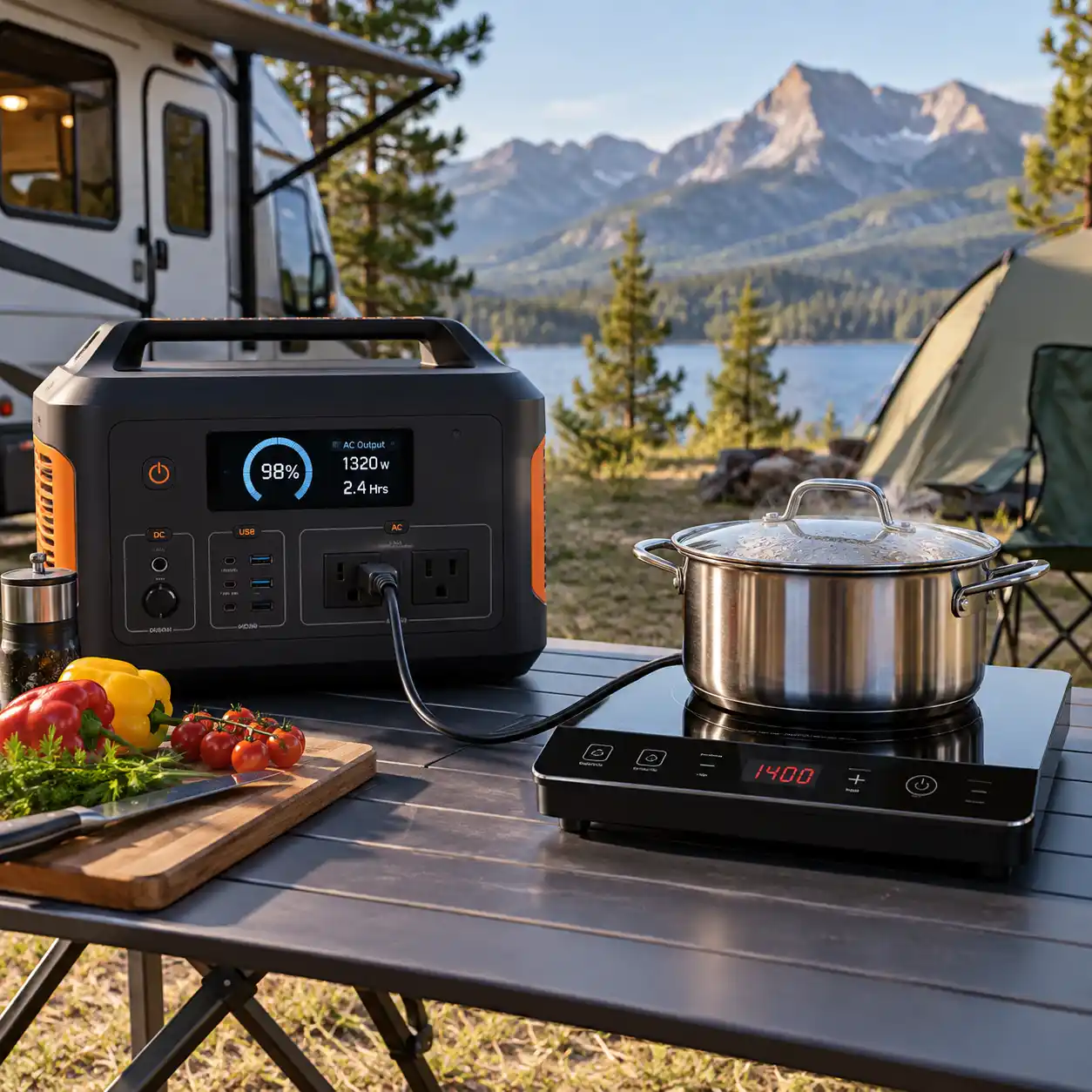
Yes — a portable induction cooktop can be powered by a portable power station, but the power station needs to have an inverter capable of handling the cooktop’s electrical demand.
This is where induction cooking becomes different from many lower-power camping appliances. A 1400W or 1800W cooktop can place a substantial load on a battery system, so battery capacity alone is not enough. You need to consider the inverter’s continuous AC output, the cooktop’s power setting, and how much energy the battery can actually provide.
Check the Inverter’s Continuous Output
The first specification to look at is the power station’s continuous AC output.
For example, a 1400W induction cooktop such as the NuWave Flex needs an inverter that can continuously supply its selected load. An 1800W model requires substantially more output when operated at its maximum setting.
Don’t size the system based only on a short-duration or peak-output figure. Induction cooking can maintain a high electrical load for several minutes, so the continuous rating is the more important number.
Battery Capacity Determines How Long You Can Cook
The inverter determines whether the power station can run the cooktop, while the battery capacity determines how long you can keep doing it.
An induction cooktop does not necessarily draw its maximum rated wattage continuously during an entire meal. Lower heat settings use less electricity, and cooking time also has a major effect on total energy consumption.
That means a smaller power station may be perfectly adequate for occasional cooking, while longer meal preparation or repeated cooking sessions can require considerably more battery capacity.
Leave Room for Your Other Camping Gear
Your induction cooktop will rarely be the only thing connected to the power station.
If you’re simultaneously charging phones, running lights, powering a laptop, or operating another AC appliance, those loads consume part of the inverter’s available output. A power station that is just large enough for the cooktop on its own may therefore become limiting in a real campsite setup.
For this reason, it is better to think about the entire electrical load rather than matching the power station to the cooktop’s wattage alone.
Use Lower Power Settings When Practical
One of the advantages of the models in this guide is adjustable power.
You don’t always need 1800W to cook. Lower settings can reduce the instantaneous electrical demand and extend the useful runtime of a battery-powered setup. The NuWave Flex is particularly well suited to this approach because it offers 600W, 900W, and 1400W settings.
The same principle applies to the 1800W models: if your meal can be cooked effectively at a lower setting, there is little reason to operate the cooktop at maximum output for the entire cooking process.
The Bottom Line
A portable power station can make induction cooking practical for off-grid RV and car camping, but the inverter and battery need to be sized for the job.
For occasional cooking, focus first on whether the inverter can continuously handle the cooktop’s required wattage. For longer trips, also consider the battery capacity and everything else you expect to run from the same power station.
And remember: these cooktops are 120V AC appliances, not 12V appliances. A portable power station works by supplying AC power through its inverter; the cooktop does not connect directly to the vehicle’s 12V system.
Portable Induction Cooktops vs. Propane Stoves for Camping
Portable induction cooktops and propane stoves can both work extremely well at camp, but they are built around very different power systems. The better choice depends primarily on whether your campsite already has reliable electrical power.
Induction Cooktops
Induction is particularly convenient for RV camping and powered car camping. There is no open flame, the cooking surface is easy to wipe down, and precise power or temperature adjustment makes it possible to handle everything from gentle simmering to high-heat cooking.
The main limitation is the electrical requirement. A portable induction cooktop needs 120V AC power, so you need an RV hookup, campground outlet, generator, or suitable battery-and-inverter system.
For campers already carrying a portable power station, induction can also become part of a broader electric campsite setup. The tradeoff is that cooking can consume a meaningful amount of battery capacity, especially when using higher power settings for extended periods.
Propane Stoves
Propane remains the more flexible option when electrical power is unavailable or limited.
A propane stove does not depend on an AC outlet or inverter, making it naturally suited to remote campsites and traditional off-grid cooking. It also provides a familiar cooking experience and can deliver high heat without drawing energy from a battery.
The disadvantages are different: you need to transport fuel, manage propane connections, and cook around an open flame. Wind can also affect flame performance, and the stove generally requires more attention to the cooking area than an induction surface.
Which One Is Better for Your Camping Setup?
| Camping Situation | Better Choice | Why |
|---|---|---|
| RV with reliable shore power | Induction | Clean, precise, and convenient. |
| Powered car campsite | Induction | Easy to integrate with existing AC power. |
| Portable power station available | Induction | Can use stored battery energy for cooking. |
| Generator-powered campsite | Either | Both can work; choose based on fuel and electrical capacity. |
| Remote off-grid camping | Propane | No AC power required. |
| Limited battery capacity | Propane | Avoids using valuable battery energy. |
| Cooking during electrical restrictions | Propane | Independent of the campsite electrical circuit. |
| Indoor RV cooking | Induction | No open flame and easy surface cleanup. |
The simplest rule is this: if reliable AC power is already part of your camping setup, induction is an excellent cooking solution. If your campsite needs to remain independent of electricity, propane is usually the more practical choice.
For many RV and vehicle campers, there is no reason to treat the two systems as mutually exclusive. An induction cooktop can handle everyday cooking when electrical power is available, while a propane stove provides a separate cooking option when you move farther off-grid.
Common Mistakes When Using an Induction Cooktop for Camping
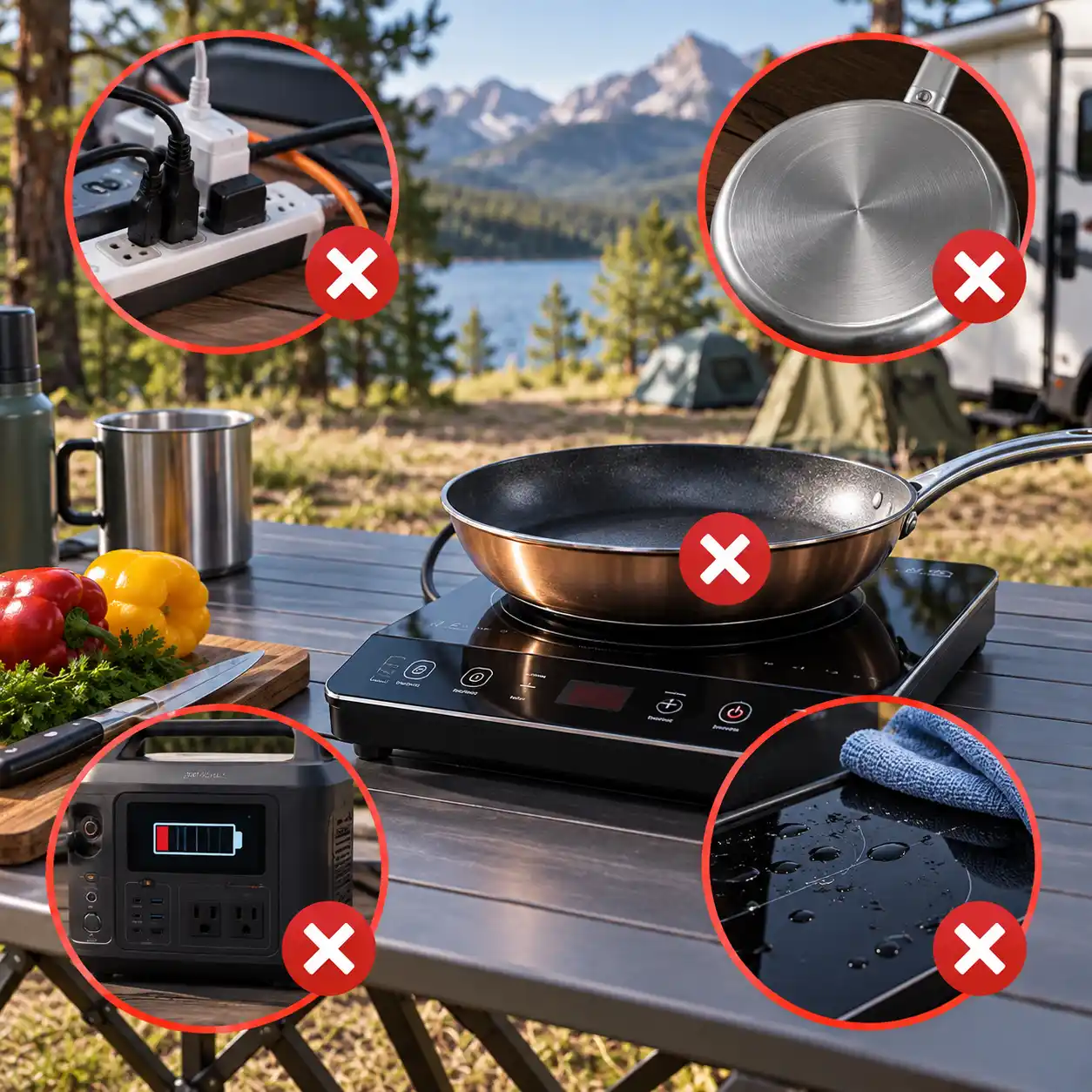
Portable induction cooking is straightforward once the electrical setup and cookware are understood. Most problems come from overlooking one of those two things or assuming that an induction cooktop behaves like a traditional propane burner.
1. Choosing the Cooktop by Wattage Alone
An 1800W cooktop may look like the obvious choice because it offers the highest output, but maximum wattage is only one part of the decision.
If your RV circuit, generator, or portable power station has limited capacity, a 1400W model such as the NuWave Flex may actually be a better fit. The right cooktop is the one that matches the power available at your campsite.
2. Assuming an Induction Cooktop Runs Directly From 12V
This is one of the easiest mistakes to make when shopping for camping equipment.
The cooktops in this guide are 120V AC appliances. They do not plug directly into a vehicle’s 12V outlet. If you’re cooking away from shore power, you need an appropriate generator or a battery system with an inverter capable of supplying the required AC output.
3. Ignoring the Rest of Your Electrical Load
An induction cooktop may be the largest electrical load in your campsite kitchen, but it probably won’t be the only one.
In an RV, the refrigerator, battery charger, lights, microwave, and other appliances may all be drawing power from the same electrical system. With a portable power station, other devices consume part of the inverter’s available output and battery capacity.
Always consider the combined load, not just the cooktop’s rating.
4. Assuming Two Burners Mean Twice the Power
The Duxtop 9620LS Double is a particularly important example.
It has two cooking zones, but its maximum combined output is 1800W. The left zone can reach 1800W and the right zone can reach 1000W, but those figures do not add up to 2800W or 3600W of simultaneous output.
The cooktop dynamically shares its available power between the two zones. Understanding this before buying prevents unrealistic expectations about how much heat both burners can deliver at once.
5. Bringing the Wrong Cookware
Induction cooking requires cookware with a magnetic base.
A pan that works perfectly well on a propane stove may not work on an induction cooktop. Before leaving home, test your camping pots and pans with a magnet. If the magnet does not attach to the base, the cookware may not be suitable for induction.
This is an especially easy mistake to avoid because the test takes only a few seconds.
6. Forgetting About Counter Space
Single-burner induction cooktops are relatively compact, but the two-burner Duxtop 9620LS is substantially wider.
Before choosing a model, think about where you will actually use it and where you will store it during transport. An appliance that fits your cooking routine but not your RV countertop or storage compartment is going to become inconvenient very quickly.
7. Treating Lower Wattage as the Same Thing as Lower Battery Consumption
A 1400W cooktop can be easier to run from a smaller electrical system than an 1800W model, but that does not mean battery capacity becomes irrelevant.
How much energy you use depends on power and cooking time. Running a 1400W cooktop for a long period can still consume substantial battery energy. When using a portable power station, consider both the inverter’s output capability and the battery’s available capacity.
8. Using Maximum Power for Everything
Maximum output is useful when you need rapid heating, but many cooking tasks do not require it.
Once a pan is hot or water has reached a boil, reducing the power can lower electrical demand while still maintaining the cooking process. Models with multiple power settings give you more flexibility to do this.
For battery-powered camping setups in particular, using the lowest effective power level can help make your available energy last longer.
9. Treating Induction as a Universal Replacement for Propane
Induction is excellent for powered RV and car camping, but it is not automatically the best cooking method for every campsite.
If you regularly camp without shore power, do not carry a generator, and do not have a sufficiently capable battery-and-inverter system, propane remains the more practical option. The biggest advantage of propane in that situation is independence from AC electricity.
The mistake is choosing induction because it looks convenient without first checking whether your camping style can actually support it.
How to Use a Portable Induction Cooktop Safely While Camping
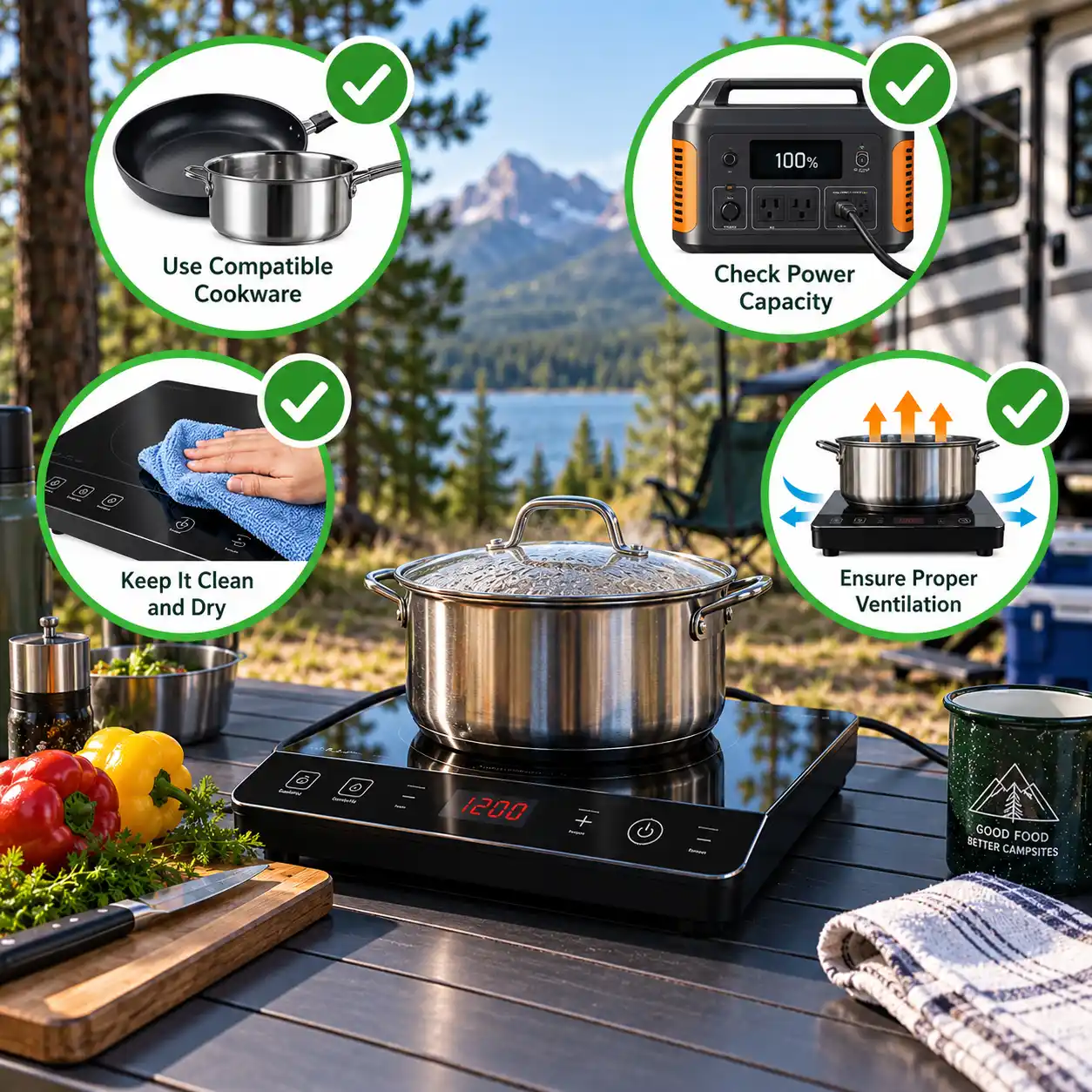
Using an induction cooktop at camp is relatively straightforward, but the environment is different from a home kitchen. A temporary cooking area, portable electrical equipment, uneven surfaces, and limited workspace all make setup more important.
Use a Stable, Level Cooking Surface
Place the cooktop on a firm, level surface that can support its weight and the cookware you intend to use.
A camping table or solid RV countertop is generally more appropriate than an unstable surface. The cooktop should sit flat before you place a pot or pan on it, particularly when cooking outdoors where the table may move or flex.
Keep the Electrical Setup Protected
Because these cooktops operate from 120V AC, pay attention to where the power connection is located.
Keep plugs, connections, and the power station or generator itself away from areas where spilled water, rain, or wet cookware could reach them. Avoid creating a situation where a power cable runs through the main food-preparation area or becomes a trip hazard.
If you’re using an extension cord, make sure it is appropriate for the electrical load rather than choosing one simply because it happens to be available at camp.
Give the Cooktop Adequate Clearance
Don’t treat the cooktop like a completely flat surface that can be surrounded by camping equipment.
Leave the manufacturer’s required ventilation clearance around the appliance and avoid covering ventilation openings with cookware, towels, bags, or other gear. This is particularly important in an RV or compact camp kitchen where counter space is limited.
Keep Water Away From the Cooking Surface
Induction eliminates the open flame, but it does not eliminate the risks associated with electricity and hot cookware.
Use reasonable separation between the cooktop and sinks, water containers, washing areas, and wet equipment. If something spills, turn the appliance off and deal with the spill safely rather than continuing to cook around it.
Use Compatible Cookware
Only use cookware that is suitable for induction and appropriate for the size of the cooking zone.
A magnetic base is essential for induction operation. Before the trip, test your cookware with a magnet and make sure the base sits properly on the cooking surface.
Avoid dragging heavy cast-iron cookware across the glass surface, since portable induction cooktops still have a glass cooking surface that can be damaged by rough handling.
Manage the Electrical Load
The safest setup is one where you know what else is using the same electrical supply.
An 1800W cooktop can represent a substantial load on an RV circuit, generator, or portable power station. If other high-power appliances are running at the same time, the total demand can exceed what the system is designed to provide.
When electrical capacity is limited, use a lower power setting where practical and avoid running several high-demand appliances simultaneously.
Let the Cooktop Cool Before Packing It Away
Induction cooking stops heating the cookware when the cooking cycle ends, but the cooking surface and cookware can remain hot.
Give the unit sufficient time to cool before moving it into an RV cabinet, vehicle storage compartment, or camping box. Packing a hot appliance among other gear can damage surrounding equipment and creates an unnecessary burn risk.
Follow the Manufacturer’s Instructions
Finally, use the cooktop according to the instructions supplied with your specific model. Details such as ventilation, cookware requirements, electrical connections, cleaning, and operating limitations can vary between appliances.
For camping, the basic principle is simple: treat the induction cooktop as a 120V electrical appliance first and a camping accessory second. A stable setup, suitable power source, compatible cookware, and sensible electrical load management will prevent most of the problems that can occur when taking countertop induction cooking outdoors.
Induction Cookware for Camping: What Works and What Doesn't
Choosing the right cookware is essential when taking an induction cooktop camping. Unlike propane burners, induction does not heat the pan through a flame. The cookware itself needs to interact with the magnetic field generated by the cooking surface.
The easiest way to check your existing camping cookware is with a magnet. Place it against the bottom of the pot or pan. If it sticks firmly, the cookware is generally suitable for induction. If it does not, the cooktop will not be able to heat it normally.
| Cookware Type | Induction Compatible? | What to Know for Camping |
|---|---|---|
| Cast Iron | Yes | Works well with induction, but the heavy weight and rough surface require careful handling on a glass cooktop. |
| Enameled Cast Iron | Yes | Excellent induction compatibility, although it is heavier than typical camping cookware. |
| Magnetic Stainless Steel | Yes | A practical option for camping; check that the base is actually magnetic. |
| Non-Magnetic Stainless Steel | No | Some stainless-steel cookware will not work because the base is not magnetic. |
| Aluminum | No* | Only suitable if it has a dedicated magnetic induction-compatible base. |
| Copper | No* | Requires a magnetic induction-compatible layer to work. |
| Glass | No | Standard glass cookware does not interact with an induction cooking surface. |
*Some cookware made from aluminum or copper can work with induction when the manufacturer adds a magnetic base.
The Magnet Test Is the Easiest Check
You do not need specialized equipment to check most cookware before a camping trip.
Hold a magnet against the outside bottom of the pot or pan. A strong attraction indicates that the base contains magnetic material and is likely to work with an induction cooktop. If the magnet barely attracts or does not stick at all, choose different cookware.
It is worth testing every piece you intend to bring rather than assuming that an entire cookware set is induction compatible.
Pay Attention to the Base
Magnetic compatibility is only part of the equation. The bottom of the cookware should also sit reasonably well on the induction cooking area.
Very small cookware may not interact effectively with the cooking zone, while an oversized pan can extend significantly beyond the area being heated. For camping, cookware with a flat, stable base and a size appropriate for the cooktop is generally the easiest combination to work with.
Cast Iron Works, but Handle It Carefully
Cast iron is naturally magnetic, so it can work very well with induction. However, it is considerably heavier than most lightweight camping cookware.
When using cast iron on a portable induction cooktop, avoid sliding the pan across the glass surface. Lift it when repositioning it instead. This is particularly important when you’re using a portable appliance that may be moved frequently between storage and the campsite.
Bring Only What You Need
Camping is one situation where a complete cookware collection can quickly become unnecessary.
If you’re using a single-burner induction cooktop, one induction-compatible frying pan and one suitable pot may cover most meals. A two-burner model such as the Duxtop 9620LS gives you more flexibility, but both cooking zones still require compatible cookware.
The best approach is to match the cookware to the meals you actually plan to prepare rather than bringing every pot and pan you own.
Check Before the Trip
The few minutes you spend testing cookware at home can prevent one of the most frustrating problems at camp: discovering that your favorite camping pot does not work with your new induction cooktop.
For the models in this guide, the rule is simple: if your cookware has a suitable magnetic base, it can generally work with induction; if it does not, the cooktop cannot replace your conventional burner for that piece of cookware.
FAQ: Portable Induction Cooktops for Camping
Can you use a portable induction cooktop for camping?
Yes, if you have access to a suitable 120V AC power source. Portable induction cooktops are particularly well suited to RV camping, powered car campsites, campground electrical hookups, generators, and camping setups with a sufficiently powerful battery-and-inverter system.
They are less practical for remote off-grid camping when electrical power is limited or unavailable. In that situation, a propane stove remains the simpler option.
How many watts does a portable induction cooktop use?
Most portable induction cooktops designed for North American 120V outlets operate in roughly the 1,200W to 1,800W range, depending on the model and power setting. The 1,800W class is common because it is close to the practical limit of a standard 120V/15A circuit.
Lower-wattage models can be useful when you’re camping with a limited electrical supply. For example, the NuWave Flex in this guide is a 1400W cooktop, giving you more electrical headroom than a full 1800W model.
Can a portable induction cooktop run from a power station?
Yes. A portable power station can run an induction cooktop if its AC inverter has sufficient continuous output for the cooktop.
For an 1800W cooktop, you need a power station capable of supplying that load while also accounting for the other appliances connected to the system. Battery capacity is a separate consideration: inverter output determines whether the cooktop can run, while watt-hours determine how long you can keep cooking.
This is one of the most important considerations for campers using induction away from shore power.
Can you run an induction cooktop directly from a 12V battery? use?
No. The portable induction cooktops covered in this guide are 120V AC appliances, not 12V DC appliances.
If you want to operate one from a 12V battery system, you need an inverter to convert the battery’s DC power into AC power. That makes the inverter’s continuous output and the battery’s available capacity important parts of the overall setup. Current 2026 camping guides continue to identify the lack of direct 12V operation as a major limitation of portable induction cooking.
What size power station do I need to run an induction cooktop?
There is no single battery size that works for every camping setup. Start with the cooktop’s maximum wattage and the power station’s continuous AC output, then consider how long you plan to cook and what other appliances will be running.
An 1800W cooktop can place a substantial load on a power station, so a unit with only a small AC inverter may not be suitable even if its battery capacity looks large on paper.
For battery-powered camping, think about two separate numbers: watts for the inverter and watt-hours for runtime.
What cookware can you use on a portable induction cooktop?
You need induction-compatible cookware with a magnetic base. Cast iron and magnetic stainless steel generally work well, while ordinary aluminum, copper, and glass cookware will not work unless they have a suitable magnetic induction base.
The easiest test is to place a magnet against the bottom of the pan. If it sticks firmly, the cookware is generally suitable for induction.
Does cast iron work on an induction cooktop?
Yes. Cast iron is magnetic and works well with induction.
The main concern when camping is not compatibility but handling. Cast iron is heavy, and sliding it across the glass surface of a portable cooktop can scratch the cooking surface. Lift the cookware rather than dragging it when repositioning it.
Is a 1400W induction cooktop better for camping than an 1800W model?
Not necessarily. A 1400W model can be the better choice when your campsite electrical circuit, generator, or battery system has limited capacity.
An 1800W cooktop gives you more maximum cooking power and can be preferable when reliable electrical power is available. The better choice depends on your actual camping setup rather than wattage alone.
This distinction is increasingly important in RV and off-grid discussions, where available electrical capacity can be a bigger limitation than the cooktop itself.
Can you use a double induction cooktop with both burners at the same time?
Yes, but you should check the combined maximum output rather than assuming that both burners can operate at their individual maximum ratings simultaneously.
The Duxtop 9620LS Double in this guide has a maximum combined output of 1800W, shared between its two cooking zones. That means it should not be treated as two independent 1800W burners.
For camping, a double burner can be useful for preparing a main dish and side dish simultaneously, but it also requires more counter space and careful management of your available electrical power.
Is induction better than propane for camping?
It depends on where and how you camp.
Induction is particularly attractive for RV camping, powered campsites, and battery-supported setups because it provides precise heat without an open flame and performs consistently in windy conditions. Propane is generally more practical for remote camping because it does not depend on a large electrical system.
Current 2026 comparisons continue to frame the decision around exactly this tradeoff: induction works particularly well when reliable electrical power is already part of the camping setup, while propane remains easier for frequent boondocking.
Can you use an induction cooktop during a fire ban?
Potentially, but you must follow the specific restrictions for the campsite, park, land-management agency, and current fire conditions.
Induction does not use an open flame, which is one reason campers are increasingly considering it as an alternative during fire restrictions. However, you should never assume that every electrical cooking appliance is automatically permitted during every fire ban. Check the current local regulations before relying on induction as your cooking method. Recent 2026 camping discussions show that this is becoming a practical reason people are adding induction cooking to their setups.
Can you use a portable induction cooktop inside an RV?
Yes, provided the specific cooktop is approved for the intended environment and you follow the manufacturer’s instructions.
One advantage of induction is that it does not produce combustion gases like a propane burner. However, it is still a high-power electrical appliance that produces heat and should be operated on a stable, appropriate surface with sufficient clearance.
Always follow the manufacturer’s instructions for indoor RV use rather than assuming that every portable induction cooktop is designed for every environment.
Does induction cooking use a lot of battery power while camping?
It can. An induction cooktop may draw well over 1,000W at higher settings, making it one of the larger electrical loads in a typical camping setup.
The important distinction is that the cooktop does not necessarily operate at maximum power continuously. Boiling water, frying, simmering, and keeping food warm can require very different power levels. Your actual battery consumption therefore depends on both the power setting and cooking time.
This is why a cooktop’s maximum wattage alone does not tell you how much battery capacity a full day of camping meals will require.
Is a portable induction cooktop good for RV camping?
Yes. RV camping is one of the strongest use cases for portable induction cooking because you may already have access to 120V shore power, a generator, or a substantial battery-and-inverter system.
An induction cooktop can also be useful as an additional cooking surface when the built-in RV kitchen is limited. The main consideration is whether your electrical system can support the cooktop together with your other appliances.
Are portable induction cooktops worth it for car camping?
They can be, especially when you camp at sites with electrical hookups or already carry a sufficiently powerful portable power station.
For simple off-grid car camping with a small battery, however, induction may add more electrical-system weight and complexity than you need. In that situation, propane can remain the more practical cooking solution.
Bottom line: portable induction cooking makes the most sense when electricity is already part of your camping setup. If your campsite provides reliable AC power, it can be an excellent way to get fast, controlled, flame-free cooking. If electricity is scarce, propane remains the more flexible choice.
Final Verdict: Which Portable Induction Cooktop Is Best for Camping?
The best portable induction cooktop for camping is not necessarily the most powerful or the most feature-rich model. The right choice depends on how your campsite is powered, how much cooking space you need, and how closely the cooktop fits the way you normally prepare meals.
For most campers using reliable AC power, the Duxtop 8100MC offers the strongest overall balance. The NuWave Flex makes more sense when electrical capacity is limited, while the Duxtop 9600LS is better suited to campers who want more precise control. The Secura 9100MC focuses on practical value, and the Duxtop 9620LS Double is the specialist choice when two cooking zones are worth the additional size and shared-power limitation.
The deciding factor should therefore be your camping setup first, and the cooktop second. Make sure the electrical system can support the appliance, confirm that your cookware is induction-compatible, and choose a size that works comfortably with your available counter and storage space.
For RV and powered car camping, a portable induction cooktop can be a very practical cooking solution. For remote camping without dependable AC power, a propane stove remains the more flexible option.
Choose the cooktop that fits the way you camp, not simply the one with the biggest specifications on the box.
The CampComfortGuide Promise
At CampComfortGuide, we believe choosing camping gear should make your trip more comfortable, practical, and enjoyable — not more complicated.
That is why we focus on the details that actually matter at camp: how equipment performs within a real camping setup, what limitations you should know before buying, and which option makes the most sense for different types of campers.
We do not believe the most expensive product is automatically the best, or that one piece of gear is right for everyone. Our goal is to give you clear, practical information so you can choose with confidence and spend more time enjoying your campsite.
CampComfortGuide — making camping more comfortable, one smart choice at a time.