
A wood-burning fire pit can bring something to a campsite that a compact stove cannot: the warmth, glow, and atmosphere of a real wood fire, contained in a purpose-built setup that is easier to manage than an improvised campfire. The right model can also give you a cleaner, more organized place to burn firewood while taking up far less space than a permanent backyard fire pit.
Camping adds a different set of priorities. Weight, packability, burn efficiency, smoke, firewood capacity, ash cleanup, durability, and campsite rules all matter once the fire pit has to travel with you. A design that works beautifully on a patio may be awkward to load into a vehicle, while an ultra-light model may not provide enough room for a comfortable evening fire.
In this guide, we compare five wood-burning fire pits for camping chosen for different camping styles and priorities. Some focus on portability, some on lower-smoke burning, and others on giving you a larger, more substantial fire without becoming impractical to take on the road. The goal is not to find the biggest fire pit or the one with the longest list of features, but the model that makes the most sense for the way you actually camp.
Table of Contents
Quick Answer
The best wood-burning fire pit for camping depends heavily on how you travel. A lightweight fire pit that is easy to carry is a very different proposition from a larger, heavier model designed to stay at a spacious campsite for the evening.
- Best Overall: Solo Stove Bonfire Amazon Exclusive Bundle — A strong all-around choice for campers who want a substantial wood-burning fire pit for 4–6 people, with a stand, lid, shelter, and ash pan included.
- Best for Portability: Solo Stove Ranger 2.0 with Stand — The lightest and easiest-to-transport option in this lineup at 16.5 lb, making it the most practical choice for campers who need to keep weight and storage space under control.
- Best for a Large Fire: Iamsii 26-Inch Smokeless Fire Pit — Its large 26-inch format provides considerably more fire capacity than the compact Ranger, while the included grill, stand, ash pan, and cover make it well suited to larger vehicle-based campsites.
- Best Heavy-Duty Option: Breeo X Series 19 — A substantial stainless-steel fire pit built for campers who prioritize robust construction and a more permanent-feeling campfire setup over low weight.
- Best for Spacious Campsites: TIKI Patio Smokeless Fire Pit 25-Inch — A large 25-inch wood-burning design with a weather-resistant finish, removable ash pan, stand, and cover, best suited to RV and car-camping setups with room to spare.
The key point: these are not five versions of the same fire pit. The Ranger 2.0 is the clear portability specialist, the Bonfire sits in the middle as a larger group-friendly option, while the Iamsii, TIKI, and Breeo move toward larger and heavier campsite setups. None of them should be treated as backpacking fire pits; this lineup is primarily for car camping, RV camping, and campsites where transporting a larger wood-burning fire pit is practical.
Why You Can Trust This Guide
Choosing a wood-burning fire pit for camping is not the same as choosing one for a backyard patio. A model can be excellent for home use and still be awkward to transport, too heavy for a vehicle-based trip, difficult to clean, or poorly suited to the way you actually spend an evening at camp.
For this guide, we looked at the factors that matter most when a fire pit has to travel: overall size, weight, portability, burn design, smoke management, firewood capacity, durability, cleanup, included accessories, and suitability for RV and car camping.
We also paid close attention to how each model is positioned within this particular lineup. A lightweight fire pit should not be judged by the same standard as a heavy-duty model built around a larger fire and more substantial construction. The goal is to identify where each fire pit makes the most sense rather than treating every model as interchangeable.
The specifications and product details used in our comparisons were checked against manufacturer information and product documentation. We do not present these fire pits as personally tested in every camping environment. Our recommendations are based on documented specifications, design characteristics, and the practical requirements of different camping setups.
Most importantly, we do not assume that the biggest fire, lowest weight, or longest feature list automatically makes a fire pit better. The best wood-burning fire pit for camping is the one that fits the way you travel, the space you have, and the kind of fire you want to enjoy at camp.
How We Selected the Best Wood-Burning Fire Pits for Camping
We selected these fire pits by looking at what changes once a wood-burning fire pit has to travel to camp rather than stay permanently in a backyard. Portability, fire capacity, smoke management, construction, cleanup, included accessories, and campsite practicality all play a role in that decision.
Size and weight received particular attention because the five models in this lineup occupy very different positions. The Solo Stove Ranger 2.0 is a relatively compact 16.5-pound option, while the TIKI Patio and Breeo X Series 19 are substantially heavier and better suited to spacious vehicle-based campsites. The Iamsii 26-inch model and Solo Stove Bonfire sit between those extremes, giving campers more fire capacity without requiring the largest designs in the category.
We also considered the way each fire pit handles the practical parts of having a wood fire at camp. Smoke reduction, ash removal, carrying or transport features, covers and stands, cooking capability, and overall fire-pit capacity can make a meaningful difference once you’re setting up, tending, and packing away the fire.
Current 2026 fire-pit comparisons also continue to treat portability, smoke performance, heat, durability, ease of use, cleanup, and cooking capability as important differentiators rather than judging every fire pit by size alone.
The five models cover distinct camping priorities rather than repeating the same basic design. The Ranger is built around easier transport, the Bonfire offers a broader middle ground, while the Breeo, TIKI, and Iamsii put more emphasis on fire capacity, construction, or campsite versatility.
Who Is This Guide For?
This guide is primarily for car campers and RV campers who want the warmth and atmosphere of a real wood fire without building a traditional fire directly on the ground.
It is a particularly good fit for:
- Car campers who have enough vehicle space for a dedicated fire pit and firewood.
- RV campers looking for a contained wood-burning fire pit for an established campsite.
- Families and groups who want a larger fire for relaxing, talking, or roasting food.
- Campers who prefer wood-burning fires rather than propane and are prepared to transport and manage firewood.
- Campers who want features such as smokeless airflow, removable ash pans, stands, covers, or cooking capability, depending on the model.
The models in this guide are not intended for backpacking or situations where every pound matters. Even the lightest option is designed for vehicle-based camping, while several models are substantially heavier and need a spacious campsite or camping table.
A wood-burning fire pit also requires more planning than simply carrying the pit itself. Before using one, check the rules for your specific campground or public land, including whether wood fires are permitted, whether portable fire pits are allowed, and whether temporary fire restrictions are in effect. Fire regulations can vary significantly by location and conditions.
The best match is therefore the camper whose vehicle, campsite, firewood supply, and local regulations can accommodate the fire pit comfortably and legally.
What Makes a Good Wood-Burning Fire Pit for Camping?

A fire pit that works well at home can become awkward once it has to travel with you. For camping, the useful question is not simply how large the fire can get, but how the entire fire pit fits into the trip from loading the vehicle to cleaning up after the fire.
Portability and Transport
Weight and dimensions matter immediately when a fire pit has to be loaded into a vehicle, carried to the campsite, and stored between uses.
A compact model such as the Solo Stove Ranger 2.0 is easier to handle than a large, heavier pit, but larger models can provide more room for a substantial fire. Look at both the packed footprint and the actual weight rather than relying on the word “portable” in a product title.
Fire Size and Capacity
The diameter and depth of the burn chamber affect how much wood you can use and how large the fire can become.
Smaller pits are easier to transport and suit couples or small groups, while larger models can be more comfortable for family camping and longer evenings around the fire. The right size depends on how many people normally gather around your campfire and how much vehicle space you can dedicate to the pit.
Smoke Reduction
Many modern wood-burning fire pits use secondary combustion or double-wall airflow to burn wood gases more completely and reduce visible smoke once the fire reaches operating temperature. This is now one of the most common differentiators in the fire-pit market.
Less smoke can make a major difference around camp, particularly when people are sitting close to the fire. It does not mean a fire pit produces zero smoke, however. Wet wood, poor airflow, overloading the chamber, and the early stages of a fire can still produce smoke.
Construction and Durability
Repeated outdoor use puts a fire pit through heat cycles, ash exposure, moisture, transport, and handling.
Stainless steel is common in higher-quality portable and smokeless designs because it offers good resistance to outdoor corrosion and repeated heating. Current 2026 evaluations also continue to identify stainless steel as a strong choice for durability, while coated steel can offer a lower-cost alternative.
Construction matters even more with larger fire pits that are likely to stay at an established campsite rather than being carried long distances.
Ash Cleanup
Ash management is easy to overlook when shopping, but it becomes one of the least pleasant parts of using a wood-burning fire pit if the design does not make cleanup straightforward.
A removable ash pan can simplify the process considerably. Some designs also allow you to separate the ash from the main burn chamber without having to turn the entire fire pit upside down.
For vehicle camping, easier cleanup has an additional benefit: less loose ash inside the vehicle and less time spent dealing with the fire pit before packing up.
Included Accessories
Accessories can change how practical a fire pit is at camp.
A stand can provide additional separation from the ground, while a cover or lid helps with storage and weather protection. Some models also include carrying bags, ash pans, or grill components. Current fire-pit comparisons frequently treat these practical additions as meaningful differences rather than simple extras.
The key is to consider what you will actually use. A complete bundle can be valuable when it eliminates additional purchases, but unnecessary accessories should not outweigh a poor fit in size or weight.
Campsite Practicality
Finally, consider where the fire pit will actually be used.
A 45- or 47-pound fire pit may be perfectly reasonable for a spacious RV campsite where it only needs to move a short distance, but it makes much less sense when storage and handling are major concerns. Conversely, a compact pit may be easier to transport but provide less fire capacity for a larger group.
For camping, the best fire pit is the one whose size, weight, fire capacity, smoke performance, cleanup, and accessories all make sense for the way you travel.
Quick Summary: Our Top Wood-Burning Fire Pit Picks
The five picks below are organized by the camping situation each model handles best, making it easier to narrow the choice before reading the full reviews.
These fire pits are not competing on exactly the same terms. The Solo Stove Ranger 2.0 prioritizes portability, while the Bonfire offers more room for a larger group. The Iamsii and TIKI models take a larger campsite-oriented approach, and the Breeo X Series 19 is aimed at campers who value substantial construction and a more permanent-feeling fire pit.
Our picks are therefore based on different camping needs, not simply on size, price, or weight.
Solo Stove Bonfire Amazon Exclusive Bundle
Award: Best Overall
Why It Won:
The Solo Stove Bonfire Amazon Exclusive Bundle strikes the strongest balance between fire size, group capacity, construction, and included accessories. With a larger format than the Ranger and a bundle that includes a stand, lid, shelter, and ash pan, it is a well-rounded choice for campers who want a substantial fire pit without moving into the very largest designs.
Choose This If:
- You want a versatile fire pit for regular car or RV camping.
- You usually camp with several people.
- You want useful accessories included with the fire pit.
- You prefer a substantial fire without stepping up to the heaviest models.
Best For:
- Family camping
- RV camping
- Car camping
- Groups of around 4–6 people
Solo Stove Ranger 2.0 with Stand
Award: Best for Portability
Why It Won:
The Ranger 2.0 is the clear portability specialist in this lineup. At 16.5 pounds, with a 15-inch format, stand, and carrying case, it is substantially easier to transport and store than the larger fire pits in this guide.
Choose This If:
- You want to keep fire-pit weight under control.
- Vehicle storage space is limited.
- You usually camp with one or two other people.
- You want a fire pit that is easy to move and pack away.
Best For:
- Couples
- Small groups
- Compact car-camping setups
- Campers who prioritize transportability
Iamsii 26-Inch Smokeless Fire Pit
Award: Best for a Large Fire
Why It Won:
The Iamsii takes a different approach from the compact Solo Stove Ranger. Its 26-inch size provides substantially more room for a larger wood fire, while the included grill, stand, ash pan, and cover make the package particularly practical for spacious vehicle-based campsites.
Choose This If:
- You want a larger fire than compact camping pits provide.
- You have enough vehicle and campsite space for a 26-inch unit.
- You want the option to cook over the fire.
- Included accessories are important to you.
Best For:
- Family campsites
- Large car-camping setups
- Group campfires
- Campers who want cooking capability
Breeo X Series 19 Stainless Steel
Award: Best Heavy-Duty Option
Why It Won:
The Breeo X Series 19 is built for campers who are willing to accept substantial weight in exchange for a more robust fire-pit setup. Its stainless-steel construction, 19-inch class design, and heavy-duty build make it the strongest choice here for durability-focused buyers.
Choose This If:
- Long-term durability matters more than low weight.
- You usually camp by vehicle rather than carrying gear any distance.
- You want a substantial, well-built fire pit.
- You are comfortable dedicating more storage space to your fire setup.
Best For:
- Frequent car campers
- RV camping
- Established campsites
- Buyers prioritizing durability
TIKI Patio Smokeless Fire Pit 25-Inch
Award: Best for Spacious Campsites
Why It Won:
The TIKI Patio Smokeless Fire Pit is a large 25-inch wood-burning design that makes sense when campsite space is available and the fire itself is the center of the evening. Its stand, removable ash pan, and weather-resistant cover add useful practicality, while the larger format suits more relaxed, stationary camping.
Choose This If:
- You have plenty of room at camp.
- You want a larger fire-pit setup for longer evenings.
- You regularly camp from an RV or large vehicle.
- Weight is less important than size and overall campsite experience.
Best For:
- Spacious RV campsites
- Large vehicle-based camps
- Families and groups
- Campers who prioritize fire size over portability
The Short Version
Solo Stove Bonfire Amazon Exclusive Bundle is the strongest all-around choice for campers who want a substantial fire pit with a useful accessory package.
Solo Stove Ranger 2.0 is the portability specialist and the easiest model to transport and store.
Iamsii 26-Inch is the better fit when you want a larger fire and useful cooking accessories.
Breeo X Series 19 is the heavy-duty choice for campers who put construction and durability ahead of low weight.
TIKI Patio 25-Inch is best suited to spacious campsites where a larger fire pit can remain the focal point of the camp.
Wood-Burning Fire Pits for Camping: Quick Comparison
The five models in this guide cover a surprisingly wide range of camping setups. Weight, overall size, group capacity, construction, included accessories, and portability matter as much as the fire pit’s burn design when you have to transport and use it at camp.
| Wood-Burning Fire Pit | Award | Size | Weight | Material | Capacity / Best Use |
|---|---|---|---|---|---|
| Solo Stove Bonfire Amazon Exclusive Bundle | Best Overall | 19.5-inch class | 34 lb | Stainless steel | 4–6 people • Versatile camping |
| Solo Stove Ranger 2.0 with Stand | Best for Portability | 15-inch | 16.5 lb | Stainless steel | 2–4 people • Compact vehicle camping |
| Iamsii Smokeless Fire Pit | Best for a Large Fire | 26-inch | 28.8 lb | Stainless steel | Large fire • Car camping & cooking |
| Breeo X Series 19 | Best Heavy-Duty Option | 19-inch class | 47 lb | Stainless steel | Heavy-duty use • Spacious campsites |
| TIKI Patio Smokeless Fire Pit | Best for Spacious Campsites | 25-inch | 45 lb | Stainless steel | Large groups • RV & car camping |
Important: These fire pits are intended primarily for vehicle-based camping, not backpacking. The Ranger 2.0 is substantially easier to transport than the larger TIKI and Breeo models, while the heavier designs trade portability for greater fire capacity and a more substantial campsite setup.
Best Wood-Burning Fire Pits for Camping
The five wood-burning fire pits below cover very different approaches to campsite fire. Some are designed to keep transport simple, while others trade additional weight for a larger burn chamber, heavier construction, or a more complete setup.
We have given each model a specific role based on size, weight, fire capacity, portability, smoke control, cleanup, construction, included accessories, and suitability for vehicle-based camping. That makes the comparisons more useful than simply ranking the fire pits from first to fifth.
1. Solo Stove Bonfire Amazon Exclusive Bundle
Best Overall
The Solo Stove Bonfire Amazon Exclusive Bundle earns our Best Overall position because it lands in a particularly useful middle ground for camping. It is large enough to create a substantial fire for a group, but it avoids the extreme weight and footprint of the heaviest models in this lineup.
What makes this particular Amazon bundle more interesting for camping is the package itself. The selected variation includes the Bonfire 2.0 fire pit, stand, lid, shelter, ash pan, base plate, and carrying case, giving you a complete setup rather than a bare fire pit that requires several additional purchases.

Quick Verdict
The Solo Stove Bonfire Amazon Exclusive Bundle is the strongest all-around option in this lineup for campers who want more than a compact evening fire but do not want to jump straight to a very large, heavy-duty fire pit. Its 19.5-inch Bonfire platform gives it enough presence for group camping while remaining much easier to integrate into a vehicle-based setup than the largest models.
The appeal here is the combination of the fire pit and the included accessories. The stand, lid, shelter, ash pan, base plate, and carrying case cover several of the practical pieces you would otherwise need to sort out separately. That gives the Bonfire bundle a particularly complete feel for regular car or RV camping.
The main tradeoff is weight. At approximately 34 pounds for this Amazon bundle, it is nowhere near the lightest option in the group. Campers who prioritize minimal storage and easy lifting will find the Ranger 2.0 much easier to handle, while those looking for maximum mass and heavy-duty construction may prefer the Breeo X Series 19.
Camp Snapshot
| Category | Solo Stove Bonfire Amazon Exclusive Bundle |
|---|---|
| Camping Style | RV Camping • Car Camping • Group Campsite Use |
| Fire Pit Type | Wood-Burning Smokeless Fire Pit |
| Fuel | Wood |
| Size | 19.5-inch Bonfire class |
| Dimensions | 22" × 22" × 17" |
| Weight | 34 lb |
| Material | Stainless Steel |
| Group Size | 4–6 people |
| Key Features | Smokeless airflow • Removable ash pan • Stand • Lid • Shelter • Carrying case |
| Primary Strength | Balanced fire size, accessories, and campsite versatility |
| CampComfortGuide Verdict | Best Overall |
Why We Chose It
The Bonfire stands out because it avoids pushing too far in any one direction.
The Ranger 2.0 is clearly easier to carry, but its smaller 15-inch format is intended for a different kind of evening fire. At the other end, the Breeo X Series 19 and TIKI Patio Fire Pit are substantially heavier commitments to transport. The Bonfire sits between those extremes, offering enough fire capacity for a group without becoming a major logistical item for a vehicle-based trip.
The bundle also changes the ownership proposition. A camping fire pit is rarely just the bowl or burn chamber; you also need to think about how it sits, how it is covered, how ash is handled, and how the unit is transported. This package addresses those concerns with a stand, lid, shelter, ash pan, and carrying case.
The removable ash pan and base plate are particularly useful for repeated camping use because they make post-fire cleanup more manageable. Instead of treating ash removal as an afterthought, the Bonfire’s design gives it a dedicated place in the setup.
The other reason we chose it is scale. Solo Stove positions the Bonfire as a 4–6 person fire pit, making it a sensible middle-size option for family camping, RV trips, and group evenings around the fire.
Check today’s price and latest customer reviews on Amazon.

Living With It at Camp
The Bonfire becomes more useful once you look at how it fits into an entire evening at camp rather than at the fire pit by itself.
For RV and car camping, the 19.5-inch Bonfire format gives you enough room for a more substantial fire without moving all the way into the 25- and 26-inch class of the larger Iamsii and TIKI models. That middle size can be a good compromise when you want a fire that several people can sit around but still need to think about vehicle storage.
The included stand is also useful when you are setting up at different campsites. Instead of treating the fire pit as something that belongs in one permanent location, you have a setup designed to be transported and assembled where you want the fire.
The accessory package is where this particular Amazon bundle becomes especially practical. The lid, shelter, ash pan, and carrying case give you dedicated pieces for covering, protecting, cleaning, and transporting the fire pit between uses. That is valuable on longer camping trips where the fire pit has to be packed away after each evening rather than left outside indefinitely.
The 34-pound weight is the main compromise. It is manageable for vehicle camping, but it is not something you will want to carry long distances. The Bonfire therefore fits best when the vehicle can get reasonably close to the campsite or when moving a 34-pound fire pit is not a concern.
The same distinction applies when comparing it with the Ranger 2.0. The Ranger is much easier to handle, but the Bonfire gives you a larger fire area and more room for a group. This is less about one model being universally better and more about deciding how much fire capacity you want relative to transport weight.
As with any wood-burning fire pit, the quality and dryness of your firewood will have a noticeable effect on how cleanly the fire burns. A suitable setup, appropriate fuel, and enough airflow matter more than simply filling the pit with as much wood as possible.
CampComfortGuide Assessment
| Evaluation Category | CampComfortGuide Assessment |
|---|---|
| Camping Practicality | ★★★★★ A well-rounded size for RV and car camping when vehicle storage is available. |
| Portability | ★★★★☆ The 34-pound weight is manageable for vehicle-based camping but not ideal for carrying any significant distance. |
| Fire Capacity | ★★★★★ The 19.5-inch Bonfire format provides a substantial fire for small groups and family camping. |
| Smoke Management | ★★★★★ The smokeless airflow design is a major part of the Bonfire's appeal when the fire is established and burning properly. |
| Ease of Cleanup | ★★★★★ The removable ash pan makes post-fire cleanup more convenient. |
| Durability | ★★★★★ Stainless-steel construction is well suited to repeated outdoor use and transport. |
| Included Accessories | ★★★★★ Stand, lid, shelter, ash pan, base plate, and carrying case make this bundle unusually complete. |
| Overall Value | ★★★★★ A strong all-around package for campers who want a substantial fire pit without moving into the heaviest models. |
Who Should Buy This
- Campers who want a larger campfire for several people without stepping up to a very large fire pit.
- RV and car campers with enough vehicle storage for a 34-pound fire pit.
- Families and groups looking for a comfortable evening fire.
- Campers who appreciate having the stand, lid, shelter, ash pan, and carrying case included.
- Buyers who want stainless-steel construction and a smokeless-style airflow design.
- Campers who plan to use their fire pit regularly rather than only on occasional trips.
Who Should Skip This
- Campers who prioritize minimum weight and maximum portability.
- Backpackers or anyone who needs to carry the fire pit any meaningful distance.
- Buyers looking for the largest possible fire capacity in this category.
- Campers with very limited vehicle storage.
- Anyone who does not want to transport or manage firewood at camp.
- Campers whose usual sites do not permit wood-burning fires or portable fire pits.
Final Verdict
Among these five models, the Bonfire offers the most balanced combination of fire size, group capacity, accessories, construction, and vehicle-based practicality. It is substantial enough for a real group campfire without taking on the weight and footprint of the largest models.
Its 19.5-inch format is large enough to create a substantial gathering fire without reaching the extreme weight of the Breeo X Series 19 or TIKI Patio Fire Pit. At the same time, the included stand, lid, shelter, ash pan, base plate, and carrying case make the bundle more complete for repeated vehicle-based camping.
The tradeoff is its 34-pound weight. The Bonfire is portable in the context of RV and car camping, but it is not designed for lightweight travel. Campers who value easy lifting above all else should look toward the Ranger 2.0 instead.
For families, couples with friends, and campers who want the fire itself to become an important part of the evening, the Bonfire provides a particularly well-balanced middle ground.
Ready to check today’s price and customer reviews?
Before You Buy
Before choosing this bundle, make sure you have enough room in your vehicle to transport a 34-pound fire pit together with your other camping gear and firewood. The Bonfire is manageable for vehicle-based trips, but it is not a lightweight accessory.
Also check the regulations for your destination before bringing it along. Wood-burning fire pits may be restricted by campground rules, seasonal fire restrictions, or local burn regulations even when a portable fire pit is allowed elsewhere.
Finally, consider whether the included accessories match how you actually camp. The stand, lid, shelter, ash pan, and carrying case add useful functionality, but they also become part of what you need to transport.
Check today’s price and latest customer reviews on Amazon.
Related Guide:
If you want to build your campsite around a safe, controlled wood fire, our guide to How to Build a Campfire covers the fundamentals of fire preparation, fuel, airflow, and campsite setup.
2. Solo Stove Ranger 2.0 with Stand
Best for Portability
The Solo Stove Ranger 2.0 with Stand is the clear portability specialist in this lineup. At 15 inches across and approximately 16.5 pounds, it is substantially easier to move, store, and pack than the larger fire pits in this guide.
That smaller format does mean less fire capacity than the Bonfire or the larger 25- and 26-inch models. But for couples, small groups, and campers working with limited vehicle space, the Ranger’s compact design can be much more useful than carrying a larger fire pit than they actually need.

Quick Verdict
The Solo Stove Ranger 2.0 with Stand is the model to choose when portability has a higher priority than fire size. Its 15-inch format and 16.5-pound weight make it the easiest fire pit in this lineup to handle, while the included stand and carrying case make transport more straightforward.
The Ranger is particularly well suited to car camping where storage space is shared with tents, coolers, chairs, cooking equipment, and the rest of the gear needed for a trip. It is small enough to avoid dominating the vehicle while still providing a dedicated wood-burning fire pit for the evening.
The compromise is capacity. A smaller burn chamber cannot provide the same scale as the larger Iamsii, TIKI, or Breeo models, so the Ranger makes the most sense for smaller groups and campers who value easy transport over a large gathering fire.
Camp Snapshot
| Category | Solo Stove Ranger 2.0 with Stand |
|---|---|
| Camping Style | Car Camping • RV Camping • Compact Campsites |
| Fire Pit Type | Wood-Burning Smokeless Fire Pit |
| Fuel | Wood |
| Size | 15-inch |
| Dimensions | 17" × 17" × 15" |
| Weight | 16.5 lb |
| Material | Stainless Steel |
| Group Size | 2–4 people |
| Key Features | Smokeless airflow • Removable ash pan • Stand • Carrying case |
| Primary Strength | Low weight and compact transport-friendly design |
| CampComfortGuide Verdict | Best for Portability |
Why We Chose It
With the Ranger, size and weight are the main reason to choose it. At 16.5 pounds, it is dramatically easier to manage than the 34-pound Bonfire bundle, the 45-pound TIKI, or the 47-pound Breeo X Series 19. That difference becomes important when the fire pit has to share limited vehicle space with the rest of your camping gear.e.
At 16.5 pounds, it is dramatically easier to manage than the 34-pound Bonfire bundle, the 45-pound TIKI, or the 47-pound Breeo X Series 19. That difference becomes important when the fire pit has to be loaded into a vehicle already filled with camping gear or moved from the vehicle to the campsite.
The 15-inch diameter also gives the Ranger a distinctly different role from the larger fire pits in this article. It is not trying to become the centerpiece of a large group campsite. Instead, it is designed around a smaller, more manageable fire that works well for a few people.
Solo Stove also includes a stand and carrying case with this version, which makes the package particularly convenient for vehicle-based camping. The stand provides a dedicated base for the fire pit, while the case makes the unit easier to transport and keep together with its accessories.
The Ranger’s compact dimensions are also useful once you return home. A fire pit that occupies less storage space is easier to keep available between trips instead of becoming another large piece of equipment that needs a permanent storage area.
The tradeoff is obvious: if you regularly camp with a larger family or want a broad fire for a bigger group, the Ranger’s smaller size can become limiting. But for campers whose first question is “How easy is this to take with me?”, it is the strongest fit in this lineup.
Check today’s price and latest customer reviews on Amazon.
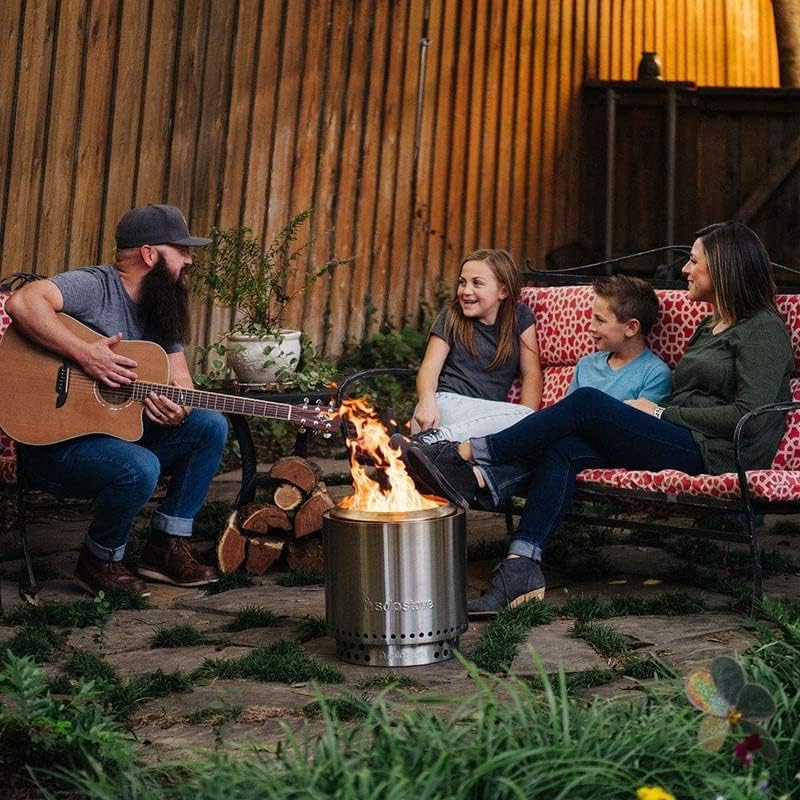
Living With It at Camp
The Ranger 2.0 is at its best when the fire pit needs to move as little of your camping space and carrying capacity as possible.
At just 16.5 pounds, it is noticeably easier to load into a vehicle, move around a campsite, and store between trips than the larger fire pits in this guide. That makes it particularly useful for compact car-camping setups where the fire pit has to share space with sleeping gear, cooking equipment, coolers, and chairs.
The smaller 15-inch format also changes the way the Ranger works at camp. It is better suited to a couple or small group gathered fairly close to the fire rather than a large family spread around a substantial fire pit. For that use case, the smaller footprint is an advantage rather than a limitation.
The included stand adds practical flexibility when choosing where to set it up, while the carrying case makes transporting the fire pit between the vehicle and campsite much easier. Instead of treating the Ranger as a heavy piece of campsite furniture, you can pack it away with the rest of your camping equipment when the evening is over.
The removable ash pan is another useful detail for vehicle-based camping. Cleanup is part of every wood-burning fire, and being able to remove the accumulated ash without turning the entire unit upside down makes the process more manageable before packing everything back into the vehicle.
The tradeoff is fire capacity. Compared with the 19.5-inch Bonfire, 25-inch TIKI, 26-inch Iamsii, or Breeo X Series 19, the Ranger is simply a smaller fire pit. That means you need to think about how many people will normally sit around the fire and how much wood you expect to burn during an evening.
For campers who value easy transport over maximum fire size, that is a sensible compromise. You are giving up some capacity in exchange for a fire pit that is considerably easier to live with on the road.
CampComfortGuide Evaluation
| Evaluation Category | CampComfortGuide Assessment |
|---|---|
| Camping Practicality | ★★★★★ Excellent fit for couples, small groups, and compact vehicle-based campsites. |
| Portability | ★★★★★ At 16.5 lb, it is the easiest fire pit in this lineup to transport and handle. |
| Fire Capacity | ★★★★☆ The 15-inch format works well for smaller groups but cannot match the fire capacity of the larger models. |
| Smoke Management | ★★★★★ The smokeless design is a major advantage once the fire is burning under suitable conditions. |
| Ease of Cleanup | ★★★★★ The removable ash pan simplifies post-fire cleanup. |
| Durability | ★★★★★ Stainless-steel construction is well suited to repeated outdoor use and transport. |
| Transport Features | ★★★★★ The included stand and carrying case make the unit particularly convenient for vehicle camping. |
| Overall Value | ★★★★★ A strong choice for campers who place portability and easy storage ahead of maximum fire size. |
Who Should Buy This
- Campers who want the most portable fire pit in this lineup.
- Couples and small groups who do not need a large burn chamber.
- Car campers with limited vehicle storage.
- RV campers who want a fire pit that is easier to move around the campsite.
- Buyers who value a carrying case and stand as part of the package.
- Campers who prefer a compact fire pit over a large, heavy-duty design.
Who Should Skip This
- Families or groups that regularly gather around a larger fire.
- Campers who want maximum firewood capacity.
- Buyers who prefer a substantial, heavy-duty fire pit for long-term campsite use.
- Anyone with plenty of space but a strong preference for larger fires.
- Campers who expect a fire pit to double as a large cooking surface.
Final Verdict
The Ranger 2.0 is the easiest model here to transport and store. Its 16.5-pound weight, compact 15-inch format, stand, and carrying case all support the same basic advantage: it takes less effort and space to bring to camp.
Its 16.5-pound weight and compact 15-inch format make it dramatically easier to handle than the larger models in this guide. The stand and carrying case strengthen that advantage, while the removable ash pan makes cleanup more manageable between trips.
You do give up fire capacity compared with the larger Bonfire, Iamsii, TIKI, and Breeo models. But for couples, small groups, and campers with limited storage, that is often a worthwhile trade.
When easy transport is the priority, the Ranger 2.0 is the most natural choice in this lineup.
Ready to check today’s price and customer reviews?
Before You Buy
Before choosing the Ranger 2.0, consider the size of the group that will normally use it. The compact 15-inch format is well suited to smaller gatherings, but it is not designed to provide the same fire capacity as a 19.5-, 25-, or 26-inch fire pit.
Also think about where the fire pit will travel in your vehicle. Its relatively low weight is a major advantage, but you still need enough protected storage space for the fire pit, stand, carrying case, and firewood.
Finally, check the rules for your destination before using a wood-burning fire pit. Campground policies and temporary fire restrictions can change by location and season.
Check today’s price and latest customer reviews on Amazon.
Related Guide:
For more help choosing the right setup for vehicle-based camping, our guide to 5 Best Camping Storage Trunks can help you organize and protect bulky gear such as fire pits, cookware, and other campsite equipment.
3. Breeo X Series 19 Stainless Steel
Best Heavy-Duty Option
The Breeo X Series 19 Stainless Steel takes a very different approach to camping fire pits. It is not designed around minimum weight or effortless portability. At approximately 47 pounds, it is a substantial piece of equipment built for campers who are comfortable giving up some transport convenience in exchange for a heavier, more durable fire-pit platform.
The X19 also stands out for its construction. Breeo uses 304 stainless steel for the fire pit, legs, and rim, while the patented X Airflow system and double-wall design are intended to improve airflow and support secondary combustion for a lower-smoke burn.

Quick Verdict
The Breeo X Series 19 Stainless Steel is the fire pit for campers who view durability as a bigger priority than carrying weight. At 47 pounds, it is substantially heavier than the Solo Stove Ranger 2.0 and Bonfire, but that added mass comes with a noticeably more substantial construction and a design intended to remain useful for years of repeated outdoor use.
Its 19-inch interior diameter gives the X19 a useful middle position in Breeo’s lineup. It is large enough to build a meaningful campfire around without moving into the much larger X24 or X30 formats. The heavy-duty stainless-steel construction also gives it a distinctly different character from lighter portable fire pits that are designed primarily around easy transport.
Breeo’s airflow system is another major part of the design. X Airflow feeds oxygen from underneath the fire, while the double-wall construction and secondary-combustion openings are designed to burn wood gases more completely once the fire is established. The goal is not to eliminate every trace of smoke, but to produce a cleaner-burning fire under suitable conditions.
The compromise is portability. Forty-seven pounds is reasonable for an RV or car-camping setup when the vehicle can stay relatively close to the campsite, but it is not a weight you will want to move frequently. The X19 therefore makes the most sense for campers who want a serious, long-term fire pit and are willing to treat transport as part of the setup.
Camp Snapshot
| Category | Breeo X Series 19 Stainless Steel |
|---|---|
| Camping Style | RV Camping • Car Camping • Established Campsites |
| Fire Pit Type | Wood-Burning Smokeless Fire Pit |
| Fuel | Wood |
| Size | X19 |
| Outside Diameter | 22.13 inches |
| Inside Diameter | 18.5 inches |
| Height | 14.75 inches |
| Weight | 47 lb |
| Material | 304 Stainless Steel |
| Recommended Wood Length | 14–16 inches |
| Key Features | X Airflow™ • Double-wall construction • Secondary combustion • Cooking-accessory compatibility |
| Primary Strength | Heavy-duty construction and long-term durability |
| CampComfortGuide Verdict | Best Heavy-Duty Option |
Why We Chose It
The X Series 19 takes the heavy-duty route. Instead of minimizing transport weight, Breeo puts more material and construction into the fire pit and accepts the added weight that comes with it.
The Ranger 2.0 is built around transport convenience. The Bonfire offers a more moderate balance of size and portability. Breeo takes the other route: it puts substantial material and construction into the fire pit and accepts that the result will be considerably heavier to move.
That tradeoff can make sense for frequent vehicle campers. If the fire pit normally travels in an RV, truck, SUV, or other vehicle with enough cargo capacity, 47 pounds becomes much less problematic than it would be for someone carrying equipment any significant distance. In return, you get a fire pit that feels designed around long-term ownership rather than minimum transport weight.
The 304 stainless-steel construction is particularly important here. Breeo specifies heavy-duty gauge stainless steel for the fire pit, while the same material is used for the legs and rim. The company also backs the X Series with a limited lifetime warranty, reinforcing its position as a long-term product rather than a disposable camping accessory.
The X19’s airflow system gives it another clear identity. Breeo’s X Airflow design feeds oxygen through the lower portion of the pit, while secondary-combustion holes in the double-wall structure help burn the gases produced by the fire. This is central to the X Series’ smokeless-burn design.
The 19-inch interior diameter is also well judged for the role we have given it. It provides enough room for a substantial wood fire while avoiding the additional bulk of Breeo’s larger X24 and X30 models. Breeo recommends 14- to 16-inch firewood for the X19, which is a useful practical detail when planning what wood to bring or buy for a trip.
Another advantage is that the X19 is compatible with Breeo’s range of live-fire cooking accessories. That gives campers the option to expand the fire pit into a more capable outdoor cooking setup later, rather than being locked into a fire-only product.
For this guide, that combination of substantial construction, smokeless-fire engineering, manageable size within the Breeo range, and long-term versatility is what makes the X19 the strongest heavy-duty choice.
Check today’s price and latest customer reviews on Amazon.

Living With It at Camp
The Breeo X Series 19 is best suited to a camping setup where the fire pit is treated as substantial equipment rather than something you carry casually from one location to another.
At 47 pounds, the X19 is in a completely different portability class from the Solo Stove Ranger 2.0. For RV campers, truck campers, and car campers with enough cargo capacity, that may not be a serious drawback. Once the fire pit is loaded into the vehicle, its weight matters much less than it would on a campsite that requires a long walk from the parking area.
The benefit becomes more apparent when the fire is actually going. The 19-inch interior gives you enough room to build a meaningful wood fire without stepping into Breeo’s much larger formats. That makes the X19 a sensible middle ground for campers who want a substantial fire but do not need a backyard-sized pit.
The X Airflow system and double-wall construction are central to the experience. Breeo’s design introduces oxygen through the lower part of the fire pit and uses secondary-combustion openings higher in the structure to support a cleaner burn once the fire is established. This is the engineering behind the X Series smokeless approach, rather than simply relying on a shallow bowl or a smaller fire.
That does not mean the X19 will produce no smoke under every condition. Wood moisture, fire-starting stage, airflow, and how the fire is loaded all affect smoke production. The design is most effective once the fire has reached the conditions needed for secondary combustion.
The heavier construction also changes how you think about storage. You are unlikely to move the X19 around repeatedly during a trip, so its best home is a stable location at a spacious campsite. That makes it a particularly natural match for RV camping and established vehicle-accessible sites rather than compact overnight stops where everything needs to be packed away quickly.
Cooking is another potential advantage. Breeo designs the X Series to work with a range of live-fire cooking accessories, allowing the fire pit to become part of a broader outdoor cooking setup. That is worth considering if you want your fire pit to do more than provide warmth and atmosphere.
The main thing to accept is that this is not a minimal camping accessory. The X19 asks for vehicle space, lifting capacity, and a campsite with enough room to use it properly. In return, it gives you a substantially built fire pit that is designed to remain useful far beyond a single camping season.
CampComfortGuide Evaluation
| Evaluation Category | CampComfortGuide Assessment |
|---|---|
| Camping Practicality | ★★★★☆ Excellent for RV and spacious vehicle-based camps, but its 47-pound weight limits how casually it can be moved. |
| Portability | ★★★☆☆ Suitable for vehicle transport, but substantially less convenient to carry than the Solo Stove models. |
| Fire Capacity | ★★★★★ The 19-inch interior provides substantial room for a serious campsite fire without moving into the largest Breeo sizes. |
| Smoke Management | ★★★★★ X Airflow, double-wall construction, and secondary-combustion design are major strengths once the fire is properly established. |
| Ease of Cleanup | ★★★★☆ The open fire-pit design is straightforward to maintain, although the larger and heavier body is less convenient to handle than a lightweight portable pit. |
| Durability | ★★★★★ 304 stainless-steel construction and heavy-duty design make durability one of the X19's defining strengths. |
| Cooking Versatility | ★★★★★ Compatibility with Breeo cooking accessories gives the fire pit useful potential beyond ordinary campfire use. |
| Overall Value | ★★★★★ A strong long-term choice for campers who value substantial construction and versatility more than low weight. |
Who Should Buy This
- Campers who prioritize durability and long-term ownership over minimum weight.
- RV campers and car campers with enough cargo capacity for a 47-pound fire pit.
- Buyers who want a substantial fire rather than the smallest practical campsite model.
- Campers who regularly use established campsites with adequate room around the fire.
- Buyers interested in adding live-fire cooking accessories later.
- Campers who prefer stainless-steel construction and a heavy-duty design.
- Anyone who expects the fire pit to become a regular part of their camping setup.
Who Should Skip This
- Campers who need a lightweight, easy-to-carry fire pit.
- Anyone with very limited vehicle storage.
- Backpackers or campers who must carry equipment any meaningful distance.
- Buyers who want the simplest and quickest setup possible.
- Campers who normally stop at compact sites where a large, heavy fire pit would be difficult to position.
- Anyone who expects two-zone cooking or a built-in grill rather than a fire pit designed for optional accessories.
Final Verdict
The X19 is the strongest choice in this group for campers who are comfortable trading transport convenience for substantial construction. Its 47-pound weight tells you exactly what kind of fire pit this is: a durable, long-term piece of campsite equipment rather than a lightweight accessory.
Its 47-pound weight is the clearest indication of that philosophy. The X19 is not the fire pit you choose because it disappears into the gear pile. You choose it because you are willing to carry a heavier piece of equipment in exchange for substantial stainless-steel construction, a sophisticated airflow design, and the ability to build a more serious campsite fire.
The 19-inch interior also gives it a useful balance. It is large enough to feel substantial around camp without moving into Breeo’s biggest fire-pit formats. Add the option of live-fire cooking accessories, and the X19 becomes more versatile than a fire-only appliance.
For RV campers, frequent car campers, and established campsites where weight is a secondary concern, the X19 is one of the most compelling choices in this lineup.
For campers whose priority is simply getting a fire pit in and out of the vehicle with as little effort as possible, the Ranger 2.0 is a much better fit.
Ready to check today’s price and customer reviews?
Before You Buy
Before buying the X19, make sure your vehicle can comfortably accommodate a 47-pound fire pit along with your other camping equipment. The weight is manageable for vehicle-based camping, but it becomes important when loading and unloading the unit.
You should also consider where the fire pit will sit once you reach camp. The X19 is best suited to a stable, spacious location where it can remain in position for the evening rather than being moved repeatedly.
Finally, check the fire regulations for your destination before taking any wood-burning fire pit on a trip. Portable fire-pit rules and temporary fire restrictions can vary by campground, land-management agency, season, and current conditions.
Check today’s price and latest customer reviews on Amazon.
Related Guide
If you are carrying larger pieces of camping equipment such as a heavy fire pit, our guide to How to Store Camping Gear Properly can help you plan practical storage and organization between trips.
4. TIKI Patio Smokeless Fire Pit 25-Inch
Best for Spacious Campsites
The TIKI Patio Smokeless Fire Pit 25-Inch is designed for campers who have enough room to let the fire pit become a central part of the campsite rather than another piece of gear that has to be squeezed into a small setup. Its 25-inch round format gives it a much larger presence than the compact Solo Stove Ranger, making it better suited to family camping, RV sites, and relaxed evenings with several people around the fire.
At approximately 45 pounds, it is also clear that TIKI has prioritized a substantial campsite experience over lightweight transport. The stainless-steel construction, included stand, removable ash pan, and weather-resistant cover make it feel more like a complete fire-pit setup than a minimalist portable burner.

Quick Verdict
The TIKI Patio Smokeless Fire Pit 25-Inch is the right choice when campsite space matters more than carrying weight. Its large 25-inch diameter gives you substantially more room for a wood fire than the smaller Ranger 2.0, while the overall design is still intended to function as a contained outdoor fire pit rather than a permanent backyard installation.
What makes the TIKI particularly interesting for camping is the combination of size and practical accessories. The included stand raises the fire pit from the ground, the removable ash pan simplifies cleanup, and the weather-resistant cover helps protect the unit when the fire pit is not in use. That makes it easier to treat the TIKI as a regular part of an RV or car-camping setup.
The size also gives it a natural advantage for larger groups. With a 25-inch fire pit, there is more room to build and maintain a substantial fire for an evening around camp, rather than creating a compact fire intended primarily for a few people. The tradeoff is that the pit takes up considerably more room in the vehicle and weighs about 45 pounds.
This is therefore not the model to choose simply because you want the easiest fire pit to transport. The TIKI makes much more sense for campers who have ample vehicle storage, a spacious campsite, and a preference for a larger fire over minimum weight.
Camp Snapshot
| Category | TIKI Patio Smokeless Fire Pit 25-Inch |
|---|---|
| Camping Style | RV Camping • Car Camping • Spacious Campsites |
| Fire Pit Type | Wood-Burning Smokeless Fire Pit |
| Fuel | Wood |
| Size | 25-inch |
| Dimensions | 24.75" × 24.75" × 18.75" |
| Weight | 45 lb |
| Material | Stainless Steel |
| Shape | Round |
| Key Features | Smokeless airflow • Removable ash pan • Stand • Weather-resistant cover |
| Primary Strength | Large fire-pit format for spacious campsites and group use |
| CampComfortGuide Verdict | Best for Spacious Campsites |
Why We Chose It
The TIKI makes the most sense when campsite space is plentiful and the fire is meant to be a central part of the evening. Its 25-inch format gives it a much larger presence than the Ranger and puts it firmly in the large-format end of this lineup.
That distinction matters when comparing it with the rest of this lineup. The Ranger 2.0 is built around low weight and compact storage. The Bonfire aims for a middle ground, while the Breeo X Series 19 takes a heavy-duty approach. The TIKI instead makes a strong case for campers who have enough room to bring a larger fire pit and actually want the additional scale.
The 25-inch round format provides more room for building a substantial wood fire, which can be particularly useful when several people are gathered around the campsite. It is a better match for an evening centered around the fire than for campers who simply want the smallest practical fire pit to take along.
The 16-gauge stainless-steel construction is another meaningful part of the design. TIKI combines that substantial body with an integrated airflow approach intended to support a cleaner burn and reduce visible smoke once the fire is properly established.
The included accessories also help justify the larger footprint. The removable ash pan makes the cleanup process more manageable, while the stand provides a dedicated base for the fire pit. The included weather-resistant cover is useful when the unit is stored outdoors between uses, particularly at campsites where weather can change quickly.
There is also a practical benefit to the TIKI’s more substantial proportions when the campsite itself is the priority. A larger fire pit can make it easier for people to sit around the fire without everyone crowding into a small circle immediately next to the burn chamber.
The downside is impossible to overlook: 45 pounds is a serious camping load. It is appropriate for an RV, truck, SUV, or other vehicle-based setup where the fire pit does not have to be carried far. It is much harder to justify for campers who regularly move through compact sites or have limited cargo capacity.
That balance is exactly why we gave the TIKI its own role. It does not compete with the Ranger on portability, and it does not try to match the Breeo purely on heavy-duty construction. Instead, it is the model for campers who want a large, comfortable campsite fire with a practical accessory package and have enough space to accommodate it.
Check today’s price and latest customer reviews on Amazon.

Living With It at Camp
The TIKI Patio Smokeless Fire Pit is best suited to campsites where the fire is going to be part of the evening for several hours and there is enough room to leave a larger fire pit comfortably in place.
At roughly 25 inches wide and 45–46 pounds, it is not a fire pit you choose for minimal packing weight. Instead, its size gives you a broad fire area that works well when several people are gathered around camp. For an RV, truck, SUV, or spacious car-camping setup, that tradeoff can be reasonable.
The stand is an important part of the overall setup because it gives the Patio Fire Pit a dedicated raised base rather than requiring you to improvise its position at camp. TIKI also includes a weather-resistant cover, which is useful when the fire pit has to remain outdoors between uses or during changing weather.
The removable ash pan is one of the more practical features for repeated camping use. Once the fire pit has completely cooled, the ash pan can be removed and emptied without having to turn the entire 25-inch body over. That makes end-of-evening cleanup considerably more manageable.
The Patio model also uses TIKI’s airflow-focused smokeless design. The manufacturer says the system is intended to create optimal burning conditions and support a cleaner fire, while the removable dome can be used with either TIKI Wood Packs or traditional firewood. For traditional logs, TIKI recommends dry, seasoned wood cut to 16 inches or shorter so it fits within the bowl.
That firewood requirement is worth considering before a camping trip. A larger fire pit can hold more wood, but it also means transporting more fuel and giving the fire enough space to burn properly. The TIKI makes sense when the vehicle and campsite can accommodate both the pit and the firewood needed to use it.
The 25-inch format also gives this model a different character from the Solo Stove Ranger 2.0. The Ranger is built around compact transport and smaller groups, while the TIKI is much more comfortable as a large-group campsite fire pit that can remain in one place once you arrive.
One thing to plan carefully is placement. TIKI’s instructions call for the fire pit to be at least 15 feet from walls, structures, buildings, dry grass, bushes, awnings, and other combustible materials, and it should not be used beneath roofs, low branches, trellises, or other overhangs.
That requirement reinforces the role we have given the TIKI in this guide. It is best when you have a genuinely spacious, suitable campsite rather than a compact location where every piece of gear has to fit into a small footprint.
CampComfortGuide Evaluation
| Evaluation Category | CampComfortGuide Assessment |
|---|---|
| Camping Practicality | ★★★★☆ Very well suited to spacious RV and car-camping sites, but its size limits where it is practical to use. |
| Portability | ★★★☆☆ Suitable for vehicle transport, but the roughly 45–46 lb weight makes it a poor choice for frequent carrying. |
| Fire Capacity | ★★★★★ The 25-inch format provides a broad fire area that works particularly well for larger groups. |
| Smoke Management | ★★★★★ TIKI's airflow-focused design is intended to support cleaner burning once the fire is properly established. |
| Ease of Cleanup | ★★★★★ The removable ash pan makes ash removal straightforward once the fire pit has fully cooled. |
| Durability | ★★★★★ 16-gauge stainless-steel construction with a powder-coated finish provides a substantial outdoor-use build. |
| Weather Protection | ★★★★★ The included weather-resistant cover is useful for protecting the fire pit between uses. |
| Overall Value | ★★★★☆ A strong option for campers who have the space and want a large, complete campsite fire-pit setup. |
Who Should Buy This
- Campers who want a large wood-burning fire pit for group evenings.
- RV campers with enough outdoor space to position a 25-inch fire pit safely.
- Car campers using a truck, SUV, or larger vehicle with adequate cargo capacity.
- Families and groups who want a substantial fire around which several people can sit.
- Campers who value a removable ash pan and included weather-resistant cover.
- Buyers who prefer a larger campsite experience over minimum transport weight.
Who Should Skip This
- Campers who prioritize lightweight equipment and easy carrying.
- Anyone with limited vehicle storage.
- Backpackers or campers who need to move their fire pit any significant distance on foot.
- Campers who usually stay at small sites with restricted usable space.
- Buyers who want the smallest practical fire pit for two or three people.
- Anyone who cannot provide the clear placement area required for safe operation.
Final Verdict
The TIKI is the natural fit for spacious campsites where the fire can remain in one place and become part of the evening. Its 25-inch format, stand, ash pan, and weather-resistant cover make it a substantial but practical choice for RV and larger vehicle-based camping.
Its 25-inch format gives it the scale to serve as the center of a larger gathering, while the removable ash pan, stand, and weather-resistant cover make the overall setup more practical for repeated use. The airflow-focused design adds another reason to consider it for campers who want a cleaner-burning fire experience.
The price of that larger experience is weight and space. At roughly 45–46 pounds, the TIKI belongs in a vehicle-based camping setup where loading and unloading are manageable. It also needs a properly cleared area because of the manufacturer’s placement requirements.
For campers with a spacious RV or car-camping setup who want the fire to become a central part of the evening, the TIKI is a convincing choice.
Ready to check today’s price and customer reviews?
Before You Buy
Before buying the TIKI Patio Smokeless Fire Pit, make sure your vehicle has enough room for a roughly 25-inch-wide, 45–46-pound fire pit as well as your other camping equipment and firewood.
Pay particular attention to the campsite itself. TIKI specifies at least 15 feet of clearance from structures and combustible materials and prohibits use under roofs, low branches, trellises, and other overhangs.
You should also plan your firewood around the pit’s requirements. TIKI recommends dry, seasoned wood up to 16 inches long for traditional firewood use.
Finally, check local campground rules and current fire restrictions before bringing a wood-burning fire pit to camp. Solid-fuel fires can be restricted even when the campsite itself is open.
Check today’s price and latest customer reviews on Amazon.
Related Guide:
If you want to make your campsite more comfortable around the fire, our guide to 5 Best Camping Chairs for Bad Backs can help you choose seating that works well for longer evenings around camp.
5. Iamsii 26-Inch Smokeless Fire Pit
The Iamsii 26-Inch Smokeless Fire Pit is the large-capacity option in this lineup for campers who want more room around the fire than the compact Solo Stove designs can provide. Its broad 26-inch class format is better suited to family camps, group gatherings, and spacious vehicle-based sites where a larger fire pit can remain the center of the evening.
This is also a more accessory-focused design than the minimalist fire pits in the lineup. The package includes a stand, removable ash pan, cover, and grill, giving it practical versatility for campers who want their fire pit to serve more than one purpose. The selected Amazon listing identifies it as a stainless-steel, wood-burning smokeless fire pit with a 360-degree airflow design.

Quick Verdict
The Iamsii 26-Inch Smokeless Fire Pit is the model to consider when a larger fire matters more than having the lightest possible setup. Its wide fire-pit format provides substantially more room than the 15-inch Ranger 2.0, making it a more natural fit for family camping and larger gatherings.
One of its biggest advantages is the combination of fire capacity and included accessories. The stand gives the unit a dedicated base, the removable ash pan simplifies cleanup, the cover helps with storage and protection, and the included grill adds a useful cooking option when you want to do more than sit around the fire.
The stainless-steel construction and 360-degree airflow design are intended to support a durable, cleaner-burning fire. As with other smokeless-style fire pits, the airflow system works best when the fire is properly established and dry, suitable firewood is being used.
The tradeoff is physical size. A fire pit in this class needs considerably more vehicle space than the Ranger 2.0 and makes much more sense for car camping, RV camping, and spacious campsites than for compact trips where storage and handling are the primary concerns.
Camp Snapshot
| Category | Iamsii 26-Inch Smokeless Fire Pit |
|---|---|
| Camping Style | Car Camping • RV Camping • Family & Group Campsites |
| Fire Pit Type | Wood-Burning Smokeless Fire Pit |
| Fuel | Wood |
| Size | 26-inch class |
| Weight | 28.8 lb |
| Material | Stainless Steel |
| Shape | Round |
| Key Features | 360° airflow • Smokeless design • Stand • Removable ash pan • Cover • Grill |
| Primary Strength | Large fire capacity with useful camping accessories |
| CampComfortGuide Verdict | Best for a Large Fire |
Why We Chose It
The Iamsii occupies an interesting middle ground for campers who want a genuinely large fire without stepping all the way up to the weight of the TIKI or Breeo. Its 26-inch format gives it the largest fire-pit footprint in this lineup, while the 28.8-pound weight remains comparatively manageable for vehicle camping.
The 26-inch format puts it firmly into the larger-fire category. That can be valuable when a campsite is built around an evening fire rather than simply using the pit as a small source of warmth for two or three people. There is more room to arrange firewood and maintain a larger central fire as the evening continues.
Its weight of approximately 28.8 pounds is also worth noting. That is considerably more than the Solo Stove Ranger 2.0, but it is still lighter than the 45-pound TIKI and 47-pound Breeo X Series 19 in this lineup. For a camper with a vehicle and reasonable cargo capacity, that creates an interesting balance between fire size and transport burden.
The accessory package further separates the Iamsii from the minimalist models. The included grill, stand, ash pan, and cover mean the fire pit arrives as a more complete campsite setup. The grill in particular gives it potential as a cooking-oriented fire pit, which can be useful when you want to combine evening campfire use with simple live-fire cooking.
The 360-degree airflow design is another important part of the product’s identity. The manufacturer/product listing describes the system as being designed to improve airflow around the fire, helping support cleaner burning and reduced smoke once the fire is established.
The removable ash pan is particularly relevant for vehicle-based camping. A larger wood fire naturally produces more ash, so being able to separate that material from the main fire pit makes end-of-evening maintenance easier and reduces the amount of loose ash that needs to be dealt with before transport.
The cover also matters more with a larger fire pit because it is less practical to move the entire unit indoors after every use. Having a dedicated cover gives you a straightforward way to protect the fire pit between evenings at camp or while it is stored outdoors, subject to the manufacturer’s care instructions.
This combination is why we gave the Iamsii its own role rather than treating it as simply another smokeless fire pit. It is the large-fire option for campers who want more fire capacity and useful accessories without choosing the heaviest fire pit in the group.
Check today’s price and latest customer reviews on Amazon.

Living With It at Camp
The Iamsii 26-Inch Smokeless Fire Pit is most at home in a campsite where the fire is a central part of the evening and there is enough room to accommodate a larger setup.
Its 26-inch format gives you considerably more room to arrange firewood than the Solo Stove Ranger 2.0, so the experience is less about creating a compact personal fire and more about building a larger fire that several people can enjoy. That makes it a natural fit for family camping, group trips, and spacious RV or car-camping sites.
The 28.8-pound weight is worth putting into context. It is certainly heavier than the Ranger, but it remains substantially easier to handle than the 45-pound TIKI and 47-pound Breeo X Series 19. For vehicle-based campers, that creates a useful middle ground: large fire capacity without choosing the heaviest model in the lineup.
The included stand also helps make setup more straightforward. Rather than finding a way to position the fire pit directly at the campsite, you have a dedicated base included with the package. That is particularly useful when you move between different campgrounds and need to establish a consistent fire area.
The removable ash pan is another feature that becomes more useful as the fire gets larger. A bigger wood-burning fire naturally leaves more ash behind, so having a dedicated pan makes the cleanup process easier once everything has cooled completely.
The included grill changes the role of the Iamsii as well. It gives you the option to use the fire pit for simple live-fire cooking rather than limiting it to warmth and evening ambience. That can be useful for campers who want one large central fire feature that can also support food preparation.
The cover is similarly practical for vehicle camping. Once the fire pit has cooled, having a dedicated cover gives you a straightforward way to protect the unit between uses and during transport, provided it is used according to the manufacturer’s care instructions.
The most important thing to remember is that a 26-inch fire pit needs more than just storage space. You also need a campsite with enough clear area around the fire, sufficient room for the people gathering around it, and enough vehicle capacity for the fire pit, stand, grill, cover, and firewood.
That makes the Iamsii a very different proposition from the Ranger. The Ranger wins when every pound and every inch of storage matters. The Iamsii makes more sense when you are willing to bring a larger piece of equipment because you want the fire itself to be bigger and more useful.
CampComfortGuide Evaluation
| Evaluation Category | CampComfortGuide Assessment |
|---|---|
| Camping Practicality | ★★★★☆ A strong fit for spacious RV and car-camping setups where the fire pit can remain in one location. |
| Portability | ★★★★☆ At 28.8 lb, it is manageable for vehicle camping and lighter than the largest models in this guide. |
| Fire Capacity | ★★★★★ The 26-inch format provides the largest fire-pit footprint in this lineup. |
| Smoke Management | ★★★★☆ The 360° airflow design is intended to support cleaner combustion when the fire is properly established and suitable dry wood is used. |
| Ease of Cleanup | ★★★★★ The removable ash pan is a practical advantage after larger wood fires. |
| Durability | ★★★★☆ Stainless-steel construction is well suited to repeated outdoor use and vehicle transport. |
| Cooking Versatility | ★★★★★ The included grill gives the fire pit useful potential for simple live-fire cooking. |
| Overall Value | ★★★★☆ A compelling option for campers who want a larger fire and useful accessories without moving to a 45–47 lb fire pit. |
Who Should Buy This
- Campers who want a large central fire for family or group evenings.
- Car campers and RV campers with enough storage for a 26-inch fire pit.
- Buyers who want a larger fire without carrying the weight of the Breeo or TIKI models.
- Campers who want a fire pit that can also support simple live-fire cooking.
- Buyers who value an included grill, stand, ash pan, and cover.
- Campers who regularly use spacious, vehicle-accessible campsites.
Who Should Skip This
- Campers who prioritize minimum weight and compact storage.
- Couples who normally need only a very small evening fire.
- Anyone who must carry the fire pit a significant distance from the vehicle.
- Campers with limited cargo space.
- Buyers looking for a more established heavy-duty construction philosophy like the Breeo X Series 19.
- Anyone camping at destinations where wood-burning fire pits are prohibited or restricted.
Final Verdict
The Iamsii is the better choice when fire size is important but a 45- or 47-pound fire pit feels excessive. Its 26-inch format provides plenty of room for a larger gathering fire, while the 28.8-pound weight keeps it more manageable for vehicle-based camping.
Its 26-inch format is the defining characteristic. This is a fire pit for campers who want a larger gathering fire and have enough campsite and vehicle space to accommodate it. The 28.8-pound weight is certainly noticeable, but it remains much more manageable than the 45-pound TIKI or 47-pound Breeo.
The accessory package strengthens its camping appeal. A grill, stand, removable ash pan, and cover give you more practical flexibility than a bare fire-pit design, while the airflow system is intended to support a cleaner-burning fire once operating conditions are right.
There are lighter and more compact choices in this guide, but that is not what the Iamsii is trying to be. Its role is to give you more fire, more usable space, and more campsite functionality without requiring the extreme weight of the most substantial fire pits.
For campers who travel by car or RV and want the fire to play a major role in the campsite experience, the Iamsii is a strong large-format choice.
Ready to check today’s price and customer reviews?
Before You Buy
Before choosing the Iamsii, make sure your vehicle can accommodate a 26-inch fire pit and its accessories alongside the rest of your camping equipment. You will also need room for enough suitable firewood to take advantage of the larger burn chamber.
Consider the campsite itself just as carefully. A larger fire pit needs a properly cleared area with enough space around it for safe operation and for people to sit comfortably away from the fire.
The included grill is useful, but remember that using the fire pit for cooking adds another task to the setup. Keep food preparation and fire management organized so that the cooking area does not interfere with the safe operation of the fire.
Finally, check campground rules and current fire restrictions before your trip. A portable wood-burning fire pit may still be prohibited under local or seasonal restrictions.
Check today’s price and latest customer reviews on Amazon.
Related Guide:
If you plan to use the included grill for campfire cooking, our guide to 5 Best Camping Dutch Ovens can help you choose cookware that works especially well with a live-fire cooking setup.
How to Choose the Right Wood-Burning Fire Pit for Camping
Choosing a wood-burning fire pit for camping starts with the way you travel. A 16.5-pound fire pit that fits easily into a crowded vehicle solves a very different problem from a 45- or 47-pound model designed for a spacious campsite.
Before comparing brands, think about transport, fire size, group size, smoke management, cleanup, and campsite conditions. These factors will usually narrow the choice much faster than a long list of secondary features.
1. Start With Weight and Transport
For vehicle-based camping, portability is largely about how much effort you are willing to spend moving the fire pit.
The Solo Stove Ranger 2.0 is the lightest model in this lineup at about 16.5 pounds, making it the easiest choice when storage and handling matter most. At the other end, the Breeo X Series 19 weighs about 47 pounds, while the TIKI Patio Fire Pit is around 45 pounds. Those heavier models make much more sense when the vehicle can stay close to the campsite.
Do not look only at the fire pit’s empty weight. Consider the stand, cover, carrying case, cooking accessories, and firewood that you may need to transport alongside it.
2. Choose the Fire Size for Your Group
A larger fire pit gives you more room for firewood and a larger central fire, but it also takes more space in the vehicle and at the campsite.
For couples and smaller groups, the 15-inch Ranger 2.0 can be enough. The Solo Stove Bonfire moves into a more versatile middle size for group camping, while the 25- and 26-inch TIKI and Iamsii models are better suited to campers who want a larger fire as the focal point of the campsite.
Think about how people actually gather around the fire. A fire pit that is oversized for two people may simply consume storage space you could use for other camping gear.
3. Decide How Important Smokeless Burning Is
Most of the models in this lineup use airflow systems designed to support secondary combustion and reduce visible smoke once the fire is properly established. This has become one of the main selling points of modern wood-burning fire pits.
But “smokeless” should not be interpreted as literally zero smoke under every condition. Wet or poorly seasoned firewood, the initial lighting stage, restricted airflow, and overloading the burn chamber can all affect smoke production.
When comparing models, look at the overall airflow design rather than choosing solely because a product title contains the word “smokeless.”
4. Consider How Much Cleanup You Want
Ash is part of every wood-burning fire, so the way a fire pit handles it matters when you are packing for the next morning.
A removable ash pan can make cleanup considerably easier because you can separate the accumulated ash from the main body after the fire has completely cooled. This is particularly useful for campers who use the same fire pit repeatedly during a trip.
The Ranger 2.0, Bonfire bundle, TIKI, and Iamsii models in this lineup all place useful emphasis on ash management. When comparing fire pits without a dedicated ash pan, think about how you will safely remove and dispose of the ash before packing the unit back into your vehicle.
5. Think About Where You Will Use It
A camping fire pit needs more than enough space to physically fit. You also need a suitable, cleared location around the fire.
Large models such as the TIKI, Iamsii, and Breeo require more room than the Ranger, both for the fire pit itself and for people sitting around it. The campsite also needs to comply with the manufacturer’s clearance requirements and local campground or land-management rules.
This is especially important during dry seasons or temporary fire restrictions, when wood-burning fires may be limited or prohibited regardless of which fire pit you bring.
6. Decide Whether Cooking Matters
Some campers want a fire primarily for warmth and atmosphere. Others would like to cook over it.
That distinction can change which model makes sense. The Iamsii 26-Inch includes a grill, while the Breeo X Series 19 is compatible with dedicated live-fire cooking accessories. A straightforward fire pit may be the better choice when cooking is not part of your plan.
Do not choose a larger fire pit simply because it can support cooking. If most of your meals are prepared on a separate camping stove, extra cooking capability may not justify the additional weight and storage requirements.
7. Match the Fire Pit to Your Camping Style
The final decision should come from the way the fire pit will actually be used.
For compact car camping, portability may outweigh everything else. For RV camping, a heavier fire pit can be reasonable because you have more vehicle capacity and may spend longer periods at one campsite. For family or group camping, a larger burn chamber can make the evening around the fire more comfortable.
The five models in this guide deliberately cover those different situations. Choose the fire pit that fits your vehicle, your group, your campsite, and your preferred way of using a wood fire—not simply the model with the largest diameter or the longest feature list.
Wood-Burning vs. Propane Fire Pits for Camping
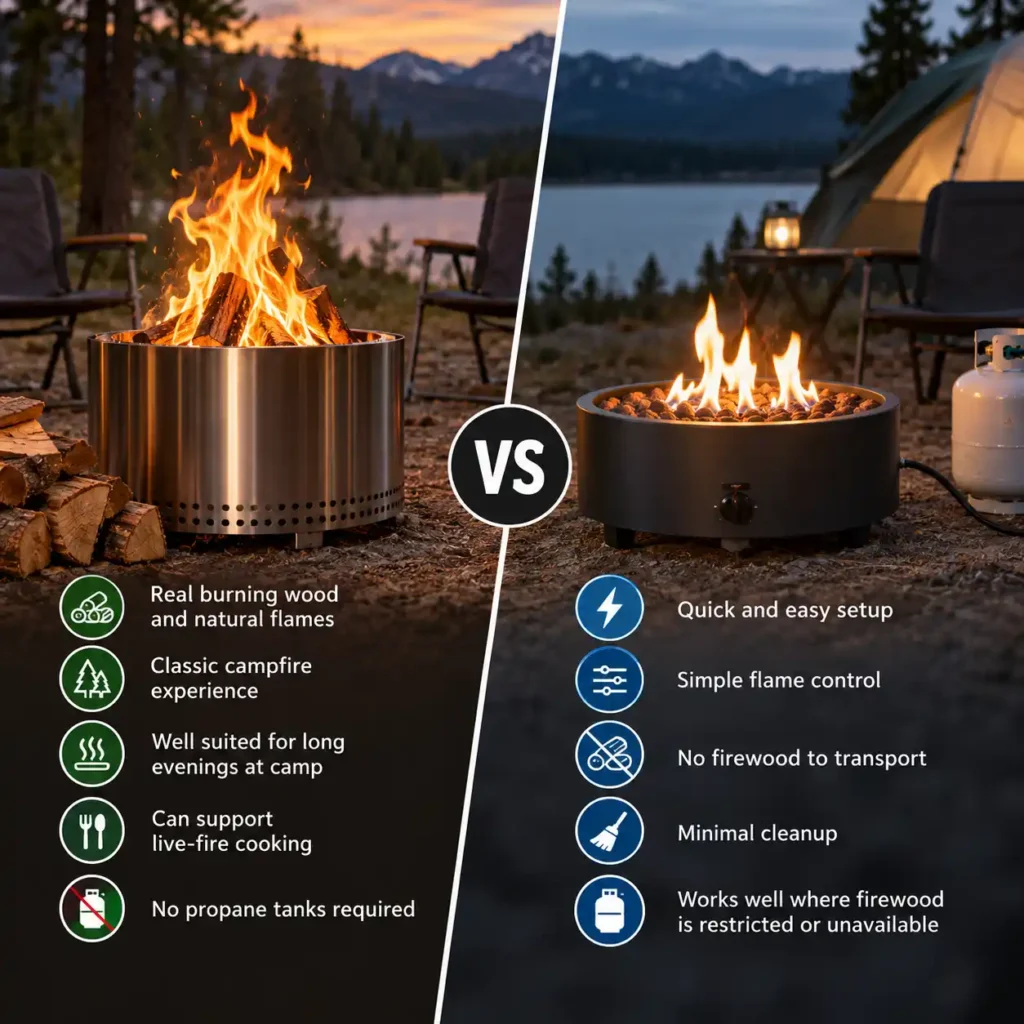
Wood-burning and propane fire pits can both work well at camp, but they serve different purposes. The choice comes down to how much you value the experience of a real wood fire versus the convenience of a cleaner, faster, more controlled setup.
Wood-Burning Fire Pits
Wood-burning fire pits are the better choice for campers who want the full campfire experience. You get real flames, burning wood, natural heat, and the familiar atmosphere of gathering around a fire.
They also do not require propane tanks, regulators, or fuel bottles. Once you have suitable firewood, the fuel system itself is simple.
The tradeoff is preparation. You need dry firewood, more time to build and manage the fire, and a way to deal with ash afterward. Wood fires can also produce smoke during startup or when the wood is wet, even when the fire pit uses a secondary-combustion design.
Propane Fire Pits
Propane fire pits are much more convenient when quick setup and easy control matter most.
There is no firewood to transport or split, and starting the fire is usually much faster. You can also adjust the flame without rearranging logs or waiting for the fire to settle into a new burn pattern.
That convenience comes at the cost of a different camping experience. Propane fire pits do not provide the same burning-wood atmosphere, and you need to transport and manage the propane supply.
Which One Is Better for Your Camping Setup?
| Camping Situation | Better Choice | Why |
|---|---|---|
| Want the traditional campfire experience | Wood-burning | Real burning wood, natural flames, and classic campfire atmosphere. |
| Fast setup after arriving at camp | Propane | Starts quickly without preparing firewood. |
| Long evening around the fire | Wood-burning | Well suited to a traditional gathering fire and extended fire management. |
| Minimal cleanup | Propane | No wood ash to remove after the fire. |
| Do not want to transport propane | Wood-burning | Uses firewood instead of a fuel cylinder. |
| Do not want to transport firewood | Propane | No logs or kindling required. |
| Want to cook over a real fire | Wood-burning | Can support live-fire cooking with suitable equipment. |
| Precise flame control | Propane | Flame output can be adjusted directly. |
| Wood-burning fires permitted and readily available | Wood-burning | Works naturally with a suitable established campsite. |
| Firewood is restricted or unavailable | Propane | Does not depend on a local wood supply. |
The Important Camping Difference
The biggest distinction is not simply wood versus propane. It is how much involvement you want from the fire itself.
A wood-burning fire pit becomes part of the camping experience. You choose and arrange the wood, start the fire, manage the airflow, add fuel as needed, and clean out the ashes afterward.
A propane fire pit is more appliance-like. It is ready when you need it, easier to control, and generally quicker to shut down and pack away.
For campers who enjoy sitting around a real fire and do not mind the extra preparation, wood-burning is usually the more satisfying choice. For campers who value convenience, speed, and simpler cleanup, propane has a clear advantage.
And for either type, the final decision should always be checked against the rules of the specific campground or public land area, since fire restrictions can change with location, season, and current conditions.
Common Mistakes When Using a Wood-Burning Fire Pit for Camping
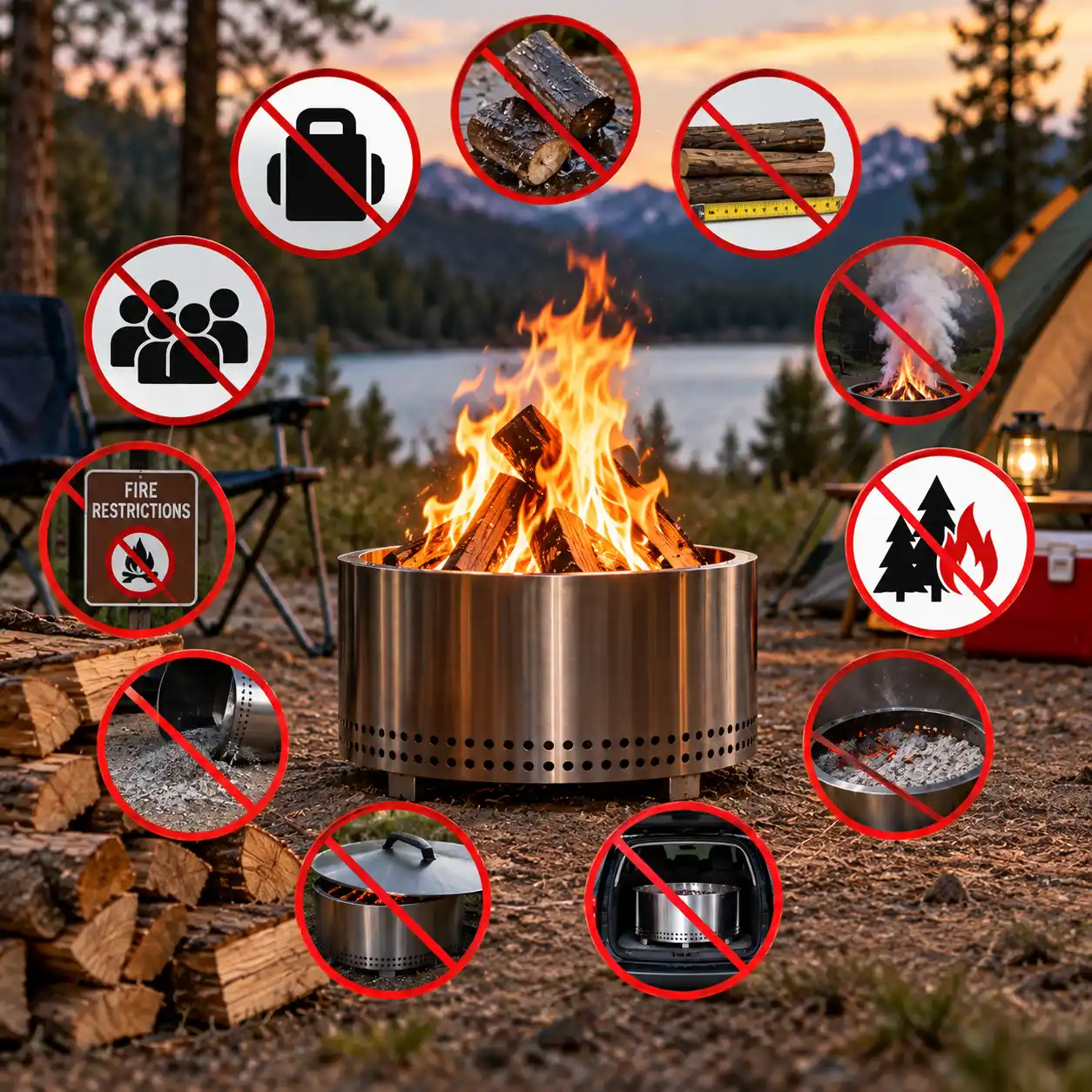
A wood-burning fire pit is fairly simple equipment, but camping adds a few complications that are easy to overlook. Most problems come from choosing a pit that does not fit the trip, using the wrong fuel, or treating campsite fire rules as an afterthought.
1. Choosing the Fire Pit Without Considering Its Weight
A larger fire pit can look appealing in product photos, but its weight becomes very real when you have to load it into the vehicle, move it to the campsite, and pack it away again.
The difference between a 16.5-pound Ranger 2.0 and a 47-pound Breeo X Series 19 is significant. For short-distance vehicle access, that may not matter much. For compact trips or campsites where gear has to be carried farther, it can change which model makes sense.
2. Buying the Largest Fire Pit You Can Fit
More fire capacity is not automatically better.
A 25- or 26-inch fire pit can be excellent for a large group, but it also takes more space in the vehicle, needs a larger clear area at camp, and may require more firewood. For two people, a smaller fire pit may be easier to transport and perfectly adequate for an evening around the fire.
Choose the size around the number of people who normally use it, not simply the largest diameter available.
3. Assuming “Smokeless” Means Zero Smoke
Modern fire pits can significantly reduce visible smoke when their airflow systems and secondary combustion are working properly, but no wood-burning fire pit should be treated as completely smoke-free under every condition.
Wet or poorly seasoned wood, the early stages of a fire, restricted airflow, and overloading the burn chamber can all increase smoke.
A smokeless design can improve the experience, but good firewood and proper fire management still matter.
4. Burning Wet or Poorly Seasoned Firewood
Wood quality can have a bigger effect on your fire than the fire pit itself.
Wet wood tends to burn poorly, produce more smoke, and make it harder for the fire to reach the conditions needed for efficient secondary combustion. Dry, properly seasoned firewood is a much better starting point.
Also check whether your destination has restrictions on transporting firewood. Some parks and regions restrict the movement of firewood to reduce the spread of insects and tree diseases.
5. Ignoring Firewood Length
A fire pit may have plenty of room internally but still be awkward to use if the logs are too long.
Check the manufacturer’s recommended firewood length before your trip. The Breeo X Series 19, for example, is designed around wood approximately 14–16 inches long, while other larger fire pits can accommodate different sizes.
Cutting or purchasing the right size of firewood before you leave is much easier than trying to improvise at the campsite.
6. Forgetting How Much Space the Fire Pit Needs
The fire pit itself is only part of the footprint.
You also need room around it for people, chairs, firewood, and safe access. Larger models such as the TIKI Patio Fire Pit and Iamsii 26-Inch require considerably more usable space than the Ranger 2.0.
A cramped campsite can make a large fire pit inconvenient even when the pit itself technically fits.
7. Skipping Local Fire Restrictions
This is one of the most serious mistakes.
Do not assume that a portable fire pit is automatically permitted because it is raised off the ground or marketed as smokeless. Campground rules, seasonal restrictions, drought conditions, and land-management regulations can limit or prohibit wood-burning fires.
Check the specific rules for the campground or public land area you are visiting, including any temporary fire restrictions in effect at the time of your trip.
8. Packing the Fire Pit Before It Has Fully Cooled
A fire can appear finished while the remaining embers and ash are still hot.
Give the fire pit enough time to cool completely before emptying it, covering it, or placing it back in your vehicle. Hot ash or hidden embers can damage equipment and create a serious fire hazard.
Never rely only on the appearance of the flames to decide that the fire is safe to pack.
9. Leaving Ash in the Fire Pit During Transport
Ash may look harmless, but loose material can spread through the vehicle and may also contain hot embers if the fire has not been completely extinguished.
Use the fire pit’s ash-management system where provided, and dispose of cooled ash according to the campground’s instructions. Models with removable ash pans can make this process considerably easier.
10. Treating a Camping Fire Pit Like a Permanent Backyard Fire Pit
A camping fire pit still needs to be transported, stored, cleaned, and protected from weather.
Think about the entire lifecycle of the trip: loading it, carrying it, setting it up, burning the fire, cleaning the ash, and packing it away.
A model that looks impressive at a stationary backyard gathering may not be the most sensible choice for someone who camps frequently and has to move every piece of equipment between trips.
11. Buying Accessories You Will Not Actually Use
A bundle with a stand, lid, cover, grill, shelter, or cooking accessories can be useful, but extra equipment also takes up storage space.
Before paying more for a larger package, decide which accessories genuinely fit your camping routine. A camper who never cooks over the fire may get more value from a simple setup, while someone who wants to grill or leave the pit outdoors may benefit from the additional equipment.
The best accessory package is the one that solves a real problem at your campsite.
12. Forgetting That Wood-Burning Fires Need Active Management
A wood-burning fire pit is not a set-and-forget appliance.
You still need to choose suitable wood, control how much fuel goes into the fire, monitor the surrounding area, and make sure the fire is completely extinguished before leaving it unattended.
The fire pit can make the experience more contained and organized, but it does not remove the responsibilities that come with having a wood fire at camp.
How to Use a Wood-Burning Fire Pit Safely While Camping
A wood-burning fire pit can make a campsite more comfortable, but it still needs to be treated as an active fire rather than a piece of camping furniture. Good setup, appropriate fuel, adequate clearance, and careful extinguishing are what keep the fire manageable from the moment you light it until the fire pit is packed away.
Use the Fire Pit on a Stable, Appropriate Surface
Set the fire pit on a firm, level surface that is suitable for the model and the campsite. Avoid unstable ground where the pit could tip or shift as people move around it.
Use the supplied stand when the manufacturer specifies one, and do not improvise with materials that could be damaged by heat. Keep the area immediately around the fire pit clear of loose gear, bags, clothing, and other combustible items.
Maintain Plenty of Clearance
Give the fire pit enough open space from tents, RVs, vehicles, trees, low branches, dry vegetation, awnings, structures, and other combustible materials.
The exact clearance depends on the fire pit and its instructions, so use the manufacturer’s requirements as the minimum rather than treating a generic distance as universally safe.
Large fire pits also need enough room for people to sit comfortably without getting too close to the flames or having chairs, blankets, and clothing positioned in the heat zone.
Burn Only Appropriate Firewood
Use dry, suitable firewood rather than wet logs, treated lumber, construction scraps, or materials that are not intended for burning.
Follow the manufacturer’s recommended wood size where one is provided. Properly sized firewood helps maintain airflow and prevents the burn chamber from being overloaded.
Do not assume that a larger fire will always burn better. Overfilling the fire pit can interfere with airflow and create more smoke and heat than the design is intended to handle.
Keep Combustible Items Away From the Fire
Camping equipment tends to accumulate around a fire as the evening progresses. Chairs move closer, jackets get hung nearby, bags are placed on the ground, and blankets can end up within reach of sparks.
Keep a deliberate buffer around the fire pit and regularly check the surrounding area for anything that may have been moved too close.
This matters particularly on windy evenings, when sparks and embers can travel farther than expected.
Never Leave the Fire Unattended
A wood-burning fire should remain under active supervision while it is burning.
Wind can change quickly, logs can shift, and embers can escape the fire pit. Make sure a responsible adult is watching the fire and knows where the water or other appropriate extinguishing supplies are located.
Do not leave the campsite assuming that the fire will safely burn itself out.
Be Careful With Ash and Embers
A fire may look finished while hot embers remain underneath the ash.
Do not remove or transport ash until the fire pit has completely cooled. Use the supplied ash pan or the manufacturer’s recommended cleanup method, and follow the campsite’s instructions for ash disposal.
Never place hot ash into a plastic bag, vehicle storage area, trash container, or other combustible location.
Keep Water and Extinguishing Supplies Accessible
Have an appropriate way to extinguish the fire available before you light it. Do not wait until the fire needs to be extinguished before looking for water or other supplies.
When extinguishing, follow the instructions for the fire pit and the requirements of the campground or land-management authority. The objective is not simply to reduce the visible flames but to make sure the fire and remaining embers are fully out.
Check Fire Restrictions Before You Travel
A fire pit does not override local fire regulations.
Before your trip, check whether wood-burning fires, portable fire pits, or open fires are permitted at your destination and whether temporary restrictions are currently in effect. Rules can change with drought, weather, wildfire danger, season, and location.
Also check whether there are restrictions on collecting or transporting firewood. A campsite that permits fires may still have separate rules governing the wood you bring.
Let the Fire Pit Cool Completely Before Packing
Give the fire pit plenty of time to cool before moving it.
The metal body, ash, and remaining embers can stay hot long after the visible fire has disappeared. Packing the unit too early can damage surrounding gear or create a serious fire hazard inside a vehicle.
Once the fire is completely out and the fire pit has cooled, clean the ash according to the manufacturer’s instructions before storing the unit.
Follow the Specific Manufacturer Instructions
Every fire pit has its own requirements for placement, operation, wood size, accessories, cleanup, and storage.
The instructions supplied with your particular model should always take priority over generic camping advice. This is especially important for larger fire pits and models with stands, covers, cooking accessories, or specialized airflow systems.
The safest approach is straightforward: set up the fire pit correctly, burn suitable dry wood, maintain generous clearance, supervise the fire continuously, and make absolutely sure the fire and embers are fully extinguished before leaving or packing up.
How to Clean and Maintain a Wood-Burning Fire Pit While Camping
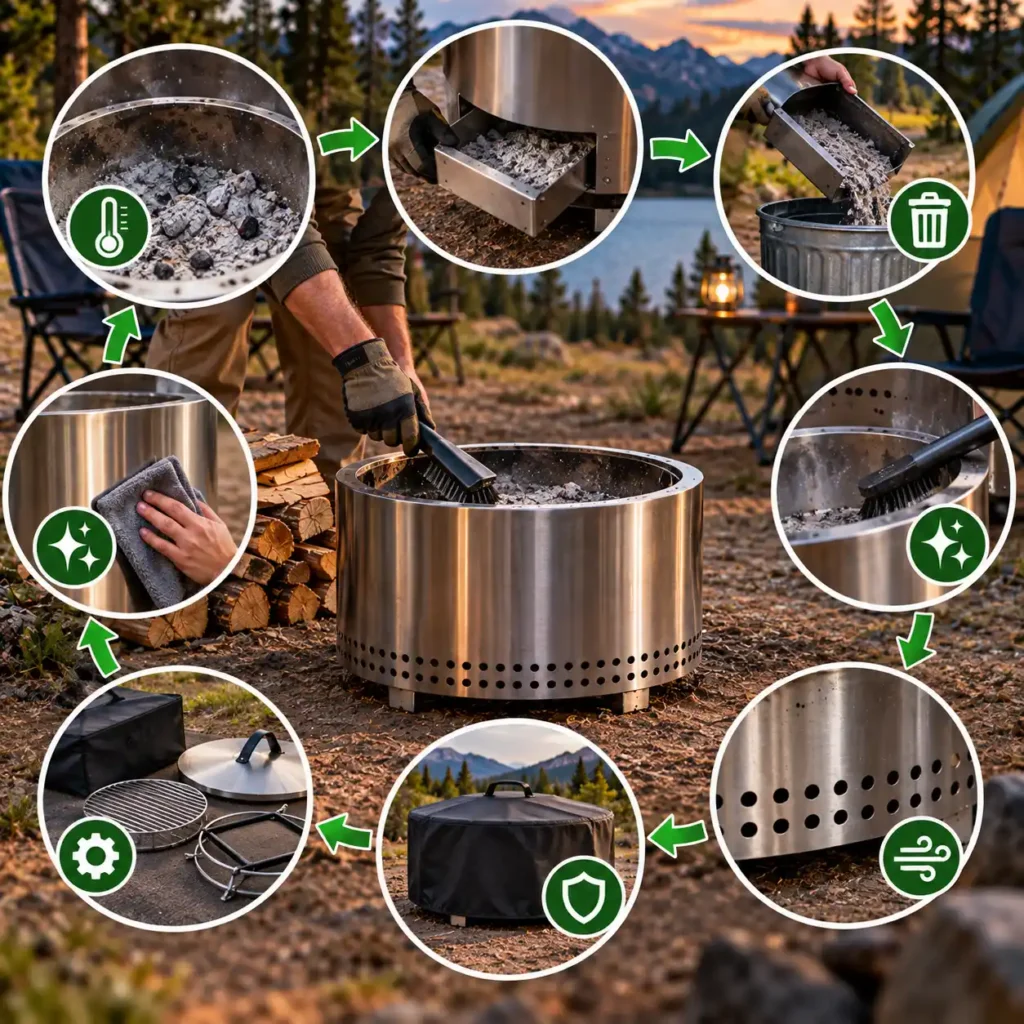
Proper cleanup matters just as much as fire preparation when a wood-burning fire pit travels with you. Ash, soot, moisture, and leftover debris can make the next trip harder if they are allowed to build up, while storing the fire pit before it has cooled completely can damage other camping gear or create an unnecessary hazard.
Let the Fire Pit Cool Completely
Never begin cleaning while the fire pit is still warm.
Even after the visible flames have disappeared, hot coals and embers can remain under a layer of ash. Wait until the fire is completely extinguished and the fire pit has cooled before removing ash, fitting the cover, or preparing it for transport.
This is particularly important in a vehicle-based camping setup, where a fire pit may eventually be placed close to other combustible equipment.
Remove Ash After the Fire Is Fully Cold
A clean fire pit starts with removing the ash left behind by the previous fire.
If your model has a removable ash pan, use it according to the manufacturer’s instructions once the unit is completely cool. This is one of the most convenient features for repeated camping because you can remove the accumulated ash without turning a large fire pit over.
Do not put hot or warm ash into plastic bags, cardboard boxes, vehicle storage compartments, or regular trash containers.
Dispose of Ash Properly
Ash should be handled according to the rules of the campground or land-management authority.
Do not dump ash randomly around the campsite, into vegetation, or near a water source. Some campgrounds provide designated locations for ash disposal, while others have specific instructions for handling cooled fire debris.
When in doubt, check the campsite rules before your trip rather than assuming that completely cooled ash can be disposed of anywhere.
Clean the Burn Chamber
Once the ash has been removed, inspect the inside of the fire pit for larger pieces of charcoal, partially burned wood, or debris.
A simple dry brush can usually remove loose material without introducing unnecessary moisture. Avoid aggressively scraping stainless-steel surfaces with tools that could cause scratches or damage the finish.
For fire pits that use specialized airflow openings, make sure those passages are not blocked by accumulated ash or debris.
Keep Airflow Open
Airflow is particularly important for smokeless wood-burning fire pits because their performance depends on the movement of oxygen through and around the burn chamber.
Check the lower intake openings, secondary-combustion holes, and other ventilation passages periodically. Ash buildup can interfere with airflow and make the next fire burn less efficiently.
The exact cleaning method varies by design, so follow the instructions supplied with your particular fire pit.
Protect the Fire Pit From Moisture
Water and damp storage can create unnecessary problems even with stainless-steel fire pits.
After cleaning, make sure the fire pit is dry before putting it away. If the unit becomes wet during a trip, allow it to dry properly before covering it for long-term storage.
A weather-resistant cover can be useful for protecting a larger fire pit while it is stored at camp or between uses, but a cover should not be used to trap moisture against a damp or freshly cleaned surface.
Check the Finish and Hardware
Camping involves repeated loading, unloading, setup, and exposure to outdoor conditions. Periodically inspect the fire pit for dents, damaged finishes, loose hardware, or other changes that could affect its use.
Pay particular attention to stands, legs, handles, lids, cooking accessories, and removable ash pans. A fire pit may be structurally sound while one of its accessories has become damaged during transport.
Clean Accessories Separately
If your fire pit includes a stand, grill, lid, shelter, or carrying case, those parts need attention too.
Remove ash and food residue from cooking accessories after they have cooled. Wipe dirty covers and carrying cases clean when appropriate, and make sure everything is dry before storing it together.
Keeping accessories clean also makes setup faster on the next trip because you are not unpacking a collection of ash-covered components.
Do Not Overclean the Fire Pit
A wood-burning fire pit is outdoor equipment, not a kitchen appliance that needs to look new after every use.
The priority is removing ash and debris, keeping airflow passages clear, preventing moisture from being trapped against the metal, and checking that the structure and accessories remain in good condition.
Trying to polish every mark or remove every trace of soot after each fire is unnecessary and can sometimes cause more wear than the dirt itself.
Store It Safely Between Trips
For longer-term storage, keep the fire pit in a dry, protected location and follow the manufacturer’s storage recommendations.
Larger models such as the TIKI and Breeo are less likely to be moved frequently, so thoughtful storage is particularly important. Smaller models can be easier to store in a garage, shed, RV compartment, or other protected area when not in use.
If you transport the fire pit regularly, secure it so that it cannot shift or damage other gear while the vehicle is moving.
A Simple Maintenance Routine
For most campers, a basic routine is enough:
After every fire: allow the pit to cool completely, remove ash safely, clear loose debris, and check for remaining embers.
During longer trips: inspect the airflow openings and accessories, and make sure moisture has not accumulated inside the pit.
Before storage: clean out remaining ash, dry the fire pit thoroughly, inspect the hardware, and protect the unit with its cover or storage system as recommended by the manufacturer.
A little maintenance after each trip keeps a wood-burning fire pit easier to transport, easier to use, and ready for the next campsite.
FAQ: Wood-Burning Fire Pits for Camping
Do smokeless fire pits really work?
Yes, but “smokeless” does not mean completely smoke-free. Double-wall fire pits use airflow and secondary combustion to burn some of the gases and particles that would otherwise escape as visible smoke. The effect is strongest after the fire has heated the chamber sufficiently and when you use dry, properly seasoned wood. Some smoke is still normal during startup, when adding wood, or as the fire dies down.
What kind of wood should you use in a wood-burning fire pit?
Use dry, seasoned firewood that is appropriate for the size of the fire pit. Dry hardwood is commonly recommended for cleaner, more efficient burning, while wet or unseasoned wood tends to produce more smoke and can make it harder for a secondary-combustion fire pit to work effectively. Never burn treated, painted, or chemically contaminated wood.
You should also check local rules about transporting firewood. Some areas restrict the movement of firewood to help prevent the spread of pests and tree diseases.
Can you use a wood-burning fire pit during a fire ban?
Not automatically. Whether a portable wood-burning fire pit is allowed depends on the specific fire restriction and the rules of the campground, park, or land-management authority.
A fire pit being raised, portable, or marketed as smokeless does not by itself make a wood fire legal during a fire ban. Some locations distinguish between wood-burning and propane fire features, while others prohibit both. Always check the current local rules before starting a fire. Current 2026 park regulations demonstrate how specific these restrictions can be.
Can you put a wood-burning fire pit on grass?
You should not assume that grass is a safe surface simply because the fire pit is portable or elevated.
Heat from the fire pit can damage grass, roots, or artificial turf, and the appropriate surface depends on the fire pit design and the campsite’s rules. Use a suitable, stable, non-combustible area and follow the manufacturer’s instructions for placement. Never use a wood-burning fire pit directly on artificial grass.
How far should a wood-burning fire pit be from a tent or RV?
The required clearance depends on the specific fire pit and the local regulations, so there is no single distance that applies to every model and campsite.
Keep the fire pit well away from tents, RVs, vehicles, trees, branches, dry vegetation, awnings, and other combustible materials, and use the manufacturer’s minimum clearance requirements as a starting point. For example, TIKI provides specific clearance requirements for its Patio Smokeless Fire Pit that are much more demanding than simply leaving a few feet around the unit.
The safest approach is to choose the campsite location first and make sure the fire pit fits within its required clear zone.
Can you cook on a smokeless wood-burning fire pit?
Yes, when the specific fire pit is designed for or compatible with cooking equipment.
Some models include a grill, while others can be paired with manufacturer-specific cooking accessories. Cooking directly on a fire pit that was not designed for that purpose is not recommended.
A cooking-compatible fire pit can be useful for simple meals, but remember that cooking introduces food residue, grease, and additional cleanup requirements.
How long does a wood-burning fire pit burn?
There is no single burn time for every fire pit. It depends on the amount and type of wood, log size, airflow, weather conditions, and how aggressively the fire is being fed.
A larger fire pit can accommodate more wood, but that does not mean every full load will burn for the same number of hours. For camping, it is more useful to think in terms of how much firewood you need for an evening rather than relying on a universal advertised burn time.
How do you safely put out a wood-burning fire pit?
Stop adding wood and let the fire burn down, then follow the fire pit manufacturer’s instructions and the campground’s extinguishing requirements.
Where water is permitted and appropriate, the fire should be thoroughly cooled rather than simply left when the flames disappear. Stirring ashes and embers helps expose remaining hot spots, and the fire is not considered safely out while heat or glowing embers remain. Current fire-safety guidance continues to emphasize that apparently dead fires can retain hot embers under ash.
Never pack a fire pit into a vehicle while it is still hot.
How often should you clean a wood-burning fire pit?
Clean out ash and larger debris after each fire once the unit is completely cold.
Regular ash removal helps keep airflow openings from becoming blocked and makes the next fire easier to manage. Fire pits with removable ash pans are particularly convenient for repeated camping use.
For longer-term maintenance, inspect the ventilation openings, stands, lids, cooking accessories, and other components and keep the unit dry before storage.
Can you leave a wood-burning fire pit outside overnight?
You should not leave an active fire unattended, even if the fire pit is designed for outdoor use.
Once the fire is completely extinguished and the unit has cooled, you can protect the fire pit according to the manufacturer’s storage and weather recommendations. A suitable cover can help protect the pit from moisture, but it should not be used to cover a hot or damp fire pit.
Are wood-burning fire pits good for camping?
Yes, particularly for car camping, RV camping, and established campsites where transporting firewood and a heavier piece of equipment is practical.
They are much less suitable for backpacking or situations where every pound matters. The five models in this guide range from the relatively portable 16.5-pound Solo Stove Ranger 2.0 to substantially heavier options such as the 45-pound TIKI and 47-pound Breeo.
The right model therefore depends heavily on how far you need to move it, how many people will use it, and how much space you have in your vehicle.
Are smokeless fire pits better than traditional fire pits for camping?
They can be, especially when smoke reduction is a priority. A properly designed secondary-combustion pit can produce substantially less visible smoke than a conventional open fire ring once it reaches operating temperature.
However, smokeless designs still require suitable dry wood and proper airflow, and they do not eliminate every smoke-producing stage of a wood fire. For camping, the main benefit is a more comfortable fire experience rather than a completely smoke-free one.
Do you need special firewood for a smokeless fire pit?
You generally do not need a special branded type of wood, but dry, seasoned wood is important for getting the best results from a secondary-combustion design.
Wet or green wood produces more smoke and uses energy to evaporate moisture, which can interfere with the hot conditions needed for secondary combustion. Dry hardwood is generally the better choice.
Final Verdict: Which Wood-Burning Fire Pit Is Best for Camping?
The best wood-burning fire pit for camping depends on how much space you have, how far you need to move it, and what you want the fire to do for your campsite.
The Solo Stove Bonfire Amazon Exclusive Bundle is our Best Overall choice because it offers the most balanced combination of fire size, group capacity, useful accessories, and vehicle-based camping practicality. It is substantial enough for a proper campsite gathering without moving into the extreme weight of the largest models.
The Solo Stove Ranger 2.0 is the better answer when portability comes first. Its 16.5-pound weight makes it dramatically easier to transport and store, although the smaller 15-inch format naturally limits fire capacity.
The Breeo X Series 19 takes the opposite approach, emphasizing heavy-duty stainless-steel construction, long-term durability, and a more substantial fire-pit setup. It makes the most sense when weight is a secondary concern and the fire pit is part of a regular RV or car-camping routine.
The TIKI Patio Smokeless Fire Pit 25-Inch is a strong choice for spacious campsites where a larger fire can become the center of the evening. The Iamsii 26-Inch offers a similar large-format experience while keeping the weight lower than the heaviest models and adding a grill to the package.
The biggest decision is therefore not which fire pit has the most impressive specifications. It is whether the size, weight, fire capacity, accessories, and campsite requirements fit the way you actually travel.
For most vehicle-based campers, choosing a fire pit that you can comfortably transport, safely position, and realistically use at your destination will matter far more than choosing the largest model available. The right fire pit is the one that fits your camping style before the fire is even lit.
The CampComfortGuide Promise
A good camping fire pit should add to the evening, not become another problem to solve.
At CampComfortGuide, we look beyond the product photo and the headline specifications. We consider the things that become important once the gear reaches the campsite — how it travels, how it fits your setup, what its limitations are, and whether it makes sense for the way you actually camp.
We also believe that the “best” piece of gear can change from one camper to another. A lightweight fire pit may be perfect for one trip, while a larger, heavier model may be the better choice for a family campsite where the fire is the center of the evening.
Our job is to help you understand those differences before you buy, so you can choose equipment that earns its place in your camping gear and use it with confidence when you arrive at camp.
CampComfortGuide — better gear choices for better camping experiences.