
A dependable 12V battery can make a camping power setup more practical, whether you’re running a 12V fridge, keeping phones and lights charged, or supporting a small off-grid electrical system. But choosing a 12V 100Ah LiFePO4 battery for camping involves more than comparing capacity or looking for the lowest price. Discharge limits, battery management system (BMS) protection, cold-weather charging, physical dimensions, and compatibility with your existing equipment can all affect whether a battery fits your setup.
In this guide, we compare five 12V 100Ah LiFePO4 batteries for camping: Power Queen, Renogy, Redodo, LiTime, and SUPER EMPOWER. Each model brings a different set of features and practical considerations, so the right choice depends on how you camp, what you need to power, and how your battery will be charged. We’ll look at the differences that matter when choosing a battery for a vehicle-based campsite or an off-grid camping setup, helping you narrow down the options before you buy.

Table of Contents
Quick Answer
The right 12V 100Ah LiFePO4 battery for camping depends on how you use your power system. Before choosing a model, consider whether you need cold-weather charging protection, Bluetooth monitoring, a compact battery for a limited installation space, or compatibility with equipment such as a 12V refrigerator or trolling motor.
Our comparison covers five options from Power Queen, Renogy, Redodo, LiTime, and SUPER EMPOWER. Each should be evaluated against your power requirements, charging setup, installation space, and the battery’s documented protection features—not capacity alone.
Quick tip: Before buying, check the battery’s dimensions, continuous discharge rating, low-temperature charging protection, and compatibility with your charger or power system. These details can determine whether a 100Ah battery is suitable for your particular camping setup.
Jump to Your Problem
Not sure which features matter most for your trip? Start with the consideration that best matches your setup:
Camping in cold weather: Check whether the battery protects against charging at low temperatures, and understand the manufacturer’s stated operating limits.
Want to monitor battery status: Look for a model with Bluetooth monitoring or another clearly documented way to check battery information.
Need to fit a tight space: Compare the exact battery dimensions and terminal placement with your available installation space.
Running a 12V refrigerator or other camping appliances: Check the appliances’ power draw and startup requirements against the battery’s discharge limits and your expected usage.
Using a trolling motor: Confirm that the battery’s documented discharge capability and the motor’s requirements are compatible.
Building or upgrading an off-grid power system: Check charger compatibility, charging sources, and any manufacturer requirements for series or parallel connections.
Use the comparison table below to review the five batteries side by side, then read the individual reviews for the details that matter to your setup.
Why You Can Trust This Guide
Choosing a camping battery involves more than comparing advertised capacity or looking at customer ratings. A battery needs to match your power requirements, installation space, charging equipment, and the conditions in which you plan to use it.
At CampComfortGuide, our goal is to make those differences easier to understand so you can make an informed decision for your own setup.
For this comparison, we focus on practical considerations that matter when choosing a 12V 100Ah LiFePO4 battery for camping:
- Relevant specifications: We look at documented capacity, discharge limits, battery dimensions, and other specifications that affect compatibility and everyday use.
- Battery protection: We consider the battery management system (BMS) and whether the manufacturer documents protections such as low-temperature charging safeguards.
- Monitoring and convenience: We distinguish models with features such as Bluetooth monitoring from those that rely on other ways of checking battery status.
- Camping applications: We consider how the batteries may fit different setups, from powering a 12V refrigerator and campsite lighting to supporting a vehicle-based or off-grid electrical system.
- Practical limitations: We identify details readers should verify before buying, including charger compatibility, installation requirements, and restrictions on series or parallel connections.
We do not treat advertised features as proof of real-world performance, and we do not present this comparison as laboratory testing or hands-on field testing. Product specifications and compatibility requirements should always be confirmed against the manufacturer’s current documentation before purchase.
Our aim is to help you understand what each battery offers, what to check, and which features are relevant to the way you camp.
How We Evaluate 12V 100Ah LiFePO4 Batteries for Camping
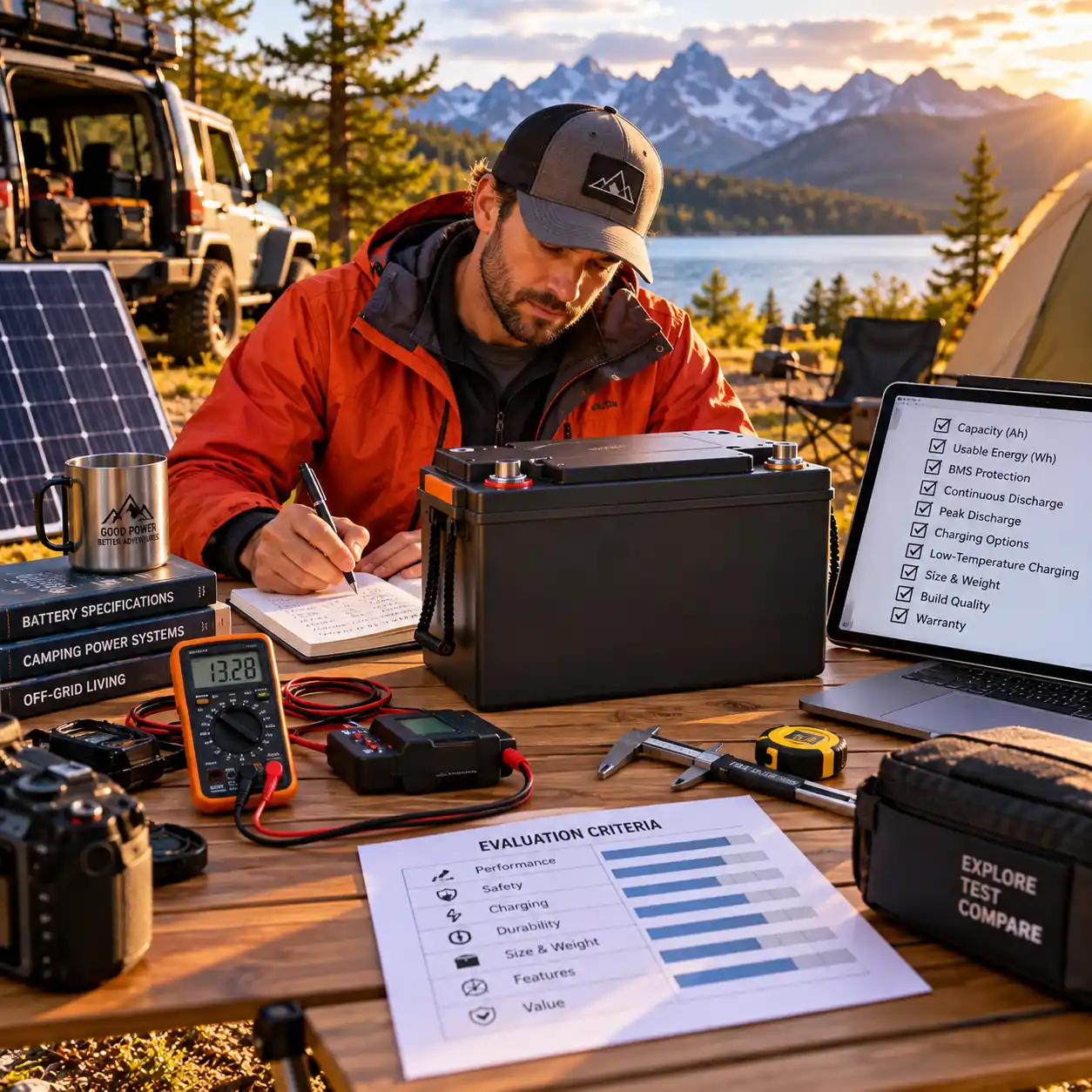
A 12V 100Ah LiFePO4 battery can look similar to another on paper, but differences in protection features, discharge capability, dimensions, and charging requirements can affect how well it fits a camping power system.
To make this comparison useful, we focus on the specifications and practical considerations that help distinguish these five batteries.
Capacity and Power Compatibility
We consider the advertised 12V 100Ah capacity alongside the battery’s documented discharge limits. These details help readers assess whether a battery may be suitable for their intended appliances and electrical setup.
Actual runtime depends on the power draw of connected devices, usable battery capacity, and system losses. A 100Ah rating alone does not guarantee a particular number of hours of operation.
Battery Management System and Protection
The battery management system (BMS) helps protect a battery against operating conditions outside its specified limits. We look for manufacturer-documented protections and distinguish between features confirmed for a specific model and those that still need verification.
Cold-Weather Charging
Low-temperature charging is an important consideration for camping in cold conditions. We examine whether the manufacturer documents low-temperature charging protection and what operating limits or precautions apply.
A battery’s ability to discharge in cold weather should not be confused with permission to charge it at low temperatures.
Monitoring and Ease of Use
Some batteries offer Bluetooth monitoring or other status-checking features. We consider how these options may help users keep track of battery information, while noting that available readings and functions depend on the specific model.
Dimensions and Installation
A battery must physically fit the intended location. We consider the importance of checking its exact dimensions, terminal arrangement, and installation requirements before purchase—particularly for vehicle-based camping setups with limited space.
Charging and System Compatibility
We consider the need to verify compatibility with the user’s charger, solar charging equipment, and other components. Readers should also check the manufacturer’s requirements before connecting batteries in series or parallel.
Intended Camping Use
Finally, we consider the type of setup each battery may suit, such as a 12V refrigerator, campsite lighting, or a broader off-grid power system. These are application considerations, not guarantees of performance.
Evaluation approach: This is a specification-based comparison, not a laboratory test or a claim of hands-on field testing. Product-specific conclusions should be based on the relevant manufacturer documentation and verified listing details. Where a specification cannot be confirmed, it should be identified as unverified rather than assumed.
Who Is This Guide For?
This guide is for campers who are comparing 12V 100Ah LiFePO4 batteries for camping and want to understand which specifications actually matter before buying.
It is particularly useful if you are:
- Building a 12V camping power system for a vehicle, camper, tent-based setup, or other off-grid application.
- Replacing an existing lead-acid battery with a LiFePO4 battery and need to understand the practical differences that affect compatibility and installation.
- Powering 12V camping equipment, such as refrigerators, lights, fans, electronics, or other DC appliances.
- Camping in colder conditions and need to determine whether low-temperature charging protection is appropriate for your environment.
- Comparing batteries with different monitoring features, including models that provide Bluetooth connectivity or other battery-status information.
- Working with limited installation space and need to compare battery dimensions, terminal placement, and other physical requirements.
- Using solar or other charging equipment and want to check whether a battery is compatible with your existing charging system.
- Considering a battery for a trolling motor or another higher-demand application and need to compare the battery’s documented discharge capability with the equipment requirements.
This guide is also useful if you already know that you want a 100Ah LiFePO4 battery but are unsure which specifications deserve the most attention. Rather than treating every 100Ah battery as interchangeable, we focus on the differences that can affect compatibility, charging, installation, and practical camping use.
Who This Guide Is Not For
This comparison may not be the right starting point if you need a battery for a large whole-home backup system, a high-voltage energy-storage installation, or an application that requires a battery voltage or capacity substantially different from 12V 100Ah.
For those systems, battery chemistry is only one part of the decision, and the required inverter, charging equipment, battery bank configuration, and electrical architecture need to be considered together.
What Makes a Good 12V 100Ah LiFePO4 Battery for Camping?
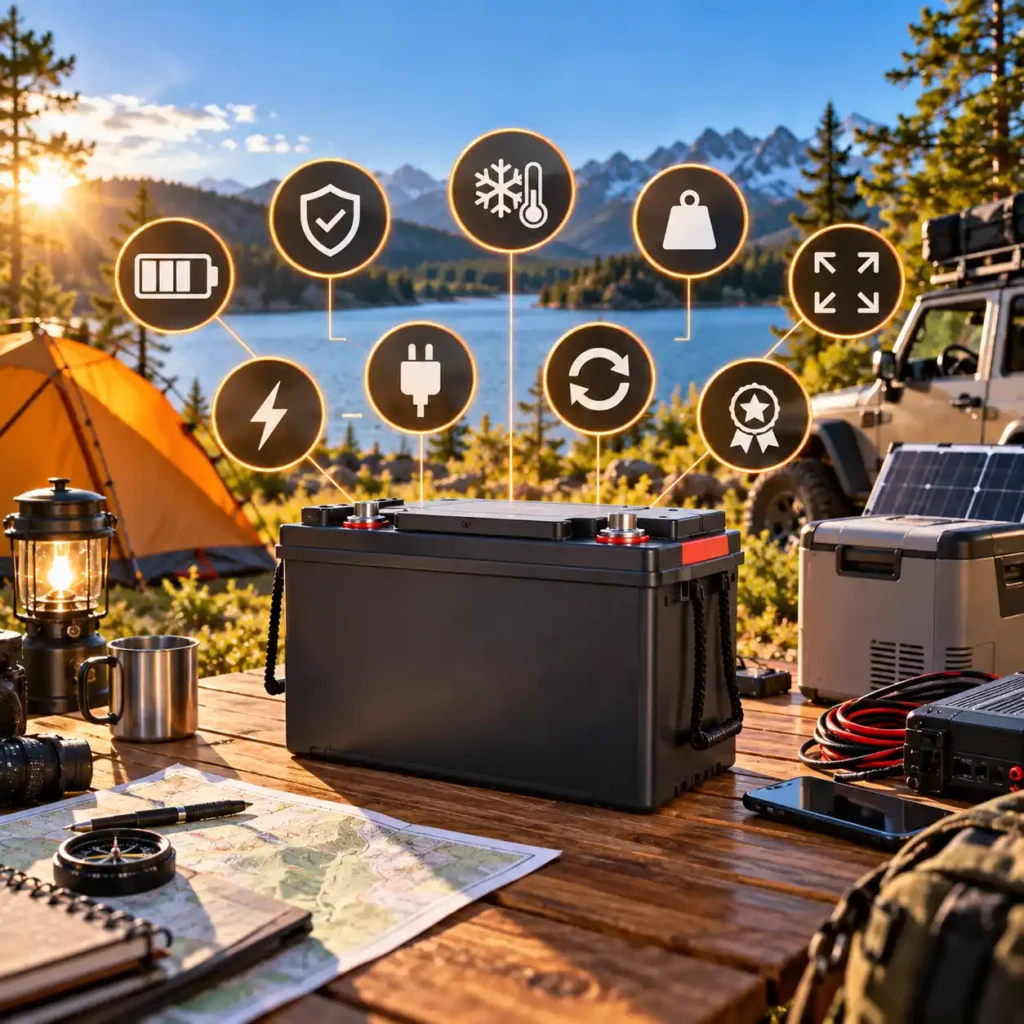
A good 12V 100Ah LiFePO4 battery should do more than provide a nominal 100Ah capacity. For camping, the more important question is whether the battery can safely and reliably work with the equipment, charging system, and conditions you actually use.
The following factors deserve particular attention when comparing 12V 100Ah LiFePO4 batteries for camping.
Usable Capacity and Discharge Capability
The 100Ah rating tells you the battery’s nominal capacity, but it does not by itself determine how long your equipment will run. Actual runtime depends on the power consumption of your appliances, the battery’s usable capacity, discharge limits, and losses elsewhere in the electrical system.
The continuous discharge rating is also important. A battery intended to run a 12V refrigerator and campsite lighting has different demands from one being considered for a higher-current appliance or trolling motor.
Battery Management System Protection
The battery management system, or BMS, is one of the most important components inside a LiFePO4 battery. It can provide protection against conditions such as overcharge, over-discharge, excessive current, and temperature-related problems, depending on the specific battery.
When comparing models, look for protection features that are explicitly documented for that particular battery rather than assuming every 100Ah LiFePO4 battery provides the same level of protection.
Low-Temperature Charging Protection
Cold-weather charging deserves special attention for campers who use their batteries outside during winter or in cold climates.
LiFePO4 batteries generally require appropriate protection against charging below their specified temperature limits. A battery with documented low-temperature charging protection can therefore be particularly relevant to cold-weather camping, but the manufacturer’s stated temperature limits and operating instructions should still be checked.
It is also important to distinguish charging temperature limits from discharge temperature limits. A battery may be capable of discharging in colder conditions while still requiring protection against charging at low temperatures.
Battery Monitoring and Bluetooth Connectivity
Battery monitoring can make a camping power system easier to manage. Depending on the model, Bluetooth connectivity may allow users to view information such as battery voltage, state of charge, current, or other available data through a mobile application.
This feature is not essential for every camping setup, but it can be useful when the battery is installed somewhere that makes physical inspection inconvenient.
Physical Size and Installation Requirements
A 12V 100Ah battery still needs to fit the space available in your vehicle, camper, battery box, or other installation location.
Before buying, compare the manufacturer’s exact dimensions with your available space and check the terminal arrangement and installation requirements. A battery that has the right electrical capacity but does not physically fit is not a practical choice for that installation.
Charging System Compatibility
The battery must also work with the equipment used to charge it. This can include a mains charger, solar charge controller, DC-to-DC charger, or another charging source.
Check the battery manufacturer’s charging specifications and make sure your existing equipment is appropriate for LiFePO4 chemistry. If you are building a larger battery bank, also verify the manufacturer’s requirements for series or parallel connections rather than assuming that any two batteries can simply be connected together.
Match the Battery to Your Actual Camping Setup
Ultimately, a good camping battery is one whose specifications match the system around it.
A camper primarily running a 12V refrigerator may prioritize different characteristics from someone building a solar-powered off-grid system or using a battery for a trolling motor. Capacity is therefore only one part of the decision.
The most useful comparison is not simply which battery has the most features, but which battery’s documented specifications and protections fit the equipment, environment, and installation you intend to use.
Quick Summary: Best 12V 100Ah LiFePO4 Batteries for Camping
The best 12V 100Ah LiFePO4 battery for your camping setup depends on the features your power system actually needs. Cold-weather charging protection, battery monitoring, discharge requirements, and physical fit can matter more than a long list of advertised features.
The five batteries below offer different starting points for comparison. Use this summary to identify which models deserve a closer look, then review the specifications and limitations in the detailed comparisons.
Power Queen Bluetooth 12V 100Ah LiFePO4 Battery
Potential fit: Camping setups where Bluetooth monitoring and low-temperature charging protection are priorities
Power Queen’s selected battery listing highlights Bluetooth functionality and low-temperature protection. Those features make it relevant to campers who want to check battery information and need to consider charging in colder conditions.
Choose this if:
- You want to investigate a battery with Bluetooth monitoring.
- Low-temperature charging protection is an important requirement.
- You are prepared to verify the exact operating limits and installation dimensions.
Best for: Campers comparing monitoring and cold-weather protection features.
Renogy 12V 100Ah LiFePO4 Battery
Potential fit: Buyers comparing Renogy’s 100Ah battery offering
Renogy is included as one of the five selected products. Before making a product-specific recommendation, confirm the exact model and its specifications against the supplied Amazon listing. Similar capacity ratings do not guarantee that two variants have the same monitoring, protection, or installation features.
Choose this if:
- You are considering the specific Renogy listing included in this guide.
- You want to compare its documented specifications with the other batteries.
- You can confirm that its charging requirements match your equipment.
Best for: Readers who want to evaluate the selected Renogy model against their existing power system.
Redodo 12V 100Ah LiFePO4 Battery
Potential fit: Buyers comparing a standard 100Ah LiFePO4 option
Redodo’s selected 12V 100Ah battery is included for direct comparison with the other models. Its suitability for a particular camping setup depends on verified details such as continuous discharge capability, BMS protections, dimensions, and charging requirements.
Choose this if:
- You are comparing 100Ah LiFePO4 batteries for a camping power system.
- You want to assess its specifications alongside the other selected models.
- You can verify its compatibility with your intended appliances and charger.
Best for: Campers comparing documented specifications across 100Ah battery options.
LiTime 12V 100Ah LiFePO4 Battery for Trolling Motors
Potential fit: Buyers considering a battery for trolling-motor use
The selected LiTime listing is associated with trolling-motor use, making it relevant to readers who are evaluating a battery for that application as well as camping. Before choosing it, check the motor’s current requirements and the battery’s documented discharge limits.
Choose this if:
- You need to evaluate battery compatibility with a trolling motor.
- You want to compare its discharge specifications with your equipment’s requirements.
- You also plan to consider it for a camping power setup and can verify that the use is supported.
Best for: Readers comparing a 100Ah battery for trolling-motor-related applications.
SUPER EMPOWER 12V 100Ah LiFePO4 Battery
Potential fit: Buyers comparing another 100Ah option
SUPER EMPOWER completes this comparison as a fifth candidate. Its practical value for camping should be assessed using verified product information rather than brand or capacity alone.
Choose this if:
- You want to compare another 12V 100Ah LiFePO4 option.
- You can confirm the battery’s protection features and discharge rating.
- Its dimensions and charging requirements suit your installation.
Best for: Readers who want to compare its documented specifications with the other four batteries.
Before you choose: Check the comparison table for verified specifications, then read the detailed reviews to understand each battery’s potential advantages, limitations, and compatibility requirements.
12V 100Ah LiFePO4 Battery Comparison
The table below compares the five selected 12V 100Ah LiFePO4 batteries for camping across the specifications and features that can affect real-world compatibility. Use it as a quick reference, then review each battery in detail to understand its protection features, charging requirements, installation considerations, and best-fit camping applications.
| Battery | Capacity | Key Feature | Camping Application | What to Verify |
|---|---|---|---|---|
| Power Queen Bluetooth LiFePO4 | 12V 100Ah | Bluetooth monitoring and low-temperature protection | Camping setups where monitoring and cold-weather charging protection are priorities | Temperature limits, monitoring functions, discharge rating, dimensions |
| Renogy LiFePO4 | 12V 100Ah | Features of the exact listed Renogy model | Vehicle-based and off-grid camping setups, subject to compatibility | Exact model variant, BMS protections, charging requirements, dimensions |
| Redodo LiFePO4 | 12V 100Ah | Documented specifications and protection features | Camping power systems requiring a standalone 12V battery | Continuous discharge rating, temperature limits, dimensions, charging specifications |
| LiTime LiFePO4 for Trolling Motors | 12V 100Ah | Compatibility with trolling-motor requirements | Potential use in camping or boating-related power setups | Motor current requirements, discharge limits, charging requirements, permitted applications |
| SUPER EMPOWER LiFePO4 | 12V 100Ah | Verified protection features and electrical specifications | Camping setups where its confirmed specifications meet system requirements | BMS protections, discharge rating, charging limits, dimensions, warranty terms |
How Much Power Can a 12V 100Ah Battery Actually Provide?
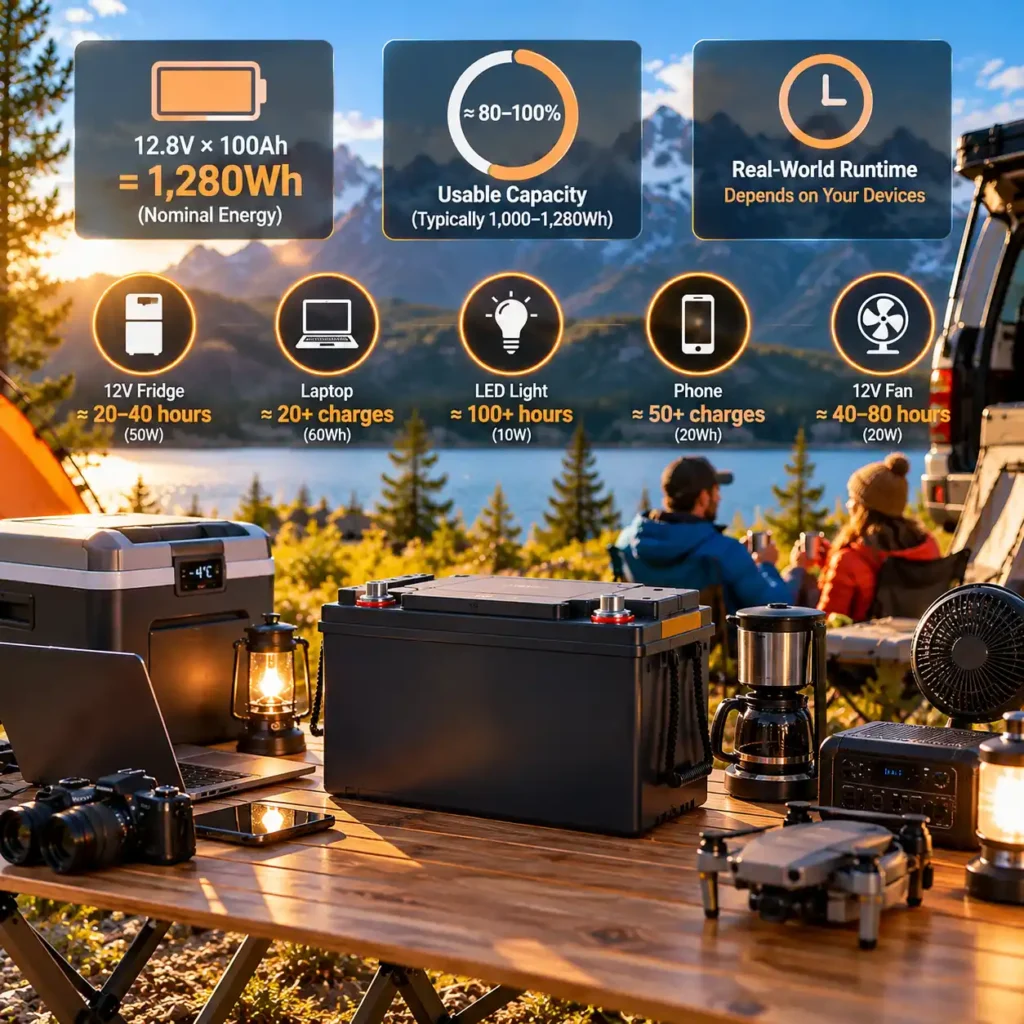
A 12V 100Ah LiFePO4 battery is commonly described by its nominal capacity, but that number does not tell you exactly how long it will power your camping equipment. To estimate runtime, you need to consider the battery’s nominal energy, usable capacity, the power draw of your devices, and losses from components such as an inverter.
Understanding Watt-Hours
Battery capacity is usually expressed in amp-hours (Ah), while the energy used by appliances is measured in watt-hours (Wh).
A simple estimate is:
Nominal energy (Wh) = Nominal voltage (V) × Capacity (Ah)
For example, using a nominal voltage of 12.8V:
12.8V × 100Ah = 1,280Wh
This is a nominal energy calculation—not a guarantee that all 1,280Wh will be available to your appliances. The usable amount depends on the battery’s specifications, operating conditions, and the rest of your power system.
Estimate Runtime for Your Camping Equipment
For a device with a reasonably steady power draw, a basic estimate is:
Estimated runtime (hours) = Usable battery energy (Wh) ÷ Device power (W)
For example, if you use a hypothetical 40W device and assume 1,000Wh of usable energy:
1,000Wh ÷ 40W = 25 hours
This is an illustrative calculation, not a runtime claim for any battery in this guide. Actual runtime may be shorter because of changing power consumption, system losses, temperature, battery limits, and other operating conditions.
What About a 12V Refrigerator?
A refrigerator’s energy use can vary depending on its model, ambient temperature, thermostat setting, ventilation, and how often its compressor runs. Its rated or running wattage alone may not represent its total daily consumption.
For a more useful estimate, look for the refrigerator’s stated daily energy consumption in Wh or measure its use under conditions similar to your planned trip. Then compare that figure with the battery’s verified usable energy and your expected opportunities to recharge.
Why Discharge Limits Matter
Stored energy and available power are not the same thing. A battery may have enough nominal energy for an appliance but still be unsuitable if the appliance’s current demand exceeds the battery’s continuous or peak discharge limits.
Before connecting a refrigerator, inverter, or other demanding load, check the exact battery’s specifications and compare them with the equipment’s requirements, including startup demand where applicable.
Bottom line: Use watt-hours to estimate how long your equipment may run, and use the battery’s documented discharge limits to check whether it can supply the required power. Both checks matter when choosing a 12V 100Ah LiFePO4 battery for camping.
Detailed Reviews: 5 Best 12V 100Ah LiFePO4 Batteries for Camping
The five batteries below share a 12V, 100Ah capacity rating, but their features and setup requirements may differ. These reviews focus on practical camping considerations, including battery monitoring, cold-weather charging protection, system compatibility, and the details to verify before buying.
1. Power Queen Bluetooth 12V 100Ah LiFePO4 Battery
A Camping Battery to Consider for Bluetooth Monitoring and Cold-Weather Protection
The Power Queen Bluetooth 12V 100Ah LiFePO4 battery is worth examining if you want battery-status information without having to access the battery directly. Its product listing advertises Bluetooth monitoring and low-temperature protection—two features that may be relevant when building a camping power system.
Bluetooth monitoring can be useful when a battery is installed in a vehicle or another compartment that is not easy to reach. Low-temperature protection is also an important feature to investigate if you camp during colder seasons. However, the exact monitoring functions, temperature thresholds, and charging restrictions should be confirmed in the current product documentation before purchase.

Quick Verdict
The Power Queen stands out in this comparison for its advertised combination of Bluetooth monitoring and low-temperature protection. For a camper building a 12V power system, those features may help address two practical concerns: checking battery status without direct access to the unit and understanding how the battery is protected when temperatures are low.
It is not possible to judge the full suitability of this battery from those advertised features alone. Bluetooth monitoring is only as useful as the information it provides, so buyers should confirm which readings are available, how the app connects, and whether it supports their device. Likewise, low-temperature protection should be assessed by checking the manufacturer’s specified charging limits and the battery’s response when temperatures fall outside them.
Before choosing this model, compare its dimensions and BMS specifications with the available installation space and the equipment in your camping power system. Confirm that your charger and charging method meet the battery’s requirements, and check that its limits are appropriate for the appliances and loads you intend to run.
This model may be worth considering if Bluetooth monitoring and low-temperature charging protection are important features in your camping setup.
Check before buying: The exact monitoring functions, temperature thresholds, BMS limits, dimensions, charging requirements, and compatibility with your existing equipment.
Camp Snapshot
| Feature | Power Queen Bluetooth 12V 100Ah |
|---|---|
| Battery chemistry | LiFePO4 |
| Nominal voltage | 12V |
| Advertised capacity | 100Ah |
| Monitoring | Bluetooth advertised; verify supported readings and app compatibility |
| Cold-weather feature | Low-temperature protection advertised; confirm operating limits and behavior |
| Potential camping relevance | Battery-status checks and charging protection in cooler conditions |
| Key checks before purchase | Dimensions, BMS limits, charging requirements, and system compatibility |
Why We Chose It
We included the Power Queen in this comparison because its advertised features raise two practical questions that matter when selecting a camping battery: how easily can you check its status, and what protection does it provide when charging in low temperatures?
Bluetooth monitoring and battery access: A battery installed inside a vehicle or a storage compartment may not be easy to inspect physically. Bluetooth monitoring could make checking battery information more convenient, depending on the readings supported by the app and the connection requirements. Buyers should confirm those details rather than assume the feature provides complete monitoring or remote control.
Low-temperature protection and charging conditions: Campers who travel during colder seasons should pay attention to the battery’s specified charging temperature range. The advertised presence of low-temperature protection does not, by itself, establish the exact cutoff points or how charging is managed when conditions fall outside the permitted range. Those details need to be checked in the current manufacturer documentation.
Fit within the overall power system: The 12V, 100Ah rating is only one part of the compatibility check. The battery’s dimensions, BMS limits, charging requirements, and installation instructions should be compared with the camper’s available space, charger, and intended loads.
The Power Queen is therefore included as an option to examine when Bluetooth monitoring and low-temperature protection are priorities. Those features are useful comparison points, but they do not replace checking the full specifications against your particular camping setup.
Check today’s price and latest customer reviews on Amazon.

Living With It at Camp
A 12V 100Ah LiFePO4 battery can serve as part of a camping power system for equipment such as a 12V refrigerator, lights, phones, and other compatible devices. With the Power Queen, the advertised Bluetooth monitoring may be particularly relevant when the battery is installed somewhere that is inconvenient to reach.
For example, if the battery is secured inside a vehicle storage compartment, checking supported battery information through a phone could be more convenient than opening the compartment for a visual inspection. The actual usefulness depends on which readings the app provides, its connection range, and whether the battery remains accessible to the phone from the intended installation location.
Cold-weather use requires a separate consideration. The listing advertises low-temperature protection, but that should not be interpreted as permission to charge the battery in any freezing conditions. Before a winter or shoulder-season trip, check the manufacturer’s charging temperature limits and protection behavior. Also make sure the battery is installed and charged according to its instructions.
For a practical camping setup, plan around the battery’s verified specifications rather than its 100Ah rating alone. Estimate the energy needs of your appliances, check their current draw against the battery’s BMS limits, and confirm that your charging equipment is compatible. The battery’s physical dimensions and terminal arrangement also need to fit the available installation space.
CampComfortGuide Assessment
The Power Queen’s advertised Bluetooth monitoring and low-temperature protection give it specific features to investigate for camping use. However, the information currently established for this review does not support assigning performance scores or claiming that the battery has been field-tested.
The assessment below separates the advertised features from the checks that remain necessary before purchase.
| Evaluation Category | Editorial Assessment |
|---|---|
| Bluetooth Monitoring | ★★★★☆ Advertised Bluetooth monitoring may make battery-status checks more convenient when the battery is installed in a hard-to-reach location. Confirm which readings and app functions are supported. |
| Cold-Weather Protection | ★★★★☆ Advertised low-temperature protection is relevant for campers using their power system in cooler conditions. The actual value depends on the specified temperature limits and protection behavior. |
| Camping Power Capacity | ★★★☆☆ The advertised 12V, 100Ah capacity makes this a candidate for a 100Ah-class camping setup. Usable energy and suitability for specific appliances depend on verified discharge limits and system requirements. |
| System Compatibility | ★★★☆☆ Compatibility cannot be established from voltage and capacity alone. Check BMS limits, charger requirements, dimensions, and the power demands of connected equipment. |
| Installation Flexibility | ★★★☆☆ Bluetooth monitoring could be useful in an installation where direct access is inconvenient. Physical fit, terminal layout, and installation requirements still need to be verified. |
| Overall Camping Value | ★★★☆☆ The advertised monitoring and low-temperature protection may appeal to campers who prioritize these features. Overall value depends on verified specifications, compatibility, and current price. |
Who Should Buy This?
The Power Queen Bluetooth 12V 100Ah LiFePO4 battery may be worth considering for:
Campers who want Bluetooth monitoring: Particularly if the battery will be installed in a compartment that is difficult to access, provided its supported app functions meet their needs.
Vehicle-based campers building a 12V system: Those who need a 100Ah-class battery and can confirm that its dimensions, BMS limits, and charging requirements match their setup.
Campers who travel in cooler weather: Those who specifically want to investigate low-temperature protection and are prepared to follow the manufacturer’s charging limits.
Buyers comparing feature-focused batteries: Those who value monitoring and protection features alongside capacity, rather than choosing by capacity rating alone.
Who Should Skip This?
Consider another battery if:
You need verified cold-weather charging performance immediately: Do not rely on the advertised feature without confirming its temperature thresholds and operating behavior.
You require specific monitoring data or remote controls: Check the app’s actual functionality first. Bluetooth alone does not establish which readings or controls are supported.
You have limited installation space: Verify the battery’s exact dimensions, terminal layout, and clearance requirements before ordering.
Your equipment has demanding power requirements: Confirm continuous and peak discharge limits, BMS specifications, and compatibility with your appliances and inverter, if used.
You need a battery for a specialized electrical system: Make sure the manufacturer explicitly supports your intended configuration and charging method.
Final Verdict
The Power Queen Bluetooth 12V 100Ah LiFePO4 battery is a model to investigate if Bluetooth monitoring and advertised low-temperature protection are important to your camping power setup. Those features give it a clear comparison angle, especially for campers who want to check battery information without direct access to the unit or need to account for cooler charging conditions.
The decision should still come down to verified specifications. Confirm the available Bluetooth readings, low-temperature charging limits, BMS ratings, physical fit, and compatibility with your charging equipment and connected loads. Without those checks, the 12V and 100Ah ratings alone are not enough to establish whether this battery suits your system.
Check today’s price and latest customer reviews on Amazon.
Related Guide
A 12V 100Ah battery is only one part of a camping power system. Before deciding whether this capacity is sufficient for your trip, use our guide to What Size Portable Power Station Do I Need? to understand how to estimate your energy needs and match battery capacity to the devices you plan to run.
Renogy 12V 100Ah LiFePO4 Battery
A 100Ah Battery to Evaluate for a Renogy-Based Camping Power System
The Renogy 12V 100Ah LiFePO4 battery is another option for campers comparing lithium batteries for a vehicle-based or off-grid power setup. Its 12V, 100Ah rating places it in the capacity class covered by this guide, but the most important decision is whether its verified specifications match the equipment you plan to power and the way you intend to recharge it.
Renogy offers different battery configurations, so it is important to check the exact product variant rather than assume that every 12V 100Ah model includes the same monitoring or protection features. Before purchasing, review the listing and manufacturer documentation for the specific battery, including its BMS limits, charging requirements, dimensions, and any advertised monitoring functions.

Quick Verdict
The Renogy 12V 100Ah LiFePO4 battery is worth comparing if you need a 100Ah-class lithium battery for a camping power system and want to assess its specifications alongside the other models in this guide.
Its suitability depends on more than the capacity rating. A battery must be compatible with your charging equipment, fit the available installation space, and support the current demands of your connected devices. Buyers should also verify the exact Renogy variant and the functions included with that model before relying on features such as monitoring or additional battery protection.
For campers assembling a system from separate components, the key question is how well this battery fits the complete setup—not simply whether it offers 100Ah of advertised capacity. Check the manufacturer’s specifications against your intended loads, charging method, and installation requirements before making a decision.
This model may be worth considering if: You are comparing 12V 100Ah LiFePO4 batteries and want to evaluate Renogy’s specific model against your camping system’s requirements.
Check carefully before buying: The exact model variant, BMS specifications, charging limits, dimensions, monitoring functions, and compatibility with your charger and connected equipment.
Camp Snapshot
| Feature | Renogy 12V 100Ah LiFePO4 |
|---|---|
| Battery chemistry | LiFePO4 |
| Nominal voltage | 12V |
| Advertised capacity | 100Ah |
| Product variant | Confirm the exact model and included features on the current listing |
| Monitoring | Verify whether this exact variant includes monitoring and which functions are supported |
| Battery protection | Check the manufacturer’s BMS specifications and protection limits |
| Potential camping relevance | A 100Ah-class battery to evaluate for a compatible 12V camping power system |
| Key checks before purchase | Model variant, dimensions, charging requirements, BMS limits, and system compatibility |
Why We Chose It
We included the Renogy battery to give readers another 12V 100Ah LiFePO4 option to compare when planning a camping power system. The important part of this review is to evaluate the exact battery configuration, rather than assume that features found on one Renogy model are present on another.
Capacity and planned loads: The advertised 100Ah rating places this battery in the category covered by the guide. However, capacity alone does not establish how long it will run a particular refrigerator, lighting system, or other appliance. That depends on the load, usable energy, discharge limits, and the rest of the electrical system.
Exact model and included features: Renogy has multiple battery products and configurations. Buyers should check the precise listing and manual to establish whether the selected variant includes monitoring features or particular forms of protection. These should not be assumed from the brand name alone.
Charging and installation compatibility: A camping battery needs to work with the charging equipment and installation space available. Confirm the specified charging requirements, BMS limits, physical dimensions, and terminal arrangement before integrating it into a vehicle or off-grid system.
The Renogy is included as a comparison option for readers who want to evaluate its particular 12V 100Ah model against their own requirements. The final decision should be based on the verified specifications of the exact variant and how those specifications align with the intended camping setup.
Check today’s price and latest customer reviews on Amazon.

Living With It at Camp
The Renogy 12V 100Ah LiFePO4 battery should be evaluated as one component of a complete camping power system. Its advertised capacity gives you a starting point, but the actual experience depends on the battery’s verified discharge limits, your appliances, and how you recharge the system between uses.
For vehicle-based camping, check whether the battery’s dimensions and terminal arrangement fit the intended compartment. Leave the clearances required by the manufacturer, secure the battery appropriately, and make sure the wiring and overcurrent protection are suitable for the installation.
For off-grid use, estimate the energy consumption of the devices you plan to run. A refrigerator, lights, charging devices, and other loads can have very different consumption patterns. Compare their combined demand with the battery’s usable capacity and discharge limits rather than assuming that 100Ah guarantees a particular number of hours or days.
Renogy offers multiple battery configurations, so confirm the exact model associated with the listing before relying on any feature claims. In particular, verify its charging requirements, BMS specifications, monitoring capabilities, and temperature limits. These details determine whether it can work safely and effectively with your existing charger and other equipment.
CampComfortGuide Evaluation
The Renogy model is included as a 12V 100Ah LiFePO4 option, but the exact variant and its full specifications need to be confirmed before assigning meaningful performance ratings. The following editorial assessment identifies the areas buyers should evaluate without presenting unverified scores as tested results.
| Evaluation Category | Editorial Assessment |
|---|---|
| Camping Power Capacity | ★★★☆☆ The advertised 12V, 100Ah capacity places this battery in the category covered by our guide. Its practical runtime depends on usable capacity, discharge limits, and the power demands of connected camping equipment. |
| Charging Compatibility | ★★★☆☆ A suitable charging setup is essential for a camping battery. Confirm the exact model’s charging requirements and make sure your charger or other charging source operates within the manufacturer’s specified limits. |
| Battery Protection | ★★★☆☆ The battery’s protection capabilities should be evaluated using its documented BMS specifications. Verify the supported protections and current limits before connecting appliances or integrating it into a larger power system. |
| Monitoring | ★★★☆☆ Monitoring capabilities depend on the exact Renogy variant. Confirm whether this model provides battery monitoring, which readings are available, and whether any app or additional equipment is required. |
| Installation Flexibility | ★★★☆☆ The 12V format may suit some vehicle-based and off-grid camping systems, but installation depends on the battery’s actual dimensions, terminal arrangement, mounting requirements, and available space. |
| Overall Camping Value | ★★★☆☆ This battery is worth comparing as a 100Ah-class option, but its overall value depends on verified features, compatibility, warranty terms, and current price. Those details should be confirmed before drawing a firm conclusion. |
Who Should Buy This?
The Renogy 12V 100Ah LiFePO4 battery may be worth considering for:
Campers comparing 100Ah-class lithium batteries: If you need a battery in this capacity range and are checking several options against your power requirements.
Vehicle-based campers: If you have a suitable installation location and can confirm the battery’s dimensions, mounting requirements, and terminal arrangement.
Campers building a 12V system from separate components: If you are prepared to verify charger compatibility, BMS limits, and the requirements of your connected equipment.
Buyers researching a specific Renogy configuration: If you can confirm the exact model and want to compare its documented features with other batteries in this guide.
Who Should Skip This?
Consider a different option if:
You cannot confirm the exact model variant. Do not assume that monitoring or protection features listed for another Renogy battery apply to this one.
You need a confirmed feature that the listing does not clearly document. Verify the specific function before purchasing rather than relying on a general product description.
The battery does not fit your installation space. Check its dimensions, terminal layout, and manufacturer installation requirements first.
Your power system has demanding loads. Confirm continuous and peak discharge limits, BMS specifications, and compatibility with your appliances or inverter.
Your charging setup does not meet the battery’s requirements. Check the specified charging profile and limits before connecting it to an existing system.
Final Verdict
The Renogy 12V 100Ah LiFePO4 battery is a comparison option for campers looking for a battery in this capacity class. Its practical suitability depends on the exact model configuration and how its documented specifications match the intended camping power system.
Before buying, verify the variant associated with the Amazon listing, then check its BMS limits, charging requirements, dimensions, monitoring functions, and warranty terms. Those details matter more than the brand name or capacity rating alone when determining whether the battery fits your setup.
Check today’s price and latest customer reviews on Amazon.
Related Guide
Choosing a 12V 100Ah LiFePO4 battery is only part of planning a reliable campsite power setup. If you’re still deciding whether a standalone battery or an all-in-one power station better fits your needs, our guide to the best portable power stations for camping compares portable power options and explains what to consider when matching a power source to your camping equipment.
3. Redodo 12V 100Ah LiFePO4 Battery
A 100Ah Lithium Battery to Compare for Everyday Camping Power Needs
The Redodo 12V 100Ah LiFePO4 battery is another option to consider when building a 12V power system for camping. Its advertised capacity places it in the same general category as the Power Queen and Renogy models covered earlier, making it relevant for campers comparing batteries for vehicle-based trips and off-grid setups.
With this model, the key consideration is how its specifications match the equipment you plan to run. A 100Ah rating provides a useful starting point, but it does not tell you the battery’s complete usable energy, discharge limits, charging requirements, or physical fit. Those details matter when you are planning to power a refrigerator, lighting, charging devices, or other compatible camping equipment.
Before choosing the Redodo, review the specifications for the exact model on the product listing and in the manufacturer’s documentation. In particular, confirm its BMS ratings, charging parameters, dimensions, and any protection or monitoring features advertised for this specific battery.

Quick Verdict
The Redodo 12V 100Ah LiFePO4 battery is a candidate for campers comparing batteries in the 100Ah capacity class for a compatible 12V camping power system. Its place in this guide gives readers another model to evaluate against their power requirements, available installation space, and charging equipment.
The most important question is not simply whether the battery has a 100Ah rating, but whether its verified specifications support the way you intend to use it. For a vehicle-based setup, physical dimensions, terminal placement, and installation requirements can determine whether the battery fits. For an off-grid system, the BMS limits, charging specifications, and expected appliance loads need to be considered together.
The Redodo may be worth investigating if you want to compare its documented specifications with the other batteries in this guide. However, the exact product features should be confirmed before drawing conclusions about cold-weather charging, monitoring, or other specialized functions.
This model may be worth considering if: You need a 12V 100Ah-class LiFePO4 battery and want to compare Redodo’s specifications with your camping power requirements.
Check carefully before buying: The exact model configuration, usable capacity, BMS limits, charging requirements, physical dimensions, and compatibility with your connected equipment.
Camp Snapshot
| Feature | Redodo 12V 100Ah LiFePO4 |
|---|---|
| Battery chemistry | LiFePO4 |
| Nominal voltage | 12V |
| Advertised capacity | 100Ah |
| BMS specifications | Confirm the exact model’s current limits and documented protection functions |
| Monitoring | Check the product listing to confirm whether this exact model includes monitoring features |
| Cold-weather protection | Verify the documented charging temperature range and any low-temperature protection |
| Potential camping relevance | A 100Ah-class battery to evaluate for a compatible 12V camping power system |
| Key checks before purchase | Usable capacity, BMS limits, charging requirements, dimensions, and system compatibility |
Why We Chose It
We included the Redodo 12V 100Ah LiFePO4 battery to broaden the comparison for readers who are choosing a battery based on the needs of their own camping power system. Rather than assuming that every battery with the same capacity rating will perform identically, this review focuses on the specifications that need to be checked for the exact model.
Capacity and practical power planning: The advertised 100Ah rating makes the Redodo relevant to this guide, but it does not establish how long it will power a particular appliance. Buyers should check the documented usable capacity and discharge limits, then compare those figures with the expected consumption of their refrigerator, lights, and other equipment.
BMS limits and connected loads: The battery management system is an important part of determining whether a battery can support a particular setup. Confirm the exact model’s documented current limits and protection functions, then compare them with the requirements of the connected devices and any inverter in the system.
Charging requirements: A battery needs to be compatible with the equipment used to recharge it. Review the manufacturer’s charging specifications and confirm that your charger or other charging source operates within the permitted parameters. If you plan to camp in colder weather, check the stated charging temperature range and whether the exact model includes low-temperature protection.
Installation and system fit: A battery that meets the capacity requirement still needs to fit the intended installation location. Check its physical dimensions, terminal arrangement, and installation instructions before planning to place it in a vehicle or camping power enclosure.
The Redodo is included as another 100Ah-class option for comparison—not on the assumption that its features are interchangeable with those of the Power Queen or Renogy. Its suitability should be determined by the exact model’s documented specifications and how those specifications align with your camping setup.
Check today’s price and latest customer reviews on Amazon.

Living With It at Camp
The Redodo 12V 100Ah LiFePO4 battery is intended to be considered as part of a complete camping power setup, rather than as a standalone solution. Its advertised capacity gives you a starting point for planning, but the practical result depends on the appliances you use, the battery’s verified discharge limits, and how you recharge it.
For vehicle-based camping, the first consideration is installation. Check the battery’s exact dimensions and terminal arrangement against the space available in your vehicle or power enclosure. Follow the manufacturer’s installation instructions and make sure the wiring and overcurrent protection are appropriate for the system.
For off-grid camping, estimate the energy consumption of your equipment before deciding whether 100Ah is sufficient. A refrigerator, lighting, phones, and other devices can draw power at different rates. Compare their expected consumption with the battery’s documented usable capacity and discharge limits instead of assuming a particular runtime from the capacity rating alone.
Charging is another important part of the setup. Verify the battery’s charging specifications and confirm that your charger or other charging source is compatible. If you camp in colder weather, check the permitted charging temperature range and whether the exact Redodo model includes low-temperature charging protection.
The Redodo’s practical suitability ultimately depends on how well its verified specifications fit your intended loads, charging equipment, and installation space.
CampComfortGuide Evaluation
The Redodo is included in this guide as a 12V 100Ah LiFePO4 battery. The following editorial assessment uses the available product information cautiously: the capacity class is established, but the exact BMS ratings, monitoring functions, cold-weather protections, and installation specifications should be verified before assigning definitive performance scores.
| Evaluation Category | Editorial Assessment |
|---|---|
| Camping Power Capacity | ★★★☆☆ The advertised 12V, 100Ah capacity places this battery in the class covered by our guide. Its practical usefulness depends on verified usable energy, discharge limits, and the power demands of your camping equipment. |
| Off-Grid Convenience | ★★★☆☆ A 100Ah-class battery can be considered for a compatible off-grid setup, but convenience depends on how well its specifications match your appliances, charging routine, and expected time away from a power source. |
| Battery Protection | ★★★☆☆ The battery’s BMS capabilities need to be assessed using the exact model’s documentation. Confirm the supported protection functions and current limits before connecting camping appliances or an inverter. |
| Charging Compatibility | ★★★☆☆ Charging suitability depends on the specified charging profile and limits. Check compatibility with your charger or other charging source, particularly if the battery will be used in a vehicle-based system. |
| Installation Flexibility | ★★★☆☆ The 12V format may fit some camping power systems, but actual installation flexibility depends on the battery’s dimensions, terminal arrangement, mounting requirements, and available space. |
| Overall Camping Value | ★★★☆☆ The Redodo is a relevant option to compare in the 100Ah category. Its overall value depends on confirmed features, compatibility, warranty terms, and current price—not capacity alone. |
Who Should Buy This?
The Redodo 12V 100Ah LiFePO4 battery may be worth considering for:
Campers comparing 100Ah-class batteries: If you need a battery in this capacity range and want to compare Redodo’s documented specifications with other options.
Vehicle-based campers: If you have an appropriate installation location and can verify the battery’s dimensions, terminal arrangement, and installation requirements.
Off-grid campers planning their power needs: If you can estimate your equipment’s energy consumption and confirm that the battery’s usable capacity and discharge limits meet those needs.
Buyers building a 12V system from separate components: If you are prepared to verify charger compatibility, BMS limits, and the requirements of your connected equipment.
Who Should Skip This?
Consider another battery if:
You need a specific protection feature that has not been verified. Confirm the exact model’s documentation before relying on a particular BMS function or cold-weather capability.
You require particular monitoring functions. Check whether this model includes monitoring and what information or controls are supported.
You have limited installation space. Verify the battery’s dimensions, terminal arrangement, and installation requirements before ordering.
Your equipment has demanding power requirements. Check continuous and peak discharge limits against the needs of your appliances and inverter, if used.
Your charging equipment may not be compatible. Confirm the manufacturer’s charging specifications before connecting the battery to your existing system.
Final Verdict
The Redodo 12V 100Ah LiFePO4 battery is another option to compare when selecting a battery for a camping power system. Its advertised capacity places it within the scope of this guide, but that alone does not establish its runtime, protection capabilities, or suitability for a particular installation.
Before purchasing, verify the exact model’s BMS specifications, charging requirements, dimensions, monitoring features, warranty terms, and compatibility with your equipment. These details will help you determine whether the Redodo fits your camping needs and how it compares with the other batteries in this guide.
Check today’s price and latest customer reviews on Amazon.
Related Guide
Planning your battery capacity is easier when you first understand what you expect to power at camp. Our Car Camping Essentials Checklist helps you organize the equipment you may need for a vehicle-based trip, giving you a practical starting point for identifying which devices belong in your camping power plan.
4. LiTime 12V 100Ah LiFePO4 Battery for Trolling Motors
A Battery to Consider for Camping Setups That Also Need Trolling Motor Power
The LiTime 12V 100Ah LiFePO4 battery is a particularly relevant option to examine if your camping trips also involve fishing or using a trolling motor. Unlike a battery chosen solely for campsite appliances, a battery used in a boating setup needs to be evaluated against the motor’s electrical requirements, expected operating time, and the manufacturer’s discharge limits.
Its advertised 12V, 100Ah capacity places it in the category covered by this guide. However, the needs of a trolling motor can differ considerably from those of a refrigerator, camp lights, or phone chargers. Motor power demand, operating speed, and time spent on the water all affect how much energy your setup may require.
The important distinction with this LiTime model is its stated trolling-motor application. That makes it worth examining for campers who combine vehicle-based trips with fishing, but it does not automatically establish compatibility with every motor. Check the exact battery specifications and your motor’s voltage and current requirements before deciding whether it fits your intended use.

Quick Verdict
The LiTime 12V 100Ah LiFePO4 battery is worth considering if your camping routine includes fishing and you need to evaluate a battery for a compatible 12V trolling motor as well as other power needs.
Its main point of interest is the combination of a 100Ah-class capacity and the product’s stated trolling-motor application. For anglers who camp near lakes or other fishing destinations, this provides a different use case from batteries selected primarily for campsite appliances. However, whether it can support your particular motor depends on the battery’s documented discharge capability and the motor’s electrical demands.
A 100Ah rating alone cannot tell you how long a trolling motor will run. Actual runtime depends on the motor’s current draw, selected operating speed, conditions on the water, and the battery’s usable capacity. Before purchasing, compare the motor’s requirements with the battery’s continuous and peak discharge limits, and check any manufacturer guidance regarding trolling-motor use.
For campsite use, also consider whether you intend to share the battery between the motor and other devices. The energy available for one application will affect what remains for the other, so planning your expected consumption is important.
This model may be worth considering if: You camp and fish, use a compatible 12V trolling motor, and want to evaluate a 100Ah-class LiFePO4 battery for that combination of activities.
Check carefully before buying: Trolling-motor compatibility, continuous and peak discharge limits, usable capacity, charging requirements, physical dimensions, and whether your intended setup permits the battery to serve multiple loads.
Camp Snapshot
| Feature | LiTime 12V 100Ah LiFePO4 |
|---|---|
| Battery chemistry | LiFePO4 |
| Nominal voltage | 12V |
| Advertised capacity | 100Ah |
| Stated application | Trolling motors; verify compatibility with your specific motor |
| Discharge capability | Check continuous and peak current limits in the exact model’s specifications |
| Camping relevance | Potential option for trips that combine camping and fishing |
| Shared power use | Confirm whether your intended setup can support both motor and campsite loads |
| Key checks before purchase | Motor requirements, usable capacity, BMS limits, charging specifications, and dimensions |
Why We Chose It
We included the LiTime battery because its stated trolling-motor application introduces a use case that differs from choosing a battery primarily for campsite appliances. For readers who combine camping with fishing, the relevant question is whether the battery’s documented electrical limits match the demands of their motor.
Trolling-motor compatibility: A 12V battery should not be assumed to work with every trolling motor simply because the voltage appears to match. Buyers need to compare the motor’s required voltage and current draw with the battery’s documented discharge limits. Check the manufacturer’s guidance for the exact battery and motor combination.
Capacity and time on the water: The advertised 100Ah capacity gives buyers a starting point for evaluating energy needs, but it does not establish a guaranteed runtime. Motor speed, current draw, operating conditions, and usable battery capacity all affect how long the motor can run. Estimate your expected usage rather than relying on the capacity number alone.
Camping and fishing in one trip: A fishing-focused battery may be relevant to a camper who also needs power at the campsite. However, using one battery for multiple applications requires planning. If the motor and campsite equipment draw from the same battery, their combined energy use needs to fit within the battery’s usable capacity and operating limits.
Charging and installation: Before integrating the battery into your setup, verify its charging requirements, BMS specifications, dimensions, and installation instructions. If you intend to move it between a vehicle and a boat, confirm that the proposed installation and handling arrangements are consistent with the manufacturer’s guidance.
The LiTime is included to represent a camping-and-fishing use case within this comparison. Its stated application makes it relevant to investigate, but the final choice should depend on the exact specifications and compatibility with your motor and camping equipment.

Living With It at Camp
The LiTime 12V 100Ah LiFePO4 battery has a distinct use case in this roundup: camping trips that also include time on the water. If you plan to use a trolling motor, the battery’s suitability depends on the motor’s voltage and current requirements, the battery’s documented discharge limits, and how long you expect to operate it.
A 100Ah capacity rating is a starting point for estimating energy needs, not a promise of a particular runtime. Motor speed, load, water conditions, and operating time can all affect energy consumption. Check the motor’s specifications and estimate your expected use before relying on this battery for a full day of fishing.
If you also want to use the battery at your campsite, consider how the two applications will share available capacity. Running a trolling motor and campsite appliances from the same battery can reduce the energy available for each activity. Plan your usage around the battery’s verified usable capacity and discharge limits.
Installation also matters. Confirm the battery’s dimensions and terminal arrangement for the intended location, and follow the manufacturer’s guidance for securing and connecting it. If you intend to use it in both a vehicle and a boat, verify that the proposed installation and handling arrangements are appropriate for the exact model.
Before heading out, make sure your charging equipment is compatible and that you understand the battery’s charging requirements. For colder trips, check the specified charging temperature range and any documented low-temperature protection rather than assuming the battery can be charged in freezing conditions.
CampComfortGuide Evaluation
The LiTime model is included for its stated trolling-motor application, which makes it relevant to campers who also fish. The ratings below are provisional editorial assessments, not results from independent or field testing. They reflect the model’s relevance to the use case and identify specifications that should be confirmed before purchase.
| Evaluation Category | Editorial Assessment |
|---|---|
| Trolling Motor Use | ★★★★☆ The product is specifically listed for trolling-motor use, making it relevant to campers who combine fishing with their trips. Confirm compatibility with your motor’s voltage and current requirements before buying. |
| Camping Power Capacity | ★★★☆☆ The advertised 12V, 100Ah capacity places it within this guide’s comparison. Actual runtime for campsite appliances depends on usable capacity, discharge limits, and the energy demands of your equipment. |
| Time on the Water | ★★★☆☆ The 100Ah rating provides a basis for planning, but it does not establish a guaranteed trolling-motor runtime. Motor current draw, speed, operating conditions, and the battery’s verified limits all matter. |
| Multi-Use Potential | ★★★☆☆ It may be possible to plan for both boating and campsite loads, but combined use requires careful energy budgeting. Check the battery’s limits and the requirements of each connected device. |
| Charging Compatibility | ★★★☆☆ Confirm the specified charging profile and limits, and make sure your charger is compatible. For colder trips, verify the permitted charging temperature range and any documented protection. |
| Overall Camping Value | ★★★☆☆ Its stated trolling-motor application gives it a distinct role in this comparison. Overall value depends on verified specifications, compatibility with your motor and camping loads, warranty terms, and current price. |
Who Should Buy This?
The LiTime 12V 100Ah LiFePO4 battery may be worth considering for:
Campers who also fish: If trolling-motor use is part of your trip and the battery’s documented specifications match your motor.
Anglers planning around a 100Ah-class battery: If you can estimate your time on the water and compare expected consumption with the battery’s usable capacity and discharge limits.
Vehicle-based campers with compatible equipment: If you have a suitable installation location and can verify the battery’s dimensions, charging requirements, and electrical limits.
People considering shared boating and campsite power: If you are prepared to budget energy for both uses and confirm that the combined loads are within the battery’s limits.
Who Should Skip This?
Consider another option if:
Your trolling motor’s requirements exceed the battery’s documented limits. Confirm voltage, continuous current, and any peak demand before connecting it.
You need a guaranteed runtime on the water. Capacity alone cannot establish how long a motor will run; estimate consumption using your actual motor and operating conditions.
You plan to power many campsite appliances as well. Make sure the combined energy demand fits within the battery’s usable capacity and discharge limits.
You cannot confirm charging compatibility. Check the manufacturer’s charging specifications before using your existing charger or charging source.
You need a specific cold-weather feature that has not been verified. Confirm the exact model’s charging temperature limits and protection behavior first.
Final Verdict
The LiTime 12V 100Ah LiFePO4 battery has a distinct place in this camping comparison because it is listed for trolling-motor use. That makes it relevant to campers whose trips combine time at the campsite with fishing, provided the battery’s documented electrical limits match their motor.
Its 100Ah rating can help with initial energy planning, but it does not guarantee a particular runtime or establish that one battery will comfortably support both boating and campsite loads. Before purchasing, verify the exact model’s discharge limits, charging requirements, dimensions, and compatibility with your equipment.
Check Today’s Price and Latest Customer Reviews on Amazon
Related Guide
If you’re planning to use a LiFePO4 battery with a 12V camping refrigerator, understanding its power consumption can help you estimate how long your setup may run between charges. Our 5 Best Portable Camping Refrigerators in 2026 guide covers portable compressor fridges for camping and vehicle-based setups.
5. SUPER EMPOWER 12V 100Ah LiFePO4
A 12V 100Ah LiFePO4 battery to consider when building a camping power system around essential 12V equipment.
A camping battery needs to do more than provide a number on a specification sheet. It has to fit the available space, work with the charging equipment, and supply enough power for the devices you plan to use. Those practical requirements become especially important when you’re setting up a vehicle-based campsite or building a dedicated off-grid electrical system.
The SUPER EMPOWER 12V 100Ah LiFePO4 battery is included in this guide as another option in the 12V 100Ah category. Its advertised voltage and capacity make it relevant to campers comparing batteries for compatible equipment, but those figures alone don’t tell the whole story.
Before choosing this model, it’s important to check the manufacturer’s specifications for continuous discharge, charging requirements, battery management system (BMS) protections, dimensions, and weight. These details determine whether the battery can support your planned setup and whether it will fit the space available in your vehicle or campsite power station.
For campers comparing several batteries with the same nominal capacity, the decision should come down to the exact specifications and the demands of the equipment—not just the brand name or the advertised amp-hour rating.

Quick Verdict
The SUPER EMPOWER 12V 100Ah LiFePO4 battery is an option for campers who are comparing 12V lithium batteries for a compatible camping power system.
Its advertised 100Ah capacity places it in the same general category as the other batteries in this guide. However, a shared capacity rating does not automatically mean that two batteries offer the same usable energy, discharge capability, charging behavior, or protection features.
The most important consideration is whether the battery’s verified specifications match your intended use. A setup powering lights and charging small devices has different requirements from one running a 12V refrigerator, inverter, or equipment with a high startup current.
What stands out: Its advertised 12V 100Ah LiFePO4 configuration makes it relevant to buyers comparing batteries in this capacity class.
What needs checking: The exact listing should be reviewed for maximum continuous discharge, BMS protection details, low-temperature charging protection, charging specifications, dimensions, and warranty terms. These features should not be assumed from the battery’s name alone.
Who it may suit: Campers who have already worked out their power requirements and want to compare this model against other batteries that meet those requirements.
Who should be cautious: Buyers who need a specific feature—such as Bluetooth monitoring, cold-weather charging protection, or a particular discharge rating—should confirm that the exact model includes it before purchasing.
Camp Snapshot
| Specification | Details |
|---|---|
| Brand | SUPER EMPOWER |
| Battery Chemistry | LiFePO4 (lithium iron phosphate) |
| Nominal Voltage | 12V |
| Advertised Capacity | 100Ah |
| Low-Temperature Charging Protection | Verify the exact product listing |
| Bluetooth Monitoring | Verify the exact product listing |
| Maximum Continuous Discharge | Verify the manufacturer's specification |
| BMS Protection Features | Confirm the protections listed for this model |
| Dimensions and Weight | Check before planning the installation |
| Best Fit | Camping power systems where the verified battery specifications match the intended loads and charging setup |
Why We Chose It
The SUPER EMPOWER battery gives readers another model to consider when comparing 12V 100Ah LiFePO4 batteries for camping. Including it allows buyers to evaluate another option within the same broad capacity category rather than focusing exclusively on a few familiar brands.
For a camping setup, the advertised capacity is a useful starting point, but it is not enough to determine how well a battery will perform with a particular combination of equipment. The battery’s discharge limits, charging requirements, and built-in protections all affect whether it is appropriate for the intended application.
We would focus on three practical checks before making a decision.
1. Match the battery to the equipment. List the devices you expect to power and check their voltage and current requirements. Pay particular attention to equipment with high startup current, such as some compressor refrigerators and inverter-powered appliances. The battery’s verified continuous and peak discharge ratings need to accommodate those demands.
2. Confirm the charging and temperature requirements. A battery used for camping may be charged from different sources depending on the setup. Check the manufacturer’s charging specifications and confirm whether low-temperature charging protection is included. Do not assume that this feature is present unless the exact model documentation says so.
3. Check the physical installation requirements. Before buying, compare the battery’s dimensions, weight, terminal layout, and mounting requirements with the space available in your vehicle or campsite power system. A battery that meets the electrical requirements still needs to fit safely and connect properly to the rest of the setup.
These checks are particularly useful when comparing batteries with similar advertised capacity. They help distinguish between a model that merely looks suitable on paper and one whose documented specifications actually match your camping needs.

Living With It at Camp
A 12V 100Ah LiFePO4 battery can be part of a practical camping power system, but the experience depends on how well the battery matches the equipment and charging setup around it. With the SUPER EMPOWER model, the key is to confirm those details before relying on it for a trip.
For a weekend at a developed campground, your power needs may be relatively modest: charging phones, running LED lights, or powering compatible 12V accessories. Longer stays away from hookups can place more consistent demands on a battery, particularly if you use a refrigerator or other equipment throughout the day and night.
Before taking this battery camping, make a simple power plan:
List the equipment you’ll run. Include each device’s voltage, current draw, and expected daily operating time.
Estimate daily energy use. Add the watt-hours consumed by your devices to understand how much energy you need between charges.
Plan how you’ll recharge. Depending on your setup, charging may involve a compatible mains charger, vehicle-based charging equipment, or a solar system.
Check the operating conditions. Confirm the manufacturer’s temperature limits and charging instructions, especially if you camp in cold weather.
Secure the installation. Make sure the battery is properly mounted and that wiring, fuses, and connections are appropriate for the system.
These steps matter regardless of brand, but they are especially important when product-specific features have not yet been confirmed. Don’t assume this battery includes Bluetooth monitoring, low-temperature charging protection, or a particular discharge rating unless the exact product documentation verifies it.
CampComfortGuide Evaluation
The assessment below focuses on what can be established from the model designation and what still needs verification. It does not assign performance scores without confirmed specifications or test evidence.
| Evaluation Category | Editorial Assessment |
|---|---|
| Capacity & Energy Storage |
12V / 100Ah — advertised capacity The stated capacity places this battery in the 100Ah category for camping power systems. Actual usable energy and runtime depend on the manufacturer's specifications, operating conditions, and the equipment connected to it. |
| Camping Applications |
Use-case dependent It may be suitable for compatible 12V camping equipment, but the intended load must be checked against the battery's verified continuous and peak discharge ratings. Capacity alone does not establish compatibility with a refrigerator, inverter, or other demanding device. |
| Cold-Weather Protection |
Requires verification Low-temperature charging protection has not been confirmed for this exact model. Campers planning cold-weather trips should check the manufacturer's charging temperature limits and BMS documentation before relying on the battery. |
| Battery Monitoring |
Feature not confirmed Bluetooth monitoring or another state-of-charge display should not be assumed. Verify the exact listing if monitoring battery status is important for managing power during a trip. |
| Installation & Compatibility |
Check before purchase Confirm the battery's dimensions, weight, terminal arrangement, charging requirements, and discharge limits against the available installation space and the rest of your electrical system. |
| Overall Camping Fit |
Conditional consideration The SUPER EMPOWER is an option to investigate within the 12V 100Ah LiFePO4 category. A meaningful overall assessment depends on verifying its specifications, protections, warranty, and compatibility with the intended camping setup. |
Who Should Buy This
The SUPER EMPOWER 12V 100Ah LiFePO4 battery may be worth considering for campers who:
Are comparing batteries in the 12V 100Ah capacity class.
Have already calculated their equipment’s power requirements.
Can verify that the battery’s discharge rating supports their intended loads.
Have a compatible charging system and understand the manufacturer’s charging instructions.
Are comfortable checking the exact product specifications before making a purchase.
For this type of buyer, the next step is to compare the verified specifications, warranty terms, and installation requirements against other batteries on the shortlist.
Who Should Skip This
Consider a different model if you need a feature that the exact SUPER EMPOWER listing does not confirm.
That includes campers who specifically require Bluetooth monitoring, verified low-temperature charging protection, a particular continuous discharge rating, or clearly documented support for a demanding electrical load.
You should also keep looking if the battery’s dimensions, terminal arrangement, or charging requirements do not match your existing setup. A battery’s advertised capacity does not compensate for an incompatible installation or an unsuitable discharge rating.
Final Verdict
The SUPER EMPOWER 12V 100Ah LiFePO4 battery rounds out this comparison as another option in the 12V 100Ah category. Its advertised configuration makes it relevant to campers evaluating lithium batteries for compatible off-grid and vehicle-based power systems.
However, a responsible buying decision requires more than the model name and capacity. Before choosing it, verify the maximum continuous discharge, BMS protections, low-temperature charging behavior, charging specifications, physical dimensions, warranty, and any monitoring features you need.
Bottom line: Keep the SUPER EMPOWER on your shortlist only if its confirmed specifications match your equipment and camping conditions. Without those details, there isn’t enough evidence to make a reliable performance comparison or assign it a defensible rating.
Related Guide
If you’re planning to recharge your camping battery with solar power, the available sunlight and panel output can affect how much energy you can put back into your system each day. Our guide to 5 Best Portable Solar Panels for Camping in 2026 compares portable solar options for off-grid power.
Buying Guide: How to Choose a 12V 100Ah LiFePO4 Battery for Camping
Choosing a 12V 100Ah LiFePO4 battery for camping involves more than comparing advertised capacity or price. The right battery needs to match your power demands, charging setup, available installation space, and the conditions in which you plan to camp.
Before buying, work through the following considerations to determine which features matter for your setup.
1. Calculate Your Camping Power Needs
A 100Ah battery provides a useful capacity class for many camping power systems, but your actual runtime depends on the devices you connect and how much energy they consume.
Start by listing the equipment you plan to run, including:
12V refrigerators and coolers
LED camping lights
Phones, tablets, and other USB devices
Fans and small 12V accessories
Inverters powering AC appliances
Check each device’s power consumption and estimate how many hours you expect to use it per day. For devices with variable consumption, such as refrigerators, use a realistic daily energy estimate rather than assuming they draw their maximum rated power continuously.
A simple planning formula is:
Daily energy use (Wh) = Device power (W) × Hours of use
Add the estimated consumption of all devices to calculate your daily energy requirement. Then compare that figure with the battery’s usable energy and your expected charging opportunities.
Remember that a battery’s advertised capacity does not guarantee that every watt-hour will be available to your equipment. System losses, inverter efficiency, battery protection limits, and your preferred reserve can affect practical runtime.
2. Check the Battery Management System (BMS)
A battery management system helps protect the battery by monitoring operating conditions and controlling charging or discharging when necessary. However, BMS specifications can differ between models.
Before purchasing, check the manufacturer’s documentation for:
Continuous charge and discharge current limits
Overcurrent and short-circuit protection
Overcharge and over-discharge protection
Temperature monitoring and protection
Any restrictions on connecting batteries in series or parallel
Do not assume that two batteries with the same 12V 100Ah rating have identical protection features. Confirm the specifications for the exact model and version you intend to buy.
3. Consider Cold-Weather Charging
Temperature is an important consideration if you camp during colder months or store your battery in an unheated vehicle.
LiFePO4 batteries may have restrictions on charging at low temperatures. Some models include low-temperature charging protection, while others may use different protective features or require the user to manage charging conditions.
Before buying, verify:
The manufacturer’s permitted charging temperature range
Whether low-temperature charging protection is built in
Whether the battery can prevent charging when conditions are too cold
Whether any heating function is included, and how it operates
Low-temperature charging protection and a built-in heating function are not the same feature. Read the specifications carefully rather than assuming that one implies the other.
4. Verify Charger and Solar Compatibility
Your battery needs to work with the equipment you use to recharge it. This may include a dedicated battery charger, a vehicle charging system, a solar charge controller, or a portable power station with an appropriate charging output.
Check the battery manufacturer’s recommended charging voltage and current, then compare those values with your charging equipment.
If you plan to use solar panels, verify that the charge controller supports the battery chemistry and that the panel configuration stays within the controller’s voltage and current limits.
For vehicle-based camping, also confirm that your intended charging method is compatible with the vehicle’s electrical system. Do not assume that a battery can be connected directly to every alternator or vehicle charging circuit.
5. Measure the Available Installation Space
A battery that fits one camping setup may not fit another. Before ordering, measure the space where you intend to install or store it.
Compare the manufacturer’s listed dimensions and weight with your available space, and leave room for any required cables, terminals, ventilation, access, or mounting hardware.
Also consider how you will secure the battery during transport. In a vehicle or trailer, the installation should prevent the battery from shifting during normal travel.
6. Check Monitoring Features and Ease of Use
Some batteries offer Bluetooth monitoring or other ways to view battery information. These features can help you check the system without relying only on external voltage readings.
If monitoring matters to you, confirm exactly what the battery’s app or display reports. Available information may vary by model, and Bluetooth connectivity should not be assumed unless it is listed in the specifications.
Consider whether you need monitoring at all. For a simple setup, straightforward operation may be sufficient; for a more involved system, access to battery status information may be useful.
7. Review Expansion and System Compatibility
If you may expand your camping power system later, check whether the battery manufacturer permits series or parallel connections and what limits apply.
Do not assume that batteries can be mixed freely. Different capacities, models, ages, or battery management systems may create compatibility issues. Follow the manufacturer’s instructions for the exact batteries and configuration.
If you are building a larger system, confirm that the inverter, charger, wiring, fuses, and other components are suitable for the planned arrangement.
8. Compare the Complete Cost, Not Just the Battery Price
The purchase price is only one part of a camping battery setup. Depending on your existing equipment, you may also need a compatible charger, solar charge controller, cables, fuses, mounting hardware, or a suitable enclosure.
Before making a decision, compare the total cost of the setup you need—not just the listed price of the battery.
Also review the manufacturer’s warranty terms, support options, and installation instructions. These details can affect how practical the battery will be to own over time.
Final Buying Checklist
Before ordering a 12V 100Ah LiFePO4 battery for camping, use this checklist to make sure it fits your power needs and camping setup.
The most suitable battery is the one whose documented specifications fit your actual camping setup. Comparing these requirements before purchasing can help you avoid paying for features you do not need—or overlooking a limitation that matters once you are off-grid.
Common Mistakes When Choosing a 12V 100Ah LiFePO4 Battery for Camping
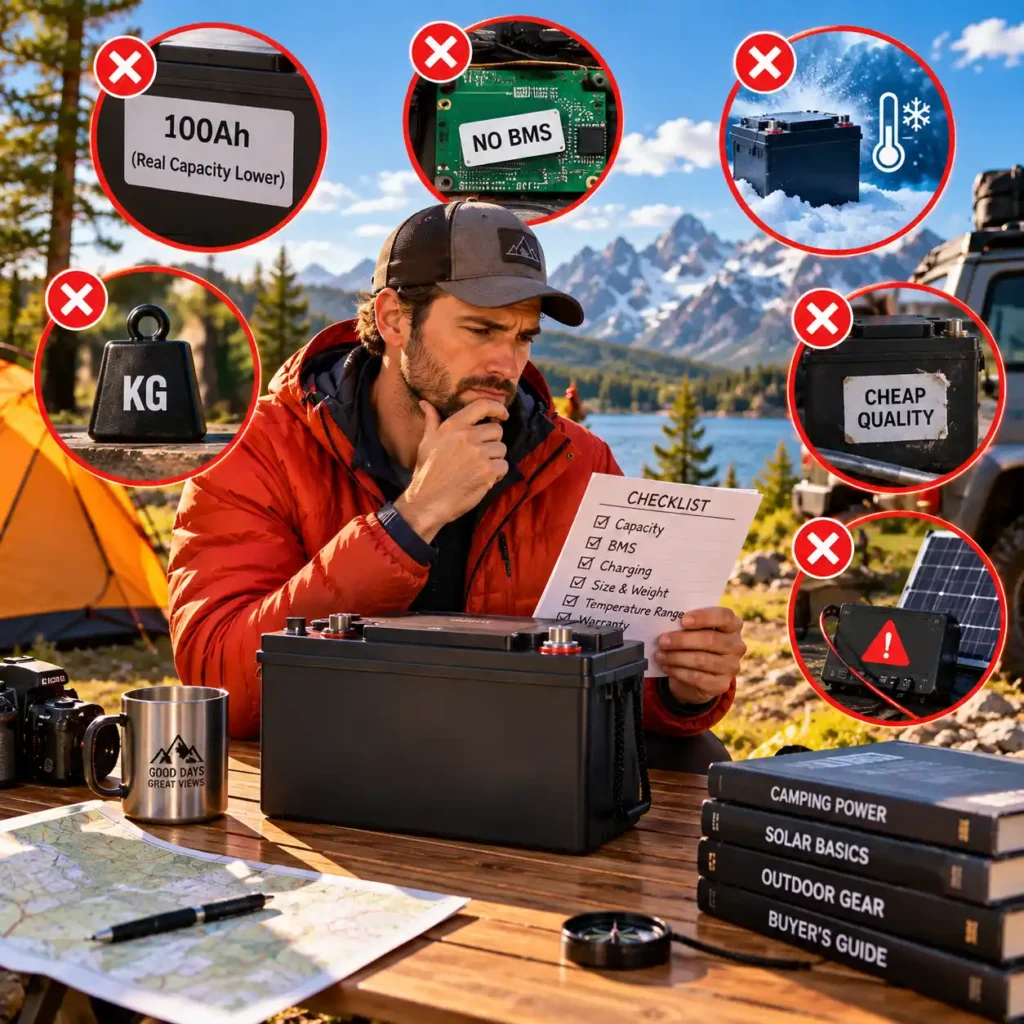
Choosing a 12V 100Ah LiFePO4 battery for camping can be straightforward once you understand your power requirements. However, focusing only on capacity or price can lead to compatibility problems, unexpected runtime, or a setup that does not suit your camping conditions.
Here are some common mistakes to avoid before buying and installing a camping battery.
1. Choosing a Battery Based on Capacity Alone
A 100Ah rating tells you the battery’s advertised capacity, but it does not tell you whether it can support every device in your camping setup.
Two batteries with the same nominal capacity may differ in continuous discharge limits, BMS protection, charging requirements, dimensions, and additional features.
How to avoid it: Check the battery’s complete specifications against your planned loads and charging equipment. Make sure its current limits and documented protections suit the devices you intend to power.
2. Underestimating Daily Power Consumption
A battery may appear sufficient on paper but run out of energy sooner than expected if you underestimate how much electricity your equipment uses.
Refrigerators, fans, lights, phones, and inverters can all contribute to daily consumption. Actual usage depends on the devices, operating conditions, and how long you run them.
How to avoid it: Estimate your daily energy consumption in watt-hours (Wh). Include every device you expect to use, and allow for system losses and a reasonable energy reserve.
3. Ignoring Cold-Weather Charging Limits
Camping in cold conditions requires particular attention to battery charging. Not every LiFePO4 battery has the same low-temperature protection or operating limits.
Assuming that all batteries can be charged in freezing conditions may result in using the battery outside the manufacturer’s specified range.
How to avoid it: Read the exact model’s charging temperature specifications. Confirm whether it includes low-temperature charging protection or a built-in heating function, and understand how those features operate.
4. Assuming Every 12V Charger Is Compatible
A battery labeled 12V is not automatically compatible with every charger, solar controller, or vehicle charging system.
Charging voltage, current limits, battery chemistry settings, and the design of the charging equipment all matter.
How to avoid it: Check the battery manufacturer’s recommended charging specifications and compare them with your charger or solar charge controller. For vehicle charging, verify that the charging method is suitable for your vehicle’s electrical system.
5. Overlooking Continuous Discharge Current
Capacity and discharge current describe different things. A battery may have sufficient stored energy for a device but still be unsuitable if the device’s current demand exceeds the battery’s permitted output.
This can become particularly important when running equipment with high startup or surge demands, or when using an inverter.
How to avoid it: Check the battery’s continuous discharge current and any applicable peak-current limits. Compare them with the requirements of your equipment, including startup demands where relevant.
6. Forgetting to Check Battery Dimensions and Weight
A battery that looks suitable in a product listing may not fit the intended location in a vehicle, camper, trailer, or camping storage area.
Limited space can also make it difficult to access terminals, connect cables, or secure the battery properly.
How to avoid it: Measure the installation space before ordering. Compare the manufacturer’s dimensions and weight with your available space, and plan for cable connections, mounting, and secure transport.
7. Paying for Features You Do Not Need
Bluetooth monitoring, low-temperature protection, heating, and other features may be useful for some camping setups, but not every camper needs the same capabilities.
Choosing features without considering how you will use the battery can increase the cost without necessarily improving your setup.
How to avoid it: Decide which features are essential for your camping conditions and which are optional. Compare the documented specifications of the exact models you are considering rather than choosing based on feature count alone.
8. Assuming Batteries Can Be Connected Freely
Connecting multiple batteries may seem like an easy way to increase capacity or voltage, but not every battery supports every series or parallel configuration.
Mixing batteries with different specifications or ignoring manufacturer restrictions can create compatibility and safety concerns.
How to avoid it: Confirm that the manufacturer permits your intended configuration. Follow its requirements for battery matching, wiring, protection, and installation. If you plan to expand your system, check those limits before purchasing.
9. Ignoring the Cost of the Complete Setup
The battery itself may not be the only purchase required to build a functional camping power system.
Depending on your existing equipment, you may also need a compatible charger, solar charge controller, cables, fuses, mounting hardware, or other components.
How to avoid it: Calculate the total cost of the setup you need. Include any additional equipment required for charging, installation, and safe operation before comparing battery prices.
10. Skipping the Manufacturer’s Instructions
Even a battery with suitable specifications can be used incorrectly if its charging, installation, or connection requirements are overlooked.
Product listings may not contain every detail needed to install and operate the battery properly.
How to avoid it: Read the manufacturer’s manual for the exact model and version. Confirm the permitted charging conditions, current limits, installation requirements, and connection restrictions before putting the battery into service.
Key Takeaway
The most common mistake is treating a 12V 100Ah LiFePO4 battery as a standalone purchase rather than one component of a complete camping power system.
Before buying, make sure the battery’s capacity, current limits, charging requirements, temperature protection, dimensions, and connection options match your actual setup. Checking these details in advance can help you avoid compatibility issues and choose a battery that fits the way you camp.
Frequently Asked Questions About 12V 100Ah LiFePO4 Batteries for Camping
Choosing a 12V 100Ah LiFePO4 battery for camping often raises questions about battery capacity, runtime, charging, cold-weather performance, and compatibility with solar panels, inverters, and RV power systems. These answers cover the key details to help you understand what to expect from a 100Ah lithium camping battery and choose the right setup for your needs.
How Long Does a 100Ah LiFePO4 Battery Last When Camping?
A 12V 100Ah LiFePO4 battery has approximately 1,200–1,280Wh of nominal energy, depending on the nominal voltage used for the calculation. How long it lasts depends on the power consumption of your devices and how much energy you can use from the battery.
Estimate runtime by dividing usable battery energy in watt-hours by the device’s average power consumption in watts. For multiple devices, add their energy use together. Inverters and other system components can introduce additional losses, so actual runtime may be shorter than a simple calculation suggests.
Is a 100Ah Lithium Battery Enough to Run a 12V Fridge?
It can be, but the runtime depends on the refrigerator’s daily energy consumption, ambient temperature, thermostat setting, ventilation, and compressor duty cycle.
Check the fridge’s energy use in watt-hours per day, then compare it with the battery’s usable energy. If you plan to camp for several days without recharging, account for the energy consumed by your other devices as well.
How Many Solar Panels Do I Need to Charge a 100Ah Lithium Battery?
The required solar panel wattage depends on how much energy you need to replace, how many hours of useful sunlight you receive, and the losses in your charging system.
A 200W solar array may be a starting point for some camping setups, but it is not a universal requirement or guarantee of a full recharge. Check your expected daily consumption, local sunlight conditions, panel placement, and charge controller limits before sizing the system.
Can You Charge a 12V 100Ah LiFePO4 Battery Below Freezing?
You should follow the charging temperature limits specified by the battery manufacturer. Many standard LiFePO4 batteries must not be charged below 32°F (0°C), because charging below the permitted temperature can damage the cells.
Some models include low-temperature charging protection, while others offer self-heating. These are different features: protection can stop charging, while a heating function may warm the cells before charging is allowed. Confirm what the exact battery model supports.
What Charger Do I Need for a 12V 100Ah LiFePO4 Battery?
Choose a charger that supports LiFePO4 batteries and matches the manufacturer’s recommended charging voltage and current.
For solar charging, use a compatible charge controller configured for the battery’s chemistry. For charging from a vehicle, verify whether your system requires a suitable DC-to-DC charger. Do not assume that every lead-acid charger or vehicle charging circuit is appropriate for a lithium battery.
Can a 12V 100Ah LiFePO4 Battery Run a 2000W Inverter?
Not necessarily. A 2000W inverter can demand a high current from a 12V battery. At 12V, 2,000W corresponds to about 167A before accounting for inverter losses, and actual battery current may be higher.
Check the battery’s continuous discharge rating, BMS limits, inverter input requirements, wiring, and overcurrent protection. The 100Ah capacity rating alone does not establish whether the battery can support a 2000W inverter.
Can I Replace My AGM Battery With a 12V 100Ah LiFePO4 Battery?
A LiFePO4 battery may be a suitable replacement in some systems, but it is not always a direct drop-in swap.
Before replacing an AGM battery, verify the new battery’s dimensions, terminal arrangement, charging requirements, current limits, and compatibility with your converter, solar controller, or vehicle charging system. Follow the instructions for both the battery and the equipment it will connect to.
Can I Connect Two 12V 100Ah LiFePO4 Batteries in Parallel?
Some batteries support parallel connections to increase the system’s available capacity, but the permitted configuration depends on the exact model and manufacturer’s instructions.
Check the allowed number of batteries, matching requirements, wiring guidance, and any restrictions on connecting batteries of different ages or specifications. Do not assume that every 12V 100Ah battery can be connected in parallel—or in series.
Is Bluetooth Monitoring Worth It on a Camping Battery?
Bluetooth monitoring can be useful if you want to check battery information through a compatible smartphone app. However, it is optional for many camping setups.
If you want this feature, confirm which information the exact model reports and whether it works with your phone. Bluetooth monitoring does not replace checking capacity, discharge limits, charging compatibility, and temperature requirements.
How Much Energy Does a 12V 100Ah LiFePO4 Battery Store?
A battery’s nominal energy is calculated by multiplying its nominal voltage by its amp-hour capacity.
For example, using 12V:
12V × 100Ah = 1,200Wh (1.2kWh)
Some 12V-class LiFePO4 batteries specify a nominal voltage of 12.8V, which gives 1,280Wh. This is nominal stored energy, not a guarantee that all of it will be available to your devices. Usable energy depends on the battery’s specifications and the losses in your system.
Final Verdict: Choosing the Right 12V 100Ah LiFePO4 Battery
A 12V 100Ah LiFePO4 battery can be a useful part of a camping power system, but its suitability depends on more than the capacity printed on the label. The battery, charging equipment, connected appliances, and installation all need to work together as a complete system.
The key takeaway from this comparison is that a battery’s specifications matter only in relation to the way you plan to use it. A feature that makes little difference on a mild-weather weekend trip may become important during extended off-grid camping or when the battery is installed in a vehicle with limited space.
Before making your purchase, take one final look at the requirements of your own setup. Make sure the exact battery model you intend to order is compatible with your charging equipment and planned loads, and verify its operating limits in the manufacturer’s documentation. Product names and similar capacity ratings are not enough to establish that two battery versions have identical features.
It is also worth considering the practical side of ownership. Think about where the battery will be installed, how it will be secured during travel, how you will recharge it at camp, and whether you may need to expand your system later. These decisions can affect the equipment you need and the overall cost of your setup.
Ultimately, the purpose of choosing a camping battery is not simply to buy 100Ah of nominal capacity. It is to build a power system that can reliably support the devices you intend to use, within the battery’s documented limits and the conditions you expect to encounter.
Before you order, verify the specifications for the exact model, confirm system compatibility, and make sure the complete setup meets your camping power requirements. That final check is the most practical way to turn a battery comparison into a well-informed purchase.
The CampComfortGuide Promise
At CampComfortGuide, our goal is to help you make informed decisions about camping gear with practical, easy-to-understand guidance. We focus on the details that matter in real camping situations—from product features and compatibility to setup requirements and everyday use.
Our recommendations are built around careful research, transparent comparisons, and the needs of campers. We aim to explain not only what a product offers, but also where it may fit your setup and what you should consider before buying.
Whether you’re preparing for a weekend at the campsite, planning an extended off-grid trip, or upgrading your camping equipment, we’re here to help you choose with confidence—not guesswork.
That’s the CampComfortGuide promise: practical advice, clear comparisons, and camping gear guidance you can use.