
Doing laundry while camping can become surprisingly difficult once a trip stretches beyond a couple of days. Dirty clothes, towels, muddy outdoor gear, and limited access to laundromats can quickly turn into a storage and hygiene problem. A portable washing machine gives campers another option, but choosing one is not as simple as picking the model with the largest capacity.
The best portable washing machines for camping need to match the way you actually camp. A lightweight twin-tub washer may make more sense for a campsite where storage space and portability matter, while a full-automatic machine can be a better fit for an RV or a longer-term setup with reliable access to water, drainage, and electricity. Capacity, machine weight, washing method, spin performance, water management, and setup requirements all affect how practical a washer will be once you are away from home.
In this guide, we compare five portable washing machines that represent distinctly different approaches to camping laundry. From compact budget models designed for smaller loads to substantially larger automatic machines intended for more permanent RV use, each one solves a different problem. Rather than treating them as interchangeable appliances, we look at where each machine fits, what its limitations mean at camp, and which type of camper is most likely to get the most value from it.
All five picks in this guide are electric portable washing machines. If you camp without reliable electricity, a manual washer or wash bag is a different and often more practical category.
As an Amazon Associate, we earn from qualifying purchases.
Table of Contents
Quick Answer: Which Portable Washing Machine Is Best for Camping?
The best portable washing machine for camping depends less on the machine itself than on how your campsite is set up. If you have access to 120V power, a practical water source, and a suitable place to drain the used water, an electric portable washer can take most of the work out of laundry. If your trip involves carrying all your water and power, however, a conventional electric washer may be more equipment than you need.
For car camping, RV camping, and longer stays at a base camp, twin-tub and compact automatic washers are the most useful formats to consider. Twin-tub models give you more control over filling, washing, spinning, and draining, while fully automatic machines require less hands-on work once the cycle starts. Current camping-focused guides consistently make the same basic distinction: power, water, drainage, and available space should be decided before capacity or features.
A simple way to narrow the choice is:
- Choose a twin-tub washer if you want larger loads and don’t mind moving clothes between the wash and spin tubs.
- Choose a fully automatic washer if convenience matters more than portability and you have a stable water and power setup.
- Choose the smallest practical machine if storage space is limited and you mainly wash everyday clothing rather than bulky items.
- Think twice about an electric washer for remote camping if your campsite has no reliable power source or you have to carry water long distances.
- Plan the drainage before buying. A washer is only practical at camp if you have somewhere appropriate to discharge the used water.
In other words, don’t start by asking “Which portable washing machine is the best?” Start with “What can my camping setup realistically support?” That answer will eliminate many unsuitable machines before capacity, cycles, or extra features even become relevant.
Keep in mind that “portable” does not always mean easy to move from campsite to campsite: some larger models are better understood as transportable RV or base-camp appliances rather than equipment for frequent relocation.
Why You Can Trust This Guide
Portable washing machines are easy to compare badly. A specification sheet can tell you the drum capacity, spin speed, dimensions, and power requirements, but it cannot tell you whether a particular machine makes sense for the way you actually camp.
That is why this guide separates verified product information from our editorial judgment. We use manufacturer and product-listing specifications for measurable details such as capacity, dimensions, weight, power requirements, wash programs, and included equipment. We then evaluate what those specifications mean in a camping environment — including storage, water supply, drainage, power availability, load size, and the amount of hands-on work required.
We also do not describe these machines as personally tested when we have not tested them ourselves. Where a recommendation is based on specifications, product configuration, and suitability for a particular camping scenario, we say so rather than presenting an unverified hands-on claim as experience.
Finally, we compare the five machines on the same practical question: which type of camper is each one actually a good fit for? That approach matters because the largest-capacity washer is not automatically the best choice for a campsite, and the smallest machine is not necessarily the most portable once you account for water, power, hoses, and drainage.
How We Selected the Portable Washing Machines
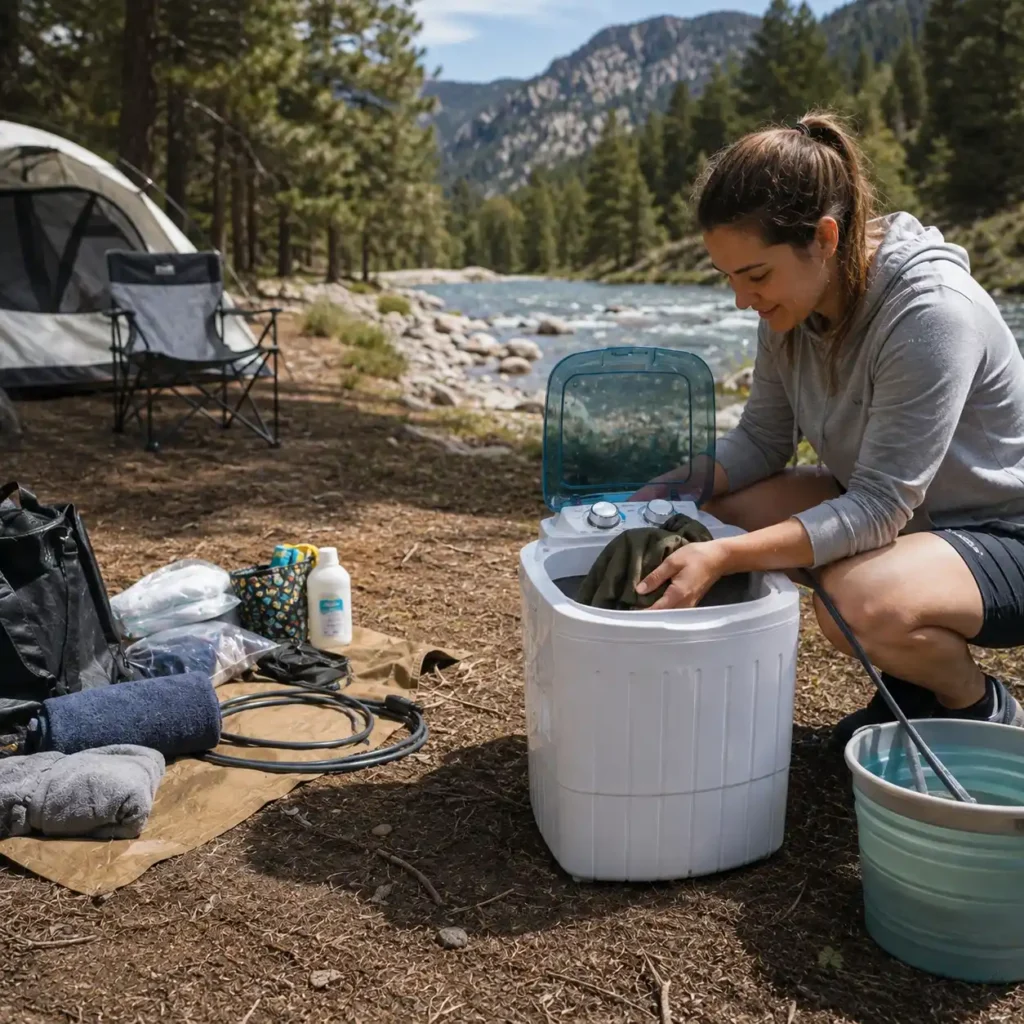
We started with the way a washing machine will actually be used at camp rather than simply collecting the highest-rated compact washers. Current camping and off-grid guides also tend to prioritize the practical constraints that matter most away from a normal laundry room: power, water supply, drainage, capacity, and portability.
For this guide, we compared five portable washing machines across the following factors:
- Washing capacity — how much laundry the machine can handle in a practical camping routine, not just the largest number in the product title.
- Machine type — twin-tub and fully automatic designs involve different levels of hands-on work, so we considered what each format requires from the camper.
- Power requirements — particularly important for campsites relying on a portable power station, inverter, generator, or another limited electrical source.
- Water and drainage setup — a washer is only useful if you can fill it and dispose of wastewater appropriately at your campsite.
- Portability and storage — overall size and weight matter when the machine has to travel with the rest of your camping equipment.
- Practical usability — controls, cycle options, spin capability, hoses, pumps, and other included equipment were considered where they affect everyday use.
- Camping-specific value — we looked at what each machine offers for its intended camping scenario rather than assuming that more capacity or more features automatically make a better choice.
Our product information is based primarily on current manufacturer and retailer specifications. The final awards are editorial recommendations based on camping suitability, not claims of laboratory or hands-on testing. This distinction is important because several competing guides use personal testing as their basis; we do not present testing experience that we do not have.
Who Is This Guide For?
This guide is for campers who want to wash a useful amount of clothing at the campsite without relying on a campground laundry room. The five machines we selected are most relevant when you can bring the washer with your other gear and have a practical way to supply water, provide electricity, and handle wastewater.
It is particularly useful for:
- Car campers staying at one campsite for several days and wanting to avoid carrying a growing bag of dirty clothes.
- RV campers who have enough storage space and an electrical setup suitable for a portable washer.
- Family campers who generate enough laundry that hand-washing becomes tedious, especially on longer trips.
- Extended-stay campers who remain at a base camp rather than moving every day.
- Off-grid campers with a power station or generator who can accommodate an electric washer as part of their campsite system.
- Campers comparing twin-tub and automatic machines and trying to decide how much convenience is worth the additional size, weight, and power requirements.
This guide is not primarily aimed at backpackers or minimalist campers who carry every item on their backs. A manual wash bag or hand-powered washer can make considerably more sense in that situation because an electric portable washer adds substantial equipment, along with the need for a suitable power source.
The same distinction applies to very short overnight trips. If you only need to wash a few lightweight items, bringing a full portable washer may solve a problem that is smaller than the equipment required to solve it. For longer stays, larger groups, or campers who regularly deal with sweaty clothing, towels, and other everyday laundry, the calculation changes considerably.
What Makes a Good Portable Washing Machine for Camping?
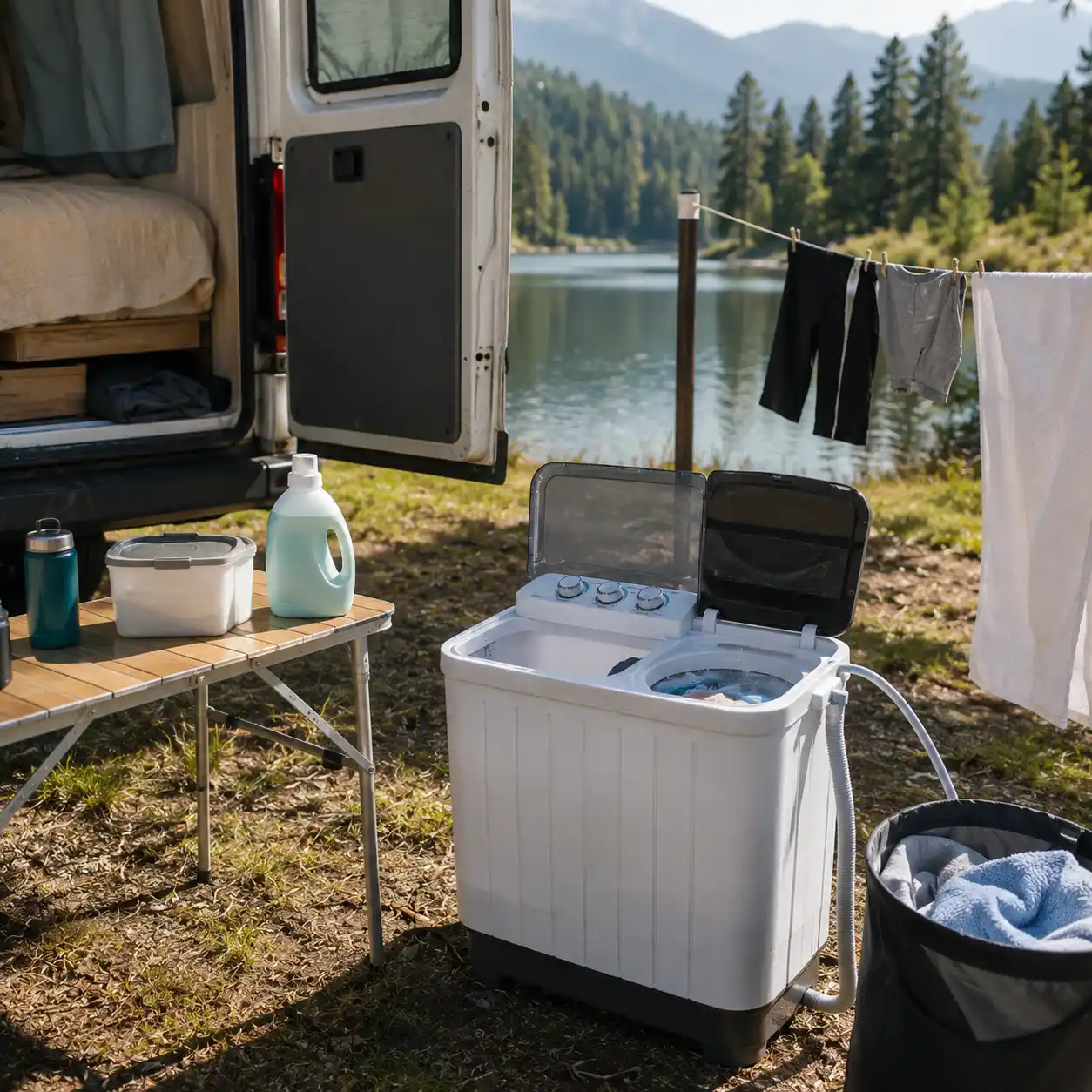
A portable washing machine can have an impressive capacity and still be a poor camping choice. Away from a house, the limiting factor is often not the wash drum itself but everything around it: where the water comes from, how the machine gets power, where wastewater goes, and whether you have enough space to use and store it. That is also the common thread across the strongest current camping and off-grid guides, although many of them stop at a basic list of specifications.
For camping, these are the characteristics that matter most:
Capacity You Can Actually Use
A larger rated capacity is useful only if the rest of your setup can support it. A 20- or 28-pound washer may reduce the number of loads for a family, but it also means more clothing, water, and physical space to manage at once. Smaller machines can be more practical when you are washing a few days of everyday clothing rather than trying to process an entire household load.
A Power Requirement That Fits Your Campsite
Electric washers are only as convenient as the power source behind them. For car camping, a portable power station or generator can make an electric washer practical; for a fully off-grid setup, the machine’s running wattage becomes part of the campsite’s energy budget. Current off-grid comparisons show why low-power machines can be attractive even when their capacity is smaller.
Water and Drainage That Are Easy to Manage
Camping changes the equation because you may need to carry the water yourself and collect or route the wastewater instead of connecting to household plumbing. A machine that is easy to fill but awkward to drain can quickly become inconvenient. Hose length, drain-pump capability, and the location of your water container therefore matter just as much as the washer’s advertised capacity.
A Useful Spin Cycle
Washing is only half the job. The more water the machine can remove during spinning, the less time wet clothes need on a clothesline or drying rack. This is particularly valuable in cool, humid, or cloudy conditions, where reducing the moisture left in the fabric can make the difference between laundry that dries during the day and laundry that stays damp overnight. Portable-washer buying guides likewise identify spin capability as an important part of the overall camping setup.
A Format That Matches the Way You Camp
Twin-tub machines require more hands-on work because washing and spinning are handled separately, but that design can offer useful capacity without demanding the electrical resources of a larger household-style appliance. Fully automatic machines reduce the amount of intervention required, but they can be heavier and less convenient to accommodate at a temporary campsite. Manual washers sit at the opposite end of the spectrum, trading automation for minimal power requirements.
Size, Weight, and Stability
Portability is more than being able to lift the machine. It needs to fit in your vehicle, have somewhere stable to operate, and leave enough room for hoses and laundry containers. A lightweight washer that moves or vibrates excessively during operation can be less practical than a heavier machine that remains stable on a suitable surface.
The best camping washer is therefore not necessarily the biggest, lightest, or most automated model. It is the one whose capacity, power demand, water handling, and physical footprint make sense together within your particular camping setup.
Noise and vibration also matter in a campsite, particularly inside an RV or when the washer is operating close to other campers. Portable machines can move or rattle during the spin cycle if they are overloaded or sitting on an uneven surface. A stable, level setup and properly distributed laundry can make a noticeable difference, even when the manufacturer does not provide a formal noise rating.
Quick Summary: Our Top Portable Washing Machine Picks
If you don’t have time to read the full guide, this shortlist gives you a quick way to see how our five picks differ. We deliberately selected machines with different strengths rather than five variations of the same portable washer.
There is no single portable washing machine that makes sense for every camping setup. The better choice depends on how much laundry you need to wash, whether you have reliable AC power, how much hands-on work you are willing to do, and whether the machine needs to stay in an RV or travel in the vehicle between campsites.
Auertech 28 lbs Twin Tub Washer
Award: Best High-Capacity Twin Tub
Why It Won
The Auertech is built for campers who would rather process larger amounts of laundry in fewer loads. Its 28-pound rated capacity and separate wash and spin tubs make it particularly useful for families and longer stays where laundry can quickly become a daily chore.
Choose This If:
- You want a high-capacity twin-tub washer.
- You expect to wash substantial loads during longer trips.
- You prefer separate washing and spinning rather than a fully automatic cycle.
- You have enough vehicle and campsite space for a larger machine.
Best For:
- Family camping
- Extended camping trips
- Base-camp setups
- Large laundry loads
- Car camping
Nictemaw 20Lbs / 2.8 Cu. Ft. Full-Automatic Washer
Award: Best Fully Automatic Option
Why It Won
The Nictemaw is the choice for campers who want portable laundry to feel closer to using a conventional washing machine. Its fully automatic design, multiple wash modes, adjustable water levels, built-in drain pump, and larger tub make it especially appealing for RV setups where convenience matters more than minimizing the machine’s footprint.
Choose This If:
- You want a fully automatic washing machine.
- You prefer minimal intervention during a wash cycle.
- You have an RV or stationary campsite setup with suitable power.
- You want more washing options and adjustable water levels.
Best For:
- RV camping
- Extended stays
- Family laundry
- Stationary campsites
- Convenience-focused campers
COSTWAY 20 lbs Twin Tub Portable Washer
Award: Best Value Twin Tub
Why It Won
The COSTWAY offers the basic advantages of a larger twin-tub washer without moving into the more complicated fully automatic format. Its separate wash and spin compartments make it a practical middle ground for campers who want meaningful laundry capacity but are comfortable managing the individual stages of the process themselves.
Choose This If:
- You want a capable twin-tub washer without going fully automatic.
- You want a useful balance between capacity and simplicity.
- You are comfortable transferring clothes between the wash and spin tubs.
- You want a practical option for regular camping laundry.
Best For:
- Car camping
- RV camping
- Longer trips
- Family laundry
- Value-focused campers
BLACK+DECKER BPWM20W 2.0 Cu. Ft. Portable Washer
Award: Best for RV Camping
Why It Won
The BLACK+DECKER takes a different approach from the twin-tub models. It is a heavier, fully automatic machine designed for campers who have the space and electrical setup to keep a more conventional portable washer as part of their RV or semi-permanent camping arrangement. Its wash programs, multiple water levels, and automatic operation favor convenience over minimum weight.
Choose This If:
- You want automatic washing with minimal hands-on work.
- You have a dedicated place to operate and store the machine.
- You are primarily an RV or stationary camper.
- You value familiar washing-machine controls over maximum portability.
Best For:
- RV camping
- Long-term camping
- Full-hookup campsites
- Stationary base camps
- Larger laundry routines
SUPER DEAL 9.9 lbs Twin Tub Portable Washer
Award: Best Compact Budget Twin Tub
Why It Won
The SUPER DEAL is aimed at campers who want the basic advantages of a twin-tub washer without moving up to the larger machines in this guide. Its smaller capacity and compact footprint make it easier to accommodate when storage space is limited, while the separate wash and spin tubs keep the design straightforward.
Choose This If:
- You want a smaller and simpler electric washer.
- Your typical laundry loads are relatively small.
- Storage space is more important than maximum capacity.
- You want to keep the purchase cost and equipment footprint under control.
Best For:
- Weekend camping
- Small households
- Compact RV setups
- Occasional campsite laundry
- Budget-conscious campers
Comparison Table: Portable Washing Machines for Camping
The five models differ most in capacity, washing format, machine size, and how much hands-on work they require. This comparison focuses on the specifications that have the biggest practical effect at a campsite, rather than filling the table with features that do not change the buying decision.
| Model | Type | Capacity | Spin | Dimensions | Weight | Best For |
|---|---|---|---|---|---|---|
| Auertech 28 lbs Twin Tub | Twin tub, semi-automatic | 28 lbs total 18 lbs wash / 10 lbs spin | 1,300 RPM | 15" D × 27" W × 32" H | 31 lbs | Large laundry loads |
| Nictemaw 20 lbs / 2.8 Cu. Ft. | Fully automatic | 2.8 cu. ft. | Not specified | 19.3" D × 20.1" W × 35" H | Not specified | RV and stationary camping |
| COSTWAY 20 lbs Twin Tub | Twin tub, semi-automatic | 20 lbs total 12 lbs wash / 8 lbs spin | 1,300 RPM | Approx. 24.8 × 15 × 28.5 in | Not specified | Balanced capacity and value |
| BLACK+DECKER BPWM20W | Fully automatic | 15.4 lbs per load | 760 RPM | 21.6" D × 22.2" W × 37.4" H | 79.4 lbs | RV camping and fixed setups |
| SUPER DEAL 9.9 lbs Twin Tub | Twin tub | 9.9 lbs total 5.5 lbs wash / 4.4 lbs spin | 1,300 RPM | 14.6" D × 22" W × 22.6" H | 22 lbs | Small loads and limited space |
The capacity and Auertech specifications are supported by current product data, while the comparison approach reflects the way current portable-washer guides distinguish models by capacity, type, power, and practical camping use.
Our Five Portable Washing Machine Picks
The five machines below are not interchangeable. We selected them to cover different camping situations, from larger twin-tub washers for family laundry to fully automatic machines for RV setups and more compact options for campers with limited storage. That distinction is important because current portable-washer guides increasingly separate their recommendations by capacity, washing format, portability, and the type of camping setup involved.
Rather than treating one specification as the deciding factor, the reviews look at what each machine means in actual camp use — including the space it occupies, the amount of laundry it can realistically handle, and how much work remains for the camper.
1. Auertech 28 lbs Twin Tub Washing Machine
Best for large laundry loads and extended car-camping stays

Quick Verdict
The Auertech 28 lbs Twin Tub Washing Machine is the heavyweight option in this lineup for campers who would rather handle more laundry per cycle than work around the smaller tubs found on many compact washers. Its 18-pound washing tub and 10-pound spinner give it substantial capacity, while the separate tubs allow washing and spinning to overlap rather than forcing you through one operation at a time.
The built-in drain pump is particularly useful in a camping environment. You have more freedom over where the machine can sit because wastewater does not have to depend entirely on gravity draining, provided the drain setup stays within the manufacturer’s stated limits. The 1300 RPM spinner is another practical advantage when clothes need to move from washing to a clothesline or drying rack without carrying as much excess water.
The trade-off is straightforward: this is not a small machine that disappears into a corner of the vehicle. At 31 pounds and 15 × 27 × 32 inches, the Auertech needs a proper place in your camping setup. It is also semi-automatic, so you remain involved in moving laundry between the two tubs and managing the individual stages. For campers who have the space and expect enough laundry to justify that workflow, however, the extra capacity is exactly what makes this model interesting.
Camp Snapshot
| Camping Style | Car Camping • Family Camping • RV Camping • Extended Trips |
| Washer Type | Twin Tub / Semi-Automatic |
| Wash Capacity | 18 lbs |
| Spin Capacity | 10 lbs |
| Total Rated Capacity | 28 lbs |
| Spin Speed | 1,300 RPM |
| Dimensions | 15" D × 27" W × 32" H |
| Machine Weight | 31 lbs |
| Drainage | Built-In Drain Pump |
| CampComfortGuide Verdict | Best for Large Laundry Loads |
Why We Chose It
The Auertech earns its place here for a simple reason: capacity becomes genuinely useful when camping turns into a multi-day laundry problem. An individual camper may be perfectly happy with a smaller washer, but families and longer-stay campers can quickly accumulate shirts, towels, underwear, socks, and other everyday clothing. The 18-pound wash tub gives this machine considerably more room to work with than the compact models in this category.
The twin-tub arrangement also changes how the workload flows. While one batch is spinning, another can be washing, so the two compartments are not simply two containers for the same job. They create a more efficient rhythm for a larger laundry session — provided you are comfortable staying involved and transferring clothes between tubs.
We also gave weight to the drain pump, because drainage is easy to overlook when comparing portable washers from a specification sheet. At camp, the nearest suitable wastewater point may not be positioned conveniently below the washer. A built-in pump gives the Auertech more flexibility than a machine that relies solely on gravity, with the manufacturer’s stated drain-height limitation still needing to be respected.
The result is a washer that makes the most sense when laundry volume, rather than minimum packed size, is the problem you are trying to solve. That is a more specific role than simply calling it a good portable washer — and it is why we selected the Auertech as the high-capacity choice in this guide.
Check today’s price and latest customer reviews on Amazon.

Living With It at Camp
The Auertech makes the most sense when laundry is something you need to keep moving through camp, rather than a small task you squeeze in occasionally. The separate wash and spin tubs give you a workable rhythm: while one batch is spinning, the next can already be going through the wash cycle. That matters more on a longer trip, when stopping to hand-wash several days of clothing can become surprisingly time-consuming.
Its 18-pound wash tub is the real reason to choose this model over a smaller portable washer. You can deal with a meaningful amount of everyday clothing in one session instead of breaking everything into very small loads. The 10-pound spinner is smaller, so larger wash loads need to be divided before spinning, but that is a normal compromise with a twin-tub design rather than a flaw unique to the Auertech.
The built-in drain pump is particularly helpful around a campsite. You are not limited to placing the washer immediately beside a low floor-level drain, although the drain hose still has a maximum lift requirement. That gives you more freedom to position the machine near your water and laundry area rather than building the entire campsite around the washer.
There is also a practical benefit to the 1,300 RPM spinner. A portable washer does not eliminate the need to dry clothes, but removing more water before the clothes reach the line can shorten the drying stage. That becomes increasingly useful when you are dealing with towels, heavier clothing, or several loads during a longer stay.
The part that requires the most adjustment is the hands-on workflow. You have to manage water, move clothes from the washer to the spinner, and control the individual stages yourself. This is not a machine you start and then forget about. For a camper who enjoys the convenience of automation, that will feel like extra work; for someone who wants a high-capacity washer without bringing a full-size appliance to camp, the trade-off is much easier to justify.
The Auertech also needs a proper place to operate. At 31 pounds and roughly 15 × 27 × 32 inches, it is portable in the sense that you can transport and reposition it, but it is not lightweight camping equipment. I would treat it as part of the campsite infrastructure: decide where it will stand, where fresh water will come from, where wastewater will go, and where the washed clothes will dry before starting the first load.
That distinction is important. The Auertech is not the washer I would choose simply because its capacity is large. It earns its space when the amount of laundry you need to process justifies bringing a substantially larger machine along.
CampComfortGuide Assessment
These ratings are CampComfortGuide editorial assessments based on the specifications, configuration, and camping use case discussed in this guide; they are not laboratory test scores.
| Evaluation Category | Editorial Assessment |
|---|---|
| Wash Capacity | ★★★★★ An 18-lb wash tub gives this model a meaningful advantage for family laundry and longer camping stays. |
| Spin Capability | ★★★★★ The 10-lb spinner and 1,300 RPM speed make water removal a strong part of the machine's appeal. |
| Camping Practicality | ★★★★☆ Useful for established campsites, but its size and weight require deliberate storage and setup. |
| Water & Drainage | ★★★★★ Built-in drain pump and adjustable inlet hose provide useful flexibility when planning the campsite laundry area. |
| Ease of Use | ★★★★☆ Simple controls are approachable, but the twin-tub format requires more hands-on involvement than a fully automatic washer. |
| Portability | ★★★☆☆ Transportable for car and RV camping, but too substantial to consider genuinely lightweight camping gear. |
| Overall Value | ★★★★★ A strong choice when higher laundry capacity is worth the additional space and manual operation. |
Who Should Buy This
- Campers who regularly deal with large amounts of laundry during multi-day trips.
- Families who want to reduce the number of small washing loads.
- Car campers with enough vehicle space for a larger portable washer.
- RV campers who prefer a twin-tub design over a fully automatic machine.
- Extended-stay and base-camp campers who can establish a dedicated laundry area.
- Campers who value a strong spin cycle and built-in drainage flexibility.
Who Should Skip This
- Backpackers or minimalist campers who need equipment that is genuinely lightweight.
- Campers who move to a different campsite every day.
- Anyone who wants a completely automatic wash-and-spin process.
- Solo campers who usually have only a few lightweight items to wash.
- Campers without a practical plan for supplying water and managing wastewater.
- Anyone who does not have enough vehicle or storage space for a 31-pound machine.
Final Verdict
The Auertech 28 lbs Twin Tub Washing Machine is at its best when camping creates a real laundry workload. Its large wash tub, separate spinner, 1,300 RPM spin speed, and built-in drain pump give it the capabilities needed for longer stays where washing clothes by hand is no longer particularly attractive.
It is not the smallest machine in this guide, nor is it the easiest to operate. Those are deliberate trade-offs for its higher capacity. If your priority is keeping a family or extended camping trip supplied with clean clothes, the additional equipment can be justified. If you are only washing a few items occasionally, a smaller machine will make more sense.
For campers who have the space and genuinely need the capacity, the Auertech is one of the most practical high-volume options in this group.
Check today’s price and latest customer reviews on Amazon.
Related Guide:
If your camping laundry will need to dry outdoors after washing, our How to Dry Camping Gear Fast After Rain (Without Mold or Smells) guide covers practical ways to speed up drying and prevent damp gear from becoming a problem.
2. Nictemaw 20Lbs / 2.8 Cu. Ft. Full-Automatic Washing Machine
Best for RV campers who want automatic laundry with minimal hands-on work

Quick Verdict
The Nictemaw takes a different approach from the Auertech. Instead of separating washing and spinning into two tubs, it puts the entire laundry cycle into one fully automatic machine. Once the cycle is selected, the washer handles filling, washing, rinsing, and spinning without requiring you to move clothes between tubs. Its 20-lb capacity also makes it suitable for campers who regularly have more than a small load to deal with.
For camping, the built-in drain pump is particularly useful because wastewater does not have to depend entirely on gravity drainage. The machine also provides 10 wash programs and eight water-level settings, giving you more control over different loads than a basic compact washer. A 24-hour delay-start function is another convenience, although it is more useful in an RV or established base-camp setup than on a constantly moving trip.
The trade-off is that this is still a substantial appliance rather than something you casually throw into the vehicle. At 19.3 × 20.1 × 35 inches, it needs a proper place to operate and store. Its 480W motor also means you need an electrical setup capable of supporting the washer, making it much more appropriate for RV camping, extended stays, and stationary camps than minimalist off-grid travel.
Camp Snapshot
| Feature | Nictemaw 20Lbs / 2.8 Cu. Ft. |
|---|---|
| Camping Style | RV Camping • Extended Trips • Base Camp |
| Washer Type | Fully Automatic |
| Capacity | 20 lbs / 2.8 cu. ft. |
| Wash Programs | 10 |
| Water Levels | 8 |
| Motor | 480W |
| Dimensions | 19.3 × 20.1 × 35 in. |
| Drainage | Built-In Drain Pump |
| CampComfortGuide Verdict | Best for Automatic Laundry in an RV or Established Camp |
The 20-lb capacity, 2.8-cu.-ft. design, 480W motor, automatic operation, and drain pump are documented for this Nictemaw configuration; exact product specifications can vary between Nictemaw models, so the ASIN selected for this guide is the reference point for this recommendation.
Why We Chose It
Nictemaw earns its place because it solves a different camping problem from a twin-tub washer: reducing the amount of attention laundry demands from the camper. With a fully automatic cycle, there is no need to stand beside the machine and transfer wet clothing from a wash compartment into a separate spinner. That distinction becomes meaningful on longer RV trips, where laundry is another routine task competing with cooking, campsite setup, and everything else happening around camp.
The 20-lb capacity is also substantial enough for regular family laundry without moving into the footprint of a conventional household washer. Combined with 10 programs and eight water levels, the machine offers flexibility that makes more sense for campers doing laundry repeatedly rather than simply washing a handful of emergency items.
We also gave weight to the integrated drain pump. At a campsite, wastewater management can be just as important as washing itself. A pump gives you more freedom in where the washer can discharge water, provided the hose can be routed safely and wastewater is disposed of according to the campsite’s rules.
Most importantly, this is a convenience-first camping washer. It is not the obvious choice for a camper trying to minimize every pound of equipment. Its 35-inch height and 480W electrical requirement make the Nictemaw much better suited to an RV, longer base camp, or established vehicle-camping setup where the washer can stay in one place and become part of the campsite’s normal routine.
Check today’s price and latest customer reviews on Amazon.

Living With It at Camp
The Nictemaw makes the most sense when laundry can become part of an established campsite routine rather than something you set up and pack away every few hours. Its fully automatic operation changes the experience considerably: load the clothes, select the program and water level, and the machine handles the cycle without the wash-to-spin transfers required by a twin-tub design.
That convenience comes with an important camping qualification. The machine is roughly 35 inches tall and requires a stable operating position, a water connection, drainage, and enough electrical capacity for its 480W motor. In an RV or long-term base camp, those requirements can be manageable. At a temporary campsite where everything has to be carried out every morning, they become much less attractive.
The built-in drain pump is one of the features that improves its usefulness away from conventional plumbing. You still need a sensible place to send the wastewater, but you have more flexibility than with a washer that depends entirely on gravity drainage. Hose connections also deserve attention before starting a load; current documentation identifies loose or incorrectly positioned hoses as potential causes of leakage or drainage problems.
The 20-lb capacity is large enough to make the washer worthwhile for family or extended-trip laundry, while the eight water levels allow smaller loads to be handled without automatically filling the tub to its maximum level. That is a more useful advantage at camp than simply having a long list of wash programs.
One limitation is worth keeping in perspective: this is a washer with a spin function, not a heated clothes dryer. Clothes still need somewhere to finish drying after the cycle, so the complete system includes drying space as well as washing, water, drainage, and electricity.
CampComfortGuide Assessment
These ratings are CampComfortGuide editorial assessments based on the specifications, configuration, and camping use case of this model; they are not laboratory test scores or results from hands-on testing.
| Category | Rating | CampComfortGuide Assessment |
|---|---|---|
| Washing Capacity | ★★★★★ | 20-lb capacity is substantial for family and extended-trip laundry. |
| Automatic Operation | ★★★★★ | A strong advantage for campers who want to minimize hands-on laundry work. |
| Water & Drainage | ★★★★☆ | Built-in pump adds flexibility, but campsite wastewater planning remains necessary. |
| Power Requirements | ★★★★☆ | 480W is reasonable for a suitable RV or power setup, but not ideal for minimal off-grid systems. |
| Camping Practicality | ★★★★☆ | Excellent for established camps and RVs; less appealing for constantly moving campers. |
| Ease of Use | ★★★★★ | Automatic cycles, multiple programs, and adjustable water levels reduce routine intervention. |
| Portability | ★★★☆☆ | Portable in the RV/vehicle sense, but its size makes frequent relocation less convenient. |
| Overall Value | ★★★★☆ | A strong convenience-oriented choice when the campsite can support the machine. |
Who Should Buy This
- RV campers who want a more automatic laundry routine without installing a full-size household washer.
- Family campers who regularly accumulate enough clothing to justify a 20-lb machine.
- Extended-stay campers who remain in one location long enough for setup and storage to make sense.
- Base-camp campers with reliable access to water, electricity, and an appropriate wastewater solution.
- Campers who dislike twin-tub workflows and would rather let one machine handle the complete wash cycle.
- Users with a suitable power station or campsite electrical supply capable of supporting a 480W appliance.
Who Should Skip This
- Backpackers and minimalist campers who need equipment that can be carried rather than transported by vehicle.
- Daily movers who would have to disconnect, pack, and reposition the washer every day.
- Campers with very limited electrical capacity where a 480W appliance would consume too much available power.
- Short-trip campers who only need to wash a few lightweight items.
- Anyone without a practical wastewater plan, because the drain pump does not eliminate the need for responsible disposal.
- Campers looking for a true clothes dryer rather than a washer with a spin function.
Final Verdict
The Nictemaw is the choice for campers who value automation over minimum equipment. Its 20-lb capacity, multiple programs, adjustable water levels, and built-in drain pump create a much more conventional laundry experience than a basic twin-tub machine.
For an RV, established base camp, or extended camping trip, that convenience can justify the additional footprint and electrical requirement. For a campsite that moves every morning, the same characteristics become liabilities.
Among our five portable washing machines, we would choose the Nictemaw when the priority is reducing the amount of attention laundry requires—not when the priority is carrying the smallest or simplest machine possible.
Related Guide:
If you use a portable washer at camp, having enough clean water on hand becomes part of the setup. Our guide to the best camping water containers covers practical options for storing and transporting the water you need.
3. COSTWAY 20 lbs Twin Tub Washing Machine
Best Value Twin Tub for Balanced Camping Laundry

Quick Verdict
The COSTWAY is the middle-ground option in this lineup. Its 20-lb total rating is divided between a 12-lb wash tub and an 8-lb spin tub, giving you enough capacity for meaningful laundry without moving up to the larger footprint of the Auertech. The twin-tub design also lets the washer and spinner operate separately or at the same time.
What makes it particularly interesting for camping is its straightforward mechanical setup. There are separate timers for washing and spinning, and the machine does not try to turn a campsite laundry chore into a complicated appliance routine. You fill the wash tub, select the wash time, move the clothes to the spinner, and repeat as needed. The important catch is that water filling is manual—the machine does not automatically stop the incoming water.
At 29.3 lbs and approximately 24.8 × 15 × 28.5 inches, it is still a substantial piece of equipment, but its dimensions make it easier to accommodate in an RV, vehicle-based camp, or established base camp than many larger portable washers. The COSTWAY therefore sits in a useful middle position: more capable than a very small budget washer, but without requiring the larger laundry setup of the highest-capacity models.
Camp Snapshot
| Feature | COSTWAY 20 lbs Twin Tub |
|---|---|
| Camping Style | Car Camping • RV Camping • Extended Trips |
| Washer Type | Twin Tub / Semi-Automatic |
| Wash Capacity | 12 lbs |
| Spin Capacity | 8 lbs |
| Total Rated Capacity | 20 lbs |
| Washing Power | 260 W |
| Spinner Power | 140 W |
| Dimensions | 24.8 × 15 × 28.5 in. |
| Machine Weight | 29.3 lbs |
| Drainage | Drain Hose |
| CampComfortGuide Verdict | Best Value Twin Tub for Balanced Camping Laundry |
These specifications come from COSTWAY’s current product information for the 20-lb configuration.
Why We Chose It
The COSTWAY earned its place because it avoids forcing the camper toward either extreme. The Auertech offers more wash capacity, while the SUPER DEAL is substantially smaller. The COSTWAY’s 12-lb wash tub and 8-lb spinner create a practical compromise for someone who wants a genuine twin-tub workflow without moving into the largest machines in this category.
Its simplicity is another reason it works here. Three basic controls handle wash selection, wash timing, and spin timing, while the two tubs can be operated independently. For camping, that matters because there is less dependence on digital menus or complicated settings.
The power figures also fit the role we have given this machine. COSTWAY lists 260W for washing and 140W for spinning, considerably below what you might expect from a full-size household washer. That does not make it an off-grid appliance by itself—you still need an appropriate 120V power source—but it keeps the electrical demand relatively modest for an RV or vehicle-based camping setup.
Finally, the machine remains compact enough to be realistic for mobile use. At just under 30 lbs, it is not something I would recommend carrying any distance from a vehicle, but it is manageable when the campsite is already established. That distinction is important: the COSTWAY is portable within a vehicle-based camping system, not portable in the backpacking sense.
Check today’s price and latest customer reviews on Amazon.

Living With It at Camp
The COSTWAY is easiest to live with when you treat it as a small laundry station rather than a grab-and-go appliance. The 12-lb wash tub is large enough for a useful load, while the separate 8-lb spinner lets you keep the process moving instead of waiting for one combined cycle to finish.
The hands-on nature is the main thing to understand before buying it. You control the wash and spin timers yourself, and the machine does not automatically stop filling with water. That is simple rather than sophisticated, but it means you need to stay involved during the wash process.
For a campsite, the straightforward drainage arrangement is useful. The included drain hose gives you a defined outlet, but you still need to position the machine close enough to a suitable wastewater collection or disposal point. This is much easier at an RV or established base camp than at a temporary site with no convenient drainage arrangement.
The 29-lb machine is manageable beside a vehicle, but I would not call it lightweight camping equipment. Its real advantage is the balance between useful capacity and a reasonably compact footprint. If you have space in the vehicle and expect to wash clothes regularly, that compromise makes sense; if every inch of cargo space matters, a smaller washer is the better direction.
CampComfortGuide Assessment
Our ratings reflect how this specific COSTWAY configuration fits practical camping needs, based on its published specifications and the use case discussed above. They are editorial assessments, not laboratory measurements or hands-on test results.
| Category | Rating | CampComfortGuide Assessment |
|---|---|---|
| Washing Capacity | ★★★★☆ | 12-lb wash capacity is a practical middle ground for regular camping laundry. |
| Spin Capability | ★★★★☆ | 8-lb spinner with 1,300 RPM provides useful water removal for line drying. |
| Camping Practicality | ★★★★☆ | Good balance for vehicle-based camping, especially longer stays. |
| Water & Drainage | ★★★★☆ | Simple hose-based system works well when the campsite has a suitable water and drainage plan. |
| Ease of Use | ★★★★☆ | Simple controls, but manual filling and transferring clothes require attention. |
| Portability | ★★★☆☆ | Reasonable for vehicle transport, but not designed for frequent carrying over distance. |
| Overall Value | ★★★★★ | Strong choice when useful capacity matters more than full automation. |
Who Should Buy This
- Car campers who have room for a dedicated laundry appliance.
- RV campers who prefer a simple twin-tub system over a fully automatic washer.
- Families needing more capacity than a compact 9.9-lb machine provides.
- Extended-stay campers who will actually use the washer enough to justify bringing it.
- Campers who want good capacity without stepping up to the largest twin-tub machines.
Who Should Skip This
- Backpackers or minimalist campers who need genuinely lightweight equipment.
- Daily movers who do not want to repeatedly set up and pack away a washer.
- Anyone wanting fully automatic operation with no manual water management or clothes transfer.
- Very short-trip campers who only need to wash a few garments.
- Campers without a practical water and wastewater setup.
Final Verdict
The COSTWAY is the balanced twin-tub choice in our lineup. It gives you a useful 12-lb washing compartment and 8-lb spinner without going all the way up to the larger Auertech.
It does require more involvement than the Nictemaw, but that is also part of why it makes sense for campers who would rather keep the machine simple and avoid paying for automation they may not need.
For vehicle-based camping, particularly longer stays where laundry becomes a regular chore, the COSTWAY offers a strong combination of capacity, manageable size, and straightforward operation.
Check today’s price and latest customer reviews on Amazon.
When you are carrying a washer, water, hoses, and other campsite equipment, keeping the vehicle organized becomes part of the setup. Our guide to how to pack a car for camping covers a practical way to make better use of limited cargo space.
4. BLACK+DECKER BPWM20W 2.0 Cu. Ft. Portable Washing Machine
Best for RV Camping and a More Conventional Washing Experience

Quick Verdict
The BLACK+DECKER BPWM20W takes a different approach from the twin-tub machines in this guide. Instead of moving clothes between separate wash and spin compartments, it uses a single 2.0 cu. ft. stainless steel tub and handles the cycle as one machine. It can wash up to 15.4 pounds per load and offers six cycle selections, including Normal, Heavy, Delicate, Quick, Bulky, and Spin Only.
That makes it particularly appealing for RV campers who want something closer to a conventional washing machine rather than a compact laundry appliance that requires more manual intervention. The three water-level settings, hot/warm/cold temperature options, delay start, and automatic unbalance detection add to that familiar washer experience.
There is, however, a major camping trade-off: this is a 79.4-pound machine measuring 21.6 × 22.2 × 37.4 inches. It is portable in the sense that it can be moved with its rollers and handles, but it is not something most campers will casually load and unload at every campsite. For an RV, seasonal site, or established base camp, that distinction matters much less.
Camp Snapshot
| Specification | BLACK+DECKER BPWM20W |
|---|---|
| Camping Style | RV • Seasonal Camping • Established Base Camp |
| Washer Type | Fully Automatic / Single Tub |
| Capacity | 2.0 cu. ft. / 15.4 lbs. per load |
| Wash Cycles | 6 |
| Water Levels | 3 |
| Temperature Settings | Hot • Warm • Cold |
| Dimensions | 21.6 × 22.2 × 37.4 in. |
| Machine Weight | 79.4 lbs. |
| Drainage | Drain Hose + Quick-Connect Sink Adapter |
| CampComfortGuide Verdict | Best for RV Camping |
The specifications above come from BLACK+DECKER’s current product information and the BPWM20W documentation.
Why We Chose It
The BPWM20W earns its place because it fills a gap that the lighter twin-tub machines do not. If your idea of camping includes an RV with a designated storage area, a seasonal campsite, or a base camp where the washer can remain in position, its heavier construction becomes much less of a disadvantage.
The 15.4-pound load capacity is also substantial enough for normal clothing and larger laundry items without forcing you into the smaller loads associated with compact twin-tub machines. Its Bulky and Spin Only cycles give it a useful range for the kind of mixed laundry that accumulates during longer stays.
Another reason we selected it is the single-tub workflow. There is no need to transfer a wet load from one compartment to another between washing and spinning. That does not make the machine lightweight or campsite-friendly in every situation, but it does make the actual laundry routine more familiar for campers who prioritize convenience over minimum equipment.
The biggest question is therefore not whether the BPWM20W has useful washing features—it clearly does—but whether your camping setup can justify a machine weighing nearly 80 pounds. That is why we see this model as an RV and established-camp choice, rather than a general-purpose portable washer for constantly moving car campers. Current camping guides make a similar distinction between heavier automatic machines and smaller washers intended for more mobile setups.
Check today’s price and latest customer reviews on Amazon.

Living With It at Camp
The BLACK+DECKER BPWM20W makes the most sense when the washing machine can become part of the campsite infrastructure rather than another piece of gear that has to be carried from one campsite to the next. Its 79.4-pound weight and nearly 37.5-inch height make that distinction important. The built-in rollers and side handles help with positioning, but this is still a substantial appliance. Customer feedback also includes complaints that the small wheels are not especially useful for frequent repositioning.
Once it is in place, however, the workflow is considerably simpler than with a twin-tub machine. You load the clothes into the single tub, select the appropriate cycle, choose the water level and temperature, and let the machine handle the wash and spin sequence. There is no wet-load transfer between compartments. For an RV camper staying in one location for several days, that reduction in manual handling can be more valuable than saving a few pounds of equipment weight.
The 15.4-pound load capacity is large enough for a meaningful amount of everyday laundry, while the six cycles give you more control over different types of loads. Normal and Heavy cover routine clothing, while Delicate, Quick, Bulky, and Spin Only provide options that are useful when your camping laundry is not limited to lightweight shirts and socks. The Bulky setting is particularly relevant on longer trips when towels or other larger items start becoming part of the laundry pile.
Water management still needs to be planned properly. The BPWM20W includes a quick-connect sink adapter and drain hose, which makes it much easier to integrate into an appropriate RV or campsite water arrangement, but the machine does not remove the need for a suitable water supply or a responsible place to discharge wastewater. That distinction is important for camping: convenience at the washer does not automatically mean the entire laundry system is convenient.
The machine also makes more sense where electricity is readily available or where the camper has already planned an adequate electrical system. This is not the kind of portable washer I would select first for a minimalist setup built around a small power station. Current camping guides similarly place fully automatic washers such as the BLACK+DECKER toward the RV and powered-camping end of the category rather than treating them as universal solutions for every type of camping.
There is another practical point worth considering: the BPWM20W is a washer, not a dryer. Its spin cycle removes excess water and can substantially shorten drying time, but clothing will still need to air-dry after washing. That makes your drying space—whether an RV drying rack, clothesline, or another suitable setup—part of the overall laundry system.
CampComfortGuide Assessment
These scores represent our editorial assessment of the BLACK+DECKER BPWM20W for camping, taking its specifications, operating format, size, and intended campsite setup into account. They are not laboratory test scores or a record of hands-on product testing.
| Category | Rating | CampComfortGuide Assessment |
|---|---|---|
| Washing Capacity | ★★★★★ | 15.4-lb loads are substantial enough for longer stays and normal family laundry. |
| Automatic Operation | ★★★★★ | Single-tub operation removes the wash-to-spin transfer required by twin-tub machines. |
| Water & Drainage | ★★★★☆ | Included hookup equipment is useful, but the campsite still needs a suitable water and wastewater arrangement. |
| Power Practicality | ★★★☆☆ | Better suited to RV electrical systems and established powered camps than minimalist off-grid setups. |
| Ease of Use | ★★★★★ | Multiple cycles, three water levels, temperature choices, and automatic operation make the routine straightforward. |
| Camping Practicality | ★★★★☆ | Excellent for an established RV setup, but excessive for campers who move frequently. |
| Portability | ★★☆☆☆ | Movable with its handles and rollers, but 79.4 pounds is a serious limitation for mobile camping. |
| Overall Value | ★★★★☆ | Strong choice when automatic convenience and useful capacity justify the size and weight. |
Who Should Buy This
- RV campers who have enough storage and a suitable electrical setup for a full-size portable washer.
- Long-stay campers who remain at one location long enough for laundry convenience to justify bringing a substantial appliance.
- Families who need more than a few small loads and prefer a 15.4-pound single-tub capacity.
- Campers who dislike twin-tub workflows and do not want to transfer wet clothing manually between wash and spin compartments.
- Seasonal or established-site campers who can position the machine once and leave it there rather than transporting it repeatedly.
- Campers who value program flexibility, including separate settings for normal, heavy, delicate, quick, bulky, and spin-only loads.
Who Should Skip This
- Backpackers and minimalist campers who cannot justify carrying a 79.4-pound appliance.
- Car campers who change campsites frequently, because repeatedly moving a machine this large quickly becomes inconvenient.
- Campers with very limited electrical capacity who are trying to build their laundry setup around a small, low-demand power source.
- Short-trip campers who only need to wash a handful of lightweight items.
- Campers without a practical wastewater plan, since the drain hose does not eliminate the need to dispose of used water appropriately.
- Anyone looking for a washer that also dries clothes, because the spin cycle only removes excess water; it does not replace air-drying or a separate dryer.
Final Verdict
The BLACK+DECKER BPWM20W is the most conventional washing-machine experience in our five-model lineup. Its single 2.0 cu. ft. tub, 15.4-pound capacity, multiple wash programs, adjustable water levels, and automatic operation make it considerably less hands-on than the twin-tub alternatives.
That convenience comes with a very clear camping cost: 79.4 pounds of machine and a substantial physical footprint. This is not a portable washer I would recommend simply because it has a handle or wheels. Its portability is practical within an RV or established campsite, not in the same sense as equipment designed to be moved frequently between camps.
For the right camper, though, that distinction is exactly why it earns its place here. If your RV or base camp has the space, power, water access, and drainage arrangement, the BPWM20W can turn laundry from a manual campsite chore into a much more familiar washing routine. For highly mobile or minimalist camping, one of the lighter twin-tub machines in this guide is the better match.
Check today’s price and latest customer reviews on Amazon.
Related Guide:
For campers building a laundry setup around an RV or vehicle, keeping the rest of the electrical system organized matters too. Our guide to portable power stations for campingexplains how to choose a power station based on the equipment you actually need to run.
5. SUPER DEAL 9.9 lbs Twin Tub Washing Machine
Best Compact Budget Twin Tub for Small Loads

Quick Verdict
The SUPER DEAL is the smallest and lightest machine in our lineup, and that is exactly why it belongs in this guide. Its 9.9-pound rated capacity is divided between a smaller wash tub and a separate spin tub, making it better suited to light, frequent laundry than to the large loads handled by the Auertech or COSTWAY. The compact body measures about 14.6 × 22 × 22.6 inches and the machine weighs 22 pounds.
Its twin-tub design keeps the basic process straightforward: wash on one side, then move the clothes to the spinner. Separate timer controls let you control the two stages independently, while the 1,300 RPM maximum spin speed can remove a substantial amount of water before clothes go onto the line. The important limitation is that this is still a hands-on machine; the compact size does not turn it into a conventional fully automatic washer.
For camping, that combination makes more sense than the headline capacity might suggest. A 22-pound washer is still far too large for backpacking, but it is considerably easier to accommodate in a car, small RV, or compact campsite than a 79.4-pound automatic machine such as the BLACK+DECKER. The trade-off is obvious: you give up load capacity and some convenience in exchange for a much smaller physical commitment.
Camp Snapshot
| Specification | SUPER DEAL 9.9 lbs |
|---|---|
| Camping Style | Car Camping • RV • Short Trips • Small-Space Camping |
| Washer Type | Twin Tub / Semi-Automatic |
| Rated Capacity | 9.9 lbs. Total |
| Wash Capacity | 5.5 lbs. |
| Spin Capacity | 4.4 lbs. |
| Maximum Spin Speed | 1,300 RPM |
| Dimensions | 14.6 × 22 × 22.6 in. |
| Machine Weight | 22 lbs. |
| Power | 110V / 240W |
| Drainage | Gravity Drain Hose |
| CampComfortGuide Verdict | Best Compact Budget Twin Tub |
The listed specifications correspond to the B07HVSR8RF / SD190119 configuration, including its 9.9-pound total capacity, 5.5-pound wash capacity, 4.4-pound spin capacity, 1,300 RPM maximum spin speed, 22-pound weight, and 110V/240W electrical specification.
Why We Chose It
The SUPER DEAL does not win this comparison by trying to compete with the larger machines on laundry volume. It wins by solving a different problem: how to bring basic machine washing to camp without dedicating as much space and weight to the appliance. That makes it a useful counterpoint to the Auertech, COSTWAY, and BLACK+DECKER models higher in the lineup.
The 5.5-pound wash capacity is modest, but that can be perfectly workable for one or two people who wash smaller loads more often. Socks, underwear, shirts, lightweight base layers, and similar everyday clothing are a much better match than bulky bedding or a family’s accumulated laundry. The separate 4.4-pound spinner also means the wet load has to be divided when the wash load exceeds what the spin tub can accept.
The machine’s physical size is its strongest camping argument. At 22 pounds and roughly 14.6 inches deep, it occupies considerably less cargo capacity than the large automatic machines in this guide. Current portable-washer roundups likewise tend to position SUPER DEAL’s compact twin-tub models toward RVs, small spaces, and budget-conscious users rather than large family laundry workloads.
We also like the simplicity of the controls for a campsite environment. There is no complicated electronic interface to learn: the washer and spinner have their own timer controls, allowing you to run the stages according to the size and type of load. That simplicity does require more involvement from the camper, but for someone who values a small footprint over automation, it is a reasonable trade.
The final reason for choosing it is its role within the overall lineup. Without the SUPER DEAL, this guide would lean heavily toward campers with substantial laundry needs or established RV setups. This model gives solo campers, couples, and people with limited storage a genuine smaller-capacity alternative rather than simply offering five machines that all assume plenty of room. That is a more useful comparison for anyone searching for the best portable washing machines for camping because the right answer can depend as much on how much equipment you can carry as on how much laundry you want to wash.
Check today’s price and latest customer reviews on Amazon.

Living With It at Camp
The SUPER DEAL is easiest to live with when you treat it as a small-load laundry station, not as a miniature replacement for a household washer. Its 5.5-pound wash capacity is enough for everyday personal clothing, but the 4.4-pound spinner creates a second limit that matters in practice. Larger wash loads need to be divided before spinning, so the machine rewards campers who are comfortable doing several smaller loads rather than waiting until an entire week of laundry has accumulated.
That smaller capacity can actually work in its favor on shorter trips. Instead of letting sweaty shirts, socks, underwear, and lightweight base layers build up until the end of the trip, you can wash a modest load and keep your clothing rotation under control. For one person or a couple, that can be a more sensible approach than carrying a much larger machine that spends most of the trip taking up valuable cargo space.
The twin-tub arrangement does require participation from the camper. You fill the wash tub, select the wash time, drain the dirty water, rinse as appropriate, and then transfer the clothes into the spinner. The wash timer can run for up to 15 minutes and the spin timer for up to 5 minutes. The separate tubs can also operate at the same time, which is useful when you are working through several small loads rather than waiting for the entire laundry process to finish before starting the next one.
Water and drainage deserve particular attention. This model uses gravity drainage, so the drain hose needs to be positioned so wastewater can flow away from the machine rather than relying on a built-in pump to move it uphill. That makes campsite placement more important than it might initially appear. A stable surface close to an appropriate drainage point is much better than trying to improvise the setup after the washer is already full of water.
The 1,300 RPM spinner is one of the more useful features for camping because removing water before hanging clothes can substantially shorten the drying stage. It still does not dry clothing completely; this is a spin cycle, not a heated dryer. That distinction becomes especially important on humid or overcast trips, when every bit of additional water left in the fabric can extend drying time.
At 22 pounds, the SUPER DEAL is genuinely easier to move than the other machines in this guide, but I would still be careful about calling it lightweight in an absolute sense. Twenty-two pounds is manageable for vehicle-based camping; it is not realistic backpacking equipment. The 14.6 × 22 × 22.6-inch footprint also makes storage considerably easier than with the taller automatic machines, particularly when cargo space is already crowded.
The best campsite for this washer is therefore one where you can set it down, connect the water supply, arrange the gravity drain, and leave it in position while you work through several small loads. It is much less appealing for a camper who packs everything away every morning and moves to a new site.
CampComfortGuide Assessment
The ratings below are editorial judgments based on the SUPER DEAL’s specifications and its suitability for the camping situations described in this review. They should not be interpreted as laboratory scores or as evidence of hands-on testing.
| Category | Rating | CampComfortGuide Assessment |
|---|---|---|
| Small-Load Washing | ★★★★☆ | Well suited to personal clothing and frequent small loads, but limited for family laundry. |
| Spin Capability | ★★★★☆ | The 1,300 RPM spinner removes useful amounts of water, although its 4.4-lb capacity requires smaller spin loads. |
| Camping Practicality | ★★★★☆ | Compact enough for vehicle camping and small RVs, but better when left set up for a while. |
| Water & Drainage | ★★★☆☆ | Simple gravity drainage works well with the right placement but gives you less flexibility than a pumped system. |
| Ease of Use | ★★★★☆ | Simple knob controls are easy to understand, but washing and spinning require hands-on involvement. |
| Portability | ★★★★☆ | At 22 pounds, it is the easiest machine in this guide to move, although it remains vehicle-camping equipment. |
| Power Requirements | ★★★★☆ | The 240W electrical demand is relatively modest for an electric portable washer. |
| Overall Value | ★★★★★ | A strong budget option when compact storage and small-load washing matter more than automation. |
Who Should Buy This
- Solo campers who want machine washing without carrying a large appliance.
- Couples who are comfortable washing smaller loads more frequently.
- Small RV owners with limited storage space and a suitable place to operate the washer.
- Weekend and short-trip campers who want to deal with dirty clothing during the trip rather than bring everything home.
- Budget-conscious campers who prefer simple mechanical controls over electronic features and multiple automatic programs.
- Campers with limited cargo capacity who cannot justify the size and weight of a larger automatic washer.
- Campers who do not mind a hands-on laundry routine, including transferring clothes between the wash and spin tubs.
Who Should Skip This
- Families with substantial laundry needs, because the 5.5-pound wash capacity will turn larger laundry sessions into multiple loads.
- Campers who want fully automatic operation, since the twin-tub workflow requires manual involvement.
- Backpackers and true minimalist campers, because 22 pounds is still far too much equipment for carrying on foot.
- Campers who frequently change sites, particularly if there is no convenient place to establish the washer and gravity-drain arrangement.
- Anyone without a suitable wastewater solution, because the gravity drain depends on proper hose placement.
- Campers who regularly wash bulky items, since neither the wash tub nor the smaller spinner is designed around large household-style loads.
Final Verdict
The SUPER DEAL earns its place by doing something the larger machines cannot: keeping the physical commitment relatively small while still giving you a real wash-and-spin system. At 22 pounds, it is substantially easier to accommodate in a vehicle than the heavy automatic machines, and its 9.9-pound rated capacity is enough for the kind of personal laundry that tends to accumulate on shorter camping trips.
Its limitations are equally clear. This is not a set-it-and-forget-it appliance, and it is not the machine I would choose for a family trying to process a week’s worth of clothing. The smaller wash and spin compartments mean more load management, while gravity drainage places greater responsibility on the campsite layout.
But that is precisely why the SUPER DEAL works as the Best Compact Budget Twin Tub in this guide. If your priority is keeping the washer small, relatively light, inexpensive, and straightforward—and you are willing to participate in the washing process—it offers a sensible middle ground between hand-washing and bringing a much larger automatic appliance.
Related Guide:
Once a compact washer becomes part of your campsite, where you place it matters almost as much as the machine itself. A well-planned campsite layout gives laundry its own practical working area without allowing hoses, water containers, and wet clothing to interfere with cooking, sleeping, or movement. Our guide on how to organize a campsite explains how to build those functional zones into the overall setup.
How a Portable Washing Machine Fits Into a Camping Setup
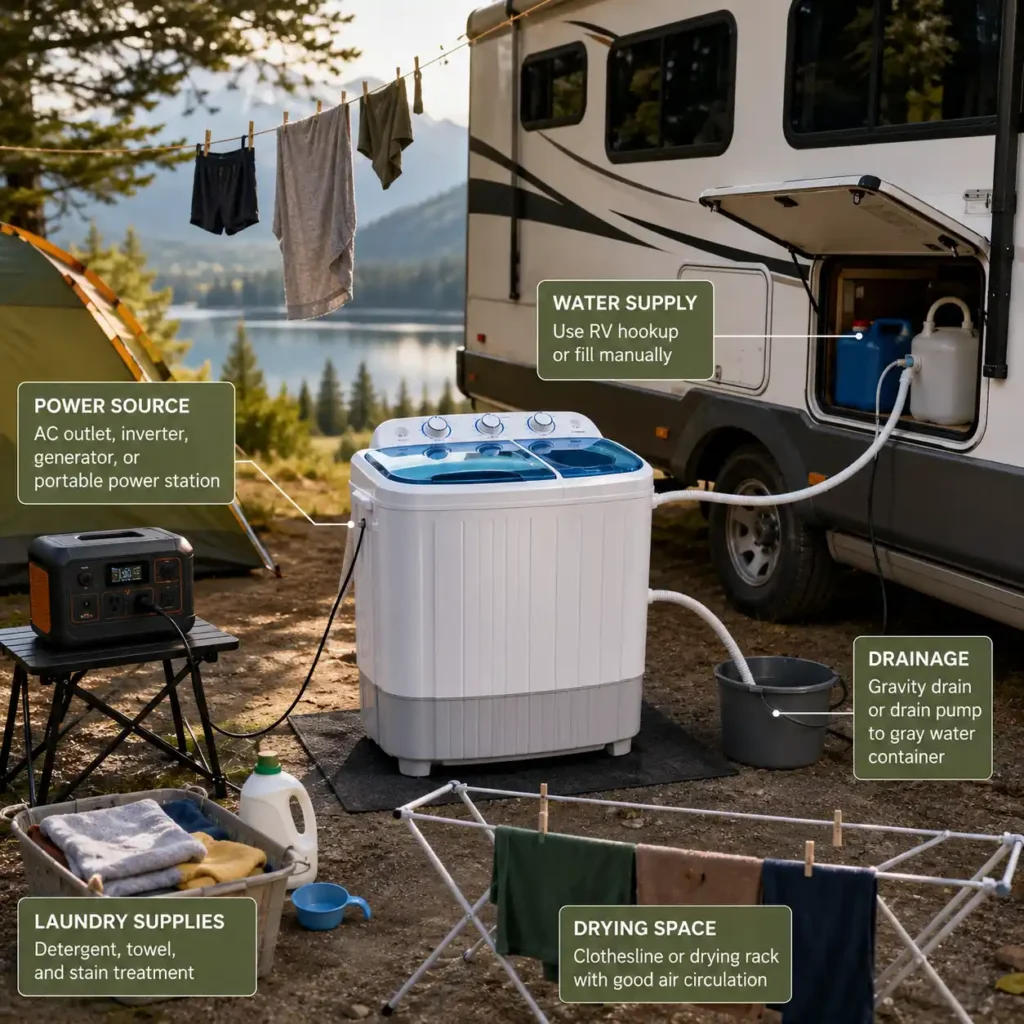
A portable washing machine does not work in isolation. At a campsite, it becomes part of a small water-and-power system, and the machine is only one piece of that setup. You need a practical way to bring water in, supply the required electricity, move wastewater out, and give the washer enough stable space to operate.
That is why a machine that looks perfectly suitable on paper can become inconvenient once you place it beside the rest of your camping gear. The easiest setup is the one where the washer, water source, power source, and drainage point can work together without creating a new chore every time you do laundry.
Start With the Water Supply
The first question is not how many clothes the washer can hold. It is where the water will come from.
Some portable washers can be filled manually, while others are designed around a faucet or hose connection. Manual filling gives you more flexibility at a remote campsite, but it also means carrying and measuring the water yourself. A machine with adjustable water levels can make that process easier because you are not necessarily using the same amount of water for every load.
For RV and established base camps, the calculation is different. Fresh-water capacity, hose connections, and the location of the washer may matter more than the machine’s nominal portability. A washer that requires repeated trips to a distant water container can quickly turn laundry into more work than expected.
Plan the Wastewater Before the First Load
Drainage is one of the easiest parts of a portable washer to overlook.
A washer does not simply make dirty water disappear. The wastewater needs to go somewhere appropriate, whether that means a suitable gray-water system, a designated collection container, or another disposal arrangement permitted at your campsite.
Gravity-drain machines need the hose positioned so water can leave the washer reliably. Models with a drain pump give you more flexibility when the outlet is higher or farther away, but they still require a planned destination for the wastewater.
This is particularly important in an RV or at an established camp. A convenient washing location is not necessarily a convenient drainage location, so it is worth planning both at the same time.
Match the Washer to Your Power System
Electric portable washers are usually much easier to run than full-size household appliances, but their power requirements still need to match the campsite.
A standard 110V or 120V portable washer also needs an inverter or suitable AC output when you are running it from a battery-based power system. The fact that a power station can provide AC power does not by itself mean it can comfortably run every washer; the machine’s operating demand, startup behavior, and the rest of your campsite’s electrical load all matter.
For a powered RV site, this may be straightforward. At an off-grid campsite, you need to consider whether the washer will run from an inverter, portable power station, generator, or another suitable AC source. The machine’s rated wattage is the starting point; the power system also needs enough inverter capacity and usable energy for the complete washing routine.
Twin-tub machines can have an advantage here because washing and spinning are separate operations and many compact models use relatively modest power. Fully automatic machines can offer considerably more convenience, but that convenience can come with a larger electrical requirement.
The practical question is therefore not simply “How many watts does this washer use?” It is “Can my camping power system run this washer without compromising everything else I need?”
Give the Washer a Proper Working Area
A portable machine still needs a place to live while it is operating.
The surface should be stable and reasonably level, with enough room to connect the water supply and route the drain hose without sharp bends or kinks. You also need clearance to open the lid and enough surrounding space to move wet laundry between the washer, spinner, and drying area when using a twin-tub design.
This becomes especially relevant with larger machines. A 30-pound washer may be portable in the sense that it can be transported in a vehicle, but that does not mean you will want to move it repeatedly around the campsite.
For that reason, the best location is often close to the water source and drainage point while remaining separate from the cooking and sleeping areas.
Think About What Happens to the Laundry Next
Washing is only half of the process.
Portable washers generally remove a substantial amount of water during the spin cycle, but they do not replace a conventional tumble dryer simply because they have a spinner. Clothes still need somewhere to finish drying, and that becomes part of the campsite layout.
On a dry, breezy day, a simple clothesline can make the entire system work efficiently. In damp conditions, drying becomes a larger consideration, particularly if several people are generating laundry at the same time.
This is one reason a strong spin cycle has practical value at camp: removing more water before hanging clothes can reduce the time your laundry remains wet.
The Camping Washer System in Simple Terms
Think of the setup as five connected parts:
Water in → Washer → Wastewater out → Spin → Air drying
Then add power to the washer if the model is electric.
If one part is missing, the machine’s advertised capacity becomes much less meaningful. A 20- or 28-pound washer does not solve much if you cannot supply enough water, have nowhere appropriate to drain it, or cannot provide the required electricity.
The best camping washing machine is therefore not simply the one with the largest drum or the most automatic controls. It is the machine that fits the entire laundry system you can realistically operate at camp.
Buying Guide: How to Choose a Portable Washing Machine for Camping
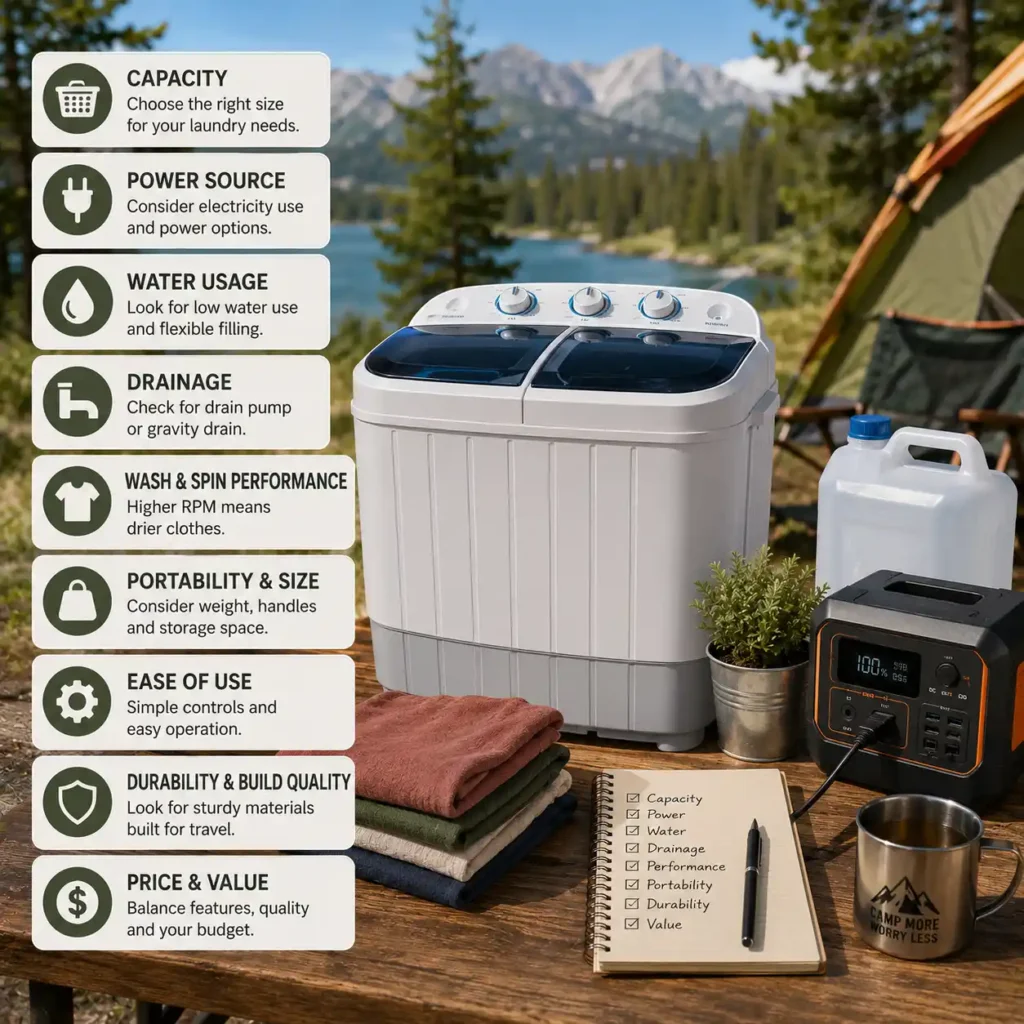
Choosing a portable washing machine for camping is less about finding the machine with the biggest capacity or the longest list of features. The better approach is to start with your camping routine and work backward from it.
The most useful questions are simple: How much laundry will you generate? Where will the machine get its water? What will power it? Where will the wastewater go? And how often will you have to move the machine? Current camping and off-grid guides consistently identify power, water, drainage, capacity, and portability as the factors that determine whether a portable washer actually works in the field.
Start With Your Camping Style
Your type of trip should determine the kind of washer you consider.
For short car-camping trips, a compact twin-tub machine can make sense if you have enough cargo space and expect to wash clothing during the trip. You generally have more room for the machine than a backpacker, but you still benefit from keeping its footprint and weight under control.
For RV camping, larger fully automatic machines become more practical. The washer can stay in one place, and access to electrical power, fresh water, and drainage makes the additional size easier to justify.
For extended or base-camp trips, capacity becomes more important. Washing several people’s clothing over multiple days is a very different requirement from washing a few shirts and pairs of socks.
For backpacking or minimalist camping, an electric portable washer is usually the wrong category altogether. The machine itself is only part of the load; you also have to carry or transport water and provide a suitable power source. A manual washing solution can be considerably more practical for that style of camping.
Choose Capacity Based on Real Laundry
Manufacturers generally quote the maximum laundry weight a machine can accommodate, but that number should not be treated as your normal camping load.
A larger tub is useful when several people are producing laundry, but there is little benefit in transporting a high-capacity machine if most of your loads are small. Conversely, choosing a very compact washer for a family can mean running repeated cycles simply because the machine cannot accommodate the amount of clothing you actually need to wash.
Think about your laundry in loads per trip, rather than choosing a capacity number in isolation.
A solo camper may be perfectly happy washing smaller loads more frequently. A family staying at one campsite for a week has a much stronger reason to carry a larger machine.
Decide How Much Automation You Want
Portable washing machines generally fall into two practical groups represented by the models in this guide: twin-tub/semi-automatic machines and fully automatic single-tub machines.
A twin-tub washer separates washing and spinning. You control more of the process, including moving laundry between compartments, but this format can offer a useful combination of capacity, relatively straightforward controls, and manageable power requirements.
A fully automatic machine handles the washing cycle inside one tub with much less intervention. That is convenient, particularly in an RV or established camp, but these machines tend to make more sense when you already have the space and electrical infrastructure to support them.
Neither format is inherently better. The important question is whether you would rather spend more time managing the laundry or more space, weight, and infrastructure on the machine itself.
Check Power Before You Buy
An electric washer is only portable if your campsite can actually power it.
Check the machine’s rated electrical requirement and compare it with the continuous output of your power station, inverter, generator, or campsite hookup. Do not look only at battery capacity; the power source must also be capable of delivering the required output while the machine is operating.
This is particularly important when comparing fully automatic machines with smaller twin-tub models. A washer that is perfectly reasonable on an RV hookup may be a poor match for a limited off-grid electrical system.
If electricity is unavailable altogether, an electric portable washer should not be your first choice. Manual washing remains the simplest way to eliminate the power requirement completely.
Look Carefully at Water and Drainage
Water can become the real limiting factor during an off-grid trip.
Before choosing a washer, determine how you will fill it and how much water your normal loads will require. Manual filling gives you flexibility when there is no convenient faucet, while hose-connected machines can be easier when an established water supply is available.
Drainage deserves the same attention. A gravity-drain washer needs a suitable downhill route for the hose, whereas a machine with a drain pump can provide more flexibility because the pump can move wastewater upward within its specified limits.
Most importantly, plan where the wastewater will go before operating the washer. At a campground, RV site, or other managed location, wastewater should be handled according to the site’s rules rather than simply released onto the ground.
Measure the Storage and Operating Space
Do not measure only the space where you intend to store the machine.
You also need to consider the space required to use it. Top-loading machines need enough clearance to open the lid, while hoses need room to connect without being sharply bent or crushed. Twin-tub machines require additional working space because laundry moves between the wash and spin compartments.
Weight matters too. A 20- or 30-pound machine may be perfectly manageable when transported in a vehicle, but it is a very different proposition from a small manual washer if you move campsites frequently.
The best portable washing machine for camping is therefore not necessarily the smallest model. It is the one whose storage footprint, operating footprint, and weight are reasonable for the way you travel.
Consider the Drying Side of the Process
A washer does not finish the laundry job by itself.
The spin cycle removes water, but the clothes still need somewhere to dry. If you regularly camp in humid or rainy conditions, the difference between a weak spin and an effective one becomes much more noticeable.
For longer trips, think about the complete routine:
wash → spin → hang → dry → store
If your campsite has limited drying space, washing smaller loads may be more practical than filling the machine to capacity. If you have plenty of outdoor space and favorable weather, a stronger spin cycle can make the rest of the process considerably easier.
Match the Machine to the Way You Actually Travel
The final decision should come from the complete setup rather than one impressive specification.
A large twin-tub machine can be the right answer for a family at a long-term base camp and completely wrong for a camper who changes locations every morning. A fully automatic washer can be excellent inside an RV and unnecessarily cumbersome for someone spending a weekend beside a remote campsite.
Before buying, make sure you can answer these five questions:
- How much laundry will I normally wash?
- Where will my water come from?
- What will power the machine?
- Where will the wastewater go?
- Where will the machine live while I use and store it?
If those five answers fit the machine, the specifications start to matter in the right context. If they do not, a higher capacity, faster spin, or more automatic controls will not fix the underlying mismatch.
Common Mistakes When Using a Portable Washing Machine for Camping
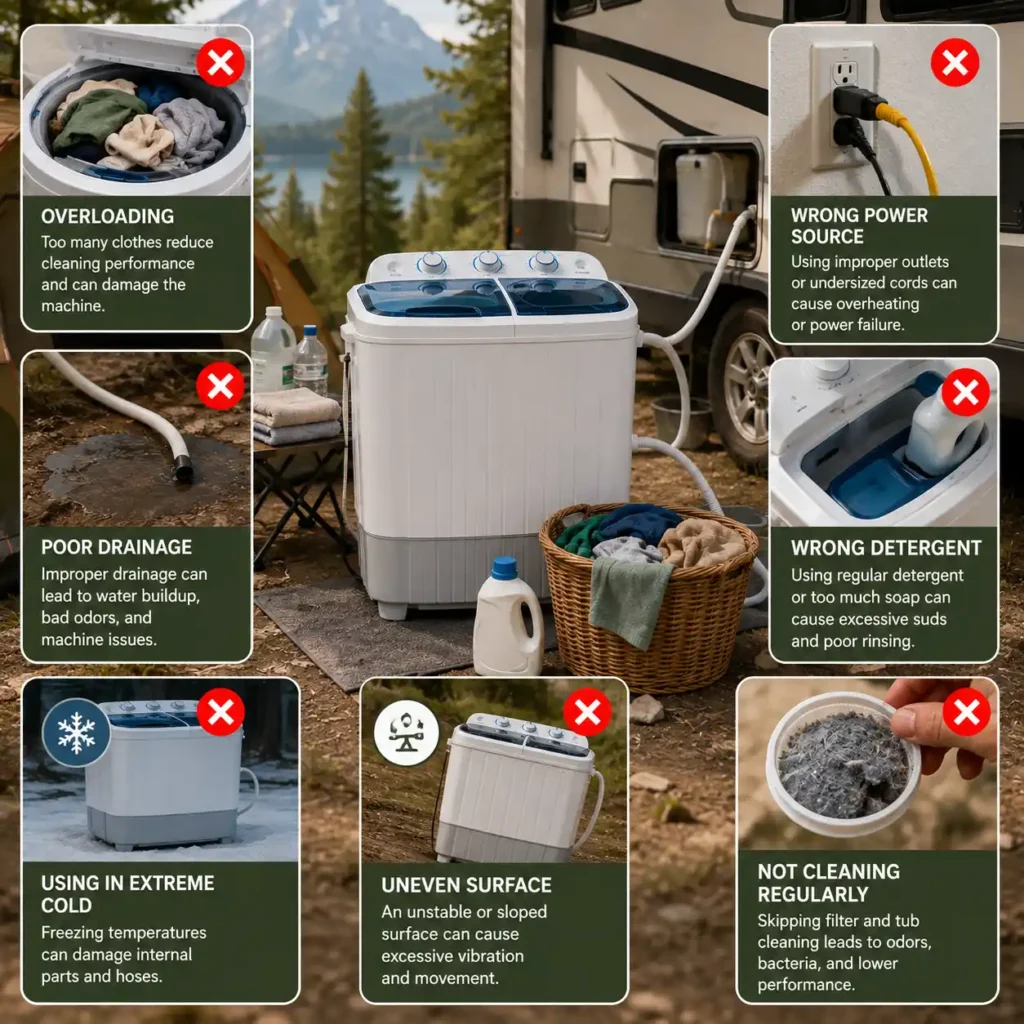
A portable washing machine is relatively simple to operate, but camping introduces a few problems that are easy to overlook. The most common mistakes are not about complicated controls; they come from treating a compact washer like a smaller version of a household machine.
The practical issues are usually overloading, using too much detergent, poor drainage, unstable placement, inadequate power, and failing to plan what happens to the wastewater. Current camping and RV guidance repeatedly highlights these problems, while some newer portable-washer guides also warn against ignoring the machine’s specific operating instructions.
Overloading the Washer
The capacity printed on the machine should not become a target for every load.
Overloading can restrict movement of the clothing, reduce washing performance, and put unnecessary strain on the motor. It is particularly easy to do with twin-tub machines because the wash and spin compartments have different capacity limits.
Pay attention to the wash capacity and spin capacity separately. A machine advertised with a 20- or 28-pound total capacity does not necessarily mean that the entire amount can be transferred into the spinner at once.
Using Too Much Detergent
Portable washers generally use less water than full-size household machines, so using the same amount of detergent you would normally pour into a conventional washer can create excessive suds.
Too much detergent also makes rinsing more difficult, which can leave residue in clothing and require additional water. Using a modest amount of detergent and following the machine’s instructions is a better approach, particularly when fresh water is limited at camp.
Ignoring the Drain Hose
A drain hose that looks correctly positioned can still create problems once the washer starts operating.
With gravity drainage, the hose needs a suitable route for water to leave the machine. A kinked, blocked, or poorly positioned hose can slow drainage or allow wastewater to collect where you do not want it.
Before starting a load, check the entire drainage path rather than only the end of the hose. If the machine has a built-in drain pump, follow its specified operating limits instead of assuming the pump can move wastewater any distance or height.
Putting the Machine on an Unstable Surface
The spin cycle is where an unstable setup becomes obvious.
A portable washer should stand on a firm, reasonably level surface. If the machine rocks or shifts during spinning, the problem is not simply noise. Excessive movement can make the machine harder to operate and place additional stress on the equipment.
This matters even more in an RV or on uneven ground. Leveling the machine before the first load is considerably easier than trying to correct a washer that starts moving once the spin cycle begins.
Forgetting About the Electrical Load
Having a power station does not automatically mean it can run the washer.
Check the washer’s electrical requirement against the continuous output of the power source and make sure the complete setup is appropriate for the appliance. If you are using an inverter, the inverter itself must also be suitable for the washer.
Do not plan your campsite around a washer’s battery-energy calculation alone. The electrical system needs to deliver the required power while the machine is running, and the same power source may also be needed for lighting, refrigeration, charging, or other equipment.
Treating the Washer as a Dryer
A spin cycle removes water; it does not turn the machine into a clothes dryer.
Even a strong spinner leaves laundry damp enough to require air drying. This is especially important on longer camping trips, where washing more clothing than you can comfortably dry can create a second problem.
Give wet laundry enough drying space and consider the weather before starting a large load. A good spin cycle is valuable because it reduces the amount of water left in the clothing, but it does not eliminate the need for a drying plan.
Using More Water Than Your Trip Can Support
It is easy to think about the washer’s capacity and forget about the water required to use it.
At an RV or remote campsite, every wash and rinse cycle draws from the water supply and eventually adds to the wastewater that has to be managed. Adjustable water levels can be useful because a small load does not necessarily need the same amount of water as a full load.
Before starting laundry, consider the rest of the trip rather than treating the available water as if it were unlimited. This becomes particularly important during multi-day off-grid stays.
Skipping the Rinse
Saving water does not mean eliminating the rinse without considering the consequences.
Detergent left in clothing can cause residue, stiffness, and unpleasant odors. If water is limited, the better strategy is to control the amount of detergent and choose an appropriate rinse method for the load rather than simply assuming that less rinsing is always better.
Washing Bulky Items That Exceed the Machine’s Practical Limits
A compact washer can handle a surprising amount of everyday clothing, but that does not make it suitable for every type of laundry.
Heavy coats, large blankets, bulky sleeping equipment, and heavily saturated items can be difficult for small machines to wash and spin properly. The stated weight capacity also does not mean every item of that weight has the same practical load characteristics.
For camping laundry, these machines are generally most useful for clothing, towels, underwear, socks, and other manageable items rather than trying to reproduce the workload of a household washer.
Forgetting to Clean and Dry the Machine After Use
The washer itself needs attention after laundry is finished.
Residual water, detergent, lint, and damp surfaces can create odors if the machine is closed and stored immediately. Drain remaining water as directed by the manufacturer, wipe accessible surfaces, and allow the tub and other wet areas to dry before putting the machine away.
This is particularly important when camping because the washer may spend several days packed inside a vehicle between uses. A little post-use maintenance is much easier than opening the storage area to a damp, musty machine later.
Starting Laundry Without a Complete Plan
The most avoidable mistake is beginning a wash before checking the entire setup.
Before the first load, make sure you know:
- where the water is coming from;
- how the machine will be powered;
- where wastewater will go;
- whether the washer is sitting securely;
- where wet clothing will dry; and
- where the machine will be stored afterward.
Once those pieces are in place, portable laundry becomes a manageable part of the campsite routine rather than another piece of equipment that creates work of its own.
Frequently Asked Questions About Portable Washing Machines for Camping
Can you use a portable washing machine while camping without hookups?
Yes, provided the machine and the rest of your setup are suitable for off-grid use. A manual washer needs no electricity, while an electric portable washer can run from a suitable power station, inverter, generator, or RV battery system. You will still need a practical water supply and a safe way to collect or dispose of the wastewater.
Can you use a portable washing machine without a water hookup?
Yes. Many portable washers can be filled manually with water from a bucket, jug, or camping water container, although the exact method depends on the machine. This is particularly useful for car camping and off-grid setups where there is no convenient faucet connection. Some fully automatic models, however, are designed around a connected water supply, so check the requirements of the specific machine before buying.
How do you drain a portable washing machine while camping?
The drain hose can usually discharge into an appropriate gray-water container, RV gray-water system, or designated wastewater facility. Gravity-drain models need the hose positioned correctly so water can flow out, while machines with a drain pump provide more flexibility when the outlet is higher than the washer. Always follow the campsite’s wastewater rules rather than dumping wash water directly onto the ground.
How much electricity does a portable washing machine use for camping?
There is no single figure because portable washers vary considerably. Current camping and RV sources describe compact electric models in roughly the 150–500 watt range, while larger conventional portable or RV machines can require substantially more. The important figure for off-grid camping is whether your inverter or power station can supply the machine’s required operating power, not simply how large the battery is.
Can a portable washing machine run from a portable power station?
Yes, many electric portable washers can be powered by a portable power station if the power station’s inverter has sufficient continuous output for the washer. You should also account for the energy used during the complete washing routine and remember that the same power station may need to operate other camping equipment. A twin-tub washer with a relatively modest electrical demand is generally easier to integrate into a limited off-grid power system than a larger appliance.
Are twin-tub washing machines good for camping?
Yes, particularly for car camping, RVs, and longer stays where some hands-on laundry work is acceptable. A twin-tub machine separates washing and spinning, so you normally move clothes between the two compartments yourself. The trade-off is less automation, but this format can provide useful capacity without requiring the same type of infrastructure as a full-size washer.
How much laundry can you wash in a portable washing machine?
It depends on the machine, but portable washers are generally intended for smaller loads than full-size household machines. Capacity should be judged by the wash and spin limits separately, especially with twin-tub models. A machine advertised with a large total capacity may have a smaller spinner, meaning a full wash load has to be divided before spinning. For camping, everyday clothing, socks, underwear, shirts, and towels are generally more practical than bulky bedding or sleeping equipment.
How long does a portable washing machine take to wash clothes?
The answer varies by machine and cycle. Compact washers can have short timed wash cycles, while fully automatic models may run considerably longer depending on the selected program. Twin-tub machines can also require additional time because washing, draining, rinsing, and spinning are handled as separate stages. The total time you spend doing laundry therefore depends on the machine’s cycle as well as how much manual work is involved.
Can a portable washing machine wash towels, jeans, or bedding?
It can handle some heavier laundry, but bulky items deserve more caution than ordinary clothing. Towels and jeans can consume a large proportion of a small machine’s practical capacity, while blankets, sheets, sleeping bags, and other bulky items may be difficult to wash and spin properly. For camping, portable washers are generally more useful for everyday clothing and moderate loads than for replacing a full-size laundry machine.
Do portable washing machines actually dry clothes?
No. The spin cycle removes excess water but does not replace a clothes dryer. Some twin-tub machines have dedicated spin compartments, and a strong spin can leave clothing considerably easier to air-dry, but the laundry will still need time on a clothesline, drying rack, or another suitable drying area. This makes drying space part of the overall camping laundry setup.
What detergent should you use in a portable washing machine?
Use a detergent and quantity appropriate for the specific machine, and avoid assuming that a normal household dose is suitable. Portable washers often use smaller amounts of water, so excessive detergent can create too many suds and make rinsing more difficult. Liquid, low-sudsing detergent is commonly recommended for compact machines, but the manufacturer’s instructions should take priority.
Are portable washing machines practical for backpacking?
Usually not if you mean an electric portable washer. The machine, power source, water requirements, hoses, and drainage equipment add too much bulk for most backpacking situations. Manual washing systems are considerably better suited to true backpacking and minimalist off-grid trips because they eliminate the need for electrical power and reduce the amount of equipment involved.
What is the biggest disadvantage of using a portable washing machine while camping?
The main disadvantage is that the machine does not operate independently of the campsite. You have to account for water, electricity, drainage, operating space, transportation, and drying in addition to the washing itself. For a long stay or family camping trip, that infrastructure can be worthwhile. For a short trip with only a small amount of laundry, a simpler manual washing method may be more practical.
Final Verdict: Which Portable Washing Machine Is Best for Camping?
A portable washing machine can make a long camping trip considerably easier, but only when the machine fits the rest of your setup. The real decision is not simply how much laundry a washer can hold. It is whether you have the space, water, power, drainage, and time to use it comfortably.
That is the main distinction between the five machines in this guide. A larger washer can reduce the number of loads, but it takes more room. Automatic operation reduces hands-on work, but usually makes the machine more dependent on a suitable electrical and campsite setup. Smaller twin-tub machines are easier to accommodate, but you accept smaller loads and more frequent laundry sessions.
For that reason, we would not recommend choosing a portable washer based on capacity or automation alone. Start with the way you camp, then choose the machine that fits that routine.
If you spend several days at one campsite, travel by vehicle, or camp with a family, a larger machine can justify the space it occupies because you are solving a genuine laundry problem rather than simply adding another convenience appliance. If you move every day or normally generate very little laundry, carrying a substantial electric washer can become more work than the laundry itself.
There is also an important difference between portable and mobile. A machine can be portable enough to transport in a vehicle while still being impractical to move around every day. Weight, dimensions, hoses, water containers, drainage, and drying space all become part of the decision once the washer leaves the house.
The same principle applies to off-grid power. Having a portable power station does not automatically make an electric washer practical. The washer must fit within the electrical system you already depend on for the rest of your campsite. Water and wastewater need the same level of planning.
Our Overall Take
For most campers considering an electric portable washer, the strongest choice is the one that solves the largest recurring laundry problem without creating an equally inconvenient campsite setup.
That is why our recommendations are deliberately spread across different camping situations rather than treating one machine as universally superior. The best choice for a family staying at a base camp can be completely different from the best choice for a couple spending a weekend in a small RV.
If your camping style supports the machine, a portable washer can be a genuinely useful part of your gear system. If it does not, a simpler washing method may be the smarter choice.
The right portable washing machine is not the one with the most impressive specification sheet. It is the one you will actually have the space, water, power, and patience to use when you are miles from a laundry room.
The CampComfortGuide Promise
At CampComfortGuide, we believe useful camping advice should make a decision clearer, not simply give you more products to compare.
That means looking beyond the feature list and considering what equipment actually means once you take it outdoors. For portable washing machines, that includes the less obvious parts of the decision: water, drainage, electricity, storage space, laundry volume, and the amount of hands-on work involved.
We also believe recommendations should have clear limits. A machine that is an excellent choice for an RV or established base camp may be completely wrong for a minimalist weekend trip. Our goal is not to make every product sound suitable. It is to help you understand where a product makes sense, where it does not, and why.
As products and specifications change, we will continue to review this guide so that its recommendations remain useful for campers making real purchasing decisions.