
Choosing the right heavy duty camping cot is about more than finding a bed with a high weight capacity. Larger adults need enough sleeping space, a supportive frame, and a stable sleeping surface that feels comfortable throughout the night. However, camping cots can differ significantly in their rated weight limits, dimensions, frame designs, materials, and ease of setup. A model rated for 600 pounds is not automatically the most comfortable or practical choice for every camper.
In this guide, we compare five heavy duty camping cots with manufacturer-listed weight capacities ranging from 450 to 600 pounds. We examine their dimensions, frame construction, fabric, portability, and practical features to help you understand the differences between each option. Whether you need an extra-wide sleeping surface, higher weight capacity, or a more practical folding design, this comparison will help you choose a cot that better matches your size, camping setup, and comfort requirements.
As an Amazon Associate I earn from qualifying purchases.

Table of Contents
Quick Answer: What Is the Best Heavy Duty Camping Cot?
The TETON Sports Outfitter XXL is our provisional Best Overall choice among the five heavy duty camping cots reviewed in this guide. Its manufacturer-listed 600 lb weight capacity, reinforced steel S-leg assembly, and patented Pivot Arm setup mechanism make it a strong candidate for campers who prioritize load capacity and a substantial support structure. However, the supplied product listing contains conflicting dimensional information, so its exact sleeping space should be confirmed before purchase.
The right heavy duty camping cot is not necessarily the one with the highest advertised weight limit. Larger adults also need enough usable sleeping width and length, a suitable frame design, and a sleeping surface that accommodates their preferred position. Overall frame dimensions should not be mistaken for the actual area available for sleeping.
Portability and setup matter as well. Oversized folding cots can be relatively heavy and bulky, making them more practical for car camping than backpacking. Tent floor space, folded dimensions, and assembly requirements should all be considered before choosing a model.
Below, our Quick Summary highlights the five selected options and their main strengths, followed by a detailed comparison of specifications, features, and potential limitations.
Why You Can Trust This Guide
Choosing a heavy-duty camping cot requires more than comparing advertised weight limits. Dimensions, frame construction, sleeping surface materials, setup features, and portability all influence whether a model is suitable for your camping needs. That is why this guide uses a consistent, specification-focused comparison rather than relying on headline claims alone.
Our editorial approach follows several principles:
Product-specific research: We examine the Amazon US listings for the exact five models included in this comparison, using their listed specifications and product details rather than assuming that different versions of the same brand share identical features.
Consistent comparison criteria: Each cot is assessed using the same core factors: stated weight capacity, overall dimensions, item weight, frame design, fabric, setup features, and included accessories.
Transparent specifications: We distinguish between manufacturer- or listing-stated information and details that are not clearly provided. Where product information contains conflicting measurements or incomplete specifications, we identify the limitation instead of presenting an uncertain figure as fact.
No invented testing results: We do not claim to have physically tested these cots or independently verified their load capacities. Product assessments are based on the available listing information and a practical comparison of the features each model offers.
Practical buying guidance: We consider how dimensions, packed size, frame design, and setup requirements may affect car camping, tent compatibility, storage, and everyday use.
Some links in this guide may be Amazon affiliate links. If you purchase through them, CampComfortGuide may earn a commission at no additional cost to you. Affiliate relationships do not determine our product comparisons or editorial assessments.
Our goal is to help you understand what each model offers, where its limitations may matter, and which specifications deserve a closer look before you buy.
How We Evaluate Heavy Duty Camping Cots
To compare heavy-duty camping cots fairly, we examine the specifications and features that have the greatest impact on sleeping space, weight support, setup, and practical use. Rather than treating the highest advertised weight capacity as the only measure of quality, we assess each model across the same set of criteria.
Our comparison uses the following evaluation factors:
1. Manufacturer-Listed Weight Capacity
We examine the maximum weight capacity stated in each product listing. This helps identify the intended support range of each cot and compare the five models consistently. These figures are treated as manufacturer- or listing-stated limits, not independently verified load-test results.
2. Overall Dimensions and Sleeping Space
We compare the listed length, width, and height to understand how much room each cot may require at the campsite. We also distinguish between overall frame dimensions and usable sleeping surface measurements whenever the listing provides enough information to do so. A wider frame does not automatically mean an equally wide fabric sleeping area.
3. Frame Construction and Support Design
We review the listed frame materials and structural design, including reinforced steel components, X-leg assemblies, S-leg configurations, and other support features. These details help explain how each model is constructed, but they do not establish independently verified stability or durability.
4. Fabric and Sleeping Surface Materials
We examine the fabric specifications provided in the product listings, including materials such as 600D polyester and 600D Oxford fabric. Where fabric details are missing or unclear, we identify that limitation rather than assuming the material or its performance.
5. Setup and Folding Mechanism
We consider how each cot is assembled, unfolded, and secured for use. Features such as pivot-arm mechanisms, locking structures, quick-setup designs, and minimal assembly requirements can influence convenience, especially for campers who regularly pack and unpack their equipment.
6. Weight, Packed Size, and Portability
We compare each cot’s listed item weight and folded dimensions when available. These measurements help determine whether a model is better suited to vehicle-based camping, where transport weight is less restrictive, or whether its storage dimensions may create challenges in a smaller vehicle or tent.
7. Included Features and Practical Details
We also consider accessories and additional features, such as carry bags, padded headrests, adjustable pillows, and side pockets. Warranty information is included when it is available in the product listing, but missing warranty details are not treated as proof that a product has no warranty.
Research Scope and Limitations
This guide is a specification-based editorial comparison of five specific camping cot models using the supplied Amazon US product listings. We have not physically tested these products, performed load tests, measured frame deflection, or independently verified manufacturer capacity claims.
Product specifications, availability, and listing details can change. Buyers should confirm the exact model, dimensions, stated weight limit, included accessories, and warranty terms on the product page before purchasing.
By applying the same comparison criteria to every model, we aim to make the differences easier to understand and help readers select a cot that better matches their body size, available camping space, and transportation requirements.
What Makes a Camping Cot Heavy Duty?

A heavy-duty camping cot is designed to support greater loads and provide a more substantial sleeping platform than many standard folding cots. However, the term heavy duty does not represent one universal engineering standard. A high advertised weight capacity is an important starting point, but the frame, support structure, fabric, dimensions, and overall design also matter.
Here are the main characteristics that distinguish a heavy-duty camping cot.
1. Higher Listed Weight Capacity
Weight capacity is one of the first specifications to examine. Many standard camping cots have lower rated limits, while the models in this comparison carry manufacturer- or listing-stated capacities ranging from 450 to 600 lb.
A higher rating can provide more capacity headroom, but it does not automatically mean better comfort or greater durability in every situation. Always follow the manufacturer’s stated limit and instructions. Do not assume that a cot can safely support additional weight simply because its frame looks substantial.
2. Reinforced Frame and Support Structure
The frame carries the load and transfers it through the legs to the ground. Heavy-duty designs commonly use steel tubing, reinforced joints, crossbars, and support configurations intended to distribute weight across the structure.
Pay attention to the actual construction rather than relying on terms such as reinforced or extra strong in a product title. X-shaped leg assemblies, S-leg configurations, and additional support components are useful design details to compare, but their presence alone does not establish a specific load-bearing performance.
3. Durable Sleeping Surface Fabric
The fabric is another important part of the cot because it supports the sleeper across the frame. Some heavy-duty models use materials such as 600D polyester, 600D Oxford fabric, or canvas.
The denier number describes the linear density of the yarn, not a complete durability rating for the finished fabric. Weave, coating, stitching, seam construction, and attachment points also influence how the sleeping surface performs over time.
For this reason, a 600D label should be treated as one specification to consider rather than proof that one cot is stronger or more durable than another.
4. Wider and More Spacious Sleeping Dimensions
A high weight rating does not necessarily provide enough room for a comfortable night’s sleep. Larger campers should compare the cot’s length and usable sleeping width, paying particular attention to the difference between overall frame dimensions and the actual fabric sleeping surface.
A wide frame may provide more room than a standard cot, but the fabric area can be narrower than the outside measurements suggest. Taller sleepers should also check the available sleeping length rather than assuming that every oversized model accommodates the same body dimensions.
5. Stable Legs and Ground Contact
The leg design affects how a cot stands on the ground and distributes its load. Reinforced support assemblies and appropriately designed feet can contribute to a more secure setup.
However, stability also depends on the surface underneath the cot, correct assembly, and how the manufacturer’s instructions are followed. Even a substantial frame should be placed on suitable, reasonably level ground.
6. Practical Construction and Setup
Heavy-duty cots often use stronger components that make them heavier and bulkier than lightweight camping beds. This is an important trade-off for car campers who prioritize sleeping space and load capacity over backpacking portability.
Setup mechanisms also deserve attention. Pivot arms, locking structures, and folding support assemblies can make installation more convenient, but buyers should check how much assembly is required and whether the manufacturer provides clear instructions.
Heavy Duty Does Not Mean the Same Thing as Comfortable
A cot can have a high weight capacity and reinforced frame without necessarily providing the best sleeping experience. Comfort also depends on the usable sleeping width, fabric tension, body dimensions, sleeping position, and whether an additional sleeping pad is needed.
The most useful approach is to evaluate the complete design rather than selecting a model based on its largest advertised number. A suitable heavy-duty cot should provide enough capacity headroom, adequate sleeping space, an appropriate support structure, and dimensions that work with your camping setup.
Who Should Consider a Heavy Duty Camping Cot?

A heavy-duty camping cot is not only for people who need a higher weight capacity. Its larger dimensions, reinforced frame designs, and substantial construction can also make it a practical choice for campers who prioritize sleeping space and a more substantial bed setup. However, the right model depends on your body dimensions, camping style, and available storage space.
Here are the types of campers who may benefit most from choosing a heavy-duty model.
1. Larger Adults Who Need a Higher Weight Capacity
Campers who exceed the weight limits of standard folding cots should consider models with higher manufacturer-listed capacities. A cot rated for 450–600 lb provides a different capacity range from many conventional camping beds.
Rather than choosing a model whose rating is barely sufficient, compare the listed limit with your actual requirements and follow the manufacturer’s instructions. The highest capacity is not automatically the best choice if the sleeping surface is too narrow or the overall dimensions do not suit your body.
2. Tall Campers Who Need More Sleeping Length
Taller adults may find standard camping cots restrictive, particularly when the listed sleeping area is shorter than their body length. An oversized model can provide additional room, but it is important to distinguish the overall cot length from the usable sleeping surface.
Before purchasing, compare the listed dimensions with your height and check whether the manufacturer specifies the actual fabric sleeping area.
3. Broad-Shouldered Campers and Side Sleepers
Campers who need more room to change sleeping positions may benefit from a wider cot. A narrow sleeping surface can feel restrictive, especially for people with broader shoulders or those who prefer sleeping on their sides.
However, overall frame width should not be confused with usable sleeping width. Check the actual fabric dimensions whenever they are available, and consider whether the cot provides enough room for your preferred sleeping position.
4. Car Campers Who Prioritize Space and Support
Heavy-duty cots are particularly relevant to car camping, where a larger frame and heavier construction are generally easier to accommodate than during backpacking trips.
If you transport your equipment by vehicle, a cot weighing approximately 25–28 lb may be a reasonable trade-off for additional sleeping space and a higher listed weight capacity. You should still check the folded dimensions to make sure the cot fits your vehicle alongside your other camping equipment.
5. Campers Who Prefer Sleeping Above the Ground
A raised sleeping platform can be useful for people who prefer not to sleep directly on the tent floor. It also creates space underneath the cot for storing some camping equipment.
This setup may appeal to campers who want a more organized sleeping area or who find getting up from a ground-level sleeping pad inconvenient. However, cot height and under-bed clearance vary by model, so check the individual dimensions before choosing.
6. Campers Looking for a More Substantial Guest Bed
A folding heavy-duty cot can also serve as an occasional guest bed at home, in a cabin, or at a campsite. Its portable design makes it useful when a temporary sleeping space is needed without installing a permanent bed.
For this purpose, consider not only the listed weight capacity but also the sleeping dimensions, ease of folding, storage requirements, and whether additional padding is needed.
Who May Not Need a Heavy Duty Camping Cot?
A heavy-duty model is not necessarily the best choice for every camper.
Backpackers: Cots weighing around 25–28 lb are generally impractical for carrying over long distances. A lightweight backpacking cot or sleeping pad is usually a better fit.
Minimalist campers: If packed size and low equipment weight are your main priorities, a large folding cot may take up more storage space than you need.
Campers with limited tent space: Oversized frames require sufficient floor space. Measure your tent’s usable interior dimensions before buying.
Occasional warm-weather campers: If you only need a simple sleeping surface for a few short trips, a standard cot may provide sufficient capacity and comfort without the additional bulk.
The best reason to choose a heavy-duty camping cot is not simply that it carries a larger weight rating. It is that its capacity, sleeping dimensions, and overall construction better match your actual needs and camping environment.
Quick Summary: Our Top Picks
Choosing the right heavy duty camping cot depends on more than its advertised weight capacity. Sleeping space, frame construction, setup, portability, and additional comfort features all influence how practical a cot will be for your camping setup. These five models offer manufacturer-listed capacities from 450 to 600 pounds, with different advantages for larger adults and campers who need more room. The specifications below are based on the supplied product listings, not independent load testing.
1. TETON Sports Outfitter XXL — Best Overall (Provisional)
The TETON Sports Outfitter XXL stands out with a manufacturer-listed 600-pound weight capacity, a reinforced steel S-leg assembly, and a patented Pivot Arm mechanism designed to make tightening the final corner easier during setup. Its 600D polyester canvas sleeping surface and elevated folding design make it a strong candidate for campers who prioritize a high capacity rating and a substantial frame. However, the supplied listing contains conflicting dimensional information, so its exact sleeping width should be confirmed before purchase. Its lifetime warranty applies to the original owner and is subject to the manufacturer’s terms and exclusions.
Best for: Campers who prioritize a 600-pound listed capacity, reinforced steel support, and an easier final setup mechanism.
2. Portal XXL Folding Cot — Best for Added Comfort Features
The Portal XXL combines a manufacturer-listed 600-pound capacity with an 83.4 × 41.9-inch overall frame, reinforced steel X-frame tubing, and double-layer 600D Oxford fabric. Its adjustable padded ergonomic headrest, side pocket, and included carry bag provide additional convenience for overnight camping. The listing also advertises a no-tools setup, while the manufacturer describes the X-frame as a design intended to help reduce wobbling and center sinking. These stability statements are manufacturer claims rather than independently verified test results.
Best for: Campers who want a high-capacity folding cot with an adjustable padded headrest and additional convenience features.
3. EVER ADVANCED XXL — Best Extra-Wide Camping Cot
The EVER ADVANCED XXL offers an overall frame size of 84.3 × 41.9 inches and a manufacturer-listed weight capacity of 550 pounds. Its reinforced steel X-leg assembly provides the main structural support, while the side pocket adds convenient storage for small personal items. The cot arrives largely assembled, with only two end rods requiring assembly, and its supplied folded dimensions of 48.6 × 4.9 × 9.1 inches help buyers assess storage requirements. The listing does not specify the fabric material, so we do not assign it an unverified fabric rating.
Best for: Larger adults who prioritize an extra-wide cot frame and substantial sleeping space while retaining a high listed weight capacity.
4. LEISURE IMPACT XXL — Best 500 lb Capacity Option
The LEISURE IMPACT XXL is listed with a 500-pound maximum weight capacity, an overall frame size of 83 × 41 × 20.6 inches, and 600D Oxford fabric. Its reinforced triangular cross-leg structure, folding design, side pocket, and included carry bag make it a practical option for vehicle-based camping. The manufacturer advertises a 10-second setup, although this should be treated as a product claim rather than a measured setup time. The supplied listing also contains a small discrepancy between its tabulated and descriptive dimensions, so buyers should check the current product specifications.
Best for: Campers looking for a wide folding cot with a 500-pound listed capacity and a quick-setup design.
5. TIMBER RIDGE Folding Cot — Best Balance of Size and Capacity
The TIMBER RIDGE Folding Cot has a manufacturer-listed weight capacity of 450 pounds and overall dimensions of 81.5 × 32.5 × 16.5 inches. Its X-shape alloy steel frame and 600D polyester fabric provide a straightforward construction, while the padded headrest adds a comfort feature not always included with folding cots. It also comes with a carry bag and uses a simple unfold-and-lock setup. Compared with the wider XXL models in this selection, its more compact frame may be easier to accommodate in some camping layouts, although buyers should still check their available tent floor space.
Best for: Campers who want a 450-pound listed capacity, a more compact frame, and practical comfort features without choosing the widest XXL design.
Before purchasing, compare the overall frame dimensions with the actual usable sleeping surface, check the available floor space inside your tent, and consider the cot’s folded size and item weight. Remember that a manufacturer’s maximum weight rating does not establish sleeping comfort or independently verified structural performance. Choose a model based on the combination of capacity, usable space, construction, and portability that best matches your camping needs.
Heavy Duty Camping Cot Comparison Table
Compare the five heavy duty camping cots by manufacturer-listed weight capacity, overall dimensions, item weight, frame construction, and practical features. All dimensions below refer to the overall cot unless a separate sleeping-surface measurement is explicitly identified.
| Model | Weight Capacity | Dimensions (L × W × H) | Item Weight | Key Features |
|---|---|---|---|---|
| TETON Sports Outfitter XXL | 600 lb | 86 × 45 × 19.5 in Sleeping surface: 80 × 35.5 in | 25.8 lb | Patented Pivot Arm, steel S-legs, 600D canvas, carry bag |
| Portal XXL Folding Cot | 600 lb | 83.4 × 41.9 × 19.7 in | 26.7 lb | Double-layer 600D Oxford, adjustable padded headrest, side pocket |
| EVER ADVANCED XXL | 550 lb | 84.3 × 41.9 × 19.7 in | 26.7 lb | Side pocket, carry bag, end tension rods required for setup |
| LEISURE IMPACT XXL | 500 lb | 83 × 41 × 20.6 in | 28.4 lb | 600D Oxford fabric, advertised 10-second quick setup, side pocket |
| TIMBER RIDGE Folding Cot | 450 lb | 81.5 × 32.5 × 16.5 in | 25.9 lb | 600D polyester fabric, integrated padded headrest, carry bag |
The 5 Best Heavy Duty Camping Cots
The best heavy duty camping cot should provide a suitable combination of weight capacity, sleeping space, frame construction, and practical setup features. However, a higher weight rating does not automatically mean a wider sleeping surface or greater comfort. The five models below have manufacturer- or listing-stated capacities ranging from 450 to 600 pounds, with different frame designs, dimensions, materials, and included features. Each product assessment focuses on its listed specifications, potential advantages, and important details to verify before buying.
1. TETON Sports Outfitter XXL — Best Overall (Provisional)

The TETON Sports Outfitter XXL is a heavy-duty folding camping cot with a manufacturer-listed weight capacity of 600 pounds. Its reinforced steel S-leg assembly and patented Pivot Arm mechanism distinguish it from simpler folding designs. The Pivot Arm is intended to make the final corner of the cot easier to tension during setup, while the 600D polyester canvas provides the sleeping surface. Although this model is a strong overall candidate based on its listed capacity and construction, its supplied Amazon listing contains conflicting dimensional information that buyers should clarify before purchase.
Overview
The TETON Sports Outfitter XXL is designed for campers who need a folding cot with a high stated weight capacity and a reinforced support structure. Its Model 120A designation identifies the specific version covered by the supplied product information.
The listing specifies a maximum load capacity of 600 pounds and an item weight of 25.8 pounds. The cot uses 600D polyester canvas and a reinforced steel S-leg assembly. Its patented Pivot Arm is a built-in lever designed to make it easier to secure the final corner and tighten the sleeping surface during assembly.
The product description also states that the cot is larger than a twin bed. However, the supplied Amazon dimension fields are inconsistent: one set lists 86 × 19 × 45 inches, while another field gives an item depth of 40 inches. These figures should not be combined or interpreted as a confirmed sleeping-surface measurement. Check the current product listing and exact model details before relying on its dimensions.
Key Features
Manufacturer-Listed 600 lb Weight Capacity
The TETON Sports Outfitter XXL has a listed maximum load capacity of 600 pounds, placing it at the highest stated capacity level among the five models in this comparison. This rating may make it worth considering for campers who need a cot with a higher advertised weight limit.
However, the 600-pound figure is a manufacturer- or listing-stated rating, not an independently verified load-test result. Buyers should follow the product’s current loading instructions and avoid exceeding its stated limit.
Patented Pivot Arm Setup Mechanism
One of the model’s distinguishing features is its patented Pivot Arm. According to the product description, this built-in lever helps ease the final corner setup and tightens the sleeping surface.
This feature is particularly relevant for a folding cot because securing the final connection can require effort when the fabric is tensioned. The Pivot Arm is designed to make that step easier, although the actual setup experience has not been independently tested for this guide.
Reinforced Steel S-Leg Assembly
The listing identifies a reinforced steel S-leg assembly as part of the cot’s construction. This is an important structural feature to consider when comparing the model with folding cots that use different support configurations.
The frame design and listed weight capacity provide useful specification-level information, but they do not establish independently measured stability, frame deflection, or long-term durability.
600D Polyester Canvas
The sleeping surface is listed as 600D polyester canvas. This identifies the supplied fabric specification and gives buyers a material detail to compare with the 600D Oxford and 600D polyester fabrics listed for other models in this guide.
The denier designation alone does not establish the complete fabric’s abrasion resistance, tear strength, or expected service life. Those performance characteristics have not been independently tested here.
Elevated Folding Design
The TETON is described as an elevated folding cot, keeping the sleeping surface raised above the ground rather than placing it directly on the campsite floor. The listing also describes the cot as larger than a twin bed.
Because the supplied dimension fields conflict, buyers should verify the exact overall dimensions and usable sleeping area before deciding whether the cot will fit inside their tent.
Technical Specifications
Specification | Details |
|---|---|
Brand | TETON Sports |
Model | Outfitter XXL (Model 120A) |
Maximum Weight Capacity | 600 lb |
Overall Dimensions (In Use) | 86 × 45 × 19.5 in |
Sleeping Surface Dimensions | 80 × 35.5 in |
Item Weight | 25.8 lb |
Fabric Material | 600D Polyester Canvas |
Frame Construction | Reinforced Steel S-Leg Assembly |
Setup Mechanism | Patented Pivot Arm system for easier final-corner setup |
Design | Oversized elevated folding cot |
Included Components | Camping cot and carry bag |
Warranty | Lifetime warranty for the original owner, subject to manufacturer terms and exclusions |
Specification Note: Dimensions are based on the manufacturer’s specifications. The Amazon listing contains conflicting dimension fields, so the manufacturer’s measurements are used for overall size and sleeping surface dimensions.
Pros and Cons
Pros
Manufacturer-listed maximum weight capacity of 600 pounds.
Reinforced steel S-leg assembly.
Patented Pivot Arm designed to ease final-corner setup.
600D polyester canvas sleeping surface.
Elevated folding design.
Carry bag included.
Lifetime warranty for the original owner, subject to applicable terms and exclusions.
Cons
Supplied Amazon dimension fields are inconsistent and require clarification.
Exact usable sleeping-surface dimensions are not established by the supplied listing information.
Item weight of 25.8 pounds may be less convenient for campers prioritizing lightweight transport.
The listed weight capacity has not been independently verified in this comparison.
Who Should Consider This Cot?
The TETON Sports Outfitter XXL may suit campers who prioritize a high listed weight capacity and a reinforced folding frame. Its 600-pound rating, steel S-leg assembly, and patented Pivot Arm give it a distinct specification profile among the five selected models.
It may also appeal to buyers who value a dedicated setup mechanism designed to make the final corner easier to secure. The included carry bag is another practical feature for transporting and storing the folded cot.
However, this model is not the best choice to make solely on the assumption that it has the largest usable sleeping area. The supplied dimensional information needs clarification, so larger adults and campers with limited tent space should confirm the exact measurements before ordering.
What to Verify Before Buying
Confirm that the selected product is TETON Sports Outfitter XXL, Model 120A, ASIN B01GLGRVU8.
Check the current Amazon listing for the correct overall dimensions.
Clarify the conflicting dimension fields before relying on the cot’s width or depth.
Confirm the usable sleeping-surface dimensions rather than assuming they match the outer frame.
Verify the current 600-pound maximum weight rating and follow the manufacturer’s loading instructions.
Review the lifetime warranty terms, including original-owner eligibility and exclusions.
Confirm that the carry bag is included with the selected package.
Our Assessment
The TETON Sports Outfitter XXL is a strong candidate for the Best Overall position in this comparison because it combines a 600-pound listed capacity, reinforced steel S-leg construction, a 600D polyester canvas surface, and a patented Pivot Arm setup mechanism.
Its main unresolved issue is dimensional accuracy. The conflicting information in the supplied Amazon listing prevents us from making a confident comparison of its usable sleeping space against the other extra-wide models. For that reason, its Best Overall designation remains provisional rather than an unconditional winner.
Based strictly on the supplied listing specifications, the TETON is most compelling for buyers who prioritize its stated capacity and setup mechanism. Those who need a confirmed sleeping width should verify the measurements before making a purchase.
Related Guide: A camping cot provides an elevated sleeping platform, but the pillow you use can also affect how comfortable your sleep setup feels. For help comparing options for different sleeping preferences, explore our guide to the best camping pillows for outdoor sleeping.
2. Portal XXL Folding Cot — Best for Added Comfort Features

The Portal XXL Folding Cot combines a manufacturer-listed weight capacity of 600 pounds with an extra-wide frame and several convenience features designed for overnight camping. Its reinforced steel X-frame, double-layer 600D Oxford fabric, adjustable padded ergonomic headrest, and side pocket give it a different feature combination from the other cots in this comparison. The included carry bag and advertised no-tools setup also make it worth considering for campers who want a folding design with additional comfort features.
Overview
The Portal XXL Folding Cot is designed for campers who want a high-capacity folding cot with more than a basic sleeping surface. According to the supplied Amazon listing, it measures 83.4 × 41.9 × 19.7 inches and has a maximum listed weight capacity of 600 pounds.
Its construction includes a reinforced X-frame made from steel tubing and double-layer 600D Oxford fabric. The package also includes an adjustable padded ergonomic headrest, a side pocket, and a carry bag. The listing advertises a no-tools setup, which may appeal to buyers who prefer a folding cot that does not require a separate tool-assisted assembly process.
One of its main distinguishing features is the adjustable padded headrest. This gives buyers an additional comfort feature to consider when comparing the Portal with models that include only a basic fabric sleeping surface or a standard padded headrest.
Key Features
Manufacturer-Listed 600 lb Weight Capacity
The Portal XXL has a listed maximum weight capacity of 600 pounds, matching the highest stated capacity among the five selected models in this guide.
This rating makes it a candidate for campers who prioritize a higher advertised weight limit. However, the figure comes from the supplied product listing and has not been independently verified through load testing for this comparison.
Reinforced Steel X-Frame
The cot uses reinforced steel X-frame tubing as its support structure. This construction is an important specification when comparing it with models that use S-leg or triangular cross-leg configurations.
The manufacturer describes the X-frame as a design intended to help reduce wobbling and center sinking. These are manufacturer claims, not independently measured performance results. Actual stability may also depend on the ground surface, setup, and use conditions.
Double-Layer 600D Oxford Fabric
The sleeping surface is described in the listing as double-layer premium 600D Oxford fabric. This is a notable material specification for buyers comparing fabric construction across heavy-duty camping cots.
However, the 600D designation alone does not establish the complete fabric’s tear strength, abrasion resistance, or long-term durability. Those characteristics have not been independently tested for this guide.
Adjustable Padded Ergonomic Headrest
The included adjustable padded ergonomic headrest is one of the Portal XXL’s main comfort-related features. Unlike a cot that provides only a flat fabric sleeping surface, this model includes an integrated padded support component that can be adjusted according to the product design.
This may appeal to campers who prefer additional head support without relying entirely on a separate camping pillow. Individual comfort preferences vary, so the feature should be considered an added convenience rather than a guarantee of better sleep.
Side Pocket and Carry Bag
The Portal XXL includes a side pocket for keeping small personal items within reach and a carry bag for storage and transport.
These accessories add practical convenience, particularly for campers who want to keep frequently used items close to the sleeping area. The carry bag also provides a dedicated way to store the folded cot between trips.
Advertised No-Tools Setup
The Amazon listing describes the Portal XXL as a no-tools setup design. This may be useful for buyers who prefer not to deal with a separate tool-assisted assembly process when preparing their campsite.
The listing does not provide an independently measured setup time, so we do not assign a specific number of seconds or minutes to assembly.
Technical Specifications
| Specification | Details |
|---|---|
| Brand | Portal |
| Model | Folding Cot |
| Manufacturer | HF |
| Amazon ASIN | B0FX2NYRK9 |
| Maximum Listed Weight Capacity | 600 lb |
| Overall Dimensions | 83.4 × 41.9 × 19.7 in |
| Item Weight | 26.7 lb |
| Frame Construction | Reinforced steel X-frame tubing |
| Fabric | Double-layer premium 600D Oxford |
| Headrest | Adjustable padded ergonomic headrest |
| Additional Storage | Side pocket |
| Setup | No-tools setup advertised |
| Included Components | Cot body, adjustable ergonomic pillow, carry bag, stable X-frame steel tube |
| Warranty | 1-year manufacturer warranty |
| Amazon Customer Rating | 4.5 out of 5 stars |
| Amazon Review Count | 303 |
Pros and Cons
Pros
Manufacturer-listed maximum weight capacity of 600 pounds.
Reinforced steel X-frame tubing.
Double-layer 600D Oxford fabric.
Adjustable padded ergonomic headrest included.
Side pocket for small personal items.
Carry bag included.
No-tools setup advertised.
1-year manufacturer warranty.
Cons
Item weight of 26.7 pounds makes it more suitable for vehicle-based camping than weight-sensitive backpacking.
The supplied listing does not provide separate sleeping-surface dimensions.
Manufacturer claims about reduced wobbling and center sinking have not been independently verified.
The listed 600-pound capacity is not an independently tested result in this comparison.
The supplied information does not establish a folded-size measurement.
Who Should Consider This Cot?
The Portal XXL may suit campers who want a high-capacity cot with additional comfort and convenience features. Its adjustable padded ergonomic headrest is particularly relevant for buyers who prefer built-in head support, while the side pocket provides a convenient place for small personal belongings.
Its 83.4 × 41.9-inch overall frame dimensions may also appeal to larger adults who need a wider cot design. However, these measurements describe the overall cot dimensions, not necessarily the usable sleeping surface. Buyers should confirm the actual fabric sleeping area before deciding whether it provides enough room.
The 26.7-pound item weight makes this model more practical for car camping and other trips where the cot can be transported by vehicle. It is less suitable for campers who need to carry their sleeping equipment over long distances.
What to Verify Before Buying
Confirm that the selected product is the Portal XXL Folding Cot, ASIN B0FX2NYRK9.
Verify that the current listing still specifies a maximum weight capacity of 600 pounds.
Check the overall dimensions and confirm the usable sleeping-surface measurements.
Confirm that the adjustable padded ergonomic headrest and carry bag are included.
Review the current description of the double-layer 600D Oxford fabric.
Check the exact setup instructions and understand what the no-tools setup claim covers.
Review the 1-year manufacturer warranty and its applicable conditions.
Confirm the folded dimensions if storage space in your vehicle or tent is limited.
Our Assessment
The Portal XXL Folding Cot is a strong option for buyers who want a combination of high listed weight capacity and additional comfort features. Its 600-pound rating, reinforced steel X-frame, double-layer 600D Oxford fabric, adjustable padded headrest, and included side pocket give it a distinctive specification profile.
Its main advantage over a more basic folding cot is the combination of the adjustable padded headrest and additional convenience features. The 26.7-pound item weight, however, makes it better suited to vehicle-based camping than backpacking.
We selected the Portal XXL as Best for Added Comfort Features because of its included adjustable headrest, double-layer fabric, and practical accessories. This designation reflects its listed features, not the results of comparative physical comfort or stability testing.
Related Guide: The Portal XXL includes an adjustable padded headrest designed to add comfort without requiring a separate pillow. If you want to improve your overall sleep setup beyond the cot itself, our guide to sleeping comfortably while camping explains how proper head and neck support, body positioning, insulation, and sleep-system setup can contribute to a more comfortable night outdoors.
3. EVER ADVANCED XXL Camping Cot — Best Extra-Wide Camping Cot

The EVER ADVANCED XXL stands out for its unusually wide sleeping platform, measuring 41.9 inches across and 84.3 inches long. With a manufacturer-stated weight capacity of 550 lb and a reinforced steel X-leg assembly, it is designed for campers who need more sleeping room and substantial load support. Its mostly assembled design also limits setup to installing two end rods, although its 26.7 lb weight makes it better suited to car camping than backpacking.
Overview
The EVER ADVANCED XXL is designed for campers who need more sleeping space than a standard folding cot provides. Its unfolded dimensions of 84.3 × 41.9 × 19.7 inches create a particularly wide sleeping platform, while the reinforced steel X-leg assembly is rated to support up to 550 lb. The extra width is its defining advantage: it gives larger sleepers and people who change positions during the night more room to move without feeling confined by narrow cot frames.
This model weighs 26.7 lb and arrives mostly assembled, with only two end rods requiring installation. A carry bag and side pocket are included, making it practical for car camping and other trips where sleeping space matters more than minimizing packed weight. Its combination of generous dimensions, reinforced frame construction, and relatively straightforward final assembly makes it a strong choice for campers prioritizing room and weight capacity.
Key Features
Extra-Wide 41.9-Inch Sleeping Platform
The cot measures 84.3 inches long and 41.9 inches wide when unfolded. That additional width is the main reason to consider this model, particularly if standard camping cots feel too restrictive or you prefer more room to change sleeping positions.
Reinforced Steel X-Leg Assembly
The manufacturer lists a maximum weight capacity of 550 lb and identifies the reinforced steel X-leg assembly as a key structural feature. This design is intended to provide support across the oversized frame. The 550 lb figure is the stated manufacturer capacity, not an independently verified load-test result.
Mostly Assembled Design
The cot arrives assembled, with only two end rods requiring installation. This reduces the amount of setup compared with designs that require more extensive frame assembly. You should still follow the manufacturer’s instructions when fitting the rods and securing the cot.
Elevated Sleeping Position
At 19.7 inches high, the unfolded cot keeps the sleeping surface above ground level. This elevated design can also make getting onto and off the cot more convenient than using a low-profile sleeping arrangement.
Side Pocket for Small Essentials
An integrated side pocket provides a convenient place for smaller items such as a phone or other personal essentials. It keeps frequently used belongings close without requiring a separate storage organizer.
Foldable Design with Carry Bag
The cot folds to 48.6 × 4.9 × 9.1 inches and includes a carry bag for storage and transport. However, its 26.7 lb item weight makes it better suited to vehicle-based camping than situations where you need to carry your sleeping equipment over long distances.
Technical Specifications
| Specification | Details |
|---|---|
| Brand | EVER ADVANCED |
| Model | EA-BD630-82701XL |
| Maximum Weight Capacity | 550 lb |
| Unfolded Dimensions | 84.3 × 41.9 × 19.7 in |
| Folded Dimensions | 48.6 × 4.9 × 9.1 in |
| Item Weight | 26.7 lb |
| Frame Material | Steel |
| Frame Construction | Reinforced steel X-leg assembly |
| Fabric Material | Not established in the supplied Amazon listing information |
| Included Accessories | Carry bag, side pocket |
| Assembly | Two end rods require installation |
| Customer Rating | 4.4/5 (1,634 ratings) |
Pros and Cons
Pros
Extra-wide 41.9-inch sleeping platform.
550 lb manufacturer-stated weight capacity.
Long 84.3-inch unfolded length.
Reinforced steel X-leg assembly.
Mostly assembled design with only two end rods to install.
Includes a carry bag and side pocket.
Elevated 19.7-inch sleeping height.
Cons
At 26.7 lb, it is relatively heavy to transport.
Its folded length of 48.6 inches requires adequate storage space.
The two end rods still need to be installed before use.
The supplied listing information does not establish the fabric material or warranty terms.
Who Should Consider This Cot?
The EVER ADVANCED XXL is worth considering if you need a wider-than-standard camping cot and want a substantial amount of room to move while sleeping. Its 41.9-inch width is particularly relevant for larger adults, restless sleepers, and campers who find conventional cot platforms too narrow.
It may also suit people who prioritize a generous sleeping area and a high stated weight capacity over lightweight portability. The 550 lb rating provides a substantial manufacturer-stated capacity, although buyers should always account for the complete load and follow the manufacturer’s instructions.
For backpackers or campers who need to carry their equipment over long distances, the 26.7 lb item weight is a meaningful disadvantage. This cot makes more sense for car camping, base camps, and other setups where it can be transported by vehicle.
What to Verify Before Buying
Weight capacity: Confirm that the 550 lb manufacturer-stated limit is appropriate for your intended use. Do not treat the rating as a recommendation to load the cot to its maximum capacity.
Available tent space: Check your tent’s usable floor dimensions before purchasing. An 84.3 × 41.9-inch cot requires considerably more floor space than a conventional single camping cot.
Assembly requirements: The cot arrives mostly assembled, but the two end rods still need to be installed. Review the setup instructions before your first trip.
Transport and storage: Consider both the 26.7 lb item weight and the folded dimensions of 48.6 × 4.9 × 9.1 inches.
Fabric and warranty details: The supplied Amazon listing information does not establish the fabric material or warranty terms. Confirm these details with the seller or manufacturer if they are important to your purchase.
Our Assessment
The EVER ADVANCED XXL earns its place as the Best Extra-Wide Camping Cot because its 41.9-inch width is a meaningful distinction, not just a minor specification difference. Combined with an 84.3-inch length and a manufacturer-stated 550 lb capacity, it offers a spacious sleeping platform for campers who need more room than standard folding cots provide.
Its main compromise is portability. At 26.7 lb, this is not a cot designed around low carry weight, and its folded dimensions also require a reasonable amount of storage space. The two-rod assembly is relatively limited, but buyers should not confuse a mostly assembled design with a completely setup-free cot.
Overall, this model is a strong option for vehicle-based camping when sleeping width is a priority. It does not have the highest stated weight capacity in this comparison, but its combination of extra-wide dimensions and reinforced steel construction makes it a distinct choice for campers who value sleeping space.
Related Guide: A wide cot gives you more room to sleep, but the surface you lie on also affects pressure distribution and comfort. If you prefer sleeping on your side, our guide to the best sleeping pads for side sleepers covers options designed to provide cushioning and support in that sleeping position.
4. LEISURE IMPACT XXL — Best 500 lb Capacity Option

The LEISURE IMPACT XXL is an oversized folding camping cot designed for adults who need a wider sleeping area and a substantial weight capacity. Measuring approximately 83 inches long and 41 inches wide according to its Amazon specification table, it has a manufacturer-stated weight capacity of 500 lb. Its reinforced triangular cross-leg frame, 600D Oxford fabric, and advertised 10-second setup make it an option worth considering for car camping and other situations where sleeping space matters more than minimizing packed weight.
Overview
The LEISURE IMPACT XXL stands out for combining a 500 lb listed capacity with a 41-inch overall width. That makes it particularly relevant to campers who find standard-width cots restrictive or want more room to move during the night.
Its frame uses a reinforced triangular cross-leg structure, while the sleeping surface is made from 600D Oxford fabric according to the product listing. The cot weighs 28.4 lb and folds into a carry bag measuring 47.63 × 10.23 × 8.66 inches. This makes it more appropriate for vehicle-based camping, temporary guest accommodation, and stationary outdoor setups than for backpacking.
The manufacturer advertises a 10-second setup. This is a product-listing claim, not an independently measured result. Buyers should consider the actual folding mechanism and locking points when evaluating ease of use.
Key Features
1. Manufacturer-Stated 500 lb Weight Capacity
The LEISURE IMPACT XXL is listed with a maximum weight capacity of 500 lb. This places it in the heavy-duty category and makes it relevant to adults who need a higher-rated cot than conventional models commonly rated around 250–300 lb.
The 500 lb figure is the manufacturer’s stated maximum capacity. It should not be interpreted as an independently verified load-test result or a guarantee of long-term durability.
2. Extra-Wide 41-Inch Design
The Amazon specification table lists overall dimensions of 83 × 41 × 20.6 inches. Its 41-inch width is a major part of the model’s appeal, providing a wider footprint than many conventional single camping cots.
This design may be useful for broader sleepers and people who prefer additional room when changing sleeping positions. However, the listed overall width should not automatically be treated as the exact usable sleeping-surface width.
3. Reinforced Triangular Cross-Leg Frame
The cot features a metal frame with a reinforced triangular cross-leg structure. This configuration is intended to support the sleeping platform across its frame.
The listing does not provide independent stability measurements or load-test results, so the construction should be assessed as a stated design feature rather than proof of a particular level of performance.
4. 600D Oxford Fabric
The sleeping surface uses 600D Oxford fabric according to the product listing. The manufacturer describes the material as wear-resistant and tear-resistant.
This fabric specification is useful when comparing heavy-duty cots, but the available listing information does not establish how the material performs after prolonged exposure to repeated folding, abrasion, or heavy use.
5. Advertised 10-Second Setup
The product listing promotes a 10-second setup, positioning the cot as a quick-folding option for campers who want to avoid complicated assembly.
The frame is designed to unfold and fold for storage. Actual setup time may vary depending on familiarity with the mechanism, and buyers should ensure that the frame is fully opened and secured before use.
6. Carry Bag and Side Pocket
The LEISURE IMPACT XXL includes a carry bag and a side pocket. The pocket provides a convenient place for small personal items, while the bag helps keep the folded cot together during transport and storage.
At 28.4 lb, however, the cot is not especially light. The carry bag makes it easier to handle and store, but does not make it a suitable choice for long-distance carrying.
Technical Specifications
| Specification | Details |
|---|---|
| Brand | LEISURE IMPACT |
| Model | XXL Folding Camping Cot |
| Maximum Weight Capacity | 500 lb (manufacturer-stated) |
| Overall Dimensions | 83 × 41 × 20.6 in (Amazon specification table) |
| Alternative Dimensions in Description | 83.5 × 41 × 20.8 in |
| Folded Dimensions | 47.63 × 10.23 × 8.66 in |
| Item Weight | 28.4 lb |
| Frame Material | Metal |
| Frame Design | Reinforced triangular cross-leg structure |
| Fabric | 600D Oxford fabric |
| Setup | Manufacturer advertises 10-second setup |
| Included Accessories | Carry bag and side pocket |
| Color | Black |
| Amazon Customer Rating | 4.3 out of 5 stars |
| Number of Ratings | 32 |
| ASIN | B0GJS79FQ1 |
Pros and Cons
Pros
Manufacturer-stated weight capacity of 500 lb.
Wide 41-inch overall footprint.
Reinforced triangular cross-leg frame design.
600D Oxford fabric listed for the sleeping surface.
Folding design with an included carry bag.
Side pocket for keeping small items within reach.
Manufacturer advertises a quick 10-second setup.
Cons
Item weight of 28.4 lb makes it less convenient for carrying over long distances.
The listing does not provide independent load-test or durability results.
Two slightly different sets of unfolded dimensions appear in the product listing.
The exact usable sleeping-surface width is not separately confirmed.
Specific warranty terms are not provided in the supplied product information.
Who Should Consider This Cot?
The LEISURE IMPACT XXL is worth considering for adults who need a wide camping cot with a manufacturer-stated 500 lb capacity. Its 41-inch overall width may be especially appealing to broader sleepers or anyone who finds conventional single cots too narrow.
It is also a practical candidate for car camping, hunting camps, temporary guest sleeping arrangements, and other setups where the cot can be transported by vehicle. The included carry bag and folding construction make storage more manageable, although its 28.4 lb weight is a clear limitation for people who need to carry their sleeping equipment far from a vehicle.
This model is less suitable for backpacking or lightweight camping. Campers in those situations should prioritize a substantially lighter cot, even if that means accepting a narrower sleeping platform or a lower listed capacity.
What to Verify Before Buying
Exact unfolded dimensions: The Amazon specification table lists 83 × 41 × 20.6 inches, while the product description gives 83.5 × 41 × 20.8 inches. Confirm the current measurements before ordering.
Usable sleeping width: The listed 41-inch measurement is an overall dimension. Check whether the actual fabric sleeping surface provides the width you need.
Weight capacity: Treat 500 lb as the manufacturer’s stated maximum, not an independently verified performance rating.
Frame locking mechanism: Confirm how the legs and folding sections lock into position. The frame should be fully secured before anyone uses the cot.
Tent compatibility: Measure your tent’s available floor space and account for other equipment, access, and clearance around the cot.
Transport requirements: Consider the 28.4 lb item weight and folded dimensions before deciding whether the cot is practical for your camping setup.
Warranty coverage: The supplied product information does not establish specific warranty terms. Check with the seller or manufacturer if warranty support is important to your purchase.
Our Assessment
The LEISURE IMPACT XXL earns its place in this comparison through its combination of a wide 41-inch overall footprint and a manufacturer-stated 500 lb capacity. Its reinforced triangular cross-leg structure, 600D Oxford fabric, folding design, and included carry bag make it a relevant option for campers who prioritize sleeping space and a higher listed load capacity.
Its main trade-off is portability. At 28.4 lb, it is better suited to car camping and stationary use than to trips involving substantial walking. The discrepancy between the two sets of unfolded dimensions is another detail worth checking before purchase.
Overall, the LEISURE IMPACT XXL is a reasonable candidate for adults looking for a wide, high-capacity folding cot. Its 500 lb rating and advertised quick setup are useful specifications, but buyers should verify the dimensions, understand the weight limitation, and avoid treating manufacturer claims as independent test results.
Related Guide: Choosing the right cot involves more than comparing maximum weight ratings. Sleeping space, frame dimensions, and the type of camping setup all affect whether a model is practical for regular use. Our guide to the best camping cots for adults compares additional options for adult campers with different sleeping and portability requirements.
5. TIMBER RIDGE Folding Cot — Best Balance of Size and Capacity

The TIMBER RIDGE Folding Cot offers a practical middle ground for campers who want a substantial weight rating without choosing one of the widest and heaviest XXL designs in this comparison. Its listed 450 lb capacity, 32.5-inch overall width, alloy steel frame, and padded headrest make it a straightforward option for car camping and other trips where portability matters, but an ultralight setup is not the priority.
Unlike the 500–600 lb models above, this cot has a lower stated weight limit. Its appeal is the combination of a relatively manageable 25.9 lb item weight, a folding X-shaped frame, and a simple unfold-and-lock setup. The manufacturer also describes its 600D polyester fabric as rip-resistant. These are listing specifications and product claims, not results from independent load or durability testing.
Overview
The TIMBER RIDGE Folding Cot is designed for campers who need more support than a standard lightweight cot but do not necessarily need the largest sleeping platform available. Its overall dimensions are 81.5 × 32.5 × 16.5 inches, giving it a substantial footprint while keeping the listed item weight below 26 lb.
The frame uses an X-shaped alloy steel structure, while the sleeping surface is made from 600D polyester. A padded headrest is included, and the cot comes with a carry bag for transport and storage. Setup is described as unfolding the frame and locking it into position, without a separate multi-step assembly process.
Its 450 lb stated capacity is lower than the 500–600 lb ratings of the other leading options in this guide. That distinction matters: the TIMBER RIDGE is best viewed as a balanced-capacity choice rather than a maximum-capacity alternative.
Key Features
450 lb Listed Weight Capacity
The manufacturer lists a maximum weight capacity of 450 lb. This places the TIMBER RIDGE above many standard camping cots, although below the 500 lb and 600 lb options elsewhere in this comparison. Buyers should treat the published figure as a limit, not a target, and should not exceed it.
X-Shaped Alloy Steel Frame
The cot uses an X-shaped alloy steel frame. This folding structure provides the support framework while allowing the cot to collapse for transport and storage. The listing identifies the frame material and configuration but does not provide independent load-test results or a quantified durability rating.
600D Polyester Sleeping Surface
The sleeping surface is made from 600D polyester. The manufacturer describes the fabric as rip-resistant, but the supplied listing does not provide independent abrasion, tear-strength, or long-term durability test results.
Padded Headrest
A padded headrest is included as part of the cot’s design. It offers an integrated head-support feature without requiring a separate pillow attachment. However, the listing does not provide measurements for the padding or describe any adjustment mechanism.
Folding Design and Carry Bag
The TIMBER RIDGE is designed to unfold and lock into position, then fold down for transport. A carry bag is included, making storage and moving the cot between a vehicle and campsite more convenient.
Technical Specifications
| Specification | Details |
|---|---|
| Brand | TIMBER RIDGE |
| Model | Folding Cot |
| Maximum Weight Capacity | 450 lb |
| Overall Dimensions | 81.5 × 32.5 × 16.5 in |
| Item Weight | 25.9 lb |
| Frame Material | Alloy steel |
| Frame Design | X-shaped structure |
| Fabric | 600D polyester |
| Headrest | Padded |
| Setup | Unfold and lock |
| Included Accessories | Carry bag |
| Amazon Customer Rating | 4.4 out of 5 stars (179 ratings, as listed) |
| ASIN | B0G3P5J385 |
Pros and Cons
Pros
Listed 450 lb weight capacity, higher than many standard camping cots.
Alloy steel X-shaped frame.
600D polyester sleeping surface.
Padded headrest included.
Unfold-and-lock setup.
Carry bag included.
Listed item weight of 25.9 lb.
Cons
Lower stated capacity than the 500 lb and 600 lb models in this guide.
At 25.9 lb, it is better suited to vehicle-based camping than backpacking.
Overall dimensions do not establish the exact usable sleeping-surface measurements.
The supplied listing does not specify warranty coverage.
Who Should Consider This Cot?
The TIMBER RIDGE Folding Cot is worth considering if you want a heavy-duty-style camping cot with a 450 lb stated capacity but do not need the highest weight rating in this comparison. Its 32.5-inch overall width and 25.9 lb item weight make it a possible fit for car campers who want a substantial folding cot without moving to the widest XXL designs.
It may also suit buyers who value a padded headrest and a relatively simple setup. However, anyone who needs a capacity of 500 lb or more should compare the higher-rated options in this guide instead.
What to Verify Before Buying
Weight capacity: Confirm that the 450 lb rating is appropriate for the intended user and never exceed the manufacturer’s limit.
Usable sleeping width: The listed 32.5-inch measurement is an overall dimension. Check the actual fabric sleeping-surface width if shoulder room is important.
Sleeping length: The listing gives an overall length of 81.5 inches, but does not separately identify the usable sleeping-surface length.
Padded headrest: Review the current product images and listing details to understand the headrest’s size and construction.
Warranty: Warranty coverage was not included in the supplied product information. Check the current listing or contact the seller before purchasing if warranty support is important.
Current listing details: Confirm the selected model, dimensions, included carry bag, and current specifications before checkout.
Our Assessment
The TIMBER RIDGE Folding Cot earns its place in this comparison as a balanced option rather than a maximum-capacity model. Its 450 lb listed limit is lower than the ratings of the TETON Sports, Portal, EVER ADVANCED, and LEISURE IMPACT options featured above, but it combines an alloy steel X-frame, 600D polyester fabric, a padded headrest, and a 25.9 lb item weight.
The main consideration is whether 450 lb provides enough capacity for your needs. Buyers who require a higher published limit should prioritize one of the 500 lb or 600 lb alternatives. Those who do not need that additional capacity may find the TIMBER RIDGE’s combination of dimensions, included features, and folding design more relevant.
Related Guide: A camping cot’s capacity is only one part of choosing a suitable sleep setup. If back support and sleeping position are also important considerations, see our guide to camping cots for people with bad backs for additional options and buying considerations.
How to Choose the Right Heavy Duty Camping Cot
Choosing a heavy duty camping cot involves more than finding the highest weight capacity. The right model should support the intended load, provide enough usable sleeping space, fit inside your tent, and remain practical to transport and set up. Frame construction, fabric, sleeping height, and compatibility with a sleeping pad also affect how well a cot works for your camping routine.
Use the following factors to compare models and identify which specifications matter most for your needs.
1. Start With the Manufacturer’s Weight Capacity
Weight capacity should be your first screening criterion. The five cots in this guide have manufacturer- or listing-stated limits ranging from 450 to 600 lb:
TETON Sports Outfitter XXL: 600 lb
Portal XXL Folding Cot: 600 lb
EVER ADVANCED XXL: 550 lb
LEISURE IMPACT XXL: 500 lb
TIMBER RIDGE Folding Cot: 450 lb
Treat these figures as maximum stated limits, not recommended everyday operating weights or guarantees of performance under every condition. Do not exceed the manufacturer’s capacity, and account for any gear that will regularly rest on the cot.
There is no single extra-capacity figure that applies to every person and every cot. If your expected load is close to a model’s stated limit, consider choosing a higher-rated option instead. Also check the exact model and size before ordering, because specifications can vary between versions.
2. Check the Actual Sleeping Surface, Not Just Overall Dimensions
A cot’s overall width and length do not necessarily match the usable fabric area. The frame, end bars, and supporting structure can extend beyond the surface you sleep on. This distinction is especially important when comparing oversized models.
The supplied listings show the following overall dimensions:
| Model | Overall Dimensions (L × W × H) |
|---|---|
| TETON Sports Outfitter XXL | 86 × 19 × 45 in* |
| Portal XXL Folding Cot | 83.4 × 41.9 × 19.7 in |
| EVER ADVANCED XXL | 84.3 × 41.9 × 19.7 in |
| LEISURE IMPACT XXL | 83 × 41 × 20.6 in* |
| TIMBER RIDGE Folding Cot | 81.5 × 32.5 × 16.5 in |
TETON’s official specifications separately identify an 80 × 35.5-inch sleeping surface within the 86 × 45 × 19.5-inch overall frame. The supplied Amazon listing contains inconsistently ordered dimension fields, so use the manufacturer’s measurements when comparing this model’s overall size and sleeping area. The LEISURE IMPACT description also gives slightly different dimensions from its specification table. Check the current listing before purchasing. The LEISURE IMPACT description also gives slightly different dimensions from its specification table. Check the current listing before purchasing.
For broad-shouldered sleepers or people who change positions during the night, usable sleeping width can matter as much as weight capacity. If the listing does not provide separate sleeping-area measurements, look for manufacturer documentation or contact the seller rather than assuming the full frame width is available as sleeping space.
3. Choose a Length That Fits Your Height
A cot should provide enough room for your body without forcing your feet against the end bars. Overall length is a useful starting point, but it is not always the same as usable sleeping length.
Among the five models, the listed overall lengths range from 81.5 to 86 inches. The TETON Sports Outfitter XXL has the longest published overall length at 86 inches, with a separately listed sleeping-surface length of 80 inches. The TIMBER RIDGE measures 81.5 inches overall, while the Portal, EVER ADVANCED, and LEISURE IMPACT fall between the two models in overall length. Because usable sleeping length may differ from the full frame length, check the sleeping-surface measurements whenever the manufacturer provides them.
If you are tall, do not choose based on the headline length alone. Check the actual sleeping area, including whether the end structure reduces the usable space. Also consider how you sleep: people who stretch out fully may need more clearance than those who sleep curled up.
4. Compare Frame Construction and Support Design
The frame determines how the cot is assembled and how its structure is arranged. Look beyond the general description of a metal frame and check the specific materials and support configuration.
In this comparison:
TETON Sports Outfitter XXL uses a reinforced steel S-leg assembly and a patented Pivot Arm lever designed to make the final corner setup easier.
Portal XXL uses a reinforced steel X-frame, with the manufacturer claiming that its design helps reduce wobbling and center sinking.
EVER ADVANCED XXL uses a reinforced steel X-leg assembly.
LEISURE IMPACT XXL uses a reinforced triangular cross-leg structure.
TIMBER RIDGE uses an X-shaped alloy steel structure.
These designs are not directly interchangeable, and the supplied listings do not provide standardized independent load or stability tests across all five models. Avoid assuming that one frame shape is automatically stronger than another. Check the manufacturer’s stated capacity, construction details, instructions, and warranty terms together.
5. Consider Fabric and Sleeping-Surface Construction
The fabric supports your body across the frame, so its material and construction are relevant when comparing heavy-duty cots.
Several models in this guide specify 600D fabric:
TETON Sports Outfitter XXL: 600D polyester canvas.
Portal XXL: double-layer 600D Oxford fabric.
LEISURE IMPACT XXL: 600D Oxford fabric.
TIMBER RIDGE: 600D polyester.
The supplied EVER ADVANCED listing does not identify its fabric material, so it should not be assumed to use 600D fabric or any other specific textile.
A denier rating is useful product information, but it does not tell you everything about durability. Fabric construction, stitching, reinforcement points, coating, and how the surface is tensioned also matter. If long-term use is important, inspect the manufacturer’s product details and warranty rather than relying on the fabric number alone.
6. Balance Cot Weight Against Portability
Heavy-duty cots are generally more practical for car camping than for backpacking. Reinforced frames and oversized sleeping surfaces add bulk, so consider how far you will need to carry the cot between your vehicle and campsite.
The listed item weights for the five models are:
| Model | Item Weight |
|---|---|
| TETON Sports Outfitter XXL | 25.8 lb |
| Portal XXL Folding Cot | 26.7 lb |
| EVER ADVANCED XXL | 26.7 lb |
| LEISURE IMPACT XXL | 28.4 lb |
| TIMBER RIDGE Folding Cot | 25.9 lb |
These are not ultralight products. Even the lightest option in this group weighs approximately 26 lb, making vehicle transport the more realistic use case.
If storage space matters, compare folded dimensions as well as item weight. The EVER ADVANCED listing provides folded dimensions of 48.6 × 4.9 × 9.1 inches, while the LEISURE IMPACT listing gives 47.63 × 10.23 × 8.66 inches. Do not assume that a cot with a lower item weight will necessarily occupy less room when folded.
Before ordering, measure the available space in your vehicle and consider whether you can comfortably carry the packed cot to your campsite.
7. Check Setup Requirements Before Your First Trip
A heavy-duty cot can be difficult to assemble if its frame requires substantial tension to secure the final support points. Setup design is therefore worth considering, especially if you expect to assemble and pack away the cot frequently.
The five models offer different approaches:
TETON Sports Outfitter XXL: its Pivot Arm lever is designed to help with the final corner connection.
Portal XXL: the listing advertises a no-tools setup.
EVER ADVANCED XXL: the cot arrives assembled, with only two end rods requiring assembly.
LEISURE IMPACT XXL: the listing advertises a 10-second setup.
TIMBER RIDGE: the setup involves unfolding the cot and locking it into position.
These are manufacturer or listing descriptions, not independently measured setup times. Actual assembly can depend on the user’s experience and the condition of the frame.
If possible, assemble the cot at home before your trip. Follow the manufacturer’s instructions, keep fingers clear of moving joints, and do not force a connection that does not align correctly.
8. Think About Comfort, Padding, and Cold-Weather Use
A heavy-duty rating does not automatically mean a cot will feel comfortable. Many folding cots use a relatively firm fabric surface rather than a mattress-like sleeping platform. Your sleeping position, preferred firmness, and sensitivity to pressure can all affect comfort.
Consider the included features:
The Portal XXL includes an adjustable padded ergonomic headrest.
The TIMBER RIDGE includes a padded headrest.
The EVER ADVANCED XXL and LEISURE IMPACT XXL include carry bags and side pockets.
The TETON Sports Outfitter XXL focuses on its reinforced frame and Pivot Arm setup system.
If you need more cushioning, check whether a separate sleeping pad can fit securely on the cot. Measure the usable sleeping surface before choosing a pad; a pad that is too narrow may shift, while one that is too wide may not sit properly within the frame.
For colder conditions, remember that a cot raises you above the ground but does not provide mattress insulation by itself. A suitable insulated sleeping pad can help reduce heat loss beneath your body. Choose insulation according to the expected temperatures and your overall sleep system, not the cot’s weight capacity.
9. Measure Your Tent and Check the Available Floor Space
An oversized cot needs enough room not only for its frame but also for access and other camping equipment. A model that fits inside a tent on paper may still leave very little usable space around it.
Before buying:
Measure the tent’s interior floor dimensions.
Compare those measurements with the cot’s assembled overall dimensions.
Allow room for doors, walls, and any sloping sections of the tent.
Consider where you will store bags, shoes, and other equipment.
Check the cot’s height against the tent’s interior clearance and sidewall design.
This is particularly important for the Portal and EVER ADVANCED models, both of which have listed overall widths of approximately 42 inches. Their larger footprints may be less practical in compact tents.
10. Review Warranty Coverage and the Exact Product Listing
Warranty terms can differ considerably between manufacturers and models. Do not assume that every heavy-duty cot includes the same coverage.
For example, the supplied TETON listing describes a lifetime warranty for the original owner, subject to exclusions and the manufacturer’s repair-or-replacement decision. The Portal listing specifies a one-year manufacturer warranty. Warranty details were not supplied for the EVER ADVANCED, LEISURE IMPACT, or TIMBER RIDGE models.
Before checkout, confirm:
The exact model and size selected.
The current stated weight capacity.
Overall and usable sleeping-surface dimensions, where available.
Included accessories and carry bag.
Setup instructions and any assembly requirements.
Warranty coverage and exclusions.
Current price, availability, and seller information.
Product listings can change, and specifications may differ between variants. Always verify the details for the exact item in your cart.
Which Heavy Duty Camping Cot Should You Choose?
Your priorities can help narrow the five options:
For the highest listed capacity: consider the TETON Sports Outfitter XXL or Portal XXL, both rated at 600 lb.
For a wide sleeping platform: compare the Portal XXL and EVER ADVANCED XXL, both listed at 41.9 inches overall width. Verify the usable sleeping area before deciding.
For a 550 lb capacity: consider the EVER ADVANCED XXL.
For a 500 lb capacity and advertised quick setup: consider the LEISURE IMPACT XXL, while checking its small dimension discrepancy.
For a 450 lb capacity and a slightly narrower overall footprint: consider the TIMBER RIDGE Folding Cot.
The best choice is the model whose stated capacity, usable sleeping area, frame design, and packed size match your actual requirements. A higher weight rating alone does not make a cot the best option if it is too wide for your tent, too heavy to transport comfortably, or does not provide the sleeping space you need.
Common Mistakes When Buying a Heavy Duty Camping Cot
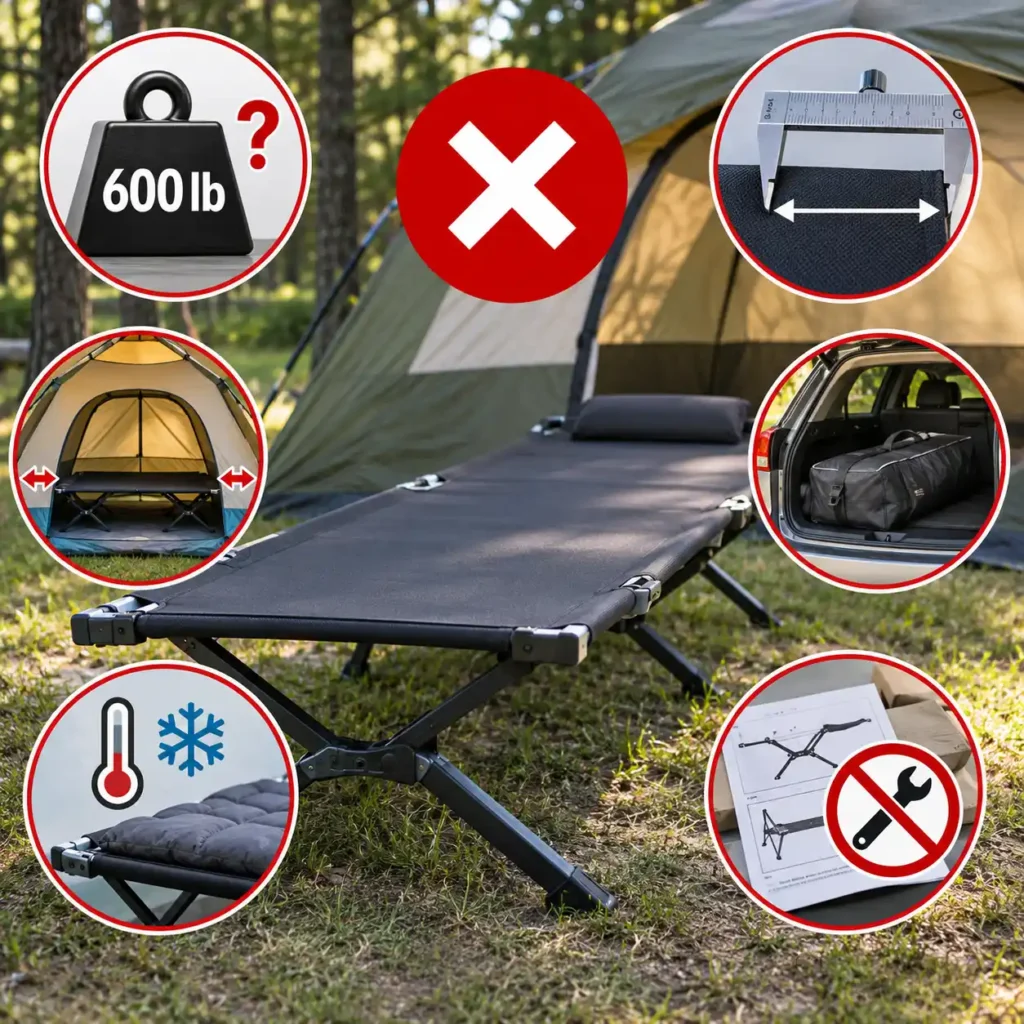
Choosing a heavy duty camping cot involves more than finding the highest weight rating or the widest sleeping surface. A model can look suitable on an Amazon product page but still be a poor match for your body size, tent, transportation setup, or camping conditions. These are the mistakes worth avoiding before you buy.
1. Choosing a Cot Based on Weight Capacity Alone
A high weight rating does not automatically mean a cot will be comfortable or suitable for every larger sleeper. Capacity, sleeping-surface dimensions, frame design, and overall stability all matter.
For example, the five models in this guide have stated capacities ranging from 450 to 600 lb. However, their overall dimensions and frame designs differ. A 600 lb rating does not tell you whether the sleeping surface provides enough room for your shoulders or whether the cot will fit inside your tent.
Compare the capacity with the manufacturer’s specifications for the exact model, then consider the sleeping space and construction rather than treating one number as the complete measure of suitability.
2. Confusing Overall Dimensions With Sleeping-Surface Dimensions
This is an important specification mistake. Product listings often show the cot’s overall length, width, and height, but those measurements do not necessarily represent the usable sleeping area.
The frame, side rails, and fabric attachment points can reduce the space available for your body. A cot advertised as approximately 42 inches wide may not provide a full 42 inches of usable sleeping surface.
Before ordering, look for separately stated sleeping-area dimensions. If the listing does not provide them, do not assume the overall width is the usable bed width. Contact the manufacturer if that measurement is essential to your decision.
3. Ignoring Tent Floor Space and Wall Clearance
An oversized cot can take up considerably more room than a standard camping bed. Checking only the advertised tent capacity is not enough: a tent may sleep four people on the ground but still have limited usable floor space for a wide cot.
Measure the interior floor and compare it with the cot’s assembled dimensions. Also consider the position of the tent walls. In tents with sloping sides, a tall cot placed close to the wall can leave little clearance around the sleeping area.
Allow room for the cot frame, your movement, and essential camping gear. Do not rely on the tent’s person-capacity rating as proof that a particular XXL cot will fit.
4. Overlooking Folded Size and Transportation Weight
A heavy duty cot may be comfortable once assembled but inconvenient to transport. Reinforced frames and oversized sleeping surfaces often result in a heavier, bulkier package.
For example, the models in this comparison weigh approximately 25.8–28.4 lb. That may be manageable for car camping, but it is a different proposition from carrying lightweight backpacking equipment.
Check both the item weight and the folded dimensions. Make sure the packed cot fits in your vehicle and that you can move it from the parking area to your campsite without difficulty.
5. Assuming Every Heavy Duty Cot Uses the Same Frame Design
The term heavy duty does not describe one standardized frame construction. Different models use different leg arrangements, cross-supports, and locking or tensioning systems.
A reinforced X-frame, an S-leg assembly, and a triangular cross-leg structure are not interchangeable descriptions. Each manufacturer presents its own design, and the published weight capacity should be considered alongside the complete construction.
Avoid judging a cot only by the number of visible legs or by phrases such as extra strong and reinforced. Look for specific construction details and clear manufacturer documentation.
6. Buying Without Checking the Exact Product Variant
Some brands sell several cots under similar product names, with different dimensions, capacities, materials, and included accessories. A product title or photograph may not make those differences obvious.
Before purchasing, confirm the exact model or variant selected on the product page. Check that its capacity, dimensions, included components, and warranty information match the specifications you used to make your decision.
This is particularly important when a listing offers multiple sizes or configurations through a single product page.
7. Expecting the Cot to Provide Enough Warmth on Its Own
A camping cot raises you above the ground, but the open space underneath does not provide insulation. The sleeping surface itself may also offer little cushioning.
In cooler conditions, relying on a sleeping bag alone can leave you uncomfortable. Consider a compatible sleeping pad or other suitable insulation beneath your body. Check the pad’s dimensions against the actual sleeping surface so it does not slide off or leave important areas uncovered.
8. Waiting Until the First Camping Trip to Assemble the Cot
A folding cot may require more effort to set up than its product photographs suggest. Some designs use tightly tensioned fabric, end rods, or locking components that take practice to handle correctly.
Assemble the cot at home before your trip. Follow the manufacturer’s instructions, check that all locking components are fully engaged, and confirm that the frame sits evenly on a level surface.
Do not force components into position or improvise a setup method if the instructions are unclear. Contact the manufacturer if a part does not fit or lock as intended.
9. Treating Customer Ratings as Proof of Long-Term Durability
A strong average rating can help you understand customer satisfaction, but it does not establish how a cot will perform after repeated camping trips or under every type of use.
Read reviews for recurring, specific observations about fabric tension, frame stability, setup difficulty, and component wear. Give more attention to detailed reviews that describe actual use than to short comments that only say the cot is comfortable or sturdy.
Also check the number of reviews and remember that ratings can change over time. They should support your comparison, not replace the manufacturer’s specifications and warranty terms.
10. Skipping the Warranty and Return-Policy Check
A heavy duty cot is a substantial piece of camping equipment, and its frame and fabric are important parts of the purchase. Before ordering, check what the manufacturer covers, how long the warranty lasts, and which conditions are excluded.
Do not assume that every model has the same warranty simply because it belongs to the same product category. If the listing does not clearly explain warranty coverage, seek clarification before buying.
Also review the retailer’s current return conditions. A cot that proves too wide, too heavy, or difficult to assemble may not be the right choice even if its published specifications are accurate.
Final Buying Check
Before placing your order, confirm these points:
The stated weight capacity belongs to the exact model or variant you selected.
The usable sleeping area is suitable for your body size, not just the overall cot dimensions.
The assembled cot fits your tent with enough room around it.
The folded package fits your vehicle and is manageable to transport.
The frame design and setup requirements are clearly explained.
You have a suitable sleeping pad or insulation plan for the expected conditions.
The warranty and return policy are clear.
Avoiding these mistakes will help you choose a heavy duty camping cot that works as a complete sleeping setup—not simply one with an impressive capacity figure.
Setup, Comfort, and Cold-Weather Considerations

A heavy duty camping cot can provide a more comfortable sleeping platform than a thin ground-level pad, but the experience depends on more than the cot itself. Proper setup, a suitable sleeping surface, tent clearance, and adequate insulation all affect how well the system works.
Whether you are setting up at a summer campsite or preparing for a chilly night outdoors, these practical considerations can help you get more from your camping cot.
Set Up the Cot on Firm, Level Ground
Start by choosing a reasonably flat, stable area inside your tent or sheltered sleeping space. Remove sharp objects, branches, and stones that could damage the tent floor or interfere with the cot’s feet.
Unfold the frame and secure all locking components according to the manufacturer’s instructions. If the model requires end bars or additional assembly, install them in the specified order. Do not force a component into position if it does not align correctly.
Once assembled:
Check that every leg and support is fully opened and locked.
Make sure the cot stands evenly without rocking.
Confirm that the fabric is properly attached and tensioned.
Check that no frame component is bent or visibly damaged.
Keep the cot away from tent walls, doors, and other equipment.
Test the cot carefully before lying down. Follow the manufacturer’s stated weight limit and usage instructions, and avoid jumping or dropping heavily onto the sleeping surface.
Check the Sleeping Surface and Frame Position
A heavy duty cot can have a strong frame and still feel uncomfortable if the fabric is too loose or a support bar creates pressure beneath your body.
Before adding bedding, inspect the sleeping surface. It should be installed correctly, without unexpected sagging or loose attachment points. If the design uses a tensioning mechanism, follow the manufacturer’s instructions to achieve the intended tension.
Pay attention to the position of the frame supports. Depending on the cot design and your sleeping position, a crossbar or side rail may create pressure around the hips, shoulders, or legs.
If you notice an uncomfortable pressure point, check whether adjusting your sleeping position or orientation helps. Do not modify the frame or remove structural components to improve comfort.
Add a Sleeping Pad for More Cushioning
The fabric deck of a camping cot is not necessarily designed to provide the same cushioning as a mattress. Some sleepers may find the surface too firm, while others may notice pressure around the shoulders and hips.
A compatible sleeping pad can improve the feel of the sleeping surface. Foam and self-inflating pads are common options, while insulated air pads may also work if their dimensions and construction suit the cot.
When choosing a pad, consider:
Width and length: It should fit securely on the cot without hanging excessively over the sides.
Thickness: More cushioning may help with pressure relief, but the pad should remain stable.
Attachment: Straps, a sleeve, or a suitable non-slip surface can help prevent movement during sleep.
Insulation: If you camp in cool weather, check the pad’s published R-value rather than judging warmth by thickness alone.
A sleeping pad is not essential for every warm-weather trip, but it can make a noticeable difference when the bare cot feels too firm or cold.
Understand Why Cots Can Feel Cold at Night
One common misconception is that sleeping above the ground automatically makes a cot warmer. Elevation can help keep you away from damp ground, but it does not eliminate heat loss.
Air can circulate beneath the sleeping surface, carrying warmth away from the underside of your body. A sleeping bag also provides less insulation underneath you when its filling is compressed by your weight.
This is why a bare cot may feel surprisingly cold during a chilly night, even when you use a sleeping bag with a suitable temperature rating.
For a more reliable setup, treat the cot as the support platform and the sleeping pad as part of your insulation system. The pad’s R-value indicates its resistance to heat flow: a higher value generally means greater insulation.
Choose Sleeping Pad Insulation for the Expected Conditions
The appropriate insulation depends on the lowest temperatures you expect during the trip, your personal comfort needs, and the rest of your sleep system.
Use the following as a general planning reference, not as a guarantee of comfort at a particular temperature:
| Camping Conditions | Sleeping Pad Consideration |
|---|---|
| Warm-weather camping | A basic pad may be sufficient if additional cushioning is needed |
| Cool nights | Consider an insulated sleeping pad with a published R-value |
| Cold-weather camping | Choose a higher-insulation pad appropriate for the expected overnight low |
| Winter conditions | Evaluate the complete sleep system, including pad insulation, sleeping bag, clothing, and shelter |
For context, REI’s sleeping pad guidance groups R-values of under 2 with warm conditions, 2–3.9 with cool conditions, 4–5.4 with cold conditions, and 5.5 or higher with extreme conditions in its example sleep-system chart. These are planning ranges, not universal guarantees: actual comfort also depends on the sleeper, sleeping bag, clothing, and exposure.
When conditions are especially cold, some campers combine an insulated pad with a closed-cell foam layer. The combined insulation can provide additional protection, provided both layers fit securely and work with the rest of the sleep system.
Keep the Sleeping Pad in Place
A pad that shifts during the night can expose parts of your body to the colder cot surface. This is particularly inconvenient when the sleeping area is wide or the fabric is relatively smooth.
Choose a pad that fits the cot as closely as practical. If it does not have a built-in attachment system, use compatible straps or another manufacturer-approved method to keep it in position.
Avoid using an oversized pad that hangs far beyond the sleeping surface. It may become unstable when you turn over or get in and out of bed.
Keep Bedding and Sleeping Gear Dry
Moisture can reduce comfort and make it harder to stay warm. Store your sleeping bag, pad, and spare sleep clothing in dry bags or other suitable waterproof storage when necessary.
Before packing the cot away, check the frame and fabric for moisture. Allow the equipment to dry fully before long-term storage, following the manufacturer’s care instructions. This helps reduce the risk of mildew, unpleasant odors, and premature material deterioration.
If condensation forms inside your tent, keep bedding away from wet tent walls and maintain ventilation where conditions allow.
Allow Enough Space Around the Cot
A heavy duty XXL cot needs more room than a compact single camping bed. Even if it fits inside your tent, you still need enough clearance to move safely and access the entrance.
Check that:
The cot does not press against the tent walls.
The entrance and exit remain accessible.
Your sleeping bag and pad do not interfere with the tent door.
There is room to store essential gear without blocking movement.
The frame does not place excessive pressure on one small area of the tent floor.
A groundsheet or suitable protective layer may help protect the tent floor from contact with cot feet and frame components. Make sure it is compatible with the tent and does not create an unstable surface.
Adjust the Setup to the Season
A cot can be useful in different camping conditions, but the ideal arrangement changes with the weather.
Warm-weather camping: Prioritize ventilation, comfortable bedding, and enough clearance around the sleeping area. The open space beneath a cot may allow airflow, although the actual cooling effect depends on the tent and surrounding conditions.
Cool-weather camping: Add a suitable insulated sleeping pad and use a sleeping bag appropriate for the expected overnight temperature. Keep spare clothing dry and avoid leaving gaps in your insulation system.
Winter camping: Plan the entire sleep system rather than relying on the cot or sleeping bag alone. Check the forecast, choose insulation appropriate for the expected conditions, and make sure the tent provides suitable protection. Never use fuel-burning heaters or open flames inside a tent unless the equipment is specifically designed and approved for that use, and follow all manufacturer and safety instructions.
A Practical Heavy Duty Cot Sleep Setup
For most car-camping situations, a straightforward arrangement is a stable cot, a compatible sleeping pad, a suitable sleeping bag, and a pillow. The exact combination should reflect your body size, sleeping preferences, and expected nighttime temperatures.
The key is to treat these components as one system. A high-capacity cot provides the elevated support, but the pad, bedding, shelter, and setup determine much of the overall sleeping comfort.
Before your trip, assemble the cot at home, test the sleeping pad on it, and confirm that the complete setup fits inside your tent. A short trial in advance is easier than discovering a fit or comfort problem after arriving at the campsite.
Frequently Asked Questions: Heavy Duty Camping Cots
How much weight can a heavy duty camping cot hold?
Heavy duty camping cots commonly have manufacturer-stated weight capacities of 500–600 lb, although ratings vary by model. The five cots compared in this guide range from 450 lb to 600 lb: TETON Sports Outfitter XXL and Portal XXL are rated for 600 lb, EVER ADVANCED XXL for 550 lb, LEISURE IMPACT XXL for 500 lb, and TIMBER RIDGE for 450 lb.
Always check the manufacturer’s stated capacity for the exact model you plan to buy. A higher rating does not automatically mean a wider or more comfortable sleeping surface.
What is the best camping cot for a 400 lb person?
A suitable cot should have a manufacturer-stated weight capacity comfortably above the sleeper’s weight, along with enough usable sleeping space and a frame design appropriate for the intended use.
Among the five models in this guide, the TETON Sports Outfitter XXL and Portal XXL have the highest listed capacities at 600 lb. The EVER ADVANCED XXL is rated for 550 lb, while the LEISURE IMPACT XXL and TIMBER RIDGE are rated for 500 lb and 450 lb, respectively. Compare the actual sleeping-surface dimensions as well as the capacity before choosing.
How wide should a heavy duty camping cot be?
The right width depends on your body size, sleeping position, and how much room you need to turn over comfortably. A wider cot can provide more space for larger sleepers and people who move frequently during the night.
However, distinguish between the overall frame width and the usable sleeping-surface width. These measurements are not necessarily identical. Check the manufacturer’s sleeping-area dimensions whenever they are available rather than assuming the full advertised width is available for sleeping.
Can two people sleep on a heavy duty camping cot?
Only if the cot is specifically designed and rated for two people. A standard single camping cot should not be treated as a double bed simply because its weight capacity appears high enough for two adults combined.
For a two-person cot, check whether the manufacturer’s weight limit applies to both sleepers together or to each sleeping position separately. Also consider the sleeping surface width and whether the design provides enough room for both people to sleep comfortably.
Can you exceed a camping cot's weight limit?
No. You should not exceed the manufacturer’s stated weight capacity. Doing so can place excessive stress on the frame, support points, fabric, and locking components, potentially causing damage or failure.
Remember that the published capacity is a manufacturer-stated limit, not a guarantee that the cot will withstand every type of movement or loading situation. Follow the product instructions and avoid jumping, dropping heavily onto the cot, or using it in ways the manufacturer does not recommend.
How can you make a heavy duty camping cot more comfortable?
Start by checking that the cot is assembled correctly and positioned on level ground. A properly tensioned sleeping surface and a stable frame can help prevent uneven support.
If the fabric feels too firm or creates pressure around your shoulders and hips, add a compatible sleeping pad. A suitable pillow and sleeping bag can also improve comfort. Make sure the pad fits the cot securely and does not slide off when you change sleeping positions.
Do you need a sleeping pad on a camping cot?
Not necessarily, but a sleeping pad can improve cushioning and insulation. Some campers find a cot’s fabric surface comfortable on its own, while others prefer the additional support of a foam, self-inflating, or insulated air pad.
For cold-weather camping, an insulated pad is particularly useful because a cot does not provide meaningful thermal insulation by itself. Check the pad’s dimensions and published R-value before choosing one.
Why is sleeping on a camping cot sometimes cold?
A camping cot raises you above the ground, but cold air can circulate underneath the sleeping surface. This can carry heat away from your body, especially when the cot is used without an insulated pad.
A sleeping bag alone may not solve the problem because its insulation becomes compressed beneath your body. For cooler conditions, use a sleeping pad with an appropriate R-value and a sleeping bag suited to the expected overnight temperatures.
Are heavy duty camping cots more durable than regular camping cots?
Not automatically. Heavy duty models are generally designed with higher stated weight capacities and may use reinforced frames or heavier materials, but durability depends on the complete construction, component quality, fabric, and how the cot is used and maintained.
Check the frame design, fabric specifications, connection points, warranty, and manufacturer instructions. Customer reviews can provide additional context, but a high average rating alone does not establish long-term durability.
Are heavy duty camping cots suitable for tall people?
They can be, provided the sleeping surface is long enough for the user’s height. Weight capacity and sleeping length are separate specifications: a cot rated for 600 lb is not necessarily suitable for a tall sleeper.
Check the actual sleeping-surface length rather than relying only on the overall frame dimensions. Also consider whether the design provides enough room for your preferred sleeping position and whether the cot fits inside your tent.
Final Verdict: What Matters Most When Choosing a Heavy Duty Camping Cot
Choosing a heavy duty camping cot is ultimately a decision about matching the product’s construction and dimensions to your actual sleeping needs. A high weight-capacity rating is useful, but it does not tell you everything about comfort, usable space, portability, or long-term ownership.
Our comparison of five models reveals several important considerations that are easy to overlook when shopping by product title or advertised capacity alone.
What This Comparison Actually Shows
The five models in this guide have manufacturer-stated capacities ranging from 450 to 600 lb. However, capacity is only one part of the comparison.
Their listed overall widths range from 32.5 to 41.9 inches, while their item weights range from 25.8 to 28.4 lb. This illustrates an important distinction: choosing a higher-capacity cot does not necessarily mean choosing the widest sleeping area, and a wider frame does not automatically provide more usable sleeping space.
The construction details also vary. The products use different support arrangements, including reinforced X-frame designs, an S-leg assembly, and a triangular cross-leg structure. These differences are worth examining, but the available listing information does not establish that one frame design is universally stronger or more durable than another.
Where the Biggest Trade-Offs Are
Capacity versus usable sleeping space
A cot with a 600 lb stated capacity may be suitable from a load-rating perspective but still feel restrictive if its actual sleeping surface is too narrow. Buyers should prioritize both specifications rather than choosing by capacity alone.
Sleeping space versus portability
Extra-wide models can offer more room, but their overall dimensions and packed weight may make them less convenient to transport. All five models in this comparison weigh approximately 26–28 lb, so they are primarily worth considering for car camping rather than situations where equipment must be carried over long distances.
Additional features versus simplicity
Features such as adjustable headrests, side pockets, and setup mechanisms can improve convenience. However, they should be evaluated according to your actual needs rather than treated as proof of superior overall quality.
Advertised specifications versus verifiable measurements
Product listings do not always present dimensions consistently. In this comparison, the TETON Sports Outfitter XXL listing contains conflicting or mismapped dimensions, while the LEISURE IMPACT XXL listing provides slightly different measurements in its specification table and description. These discrepancies make it important to confirm the exact measurements before purchasing.
What to Confirm Before Making Your Final Choice
Before ordering any heavy duty camping cot, verify the following details on the current product listing or directly with the manufacturer:
The weight capacity applies to the exact model or variant selected.
The actual sleeping-surface dimensions are available and suitable for your body size.
The assembled dimensions fit inside your tent.
The folded dimensions and item weight are manageable for your transportation setup.
The frame assembly and locking instructions are clear.
The warranty coverage and return conditions are acceptable.
Do not assume that an overall frame measurement represents the usable sleeping area. This is particularly important when comparing oversized models.
The Bottom Line
A good heavy duty camping cot should provide the required load capacity, sufficient sleeping space, a suitable support structure, and dimensions that work with your camping setup. No single specification can establish all four.
The most reliable buying decision comes from checking the complete set of measurements and manufacturer information rather than relying on a product title, a high weight rating, or customer ratings alone.
Use this comparison to narrow your options, then confirm the exact specifications of your preferred model before placing an order.
About the Author
Anthony is a camping gear researcher and contributor to CampComfortGuide. He focuses on researching outdoor equipment, comparing product specifications, and evaluating the practical features that matter when choosing camping gear.
His work emphasizes clear product comparisons, manufacturer-provided specifications, and practical buying considerations to help readers make informed decisions about camping equipment, outdoor comfort, and campsite essentials.
Through CampComfortGuide, Anthony aims to make camping gear research easier to understand by highlighting important product differences, explaining technical specifications, and identifying details buyers should verify before making a purchase.