
Hi, I’m Anthony.
For years, I tried to sleep by bunching up a sweatshirt under my head. I always woke up with a stiff neck and a headache.
The day I bought a dedicated camping pillow, my sleep quality doubled. It is a small investment that makes a massive difference. You don’t have to suffer just because you are outside.
I’ve tested everything from rolled-up jackets to premium shredded memory foam options. Comfort isn’t marketing — it’s biomechanics.
As an Amazon Associate, we earn from qualifying purchases.
Are you looking for the best camping pillows to cure your neck pain and help you sleep like a baby? You are in the right place.
Bringing a pillow from home is bulky and it gets dirty. Inflatable pillows are compact but can feel like sleeping on a balloon. The best modern camping pillows use a hybrid of memory foam and air to give you home-like comfort in a packable size.
We tested the top options to find the ones that are soft, supportive, and quiet.

How We Tested These Camping Pillows
I tested these pillows over 30+ nights across car camping trips, shoulder-season backpacking, and one windy desert camp where temperatures dropped below freezing.
Here’s what I evaluated in real-world conditions:
Neck alignment (side vs back sleeping)
Insulation vs cold air transfer
Stability on sleeping pads
Noise when shifting at night
Durability of valves and seams
Packed size vs actual comfort payoff
Moisture resistance after condensation exposure
Moisture inside a tent changes how foam and fabric feel overnight. If you struggle with damp gear, read our breakdown on why tents condense at night — and how to stop it.
I tested them on:
Inflatable insulated pads
Self-inflating foam pads
Car camping mattresses
A pillow that feels good indoors can completely fail outside.
Cold air, slick nylon, and uneven ground change everything.
Why You Can Trust This Review
I buy and test most of the gear I review. No brand pays for placement, and no product gets a “best” award without real-world field time.
These pillows were tested across multiple trips — not just one overnight setup. I rotated them on the same sleeping pads, in the same conditions, to compare comfort, insulation, and stability directly.
I prioritize:
Real sleep quality over spec sheets
Long-term durability over first impressions
Practical comfort over marketing claims
If a product doesn’t perform outside — it doesn’t make this list.
That’s the standard.
How We Ranked These Camping Pillows

Not all criteria matter equally.
Here’s what carried the most weight in our rankings:
Comfort & neck alignment (35%)
Stability on sleeping pads (20%)
Insulation & temperature feel (15%)
Packability (15%)
Durability (15%)
Comfort always wins.
A pillow that saves 2 ounces but ruins your sleep doesn’t deserve a top spot.
Quick Summary: Top 3 Picks for Comfort
- Best Overall (The Classic): Therm-a-Rest Compressible Pillow
- Why: Made of upcycled foam chunks. Expands huge and feels exactly like a home pillow.
- Best Hybrid (Support & Softness): NEMO Fillo Camping Pillow
- Why: A brilliant mix of an air baffle (for height) and a thick foam topper (for comfort).
- Best Budget (Ultralight): Trekology Aluft 2.0
- Why: Costs the price of a lunch, packs down to the size of a soda can, and is surprisingly ergonomic.
Best for campers who want real neck support and better sleep while car camping.
Quick Picks by Sleeping Style

Best for Side Sleepers: Sea to Summit Aeros Premium
Best for Back Sleepers: NEMO Fillo
Best for Stomach Sleepers: Trekology Aluft (under-inflated)
Best for Cold Sleepers: Therm-a-Rest Compressible
Best for Luxury Comfort: COOP Memory Foam
Comparison Table – Best Camping Pillows in 2026
| Pillow | Type | Weight | Packed Size | Loft | Best For |
|---|---|---|---|---|---|
| Therm-a-Rest Compressible | Foam | ~10–15 oz | Medium (compressible roll) | ~4–7 in | Car Camping |
| NEMO Fillo | Hybrid | ~9 oz | 4 x 6 in | ~4 in | Balanced Comfort |
| Trekology Aluft 2.0 | Inflatable | ~3.4 oz | Soda-can size | ~4 in (adjustable) | Ultralight |
| COOP Travel & Camp | Memory Foam | ~16 oz+ | Large stuff sack | ~5 in | Luxury Camping |
| Sea to Summit Aeros Premium | Inflatable | ~2.8–3 oz | Ultra-compact | ~4 in | Side Sleepers |
Side-by-Side Field Impressions
After testing these pillows back-to-back on the same sleeping pad:
The Therm-a-Rest felt the most stable and warm, but clearly the bulkiest.
The NEMO Fillo offered the best comfort-to-size ratio.
The Trekology felt the lightest but required the most inflation tuning.
The COOP was unmatched in plushness, but overkill for mobile setups.
The Sea to Summit had the best contour for side sleepers but less warmth retention.
Testing them directly highlighted one thing:
Foam wins comfort.
Air wins space.
Which Type of Camping Pillow Is Best for You?

The best camping pillow depends on how you camp and what kind of sleeper you are. Not all camping pillows feel the same, and choosing the right type can make a big difference in comfort.
Foam Camping Pillows
Best for: car camping, comfort-focused sleepers
Foam pillows feel the most like a pillow from home. They are softer and quieter but take up more space.
Camping pillows work especially well when used with double sleeping bags designed for couples who want a more bed-like sleep experience.
Inflatable Camping Pillows
Best for: saving space, travel, minimalist setups
Inflatable pillows pack down very small and allow you to adjust firmness, but they usually feel less plush.
Hybrid Camping Pillows
Best for: balance of comfort and packability
Hybrid pillows combine air support with a foam or fabric layer, offering better neck support without excessive bulk.
Choosing the right pillow type helps ensure you get the most comfort from your camping sleep setup.
What Actually Matters in a Camping Pillow

Most buyers focus on size and weight.
That’s not what determines sleep quality.
Here’s what really matters:
1 Neck Height vs Sleeping Position
Side sleepers need 3–5 inches of loft
Back sleepers need moderate contouring
Stomach sleepers need minimal loft
Too low → neck collapses
Too high → spine bends
Your pillow only works as well as your sleeping pad. If your pad collapses under your shoulder, even the best pillow won’t fix alignment. See our guide to the best sleeping pads for side sleepers (car camping) for proper spine support.
2 Insulation vs Warmth
Inflatable pillows without insulation can feel cold on your ear in 40°F conditions.
Air transfers temperature fast.
Foam retains warmth better.
Hybrid designs balance both.
If you’re camping on cold ground, insulation under your body matters even more. We break down real R-value performance in our guide to the best sleeping pads for cold ground.
3 Surface Friction (Slide Factor)
Nylon-on-nylon = frictionless.
If the pillow slides, you wake up.
Rubberized bottoms or integrated attachment systems matter more than people think.
4 Noise
Some air pillows crinkle when you move.
That tiny sound becomes huge at 2AM.
Brushed polyester and foam layers reduce noise dramatically.
5 Packability vs Real Comfort
Packed size is irrelevant if you wake up stiff.
Ultralight only matters if you’re actually backpacking.
Car campers should prioritize support over compression ratio.
Where Camping Pillows Usually Fail
Most camping pillows fail in predictable ways:
Overinflation → neck strain
Underinflation → head collapse
Cold air transfer → discomfort below 45°F
Slippery fabrics → pillow migration
Weak valves → slow overnight deflation
Long-Term Durability Considerations

Over multiple compression cycles, shredded foam tends to retain shape better than single-layer foam blocks.
Inflatable pillows depend heavily on valve quality. Lower-cost models may develop slow leaks after repeated packing and inflation.
If you camp frequently, durability matters more than minor weight savings.
Table of Contents
1. Therm-a-Rest Compressible Pillow Cinched
Award: Best Overall / Most Like Home

This isn’t a balloon; it’s a real pillow. The Therm-a-Rest uses chunks of upcycled foam from their mattress manufacturing. It compresses into a roll but expands into a thick, lumpy (in a good way) cushion.
The “Cinch” cord allows you to adjust the firmness. Pull it tight for a firm pillow, or loosen it for a soft, flat one.
Pros:
- ✅ Feels like a real bed pillow (no bouncing).
- ✅ Machine washable cover.
- ✅ Eco-friendly (recycled foam).
- ✅ Adjustable firmness.
Cons:
- ❌ Takes up more space than inflatable ones.
- ❌ Can be lumpy if you don’t fluff it up.
Real-World Performance
On cold nights (40–45°F), this pillow feels noticeably warmer than inflatable models. Foam doesn’t transfer cold air the way air chambers do.
The loft is forgiving. Even on slightly uneven ground or softer car-camping mattresses, it absorbs pressure and prevents neck tilt.
The cinch system actually works — tightening it increases density without making it stiff.
What to watch:
If stored tightly compressed, it needs 5–10 minutes to fully regain shape.
In humid environments, it can absorb moisture if left exposed.
Best use case:
Car camping
Van life
Basecamp setups
For a full comfort setup, pair it with one of the best camping mattresses & sleeping mats for car camping to create a bed-like sleep system.
Not ideal for:
- Backpacking where every liter of space matters
Verdict:
If you have the space in your car and hate inflatable pillows, this is the only choice. It guarantees good sleep.
2. NEMO Fillo Camping Pillow
Award: Best Hybrid Design

Can’t decide between foam and air? The NEMO Fillo gives you both. It has an inflatable core (so you can adjust the height) covered by a thick layer of luxury foam and a soft jersey cover.
This means you get the packability of air but the soft feel of foam against your face. It packs down into its own integrated stuff sack.
Pros:
- ✅ Best balance of comfort and packability.
- ✅ No “balloon” feeling thanks to the foam topper.
- ✅ Removable, washable cover.
- ✅ Fits inside a mummy bag hood perfectly.
Cons:
- ❌ Expensive.
- ❌ The valve is inside the cover (slightly hard to reach).
Real-World Performance
The hybrid construction solves the classic “air pillow problem.” You get height from the air core, but your face touches foam — not plastic.
During side-sleep testing, it held alignment better than pure inflatables, especially when slightly under-inflated.
The jersey cover reduces noise significantly. No crinkling when shifting.
Trade-offs:
The internal valve placement makes late-night adjustments slightly awkward.
In very cold conditions, the air core still cools faster than full foam models.
Best use case:
Shoulder-season camping
Campers needing adjustability
Mummy bag users
Not ideal for:
Extreme ultralight trips
Campers who want zero air components
Verdict:
The engineering marvel. Perfect for campers who want luxury but need to save some space.
3. Trekology Aluft 2.0 Inflatable Pillow
Award: Best Budget / Ultralight
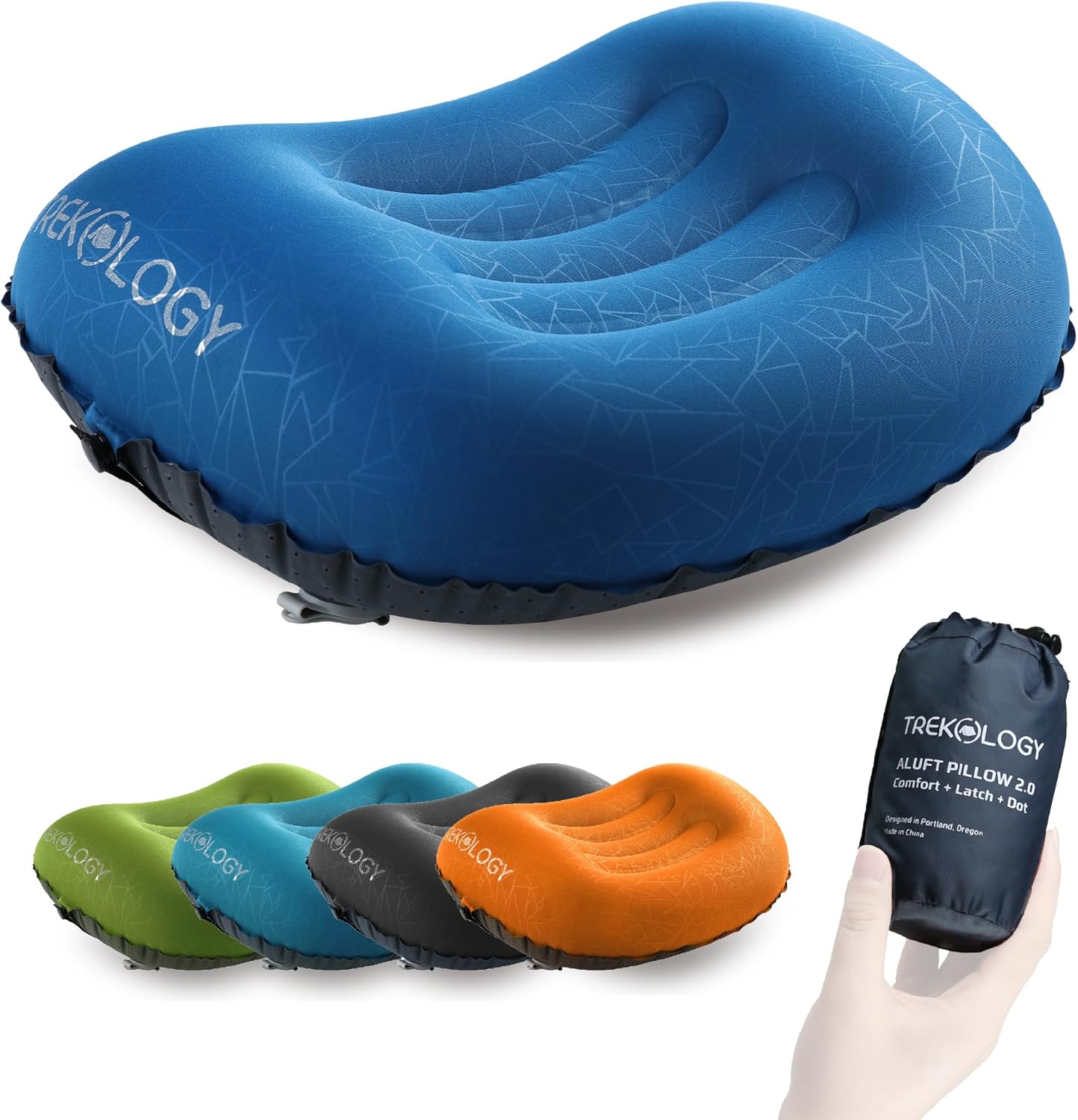
This is the #1 bestseller on Amazon for a reason. It is cheap, tiny, and effective. It is 100% inflatable, but it has a curved ergonomic shape that cradles your head and supports your neck.
It features a rubberized bottom so it doesn’t slide off your sleeping pad in the middle of the night.
Pros:
- ✅ Insanely affordable.
- ✅ Packs down to the size of a soda can.
- ✅ Anti-slip dots on the bottom.
- ✅ easy-to-use button valve.
Cons:
- ❌ It’s an air pillow (feels a bit bouncy).
- ❌ Not insulated (can feel cold on your ear).
Real-World Performance
For a fully inflatable pillow, the ergonomic curve performs better than expected.
When inflated to about 80% capacity, it reduces the “balloon bounce” effect and stabilizes neck positioning.
The anti-slip rubber dots genuinely help on slick sleeping pads.
Where it struggles:
In 45°F and below, you feel cold air transfer.
Overinflation makes it unstable and uncomfortable.
Long-term durability of budget valves is a question mark under heavy use.
Best use case:
Backpacking
Air travel
Emergency backup pillow
Not ideal for:
Cold-weather camping
Campers sensitive to pressure points
Verdict:
For the price, you can’t beat it. Buy one for every member of the family.
4. COOP Home Goods Travel & Camp Pillow
Award: Best Premium Memory Foam

Coop Home Goods makes famous adjustable pillows for beds. They took that same technology and shrunk it. This pillow is filled with shredded memory foam. It is heavy, dense, and luxurious.
It comes with a waterproof, dirt-resistant stuff sack. It’s basically a luxury mini-pillow.
Pros:
- ✅ Real shredded memory foam.
- ✅ Fully adjustable (you can add or remove foam).
- ✅ Water-resistant outer shell for transport.
- ✅ CertiPUR-US certified foam (no chemical smell).
Cons:
- ❌ Heavy and bulky.
- ❌ Takes time to dry if it gets wet.
Real-World Performance
This feels like a scaled-down home pillow — dense, supportive, and highly adjustable.
The shredded memory foam adapts to head shape instead of pushing back like air pillows do.
In cold weather, insulation is excellent. No cold ear effect.
However:
It’s heavy. You notice it in your gear bag.
If it gets wet, drying takes significantly longer than synthetic foam hybrids.
Best use case:
Glamping
RV camping
Long stays in one location
Not ideal for:
Backpacking
Minimalist setups
Wet climates without drying time
If you’re camping in sub-freezing temperatures, pairing your pillow with one of the best insulated sleeping pads for winter camping dramatically improves comfort.
Verdict:
For the Glamper who refuses to compromise. It feels exactly like a $100 home pillow.
5. Sea to Summit Aeros Premium
Award: Best for Side Sleepers

This is an inflatable pillow, but it uses a unique “curved baffle” design that creates a cradle for your head. The outer fabric is a soft brushed polyester that is quiet (no plastic crinkling sounds).
It is shaped to fit perfectly into the hood of a sleeping bag and pairs well with Sea to Summit mats (using the PillowLock system).
Pros:
- ✅ Very light and compact.
- ✅ Contoured shape is great for side sleepers.
- ✅ “PillowLock” system prevents sliding (if you have their mat).
- ✅ Easy fine-tuning valve.
Cons:
- ❌ Expensive for an air pillow.
- ❌ Not as soft as foam.
Real-World Performance
The curved baffle design genuinely improves head stability for side sleepers.
Unlike basic inflatable pillows, it prevents lateral roll-off during the night.
The brushed polyester surface reduces noise compared to standard nylon air pillows.
Limitations:
Still an air pillow — insulation is minimal.
Requires careful inflation tuning; too firm creates pressure points.
Performs best when paired with a compatible mat using the PillowLock system.
Best use case:
Ultralight backpacking
Side sleepers needing contour
Warm to mild conditions
Not ideal for:
Sub-40°F nights
Campers prioritizing plush softness
Verdict:
A high-tech option for those who prioritize weight and packability but still want a soft touch.
Who This Guide Is NOT For
This guide is not for:
Ultralight hikers who cut toothbrush handles
Campers using rolled-up jackets and happy with it
Winter expedition mountaineers needing insulated specialty gear
This list focuses on realistic comfort for normal camping conditions.
Buying Guide: How to Choose the Best Camping Pillows

1. Type: Foam vs. Air vs. Hybrid
- Compressible Foam (Therm-a-Rest): Most comfortable, but bulky. Best for car camping. For the best results, pair your pillow with one of the best sleeping mats for car camping to keep your neck and spine properly aligned.
- Inflatable (Trekology): Tiny and light, but can feel bouncy. Best for hiking or full cars.
- Hybrid (NEMO): The sweet spot. Air core + Foam top.
2. Slide Factor
Nylon pillows on nylon sleeping bags are like ice on ice. They slide away. Look for best camping pillows with rubber dots on the bottom (Trekology) or use a texture strap to hold it to your mat.
3. Washability
Camping is dirty. Ensure the pillow has a removable cover or is fully machine washable (like the Therm-a-Rest). Face oils and campfire smoke build up fast.
FAQ – Camping Pillows (2026)
What is the best camping pillow for neck pain?
A hybrid or shredded memory foam pillow offers better spinal alignment than pure air models. Foam distributes pressure evenly and prevents neck collapse during side sleeping.
Are inflatable camping pillows bad?
Not bad — just less forgiving. They require precise inflation. Overinflate them and you create pressure points. Underinflate them and your neck sinks.
They’re best for backpacking.
How thick should a camping pillow be?
Side sleepers: 3–5 inches
Back sleepers: 2–4 inches
Stomach sleepers: 1–3 inches
Loft must match shoulder width and sleeping pad thickness.
Why does my camping pillow feel cold?
Air transfers temperature rapidly. Non-insulated inflatable pillows feel cold in sub-50°F conditions. Foam retains warmth better.
For true cold-weather performance, your pillow is only part of the equation. Here’s how to keep a tent warm during winter camping.
Do I need a camping pillow if I have a sleeping bag hood?
Yes. Sleeping bag hoods stabilize a pillow, but they don’t replace neck support.
Can I use a camping pillow for backpacking?
Yes — but choose under 4 oz and compact. Comfort-to-weight ratio matters more than absolute comfort.
Proper storage extends the life of foam and inflatable pillows. Here’s how to store camping gear properly to prevent compression damage and mildew.
Final Verdict: What I’d Personally Pack
- If I’m car camping → Therm-a-Rest Compressible. No debate.
- If I need balance → NEMO Fillo. Smart engineering.
- If I’m flying or backpacking → Trekology Aluft 2.0.
- If comfort is non-negotiable → COOP.
- If I’m a side sleeper counting ounces → Sea to Summit Aeros Premium.
A bad pillow ruins recovery.
Recovery determines energy.
Energy determines your trip.
Choose accordingly.
For colder nights, many campers also add a camping blanket on top of their sleeping bag for extra warmth and comfort.