
Setting up a campsite often means finding room for food, drinks, and everyday essentials while keeping camping gear organized. The best camping wagons with table tops combine cargo space with a convenient surface for outdoor meals, refreshments, or small items you want within easy reach—without requiring a separate table for every task.
In this guide, we compare five camping wagons with tabletop features, looking at load capacity, storage design, tabletop configuration, wheel construction, and portability. Some models also offer features such as multiple storage levels or a canopy, so the right choice depends on how you camp and what you need to carry. Our comparison will help you weigh these practical differences before choosing a wagon for your next outdoor trip.
As an Amazon Associate I earn from qualifying purchases.

Table of Contents
Why We Can Trust This Guide
Choosing a camping wagon with a tabletop involves more than comparing advertised weight limits or looking at product photos. The tabletop’s design, whether it is included with the wagon, the available cargo space, and the folding mechanism all affect how useful the wagon may be at a campsite. A model designed for carrying equipment and providing a convenient surface may suit a different camping setup than one focused mainly on storage capacity.
This guide compares five specific camping wagons using their product descriptions, available specifications, and details associated with the exact Amazon.com listings. We focus on practical differences that matter for camping, picnics, and outdoor gatherings, including tabletop configuration, storage design, portability, and additional features. When a specification or package detail cannot be reliably confirmed, we avoid presenting it as an established fact.
Our goal is to explain what each model offers, where its features may be useful, and which trade-offs deserve attention before purchasing. We distinguish between manufacturer or seller claims and conclusions that would require hands-on testing. A tabletop shown in a product image does not, by itself, establish its dimensions, stability, load rating, or whether every pictured accessory is included in the package.
This is a research-based comparison, not a report of personal field tests. We do not claim to have physically tested all five wagons or independently measured their tabletop performance. Before buying, check the current listing for the exact model and ASIN, confirm the included accessories, and verify any load limits or setup requirements that matter for your intended use.
How We Evaluate and Compare Camping Wagons with Table Tops
A camping wagon with a tabletop should be evaluated as both a transport solution and a practical outdoor surface. Carrying capacity matters, but so do the table’s configuration, usable cargo space, ease of setup, and the amount of room the folded wagon requires. For this comparison, we examine the available product information to understand how each model balances these features and where buyers may need to make trade-offs.
Our evaluation is based on published product descriptions, available specifications, and information associated with the exact product listings. We do not claim to have conducted hands-on tests of all five wagons. When a specification is missing, conflicting, or unclear, we flag the uncertainty rather than inventing a figure or presenting a marketing claim as an independently verified result.
Tabletop Design and Included Accessories
We examine how each tabletop is described, including whether it folds out from the wagon, can be removed, or is supplied as part of a separate table-and-wagon set. These distinctions affect setup, storage, and how easily the wagon can be used for different outdoor activities.
We also check whether the tabletop is explicitly included in the listed package. Product photographs may show accessories that are sold separately or may not be included in every configuration. Buyers should confirm the exact listing and package contents before purchasing.
A wagon tabletop can be useful for organizing food, drinks, and cooking essentials, but it may not replace a dedicated cooking surface for every campsite. If you are planning a more complete outdoor kitchen, our guide to organizing and equipping a camping kitchen can complement this comparison.
Tabletop Size, Stability, and Practical Use
A tabletop is useful only if its available surface suits the tasks you intend to perform. We consider published dimensions and design details when available, while recognizing that a product description alone cannot establish how stable a table will be under real-world conditions.
For camping, a tabletop may provide space for drinks, snacks, meal preparation, or small essentials. However, buyers should not assume that every tabletop is suitable for heavy equipment, cooking appliances, or other concentrated loads. Check any stated table-specific weight limit and the manufacturer’s usage instructions.
Load Capacity and Usable Storage Space
We compare stated wagon load limits and cargo dimensions where reliable information is available. These measurements answer different questions: the load rating indicates the manufacturer’s stated weight limit, while the cargo dimensions help determine whether items such as coolers, folding chairs, food containers, and camping accessories will fit.
A tabletop can also affect how you organize the wagon, particularly when the design uses multiple storage levels. We consider these arrangements where documented, without assuming that a larger advertised capacity automatically means more usable space or better everyday convenience.
Planning the rest of your equipment around the wagon can also help prevent bulky items from competing for limited cargo space. Our guide to packing a car for camping with a more efficient gear layout offers related advice on organizing equipment before leaving home.
Portability, Folding, and Setup
A wagon needs to fit your camping routine as well as your equipment. We examine listed product weight, folded dimensions, folding mechanisms, and setup information where available. These details can help you assess whether a model is practical to transport in your vehicle, carry into storage, and assemble at the campsite.
We also consider how the tabletop fits into the setup process. A removable table may offer flexibility, while an integrated or fold-out design may reduce the need to handle a separate component. The actual advantage depends on the specific construction and package, so we avoid declaring one configuration universally better.
Frame, Wheels, and Additional Features
We review documented construction materials and practical features such as wheel design, brakes, adjustable handles, storage pockets, multiple tiers, and canopies. These features may improve convenience for particular camping arrangements, but their value depends on how you plan to use the wagon.
Wheel dimensions and construction can influence handling across grass, gravel, and other campsite surfaces. However, we do not assume that a wagon marketed as all-terrain will perform equally well on every surface without independent testing. Likewise, the presence of a canopy or additional storage level does not automatically establish better overall quality.
How We Reach Our Recommendations
Our assessments consider tabletop configuration, included accessories, usable storage, stated load limits, portability, construction, and the practical needs of different camping setups. We weigh documented features against their likely usefulness without treating advertised claims as proof of independently measured performance.
The goal is not to declare one wagon the best choice for every camper. It is to help readers identify which model deserves closer consideration for their intended use, understand the important differences, and verify the specifications that matter before making a purchase.
Quick Answer: Which Camping Wagon with a Table Top Is Best?
The best camping wagon with a table top depends on how you plan to use it at the campsite. Some campers need a simple surface for drinks and snacks, while others may benefit from a larger work area, extra storage levels, or a design that combines several functions.
For campers who want multiple functions in one unit, the CLICKBIN Double Tabletop Foldable All-Terrain Wagon is a promising option based on its listed features. The product description advertises a two-tier storage design, a fold-out steel tabletop, a canopy, and a 500 lb load capacity. These are manufacturer or seller claims, not independently verified performance results.
Before choosing among the five models in this guide, check whether the tabletop is included, how it attaches to the wagon, how much usable space it provides, and whether the folded dimensions suit your vehicle and storage area. A wagon with more features is not automatically the best choice if you only need a compact carrier for basic campsite tasks.
Who Should Consider Camping Wagons with Table Tops?
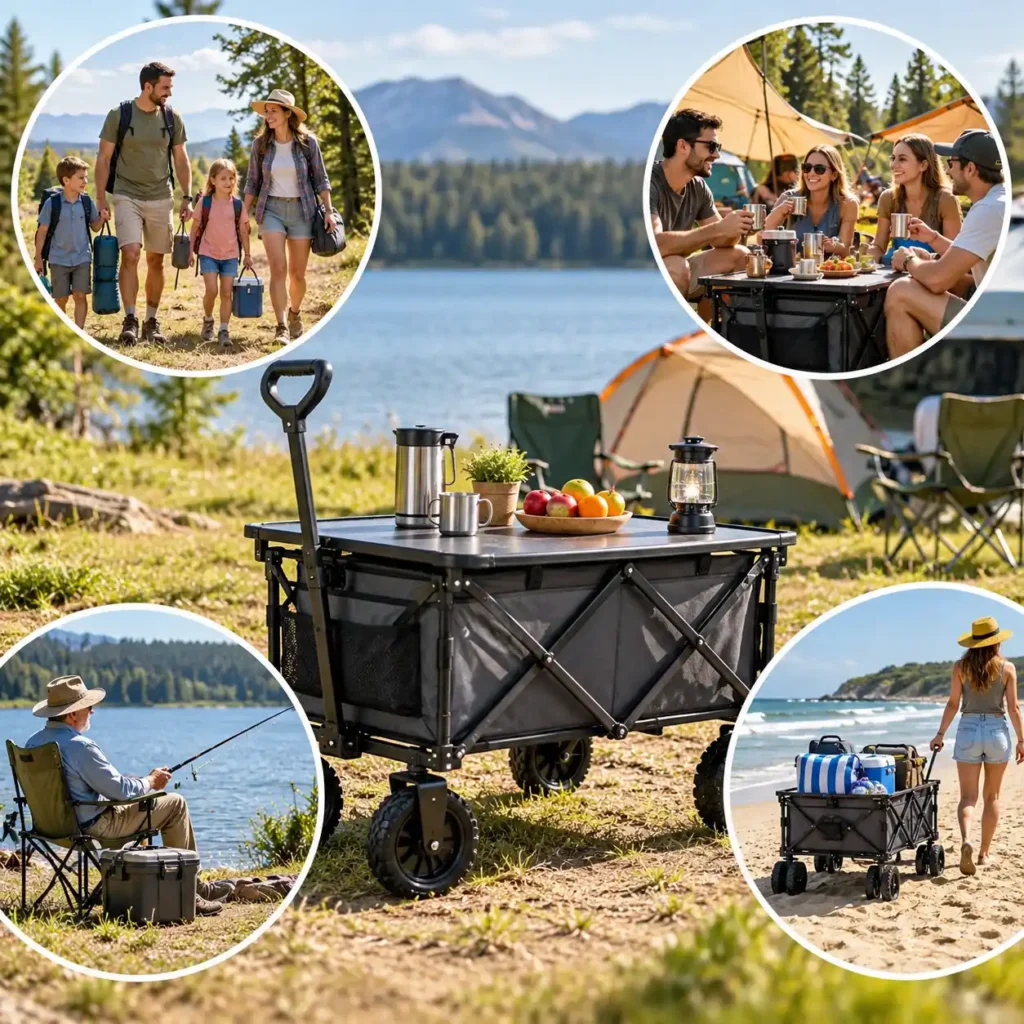
A camping wagon with a tabletop can be more useful than a standard gear cart because it serves two purposes: transporting equipment and providing an accessible surface once you reach your campsite. Instead of unloading everything onto the ground and immediately setting up another piece of furniture, you can keep selected supplies close at hand and use the tabletop for everyday campsite tasks.
However, this combination is not equally valuable for every camper. The main benefit depends on how much equipment you carry, how you organize your campsite, how often you need a temporary work surface, and whether the wagon remains practical to transport when folded. The following camping styles are particularly well suited to this type of equipment.
Car Campers Who Want to Reduce the Number of Separate Items
Car camping is one of the most practical settings for a wagon with a tabletop. When you arrive at a campground, you may need to move coolers, food containers, chairs, cooking accessories, lighting, and other supplies from your vehicle to the place where you intend to camp. A wagon helps consolidate those trips, while the tabletop provides an additional surface after the equipment has been unloaded or arranged.
This can be particularly useful at campsites where the parking area is separated from the tent or cooking area. Rather than carrying several small items individually, you can organize them in the wagon and keep frequently used essentials together.
The tabletop does not replace a full-size dining table, but it may be sufficient for setting down drinks, organizing small accessories, or keeping items off damp or dusty ground. Campers who are still planning their overall equipment layout may also benefit from our guide to building a practical vehicle camping setup.
Families and Groups Sharing a Campsite
Families often have more small items to manage than they initially expect: water bottles, snacks, sunscreen, games, napkins, reusable utensils, and personal accessories can quickly spread across a campsite. A wagon with a tabletop offers a convenient place to keep some of these items together while making them easier to reach throughout the day.
For example, the surface could serve as a temporary snack station between meals or a place to organize drinks while everyone is relaxing outdoors. The storage compartment can carry additional supplies, although the usable cargo space may be reduced when the wagon has a second tier, a canopy, or other attachments.
Before choosing a model for family use, distinguish between the wagon’s total load capacity and the tabletop’s own weight limit. They are not necessarily the same. Also consider the stability of the surface when the wagon is stationary, whether the wheels have brakes, and whether the manufacturer permits the intended use. A tabletop wagon is designed to transport equipment, not people, and should never be treated as a seat unless the manufacturer explicitly provides for that purpose.
Campers Who Want a More Organized Outdoor Kitchen
For campers who prepare meals at the campsite, a tabletop can provide a convenient place for lightweight kitchen essentials, such as condiments, utensils, paper towels, or sealed food containers. It can also help keep frequently used accessories separate from bulkier equipment stored inside the wagon.
This is most useful when the campsite has limited counter space or when supplies need to move between the vehicle, food-storage area, and cooking area. A wagon may complement a dedicated kitchen table, but it does not automatically provide the same working area, height, or stability.
Pay particular attention to the tabletop material and the manufacturer’s care instructions. Do not assume that a surface is heat-resistant, food-safe, waterproof, or suitable for direct food preparation simply because it is marketed as a table. Keep hot cookware and open flames away unless the manufacturer specifically approves that use. A stove should only be placed on the surface if the product instructions confirm that the setup is safe and suitable.
If your priority is organizing cooking equipment rather than transporting it, our guide to camping kitchen organizers and chuck boxes can help you consider other ways to keep utensils and meal-preparation supplies in order.
Beach Campers and People Who Make Frequent Day Trips
A wagon with a tabletop can also be useful for beach outings, picnics, tailgating, and other outdoor activities where you carry several items and want a convenient surface at your destination. The cargo area can hold towels, chairs, bags, and refreshments, while the tabletop can keep smaller belongings within reach.
Terrain, however, becomes especially important in these situations. A wagon that rolls comfortably on pavement or compact campground paths may be difficult to pull through loose sand. Larger wheels and a wider tread can help with some surfaces, but wheel design alone does not guarantee good performance on soft sand or uneven ground.
Check the exact wheel dimensions, the manufacturer’s stated terrain suitability, and the wagon’s overall weight before buying. If shade is also important for your outing, remember that a canopy-equipped wagon and a dedicated shade shelter serve different purposes. Our guide to portable shade canopies for camping covers the separate shelter option.
Campers Who Want to Keep Essential Items Close at Hand
Some campers value a tabletop less as a work surface and more as a way to keep frequently used items accessible. A wagon parked near the seating area can provide a convenient place for a lantern, water bottles, maps, small accessories, or other lightweight supplies, while larger items remain in the main storage compartment.
This arrangement may be helpful when setting up a campsite for several hours or moving between different activity areas. It can also reduce the need to repeatedly open storage bags to retrieve small items.
Still, a tabletop does not necessarily create more storage capacity. Depending on the design, it may occupy space above the cargo compartment, fold away when not needed, or need to be removed before the wagon can be collapsed. Look at how the table attaches and whether it interferes with access to the items underneath. The best design is the one that makes your actual routine easier, not simply the one with the greatest number of features.
Campers With Limited Vehicle or Home Storage Space
A folding wagon with an integrated or removable tabletop may appeal to people who need to make efficient use of their vehicle’s cargo area, garage, or storage closet. Combining two functions can reduce the need to transport or store a separate small table, provided the wagon folds compactly and the tabletop can be stored conveniently.
The important detail is the complete folded footprint. A wagon may have a compact frame but still take up considerable room when its wheels, canopy, tabletop, and other accessories are included. Check the folded dimensions and whether the table must be detached before storage. If the tabletop is removable, establish where it will be carried and whether it can be secured during transport.
For campers who regularly rearrange their vehicle to accommodate different trips, planning the whole load matters more than evaluating the wagon in isolation. Our guide to packing a car for camping efficiently offers additional ideas for arranging equipment without wasting valuable cargo space.
Who May Be Better Off With a Standard Wagon or a Separate Camping Table?
A tabletop wagon is not automatically the right choice for every outdoor setup. Backpackers and campers who prioritize minimal weight may find the additional structure unnecessary. People who mainly transport heavy equipment over rough terrain may prefer to focus on the wagon’s frame, wheels, steering, and load rating rather than pay extra for a tabletop they rarely use.
A separate camping table may also be more practical when you need a larger, dedicated surface for preparing meals or dining with several people. At established campgrounds with picnic tables, the wagon’s tabletop may provide little additional value. And if storage capacity is your main concern, a design with a large unobstructed cargo area may suit you better than a multi-level model with extra attachments.
Before buying, consider how frequently you will use the table, what you expect to place on it, and whether the wagon will fit your vehicle and storage space. Compare the tabletop’s own load limit with the wagon’s cargo capacity, and confirm which accessories are included in the exact product listing.
The best camping wagons with table tops are most valuable to campers who will regularly use both functions. If the tabletop solves a genuine problem at your campsite and the wagon still meets your transport needs, the combination can make everyday outdoor tasks more convenient. If you rarely need the extra surface, a simpler wagon or a separate portable table may be the more practical investment.
Quick Summary: Our Top Picks
Choosing the right camping wagon with a tabletop depends on how you plan to use it, how much gear you need to transport, and what kind of surface you need once you reach your campsite. These five models offer different approaches, from a multi-function wagon with a fold-out steel tabletop and canopy to a removable-table design and a longer cart configuration. Check the exact product listing before purchasing, particularly for tabletop inclusion, load limits, and package contents.
1. CLICKBIN Double Tabletop Foldable All-Terrain Wagon — Best for Multi-Function Campsite Setup
The CLICKBIN wagon is advertised as a multi-function design combining two-tier storage, a fold-out steel tabletop, and a canopy. Its product description lists a 500-pound overall load capacity and 400-liter storage capacity, along with wheels equipped with brakes. These are seller-provided specifications rather than independently tested results, so confirm the current listing and distinguish the wagon’s cargo limit from the tabletop’s own load rating. Its combination of storage and a separate surface may appeal to campers who want to keep equipment organized while making drinks, snacks, or small accessories easier to reach.
Best for: Campers looking for a multi-function wagon with a fold-out tabletop, additional storage, and a canopy.
2. Whitsunday Folding Wagon with Tabletop — Best for a Removable Table and Everyday Versatility
The Whitsunday folding wagon is listed with a removable tabletop, side pockets, and a collapsible frame. Available product information for ASIN B0B7KY969Z lists a maximum wagon load capacity of 400 lb. This is a stated product specification, not an independently tested result, and it does not establish the tabletop’s separate weight limit. Before ordering, confirm that the selected Amazon variant includes the tabletop and matches this ASIN.
Best for: Campers who want a removable tabletop and additional pockets for organizing smaller outdoor essentials.
3. iChuvo Double Decker Folding Wagon (LWY20240731) — Best for High-Capacity Gear Transport
The iChuvo LWY20240731 is a two-tier folding wagon designed for transporting camping equipment, beach gear, groceries, and other outdoor supplies. Its product description advertises 400 liters of storage space, an extended lower compartment, a reinforced steel frame, and tear-resistant fabric. The listed features also include all-terrain wheels with brakes, an adjustable handle, two storage levels, mesh pockets, and built-in cup holders. However, the listing gives conflicting maximum load figures of 600 and 550 pounds, so confirm the applicable rating with the seller before purchasing. Also verify whether the selected package includes the tabletop required for this guide, as the supplied specifications do not explicitly confirm it.
Best for: Campers who need a two-tier wagon with substantial storage space and practical features for transporting outdoor gear.
4. SHINLEYPACK Collapsible Wagon with Table — Best for a Straightforward Folding Wagon with Table
The SHINLEYPACK collapsible wagon is marketed as a folding outdoor cart with a table, an adjustable handle, and a compact storage design. Its listed specifications identify a 220-pound maximum load capacity, although buyers should verify that figure and the tabletop’s separate limit on the current product page. This style may suit campers who want to combine gear transport with a convenient surface without necessarily needing a multi-tier configuration or a large canopy. Check the folded dimensions and tabletop attachment before deciding whether it fits your vehicle and storage space.
Best for: Campers looking for a folding wagon with a tabletop and a relatively straightforward feature set.
5. Collapsible Foldable Tabletop Capacity Shopping Wagon — Best for Buyers Considering a Basic Tabletop Wagon
This listing is identified by a generic product title, and the available information does not establish enough reliable specifications to make a detailed performance comparison. Before treating it as a practical alternative, verify the brand, exact tabletop design, overall load capacity, tabletop weight limit, wheel construction, and folded dimensions. Also confirm whether the tabletop is included in the selected package rather than offered as an optional accessory. Until those details are confirmed, it is best considered a candidate for comparison rather than a proven value or performance winner.
Best for: Buyers willing to verify the listing carefully before choosing a more basic tabletop wagon.
Before buying, compare the tabletop’s usable area and load limit, the wagon’s overall cargo capacity, wheel design, folded dimensions, and included accessories. A high advertised cargo rating does not establish how much weight the tabletop can safely support. Choose the design that fits your actual camping routine rather than paying for features you are unlikely to use.
Camping Wagons with Table Tops: Side-by-Side Comparison
| Camping Wagon | Best For | Tabletop and Storage | Portability & Design | Load Capacity | Main Trade-Off |
|---|---|---|---|---|---|
| CLICKBIN Double Tabletop Foldable All-Terrain Wagon | Campers who want multiple functions in one unit | Advertised fold-out steel tabletop, two-tier storage, 400L capacity, and canopy. | Folding design, 7 × 4-inch wheels with brakes, and advertised quick setup. | 500 lb advertised overall capacity. Verify the tabletop's separate weight limit. | Multiple features may increase the space needed for transport and storage. Specifications are seller claims. |
| Whitsunday Folding Wagon with Tabletop | Campers who want a removable tabletop | Listed with a tabletop and storage pockets. Confirm the included accessories and exact configuration. | Folding wagon design intended for outdoor trips and everyday hauling. | Confirm the exact capacity on the current product listing. | Available capacity information is inconsistent. Verify the selected listing before purchasing. |
| iChuvo Double Decker Folding Wagon (LWY20240731) | Campers who need high-capacity gear transport | Advertised 400L storage, two levels, an extended lower compartment, mesh pockets, and cup holders. Tabletop inclusion is unconfirmed. | Steel frame, adjustable handle, folding design, and all-terrain wheels with brakes. | Conflicting figures: 550 lb in the specifications table and 600 lb in the product description. | Confirm the applicable load rating and whether a tabletop is included before treating it as a tabletop wagon. |
| SHINLEYPACK Collapsible Wagon with Table | Campers looking for a straightforward folding design | Marketed with a table. Confirm whether it is removable and included in the selected package. | Collapsible outdoor wagon design. Verify folded dimensions and tabletop attachment details. | 220 lb reported in available product information; verify against the current listing. | Confirm the tabletop's separate weight limit and the exact package contents. |
| Collapsible Foldable Tabletop Capacity Shopping Wagon | Buyers looking for a folding wagon with a tabletop | The product title identifies a tabletop wagon. Exact tabletop design, storage configuration, and included accessories require confirmation. | Verify the folding mechanism, wheel construction, and folded dimensions on the exact product listing. | Not verified for the exact product listing. | Confirm the exact product details and package contents before purchasing. |
Comparison note: Product specifications are based on available listing information and have not been independently tested. Advertised cargo capacity does not establish the tabletop's own weight limit. Confirm the exact model, included tabletop, package contents, and current specifications before purchasing.
The 5 Best Camping Wagons with Table Tops in 2026
The best camping wagons with table tops combine practical gear transport with a convenient surface for everyday campsite tasks. Our five picks differ in storage design, tabletop configuration, portability, and additional features, helping you choose a wagon that fits the way you camp.
1. CLICKBIN Double Tabletop Foldable All-Terrain Wagon
Award: Best for a Multi-Function Campsite Setup

The CLICKBIN Double Tabletop Foldable All-Terrain Wagon is designed for campers who want more than a basic cart for moving equipment. Its advertised combination of two-tier storage, a fold-out steel tabletop, and a canopy brings several useful functions into one unit. Instead of treating gear transport and campsite organization as separate tasks, this design aims to connect them in a single setup.
Overview
A typical camping wagon is useful while moving coolers, chairs, food containers, and other supplies from the vehicle to the campsite. Once those items have been unloaded, however, the wagon often becomes little more than an empty cart. The CLICKBIN takes a different approach by combining a two-level cargo layout with a fold-out tabletop, giving the frame another purpose after arrival.
According to the product description, the wagon offers 400 liters of storage space and a maximum overall load capacity of 500 pounds. The seller also advertises an 80-square-foot UPF 50+ canopy, 7 × 4-inch wheels with brakes, and a fold-out steel tabletop. These are listing claims rather than independently verified measurements or performance results, so the current product page should be checked before purchase.
The two-tier layout is particularly relevant to campers carrying a mixture of bulky equipment and smaller supplies. Larger items can occupy the main cargo area while selected essentials are arranged on the upper level, depending on the actual configuration and available space. The tabletop adds another potential use for the wagon, such as holding drinks, snacks, or lightweight campsite accessories.
The main consideration is whether you will regularly use all these features. A multi-function wagon may be attractive for a family campsite or a longer car-camping trip, but its extra components are less valuable if you mainly need a simple cart for short trips between your vehicle and a picnic area.
Key Features
Two-Tier Storage for Different Types of Camping Gear
The advertised 400-liter capacity and double-decker design are central to the CLICKBIN’s appeal. Rather than placing every item in one undivided cargo area, the two-level arrangement is intended to separate supplies and make selected items easier to organize.
This can be useful when transporting a mixture of camping equipment, food supplies, folding chairs, and smaller accessories. The practical benefit depends on the dimensions of each compartment and how the upper level is configured. The advertised total capacity should not be interpreted as a guarantee that every combination of bulky gear will fit conveniently.
Fold-Out Steel Tabletop
The fold-out steel tabletop is the feature that makes this model especially relevant to a guide focused on camping wagons with table tops. It provides an additional surface without requiring campers to carry a completely separate small table for every task.
At a campsite, the surface may be useful for drinks, packaged snacks, or lightweight accessories that you want to keep within reach. Its suitability for heavier items, food preparation, or hot cookware depends on the manufacturer’s instructions and the tabletop’s specific weight limit. The overall wagon capacity does not establish how much weight the tabletop itself can support.
Before purchasing, check how the table folds, how securely it attaches, and whether it must be removed before the wagon can be collapsed for storage.
Canopy for a More Versatile Campsite Setup
The product listing advertises an 80-square-foot canopy with UPF 50+ protection. If the supplied canopy matches these specifications, it may add shade to the wagon’s setup during outdoor activities.
However, a canopy is not a substitute for a properly selected camping shelter. Its actual coverage, attachment system, wind limitations, and operating instructions should be confirmed from the manufacturer’s documentation. Campers should also follow the instructions for removing or securing the canopy in windy conditions.
Large Wheels and Brakes
The listing specifies 7 × 4-inch wheels and describes the wagon as an all-terrain model. Larger wheels can be useful when moving equipment across surfaces such as grass, compact gravel, and uneven campground paths, although wheel dimensions alone do not establish performance on every terrain type.
The advertised brakes are another practical detail because a loaded wagon can move unintentionally on a slope. Check how the brakes engage and whether the manufacturer specifies any limitations on gradients or surfaces. The brakes should not be treated as a substitute for keeping the wagon properly controlled.
Folding Design and Setup
The CLICKBIN is marketed as a foldable wagon with an advertised setup time of approximately six minutes. A folding design can make storage and transport easier, but the complete unit matters more than the frame alone.
Before buying, check the folded dimensions and determine whether the tabletop, canopy, and other components need to be removed separately. This is especially important if the wagon must fit into a car trunk alongside chairs, coolers, and the rest of your camping equipment.
High Advertised Load Capacity
The product description lists a maximum load capacity of 500 pounds. That figure may make the wagon worth considering for campers carrying substantial amounts of equipment, but it must be treated as a seller-provided rating rather than a verified real-world result.
Load distribution, the condition of the wheels, the surface under the wagon, and the manufacturer’s loading instructions all matter. The tabletop may also have its own lower weight limit. Do not assume that the full advertised cargo capacity can be placed on the upper level or tabletop.
Technical Specifications
| Specification | Details |
|---|---|
| Brand | CLICKBIN |
| Product | Double Tabletop Foldable All-Terrain Wagon |
| Model Number | TMLYC-SC-HS |
| Amazon ASIN | B0HDNXK5V5 |
| Wagon Design | Folding, two-tier wagon |
| Advertised Storage Capacity | 400 L |
| Advertised Overall Load Capacity | 500 lb |
| Tabletop | Fold-out steel tabletop, according to the product description |
| Canopy | Advertised 80 sq ft canopy with UPF 50+ protection |
| Wheel Dimensions | 7 × 4 in, according to the listing |
| Brakes | Advertised |
| Setup Time | Approximately 6 minutes, according to the seller |
| Tabletop Weight Limit | Not confirmed in the available information |
| Folded Dimensions | Verify the current product listing |
| Included Components | Confirm the exact package contents before purchase |
Specification note: The figures above are based on the available product description. They have not been independently tested. Confirm the current listing, tabletop load limit, folded dimensions, and included accessories before ordering.
Pros and Cons
Pros
Combines a wagon, two-tier storage, and a fold-out tabletop in one design.
Advertised 400-liter capacity for transporting camping equipment and supplies.
A steel tabletop provides a potentially useful surface for lightweight campsite items.
Includes an advertised canopy for additional shade.
Listed with 7 × 4-inch wheels and brakes.
Folding construction is intended to simplify storage and transport.
Cons
The multiple components may make the complete setup bulkier than a basic folding wagon.
The tabletop’s independent weight limit is not confirmed in the available information.
The advertised cargo capacity and canopy specifications have not been independently verified.
The complete folded dimensions and storage requirements need checking.
A feature-rich design may be unnecessary for campers who only need to transport gear over short distances.
Who Should Consider This Wagon?
The CLICKBIN is worth considering for car campers who want to combine gear transport with a more organized campsite setup. Its advertised two-tier storage may appeal to families carrying different types of equipment, while the fold-out tabletop offers a potential place for drinks, snacks, and small accessories once the wagon is in position.
It may also suit campers who value having several functions in one product rather than carrying a separate wagon and small utility table. The canopy could be an additional benefit for outdoor gatherings, provided its coverage and use limitations match the intended setting.
This model may be less appealing to minimalist campers who prioritize low weight, compact storage, or a simple design. If you rarely need a tabletop or canopy, the additional components may add complexity without providing much practical value. Likewise, anyone planning to place heavy cookware or equipment on the table should first confirm the tabletop’s own load rating and permitted uses.
What to Verify Before Buying
Confirm that the product is the CLICKBIN Double Tabletop Foldable All-Terrain Wagon, ASIN B0HDNXK5V5.
Verify the advertised 400-liter storage capacity and 500-pound overall load rating on the current listing.
Check the tabletop’s separate weight limit and the manufacturer’s permitted uses for the surface.
Confirm that the steel tabletop and canopy are included in the selected package.
Check the canopy’s advertised dimensions, UPF rating, and wind-related restrictions.
Verify the wheel dimensions and understand the limitations of the braking system.
Check the complete folded dimensions, including any components that must be detached.
Review the manufacturer’s setup, loading, folding, and maintenance instructions.
Our Assessment
The CLICKBIN stands out because it attempts to make a camping wagon useful both during transport and after arrival. Its combination of two-tier storage, a fold-out steel tabletop, and a canopy gives it a distinct role in this comparison: it is aimed at campers who want a multi-function campsite setup rather than a basic hauling cart.
Its suitability ultimately depends on whether those features work together for your needs. The advertised capacity, tabletop limit, canopy specifications, and folded dimensions should be confirmed before purchase. Based on the available listing information, it is a promising option for campers who value versatility, but this is a specification-based assessment rather than a claim of hands-on testing.
Related Guide: If you are planning how to transport and arrange the rest of your equipment, see our guide to building a vehicle camping setup step by step for practical ideas on organizing a complete car-camping setup.
2. Whitsunday Folding Wagon with Tabletop
Award: Best for a Removable Tabletop and Everyday Versatility

The Whitsunday Folding Wagon with Tabletop takes a practical approach to outdoor convenience: transport your supplies in a collapsible cart, then use the detachable table surface when you reach your destination. Rather than focusing on a canopy or a multi-level storage system, this model emphasizes portability, accessible storage, and a tabletop that can serve purposes beyond hauling gear. That combination makes it worth considering for campers who also use their wagon for picnics, beach trips, gardening, or shopping.
Overview
Some camping accessories are useful only during setup, while others can continue serving a purpose throughout the day. The Whitsunday is designed to bridge that gap. Its cargo compartment carries outdoor supplies, while the included tabletop can provide a separate surface for drinks, snacks, small accessories, or other lightweight items when the wagon is stationary.
The product listing identifies a removable tabletop, a folding frame, a side pocket, and a spring-loaded pull handle. It also describes a double-layer 600D Oxford fabric body and wheels with brakes. These details suggest a design intended for repeated use across different outdoor settings rather than a wagon dedicated exclusively to camping.
One practical distinction is the detachable table. A removable surface can be convenient when you need access to the cargo compartment, want to store the wagon without its tabletop, or prefer to use the cart without the extra component. Its usefulness depends on how easily the table attaches and detaches, how it must be stored, and whether the surface is large enough for your intended tasks.
The available product information lists a maximum load capacity of 400 pounds for ASIN B0B7KY969Z. However, product information for other Whitsunday variants can differ, so buyers should confirm that the selected Amazon listing corresponds to the exact model and configuration. The wagon’s overall load rating also does not establish the tabletop’s separate weight limit.
Key Features
Removable Tabletop for Flexible Use
The defining feature of the Whitsunday is its removable tabletop, which turns the wagon into more than a transport cart. At a campsite, the surface may be useful for keeping drinks, packaged snacks, maps, or small accessories within reach. At a picnic or outdoor gathering, it can provide a convenient place to set down lightweight items without immediately assembling a separate small table.
The removable design also gives you the option of leaving the tabletop behind when you do not need it. That flexibility can be helpful when the wagon is being used primarily to carry supplies or when storage space is limited.
Before purchasing, verify the tabletop material, dimensions, attachment method, and separate weight limit. The available product information associates this model with a table surface, but the exact specifications should be checked against the selected package. Do not assume the tabletop is suitable for hot cookware or direct food preparation unless the manufacturer explicitly confirms those uses.
Folding Construction for Transport and Storage
A folding wagon can be useful when you need to move equipment between your vehicle and a campsite but do not want a rigid cart occupying storage space between trips. The Whitsunday is marketed as a collapsible design intended for outdoor activities and everyday hauling.
The tabletop is an important part of the storage equation. A wagon may fold compactly while the detached table still requires a separate place in the vehicle or garage. Check the folded dimensions of the complete unit and determine whether the tabletop can be stored alongside the wagon without taking up excessive space.
This matters particularly for car campers who already need to fit chairs, coolers, tents, and other equipment into a limited cargo area. A convenient folding mechanism is useful only if the wagon and its accessories fit your actual storage arrangement.
Side Pocket for Frequently Used Items
The product description lists a side pocket for additional storage. This feature can help separate smaller essentials from the main cargo compartment, making items such as sunscreen, napkins, snacks, or compact accessories easier to reach.
For a campsite, that separation can reduce the need to search through larger bags whenever you need something small. The pocket is best treated as supplementary storage rather than a replacement for the main compartment, particularly when carrying items that need protection from rain, sand, or dust.
Check the pocket’s actual size and placement on the selected model. The available listing information does not establish its precise dimensions or weather resistance.
Pneumatic Wheels and Brakes
Available product specifications identify pneumatic wheels and describe a braking system. Air-filled tires can help absorb some surface irregularities, potentially making a loaded wagon more comfortable to pull over suitable outdoor paths. The actual result depends on tire dimensions, pressure, load distribution, and terrain.
The listing also describes rotating front wheels and brakes, which can help with steering and keeping the wagon stationary when it is parked. These features may be useful at picnic areas and campsites where you need to position the cart near a seating or food-preparation area.
However, pneumatic wheels require appropriate maintenance, and air-filled tires can lose pressure or become punctured. Do not assume that the wagon will perform equally well on pavement, grass, gravel, mud, and loose sand. Check the manufacturer’s guidance for tire care, terrain suitability, and brake operation.
Double-Layer Oxford Fabric and Frame Construction
The Whitsunday listing describes a double-layer 600D Oxford fabric body and a metal frame. This construction is intended to support everyday outdoor hauling while providing a fabric cargo compartment that can be folded with the frame.
Fabric durability still depends on stitching, attachment points, loading, exposure, and care. Avoid dragging sharp-edged equipment against the fabric or exceeding the manufacturer’s load limit. After use in wet or sandy conditions, allow the fabric to dry and remove accumulated dirt before folding the wagon away.
The product information identifies carbon steel as the frame material for the listed configuration. Confirm the exact material specifications on the current listing if they are important to your purchase decision.
Spring-Loaded Handle for Easier Handling
The product description identifies a spring-loaded pull handle designed to remain upright when released. This can make the handle easier to retrieve when you stop to unload equipment or reposition the wagon.
The benefit is practical rather than complicated: you spend less time bending down to pick up a handle that has fallen to the ground. Still, comfort depends on the handle’s height, angle, grip, and the amount of weight being pulled. If you regularly transport heavy equipment, consider the total load and the distance you expect to cover rather than relying on the handle design alone.
Technical Specifications
| Specification | Details |
|---|---|
| Brand | Whitsunday |
| Product | Folding Collapsible Utility Wagon with Tabletop |
| Model Number | WG2-072S+TB, according to available product information |
| Amazon ASIN | B0B7KY969Z |
| Wagon Type | Folding utility wagon |
| Tabletop | Removable tabletop; verify the exact package |
| Advertised Maximum Load Capacity | 400 lb in available listing information |
| Fabric | Double-layer 600D Oxford fabric, according to the listing |
| Frame Material | Carbon steel, according to available product details |
| Wheels | Pneumatic wheels, according to available specifications |
| Brakes | Listed; verify the configuration on the current product page |
| Handle | Spring-loaded pull handle |
| Additional Storage | Side pocket |
| Product Dimensions | One listing reports 37 × 18.8 × 39.1 in; verify the selected variant |
| Folded Dimensions | Confirm the exact configuration before purchase |
| Tabletop Weight Limit | Not confirmed in the available information |
| Included Components | Verify the tabletop and all accessories on the exact Amazon listing |
Specification note: The specifications above reflect available product information for ASIN B0B7KY969Z. Some Whitsunday listings describe different configurations and capacities. Confirm the model number, load rating, dimensions, tabletop, and included accessories before purchasing.
Pros and Cons
Pros
Removable tabletop offers a separate surface for lightweight campsite essentials.
Folding construction is intended to simplify storage and transport.
Side pocket provides additional space for frequently used small items.
Spring-loaded handle is designed to remain upright when released.
Pneumatic wheels may help absorb some surface irregularities on suitable terrain.
Available listing information identifies a 400-pound maximum load capacity for this configuration.
Cons
The detached tabletop still needs to be stored and transported.
The tabletop’s separate weight limit and exact dimensions are not confirmed in the available information.
Specifications can differ across Whitsunday product variants.
Pneumatic tires require pressure checks and may be vulnerable to punctures.
The wagon’s actual performance on loose sand or rough terrain cannot be established from the product description alone.
The overall load rating does not establish the amount of weight the tabletop can safely support.
Who Should Consider This Wagon?
The Whitsunday is worth considering for campers who want a folding wagon that can transport supplies and provide a removable surface when needed. Its design may suit people who move between the vehicle, picnic area, and campsite and prefer to keep smaller essentials accessible rather than carrying a separate table for every minor task.
It may also appeal to buyers who want one wagon for several activities. The combination of a folding frame, side pocket, pull handle, and removable tabletop is relevant to camping, picnics, outdoor gatherings, gardening, and shopping. If you use a wagon throughout the year rather than only on camping trips, that flexibility may make the tabletop more useful.
This model may be less suitable if your priority is a large, permanent work surface, a built-in canopy, or a multi-tier cargo layout. Campers who regularly carry heavy equipment over challenging terrain should also evaluate the wheel design, maintenance requirements, and manufacturer guidance before choosing it.
Ultimately, the value of the Whitsunday depends on whether you will use the tabletop often enough to justify carrying and storing the additional component. If a removable surface fits your routine better than a fixed or fold-out design, this model deserves consideration.
What to Verify Before Buying
Confirm that the listing is for Whitsunday ASIN B0B7KY969Z and model WG2-072S+TB.
Verify that the selected package includes the tabletop.
Confirm the wagon’s maximum load capacity and distinguish it from the tabletop’s own weight limit.
Check the tabletop’s dimensions, material, attachment method, and permitted uses.
Verify the unfolded and folded dimensions of the exact variant.
Confirm the wheel type, brake arrangement, and any terrain limitations.
Check the fabric and frame specifications against the current listing.
Determine whether the tabletop must be removed before folding and where it will be stored.
Review the current package contents, price, availability, and return conditions before ordering.
Our Assessment
The Whitsunday offers a different proposition from the CLICKBIN. Rather than emphasizing a canopy and two-tier storage, it focuses on a removable tabletop, folding construction, and practical details such as a side pocket and spring-loaded handle. That makes its strongest appeal flexibility: the wagon can transport supplies, while the tabletop can provide an additional surface when the situation calls for one.
The main buying considerations are the exact variant, the tabletop’s specifications, and the space needed to store the detached component. The listed 400-pound capacity should also be verified against the current Amazon page before purchase. Based on the available product information, the Whitsunday is a relevant option for campers who value a removable table and everyday versatility. This assessment is based on published specifications, not hands-on testing.
3. iChuvo Double Decker Wagon with Table (LWY20240731)
Award: Best for Bulky Camping Gear and Extended Storage

Not every campsite load fits neatly into a conventional folding wagon. Long folding chairs, bulky shelters, coolers, and bags of equipment can quickly fill a standard cargo compartment, leaving little room for anything else. The iChuvo Double Decker Wagon takes a different approach, combining an extended lower compartment with a second storage level and a tabletop-oriented design. Its main appeal is the ability to organize a substantial load rather than simply carry a few essentials from the car to the campsite.
Overview
The defining feature of the iChuvo is its elongated, two-level layout. The product description advertises 400 liters of storage and an extended lower compartment that is intended to accommodate larger outdoor equipment. This arrangement may be useful when a camping trip involves several types of gear that are awkward to stack together in one conventional wagon.
For example, a family might need to transport folding chairs and a cooler alongside bags of cooking supplies, lighting, and smaller accessories. The lower compartment can provide room for bulkier items, while the upper level offers another area for organizing selected supplies. The actual benefit depends on the dimensions of each section and the way the load is distributed, so the advertised total volume should not be interpreted as a guarantee that every piece of equipment will fit.
The product is listed under model number LWY20240731, with a steel frame, pneumatic wheels, four-wheel construction, and an adjustable handle. The listing also identifies a built-in shelf, cup holders, and a collapsible design. Its product title refers to a wagon with a table, although buyers should verify the exact tabletop configuration and included components in the current Amazon listing before ordering.
The iChuvo is therefore best considered as a gear-hauling system with additional organization features. Its usefulness depends less on having the greatest number of accessories and more on whether the extended cargo layout suits the equipment you regularly take outdoors.
Key Features
Extended Lower Compartment for Bulky Equipment
The extended lower compartment is the most distinctive practical feature of this wagon. Instead of relying entirely on a compact, box-shaped cargo area, the design provides additional length for equipment that can be difficult to arrange in a smaller cart.
This may be particularly helpful for family camping trips involving folding chairs, tent accessories, shelter components, and other bulky items. A longer compartment can make it easier to arrange some equipment without forcing every item into a single compact pile.
However, extra length does not automatically mean that the wagon is easier to load in every situation. The dimensions of individual items, the available width, and the placement of the upper level all influence how much usable space you have. Check the internal dimensions against your actual equipment, especially if you regularly carry long chairs, tables, or other oversized items.
Two-Level Storage for Better Organization
The iChuvo’s double-decker configuration provides a second level for organizing supplies. This can help separate smaller items from heavier or bulkier equipment stored below, making the contents easier to arrange for a trip.
For instance, a camper might keep larger bags and folding equipment in the lower compartment while reserving the upper level for items needed more frequently. The exact arrangement will depend on the wagon’s layout and the manufacturer’s loading instructions.
The important distinction is between total capacity and usable organization. A large volume rating tells you how much space the manufacturer claims is available, but it does not tell you how conveniently the space accommodates your particular load. Before buying, inspect the two levels and determine whether the upper section leaves enough room for the equipment you want to transport.
Tabletop Function for Campsite Convenience
The product is marketed as a wagon with a table, making the tabletop feature relevant to this comparison. A suitable surface can be useful for setting down drinks, snacks, small accessories, or other lightweight items when the wagon is stationary.
For a campsite, this can provide a convenient place to keep selected supplies within reach without immediately setting up another small table. However, the available specifications do not establish the tabletop’s exact dimensions, material, attachment method, or independent weight limit. Those details should be confirmed on the current product page before treating the table as a substitute for a dedicated camping work surface.
Do not assume that the tabletop can support the wagon’s full advertised cargo capacity. The cargo compartment and the table are separate load-bearing areas, and the permitted weight and uses may differ. Hot cookware, cooking appliances, and direct food preparation should only be considered if the manufacturer explicitly approves them.
Pneumatic Wheels for Outdoor Mobility
The listing identifies pneumatic tires and describes the wagon as suitable for outdoor terrain. Air-filled tires can help absorb some surface irregularities, which may be useful when moving equipment across suitable campground paths, grass, or gravel.
Actual performance still depends on tire dimensions, inflation pressure, load distribution, and the surface being crossed. Loose sand, deep mud, steep slopes, and uneven ground can present challenges even for a wagon marketed as all-terrain.
Pneumatic wheels also require maintenance. Check tire pressure before a trip, inspect the tires for damage, and follow the manufacturer’s care instructions. The listing identifies four wheels and brakes, but the wagon should not be assumed to remain stationary on every slope simply because brakes are provided.
Adjustable Handle and Folding Construction
The product description specifies an adjustable handle with a 90-degree angle adjustment and a height range of approximately 37 to 40.16 inches. This adjustability may help accommodate different pulling positions, although comfort depends on the user’s height, the load, and the terrain.
The collapsible frame is intended to make the wagon easier to store between outings. For car campers, however, the complete folded package matters more than the frame alone. Check whether the upper level, tabletop, or other components must be removed before folding, and establish how much room the wagon occupies in your vehicle.
The published dimensions of approximately 51.97 × 21.25 × 42.12 inches appear to describe the product’s overall dimensions rather than its folded footprint. Do not use them as folded-storage measurements without confirmation from the manufacturer.
High Advertised Capacity: An Important Specification to Check
The iChuvo listing contains conflicting load-capacity figures. Its promotional description states that the wagon supports up to 600 pounds, while the specifications table lists a maximum capacity of 550 pounds.
Because these figures do not agree, it would be misleading to present either number as an unambiguous confirmed limit. Buyers should verify the applicable rating with the seller or manufacturer before loading the wagon. They should also distinguish the wagon’s overall cargo capacity from any separate weight limit for the tabletop or upper level.
Whatever rating is confirmed, it does not override the limits of individual components or guarantee safe handling on every surface. Loading instructions and proper weight distribution remain important.
Technical Specifications
| Specification | Details |
|---|---|
| Brand | iChuvo |
| Product | Double Decker Wagon with Table |
| Model Number | LWY20240731 |
| Amazon ASIN | B0DBPMH471 |
| Wagon Design | Folding, two-level wagon with extended lower compartment |
| Advertised Storage Capacity | 400 L |
| Advertised Overall Load Capacity | Conflicting figures: 550 lb in the specification table and 600 lb in the promotional description |
| Tabletop | Product title identifies a table; exact configuration and load limit require confirmation |
| Frame Material | Alloy steel, according to the listing |
| Tire Type | Pneumatic |
| Number of Wheels | 4 |
| Brakes | Listed in the product description |
| Handle | Adjustable; advertised height range of 37–40.16 in |
| Additional Features | Built-in shelf, cup holders, and collapsible construction |
| Product Dimensions | Approximately 51.97 × 21.25 × 42.12 in; confirm the measurement configuration |
| Folded Dimensions | Not confirmed in the available information |
| Item Weight | Not confirmed in the supplied specifications |
| Included Components | Confirm the exact package contents on Amazon |
Specification note: These details are based on available product-listing information, not independent testing. The conflicting capacity figures must be resolved before relying on a maximum load rating. Confirm the tabletop configuration, dimensions, included accessories, and current specifications for ASIN B0DBPMH471.
Pros and Cons
Pros
Extended lower compartment is intended to accommodate bulky outdoor equipment.
Two-level layout provides another area for organizing supplies.
Advertised 400-liter storage capacity may suit larger camping loads.
Table-oriented design adds a potential surface for lightweight campsite essentials.
Adjustable handle allows different pulling positions.
Pneumatic wheels may help absorb some surface irregularities on suitable terrain.
Folding construction is designed to simplify storage between trips.
Cons
The listed maximum load capacity is inconsistent: 550 lb in the specification table versus 600 lb in the promotional text.
The tabletop’s exact dimensions, material, and separate weight limit are not confirmed.
The extended design may require more storage space than a shorter wagon.
Pneumatic tires need appropriate inflation and inspection.
The published overall dimensions do not establish the folded footprint.
A large advertised storage volume does not guarantee that every type of camping equipment will fit conveniently.
Who Should Consider This Wagon?
The iChuvo is worth considering for campers who regularly transport a substantial amount of equipment and find that ordinary folding wagons leave them short on usable space. Its extended lower compartment may be particularly relevant to family trips involving folding chairs, coolers, shelter components, and several bags of supplies.
The two-level layout may also appeal to people who prefer to separate frequently used accessories from bulkier gear. Rather than treating the wagon purely as a carrier, they can organize the load around the order in which equipment will be needed at the campsite. The table feature may add further convenience if its dimensions and permitted uses match the intended tasks.
This model may be less suitable for minimalist campers who carry only a few essentials or have very limited vehicle storage. A longer, multi-level wagon can be unnecessary when a compact cart would do the job. It is also important to resolve the conflicting load-capacity figures before choosing this wagon for heavy equipment.
For buyers whose priority is a dedicated, stable cooking or dining surface, a separate camping table may still be more appropriate. The iChuvo’s main attraction is its combination of cargo space and added functionality, not a confirmed replacement for a full-size outdoor work surface.
What to Verify Before Buying
Confirm that the listing is for iChuvo model LWY20240731, ASIN B0DBPMH471.
Ask the seller or manufacturer to clarify whether the maximum load rating is 550 or 600 pounds.
Confirm that the selected package includes the tabletop and identify its exact configuration.
Check the tabletop’s separate weight limit, dimensions, and permitted uses.
Verify the usable dimensions of both storage levels and the extended lower compartment.
Confirm the overall dimensions and the actual folded footprint.
Check the handle adjustment range and the manufacturer’s loading instructions.
Verify the pneumatic tire specifications, brake operation, and maintenance requirements.
Confirm which accessories are included in the exact package.
Review the current Amazon listing and warranty information before purchase.
Our Assessment
The iChuvo has a distinct place in this comparison because its extended lower compartment and two-level layout address a different problem from a conventional compact wagon: transporting and organizing a larger, more varied camping load. The advertised 400-liter capacity and additional storage level are its main selling points, while the table feature offers a potential extra benefit at the campsite.
Its biggest unresolved issue is the inconsistent maximum load rating. The tabletop’s exact specifications and the folded dimensions also need confirmation before the product can be evaluated confidently for a particular setup. Based on the available listing information, the iChuvo is a candidate for campers who prioritize extended cargo space and organized storage, but this is a specification-based assessment rather than a claim of hands-on testing.
4. SHINLEYPACK Collapsible Wagon with Table
Award: Best for Compact Storage and Removable Tabletop Convenience

A wagon does not need a complicated multi-level frame to be useful at a campsite. The SHINLEYPACK Collapsible Wagon with Table takes a more straightforward approach: carry your equipment in a folding cart, attach the tabletop when you need an extra surface, and remove it when you want to return to a simpler hauling setup. Its appeal lies in that flexibility, especially for campers who use the same wagon for several outdoor activities throughout the year.
Overview
The SHINLEYPACK is designed around a familiar camping problem: moving several bags, chairs, drinks, and accessories is easier with a wagon, but a separate table can take up additional room in the vehicle. This model combines the two functions by adding a removable tabletop to a collapsible cart.
The tabletop is intended to hold items such as mugs, food, and beverages during outdoor activities. Once the surface is no longer needed, the product instructions describe removing it, retracting its four horizontal support poles, folding the table, and storing it inside the wagon. That arrangement offers a different kind of convenience from a permanently attached tabletop: you can choose whether to carry the additional component for a particular outing.
The listed wagon has a steel frame and a double-layer 600D Oxford fabric body. The manufacturer or seller advertises a maximum load capacity of 220 pounds, making this a more modestly rated option than some heavy-duty wagons. That rating should be checked against the current product listing, and it must not be confused with the tabletop’s separate weight limit.
The SHINLEYPACK is therefore best approached as a general-purpose outdoor wagon with an optional-use table surface. It may be useful for picnics, campground visits, beach outings, and short trips between a vehicle and a seating area. Its real value depends on whether the folding frame and removable table match your storage space and everyday needs.
Key Features
Removable Tabletop That Can Be Stored with the Wagon
The removable tabletop is the defining feature of this model. It provides a place for lightweight items when the wagon is stationary, without requiring the table to remain attached during every stage of transport.
At a campsite, that surface may be useful for drinks, packaged snacks, napkins, or small accessories that you want to keep away from the ground. During a picnic, it can provide a convenient place to set down refreshments while the wagon carries other supplies. The table is not necessarily a replacement for a full-size camping kitchen table, but it may cover smaller everyday tasks.
The ability to remove the tabletop also matters when packing the vehicle. If you only need the wagon for transporting equipment, you can leave the table out of the setup. If you do take it, the described storage method allows the folded tabletop to be placed inside the cart.
Before buying, verify the table’s dimensions, material, attachment method, and independent weight limit. The listing describes it as a surface for food and beverages, but that does not establish that it is suitable for hot cookware, open flames, or direct food preparation.
Folding Frame for Vehicle and Home Storage
The wagon is designed to collapse for storage rather than occupy its full operating footprint between trips. The available product description lists unfolded dimensions of approximately 34.3 inches long, 18.7 inches wide, and 26.8 inches high.
Those measurements provide a useful reference for planning space in a vehicle or campsite, but they do not describe the complete folded package. The tabletop and its support components may affect how the product needs to be stored, so check the manufacturer’s folded dimensions before purchasing.
For car campers, this distinction is important. A wagon can be relatively compact when folded yet still compete for space with a cooler, tent, chairs, and other equipment. Consider where both the wagon and tabletop will fit, rather than assessing the cart alone.
Double-Layer 600D Oxford Fabric
The product listing identifies a double-layer 600D Oxford fabric body. This construction is intended to provide a durable cargo compartment for regular outdoor use while allowing the wagon to collapse when it is not needed.
The fabric compartment is relevant for carrying soft bags, picnic supplies, folded blankets, and similar items. As with any fabric wagon, actual durability depends on stitching, attachment points, loading, and care. Avoid sharp edges that could cut or abrade the material, and do not exceed the stated capacity.
The listing describes the fabric as resistant to tearing from sharp objects, but that should not be interpreted as puncture-proof or damage-proof construction. After use in wet or sandy conditions, clean the fabric as directed and allow it to dry before folding it away for extended storage.
Four Wheels and a Maneuverable Front End
The available product information describes four wheels, with 6.5-inch-diameter wheels advertised for outdoor terrain. The front wheels can rotate through 360 degrees, helping the wagon change direction when moving around picnic tables, parked vehicles, or campsite seating areas.
This maneuverability can be useful in confined spaces where a longer, less flexible cart would be awkward to turn. The listing also describes brakes on the front wheels, which may help keep the wagon in position when parked.
Wheel size alone does not guarantee reliable movement over every surface. Loose sand, deep mud, steep slopes, and heavily rutted paths can still be difficult. Check the current listing for the exact wheel configuration and follow the manufacturer’s instructions for using the brakes and moving a loaded wagon.
Adjustable Handle for Different Pulling Positions
The wagon includes an adjustable handle intended to make pulling more comfortable. Being able to change the handle position can help when maneuvering the cart between a vehicle, picnic area, or campsite, although comfort will depend on the user’s height and the weight of the load.
A heavily loaded wagon requires more effort to pull, particularly over uneven ground. For that reason, the handle should be considered one part of the overall design rather than evidence that the wagon will be effortless to move at its maximum capacity.
Before purchasing, check the handle’s adjustment range and locking mechanism on the current product page. The available information does not establish a verified handle-height range for this exact configuration.
A 220-Pound Capacity for General Outdoor Loads
The listed maximum load capacity is 220 pounds, or approximately 100 kilograms. This gives the SHINLEYPACK a defined place in the comparison: it may be suitable for ordinary camping and picnic supplies, but it should not automatically be treated as a heavy-duty carrier for very large loads.
Think about the weight of the equipment you actually plan to transport. Chairs, bags, blankets, and refreshments may fit comfortably within a modest load rating, while a large cooler combined with multiple heavy items can use up the available capacity quickly.
The 220-pound figure applies to the wagon’s advertised maximum load, not necessarily to the tabletop. Confirm the table’s own limit before placing anything on it, and distribute cargo according to the manufacturer’s instructions.
Technical Specifications
| Specification | Details |
|---|---|
| Brand | SHINLEYPACK |
| Product | Collapsible Wagon with Table |
| Model Number | SHINLEYPACK25 |
| Amazon ASIN | B0CZ3D5WNJ |
| Wagon Type | Collapsible outdoor utility wagon |
| Tabletop | Removable, foldable tabletop |
| Maximum Load Capacity | 220 lb (approximately 100 kg), according to the listing |
| Frame Material | Alloy steel |
| Fabric | Double-layer 600D Oxford fabric |
| Number of Wheels | 4 |
| Wheel Diameter | Approximately 6.5 in, according to the product description |
| Front Wheels | 360-degree swivel design, according to the listing |
| Brakes | Advertised on the front wheels |
| Handle | Adjustable |
| Unfolded Dimensions | Approximately 34.3 × 18.7 × 26.8 in |
| Folded Dimensions | Verify the exact dimensions for the current listing |
| Item Weight | Available sources report different figures; verify the current listing |
| Tabletop Weight Limit | Not confirmed in the available information |
| Included Components | Confirm the tabletop and support components in the selected package |
Specification note: These details are based on available product-listing information and have not been independently tested. Confirm the current dimensions, load rating, tabletop limit, and included components for ASIN B0CZ3D5WNJ before purchasing.
Pros and Cons
Pros
Removable tabletop can provide a convenient surface for drinks, snacks, and small items.
The table can be folded and stored inside the wagon, according to the product description.
Collapsible construction is designed to simplify storage between trips.
Double-layer 600D Oxford fabric provides a fabric cargo compartment for everyday outdoor gear.
Swiveling front wheels can help with maneuvering around confined spaces.
Advertised 220-pound capacity provides a defined load limit for general outdoor use.
Suitable for considering across several activities, including camping, picnics, shopping, and beach outings.
Cons
The 220-pound maximum capacity is lower than the advertised limits of some larger heavy-duty wagons.
The tabletop’s separate weight limit and exact dimensions are not confirmed.
The detached tabletop and support components still need to be stored.
The folded dimensions should be verified before planning vehicle storage.
The wagon’s actual performance on loose sand and rough terrain has not been independently tested.
Fabric durability and wheel performance depend on loading, terrain, maintenance, and care.
Who Should Consider This Wagon?
The SHINLEYPACK is worth considering for campers who want a straightforward wagon that can also provide a temporary surface for small campsite tasks. It may suit people who carry a moderate amount of gear and want to keep refreshments or lightweight accessories accessible without setting up another table for every short stop.
Its removable tabletop may be especially useful for buyers who do not need the surface on every trip. For example, the wagon can be used to transport bags and chairs on one outing, while the table can be attached for a picnic or a longer stay at a campground. That flexibility is the product’s main distinction from wagons with fixed or more elaborate tabletop arrangements.
This model may be less appropriate for campers who regularly transport very heavy equipment, require a large work surface, or need a wagon specifically engineered for difficult terrain. Buyers should also consider whether the removable table is convenient enough to justify carrying and storing the extra component.
The key question is not how many features the wagon offers, but whether its load capacity, folding arrangement, and table size suit the tasks you expect it to handle.
What to Verify Before Buying
Confirm that the Amazon listing matches SHINLEYPACK model SHINLEYPACK25, ASIN B0CZ3D5WNJ.
Verify that the removable tabletop and its support components are included.
Confirm the maximum wagon load capacity of 220 pounds on the current listing.
Check the tabletop’s independent weight limit and intended uses.
Verify the unfolded and folded dimensions, including the tabletop stored separately or inside the wagon.
Confirm the wheel diameter, swivel arrangement, and brake configuration.
Check the handle’s adjustment range and locking mechanism.
Review the manufacturer’s instructions for loading, folding, cleaning, and storage.
Confirm the current price, availability, and package contents before ordering.
Our Assessment
The SHINLEYPACK offers a practical alternative to more elaborate tabletop wagons. Its main attraction is the removable table: it can provide an additional surface when needed and be stored away when the wagon is used primarily for carrying gear. The folding frame and fabric cargo compartment make it relevant to everyday outdoor activities as well as camping trips.
The 220-pound advertised capacity places clear limits on the loads it should be considered for, and the tabletop’s own weight rating still needs confirmation. Campers should also check the complete folded dimensions before deciding whether the wagon will fit their vehicle. Based on the available specifications, this model is most compelling for buyers who value a removable tabletop and a relatively straightforward folding design. This is a specification-based assessment, not a claim of hands-on testing.
Related Guide: Keeping food and drinks organized is another part of a convenient campsite setup. Our guide to camping coolers for ice retention can help you choose storage for chilled food and beverages to use alongside your wagon.
5. Collapsible Foldable Tabletop Capacity Shopping Wagon
Award: Best for Everyday Versatility

The Collapsible Foldable Tabletop Capacity Shopping Wagon combines a heavy-duty cargo cart with a removable aluminum tabletop, giving campers a practical way to transport supplies and create a convenient work surface at their destination. Manufactured by Outdopia, this brown folding wagon is designed for camping, beach outings, picnics, sports events, and other activities where moving bulky equipment is part of the setup.
The listing advertises a maximum wagon load of 440 pounds and a storage capacity of 250 liters. Its 35 × 21.6-inch roll-up tabletop attaches directly to the frame and can be removed when you need unrestricted access to the cargo compartment. A reinforced steel frame, double-layer 600D Oxford fabric, wide wheels, and a spring-loaded handle round out a design focused on carrying capacity and everyday outdoor versatility.
Overview
Unlike a basic collapsible shopping wagon, this Outdopia model includes a dedicated tabletop that can turn the cart into an additional surface for organizing camping equipment. It can be useful for arranging utensils, serving accessories, drinks, or other supplies near your cooking area, while the wagon itself transports the heavier items between your vehicle and campsite.
The tabletop is made from aluminum and measures 35 × 21.6 inches. It rolls up for storage and attaches directly to the wagon frame, so you can remove it when transporting larger loads. The seller describes the surface as scratch-resistant and promotes the wagon for outdoor cooking, although buyers should confirm the manufacturer’s instructions for hot cookware and other heat sources before using it as a cooking surface.
For hauling, the wagon features an alloy-steel frame and double-layer 600D Oxford fabric. Outdopia advertises a maximum cargo capacity of 440 pounds and a storage volume of 250 liters. Those figures suggest that the design targets users who carry more than a few lightweight picnic items, but the maximum rating should not be confused with a recommended load for every terrain or situation.
Key Features
Integrated Roll-Up Aluminum Tabletop
The included aluminum tabletop measures 35 × 21.6 inches and attaches directly to the wagon frame. It creates a convenient surface for keeping frequently used supplies organized without setting up a separate table beside the cart.
When the tabletop is not needed, it can be detached and rolled up for storage. This makes the wagon adaptable to different tasks: use the table when arranging campsite supplies, then remove it when you need the full cargo area for transporting gear.
The listing also describes the surface as scratch-resistant. However, it does not provide a specific temperature rating, so the seller’s general reference to outdoor cooking should not be taken as confirmation that the tabletop is suitable for direct contact with hot cookware or a portable stove.
Heavy-Duty Cargo Capacity
Outdopia advertises a maximum wagon load of 440 pounds and a storage capacity of 250 liters. The combination is intended to accommodate camping supplies, coolers, beach equipment, sports gear, and other bulky items.
A high advertised weight limit does not guarantee easy handling when the wagon is fully loaded. The effort required to pull it will depend on the ground surface, load distribution, and wheel conditions. Keep heavy items low and balanced, and follow the manufacturer’s loading instructions rather than treating the maximum capacity as a target for every trip.
Reinforced Steel Frame and Double-Layer Fabric
The wagon uses an alloy-steel frame paired with double-layer 600D Oxford fabric. According to the product description, the fabric is tear-resistant, easy to clean, and weather-resistant, making it suitable for the demands of regular outdoor use.
This construction is intended to withstand routine loading and transport, but weather-resistant fabric is not necessarily waterproof. Cleaning and drying the fabric after wet or muddy trips can help keep the wagon in good condition. Periodically inspect the fabric attachment points, frame joints, and folding mechanism for signs of wear.
Wide All-Terrain Wheels with Brakes
The product listing specifies four wide wheels advertised as 7 inches across, with a dual-bearing design. Outdopia promotes them for moving across sand, grass, gravel, and muddy ground. Built-in brakes are intended to help keep the wagon stationary during loading and unloading.
Wide wheels can be helpful on softer surfaces, particularly when carrying bulky beach or camping equipment. Nevertheless, performance will vary with the terrain and total load; deep sand, thick mud, and uneven ground can still make a loaded wagon difficult to pull. Use the brakes according to the manufacturer’s instructions, especially when parking on a slope.
Collapsible Design for Transport and Storage
The wagon is designed to fold for storage between outings. Its published unfolded dimensions are 38.9 inches long, 18.5 inches wide, and 38.7 inches high. The seller describes the folding process as a one-step design and states that wheel assembly does not require tools.
These features may simplify setup and transport, particularly for car campers who move equipment from the vehicle to a campsite. However, the supplied listing does not provide a confirmed folded-size measurement. Check the actual folded dimensions before purchasing if trunk space is limited.
Spring-Loaded Adjustable Handle
The adjustable, spring-loaded handle is designed to remain upright when released. This can make it more convenient to grab the handle again when moving supplies between a parking area, beach, or campsite.
The listing does not specify the full handle-adjustment range. Buyers who need a particular handle height should confirm the measurement with the seller before ordering.
Technical Specifications
| Specification | Details |
|---|---|
| Product Name | Collapsible Foldable Tabletop Capacity Shopping Wagon |
| Brand | Outdopia |
| Model Number | WWT002 |
| ASIN | B0GLNNFJM8 |
| Color | Brown |
| Product Type | Collapsible utility wagon with removable tabletop |
| Advertised Maximum Wagon Capacity | 440 lbs |
| Advertised Storage Capacity | 250 liters |
| Tabletop Material | Aluminum |
| Tabletop Dimensions | 35 × 21.6 inches |
| Tabletop Capacity | The listing mentions 220 lbs in the tabletop description; confirm the rating with the manufacturer |
| Unfolded Dimensions | 38.9 × 18.5 × 38.7 inches |
| Item Weight | 30 lbs |
| Frame Material | Alloy steel |
| Fabric | Double-layer 600D Oxford cloth |
| Number of Wheels | 4 |
| Advertised Wheel Width | 7 inches |
| Wheel Design | Dual-bearing; swivel caster type listed |
| Brakes | Included, according to the listing |
| Handle | Adjustable, spring-loaded |
| Folding Design | Collapsible, one-step folding advertised |
| Assembly | Tool-free wheel assembly advertised |
| Tabletop Included | Yes, according to the listing |
| Intended Uses | Camping, beach trips, picnics, shopping, sports, and outdoor activities |
Specifications are based on the supplied Amazon listing. The advertised values have not been independently tested. Confirm the current product details and separate load ratings before purchase.
Pros and Cons
Pros
Two-in-one functionality: Combines a cargo wagon with a removable aluminum tabletop.
High advertised cargo capacity: The listing states a maximum wagon load of 440 pounds.
Generous stated storage volume: The advertised 250-liter capacity can accommodate a variety of outdoor supplies.
Wide wheels: Designed for use on sand, grass, gravel, and other outdoor surfaces.
Removable tabletop: Allows the cart to be used without the table when carrying bulky equipment.
Durable construction: Uses an alloy-steel frame and double-layer 600D Oxford fabric.
Collapsible design: Helps simplify storage and transport between outings.
Adjustable handle: The spring-loaded mechanism is designed to remain upright when released.
Cons
30-pound listed weight: The wagon itself adds a substantial amount of weight before any cargo is loaded.
Tabletop rating needs confirmation: The description mentions a 220-pound tabletop capacity separately from the wagon’s 440-pound rating. Verify both limits before use.
Folded dimensions are not listed in the supplied information: Confirm the storage size if the wagon must fit into a specific vehicle.
Terrain performance is variable: Wide wheels do not eliminate the difficulty of pulling a heavy load through deep sand or thick mud.
Heat tolerance is unclear: The listing promotes outdoor cooking use but does not give a specific tabletop temperature rating.
Weather resistance is not waterproofing: The available description does not establish that the complete wagon can withstand prolonged exposure to rain.
Who Should Consider This Wagon?
This model is worth considering for car campers who regularly transport substantial amounts of gear and want a convenient surface for organizing supplies after arrival. The removable tabletop can be particularly useful near a campsite cooking area, where it provides space for utensils, drinks, food-service accessories, or other items that are easier to reach when kept off the ground.
It may also suit beach trips, picnics, sports events, gardening, and general outdoor hauling. The combination of a folding frame, wide wheels, and a tabletop offers flexibility for people who use a wagon for several different activities throughout the year.
However, this is not the most obvious choice for campers who prioritize minimal weight or need to fit every item into a very small vehicle. At a listed 30 pounds, the wagon is relatively substantial before loading, and its actual folded dimensions should be checked before purchase.
For more efficient vehicle-based packing, see our vehicle camping setup guide.
What to Verify Before Buying
Before ordering the Collapsible Foldable Tabletop Capacity Shopping Wagon, check the following details on the current Amazon listing or with Outdopia:
Wagon and tabletop load limits: Confirm that the 440-pound rating applies to the wagon and clarify the separate 220-pound tabletop rating.
Hot cookware use: Ask whether the aluminum tabletop is suitable for hot pots and pans and whether the manufacturer specifies any temperature restrictions.
Storage capacity: Confirm the stated 250-liter volume and how it is measured.
Folded dimensions: Obtain the folded measurements to determine whether the wagon fits in your vehicle’s cargo area.
Wheel and brake details: Verify the wheel specifications and follow the manufacturer’s instructions for securing the wagon on uneven ground.
Included components: Confirm that the tabletop, four wheels, and required assembly components are included in the selected package.
Warranty and replacement parts: Review the applicable warranty terms and check the availability of replacement wheels, fabric, or folding components.
Our Assessment
The Collapsible Foldable Tabletop Capacity Shopping Wagon stands out for combining a removable aluminum tabletop with a high advertised cargo capacity, substantial stated storage volume, and wide wheels intended for outdoor surfaces. Its strongest selling point is versatility: it can transport supplies and provide an additional surface once you reach your destination.
The trade-offs are its listed 30-pound weight and the need to verify the separate wagon and tabletop load ratings. Buyers should also confirm the folded dimensions and tabletop-use instructions rather than relying solely on the headline features.
For campers who travel by car, carry bulky equipment, and want a built-in table without transporting a separate one, this Outdopia wagon is a practical candidate to compare with other best camping wagons with table tops. Its suitability ultimately depends on whether its weight, storage requirements, and verified load limits match your camping setup.
Related Guide: For other equipment that can support trips away from mains power, explore our best solar chargers for car camping guide. It covers portable charging options for compatible devices and accessories; check each product’s output and your equipment’s power requirements before relying on it in your setup.
How to Choose the Best Camping Wagon with a Table Top

A camping wagon with a table top can serve two purposes at the campsite: moving equipment from your vehicle and providing a convenient surface once everything is unloaded. The real advantage depends on how well these two functions work together. A large cargo compartment is useful for transporting supplies, but the wagon becomes much more versatile when its tabletop is easy to set up, stable enough for its intended use, and simple to store between trips.
Before choosing a model, think about what you want the wagon to do after it reaches your campsite. The following considerations will help you distinguish a genuinely practical setup from one that simply combines a cart and a table.
1. Decide What the Tabletop Needs to Do at Your Campsite
Start with the tasks you expect to perform on the table. If you mainly need somewhere to keep drinks, snacks, and small accessories, a compact surface may be sufficient. If you want to organize a camp kitchen, arrange serving dishes, or keep cooking equipment within reach, the available tabletop area becomes much more important.
Measure the approximate space your usual equipment occupies. Compare those measurements with the table’s published dimensions, paying attention to both its length and width. A tabletop can look generous in a product photograph but leave little room once a cooler, utensils, or other supplies are placed on it.
The attachment design matters just as much. A table that attaches directly to the wagon can reduce the need to transport a separate piece of furniture. However, check whether it remains attached during folding, needs to be removed first, or requires separate storage. These details determine whether the combined design genuinely simplifies your camping routine.
2. Understand the Difference Between a Cargo Wagon and a Working Surface
One of the most important details in this category is that the wagon and the tabletop may have different load limits. The cargo compartment is designed to transport equipment, while the table is intended to support items placed on its surface. The two capacities should never be assumed to be identical.
Check the stated maximum load for the wagon and look for a separate tabletop rating. Also consider how the table attaches to the frame, whether its supports are adequately described, and whether the manufacturer provides instructions for loading and use.
Think about the equipment you intend to place on the surface. Lightweight meal supplies and utensils create different demands from a heavy cooking appliance or a fully loaded cooler. If you plan to use the tabletop around a camp kitchen, verify the manufacturer’s guidance on heat exposure before placing hot cookware or a portable stove on it.
A useful tabletop should make campsite tasks easier without encouraging you to exceed its intended limits. When a listing does not clearly distinguish between the wagon’s capacity and the table’s capacity, treat that missing information as something to verify before buying.
3. Look at How the Wagon Transitions from Transport to Camp Setup
The convenience of a wagon with a table top depends partly on how quickly and easily you can move from transporting gear to using the table. Consider the entire process, not just the advertised folding mechanism.
For example, ask yourself whether you will need to unload the wagon completely before attaching the table, whether the tabletop can be stored inside the folded frame, and whether setting it up requires additional tools or loose components. A design that involves several separate pieces may be less convenient when you arrive at a crowded campsite or need to pack up in a hurry.
Also consider what happens when you do not need the table. A removable tabletop can give you access to the full cargo compartment for bulky equipment, while a roll-up design may reduce the space needed to store the table itself. The best arrangement depends on whether you prioritize a quick campsite setup, maximum cargo space, or compact storage.
Do not rely on the word foldable alone. Look for clear instructions or photographs showing how the complete product folds and where its tabletop goes when it is not in use.
4. Match the Wagon’s Wheels to the Route Between Your Vehicle and Campsite
A wagon may work well on a paved campground path but become difficult to pull when the route crosses loose sand, soft grass, gravel, or uneven ground. Because these products are often used to move both equipment and a tabletop, the effort required to transport the loaded wagon deserves careful consideration.
For beach camping, examine the wheel width and the manufacturer’s stated suitability for sand. For established campgrounds, consider maneuverability on paths, grass, and compacted ground. If your route includes several surfaces, choose according to the most challenging section rather than the easiest one.
The wheels also affect how the wagon behaves when parked. Brakes can help keep it stationary during loading and unloading, but they do not eliminate the need to position a loaded wagon carefully. Check the manufacturer’s instructions for using the brakes on slopes and uneven surfaces.
Most importantly, remember that wheel design and cargo weight work together. A wagon with a high load rating is not necessarily easy to pull at its maximum capacity, particularly over soft ground. Choose a combination that suits the equipment you actually carry.
5. Decide How Much Cargo Space You Need Alongside the Table
The tabletop is only one part of the setup. The wagon still needs to accommodate the equipment you want to transport, and the table may occupy space or affect how the cargo compartment can be used.
Consider the items you normally carry together: coolers, cooking supplies, folding chairs, food containers, or bags of camping equipment. Compare their dimensions with the wagon’s usable interior space. Published storage volume can help, but it does not tell you whether a particular cooler or storage box will fit comfortably.
If you frequently transport bulky equipment, check whether the tabletop can be removed without making the rest of the wagon difficult to use. If your loads are relatively small, a more compact design may be sufficient and easier to store.
6. Check Portability Before Committing to a Larger Design
A tabletop, stronger frame, and larger wheels can make a wagon more versatile, but they may also increase its weight and storage requirements. The most feature-rich option is not automatically the most convenient one for every camping setup.
Compare the product’s empty weight with how you will transport it. If you need to lift the wagon into a car trunk or move it in and out of storage alone, a heavier model may become inconvenient even if it performs well at the campsite.
Check the actual folded dimensions, too. Make sure there is room for the frame, wheels, handle, and tabletop, along with the other equipment you carry. If the listing provides only the unfolded dimensions, obtain the folded measurements before relying on the product’s compact-storage claims.
Think about where the wagon will live between trips. A design that fits comfortably in your vehicle and home storage area is more likely to be useful regularly than one that requires you to reorganize your entire loadout every time you go camping.
7. Verify the Details That Product Photos Cannot Confirm
Product images can show how a tabletop looks when attached to a wagon, but they do not establish every specification that matters for safe and convenient use. Before purchasing, check the listing for the exact model rather than relying on details from a similar-looking product.
Pay particular attention to:
Tabletop dimensions and load rating: Confirm the usable surface area and the manufacturer’s stated weight limit.
Tabletop material and care: Check cleaning instructions and any restrictions on hot cookware.
Attachment and storage: Establish whether the table detaches, folds, or rolls up, and how it is stored during transport.
Wagon capacity: Verify the maximum cargo weight separately from the tabletop rating.
Cargo dimensions: Make sure your largest equipment will fit inside the wagon.
Included components: Confirm that the tabletop and all required mounting parts are included in the selected package.
Folding and transport measurements: Check the actual folded dimensions and product weight.
Warranty and replacement parts: Review the support terms and whether important components can be replaced.
If a listing contains conflicting figures or omits a critical measurement, do not fill the gap by assuming that another model has the same specifications. Confirm the detail with the manufacturer or seller before allowing it to influence your decision.
Which Type of Camping Wagon with a Table Top Makes the Most Sense?
The right choice depends on which part of the experience matters most to you.
For campsite meal preparation: Prioritize a usable tabletop area, a clearly stated table load limit, and manufacturer guidance on appropriate use around cooking equipment.
For hauling bulky camping gear: Focus on the wagon’s verified cargo capacity, interior dimensions, and the ease of removing the tabletop when necessary.
For beach trips: Give particular attention to wheel width, terrain suitability, and how manageable the wagon will be when loaded.
For frequent car camping: Compare the complete folded size, empty weight, and tabletop storage method with the space available in your vehicle.
For occasional picnics and outdoor events: A simpler design may be sufficient if it provides enough cargo room and a tabletop suited to your intended tasks.
A camping wagon with a table top is most useful when the table solves a real problem rather than merely adding another feature. Compare the five models in this guide by how well their tabletop, cargo compartment, wheels, and folding design work together. That approach will help you choose a wagon that fits your actual campsite routine instead of paying for capacity or accessories you may rarely use.
How Different Camping Surfaces Affect a Wagon with a Table Top

A camping wagon with a table top may move easily across a campground parking area but require considerably more effort on loose sand or uneven ground. The difference becomes more noticeable when the cargo compartment is full. Wheel design, total load, steering, and the condition of the route all influence how practical the wagon will be between your vehicle and campsite.
Terrain also affects where you can use the tabletop. A wagon that reaches your destination successfully may still be difficult to position on a slope or an uneven surface. Understanding these differences helps you choose a model that works for your usual camping conditions rather than relying on an all-terrain label alone.
Beach Sand: Wheel Width Matters
Soft beach sand is one of the more demanding surfaces for a loaded wagon. Narrow wheels can sink into loose sand, increasing rolling resistance and making the handle harder to pull. Wider wheels distribute the load across a larger contact area and may make movement over softer ground easier.
However, wheel width is not the only consideration. The total cargo weight, sand conditions, and distance from the parking area to the beach all affect how much effort is required. Even a wagon advertised for beach use can be difficult to move through deep, loose sand when heavily loaded.
If you plan to use the tabletop near the beach, consider where you will position the wagon after unloading. A firm, relatively level area is generally more practical for arranging supplies than soft, sloping sand. Use the brakes according to the manufacturer’s instructions and do not assume they will secure the wagon on every surface.
Grass and Established Campsites: Consider Rolling Resistance
Grass is common at developed campgrounds, picnic areas, and outdoor events. On short, relatively level stretches, many utility wagons can be practical for transporting coolers, chairs, and food supplies. Long grass, soft soil, and damp ground can make the same journey more difficult.
A heavily loaded wagon may require noticeably more pulling effort on grass than on pavement. Before choosing a model, consider the distance you normally travel between your vehicle and your camping spot, as well as the weight of the equipment you carry.
Once you arrive, check the ground before using the tabletop. Grass can conceal uneven patches or soft areas that make positioning the wagon less convenient. A level, stable location is preferable when arranging food, utensils, or other items on the table.
Gravel and Uneven Paths: Pay Attention to Stability
Gravel paths and rough campground tracks introduce small obstacles that can affect the wheels and frame as the wagon moves. Loose stones may increase rolling resistance, while larger irregularities can make steering less predictable, particularly when the cargo is heavy or unevenly distributed.
Look beyond the manufacturer’s general terrain claims. Wheel diameter, wheel construction, steering arrangement, and the way the load sits inside the wagon all contribute to how manageable it is on an uneven route.
At the destination, avoid placing the wagon where one or more wheels rest on loose stones or a noticeable slope. A tabletop is most useful when the wagon is positioned securely and the surface is reasonably level. Follow the manufacturer’s instructions for the brakes and never treat them as a substitute for careful positioning.
Pavement and Campground Roads: Convenience on Firm Ground
Paved paths, asphalt, and concrete generally provide a firmer rolling surface than loose sand or soft soil. These conditions can make it easier to move a loaded wagon between a parking area, picnic spot, and campsite.
On firm ground, maneuverability may become more important than flotation on soft surfaces. Consider how easily the front wheels turn, whether the handle adjusts to a comfortable height, and whether the wagon can navigate narrow paths without repeatedly repositioning the load.
Firm ground can also provide a convenient place to use the tabletop, provided the wagon is positioned securely. If you regularly camp at developed sites, you may not need to prioritize the widest possible wheels at the expense of other features. Choose a wheel design that reflects the surfaces you actually encounter.
Mud and Wet Ground: Know the Limits
Wet grass, muddy tracks, and waterlogged soil can make a wagon harder to pull and more difficult to keep on a straight path. Wheels may collect mud, lose effective traction, or encounter soft patches that resist movement. A high advertised load capacity does not guarantee that a wagon will handle these conditions comfortably.
If your camping trips regularly involve wet ground, review the manufacturer’s guidance on terrain suitability and maintenance. Check how the wheels and frame should be cleaned after muddy use, and allow damp fabric to dry before storing the wagon.
Avoid setting up the tabletop on soft or sloping ground where the wagon may shift. If the surface is unstable, move to a firmer location before unloading or arranging equipment. Do not rely on the brakes to hold a heavily loaded wagon on a steep or slippery slope.
How to Position the Tabletop on Uneven Ground
Terrain affects more than the effort required to pull the wagon. Once you reach your campsite, the surface beneath the wheels influences how practical the tabletop is for organizing supplies.
Before using the table:
Check the ground: Look for slopes, loose stones, soft patches, and uneven areas beneath the wheels.
Position the wagon carefully: Choose the firmest, most level location available.
Secure the wagon as directed: Use the supplied brakes according to the manufacturer’s instructions.
Keep the load balanced: Avoid concentrating heavy items on one side of the cargo compartment or tabletop.
Respect the tabletop rating: Never exceed the stated load limit, even if the wagon itself supports a higher maximum weight.
A wagon’s tabletop should be treated as a working surface, not as proof that the entire setup is stable on every terrain type. If the ground is too uneven or soft for secure positioning, relocate the wagon before using the table.
Which Terrain Should Guide Your Choice?
Your regular camping environment should determine which features deserve the most attention.
Beach camping: Prioritize suitably wide wheels and a realistic assessment of how much equipment you will pull across sand.
Developed campgrounds: Consider maneuverability, comfortable handling, and sufficient cargo space for routine trips from the vehicle.
Gravel and rough paths: Look at wheel construction, steering, load distribution, and the manufacturer’s terrain guidance.
Wet or muddy locations: Check the stated limitations, cleaning requirements, and how securely the wagon can be positioned.
Mixed terrain: Choose a balanced design that suits the most difficult part of your usual route rather than assuming that one feature guarantees performance everywhere.
No single wheel configuration makes a camping wagon effortless on every surface. The most suitable model is the one that matches your usual route, carries your equipment within its verified limits, and can be positioned securely when you need to use the tabletop. Considering both transport and campsite setup will help you get more practical value from a wagon with a table top.
Buying Mistakes to Avoid When Choosing a Camping Wagon with a Table Top
A camping wagon with a table top can simplify campsite setup, but only if its design suits the way you travel, transport equipment, and use the table. Some models emphasize cargo capacity, others focus on portability or a removable work surface. Choosing by a single headline feature can leave you with a wagon that looks suitable on paper but proves inconvenient in everyday use.
Before making a purchase, avoid these common mistakes.
1. Choosing the Highest Weight Capacity Without Checking the Table
A wagon’s advertised cargo capacity can look impressive, but it does not necessarily indicate how much weight the tabletop can support. The cargo compartment and the table serve different purposes and may have separate load limits.
Check both ratings before comparing models. If you plan to place cooking accessories, food containers, or other equipment on the table, make sure its stated capacity covers your intended use. If the listing does not clearly identify the tabletop’s limit, ask the seller or manufacturer rather than assuming it matches the wagon’s maximum capacity.
2. Buying a Tabletop That Is Too Small for Your Needs
A built-in table is useful only if it provides enough space for the tasks you intend to perform. A compact surface may be perfectly adequate for drinks and small accessories but inconvenient for arranging several cooking utensils, serving dishes, and food containers.
Think about what you normally place on a campsite table and compare those items with the published tabletop dimensions. Pay attention to both length and width. Product photographs can make a surface appear larger than it is, especially when the wagon is shown without equipment on top.
3. Assuming Every Tabletop Is Suitable for Hot Cookware
Descriptions sometimes promote a wagon for outdoor cooking without specifying the tabletop’s heat tolerance. That does not automatically mean the surface is designed for direct contact with hot pots, pans, or a portable stove.
Check the manufacturer’s instructions for the tabletop material, temperature limitations, and approved uses. If those details are unavailable, treat the surface as a general-purpose work area until the manufacturer confirms otherwise. This simple check can prevent you from using the table in a way its design does not support.
4. Ignoring How the Table Is Stored
Two wagons may both include a tabletop but differ considerably in how conveniently it can be packed away. Some tables detach, some fold, and others roll up. These differences affect how much space the complete setup occupies and how many separate components you need to manage.
Before ordering, establish whether the tabletop must be removed before the wagon folds, whether it can be stored inside the folded frame, and whether a separate carrying solution is required. If your vehicle already carries coolers, chairs, and camping boxes, the storage arrangement may matter more than a small difference in open cargo capacity.
5. Relying on an All-Terrain Label Without Considering Your Route
The term all-terrain does not guarantee that a wagon will move easily across every surface. Deep sand, soft grass, loose gravel, and muddy ground place different demands on the wheels, particularly when the wagon is heavily loaded.
Consider the actual route between your vehicle and campsite. For beach trips, wheel width deserves particular attention; for established campgrounds, maneuverability on paths and grass may be more relevant. Compare the wheel specifications and manufacturer guidance instead of treating an all-terrain label as proof of universal performance.
6. Overlooking the Wagon’s Own Weight
A heavy-duty wagon can offer useful capacity and a substantial frame, but its empty weight affects how easily you can lift it into your vehicle and move it in and out of storage. Adding a tabletop and larger wheels may also increase the space required for transport.
Check the listed item weight and folded dimensions before purchasing. If you regularly camp alone or drive a smaller vehicle, consider whether the extra capacity and features justify the additional weight. A wagon that is difficult to load or store may be less useful than a simpler model that fits your routine.
7. Confusing Storage Volume with Usable Space
A large advertised volume does not guarantee that every item will fit conveniently. Long folding chairs, rigid storage boxes, and large coolers may require specific interior dimensions, even when the stated volume appears sufficient.
Compare the wagon’s usable length, width, and depth with the equipment you carry most often. Also consider how the tabletop attachment affects access to the cargo compartment. If you regularly transport bulky items, confirm that you can load and unload them without having to rearrange the entire setup.
8. Assuming the Product Photos Show Everything Included
A listing may display accessories or equipment that are not necessarily part of the selected package. Before buying, confirm that the tabletop, wheels, mounting hardware, and other components you expect are included.
Read the package details for the exact model and variation. If the listing offers several versions, check that the selected option includes the table rather than a wagon-only configuration. Also review the warranty terms and availability of replacement components if you intend to use the wagon regularly.
9. Comparing Conflicting Specifications as Though They Were Confirmed
Product descriptions can contain inconsistent figures, incomplete measurements, or details that apply to a different variation. Choosing the most attractive number without checking its source can lead to an unsuitable purchase.
Verify the exact model number and product identifier, then compare the specifications stated for that particular item. Give priority to clearly documented load limits, tabletop dimensions, open and folded measurements, and item weight. If important figures conflict, treat them as unverified until the seller or manufacturer clarifies them.
10. Paying for Features You Will Rarely Use
A wagon may include extra pockets, cup holders, specialized wheels, or other accessories. These features can be useful, but they should not distract you from the essentials: a suitable tabletop, adequate cargo space, manageable transport weight, and a design that works for your campsite.
Decide which functions you will use regularly before comparing prices. If your main goal is to organize a simple picnic, a complex heavy-duty model may offer more than you need. If you carry substantial equipment and prepare meals outdoors, investing in a more capable table-and-wagon combination may make better sense.
How to Avoid a Poor Purchase
Before choosing a camping wagon with a table top, confirm three things: the wagon can carry your usual equipment within its stated limits, the tabletop is appropriate for the tasks you intend to perform, and the complete unit fits your transport and storage arrangements.
Then check the wheel design against your usual terrain and verify the exact specifications and package contents. A carefully matched wagon will be more useful than one selected solely for its maximum advertised capacity, number of features, or product photographs.
Camping Wagon Setup, Use & Maintenance

A camping wagon with a table top becomes most useful when it is easy to prepare before a trip, convenient to use at the campsite, and properly maintained between outings. A few simple habits can help you organize your equipment, avoid unnecessary strain on the frame, and keep the tabletop and wheels in good working condition.
The exact setup process varies by model, so always follow the manufacturer’s instructions for assembly, loading, folding, and maintenance.
Prepare Your Wagon Before Leaving Home
Before packing the wagon into your vehicle, inspect its main components and make sure everything needed for assembly is available. This is particularly important for models with removable tabletops, detachable wheels, or separate mounting hardware.
Use this pre-trip checklist:
Inspect the frame: Look for visible damage, loose fasteners, bent components, or problems with the folding mechanism.
Check the wheels: Make sure they are securely attached and rotate as intended. Inspect the tires for visible damage and remove dirt or debris.
Test the brakes: Confirm that the braking mechanism engages and releases according to the manufacturer’s instructions.
Check the tabletop: Inspect the surface, attachment points, and any hinges or folding components.
Confirm the package components: If the table or wheels detach for storage, make sure all necessary parts are available.
Review the load limits: Check the wagon’s maximum cargo rating and any separate limit specified for the tabletop.
If the wagon is new, assemble it according to the supplied instructions before your trip. Testing the folding mechanism, wheel attachment, and tabletop installation at home is easier than troubleshooting them after arriving at a campsite.
Pack the Cargo Compartment Strategically
How you load a camping wagon affects its handling and the convenience of unloading. Rather than filling every available space at random, organize equipment according to its weight, size, and how often you need to access it.
Place heavier items low in the cargo compartment and distribute the load as evenly as practical. Keep lighter bags and frequently used accessories accessible instead of burying them beneath bulky equipment. Avoid placing more weight in the wagon than the manufacturer’s stated limit allows.
Consider grouping equipment by purpose. For example, keep cooking supplies together, separate food containers from dirty gear, and position items you need immediately near the top. This makes it easier to unload the wagon and arrange the campsite without unpacking everything.
Remember that the tabletop may have a separate load rating from the cargo compartment. Transporting heavy equipment inside the wagon does not mean the same equipment can safely be placed on the table. Check both limits and use each part of the product as directed.
Set Up the Tabletop on Suitable Ground
Once you reach your campsite, choose a firm, reasonably level location before attaching or using the tabletop. Uneven ground can make the wagon awkward to position, while loose soil or soft sand may allow the wheels to shift.
Follow the manufacturer’s instructions for attaching the table and securing any supports or locking mechanisms. Check that the tabletop is correctly installed before placing equipment on it. If the design uses a removable or roll-up surface, make sure it is fully deployed and secured as instructed.
Arrange items so that the weight is distributed sensibly across the surface. Keep frequently used utensils and lightweight supplies within reach, and avoid leaning heavily on the table or using it as a seat unless the manufacturer explicitly permits that use.
If you intend to use the tabletop around a camp kitchen, verify its approved uses and any heat restrictions. Do not place hot cookware, an open flame, or a portable stove on the surface unless the manufacturer confirms that the specific tabletop is suitable for it.
Use the Wagon According to the Terrain
Before moving a loaded wagon, check the route between your parking area and campsite. A path that is manageable when empty may become difficult when the wagon carries a cooler, chairs, and other heavy equipment.
On soft sand or grass, avoid overloading the wagon and choose the firmest practical route. On gravel or uneven ground, move carefully and watch for obstacles that could affect the wheels or cause the cargo to shift. If the wagon becomes difficult to pull, reduce the load or adjust the route rather than forcing it through unsuitable terrain.
Use the handle as intended and keep control of the wagon while moving. When stopping, position it on suitable ground and operate the brakes according to the manufacturer’s instructions. Do not assume the brakes will hold a fully loaded wagon securely on a steep slope.
If you need to transport equipment over a particularly rough section, consider whether carrying some items separately would be safer and easier than moving everything in one load.
Fold and Store the Wagon Correctly
After unloading, remove the tabletop if the manufacturer’s instructions require it before folding the wagon. Follow the specified folding sequence rather than forcing the frame or folding mechanism into position.
Before placing the wagon in your vehicle, check that loose accessories and mounting components are secured. Store the tabletop according to its design so that it does not bend, become scratched, or interfere with the folded frame.
When storing the wagon between trips:
Keep it in a dry, suitable location.
Allow damp fabric to dry before putting the wagon away.
Avoid placing heavy objects on a folded tabletop unless the manufacturer permits it.
Keep detachable components together so they are available for the next trip.
Follow any storage instructions supplied with the product.
Check the folded dimensions before loading the wagon into your vehicle, particularly if the tabletop must be stored separately. Planning the storage arrangement in advance can prevent problems when packing alongside other camping equipment.
Clean the Wheels, Frame, and Fabric After Use
Outdoor use exposes a wagon to sand, dust, mud, grass, and moisture. Cleaning it after a trip helps prevent debris from accumulating around moving components and makes it easier to identify damage before the next outing.
Remove loose dirt from the frame and cargo compartment. Clean the fabric using the method recommended by the manufacturer, and avoid harsh cleaning products unless they are specifically approved. If the wagon has been used on a beach, pay particular attention to sand around the wheels, joints, and folding mechanism.
Inspect the wheels after cleaning and remove debris that could interfere with their movement. Check the frame, fasteners, brakes, and tabletop attachments for visible wear. Allow the wagon to dry thoroughly before storing it, especially after use in rain or on wet ground.
Do not assume that weather-resistant fabric or metal components are immune to deterioration. Appropriate cleaning and storage depend on the materials and the manufacturer’s care instructions.
Inspect Moving Parts and Replace Worn Components
A folding wagon contains several components that experience repeated movement, including wheel assemblies, handle joints, frame connections, brakes, and tabletop attachments. Periodic inspection helps identify problems before they interfere with normal use.
Before each trip, check for loose fasteners, unusual wheel movement, damaged fabric, or a folding mechanism that no longer operates smoothly. If a component appears bent, cracked, or insecure, stop using the wagon until the problem has been assessed.
For maintenance or replacement parts, consult the manufacturer or seller for components compatible with your exact model. Do not assume that wheels, tabletop fittings, or other parts from a similar-looking wagon will fit correctly.
Follow the product’s maintenance instructions and warranty terms. If a repair affects the frame, brakes, or tabletop support system, use an approved repair method rather than improvising a modification that could compromise the wagon’s intended load limits.
Camping Wagon Maintenance Checklist
Use this quick checklist before and after each trip.
Before departure
Confirm that the wheels and handle are securely attached.
Test the brakes and folding mechanism.
Inspect the tabletop and its mounting points.
Check the stated cargo and tabletop load limits.
Make sure all detachable components are packed.
At the campsite
Distribute cargo evenly and stay within the stated load limits.
Position the wagon on suitable ground before using the tabletop.
Secure the table according to the manufacturer’s instructions.
Keep the wagon under control when moving across uneven terrain.
Use the tabletop only for its intended purposes.
After the trip
Remove sand, dirt, and debris from the wheels and frame.
Clean the fabric and tabletop according to the care instructions.
Inspect the frame, brakes, wheels, and attachment points.
Dry the wagon before storage.
Store the tabletop and accessories safely.
A camping wagon with a table top should make transporting and organizing equipment easier, not create another complicated piece of gear to manage. Preparing it before departure, using the table within its intended limits, and cleaning and inspecting the moving parts after each trip can help keep the wagon practical for future camping outings.
Camping Wagons with Table Tops: Frequently Asked Questions
Are camping wagons with table tops worth it?
Camping wagons with table tops can be worth it if you regularly transport equipment and need a convenient surface at your campsite. The combination can reduce the need to carry a separate table for drinks, food supplies, and small accessories. However, the added tabletop is most valuable when its dimensions, load rating, and storage design suit your camping routine
What is the best camping wagon with a table top for the beach?
The best option for beach use is a wagon with wheels suited to loose sand, sufficient cargo space, and a tabletop that can be secured when the wagon is stationary. Wider wheels may help distribute the load over soft ground, although performance also depends on sand conditions and the total weight being transported. Check the manufacturer’s terrain guidance rather than relying on an all-terrain label alone.
How much weight can a camping wagon with a table top hold?
Weight capacity varies by model, so check the manufacturer’s specifications for the exact wagon you intend to buy. The maximum cargo capacity applies to the wagon’s load rating, while the tabletop may have a separate limit. For example, a product listing might advertise a 440-pound wagon capacity without establishing that the table can support the same weight. Never treat these ratings as interchangeable.
Can you use a camping wagon table top for cooking?
A wagon tabletop can provide a convenient surface for organizing utensils, food containers, and cooking accessories. However, not every tabletop is designed to withstand direct heat. Before placing hot cookware or a portable stove on it, check the manufacturer’s instructions and temperature limitations. Unless the manufacturer confirms that the surface is suitable, use it for general preparation and organization rather than direct heat exposure.
Are camping wagon table tops removable?
Some camping wagons have removable tabletops, while others use folding or roll-up designs. A removable table can be useful when you need the full cargo compartment for transporting bulky equipment. Before purchasing, check how the tabletop attaches, whether tools are required for installation, and whether it can be stored inside the folded wagon or needs a separate storage space.
6. What wheel size is best for an all-terrain camping wagon?
There is no single wheel size that is best for every camping surface. Larger wheels can help a wagon roll over some obstacles, while wider wheels may be advantageous on softer ground such as sand. Wheel construction, steering, cargo weight, and terrain also affect performance. Compare the complete wheel design and intended use rather than choosing a wagon based on diameter alone.
Will a folding camping wagon with a table top fit in a car trunk?
That depends on the wagon’s folded dimensions and the available cargo space in your vehicle. Check the folded length, width, and height, and establish whether the tabletop must be detached before storage. Remember to leave room for the other equipment you carry, including coolers, chairs, and camping bags. If the manufacturer does not publish folded dimensions, ask the seller before ordering.
Are camping wagons with table tops difficult to set up?
Setup requirements vary by design. Some wagons use a simple folding frame and a tabletop that attaches separately, while others require additional assembly or wheel installation. Check the product instructions and confirm whether tools are needed. If you want a quick campsite setup, choose a model with a straightforward folding mechanism and a tabletop that can be attached, secured, and stored without unnecessary steps.
Can you leave a camping wagon with a table top outside overnight?
Do not assume that a camping wagon is designed for permanent outdoor exposure. Weather-resistant fabric does not necessarily mean the entire product is waterproof, and metal components may deteriorate if they remain wet or are poorly maintained. Follow the manufacturer’s storage instructions, remove dirt and moisture after use, and store the wagon in a suitable dry location whenever practical.
How do you maintain a folding camping wagon with a table top?
After each trip, remove sand, dirt, and debris from the wheels, frame, and folding mechanism. Clean the fabric and tabletop according to the manufacturer’s instructions, inspect the brakes and attachment points, and allow damp components to dry before storage. Check the wheels, fasteners, handle, and tabletop supports periodically, and replace damaged components with parts approved for your specific model.
Final Verdict
A camping wagon with a table top makes the most sense when you want one piece of gear to handle more than transportation. It can move supplies from the vehicle to your campsite and then provide a convenient surface for organizing drinks, snacks, cooking accessories, or other essentials. The real advantage is reducing the number of separate items you need to carry and set up.
However, the tabletop should be judged as carefully as the wagon itself. A compact surface may be enough for drinks and small accessories but feel restrictive when you need room to prepare food or organize several items at once. Likewise, a high cargo capacity does not automatically mean the tabletop can support the same weight. Check the manufacturer’s limits for each component, along with the folded dimensions and overall weight.
Before making a decision, consider where you camp most often and how you transport your gear. Wide wheels may help on loose ground, while a lighter, more compact design may be easier to manage when storage space is limited. Look beyond feature lists and product photos to confirm what comes in the box, how the tabletop attaches, and whether the assembled dimensions suit your setup.
Ultimately, the right camping wagon with a table top is the one that fits your routine without adding unnecessary bulk or complexity. Choose based on the way you plan to use the surface, the terrain you regularly encounter, and the amount of gear you need to move—not simply the number of features advertised.
About the Author
The Camp Comfort Guide Editorial Team creates practical guides to camping gear, outdoor equipment, and campsite organization. Our content focuses on product specifications, useful features, portability, durability considerations, and the factors that matter when choosing equipment for real-world camping needs. Our goal is to help readers compare their options, understand important trade-offs, and choose gear that fits their camping style and budget.