
Keeping food cold during a camping trip sounds simple — until your ice melts faster than expected and everything inside the cooler turns warm, wet, and frustrating by the second day outdoors.
Hi, I’m Anthony.
A few years ago during a hot summer campground trip in eastern Washington, I made the mistake of trusting a cheaper cooler that claimed “multi-day ice retention” on the product page. By the second afternoon, the ice had mostly turned into water, drinks were barely cold, and several food containers had already warmed far beyond safe storage temperatures.
That trip completely changed how I evaluate camping coolers.
Since then, I’ve tested coolers during:
family campground trips
multi-day road travel
beach camping
lake weekends
extreme summer heat
vehicle-based camping
long holiday weekends
And one thing became obvious very quickly:
Most coolers do not fail because of one obvious flaw.
They fail because small design weaknesses slowly destroy ice retention over time.
Poor lid seals, thin insulation, weak hinges, oversized interiors, and constant warm-air exposure all reduce cooling performance much faster than most campers realize.
Some coolers that advertised “5–7 day ice retention” struggled to survive a normal summer weekend once the lid started opening regularly for drinks, food, and snacks.
Others genuinely kept ice surprisingly long even during temperatures above 90°F.
This guide focuses on the best camping coolers for ice retention based on real-world camping performance — including which coolers stayed cold longest, which handled repeated outdoor use best, and which ones actually justified their price after extended testing.
For campers building a complete warm-weather campsite setup, our guide on Best Camping Fans for Tents pairs especially well with better food and cooler temperature management during summer trips.
And if you regularly camp in extreme heat, our guide on How to Stay Cool While Camping explains the campsite setup mistakes that raise cooler temperatures much faster than most campers expect.
As an Amazon Associate, we earn from qualifying purchases.

Table of Contents
How We Tested Camping Coolers for Ice Retention
Most camping coolers perform well during the first few hours outdoors.
The real differences usually appear later — once coolers start dealing with constant lid openings, direct sunlight, hot vehicle transport, warm drinks, melting ice water, and repeated multi-day camping use.
Instead of relying on short backyard ice tests, we focused on how these coolers behaved during realistic camping conditions where long-term ice retention actually matters.
Some coolers kept ice surprisingly well for several days.
Others lost cooling performance much faster once temperatures increased and normal campsite use started introducing warm air into the cooler repeatedly.
Our testing focused heavily on the problems campers usually notice during real trips rather than controlled lab conditions.
Hot Weather & Sun Exposure
We tested coolers during:
– hot summer campground trips
– lake camping weekends
– direct sunlight exposure
– vehicle-based camping
– extended road travel
– repeated daytime opening cycles
Particular attention went toward how quickly each cooler lost ice during hotter afternoon temperatures once the lid started opening regularly throughout the day.
Ice Retention Performance
Ice retention testing focused on:
– overall ice lifespan
– internal temperature stability
– resistance to warm-air intrusion
– lid seal consistency
– cold retention after repeated opening cycles
Some coolers maintained usable ice far longer than expected.
Others developed soft ice and rising internal temperatures much earlier despite similar advertised ratings.
Vehicle Camping & Transport Testing
One area many reviews barely cover is how coolers behave during real vehicle camping setups.
We tested coolers inside:
– SUVs
– truck beds
– rooftop cargo travel setups
– family camping vehicles
– hot parking conditions
Some models handled transport extremely well while others lost ice rapidly once exposed to constant vehicle heat and repeated movement.
Real Campsite Usability
Long ice retention means very little if the cooler becomes frustrating during normal campground use.
We also evaluated:
– carrying comfort
– drainage systems
– latch usability
– lid access
– food organization
– cleanup after multi-day trips
Several coolers performed well thermally but became inconvenient once fully loaded with camping food and drinks.
How We Evaluated Camping Coolers

Ice retention alone does not automatically make a cooler good for camping.
Some extremely heavy coolers hold ice well but become frustrating during transport, crowded campground setups, and repeated loading during longer trips.
Our evaluation focused on the factors campers actually notice after several days outdoors.
Ice Retention Efficiency
This was the most important category.
We looked closely at:
– insulation thickness
– lid gasket quality
– cooler wall construction
– temperature consistency
– real-world ice lifespan
The strongest coolers slowed ice melt consistently even during repeated opening cycles and hotter daytime temperatures.
Portability & Carrying Comfort
A cooler that performs well but becomes miserable to move quickly loses practicality during camping trips.
We evaluated:
– handle comfort
– loaded carry stability
– wheel performance
– empty weight
– packed transport usability
This became especially important for family camping and larger coolers above 45 quarts.
Campsite Practicality
Several coolers looked impressive online but became awkward during real campground use.
We compared:
– internal organization
– drainage systems
– latch reliability
– lid usability
– cleanup difficulty
– space efficiency inside vehicles
Some oversized coolers sacrificed too much usable space for insulation thickness alone.
Long-Term Durability
A cooler that performs well for one season is not automatically a good long-term investment.
We paid close attention to:
– hinge durability
– latch fatigue
– gasket wear
– shell rigidity
– drain plug reliability
– exterior abrasion resistance
The strongest coolers maintained stable performance after repeated transport, sun exposure, and rough campground handling.
Why You Can Trust This Guide
CampComfortGuide is fully independent.
We do not rank camping coolers based on sponsorships, paid placements, or manufacturer partnerships hidden behind “editor’s choice” labels.
Every cooler in this guide was evaluated during real outdoor use where ice retention genuinely affects camping comfort, food storage, and trip organization.
Over the years, I’ve used camping coolers during:
– humid summer campground trips
– long road travel
– beach camping
– family camping weekends
– lakeside camping
– multi-day vehicle camping
– extreme summer heat
And one thing became obvious very quickly:
Advertised ice retention numbers rarely match real camping conditions.
A cooler sitting unopened in perfect laboratory conditions behaves very differently from a cooler constantly exposed to:
– direct sunlight
– warm drinks
– repeated lid openings
– hot vehicles
– crowded campground use
– humid outdoor temperatures
This guide focuses heavily on the real-world performance differences most campers only discover after several trips outdoors.
That includes:
– rapid ice melt during hot afternoons
– poor lid sealing
– weak hinges and latches
– uncomfortable transport
– inefficient storage layouts
– excessive cooler weight
– frustrating campsite usability
For campers trying to build more efficient warm-weather camping systems overall, our guide on **How to Pack a Car for Camping** pairs especially well with smarter cooler organization and cold-food management during longer trips.
The goal is simple:
Help campers choose coolers that actually stay cold, remain practical to use outdoors, and continue performing reliably long after the first camping trip.
Quick Summary: Top 3 Picks
YETI Tundra 45
Best Overall Camping Cooler for Ice Retention
The YETI Tundra 45 delivered some of the most consistent long-term ice retention during testing, especially during hot summer campground trips and repeated daytime opening cycles.
Its thick insulation, strong lid seal, and durable rotomolded construction helped it maintain cold temperatures longer than most coolers in this category even during temperatures above 90°F.
Best for: campers prioritizing maximum ice retention, long-term durability, and reliable multi-day cooling performance.
Coleman Xtreme 5-Day Cooler
Best Budget Camping Cooler
The Coleman Xtreme performed surprisingly well for the price during normal campground trips, family camping weekends, and shorter road travel.
While it cannot match premium rotomolded coolers for extreme long-term cooling, it consistently handled weekend camping trips better than many cheaper budget coolers we tested.
Best for: casual campers wanting strong value, decent ice retention, and lightweight transport without premium pricing.
RTIC Ultra-Light Cooler
Best Lightweight Cooler for Long Ice Retention
The RTIC Ultra-Light Cooler balanced impressive cooling performance with noticeably easier transport compared to many heavier rotomolded models.
It stayed cold consistently during multi-day camping while remaining far easier to load, carry, and organize inside crowded vehicles.
Best for: campers wanting strong ice retention without the excessive weight of oversized premium coolers.
Igloo BMX Cooler
Best Mid-Range Camping Cooler
The Igloo BMX delivered a strong balance between affordability, durability, and practical camping usability without becoming overly heavy or expensive.
It handled weekend camping, lake trips, and family campground use much better than traditional budget coolers while remaining easier to transport than many premium rotomolded options.
Best for: campers wanting upgraded cooling performance without jumping into ultra-premium cooler pricing.
RovR RollR Cooler
Best Cooler for Car Camping & Mobility
The RovR RollR stood out for campsite mobility and real-world usability during vehicle camping and family campground travel.
The wheeled design, large storage capacity, and practical organization features made it much easier to manage during longer camping trips compared to traditional heavy coolers.
Best for: campers prioritizing campsite mobility, vehicle camping convenience, and easier transport across larger campgrounds.
Camping Cooler Comparison Table
| Cooler | Best For | Ice Retention | Weight | Main Strength |
|---|---|---|---|---|
| YETI Tundra 45 | Overall Performance | Excellent | Heavy | Elite long-term ice retention |
| RTIC Ultra-Light 52 | Best Value | Excellent | Moderate | Premium cooling at lower cost |
| Coleman Xtreme 5-Day | Budget Camping | Very Good | Light | Affordable weekend performance |
| RovR RollR 60 | Beach & Vehicle Camping | Exceptional | Heavy | All-terrain mobility |
| Igloo BMX 52 | Mid-Range Durability | Good | Moderate | Strong rugged value |
Detailed Reviews
1. YETI Tundra 45 Cooler Review
Award: Best Overall Camping Cooler for Ice Retention
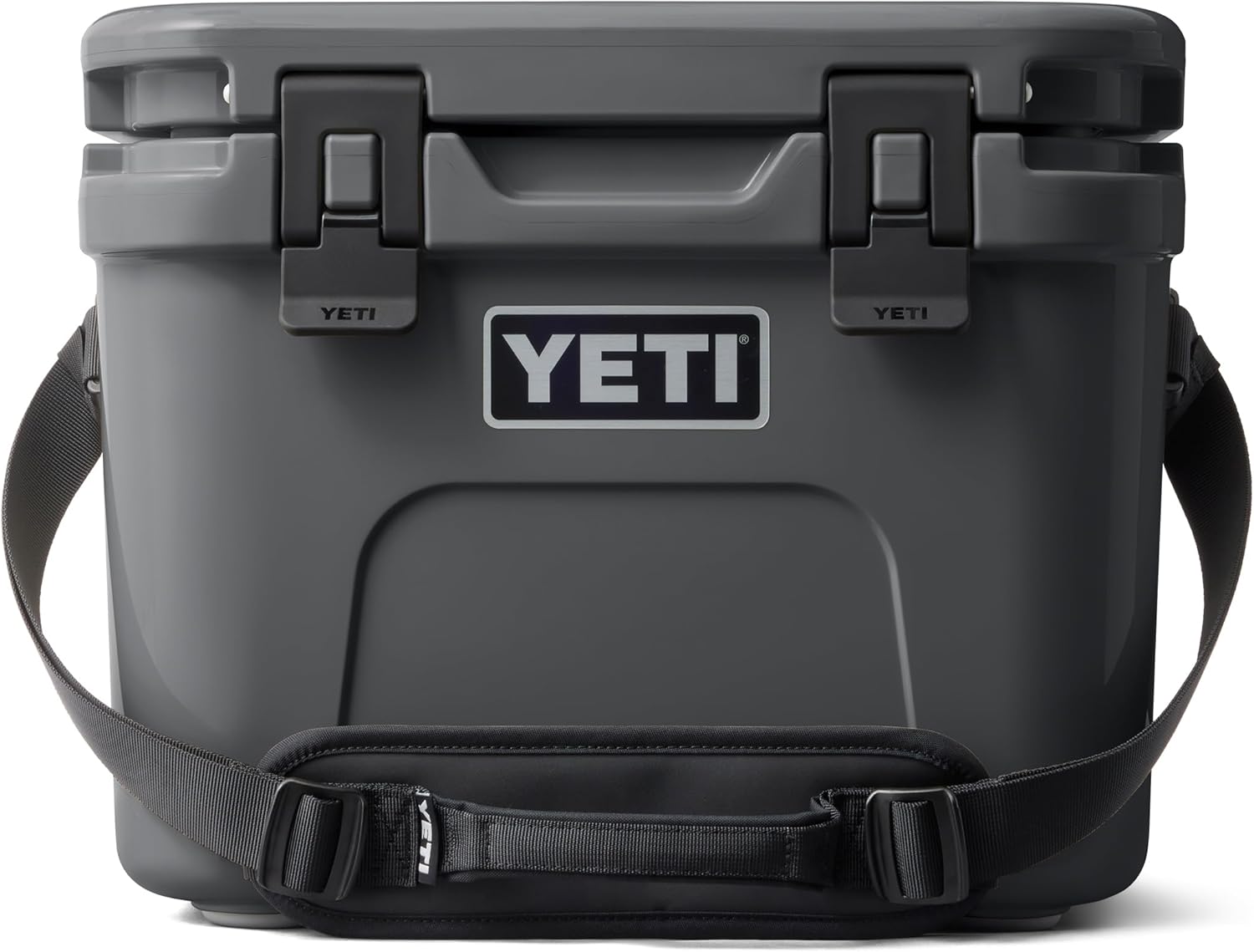
The YETI Tundra 45 became one of the most consistent performers during testing, especially during hot summer campground trips where coolers spent long hours exposed to direct heat, repeated lid openings, and warm vehicle transport.
Its rotomolded construction and thick PermaFrost insulation helped it maintain stable internal temperatures noticeably longer than most traditional camping coolers we tested.
During multi-day campground use, the biggest difference was consistency.
Even after repeated daytime opening cycles for drinks, food, and ice access, the cooler continued holding usable ice surprisingly well into later stages of the trip.
The heavy-duty lid gasket also reduced warm-air intrusion better than many lower-cost coolers that gradually lost cooling efficiency during hotter afternoons.
Another thing that stood out was overall durability.
The Tundra feels extremely solid once fully loaded, and the construction handled:
- rough campground transport
- truck-bed movement
- hot parking conditions
- repeated loading cycles
- outdoor storage exposure
without developing hinge looseness or lid instability during testing.
The downside is obvious:
this cooler is heavy.
Once packed with food, drinks, and ice, moving it alone becomes difficult for longer distances without help.
It is also significantly more expensive than casual weekend camping coolers.
That said, the cooling performance genuinely lives up to the reputation far more than many “premium” coolers currently dominating online search results.
For campers building a complete warm-weather food setup, our guide on Best Camping Stoves for Car Camping pairs especially well with longer-lasting cooler systems during multi-day trips.
Pros
✅ Outstanding long-term ice retention
✅ Extremely durable rotomolded construction
✅ Strong lid gasket and latch system
✅ Handles repeated hot-weather camping very well
✅ Reliable performance during multi-day trips
Cons
❌ Expensive compared to standard coolers
❌ Very heavy once fully loaded
❌ Takes up significant vehicle space
Verdict
The YETI Tundra 45 remains one of the strongest all-around camping coolers for ice retention if long-term cooling performance matters more than budget pricing or lightweight portability.
For multi-day camping, summer road trips, and serious campground use, it consistently outperformed most standard coolers during real outdoor testing.
(Prices may vary depending on availability)
2. RTIC Ultra-Light 52 Qt Cooler Review
Award: Best Value Cooler for Ice Retention

The RTIC Ultra-Light 52 impressed us more than expected during testing because it delivered cooling performance surprisingly close to premium rotomolded coolers while remaining noticeably lighter and easier to manage during normal camping trips.
That difference became obvious immediately during vehicle camping and campground unloading.
Many heavy-duty coolers perform well thermally but become frustrating once fully packed with ice, drinks, and food. The RTIC Ultra-Light avoided much of that problem while still maintaining very strong ice retention during multi-day outdoor use.
During testing, it handled:
- hot summer campground trips
- multi-day road travel
- repeated daytime opening cycles
- warm vehicle storage
- family camping weekends
without losing cooling performance nearly as quickly as most mid-range coolers.
The lighter construction genuinely improves usability during real trips.
Carrying the cooler across campgrounds, lifting it into SUVs, and reorganizing packed vehicles felt much easier compared to heavier premium models like the YETI Tundra.
Another thing we liked was latch usability.
The rubber latches opened more naturally during repeated campsite use and felt less stiff than some rotomolded competitors that became annoying after constant opening cycles.
The trade-off is that the overall shell does not feel quite as overbuilt or premium as the YETI.
It is still very durable, but slightly less confidence-inspiring during rough transport and aggressive outdoor abuse.
Pros
✅ Excellent ice retention for the price
✅ Noticeably lighter than many rotomolded coolers
✅ Easier transport during camping trips
✅ Strong overall value compared to premium brands
✅ Comfortable latch system for repeated use
Cons
❌ Exterior finish feels less premium than YETI
❌ Not certified bear-resistant
❌ Slightly less rugged under extreme abuse
Verdict
The RTIC Ultra-Light 52 is one of the smartest overall buys for campers who want premium-level cooling performance without paying ultra-premium cooler prices.
It balances ice retention, portability, and real-world camping usability extremely well while avoiding many of the weight frustrations common in heavier rotomolded coolers.
(Prices may vary depending on availability)
3. Coleman Xtreme 5-Day Cooler Review
Award: Best Budget Camping Cooler
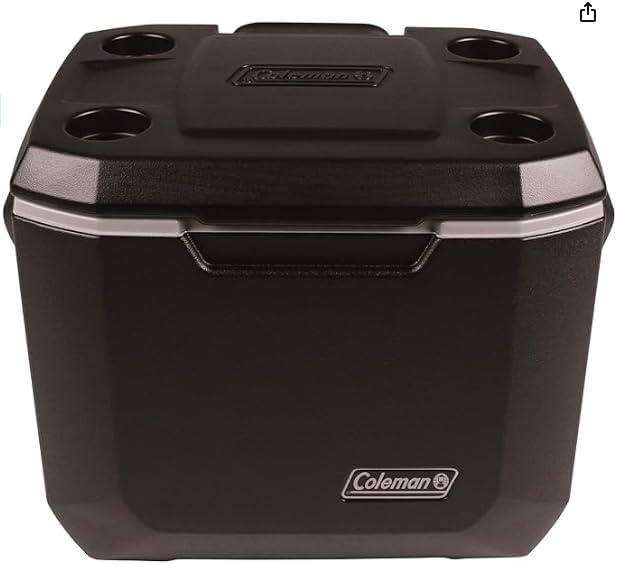
The Coleman Xtreme 5-Day Cooler proved once again why it remains one of the most popular campground coolers for casual family camping and weekend outdoor trips.
It obviously does not compete directly with premium rotomolded coolers for extreme long-term ice retention, but for normal campground use, it performed far better than many campers would expect at this price point.
During testing, the cooler handled:
- weekend camping trips
- short road travel
- family campground use
- moderate summer temperatures
- repeated food and drink access
surprisingly well for a lightweight non-rotomolded cooler.
The biggest advantage is practicality.
Unlike oversized heavy-duty coolers, the Coleman Xtreme stays relatively lightweight even when packed, making it much easier to move around campgrounds, lift into vehicles, and organize during family trips.
The molded cup holders on the lid also ended up being more useful than expected during relaxed campground setups and lakeside camping.
Ice retention remained respectable during moderate summer weather, especially when the cooler stayed shaded and properly pre-chilled before packing.
That said, the difference in insulation quality becomes more noticeable once temperatures climb aggressively or the cooler starts opening constantly throughout the day.
The plastic hinges and latches also feel less durable compared to premium camping coolers designed for years of rough outdoor use.
For campers mostly taking shorter campground trips, though, the performance-to-price ratio is honestly hard to beat.
For families building a more complete beginner-friendly campground setup, our guide on Best Family Camping Tents pairs especially well with affordable cooler systems for weekend camping trips.
Pros
✅ Very affordable for most campers
✅ Lightweight and easy to transport
✅ Good ice retention for weekend trips
✅ Large storage capacity for family camping
✅ Cup holders built into the lid
Cons
❌ Plastic hinges may wear over time
❌ Not ideal for extreme summer heat
❌ Insulation weaker than rotomolded coolers
Verdict
The Coleman Xtreme 5-Day Cooler remains one of the strongest budget camping coolers for campers who want dependable weekend cooling performance without spending premium cooler money.
For casual campground trips, road travel, and family camping a few times per year, it delivers excellent real-world value.
(Prices may vary depending on availability)
4. RovR RollR 60 Review
Award: Best Rolling Camping Cooler

The RovR RollR 60 stood out immediately during testing because it solves one of the biggest real-world camping problems most coolers completely ignore:
transport.
Once fully loaded with ice, drinks, and food, large coolers become extremely heavy during campground trips — especially across sand, dirt, gravel, and uneven terrain.
The RovR handled those situations noticeably better than traditional hard coolers thanks to its oversized all-terrain wheels and long pull handle system.
During testing, it performed especially well during:
- beach camping
- larger campground setups
- lakeside trips
- vehicle camping
- long unloading walks from parking areas
The mobility difference genuinely changes the overall camping experience once the cooler is heavily packed.
Most standard coolers become frustrating after several trips because moving them repeatedly starts feeling like work.
The RollR avoided much of that problem surprisingly well.
Ice retention performance was also stronger than expected.
The thick insulation and deep internal layout helped maintain cold temperatures consistently during multi-day summer camping, even with repeated opening cycles throughout the day.
Another feature we liked was the internal Deep Freeze dry bin.
Keeping certain foods separated from melting ice water made organization much easier during longer trips where food management becomes messy quickly inside standard coolers.
The main downside is bulk.
This cooler takes up a significant amount of cargo space inside smaller SUVs and compact vehicles, and the taller shape can feel awkward during tighter packing setups.
It is also expensive compared to traditional wheeled coolers.
For campers frequently transporting heavy food loads across campgrounds or beaches, though, the wheel system alone can absolutely justify the upgrade.
For campers improving larger campground kitchen setups overall, our guide on Best Camping Tables for Cooking pairs especially well with larger rolling cooler systems during family camping trips.
Pros
✅ Excellent all-terrain wheel system
✅ Strong multi-day ice retention
✅ Much easier transport across rough ground
✅ Deep Freeze dry bin improves organization
✅ Handles beach camping extremely well
Cons
❌ Expensive compared to standard coolers
❌ Bulky inside smaller vehicles
❌ Tall shape can complicate tight cargo packing
Verdict
The RovR RollR 60 is one of the best camping coolers for campers prioritizing mobility, campsite transport, and long-term outdoor usability during larger camping trips.
For beach camping, family campground setups, and vehicle camping where coolers constantly move around camp, it delivers a much more practical experience than traditional heavy hard coolers.
(Prices may vary depending on availability)
5.Igloo BMX 52 Quart Review
Award: Best Mid-Range Camping Cooler
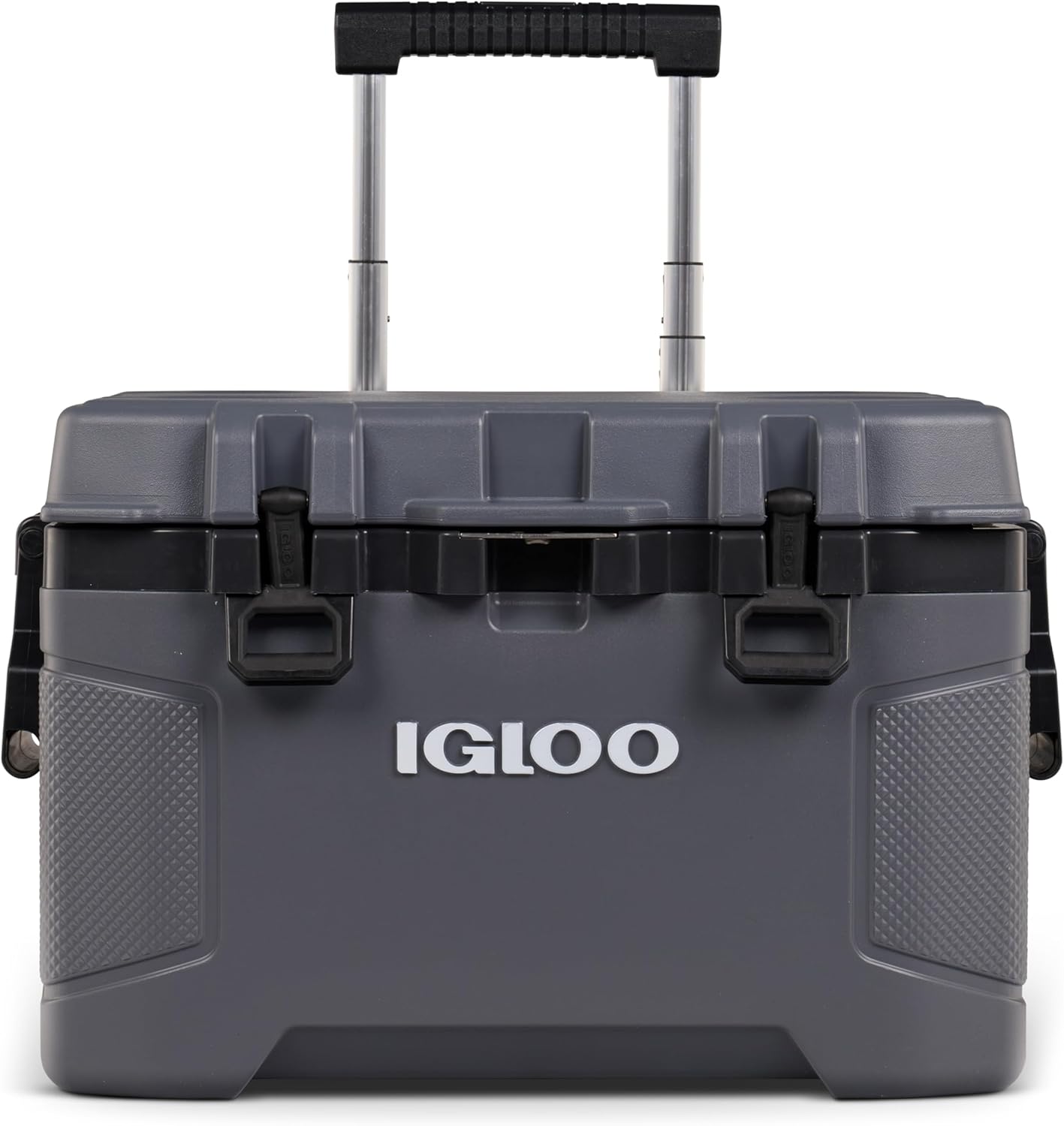
The Igloo BMX 52 sits in one of the most practical positions in the camping cooler market right now.
It delivers noticeably better durability and insulation than cheap entry-level coolers while avoiding the extreme price and heavy weight of premium rotomolded models.
During testing, it handled:
- weekend campground trips
- family camping
- lake days
- warm-weather road travel
- repeated vehicle loading
much better than traditional budget coolers in the same general price range.
The BMX construction feels tougher immediately.
The reinforced handles, thicker shell, and stronger latches gave the cooler a more durable feel during campground use without becoming excessively heavy during transport.
That balance became one of its biggest strengths.
Many premium coolers perform slightly better thermally, but they also become frustratingly heavy once fully packed.
The Igloo BMX stayed much easier to carry while still maintaining solid ice retention during multi-day summer camping.
We also liked the overall shape.
It packed more naturally inside SUVs and campground setups compared to several oversized rotomolded coolers that consumed excessive cargo space during testing.
Ice retention performance remained very respectable for this category, especially when pre-chilled properly and kept out of direct sun exposure.
The biggest compromise is long-term cooling efficiency.
In extreme heat, premium rotomolded coolers like the YETI and RTIC still held ice longer during extended testing.
The hinge system also feels slightly less confidence-inspiring after repeated heavy use compared to more expensive heavy-duty coolers.
Pros
✅ Strong balance between price and performance
✅ More rugged than standard budget coolers
✅ Easier to carry than heavier premium models
✅ Good ice retention for weekend camping
✅ Reinforced handles and latches feel durable
Cons
❌ Ice retention trails premium rotomolded coolers
❌ Hinges may weaken over time
❌ Not ideal for extreme multi-day heat exposure
Verdict
The Igloo BMX 52 is one of the best mid-range camping coolers for campers who want stronger durability and improved ice retention without paying premium rotomolded cooler prices.
For family camping, road trips, and normal summer campground use, it delivers one of the best overall value balances in this category.
(Prices may vary depending on availability)
What Actually Matters in a Camping Cooler for Ice Retention
Most camping coolers look impressive online.
The real differences usually appear later — once coolers start dealing with repeated opening cycles, direct summer heat, crowded vehicle transport, melting ice water, and multi-day campground use where temperature consistency actually matters.
A cooler that performs well during a short backyard barbecue may struggle badly during real camping trips.
Insulation Quality Matters More Than Marketing Claims
One of the biggest differences during testing came from insulation thickness and lid sealing quality.
Many cheaper coolers advertise “5-day ice retention,” but those numbers often happen under unrealistic laboratory conditions with limited lid openings and controlled temperatures.
In real campground conditions, coolers with thicker insulation and stronger lid gaskets consistently maintained cold temperatures much longer.
That became especially noticeable during:
– temperatures above 85°F
– repeated daytime opening
– direct sunlight exposure
– warm vehicle storage
Direct Sunlight Destroys Ice Faster Than Most Campers Realize
Even premium coolers lose performance quickly in constant direct sun.
During testing, simply moving a cooler into shade noticeably improved ice retention during hot afternoons.
The coolest-performing setups usually kept coolers:
– under picnic tables
– beneath awnings
– inside shaded vehicles
– protected from late afternoon heat
Weight and Portability Matter More During Real Trips
This became obvious quickly during campground testing.
Large rotomolded coolers perform extremely well thermally, but once fully packed with food and ice, many become difficult to move comfortably.
Some campers realistically need:
– lighter coolers
– wheel systems
– easier vehicle loading
– more compact storage shapes
—not simply maximum ice retention at any cost.
The best camping cooler depends heavily on how far you actually carry it during trips.
Cooler Organization Affects Cooling Performance
Messy coolers lose cold air faster.
Repeatedly digging through loose drinks, food, and melting ice causes temperature loss surprisingly quickly during warm-weather camping.
The best-performing setups usually separated:
– drinks
– raw food
– dry food
– frozen items
– quick-access items
more efficiently inside the cooler.
Internal baskets and divider systems helped much more than expected during multi-day trips.
Ice Type Changes Cooling Performance
Block ice consistently lasted longer than loose cubes during testing.
Most long-lasting cooler setups worked best using:
– block ice for long-term cooling
– cubed ice for quick access
– frozen water bottles for dual-purpose storage
Smaller cube ice melted dramatically faster during repeated summer campground use.
Not Every Camper Needs a Premium Rotomolded Cooler
This is one of the biggest buying mistakes we noticed.
Many casual campers spend hundreds on heavy-duty premium coolers designed for:
– overlanding
– offshore fishing
– extreme heat exposure
– week-long trips
when they realistically only camp for short weekends a few times per year.
For many campground campers, a well-packed mid-range cooler is honestly more than enough.
The best camping cooler is the one that realistically matches your actual camping style, trip length, vehicle setup, and weather conditions — not simply the most expensive option on Amazon.
How to Choose the Right Camping Cooler

Choosing the right camping cooler has a lot less to do with marketing claims than most buyers expect.
The biggest differences usually appear after several real trips outdoors — once the cooler starts dealing with:
– repeated opening cycles
– direct summer heat
– crowded vehicle packing
– melting ice water
– rough campground transport
– multi-day food storage
A cooler that looks impressive online may become frustrating very quickly if it does not match the way you actually camp.
Rotomolded vs Standard Coolers
This is one of the biggest decisions buyers face.
Rotomolded coolers usually offer:
– thicker insulation
– longer ice retention
– stronger durability
– better lid sealing
– improved heat resistance
They perform especially well during:
– multi-day camping
– extreme summer heat
– overlanding
– extended road trips
The trade-off is weight and cost.
Most rotomolded coolers become very heavy once fully loaded.
Standard coolers are usually:
– lighter
– cheaper
– easier to transport
– better for casual trips
For many weekend campers, a good mid-range cooler honestly provides more than enough cooling performance.
Think About Vehicle Space Before Buying
This became obvious during testing very quickly.
Some premium coolers performed extremely well thermally but consumed huge amounts of cargo space inside smaller SUVs and packed family camping setups.
Before buying, think realistically about:
– cooler dimensions
– trunk space
– food volume
– trip length
– how many people are camping
A slightly smaller cooler that packs efficiently often works better than an oversized cooler that dominates the entire vehicle.
A lot of campers underestimate how heavy coolers become once fully loaded.
During testing, wheel systems became extremely valuable during:
– beach camping
– larger campgrounds
– long parking walks
– family camping trips
– soft dirt and gravel terrain
The downside is that wheeled coolers usually take up more storage space and weigh more overall.
Still, for many campers, mobility improves real-world usability far more than slightly better insulation numbers.
Don’t Chase Unrealistic Ice Retention Claims
This is one of the biggest mistakes buyers make.
Many coolers advertise:
– “5-day ice retention”
– “7-day cooling”
– “extreme insulation performance”
under ideal laboratory conditions.
Real campground use is very different.
Direct sunlight, warm food, repeated lid opening, and hot vehicle transport dramatically reduce real-world cooling performance.
In actual camping conditions, proper cooler management matters almost as much as the cooler itself.
Cooler Size Matters More Than Most Campers Expect
Bigger is not always better.
Oversized coolers often become:
– harder to carry
– more difficult to organize
– slower to cool efficiently
– awkward inside packed vehicles
A tightly packed medium cooler usually performs better thermally than a half-empty oversized one.
For most campers:
– 20–40 qt works well for couples
– 45–65 qt fits most family camping
– 70 qt+ works best for larger groups and extended trips
Lid Seals and Latches Matter More Than Branding
During testing, several mid-range coolers surprised us simply because they sealed extremely well.
Strong lid gaskets and dependable latches helped maintain cold temperatures far longer during repeated opening cycles.
Meanwhile, some cheaper coolers lost cooling performance quickly because warm air entered constantly through weaker seals.
Good insulation only works if the cooler stays properly sealed.
Real Camping Conditions Matter Most
The best camping cooler depends heavily on:
– trip length
– outside temperature
– campground style
– vehicle size
– how often the cooler opens
– transport distance
– food storage needs
For short casual campground weekends, a lighter mid-range cooler may honestly feel more practical than a massive premium rotomolded model.
For long summer trips and aggressive heat, premium insulation becomes much more valuable very quickly.
🧊 Bottom Line
The best camping cooler is usually the one that realistically matches your camping style — not simply the most expensive model with the biggest ice retention number.
For most campers, balancing:
– cooling performance
– portability
– storage space
– organization
– real-world usability
matters far more long-term than chasing extreme marketing claims alone.
Common Mistakes Buyers Make When Choosing Camping Coolers
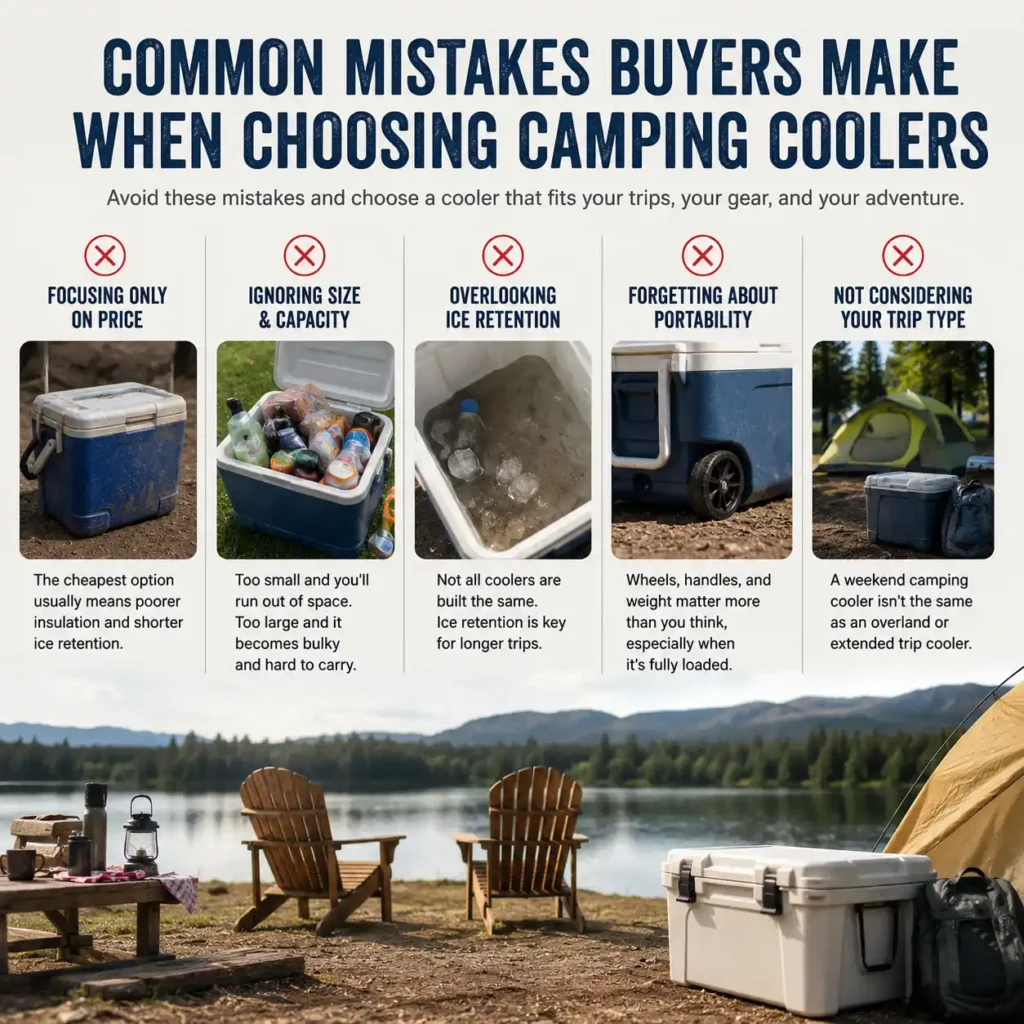
A lot of campers end up disappointed with their cooler for one simple reason:
they buy based on marketing instead of how they actually camp.
During testing, several patterns showed up repeatedly — especially during summer campground trips where coolers were opened constantly, transported in hot vehicles, and exposed to direct sunlight for hours at a time.
Buying a Cooler That Is Too Large
This happened constantly.
Large coolers sound great online, but oversized models quickly become difficult once fully loaded with:
– ice
– drinks
– meat
– food containers
– camping supplies
Many campers underestimate how heavy a fully packed cooler becomes during real trips.
A cooler that is too large also loses cooling efficiency faster if it stays partially empty.
For many weekend campers, a medium-sized cooler actually performs better and feels much easier to manage.
Ignoring Weight Before the Trip
Some premium rotomolded coolers perform incredibly well thermally but become exhausting to carry after loading.
During testing, several heavy coolers became frustrating during:
– beach camping
– longer campground walks
– SUV loading
– unloading at crowded campsites
Mobility matters much more than most buyers initially expect.
That is exactly why rolling coolers and lighter insulated models continue becoming more popular for family camping.
Constantly Opening the Lid
This sounds obvious, but it destroys ice retention surprisingly fast.
Many campers use one cooler for everything:
– drinks
– meat
– snacks
– ice
– quick-access items
The result is constant warm-air exposure throughout the day.
The best-performing setups usually separated beverages from food storage whenever possible.
Packing Warm Food Into the Cooler
Warm food kills ice quickly.
Several coolers performed dramatically worse during testing when campers loaded room-temperature drinks or recently cooked food directly into the ice compartment.
The best results always came from pre-chilling food and drinks before departure.
Even premium coolers lose performance fast once large amounts of heat enter the system early.
Trusting “5-Day Ice Retention” Marketing Blindly
One of the biggest surprises for newer campers is how unrealistic many ice retention claims actually are.
Most manufacturer testing happens under ideal conditions with:
– minimal lid openings
– moderate temperatures
– controlled shade
– perfect packing conditions
Real campground use is much harsher.
Direct sun, repeated opening cycles, and hot vehicle transport change cooling performance dramatically.
Buying Premium Coolers for Casual Weekend Camping
Not every camper needs a $400 rotomolded cooler.
This became extremely obvious during testing.
For short weekend campground trips, several mid-range coolers delivered more than enough cooling performance without the:
– extra weight
– oversized bulk
– premium pricing
The best camping cooler is usually the one that realistically fits your trip style — not simply the most expensive cooler available.
Forgetting About Vehicle Space
Some coolers performed well thermally but became frustrating inside smaller SUVs and packed family camping setups.
A bulky cooler can quickly dominate cargo organization during longer trips.
🧊 Bottom Line
The biggest mistakes usually happen when buyers focus too heavily on marketing numbers instead of realistic camping conditions.
A cooler that matches your actual:
– camping style
– trip length
– transport needs
– vehicle space
– weather conditions
will almost always perform better long-term than simply buying the biggest or most expensive model available.
FAQ: Best Camping Coolers for Ice Retention
How long should ice last in a good camping cooler?
For most high-quality camping coolers, ice should realistically last anywhere from 3–7 days depending on:
– outside temperature
– cooler size
– how often the lid opens
– direct sun exposure
– ice type
Premium rotomolded coolers usually perform best during multi-day summer camping and hotter weather conditions.
Are YETI coolers really better than cheaper coolers?
The biggest difference is usually consistency during extended heat exposure.
Premium coolers like YETI tend to maintain stable internal temperatures longer during:
– repeated lid openings
– direct summer heat
– multi-day camping
– vehicle transport
That said, many casual weekend campers honestly do not need ultra-premium performance for shorter trips.
Is RTIC as good as YETI for ice retention?
RTIC coolers performed surprisingly close to YETI during testing, especially considering the lower price.
The biggest differences usually came down to:
– overall finish quality
– long-term durability
– latch feel
– brand reputation
For most campground campers, RTIC offers one of the strongest value-to-performance balances currently available.
Does pre-chilling a cooler actually help?
A lot more than most campers expect.
Loading ice into a warm cooler forces the ice to cool the cooler walls first before cooling your food and drinks.
Pre-chilling overnight with sacrificial ice or frozen water bottles noticeably improved ice retention during nearly every camping test.
What keeps ice longer: block ice or cube ice?
Block ice consistently lasted longer during testing.
Cube ice cools food faster initially but melts much quicker during warm-weather camping and repeated cooler opening.
The best-performing setups usually combined:
– block ice for long-term cooling
– cube ice for quick-access drinks
– frozen water bottles for extra thermal mass
Are rotomolded coolers worth it for camping?
For longer camping trips and hot-weather travel, usually yes.
Rotomolded coolers generally offer:
– thicker insulation
– stronger lid seals
– better durability
– longer ice retention
But they are also:
– heavier
– bulkier
– significantly more expensive
For short weekend camping trips, many mid-range coolers perform perfectly well without the extra cost.
What size cooler is best for camping?
That depends heavily on trip length and group size.
As a general rule:
– 20–40 qt → solo campers and couples
– 45–65 qt → family camping and weekend trips
– 70 qt+ → larger groups and extended camping
Oversized coolers often become unnecessarily heavy and harder to organize during normal campground trips.
Do expensive coolers actually keep ice longer?
Usually yes — but not always as dramatically as marketing suggests.
Premium coolers tend to maintain cold temperatures more consistently during:
– extreme summer heat
– repeated lid opening
– longer trips
– direct sunlight exposure
The difference becomes much more noticeable after the second or third day outdoors.
Can dry ice damage a camping cooler?
Some coolers can handle dry ice safely, while others may crack or become damaged from extremely low temperatures.
Always check manufacturer recommendations first.
During camping trips, dry ice works best for:
– frozen food storage
– long-distance travel
– multi-day cooling support
—not for everyday drink access.
Are electric camping coolers better than ice coolers?
Electric coolers solve different problems.
They work extremely well for:
– vehicle camping
– RV travel
– powered campsites
– long road trips
Traditional ice coolers still perform better for:
– remote campsites
– off-grid camping
– beach trips
– situations without reliable power access
Many campers eventually use both depending on the type of trip.
Final Verdict

The best camping cooler for ice retention depends far less on marketing claims than on how you actually camp.
After extensive campground testing, road travel, and hot-weather outdoor use, one thing became very clear:
real-world usability matters just as much as raw insulation performance.
The YETI Tundra 45 remained the strongest overall performer for long-term cooling consistency, durability, and multi-day campground reliability.
For campers spending long days outdoors in extreme summer heat, it delivered the most dependable ice retention during repeated real-world use.
The RTIC Ultra-Light 52 offered one of the best overall value balances in this category by combining strong cooling performance with noticeably easier portability and lower pricing.
For many campers, it honestly makes more practical sense than spending significantly more on ultra-premium branding.
The Coleman Xtreme 5-Day continued proving why it remains one of the best budget camping coolers for casual campground trips and family weekends.
Meanwhile, the RovR RollR 60 completely changed cooler mobility during larger campground setups and beach trips where transport becomes a major part of the experience.
And for campers wanting a more rugged mid-range option, the Igloo BMX 52 delivered a very solid balance between durability, cooling performance, and realistic everyday usability.
The biggest lesson from testing was simple:
Most campers do not actually need the most extreme cooler available.
They need a cooler that:
– fits their vehicle properly
– stays manageable during transport
– handles realistic trip lengths
– performs well in actual summer conditions
– remains easy to organize during repeated outdoor use
Because once temperatures climb and campground routines become busy, practical usability matters just as much as how long ice survives on paper.
🧊 Bottom Line
The best camping cooler is usually the one that matches your actual camping style, travel habits, and outdoor conditions — not simply the cooler with the most aggressive marketing or highest price tag.
For most campers, balancing:
– ice retention
– portability
– cargo space
– durability
– organization
– realistic campsite usability
will lead to a much better long-term camping experience than chasing extreme specifications alone.
Cold drinks and cold backs don’t mix — comfortable seating matters too. Check out our picks for the Best Camping Chairs for Bad Backs.
About the Author
Anthony is the lead editor of CampComfortGuide.com and focuses on real-world camping gear testing centered around campground usability, outdoor comfort, long-term durability, and practical family camping systems.
Over the past several years, he has tested camping equipment across:
– hot summer campground trips
– rainy forest campsites
– multi-day road travel
– lakeside camping
– vehicle-based camping setups
– crowded family campground environments
His reviews focus heavily on how camping gear performs after repeated outdoor use rather than controlled studio demonstrations or short-term promotional testing.
For camping coolers specifically, Anthony pays close attention to:
– real-world ice retention
– hot-weather performance
– transport usability
– lid seal consistency
– campground practicality
– long-term durability during repeated trips
The goal is simple:
Help campers choose gear that stays practical, reliable, and easy to live with long after the first camping trip ends.