
A limited hot-water supply can become one of the most frustrating parts of RV camping. A traditional tank water heater gives you a fixed amount of hot water, and once that supply is gone, you have to wait for the tank to recover. That limitation becomes especially noticeable when two people are showering, washing dishes, or using several hot-water fixtures during the same camping trip.
An RV tankless water heater takes a different approach. Instead of storing and reheating a fixed volume of water, it heats water as it flows through the unit, allowing the heater to provide hot water continuously as long as the propane, water supply, and electrical system meet its requirements.
But choosing the right RV tankless water heater is not simply a matter of finding the highest BTU rating or the largest GPM number. RV water heaters vary significantly in installation size, flow capacity, 12V requirements, temperature control, freeze protection, and compatibility with existing RV plumbing and exterior openings.
There is also an important distinction between a built-in RV tankless water heater designed to replace an existing water heater and a portable propane water heater intended for outdoor showers, vans, and temporary camping setups. Those products solve different problems, even though both may appear in searches for RV hot water.
In this guide, we compare five RV tankless water heaters for camping in 2026, focusing on the factors that actually affect an RV installation and everyday use. We look at heating output, water flow, temperature control, 12V power requirements, retrofit compatibility, cold-weather features, installation considerations, and the type of camper each model makes the most sense for.
The goal is straightforward: help you choose an RV tankless water heater that matches your rig, hot-water demand, and camping style without paying for performance or features you do not actually need.
As an Amazon Associate, I earn from qualifying purchases.

Table of Contents
Quick Answer: What Is the Best RV Tankless Water Heater for Camping?
The best RV tankless water heater depends less on maximum BTU output than on how your RV is set up and how you use hot water. Built-in RV tankless models are designed to replace an existing water heater and provide continuous hot water through the RV’s plumbing, while portable propane units are better suited to outdoor showers, van builds, gear washing, and other temporary setups.
For most RV owners replacing a conventional water heater, a built-in propane tankless model is the more relevant category. The main factors to compare are water-flow capacity, burner output, installation fit, 12V power requirements, temperature control, and cold-weather protection. Models in the current RV-specific market commonly range from roughly 42,000 to 65,000 BTU and about 1.7 to 3.1 GPM, although actual flow depends heavily on incoming water temperature and the heater’s operating conditions.
Your existing RV water-heater opening is also critical. Many retrofit models are designed around common RV cutout dimensions, but the exterior door size, opening, plumbing connections, propane connection, and electrical requirements can vary. Confirming these measurements before buying can prevent an expensive installation problem.
For campers who spend time off-grid, 12V power consumption deserves particular attention. A lower-draw model can put less demand on a battery and solar system, while higher-output forced-exhaust units may provide more heating capacity but require more electrical power to operate.
In this guide, we compare five RV tankless water heaters for camping across different priorities, including overall performance, value, higher-flow demand, factory-style replacement, and lower-power operation. The goal is to match the heater to your RV rather than simply choosing the model with the biggest specifications.
Why You Can Trust This Guide
Choosing an RV tankless water heater requires more than comparing BTU ratings or the highest advertised flow rate. A heater that looks powerful on paper may still be a poor fit if its exterior opening, plumbing connections, propane setup, or 12V requirements do not match your RV.
For this guide, we evaluated RV tankless water heaters based on the factors that have the greatest effect on real-world camping use: heating output, usable water flow, retrofit compatibility, temperature control, 12V power requirements, propane operation, freeze protection, installation requirements, and overall value. We also considered the differences between standard drop-in RV models and portable propane heaters so the products are compared within the right use case.
We give particular attention to flow rate and incoming water temperature. An advertised GPM figure does not tell the whole story because RV tankless heaters have limited burner capacity, and colder inlet water can significantly reduce the amount of hot water they can produce comfortably. A model with a higher BTU rating may therefore make more sense for cold-weather camping or heavier hot-water demand than a lower-output unit with a similar advertised flow rate.
We also look closely at installation compatibility. Common RV tank openings can make some tankless heaters relatively straightforward replacements, but dimensions, exterior doors, plumbing connections, propane connections, electrical requirements, and manufacturer clearances still need to be verified before purchase.
Our goal is not to identify the heater with the biggest specification sheet. It is to show where each model fits, what its important limitations are, and which type of RV camper is most likely to benefit from it. That makes the comparison more useful when you are choosing between continuous hot water, easier installation, higher flow, lower 12V consumption, and overall cost.
What Makes a Good RV Tankless Water Heater?
Not every RV tankless water heater is designed for the same installation or hot-water demand. The most important differences are usually found in the details that affect everyday use rather than in the headline specifications.
Heating Output and Water Flow
BTU output and GPM determine how much hot water a heater can produce under different conditions. Higher output can be particularly useful when incoming water is cold or when you want stronger flow during a shower, but maximum advertised GPM does not necessarily represent the flow you will achieve in every camping situation.
Retrofit Compatibility
For an RV replacement, physical fit matters as much as heating performance. Check the exterior door or cutout dimensions, plumbing connections, propane connection, electrical requirements, and installation clearances before choosing a model. A heater designed around common RV dimensions can make replacement considerably easier.
Temperature Control
A good RV tankless heater should maintain a reasonably consistent outlet temperature as water flow changes. Electronic controls, adjustable temperature settings, and systems designed to reduce temperature fluctuations can make a noticeable difference when switching between a shower, sink, or other hot-water fixture.
12V Power and Off-Grid Use
Although propane supplies most of the heating energy, RV tankless heaters still require 12V electricity for controls, ignition, fans, pumps, or other components depending on the design. If you regularly camp without hookups, the heater’s electrical demand becomes part of the overall battery and solar calculation.
Freeze Protection and Cold-Weather Features
Cold-weather protection can be important for RVs used during shoulder seasons or winter camping. Depending on the model, features may include freeze-prevention systems, automatic protection, or procedures for draining the heater when temperatures can fall below freezing.
The best model is therefore not necessarily the one with the highest BTU rating. It is the one whose flow capacity, physical fit, controls, power requirements, and cold-weather features match your RV and the conditions in which you actually camp.
What Makes This Guide Different?
RV tankless water heaters can look very similar in product listings, but the differences that matter to an RV owner are often hidden behind the headline BTU and GPM numbers. A heater that works well for a compact trailer may not be the right choice for a larger RV, a cold-weather campsite, or an off-grid setup with limited battery capacity.
That is why we are looking beyond maximum heating output. Actual RV fit, usable water flow, 12V power demand, temperature control, propane requirements, and cold-weather protection all affect how a tankless heater performs once it is installed in an RV. Current RV-focused comparisons also emphasize the difference between built-in retrofit units and portable propane heaters, which serve very different camping needs.
We also pay attention to the difference between advertised maximum flow and practical hot-water performance. RV tankless heaters operate with relatively small burners compared with residential systems, so colder incoming water can reduce the amount of hot water the heater can comfortably deliver. A higher GPM rating therefore does not automatically make one model better for every camper.
Installation is another major part of the decision. For a built-in replacement, the exterior door and cutout dimensions, plumbing connections, propane connection, 12V requirements, and installation clearances can determine whether a heater is a straightforward upgrade or a much more involved project.
Most importantly, we separate features that improve hot-water performance from features that mainly improve convenience. A remote control, digital display, or additional monitoring can be useful, but those features do not compensate for inadequate flow, poor physical fit, or excessive power requirements.
The result is a comparison built around the decisions RV campers actually face: which heater fits your RV, provides enough hot water for your camping routine, works with your available power and propane system, and makes sense for the conditions in which you camp.
How We Selected the Best RV Tankless Water Heaters
Choosing the five best RV tankless water heaters requires more than sorting models by BTU output or advertised GPM. Current RV-focused comparisons consistently emphasize flow rate, retrofit compatibility, 12V power requirements, propane operation, and cold-weather considerations because these factors can have a direct effect on how a heater works in an RV.
We started with propane tankless water heaters relevant to RV camping, including RV-specific built-in models and one portable point-of-use option. Portable heaters were evaluated separately because their installation, power requirements, and intended use are different from a direct replacement for an RV’s existing water heater.
We then compared the specifications that matter most in actual camping conditions:
- Heating output: BTU capacity and how much burner capacity each model provides for heating incoming water.
- Water flow: advertised GPM, while recognizing that maximum flow can depend heavily on inlet-water temperature and required temperature rise. Current comparisons specifically caution that cold incoming water can reduce practical flow.
- RV installation compatibility: exterior opening dimensions, retrofit design, plumbing connections, propane requirements, and other installation considerations.
- 12V electrical demand: particularly important for campers who rely on batteries or solar power while boondocking.
- Temperature control: how the heater manages outlet temperature and adjusts to changing water-flow conditions.
- Cold-weather protection: freeze-protection features and considerations for winterization and low-temperature camping.
- Overall value: the relationship between performance, features, installation practicality, and purchase price rather than simply choosing the most powerful model.
We also considered how each heater fits a different type of RV camper. A couple using a single shower has different requirements from a family wanting higher flow, while an off-grid camper may place more importance on 12V power consumption than maximum heating output.
Finally, we checked current product information and market availability so the lineup reflects models that are relevant to RV campers in 2026. The result is a five-model comparison designed around real RV use, installation fit, hot-water demand, and camping conditions, rather than a simple specification-based ranking.
Quick Summary: Our Top RV Tankless Water Heater Picks
If you don’t have time to read the full guide, this quick summary highlights our top RV tankless water heaters for camping across different replacement needs, hot-water demands, feature sets, and budgets. Each model earns its place for a different reason, from a balanced built-in RV replacement to higher-output alternatives and a portable option for campers who do not need a permanent installation.
There isn’t one perfect RV tankless water heater for every camper. The right choice depends on your RV’s existing water-heater opening, hot-water demand, available 12V power, propane setup, installation requirements, and whether you need a built-in replacement or a portable system. Use this shortlist to narrow your options, then read the detailed reviews below for a closer look at each model’s strengths and limitations.
Fogatti InstaShower 8 Plus
Award: Best Overall
Why It Won
The Fogatti InstaShower 8 Plus offers a balanced combination of heating output, water flow, RV-specific design, and replacement-oriented features. With a 55,000-BTU burner and advertised flow of up to 2.9 GPM, it is positioned around the needs of campers looking for a dedicated built-in tankless system rather than a portable outdoor heater.
Its RV-specific design, forced exhaust, 12V operation, temperature control, and freeze-protection features give it a well-rounded profile for everyday RV use. The key advantage is not one extreme specification, but the way the major requirements come together in a single replacement-focused system.
Choose This If:
- You want a built-in tankless water heater for your RV.
- You want a balanced combination of heating output and water flow.
- You are replacing a conventional RV water heater.
- You need a 12V propane system designed around RV use.
- You want freeze-protection features for shoulder-season camping.
Best For:
- RV water-heater replacement
- Car and RV camping
- Couples and families
- Everyday hot-water use
- Campers looking for a balanced built-in system
Camplux F10 Ultra
Award: Best Value
Why It Won
The Camplux F10 Ultra stands apart from the other models in this lineup because it is a portable propane water heater rather than a conventional built-in RV replacement. That makes it relevant to a different type of camping setup: campers who want on-demand hot water for an RV, outdoor shower, washing equipment, or temporary campsite use without permanently replacing the RV’s existing water heater.
Its value comes from combining portable operation with thermostatic temperature control and a useful flow rate for outdoor applications. It should not, however, be treated as a drop-in replacement for a built-in RV water heater.
Choose This If:
- You want a portable rather than permanently installed water heater.
- You camp with an RV but mainly need outdoor hot water.
- You want a flexible solution for showers or washing equipment.
- You do not want to modify your RV’s existing water-heater opening.
- You value lower-cost, portable hot-water capability.
Best For:
- Portable RV hot water
- Outdoor showers
- Camping
- Van and temporary setups
- Campers looking for a flexible alternative to a built-in replacement
Suburban Tankless Water Heater
Award: Best for Established RV Brands / RV Replacement
Why It Won
The Suburban Tankless Water Heater takes a more traditional RV-appliance approach. Rather than competing primarily on maximum output, its main appeal is its role as an RV-specific replacement system from an established RV appliance manufacturer.
Suburban designed this tankless system around replacing existing RV water heaters, including common 6-gallon applications. That makes installation compatibility and replacement practicality central to its appeal. For RV owners who want to stay within an established RV appliance ecosystem, those factors can matter more than simply choosing the heater with the largest BTU number.
Choose This If:
- You are replacing an existing RV water heater.
- You want an RV-specific appliance from an established RV manufacturer.
- Your RV currently uses a conventional tank water heater.
- Replacement compatibility is more important than maximum advertised output.
- You want a tankless system designed specifically around RV applications.
Best For:
- RV water-heater replacement
- Established RV appliance systems
- Travel trailers
- Motorhomes
- Campers prioritizing replacement compatibility
APUS Tankless Propane RV Water Heater
Award: Best Alternative / Feature-Focused Option
Why It Won
The APUS tankless propane RV water heater takes a feature-focused approach. Its appeal is not simply its heating output, but the combination of high burner capacity, high advertised flow, electronic controls, display functionality, and multiple protection systems.
With a listed output of 68,000 BTU and advertised flow of up to 3.9 GPM, it sits toward the higher-output end of this comparison. That makes it particularly interesting for RV owners who want more performance headroom while also placing importance on controls, diagnostics, and additional operating protections.
Choose This If:
- You want a higher-output RV tankless water heater.
- You value electronic controls and display features.
- You want additional protection and monitoring features.
- Your RV installation can accommodate the required specifications.
- You want an alternative to the more established RV appliance brands.
Best For:
- Feature-focused RV setups
- Higher hot-water demand
- Family RV camping
- Campers wanting electronic controls
- Buyers comparing alternatives to mainstream RV brands
Ranein RA65EH
Award: Best Alternative / Higher-Output Option
Why It Won
The Ranein RA65EH is aimed at campers who want to move toward the higher-output end of the RV tankless water-heater category. Its 65,000-BTU rating and advertised flow of up to 3.9 GPM give it substantial heating capacity on paper, while its 12V propane configuration keeps it within the familiar architecture of a built-in RV system.
The RA65EH is therefore worth considering when hot-water demand is a more important part of the decision. The higher output does not eliminate the need to verify your RV’s opening, connections, electrical requirements, and other installation details, but it gives this model a clear identity within the lineup.
Choose This If:
- You want a higher-output built-in RV tankless water heater.
- Your RV has greater hot-water demand.
- You want up to 3.9 GPM of advertised flow.
- You prefer a 12V propane RV system.
- You are comparing higher-output alternatives to more conventional replacement models.
Best For:
- Larger RVs
- Higher hot-water demand
- Family camping
- Built-in RV replacement projects
- Campers prioritizing heating output
Still Not Sure Which RV Tankless Water Heater Is Right for You?
The five models in this guide cover distinctly different buying situations. The Fogatti focuses on balanced built-in RV replacement, the Camplux on portable value, the Suburban on established RV replacement compatibility, the APUS on features and higher output, and the Ranein on higher-output performance.
Before choosing, verify the details that can make or break an RV installation: your existing cutout and exterior door dimensions, plumbing connections, propane requirements, 12V electrical requirements, and expected hot-water demand. A heater with impressive specifications is not the right choice if it does not fit your RV or match the way you camp.
Compare the Best RV Tankless Water Heaters at a Glance
The five models below cover different RV and camping setups, from built-in tankless replacements to portable propane hot-water systems. Use the table to compare the key specifications and see which type best matches your installation, hot-water demand, and camping setup.
| Model | Type | Fuel | Max BTU/h | Max Flow | Electrical |
|---|---|---|---|---|---|
| Fogatti InstaShower 8 Plus | Built-in RV | Propane | 55,000 | 2.9 GPM | 12V DC |
| Camplux F10 Ultra | Portable | Propane | 68,000 | 2.64 GPM | D-cell battery ignition |
| Suburban ST-60 | Built-in RV | Propane | 60,000 | 0.7 GPM minimum activation flow | 12V DC |
| APUS Tankless RV | Built-in RV | Propane | 68,000 | 3.9 GPM | 12V DC |
| Ranein RA65EH | Built-in RV | Propane | 65,000 | 3.9 GPM max | 12V DC |
Important: The Camplux F10 Ultra is a portable propane water heater, not a built-in RV tankless replacement. The other models are designed for RV water-heater installation or replacement applications. For a built-in RV heater, check the existing water-heater opening, cutout and door compatibility, plumbing connections, propane supply, 12V electrical requirements, and available installation space before purchasing.
The 5 Best RV Tankless Water Heaters for Camping in 2026
Choosing an RV tankless water heater is less about finding the highest advertised output and more about matching the heater to the way your RV is actually used. The models in this lineup cover different priorities, from direct RV replacement and higher hot-water output to portable propane use for flexible camping setups.
We selected these five RV tankless water heaters based on their intended installation, heating performance, flow capacity, propane and 12V requirements, temperature control, protection features, and practical fit for different RV camping situations. One important distinction is that the Camplux F10 Ultra is a portable propane heater rather than a built-in RV replacement, while the other models are designed around RV water-heater installation or replacement scenarios.
1. Fogatti InstaShower 8 Plus
Best Overall RV Tankless Water Heater for Camping
For many RV owners, the ideal tankless water heater is not necessarily the most powerful model available. It is the one that fits naturally into the RV, delivers enough hot water for everyday use, and avoids turning a basic shower or dishwashing task into a complicated campsite setup. The Fogatti InstaShower 8 Plus takes that balanced approach, combining RV-specific design with propane heating, 12V operation, and the features expected from a modern tankless replacement.
The InstaShower 8 Plus is built around the realities of RV use rather than general outdoor water heating. Its approximately 55,000 BTU heating capacity and advertised flow of up to 2.9 GPM put it in a practical range for everyday RV hot-water demand, while its 12V electrical system fits the electrical architecture found in many RVs.
That makes the Fogatti particularly relevant when replacing a conventional RV water heater. Instead of treating portability as the primary goal, this model is designed around a more permanent installation, with features such as forced exhaust, temperature control, and freeze protection aimed at making the system part of the RV rather than another piece of camping equipment you set up for each trip.

Quick Verdict
The Fogatti InstaShower 8 Plus is the most balanced option in this lineup for RV owners who want a dedicated built-in tankless water heater rather than a portable camping unit. Its combination of RV-focused design, propane heating, 12V operation, and practical hot-water capacity makes it well suited to everyday use in a travel trailer or motorhome.
The approximately 55,000 BTU output and up to 2.9 GPM advertised flow provide a useful middle ground. It is not positioned as the highest-output heater in this comparison, but that is not necessarily the point. For many RV setups, consistent everyday performance and installation compatibility matter more than chasing the largest numbers on a specification sheet.
The model also includes features that become important when a water heater is permanently integrated into an RV. Forced exhaust, temperature control, and freeze protection address different parts of the installation and operating equation, making the InstaShower 8 Plus more than simply a propane burner connected to a water line.
For RV owners replacing an older water heater and looking for a balanced built-in tankless system, the Fogatti offers a practical combination of capacity, RV-specific design, and everyday usability. If your priority is maximum flow for a larger household, however, the higher-output models later in this guide deserve a closer look.
Camp Snapshot
| Camping Style / Best Fit | CampComfortGuide Assessment |
|---|---|
| Camping Style | RV Camping • Car Camping • Vehicle-Based Camping |
| Trip Length | Weekend Trips • Multi-Day Trips • Extended RV Stays |
| Ideal Campsite | Established RV Sites • Full-Service Campgrounds • Vehicle-Based Campsites |
| Ideal For | RV Owners • Couples • Families • RV Water-Heater Replacements |
| Investment Level | Mid-Range RV Appliance Upgrade |
| CampComfortGuide Verdict | Best Overall RV Tankless Water Heater for Camping |
Why We Chose It
The Fogatti InstaShower 8 Plus earned the Best Overall RV Tankless Water Heater for Camping recommendation because it addresses the central problem with replacing an RV water heater: you need a system that makes sense as part of the RV itself, not simply a heater that can produce hot water.
Its approximately 55,000 BTU heating capacity and advertised flow of up to 2.9 GPM give it a useful balance between heating performance and everyday RV requirements. That makes the model particularly relevant for campers who want dependable hot water for showers, washing dishes, and normal campsite routines without moving into the highest-output end of the category.
The 12V DC electrical system is another important part of the picture. An RV tankless heater has to work within the electrical and propane systems already available in the vehicle, so the heater’s compatibility with an RV-oriented installation matters just as much as its headline heating capacity.
We also consider the combination of forced exhaust, temperature control, and freeze protection important for a built-in RV application. These features address practical operating concerns that become much more significant when the heater is installed permanently and expected to function as part of the RV’s water system.
The biggest reason to choose the Fogatti, however, is its overall balance. It does not try to win this comparison simply by having the largest output number. Instead, it makes a strong case as an everyday RV water-heating system for owners who want a purpose-built tankless replacement with enough capacity for normal camping use.
Check today’s price and latest customer reviews on Amazon.

Living With It at Camp
The Fogatti InstaShower 8 Plus makes the most sense when it becomes part of the RV’s normal water system rather than something you think about each time you arrive at camp. That changes the camping experience in a simple but important way: hot water is available as part of the vehicle, without having to unpack, connect, and position a separate portable heater.
For a travel trailer or motorhome, that can make everyday routines considerably easier. Showering, washing dishes, and cleaning up after a day outside all become normal RV tasks rather than separate camping projects. The propane system supplies the heat, while the 12V electrical connection fits into the vehicle’s existing electrical environment.
The installation itself deserves more attention than the heater’s headline specifications. A tankless RV water heater is not a universal plug-and-play appliance. The existing water-heater opening, cutout, exterior door, plumbing connections, propane supply, electrical connections, and available space all have to work with the particular installation.
That is especially important when replacing an older conventional water heater. The fact that a model is marketed as an RV replacement does not mean every RV will accept it without checking the existing installation. Measure first, then compare those measurements and connections with the heater requirements.
Once properly installed, the Fogatti’s RV-specific design becomes much more valuable. Features such as forced exhaust and temperature control are not simply conveniences; they are part of what makes a permanently installed propane water heater practical for repeated RV use. Freeze protection is also relevant for owners who camp during colder weather, although it should never be treated as a substitute for proper winterization when the RV is being stored in freezing conditions.
The other consideration is water demand. The Fogatti’s advertised output is well suited to everyday RV use, but a tankless heater still has to respond to the conditions of the water system feeding it. Incoming water temperature, flow rate, and the number of fixtures being used at the same time can all affect the experience.
For a couple or family using the RV in a fairly conventional way, that balance is likely to be more useful than simply choosing the highest-output heater available. The goal is not to win a specification contest. The goal is to have a hot-water system that works predictably within the RV you actually own.
CampComfortGuide Evaluation
| Evaluation Category | Editorial Assessment |
|---|---|
| RV Integration | ★★★★★ Designed specifically around built-in RV water-heater applications rather than temporary campsite use. |
| Hot-Water Performance | ★★★★☆ Its output provides a practical balance for everyday RV showers, dishwashing, and general hot-water use. |
| Installation Practicality | ★★★★☆ RV-focused design is helpful, but compatibility with the existing cutout, plumbing, propane, and electrical system must still be verified. |
| Temperature Control | ★★★★☆ Adjustable temperature control makes the system easier to manage for different RV water-use situations. |
| Cold-Weather Use | ★★★★☆ Freeze-protection features add useful protection, although proper RV winterization remains essential in freezing conditions. |
| Everyday RV Convenience | ★★★★★ A permanently installed tankless system eliminates the setup and storage demands of a portable camping water heater. |
| Overall Value | ★★★★★ A well-balanced option for RV owners who want a dedicated tankless replacement rather than maximum output at any cost. |
Who Should Buy This
- RV owners replacing a conventional water heater with a built-in tankless system.
- Couples and families who want dependable hot water for normal RV camping.
- Travel-trailer and motorhome owners looking for an RV-specific propane water heater.
- Campers who prefer a permanent installation over carrying a separate portable heater.
- RV owners who value a balance of heating capacity, 12V operation, temperature control, and protection features.
- Campers who regularly use established RV sites or vehicle-based campsites where an integrated water system makes the most sense.
Who Should Skip This
- Campers looking specifically for a portable water heater they can move between different vehicles or campsites.
- Backpackers or minimalist campers who do not have an RV water-heater installation.
- RV owners who have not yet confirmed the heater’s cutout, door, plumbing, propane, and electrical compatibility.
- Campers whose main priority is the highest possible hot-water flow rather than balanced everyday RV performance.
- Anyone who wants a temporary hot-water solution for an outdoor shower or standalone campsite washing station.
Final Verdict
The Fogatti InstaShower 8 Plus earns its Best Overall position because it makes sense as an RV water-heating system first and a camping product second. Its combination of RV-specific design, propane heating, 12V operation, practical output, temperature control, and protection features gives it a well-rounded role in a travel trailer or motorhome.
The most important advantage is not any single specification. It is the way the system fits into the normal rhythm of RV camping. Once installed correctly, there is no separate portable heater to unpack, no temporary water-heating station to assemble, and no need to treat every shower as a separate campsite project.
There is one important qualification: compatibility must come before the purchase. Check the existing RV water-heater opening, door and cutout dimensions, plumbing, propane connection, electrical requirements, and installation space before assuming the Fogatti will fit your particular RV.
For RV owners who have confirmed compatibility and want a balanced built-in tankless upgrade, the Fogatti InstaShower 8 Plus is a practical choice that does not rely on maximum output alone.
Our verdict: choose the Fogatti when you want a dedicated RV tankless water heater that balances everyday performance, installation practicality, and long-term campsite convenience.
Check today’s price, availability, and latest customer reviews on Amazon.
Related Guide
If your goal is comfortable hot-water use at camp rather than a permanent RV installation, our 5 Best Portable Camping Showers in 2026 (Hot Water & Pressure) guide looks at portable shower systems for campers who need a more flexible setup.
2. Camplux F10 Ultra
Best Value Portable Propane Water Heater for RV Camping
Not every camper looking for hot water around an RV actually needs to replace the water heater inside the vehicle. Sometimes the problem is much simpler: you want a reliable source of hot water outside the RV for showers, washing dishes, rinsing muddy gear, or setting up a temporary camp kitchen without modifying the vehicle itself.
That is where the Camplux F10 Ultra fits into this comparison.
Unlike the built-in RV tankless water heaters elsewhere in our lineup, the F10 Ultra is a portable propane water heater. You do not install it into the RV’s existing water-heater compartment and treat it as a direct replacement for a conventional tank. Instead, it gives campers a separate hot-water system that can be deployed where it is actually needed.
That distinction is also the reason we included it. For an RV owner who does not need a permanent replacement—or who wants hot water beyond the walls of the RV—paying for and installing a built-in system may solve a problem they do not have. The Camplux offers a different route: keep the RV unchanged and bring the hot-water source to the campsite task.
Its thermostatic temperature-control system is particularly relevant in that role. Portable propane heaters can require more hands-on management than permanently installed RV systems, so being able to regulate the delivered water temperature makes the F10 Ultra more practical for repeated campsite use.

Quick Verdict
The Camplux F10 Ultra is the value-focused choice in this lineup for campers who need portable hot water around an RV rather than a permanent tankless conversion inside it. That sounds like a small distinction, but it completely changes who should buy this heater.
With the F10 Ultra, the appeal is flexibility. You can build an outdoor shower setup, create a hot-water station beside a camp kitchen, or use it for cleanup without cutting into the RV, removing the existing water heater, or committing to a permanent installation.
The thermostatic design also makes sense for this kind of use. When hot water is being used for several different campsite jobs, temperature control is more useful than simply having a propane burner capable of making water as hot as possible.
For RV campers who want useful hot water without turning the purchase into an RV renovation project, the Camplux F10 Ultra offers one of the more flexible approaches in this guide. But anyone specifically looking for a built-in replacement for an existing RV water heater should skip it and concentrate on the four RV-installed models instead.
Camp Snapshot
| Camping Style / Best Fit | CampComfortGuide Assessment |
|---|---|
| Camping Style | RV Camping • Car Camping • Basecamp Camping • Outdoor Shower Setups |
| Trip Length | Weekend Trips • Multi-Day Camping • Extended Basecamp Stays |
| Ideal Campsite | Vehicle-Based Campsites • Private Campsites • Outdoor Camp Kitchens |
| Ideal For | Outdoor Showers • Dishwashing • Gear Cleanup • Flexible Hot-Water Stations |
| Installation Style | Portable Setup • No Built-In RV Replacement Required |
| CampComfortGuide Verdict | Best Value Portable Propane Water Heater for RV Camping |
Why We Chose It
We chose the Camplux F10 Ultra because value in this category should not automatically mean finding the cheapest built-in RV water heater. A better definition is getting the hot-water capability you actually need without paying for installation complexity you may never benefit from.
For some campers, a permanent tankless conversion is exactly the right solution. For others, hot water is primarily needed outside: taking a shower after hiking, washing cookware after dinner, cleaning muddy equipment, rinsing a dog, or establishing a washing station beside the vehicle.
The F10 Ultra addresses those situations without pretending to be something it is not. This is a portable propane water heater, not a drop-in replacement for the water heater already installed in your RV. That makes it less suitable for someone rebuilding an integrated RV hot-water system, but considerably more adaptable for campers whose needs move around the campsite.
Its thermostatic control is another reason it stands out from simpler portable heaters. Instead of treating temperature management as an afterthought, the system is designed to regulate hot-water delivery—a meaningful advantage when the same heater may move from shower duty to dishes and general campsite cleanup.
There is also a practical ownership advantage to keeping the system separate from the RV. You are not committing the heater to one vehicle or one fixed installation. That can make the Camplux especially attractive for campers who change vehicles, use different camping setups throughout the year, or simply do not want to modify their RV to gain access to propane-heated water outside.
That flexibility is ultimately why the F10 Ultra earns its place here. The other heaters compete primarily over how well they integrate into an RV. The Camplux competes on a different question: how much useful hot water can you add to your campsite without rebuilding the RV to get it?
Check today’s price and latest customer reviews on Amazon.

Living With It at Camp
The biggest advantage of the Camplux F10 Ultra becomes obvious once you stop thinking of it as an RV appliance. It is a piece of campsite equipment that can follow the job. You can position the heater near an outdoor shower one day and use it beside the camp kitchen the next, without permanently dedicating it to one location in the RV.
That flexibility is particularly useful for campers who spend a lot of time outside the vehicle. After a hike, the hot-water station can be set up for a shower or gear cleanup. During meal preparation, the same general setup can provide hot water for washing cookware. At a family campsite, it can also keep messy washing tasks outside rather than sending everyone into the RV.
The portable format does mean there is more setup involved than with a built-in tankless RV heater. You still need to establish the water supply, propane connection, and a suitable operating location before using it. The heater also needs to be positioned and operated according to the manufacturer’s safety requirements for outdoor propane equipment.
That makes campsite layout important. You want the heater close enough to the water source and the area where hot water will be used, while keeping the operating space appropriate for a propane appliance. A permanent RV installation hides much of this planning; with a portable heater, you see it every time you set up.
The thermostatic control is helpful here because campsite hot-water tasks are rarely identical. A comfortable shower temperature and a useful dishwashing temperature are not necessarily the same thing. Having control over the delivered water temperature makes the portable setup more adaptable instead of forcing every task into the same operating range.
There is also a practical advantage for campers who use more than one vehicle or camping configuration. A built-in water heater stays with the RV. A portable Camplux heater can move with the person using it. If your camping habits change from RV trips to car camping, hunting trips, basecamp stays, or outdoor work around a vehicle, that flexibility can become more valuable than permanent integration.
The trade-off is equally straightforward. This is not the heater to choose when your goal is to modernize the RV’s internal hot-water system and have everything work as though it were factory-installed. Its strength is separation from the RV, not integration with it.
CampComfortGuide Evaluation
| Evaluation Category | Editorial Assessment |
|---|---|
| Portability | ★★★★★ The separate portable design allows the heater to be used in different campsite locations and setups. |
| Temperature Control | ★★★★☆ Thermostatic control adds useful flexibility for showers, washing, and other campsite tasks. |
| RV Integration | ★★☆☆☆ This is a portable system rather than a built-in RV water-heater replacement. |
| Setup Flexibility | ★★★★★ Can be used for outdoor hot-water tasks without modifying the RV's existing water-heater compartment. |
| Everyday Convenience | ★★★★☆ Flexible once configured, although portable use requires more setup than a permanently installed RV heater. |
| Overall Value | ★★★★☆ A practical value-oriented option when portable hot water is more important than permanent RV integration. |
Who Should Buy This
- RV campers who want portable hot water without replacing the RV’s built-in water heater.
- Campers who regularly use outdoor showers or washing stations.
- Families who want to keep messy washing and cleanup tasks outside the RV.
- Campers who use different vehicles or camping setups throughout the year.
- Anyone who values flexibility more than permanent installation.
- Campers looking for a portable propane solution for showers, dishes, gear cleanup, and similar outdoor tasks.
Who Should Skip This
- RV owners looking for a direct replacement for an existing built-in water heater.
- Anyone who wants hot water fully integrated into the RV’s existing plumbing system.
- Campers who do not want to set up a separate water and propane system at camp.
- Minimalist campers who have no practical need for heated water.
- Anyone expecting a portable heater to function like a factory-installed RV appliance.
Final Verdict
The Camplux F10 Ultra earns its place in this guide because it solves a different hot-water problem from the built-in RV heaters. Instead of replacing the appliance inside the vehicle, it gives campers a portable way to create hot water where it is needed.
That makes the F10 Ultra particularly interesting for RV owners who spend much of their time outside the vehicle. An outdoor shower, campsite kitchen, gear-cleaning station, or general washing area can all benefit from having a dedicated source of heated water without requiring a permanent RV modification.
The trade-off is that portability comes with setup. You need to provide the appropriate water and propane connections and establish a suitable outdoor operating position. If you want a seamless built-in RV water-heater replacement, this is the wrong category of product.
But if your priority is flexibility, the distinction becomes an advantage rather than a limitation.
Our verdict: choose the Camplux F10 Ultra when you want portable propane hot water that can move with your campsite setup instead of becoming part of the RV itself.
Check today’s price, availability, and latest customer reviews on Amazon.
Related Guide
For campers who want to simplify cleanup around the campsite as well as improve their hot-water setup, our 5 Best Portable Camping Sinks in 2026 (Hands-Free & Durable) looks at practical washing stations that pair naturally with an RV’s hot-water system.
3. Suburban Tankless Water Heater
Best for RV Replacement / Established RV Brands
Replacing an RV water heater is a different job from choosing one for a new camping setup. When an existing heater is already built into the sidewall of the RV, the practical question is not simply how much hot water a new unit can produce. It is how well the replacement fits the existing installation, controls, plumbing, exterior opening, and the way the RV is already configured.
That is where the Suburban Tankless Water Heater stands out in this lineup. Suburban has been making RV appliances for decades, and its tankless system is specifically designed around RV replacement applications. The company states that its Advantage tankless heater can replace existing 6-, 10-, 12-, and 16-gallon tank models, as well as 6- and 10-gallon competitive aluminum tank water heaters.
For an RV owner who already has a conventional tank water heater and wants to move to on-demand heating, that established RV-appliance approach matters. Instead of treating the heater as a generic propane appliance, Suburban designed the system around the realities of RV installation, including exterior access, venting, controls, and replacement panels.
The tankless system uses microprocessor-controlled self-modulation across a 15,000–60,000 BTU/h range and provides adjustable outlet-water temperature from 95°F to 130°F when used with the optional On-Demand Control Center. Suburban also incorporates two freeze-protection mechanisms: an active powered system and a passive mechanical valve that can drain the system when temperatures fall to the specified threshold.

Quick Verdict
The Suburban Tankless Water Heater makes the most sense for RV owners who want a purpose-built tankless replacement from an established RV appliance manufacturer. Its strongest advantage is not a headline flow-rate number; it is the combination of RV-specific design, replacement flexibility, temperature control, and integrated protection features.
This is particularly relevant when upgrading an older tank-style RV water heater. Suburban confirms that its ST-60 tankless model can replace existing Suburban and Atwood-style RV water heaters, although replacement panels and vent components may be required depending on the original installation.
If your priority is a clean RV-oriented replacement rather than a portable campsite heater, this is a very different proposition from the Camplux F10 Ultra above.
Camp Snapshot
| Category | Suburban Tankless Water Heater |
|---|---|
| Best For | RV replacement and established RV installations |
| Heater Type | Built-in tankless / on-demand |
| Fuel | Propane |
| Heating Range | 15,000–60,000 BTU/h |
| Temperature Control | 95°F–130°F with optional control center |
| Freeze Protection | Powered and passive mechanical protection |
Why We Chose It
We included the Suburban because RV water-heater replacement is its natural territory. The product is designed around the existing RV appliance ecosystem rather than around temporary outdoor use, which makes it particularly relevant to owners upgrading an established RV rather than adding hot water to a campsite from scratch.
Another important factor is temperature control. The system is designed to modulate its heating output rather than simply running at one fixed level, while the optional control center allows the outlet temperature to be adjusted in one-degree increments between 95°F and 130°F. That gives the owner considerably more control over shower temperature and everyday hot-water use.
The freeze-protection design is also worth noting for RV use. Suburban provides both a powered protection system and a non-powered mechanical valve. The powered system requires both gas and electrical supply, while the passive valve is designed to open at 34°F and drain water from the system.
For an RV owner replacing an aging tank heater, these details make the Suburban a fundamentally different type of product from the portable heaters in this category. It is intended to become part of the RV itself, with the installation requirements and professional service considerations that come with that role.
Check today’s price and latest customer reviews on Amazon.

Living With It at Camp
The Suburban makes the most sense when the water heater is already part of the RV and you want the upgrade to feel like an RV-system improvement rather than another piece of camping equipment. Once installed, the tankless design heats water when it is needed instead of maintaining a reservoir of hot water, so there is no conventional tank waiting to recover between showers. Suburban describes the system as a continuous hot-water solution for showers, dishes, and other RV fixtures.
There is also a practical advantage to the way the heater manages output. Its microprocessor-controlled system modulates between 15,000 and 60,000 BTU/h, adjusting LP gas input according to the demand for hot water. That is more useful in an RV than simply looking at the maximum BTU number because water demand can change considerably between a quick hand wash and a longer shower.
Temperature control is another area where the Suburban feels purpose-built for RV use. With the optional Tankless Control Center, the outlet temperature can be adjusted from 95°F to 130°F in one-degree increments. The existing on/off switch can also be used, although it provides a more limited set of temperature settings.
The replacement side of the installation deserves particular attention. Suburban states that the ST-60 can replace pre-installed Suburban and Atwood-style RV water heaters, but a replacement panel and vent cap are required for those conversions. That means this is not necessarily a simple remove-and-replace project for every RV. The exact existing heater, exterior opening, panel, and vent arrangement need to be checked before ordering.
Freeze protection is another useful feature for RV owners who camp during colder seasons. The system has both powered and passive protection: the powered system can cycle the heater when incoming water reaches the specified low-temperature threshold, while the mechanical valve can drain water from the system as temperatures fall. Suburban also recommends draining the heater when the RV is stored for winter.
One important point is that this is an LP-gas appliance with 12V DC electrical operation for its components, not a 120V electric water heater. And because it is a gas appliance integrated into an RV, Suburban specifies that installation and service should be performed by a qualified service technician.
CampComfortGuide Evaluation
| Evaluation Category | Editorial Assessment |
|---|---|
| RV Integration | ★★★★★ Built specifically around RV water-heater installations, making it a natural choice for replacing an existing built-in system rather than adding a separate campsite appliance. |
| Replacement Flexibility | ★★★★★ Designed to replace several common RV tank-style water heaters, including existing Suburban and Atwood-style installations, although the exact installation and replacement components must be verified. |
| Temperature Control | ★★★★★ The optional Tankless Control Center provides one-degree temperature adjustment from 95°F to 130°F, giving the owner unusually precise control for an RV water heater. |
| Hot-Water Performance | ★★★★☆ The 15,000–60,000 BTU/h modulating system is designed to adjust output according to demand, providing the continuous-heating behavior expected from a tankless RV system. |
| Installation Simplicity | ★★★☆☆ This is a built-in RV appliance, not a portable plug-and-play heater. Replacement panels, vent components, plumbing, propane, and 12V connections may need to be addressed depending on the original installation. |
| Everyday RV Use | ★★★★★ Its built-in design, temperature control, continuous heating, and freeze-protection features make it well suited to regular RV showers and household-style hot-water use while traveling. |
Who Should Buy This
RV owners replacing an existing tank-style water heater with a built-in tankless system.
Travel-trailer and motorhome owners who want an RV-specific water-heating appliance.
Campers who place a high priority on replacement compatibility and RV-oriented installation.
RV owners who prefer an established RV appliance manufacturer over a portable or general-purpose water heater.
Campers who want integrated temperature control and freeze-protection features as part of a permanent RV installation.
Who Should Skip This
Campers looking for a portable water heater for outdoor showers or standalone campsite use.
RV owners who have not confirmed compatibility with their existing water-heater opening and installation.
Anyone who wants a simple temporary hot-water solution without modifying or servicing the RV’s existing water-heater system.
Campers whose main requirement is maximum advertised water flow rather than RV replacement compatibility.
Anyone unwilling to account for the installation requirements of a built-in propane RV appliance.
Final Verdict
The Suburban Tankless Water Heater earns its place in this guide because it is built around the RV replacement problem rather than portable campsite use. Its main appeal is the combination of RV-specific design, established appliance support, replacement flexibility, temperature control, and integrated freeze-protection features.
For an RV owner upgrading from a conventional tank water heater, that focus can be more important than simply comparing maximum BTU or flow figures. The heater is intended to become part of the RV’s existing water-heating system, so the quality of the fit and the compatibility of the installation deserve close attention before purchase.
The important qualification is that RV replacement does not mean universal compatibility. The existing opening, exterior door, plumbing, propane connection, 12V electrical system, venting, and any required replacement components should be checked against the specific installation.
Our verdict: choose the Suburban when RV-oriented replacement compatibility and an established RV appliance platform are more important to you than portability or simply chasing the highest output specification.
Check today’s price, availability, and latest customer reviews on Amazon.
Related Guide
If you are upgrading the hot-water system in an RV for colder-weather camping, our Camping Temperature Guide: What Gear You Actually Need explains how outdoor temperatures affect overall campsite comfort and what equipment is worth considering as conditions get colder.
4. APUS Tankless Propane RV Water Heater
Best Alternative / Feature-Focused Option
Not every RV owner is looking for the most established name or the simplest replacement path. Sometimes the priority is getting more capability into a relatively compact tankless system: higher advertised heating output, strong water-flow capacity, a wired controller, and a broader set of built-in protection features.
That is where the APUS Tankless Propane RV Water Heater earns its place in this lineup. The model supplied for this guide is the AP-AWH-RV10B-NEW, a propane-powered RV tankless water heater rated at 68,000 BTU with a maximum flow rate of 3.9 GPM and 12V DC operation. Its listing also positions the unit for high-altitude RV use and includes a wired remote controller.
The important distinction is that APUS is not being included simply because its maximum numbers are higher than several other models here. The more interesting part of the product is the combination of output, controls, and protection features. The documented feature set includes anti-freezing protection, dry-combustion protection, flame-failure protection, high-water-pressure protection, and an LED display.
That makes the APUS particularly interesting for RV owners who want a feature-heavy alternative to the more established replacement-focused choices. It is still a built-in RV appliance, so the same basic installation realities apply: propane, 12V power, water connections, exterior mounting, venting, and proper RV installation all matter.

Quick Verdict
The APUS Tankless Propane RV Water Heater is the feature-focused alternative in this comparison. Its 68,000 BTU output and 3.9 GPM maximum flow rate give it substantial headline capacity, while the wired controller and multiple protection systems make the product more than just a high-output burner.
The 3.9 GPM figure is particularly worth putting into perspective. Maximum flow is not the same thing as guaranteed shower performance under every RV condition. Actual hot-water flow depends on incoming-water temperature, desired outlet temperature, water pressure, and the demand placed on the heater. For that reason, we view the APUS as a high-capacity option rather than simply declaring it the best heater because it has the largest number on the specification sheet.
Its temperature range is also practical for RV use. The controller allows the water temperature to be set from 95°F to 124°F, giving the owner direct control rather than relying on a fixed heating setting.
For campers who want a built-in RV heater with a strong feature set and higher maximum output, the APUS deserves consideration. For someone replacing an existing heater, however, installation compatibility still needs to be checked before the higher output becomes relevant.
Camp Snapshot
| Category | APUS Tankless Propane RV Water Heater |
|---|---|
| Best For | Feature-focused RV owners and higher-output applications |
| Heater Type | Built-in tankless / on-demand |
| Fuel | Propane |
| Heat Output | 68,000 BTU |
| Maximum Flow | 3.9 GPM |
| Power | 12V DC |
| Temperature Range | 95°F–124°F |
| Control | Wired remote controller with LED display |
Why We Chose It
We chose the APUS because it fills a specific gap in this lineup. The Fogatti is positioned as the balanced overall choice, while the Suburban is particularly relevant when established RV replacement compatibility is the priority. APUS takes a different route: it puts the emphasis on output and feature density.
The combination of 68,000 BTU and up to 3.9 GPM gives the APUS substantial capacity on paper. That can be useful for RV owners who place greater demands on their hot-water system, particularly when more than one person is using the RV throughout the day. But the important editorial point is that maximum GPM should never be interpreted in isolation. A tankless heater’s real-world hot-water delivery is influenced by the temperature rise required, incoming water temperature, and available water pressure.
We also give the APUS credit for its control system. The wired controller provides temperature adjustment from 95°F to 124°F, while the LED display gives the user a direct way to monitor and control the heater. That is more useful in an RV than a simple on/off arrangement because the desired water temperature can change depending on whether you are showering, washing dishes, or using another fixture.
Protection features are another reason this model belongs in the comparison. The documented system includes freeze protection, dry-combustion protection, flame-failure protection, and high-water-pressure protection. These features do not eliminate the need for proper RV winterization or installation, but they address several of the operating conditions that matter when a propane tankless heater is permanently integrated into an RV.
Finally, APUS lists this model for high-altitude applications. That gives it a useful point of differentiation for RV owners who regularly travel into higher elevations, although the exact operating conditions and installation requirements should still be checked against the current product documentation before installation.
The result is a heater that makes the most sense for the buyer who looks beyond brand familiarity and wants a higher-output, feature-rich RV tankless system without moving into a completely different product category.
Check today’s price and latest customer reviews on Amazon.

Living With It at Camp
The APUS is the kind of heater that makes the most sense once an RV is being used as a real living space rather than simply as a place to sleep. A longer shower, repeated dishwashing, and multiple hot-water uses throughout the day are exactly where a tankless system becomes more useful than a conventional six-gallon tank.
Its 68,000 BTU output and 3.9 GPM maximum flow rate give the APUS plenty of capacity on paper, but those numbers need to be interpreted correctly. The heater still has to raise the incoming water to the selected temperature, so cold incoming water and higher temperature settings can reduce the amount of hot water available at the fixture. In other words, the 3.9 GPM figure is a maximum flow specification, not a promise that 3.9 GPM of fully heated water will always be available under every camping condition.
The wired controller is one of the more useful parts of the system in everyday use. It allows the temperature to be adjusted from 95°F to 124°F, while the display shows operating information such as water temperature, flame status, fan status, and water flow. That makes it easier to make small temperature adjustments without repeatedly changing the water flow at the shower.
The APUS is also designed around several protection systems that matter in an RV. The documentation lists freeze protection, flame-out protection, dry-combustion protection, overheat protection, and high-water-pressure protection. Those systems add useful safeguards, but they do not replace proper winterization or correct installation. The manufacturer documentation specifically states that installation and service should be performed by a qualified technician.
High-altitude operation is another useful point of differentiation. APUS documentation states that the unit is designed to operate at elevations up to 9,800 feet, which is relevant for RV owners who regularly travel through mountainous areas. That does not mean every installation will perform identically at altitude, but it gives the model a clearer use case than a generic propane water heater with no stated high-altitude positioning.
Installation still deserves careful attention. The documented dimensions are approximately 14.18 inches wide by 15 inches high, and the unit uses a door-mounted installation with 12V DC electrical power, propane, water connections, and a wired controller. The documentation also notes that minor modifications to the opening may be required for an exact fit, so buyers should verify their existing RV installation before assuming this will be a direct replacement.
That last point is important because the APUS is a built-in RV appliance, not a portable camping water heater. Once installed correctly, that integration is an advantage. Before installation, however, compatibility is part of the buying decision.
CampComfortGuide Evaluation
| Evaluation Category | Editorial Assessment |
|---|---|
| Heating Output | ★★★★★ The 68,000 BTU rating gives the APUS substantial heating capacity and places it toward the higher-output end of this comparison. |
| Hot-Water Capacity | ★★★★☆ The advertised 3.9 GPM maximum is strong for an RV tankless heater, although actual heated flow depends on incoming-water temperature, temperature rise, and water pressure. |
| Temperature Control | ★★★★★ The wired controller provides adjustable settings from 95°F to 124°F and displays operating information directly to the user. |
| Protection Features | ★★★★★ Freeze, flame-out, dry-combustion, overheat, and high-water-pressure protection give the system a comprehensive feature set for RV use. |
| Installation Flexibility | ★★★★☆ The unit is designed for RV installation and common replacement applications, but the existing opening, connections, and mounting arrangement still need to be verified before purchase. |
| Feature-to-Size Balance | ★★★★☆ The combination of high output, remote control, protection systems, and high-altitude capability makes the APUS a feature-rich alternative without moving outside the conventional RV tankless category. |
Who Should Buy This
The APUS Tankless Propane RV Water Heater makes the most sense for RV owners who want more than a basic tankless replacement and place a high value on output, controls, and built-in protection features.
It is particularly worth considering if:
- You want a higher-output propane tankless heater for an RV.
- You regularly use the RV for longer trips or extended stays.
- You want a wired controller with direct temperature adjustment.
- You camp or travel at higher elevations.
- You want multiple protection systems built into the heater.
- You are replacing a conventional RV water heater and have verified that the APUS installation dimensions and connections work with your RV.
- You prefer a feature-rich alternative to the more established RV appliance brands in this comparison.
Who Should Skip This
The APUS is not automatically the right choice simply because its BTU and GPM numbers are high.
Consider another model if:
- You want the simplest possible replacement path for an existing RV water heater.
- Your priority is established RV-appliance integration rather than maximum advertised output.
- You have a compact installation area that does not accommodate the documented dimensions.
- You do not need high-altitude capability or the additional control and protection features.
- You are looking for a portable propane heater for outdoor showers or campsite washing.
- You are uncomfortable having a propane RV appliance professionally installed and checked.
The most important thing to verify before ordering is fit and installation compatibility, not just the 68,000 BTU headline. The documentation identifies the physical dimensions, 12V electrical requirement, propane connection, water connections, and exterior mounting arrangement, all of which need to match the RV installation.
Final Verdict
The APUS Tankless Propane RV Water Heater earns its position as our Best Alternative / Feature-Focused Option because it brings together several characteristics that are difficult to ignore: 68,000 BTU of heating output, up to 3.9 GPM, 12V operation, adjustable temperature control, multiple protection systems, and stated high-altitude capability.
Its main strength is therefore not simply that it has a bigger number on the specification sheet. It is the combination of capacity and features. For an RV owner who wants a more heavily equipped tankless system and has the installation requirements covered, that combination can be valuable.
The trade-off is that buyers should do more homework before installation. This is a built-in propane RV appliance, and compatibility with the existing opening, plumbing, electrical system, propane supply, and mounting arrangement matters. A higher BTU rating cannot compensate for an installation that is not properly matched to the RV.
Our verdict: choose the APUS when higher output and a feature-rich control and protection package matter more to you than simply choosing the most established RV appliance brand.
Check the current price, availability, and latest customer reviews on Amazon.
Related Guide
If you are building a more complete RV camping setup around the new water heater, our 5 Best Camping Generators in 2026 (Quiet, Reliable & RV-Ready) guide covers generator options for RVs and campsite power needs.
5. Ranein RA65EH Tankless Water Heater
Best Alternative / Higher-Output Option
When an RV water heater is being compared by headline specifications, the Ranein RA65EH immediately gets attention. Its 65,000 BTU burner and advertised maximum flow of 3.9 GPM put it toward the higher-output end of this lineup, but those numbers alone are not the reason we included it.
The more interesting part is how Ranein combines that output with a 12V DC system, thermostatic temperature control, a multi-function remote controller, anti-freeze protection, and high-altitude capability. Ranein states that the system can operate at elevations up to 9,800 feet and that the remote controller can display information including gas usage, voltage, and water flow.
There is also an important distinction between the advertised maximum flow and the heater’s rated hot-water capacity. Ranein lists 3.9 GPM as the maximum flow, while its installation documentation specifies 2.64 GPM at a 45°F temperature rise. That is a much more useful figure when thinking about actual shower performance because a tankless heater has to spend its available heating capacity raising the temperature of the incoming water.
That makes the RA65EH a particularly interesting option for RV owners who want strong output without choosing a heater solely on the basis of the largest advertised GPM figure. It has enough heating capacity for demanding RV use, but the real-world result will still depend on incoming water temperature, water pressure, altitude, and the temperature setting.

Quick Verdict
The Ranein RA65EH is our Best Alternative / Higher-Output Option for RV owners who want a substantial propane burner, high maximum flow, and more information and control from the heater’s remote controller.
The 65,000 BTU rating gives it plenty of heating capacity, while the controller adds useful visibility into the system rather than functioning as a simple temperature switch. Ranein’s documentation also specifies a 95°F–124°F temperature range, a 12V DC power supply, and an anti-freeze system.
The 3.9 GPM maximum deserves some context, though. Ranein itself notes that actual GPM varies with inlet-water temperature and altitude, and its technical documentation lists 2.64 GPM at a 45°F temperature rise. That means we would not choose this heater simply because “3.9 GPM” looks larger in a comparison table. The useful advantage is the combination of high burner output and the system’s ability to manage changing water demand.
The RA65EH is also designed around RV replacement applications. Ranein states that the heater can replace common Suburban and Atwood 6-, 10-, and 12-gallon tank water heaters using the appropriate door arrangement, with a 12.8 × 12.8-inch cutout specified for the installation. The exterior door is not included with the base unit, so that needs to be accounted for when planning the replacement.
For an RV owner who wants higher-output performance but also wants to monitor what the system is doing, that combination makes the Ranein more interesting than a generic high-BTU heater.
Camp Snapshot
| Category | Ranein RA65EH |
|---|---|
| Best For | Higher-output RV hot-water demand |
| Heater Type | Built-in tankless / on-demand |
| Fuel | Propane |
| Heat Output | 65,000 BTU |
| Maximum Flow | 3.9 GPM |
| Rated Flow at 45°F Rise | 2.64 GPM |
| Power | 12V DC |
| Temperature Range | 95°F–124°F |
| Controller | Multi-function remote controller |
Why We Chose It
We included the Ranein RA65EH because it gives this comparison a useful higher-output alternative without turning the article into a contest over maximum BTU numbers.
At 65,000 BTU, the RA65EH has substantial burner capacity. That matters when an RV is being used by several people or when hot water is being consumed repeatedly throughout the day. The system is designed to provide continuous hot water rather than waiting for a storage tank to recover, provided that propane, water, and electrical supply are available.
The maximum 3.9 GPM specification is another reason it belongs here, but this is where we deliberately take a more careful view than a typical product roundup. Ranein’s own documentation shows that maximum flow and usable heated-water capacity are not the same thing. At a 45°F temperature rise, the specified capacity is 2.64 GPM. In colder conditions, the heater has to supply a greater temperature rise, so the practical hot-water flow can be lower than the headline maximum.
The multi-function controller is another genuine advantage. Rather than giving the owner only basic temperature control, Ranein describes the controller as providing information such as gas usage, voltage, and GPM, allowing the user to see more of what the system is doing. For RV owners who pay attention to propane consumption and 12V electrical demand, that information can be considerably more useful than a basic wall control.
Ranein also gives the RA65EH a practical advantage for travelers who move between climates. The manufacturer lists high-altitude availability up to 9,800 feet, while the heater incorporates an anti-freeze system and automatic gas shutoff in the event of flame failure.
Finally, the replacement dimensions make the RA65EH relevant to owners upgrading an existing RV rather than starting from scratch. Ranein specifies a 12.8 × 12.8-inch installation opening, with compatibility for common 6-, 10-, and 12-gallon tank-style RV water-heater replacements when the appropriate door arrangement is used. The fit still needs to be checked against the specific RV before ordering, but the replacement-oriented design gives this model a much clearer purpose than a generic propane tankless heater.
Check today’s price and latest customer reviews on Amazon.

Living With It at Camp
The Ranein RA65EH is designed to become part of the RV rather than another piece of equipment that has to be unpacked every time you need hot water. Once installed, the tankless system supplies hot water on demand, which makes the most sense for RV owners who use their water system regularly throughout a trip.
The higher-output design becomes more useful when hot water demand is not limited to a single short shower. Washing dishes, cleaning up after meals, and taking consecutive showers all place different demands on an RV water heater. The RA65EH has the burner capacity to handle those situations, but its 3.9 GPM maximum should not be interpreted as 3.9 GPM of fully heated water under every condition. The 2.64 GPM figure at a 45°F temperature rise is the more useful reference when thinking about actual heated-water performance.
The remote controller is one of the features that becomes genuinely useful during everyday RV use. Ranein’s controller provides temperature adjustment and displays operating information, including water flow and voltage. That gives the owner more visibility into what the heater is doing and can make troubleshooting or adjusting the system easier than with a basic on/off control.
The temperature range is designed for normal RV hot-water use, with settings from 95°F to 124°F. That is enough range to accommodate different preferences while avoiding the need to operate the heater at unnecessarily high temperatures for ordinary showering and washing.
Ranein also builds the RA65EH around RV travel rather than stationary residential use. The manufacturer lists operation at elevations up to 9,800 feet, and the system incorporates anti-freeze protection as well as automatic gas shutoff in the event of flame failure. Those features are particularly relevant to RV owners who move between climates and elevations during the same trip.
Installation is where buyers need to slow down. Ranein specifies a 12.8 × 12.8-inch cutout for the RA65EH and positions the heater as a replacement for common Suburban and Atwood 6-, 10-, and 12-gallon tank water heaters when the appropriate installation configuration is used. The exterior door is not included with the base heater, so the existing RV door and mounting arrangement need to be checked before ordering.
That makes the RA65EH a good example of why choosing an RV tankless water heater is about more than BTU and GPM. The heater needs to physically work with the RV, connect correctly to the existing systems, and provide the type of control and output the owner actually needs.
CampComfortGuide Evaluation
| Evaluation Category | Editorial Assessment |
|---|---|
| Heating Output | ★★★★★ The 65,000 BTU rating provides substantial burner capacity and places the RA65EH among the higher-output models in this comparison. |
| Hot-Water Performance | ★★★★☆ The 3.9 GPM maximum is strong, while the documented 2.64 GPM at a 45°F temperature rise gives a more realistic reference for heated-water capacity. |
| Temperature Control | ★★★★★ The 95°F–124°F operating range and multi-function controller provide useful control for everyday RV showering and washing. |
| System Monitoring | ★★★★★ The remote controller provides additional operating information, including water flow and voltage, which is useful when managing an RV's propane and 12V systems. |
| Replacement Potential | ★★★★☆ Designed around common Suburban and Atwood replacement applications, but the cutout, exterior door, connections, and existing RV installation must still be verified. |
| Travel Versatility | ★★★★★ High-altitude capability and anti-freeze protection make the RA65EH well suited to RV owners who travel through varied elevations and climates. |
Who Should Buy This
The Ranein RA65EH is aimed at RV owners who want a higher-output tankless water heater with more control and system information than a basic replacement unit provides.
It makes particular sense if:
- You want a 65,000 BTU propane tankless water heater for your RV.
- Your RV sees frequent or extended hot-water use.
- You want a higher maximum flow specification without relying on that number alone.
- You want a remote controller that provides useful system information.
- You regularly travel at higher elevations.
- You are replacing an existing Suburban or Atwood-style tank water heater and have confirmed the installation dimensions and connections.
- You prefer a built-in RV system rather than a portable propane heater.
Who Should Skip This
The RA65EH may not be the right fit if your priority is the simplest possible installation or if you do not need a higher-output system.
Consider another model if:
- You are looking for a portable water heater for outdoor showers or campsite cleanup.
- Your RV does not have a compatible installation opening.
- You want a heater with the least complicated replacement process possible.
- You are unlikely to benefit from the additional controller information and higher output.
- Your RV’s propane, water, or 12V system has not been verified for compatibility.
- You are choosing purely on the basis of the advertised 3.9 GPM maximum.
The last point is especially important. Maximum GPM is not the same as maximum heated-water delivery. The actual flow available at the shower depends on the temperature rise the heater must achieve, which is why the documented 2.64 GPM figure at a 45°F rise is useful when evaluating the RA65EH for real RV use.
Final Verdict
The Ranein RA65EH earns its place as our Best Alternative / Higher-Output Option because it combines a substantial 65,000 BTU burner with a high maximum flow specification, 12V operation, temperature control, system monitoring, and RV-oriented replacement compatibility.
What we particularly like about this model is that its higher-output positioning comes with useful controls rather than being based solely on a larger BTU number. The remote controller gives the owner additional information about the system, while the documented performance figures provide a more realistic way to judge what the heater can deliver under different temperature-rise conditions.
The main consideration remains installation. This is a built-in propane RV appliance, and compatibility with the existing cutout, exterior door, plumbing, propane supply, and 12V system needs to be confirmed before purchase.
Our verdict: choose the Ranein RA65EH when higher heating capacity and better system control are priorities, but evaluate its real-world hot-water performance using temperature rise—not just the 3.9 GPM headline.
Check the current price, availability, and latest customer reviews on Amazon.
Related Guide
If your RV setup also needs dependable off-grid power for its electrical systems and appliances, see our 5 Best Portable Power Stations for Camping in 2026 (Laptops & CPAP) guide for a look at portable battery options for campsite and RV use.
How to Choose the Right RV Tankless Water Heater for Camping
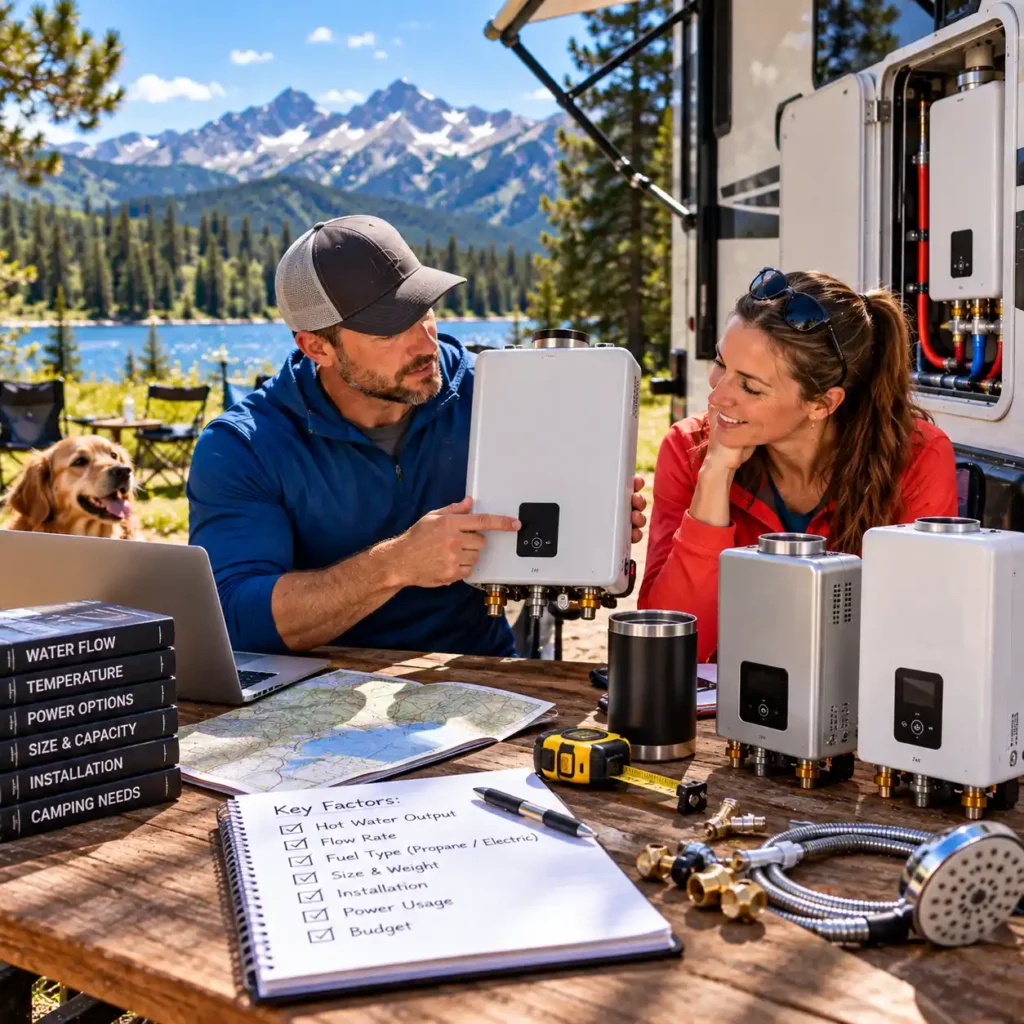
Choosing an RV tankless water heater is less about finding the biggest BTU rating or the highest advertised GPM and more about making sure the heater matches your RV and the way you actually use it.
A good match has to work with the existing installation, propane supply, 12V electrical system, water pressure, and available space. It also needs enough heating capacity for the temperature rise you expect in real camping conditions.
Before buying, work through these checks.
Built-In RV Replacement vs. Portable Water Heater
Start by identifying which type of water heater you actually need.
A built-in RV tankless water heater replaces or upgrades the water heater already installed in the RV. It connects to the RV’s plumbing, propane, and 12V systems and is mounted through the exterior water-heater opening.
A portable propane water heater is a different category. It is designed to be set up outside the RV for applications such as outdoor showers, washing dishes, or cleaning equipment.
This distinction matters because a portable heater is not automatically a substitute for a built-in RV water heater. If your goal is to replace the existing appliance and use the RV’s interior shower and faucets normally, you need to evaluate a heater designed for that installation.
If you simply want hot water outside the RV without modifying the existing water-heater system, a portable model may make more sense.
How Much BTU Do You Need?
BTU tells you how much heating power the burner can provide, but it should not be used as the only way to compare RV tankless water heaters.
The heater has to raise the temperature of the incoming water to your desired outlet temperature. The colder the incoming water, the more heating capacity is required to produce the same hot-water flow.
That is why a 65,000- or 68,000-BTU heater does not automatically deliver a particular amount of hot water under every camping condition.
Think of BTU as heating capacity, not as a direct measurement of shower performance.
For most buyers, the useful questions are:
- How cold is the incoming water likely to be?
- How hot do you want the water?
- How much water does your shower or faucet actually use?
- Will more than one fixture operate at the same time?
- Will the RV be used at higher elevations?
A higher-output heater can provide more heating capacity, but it may also be unnecessary if your actual water demand is modest.
How Much Water Flow Do You Need?
GPM, or gallons per minute, describes water flow through the heater. It is one of the most useful specifications to examine, but maximum GPM can be misleading when viewed without temperature rise.
For example, a heater may advertise a maximum flow of 3.9 GPM, while its usable heated-water flow at a particular temperature rise is considerably lower.
For an RV shower, you generally do not need to chase the highest possible flow number. What matters is whether the heater can maintain the water temperature you want at the flow rate your shower actually requires.
Also consider whether you plan to use two fixtures simultaneously. A shower running at the same time as a kitchen faucet creates substantially more demand than either fixture operating alone.
The practical rule is simple: compare the heater’s flow specifications at a stated temperature rise whenever that information is available, rather than comparing maximum GPM alone.
Check Your RV’s Cutout and Door Dimensions
This is one of the most important checks before ordering a built-in RV tankless water heater.
Measure and verify the existing installation rather than assuming that every “6-gallon replacement” has the same dimensions.
Check:
- Exterior opening dimensions
- Required cutout dimensions
- Door dimensions
- Door or panel compatibility
- Water connections
- Propane connection
- 12V electrical connections
- Venting and exhaust arrangement
- Available installation depth
A heater can have excellent specifications and still be the wrong choice if it does not physically fit your RV.
Replacement panels or doors may also be required for some installations. That is why manufacturer compatibility information should be checked against the specific water heater currently installed in your RV.
Propane and 12V Requirements
Most built-in RV tankless water heaters in this category use propane for heating and 12V DC electricity for the control and operating systems.
That means you need to consider two separate resources.
Propane supplies the heat. The amount consumed depends on the heater’s output and how long it operates, so higher hot-water demand generally means greater propane use.
The 12V system powers components such as controls, ignition, sensors, fans, and other electronics. The actual electrical draw varies between models, so do not assume that every 12V tankless water heater places the same load on your RV battery system.
Before installation, verify the manufacturer’s specified electrical requirements and make sure the RV’s existing wiring and protection are appropriate.
Temperature Control and Water Pressure
Temperature control becomes particularly important with a tankless system because the heater is responding to water flow and temperature conditions rather than storing a fixed volume of already-heated water.
Look for a control system that lets you set the desired temperature clearly and consistently.
Water pressure matters too. The heater needs sufficient flow to activate and maintain operation, while excessive pressure may exceed the unit’s specified operating range.
If your RV has inconsistent campground water pressure or you frequently use a water pump from the onboard tank, the heater’s minimum activation flow and operating-pressure specifications deserve particular attention.
Do not judge a tankless heater only by its maximum GPM. Low-flow activation can be just as important for comfortable showering and normal faucet use.
Freeze Protection and Winter Camping
Freeze protection is an important consideration for RV owners who camp or store their vehicles in cold conditions.
A built-in tankless water heater can contain water in its internal passages and plumbing connections, so simply switching the heater off does not necessarily protect it from freezing temperatures.
Different models use different approaches, including powered freeze-protection systems and passive mechanical protection. Some require 12V power to operate their active protection features.
That means freeze protection should be viewed as a system feature, not a substitute for proper winterization.
If the RV will be stored in freezing conditions, follow the heater manufacturer’s winterization and draining instructions rather than assuming the built-in protection system is sufficient by itself.
What Features Matter Most in an RV Tankless Water Heater
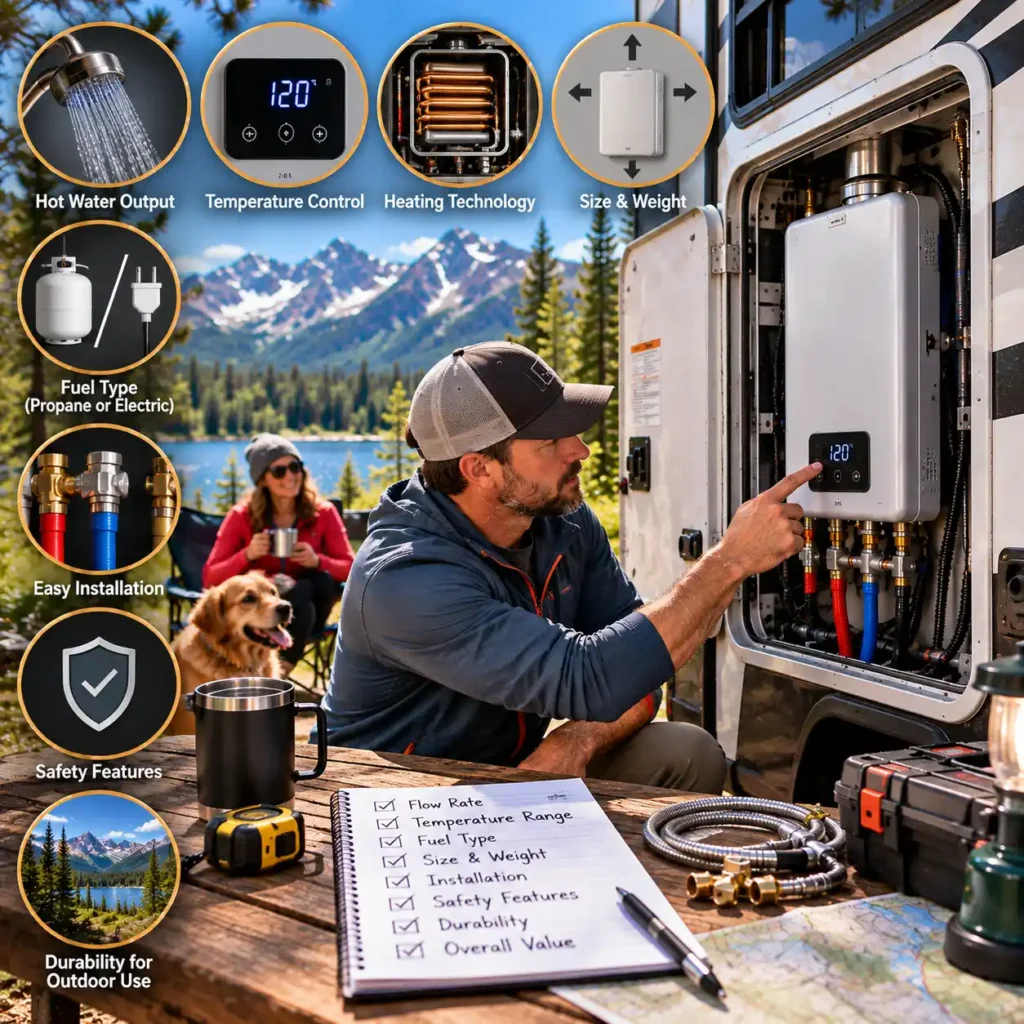
The most important specifications on an RV tankless water heater are not necessarily the ones printed in the largest type on the product page. BTU, maximum GPM, 12V power, temperature range, and replacement dimensions all tell you something about the heater, but none of them should be evaluated in isolation.
The right approach is to look at how these specifications work together and how they match your RV’s water system, propane supply, electrical system, and camping conditions.
Heating Output
Heating output, measured in BTU/h, tells you how much heat the burner can provide.
A higher BTU rating generally gives a tankless heater more capacity to raise incoming water to the desired temperature, particularly when the incoming water is cold. But more BTUs do not automatically mean better performance for every RV.
The useful question is whether the heater has enough heating capacity for your expected water flow and temperature rise.
For example, producing a comfortable shower temperature from cold mountain water requires considerably more heating power than maintaining the same outlet temperature when the incoming water is already relatively warm.
Water Flow
Water flow is measured in gallons per minute (GPM).
This specification tells you how much water can pass through the heater, but the maximum advertised GPM should not be treated as the amount of hot water you will always receive at the shower.
As temperature rise increases, the heater has to devote more energy to heating each gallon of water. That means actual heated-water flow can be lower than the maximum flow figure listed by the manufacturer.
When comparing models, look for performance figures that specify the temperature rise. Those figures provide more useful information than maximum GPM alone.
Low-Flow Activation
A tankless heater needs a minimum amount of water flow before it activates.
This matters in an RV because faucets and showerheads do not always use the same amount of water. A heater with a relatively high activation threshold may struggle to remain running when the water flow is reduced.
Low-flow activation can therefore affect everyday comfort just as much as maximum GPM.
If you prefer low-flow showers or frequently use a faucet at a small flow rate, check the manufacturer’s minimum activation-flow specification before buying.
Temperature Control
Temperature control determines how precisely you can set the water you actually use.
Basic systems may offer relatively simple temperature adjustment, while more advanced RV tankless water heaters use digital or remote controls that allow more precise settings.
Precise control is useful because the ideal temperature can change depending on the fixture and the conditions. You may want a different setting for a shower than for washing dishes, for example.
It also reduces the temptation to compensate for poor temperature control by constantly adjusting the water flow at the faucet.
12V Power Consumption
Built-in RV tankless water heaters typically use propane for heating and 12V DC electricity for their electronic and mechanical operating systems.
The important specification is not simply that a heater is “12V.” You also need to know how much current it draws during operation.
The electrical load can matter when the RV is operating from batteries rather than shore power, particularly during extended off-grid trips.
A heater that uses 12V power for ignition, controls, sensors, and a combustion fan can place a different demand on the battery system than another model. Check the manufacturer’s electrical specifications rather than assuming all 12V RV heaters consume the same amount.
Propane Efficiency
Propane is the primary energy source for the heaters in this comparison.
A tankless system does not maintain a stored volume of hot water continuously, which changes how propane is consumed compared with a conventional tank heater. The burner operates in response to hot-water demand rather than maintaining the temperature of a storage tank.
Actual propane consumption still depends on how much hot water you use, the required temperature rise, burner output, incoming-water temperature, and operating conditions.
For that reason, a manufacturer’s maximum BTU rating should not be interpreted as a fixed propane-consumption figure.
Freeze Protection
Freeze protection is particularly important for RV water heaters because water remaining inside the system can freeze when temperatures fall below freezing.
Different heaters use different approaches. Some provide active freeze protection that requires electrical power, while others incorporate passive mechanical protection or draining mechanisms.
Do not assume that the presence of a “freeze protection” feature means the heater is safe indefinitely in freezing conditions.
If the RV is being stored or left unused in freezing weather, follow the manufacturer’s winterization procedure. Freeze protection should be treated as an additional safeguard, not as a replacement for proper winterization.
Forced Exhaust
Built-in propane RV water heaters need to manage combustion gases safely.
A forced-exhaust system uses a powered fan to move combustion gases through the designated exhaust path. This is different from simply relying on natural convection.
The exhaust system is part of the heater’s installation, not an optional convenience feature. The venting arrangement, exterior opening, clearances, and installation method must match the manufacturer’s requirements.
Because combustion gases are involved, never modify or bypass the specified exhaust system.
Error Codes and Diagnostics
Modern tankless RV water heaters can provide diagnostic information when a problem occurs.
Depending on the model, the system may display an error code or provide information about conditions such as ignition failure, flame loss, overheating, water flow, or other operating faults.
Diagnostics can make troubleshooting easier because they provide more information than a heater that simply stops producing hot water.
However, an error code should not be treated as an invitation to bypass a safety device or repeatedly restart a heater without identifying the underlying problem.
Remote Control
A remote controller can make an RV tankless water heater easier to operate, particularly when the heater itself is mounted outside the living area.
Depending on the model, the controller may provide temperature adjustment, operating information, error codes, or other system data.
This is useful, but it is not an essential feature for every RV owner. If the heater is simple to operate and the control location is already convenient, paying extra for an advanced controller may provide little practical benefit.
Display
A digital display can provide information that is otherwise difficult to determine from the heater itself.
Useful information can include set temperature, water temperature, flow, voltage, operating status, or diagnostic codes, depending on the model.
For RV owners who frequently troubleshoot their own equipment or manage battery and propane usage closely, that additional information can be valuable.
The important distinction is between a display that provides genuinely useful operating information and one that simply shows a temperature number. More information is not automatically more useful.
RV Door Compatibility
For a built-in replacement, exterior door compatibility can be more important than several performance specifications.
The heater has to fit the RV’s existing exterior opening and work with the required door or replacement panel. Two heaters marketed as replacements for the same nominal tank size can still require different installation arrangements.
Before ordering, compare the manufacturer’s cutout and door requirements with the dimensions of the water heater currently installed in your RV.
Never assume that “6-gallon replacement” means every 6-gallon RV water heater uses the same opening.
Installation Requirements
Finally, consider the complete installation rather than the heater itself.
A built-in RV tankless water heater may require connections to:
- The RV propane system
- The 12V electrical system
- Hot- and cold-water plumbing
- The exterior water-heater opening
- The exhaust and venting system
- A control panel or remote controller
The exact requirements vary by model.
Because these are propane-burning RV appliances, installation should follow the manufacturer’s instructions and applicable RV requirements. Where the manufacturer specifies qualified installation or service, use a qualified RV technician rather than treating the replacement as a generic DIY appliance swap.
The best RV tankless water heater is ultimately the one whose output, flow characteristics, controls, power requirements, protection features, and physical installation all match the RV—not the model with the most impressive single specification.
How to Use an RV Tankless Water Heater Safely
An RV tankless water heater combines propane, water, combustion, and 12V electrical systems, so safe operation depends on more than simply turning the heater on. Before using a newly installed unit, make sure the installation follows the manufacturer’s instructions and that the water, propane, electrical, and exhaust systems are properly connected.
Check the Installation
Before operating the heater, verify that it has been installed according to the manufacturer’s instructions for the specific model. Check the mounting arrangement, required clearances, exterior opening, water connections, propane connection, electrical connections, and exhaust system.
If the manufacturer specifies qualified installation or service, use a qualified RV technician. Do not treat a propane-burning RV water heater as a generic plug-and-play appliance.
Confirm Propane and 12V Connections
The heater needs both a reliable propane supply and the correct 12V electrical connection to operate its heating and control systems.
Before use, confirm that the propane connection matches the manufacturer’s requirements and that the 12V wiring, polarity, fusing, and electrical protection are appropriate for the RV and the heater. Do not modify the electrical or propane system beyond the manufacturer’s installation requirements.
Prime the Water System
Before normal operation, make sure water is reaching the heater and that the water system has been properly filled and purged according to the manufacturer’s instructions.
Running the water system before relying on the heater helps confirm that the plumbing is connected correctly and that water can flow through the heater as intended. Never operate the heater without the water flow required by its operating instructions.
Check for Leaks
Inspect the water connections and propane connections after installation and before regular use.
Look for signs of water leakage around the inlet and outlet connections and follow the manufacturer’s procedure for checking the propane system. If you detect a propane leak, do not operate the heater. Follow the RV and appliance manufacturer’s safety procedures and have the system inspected by a qualified professional.
Use Correct Water Flow
Tankless water heaters require a minimum water flow to activate and remain operating. Using a flow rate below the manufacturer’s specified activation threshold can cause the burner to cycle off or prevent the heater from operating normally.
Use the heater within its specified flow and water-pressure range. If the water temperature changes unexpectedly when you reduce the flow, check the heater’s minimum activation-flow requirements rather than repeatedly adjusting the controls without understanding the cause.
Never Operate With a Faulty Exhaust System
A propane-burning RV water heater must discharge combustion gases through the specified exhaust system.
Never operate the heater if the exhaust or venting system is damaged, blocked, improperly installed, or modified. Do not obstruct the exterior exhaust area or bypass any combustion or safety components.
If the heater reports an exhaust, combustion, ignition, or other safety-related fault, stop using it and follow the manufacturer’s troubleshooting and service instructions.
Follow Winterization Instructions
Freeze protection does not eliminate the need for proper winterization.
Water can remain inside the heater and connected plumbing even when the appliance is switched off. Depending on the model, active freeze protection may also require 12V power to function.
If the RV will be stored or exposed to freezing temperatures, follow the manufacturer’s specific winterization, draining, and freeze-protection procedures. Do not assume that an integrated freeze-protection feature alone makes the system safe from freezing.
Do Not Bypass Safety Systems
Never bypass flame-failure protection, overheat protection, pressure protection, freeze protection, error detection, or other safety systems built into the heater.
If a safety system repeatedly shuts the heater down, treat the shutdown as a fault that needs to be identified rather than something to override. Follow the manufacturer’s troubleshooting procedure and use qualified service when required.
Safe operation ultimately comes down to following the heater’s installation and operating instructions, keeping the propane and exhaust systems properly maintained, and making sure the RV’s water and 12V systems can support the appliance as specified.
Common Mistakes When Buying an RV Tankless Water Heater
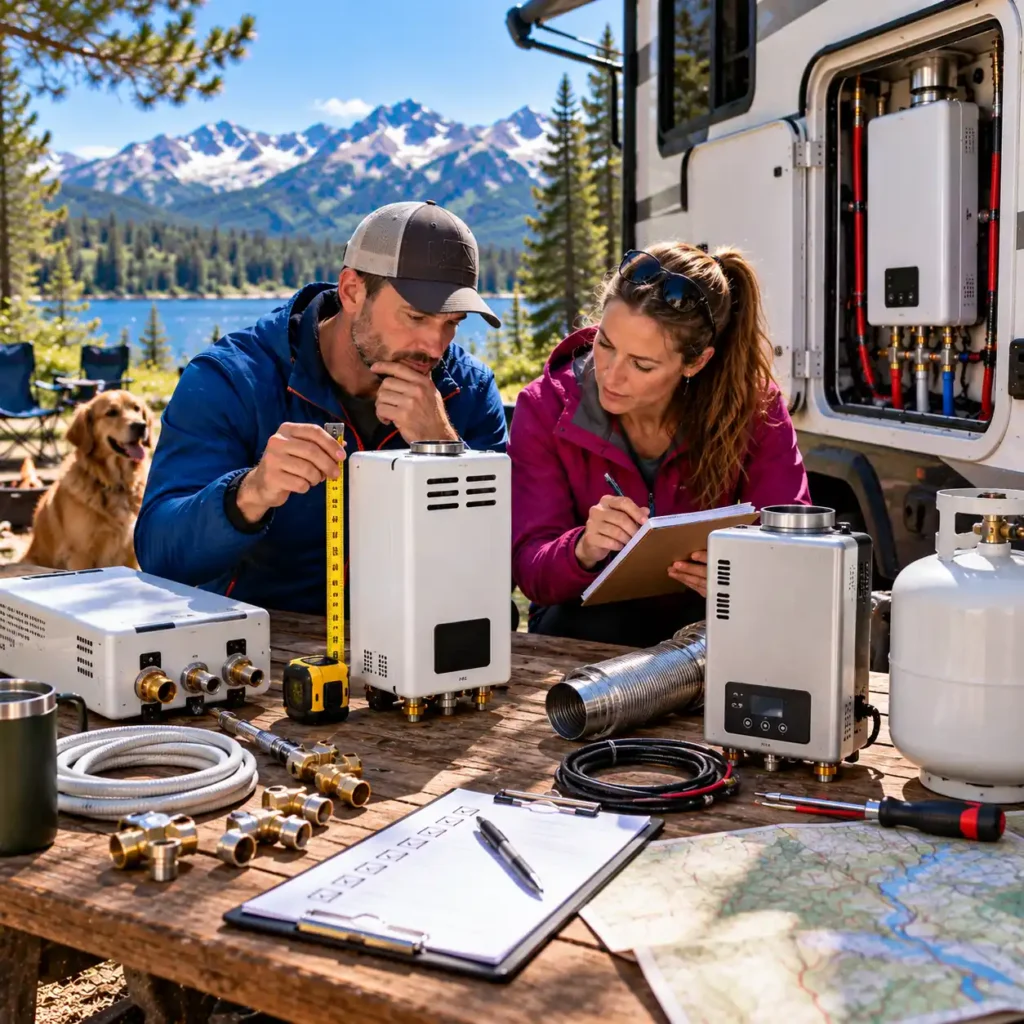
An RV tankless water heater can look like a straightforward upgrade until you start comparing installation dimensions, flow ratings, temperature rise, propane requirements, and 12V power.
Many buying mistakes happen because one attractive specification gets more attention than the complete installation. Avoiding these mistakes can save you from buying a heater that technically looks right on paper but does not match the way your RV actually works.
Buying by BTU Alone
A higher BTU rating does not automatically make one RV tankless water heater better than another.
BTU measures heating capacity. It does not tell you how much hot water the heater will deliver at a particular temperature rise, how much propane it will consume in your specific situation, or whether it will physically fit your RV.
A 65,000- or 68,000-BTU heater can be an appropriate choice for higher demand, but the useful question is whether that additional capacity matches your actual water use.
Look at BTU together with GPM, temperature rise, water pressure, and incoming-water temperature.
Ignoring RV Cutout Dimensions
This is one of the easiest mistakes to make when replacing an existing water heater.
Two products can both be marketed as RV replacement heaters for similar tank sizes while requiring different cutout dimensions, exterior doors, panels, or mounting arrangements.
Before ordering, measure the existing installation and compare it with the manufacturer’s specifications.
Check the:
- Cutout dimensions
- Exterior door or panel
- Mounting requirements
- Water connections
- Propane connection
- 12V connections
- Vent and exhaust arrangement
Do not assume that a product described as a “6-gallon replacement” will automatically fit the opening in your RV.
Ignoring 12V Power Requirements
A heater being labeled “12V” does not tell you how much electricity it actually uses.
The RV battery system may power ignition, controls, sensors, a combustion fan, and other components. Electrical demand varies by model and operating conditions.
This matters most when camping without shore power. A heater that is perfectly practical when connected to campground electricity may place a different burden on the battery system during extended boondocking.
Check the manufacturer’s specified voltage and electrical consumption before installation, and make sure the RV’s wiring and electrical protection are appropriate for the appliance.
Confusing Maximum GPM With Real-World Hot-Water Flow
Maximum GPM is one of the most commonly misunderstood specifications in tankless water-heater shopping.
A manufacturer may list a maximum flow of 3.9 GPM, but that does not mean the heater can continuously deliver 3.9 GPM of water at your desired shower temperature.
The heater’s available hot-water flow depends on the required temperature rise. Colder incoming water requires more heating energy, which can reduce the amount of water the system can heat to the selected temperature.
When available, compare performance at a stated temperature rise rather than relying exclusively on the maximum GPM number.
Buying a Portable Heater for a Built-In Replacement
A portable propane water heater and a built-in RV tankless water heater serve different purposes.
Portable models can be useful for outdoor showers, washing dishes, and other temporary point-of-use applications. They generally do not replace the permanently installed water heater that supplies an RV’s interior plumbing.
If your goal is to upgrade the RV’s existing shower and faucets, look for a built-in RV replacement designed to connect to the vehicle’s plumbing, propane, 12V system, and exterior water-heater opening.
This distinction is especially important because portable does not mean interchangeable with an RV replacement heater.
Ignoring Incoming Water Temperature
Tankless heaters do not heat water from a fixed starting temperature.
If the water entering the heater is relatively warm, the system has an easier job reaching your selected outlet temperature. If the incoming water is cold, the required temperature rise is much greater.
This can become particularly noticeable during cold-weather camping or when using water from a cold campground supply.
That is why published flow specifications need context. A heater may deliver a certain flow under one temperature-rise condition and substantially less under another.
Forgetting Winterization
Freeze protection is useful, but it does not eliminate the need to winterize an RV water system.
Water can remain inside the heater and connected plumbing, and freezing can damage components even when the heater includes built-in protection.
Active freeze-protection systems may also depend on 12V power and other operating conditions.
If the RV will be stored or left unused in freezing weather, follow the manufacturer’s winterization and draining instructions. Do not rely on the heater’s freeze-protection feature as a substitute for proper winter storage procedures.
Assuming Every 6-Gallon Replacement Is Identical
“6-gallon replacement” describes the approximate class of the existing tank heater. It does not guarantee that every replacement model uses the same opening, door, connections, or installation method.
This is particularly important when comparing products from different RV appliance manufacturers.
Before buying, identify the exact water heater currently installed in your RV and compare its installation requirements with the replacement manufacturer’s documentation.
A few minutes spent checking compatibility can be much more valuable than choosing a heater based solely on BTU or GPM.
Paying for Features You Do Not Need
More features are not automatically better for every RV owner.
A remote controller, digital display, additional diagnostics, high-altitude capability, and multiple protection systems can all be useful. But their value depends on how and where you use the RV.
If you primarily take short trips at established campgrounds and rarely operate off-grid, some advanced features may have little practical impact on your experience.
On the other hand, frequent boondockers, high-altitude travelers, and owners who regularly troubleshoot their own RV systems may place considerably more value on those features.
The goal is not to buy the heater with the longest feature list. Choose the features that solve problems you are actually likely to encounter while camping.
Frequently Asked Questions About RV Tankless Water Heaters
Are RV tankless water heaters worth it?
For many RV owners, yes, especially if you regularly camp with full hookups, travel with several people, or are tired of waiting for a storage tank to recover between showers. A tankless RV water heater can provide continuous hot water as long as the RV has water, propane, and the required 12V power.
The trade-off is that tankless systems are more sensitive to water flow, incoming water temperature, and installation compatibility. They can also use more water during the initial warm-up or when the water is repeatedly turned off and back on. For extended boondocking where conserving fresh water is a priority, a traditional tank heater may still make more sense.
What are the disadvantages of a tankless water heater in an RV?
The main disadvantages are flow sensitivity, cold-water performance, installation requirements, and the potential for water waste during warm-up. A tankless heater must maintain a suitable water flow to operate correctly and regulate temperature.
You also need to match the heater to your RV’s cutout, propane connection, water connections, 12V system, and exhaust requirements. In cold weather, the heater may deliver less usable hot-water flow because more heating capacity is required to raise the temperature of very cold incoming water.
Can I replace my 6-gallon RV water heater with a tankless model?
Often, yes, but you should never assume that every 6-gallon RV water heater is a direct replacement. Tankless replacement models are designed around specific installation dimensions, exterior-door sizes, connection locations, and existing RV water-heater configurations.
Before buying, measure the existing cutout and verify the manufacturer’s compatibility information for your exact RV and water-heater model. A heater that is marketed as a 6-gallon replacement may still require a different door, trim kit, adapter, or installation work.
How many GPM do I need for an RV tankless water heater?
For a typical RV shower, roughly 1.5 to 2.5 GPM is generally enough for comfortable use. A higher maximum GPM rating can be useful when you want stronger flow or need to supply more than one fixture, but maximum GPM should not be treated as the amount of hot water the heater will always deliver.
Actual hot-water flow depends on incoming water temperature, desired outlet temperature, water pressure, and the heater’s available heating capacity. In colder conditions, usable hot-water flow can be substantially lower than the advertised maximum.
Why does an RV tankless water heater produce less hot water in cold weather?
Tankless heaters have to raise the temperature of incoming water while it is flowing through the heat exchanger. The colder the incoming water, the more heat is required to reach the same outlet temperature.
That means a heater may deliver its advertised maximum flow under favorable conditions but require a lower flow rate when the incoming water is very cold. This is one reason BTU output and real-world temperature rise matter more than the maximum GPM number by itself.
Why does my RV tankless water heater turn off when I reduce the water flow?
Tankless heaters require a minimum flow rate to detect demand and keep the burner operating. If you reduce the water flow below that operating threshold, the heater may shut down rather than continue heating.
This can become noticeable during a shower when you turn the water down to conserve fresh water. The exact minimum activation flow varies by model, so it is important to check the specifications for the heater you are considering rather than assuming all RV tankless systems behave the same way.
Do RV tankless water heaters waste more water when boondocking?
They can. A tankless heater does not store a supply of already-heated water, so you may have to let water run while the system brings the water up to temperature. Repeatedly turning the water off can also result in another period of cool water when you turn it back on.
That matters much more when boondocking because every gallon comes from the RV’s fresh-water tank and eventually goes into the gray-water tank. If water conservation is one of your main priorities, consider how the heater behaves at low flow and whether your setup allows you to capture or recirculate water during warm-up.
How much 12V power does an RV tankless water heater use?
Built-in RV tankless water heaters normally use the RV’s 12V DC electrical system for controls, ignition, sensors, and, on some models, the combustion/exhaust fan. The actual electrical draw varies significantly between models.
For that reason, do not judge a heater’s electrical requirements from the propane BTU rating alone. Check the manufacturer’s stated 12V requirements and consider how the heater’s electrical load fits into your battery and boondocking setup.
How long does it take an RV tankless water heater to produce hot water?
The heater itself can begin heating water almost immediately after it detects sufficient flow, but hot water still has to travel through the RV’s plumbing from the heater to the faucet or shower.
The actual delay depends on the distance between the heater and the fixture, the plumbing layout, water flow, and the heater’s control system. A short delay is normal; it does not necessarily mean the heater is malfunctioning.
Can an RV tankless water heater run two fixtures at the same time?
It depends on the heater’s heating capacity, water flow, incoming water temperature, and the combined demand of both fixtures. A unit may handle a shower and faucet simultaneously under favorable conditions but struggle to maintain the same temperature when the incoming water is cold.
If using two fixtures at once is important, look beyond the maximum GPM rating. Compare the heater’s BTU output, expected temperature rise, operating flow range, and your RV’s actual water-pump and plumbing capacity.
Do RV tankless water heaters work for winter camping?
Yes, many are designed for cold-weather RV use and include some form of freeze protection. However, freeze protection is not the same thing as complete winterization.
Automatic freeze protection generally depends on the heater having the necessary 12V power and propane available. If the RV will be stored in freezing conditions, lose power, or remain unused for an extended period, the water heater and RV plumbing should still be properly drained and winterized according to the manufacturer’s instructions.
Can I use a portable propane tankless water heater in an RV?
A portable propane water heater can be useful for outdoor showers, washing equipment, van camping, or temporary hot-water setups, but it is not automatically a replacement for a built-in RV water heater.
Portable and built-in RV systems solve different problems. A built-in RV tankless heater is designed to connect to the RV’s existing plumbing, propane system, 12V electrical system, and exterior water-heater opening. A portable unit is generally intended for temporary outdoor use and should be installed and operated only as directed by its manufacturer.
Does altitude affect an RV tankless water heater?
It can. Propane combustion and available heating performance can change at higher elevations, and some RV tankless water heaters are specifically designed or adjusted for high-altitude operation.
If you regularly camp at high elevations, check the manufacturer’s altitude specifications before buying. Do not assume that two heaters with similar BTU ratings will have identical high-altitude performance.
Final Verdict: Which RV Tankless Water Heater Is Best for Camping?
An RV tankless water heater is a system component, not simply another camping appliance. The most important decision is whether the heater will work properly with the RV you already have and with the way you use it.
Before placing an order, work through the following checks.
Which RV Tankless Water Heater Is Best for Most Campers?
There is no single specification that determines whether a tankless water heater is the right choice for an RV. A successful installation depends on several systems working together: the water supply, propane system, 12V electrical system, exterior opening, ventilation, and the heater itself.
For most RV owners, the decision should therefore begin with compatibility rather than performance numbers. If the heater does not match the existing installation, a higher BTU rating or larger maximum GPM will not make it a better fit.
Which One Should You Choose for Your RV?
Start with your existing water heater.
If you are replacing a conventional RV water heater, measure the exterior opening and compare the dimensions, connection locations, door requirements, and installation specifications before looking at performance. This eliminates models that cannot realistically fit your RV.
Next, consider how you use hot water. One person taking a normal shower places very different demands on a heater than a family using a shower and kitchen faucet at the same time. Your expected water flow should determine how much heating capacity you actually need.
Then consider your camping style. Full-hookup camping, weekend trips, extended boondocking, and winter camping each place different demands on the combination of propane, 12V power, fresh water, and freeze protection.
Finally, consider installation. A purpose-built RV replacement and a portable propane water heater are not interchangeable categories. If you need a permanent replacement for an existing RV appliance, the heater must be designed for that type of installation.
The Most Important Thing to Get Right
The most important number on an RV tankless water heater is not necessarily the largest number printed on the specification sheet.
A useful evaluation starts with four questions:
Will it fit?
Verify the cutout, exterior door, installation depth, and connection configuration.
Can my RV support it?
Check the propane supply, 12V electrical requirements, water pressure, and installation requirements.
Can it deliver the water temperature I need?
Consider incoming water temperature, desired outlet temperature, available heating capacity, and actual operating flow—not maximum GPM alone.
Does it suit the way I camp?
Boondocking, cold-weather camping, high-altitude travel, and regular full-hookup use can all change which specifications matter most.
Once those questions are answered, choosing between otherwise suitable models becomes much easier. You are no longer comparing numbers in isolation; you are matching the water heater to a specific RV and a specific camping routine.
That is ultimately the right way to approach an RV tankless water heater purchase in 2026: fit first, system compatibility second, real-world hot-water demand third, and convenience features last.
The CampComfortGuide Promise
At CampComfortGuide, we believe camping equipment should be judged by how well it fits the way people actually camp—not by a specification sheet alone.
With RV tankless water heaters, that means looking beyond BTU and maximum GPM. A heater also has to make sense for the RV’s existing installation, water system, propane supply, 12V electrical system, hot-water demand, and camping conditions. Those details can matter just as much as the headline specifications.
We also believe that a useful recommendation should include the limitations, not just the advantages. A higher-output heater is not automatically the right choice, and a feature-rich model is not necessarily better for every RV. Compatibility, practical performance, installation requirements, and the way you camp all matter.
Our goal is simple: give you enough reliable information to understand the equipment, recognize the trade-offs, and choose an RV water-heating system that makes sense for your particular rig and camping style.