
Cold nights can change the entire experience of an overlanding trip. A well-equipped vehicle may carry your shelter, cooking gear, recovery equipment, and supplies, but staying comfortable when temperatures drop requires a heating plan that suits your setup. For campers who spend time in remote areas or travel during colder months, a portable diesel heater can be worth considering.
Unlike a traditional fuel-burning space heater designed to warm the surrounding air directly, a diesel air heater burns fuel in a combustion chamber and transfers heat to a separate stream of air. When correctly installed and operated according to the manufacturer’s instructions, this design can provide warmth for a compatible vehicle or enclosed living space while keeping combustion exhaust separate from the heated airflow. Safe installation, exhaust routing, ventilation, and carbon monoxide precautions remain essential.
The challenge is choosing a unit that fits your vehicle, available power supply, expected temperatures, and travel style. Advertised heating output alone does not tell the whole story. Fuel consumption, electrical demand during startup and operation, control options, altitude capability, included components, and the complexity of installation can all affect how practical a heater will be on an overlanding trip.
In this guide, we compare five portable diesel heaters from VEVOR, HCALORY, LF Bros, and WAYSKA to help you understand their intended uses and the differences worth checking before you buy. We’ll focus on the available product specifications, practical setup considerations, and the questions to ask before choosing a heater for your rig. Because product configurations can differ, verify the exact model and its current manufacturer documentation before relying on any advertised rating.
As an Amazon Associate I earn from qualifying purchases.

Table of Contents
Quick Answer
The best portable diesel heater for overlanding depends on how you travel, where you camp, and how much installation work you’re prepared to handle. A self-contained unit with an integrated fuel tank and controls can be convenient for a vehicle-based setup, while a more traditional heater may suit travelers who are comfortable planning a separate installation.
For this comparison, we selected five models to examine: the VEVOR 8KW Diesel Heater, HCALORY 8KW Diesel Heater, LF Bros 5KW All-in-One Diesel Heater, VEVOR All-in-One Diesel Heater, and WAYSKA 12V Diesel Heater. They represent different configurations and advertised power ratings, giving buyers a starting point for comparing the features that matter during cold-weather travel.
Before choosing one, look beyond the wattage printed in a product listing. Check the manufacturer’s documented heating output, fuel consumption, startup and running power requirements, control options, fuel-tank capacity, and whether the supplied components match your intended installation. Advertised ratings can vary by model and configuration, so specifications should be verified against the exact unit being sold.
A diesel air heater also requires more planning than a simple plug-in camping accessory. The combustion system and exhaust must be installed and routed correctly, and the heater must be operated according to its manufacturer’s safety instructions. Never run a fuel-burning heater in a tent or other enclosed living space unless the specific equipment and installation are explicitly designed and approved for that use. Carbon monoxide exposure can be fatal.
Our goal is to help you narrow the options, understand the trade-offs, and identify the technical details worth confirming before you buy. The detailed reviews and comparison table below will distinguish verified specifications from claims that still need confirmation.
Why You Can Trust This Guide
Choosing a portable diesel heater involves more than comparing advertised wattage or picking the unit with the longest feature list. Fuel consumption, electrical requirements, control options, installation demands, and safety instructions all affect whether a heater is suitable for a particular overlanding setup.
At CampComfortGuide, our approach is to evaluate camping equipment against the practical requirements of its intended use. For this guide, that means looking beyond product-listing claims and examining the technical details buyers should verify before committing to a diesel heating system.
Manufacturer Specifications Come First
We use available manufacturer product pages, technical documentation, and installation instructions to establish the specifications for each model. Where information differs between listings or configurations, we avoid treating the figures as interchangeable. Advertised heating output, fuel consumption, tank capacity, voltage, and included accessories must correspond to the exact model being discussed.
Practical Considerations Matter
A heater that looks suitable on paper may not fit every vehicle or campsite. We consider how its power supply, fuel system, controls, portability, and installation requirements affect everyday use. We also distinguish between a self-contained portable unit and a heater that requires additional components or a more involved installation.
Safety Is Part of the Evaluation
Diesel heaters use combustion and require careful exhaust management. We take manufacturer safety instructions seriously, particularly regarding exhaust routing, ventilation, carbon monoxide exposure, electrical connections, and safe placement. A product should never be described as safe for an enclosed sleeping space simply because it is marketed for camping or vehicle use.
Clear Limits on Our Claims
This comparison is based on available product information and documented specifications, not a claim that all five models have undergone independent, side-by-side field testing. We distinguish published manufacturer claims from independently verified facts and avoid presenting advertised performance figures as guaranteed real-world results.
For readers planning a complete vehicle-based setup, our guide to building a vehicle camping setup explains how equipment choices, available space, and power requirements need to work together.
Our aim is straightforward: help you compare the options carefully, identify the specifications that still need confirmation, and make a better-informed decision before buying a diesel heater for overlanding.
What Makes This Guide Different?
Portable diesel heaters can look remarkably similar in product listings, yet differences in design and installation requirements can affect how well they fit an overlanding setup. A useful comparison needs to look beyond advertised kilowatt ratings and identify the details that influence the buying decision.
This guide focuses on five practical questions:
Portable design vs. installation needs: Does the unit arrive in a self-contained housing, or will your setup require additional components and mounting work?
Fuel and electrical demands: What does the manufacturer specify for fuel consumption, voltage, startup current, and ongoing power draw?
Controls and convenience: Does the model include a remote, an LCD controller, an app, or another control method, and are those features confirmed for the exact version?
Cold-weather suitability: What operating conditions and altitude limits does the manufacturer document, and what limitations should buyers understand?
Safety and setup: What do the instructions say about exhaust routing, ventilation, electrical connections, and placement?
We also distinguish confirmed specifications from advertised claims that need further verification. This matters because a product listing may describe a heater as an “8KW” or “5KW” model without providing enough evidence to establish its actual usable heat output under specific conditions.
The goal is not to declare one heater universally best. It is to help you match a suitable model to your vehicle, available power, expected camping conditions, and willingness to handle installation and maintenance.
For a broader view of the equipment that works together in a vehicle-based campsite, see our vehicle camping gear guide.
Our Selection Criteria: Heating Output, Fuel Use, and Setup Requirements
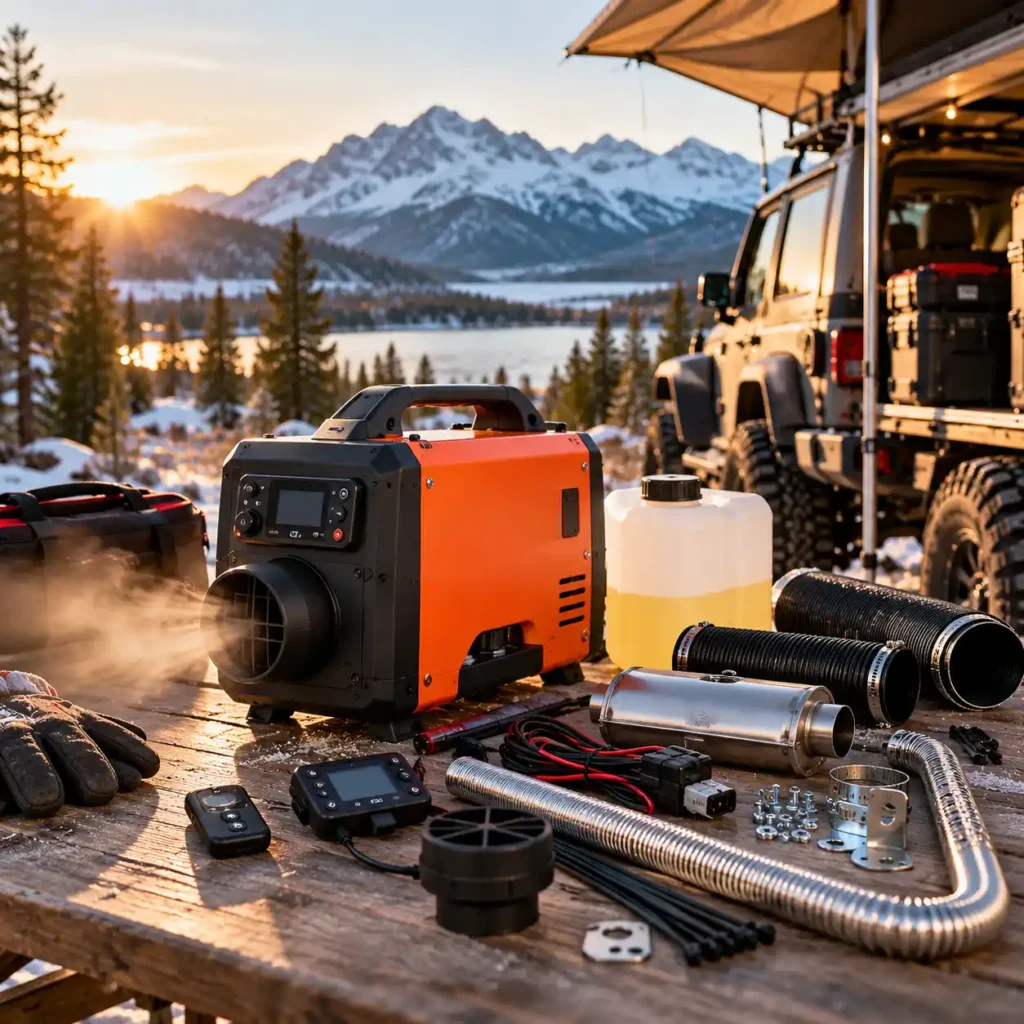
Selecting a portable diesel heater for overlanding requires more than comparing the wattage shown in a product title. Two units advertised with similar power ratings may differ in their construction, fuel capacity, control system, electrical requirements, and installation needs. We selected five models for comparison to examine those differences and help buyers identify which details deserve the closest attention.
Product Selection Criteria
1. Portable Design and Included Equipment
We considered the overall configuration of each heater, including whether it uses an integrated housing and fuel tank, what controls are supplied, and which installation components are listed in the package. A self-contained design can simplify transport, but buyers should still confirm the complete contents and any additional equipment required for their intended setup.
2. Advertised Heating Output
The five selected products include models advertised as 5 kW or 8 kW. These figures are manufacturer or seller claims, not independent measurements of delivered heat. We treat the advertised rating as a starting point and avoid assuming that two heaters with the same stated output will perform identically.
3. Fuel Capacity and Consumption
Fuel-tank capacity and published consumption figures help buyers estimate how a heater may fit into a longer trip. However, consumption depends on operating conditions and the selected heat setting. We use figures only when they can be matched to the exact product configuration, rather than transferring specifications from a similar model.
4. Electrical Requirements and Controls
A diesel air heater needs electrical power to operate its control system, fuel pump, and ignition components. We therefore consider the stated voltage, available control methods, and documented electrical requirements. Buyers should check startup current as well as ongoing power draw before deciding whether a vehicle battery or portable power station is suitable.
5. Installation and Safety Information
We also consider the information available about installation, exhaust routing, ventilation, and operating limitations. These are essential factors, not optional extras. A portable housing does not make a combustion heater safe to operate inside a tent, vehicle cabin, or other enclosed space without an appropriate manufacturer-approved installation.
The Five Models in This Comparison
The shortlist includes the VEVOR 8KW Diesel Heater, HCALORY 8KW Diesel Heater, LF Bros 5KW All-in-One Diesel Heater, VEVOR All-in-One Diesel Heater, and WAYSKA 12V Diesel Heater. We will evaluate them using the same criteria wherever comparable information is available.
Manufacturer documentation supports some model specifications, including VEVOR’s published details and HCALORY’s M98 product specifications.
Other details must be checked against the exact Amazon listing and corresponding manufacturer documentation before being presented as confirmed facts. Where information cannot be verified, we will identify that limitation rather than fill the gap with an assumption.
This approach keeps the comparison focused on useful buying information while distinguishing published claims from independently tested performance.
Who Should Consider a Portable Diesel Heater for Overlanding?

A portable diesel heater makes the most sense for overlanders who regularly travel in cold weather, spend multiple nights away from powered campsites, and have a suitable vehicle-based shelter or other approved space to heat. It can be a useful addition to a truck camper, enclosed canopy, camper van, or similar setup when the heater is correctly installed and operated according to its instructions.
Cold-Weather Overlanders
If you camp during late autumn, winter, or early spring, a diesel heater may help maintain a more comfortable temperature in a properly configured living space. The right model depends on the size and insulation of that space, the expected outdoor temperatures, and the heater’s documented minimum and maximum output. A higher advertised wattage is not automatically better: an oversized heater may be poorly matched to a small, well-insulated sleeping area.
Travelers Who Spend Several Nights Off-Grid
Diesel air heaters use fuel for combustion but also need electricity for components such as the fan, controller, fuel pump, and ignition system. They may suit travelers who want sustained heating without running a vehicle engine continuously, provided their battery system can handle the startup demand and ongoing electrical load. Check the exact heater’s power requirements before relying on a portable power station or auxiliary battery.
Vehicle-Based Campers With a Suitable Installation
A portable, all-in-one design can be convenient for some vehicle-based setups because the heater and fuel tank are housed together. However, portability does not remove the need for safe exhaust routing, suitable combustion-air intake placement, electrical protection, and compliance with the manufacturer’s instructions. Some configurations may require additional installation work or accessories.
DIY Travelers Who Are Comfortable With Technical Setup
Budget diesel heaters can involve more setup and troubleshooting than a simple plug-in appliance. Buyers should be prepared to understand the wiring, fuel system, exhaust components, maintenance requirements, and operating limits. If you are not confident working with combustion equipment, having the installation assessed or completed by a qualified professional is the more prudent option.
Who May Be Better Off With Another Heating Solution?
A diesel heater may not be the right purchase if you only camp in mild weather, sleep in an open tent, or lack a suitable way to route combustion exhaust safely outside an occupied space. In those situations, improving your sleeping bag, insulated sleeping pad, shelter, and clothing may be a better first step. For anyone considering a heater, safety and suitability should take priority over advertised output or price.
Quick Summary: Best Portable Diesel Heaters for Overlanding
Not every portable diesel heater is designed for the same overlanding setup. Some prioritize an all-in-one configuration, while others differ in advertised heating output, fuel capacity, control options, and electrical requirements. The right choice depends on your vehicle, the space you need to heat, your available power supply, and the installation you can safely accommodate.
The five diesel heaters below represent different options to investigate when comparing heating systems for overlanding. Before choosing a winner in each category, verify the exact product configuration, manufacturer specifications, fuel consumption, electrical requirements, and included components.
1. VEVOR 8KW Diesel Heater
Award: Best Budget-Oriented Candidate
Why:
The VEVOR 8KW Diesel Heater is worth comparing if you want to explore an accessible diesel-heating option for a vehicle-based camping setup. Before buying, check the exact heater configuration, documented heat output, fuel-tank capacity, electrical requirements, and included accessories. Its overall value depends on whether the supplied components suit your installation without requiring additional equipment.
2. HCALORY 8KW Diesel Heater
Award: Best All-in-One-Style Candidate
Why:
The HCALORY 8KW Diesel Heater is a candidate to investigate if you prefer a portable configuration with integrated components and convenient controls. Check the exact model number and verify the manufacturer’s specifications for heating output, fuel consumption, tank capacity, power draw, and altitude capability. Confirm which accessories and control options are included in the specific listing before comparing its overall value with other models.
3. LF Bros 5KW All-in-One Diesel Heater
Award: Best 5KW-Class Candidate
Why:
The LF Bros 5KW All-in-One Diesel Heater is worth considering if you want to compare a lower advertised output class with the 8KW-labelled alternatives. Its suitability depends on the space being heated, insulation, expected outdoor temperatures, and the heater’s documented output range. Verify the precise LF Bros model, voltage configuration, fuel consumption, and included installation components rather than assuming that specifications from a related model also apply.
4. VEVOR All-in-One Diesel Heater
Award: Best Alternative VEVOR Configuration
Why:
This separate VEVOR all-in-one configuration is worth comparing if you want a self-contained heater that can be transported as part of a vehicle-based setup. Do not assume it has the same specifications as the VEVOR 8KW model listed above. Check its exact heating rating, fuel-tank capacity, voltage, control system, electrical demand, and included components before deciding whether it suits your intended installation.
5. WAYSKA 12V Diesel Heater
Award: Best Compact-Output Candidate
Why:
The WAYSKA 12V Diesel Heater is listed as a 2KW-class option, making it a different proposition from the models advertised as 5KW or 8KW. A lower-output heater may be worth investigating for a suitably sized, insulated space, but the correct choice depends on its verified output range and the conditions in which you plan to camp. Confirm the current listing, exact model, fuel-tank capacity, electrical requirements, and included controls before purchasing.
Which Portable Diesel Heater Should You Choose?
Start by matching the heater’s verified output to the size and insulation of the space you need to heat. Then compare fuel consumption, startup and running power requirements, tank capacity, control options, and the work required for a safe installation. Do not choose solely by the advertised kilowatt rating: specifications can differ between configurations, and a higher rating does not automatically mean a better fit for your setup.
A diesel air heater also requires correct exhaust routing, appropriate ventilation, and compliance with the manufacturer’s safety instructions. Never operate one in an enclosed sleeping space unless the specific equipment and installation are explicitly designed and approved for that use. Carbon monoxide exposure can be fatal.
Before choosing a heater, verify the exact product specifications and make sure the complete setup is appropriate for your vehicle, available power supply, and intended camping conditions. If you are planning your electrical system for off-grid trips, our guide to choosing the right portable power station for camping can help you understand the power requirements of your equipment. Prioritize safe installation and documented performance over advertised wattage alone.
Compare the Best Portable Diesel Heaters for Overlanding at a Glance
The five portable diesel heaters in this comparison differ in their advertised output, configuration, and intended setup. The table below highlights the main details to check before choosing a model. Where specifications have not been confirmed for the exact product listing, they are marked as requiring verification rather than treated as established facts.
| Heater | Advertised Output | Configuration | Key Details to Verify |
|---|---|---|---|
| VEVOR 8KW Diesel Heater | 8 kW advertised | Exact configuration requires confirmation | Fuel-tank capacity, fuel consumption, electrical demand, included controls |
| HCALORY 8KW Diesel Heater | 8 kW advertised | Exact HCALORY model requires confirmation | Heating-output range, fuel consumption, altitude capability, control options |
| LF Bros 5KW All-in-One Diesel Heater | 5 kW advertised | All-in-one | Exact model number, voltage options, fuel consumption, included components |
| VEVOR All-in-One Diesel Heater | Verify exact listing | All-in-one | Advertised output, tank capacity, voltage, controls, included accessories |
| WAYSKA 12V Diesel Heater | 2 kW reported; verify listing | Exact configuration requires confirmation | Current availability, model identity, tank capacity, fuel consumption, electrical requirements |
What Matters Most When Comparing These Heaters
Heating output: Match the documented output range to the size and insulation of the space you intend to heat. The advertised kilowatt figure alone does not establish real-world performance.
Fuel consumption: Check the manufacturer’s stated consumption range and the conditions under which it applies. Do not assume that similarly advertised heaters use the same amount of fuel.
Electrical requirements: Confirm startup current and ongoing power draw before pairing a heater with a vehicle battery or portable power station.
Configuration and included components: An all-in-one housing may simplify transport, but you still need to confirm the supplied equipment and the requirements for safe installation.
Safety and operating limits: Follow the manufacturer’s instructions for exhaust routing, combustion-air intake, ventilation, and operation. A portable design does not remove the risks associated with combustion equipment.
Use this comparison as a starting point, then verify each specification against the exact product and its current manufacturer documentation before making a purchase decision.
Our Top Picks: Portable Diesel Heaters for Overlanding
1. VEVOR 8KW Diesel Heater
Award: Best Budget-Oriented Candidate

The VEVOR 8KW Diesel Heater is a candidate for overlanders looking for a diesel-powered air-heating system without immediately committing to a more expensive, vehicle-specific heating installation. Its appeal is the combination of an advertised 8 kW heating rating, a 12V power supply, adjustable temperature controls, and remote operation. However, the advertised output is only one part of the buying decision. The exact heater configuration, electrical requirements, fuel consumption, altitude capability, and installation components all need to be considered before deciding whether this model fits your setup.
Overview
VEVOR markets diesel air heaters for vehicles and other applications where a separate fuel-burning heating system can provide warm air. The heater burns diesel in a combustion chamber and transfers heat through a heat exchanger to the air delivered into the space being heated. This design separates the combustion process from the heated airflow, but the exhaust system must still be installed and routed correctly.
The Amazon listing associated with this model identifies it as an upgraded 8KW diesel parking heater with automatic altitude adjustment, Bluetooth app control, a remote, and an LCD controller. VEVOR’s published specifications for related 12V 8 kW configurations include different fuel-tank sizes and consumption figures, so those figures should not automatically be treated as specifications for every version of the product.
For an overlanding setup, the key question is whether the particular unit provides the right balance of heat output, fuel autonomy, electrical demand, and installation practicality. Buyers should verify the current Amazon listing and the documentation for the exact model before relying on any advertised specification.
Key Features
Advertised 8 kW heating output
The product is marketed as an 8 kW diesel heater. This rating provides an initial point of comparison, but it should not be treated as independently verified usable heat output. The right heater depends on the size and insulation of the space, the outdoor temperature, and the manufacturer’s documented operating range. A higher advertised rating is not automatically an advantage in a small, well-insulated sleeping area.
12V electrical system
The listed configuration is intended for a 12V power supply. This may suit some vehicle-based electrical systems, but compatibility should never be assumed from voltage alone. Confirm the startup current, continuous electrical draw, fuse requirements, wiring specifications, and any power-supply limitations in the manual before connecting the heater to a starter battery, auxiliary battery, or portable power station.
LCD controller and remote operation
The associated product information identifies an LCD controller and remote control. These options can make it more convenient to adjust the heater without accessing the main unit directly. Check whether Bluetooth app control and automatic altitude adjustment are included in the exact version being sold, rather than assuming that every VEVOR 8 kW heater has identical controls and features.
Diesel fuel operation
The heater uses diesel for combustion and electricity to operate its fan, controller, fuel pump, and ignition components. This means trip planning must account for both fuel availability and electrical capacity. Estimate fuel needs using the documented consumption range for the exact model and the number of hours you expect to run it, allowing for changes in operating conditions.
Vehicle-oriented installation components
VEVOR’s heater configurations are supplied with different combinations of installation accessories. Before purchasing, confirm the actual package contents, including the exhaust components, combustion-air intake, hot-air ducting, fuel lines, wiring harness, mounting hardware, and controller. Missing or incompatible components can add cost and delay installation.
Technical Specifications
The following details distinguish the advertised product identity from specifications that still need to be confirmed against the exact Amazon configuration.
| Specification | Details |
|---|---|
| Brand | VEVOR |
| Product | 8KW Diesel Heater, upgraded version |
| Advertised heating output | 8 kW |
| Fuel type | Diesel |
| Listed electrical system | 12V |
| Control options | LCD controller and remote; verify app-control compatibility |
| Altitude capability | Automatic altitude adjustment is advertised for the associated upgraded listing; confirm the documented operating limit |
| Fuel-tank capacity | Verify the exact version |
| Fuel consumption | Verify the exact version |
| Startup current | Confirm in the manufacturer’s manual |
| Continuous power draw | Confirm in the manufacturer’s manual |
| Included installation components | Check the current Amazon package description |
| Product link | View the VEVOR 8KW Diesel Heater on Amazon |
Important specification note: VEVOR sells several diesel-heater configurations with similar names and advertised power ratings. Published specifications for one configuration should not be copied to another solely because both are labelled 8 kW. Confirm the exact model and its current documentation before using tank capacity, fuel consumption, dimensions, or altitude limits for trip planning.
What Makes the VEVOR 8KW Worth Considering for Overlanding?
A candidate for budget-conscious vehicle setups
VEVOR is worth investigating if you want to compare a budget-oriented diesel heater with more specialized vehicle-heating systems. The purchase price alone, however, does not establish overall value. The final cost depends on the included components, the electrical setup already available in your vehicle, any additional installation materials, and whether professional installation is needed.
Remote control can be useful at camp
A remote can make temperature adjustments more convenient when the heater is installed in an accessible but separate location. The benefit depends on the actual control system and its documented operating range. Buyers should also understand the controller’s functions and shutdown procedure before relying on remote operation during a trip.
Potential suitability for extended cold-weather trips
A diesel air heater may be useful during longer trips when temperatures fall and a properly configured vehicle-based living space needs sustained heating. Practical suitability depends on the heater’s verified output, fuel consumption, electrical requirements, and the capacity of the space being heated. The advertised 8 kW figure alone does not establish how well the unit will perform in a particular camper, canopy, or van.
Altitude claims require careful verification
The associated upgraded listing advertises automatic altitude adjustment. This feature may be relevant for overlanders travelling through mountainous regions, where reduced air density can affect combustion. Before relying on it, check the exact model’s altitude specification, operating instructions, and any restrictions that apply at elevation. Do not assume that every heater sold under a similar product name includes the same altitude-control system.
Limitations to Consider
The advertised output is not an independent performance measurement. The 8 kW designation is a product claim. Buyers should look for clear manufacturer documentation and avoid comparing nominal ratings as if they were standardized independent test results.
Electrical demand needs to be established before purchase. A 12V designation does not tell you how much current the heater draws during startup or how much energy it consumes over a full night. These figures matter when sizing an auxiliary battery or portable power station.
Fuel autonomy cannot be calculated reliably without the correct consumption figure. Different VEVOR configurations publish different tank capacities and fuel-consumption ranges. Confirm both values for the exact model before estimating how long a full tank will last.
The installation still requires careful planning. A heater described as suitable for vehicles or camping is not automatically safe to operate in any enclosed space. Combustion exhaust must be routed safely outside, the combustion-air intake must be correctly positioned, and the system must be installed and operated according to the manufacturer’s instructions. Carbon monoxide protection and appropriate ventilation are essential considerations.
The complete package determines the real value. Check the supplied ducting, exhaust components, wiring, mounting hardware, and controls. If additional equipment is required, include those costs when comparing the VEVOR with alternative systems.
Who Should Consider This Heater?
The VEVOR 8KW Diesel Heater is worth investigating if you are assembling a vehicle-based heating system, want to compare a budget-oriented option, and are prepared to verify the specifications and plan the installation carefully. It may be relevant to overlanders using a compatible camper, van, or enclosed vehicle-based living space where a diesel air heater can be installed appropriately.
It is less suitable for buyers who need a fully verified, ready-to-install solution but are unwilling to check the electrical requirements, installation components, or operating limits. It is also not a substitute for safe sleeping equipment or an appropriate heating plan in an open tent or other space that cannot accommodate a properly installed combustion heater.
What to Verify Before Buying
Before placing an order, check these details against the exact product listing and manufacturer documentation:
Confirm that the listing corresponds to the upgraded 8 kW model with the control features you want.
Verify the fuel-tank capacity and the manufacturer’s stated fuel-consumption range.
Establish the startup current, continuous power draw, and wiring and fuse requirements.
Confirm the documented altitude limit and whether automatic altitude adjustment is included.
Check the full package contents and identify any additional installation components you need.
Read the installation, exhaust-routing, ventilation, maintenance, and shutdown instructions before planning to use the heater.
Our assessment: The VEVOR 8KW Diesel Heater is a budget-oriented candidate worth comparing, particularly if its configuration and included components suit your vehicle. Its final position in this guide should depend on verified specifications and the total installation requirements—not the advertised wattage alone.
2. HCALORY 8KW Diesel Heater
Award: Best All-in-One-Style Candidate

The HCALORY 8KW Diesel Heater is an option to investigate if you want a portable diesel air-heating system with integrated components and several control methods. The product listing associated with this ASIN describes an upgraded heater with app control, remote operation, automatic start and stop, timed settings, and an altitude mode. Its advertised 8 kW rating makes it worth comparing with other high-output-labelled models, but the rating alone does not establish how much usable heat the unit delivers under real operating conditions.
For overlanding, the important question is how the complete system fits your vehicle, power supply, fuel requirements, and intended camping environment. A portable design can make transport and storage more convenient, but it does not remove the need to plan the exhaust system, combustion-air intake, electrical connections, and safe operating location. Buyers should also confirm that the current listing and supplied manual correspond to the exact version being purchased.
Overview
HCALORY offers several diesel air heaters with similar product names and overlapping advertised power ratings. The Amazon listing for this particular selection is associated with model number SKUK63123 and manufacturer part number LuneG161. Available third-party product data identifies it as an HBU1S-style 10L heater, but that identification and the technical details should be checked against the current Amazon listing and the documentation supplied with the unit before purchase.
The heater’s operating principle is the same as that of other diesel air heaters: diesel fuel burns in a combustion chamber, and a heat exchanger transfers energy to the separate airflow used to warm the target space. The combustion exhaust must be directed safely outside the occupied area, and the installation must follow the manufacturer’s instructions. The heated-air outlet and combustion exhaust are separate systems and must not be confused during installation.
The product’s advertised control features may appeal to travelers who want to adjust heating settings without accessing the heater directly. However, the usefulness of these features depends on the exact controller supplied, the supported app, the remote’s operating range, and the operating limits documented for this model.
Key Features
Advertised 8 kW heating rating
The product is marketed as an 8 kW diesel heater. Treat this as an advertised product rating rather than an independent measurement of heat delivered to your living space. When comparing heaters, check whether the manufacturer documents a usable output range and how the unit adjusts its output. The best match depends on the size and insulation of the space, expected outdoor temperatures, and the heater’s minimum and maximum operating settings.
Multiple control methods
The associated product listing advertises app control, a remote, and a control panel. These options can make it easier to adjust the heater and manage its operating schedule. Before buying, verify that all advertised controls are included with the exact product configuration, and check whether app operation requires a compatible smartphone or a particular connection method.
Automatic start and stop with timed settings
The listing describes automatic start and stop and multiple timed settings. These features can help users plan heating periods, but they do not eliminate the need to understand the heater’s startup, shutdown, and cooling procedures. Follow the supplied manual, particularly when switching the unit off, because the heater may need to complete its controlled shutdown cycle before power is disconnected.
Altitude mode
The product listing advertises an altitude mode. This is a feature worth examining if your overlanding routes include mountainous terrain, because combustion conditions change with elevation. Do not assume that the feature guarantees reliable operation at every altitude. Confirm the maximum supported elevation, the mode’s operating instructions, and any limitations specified for the exact model.
Integrated fuel and heater configuration
Available product data associates this ASIN with a 10L HBU1S-style configuration. Because HCALORY sells several visually similar heaters, confirm the tank capacity on the current listing and product documentation before relying on it. Tank size alone also does not determine runtime: you need a verified fuel-consumption range for the exact unit and must account for the selected heat setting and operating conditions.
Technical Specifications
The table below separates the information associated with the supplied Amazon ASIN from details that still require confirmation against the exact product documentation.
| Specification | Details |
|---|---|
| Brand | HCALORY |
| Product | 8KW Diesel Heater |
| Amazon ASIN | B0D44YHQD3 |
| Associated model number | SKUK63123 |
| Associated manufacturer part number | LuneG161 |
| Advertised heating rating | 8 kW |
| Fuel type | Diesel |
| Fuel-tank capacity | 10L reported for the associated HBU1S-style listing; verify before purchase |
| Electrical requirements | Confirm the exact model’s supported voltage and power requirements |
| Control options | App, remote, and control panel advertised; confirm included components |
| Automatic start/stop | Advertised; verify in the current listing and manual |
| Timed settings | Advertised; confirm the available functions |
| Altitude mode | Advertised; confirm the documented operating limit |
| Fuel consumption | Requires confirmation for this exact configuration |
| Startup current | Requires confirmation in the model-specific manual |
| Continuous power draw | Requires confirmation in the model-specific manual |
| Dimensions and weight | Confirm against the exact product documentation |
| Included accessories | Check the current Amazon listing and package contents |
| Product link | View the HCALORY 8KW Diesel Heater on Amazon |
Specification note: HCALORY’s product range includes heaters with different tank capacities, voltage options, controllers, and fuel-consumption figures. Specifications published for the M98 or another HCALORY model must not be used as if they applied to ASIN B0D44YHQD3. Where the exact documentation is not available, the relevant value remains unverified.
What Makes the HCALORY Worth Considering for Overlanding?
A portable configuration with integrated components
A self-contained heater can be convenient when organizing vehicle-based camping equipment because the unit can be transported and stored as a single assembly. The practical benefit depends on the product’s actual dimensions, weight, carrying arrangements, and the amount of installation equipment that must be stored separately. Confirm those details before deciding whether it suits your available cargo space.
Several ways to control the heater
App, remote, and panel controls can provide flexibility when adjusting heat settings or scheduling operation. This may be useful when the heater is positioned away from the main living area. Before relying on a particular control method, check the supplied accessories, supported functions, and operating instructions for the exact model.
An altitude feature to investigate
The advertised altitude mode makes this model worth considering for trips that include elevated campsites. However, the feature should not be treated as proof that the heater will perform consistently at every elevation. Confirm the documented altitude limit and understand how the mode is activated and used.
A candidate for comparing fuel autonomy
If the reported 10L tank capacity is confirmed for the unit you receive, it provides one input for estimating how much fuel the heater can carry onboard. To estimate runtime, you also need the correct model’s fuel-consumption range. Do not calculate runtime using figures taken from a different HCALORY heater, and allow for changes in fuel use as the operating setting changes.
Limitations to Consider
The advertised 8 kW figure needs context. A product’s stated rating is not the same as independently measured heat delivered in a particular installation. Check the manufacturer’s documented output range and do not assume that every model advertised as 8 kW offers identical performance.
Fuel-consumption data must match the exact unit. Similar HCALORY heaters publish different consumption ranges. Without a verified figure for ASIN B0D44YHQD3, a precise estimate of overnight fuel use or tank runtime would be unreliable.
Electrical compatibility must be established before use. Do not assume that a heater supports every 12V, 24V, or AC power configuration simply because other models in the same product family do. Confirm the input voltage, startup current, continuous power draw, wiring requirements, and any included power adapter in the exact manual.
Altitude capability has limits. An altitude mode can be useful, but its presence does not establish a universal operating ceiling. Confirm the model-specific limit and follow the manufacturer’s instructions for operation at elevation.
A portable design does not make combustion equipment risk-free. The heater still requires correctly routed exhaust, appropriate combustion-air intake placement, suitable electrical connections, and a safe installation. Do not operate it in a tent, vehicle cabin, or other enclosed living space unless the specific equipment and installation are explicitly designed and approved for that use. Carbon monoxide exposure can be fatal.
The package contents affect the final cost. Verify the supplied controller, remote, ducting, exhaust components, fuel lines, wiring, mounting hardware, and any power adapter. If the package does not include everything required for your intended installation, account for the additional equipment and work before comparing prices.
Who Should Consider This Heater?
The HCALORY 8KW Diesel Heater is worth investigating if you want to compare a portable diesel heater with multiple advertised control methods and an altitude mode. It may suit an overlander who is prepared to check the exact specifications, assess the vehicle’s electrical system, and plan an appropriate installation.
It is not the right choice solely because its product title includes an 8 kW rating or because the listing advertises several convenience features. Buyers who need predictable fuel autonomy, documented operation at high elevation, or a clearly specified electrical configuration should resolve those questions before purchasing.
What to Verify Before Buying
Before ordering, check the following details against the current Amazon listing and the documentation for the exact model:
Confirm the model number and manufacturer part number associated with ASIN B0D44YHQD3.
Verify the advertised heating output and the manufacturer’s documented output range.
Confirm the fuel-tank capacity and fuel-consumption range for this exact configuration.
Check the supported voltage, startup current, continuous power draw, and wiring requirements.
Verify which control methods are supplied and which functions they support.
Confirm the altitude mode’s documented operating limit and instructions.
Check the product dimensions, weight, included accessories, and any additional installation equipment required.
Read the manufacturer’s instructions for installation, exhaust routing, ventilation, operation, maintenance, and shutdown.
Our assessment: HCALORY is a candidate worth comparing when portability and multiple control options matter. Its suitability for overlanding depends on verifying the exact configuration and operating specifications, rather than relying on the advertised 8 kW rating or assuming that features listed for related HCALORY models are included.
3. LF Bros 5KW All-in-One Diesel Heater
Award: Best 5KW-Class Candidate

The LF Bros 5KW All-in-One Diesel Heater is a candidate for overlanders who want a self-contained heating unit with an integrated fuel tank, remote control, and a compact, transportable format. Unlike the two models advertised as 8 kW earlier in this guide, this heater belongs to the advertised 5 kW class, giving buyers another output category to consider when matching a heater to their vehicle and camping conditions.
The Amazon ASIN supplied for this product, B0CBTN3HC1, corresponds to the LF Bros N2 model. The manufacturer’s product information describes an all-in-one diesel air heater with a 5-liter tank and support for 12V and 24V DC power, together with a 110V AC adapter for compatible applications. The manufacturer lists a fuel-consumption range of approximately 0.18–0.53 L/h for the N2 configuration. These figures should still be checked against the current listing and the manual supplied with the purchased unit.
For overlanding, the main attraction is the combination of a self-contained housing and multiple power options. The trade-off is that portability does not remove the need for a suitable electrical supply, safe exhaust routing, and careful placement. The 5 kW advertised rating also needs to be considered alongside the size and insulation of the space being heated rather than treated as a universal indicator of performance.
Overview
LF Bros manufactures diesel air heaters in several configurations, including integrated all-in-one units and heaters intended for other installation arrangements. The N2 is the all-in-one version associated with the supplied Amazon listing. Its integrated design brings the heater, fuel tank, and control components together in one housing, which can make transporting and organizing the equipment easier than managing a collection of separate components.
The heating process uses diesel combustion to generate heat, which is transferred through a heat exchanger to a separate stream of air. The heated air is delivered through the warm-air outlet, while combustion exhaust must be routed outside through the designated exhaust system. Correct installation is essential: the combustion exhaust must not enter an occupied area, and the heater must be used according to its manufacturer’s instructions.
The N2’s advertised power options may be useful for travelers who want to operate the heater from a compatible vehicle electrical system or use the supplied AC adapter where an appropriate mains supply is available. However, the power input must match the exact configuration and adapter supplied. A 12V label does not establish the heater’s startup current or its total overnight energy consumption.
For a vehicle-based camping setup, the central question is whether the N2’s documented output range, fuel use, tank capacity, and electrical requirements suit your expected conditions. Buyers should assess these factors together rather than selecting a heater based on the advertised 5 kW figure alone.
Key Features
Advertised 5 kW heating output
The LF Bros N2 is marketed as a 5 kW diesel air heater. The manufacturer’s product information associates this model with a stated heat-output range, but the advertised maximum should not be interpreted as independently measured performance in every installation. Actual heating suitability depends on the space being heated, its insulation, outside temperature, airflow, and the operating setting selected.
A 5 kW-class heater may be worth comparing for vehicle-based camping, but higher output is not automatically better. An oversized heater may be poorly matched to a small, well-insulated space. Check the manufacturer’s documented output range and consider how the heater will be controlled during milder conditions.
All-in-one construction
The N2 integrates the main heating components and a fuel tank into a single housing. This can simplify transport and storage because the core equipment is assembled as one unit. However, the overall package still needs appropriate placement, exhaust routing, electrical connections, and a safe arrangement for the warm-air duct.
Before purchasing, confirm the unit’s dimensions and weight and consider where it will be stored and operated. The term all-in-one describes the equipment configuration; it does not mean the heater can be used safely without installation planning.
Integrated 5-liter fuel tank
The manufacturer’s N2 product information identifies a 5-liter fuel tank. This capacity helps establish how much diesel the unit can carry, but it does not by itself determine how long the heater will run.
The manufacturer lists fuel consumption of approximately 0.18–0.53 liters per hour for this model. Actual fuel use depends on the operating setting and conditions. For trip planning, use the documented range as an estimate rather than a guarantee, and retain a reasonable fuel reserve instead of planning to exhaust the tank completely.
Multiple power options
The N2 product information describes support for 12V and 24V DC power, with a 110V AC adapter included for compatible applications. This may offer flexibility for users who have different power arrangements at home, in a garage, or at a vehicle-based campsite.
However, the presence of multiple power options does not mean every connection can be used interchangeably. Confirm the input specifications, the adapter included with the exact listing, and the manufacturer’s wiring instructions. Before using a vehicle battery or portable power station, establish the heater’s startup current and continuous power draw.
Remote control and LCD controller
The product listing identifies an LCD controller and remote control. These controls can make it easier to adjust settings without accessing the heater’s main housing directly. Their practical usefulness depends on the functions supported by the supplied controller and the remote’s operating range.
Verify the exact accessories included in the package. Do not assume that app control, Bluetooth connectivity, or the more advanced controls offered on other LF Bros models are included with the N2.
Integrated housing for transport
The self-contained format can be useful for overlanders who need to transport the heater as part of their camping equipment. Nevertheless, buyers should consider the complete package rather than the housing alone. Ducting, exhaust components, power cables, and other installation accessories still need to be stored and handled correctly.
Technical Specifications
The following table summarizes the LF Bros N2 information associated with Amazon ASIN B0CBTN3HC1. Specifications should be checked against the current product listing and the documentation supplied with the unit before purchase.
| Specification | Details |
|---|---|
| Brand | LF Bros |
| Model | N2 |
| Amazon ASIN | B0CBTN3HC1 |
| Product type | All-in-one diesel air heater |
| Advertised heating rating | 5 kW |
| Fuel type | Diesel |
| Fuel-tank capacity | 5 liters |
| Fuel consumption | Approximately 0.18–0.53 L/h, according to manufacturer product information |
| Supported DC input | 12V and 24V, according to the product configuration |
| AC power option | 110V adapter described in the product information; confirm that it is included with the current listing |
| Heating method | Forced-air heating |
| Controls | LCD controller and remote control |
| Dimensions | Manufacturer product information lists approximately 421 × 405 × 340 mm; verify the exact configuration |
| Net weight | Manufacturer product information lists approximately 8.5 kg; verify the exact configuration |
| Startup current | Confirm in the model-specific manual |
| Continuous power draw | Confirm in the model-specific manual |
| Altitude capability | Confirm the documented operating limit for the N2 |
| Included installation components | Check the current Amazon package description |
| Product link | View the LF Bros N2 on Amazon |
Specification note: LF Bros also sells N2 Pro, N3, N4, and other diesel-heater configurations. Their dimensions, weight, controls, tank capacity, and operating features can differ. This card concerns the N2 associated with ASIN B0CBTN3HC1; specifications from a related model should not be substituted without confirmation.
What Makes the LF Bros N2 Worth Considering for Overlanding?
A self-contained format for vehicle-based camping
The integrated housing and fuel tank may appeal to travelers who prefer to transport the core heating equipment together. This can help organize the setup and reduce the need to assemble the main heater from separate components each time it is moved. The practical benefit depends on the available storage space, the unit’s actual dimensions, and the arrangement needed for safe operation.
A different advertised output class from the 8 kW-labelled alternatives
The N2 gives buyers an opportunity to compare a 5 kW-labelled unit with the two 8 kW-labelled heaters earlier in this guide. That distinction is useful when evaluating the space to be heated and the expected operating conditions.
However, advertised ratings alone do not establish which model will be most effective. Compare the manufacturer’s documented output range, minimum operating setting, control system, and suitability for the size and insulation of your living space before deciding which rating is appropriate.
A defined fuel-tank capacity and published consumption range
The manufacturer’s N2 information lists a 5-liter tank and fuel consumption of approximately 0.18–0.53 L/h. These values give buyers a starting point for estimating fuel requirements over a trip.
For example, dividing the nominal tank capacity by the published consumption range produces a theoretical range of roughly 9.4–27.8 hours of operation. This is a mathematical estimate, not a guaranteed runtime: it assumes the full 5 liters are usable and that consumption remains at one of the stated endpoints. Actual runtime can differ with operating conditions, and a practical plan should include a reserve.
Flexible power arrangements
The listed 12V and 24V DC options may help buyers match the heater to a compatible electrical system. The 110V adapter described by the manufacturer may also be useful where an appropriate AC supply is available.
For off-grid overlanding, the key consideration is not simply whether the heater can connect to a battery. It is whether the battery and wiring can safely support startup and continued operation for the required number of hours. Check the manual’s electrical specifications before selecting a power station or auxiliary battery.
Controls suited to adjusting heat settings
The LCD controller and remote provide more convenient adjustment than a system that requires direct access to the heater for every change. Before relying on them, confirm the functions available on the supplied controller, including temperature adjustment, timer settings, and the proper shutdown procedure.
The controller should be treated as part of the heating system, not as a substitute for supervision, safe installation, or compliance with the manufacturer’s operating instructions.
Limitations to Consider
The advertised 5 kW rating is not a guarantee of real-world heating performance. A nominal output figure does not tell the whole story. Space size, insulation, outside temperature, airflow, and operating settings all affect the results. Match the documented output range to the actual space you intend to heat.
Electrical demand still needs to be confirmed. The supported voltage options do not establish startup current or ongoing power consumption. These figures matter when calculating whether an auxiliary battery or portable power station can operate the heater for a full night without compromising other equipment.
Fuel-consumption estimates are not fixed runtime guarantees. The stated 0.18–0.53 L/h range is useful for planning, but actual fuel use changes with operating conditions. Avoid assuming the heater will run at the lowest stated consumption throughout an entire trip.
The all-in-one design does not remove installation requirements. The heater still needs appropriate combustion-air intake placement, correctly routed exhaust, suitable electrical connections, and safe positioning. Do not run a combustion heater in an enclosed sleeping space unless the specific equipment and installation are explicitly designed and approved for that use. Carbon monoxide exposure can be fatal.
The supplied package must be checked carefully. Confirm the actual controller, remote, AC adapter, exhaust components, warm-air ducting, fuel lines, wiring, and mounting accessories included with the product. Additional parts or installation work may affect the total cost.
Altitude performance should not be assumed. Some LF Bros models advertise altitude-related features, but features from the N3, N2 Pro, or another version should not automatically be attributed to the N2. If your routes include high-elevation campsites, verify the exact model’s documented altitude capability and follow the applicable instructions.
Who Should Consider This Heater?
The LF Bros N2 is worth considering if you want to compare a self-contained diesel air heater in the advertised 5 kW class and value an integrated fuel tank, remote control, and multiple documented power options. It may be relevant to overlanders who have a compatible vehicle-based shelter and are prepared to plan the electrical supply and installation carefully.
It may be less suitable if you need verified high-altitude operation, app-based controls, or a specific electrical configuration that the N2 documentation does not confirm. Buyers should not assume that features available on a more advanced LF Bros model are included simply because the products share the same brand.
What to Verify Before Buying
Before placing an order, check the following against the current Amazon listing and the manual for the exact N2 configuration:
Confirm that the product is the LF Bros N2 associated with ASIN B0CBTN3HC1, rather than the N2 Pro, N3, or another model.
Verify the advertised output and the manufacturer’s documented operating range.
Confirm the 5-liter tank capacity and the stated fuel-consumption range.
Check the supported voltage, startup current, continuous power draw, wiring, and fuse requirements.
Confirm whether the 110V AC adapter is included and suitable for your intended use.
Check the supplied LCD controller, remote, exhaust parts, ducting, and other installation components.
Verify the dimensions and weight for the exact configuration you plan to purchase.
If travelling at elevation, check the N2’s documented altitude capability rather than relying on features listed for related models.
Read the manufacturer’s instructions for installation, exhaust routing, ventilation, maintenance, and shutdown.
Our assessment: The LF Bros N2 is a useful 5 kW-class candidate to compare when an integrated design and flexible power arrangements are priorities. Its suitability depends on matching the documented output and electrical requirements to your setup, confirming the exact package contents, and planning a safe installation. The advertised wattage alone is not enough to determine whether it is the right heater for your overlanding trips.
4. VEVOR All-in-One Diesel Heater
Award: Best Alternative VEVOR Configuration

The VEVOR All-in-One Diesel Heater is a separate configuration worth considering if you want a portable diesel air heater with an integrated housing, electronic controls, and remote operation. Although it shares the VEVOR brand and an advertised 8 kW rating with the first model in this guide, it has a different product identifier and configuration. Buyers should evaluate it independently rather than assuming the two heaters have identical dimensions, fuel capacity, controls, or installation requirements.
The Amazon listing associated with ASIN B0CFQNPZX4 identifies the product as an upgraded vertical heater, model XMZ-L-D3. Available product documentation describes a 12V diesel heater with an LCD controller, remote control, Bluetooth app control, and automatic altitude adjustment. A corresponding manual also provides operating and installation instructions for this configuration.
For overlanding, its potential appeal lies in the integrated design and multiple control options. However, an all-in-one housing does not make the heater installation-free in the safety sense: the exhaust must be routed correctly, combustion air must be supplied appropriately, and the electrical system must meet the manufacturer’s requirements. The actual value of this model depends on how its verified specifications and included components fit your vehicle and planned use.
Overview
VEVOR sells several diesel air heaters under similar product names, including traditional vehicle heaters and portable all-in-one configurations. The model covered here is the vertical configuration associated with Amazon ASIN B0CFQNPZX4 and model number XMZ-L-D3.
The heater uses diesel combustion to generate heat. A heat exchanger transfers that energy to a separate airflow, which is delivered through the warm-air outlet. The combustion exhaust follows a separate route and must be directed safely outside the occupied space. These systems should be installed and operated according to the supplied instructions; the presence of an integrated housing does not remove the need for correct exhaust routing, suitable intake placement, and appropriate ventilation.
The listing advertises an 8 kW heating rating, Bluetooth app control, remote operation, and automatic altitude adjustment. These are useful points to investigate, but advertised features and performance claims should be checked against the current listing and the exact manual. In particular, the rated heating output should not be treated as an independently measured figure, and the altitude feature should not be interpreted as a guarantee of operation under every high-elevation condition.
For a vehicle-based campsite, the main buying questions are whether the heater’s documented output is appropriate for the space, how much fuel and electricity it requires, and whether the supplied components suit the intended installation. These factors matter more than choosing between two products simply because both carry an 8 kW label.
Key Features
Advertised 8 kW heating rating
The product is marketed as an 8 kW diesel heater. This rating provides a starting point for comparison, but it does not independently establish the usable heat delivered in a particular vehicle or campsite setup. The appropriate output depends on the space being heated, insulation, outside temperature, airflow, and the heater’s documented operating range.
When comparing this model with the first VEVOR heater in the guide, confirm the specifications for each product separately. Similar advertised ratings do not guarantee identical heating performance, fuel consumption, or electrical requirements.
Vertical all-in-one configuration
The vertical housing brings the heater’s main components together in one portable assembly. This can make storage and transport more straightforward than carrying a collection of separate components, particularly when equipment needs to be moved between a vehicle and a campsite.
However, buyers should check the actual dimensions, weight, base arrangement, and required clearances. The position of the exhaust outlet and combustion-air intake must be taken into account when planning where the unit will operate. A compact housing does not eliminate the need for stable placement and safe routing of the combustion system.
LCD controller and remote operation
The associated listing and manual describe an LCD controller and remote control. These controls allow the user to adjust settings without having to reach the main unit for every change. The manual describes temperature adjustment and other operating functions, but buyers should consult the documentation supplied with their exact product to confirm the available settings and remote-control range.
Correct shutdown is especially important. Do not disconnect the electrical supply abruptly while the heater is running. Follow the manufacturer’s shutdown procedure so the unit can complete its required cooling cycle.
Bluetooth app control
Bluetooth app control is advertised for this configuration. If the feature is included in the purchased version, it may allow temperature adjustment and preheating from a compatible smartphone within the supported connection range.
Before relying on this feature, confirm the required app, compatibility, connection method, and operating distance. App control should be treated as a convenience feature rather than a substitute for checking the heater directly or following the manufacturer’s safety instructions.
Automatic altitude adjustment
The product listing advertises automatic altitude adjustment. This may be relevant for overlanders travelling through mountainous regions, where changes in air density can affect combustion.
The feature’s presence does not establish a universal operating limit. Check the exact model’s documented altitude capability and follow the instructions for any altitude-related operating mode. If your travel plans involve sustained operation at high elevations, make this specification a deciding factor rather than relying on the general phrase “altitude adjustment.”
Integrated fuel system
The heater has an integrated fuel system, but tank capacity must be confirmed for the exact configuration. VEVOR sells multiple heaters with different tank sizes, and specifications from another all-in-one model should not be substituted automatically.
Fuel capacity and fuel consumption need to be evaluated together. A larger tank may extend the interval between refills, but the actual runtime depends on the verified consumption range and the selected operating setting.
Technical Specifications
The table below identifies the model associated with the approved Amazon link and distinguishes advertised features from specifications that should be verified before purchase.
| Specification | Details |
|---|---|
| Brand | VEVOR |
| Product | All-in-One Diesel Heater |
| Amazon ASIN | B0CFQNPZX4 |
| Associated model number | XMZ-L-D3 |
| Product configuration | Upgraded vertical heater |
| Advertised heating rating | 8 kW |
| Fuel type | Diesel |
| Electrical input | 12V DC, according to the associated manual |
| Controls | LCD controller and remote control |
| Bluetooth app control | Advertised for the associated listing |
| Automatic altitude adjustment | Advertised; confirm the documented operating limit |
| Fuel-tank capacity | Verify the exact configuration |
| Fuel consumption | Verify against the exact model documentation |
| Startup current | Confirm in the supplied manual |
| Continuous power draw | Confirm in the supplied manual |
| Dimensions and weight | Check the current listing and model documentation |
| Included accessories | Confirm the package contents for ASIN B0CFQNPZX4 |
| Product link | View the VEVOR All-in-One Diesel Heater on Amazon |
Specification note: The model number XMZ-L-D3 is associated with this Amazon ASIN in available product data. VEVOR also sells other all-in-one heaters with different configurations, tank capacities, and electrical specifications. Do not transfer values from the first VEVOR heater or another similarly named product unless the manufacturer’s documentation confirms that they apply to this exact model.
What Makes This VEVOR Configuration Worth Considering for Overlanding?
A distinct option within the VEVOR range
This model gives buyers a second VEVOR configuration to compare, but its role in the shortlist is not simply to duplicate the first heater. The vertical all-in-one design, associated controls, and model-specific configuration should be assessed on their own merits.
Before deciding between the two VEVOR products, compare the current package contents, dimensions, fuel capacity, electrical specifications, and installation arrangement. If those details are effectively the same for your needs, there may be little reason to choose one solely because its listing uses a different product title.
Multiple control options
The advertised combination of an LCD controller, remote, and Bluetooth app may be convenient for users who want several ways to adjust the heater. The practical advantage depends on which controls are supplied and how reliably they operate in the intended setup.
Check the manual for temperature settings, timer functions, remote-control operation, and the proper shutdown sequence. Do not assume that the control system is identical to that of another VEVOR heater.
An altitude feature for mountain travel
Automatic altitude adjustment is potentially relevant to overlanding routes that include high-elevation campsites. However, the maximum supported altitude and any operating restrictions should be confirmed in the model-specific documentation.
If high-altitude operation is a priority, compare the documented limits rather than treating the presence of an altitude feature as sufficient evidence of suitability.
A portable form factor
An integrated housing may make it easier to transport the heater as a single assembly. This can be useful when organizing equipment for vehicle-based trips, provided the unit’s actual dimensions, weight, and placement requirements fit the available space.
Plan storage for any components that remain separate, including ducting, electrical cables, and other installation accessories. Also ensure that the intended operating position allows safe exhaust routing and suitable intake placement.
Limitations to Consider
The 8 kW rating is an advertised specification. It should not be treated as an independent measurement of usable heat output. The suitability of the heater depends on its documented output range and the characteristics of the space being heated.
Fuel consumption and tank capacity must be confirmed. Without verified values for this exact model, a reliable runtime estimate cannot be made. Do not use figures from a different VEVOR heater simply because the product names are similar.
Electrical requirements need careful checking. The 12V designation does not establish startup current, continuous power draw, or total overnight energy consumption. These figures are essential when planning an auxiliary battery or portable power station.
Altitude adjustment does not mean unlimited high-altitude operation. Confirm the manufacturer’s stated operating limit and any conditions attached to the feature before taking the heater on mountain routes.
All-in-one does not mean risk-free or universally installation-free. Combustion equipment requires correct exhaust routing, suitable combustion-air intake placement, secure electrical connections, and compliance with the manufacturer’s instructions. Do not operate the heater in a tent, vehicle cabin, or other enclosed living space unless the specific equipment and installation are explicitly designed and approved for that use. Carbon monoxide exposure can be fatal.
The complete package determines the final cost. Check the supplied exhaust components, intake parts, warm-air ducting, wiring, mounting hardware, controller, and remote. Additional parts or installation work can affect the total cost and convenience of the setup.
Who Should Consider This Heater?
The VEVOR All-in-One Diesel Heater is worth investigating if you want a portable diesel air heater with an integrated vertical configuration and advertised app, remote, and altitude-control features. It may suit overlanders who are prepared to verify the exact specifications and plan the installation around their vehicle, available power supply, and intended camping conditions.
It is less suitable for buyers who require confirmed fuel autonomy, documented high-altitude performance, or a fully specified electrical configuration before making a purchase but cannot obtain the relevant model-specific information. In those circumstances, resolving the documentation gaps should come before committing to the heater.
What to Verify Before Buying
Before placing an order, confirm the following details against the current Amazon listing and the manual for model XMZ-L-D3:
Verify that ASIN B0CFQNPZX4 corresponds to the exact vertical all-in-one configuration you intend to buy.
Check the documented heating output and operating range rather than relying only on the advertised 8 kW rating.
Confirm the fuel-tank capacity and the manufacturer’s fuel-consumption figures.
Establish the startup current, continuous power draw, wiring requirements, and compatible power supply.
Confirm which controls are included and whether Bluetooth app operation is supported by the supplied version.
Verify the documented altitude limit and any restrictions on automatic altitude adjustment.
Check the unit’s dimensions, weight, base arrangement, and included installation accessories.
Read the instructions for exhaust routing, combustion-air intake, ventilation, electrical connection, operation, and shutdown.
Our assessment: The VEVOR All-in-One Diesel Heater is a separate candidate in the VEVOR range, with an advertised 8 kW rating and several control features worth examining. Its suitability for overlanding depends on verified model-specific specifications, the included equipment, and the requirements of a safe installation. Compare it directly with the first VEVOR model before deciding whether its particular configuration offers a meaningful advantage for your setup.
5. WAYSKA 12V Diesel Heater
Award: Best Compact-Output Candidate

The WAYSKA 12V Diesel Heater is a compact diesel air heating option advertised with a 2 kW heating output, a 12V power supply, and a package that reportedly includes a fuel tank, LCD controller, remote control, and muffler. For overlanding, this model is worth considering when choosing a diesel heater for a small, well-insulated vehicle interior. Its lower advertised output distinguishes it from higher-capacity 5 kW and 8 kW models, making it important to match the heater to the vehicle’s interior size, insulation, and expected winter temperatures. Confirm the exact specifications and included accessories before purchasing.
Overview
The WAYSKA 12V Diesel Heater is marketed for vehicle-based applications such as truck cabins, campers, trailers, motorhomes, and other compact spaces. Its advertised 2 kW output places it in a lower-output category than most of the other heaters featured in this guide. That difference matters when choosing equipment for cold-weather overlanding, where the right heating capacity depends on interior volume, insulation quality, air leakage, and outside temperatures.
The listed configuration reportedly includes a 5-liter fuel tank, an LCD thermostat controller, a remote control, a muffler, and installation accessories. These features may make the package convenient to evaluate as a potential vehicle-heating solution, but the exact contents and technical specifications should be confirmed against the current Amazon listing and the manual supplied with the product.
This heater should not automatically be treated as suitable for every van or camper. A 2 kW model may be a candidate for a small, well-insulated interior, but it may struggle to maintain comfortable temperatures in a larger or poorly insulated space during severe cold. Buyers should assess their expected heating load before choosing this model over a higher-output alternative.
Key Features
Advertised 2 kW heating output: A lower-output option to evaluate for compact, insulated vehicle interiors.
12V electrical system: Intended for compatible 12V installations, subject to the manufacturer’s wiring and power requirements.
5-liter fuel tank: Reportedly included in the listed configuration; verify the capacity and package contents before ordering.
LCD thermostat controller: Provides a control interface for operating the heater. Confirm the precise control modes in the product manual.
Remote control: Reportedly included for convenient operation, with functionality dependent on the supplied version.
Muffler and installation accessories: Listed as included, although the complete contents of the current offer should be checked.
Technical Specifications
| Specification | Details |
|---|---|
| Brand | WAYSKA |
| Model | Listed as WKH-B1; verify against the current listing |
| Amazon ASIN | B0B4FTKJ81 |
| Advertised heating output | 2 kW |
| Rated voltage | 12V DC |
| Fuel type | Diesel |
| Fuel tank capacity | Reportedly 5 liters |
| Controller | LCD thermostat controller, according to reseller listings |
| Remote control | Reportedly included |
| Muffler | Reportedly included |
| Product weight | A third-party listing reports approximately 11.92 lb; confirm whether this refers to the heater or complete package |
| Listed dimensions | A third-party listing reports approximately 13.39 × 4.72 × 4.72 in; verify the measured components |
| Fuel consumption | Some reseller listings report approximately 0.2–0.5 L/h; verify with the manufacturer’s documentation |
| Altitude capability | A reseller description mentions an altitude-related function; supported altitude range requires confirmation |
| Package contents | Reportedly includes the heater, tank, controller, remote, muffler, and installation accessories |
Specification note: These figures are provisional and based on third-party listings associated with the product. They have not all been independently confirmed against official documentation for this exact ASIN.
What Makes It Worth Considering for Overlanding?
1. A lower-output option for compact interiors
A 2 kW diesel heater may be worth evaluating for a small, insulated sleeping compartment or compact vehicle conversion. Choosing a heater according to the actual heat load is more useful than selecting the highest advertised output by default. Interior volume, insulation, windows, air leakage, and minimum expected temperatures all affect the required capacity.
2. A package with useful listed accessories
The advertised configuration reportedly includes a fuel tank, controller, remote, muffler, and installation accessories. Having several components listed together can simplify initial equipment selection, but it does not guarantee that every item required for a safe installation is included. Check the package description and manual before purchasing additional parts or beginning installation.
3. Controller and remote operation
An LCD controller and remote may make day-to-day operation more convenient, particularly when the heater is installed in a vehicle compartment. However, do not assume that every advertised function is available on every version. Confirm the supported settings, controller compatibility, and any timer or altitude-related features using the documentation for the exact model.
4. Potential suitability for smaller overlanding setups
For a compact vehicle-based camping setup, the WAYSKA may be worth comparing with larger heaters if its verified output is sufficient for the space. The important consideration is whether the unit can meet the expected heating demand—not simply whether it is marketed for trucks, trailers, motorhomes, or other vehicle applications.
Limitations to Consider
1. Lower advertised heating output
The 2 kW rating makes this model different from the 5 kW and 8 kW heaters elsewhere in this guide. It may be insufficient for a large van, a poorly insulated camper, or prolonged exposure to severe winter conditions. Compare heating capacity with the requirements of your specific vehicle rather than treating all diesel heaters as interchangeable.
2. Fuel-consumption figures require verification
Third-party listings report a fuel-consumption range of approximately 0.2–0.5 liters per hour, but this range should not be treated as a guaranteed operating figure without confirmation from the manufacturer’s documentation. Actual consumption varies with operating conditions and the heater’s output setting.
A 5-liter tank does not establish a guaranteed runtime. Before estimating overnight fuel needs, confirm the consumption figures for the exact model and allow for changes in operating conditions.
3. Safe installation is essential
A diesel air heater burns fuel and produces exhaust gases. The combustion-air intake, exhaust routing, fuel supply, and mounting must follow the manufacturer’s instructions. Incorrect installation can expose occupants to carbon monoxide, which can be fatal.
Do not operate the heater in an enclosed sleeping space unless the exact equipment and installation are specifically designed and approved for that use. Follow the manual, provide the required ventilation, and install a suitable carbon monoxide alarm as an additional safeguard—not as a replacement for correct installation.
4. Package contents and dimensions may vary
Third-party listings may describe a particular configuration or measure only part of the product. Verify the heater’s dimensions, installation clearances, ducting requirements, exhaust components, mounting hardware, and included electrical connections before deciding whether it will fit your vehicle.
5. Warranty and replacement-part availability
For overlanding use, the ability to obtain replacement components and technical support can be important. Check the seller’s return policy, warranty coverage, availability of compatible parts, and whether the documentation corresponds to the exact model being sold.
Who Should Consider This Heater?
The WAYSKA 12V Diesel Heater may be worth investigating if you:
Need a lower-output heater for a small, well-insulated vehicle interior.
Are evaluating heating options for a compact truck sleeper, trailer, or similar vehicle-based setup.
Prefer a package that reportedly includes a tank, controller, remote, and muffler.
Can verify the specifications and arrange a safe, compliant installation.
Understand that a 2 kW unit may not provide enough heat for a large interior or extreme winter conditions.
It may be a poor fit if you need to heat a large van, a poorly insulated living area, or a vehicle exposed to prolonged severe cold. In those situations, assess the expected heat load and compare it with the verified output of a higher-capacity model.
What to Verify Before Buying
Before ordering, check the following details against the current Amazon listing and the supplied manual:
Exact model and output: Confirm that the selected product is the 2 kW, 12V version associated with ASIN B0B4FTKJ81.
Fuel consumption: Verify the manufacturer’s stated consumption range before estimating fuel requirements.
Electrical requirements: Check startup current, normal operating draw, fuse rating, wiring specifications, and compatibility with your 12V power system.
Tank and package contents: Confirm the tank capacity and whether the controller, remote, muffler, exhaust components, ducting, and mounting accessories are included.
Installation requirements: Review the instructions for combustion-air intake, exhaust routing, fuel-line installation, mounting clearances, and separation from occupied areas.
Altitude capability: If you plan to camp in mountainous areas, confirm the supported operating altitude and any required adjustment or compatible controller.
Warranty and replacement parts: Check return terms, warranty coverage, and access to compatible replacement components.
Our Assessment
The WAYSKA 12V Diesel Heater earns its place in this roundup as a compact-output candidate, rather than a universal heating solution for overlanding. Its advertised 2 kW output and listed accessories may make it relevant for a smaller, insulated vehicle space, but the exact specifications, fuel consumption, and package contents should be confirmed before purchase.
The central decision is whether a verified 2 kW heater can meet the heat load of your intended space. If it can, this model may be worth investigating. If your vehicle is larger, poorly insulated, or used in severe winter conditions, a higher-output alternative may be more appropriate.
Check the current listing, confirm the exact configuration, and review the installation manual before buying.
How to Choose the Right Portable Diesel Heater for Overlanding
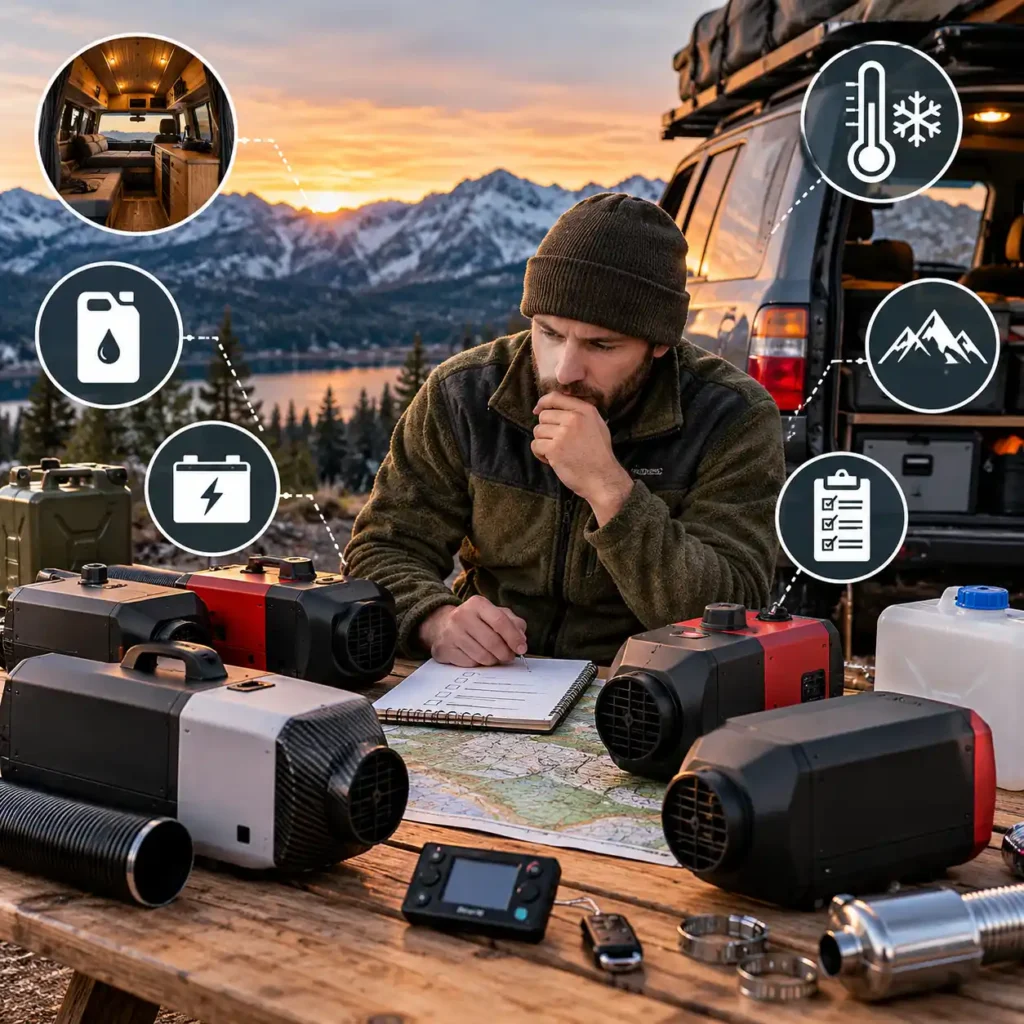
Choosing the right portable diesel heater for overlanding involves more than comparing advertised heating power or looking for the lowest price. The best option depends on your vehicle’s interior size, insulation, expected outdoor temperatures, available electrical power, fuel capacity, and installation requirements. Before buying, evaluate how and where you plan to camp, then compare the heater’s verified specifications with your actual needs.
Match Heating Output to Your Vehicle
Heating output is one of the most important factors when comparing diesel heaters. The models in this guide have different advertised capacities, so they should not be treated as interchangeable.
A lower-output heater may be suitable for a small, well-insulated sleeping area, while a larger vehicle or a poorly insulated interior may require more heating capacity in cold conditions. However, a higher advertised rating does not automatically guarantee better comfort or efficiency. The appropriate capacity depends on the space being heated, heat loss, outside temperature, and the heater’s operating range.
Before choosing a model, consider:
The interior volume you need to heat.
The quality of insulation and the number of windows.
The lowest temperatures you expect during your trips.
Whether you need to heat the entire vehicle or only a sleeping compartment.
The manufacturer’s verified heating-output specifications.
Avoid selecting a heater based on a marketing label alone. Confirm the rating and operating requirements for the exact model you intend to purchase.
Consider Fuel Consumption and Tank Capacity
Fuel consumption affects how often you need to refuel during a trip, particularly when camping away from fuel stations. A larger tank can reduce the frequency of refills, but tank capacity alone does not determine runtime.
Compare the manufacturer’s stated fuel-consumption range with the tank capacity, and remember that actual consumption varies with operating conditions and heat demand. Treat any runtime calculation as an estimate rather than a guarantee.
For longer overlanding trips, consider how easily you can carry and store additional diesel safely. Follow the heater manufacturer’s fuel-system instructions and the applicable requirements for storing fuel in your vehicle.
Check Electrical Requirements and Battery Capacity
Although diesel provides the heat source, a diesel air heater still needs electricity to operate its controls, fan, and fuel pump. Startup demand can differ from the power required during normal operation, so checking only the nominal voltage is not enough.
Before purchasing, verify:
The required supply voltage and acceptable operating range.
Startup current and normal electrical consumption.
The specified fuse rating and wiring requirements.
Compatibility with your vehicle battery or auxiliary power system.
Whether the manufacturer permits the intended power-supply configuration.
If you plan to heat the vehicle overnight without running the engine, account for the heater’s electrical consumption alongside other equipment, such as refrigerators, lights, and charging devices. Do not assume that a 12V label alone guarantees compatibility with every battery setup.
Evaluate the Complete Package
Some diesel heaters are sold as all-in-one units, while others require more separate components or installation work. A package may advertise a fuel tank, controller, remote, muffler, ducting, and mounting accessories, but the included items vary by model and seller.
Read the current product listing carefully and check the manual before comparing prices. Confirm whether the package contains the components required for your intended installation, and identify anything that must be purchased separately.
Also consider the physical dimensions of the heater and the space needed for safe mounting, ducting, fuel lines, combustion-air intake, and exhaust routing. A compact product may be easier to accommodate, but the complete installation still needs to meet the manufacturer’s requirements.
Assess Cold-Weather and Altitude Requirements
Overlanding conditions can vary considerably. A heater that works for mild autumn camping may not provide sufficient heat in a poorly insulated vehicle during prolonged freezing weather. Choose according to the lowest temperatures and the heat load you realistically expect, not just average conditions.
Altitude is another consideration when travelling through mountainous areas. Some models advertise altitude-compensation features, but the supported elevation range and adjustment method are model-specific. Verify these details in the manufacturer’s documentation rather than assuming every diesel heater can operate reliably at the same altitude.
Compare Warranty, Documentation, and Replacement Parts
Purchase price is only one part of the decision. Product documentation, warranty terms, replacement-part availability, and access to technical support can affect the long-term usefulness of a heater on remote trips.
Before buying, check whether the manufacturer provides a manual for the exact model, whether replacement components are available, and whether the seller explains its return and warranty policies clearly. This is especially important when a listing contains broad specifications that may apply to several versions of a product.
Choose According to Your Actual Overlanding Setup
The right diesel heater is the one whose verified heating capacity, electrical requirements, fuel system, and installation requirements match your vehicle and travel conditions. A compact, lower-output model may be a reasonable candidate for a small, insulated space, while a larger or less insulated interior may need a higher-capacity option.
Compare the five heaters in this guide using the same criteria: confirmed heating output, fuel consumption, electrical demand, tank capacity, package contents, installation requirements, and documentation. Where specifications remain uncertain, verify them with the seller or manufacturer before making a decision.
A careful comparison will help you choose a heater that suits your overlanding setup rather than paying for features you do not need—or discovering that the selected model cannot meet your heating requirements.
Common Mistakes to Avoid When Choosing a Diesel Heater
Choosing a diesel heater for overlanding can be challenging when product listings use different power ratings, fuel-consumption figures, and descriptions of included accessories. A heater that looks suitable on paper may not meet your vehicle’s heating requirements or installation constraints. Avoiding a few common mistakes can help you compare models more accurately and make a better-informed purchase.
Choosing Heating Output Based on the Advertised Number Alone
One of the most common mistakes is assuming that a higher advertised kW rating automatically makes a heater the best choice. Heating requirements depend on the vehicle’s interior volume, insulation, window area, air leakage, and the lowest temperatures expected during a trip.
An oversized heater is not necessarily the most suitable option, while an undersized unit may struggle to maintain comfortable temperatures in severe cold. Compare the manufacturer’s verified output with your expected heat load instead of relying on the product title alone.
Confusing Different Models or Product Variants
Some diesel heater listings use similar product names for different configurations. Models sold under the same brand may differ in heating output, tank capacity, controller, power requirements, and included accessories.
Do not assume that specifications published for one version apply to another. Confirm the exact model number, voltage, and configuration offered by the seller, and check the corresponding manual before making a decision.
Underestimating Electrical Requirements
A diesel heater uses fuel to generate heat, but it also requires electricity to operate its fan, controls, and fuel pump. Startup demand may be different from normal operating consumption, making it important to check both.
Before purchasing, confirm the required voltage, startup current, operating draw, fuse rating, and wiring specifications. If you plan to run the heater overnight from an auxiliary battery, account for its electrical needs alongside your other camping equipment.
Relying on Unverified Fuel-Consumption or Runtime Claims
Fuel-consumption figures can vary according to the model, operating setting, and conditions. A tank’s advertised capacity does not guarantee a particular number of hours of heating.
Avoid planning a trip around an unverified runtime claim. Check the manufacturer’s consumption figures for the exact heater, calculate an estimated range where appropriate, and allow for changing temperatures and heating demand.
Assuming Every Package Includes Everything You Need
Product photographs may show components that are optional, sold separately, or included only with certain configurations. A listing that mentions a remote, fuel tank, muffler, or installation kit does not necessarily confirm that every required part comes with the selected product.
Review the current package description and verify the included components before ordering. Pay particular attention to the exhaust system, combustion-air intake, fuel lines, electrical connections, mounting hardware, and ducting required for your installation.
Ignoring Installation Space and Exhaust Routing
A heater may fit inside a vehicle compartment but still be unsuitable for the intended installation. The complete setup needs appropriate space for mounting, air ducts, fuel lines, electrical connections, combustion-air intake, and exhaust routing.
Plan the installation before purchasing. Follow the manufacturer’s requirements for clearances and exhaust routing, and ensure that combustion gases cannot enter the occupied cabin. Incorrect installation can expose occupants to carbon monoxide, which can be fatal.
Overlooking Cold Weather and High-Altitude Conditions
Not every heater is suitable for every climate or elevation. A unit that provides sufficient heat in mild weather may struggle in a poorly insulated vehicle during prolonged freezing conditions. Some models advertise altitude-related functions, but their supported operating ranges can differ.
Check the manufacturer’s documented temperature and altitude limitations if you expect to camp in severe cold or travel through mountainous areas. Do not assume that an advertised altitude feature guarantees reliable operation at every elevation.
Choosing the Cheapest Option Without Checking Support
A low purchase price can be attractive, but it should not be the only factor in your decision. Unclear documentation, limited replacement-part availability, or difficult warranty claims can become inconvenient when a heater is needed during a remote trip.
Before ordering, review the seller’s return policy, warranty terms, product manual, and access to compatible replacement parts. A slightly more expensive model may be worth considering if its specifications and after-sales support are better documented.
Skipping the Final Specification Check
Before completing your purchase, compare the exact listing against your requirements. Verify the heating output, voltage, fuel-consumption range, tank capacity, controller, package contents, dimensions, and installation requirements. If important details are missing or contradictory, ask the seller or manufacturer for clarification rather than guessing.
The key takeaway: choose a diesel heater according to your actual heating needs, confirm the specifications for the exact model, and plan for safe installation before buying. These steps help you avoid common purchasing mistakes and select equipment that better matches your overlanding setup.
Diesel Heater Safety and Installation Considerations
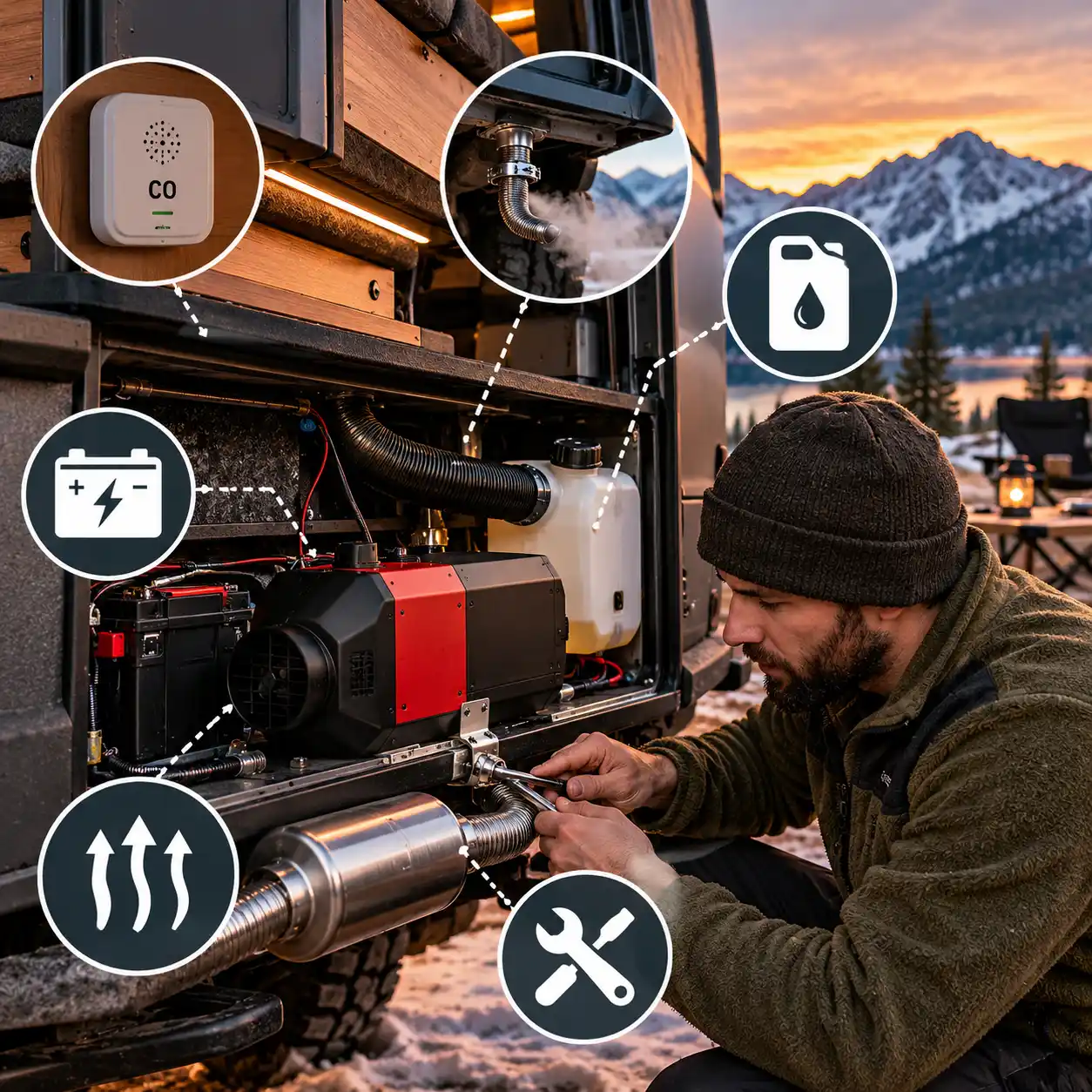
A portable diesel heater can make cold-weather overlanding more comfortable, but safe operation depends on correct installation, exhaust routing, fuel handling, and electrical connections. Before choosing a model, consider not only its heating output and price but also whether you can install and operate it according to the manufacturer’s instructions. Improper installation can create fire hazards or expose occupants to carbon monoxide, a poisonous gas that cannot be seen or smelled.
Understand the Risk of Carbon Monoxide
Carbon monoxide (CO) is one of the most important safety concerns when using fuel-burning equipment around a vehicle or sleeping area. It can enter an occupied space if exhaust gases leak, the exhaust system is incorrectly routed, or combustion products reach an air intake or opening.
The U.S. Consumer Product Safety Commission warns against using portable fuel-burning heaters while sleeping in enclosed spaces such as tents, campers, and vehicles. A diesel air heater with a separate combustion chamber and externally routed exhaust is a different design from an unvented portable heater, but it is not automatically safe regardless of installation. Follow the exact heater manufacturer’s instructions and all applicable requirements for the intended vehicle or enclosure.
Install a suitable carbon monoxide alarm in the occupied area as an additional precaution, and check it regularly according to its manufacturer’s instructions. An alarm does not replace correct installation, proper exhaust routing, or maintenance.
Route the Exhaust Outside the Occupied Space
The exhaust system must be installed so combustion gases are discharged outside the vehicle and cannot enter the cabin through windows, doors, ventilation openings, or air intakes. Exhaust routing, pipe configuration, mounting, sealing, and required clearances depend on the specific heater.
Before operating the unit, check that:
The exhaust components are installed and secured as specified in the manual.
The exhaust outlet is positioned to prevent fumes from entering the vehicle.
Exhaust pipes are kept away from combustible materials and components that could be damaged by heat.
The exhaust path is unobstructed and protected from damage.
Connections and seals are checked according to the manufacturer’s instructions.
Exhaust components can become extremely hot during operation. Never improvise a different exhaust arrangement or extend or modify the supplied system unless the manufacturer explicitly permits it.
Provide the Correct Combustion-Air Intake
A diesel heater requires an appropriate supply of air for combustion. The combustion-air intake must be installed in the location and configuration specified by the manufacturer and protected against blockage, water ingress, and contamination.
Do not assume that the combustion-air intake and the warm-air circulation intake serve the same purpose. Their placement and installation requirements may be different. Use the supplied manual to identify each opening and ensure that the combustion-air supply cannot draw in exhaust gases.
Keep air inlets and hot-air outlets clear during use. Incorrect ducting or blocked openings can interfere with operation and may cause overheating or other faults.
Install the Heater Securely and Maintain Clearances
Whether you choose an all-in-one unit or a heater intended for a more permanent vehicle installation, follow the manufacturer’s mounting instructions. The installation must account for the heater’s weight, vibration during travel, access for maintenance, duct routing, and proximity to heat-sensitive materials.
Before fitting the heater, confirm:
The required mounting surface and orientation.
The specified clearance around the unit and hot components.
The permitted routing of hot-air ducts.
Protection of nearby wiring, upholstery, insulation, and other combustible materials.
Access for inspection, cleaning, and servicing.
Never assume that a heater advertised as portable can be operated safely in any position or on any surface. Portable describes how a product can be transported; it does not remove the need for safe placement and correct installation.
Check Electrical Connections and Power Supply
Diesel heaters need a suitable electrical supply for their startup sequence, controls, fan, and fuel pump. An inadequate supply, undersized wiring, poor connections, or an incorrectly rated fuse can cause malfunctions and may create an electrical hazard.
Use the voltage, wire size, fuse rating, and power-supply requirements specified in the manual for the exact model. Secure the wiring against abrasion, vibration, and contact with hot components. If you intend to run the heater from an auxiliary battery, make sure the battery and wiring can support the required startup current as well as ongoing operation.
Do not choose a power adapter or modify the wiring based only on the product’s nominal voltage. Confirm the manufacturer’s complete electrical requirements before connecting the unit.
Handle Diesel Fuel Carefully
Diesel fuel must be stored and supplied in accordance with the heater manufacturer’s instructions and applicable vehicle-safety requirements. Fuel lines, fittings, tanks, and connections should be appropriate for the specific heater and installed so that they are protected against damage and leaks.
Before each trip, inspect accessible fuel-system components for signs of leakage, wear, or loose connections. Keep fuel away from ignition sources and hot surfaces, and switch the heater off as directed by the manufacturer before refuelling or performing maintenance. Allow hot components to cool when required by the manual.
Never operate the heater if you suspect a fuel leak. Resolve the problem before restarting the unit.
Follow the Correct Startup, Shutdown, and Maintenance Procedures
Use the controller and operating sequence specified by the manufacturer. Some diesel heaters require a controlled shutdown cycle to cool internal components and clear the combustion chamber. Cutting power abruptly during normal operation may interrupt that process.
Do not disconnect the power supply as a substitute for the normal shutdown procedure unless an emergency or the manufacturer’s instructions require it. Follow the manual for cleaning, inspection, fault codes, and periodic maintenance. If the heater produces unusual smoke, develops a fuel leak, shows signs of exhaust leakage, or behaves abnormally, stop using it and investigate the cause before further operation.
Consider Weather, Elevation, and Storage Conditions
Overlanding can expose a heater to rain, snow, dust, vibration, freezing temperatures, and high elevations. Check the manufacturer’s operating limits and storage requirements before using the unit in these conditions.
If the model advertises altitude compensation, verify the supported elevation range and any operating restrictions. Do not assume that every diesel heater can operate reliably at the same altitude. Keep the intake and exhaust openings clear of snow, mud, debris, and other obstructions, and inspect the system after rough travel or exposure to harsh weather.
When to Use a Qualified Installer
If you are unsure how to route the exhaust, seal a vehicle penetration, mount the heater, or connect its fuel and electrical systems, consult a qualified installer familiar with the particular equipment and vehicle. Professional installation is especially worth considering when the heater will be used regularly in a sleeping or living area.
Before the first trip, review the complete installation against the manual, test the system according to the manufacturer’s procedure, and verify that the carbon monoxide alarm works. Recheck the installation periodically and after any repairs or changes to the vehicle.
Safety takeaway: choose a diesel heater that suits your vehicle, follow the instructions for the exact model, route combustion gases safely outside, and maintain the fuel and electrical systems. Never treat an all-in-one design, a remote control, or a carbon monoxide alarm as a substitute for correct installation and safe operation.
Frequently Asked Questions About Portable Diesel Heaters for Overlanding
What size diesel heater do I need for overlanding?
The right diesel heater size depends on your vehicle’s interior volume, insulation, window area, and the lowest temperatures you expect during your trips. A 2 kW heater may suit a small, well-insulated space, while a larger or poorly insulated interior may require more heating capacity. Compare the manufacturer’s verified output with your expected heat load rather than choosing a heater based on its advertised power rating alone.
How much diesel does a portable diesel heater use per hour?
Fuel consumption varies by model, operating setting, and heating demand. Some compact diesel heaters advertise relatively low consumption, while higher-output models may use more fuel when operating at greater power. Check the manufacturer’s minimum and maximum consumption figures for the exact model before estimating your fuel needs. Treat published figures as estimates rather than guaranteed real-world consumption.
How much battery power does a diesel heater use overnight?
A diesel heater uses electricity to operate its fan, controls, and fuel pump, even though diesel supplies the heat energy. Electrical demand varies by model and operating stage, and startup may require more current than normal operation. Check the manufacturer’s startup current, running consumption, voltage, fuse rating, and wiring requirements. If you plan to run the heater overnight from an auxiliary battery, account for its electrical needs alongside your other camping equipment.
Can you run a diesel heater all night while camping?
Some diesel heaters are designed for extended operation, but whether a particular unit can run overnight depends on the manufacturer’s instructions, installation, fuel supply, electrical capacity, and operating conditions. Follow the specified startup and shutdown procedures, keep the combustion-air intake and exhaust outlet unobstructed, and ensure exhaust gases cannot enter the occupied space. Use a suitable carbon monoxide alarm as an additional precaution. Never assume that every portable diesel heater is safe for unattended or overnight operation.
Are portable diesel heaters safe to use inside a camper or vehicle?
A diesel air heater may be suitable for a vehicle-based heating system when the specific equipment is designed for that application and installed according to the manufacturer’s instructions. Safety depends on correct exhaust routing, combustion-air intake, fuel connections, electrical wiring, and required clearances. Carbon monoxide exposure can be fatal if exhaust gases enter an occupied area. Do not assume that every portable heater is safe to operate inside an enclosed vehicle.
Do you need a carbon monoxide detector with a diesel heater?
A suitable carbon monoxide (CO) alarm is an important additional safety measure when using a diesel heater near an occupied vehicle or sleeping area. It can warn occupants of dangerous CO levels, but it cannot prevent exposure caused by incorrect installation or a damaged exhaust system. Install and maintain the alarm according to its manufacturer’s instructions, and inspect the heater’s exhaust and combustion-air systems regularly. An alarm does not replace correct installation or safe operating practices.
Can a diesel heater run at high altitudes?
Some diesel heaters include altitude-compensation features designed to help maintain combustion as air density decreases at higher elevations. However, supported altitudes and adjustment methods vary by model. Before travelling into mountainous areas, check the manufacturer’s specified altitude range and determine whether manual adjustment or an automatic altitude mode is required. Do not assume that a heater advertised for high-altitude use will operate reliably at every elevation.
Are 2kW or 5kW diesel heaters better for overlanding?
Neither a 2 kW nor a 5 kW diesel heater is automatically better for every overlanding vehicle. A 2 kW model may suit a small, well-insulated interior, while a 5 kW model may provide more capacity for a larger space or greater heat loss. The appropriate choice depends on interior volume, insulation, outside temperatures, and the heater’s actual operating range. Compare verified specifications rather than relying on advertised power alone.
Can you use a portable diesel heater in freezing temperatures?
A diesel heater may be suitable for cold-weather overlanding if its operating limits and heating capacity match the conditions. Performance depends on the model, installation, insulation, fuel system, and outside temperature. Before travelling in freezing weather, check the manufacturer’s minimum operating temperature, fuel requirements, electrical specifications, and cold-weather instructions. Keep the combustion-air intake and exhaust outlet clear of snow and debris, and ensure the fuel supply and electrical system are suitable for the expected conditions.
Why does a diesel heater produce smoke or soot?
Smoke or excessive soot can indicate incomplete combustion, incorrect fuel-air conditions, restricted airflow, carbon buildup, or a maintenance issue. The cause depends on the heater and the symptoms. Follow the manufacturer’s troubleshooting procedure and inspect only those components identified as user-serviceable in the manual. If smoke is persistent or unusual, exhaust fumes reach the occupied area, or you suspect an exhaust leak, stop using the unit until the problem has been investigated.
How long will a diesel heater run on a 5-liter fuel tank?
Runtime depends on the heater’s verified fuel-consumption rate and operating conditions. For example, if a heater consumes 0.2 liters per hour, 5 liters would theoretically provide 25 hours of operation. At 0.5 liters per hour, the same amount would provide 10 hours. These are mathematical estimates, not guaranteed runtimes. Actual consumption can vary with output settings, ambient temperature, and heating demand. Check the manufacturer’s specifications for the exact model and allow for a practical fuel reserve.
Are cheap Chinese diesel heaters worth buying for overlanding?
A lower-priced diesel heater may be worth considering if its specifications are clearly documented, compatible replacement parts are available, and the seller provides credible warranty and technical-support information. However, price alone does not establish product quality, reliability, or safety. Before buying, verify the exact model, heating output, fuel consumption, electrical requirements, included components, installation instructions, and return policy. For remote overlanding trips, documentation and access to replacement parts can be particularly important because a heater failure may leave you without a reliable source of warmth.
Final Verdict: Which Portable Diesel Heater Is Best for Overlanding?
The best portable diesel heater for overlanding depends on your vehicle, expected temperatures, available electrical power, and the amount of space you need to heat. The five models in this guide offer different configurations and advertised heating capacities, so the right choice is not necessarily the heater with the highest power rating or the lowest purchase price.
Before making a final decision, compare the exact model specifications, fuel consumption, electrical requirements, included accessories, installation instructions, and warranty terms. Product listings can change, and specifications should be confirmed against the current offer and the manufacturer’s documentation.
Which Diesel Heater Should You Choose?
VEVOR 8KW Diesel Heater: Worth investigating if you want a higher-output, budget-oriented option. Confirm the exact version, rated output, fuel consumption, and included components before buying.
HCALORY 8KW Diesel Heater: A candidate for buyers interested in an all-in-one-style configuration. Verify the precise model identity, electrical requirements, tank capacity, and supplied accessories.
LF Bros 5KW All-in-One Diesel Heater: Worth comparing if you are considering a 5 kW-class unit. Check the manufacturer’s specifications for the exact version and make sure its output suits your vehicle’s heat load.
VEVOR All-in-One Diesel Heater: An alternative VEVOR configuration to evaluate if an integrated package suits your setup. Confirm the current product configuration and installation requirements rather than assuming all VEVOR heaters share the same specifications.
WAYSKA 12V Diesel Heater: A lower-output candidate to investigate for a compact, well-insulated space. Its advertised 2 kW output makes it a different proposition from the higher-capacity models in this roundup, and its exact specifications should be verified.
What Matters Most Before You Buy?
Start by estimating the heat your vehicle actually needs. A compact, well-insulated sleeping compartment may require a different solution from a large van or a poorly insulated camper used in freezing conditions. Compare verified heating output with the expected heat load instead of choosing solely by the advertised kilowatt rating.
Next, consider your available power and fuel. Check startup current, normal electrical consumption, fuel-consumption figures, and tank capacity for the exact model. These details affect whether the heater can operate for the periods you need without placing excessive demands on your battery or requiring frequent refuelling.
Finally, assess installation and long-term ownership. Review the manufacturer’s manual, exhaust-routing requirements, mounting clearances, warranty, replacement-part availability, and seller return policy. A low purchase price is less attractive if the specifications are unclear or suitable replacement components are difficult to obtain.
Our Final Recommendation
There is no single best diesel heater for every overlanding setup. A lower-output model may be appropriate for a compact, insulated space, while a higher-capacity heater may be more suitable for a larger interior or greater heat loss. The decision should be based on verified specifications, realistic heating requirements, and the conditions in which you intend to travel.
For most buyers, the smartest approach is to shortlist two or three models that match the required heating capacity, then compare their documented fuel consumption, electrical demand, package contents, installation requirements, and after-sales support. Verify any uncertain specifications with the manufacturer or seller before ordering.
The bottom line: choose the heater that matches your vehicle and climate, not simply the biggest advertised output or the lowest price. Confirm the exact model, plan a safe installation, and make sure you can maintain and operate the unit according to its instructions before relying on it for cold-weather overlanding.
Sources
VEVOR Official Website — Official product information, specifications, and available documentation for VEVOR diesel heaters.
HCALORY Official Website — Product information and technical documentation for HCALORY diesel heaters.
HCALORY Product Manuals and Guides — Model-specific manuals and operating instructions for supported HCALORY heaters.
LF Bros Official Manufacturer Website — Manufacturer product information, specifications, and technical details for LF Bros diesel heaters.
LF Bros Diesel Heater Products — Product listings for several LF Bros heater models and configurations.
U.S. Consumer Product Safety Commission: Portable Heaters and Camping Equipment — Official safety guidance concerning carbon monoxide risks associated with portable heaters and camping equipment.
Note: Product specifications and package contents may vary by model and listing. Always consult the manufacturer’s documentation for the exact heater before purchasing, installing, or operating it.
About the Author
The CampComfortGuide editorial team researches camping equipment and outdoor gear to help readers make informed purchasing decisions. Our guides focus on practical selection criteria, product specifications, usability, safety considerations, and the features that matter when preparing for outdoor adventures.
For this guide to portable diesel heaters for overlanding, we compare advertised heating capacity, fuel consumption, electrical requirements, configuration, and installation considerations to help readers identify options that may suit their vehicle and travel conditions.
Our goal is to provide clear, useful buying information while distinguishing verified specifications from details that require further confirmation. Readers should always consult the manufacturer’s documentation before purchasing, installing, or operating fuel-burning equipment.