
Most advice on how to choose camping tent size sounds simple — until you’re lying inside a “2-person tent” with no space to move, your gear piled against the walls, and condensation soaking into your sleeping bag.
That’s where most sizing decisions fail.
Hi, I’m Anthony.
After years of real-world camping — including nights in tents that technically “fit” but didn’t actually work — I’ve learned something most guides miss:
Tent size doesn’t fail on paper. It fails in in bad weather
And the problem usually comes down to three things:
— capacity ratings that assume no gear and no movement
— underestimating how much space gear actually takes
— ignoring how weather forces everything inside
Fix those, and your tent feels functional, not restrictive.
Ignore them, and even a well-built tent becomes uncomfortable, humid, and hard to live in.
If condensation is already an issue in your setup, see how to stop condensation in a tent — it directly affects how usable your space actually feels.
In this guide, I’ll show you how to choose camping tent size using a system based on real use — not ideal conditions.
As an Amazon Associate, we earn from qualifying purchases.
🔧 Real Experience (What Actually Happens)
On a multi-day trip in sustained rain, I shared a 2-person tent with another camper.
On paper, it was the “right size.”
In reality, it failed by the second night.
Here’s what actually changed:
— both backpacks had to move inside
— wet layers spread across the floor
— usable space dropped by nearly half
At that point:
— sleeping pads were pressed into the walls
— condensation transferred directly into our sleeping bags
— movement inside the tent became restricted
The problem wasn’t just comfort.
👉 It was sleep degradation.
We couldn’t shift position without hitting the walls.
Moisture built up faster than it could ventilate.
Everything inside the tent started working against us.
This is exactly what happens when moisture builds up inside — explained in why tents condense at night.
🔬 What That Revealed
👉 It failed because it was sized for ideal conditions — not real use.
That’s the difference most guides ignore.
⚡ How to Choose Camping Tent Size (Quick Answer That Actually Works)
To choose camping tent size correctly, you need to account for how space behaves in actual use — not how many people fit on paper.
— Start with the number of people, but treat it as a minimum, not a recommendation
— Add +1 capacity to compensate for gear displacement and reduced usable width from wall slope
— If gear will be stored inside, expect usable space to drop by 30–50%
— In bad weather or multi-day trips, size up again — interior space becomes living space, not just sleeping space
👉 System insight:
Tent size = usable space under pressure, not theoretical capacity
If you fix only one mistake, fix this:
👉 Most tents feel too small because they are sized for ideal conditions — not real use
📏 Tent Size Dimensions (What Numbers Actually Mean)
Most campers choose tent size based on labels — but real comfort depends on usable dimensions.
Sleeping width per person:
— minimum: ~20 inches (tight)
— comfortable: 24–30 inches
Two wide sleeping pads:
— ~25 inches each
— = ~50 inches total
Most 2-person tents:
— 50–52 inches (measured at the widest point)
— usable width is smaller due to wall slope
👉 Result:
Two people technically fit — but only with no extra space.
Gear impact:
— gear inside reduces usable space by ~30–50%
— especially in bad weather
Height matters:
— low tents restrict movement
— taller tents improve livability during long trips
👉 Key takeaway:
Tent dimensions describe maximum space —
not usable space in real-world use.
🧭 Jump to Your Situation (Find Your Real Setup)

Jump directly to your situation:
— Solo camping with gear → see Solo Camper
— Camping as a couple → see Couple Setup
— Choosing between 2P vs 3P → see Size Comparison
— Backpacking vs comfort → see Weight vs Space Trade-off
👉 Most sizing mistakes happen because people choose based on labels, not use cases.
Match your setup — not the tent label.
❌ What Most People Get Wrong About Tent Size
Most people assume:
👉 “If it says 2-person, it fits two people comfortably.”
That assumption breaks immediately in real use.
Because tent capacity is based on maximum body fit — not usable space under real conditions.
Here’s what that actually means:
— it assumes narrow sleeping pads with no gap between them
— it ignores gear entirely (packs, shoes, wet layers)
— it doesn’t account for wall slope reducing usable width
— it assumes you’re only sleeping — not moving, changing, or spending time inside
👉 In reality:
— two wide sleeping pads can already exceed the usable width of most 2P tents
— once gear moves inside, available space drops by 30–50%
— wall contact increases condensation transfer directly into your sleeping system
🔬 The Real Problem
The issue isn’t that tents are “too small.”
👉 It’s that they are sized for ideal conditions that almost never exist in real use.
Until you understand how usable space behaves under pressure:
— gear inside
— limited movement
— moisture buildup
👉 you’ll keep choosing tents that technically fit — but don’t actually work.
If you want to understand how tent shape affects space, see dome vs cabin tent — wall design directly changes usable width.
⚠️ Why Tent Size Problems Happen (Real Causes in Actual Use)
Most tent sizing problems don’t come from choosing the “wrong tent.” They come from misunderstanding how space behaves once you start using it. Here’s what actually causes tents to feel too small:
Capacity illusion — designed for maximum fit, not real use
Tent capacity assumes:
— tightly packed sleeping pads
— no gear inside
— minimal movement
In reality:
— most campers use wider pads
— need space between bodies
— store at least some gear inside
👉 This creates an immediate mismatch between rated capacity and usable space.
These problems become obvious when conditions get worse — especially during camping in the rain.
Gear displacement — space doesn’t disappear, it gets replaced
Gear doesn’t just “take up space.”
It changes how space is used:
— backpacks occupy floor area
— wet layers need to be spread out
— shoes and small items fill gaps
👉 In bad weather, this can reduce usable sleeping space by up to 30–50%.
Wall geometry loss — floor dimensions are misleading
Most tents list floor width — but not usable width.
Because of sloped walls:
— shoulder space is reduced
— headroom becomes limited
— edge areas become unusable
👉 A tent can technically fit two people
but still feel cramped because only the center is functional.
Weather compression — the moment everything changes
This is where most tents fail.
When weather forces you inside:
— all gear moves into the tent
— movement increases (changing, organizing)
— airflow decreases
👉 The tent shifts from “sleeping space” to “living space”
And that’s when size becomes critical.
This aligns with real-world guidance from the National Park Service on backcountry shelter setup and gear management.
🧭 Real Scenarios (What Actually Works in Actual Use)

👤 Solo Camper
Most 1-person tents technically fit one person.
But in real use, they fail once gear is introduced.
Here’s what happens:
— backpacks and shoes take up floor space
— usable width becomes restricted
— airflow is reduced due to limited volume
👉 Result:
The tent becomes cramped, even for a single person.
What actually works:
👉 A 2-person tent creates enough space for:
— gear separation
— movement during the night
— better ventilation
If your setup feels cramped, your sleep system matters too — see best camping mattresses.
👥 Couple Camping
A 2-person tent is designed for maximum fit — not comfort.
during extended trips:
— sleeping pads often touch or overlap
— walls are within direct contact range
— condensation transfers easily to sleeping bags
👉 Add gear or bad weather — and space collapses completely.
What actually works:
👉 A 3-person tent provides:
— separation between sleepers
— room for limited gear
— reduced wall contact and moisture transfer
If you’re sharing space, your sleep setup changes everything — see best double sleeping bags.
🎒 Backpacking Duo
This is where most people make trade-offs without understanding the impact.
2-person tent:
— lighter to carry
— minimal usable space
— higher chance of poor sleep in bad weather
3-person tent:
— adds weight
— significantly improves livability
— allows gear management and movement
👉 Real decision:
Not just weight vs comfort —
👉 it’s weight vs recovery quality over multiple days
If you’re balancing weight and comfort, compare options in best budget camping tents.
👨👩👧 Family Camping
Capacity labels stop being useful as group size increases.
Because:
— gear scales faster than people
— movement inside becomes necessary
— time spent inside increases in bad weather
👉 A “4-person tent” rarely works for 4 people in real-world use.
What actually works:
👉 Choose at least +2 capacity to account for:
— gear volume
— movement
— extended time inside the tent
For larger setups, see best 6 person tents for family camping.
Best Tent Size by Scenario (What Actually Works)
Choosing the right tent size depends on how you actually camp — not just capacity labels.
Here’s what works during extended trips conditions:
👤 Solo camping
→ Best size: 2-person tent
→ Why: space for gear, movement, and airflow
👥 Couple camping
→ Best size: 3-person tent
→ Why: separation between sleepers, less condensation transfer
🎒 Backpacking (weight priority)
→ 2P = lighter but tight
→ 3P = heavier but significantly more livable
🌧️ Rain / bad weather
→ Add +1 capacity minimum
→ Why: gear moves inside, space collapses
👨👩👧 Family camping
→ Add +2 capacity minimum
→ Why: gear + movement + time inside
👉 Quick rule:
Tent size = people + gear + conditions
🧰 What You Actually Need (And What Changes the Outcome)

Most people think choosing a tent size is about picking a number. It’s not. It’s about removing the constraints that make tents feel too small in real use.
Extra capacity margin (+1 minimum) — compensates for space loss
This isn’t “extra comfort.”
It compensates for real-world space loss caused by:
— gear moving inside the tent
— reduced usable width from wall slope
— lack of separation between sleeping pads
👉 Without this margin, space collapses as soon as conditions change.
Vestibule — controls where your gear lives
A vestibule doesn’t just store gear.
It determines whether your interior space remains usable.
Without a vestibule:
— packs move inside
— wet gear spreads across the floor
— airflow becomes restricted
👉 The tent effectively becomes one size smaller.
Ground setup also affects usable space — see what is a tent footprint.
Wall design — defines usable space, not floor dimensions
Most people look at floor size.
But real space is defined by wall geometry.
— steep walls → usable width across the tent
— sloped walls → only the center is functional
👉 Two tents with the same dimensions can feel completely different inside.
🌧️ What Actually Happens Inside a Tent in Bad Weather
Most sizing decisions are based on ideal conditions.
That’s where they fail.
When weather forces you inside, the tent stops being just a sleeping space.
Here’s what changes:
— gear moves inside and replaces usable floor space
— movement increases (changing, organizing, waiting)
— airflow decreases, accelerating condensation
👉 Result:
Usable space drops fast — often by 30–50%.
A tent that felt fine in dry conditions becomes cramped, humid, and restrictive.
🔬 Key Insight
Tent size doesn’t fail in good conditions.
👉 It fails when:
— space is reduced
— time inside increases
— airflow is limited
That’s what you need to size for.
🔬 Why Sleeping Pad Width Matters Most (The Hidden Constraint)
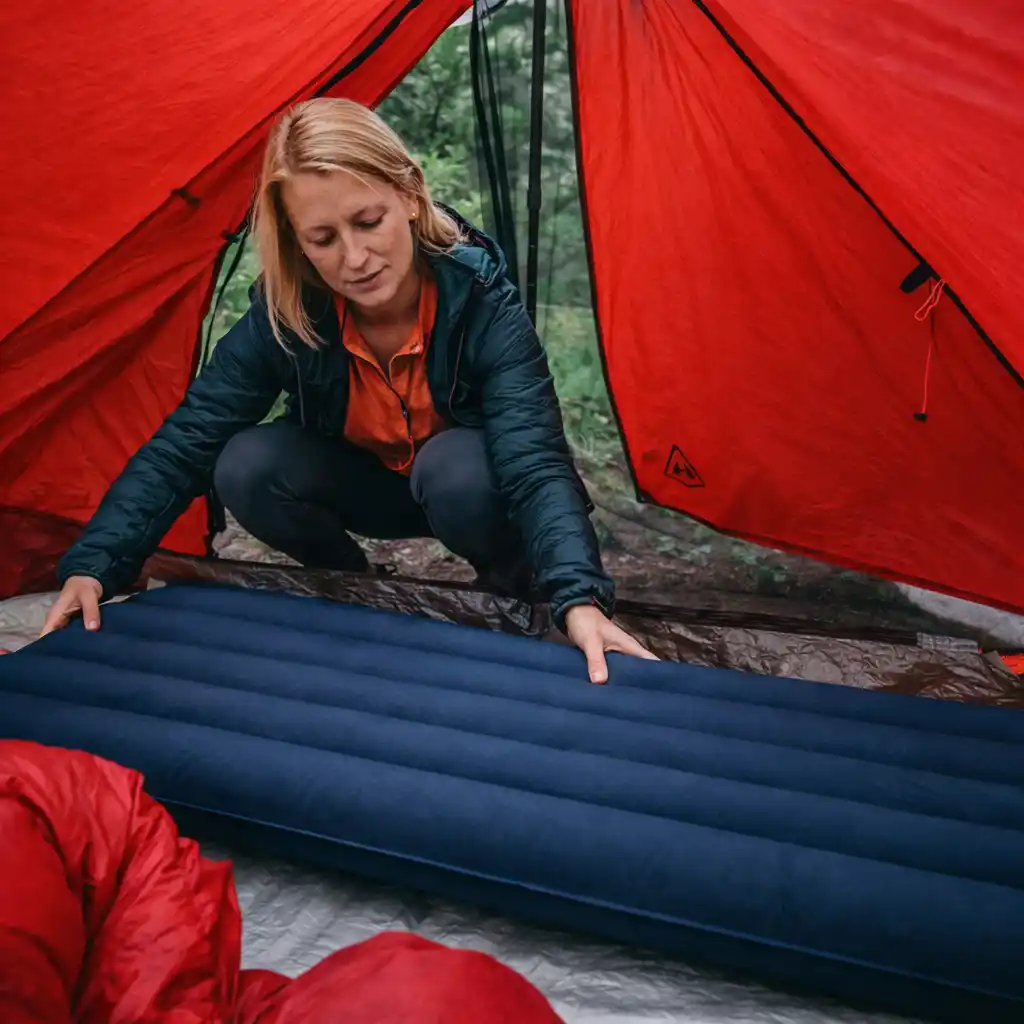
This is one of the most overlooked — and most decisive — factors in tent sizing.
Because tent capacity is calculated for minimal width.
Real setups are not.
The math most people ignore
Two wide sleeping pads:
— ~25 inches each
— = ~50 inches total width
Most 2-person tents:
— list floor width around 50–52 inches
— measured at the widest point (usually the center)
👉 On paper: it fits
👉 In reality: it doesn’t
This is why many outdoor experts, including REI, recommend factoring in sleeping pad dimensions when choosing tent capacity.
Where space actually disappears
Because of wall slope:
— pad edges push into angled walls
— usable width shrinks toward the shoulders
— center space becomes the only functional area
👉 This forces both sleepers inward — whether they notice it or not.
What happens overnight
Once both people are inside:
— pads press into the tent walls
— any condensation transfers directly to sleeping bags
— micro-movements wake the other person
👉 There is no buffer zone.
And that’s where comfort breaks down.
🔬 The Real Impact
This isn’t just about “tight space.”
👉 It affects:
— sleep quality
— insulation performance (wet bags lose warmth)
— recovery on multi-day trips
👉 The Key Insight
A tent doesn’t fail when people don’t fit.
 It fails when there’s no space between them.
If you’re using wider pads, see best sleeping pads for side sleepers — they require significantly more space.
According to REI, tent capacity ratings are based on minimal sleeping space and do not account for gear or comfort.
🛠️ How to Choose Camping Tent Size (Step System That Works in Real Conditions)
1️⃣ Start with the number of people — but don’t trust it
This is only your baseline.
Tent capacity assumes:
— no gear inside
— minimal movement
— perfect conditions
👉 In real use, this assumption breaks immediately.
2️⃣ Add +1 capacity — this creates usable space
This isn’t about comfort — it’s about function.
Without extra space:
— sleeping pads touch
— gear has nowhere to go
— airflow is restricted
👉 +1 size is what turns “fit” into “livable.”
3️⃣ Add gear pressure — especially in bad weather
In bad weather, gear doesn’t stay outside.
When it rains:
— backpacks move inside
— wet clothing spreads out
— floor space disappears
👉 Gear doesn’t add a little volume — it redefines your usable space.
In cold conditions, space and insulation work together — see how to keep a tent warm.
4️⃣ Adjust for conditions — this is where most decisions fail
Bad weather changes how your tent is used:
— you spend more time inside
— you move less efficiently
— moisture builds up faster
👉 A tent that feels fine in dry conditions
can feel unusable in rain.
👉 Final Rule
Your tent size should be based on:
✔ how you use space under pressure
❌ not how many people technically fit
👉 Final size = realistic, not theoretical
📊 Tent Size vs Real Comfort (What Actually Changes in Real Use)
| Tent Label | What It Assumes | What Happens in Real Use | Who It Actually Works For |
|---|---|---|---|
| 1P | No gear inside, minimal movement | No space to sit up, gear spills inside | Ultralight solo only |
| 2P | Two narrow pads, no gear | Pads touch walls, condensation transfers, zero gap | Solo comfort or tight couple use |
| 3P | Three compact sleepers | Real space for 2 + gear + movement | Couples who want actual comfort |
| 4P | Four minimal sleepers | Comfortable for 2–3 with gear and bad weather | Car camping / longer trips |
For specific recommendations, see best camping tents for every type of camper.
⚠️ Mistakes That Ruin Tent Sizing (And Why They Actually Fail)

— Choosing based on capacity labels
→ labels assume ideal conditions with no gear and no movement
— Ignoring how gear behaves in bad weather
→ once rain starts, all gear moves inside and space collapses
— Not accounting for wall slope
→ sloped walls reduce usable width by up to 20–30%
— Using wide sleeping pads in a tight tent
→ creates constant wall contact and condensation transfer
— Assuming floor dimensions = usable space
→ real usable space is always smaller than advertised
Most people try to fix this by changing tents or buying lighter gear.
👉 That doesn’t solve the real problem.
The issue isn’t the tent.
It’s misunderstanding how space works in real-world use.
If your tent already has issues, see how to repair a tent and how to clean a moldy tent.
🧠 Pro Tips Most Guides Don’t Tell You
✔ If your sleeping pads touch the tent walls — your tent is too small, regardless of capacity rating
✔ A tent feels 30–40% smaller in bad weather because all gear moves inside — plan for that, not ideal conditions
✔ Vestibules don’t just store gear — they protect interior airflow and reduce condensation pressure
✔ The longer your trip, the more space you need — not for comfort, but for sustainability of sleep
✔ If you can’t sit up comfortably without hitting the walls, your usable volume is already compromised
👉 Most people don’t have a tent size problem.
They underestimate how space behaves under real conditions.
🧭 What Matters Most (Priority Order That Actually Works)
Most people prioritize tent weight or capacity labels.
That’s backwards.
What actually determines whether a tent works is how space holds up under real conditions.
1. Usable sleeping width — the first failure point
This is the most critical constraint.
Not floor width — usable width.
Because of wall slope:
— pad edges push into angled walls
— shoulder space becomes restricted
— both sleepers are forced toward the center
👉 Once pads touch the walls:
— condensation transfers directly into sleeping bags
— movement becomes limited
— sleep quality drops immediately
2. Interior volume under real conditions — not empty space
A tent doesn’t stay empty.
As soon as you use it:
— gear takes floor space
— wet layers spread out
— movement requires clearance
👉 Volume determines whether the tent remains usable — or becomes cluttered.
3. Weather-driven space compression — the breaking point
This is where most tents fail.
When weather forces everything inside:
— usable space shrinks rapidly
— time spent inside increases
— airflow drops
👉 The tent shifts from sleeping space → living space
And that’s when sizing mistakes become obvious.
🔬 The Priority Insight
Tent sizing fails in this order:
1️⃣ width disappears
2️⃣ volume gets consumed
3️⃣ pressure increases
👉 Most people evaluate tents in reverse:
— weight
— label
— specs
That’s why they end up with tents that fit — but don’t work.
⚠️ When This Won’t Work (And Why the Rules Change)

This sizing system is built for real-world comfort and usability.
But there are situations where those priorities don’t apply.
Ultralight backpacking — weight overrides space
When every ounce matters:
— reducing pack weight becomes the primary constraint
— tent size is minimized to the smallest functional option
— interior space is sacrificed for efficiency
👉 In this case:
A tighter tent is acceptable — because the goal is distance, not comfort.
Sleep-only shelter use — no time spent inside
If the tent is only used for sleeping:
— no gear is stored inside
— no movement or organization happens inside
— exposure time is minimal
👉 Usable space requirements drop significantly.
A smaller tent can still work — because the tent is not being “lived in.”
Alpine or emergency conditions — exposure risk dominates
In high-risk environments:
— setup speed matters more than interior space
— structural stability matters more than comfort
— time inside the shelter is limited
👉 The goal shifts from usability → protection.
🔬 The Key Difference
In all these scenarios:
👉 You are no longer optimizing for:
— comfort
— movement
— livability
👉 You are optimizing for:
— weight
— efficiency
— survival
👉 What That Means for Sizing
The standard sizing rules don’t apply here.
Because the goal has changed.
👉 You’re not choosing a tent that feels good.
👉 You’re choosing a tent that works under constraint.
❓ FAQ: How to Choose Camping Tent Size (Real Questions Answered)
How do I choose the right camping tent size?
To choose camping tent size correctly, use this system:
— start with the number of people (baseline only)
— add at least +1 capacity to compensate for gear and reduced usable width
— account for gear inside the tent (can reduce space by 30–50%)
— adjust for weather and trip length, which increase time spent inside
👉 The key: tent size should match how space behaves during extended trips — not just how many people fit on paper.
Is a 2-person tent enough for two people?
Technically yes, but in real conditions it often feels too small.
Most 2-person tents are designed for maximum fit:
— sleeping pads sit edge-to-edge with no buffer
— wall slope reduces usable width
— gear has no dedicated space
👉 In practice:
— pads press into the walls
— condensation transfers to sleeping bags
— movement becomes restricted
For real comfort, a 3-person tent is usually the better choice.
What size tent should I get for a couple?
The most reliable option for couples is a 3-person tent.
It provides:
— space between sleepers
— room for gear
— better airflow and less condensation
2-person tents are only suitable for short trips with minimal gear.
Should I size up my camping tent?
In most cases — yes.
You should size up if:
— you bring gear inside
— you expect rain or wind
— you’re camping for multiple days
👉 Sizing up improves comfort, airflow, and usability.
Why do tents feel smaller than advertised?
Manufacturers assume:
— no gear inside
— minimal movement
— perfectly flat sleeping positions
In real use:
— gear replaces floor space
— wall angles reduce usable width
— time spent inside increases in bad weather
👉 This creates a gap between “fits on paper” and “works in reality.”
Does sleeping pad size affect tent size?
Yes — and it’s one of the most critical factors.
Two wide sleeping pads can take up around 50 inches of width, which matches the listed width of many 2-person tents.
👉 In real conditions:
— pads press into angled walls
— usable space shrinks toward the center
— there’s no separation between sleepers
If you use wide pads, sizing up is almost always necessary.
What tent size is best for backpacking?
For backpacking:
— 2-person tent → lighter but tighter
— 3-person tent → more comfortable but heavier
👉 Choose based on:
— trip length
— weather conditions
— comfort vs weight priority
🏁 Final Verdict
Most people don’t choose the wrong tent.
They choose the wrong size for how they actually camp.
A tent that feels fine in ideal conditions can fail completely once:
— gear moves inside
— time spent inside increases
— airflow becomes limited
That’s where most sizing decisions break down.
🔬 The Real Takeaway
Tent size isn’t about how many people fit.
👉 It’s about whether space still works when conditions change.
👉 What That Means for You
If your tent feels too small, the problem usually isn’t comfort.
It’s that the tent was sized for ideal conditions — not real use.
🎯 The Rule That Actually Works
— Start with the number of people
— Add at least +1 capacity
— Add more if gear or weather will limit space
👉 When in doubt, choose the larger size.
Because space solves more problems than weight ever creates.
🎯 Quick Decision Guide

— Solo (with gear inside) → 2P minimum
→ prevents gear from replacing sleeping space
— Couple (real comfort) → 3P baseline
→ creates separation and reduces wall contact
— Using wide sleeping pads → size up immediately
→ avoids forced contact with tent walls
— Rain or multi-day trips → add +1 size
→ accounts for gear moving inside and increased time in the tent
— Car camping / comfort focus → add +2 sizes
→ allows full movement, organization, and livability
👉 If you’re unsure:
Choose the larger option.
Because once space is lost inside a tent,
you can’t get it back.
🔥 Bottom Line (What Actually Matters)
You don’t need a bigger tent.
You need a tent that still works when conditions stop being ideal.
That means:
— when your gear moves inside
— when space gets compressed
— when you’re spending hours inside, not minutes
🔬 The Real Difference
The problem isn’t size.
👉 It’s how that size performs under pressure.
👉 What That Looks Like in Practice
A tent that “fits”:
— works on paper
— fails once conditions change
A tent that actually works:
— maintains usable space
— allows movement
— prevents constant wall contact
🎯 The Takeaway
If your tent feels too small, it’s not a comfort issue.
👉 It’s a sizing decision based on ideal conditions — not real use.
👉 Choose based on how you use space under pressure.
That’s what determines whether your tent works — or fails.
— Anthony