
Canvas tents are a popular choice for campers who want generous interior space, durable fabric, and a comfortable setup for extended outdoor stays. However, differences in tent size, canvas treatment, frame design, ventilation, and weather protection can significantly affect real-world performance.
In this guide, we compare five of the best canvas tents for camping and glamping in 2026, including spacious family tents and premium options for longer stays. We examine their practical features, construction, capacity, and potential limitations to help you identify the right tent for your camping style, available space, and budget.
Whether you are planning family camping trips, a dedicated base camp, or a more comfortable glamping experience, this comparison will help you understand what to look for before investing in a canvas tent.
As an Amazon Associate I earn from qualifying purchases.

Table of Contents
Why You Can Trust This Guide
Choosing a canvas tent requires more than comparing advertised capacity or looking at product photos. Fabric treatment, frame construction, ventilation, floor materials, and weather protection all affect how a tent performs during extended camping trips.
For this guide, we compare five canvas tents from WaldZimmer, Dream House, WHITEDUCK, and TETON Sports, focusing on their published specifications, practical features, intended uses, and potential limitations. We consider differences in interior space, construction, setup requirements, and suitability for family camping, base camps, and glamping.
We also distinguish manufacturer specifications from marketing claims and avoid treating water-resistant canvas as automatically waterproof. These details matter when deciding whether a particular tent fits your climate, camping plans, and maintenance expectations.
Our goal is to help you compare the best canvas tents more confidently by explaining what each model offers, where it may fall short, and which factors deserve closer attention before you buy. Always confirm the latest specifications, included accessories, and warranty terms on the product listing before placing an order.
How We Evaluated These Canvas Tents
Evaluating the best canvas tents requires more than comparing advertised capacity, fabric weight, or the number of features listed on a product page. A canvas shelter is a combination of materials, structural components, weather-protection systems, and practical design decisions. The quality of that combination determines how well a tent suits extended camping, family trips, established base camps, or glamping.
For this comparison, we assessed five selected models from WaldZimmer, Dream House, WHITEDUCK, and TETON Sports using their available product specifications, stated construction details, and intended applications. We focused on the characteristics that most directly affect usability, long-term ownership, and the suitability of each tent for different camping conditions.
This is a specification-based editorial comparison, not a claim that all five tents underwent independent laboratory testing or identical field trials. Where manufacturer claims, product variations, or available specifications require further confirmation, we identify the issue rather than treating an unverified figure as an established fact.
Canvas Material, Fabric Construction, and Weather Resistance
The word canvas describes a category of substantial woven fabrics, not a universal performance standard. Cotton canvas and polycotton canvas differ in fibre composition, weight, drying behaviour, and maintenance requirements. Even two tents made from cotton canvas may perform differently because of their fabric construction, applied treatments, seams, and overall design.
We therefore considered the stated fabric composition and treatment instead of assuming that every canvas tent offers the same degree of weather protection. Water-resistant, water-repellent, and waterproof are not interchangeable descriptions. A water-repellent treatment may help shed rain, but it does not by itself establish that the complete tent will remain dry during prolonged exposure.
We also considered how the outer fabric relates to the rest of the shelter. Rain can enter through seams, doors, windows, roof joints, or poorly managed runoff, even when the main fabric has a protective treatment. A separate rain canopy, a coated groundsheet, and the canvas itself perform different functions and should be evaluated separately.
Interior Dimensions, Usable Space, and Advertised Capacity
Advertised occupancy is a useful starting point, but it is not a reliable measure of comfort on its own. A tent described as suitable for six or ten people may accommodate that number primarily in sleeping arrangements, leaving less room for bags, furniture, changing clothes, or moving around comfortably.
We considered published floor dimensions and the general layout of each model, while distinguishing stated capacity from a guarantee of comfortable occupancy. The WaldZimmer and Dream House models are positioned as spacious options, the TETON Sports Mesa has an advertised 10-by-10-foot footprint, and the WHITEDUCK Avalon uses a circular bell-tent layout. These differences affect how occupants can arrange sleeping areas and equipment.
Interior height also matters. A tall central peak can improve movement and the feeling of space, but it does not mean that the full floor area has standing height. Wall height, roof slope, door height, and the location of support poles all influence how effectively the interior can be used.
Where exact dimensions or selected product variations are not sufficiently clear, buyers should confirm the current listing rather than relying on a figure that may belong to another size.
Frame Design, Stability, and Setup Requirements
The frame determines how the shelter is supported and how much work is involved in erecting it. Depending on the design, a canvas tent may use a multi-pole frame, a central support pole, or a combination of structural poles, connectors, stakes, and guy lines.
We considered the published frame materials and structural configuration where available. For example, the WHITEDUCK Alpha is specified with an aluminum frame, while the Avalon bell tent uses a different support arrangement. The WaldZimmer listing describes a steel frame. These are meaningful differences, but the material alone does not establish which tent is strongest or safest in a particular wind speed.
Stability also depends on pole dimensions, connection design, anchoring points, guy-line placement, ground conditions, and correct installation. We did not assign wind-resistance ratings without comparable supporting evidence. Buyers planning to camp in exposed locations should check the manufacturer’s setup instructions and operating limitations rather than interpreting heavy-duty construction as a guarantee of storm performance.
Portability is part of this assessment as well. Canvas shelters can be substantially heavier and bulkier than many lightweight synthetic tents. Packed weight, the number of packages, assembly time, and whether a second person is needed can make a significant difference when a campsite must be reached on foot or the tent is erected frequently.
Floor Construction and Ground Protection
The floor is an important part of the overall shelter system because it separates the sleeping and living area from soil, surface moisture, and everyday campsite wear. We considered the stated floor materials and construction where this information was available.
Several of the selected models specify PVC or other heavy-duty waterproof floor materials. However, a waterproof floor does not make the entire tent waterproof. Protection still depends on the relationship between the floor, tent walls, seams, entrances, and the way rainwater moves across the campsite.
Ground conditions matter too. A floor may provide a durable barrier, but standing water, poor drainage, sharp objects, and incorrect pitching can create problems regardless of the material. We therefore treat floor construction as one component of weather protection rather than as proof that a tent is suitable for every wet environment.
Ventilation, Condensation, and Interior Comfort
Canvas is often chosen for its breathable fabric characteristics, but breathability does not eliminate condensation in every situation. Moisture from occupants, wet equipment, cooking, and differences between indoor and outdoor temperatures can still contribute to damp conditions.
We considered the ventilation features identified in the available product information, including doors, windows, mesh panels, roof vents, and other openings. Their usefulness depends on their placement and the ability to create airflow while maintaining appropriate protection from rain and insects.
A tent with multiple windows may offer more options for ventilation, but the number of openings alone does not establish how effectively air circulates. Weather, campsite exposure, the number of occupants, and how the tent is pitched all influence interior conditions.
For this reason, ventilation should be evaluated alongside fabric construction, layout, and intended use—not treated as an isolated feature or a promise of condensation-free camping.
Stove Compatibility and Other Specialized Features
Some canvas tents are designed to accommodate a wood-burning stove through a dedicated stove jack. This feature can be useful for certain cold-weather or extended-stay setups, but it also introduces additional safety requirements and should not be interpreted as permission to use any stove in any configuration.
We considered stove-jack provisions where they are stated in the product specifications. The WHITEDUCK Avalon and Alpha product families include stove-jack options, but buyers must verify the configuration supplied with the exact model and size they select. Compatibility depends on the opening, stove-pipe arrangement, manufacturer’s instructions, and any required heat protection.
A stove jack is not proof that a tent is fireproof. Safe installation requires following the tent and stove manufacturers’ instructions, maintaining appropriate clearances, ensuring ventilation, and using carbon-monoxide precautions. Similar care applies to any other specialized feature: its presence matters only if it is appropriate for the buyer’s intended setup.
Maintenance, Drying, Storage, and Long-Term Ownership
Canvas tents require a different maintenance routine from many lightweight synthetic shelters. Depending on the fabric and treatment, owners may need to allow the tent to weather before use, clean it according to the manufacturer’s guidance, inspect seams and stress points, and dry it thoroughly before storage.
We considered maintenance implications because they influence the practical cost and effort of owning a canvas tent. A large, heavy shelter may be comfortable once erected but difficult to dry or store if space is limited. Putting canvas away while damp can encourage mildew and cause avoidable damage.
The best choice is therefore not necessarily the largest tent or the model with the longest feature list. It is the tent whose construction, space, setup demands, and maintenance requirements match the way it will actually be used.
How We Interpret Value and Product Claims
We did not assume that a higher price, heavier fabric, larger advertised capacity, or longer list of features automatically makes one model better than another. Each specification must be considered in context, and a feature is valuable only when it serves a real requirement.
Our assessment distinguishes three things: specifications stated in available product information, practical implications that can reasonably be drawn from those specifications, and details that still need confirmation from the manufacturer or current Amazon listing. We do not present unverified durability claims, unsupported wind ratings, or waterproof guarantees as established facts.
Prices, availability, included accessories, and product configurations can change. Before purchasing, readers should confirm the current listing for the exact model and size, paying particular attention to dimensions, frame components, fabric treatment, floor construction, stove-jack configuration, and warranty conditions.
The result is a practical comparison of five canvas tents based on documented features and relevant buying considerations—not a fabricated test ranking. This approach helps readers understand what distinguishes each model and which details deserve closer inspection before making a purchase.
Quick Answer: Best Canvas Tents at a Glance
The best canvas tent for your trip depends on how much space you need, how often you camp, and which construction features matter most. These five options cover different approaches to family camping, extended stays, and glamping.
WaldZimmer Cotton Canvas Wall Tent: A large canvas tent option for campers looking for a spacious shelter with a separate rain canopy.
Dream House 10-Person Canvas Tent: A roomy option for larger groups and family camping, with a generous floor area.
WHITEDUCK Alpha Canvas Wall Tent: An outfitter-style canvas tent to consider for extended camping and base-camp setups.
TETON Sports Canvas Mesa 10′: A six-person canvas tent option for campers seeking a defined 10-by-10-foot floor area.
WHITEDUCK Avalon Canvas Bell Tent: A bell-shaped canvas tent suited to glamping and comfortable outdoor stays.
Quick recommendation: Compare the available floor space, packed weight, frame design, weather protection, and setup requirements before choosing. Canvas construction alone does not guarantee waterproof performance, and the right option depends on your camping conditions and intended use.
Why Canvas Camping Tents Are Becoming So Popular

Canvas camping tents appeal to campers who prioritize interior comfort, substantial construction, and the ability to establish a comfortable base for more than a single overnight stay. Unlike lightweight backpacking shelters, which are designed primarily to minimize packed weight, canvas tents are often chosen for car camping, family trips, extended stays, and glamping setups where living space and everyday usability matter as much as basic weather protection.
Their growing appeal is tied to several practical characteristics: breathable fabric, adaptable interior layouts, repair and maintenance potential, and construction suited to repeated use. However, these advantages depend on the specific fabric, treatment, frame, and design. Canvas is not automatically waterproof, stormproof, or suitable for every camping environment.
Breathability and a More Comfortable Interior
One of the main reasons campers choose canvas is its ability to allow water vapor to pass through the fabric more readily than many heavily coated synthetic materials. Under suitable conditions, this can help reduce the stuffy, damp feeling that sometimes develops inside a tent when occupants release moisture through breathing and perspiration.
Breathability does not eliminate condensation. Moisture can still accumulate when ventilation is inadequate, temperatures change rapidly, or several people sleep in an enclosed space. The tent’s ventilation openings, fabric treatment, ground conditions, and campsite exposure all influence the interior environment. A well-designed canvas tent combines suitable fabric with effective airflow rather than relying on the material alone.
This characteristic can be particularly valuable during extended stays, when occupants spend more time inside the shelter instead of using it only for sleeping.
Space for Family Camping and Longer Stays
Many canvas tents are designed around relatively generous floor areas and taller interiors. Depending on the construction, campers may have room for sleeping equipment, bags, chairs, and other essentials without relying entirely on the limited floor space typical of compact backpacking tents.
That extra room can make a meaningful difference during multi-day trips, when changing clothes, organizing equipment, and waiting out poor weather become part of everyday campsite life. Bell tents, wall tents, and other canvas designs provide different interior layouts, so the most useful shape depends on how occupants intend to arrange their sleeping areas and gear.
Advertised capacity still requires careful interpretation. A tent rated for six or ten people may provide much less living space when everyone brings full-size sleeping equipment and personal belongings. Actual comfort depends on floor dimensions, wall height, roof slope, support poles, and the amount of space reserved for storage.
Construction Designed for Repeated Use
Canvas tents are often purchased by campers who expect to use the same shelter repeatedly over multiple seasons. Their substantial fabric and, in many designs, metal support systems can suit established campsites and vehicle-accessible locations where low weight is less important than practical usability.
Long service life is possible, but it is not guaranteed by the word canvas. Fabric quality, stitching, reinforcement, frame components, groundsheet construction, exposure to ultraviolet radiation, and routine maintenance all influence durability. A tent that is frequently packed away while damp or left exposed to damaging conditions can deteriorate even if it was originally well constructed.
Canvas can also be repaired in some circumstances, depending on the damage and the fabric treatment. This may make repair a practical alternative to replacement, but repairability should not be confused with immunity to tears, mildew, worn seams, or frame failure.
Adaptability for Camping and Glamping
Canvas tents are available in several configurations, including wall tents and bell tents. These designs serve overlapping but distinct purposes: wall tents generally provide a more rectilinear interior, while bell tents use a central support and a sloping perimeter. Both can be used for comfortable camping, but their layouts affect furniture placement, usable headroom, and how the available floor area can be arranged.
Some models also include features intended for particular setups, such as mesh-covered openings, additional ventilation, or a stove jack designed for compatible heating equipment. These features should be checked on the exact model rather than assumed to be standard across all canvas tents.
For glamping, the appeal often comes from combining a substantial shelter with beds, rugs, lighting, and other comforts. For extended camping, the priorities may instead include practical storage, weather management, maintenance requirements, and the ease of setting up the tent at a semi-permanent base.
Modern Fabric Treatments and Weather Protection
Modern canvas tents may use treated cotton or polycotton fabrics, reinforced seams, separate rain canopies, and coated floors to improve protection from the elements. These developments make it important to evaluate the complete shelter rather than judge performance from the material name alone.
A water-repellent finish, a waterproof groundsheet, and a separate rainfly perform different functions. A tent may have a waterproof floor and canopy while its main canvas remains breathable and water-resistant rather than fully waterproof. The seams, openings, pitching method, and drainage around the campsite also influence whether the interior stays dry.
Buyers should therefore look for clear product information about fabric composition, treatment, floor construction, and the manufacturer’s guidance for prolonged rain exposure. Claims about all-weather performance should be assessed against the specific model’s documented limitations.
The Trade-Offs Buyers Should Understand
Canvas tents are not the right choice for every camper. Their substantial materials can make them heavy to transport, slower to erect, and more demanding to dry and store than many lightweight synthetic alternatives. Purchase prices can also be higher, particularly for larger models with substantial frames and specialized features.
For backpackers who carry all their equipment over long distances, a lightweight nylon or polyester tent will often be more practical. For car campers, families, and people establishing a base for several days, the additional weight may be an acceptable trade-off for interior space and the style of shelter they prefer.
Canvas also needs proper care. It should be cleaned according to the manufacturer’s instructions and dried thoroughly before storage to reduce the risk of mildew. The appropriate care routine depends on the fabric and its treatment, so owners should not assume that every canvas tent can be cleaned or re-waterproofed in the same way.
Ultimately, canvas camping tents remain popular because they suit a particular way of camping: one that values space, a substantial shelter, and a comfortable base over minimum weight and rapid packing. Understanding both their advantages and their limitations is the most reliable way to decide whether canvas is appropriate for your next trip.
What Actually Matters in a Canvas Camping Tent

Choosing a canvas camping tent requires evaluating how its materials, structure, dimensions, and weather-protection features work together. A large tent with heavy fabric is not automatically the best option, just as a high advertised occupancy does not guarantee a comfortable interior. The most useful choice is the one that matches your camping conditions, group size, transport arrangements, and willingness to maintain the shelter.
Before comparing individual models, focus on the specifications that have the greatest practical effect on comfort, reliability, and long-term ownership.
1. Canvas Composition and Fabric Treatment
Start by identifying whether the tent uses cotton canvas, polycotton, or another canvas-style fabric. Cotton and blended fabrics can differ in breathability, drying behaviour, weight, and maintenance requirements. Fabric weight may provide useful context, but it cannot independently establish overall quality or durability.
The applied treatment is equally important. Water-repellent or water-resistant canvas should not automatically be described as waterproof. Check the manufacturer’s explanation of the treatment, its care requirements, and any restrictions on prolonged exposure to rain. Also consider seam construction, reinforced stress points, and the design of doors and windows, where moisture may enter.
2. Floor Area, Wall Height, and Usable Space
Compare actual floor dimensions rather than relying exclusively on the advertised number of occupants. The space needed for sleeping pads or beds, luggage, furniture, and movement can substantially reduce the practical capacity of a tent.
Wall height and roof shape also affect usability. A high central peak may provide generous headroom in one area while sloping walls limit standing space elsewhere. Bell tents, for example, have a different usable floor layout from rectangular wall tents. Consider how the available space will accommodate your intended sleeping arrangement and equipment.
3. Frame Materials and Structural Design
The frame determines how the tent is supported, assembled, and anchored. Steel and aluminum are common structural materials, but the material alone does not establish the strength or stability of the complete shelter.
Look for clear information about poles, joints, connectors, stakes, guy lines, and anchoring points. These components work together, and correct pitching is essential. If you expect to camp in exposed locations, check the manufacturer’s guidance on wind conditions and setup. Do not assume that a heavy-duty frame automatically makes a tent suitable for severe weather.
4. Rain Protection and Groundsheet Construction
Evaluate the canvas, rain canopy, seams, and floor as separate parts of the shelter. A waterproof PVC floor can help protect the interior from ground moisture, but it does not make the walls or roof waterproof. Similarly, a separate rainfly may improve protection without changing the properties of the underlying canvas.
Campsite drainage matters as well. Water can collect beneath a tent or enter through vulnerable openings when the shelter is pitched in a depression or on poorly drained ground. Check the product’s stated weather limitations and choose a suitable, well-drained campsite rather than relying on material claims alone.
5. Ventilation and Condensation Management
Windows, mesh panels, doors, and roof vents help regulate airflow. Their number and placement matter more than a simple feature count. Ventilation needs also change with the number of occupants, outdoor humidity, temperature differences, and the amount of wet equipment stored inside.
Canvas may allow water vapor to pass through the fabric, but it does not eliminate condensation. A suitable design combines fabric characteristics with effective ventilation and sensible campsite practices. If the tent will be used for several consecutive nights, consider how easily you can adjust the openings while maintaining privacy and protection from insects or rain.
6. Packed Weight, Setup, and Transport
Canvas tents are often heavier and bulkier than lightweight synthetic shelters. Before purchasing, check the packed weight, package dimensions, frame weight, and whether the tent can reasonably be carried and assembled by the people who will use it.
For vehicle camping, weight may be a manageable trade-off for additional space. For backpacking or frequent changes of campsite, it can become a significant disadvantage. Also consider how many components must be assembled, whether a second person is recommended, and whether you have enough storage space at home.
7. Maintenance and Expected Service Life
Canvas requires appropriate cleaning, drying, and storage. A tent should be thoroughly dried before being packed away for extended periods, following the manufacturer’s instructions. Storing damp canvas can encourage mildew and damage the fabric.
Inspect the seams, floor, frame, and stress points periodically. The care routine depends on the fabric composition and treatment, so avoid applying cleaning agents or waterproofing products unless they are suitable for the specific material. Durability depends on construction, use, exposure, and maintenance—not simply on whether a tent is made from canvas.
8. Stove Jacks and Specialized Features
Some canvas tents include a stove jack for a compatible wood-burning stove. This can be relevant for particular extended-stay or cold-weather setups, but it should be treated as a specialized feature rather than a general indication of quality.
Confirm whether the stove jack is included in the exact configuration, what pipe dimensions it accommodates, and which installation instructions apply. A stove jack does not make a tent fireproof or guarantee safe heating. Any stove must be installed and operated according to the manufacturers’ requirements, with appropriate clearances, ventilation, and carbon-monoxide precautions.
Other features—such as mesh windows, additional doors, cable access, or a separate rain canopy—should be assessed according to your actual needs. More features do not necessarily mean better value if they add cost or complexity without serving your intended camping style.
9. Warranty, Included Components, and Overall Value
Finally, compare what is included in the advertised price. Frames, groundsheets, rain canopies, stakes, and other accessories can vary by model or product configuration. A low headline price may not represent the cost of a complete setup.
Review the warranty terms, exclusions, availability of replacement components, and the manufacturer’s support information. Confirm the exact size and version before ordering, particularly when a product range includes several capacities or frame configurations.
The bottom line: The best canvas camping tent is not necessarily the largest, heaviest, or most expensive. Prioritize suitable fabric treatment, usable space, structural design, weather protection, manageable setup, and realistic maintenance requirements. These factors provide a more reliable basis for comparison than advertised capacity or promotional claims alone.
Who a Canvas Camping Tent Is NOT For
Canvas tents offer generous living space and durable fabric, but they are not the right choice for every camping style. Their weight, maintenance requirements, and setup demands can outweigh their benefits for campers who prioritize mobility, speed, or minimal equipment.
Campers Who Need Lightweight, Portable Gear
Canvas tents are generally heavier and bulkier than comparable synthetic tents. Models with metal frames, reinforced floors, and multiple accessories can be particularly difficult to transport. If you regularly hike to remote campsites, travel by bicycle, or need to carry your shelter over long distances, a lightweight backpacking tent is usually a more practical option.
Campers Who Frequently Change Campsites
Many canvas tents require more time and effort to pitch, secure, and pack away than conventional dome tents. Wall tents and large bell tents can be especially demanding because of their size and structural components. If your trips involve moving every day or staying at several campsites over a short period, a simpler tent may save considerable time.
Campers Who Want Minimal Maintenance
Canvas requires more attention than many modern synthetic tent fabrics. Before long-term storage, the fabric must be completely dry to reduce the risk of mold and mildew. Dirt, moisture, and prolonged exposure to unsuitable weather conditions can also affect the material over time. Campers who want to pack their tent away quickly after a wet trip may find these responsibilities inconvenient.
Buyers on a Tight Budget
A quality canvas tent can require a substantial initial investment, particularly when the frame, groundsheet, stove-compatible accessories, or other components are sold separately. The purchase price is only part of the equation: transport, storage, maintenance, and replacement components can add to the overall cost. If you camp only occasionally, a less expensive synthetic tent may offer better value for your needs.
Campers Who Regularly Face Severe Weather Without Careful Preparation
Canvas is not automatically waterproof, storm-proof, or suitable for every season. Performance depends on the fabric treatment, seams, floor construction, design, anchoring, and overall setup. Some models also require additional protection or specific drying procedures after wet conditions. If you need a shelter for exposed locations or prolonged heavy rain, examine the manufacturer’s weather-resistance specifications rather than relying on the word canvas alone.
Campers Who Expect Easy Setup and Immediate Comfort
Large canvas tents can provide an excellent base camp, but they are not always quick or simple to assemble. Some designs need multiple people, careful tensioning, suitable ground, and enough room for the complete structure. If you prefer a straightforward shelter that can be pitched with minimal effort, a conventional family tent may be a better fit.
The bottom line: A canvas tent makes the most sense for campers who value space, a substantial shelter, and repeated use enough to accept the extra weight, setup time, cost, and maintenance. For lightweight travel, frequent campsite changes, or occasional no-fuss camping, a synthetic tent is often the more practical choice.
Quick Summary: Our Top Canvas Tent Picks
Choosing among canvas tents depends on how you plan to use your shelter, how much interior space you need, and whether you prefer a traditional wall-tent structure or a bell-tent layout. These five models cover different camping setups, from family-oriented designs to more substantial base-camp shelters and spacious glamping accommodations.
1. WaldZimmer Cotton Canvas Wall Tent — Best for a Traditional Wall-Tent Setup
The WaldZimmer Cotton Canvas Wall Tent is an option for campers looking for a large, cabin-like shelter with a more conventional wall-tent layout. Its rectangular footprint and steel-pole construction suit a dedicated campsite where a clearly defined interior area is useful. The manufacturer advertises capacity for six to eight people, although the practical sleeping arrangement will depend on the amount of gear and furniture inside. Check the selected size and included components on the current listing before ordering.
Best for: Campers who prefer a rectangular wall tent for family trips or an established base camp.
2. Dream House Cotton Canvas Tent — Best for a Spacious Group Setup
The Dream House Large Spacious Outdoor Cotton Canvas Tent is worth considering when interior room is a major priority. Its advertised large footprint and capacity for up to ten people make it a candidate for group camping, although maximum capacity should not be confused with comfortable sleeping space for ten adults with equipment. The design is better suited to a campsite where there is sufficient room to pitch a substantial shelter.
Best for: Groups and families who want a large shared tent for longer stays at a fixed campsite.
3. WHITEDUCK Alpha Canvas Wall Tent — Best for a Base-Camp Shelter
The WHITEDUCK Alpha is a wall-tent option for campers planning a more permanent-feeling outdoor base. The Alpha range features Army Duck cotton canvas, an aluminum frame, a heavy-duty groundsheet, and a stove-jack configuration, depending on the selected version. Its appeal lies in the combination of a traditional wall-tent design and equipment intended for extended outdoor use. Confirm the exact size, finish, and stove-jack details of the version you choose.
Best for: Campers building a substantial base camp and looking for a wall tent with a configurable setup.
4. TETON Sports Canvas Mesa 10′ — Best for a Six-Person Canvas Tent
The TETON Sports Canvas Mesa 10′ offers a more clearly defined option for campers who want a canvas tent advertised for six people. Its 10-by-10-foot floor plan provides a square layout that can be easier to plan around than a much larger group shelter. As with any stated capacity, the amount of usable room will depend on sleeping arrangements and the gear brought inside.
Best for: Families or small groups seeking a six-person canvas tent with a straightforward square footprint.
5. WHITEDUCK Avalon Canvas Bell Tent 13′ — Best for Bell-Tent Glamping
The WHITEDUCK Avalon 13′ uses a bell-tent design rather than the rectangular layout of a wall tent. Its circular floor plan, multiple windows, mesh panels, roof vents, and included stove jack make it a distinctive option for campers who want a more open, glamping-oriented interior. WHITEDUCK lists capacity for six people camping or three people glamping, illustrating how the intended level of comfort affects usable capacity.
Best for: Couples, small families, and glamping enthusiasts who prefer a bell-shaped shelter with room for a more comfortable campsite setup.
Before choosing, confirm the exact model variant, dimensions, included frame and floor components, and current manufacturer specifications. Capacities and accessories can vary by listing or configuration, so use the selected product’s details rather than relying on the model name alone.
Comparison Table: Best Canvas Tents Compared
| Canvas Tent | Advertised Capacity | Tent Style | Main Distinguishing Feature | Key Consideration |
|---|---|---|---|---|
| WaldZimmer Cotton Canvas Wall Tent | 6–8 people | Wall tent | Rectangular layout with steel-pole construction | Verify the exact dimensions, weight, and included components |
| Dream House Cotton Canvas Tent | Up to 10 people | Large canvas tent | Spacious design for group camping | Confirm the selected version's dimensions and configuration |
| WHITEDUCK Alpha Canvas Wall Tent | Depends on selected size | Wall tent | Army Duck cotton canvas, aluminum frame, and stove-jack configuration | Check the exact size, finish, and included accessories |
| TETON Sports Canvas Mesa 10' | 6 people | Canvas camping tent | 10 × 10 ft advertised floor area | Consider how sleeping arrangements affect usable space |
| WHITEDUCK Avalon Canvas Bell Tent 13' | 6 camping / 3 glamping | Bell tent | Circular layout with windows, ventilation, and a stove jack | The bell-tent layout differs from a conventional rectangular floor plan |
Comparison note: Capacities and specifications are based on advertised product information and may vary by size or configuration. Verify the exact Amazon listing before purchasing, particularly for dimensions, frame components, stove-jack details, and included accessories.
The 5 Best Best Canvas Tents: Individual Reviews
The five canvas tents below offer different approaches to spacious camping, from traditional wall-tent designs for established base camps to a bell tent suited to a more comfortable glamping setup. Each review examines the model’s construction, usable space, key specifications, practical advantages, and limitations to help you compare the options against your camping requirements.
1. WaldZimmer Cotton Canvas Wall Tent
Award: Best for a Spacious Wall Tent with an Included Rainfly and PVC Floor

The WaldZimmer Cotton Canvas Wall Tent is designed for campers who need a substantial shelter for family trips, group camping, or an established outdoor base camp. Its rectangular floor plan, steel-pole frame, polycotton canvas body, and included rainfly give it a more traditional wall-tent configuration than a lightweight recreational tent. The advertised capacity of six to eight people makes it worth considering for larger groups, although the amount of comfortable sleeping space depends on occupants, bedding, and stored equipment.
Overview
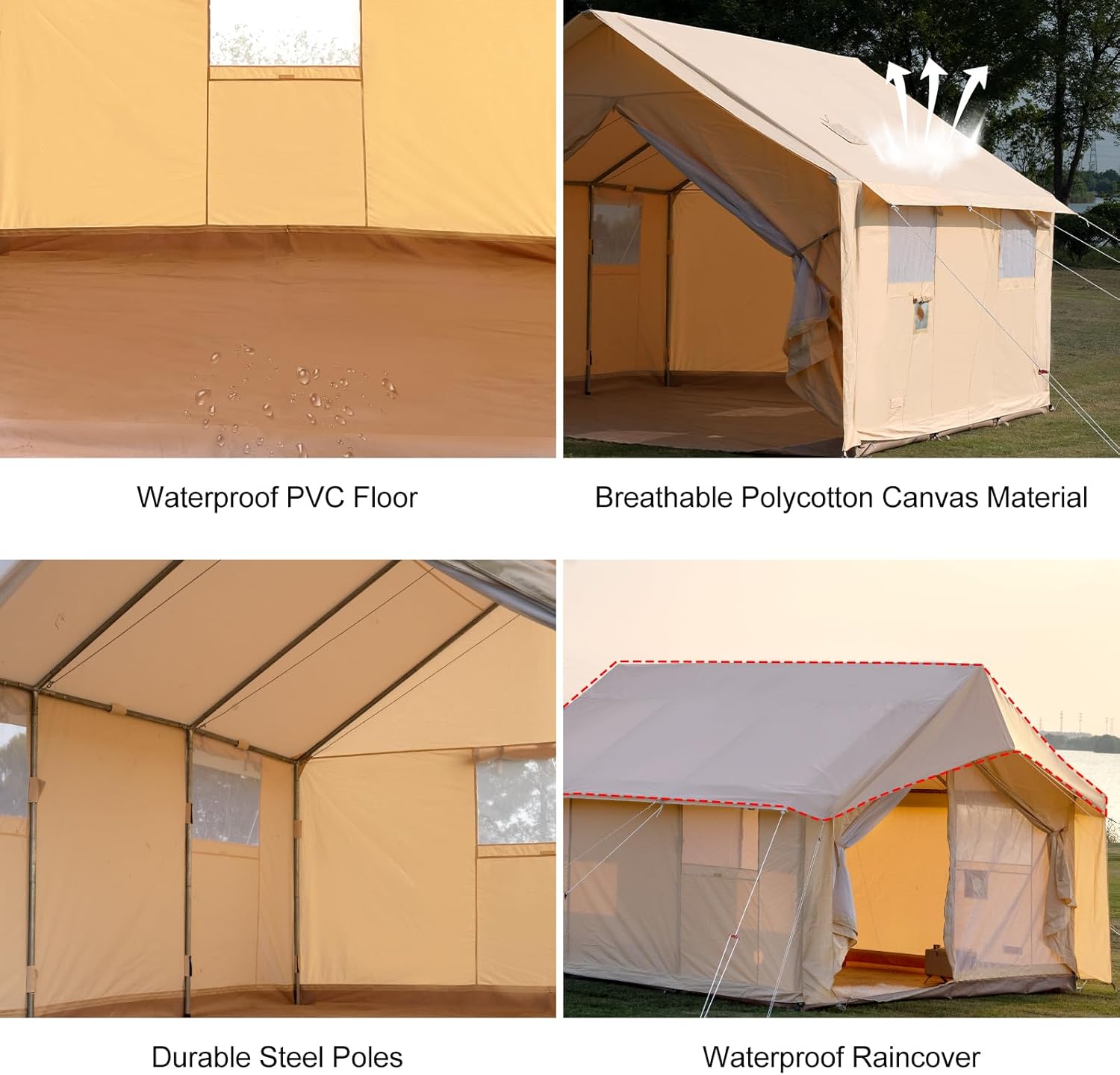
The WaldZimmer combines a polycotton canvas body with a steel frame, a waterproof PVC floor, and a separate rainfly. This configuration is intended for campers who want a large, structured shelter rather than a compact tent designed primarily for quick overnight stops. The manufacturer lists dimensions of approximately 12.1 × 10.2 feet, with a maximum height of about 8.3 feet.
The rectangular layout gives campers a defined interior area for sleeping and organizing equipment. Compared with smaller dome-style tents, a wall tent of this size may be more practical for a dedicated campsite where occupants want room to arrange bedding and supplies. However, the advertised capacity of six to eight people should be treated as a maximum occupancy claim rather than a guarantee of spacious accommodation for eight adults with full camping gear.
The fabric is described as breathable, tear-resistant, water-resistant, and UV-resistant polycotton. The separate rainfly uses 150D Oxford fabric, while the floor is specified as heavy-duty 500 gsm PVC. These components serve different purposes: the canvas forms the main shelter, the rainfly provides an additional layer of weather protection, and the PVC floor helps separate the interior from damp ground.
One important qualification concerns rain protection. The product information specifically warns against leaving the canvas exposed to rain overnight or for prolonged periods. Therefore, the presence of a waterproof floor and rainfly should not be interpreted as proof that the entire tent can withstand continuous heavy rain without careful setup and maintenance.
The listing also describes steel stabilizing wires, adjustable guy lines, double-layered door and window panels, and stove-jack provisions. Buyers should verify the exact included configuration on the current Amazon listing, particularly if they intend to use a stove or need a complete frame and accessory kit.
Key Features
Polycotton Canvas Construction
The tent body uses a polycotton fabric blend intended to combine the character of canvas with breathability and resistance to tearing. The manufacturer also advertises water and UV resistance.
For buyers, the distinction between water-resistant canvas and a fully waterproof shelter is important. The listed fabric treatment does not remove the need to use the supplied rainfly as directed or to protect the tent from prolonged wet conditions. The manufacturer’s warning about extended rain exposure should be considered when deciding whether this model suits the local climate and expected trip conditions.
Spacious Rectangular Floor Plan
The advertised floor dimensions are approximately 12.1 × 10.2 feet, providing a rectangular layout for sleeping areas and camping equipment. This shape can be useful when several people need to organize their belongings within one shared shelter.
The listing advertises accommodation for six to eight people. In practice, the comfortable capacity will depend on sleeping-pad sizes, bedding, bags, and whether occupants want additional living or storage space. Campers planning longer stays should map out the sleeping arrangement before assuming that the maximum advertised capacity will meet their needs.
Heavy-Duty PVC Floor
The floor is specified as 500 gsm PVC, providing a substantial barrier between the interior and the ground. This is a useful feature for a large campsite shelter, particularly when the ground is damp or the tent will be used repeatedly.
However, the floor material alone does not establish how well the complete tent will perform on a poorly drained site. Ground selection, correct pitching, and the manufacturer’s instructions still matter. Avoid setting up in depressions where rainwater can collect around or beneath the tent.
Separate Oxford Rainfly
The included rainfly is described as 150D Oxford fabric with waterproof properties. A separate rainfly adds a layer of protection over the main canvas body, provided it is installed and tensioned correctly.
This feature is particularly relevant because the manufacturer advises against prolonged rain exposure for the canvas itself. Before relying on the shelter in wet weather, confirm that the rainfly is included in the selected package, covers the intended areas, and is installed according to the supplied instructions.
Steel Frame and Stabilizing Lines
The tent uses steel poles, with the product description also referring to stabilizing wires and adjustable guy lines. These components are intended to support the wall-tent structure and help secure it at the campsite.
The presence of a steel frame does not establish a particular wind rating. Stability depends on correct assembly, suitable anchoring, ground conditions, exposure, and the weather encountered. Follow the manufacturer’s setup instructions and do not interpret general wind-resistance language as a guarantee of performance in severe conditions.
Ventilation and Stove-Jack Provisions
The listing describes double-layered door and window panels intended to support airflow while helping keep insects outside. It also refers to stove-jack provisions for campers considering a stove-compatible configuration.
Before purchase, verify the number and location of the windows and stove jacks on the exact model being sold. A stove jack alone does not make stove use safe: any heating appliance must be compatible with the tent and installed with appropriate clearances, ventilation, and manufacturer-approved components. Never use a fuel-burning appliance in a way that creates a carbon-monoxide or fire hazard.
Technical Specifications
| Specification | Details |
|---|---|
| Brand | WaldZimmer |
| Product | Cotton Canvas Wall Tent with Rain Canopy |
| Amazon ASIN | B0G4C313P6 |
| Tent Style | Rectangular wall tent |
| Main Fabric | Polycotton canvas |
| Advertised Capacity | 6–8 people |
| Approximate Floor Dimensions | 12.1 × 10.2 ft |
| Advertised Maximum Height | Approximately 8.3 ft |
| Floor Material | PVC |
| Floor Specification | 500 gsm, according to the listing |
| Rainfly Material | 150D Oxford fabric, according to the listing |
| Frame | Steel poles |
| Weather-Related Features | Water-resistant canvas, separate rainfly, waterproof PVC floor |
| Ventilation | Double-layered door and window panels, according to the listing |
| Stove-Jack Configuration | Verify the number and details on the selected listing |
| Listed Weight | Approximately 130 lb; verify the selected package |
| Included Components | Confirm the tent, frame, rainfly, stakes, guy lines, and other accessories on the current listing |
| Manufacturer’s Rain Guidance | Do not leave the canvas exposed to rain overnight or for prolonged periods |
Specification note: These details are based on available product-listing information, not independent testing. Confirm the selected variant, dimensions, package weight, stove-jack configuration, and included components before purchasing.
Pros and Cons
Pros
Large rectangular layout for a shared campsite or base-camp setup.
Advertised capacity of six to eight people.
Polycotton canvas body with advertised breathability and water resistance.
Heavy-duty 500 gsm PVC floor, according to the listing.
Separate 150D Oxford rainfly.
Steel frame and adjustable guy-line system.
Door and window panels designed to support ventilation.
Cons
The listed weight of approximately 130 pounds makes transport and handling demanding.
The manufacturer warns against leaving the canvas exposed to rain overnight or for extended periods.
Advertised maximum occupancy may leave limited room for gear and comfortable movement.
The complete dimensions, package contents, and stove-jack configuration should be verified.
The available specifications do not establish a tested wind rating or guarantee performance in severe weather.
A large wall-tent structure may require more setup space and effort than a conventional recreational tent.
Who Should Consider This Tent?
The WaldZimmer is worth considering for campers who want a large wall tent for a fixed or semi-permanent campsite. Its rectangular footprint can suit family groups, hunting camps, and longer stays where the shelter needs to accommodate both people and equipment.
It may also appeal to buyers who prefer a package that combines a canvas body, steel frame, PVC floor, and separate rainfly. Having these components together can simplify the initial equipment checklist, provided the selected listing includes everything required for the intended setup.
This model is less suitable for backpackers, campers who move between sites every day, or anyone who prioritizes low carrying weight. Its advertised weight alone makes it a vehicle-transport option rather than a practical shelter for carrying over long distances.
It is also not the right choice for someone who expects canvas construction to guarantee protection during prolonged heavy rain. The manufacturer’s explicit rain warning makes weather management a key part of the buying decision. Campers in persistently wet climates should carefully assess the rainfly design, setup instructions, and drying requirements before choosing this model.
What to Verify Before Buying
Confirm that the listing is for WaldZimmer ASIN B0G4C313P6 and the intended size.
Check the advertised 12.1 × 10.2 ft footprint and approximately 8.3 ft maximum height.
Verify whether the selected package includes the complete steel frame, rainfly, stakes, guy lines, and all necessary connectors.
Confirm the packed weight and whether the tent can be transported and assembled with the help available at your campsite.
Check the number and configuration of windows, door layers, and stove jacks.
Review the manufacturer’s instructions for rain protection, drying, storage, anchoring, and wind limitations.
If you plan to use a stove, confirm compatibility and all required safety components before purchasing.
Read the current listing carefully for changes to the selected variant, specifications, or package contents.
Our Assessment
The WaldZimmer Cotton Canvas Wall Tent earns its place in this comparison as a spacious, traditional wall-tent option with a steel frame, a substantial PVC floor, and a separate rainfly. Its advertised capacity and rectangular layout may suit campers who want a shared shelter for an established campsite rather than a lightweight tent for frequent travel.
Its strongest selling point is the combination of interior space and the listed structural components. The main trade-offs are its substantial weight and the need to take the manufacturer’s warning about prolonged rain exposure seriously. Buyers should also confirm the exact stove-jack arrangement and package contents instead of assuming every advertised feature is included in every variant.
Based on the available specifications, this is a candidate for vehicle-based group camping and base-camp use. This assessment is based on published product information, not hands-on testing, and does not establish performance under severe weather conditions.
Related Guide: Choosing a suitable location is especially important when pitching a large wall tent. Our guide to how to choose a campsite explains how to assess usable space, ground conditions, drainage, and exposure before setting up your shelter.
2. Dream House Large Spacious Outdoor Waterproof Cotton Canvas 4 Season Tent
Award: Best for a High-Capacity Canvas Tent with a Tall Interior

The Dream House Large Spacious Outdoor Waterproof Cotton Canvas 4 Season Tent is designed for campers who need substantial floor space for group trips, family camping, or extended stays at a single campsite. Its advertised 215-square-foot footprint, tall central roof, cotton canvas construction, and integrated PVC floor distinguish it from smaller recreational tents. With a stated capacity of up to ten people, it is an option for groups that prioritize a large shared interior over compact transport.
Overview
The Dream House tent uses cotton canvas with a polyurethane waterproof coating and a galvanized steel support structure. Its advertised dimensions are approximately 16.4 × 13.1 feet, with a peak height of around 9.8 feet. The manufacturer lists a fabric weight of 285 g/m² and a heavy-duty PVC floor rated at 540 g/m². These specifications make the model worth considering for campers seeking a spacious shelter with a more substantial structure than a typical lightweight family tent.
The tall, cabin-like layout is one of its defining characteristics. The central support pole raises the roof, while additional poles support the entrances. This arrangement creates a large shared interior that can accommodate sleeping equipment and camping supplies, depending on how the space is organized. The advertised ten-person capacity should not, however, be interpreted as ten people having generous personal space: bedding, bags, and other equipment reduce the area available for comfortable movement.
The tent is described as having two large doors and four triangular windows, with mesh screens intended to improve airflow and help keep insects out. Its integrated PVC groundsheet is designed to provide a barrier between the interior and the ground. The manufacturer also specifies reinforced stitching and rainproof caps for the door poles.
Weather protection requires some care. The canvas has a 3000 mm waterproof PU coating according to the manufacturer, but the product information also explains that the cotton fabric may leak slightly during its first exposure to heavy rain as the fibers become wet and shrink. The manufacturer recommends allowing this initial wetting process to occur and then drying the tent completely. This is an important preparation step, not a reason to assume the shelter is immediately ready for every prolonged downpour.
The tent is also heavy: the manufacturer’s listed gross weight is approximately 99 pounds. It is therefore better suited to vehicle-based camping than to trips where the shelter must be carried over long distances. Before buying, confirm the current Amazon listing and included components, particularly if you need to transport the packed tent in a vehicle with limited cargo space.
Key Features
Large Floor Area for Group Camping
The advertised footprint measures approximately 16.4 × 13.1 feet, providing around 215 square feet of floor area. This is the central attraction for campers who need a shared shelter for several occupants rather than separate small tents.
The rectangular layout can help organize sleeping spaces and equipment, although the practical arrangement depends on the size of sleeping pads, bags, and personal belongings. If you plan to accommodate ten people, consider drawing up a sleeping layout before purchasing. The maximum advertised capacity is not the same as a comfortable capacity for a group carrying substantial equipment.
Cotton Canvas with PU Waterproof Coating
The tent fabric is specified as cotton canvas weighing 285 g/m², with a 3000 mm waterproof PU coating. The treatment is intended to improve resistance to water while retaining the character of a canvas shelter.
The manufacturer notes that the cotton may allow some water through during the first heavy wetting before the fibers shrink. Following the supplied preparation and drying instructions is therefore important. After use, the tent should be completely dry before storage to reduce the risk of mold and mildew.
The advertised waterproof rating describes the fabric specification; it does not independently establish how the complete tent will perform in prolonged rain, particularly around doors, seams, and other potential water-entry points.
Tall Central Roof
The advertised peak height is approximately 9.8 feet, giving the tent a notably tall central interior. This can make it easier to move around the central area and organize a group campsite than in a low-profile shelter.
The peak height should not be confused with standing height throughout the tent. The sides slope down toward the perimeter, and the manufacturer lists a side height of approximately 2.6 feet. When planning sleeping arrangements or placing furniture, allow for the reduced headroom near the edges.
Two Doors and Four Mesh-Screened Windows
The manufacturer describes two large entrances and four triangular windows fitted with mesh screens. Multiple openings can help occupants ventilate the interior and provide more flexibility when entering or leaving a large shared shelter.
Ventilation remains dependent on conditions and how the openings are used. In warm weather, opening suitable doors and windows can encourage airflow; in rain or strong wind, the fabric panels may need to be adjusted according to the manufacturer’s instructions. Mesh screens help limit insect entry but do not replace appropriate weather protection.
Integrated Heavy-Duty PVC Floor
The groundsheet is specified as 540 g/m² PVC. It is connected to the upper tent structure and is described in product information as a non-removable floor. This construction helps create a continuous barrier between the sleeping area and the ground.
A substantial floor can be useful on established campsites, but site selection still matters. Avoid depressions where water can accumulate, and inspect the ground for sharp objects before pitching. The floor’s material specification alone does not guarantee that the entire shelter will remain dry under every ground or weather condition.
Galvanized Steel Poles and Reinforced Construction
The main center pole is specified as a galvanized steel tube approximately 1.5 inches in diameter, with a thickness of 2 mm. The door poles are smaller galvanized steel tubes. The manufacturer also describes double stitching and reinforced points, together with 14 small stakes, 14 large stakes, and 14 wind ropes in the listed package.
These components are intended to support the tent’s large structure and secure it at the campsite. The manufacturer advertises a wind limit of approximately 30 mph and advises against use in stronger windstorms. This should be treated as a manufacturer-stated limit, not an independently verified storm-performance rating. Correct anchoring, suitable ground, exposure, and the actual weather conditions remain important.
Technical Specifications
| Specification | Details |
|---|---|
| Brand | Dream House |
| Product | Large Spacious Outdoor Waterproof Cotton Canvas 4 Season Tent |
| Model Number | US-TR001 |
| Amazon ASIN | B06XWXQ94Z |
| Tent Style | Large cabin-style canvas tent |
| Advertised Capacity | Up to 10 people |
| Approximate Floor Dimensions | 16.4 × 13.1 ft |
| Advertised Floor Area | Approximately 215 sq ft |
| Peak Height | Approximately 9.8 ft |
| Side Height | Approximately 2.6 ft |
| Door Height | Approximately 6.2 ft |
| Main Fabric | Cotton canvas, 285 g/m² |
| Fabric Treatment | 3000 mm waterproof PU coating, according to the manufacturer |
| Floor Material | PVC, 540 g/m² |
| Main Support Pole | Galvanized steel, approximately 1.5 in diameter |
| Doors | 2 large doors, according to the manufacturer |
| Windows | 4 triangular mesh-screened windows |
| Stakes and Guy Ropes | 14 small stakes, 14 large stakes, and 14 wind ropes, according to the listed package |
| Advertised Gross Weight | Approximately 99 lb |
| Advertised Wind Limit | Approximately 30 mph; manufacturer-stated guidance |
| Included Components | Tent fabric, center pole, four door poles, rainproof caps, stakes, wind ropes, instructions, and carry bag, according to the manufacturer |
Specification note: The figures above follow the manufacturer’s product information. Some third-party listings report different weights or waterproof specifications, so verify the current Amazon listing and the exact product variant before purchasing. The advertised capacity and wind limit are not independently verified performance results.
Pros and Cons
Pros
Large advertised floor area of approximately 215 square feet.
Capacity advertised for up to ten people.
Tall central roof with a peak height of approximately 9.8 feet.
Cotton canvas with a manufacturer-stated 3000 mm waterproof PU coating.
Heavy-duty 540 g/m² PVC floor.
Two large doors and four mesh-screened windows.
Galvanized steel support poles and reinforced stitching.
Manufacturer-listed stakes, wind ropes, and carry bag.
Cons
Gross package weight of approximately 99 pounds makes it unsuitable for most backpacking trips.
The advertised ten-person capacity leaves less room per occupant when everyone brings substantial gear.
The manufacturer notes that the canvas may leak slightly during its first heavy wetting.
The tent must be dried completely before storage.
The large structure requires sufficient campsite space for the footprint, stakes, and guy lines.
The advertised wind limit should not be treated as a guarantee of performance in severe weather.
Who Should Consider This Tent?
The Dream House is worth considering for larger families and groups who want to share one substantial shelter. Its broad floor area and tall central roof can be useful when a campsite serves as a base for several days, especially if occupants need room for sleeping equipment and organized storage.
It may also appeal to campers who prefer a cabin-like canvas tent rather than a low-profile dome design. The two doors and multiple mesh-screened windows offer practical flexibility for entering the tent and ventilating the interior, while the integrated PVC floor provides a defined barrier from the ground.
This model is less suitable for backpackers, minimalist campers, or people who frequently change campsites. Its weight and large footprint make vehicle transport and careful site selection important parts of the setup.
It is also not the best choice for someone who expects completely trouble-free use straight out of the package in prolonged wet weather. The manufacturer specifically describes an initial wetting process for the cotton canvas and emphasizes complete drying before storage. Buyers should be comfortable following these requirements and planning for the tent’s size and weight.
What to Verify Before Buying
Confirm that the selected listing is Dream House model US-TR001, ASIN B06XWXQ94Z.
Check the advertised footprint, peak height, side height, and door height.
Verify the fabric’s waterproof treatment and the PVC floor specification on the current listing.
Confirm that the complete pole set, rainproof caps, stakes, guy ropes, instructions, and carry bag are included.
Check the package dimensions and gross weight to make sure the tent fits your vehicle and storage space.
Review the manufacturer’s instructions for initial wetting, drying, cleaning, and long-term storage.
Check the manufacturer’s stated wind limitations and the recommended anchoring procedure.
Plan the sleeping arrangement based on the number of occupants and the gear that will be stored inside.
Confirm the current listing’s return policy and availability of replacement components before ordering.
Our Assessment
The Dream House Large Spacious Outdoor Waterproof Cotton Canvas 4 Season Tent stands out for its large floor area, tall central roof, and advertised ten-person capacity. It is best viewed as a vehicle-based group shelter for campers who want a shared interior and are prepared to manage a substantial tent.
Its principal advantage is space, supported by a cotton canvas body, a heavy-duty PVC floor, and a multi-pole steel structure. Its main trade-offs are weight, the need for a large pitching area, and the manufacturer’s guidance on the initial wetting and complete drying of the canvas.
Based on the available specifications, this model is a candidate for family and group camping at established sites. The manufacturer’s advertised capacity and weather-related specifications should be checked against the exact listing, and this assessment is based on published information rather than hands-on testing.
Related Guide: A large canvas tent can take up a substantial share of your vehicle’s cargo space. Our guide to packing a car for camping efficiently explains how to organize bulky equipment, keep essential items accessible, and plan your gear layout before leaving home.
3. WHITEDUCK Alpha Canvas Wall Tent
Award: Best for a Heavy-Duty Wall Tent with a Dedicated Stove Jack

The WHITEDUCK Alpha Canvas Wall Tent is designed for campers who want a substantial wall tent for extended stays, hunting camps, or a dedicated outdoor base. Its Army Duck cotton canvas, reinforced construction, aluminum frame, heavy-duty groundsheet, and pre-installed stove jack distinguish it from simpler canvas shelters. The Alpha range is available in multiple sizes and fabric finishes, so buyers should select the configuration that matches their intended use rather than assuming every model has the same dimensions or capacity.
Overview
The WHITEDUCK Alpha is a traditional wall tent built around a structured frame and a rectangular interior. Unlike lightweight tents designed primarily for sleeping and quick overnight stops, this style is intended to provide a more substantial sheltered space for longer periods at an established campsite.
The manufacturer specifies 10.10 oz Army Duck cotton canvas with a DYNADUCK finish designed to provide water repellency and resistance to mold and UV exposure. Buyers can choose between water-repellent and fire-water-repellent fabric options, depending on the selected configuration. These are distinct finishes, and the fire-water-repellent option should not be interpreted as making the entire tent fireproof.
The Alpha’s frame uses anodized aluminum poles, galvanized-steel angle connectors, and a system of shock-absorbing bungee cords. The manufacturer also describes double-stitched seams, reinforced corners, storm windows, a storm door, and insect mesh. Together, these features are intended to create a robust shelter with a more developed structural system than a basic canvas tent.
One of the model’s most distinctive features is its pre-installed, heat-resistant, silicone-coated stove jack, with precut openings for compatible 5-inch and 6-inch stove pipes. This makes the Alpha relevant to campers considering a wood-burning tent stove, provided the selected configuration and stove are compatible and all safety instructions are followed.
The Alpha range also includes a separate 16 oz PVC groundsheet designed to be removable for cleaning and transport. However, the complete package weight can be substantial, especially when the frame, connectors, stakes, and other components are included. This is primarily a vehicle-based camping option rather than a shelter intended for carrying long distances.
Because the Amazon listing may correspond to a particular size or configuration, verify the exact dimensions, capacity, finish, and package contents before purchasing. The official Alpha range specifications are useful for understanding the design, but they should not automatically be treated as the exact specifications of every listing.
Key Features
Army Duck Cotton Canvas with Protective Treatment
The Alpha uses 10.10 oz Army Duck cotton canvas, a substantial fabric selected for the wall-tent design. The manufacturer describes its DYNADUCK finish as water-repellent and resistant to mold and UV exposure.
For campers, the treatment is relevant to repeated outdoor use, but water repellency is not an unconditional guarantee against leakage. Performance depends on the fabric finish, seams, setup, exposure, and maintenance. The canvas should be dried completely before long-term storage, and the manufacturer’s care instructions should be followed to preserve the treatment.
The optional fire-water-repellent finish is a separate purchasing consideration for campers planning to use a compatible stove. It does not eliminate fire risk or remove the need for safe clearances and proper ventilation.
Anodized Aluminum Frame and Reinforced Construction
The Alpha uses anodized aluminum frame poles with galvanized-steel angle connectors. The manufacturer also specifies shock-absorbing bungee cords, double-stitched seams, and reinforced corners.
This combination is intended to support the structure while allowing some movement through the frame system. However, the presence of reinforced construction does not establish a universal wind rating for every Alpha size or setup. Correct assembly, suitable anchoring, ground conditions, and exposure all influence stability.
Before buying, confirm which frame system is included with the selected size and whether the package contains the required connectors, stakes, and tools. The dimensions and number of frame sections vary across the Alpha range.
Pre-Installed Stove Jack
A pre-installed stove jack is one of the Alpha’s main differentiators. The manufacturer describes a heat-resistant, silicone-coated stove-jack panel with precut openings for compatible 5-inch and 6-inch stove pipes.
This feature can simplify planning for campers who intend to use an appropriate tent stove, but it does not mean that any stove or chimney system can be installed safely. The stove, pipe diameter, heat shielding, clearances, ventilation, and installation method must all follow the relevant manufacturers’ instructions.
A stove jack is not a substitute for carbon-monoxide precautions or fire safety. Never use a fuel-burning appliance in an enclosed shelter unless the equipment is specifically designed for that application and all safety requirements can be met.
Heavy-Duty Removable PVC Groundsheet
The Alpha range uses a 16 oz heavy-duty PVC groundsheet. The manufacturer describes it as a free-floating design that can be removed for cleaning and transport.
A removable groundsheet is practical when maintaining a large tent because it can make cleaning and handling easier. It also provides a substantial barrier between the interior and the ground. Nevertheless, it cannot compensate for poor drainage or an unsuitable pitching location. Avoid low spots where water can collect, and inspect the site for sharp objects before assembly.
Confirm that the groundsheet is included in the selected package and check its dimensions against the tent size you intend to purchase.
Storm Door, Layered Windows, and Bug Mesh
The manufacturer describes the Alpha as having a storm door, three-layer storm windows, and insect mesh on the doors and windows. These features are intended to balance protection from the elements with ventilation and insect control.
The number of windows varies by tent size. For example, the official 8 × 10 ft version lists two windows, while the 10 × 12 ft version lists four. This is why the selected size matters when comparing configurations.
Mesh helps limit insect entry when the openings are configured correctly, but it does not guarantee that the interior will remain free of condensation. Airflow, occupant numbers, outdoor humidity, and the way the tent is pitched still affect interior moisture.
Choice of Water-Repellent or Fire-Water-Repellent Finish
The Alpha is offered with different fabric finishes. The water-repellent option is intended for general outdoor use, while the fire-water-repellent version is aimed at buyers who want a fabric treatment intended for use with the appropriate stove setup.
The choice should be based on the intended application and the manufacturer’s instructions. A fire-retardant or fire-water-repellent fabric treatment does not make the canvas, frame, floor, or contents immune to ignition. Buyers should also confirm the exact finish selected in the Amazon listing because different finishes can affect the overall package weight.
Technical Specifications
| Specification | Details |
|---|---|
| Brand | WHITEDUCK |
| Product | Alpha Canvas Wall Tent |
| Amazon ASIN | B0BRKPGT5V |
| Tent Style | Rectangular wall tent |
| Main Fabric | 10.10 oz Army Duck cotton canvas |
| Fabric Finish | Water-repellent or fire-water-repellent option, depending on configuration |
| Canvas Treatment | DYNADUCK finish, according to the manufacturer |
| Frame | Anodized aluminum poles |
| Connectors | Galvanized-steel angle connectors |
| Structural Features | Shock-absorbing bungee cords, double-stitched seams, reinforced corners |
| Groundsheet | Removable 16 oz heavy-duty PVC |
| Doors | Varies by size |
| Windows | Varies by size; mesh included |
| Stove Jack | One pre-installed heat-resistant, silicone-coated stove jack in the listed Alpha configurations described by the manufacturer |
| Stove-Pipe Openings | Precut patterns for compatible 5-inch and 6-inch pipes |
| Guy Lines | UV-resistant reflective polypropylene rope, according to the manufacturer |
| Stakes | Heavy-duty galvanized steel, according to the manufacturer |
| Exact Floor Dimensions | Verify the selected Amazon listing |
| Advertised Capacity | Depends on the selected size; verify before purchase |
| Total Package Weight | Depends on size and fabric finish; verify the selected package |
| Included Components | Confirm the exact frame, groundsheet, stakes, connectors, tools, and accessories on the selected listing |
Specification note: The specifications above describe the WHITEDUCK Alpha range. Exact dimensions, capacity, window count, frame components, package weight, and included accessories vary by size and finish. Confirm the current Amazon listing for ASIN B0BRKPGT5V before ordering.
Pros and Cons
Pros
Substantial Army Duck cotton canvas with a manufacturer-specified protective finish.
Anodized aluminum frame with galvanized-steel connectors.
Reinforced corners and double-stitched seams.
Pre-installed stove jack with compatible 5-inch and 6-inch pipe openings.
Removable 16 oz PVC groundsheet.
Storm door, layered storm windows, and insect mesh.
Choice of water-repellent or fire-water-repellent finish.
Multiple sizes within the Alpha range for different campsite requirements.
Cons
The complete tent and frame system can be very heavy and bulky to transport.
The selected size and finish affect capacity, dimensions, and package weight.
Stove compatibility and installation require careful attention to safety requirements.
The fire-water-repellent finish does not make the entire shelter fireproof.
A substantial frame system requires adequate pitching space and careful assembly.
The exact specifications and included components must be confirmed for the selected Amazon listing.
Who Should Consider This Tent?
The WHITEDUCK Alpha is worth considering for campers who want a dedicated wall tent for an established base camp, hunting trips, or extended outdoor stays. Its reinforced construction, aluminum frame, removable PVC groundsheet, and multiple fabric options make it a more specialized choice than a simple canvas shelter.
It may be particularly appealing to buyers planning a stove-compatible setup. The pre-installed stove jack provides a defined route for a compatible stove pipe, but the complete heating arrangement must be selected and installed according to the manufacturer’s safety instructions. Anyone planning to use a stove should verify the fabric finish, stove-jack configuration, clearances, and required accessories before ordering.
The Alpha is less suitable for campers who need a lightweight tent for backpacking or who frequently relocate their campsite. Its frame and groundsheet contribute to a substantial transport load, and larger sizes require more pitching space and assembly effort.
It may also be unnecessary for occasional fair-weather camping. If you do not need the wall-tent layout, the reinforced frame, or stove compatibility, a simpler shelter may be more practical and economical.
What to Verify Before Buying
Confirm that the listing is for WHITEDUCK Alpha Canvas Wall Tent, ASIN B0BRKPGT5V.
Check the exact tent size, floor dimensions, center height, wall height, and advertised capacity.
Choose the intended fabric finish and verify that the selected variant matches your requirements.
Confirm the number of doors, windows, and stove jacks for the selected size.
Verify that the groundsheet, frame poles, angle connectors, stakes, guy lines, and required tools are included.
Check the complete package weight and dimensions for transport and storage planning.
If using a stove, confirm compatibility with the stove pipe, required clearances, heat shielding, and all manufacturer safety instructions.
Review the care instructions for cleaning, drying, storage, and maintaining the canvas finish.
Check the current listing for availability, return conditions, and replacement-component support.
Our Assessment
The WHITEDUCK Alpha is a specialized wall tent for campers who value a substantial structure and want the option of a stove-compatible setup. Its Army Duck canvas, aluminum frame, reinforced construction, and removable PVC groundsheet give it a clear role among larger canvas shelters.
Its most distinctive advantage is the combination of a dedicated stove jack and a structured wall-tent design. The trade-offs are transport weight, setup requirements, and the need to choose the correct size and fabric finish. Because Alpha specifications vary across the range, buyers should verify the selected Amazon variant rather than relying on figures from a different size.
Based on the available manufacturer specifications, the Alpha is a candidate for vehicle-based base-camp use and extended outdoor stays. This is a specification-based assessment, not a claim of hands-on testing or verified performance in severe weather.
Related Guide: Canvas treatments and seam condition both matter when maintaining a shelter for repeated outdoor use. Our guide to how to waterproof a tent and maintain its weather protection explains how to inspect vulnerable areas, care for protective coatings, and recognize signs that a tent may need maintenance.
4. TETON Sports Canvas Mesa 10'
Award: Best for a Square Canvas Tent with a Defined Floor Plan

The TETON Sports Canvas Mesa 10′ is designed for campers who want a canvas shelter with a straightforward square footprint rather than a large wall tent intended for a more elaborate base-camp setup. Its advertised 10 × 10-foot floor area, six-person capacity, cotton canvas construction, and integrated PVC floor make it a candidate for family camping and established campsites. The design prioritizes a clearly defined sleeping area, making it worth considering for groups who want a canvas tent without moving to a much larger footprint.
Overview
The Canvas Mesa 10′ is a square canvas camping tent with an advertised floor area of 100 square feet. TETON Sports lists capacity for six people, placing it between compact recreational shelters and larger canvas wall tents designed for extended group stays.
Its cotton canvas body provides a traditional alternative to synthetic tent fabric. The tent also features a PVC floor, metal support poles, and stakes. This combination is intended for campsite use where a structured shelter and a defined interior floor area are more important than minimizing packed weight.
The advertised six-person capacity should be considered a maximum occupancy figure rather than a promise of generous room for six adults and all their equipment. Sleeping-pad dimensions, bedding, bags, and the space required to move inside all affect how comfortably a group can use the tent. For a family with substantial gear, it is worth planning the sleeping arrangement before deciding whether the Mesa’s 100-square-foot footprint is sufficient.
The manufacturer advertises a 1500 mm waterproof rating. This figure should be interpreted as a product specification, not an independently verified guarantee that the complete tent will remain dry in prolonged heavy rain. Correct pitching, fabric condition, site drainage, and care all affect the shelter’s performance.
The Mesa is also a substantial item to transport. Its advertised weight is approximately 71 pounds, so it is better suited to car camping than to backpacking. Buyers should check the current listing for the exact package dimensions, included components, and setup instructions before purchasing.
Key Features
10 × 10-Foot Square Footprint
The Mesa’s advertised 10 × 10-foot floor provides 100 square feet of interior floor area. A square layout can make it relatively straightforward to arrange sleeping pads and organize equipment around the available space.
The practical advantage is predictability: campers can estimate the floor area before arriving at the campsite and plan a layout around their sleeping arrangements. However, floor area alone does not establish how much usable headroom is available near the tent walls, so the actual layout should account for the tent’s shape and roof geometry.
For six occupants, the available space will be more limited once sleeping equipment and personal belongings are added. Campers who want a generous shared living area may prefer a larger tent, while smaller groups may find the Mesa’s footprint easier to accommodate at a campsite.
Cotton Canvas Construction
The Mesa uses cotton canvas with a listed fabric weight of approximately 285 g/m². Canvas construction is intended for repeated campsite use, but the fabric still requires appropriate care after exposure to moisture and dirt.
The manufacturer advertises a 1500 mm waterproof rating. Buyers should confirm the exact treatment and the manufacturer’s instructions for initial use, rain exposure, cleaning, and drying. A stated fabric rating does not independently establish the weather performance of seams, doors, floor connections, or the complete assembled shelter.
After a wet trip, allow the tent to dry completely before packing it away for long-term storage. This helps reduce the risk of mold and mildew developing in the fabric.
Integrated PVC Floor
The Mesa includes a PVC floor intended to separate the interior from the ground. This is useful when organizing a sleeping area because it creates a defined surface beneath occupants and their equipment.
A floor does not eliminate the importance of campsite preparation. Remove sharp debris before pitching, avoid depressions where water can collect, and follow the manufacturer’s guidance for setup and care. Buyers should also confirm the floor’s construction and the included components on the current product listing.
Metal Support Poles and Stakes
The Mesa uses metal poles and stakes to support and secure the shelter. These components form the basic structure of the tent and are important when planning the complete setup.
The supplied equipment should be checked before departure, particularly if the tent will be used at remote campsites where replacement components may be difficult to obtain. Correct pole assembly and secure anchoring remain essential; the presence of metal supports alone does not establish a particular wind rating.
Six-Person Advertised Capacity
TETON Sports advertises the Mesa for six people. This provides a useful starting point when comparing it with smaller tents, but the actual sleeping arrangement depends on the dimensions of the occupants and their equipment.
Six people using compact sleeping arrangements will have different space requirements from a family bringing wide sleeping pads, bulky bedding, and bags inside. If the tent will also serve as a place to sit or organize equipment during poor weather, consider whether the available floor area will meet those needs.
Warranty and Long-Term Ownership
TETON Sports advertises a lifetime warranty for the original owner, subject to the manufacturer’s terms and exclusions. Warranty coverage can be a relevant consideration when comparing camping equipment intended for repeated use.
Before relying on the warranty, review the current terms to understand which parts and types of damage are covered, whether proof of purchase is required, and how claims are handled. A warranty does not replace appropriate setup, maintenance, or protection from conditions outside the manufacturer’s stated limits.
Technical Specifications
| Specification | Details |
|---|---|
| Brand | TETON Sports |
| Product | Canvas Mesa 10′ |
| Model Number | 2110BR |
| Amazon ASIN | B08622Y9LV |
| Tent Style | Square canvas camping tent |
| Advertised Capacity | 6 people |
| Advertised Floor Dimensions | 10 × 10 ft |
| Advertised Floor Area | 100 sq ft |
| Main Fabric | Cotton canvas |
| Listed Fabric Weight | Approximately 285 g/m² |
| Advertised Waterproof Rating | 1500 mm, according to product information |
| Floor Material | PVC |
| Frame | Metal poles |
| Stakes | Metal stakes |
| Advertised Weight | Approximately 71 lb |
| Peak Height | Verify the current listing; available specifications differ |
| Warranty | Lifetime warranty for the original owner, subject to terms and exclusions |
| Included Components | Confirm the exact package contents on the current Amazon listing |
Specification note: The details above reflect available product information for the TETON Sports Canvas Mesa 10′. Confirm the current listing for ASIN B08622Y9LV, particularly the peak height, package dimensions, included components, and warranty terms. Advertised specifications have not been independently tested for this comparison.
Pros and Cons
Pros
Defined 10 × 10-foot square footprint.
Advertised 100 square feet of floor area.
Capacity listed for six people.
Cotton canvas construction.
Integrated PVC floor.
Metal support poles and stakes.
More compact floor plan than many large wall tents.
Manufacturer-advertised lifetime warranty for the original owner, subject to terms.
Cons
Advertised weight of approximately 71 pounds makes it unsuitable for most backpacking trips.
Six-person capacity may leave limited room for gear and comfortable movement.
The advertised waterproof rating does not guarantee that the complete tent will remain dry in every weather condition.
The exact peak height should be confirmed because available specifications differ.
The square floor plan may be less suitable for campers who need a large shared living or storage area.
Warranty coverage is subject to the manufacturer’s conditions and exclusions.
Who Should Consider This Tent?
The TETON Sports Canvas Mesa 10′ is worth considering for families and small groups who want a canvas tent with a clearly defined 10 × 10-foot floor plan. Its advertised six-person capacity provides a starting point for planning sleeping arrangements, while the integrated PVC floor helps create a distinct interior area.
It may suit vehicle-based campers who prefer a traditional canvas shelter for established campsites and do not need the larger footprint of a full-size wall tent. The square layout can also make it easier to estimate how much campsite space is needed before arrival.
This model is less suitable for backpackers or campers who prioritize low carrying weight. At approximately 71 pounds according to available product information, it is better treated as vehicle-transport equipment. Groups who want to spend substantial time inside the tent or store bulky equipment alongside six sleeping spaces should also consider whether a larger shelter would be more practical.
The Mesa is not automatically the right choice simply because the advertised capacity matches the number of people in your group. The more useful question is whether its floor area can accommodate your actual sleeping equipment and gear without making the interior difficult to use.
What to Verify Before Buying
Confirm that the selected listing is TETON Sports Canvas Mesa 10′, model 2110BR, ASIN B08622Y9LV.
Verify the advertised 10 × 10-foot footprint and 100-square-foot floor area.
Check the exact peak height and packed dimensions on the current listing.
Confirm the canvas fabric specification and advertised waterproof rating.
Verify that the PVC floor, complete pole set, stakes, and all required accessories are included.
Check the package weight and make sure it can be transported and handled at your intended campsite.
Review the setup, drying, cleaning, and storage instructions.
Read the current warranty terms, including exclusions and requirements for the original owner.
Plan the sleeping arrangement around the dimensions of your sleeping pads and the amount of gear you expect to keep inside.
Our Assessment
The TETON Sports Canvas Mesa 10′ occupies a useful middle ground in this comparison: it offers a defined square floor plan and an advertised six-person capacity without the larger footprint associated with many wall tents. Its cotton canvas body, PVC floor, and metal support components make it a candidate for vehicle-based family camping.
Its main advantage is the straightforward 10 × 10-foot layout, which allows buyers to estimate the available floor area before purchasing. The main trade-offs are its substantial transport weight and the limited room that may remain when six people bring their sleeping equipment and personal belongings.
Based on the available specifications, the Mesa is worth considering for groups who want a canvas shelter for an established campsite and do not need a very large interior. Confirm the current product details and warranty conditions before buying. This assessment is based on published product information, not hands-on testing.
Related Guide: A tent’s advertised capacity does not always translate into comfortable sleeping space once pads and personal gear are added. Our guide to choosing the right camping tent size explains how to account for occupants, equipment, and usable interior space when comparing tent dimensions.
5. WHITEDUCK Avalon Canvas Bell Tent 13'
Award: Best for a Bell Tent with Multiple Windows and Built-In Ventilation

The WHITEDUCK Avalon Canvas Bell Tent 13′ is designed for campers who want a more comfortable, open-plan shelter for glamping, family trips, or extended stays at an established campsite. Its circular floor plan, Army Duck cotton canvas, eight windows, four roof vents, and pre-installed stove jack give it a different character from the rectangular wall tents in this comparison. The 13-foot model is advertised to sleep six for conventional camping or three for glamping, reflecting the difference between maximum sleeping capacity and a more spacious setup.
Overview
The Avalon is a bell tent built around a central galvanized-steel pole and an A-frame entrance structure. Rather than dividing the interior into a rectangular sleeping area, its circular footprint creates a central space that can be arranged around beds, sleeping pads, storage, or selected camping furniture.
The manufacturer specifies 10.10 oz Army Duck cotton canvas with a DYNADUCK finish designed to provide water repellency and resistance to mold and UV exposure. Buyers can choose between water-repellent and fire-water-repellent fabric options. The distinction matters for anyone planning to use a compatible tent stove, although neither treatment makes the complete tent fireproof.
The 13-foot model has a floor diameter of approximately 13 feet, a center height of 8 feet 5 inches, and a wall height of 3 feet. The manufacturer lists one door and eight windows, with no-see-um mesh intended to help keep small insects outside. Four roof vents provide additional ventilation, while the 16 oz heavy-duty polyvinyl groundsheet creates a defined floor beneath the living area.
A pre-installed, heat-resistant, silicone-coated stove jack is another notable feature. The manufacturer specifies precut openings for compatible 5-inch and 6-inch stove pipes. This makes the Avalon a candidate for a stove-compatible campsite setup, provided the stove, chimney, clearances, and installation meet all relevant safety requirements.
The main consideration is that the bell-tent design offers a different use of space from a wall tent. Its sloping sides reduce headroom around the perimeter, so the full floor diameter should not be treated as an equally usable area for standing or arranging furniture. At approximately 99–104 pounds for the complete setup, depending on the fabric finish, it is also intended primarily for vehicle-based camping rather than backpacking.
Key Features
13-Foot Circular Floor Plan
The Avalon has an advertised 13-foot floor diameter, equivalent to approximately 4 meters. Its circular layout gives campers flexibility when arranging sleeping spaces and creating a shared central area.
For glamping, this arrangement can accommodate a more deliberate interior setup with bedding, bags, and selected furniture. For conventional camping, the manufacturer advertises sleeping capacity for six people. However, the same tent is rated for three people in a glamping arrangement, when each occupant may need more room and additional furnishings occupy part of the floor.
The sloping walls also affect how the floor can be used. Sleeping pads and low storage can be arranged closer to the perimeter, while taller equipment and furniture generally need to be positioned with the center pole and available headroom in mind.
Army Duck Cotton Canvas with DYNADUCK Finish
The Avalon uses 10.10 oz Army Duck cotton canvas with the manufacturer’s DYNADUCK finish. WHITEDUCK describes the treatment as water-repellent and resistant to mold and UV exposure.
The fabric finish is an important specification, but water repellency should not be confused with a guarantee that the entire tent will remain dry in every condition. Setup, seam condition, exposure, ground drainage, and maintenance all influence performance. Buyers should follow the manufacturer’s instructions for care and drying after wet conditions.
Two fabric options are advertised: water-repellent and fire-water-repellent. Campers considering a stove should check which finish is selected and understand its stated limitations. A fire-water-repellent treatment does not eliminate ignition risks or replace safe stove installation.
Eight Windows and Four Roof Vents
The Avalon has eight windows and four roof vents, according to the manufacturer. No-see-um mesh is specified for the doors and windows, helping limit the entry of small insects when the openings are configured correctly.
The multiple openings provide flexibility when adjusting airflow, particularly when several people occupy the tent or when the campsite is warm and humid. Roof vents also provide openings near the top of the shelter, where warm, moisture-laden air can accumulate.
Ventilation cannot eliminate condensation in every situation. Temperature differences, humidity, occupant numbers, and cooking or drying wet gear inside the shelter all influence moisture buildup. The practical benefit comes from using the available vents and windows appropriately rather than assuming that their presence guarantees a dry interior.
Pre-Installed Stove Jack
The Avalon includes one pre-installed heat-resistant, silicone-coated stove jack. The manufacturer specifies precut patterns for compatible 5-inch and 6-inch stove pipes.
This can simplify planning for campers who want a compatible tent stove, but the stove jack alone does not make the tent safe for any heating appliance. The stove, chimney, heat shielding, clearances, ventilation, and installation must all follow the relevant manufacturer’s instructions.
The fire-water-repellent canvas option may be relevant to this setup, but it should not be treated as a substitute for fire precautions. Never use a fuel-burning appliance in an enclosed shelter unless the appliance is specifically designed for that application and all safety requirements can be met. Carbon-monoxide protection and appropriate ventilation are essential.
Heavy-Duty Polyvinyl Groundsheet
The manufacturer specifies a 16 oz heavy-duty polyvinyl floor. This provides a substantial surface between the interior and the ground, helping create a defined living and sleeping area.
For glamping, the floor can make it easier to arrange bedding and selected furnishings. For conventional camping, it provides a barrier beneath sleeping equipment and personal belongings. However, a heavy-duty floor cannot compensate for poor site drainage. Choose a suitable, well-drained location and clear the ground of sharp objects before pitching.
Before ordering, confirm the groundsheet dimensions and the components included in the selected package, particularly if you plan to purchase additional floor protection or accessories.
Galvanized Steel Frame and Reinforced Construction
The Avalon uses a galvanized-steel center pole and A-frame entrance structure. The manufacturer also describes double-stitched seams, reinforced corners, heavy-duty galvanized-steel pegs, and a shock-absorbing grounding system.
These components are intended to support the bell-tent structure and help secure it at the campsite. Correct assembly and anchoring remain important, especially because a tall shelter with a broad footprint can be exposed to wind. The construction details alone do not establish a universal wind rating, so follow the manufacturer’s guidance and avoid conditions beyond the tent’s stated limits.
Waterproof Zippers and Electrical Cable Outlet
The manufacturer lists waterproof zippers and an integrated electrical cable outlet among the Avalon’s features. These details may be useful when organizing a campsite with lighting or other electrical equipment.
However, a waterproof zipper should not be interpreted as proof that every entrance and seam is impervious to water in all conditions. Likewise, the cable outlet does not make electrical equipment suitable for wet environments. Check the manufacturer’s instructions for cable routing and use only equipment rated for the conditions in which it will operate.
Technical Specifications
| Specification | Details |
|---|---|
| Brand | WHITEDUCK |
| Product | Avalon Canvas Bell Tent 13′ |
| Amazon ASIN | B07VL9WTHD |
| Tent Style | Bell tent |
| Floor Diameter | 13 ft / approximately 4 m |
| Advertised Camping Capacity | 6 people |
| Advertised Glamping Capacity | 3 people |
| Main Fabric | 10.10 oz Army Duck cotton canvas |
| Fabric Finish | Water-repellent or fire-water-repellent option |
| Canvas Treatment | DYNADUCK finish, according to the manufacturer |
| Center Height | 8 ft 5 in |
| Door Height | 5 ft 10 in |
| Wall Height | 3 ft |
| Doors | 1 |
| Windows | 8 |
| Roof Vents | 4 |
| Insect Protection | No-see-um mesh |
| Groundsheet | 16 oz heavy-duty polyvinyl |
| Frame | Galvanized-steel center pole and A-frame |
| Stove Jack | 1 pre-installed heat-resistant, silicone-coated jack |
| Stove-Pipe Openings | Precut patterns for compatible 5-inch and 6-inch pipes |
| Zippers | Waterproof zippers, according to the manufacturer |
| Electrical Access | Electrical cable outlet included |
| Guy Lines | UV-resistant reflective polypropylene rope |
| Total Advertised Weight | Approximately 99–104 lb, depending on fabric finish |
| Included Components | Tent, groundsheet, poles, and tool kit; verify exact package contents on the selected listing |
Specification note: These specifications are based on the manufacturer’s official information for the 13-foot Avalon. Confirm the selected Amazon listing, fabric finish, package contents, and current dimensions before purchasing. The listed weight varies with the finish and package configuration. Manufacturer specifications have not been independently tested for this comparison.
Pros and Cons
Pros
Circular 13-foot floor plan suited to a flexible glamping layout.
Advertised capacity for six people camping or three people glamping.
10.10 oz Army Duck cotton canvas with a protective finish.
Eight windows and four roof vents for adjustable ventilation.
No-see-um mesh on doors and windows.
Pre-installed stove jack with precut openings for compatible 5-inch and 6-inch stove pipes.
Heavy-duty 16 oz polyvinyl groundsheet.
Galvanized-steel center pole and A-frame entrance structure.
Electrical cable outlet and waterproof zippers, according to the manufacturer.
Cons
The advertised total weight of approximately 99–104 pounds makes it unsuitable for most backpacking trips.
Sloping walls reduce usable headroom around the perimeter.
The comfortable glamping capacity is lower than the advertised conventional camping capacity.
The stove jack requires careful compatibility checks and safe installation.
The fabric finish does not make the entire tent fireproof or guarantee waterproof performance in every condition.
The complete setup requires adequate campsite space and secure anchoring.
Who Should Consider This Tent?
The WHITEDUCK Avalon 13′ is worth considering for campers who want a bell tent for glamping, comfortable family trips, or longer stays at an established campsite. Its circular floor plan allows a different interior arrangement from a conventional wall tent, particularly when the aim is to create a shared living area rather than simply fit the maximum number of sleeping spaces.
It may appeal to couples or small families who want room for bedding and selected furniture without moving to one of the largest wall-tent designs. The eight windows, four roof vents, and mesh panels also provide flexibility when managing airflow and insects.
The stove jack may be useful for campers planning a compatible stove installation, but the full heating setup must be assessed carefully. Buyers should select the appropriate fabric finish and follow all stove, chimney, clearance, ventilation, and carbon-monoxide safety instructions.
This model is less suitable for campers who need a lightweight shelter, frequently move between campsites, or want maximum standing room throughout the entire floor area. The sloping walls and central support pole influence how the interior can be furnished, and the complete package is heavy enough to make vehicle transport the practical choice.
It is also important to choose the tent based on the intended level of comfort. Six people may fit for conventional camping, but three people is the manufacturer’s stated glamping capacity. Buyers planning a furnished interior should use the lower figure as the more relevant starting point.
What to Verify Before Buying
Confirm that the listing is WHITEDUCK Avalon Canvas Bell Tent 13′, ASIN B07VL9WTHD.
Check that the selected size is 13 feet rather than another size in the Avalon range.
Choose the intended fabric finish and verify the selected option on the product page.
Confirm the 13-foot floor diameter, center height, wall height, and door height.
Verify that the groundsheet, center pole, A-frame, pegs, guy lines, and tool kit are included.
Check the package weight and dimensions, including separate pole packaging.
Confirm the stove-jack configuration and compatibility with your intended stove pipe.
Review all stove safety, ventilation, fire-clearance, and carbon-monoxide requirements before planning to heat the tent.
Check the manufacturer’s guidance for pitching, anchoring, cleaning, drying, and storage.
Confirm the current listing’s return policy, warranty terms, and availability of replacement components.
Our Assessment
The WHITEDUCK Avalon Canvas Bell Tent 13′ offers a distinct alternative to the four wall-tent and square-tent designs in this comparison. Its circular floor plan, multiple windows, roof vents, and stove-jack provision make it a candidate for campers who want a more comfortable, glamping-oriented shelter.
Its strongest selling point is the way the interior can be arranged for a smaller group seeking more than a basic sleeping space. The trade-offs are its substantial weight, reduced headroom near the perimeter, and the need to plan carefully if a stove will be used. The advertised capacity also depends on the intended setup: six for conventional camping, compared with three for glamping.
Based on the manufacturer’s specifications, the Avalon is best suited to vehicle-based camping where comfort and interior arrangement matter more than low weight. This assessment is based on published product information, not hands-on testing, and does not establish performance under severe weather conditions.
Related Guide: A spacious tent can still feel damp if moisture accumulates overnight. Our guide to how to stop condensation in a tent explains how ventilation, campsite selection, and moisture management can help keep your sleeping area more comfortable.
What to Consider Before Choosing a Canvas Tent for Camping

Choosing a canvas tent involves more than comparing floor dimensions or the number of people listed on the product page. The right model should match your camping setup, the amount of usable interior space you need, your expected weather conditions, and the effort you are willing to invest in transportation and maintenance. Use the following factors to narrow down your options before making a purchase.
1. Match the Tent Size to Your Actual Camping Group
Start with the number of people who will regularly use the tent, then account for sleeping equipment, bags, and any furniture you intend to keep inside. A tent advertised for eight or ten people may accommodate that number for sleeping, but it will not necessarily provide generous living space for everyone.
For family camping, consider whether children and adults will share sleeping areas and how much room is needed for personal belongings. For glamping, allow additional space for beds, chairs, or other furnishings. If you expect to spend extended periods inside during poor weather, a larger interior may be more useful than choosing a tent based solely on maximum capacity.
Before purchasing, compare the floor dimensions rather than relying on the capacity label alone.
2. Choose Between a Wall Tent and a Bell Tent
The tent’s shape influences how you can arrange the interior and use the available space.
Wall tents generally have rectangular floor plans and more vertical wall sections. They can be practical for organized sleeping arrangements, equipment storage, and established base camps.
Bell tents have a circular footprint and sloping sides. They can suit glamping and comfortable campsite setups, but the reduced headroom near the perimeter affects furniture placement and usable space.
Neither design is universally better. Choose a wall tent if a rectangular layout suits your group and equipment; consider a bell tent if you prefer a more open central area and a different style of campsite accommodation.
3. Check the Canvas Fabric and Its Treatment
Canvas tents differ in fabric composition, weight, and protective finish. Cotton canvas and polycotton blends should not be assumed to have identical properties, and a product described as water-resistant is not necessarily waterproof under all conditions.
Read the manufacturer’s specifications to establish the fabric type and the treatment applied. Check whether the instructions require an initial wetting process, special care after exposure to rain, or specific drying procedures. These details can influence how much preparation and maintenance the tent will need.
If you expect to camp in frequently wet conditions, pay particular attention to the manufacturer’s guidance on prolonged rain exposure. Do not treat the word canvas or a general waterproof claim as proof that the complete tent will remain dry in every situation.
4. Evaluate the Complete Weather-Protection System
The canvas body is only one part of the shelter. Examine the floor, seams, doors, windows, rainfly if supplied, and the way the tent is anchored.
A heavy-duty floor can help separate the interior from damp ground, but it cannot compensate for poor drainage at the campsite. A separate rainfly can provide an additional layer of protection, while correctly secured guy lines and suitable stakes help keep the structure in position.
Look for clear manufacturer instructions on pitching, anchoring, rain protection, and wind limitations. If you expect to camp in exposed locations, avoid choosing a model based only on general descriptions such as all-weather or four-season. Confirm the actual specifications and limitations for the exact tent size you intend to buy.
5. Decide Whether You Need a Stove Jack
Some canvas tents include a dedicated stove jack for a compatible tent stove, while others may not have one or may offer different configurations. This feature is relevant if you specifically plan to use a suitable stove during cold-weather camping.
Before buying, confirm that the stove jack is included in the selected model, check the permitted pipe diameter, and review the manufacturer’s installation instructions. You may also need to verify the fabric finish and any additional safety components required for your setup.
A stove jack does not make a tent automatically safe for heating. The stove and chimney must be compatible with the shelter, and all clearance, ventilation, fire-safety, and carbon-monoxide precautions must be followed. If you do not intend to use a stove, there is little reason to make this feature the deciding factor.
6. Consider Packed Weight, Frame, and Transport
Canvas tents can be heavy, particularly when the package includes a substantial frame, groundsheet, stakes, and accessories. The weight shown for the fabric alone may not represent the weight of the complete kit.
Check the total package weight, packed dimensions, and number of components. Consider whether you can load, carry, and assemble the tent with the help available at your campsite. A model that suits a vehicle-based base camp may be impractical for a trip involving frequent moves or long walks from the parking area.
The frame also deserves attention. Confirm which poles and connectors are supplied and whether the manufacturer specifies particular anchoring requirements. A robust-looking frame should not be assumed to have a specific wind rating unless the manufacturer provides that information.
7. Assess Ventilation and Interior Layout
Ventilation matters when several people sleep in one shelter, particularly in humid conditions or when wet clothing and equipment are brought inside. Check the number and placement of windows, mesh panels, doors, and roof vents.
The ability to open different sections can help you adjust airflow to the weather and campsite conditions. However, additional vents do not guarantee that condensation will never occur. Occupant numbers, outdoor humidity, temperature differences, and how the tent is used all influence moisture buildup.
Also consider the location of central poles, sloping walls, and entrances when planning the interior. These features determine where beds, sleeping pads, and equipment can be placed without obstructing movement.
8. Compare the Complete Cost, Not Just the Tent Price
The listed price may not include every accessory required for your intended setup. Depending on the model, you may need to budget separately for a compatible stove, additional ground protection, replacement stakes, or other camping equipment.
Check what is included in the selected package and whether the manufacturer offers replacement components. Review the warranty terms, including exclusions and any requirements for proof of purchase. A longer warranty can be useful, but it does not eliminate the need to follow the care instructions or protect the tent from conditions beyond its stated limits.
Compare models on the basis of the complete setup you need, rather than assuming that the lowest initial price represents the best value.
9. Confirm the Exact Model and Configuration Before Ordering
Product listings can contain multiple sizes, fabric finishes, or package options under one product family. Specifications for one version should not automatically be applied to another.
Before checkout, verify the model name, dimensions, advertised capacity, fabric finish, floor, frame, stove-jack configuration, total weight, and included accessories. If a specification is missing or contradictory, consult the manufacturer’s documentation or contact the seller rather than relying on an unverified figure.
This final check is particularly important when buying a large canvas tent because differences in size and included components can affect transport, setup, and the overall cost.
Final buying principle: Choose the canvas tent that fits your actual group, campsite, and intended use—not simply the largest model or the one with the most advertised features. A well-matched tent should provide the space you need while remaining manageable to transport, assemble, protect, and maintain.
Common Mistakes to Avoid When Buying a Canvas Tent
Buying a canvas tent without checking the details can lead to a shelter that is too small, difficult to transport, or unsuitable for the weather you expect to encounter. Product listings often emphasize capacity and material features, but the practical differences between models become clearer when you examine their limitations as well as their advertised benefits.
Choosing a Tent Based Only on Advertised Capacity
One of the most common mistakes is assuming that a tent advertised for six, eight, or ten people will comfortably accommodate that number of campers and their equipment.
Maximum capacity usually describes a sleeping arrangement rather than a spacious living area. Sleeping pads, bedding, bags, and other gear reduce the available floor space. For glamping or longer stays, the difference can be especially noticeable because furniture and additional supplies take up room.
Before buying, compare the actual floor dimensions and consider how many people will regularly use the tent. If you want room to move around or store equipment inside, allow more space than the minimum sleeping arrangement requires.
Assuming Canvas Is Automatically Waterproof
Canvas is not a single, uniform material, and not every canvas tent provides the same level of weather protection. Cotton canvas and polycotton blends can have different treatments, while seams, doors, windows, and floor connections also affect how well the complete shelter handles rain.
A manufacturer may describe a fabric as water-resistant, waterproof-treated, or suitable for multiple seasons. These terms should not be treated as interchangeable guarantees of performance in prolonged heavy rain.
Read the specific weather guidance for the model you intend to purchase. Check whether it includes a rainfly, whether the manufacturer recommends an initial wetting process, and whether there are restrictions on prolonged rain exposure. A tent’s advertised fabric rating does not independently establish how the entire assembled shelter will perform.
Overlooking the Total Weight and Packed Size
Canvas tents can be substantially heavier than comparable lightweight synthetic shelters. The listed weight may also exclude some accessories or refer to a different size or fabric finish.
This matters when transporting the tent to the campsite, loading it into a vehicle, or carrying its components from a parking area. A model that works well as a permanent or semi-permanent base-camp shelter may be inconvenient for trips involving frequent campsite changes.
Check the complete package weight, packed dimensions, and number of components before ordering. Make sure you can transport and assemble the tent with the equipment and assistance available to you.
Ignoring Ventilation and Condensation
A large interior does not automatically mean a comfortable sleeping environment. Moisture from breathing, damp clothing, wet equipment, and humid outdoor conditions can contribute to condensation inside a tent.
Check the number and placement of windows, mesh panels, doors, and roof vents. Consider whether you can adjust the openings to suit different weather conditions while maintaining appropriate protection from rain and insects.
Ventilation helps manage moisture, but it cannot guarantee a condensation-free interior. Your campsite, the number of occupants, temperature differences, and the way you use the shelter all influence the result.
Buying a Stove-Compatible Tent Without Checking Safety Requirements
A stove jack can be useful for campers planning to use a compatible tent stove, but it does not mean that every stove can be installed safely. The opening, pipe diameter, heat protection, fabric finish, and required clearances must match the manufacturer’s instructions.
Another mistake is assuming that fire-retardant or fire-water-repellent canvas makes the entire tent fireproof. These treatments do not eliminate the risks associated with flames, hot surfaces, or carbon monoxide.
Before purchasing a stove-compatible model, verify the stove-jack configuration and the safety requirements for the complete installation. If you do not plan to use a stove, there is little reason to pay extra solely for this feature.
Failing to Check What the Package Includes
Two tents from the same product range may differ in size, fabric finish, frame components, or included accessories. Product listings can also present optional extras alongside standard equipment, making it easy to assume that everything shown is included.
Before placing an order, confirm whether the selected package contains the complete frame, groundsheet, rainfly, stakes, guy lines, connectors, and any other components required for the intended setup. If you plan to use a stove, check the exact stove-jack configuration separately.
Do not rely solely on photographs or specifications for a different version of the same tent. Verify the selected model and its current package details.
Underestimating Setup Space and Anchoring Requirements
The tent’s floor dimensions do not represent the full area required at the campsite. Guy lines, stakes, entrances, and access around the shelter need additional space.
A large canvas tent may be difficult to pitch in a narrow campsite or on ground that does not allow secure anchoring. Poor drainage can also create problems even when the tent has a substantial floor.
Check the manufacturer’s setup instructions and allow enough room for the complete structure. Choose a suitable, well-drained location, inspect the ground before pitching, and follow the recommended anchoring procedure. Never assume that a heavy frame alone guarantees stability in strong winds.
Neglecting Drying, Cleaning, and Storage
Canvas requires appropriate care, particularly after wet or humid trips. Packing a damp tent away for extended periods can encourage mold and mildew, damage the fabric, and create persistent odors.
Before storing the shelter, allow the canvas, floor, and other components to dry completely. Follow the manufacturer’s cleaning instructions and avoid treatments that could damage the fabric or its protective finish. Store the tent in suitable conditions and inspect it before the next trip.
If you regularly camp in wet weather, consider whether you have enough space and time to dry a large canvas tent properly. This practical requirement is easy to overlook when comparing product specifications.
Comparing Prices Without Considering the Complete Setup
A lower purchase price does not necessarily mean that a tent offers better value. The selected model may lack components you need, or its size and design may require additional equipment for your intended campsite.
Compare the complete package, warranty conditions, availability of replacement parts, and any accessories required for your setup. Also consider how frequently you expect to use the tent and whether its weight and maintenance requirements fit your camping habits.
A more expensive model may be justified if its features match your needs, but extra features are not automatically worth paying for. The objective is to choose a shelter that fits your actual use rather than purchasing specifications you will rarely need.
The main takeaway: Before buying a canvas tent, verify the exact model, usable floor area, fabric treatment, weather limitations, total weight, included components, and care requirements. These checks help prevent mismatched expectations and make it easier to select a tent suited to your camping plans.
Canvas Wall Tent vs. Bell Tent: What’s the Difference?

Canvas wall tents and bell tents are both designed to provide a substantial shelter for camping, but their shapes create different interior layouts and practical advantages. A wall tent typically has a rectangular floor plan and relatively upright walls, while a bell tent uses a circular footprint with a central support pole and sloping sides. Understanding these differences can help you choose a design that suits your group, campsite, and intended style of camping.
What Is a Canvas Wall Tent?
A canvas wall tent usually has a rectangular floor plan, upright sidewalls, and a pitched roof supported by a frame. This structure creates a defined interior area that can be easier to organize for sleeping, equipment storage, and longer stays at an established campsite.
The relatively vertical walls are one of its main practical advantages. Compared with a tent whose sides slope sharply toward the ground, a wall tent generally provides more usable space near the perimeter. This can make it easier to arrange sleeping areas, store equipment, and move around the interior.
Wall tents are often considered for hunting camps, family group camping, and extended base-camp setups. Depending on the model, they may also include a dedicated stove jack for a compatible tent stove. However, dimensions, frame design, weather protection, and stove compatibility vary by product, so these features should be checked individually.
The main trade-offs are the frame components, transport weight, and setup requirements. Larger wall tents need sufficient room for the structure and its anchoring system, making them better suited to vehicle-based camping than to trips where the shelter must be carried over long distances.
What Is a Canvas Bell Tent?
A canvas bell tent typically has a circular floor plan, a central support pole, and sloping sides. The design creates an open central area that can be arranged for sleeping or a more comfortable glamping setup.
The circular layout gives the interior a different character from a rectangular wall tent. Campers may arrange beds, sleeping pads, and selected furniture around the central pole, depending on the tent’s dimensions. This can be appealing when the goal is to create a shared living space rather than maximize the amount of usable area along every wall.
The sloping sides are an important consideration. Although a bell tent may have a generous floor diameter and a tall central peak, headroom decreases toward the perimeter. Taller furniture and equipment may therefore need to be positioned closer to the center, while lower items can be placed nearer the walls.
Bell tents are often chosen for glamping, couples’ trips, and family camping where interior arrangement and atmosphere matter. Some models also include multiple windows, roof vents, and a stove jack, but these features are not universal. As with wall tents, check the exact product specifications before purchasing.
Key Differences at a Glance
| Feature | Canvas Wall Tent | Canvas Bell Tent |
|---|---|---|
| Typical Floor Plan | Rectangular | Circular |
| Wall Shape | Relatively upright sidewalls | Sloping sides |
| Interior Layout | Easier to organize into defined sleeping and storage areas | Open central area suited to flexible arrangements |
| Usable Space Near Walls | Generally greater because of the more upright walls | More limited because of the sloping sides |
| Typical Use | Base camps, group camping, extended stays | Glamping, couples' trips, comfortable family camping |
| Frame Design | Often uses a multi-pole frame | Commonly uses a central pole and entrance support |
| Stove Compatibility | Available on some models | Available on some models |
| Transport and Setup | Can be heavy and require several frame components | Can also be heavy, depending on size and construction |
| Best Selection Criteria | Floor layout, wall height, frame, and intended base-camp use | Floor diameter, central height, perimeter headroom, and intended interior layout |
These are general design differences rather than guarantees about every product. A compact wall tent may be easier to manage than a very large bell tent, and the weight and setup requirements depend on the individual model.
Which Tent Offers More Usable Interior Space?
The answer depends on the shape of the tent, its dimensions, and how you intend to use it. A wall tent’s upright sides generally provide more usable space close to the walls, which can be helpful when arranging sleeping pads, bags, and equipment.
A bell tent may offer a comfortable central area, but its sloping sides reduce headroom around the perimeter. Its advertised floor diameter should not be interpreted as meaning that the entire floor is equally suitable for standing or placing tall furniture.
When comparing two models, look beyond the maximum floor dimensions. Check the wall height, center height, door dimensions, position of support poles, and the manufacturer’s recommended capacity. If possible, plan where the sleeping spaces and larger items will go before deciding which design offers better value for your needs.
Which Design Is Better for Glamping?
A bell tent can be an attractive option for glamping because its open central layout lends itself to a furnished interior. Depending on the size, campers may be able to arrange beds, low furniture, and storage around the central pole while maintaining a shared living area.
A wall tent can also work well for glamping, particularly when its rectangular layout makes it easier to separate sleeping spaces from equipment or furniture. It may be preferable for groups that want a more structured arrangement or need to use the interior efficiently.
Neither design is automatically more comfortable. The result depends on the dimensions, ventilation, floor construction, weather protection, and how many people will use the shelter. Compare the intended occupancy for ordinary camping with the amount of room available for a furnished setup.
What About Weather Protection and Stove Use?
Neither wall tents nor bell tents are inherently waterproof, storm-proof, or suitable for every season. Fabric treatment, seam construction, rainfly design, floor connections, anchoring, and the manufacturer’s instructions all influence weather performance.
If you expect to camp in wet conditions, verify the product’s specific rain guidance and determine whether additional protection is required. Consider how you will dry and store the tent after a wet trip, especially if it will be used repeatedly.
Stove compatibility also depends on the individual model. Some tents include a dedicated stove jack, while others do not. Before planning to use a tent stove, verify the stove-jack configuration, compatible pipe dimensions, fabric finish, required clearances, ventilation, and all fire and carbon-monoxide safety requirements. A stove jack or fire-retardant fabric treatment does not make the complete shelter fireproof.
Wall Tent vs. Bell Tent: Which Should You Choose?
Choose a canvas wall tent if you prefer a rectangular layout, need more usable space near the walls, or plan to organize a substantial base-camp shelter for a group. Its shape can be especially useful when sleeping arrangements and equipment storage need to be clearly organized.
Choose a canvas bell tent if you prefer a circular floor plan, want a flexible central living area, or are planning a glamping-oriented setup. Pay particular attention to the center height and the reduced headroom near the perimeter when arranging beds and furniture.
If you are still deciding, compare the actual dimensions and complete package weight of the models you are considering. The best design is the one that fits your group, campsite, and intended use—not simply the one with the largest advertised capacity.
Are Canvas Tents Worth It?
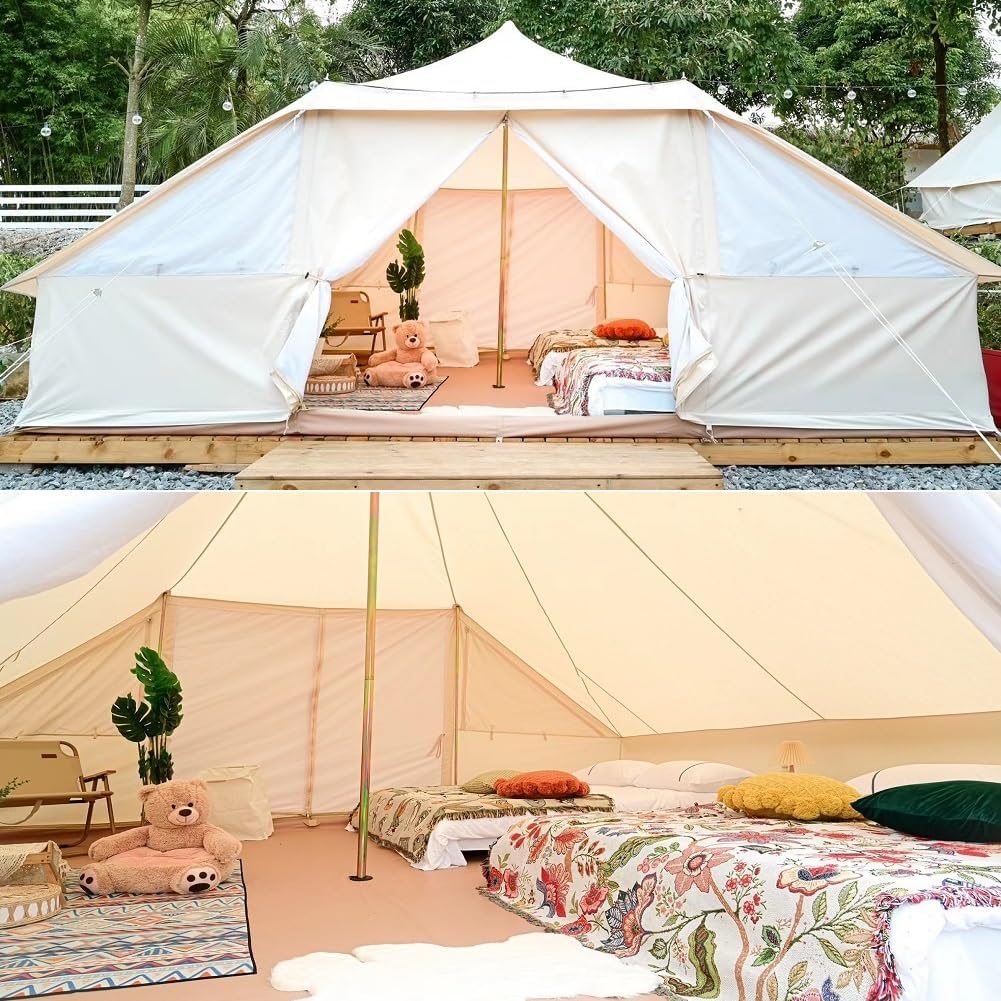
Canvas tents can be worth the investment for campers who prioritize long-term use, generous living space, and comfort during extended stays. However, they are not automatically a better choice than modern synthetic tents. Their value depends on how often you camp, where you camp, how much equipment you can transport, and how much maintenance you are willing to handle.
When a Canvas Tent Is Worth the Investment
A canvas tent makes the most sense when you regularly camp in one location for several days or longer. Family camping trips, seasonal campsites, hunting camps, base camps, and glamping setups can all benefit from the spacious interiors and substantial construction offered by many canvas models.
Canvas fabric can also provide a comfortable indoor environment when the tent is properly ventilated. Compared with lightweight backpacking shelters, larger canvas tents often offer more room to stand, organize equipment, and spend time indoors when the weather keeps you at camp.
Durability is another reason to consider canvas. A well-maintained tent made from quality fabric and supported by a suitable frame can serve for many seasons. Nevertheless, its lifespan depends on fabric quality, construction, exposure, storage conditions, and care—not simply on the fact that it is made from canvas.
When a Canvas Tent May Not Be Worth It
For short weekend trips, frequent campsite changes, or journeys where every kilogram matters, a canvas tent may create more inconvenience than value. Many models are heavy, bulky when packed, and slower to pitch than lightweight synthetic alternatives.
Maintenance is also part of the ownership cost. Canvas must be dried thoroughly before storage to reduce the risk of mildew, and some fabrics require specific cleaning or reproofing procedures. Leaving a damp canvas tent packed away can damage the material, even if the tent was expensive or marketed as durable.
The initial purchase price may also be higher than that of a comparable synthetic tent. Additional costs can include a suitable groundsheet, replacement components, transport arrangements, or a compatible stove system if the model supports one.
Canvas vs. Synthetic Tents: What Is the Better Value?
| Consideration | Canvas Tent | Synthetic Tent |
|---|---|---|
| Best use | Extended stays and established camps | Weekend trips and mobile camping |
| Weight and packed size | Usually heavier and bulkier | Often lighter and more compact |
| Interior comfort | Spacious models can provide a comfortable living area | Depends on design, size, and ventilation |
| Maintenance | Requires careful drying and storage | Also needs care, but many models are easier to dry and pack |
| Initial cost | Often higher for large, substantial models | Available across a wider range of budgets |
| Long-term value | Can be strong with regular use and proper care | Can be better for occasional trips and frequent travel |
Neither material guarantees better weather protection. Performance depends on the specific fabric, coatings, seams, floor, ventilation, construction, and setup. Cotton canvas can absorb moisture, and some canvas tents require an initial wetting or seasoning process; others use treatments that change how they should be maintained. Always follow the manufacturer’s instructions.
How to Decide Whether the Cost Is Justified
Before buying, consider how many nights you expect to spend in the tent each year and whether its advantages will make those trips more comfortable. A canvas tent used regularly for family camping or as a semi-permanent base may justify its higher purchase price. A heavy tent used only once or twice a year may be a less practical investment.
Also evaluate the complete setup rather than the tent price alone. Check the packed dimensions, total weight, included poles and stakes, groundsheet construction, ventilation, weather limitations, and availability of replacement parts. If you plan to use a wood-burning stove, confirm that the exact model is designed for that purpose and follow all stove and fire-safety requirements.
The bottom line: Canvas tents are worth it for campers who need space, plan extended stays, and are prepared to maintain their equipment. For lightweight travel, frequent moves between campsites, or occasional overnight trips, a synthetic tent will often be the more practical and economical choice.
Canvas Tent Care and Maintenance
Proper care is essential to getting the most out of a canvas tent. Although quality canvas tents can last for many seasons, their longevity depends on how the fabric is cleaned, dried, stored, and protected from unnecessary wear. Moisture management is especially important because storing damp canvas can lead to mildew, unpleasant odors, and fabric deterioration.
1. Dry the Tent Completely Before Storage
Never pack away a canvas tent for long-term storage while the fabric is damp. Even when the exterior appears dry, moisture can remain in seams, folded sections, corners, and areas around the floor.
After a trip, allow the tent to air-dry fully before packing it away for an extended period. If you must leave the campsite before the tent has dried, unpack it and finish drying it as soon as practical after returning home.
Avoid leaving a wet tent tightly packed for several days. Prolonged moisture creates conditions that encourage mildew and can make cleaning more difficult.
2. Clean Canvas Without Damaging the Fabric
Remove loose dirt, leaves, and debris with a soft brush. For localized marks, use water and a cleaning method approved by the manufacturer. Aggressive scrubbing, harsh detergents, bleach, and unapproved chemical treatments can damage canvas fibers or interfere with water-repellent finishes.
Do not assume that every canvas tent can be cleaned in the same way. Cotton canvas, polycotton blends, and coated fabrics may have different care requirements. Check the product instructions before applying cleaning products or attempting to remove stubborn stains.
After cleaning, let the tent dry completely before folding it for storage.
3. Protect the Tent From Mold and Mildew
Mold and mildew are among the main risks associated with poor canvas tent maintenance. Prevention is easier than treating established growth.
Dry the tent thoroughly after rain or cleaning.
Store it in a cool, dry, well-ventilated location.
Avoid sealing damp fabric inside an airtight container.
Inspect the tent periodically during long periods of storage.
Address moisture problems before they develop into persistent odors or visible growth.
If mildew appears, use a cleaning product specifically approved for the tent’s fabric and follow the manufacturer’s instructions. Avoid experimenting with bleach or strong household cleaners, as these may weaken the material or damage its treatment.
4. Inspect Seams, Zippers, Poles, and the Groundsheet
A regular inspection helps identify small problems before they affect a future trip. Check the tent after use and before longer camping trips.
Pay particular attention to:
Seams and stitching: Look for loose threads, separated seams, and signs of leakage.
Zippers and doors: Remove dirt and check for damaged teeth, sliders, or fabric caught in the mechanism.
Poles and frame connections: Look for bends, corrosion, cracks, or loose fittings.
Groundsheet: Inspect for punctures, abrasion, and damage around corners and attachment points.
Guy lines and stakes: Check for fraying, deformation, or missing components.
Repair minor damage with materials compatible with the tent’s construction. For structural damage or significant seam failure, consult the manufacturer or a qualified repair service rather than relying on a temporary patch.
5. Maintain Water Resistance Correctly
Not all canvas tents have the same weather-protection system. Some use untreated or treated cotton canvas, while others incorporate water-repellent finishes, waterproof coatings, or additional rainflies. Their maintenance requirements can differ significantly.
Follow the manufacturer’s guidance on seasoning, cleaning, and reproofing. Some cotton canvas tents need an initial wetting process that allows the fibers to swell and tighten around stitching. Other models use coatings or treatments that require a different approach.
Do not automatically apply a generic waterproofing spray to the entire tent. An incompatible product may affect breathability, discolor the fabric, or interfere with an existing treatment. If water resistance declines, confirm which treatment is suitable for the exact model.
Remember that water resistance does not make every canvas tent suitable for prolonged exposure to heavy rain. Pitching, drainage, ventilation, seams, and the condition of the fabric all affect performance.
6. Store the Tent Properly Between Trips
Once the tent is clean and completely dry, store it according to the manufacturer’s instructions. Keep it away from persistent dampness, direct heat, and locations where rodents can damage the fabric or accessories.
Avoid compressing the tent unnecessarily for long periods if the manufacturer recommends loose storage. Keep poles, stakes, and small components organized separately when appropriate, and make sure sharp hardware cannot puncture the fabric.
Before the next trip, check that the complete setup is present and that the tent remains in serviceable condition.
7. Use Wood-Burning Stoves With Extra Care
If your canvas tent has a compatible stove jack, inspect the surrounding fabric and heat-resistant components before every use. A stove jack does not make the tent fireproof, and canvas can ignite when exposed to flames, sparks, or excessive heat.
Use only a stove and flue arrangement approved for the tent, maintain the required clearances, and follow the stove manufacturer’s instructions. Never leave a burning stove unattended, and ensure adequate ventilation and suitable carbon monoxide protection where required. Do not use a fuel-burning stove in a tent if the equipment or manufacturer prohibits it.
After the equipment has cooled completely, inspect the stove jack and nearby fabric for scorching, damage, or loose fittings.
A Simple Canvas Tent Maintenance Checklist
| When | What to Do |
|---|---|
| After every trip | Remove debris, inspect for damage, and dry the tent thoroughly |
| After rain | Check for damp folds, wet seams, and moisture around the floor |
| Before storage | Confirm that the fabric is completely dry and all components are accounted for |
| Before the next trip | Inspect seams, zippers, poles, stakes, guy lines, and the groundsheet |
| When water resistance declines | Check the manufacturer’s guidance before applying a suitable treatment |
| During long-term storage | Keep the tent dry and periodically check for mildew or pest damage |
The bottom line: The best way to extend the life of a canvas tent is to keep it clean, dry it completely, store it correctly, and repair small problems before they worsen. Consistent maintenance protects your investment and helps ensure the tent is ready for the next camping trip.
Frequently Asked Questions About Canvas Tents
Are canvas tents waterproof?
Canvas tents can provide reliable protection from rain, but their performance depends on the fabric, water-repellent treatment, seams, construction, and setup. Some cotton canvas tents may need an initial seasoning process to help seal tiny needle holes. Other models use coatings or treatments with different maintenance requirements. Always check the manufacturer’s weather-resistance claims for the exact tent rather than assuming every canvas tent is fully waterproof.
Do canvas tents need to be seasoned before use?
Some cotton canvas tents benefit from seasoning before their first camping trip. The process typically involves pitching the tent, wetting the canvas as directed by the manufacturer, and allowing it to dry completely. Moisture causes the cotton fibers to swell, helping tighten the weave and seal small openings around stitched seams. However, seasoning requirements vary, so follow the instructions for your specific model.
Can you use a canvas tent in heavy rain?
Yes, many canvas tents are designed for rainy conditions, provided they are properly pitched and maintained. However, performance depends on the tent’s treatment, seam construction, drainage, and overall design. Pitch the tent on well-drained ground, secure all guy lines, and prevent water from pooling on the roof. Some models have specific limitations during prolonged or heavy rainfall, so check the manufacturer’s guidance before camping in severe weather.
Are canvas tents good for winter camping?
Canvas tents can be suitable for winter camping when the particular model and its frame are designed for the expected conditions. Their substantial fabric and spacious interiors can make extended cold-weather stays more comfortable, especially in a properly equipped wall tent. However, canvas alone does not provide adequate insulation, and not every model is rated for snow or strong winds. Check the manufacturer’s weather limits and use appropriate sleeping insulation and cold-weather equipment.
Do canvas tents get condensation inside?
Yes. Canvas tents can develop condensation when warm, humid air comes into contact with cooler surfaces. Breathing, wet clothing, and cooking can increase indoor humidity. Good ventilation is essential, even in cold weather. Open suitable vents, avoid bringing unnecessary wet gear inside, and choose a campsite with good drainage. Condensation is not automatically evidence of a leak; its distribution and location can help distinguish moisture buildup from water entering through the fabric or seams.
How do you prevent mold on a canvas tent?
The most effective prevention is to dry the tent completely before long-term storage. Moisture can remain in folds, seams, corners, and around the groundsheet even when the outer fabric appears dry. Store the tent in a cool, dry, ventilated location and inspect it periodically. If mold develops, use a cleaning treatment approved for the specific fabric and follow the manufacturer’s instructions, because some cleaning products can damage water-repellent treatments.
How long does a canvas tent last?
A well-made canvas tent can last for many years, but there is no single lifespan that applies to every model. Fabric quality, stitching, frame construction, frequency of use, sunlight exposure, weather conditions, and maintenance all affect durability. Keeping the tent clean and dry, repairing small defects promptly, and following the manufacturer’s storage instructions can help extend its useful life. Be cautious of specific lifespan promises that are not supported by the manufacturer or warranty.
Are canvas tents better than synthetic tents?
Neither material is universally better. Canvas tents are often well suited to extended stays, spacious base camps, family camping, and glamping. Synthetic tents are generally more practical when low weight, compact packing, and quick setup are priorities. Canvas also requires careful drying and storage. The better choice depends on your camping style, transport capacity, expected weather, budget, and willingness to maintain the tent.
Can you use a wood-burning stove inside a canvas tent?
Only use a wood-burning stove if the tent is specifically designed for compatible stove use and the manufacturer permits it. A stove jack alone does not make a tent fireproof or guarantee that every stove and flue arrangement is safe. Follow the stove manufacturer’s installation and clearance requirements, maintain ventilation, use appropriate carbon monoxide protection, and never leave a burning stove unattended. Never use a stove in a tent if either manufacturer prohibits it.
How do you clean a canvas tent?
Start by removing loose dirt and debris with a soft brush. For stains, use a cleaning method approved by the manufacturer, then rinse if instructed and allow the tent to dry completely. Avoid bleach, harsh chemicals, aggressive scrubbing, and unapproved waterproofing products, as they may damage the canvas or its protective treatment. Care requirements differ between untreated cotton canvas, polycotton fabric, and coated materials, so check the product instructions before cleaning.
Do canvas tents keep you cool in hot weather?
Canvas tents can offer a comfortable environment in warm weather, but they do not automatically stay cool. Interior temperature depends on sunlight, airflow, humidity, tent color, ventilation, and the amount of heat generated inside. Choose a shaded campsite when practical, open suitable windows and vents, and avoid blocking airflow with equipment. A large canvas tent can provide useful living space, but direct sun and poor ventilation can still make the interior hot.
Are canvas tents worth the money?
Canvas tents can be worth the higher initial cost if you camp regularly, need substantial interior space, or plan extended stays at one campsite. Their value is less compelling for occasional overnight trips, backpacking, or travel that involves frequent campsite changes. Before buying, consider the tent’s packed weight, setup time, maintenance requirements, included components, and replacement-part availability—not just its purchase price. A less expensive synthetic tent may be the more practical option for lightweight or occasional camping.
Final Verdict: Which Canvas Tent Should You Choose?
The best canvas tent depends on how you plan to camp, how much interior space you need, and whether portability or long-term comfort matters more to you. The five models in this guide serve different purposes, from traditional wall-tent camping to spacious family trips and glamping.
Choose the WaldZimmer Cotton Canvas Wall Tent if you want a large wall-tent layout for an established campsite and are comfortable checking its weather limitations and maintaining the fabric properly.
Choose the Dream House Large Spacious Outdoor Cotton Canvas Tent if you need generous interior space for family camping or group stays. Confirm the exact listing specifications and follow the manufacturer’s guidance on initial wetting and drying.
Choose the WHITEDUCK Alpha Canvas Wall Tent if you want a purpose-built wall-tent design with a substantial frame and the option of a compatible stove setup. Verify the exact size, finish, and included components before purchasing.
Choose the TETON Sports Canvas Mesa 10′ if you prefer a more conventional six-person canvas tent for family camping without moving to a large wall-tent or bell-tent setup.
Choose the WHITEDUCK Avalon Canvas Bell Tent 13′ if your priority is a distinctive bell-tent layout for comfortable camping or glamping, with a spacious central area and multiple windows.
Before making your final decision, compare more than advertised capacity and price. Check packed weight, setup requirements, floor construction, ventilation, weather limitations, maintenance instructions, and whether all necessary poles, stakes, and accessories are included. If you intend to use a wood-burning stove, verify compatibility with the exact tent configuration and follow the relevant safety requirements.
Remember that canvas construction does not automatically guarantee waterproof performance, superior durability, or suitability for every season. The fabric treatment, stitching, frame, design, and care routine all influence how well a tent performs over time.
Our recommendation: Choose a canvas tent that matches your actual camping habits rather than buying the largest or most feature-rich model. For extended stays and spacious base camps, a wall tent may be the better fit. For a traditional family camping setup, the TETON Sports Mesa 10′ is worth considering. For a more spacious glamping experience, the WHITEDUCK Avalon offers a different layout. The right choice is the one that balances usable space, practical setup, weather protection, and long-term maintenance for your needs.
About the Author
The CampComfortGuide editorial team creates practical camping gear guides to help readers make informed purchasing decisions. Our content focuses on comparing product specifications, materials, features, intended uses, and important limitations so campers can choose equipment that suits their needs and budget.
For this guide, the canvas tent comparison is based on available manufacturer information and published product specifications. We aim to distinguish verified product details from marketing claims and highlight what readers should confirm before buying.
Our goal is to provide clear, useful information that helps campers choose gear with greater confidence.