
Getting camping gear from your vehicle to the campsite can mean carrying a loaded cooler, folding chairs, tents, and storage bins across gravel paths, grass, or uneven ground. The best all-terrain camping wagons can make that job easier by bringing more of your equipment in a single trip, but not every folding wagon handles the same loads or surfaces equally well.
In this guide, we compare five camping wagons with different approaches to capacity, portability, and outdoor hauling: BEAU JARDIN, Gregory Alpaca Gear Wagon, US Original Outlander XL, Coleman XL, and Sekey 220L. We’ll examine their verified specifications, wheel designs, storage dimensions, and practical limitations to help you identify the right fit for your camping setup. Whether you prioritize hauling bulky gear, saving storage space, or moving supplies across mixed terrain, the goal is to choose a wagon that suits the way you camp—not simply the one with the biggest advertised capacity.
As an Amazon Associate I earn from qualifying purchases.

Table of Contents
Why We Can Trust This Guide
Choosing a camping wagon involves more than comparing advertised weight limits. Wheel design, usable cargo space, folding dimensions, and the type of ground you need to cross can all affect whether a wagon suits your camping routine.
This guide compares five selected models using product specifications, manufacturer information where available, and details from their exact Amazon.com listings. We focus on practical differences that matter when transporting camping equipment, including capacity, portability, wheel construction, and potential limitations. When a specification cannot be reliably confirmed, we avoid presenting it as an established fact.
Our goal is to help you understand what each wagon is designed to do, where its features may be useful, and which trade-offs deserve attention before you buy. Rather than assuming that every product marketed as all-terrain performs equally well on sand, grass, gravel, and uneven paths, we consider the available evidence and distinguish documented specifications from conclusions that require real-world testing.
How We Evaluate and Compare All-Terrain Camping Wagons
A useful comparison goes beyond advertised load limits. For camping, a wagon must carry the equipment you actually bring, fit into your vehicle when folded, and remain practical on the surfaces you encounter. We assess each model across the following criteria.
Load Capacity and Usable Cargo Space
We compare the manufacturer’s stated weight limit with the wagon’s interior dimensions and advertised cargo volume, where available. These measurements answer different questions: weight capacity indicates how much load the wagon is rated to support, while cargo space determines whether bulky items such as coolers, folding chairs, and storage bins will fit.
If a cooler is a regular part of your camping setup, our guide to portable camping refrigerators can help you compare food-storage options before deciding how much room your wagon needs.
Wheel Design and Terrain Suitability
Wheel diameter, width, material, tread, and construction can affect how a loaded wagon moves across different surfaces. We examine the available specifications to assess the intended use of each wheel design, distinguishing between documented features and performance claims that would require hands-on testing. A product described as all-terrain is not automatically suitable for deep sand or every type of uneven ground.
Portability, Folding, and Storage
A wagon that is difficult to lift or too bulky for a vehicle may be inconvenient even if it offers generous cargo space. We compare listed product weight, folded dimensions, and folding features when those details are available. These factors help readers judge whether a model suits their vehicle, storage area, and typical camping routine.
Frame, Fabric, and Practical Features
We review documented construction materials and useful features such as adjustable handles, wheel brakes, removable liners, and storage pockets. We distinguish between features confirmed by product documentation and broader assumptions about durability. A feature earns attention when it offers a clear practical benefit, not simply because it appears in a marketing description.
Limitations and Overall Suitability
Every wagon involves trade-offs. A model may offer substantial cargo space but require more storage room; another may fold compactly but provide less room for bulky equipment. We consider these compromises alongside the intended use, available specifications, and relevant supporting evidence rather than assigning every product the same strengths.
Our comparisons are based on published product information and the sources identified during research, not on personal field tests of all five wagons. Where specifications are missing or conflicting, we will identify the uncertainty rather than invent a figure or present an unverified performance claim as fact.
Quick Answer: Which All-Terrain Camping Wagon Is Best?
The best all-terrain camping wagon depends on how much gear you carry, the terrain between your vehicle and campsite, and how much storage space you have available. A high weight capacity is useful for heavy equipment, while wheel design, cargo dimensions, and folded size matter when transporting bulky gear over grass, gravel, or uneven paths.
The Coleman XL Collapsible Wagon is a strong option for campers who prioritize carrying capacity. Coleman lists a 400-pound weight capacity, more than 50 gallons of cargo space, wide-base all-terrain wheels, and a one-pull folding design. These features make it worth considering for hauling bulky camping equipment. However, wide wheels alone do not guarantee easy movement through deep sand or other particularly soft terrain.
The other four wagons offer different advantages. The Gregory Alpaca Gear Wagon combines 140 liters of storage with an included rain and sun cover and organizational features for outdoor gear. The Sekey 220L Collapsible Foldable Wagon is worth considering if cargo volume is a priority. The US Original Outlander XL features extra-wide, airless wheels designed for outdoor hauling, while the BEAU JARDIN Folding Wagon is a general-purpose option for transporting camping supplies.
Before choosing, compare each wagon’s verified load limit, usable cargo dimensions, wheel design, and folded size. These details help determine whether a model can accommodate your equipment and fit in your vehicle. For example, a large cooler may take up considerable cargo space even when its weight is within the wagon’s stated limit. Our guide to camping coolers designed for extended ice retention can help you choose a cooler for longer trips.
Ultimately, choose the wagon that matches your typical load, campsite terrain, and available storage space rather than relying on advertised capacity alone.
Who Should Consider an All-Terrain Camping Wagon?

An all-terrain camping wagon is most useful when you need to move several bulky items together or cover a meaningful distance between your vehicle and campsite. Whether it is worth the extra weight and storage space depends on how you camp, what you carry, and the ground you need to cross.
Car Campers with Bulky Equipment
If your usual setup includes a large cooler, folding chairs, a tent, a canopy, and several storage containers, a wagon can reduce the number of trips between your vehicle and the campsite. It is particularly convenient when parking is separate from the camping pitch or when you regularly transport equipment for several people.
Campers Using Grass, Gravel, or Uneven Paths
Standard small-wheel utility wagons can become difficult to pull over loose gravel, soft ground, and uneven paths. A wagon designed with suitable wheels may make these journeys easier, but performance depends on wheel dimensions, construction, load weight, and the actual surface. Check the specifications carefully if your campsite involves deep sand or particularly rough ground.
Families and Groups Carrying Shared Gear
When several people share a campsite, equipment quickly adds up. A wagon can help consolidate chairs, bags, food supplies, and other essentials into fewer loads. However, check the usable cargo dimensions as well as the rated weight limit: bulky items may not fit even when the combined load remains within the stated capacity.
Campers Who Need a More Organized Setup
A wagon can also serve as a temporary way to keep frequently used equipment together while unloading or arranging a campsite. Features such as storage pockets, removable covers, and adjustable handles may be useful, depending on the model. These extras should be weighed against the wagon’s folded size and empty weight.
When a Camping Wagon May Not Be Worth It
A wagon is less essential when you camp directly beside your vehicle, carry only a few lightweight items, or have limited room for storage. Backpackers who need to carry equipment over long distances on foot will generally be better served by equipment designed for carrying rather than rolling.
Before buying, consider the distance from your parking spot to the campsite, the heaviest items you regularly transport, the terrain along the route, and the space available in your vehicle. Those practical details will tell you more about whether a wagon suits your needs than the advertised weight capacity alone.
Quick Summary: Our Top Picks
The right all-terrain camping wagon depends on the equipment you carry, the terrain between your vehicle and campsite, and how much storage space you have at home or in your vehicle. These five models offer different approaches to hauling capacity, gear organization, and everyday portability. Our recommendations focus on their documented features and the practical trade-offs buyers should consider.
1. Coleman XL Collapsible Wagon — Best for Heavy Loads
The Coleman XL stands out for its stated 400-pound carrying capacity and more than 50 gallons of cargo space. Its wide-base all-terrain wheels are designed to support maneuverability and stability, while the one-pull folding design simplifies setup and storage. The wheels are removable to make the folded wagon more compact. These features make it a compelling option for campers transporting bulky equipment, although the published specifications alone do not establish how well it performs on deep sand or particularly rough ground.
Best for: Campers who prioritize a substantial stated load capacity, generous cargo space, and convenient folding.
2. Gregory Alpaca Gear Wagon — Best for Organized Gear Transport
The Gregory Alpaca Gear Wagon combines 140 liters of storage with an included rain-and-sun cover, two water-bottle pockets, reflective gear loops, and a protective storage case. Its eight-inch wheels, reinforced frame, and removable floor panel are useful design details for outdoor gear transport and cleanup. Gregory specifies a maximum carry weight of 250 pounds with the floor installed. One consideration is its substantial empty weight of approximately 28.75 pounds, which may matter when lifting it into a vehicle.
Best for: Campers who value organized storage, protective accessories, and a wagon designed specifically for transporting outdoor equipment.
3. Sekey 220L Collapsible Foldable Wagon — Best for High Cargo Volume
The Sekey 220L is worth considering when fitting bulky equipment is a priority. Its advertised 220-liter capacity provides a useful starting point for comparing cargo space with smaller wagons, while its collapsible construction is intended to simplify storage between trips. Before buying, check the exact listing for the stated load limit, folded dimensions, and wheel specifications. A large cargo volume does not necessarily mean a higher safe payload or better performance on soft ground.
Best for: Campers who need substantial advertised storage volume for bulky supplies and want a folding design.
4. BEAU JARDIN Folding Wagon — Best for General Outdoor Hauling
The BEAU JARDIN Folding Wagon is a versatile candidate for transporting camping supplies and other outdoor essentials. Its folding format is intended to make storage and transport more convenient, while the wagon-style layout accommodates a range of everyday gear. However, available listings associated with this model report inconsistent load-capacity figures. Verify the exact product variant and its stated weight limit before relying on a particular number or comparing it with heavier-duty alternatives.
Best for: Buyers looking for a general-purpose folding wagon for campsite supplies and other outdoor activities, provided its verified specifications meet their needs.
5. US Original Outlander XL — Best for Buyers Comparing Utility-Focused Designs
The US Original Outlander XL is another candidate in this five-wagon comparison. Before assigning it a more specific advantage, its exact product listing needs to be checked for carrying capacity, usable cargo dimensions, wheel construction, and folded size. These details will determine whether it offers a meaningful advantage for transporting heavy equipment, handling uneven ground, or fitting into a vehicle with limited cargo room.
Best for: Buyers comparing utility-wagon designs who are prepared to confirm the exact model specifications before choosing.
Before making a final decision, compare the verified payload limits, interior cargo dimensions, wheel designs, empty weights, and folded measurements of all five wagons. Manufacturer-stated capacity and volume figures describe different things, and neither guarantees suitability for every surface. Choose according to the equipment you carry and the conditions you expect to encounter.
Comparison Table: Best All-Terrain Camping Wagons in 2026
Compare these five all-terrain camping wagons by carrying capacity, cargo volume, wheel design, and portability. The table highlights key differences and practical trade-offs to help you choose a wagon that fits your camping gear, vehicle storage space, and typical campsite terrain.
| Camping Wagon | Best For | Capacity & Storage | Wheels & Design | Folding & Portability | Main Trade-Off |
|---|---|---|---|---|---|
| Coleman XL Collapsible Wagon | Hauling bulky camping equipment | 400 lb stated carrying capacity; more than 50 gallons of cargo space. | Wide-base all-terrain wheels; removable wheels for storage. | One-pull folding design; folds to approximately 20% of its full size, according to Coleman. | Confirm the folded dimensions and whether its wheel design suits your usual terrain. |
| Gregory Alpaca Gear Wagon | Organized outdoor gear transport | 140 L storage capacity; 250 lb carry limit with the floor installed. | 8-inch wheels; removable mesh floor, protective cover, and storage pockets. | Folded dimensions: 32 × 18 × 8 inches; product weight approximately 28.75 lb. | Relatively heavy to lift; small, hard wheels may struggle in deep, soft sand. |
| US Original Outlander XL | Large loads and sandy outdoor routes | 300 lb stated capacity; listed dimensions are 48 × 24 × 24 inches. | Extra-wide, 9 × 5-inch solid foam wheels with a reinforced tread. | Foldable design; verify the exact folded dimensions in the current listing. | Its large wheels may add bulk; performance still depends on the load and surface. |
| Sekey 220L Collapsible Foldable Wagon | Transporting bulky supplies | 220 L advertised storage volume; confirm the exact load limit for ASIN B0B7MSNG67. | Large all-terrain wheels are advertised; confirm their exact dimensions and construction. | Collapsible design; check folded dimensions and empty weight before purchase. | Storage volume alone does not establish payload capacity or performance on soft ground. |
| BEAU JARDIN Folding Wagon | General outdoor and campsite hauling | Published listings conflict on maximum capacity; verify the rating for ASIN B07S9W4SK6. | Wide wheels and a folding steel-frame design; check the exact wheel configuration. | Folding design intended for transport and storage; verify the dimensions of the selected variant. | Conflicting capacity information makes direct payload comparisons unreliable until verified. |
Comparison note: Specifications are based on available manufacturer and product-listing information. Verify the exact model, load limit, package contents, and dimensions before purchasing. Advertised cargo volume and weight capacity measure different things. All-terrain labeling does not guarantee equal performance on grass, gravel, uneven ground, or deep sand.
The 5 Best All-Terrain Camping Wagons in 2026
The best all-terrain camping wagons balance carrying capacity, cargo space, wheel design, and convenient storage. We compare five models to help you identify the right option for hauling camping gear, transporting bulky supplies, and navigating the surfaces you encounter at your campsite. Each pick has a distinct focus, with practical advantages and limitations to consider before buying.
1. Coleman XL Collapsible Wagon
Award: Best for Heavy Loads

The Coleman XL Collapsible Wagon is designed for campers who need to move substantial amounts of equipment without making repeated trips between the vehicle and campsite. Its defining strengths are a manufacturer-rated 400-pound carrying capacity, more than 50 gallons of cargo space, and a folding design that reduces storage bulk between outings.
Unlike wagons selected primarily for compactness or specialized storage features, the Coleman XL emphasizes load capacity and straightforward handling. Its wide-base wheels, ergonomic handle, and one-pull folding mechanism are practical features for transporting coolers, folding chairs, tents, and other bulky supplies. However, its maximum load rating should not be confused with a guarantee of easy movement on every surface.
Overview
The Coleman XL is a collapsible utility wagon intended for outdoor gear transport and other hauling tasks. Its large cargo area can accommodate a combination of bulky equipment, while the rated payload provides a useful reference point for campers carrying heavier supplies. The advertised capacity is especially relevant when comparing wagons for family camping trips, where coolers, chairs, food containers, and storage bins can add up quickly.
Coleman lists more than 50 gallons of cargo space and a maximum carrying capacity of 400 pounds. These figures describe different aspects of the design: the volume indicates how much space is available, while the weight rating indicates the manufacturer’s stated load limit. Both matter when planning a load, particularly if your equipment includes large items that may not fit neatly inside the wagon.
The folding system is another practical consideration. Coleman states that the wagon collapses to approximately 20% of its open size and can be opened or folded with one pull. Its wheels can also be removed to reduce the space required for storage. This may help when packing camping equipment into a vehicle, although you should check the available storage space and account for the detached wheels before deciding whether it will fit.
Key Features
400-pound stated carrying capacity
Coleman rates the XL Wagon to carry up to 400 pounds. That capacity gives it a substantial published load rating for transporting camping supplies, including heavier coolers and multiple pieces of equipment. It is important to distribute the load sensibly and remain within the manufacturer’s limit. A high weight rating does not, by itself, establish how easily the wagon will roll when fully loaded.
More than 50 gallons of cargo space
The advertised cargo volume makes the wagon worth considering for bulky equipment that can be awkward to carry by hand. Rather than focusing only on the combined weight of your supplies, consider the dimensions and shape of the items you intend to transport. A large cooler or wide storage bin may determine whether the load fits comfortably, even when its weight is well below the rated limit.
Wide-base all-terrain wheels
Coleman describes the wheels as all-terrain and designed with a wide base to support maneuverability and stability. The manufacturer confirms that they use a durable plastic core with a rubber tread. This construction is intended for movement across a variety of outdoor surfaces, but it does not establish that the wagon will perform equally well on packed gravel, grass, loose sand, and deep sand. Buyers who regularly cross soft ground should evaluate wheel dimensions and seek evidence relevant to their specific terrain.
One-pull folding mechanism
The wagon is designed to open and collapse with one pull, reducing the effort involved in setup and pack-down. Coleman states that it folds to approximately 20% of its open size. This is useful for campers who want a large cargo area without leaving the wagon fully assembled between trips. The folding mechanism does not eliminate the need to check the actual storage dimensions for your vehicle.
Removable wheels for compact storage
The wheels can be detached after the wagon is folded, allowing a more compact storage arrangement. This is particularly relevant when the cargo area of a car or camper is already occupied by other equipment. The trade-off is that the wheels must be kept together with the folded wagon so they are available when it is time to use it again.
Ergonomic pulling handle
Coleman includes an ergonomic handle intended to make pulling the wagon more comfortable. Handle comfort can matter when transporting heavy supplies over a campsite, but the actual effort required will still depend on the load, surface, slope, and wheel contact with the ground. Do not assume that a high capacity makes a fully loaded wagon effortless to pull.
Technical Specifications
| Specification | Details |
|---|---|
| Brand | Coleman |
| Product | XL Collapsible Wagon |
| Amazon ASIN | B0G319SNDP |
| Product Type | Folding utility wagon |
| Maximum Carrying Capacity | 400 lb (181.4 kg), manufacturer-stated |
| Cargo Volume | More than 50 US gallons |
| Wheel Design | Wide-base all-terrain wheels |
| Wheel Construction | Plastic core with rubber tread, according to Coleman |
| Folding Mechanism | One-pull opening and folding |
| Folded Size | Approximately 19.3 × 8.7 × 5.3 inches, excluding wheels, according to Coleman customer care |
| Product Weight | Approximately 25.69 lb (11.65 kg), according to Coleman customer care |
| Removable Wheels | Yes |
| Handle | Ergonomic pulling handle |
| Warranty | One-year limited warranty, according to Coleman |
| Product Link | View the Coleman XL Collapsible Wagon on Amazon |
Specification note: The figures above refer to the Coleman XL Wagon described on the manufacturer’s official website and the selected Amazon listing. Confirm the product identity and package details before purchase. The folded measurements are approximate and exclude the wheels; check the available storage space with that limitation in mind.
Pros and Cons
Pros
Manufacturer-rated carrying capacity of 400 pounds.
More than 50 gallons of advertised cargo space.
Wide-base wheels with a plastic core and rubber tread.
One-pull opening and folding mechanism.
Removable wheels allow a more compact storage arrangement.
Ergonomic pulling handle.
One-year limited warranty listed by Coleman.
Cons
The maximum load rating does not guarantee easy handling with a heavy load.
Wide-base all-terrain wheels do not prove suitability for every type of soft or uneven ground.
The wheels need to be removed separately when using the most compact storage configuration.
The folded dimensions exclude the detached wheels, which also need storage space.
The published specifications do not establish real-world performance under a 400-pound load on different surfaces.
Who Should Consider This Wagon?
The Coleman XL is worth considering for car campers and families who regularly transport bulky or heavy equipment between their vehicle and campsite. Its stated payload and cargo volume may be particularly useful when a single trip with several pieces of gear is preferable to carrying each item separately.
It may also suit buyers who need a large wagon but cannot leave it fully assembled between outings. The one-pull folding system and removable wheels offer different ways to reduce storage bulk, although the actual fit will depend on the dimensions of your vehicle and the rest of your packed equipment.
This model may be less appealing if minimizing empty weight is your primary concern, or if your regular route crosses deep, loose sand where wheel design can be critical. In those situations, compare the complete wagon dimensions and wheel specifications with your intended use rather than choosing solely on the advertised load capacity.
What to Verify Before Buying
Confirm that the Amazon listing is for the Coleman XL Collapsible Wagon, ASIN B0G319SNDP.
Verify that the listed carrying capacity is 400 pounds for the exact product being sold.
Check the cargo dimensions against your largest cooler, storage bin, or other bulky equipment.
Measure the available vehicle storage space and account for the detached wheels.
Confirm the wheel construction and assess whether it suits your usual campsite surfaces.
Check the current package contents, price, availability, return terms, and warranty conditions.
Do not interpret the advertised all-terrain designation as proof of performance on deep sand or every uneven surface.
Our Assessment: The Coleman XL earns its place as the heavy-load candidate in this comparison because Coleman specifies a 400-pound carrying capacity and more than 50 gallons of cargo space. Its folding mechanism and removable wheels add practical storage flexibility. The key trade-off is that published capacity and wheel descriptions cannot substitute for verified performance on the terrain you expect to encounter. Compare its dimensions, storage requirements, and wheel design with your own camping setup before buying.
Related Guide: A camping wagon can make transporting gear easier, but a well-planned packing list helps ensure you bring everything you need. Use our camping checklist to prepare essential equipment before your next trip.
2. Gregory Alpaca Gear Wagon
Award: Best for Organized Gear Transport

The Gregory Alpaca Gear Wagon takes a different approach to campsite hauling. Instead of focusing only on how much weight a wagon can carry, Gregory combines a 140-liter cargo area with dedicated storage pockets, reflective gear loops, a removable floor, and a protective cover. The result is a gear-focused design intended to help campers transport equipment, keep smaller essentials organized, and pack the wagon away without bringing dirt and mud directly into their vehicle.
Its standout feature is the combination of a removable mesh floor and a full-coverage storage case. The mesh allows sand and debris to pass through, while the floor can be removed for cleaning. However, the wagon weighs approximately 28.75 pounds before loading, so its storage convenience comes with a trade-off when lifting it into a vehicle.
Overview
The Gregory Alpaca Gear Wagon is designed around the practical details of moving outdoor equipment. Its 140-liter storage area provides room for camping supplies, while the included rain-and-sun cover helps protect the contents from the elements. Two water-bottle pockets, a large slip pocket, and reflective gear loops offer dedicated places for smaller items that might otherwise become buried beneath larger equipment.
The construction also differs from a basic folding fabric wagon. Gregory specifies an oversized powder-coated alloy frame with custom bushings intended to resist rust and support reliable operation. The body uses a blend of recycled fabrics, and the removable floor panel makes it easier to clean the cargo area after trips involving sand, dirt, or muddy equipment.
Storage is another important part of the design. The wagon folds down to approximately 32 × 18 × 8 inches and is secured with an aluminum hook that doubles as a carrying handle. An included heavy-duty case fully encloses the folded wagon, helping keep dirt and mud away from the rest of your vehicle’s cargo. This is a particularly useful detail for campers who regularly pack away equipment after outdoor activities.
Key Features
140-liter cargo capacity with dedicated storage pockets
The 140-liter capacity provides a useful amount of room for transporting camping equipment, while the two water-bottle pockets and large slip pocket separate smaller essentials from the main load. Reflective gear loops on the outside can also make the wagon easier to locate in low-light conditions. These organizational details are the main reason to consider Gregory over a simpler wagon with a similar carrying capacity.
Removable mesh floor for easier cleaning
Gregory’s coated mesh bottom allows sand to pass through, and the removable floor panel can be taken out for cleaning. This arrangement can be useful after a trip to a sandy campsite or when transporting equipment that leaves dirt and debris behind. It is important to distinguish this feature from sand-driving performance: a mesh floor helps with cleanup, but it does not mean the wagon will roll easily through every type of sand.
Eight-inch all-terrain wheels
The wagon uses four 8-inch wheels designed for outdoor terrain. Field Mag reported positive results on sand and rocky shore surfaces during its testing, while WIRED found that the front wheels struggled in deep, dry sand. These observations illustrate why terrain claims need context. The Gregory may be suitable for many campground paths and mixed outdoor surfaces, but buyers who regularly cross deep beach sand should consider the limitations carefully rather than assuming that the all-terrain designation guarantees effortless movement.
Reinforced, powder-coated frame
Gregory specifies an oversized alloy frame with a powder-coated finish and custom bushings designed to resist rust. The frame supports the collapsible structure while allowing the wagon to fold for storage. The manufacturer describes the construction as intended for reliable use, but no material specification alone can establish how long a wagon will last under every loading condition.
Included rain-and-sun cover
The supplied cover helps shield the contents from sun and rain while the wagon is being used outdoors. It stores separately when not needed, so it does not have to remain over the cargo area. The cover adds versatility for changing conditions, although it should not be treated as a guarantee that the wagon or its contents will remain completely dry in every situation.
Foldable design with a protective storage case
When folded, the wagon measures approximately 32 × 18 × 8 inches. The aluminum securing hook doubles as a carry handle, and the included heavy-duty case encloses the folded unit to help prevent dirt and mud from transferring to the vehicle interior. These features make the storage system more comprehensive than simply collapsing the frame, although the wagon’s empty weight remains relevant when lifting it into a trunk or cargo area.
Technical Specifications
| Specification | Details |
|---|---|
| Brand | Gregory |
| Product | Alpaca Gear Wagon |
| Amazon ASIN | B0D12F1R3C |
| Product Type | Collapsible gear and utility wagon |
| Maximum Carrying Capacity | 250 lb (113.4 kg), with floor installed |
| Cargo Volume | 140 L |
| Product Weight | Approximately 28.75 lb (13.0 kg) |
| Open Dimensions | 38.6 × 23.2 × 20.9 inches |
| Folded Dimensions | 32 × 18 × 8 inches |
| Wheel Diameter | 8 inches |
| Frame | Powder-coated alloy |
| Cargo Floor | Coated mesh with removable floor panel |
| Fabric | Blended recycled polyester fabrics |
| Storage Features | Two water-bottle pockets, one large slip pocket, reflective gear loops |
| Included Accessories | Rain-and-sun cover and heavy-duty storage case |
| Warranty | Limited lifetime warranty, according to Gregory |
| Product Link | View the Gregory Alpaca Gear Wagon on Amazon |
Specification note: These figures correspond to the Gregory Alpaca Gear Wagon 140L. The 250-pound carrying limit applies with the floor installed. Confirm the exact model, package contents, and warranty terms in the current listing before purchase.
Pros and Cons
Pros
140 liters of cargo space for camping and outdoor equipment.
Stated carrying limit of 250 pounds with the floor installed.
Removable mesh floor allows sand to pass through and simplifies cleaning.
Eight-inch wheels designed for outdoor terrain.
Included rain-and-sun cover.
Full-coverage storage case helps keep dirt and mud away from vehicle interiors.
Dedicated pockets and reflective gear loops improve organization.
Folds to approximately 32 × 18 × 8 inches.
Cons
An empty weight of approximately 28.75 pounds may make lifting and carrying less convenient.
Eight-inch wheels struggled in deep, dry sand during WIRED’s testing.
The 250-pound rating applies with the floor installed, so the configuration matters.
Its storage accessories and organization features may be unnecessary for buyers who simply need a basic wagon.
The advertised load limit does not establish performance on every surface or under every loading condition.
Who Should Consider This Wagon?
The Gregory Alpaca Gear Wagon is worth considering for campers who want more than a large open cargo compartment. Its pockets, reflective loops, removable floor, protective cover, and storage case suit people who regularly transport varied equipment and want to keep it organized between trips.
It may be particularly useful for outdoor enthusiasts who move between campgrounds, parks, festivals, and other recreation areas where the wagon needs to be packed away after use. The protective case can help keep a dirty wagon separate from other equipment, while the removable mesh floor makes post-trip cleanup more manageable.
This model may be less suitable if you prioritize the lowest possible empty weight or frequently haul equipment across deep, loose beach sand. In those situations, compare its weight and wheel design against alternatives built around easier lifting or wider wheels for soft ground.
What to Verify Before Buying
Confirm that the listing is for the Gregory Alpaca Gear Wagon 140L, ASIN B0D12F1R3C.
Verify that the stated 250-pound carrying limit applies to the selected model and configuration.
Check the 140-liter cargo volume against the size of your largest equipment.
Confirm the folded dimensions and make sure you have room for the wagon and its storage case.
Account for the approximately 28.75-pound empty weight when planning to lift it into a vehicle.
Confirm that the removable floor, rain-and-sun cover, and storage case are included in the package.
Consider the limitations of 8-inch wheels if your regular route crosses deep, dry sand.
Check the current Amazon listing for availability, price, return terms, and warranty details.
Our Assessment: The Gregory Alpaca Gear Wagon stands out for organized gear transport rather than maximum carrying capacity. Its 140-liter cargo area, removable mesh floor, dedicated pockets, weather cover, and full-coverage storage case form a useful package for campers who regularly move and store outdoor equipment. Its main trade-offs are the relatively high empty weight and the documented difficulty of rolling through deep, dry sand. It is a strong candidate for organized campsite transport, provided those limitations match your needs.
Related Guide: If you are planning how to pack and arrange equipment for trips by car, our guide to setting up a vehicle-based camping kit covers complementary storage and transport considerations.
3. US Original Outlander XL
Award: Best for Wide, Airless Wheels

The US Original Outlander XL is built around a feature that matters when hauling equipment outdoors: oversized, wide airless wheels. With a stated carrying capacity of 300 pounds and 9-inch-diameter, 5-inch-wide tires, this folding wagon is designed for moving coolers, chairs, beach supplies, and camping gear across a range of outdoor surfaces. Its focus is not simply on how much equipment fits inside, but on the wheel and frame design used to transport that load.
The wagon combines a reinforced steel frame, a nylon cargo liner, a spring-loaded pulling handle, and quick-release wheels. These features make it worth considering for campers who need a utility wagon for mixed outdoor conditions. However, the manufacturer’s terrain claims should not be treated as proof that the wagon will roll effortlessly through deep, loose sand or over every uneven path.
Overview
The Outlander XL is an extra-large folding beach and utility wagon sold under the US Original brand. The selected model is identified as BW394 and has a stated maximum carrying capacity of 300 pounds. Its open dimensions are approximately 48 × 24 × 24 inches, giving it a substantial footprint for carrying bulky equipment.
Its most distinctive feature is the wheel assembly. The wagon uses 9-inch airless wheels that are approximately 5 inches wide. Unlike pneumatic tires, airless wheels do not require inflation, so there is no need to check tire pressure or carry a pump. The wide contact area is intended to help distribute the load over a larger footprint, which can be useful on some loose outdoor surfaces. Actual performance still depends on the ground, load distribution, and pulling angle.
The steel frame includes dual crossbars, while the nylon liner forms the cargo compartment. The spring-loaded handle is designed for pulling, and eight wheel bearings are specified to help reduce rolling friction. Two built-in cup holders add convenience for beach and campsite use. When the wagon needs to be stored, the frame folds and the quick-release wheels can be detached to reduce the overall storage footprint.
Key Features
Nine-inch, five-inch-wide airless wheels
The Outlander XL’s wide wheels are its defining feature. At 9 inches in diameter and 5 inches wide, they offer a broader contact area than the narrow hard-plastic wheels found on many basic utility wagons. That design is intended to make movement across mixed outdoor terrain easier, particularly where narrow wheels may sink into softer ground.
Airless construction also eliminates punctures and inflation maintenance. The trade-off is that wheel size alone cannot guarantee good performance on every surface. Loose, deep sand remains challenging for many wagons, so buyers who regularly transport gear across beaches should consider the exact terrain rather than relying solely on the all-terrain label.
300-pound stated carrying capacity
The selected BW394 model is listed with a maximum carrying capacity of 300 pounds. This provides a reference point when planning loads that include coolers, chairs, bags, and other bulky supplies. As with any wagon, the rated limit should not be treated as a promise that the maximum load will be easy to pull over uneven ground. Keep the load within the stated limit and distribute weight evenly.
Reinforced steel frame with dual crossbars
The steel frame and dual-crossbar construction are designed to support the cargo compartment under load. The frame folds for storage, combining a utility-wagon structure with a collapsible format. Although steel is commonly used for strength in utility equipment, the material alone does not establish the wagon’s long-term durability or performance under every loading condition.
Nylon cargo liner
The nylon liner provides the main compartment for transporting camping and outdoor supplies. Its open wagon layout can accommodate different combinations of equipment, provided individual items fit within the interior dimensions. Before buying, compare the cargo space with the largest item you expect to carry, especially wide coolers or bulky storage containers.
Spring-loaded pulling handle and wheel bearings
The spring-loaded handle is designed to provide a more comfortable pulling arrangement, while the product listing specifies eight wheel bearings to help reduce rolling friction. These features may contribute to handling, but the effort needed to pull the wagon depends on the weight of the load, the surface, and the route. They should not be interpreted as evidence of effortless movement when fully loaded.
Folding frame and quick-release wheels
The Outlander XL folds for transport and storage, and the wheels can be removed using the quick-release design. This can reduce the space required when the wagon is packed away. However, its full-size dimensions mean buyers should check both the folded frame and the space needed to store the detached wheels before assuming it will fit comfortably in a vehicle.
Two built-in cup holders
The wagon includes two cup holders for drinks during outdoor trips. This is a small convenience rather than a core performance feature, but it may be useful when the wagon is used for beach outings, picnics, or campsite transport. It should carry little weight in the purchasing decision compared with the wheel design, load limit, and storage dimensions.
Technical Specifications
| Specification | Details |
|---|---|
| Brand | US Original |
| Product | Outlander XL Folding All-Terrain Wagon |
| Model Number | BW394 |
| Amazon ASIN | B0FDMLNTG2 |
| Product Type | Folding beach and utility wagon |
| Maximum Carrying Capacity | 300 lb (136.1 kg), listed specification |
| Open Dimensions | 48 × 24 × 24 inches |
| Product Weight | Approximately 34.6 lb (15.7 kg) |
| Wheel Diameter | 9 inches |
| Wheel Width | 5 inches |
| Wheel Type | Airless wheels with tread |
| Frame | Steel with dual crossbars |
| Cargo Liner | Nylon |
| Handle | Spring-loaded pulling handle |
| Wheel Bearings | Eight, according to the product listing |
| Additional Features | Two built-in cup holders |
| Folding | Collapsible frame with quick-release wheels |
| Product Link | View the US Original Outlander XL on Amazon |
Specification note: The figures above are associated with the selected US Original Outlander XL, model BW394, ASIN B0FDMLNTG2. They are drawn from available retailer and product-listing information. I have not independently verified every specification against official manufacturer documentation, so confirm the current listing and package details before purchase.
Pros and Cons
Pros
Wide, 9-inch airless wheels with a stated width of 5 inches.
No tire inflation required.
Listed carrying capacity of 300 pounds.
Steel frame with dual crossbars.
Nylon cargo liner for general outdoor hauling.
Spring-loaded pulling handle and specified wheel bearings.
Quick-release wheels help reduce storage bulk.
Two built-in cup holders.
Cons
The approximately 34.6-pound empty weight may make lifting it into a vehicle less convenient.
Its open dimensions of 48 × 24 × 24 inches require adequate cargo space when in use.
Wide airless wheels do not guarantee easy travel through deep, loose sand.
Folded dimensions should be verified for the exact product before planning vehicle storage.
Several specifications rely on retailer listings rather than independently confirmed manufacturer documentation.
Who Should Consider This Wagon?
The US Original Outlander XL is worth considering for campers and beachgoers who want a folding wagon with broad, airless wheels and a substantial stated load capacity. Its wheel design may be particularly appealing to buyers who prefer not to maintain pneumatic tires and want a wagon for transporting equipment across a variety of outdoor surfaces.
It may also suit people who carry bulky supplies and value a reinforced frame, a pulling handle, and quick-release wheels. The cup holders are a useful extra for recreational outings, although they are secondary to the wagon’s dimensions and wheel construction.
This model may be less suitable for buyers who prioritize the lowest possible empty weight or need a particularly compact wagon for a small vehicle. If deep beach sand is a regular part of your route, compare the wheel design with alternatives specifically evaluated on that surface before making a decision.
What to Verify Before Buying
Confirm that the selected listing is for US Original Outlander XL, model BW394, ASIN B0FDMLNTG2.
Verify the stated 300-pound carrying capacity for the exact model being sold.
Check the open and folded dimensions, including the space needed for detached wheels.
Confirm the 9-inch wheel diameter and 5-inch width in the current listing.
Check the actual package contents and whether the cup holders and quick-release wheels are included.
Consider the approximately 34.6-pound product weight when planning to lift the wagon.
Assess whether the wheel design suits the actual ground you expect to cross.
Check current price, availability, return terms, and warranty conditions before ordering.
Our Assessment: The US Original Outlander XL stands out for its wide, airless wheels, 300-pound listed load rating, and reinforced steel-frame construction. Those features make it a candidate for campers who want a substantial utility wagon without the maintenance associated with pneumatic tires. Its main trade-offs are its empty weight, storage footprint, and the uncertainty around performance on particularly soft terrain. The wheel design is a useful specification to compare, not a guarantee that the wagon will handle every surface equally well.
Related Guide: When planning how to transport and store outdoor equipment, our guide to building a practical vehicle-based camping setup covers related gear and storage considerations.
4. Sekey 220L Collapsible Foldable Wagon
Award: Best for High Cargo Volume

The Sekey 220L Collapsible Foldable Wagon is designed for people who want to move a substantial amount of camping equipment without switching to a rigid utility cart. Its headline feature is the roomy cargo compartment, while the folding frame, large wheels, and built-in drink holders make it suitable for a range of outdoor and everyday hauling tasks.
For campers, the main question is how that storage volume translates into practical use. A spacious compartment can accommodate bulky items such as folding chairs, bags, and picnic supplies, but the wagon’s rated payload, wheel design, and folded dimensions matter just as much. Buyers should verify the specifications for the exact listing rather than assuming that every Sekey 220L wagon uses identical components.
Overview
The Sekey 220L is a collapsible utility wagon intended for transporting equipment around campsites, parks, gardens, and beaches. The selected Amazon product is ASIN B0B7MSNG67. Sekey’s product information for a 220L wagon lists a maximum load of 330 pounds and an interior cargo area measuring approximately 36.2 × 22.4 × 14.2 inches. Those dimensions are useful reference points, but they should be confirmed against the selected Amazon variant before publication or purchase.
The deep cargo compartment is designed to hold a mixture of outdoor supplies rather than a single type of item. Two mesh cup holders provide space for drinks, and the folding frame is intended to reduce the amount of storage space needed when the wagon is not in use. Sekey also describes a compact folded configuration and includes a storage bag with the corresponding product offering.
The large-wheel design is marketed for outdoor surfaces, including grass and sand. However, a general all-terrain claim does not establish how easily a fully loaded wagon will travel across deep, loose sand, soft soil, or uneven ground. Terrain, load distribution, and the wheel configuration of the exact model all influence how much effort pulling requires.
Key Features
Roomy cargo compartment
The 220L designation emphasizes the wagon’s storage volume. A large compartment can be useful when packing several categories of camping equipment together, such as chairs, dry bags, food supplies, and smaller accessories. Before buying, compare the usable interior dimensions with your largest items; advertised volume alone does not guarantee that a bulky cooler or storage bin will fit.
Stated 330-pound load capacity
Sekey’s product information for its 220L wagon lists a maximum load of 330 pounds. This is a substantial advertised payload for a folding wagon, but it must not be confused with cargo volume. The maximum load should also not be interpreted as a guarantee that the wagon will be easy to pull at full capacity across rough or soft terrain. Confirm that the 330-pound rating applies to ASIN B0B7MSNG67 and follow the instructions supplied with the purchased model.
Large wheels for outdoor use
The wagon is marketed with large all-terrain wheels intended for surfaces encountered during outdoor trips. Larger wheels can help a wagon negotiate some surface irregularities more effectively than small, narrow wheels, but performance depends on wheel width, tread, ground conditions, and the weight being carried.
The available product information for similar Sekey 220L versions is not fully consistent about wheel construction and dimensions. For that reason, the precise wheel diameter, tread width, and whether the selected version uses solid or pneumatic tires should be checked on the current Amazon listing. Do not choose this wagon for regular deep-sand use based on the all-terrain label alone.
Collapsible frame and compact storage
The folding construction is intended to make the wagon easier to store in a garage, shed, or vehicle cargo area. Sekey advertises a compact folded configuration for its 220L model. Before purchasing, check the actual folded length, width, and height for the selected version, and allow for any wheels or accessories that remain attached or need to be stored separately.
Two mesh cup holders
The wagon includes two mesh cup holders, according to Sekey’s product description. They provide convenient places for drinks during campsite setup, picnics, or beach outings. This is a useful secondary feature, but the load rating, dimensions, and wheel design should carry more weight in the buying decision.
Metal frame and fabric cargo bed
Sekey describes the wagon as having a heavy-duty metal frame and a fabric cargo compartment. These materials provide the basic structure for carrying outdoor equipment in a collapsible design. Check the product details for the exact fabric specification, cleaning instructions, and any restrictions on how the wagon should be loaded. A material description by itself is not proof of long-term durability under repeated heavy use.
Technical Specifications
| Specification | Details |
|---|---|
| Brand | Sekey |
| Product | 220L Collapsible Foldable Wagon |
| Amazon ASIN | B0B7MSNG67 |
| Product Type | Folding utility and outdoor wagon |
| Advertised Cargo Volume | 220 L, as stated in the product name |
| Maximum Carrying Capacity | 330 lb (approximately 150 kg), listed for Sekey’s 220L model; confirm for the exact ASIN |
| Interior Dimensions | Approximately 36.2 × 22.4 × 14.2 inches, listed for a Sekey 220L model |
| Frame | Metal; confirm exact material for the selected listing |
| Wheels | Large all-terrain design; exact type and dimensions require confirmation |
| Drink Holders | Two mesh cup holders |
| Folding | Collapsible frame |
| Folded Dimensions | Verify the current Amazon listing for the exact model |
| Storage Bag | Advertised with the corresponding Sekey 220L product offering; confirm package contents |
| Product Link | View the Sekey 220L on Amazon |
Specification note: Sekey’s product page lists a 330-pound load capacity and interior dimensions of approximately 36.2 × 22.4 × 14.2 inches for a 220L wagon. I could not independently confirm that every listed detail, including the wheel configuration and folded dimensions, applies to Amazon ASIN B0B7MSNG67. Verify the current listing and package details before relying on these figures. https://sekeystore.com/products/sekey-220l-heavy-duty-foldable-beach-wagon-4011
Pros and Cons
Pros
Large advertised 220L cargo volume.
A 330-pound load rating is listed for a Sekey 220L model.
Deep cargo compartment can accommodate a variety of camping supplies.
Folding construction helps reduce storage requirements.
Two mesh cup holders add convenience.
Marketed for outdoor use, including trips to campsites and beaches.
Cons
The exact payload rating should be confirmed for ASIN B0B7MSNG67.
Wheel type and dimensions need verification for the selected version.
The all-terrain label does not guarantee easy pulling across deep, loose sand.
Folded dimensions should be checked before planning vehicle storage.
Large cargo volume does not automatically mean that every bulky item will fit.
Who Should Consider This Wagon?
The Sekey 220L is worth considering for campers who prioritize cargo space and want a folding wagon for transporting several bags, chairs, and other supplies together. It may also appeal to people who use a wagon for a mix of camping, gardening, shopping, and recreational outings.
It is a particularly relevant option for buyers comparing large-capacity folding wagons rather than compact carts designed primarily for light loads. The key is to match the usable compartment dimensions and verified load rating to the equipment you actually carry.
Buyers who regularly cross deep sand or rough, uneven ground should pay special attention to the exact wheel design and seek evidence relevant to those conditions. Anyone with limited vehicle storage should also measure the available cargo area and compare it with the wagon’s confirmed folded dimensions.
What to Verify Before Buying
Confirm that the Amazon listing is for Sekey 220L Collapsible Foldable Wagon, ASIN B0B7MSNG67.
Check whether the stated 330-pound maximum load applies to this exact version.
Confirm the interior dimensions and the usable space available for bulky equipment.
Verify wheel diameter, tread width, and wheel construction in the current listing.
Check the folded dimensions and whether the wheels remain attached when folded.
Confirm whether a storage bag is included in the selected package.
Review the care instructions for the fabric compartment and frame.
Check current price, availability, return terms, and warranty conditions before ordering.
Our Assessment: The Sekey 220L stands out primarily for its advertised cargo volume and collapsible design. It is a candidate for campers who want to move several pieces of equipment in one trip without storing a rigid cart between outings. Its practical value depends on confirming the payload rating, wheel configuration, and folded size for the exact Amazon model. Until those details are verified, its large stated volume is a useful starting point for comparison—not enough on its own to establish that it is the best option for every type of terrain.
Related Guide: A high-capacity wagon can simplify moving bulky camping equipment, but efficient transport starts before you reach the campsite. Our guide to packing a car for camping efficiently explains how to organize gear, manage cargo space, and keep essential equipment accessible during arrival and setup.
5. BEAU JARDIN Folding Wagon
Award: Best for Push-and-Pull Versatility

The BEAU JARDIN Folding Wagon is a collapsible outdoor utility cart designed for transporting camping supplies, groceries, beach equipment, and other bulky items. Its appeal lies in a combination of wide wheels, a steel frame, a removable fabric liner, and a handle arrangement intended to support outdoor hauling. For campers who want one wagon for several types of trips, this combination is worth comparing with more specialized high-capacity models.
The selected product is associated with model AT0321 and Amazon ASIN B07S9W4SK6. However, published listings disagree about its maximum load: some specify 300 pounds, while others advertise 500 pounds. That discrepancy matters when choosing a wagon for heavy equipment, so the higher figure should not be treated as confirmed until it is verified against the exact product listing.
Overview
The BEAU JARDIN Folding Wagon is a four-wheel collapsible cart intended for recreational and general utility use. Its steel frame supports a fabric cargo compartment, while the folding construction allows the wagon to be stored when it is not needed. The selected model is listed with a removable polyester liner, which can make it easier to access the interior for cleaning after outdoor use.
One of its main distinguishing features is the wide-wheel design. Product descriptions for this model family specify wheels approximately 7 inches in diameter and 4 inches wide. A wider wheel can spread the load over a larger contact area than a narrow wheel, potentially helping on some loose or uneven surfaces. Nevertheless, the wheel dimensions and construction should be confirmed for the exact unit being sold, and the design should not be taken as proof of effortless travel through deep sand.
BEAU JARDIN listings also describe a handle arrangement intended to make the wagon easier to maneuver, with some versions offering both pushing and pulling. Because specifications and feature descriptions vary across listings, buyers should confirm the handle configuration, wheel brakes, and included accessories before ordering the selected ASIN.
Key Features
Wide wheels for outdoor hauling
Wide wheels are a notable feature of the BEAU JARDIN design. Product descriptions for the AT0321 model family specify approximately 7 × 4-inch wheels. Their broader footprint is intended to improve mobility on outdoor surfaces compared with narrow wheels that can sink or catch more easily.
Actual performance depends on the surface, load, wheel material, and distribution of weight inside the wagon. Buyers planning regular trips across deep sand should compare the precise wheel design with alternatives that have been specifically evaluated on soft terrain rather than relying only on the term “all-terrain.”
Steel frame construction
The wagon uses an alloy-steel frame according to available product listings. A metal frame provides the supporting structure for the cargo compartment and folding mechanism. As with other collapsible wagons, the frame should be opened and locked according to the manufacturer’s instructions, and loads should remain within the verified weight limit.
Steel construction alone does not establish a particular service life or guarantee performance under repeated maximum-load use. The frame design, joints, fasteners, and care between trips all affect long-term usability.
Removable polyester liner
The cargo compartment uses polyester fabric, with listings describing a removable liner. This arrangement can be useful after transporting dusty camping equipment, damp accessories, or supplies that leave dirt behind. Before cleaning, check the manufacturer’s care instructions and whether the liner is designed to be removed completely.
The compartment’s dimensions are just as important as its stated capacity. Measure your largest cooler, storage box, or folded chair and compare those measurements with the wagon’s usable interior space before deciding that the compartment will accommodate it.
Folding design for storage
The collapsible frame is intended to reduce the wagon’s storage footprint when it is not being used. This can be helpful for people who keep their camping equipment in a garage, shed, or vehicle cargo area.
However, the exact folded dimensions for the selected ASIN should be verified before purchase. A wagon that folds down is not necessarily compact enough for every car, particularly if the wheels or other components need additional storage space.
Push-and-pull handling
BEAU JARDIN’s product family includes descriptions of handles intended for pushing and pulling. This type of arrangement can offer flexibility when maneuvering a loaded wagon through a campsite or around a picnic area. The exact handle setup should be confirmed for ASIN B07S9W4SK6 because feature descriptions differ across listings.
Handling effort still depends on load weight, wheel alignment, surface conditions, and the distance being covered. A push-and-pull feature should be treated as a convenience rather than evidence that a fully loaded wagon will be easy to maneuver on every surface.
Additional outdoor-use features
Some listings for the selected model family describe wheel brakes and drink holders. These can be useful for recreational outings, particularly when the wagon is parked on a slight incline or used for a picnic. However, the available listings are not consistent enough to assume that every accessory is included with the selected ASIN. Confirm the package contents before relying on these features.
Technical Specifications
| Specification | Details |
|---|---|
| Brand | BEAU JARDIN |
| Product | Folding Wagon Cart |
| Model Number | AT0321, according to available listings |
| Amazon ASIN | B07S9W4SK6 |
| Product Type | Collapsible outdoor utility wagon |
| Maximum Carrying Capacity | Conflicting listings: 300 lb and 500 lb; verify for the exact ASIN |
| Frame | Alloy steel, according to product listings |
| Cargo Liner | Polyester fabric; removable according to available descriptions |
| Wheel Dimensions | Approximately 7 × 4 inches in some listings; confirm for the selected version |
| Number of Wheels | Four |
| Handle Configuration | Confirm the exact push-and-pull arrangement in the current listing |
| Wheel Brakes | Reported in some listings; confirm package configuration |
| Drink Holders | Reported in some listings; confirm package configuration |
| Folding | Collapsible frame |
| Folded Dimensions | Not reliably confirmed for the selected ASIN |
| Product Weight | Listings vary; verify the current product details |
| Product Link | View the BEAU JARDIN Folding Wagon on Amazon |
Specification note: Available third-party listings associate ASIN B07S9W4SK6 with model AT0321, but they disagree about carrying capacity and do not consistently report the same product details. The figures above should therefore be treated as provisional where indicated. Confirm the maximum load, wheel configuration, folded dimensions, and included accessories on the exact Amazon listing before purchase.
Pros and Cons
Pros
Wide wheels are specified in descriptions of the AT0321 model family.
Steel-frame construction for general outdoor hauling.
Removable polyester liner is reported in available listings.
Collapsible design helps with storage between trips.
Push-and-pull handling may offer flexibility, depending on the selected configuration.
Designed for a range of recreational and utility uses.
Cons
Published listings disagree about the maximum carrying capacity.
Exact wheel dimensions and construction need confirmation for the selected ASIN.
Folded dimensions and product weight are not reliably established here.
Brakes, drink holders, and handle features may vary by listing or package.
Wide wheels alone do not establish suitability for deep, loose sand.
Who Should Consider This Wagon?
The BEAU JARDIN Folding Wagon is worth considering for campers who want a general-purpose collapsible cart for moving chairs, bags, food supplies, and other equipment around a campsite. Its wide-wheel design and removable fabric liner are relevant features for buyers who expect to use a wagon outdoors for more than one type of activity.
It may also appeal to people who want a wagon for camping, beach outings, gardening, shopping, and recreational events rather than a cart dedicated to one specific task. The folding frame makes it worth comparing with other wagons when storage space is limited.
However, buyers who plan to carry especially heavy loads should resolve the capacity discrepancy before choosing this model. If the main priority is hauling equipment across deep sand, confirm the wheel specifications and seek terrain-specific evidence before relying on the all-terrain description.
What to Verify Before Buying
Confirm that the product is BEAU JARDIN model AT0321, ASIN B07S9W4SK6.
Verify whether the maximum carrying capacity is 300 or 500 pounds for the exact listing.
Check the wheel diameter, width, and construction.
Confirm whether the handle supports both pushing and pulling.
Verify whether wheel brakes and drink holders are included.
Check the folded dimensions and product weight for vehicle storage.
Confirm that the fabric liner is removable and review its cleaning instructions.
Check current price, availability, return terms, and warranty conditions before ordering.
Our Assessment: The BEAU JARDIN Folding Wagon offers a useful combination of a collapsible frame, a fabric cargo compartment, and a wide-wheel design. Its versatility makes it relevant for campers who want a general-purpose outdoor wagon. However, the conflicting capacity figures and incomplete confirmation of some configuration details prevent a confident recommendation based on maximum payload alone. Verify the exact specifications first, then compare its dimensions and wheels with the terrain and equipment you expect to handle.
How to Choose an All-Terrain Camping Wagon

Choosing an all-terrain camping wagon is easier when you start with the equipment you need to transport, the ground you expect to cross, and the space available in your vehicle. A wagon with a high advertised weight limit may still be inconvenient if its wheels struggle on your usual route or its folded frame takes up too much room in the trunk.
Use the following criteria to compare models before deciding which features justify the price.
1. Match the Load Capacity to Your Camping Gear
Start by estimating the combined weight of the equipment you normally carry in one trip. A cooler filled with food and drinks, several camp chairs, a tent, and bags of supplies can add up quickly. Choose a wagon with a verified weight rating that accommodates your typical load without requiring you to approach the stated maximum every time.
Pay attention to the difference between maximum load capacity and cargo volume. A wagon advertised as holding 220 liters may have plenty of room for bulky items without necessarily supporting the same number of pounds as another model. Volume describes the available space; the load rating describes the weight the wagon is designed to carry.
Also verify that the capacity applies to the exact model you are buying. In this comparison, some listings have inconsistent or incomplete specifications, so a larger advertised number should not automatically determine the winner.
2. Choose Wheels for Your Usual Campsite
Wheel design affects how a wagon moves, how it handles uneven ground, and how much effort pulling it may require. Consider the surfaces between your parking area and campsite rather than choosing solely by the manufacturer’s all-terrain label.
When comparing wheel specifications, look at:
Diameter: Larger wheels can roll over some bumps and surface irregularities more easily.
Width: Wider wheels can distribute the load over a broader contact area, which may help on softer ground.
Tread and construction: The wheel material and tread pattern influence traction, rolling resistance, and maintenance.
Steering and brakes: The front-wheel arrangement affects maneuverability, while brakes can help keep a parked wagon from rolling on a slope.
Do not assume that every wide or large wheel performs equally well. If your route includes deep sand, loose gravel, or soft ground, prioritize a wheel design suited to those conditions. The next section, What Terrain Can a Camping Wagon Handle?, examines the differences between common surfaces in more detail.
3. Measure the Cargo Area Before Buying
A wagon’s open dimensions determine how much space it offers for your equipment. This matters if you regularly carry a large cooler, long folding chairs, storage boxes, or several bags together. Check the usable interior dimensions rather than relying on the headline volume alone.
Next, compare the folded dimensions with the cargo area of your vehicle. A folding wagon may be convenient at the campsite but awkward to transport if its frame, wheels, or accessories occupy more room than expected.
Before ordering, measure the available storage space and allow room for other camping equipment. If you drive a smaller car, the wagon’s folded footprint may be more important than having the largest possible cargo compartment.
4. Consider the Empty Weight and Folding Mechanism
You will need to lift or reposition the wagon when loading it into a vehicle, removing it from storage, or carrying it around obstacles. A heavier model may offer a substantial frame and larger wheels, but it can be less convenient when you are handling it alone.
Look at the complete folding process, too. Check whether the wagon folds with its wheels attached, whether any components need to be removed, and whether a storage bag is included. A simple folding mechanism can save time during arrival and departure, particularly when you are already managing several pieces of camping equipment.
Do not judge portability by the word collapsible alone. Compare the actual folded dimensions and product weight whenever reliable figures are available.
5. Check the Frame, Fabric, and Useful Features
The frame supports the load, while the fabric forms the cargo compartment. Look for clear specifications about the frame material, liner construction, cleaning requirements, and any care instructions. A removable liner may be useful after transporting dusty or muddy equipment, while a cover or storage pockets may help keep supplies organized.
Additional features should solve a real problem for your setup. For example:
A cover can help protect cargo from direct sun or light exposure, depending on its design.
Mesh pockets or cup holders provide convenient places for small items.
Removable wheels may make storage easier when the folded frame is bulky.
Wheel brakes can be useful when the wagon is stationary on an incline.
These extras are secondary to a suitable load rating, wheel design, and overall fit. Avoid paying more for features you are unlikely to use.
6. Verify Specifications and Package Details
Product listings can change, and similar-looking models may have different dimensions, wheel assemblies, or accessories. Check the exact model number and Amazon ASIN before comparing prices or relying on a specification from another retailer.
For each wagon, confirm the maximum load, open dimensions, folded dimensions, wheel measurements, product weight, and included accessories. Where specifications conflict, treat the disputed figure as unverified rather than choosing the most attractive number.
This is especially important when the advertised capacity is a deciding factor. A high load rating is useful only when it applies to the exact product and reflects the manufacturer’s stated limits.
Which Features Should Matter Most?
For most campers, the most sensible order of priorities is:
Suitable wheels for your route — choose for the ground you actually cross.
Verified load capacity — make sure the wagon can carry your normal equipment.
Usable cargo dimensions — confirm that your largest items fit.
Folded size and empty weight — make sure you can transport and store it conveniently.
Frame, fabric, and accessories — compare construction and practical extras after the essentials are covered.
There is no single specification that makes a wagon the right choice for everyone. The best fit is the model whose verified capacity, wheel design, cargo space, and storage requirements match your camping routine. Use those criteria to compare the five options in this guide instead of selecting a wagon based on its advertised capacity or all-terrain branding alone.
What Terrain Can a Camping Wagon Handle?
Not every camping wagon performs equally well on every surface. A model that rolls easily across a paved campground may become difficult to pull over loose gravel or soft sand when fully loaded. Wheel diameter, width, tread, and construction all influence mobility, so consider the hardest part of your usual route before choosing a wagon.
Pavement and Paved Campground Paths
Pavement is generally the easiest surface for most camping wagons. The firm, even ground allows the wheels to roll without sinking, and smaller wheels can work well when the route has few obstacles.
On paved paths, maneuverability and storage may matter more than oversized wheels. If you mainly transport equipment from a parking space to a paved campsite, you may not need the bulk or additional weight of a specialized beach wagon.
Packed Dirt and Firm Ground
Firm dirt paths and compacted campground surfaces are usually manageable for many utility wagons. The surface provides enough support for the wheels, although ruts, exposed roots, and abrupt changes in elevation can increase pulling effort.
Check the wheel diameter and the clearance beneath the frame if your route includes uneven sections. A wagon that works well on a smooth dirt road may still catch on larger roots or deep depressions.
Gravel and Loose Stones
Gravel is more demanding than pavement because the surface is uneven and individual stones can shift beneath the wheels. Larger wheels may roll over small irregularities more easily, while a suitable tread can help maintain control.
Loose gravel can still slow a loaded wagon, particularly when the wheels are narrow or the cargo is unevenly distributed. If gravel paths are common at your campsite, compare wheel dimensions and construction rather than relying only on the stated weight capacity.
Grass and Uneven Lawns
Grass can be relatively easy to cross when it is short, dry, and firm. Wet grass, soft soil, and uneven ground are more challenging because the wheels may lose traction or sink into the surface.
Wider wheels can help distribute the load over a larger contact area, while larger diameters may make it easier to cross small bumps and shallow ruts. Even so, the result depends on the wheel design, ground conditions, and how heavily the wagon is loaded.
For grassy campsites, look for a stable wheel arrangement and a handle that gives you good control. Avoid assuming that a wagon rated for a heavy load will necessarily be easy to pull across wet or soft ground.
Sand and Beach Access
Sand is one of the most demanding surfaces for a camping wagon, especially when it is deep, dry, and loose. Narrow wheels can sink into the surface, increasing resistance and making a loaded wagon difficult to move.
Wider wheels can spread the load over a larger contact area and may reduce sinking. Wheel construction also matters: pneumatic tires can deform over the surface, while wide solid or foam-filled wheels avoid punctures but may behave differently over bumps.
Not all sand is equally difficult. Firm, compacted sand is generally easier to cross than deep, loose sand above the waterline. Even a wagon marketed as all-terrain may struggle in particularly soft conditions, especially when heavily loaded. If beach access is a regular part of your trips, prioritize wide wheels and look for credible evidence of performance on similar sand rather than relying on marketing language alone.
Mud, Roots, and Rough Trails
Mud, deep ruts, and exposed roots can challenge a folding wagon beyond what its wheel size alone suggests. Mud may reduce traction, while roots and uneven obstacles can catch small wheels or destabilize a poorly balanced load.
Most fabric folding wagons are best treated as equipment carriers for campgrounds, paths, and recreational areas—not as substitutes for purpose-built off-road carts. Before taking a wagon onto a rough trail, check the manufacturer’s intended-use guidance and any restrictions that apply to the area.
Also remember that some hiking trails prohibit wheeled equipment or have surfaces that are unsuitable for wagons. Confirm local rules before planning to transport camping supplies along a trail.
Match the Wagon to Your Most Difficult Surface
Use this general guide when comparing the five wagons in this article:
| Terrain | What to Look For | Main Limitation |
|---|---|---|
| Pavement | Easy steering and convenient folding | Oversized wheels may add unnecessary bulk |
| Packed dirt | Adequate wheel diameter and ground clearance | Roots and ruts can still obstruct small wheels |
| Gravel | Larger wheels and a suitable tread | Loose stones can increase rolling resistance |
| Grass | Stable handling and a reasonably wide wheel footprint | Wet or soft ground can reduce traction |
| Deep sand | Wide wheels designed for soft surfaces | Even suitable wagons can struggle under heavy loads |
| Mud and rough trails | Appropriate tires, stable handling, and manufacturer approval | Poor traction, obstacles, and trail restrictions |
The most important principle is to choose for the hardest surface you expect to cross regularly. A wagon intended mainly for paved paths does not need the same wheel design as one used for beach access or uneven campground terrain. Match the wheels and verified load capacity to your actual route, and remember that reducing the load may improve mobility when conditions become difficult.
Common Camping Wagon Buying Mistakes to Avoid

A camping wagon can look ideal in a product listing but become inconvenient once you load it, fold it into your vehicle, or pull it across an uneven campsite. Avoiding a few common buying mistakes can help you choose a model that suits your equipment and the conditions you encounter.
Choosing the Highest Weight Rating Without Checking the Details
A high advertised load capacity can be attractive, especially if you carry a large cooler, several chairs, and bags of camping supplies. However, the rating must apply to the exact model you intend to buy.
Check the manufacturer’s stated maximum load and follow any instructions about weight distribution or use. Do not assume that two wagons with similar appearances have the same load rating, and remember that a wagon’s maximum capacity does not guarantee easy handling when fully loaded.
Confusing Cargo Volume With Carrying Capacity
Liters and pounds measure different things. Cargo volume describes how much space is available inside the wagon, while carrying capacity describes the weight it is designed to support.
A wagon with a large compartment may fit bulky equipment but still have a lower weight limit than another model with a smaller cargo area. Compare both measurements, then check the interior dimensions to make sure your largest items will fit.
Assuming Every All-Terrain Wagon Handles Deep Sand
The term all-terrain can suggest that a wagon will work equally well on grass, gravel, mud, and beach sand. In practice, wheel diameter, width, tread, load, and ground conditions all affect performance.
If you regularly cross loose sand or soft ground, examine the actual wheel specifications and seek credible evidence relevant to that surface. Wide wheels may help distribute the load, but no general product label guarantees easy movement in every condition.
Ignoring Folded Dimensions and Empty Weight
A wagon that offers generous cargo space may also be heavy or bulky when stored. Before buying, check the folded length, width, and height, along with the product’s empty weight.
Measure your vehicle’s available cargo area and consider whether you will need to lift the wagon yourself. Also check whether the wheels remain attached when folded or must be removed and stored separately. These details can make a noticeable difference during everyday use.
Trusting Inconsistent Product Specifications
Similar product names, different model versions, and changing retailer listings can make comparisons confusing. A specification displayed for one version may not apply to another.
Confirm the exact model number or Amazon ASIN, then check the current listing for the load rating, wheel dimensions, folded size, and included accessories. If reputable listings disagree, treat the disputed figure as unverified until you can confirm it.
This matters when comparing the five wagons in this guide: where a specification could not be reliably established for the exact selected model, it should not be treated as a confirmed advantage.
Paying Extra for Features You Do Not Need
Cup holders, storage pockets, covers, removable liners, and quick-release wheels can all be useful. However, their value depends on how you plan to use the wagon.
For example, a cover may be worthwhile if you need additional protection for cargo, while removable wheels may matter more if storage space is limited. If you mainly transport equipment over short, paved paths, a simpler model may meet your needs without extra features.
Prioritize suitable wheels, a verified load rating, usable cargo dimensions, and convenient storage before paying more for accessories.
Forgetting About Maintenance and Cleaning
Camping equipment can collect dust, sand, mud, and moisture. Before buying a wagon, check how the fabric compartment should be cleaned, whether the liner is removable, and whether the manufacturer provides care instructions for the frame and wheels.
After use, remove loose dirt and allow damp components to dry as directed. Inspect the folding mechanism, wheel attachments, and handle periodically, especially if you frequently carry heavy loads. Basic care can help keep the wagon ready for the next trip.
Overlooking Returns, Warranty, and Package Contents
Before placing an order, check the current return policy and warranty conditions. Confirm what is included in the package rather than assuming that every accessory shown in product photographs comes with the wagon.
If a particular feature is essential—for example, a storage bag, wheel brakes, a removable liner, or a specific handle configuration—verify that it is included with the exact version you are buying.
A Final Checklist Before You Order
Before choosing your camping wagon, make sure you can answer these questions:
Is the maximum carrying capacity confirmed for the exact model?
Will the cargo compartment accommodate your largest items?
Are the wheels suitable for the most difficult surface on your regular route?
Will the folded wagon fit in your vehicle?
Can you comfortably lift and maneuver it?
Are the advertised accessories included?
Have you checked the current price, return terms, and warranty?
The right wagon is not necessarily the one with the biggest advertised numbers or the longest feature list. It is the one that can carry your actual equipment, handle your usual route, and fit your storage arrangements without creating new problems.
Camping Wagon Setup, Use & Maintenance
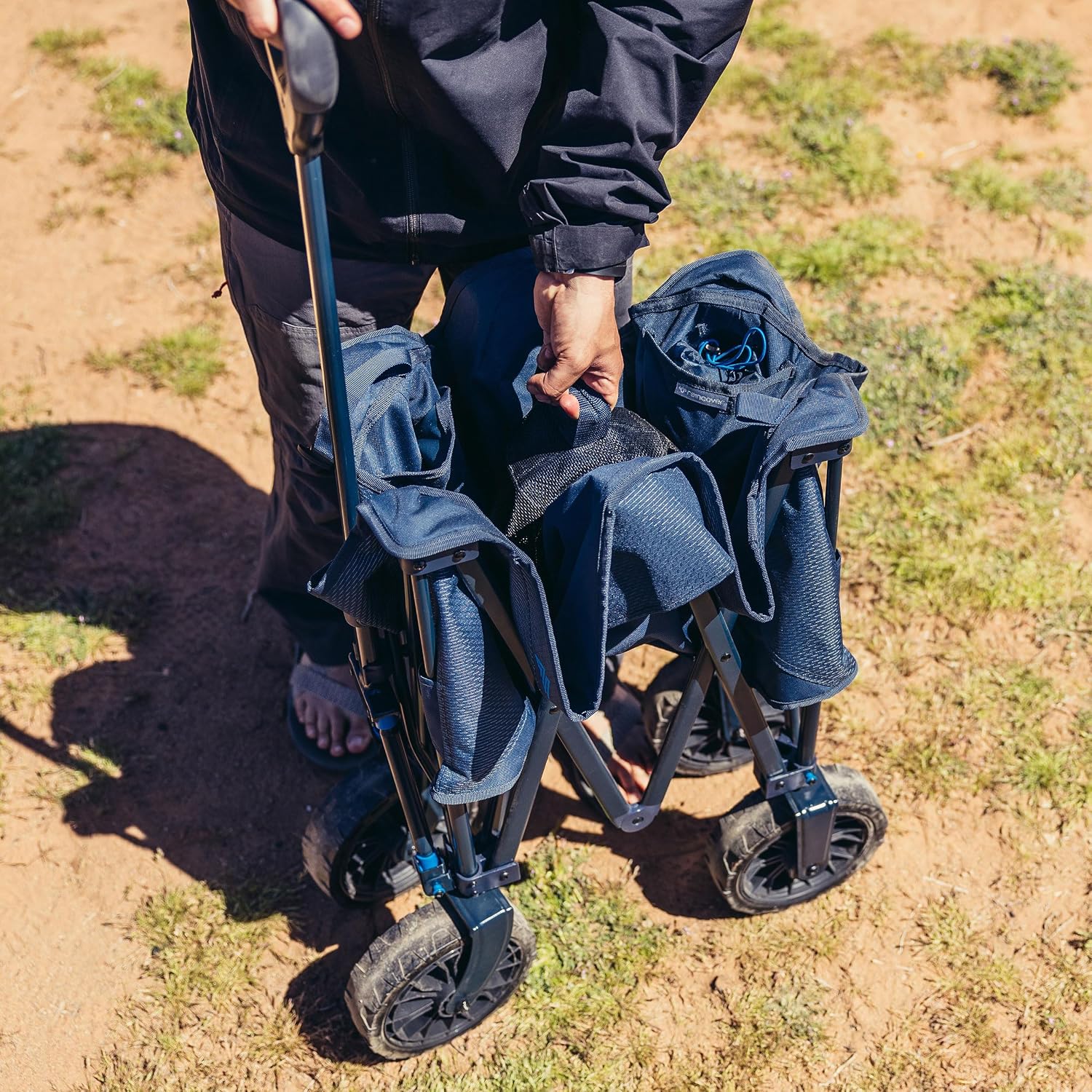
A camping wagon is most useful when it is loaded thoughtfully, handled within its limits, and cleaned before storage. A few simple habits can make campsite transport easier while helping you spot wear or damage before your next trip.
Distribute the Load Evenly
Place heavier items low in the cargo compartment and distribute the weight across the wagon rather than concentrating it at one end. A cooler or heavy storage box should be positioned securely so it cannot slide when the wagon turns or crosses uneven ground.
Keep the load balanced from side to side, too. An uneven load can make a wagon harder to steer and may place additional stress on individual wheels or parts of the frame. Pack lighter bags and smaller accessories around heavier items, and avoid stacking cargo so high that it becomes unstable.
Always follow the manufacturer’s loading instructions and never exceed the verified capacity for your particular model. Remember that the maximum rated load does not guarantee easy movement over rough or soft terrain.
Secure Loose and Bulky Equipment
Before moving the wagon, check that chairs, bags, coolers, and other items are not likely to fall out. Use suitable straps or other secure restraints when appropriate, provided they do not interfere with the wheels, handle, or folding mechanism.
Keep the cargo below a height that blocks your view of the route ahead. Avoid placing long or awkward items where they can catch on obstacles or make the wagon unstable when turning.
If you are carrying food or drinks, make sure lids are closed and containers are secure. This helps reduce spills and keeps the rest of your equipment cleaner during transport.
Check the Wagon Before Loading
Before each trip, take a moment to inspect the main components:
Wheels: Look for visible damage, debris, loose attachments, or unusual movement.
Frame: Check for bent parts, cracks, loose fasteners, or signs of corrosion.
Handle: Make sure it moves as intended and locks into position where applicable.
Folding mechanism: Confirm that the frame opens and locks according to the manufacturer’s instructions.
Brakes: If fitted, check that they engage and release properly.
Fabric compartment: Look for tears, damaged seams, loose attachment points, or worn areas.
Do not use a wagon with a damaged frame, an unstable wheel, or a folding mechanism that will not secure properly. Follow the manufacturer’s guidance for inspection and repairs.
Pull at a Controlled Pace
Move at a pace that allows you to maintain control, especially when the wagon is loaded. Watch for potholes, roots, curbs, loose stones, and other obstacles that could catch a wheel or shift the cargo.
Avoid sudden turns and jerking movements. When approaching a slope, reduce speed and maintain a firm grip on the handle. Do not assume the wagon will remain stationary on an incline; use its brakes if equipped and suitable for the situation, and follow the manufacturer’s safety instructions.
If the load becomes difficult to move, stop in a safe place and reassess it. Redistributing the cargo or making more than one trip may be safer than trying to pull an overloaded wagon across difficult ground.
Respect the Intended Use
A folding camping wagon is designed primarily to transport equipment. Unless the manufacturer explicitly states otherwise and provides the required safety instructions, do not use it to carry children or pets.
Do not ride in the wagon, attach it to a moving vehicle, or use it on terrain outside the manufacturer’s stated intended use. Keep hands and fingers clear of hinges and joints when folding or unfolding the frame, and keep children away from moving parts during setup.
When transporting the wagon in a vehicle, secure it so it cannot shift during driving. Store detached wheels or accessories so they cannot roll or move around the cargo area.
Clean the Wagon After Each Trip
Dirt, sand, and moisture can accumulate around the wheels, frame joints, and fabric compartment. After use, remove loose debris and clean the wagon according to the manufacturer’s care instructions.
If the liner is removable, check whether it can be washed separately. Do not assume that every fabric component is machine-washable or that the entire wagon can be rinsed with a hose. Use only cleaning methods approved for the specific model.
Pay particular attention to sand and small stones around moving parts. Remove debris carefully without forcing the folding mechanism or damaging the wheel assemblies.
Dry It Thoroughly Before Storage
Allow damp fabric and frame components to dry fully before storing the wagon. Putting it away while wet can encourage unpleasant odors and may contribute to corrosion or deterioration, depending on the materials and storage conditions.
Store the wagon in a dry location, away from prolonged exposure to harsh weather when possible. Follow any instructions for protecting the wheels, lubricating moving parts, or maintaining pneumatic tires. Do not apply lubricants or adjust components unless the manufacturer permits it.
Prepare It for the Next Camping Trip
A short pre-trip routine helps you avoid discovering problems at the campsite. Check that the wagon folds and opens correctly, confirm that any detachable parts are present, and inspect the wheels before loading it into your vehicle.
If the wagon uses pneumatic tires, check their pressure according to the manufacturer’s recommendations. For other wheel types, inspect the surface and attachments for damage or accumulated debris.
Finally, confirm that your planned load fits both the wagon’s verified capacity and its usable cargo dimensions. Good preparation, sensible loading, and routine cleaning will help keep the wagon ready for repeated outdoor use.
Frequently Asked Questions About All-Terrain Camping Wagons
Can a camping wagon be used on sand?
Yes, but performance depends heavily on the wheel design and the type of sand. Firm, compacted sand is generally easier to cross than deep, loose beach sand. Wide wheels can help distribute the load and reduce sinking, while narrow wheels may struggle under the same conditions. If you regularly camp near the beach, choose a wagon with wheels suited to soft surfaces and avoid assuming that every model marketed as all-terrain will handle deep sand easily.
What size wheels are best for an all-terrain camping wagon?
There is no single wheel size that works best on every surface. Larger-diameter wheels can help roll over bumps and uneven ground, while wider wheels can distribute weight over a larger contact area. Tread and wheel construction also affect traction and rolling resistance. For regular use on gravel, grass, or sand, compare the actual diameter and width rather than relying only on the manufacturer’s all-terrain label.
How much weight can a camping wagon hold?
The rated capacity varies by model. Some folding utility wagons are designed for relatively light loads, while heavy-duty models advertise substantially higher limits. Check the manufacturer’s maximum carrying capacity for the exact model you intend to buy, and follow its loading instructions. Remember that the stated weight limit does not guarantee easy pulling on rough terrain, particularly when the wagon is fully loaded.
Are folding camping wagons worth buying?
A folding camping wagon can be worthwhile if you regularly carry coolers, chairs, food supplies, and other equipment from your vehicle to a campsite. It can reduce the need to make multiple trips and help keep gear together. However, it may offer limited benefit if your campsite is close to your parking space or if the terrain is unsuitable for wheels. Consider how often you will use it, how much equipment you carry, and whether the folded wagon will fit in your vehicle.
What should I look for when buying an all-terrain camping wagon?
Start with four essentials: verified load capacity, wheel design, usable cargo dimensions, and folded size. Choose wheels for the surfaces you regularly encounter, and make sure the cargo compartment accommodates your largest items. Then compare the wagon’s empty weight, folding mechanism, frame construction, and useful extras. Confirm specifications for the exact model because similar-looking wagons can have different capacities and features.
Do all camping wagons fold small enough to fit in a car trunk?
No. Folding wagons vary considerably in their folded dimensions, product weight, and folding mechanisms. Some collapse into a relatively flat package, while others remain bulky or require the wheels to be removed. Before buying, measure your available cargo space and compare it with the manufacturer’s folded dimensions. Remember to leave room for the rest of your camping equipment.
Can you use a camping wagon on hiking trails?
A camping wagon may work on a suitable, relatively smooth path, but it is not necessarily appropriate for rugged hiking trails. Roots, steep sections, narrow passages, and loose surfaces can make a loaded wagon difficult to maneuver. Some parks and trails also restrict wheeled equipment. Check local regulations and the manufacturer’s intended-use guidance before taking a wagon onto a trail.
How do you clean and maintain a camping wagon?
Remove loose dirt, sand, and debris after each trip, paying particular attention to the wheels and folding joints. Clean the fabric compartment according to the manufacturer’s instructions, especially if the liner is removable. Allow damp components to dry thoroughly before storing the wagon, and periodically inspect the frame, handle, wheels, and folding mechanism for damage or loosened parts. Follow the model-specific care instructions rather than assuming that every wagon can be washed in the same way.
Is a higher-capacity camping wagon always the better choice?
No. A higher load rating can be useful for transporting heavy equipment, but it does not automatically mean that a wagon is easier to pull, more stable on soft ground, or more convenient to store. A larger model may also be heavier and take up more room in your vehicle. Choose a verified capacity that suits your typical load, then compare the wheels, cargo dimensions, and portability before making a decision.
Final Verdict: Which All-Terrain Camping Wagon Should You Choose?
The Coleman XL is the first model to consider if carrying capacity is your main priority. The Gregory Alpaca Gear Wagon is better suited to buyers who value organized storage and included accessories, while the Sekey 220L emphasizes cargo volume. The US Original Outlander XL offers wide airless wheels, and the BEAU JARDIN is a general-purpose folding option. Verify any unconfirmed specifications against the exact Amazon listing before buying.
Which Wagon Is Best for Your Needs?
Best for Heavy Loads: Coleman XL Collapsible Wagon. Its published 400-pound capacity, cargo volume exceeding 50 gallons, and one-pull folding design make it a strong starting point for campers who regularly transport substantial amounts of equipment. Check the current listing for the exact configuration and dimensions.
Best for Organized Gear Transport: Gregory Alpaca Gear Wagon. Its 140-liter compartment, removable floor, cover, storage pockets, and reflective gear loops make it particularly appealing to campers who value organization and protection for their equipment. Its storage-focused design may be more important to some buyers than maximum cargo volume.
Best for High Cargo Volume: Sekey 220L Collapsible Foldable Wagon. The advertised 220-liter compartment is attractive for transporting bulky camping supplies. Before choosing it, confirm the maximum load rating, wheel specifications, and folded dimensions for ASIN B0B7MSNG67.
Best for Wide, Airless Wheels: US Original Outlander XL. Its listed 9-inch-diameter, 5-inch-wide airless wheels distinguish it from many conventional folding wagons. It is worth comparing if you prefer wide wheels without inflation maintenance, but do not assume that this design guarantees easy movement through deep sand.
Best for General Outdoor Hauling: BEAU JARDIN Folding Wagon. Its collapsible construction and wide-wheel design make it a candidate for general recreational use. However, published listings disagree about its carrying capacity, so confirm the exact rating for ASIN B07S9W4SK6 before relying on it for heavy equipment.
What Matters Most Before You Buy?
Before making your final choice, check three things: the maximum load rating for the exact model, the wheel design for your usual terrain, and the folded dimensions for your vehicle. These practical details are more useful than choosing a wagon simply because it advertises the highest capacity or uses the term all-terrain.
Also consider how often you will use the wagon. If you mainly transport a few chairs and bags over short, paved paths, a large heavy-duty model may be unnecessary. If you regularly move coolers, storage boxes, and shared family equipment across a campground, greater capacity and a suitable wheel design may justify the additional size and weight.
Our final recommendation: Start with the Coleman XL if heavy-load capacity is your main priority. Consider the Gregory Alpaca Gear Wagon if organized storage and included accessories matter more. Treat the Sekey, US Original Outlander XL, and BEAU JARDIN as alternatives whose suitability depends on verifying the specifications most important to your setup. No single wagon is best for every camper, and none should be assumed to handle every surface equally well.
The right choice is the wagon that carries your actual equipment, suits your regular route, and fits your storage space without adding unnecessary weight or bulk.
About the Author
Anthony — Founder of Camp Comfort Guide
Anthony created Camp Comfort Guide to help families and car campers choose practical, reliable equipment for more comfortable outdoor trips. His approach focuses on the details that matter when planning a real camping setup: usability, durability, storage, convenience, and value for money.
Through Camp Comfort Guide, Anthony shares research-based gear comparisons and practical guidance designed to make purchasing decisions easier. Product guides examine available specifications, compare relevant features, and explain the advantages and limitations of different options so readers can choose equipment that fits their needs.
For this all-terrain camping wagon guide, the focus is on carrying capacity, wheel design, cargo space, portability, and suitability for different campsite surfaces. Product specifications are assessed against available sources, and details that cannot be reliably confirmed are identified rather than presented as established facts.
Anthony’s goal is to help readers spend less time researching equipment and more time enjoying comfortable, well-organized camping trips.
Learn more about the site’s approach on our About Camp Comfort Guide page.