
A pizza oven sounds like a luxury until you have one at a campsite and realize how much better it can make a simple evening outdoors. Fresh pizza cooks in minutes, there is no need to turn the camp kitchen into a full restaurant, and the meal becomes part of the experience rather than something prepared in a hurry.
The tricky part is choosing the right oven. A model that works beautifully on a backyard patio may be far too heavy for a weekend camping setup, while a lighter oven may sacrifice cooking space or heat retention. Fuel matters too: propane keeps things simple, whereas wood and multi-fuel ovens bring more flexibility but also more gear and cleanup.
That is why we looked at these ovens from a camper’s perspective, not simply by asking which one makes the hottest pizza. We compare cooking size, weight, fuel, heat-up and recovery, portability, and the practical realities of using an oven outdoors. The five models below cover everything from compact adventure-oriented cooking to large family car-camping setups, so you can choose the one that fits your campsite—not somebody else’s backyard.
As an Amazon Associate, we earn from qualifying purchases.
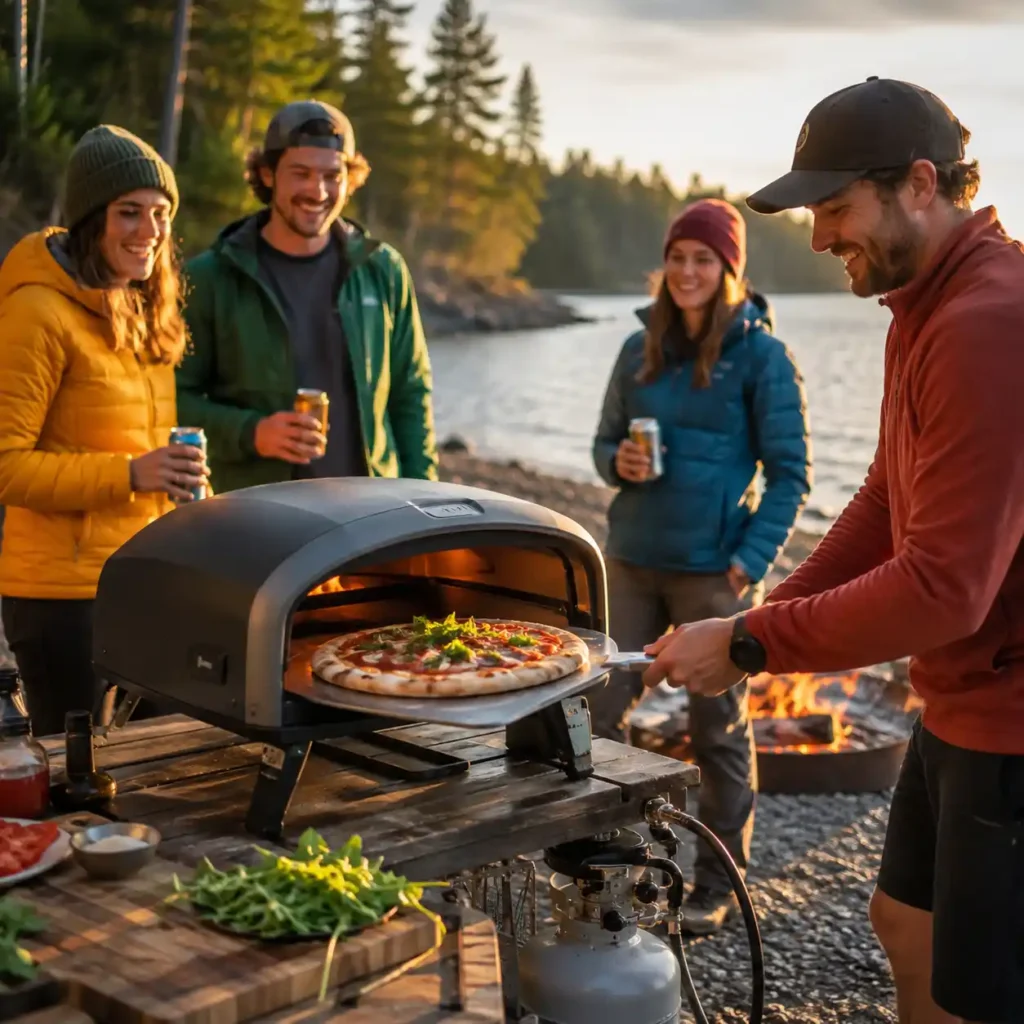
Table of Contents
Quick Answer: Which Camping Pizza Oven Should You Buy?
For most car campers, the best choice depends less on chasing the highest temperature and more on how much oven you are willing to carry, which fuel you want to manage, and how many people you plan to feed.
- Want the most cooking space? The Ooni Koda 2 Pro is the heavyweight option for family camping and larger pizzas.
- Want maximum fuel flexibility? The Ooni Karu 2 Pro lets you build your setup around a multi-fuel approach rather than relying on propane alone.
- Want a rugged, well-insulated oven? The Gozney Roccbox makes sense when heat retention and solid construction matter more than minimum weight.
- Want to keep the load down? The Gozney Tread is the easier oven to justify when portability is high on your list.
- Want straightforward propane cooking? The Solo Stove Pi Prime keeps the setup simple without adding wood-fire management to your campsite routine.
There is one important catch: none of these ovens is truly lightweight camping gear in the backpacking sense. These are outdoor cooking appliances best suited to car camping, basecamps, tailgating, and other situations where the oven travels with your vehicle. That distinction matters more than a “portable” label on the box.
Why Trust This Guide
A camping pizza oven has a different job from one that stays on a backyard patio. Weight, fuel, storage, setup space, and weather can matter just as much as cooking temperature. That is the lens we use throughout this guide.
We selected five specific models and compared them across the factors that actually affect a camping setup: cooking capacity, weight, fuel type, heat performance, portability, setup, and overall practicality at camp. We also separate manufacturer specifications from our editorial assessment rather than treating every advertised number as a real-world performance test.
Our editorial ratings are based on how each oven’s specifications translate into practical camping use. We consider cooking capacity, weight, fuel requirements, portability, setup demands, and campsite usability together rather than treating any single specification as decisive. Manufacturer specifications are used for measurable product details, while our awards and recommendations reflect the overall fit of each model for a specific camping scenario.
That distinction matters because “portable” covers a surprisingly wide range of products. A 30-pound oven may be perfectly reasonable for car camping but a poor choice when every pound has to be carried by hand. Likewise, a larger oven can be a smart investment for a family campsite and unnecessary bulk for a couple traveling light.
Our recommendations are therefore based on use case and trade-offs, not simply on which oven has the highest temperature rating or the biggest cooking surface. Current 2026 guides similarly emphasize that camping changes the priorities around portability, fuel flexibility, heat recovery, and cooking capacity.
What Actually Matters in a Camping Pizza Oven

Quick Decision Guide: Choose Your Oven by Camping Style
A pizza oven can be excellent at home and still be a poor choice for camping. Once the oven leaves the patio, every part of the setup starts competing for space in your vehicle: the oven itself, fuel, peel, cookware, food, cooler, and the rest of your camp gear. That is why portability should be judged as a complete cooking load, not just the number printed next to “weight.”
Current camping-focused comparisons tend to emphasize weight and packability, while newer guides increasingly distinguish between genuinely portable ovens and larger models intended for car camping or basecamp use.
Portability Is More Than the Oven’s Weight
A 30-pound oven may be perfectly manageable when it goes directly from your trunk to a campsite table. The same oven becomes much less attractive if you have to carry it several hundred yards, together with fuel and accessories.
For this guide, think about portability in three parts:
Oven weight — how difficult the appliance itself is to move.
Packed footprint — whether it fits easily alongside your tent, cooler, chairs, and kitchen gear.
Total cooking load — the oven plus the fuel and essential accessories needed to actually use it.
That last point is easy to overlook. A wood-fired or multi-fuel oven may offer more flexibility, but you also have more to organize and carry. Propane simplifies the cooking process, although the fuel cylinder becomes part of the load.
Pizza Size Changes the Whole Setup
A 12-inch oven is not simply a smaller version of a 16- or 18-inch model. It changes how you cook.
A compact oven works well when you’re making individual pizzas and want to keep the campsite setup relatively small. Larger ovens make more sense when several people are eating, because a bigger cooking chamber can accommodate larger pies and gives you more room to work.
That trade-off is particularly important with the five models in this guide. The Gozney Tread, Gozney Roccbox, and Solo Stove Pi Prime are built around 12-inch pizzas, while the Ooni Karu 2 Pro moves up to 16 inches and the Ooni Koda 2 Pro goes as large as 18 inches.
More cooking space is useful—but you have to decide whether the extra capacity is worth the additional bulk.
Propane vs. Wood vs. Multi-Fuel
Fuel choice affects much more than flavor.
Propane is the straightforward option when you want predictable heat, fast setup, and minimal cleanup. There is no firewood to manage and no ash left behind, but you need to bring an appropriate propane supply.
Wood gives the cooking process a different character and can be appealing when live-fire cooking is part of the camping experience. The downside is additional tending, more cleanup, and greater sensitivity to campsite fire restrictions.
Multi-fuel ovens give you the most flexibility. You can adapt the fuel to the trip, but that versatility can come with additional equipment, weight, and a steeper learning curve.
And there is one rule that matters more than any feature on the oven: campground and local fire regulations come first.
Heat-Up Time Isn’t the Whole Story
Manufacturers often highlight how quickly an oven can reach its maximum temperature. That is useful, but it does not tell you everything you need to know.
For camping, we care about three separate things:
- Time to preheat
- Stone temperature when you are actually ready to cook
- Heat recovery after opening the oven and launching a pizza
The third one becomes increasingly important when you’re cooking for a group. A dramatic first pizza means less if the oven takes too long to recover before the next one.
Wind and cold weather can complicate this further. An exposed campsite is a very different environment from a sheltered backyard patio, so insulation, burner design, oven placement, and wind protection all deserve consideration rather than relying solely on the advertised maximum temperature.
The easiest way to narrow these five down is to start with how you camp, not which oven has the most impressive specification sheet. A couple traveling with limited cargo space has very different priorities from a family unloading half the trunk at a lakeside campsite.
If You Mainly Car Camp With Family
Choose the Ooni Koda 2 Pro.
Its larger cooking area makes sense when several people are waiting for dinner, and propane keeps the cooking routine straightforward. The compromise is weight and bulk: this is a substantial oven, not something you casually carry from the parking area to a remote campsite.
If You Want Wood-Fired Flexibility
Choose the Ooni Karu 2 Pro.
This is the choice for campers who see the pizza oven as part of the outdoor cooking experience rather than simply a fast way to make dinner. Multi-fuel capability gives you more ways to cook, although the larger oven and additional fuel options make the setup considerably more substantial than a lightweight travel oven.
If Carrying Weight Is a Major Concern
Choose the Gozney Tread.
At roughly 30 pounds, it sits in a much more manageable range than the two large Ooni models in this lineup. It is still a serious cooking appliance, but its design makes more sense when the oven will actually travel with you rather than live permanently beside the patio.
If You Value Insulation and Rugged Construction
Choose the Gozney Roccbox.
The Roccbox takes a different approach from the Tread: more weight in exchange for substantial insulation and a design built around retaining heat. That makes it a strong fit for campers who expect longer cooking sessions or want a more substantial oven and don’t mind carrying the extra weight.
If You Want Simple Propane Cooking
Choose the Solo Stove Pi Prime.
The Pi Prime keeps the fuel system uncomplicated and gives you a 12-inch cooking capacity without moving into the size of the larger Ooni models. It is a sensible option when you want to keep the learning curve and campsite cooking routine relatively straightforward.
One Last Check Before You Choose
There is no universal “best” here. The lighter options make more sense when the oven has to move frequently; the larger Ooni models become easier to justify when you’re driving directly to the campsite and cooking for a group. That’s the distinction that gets lost when portable pizza ovens are ranked by weight alone. Current camping comparisons also tend to place the Tread at the portable end of the category, while heavier insulated ovens such as the Roccbox trade carrying ease for heat retention.
Quick Summary: Our Top Camping Pizza Oven Picks
If you don’t have time to read the full guide, this quick summary highlights our top camping pizza ovens for different camping styles, cooking capacities, fuel preferences, and portability needs. Each oven earns its place for a different reason, from large family car-camping setups to more compact options that are easier to move around camp.
There isn’t one perfect camping pizza oven for every camper. The right choice depends on how you travel, how many people you cook for, how much space and weight you can spare, which fuel you prefer, and how much cooking capacity you actually need. Use this shortlist to narrow your options, then read the detailed reviews below for a closer look at each oven’s strengths and trade-offs.
Ooni Koda 2 Pro
Award: Best Camping Pizza Oven for Family Car Camping
Why It Won
The Ooni Koda 2 Pro is the largest oven in our lineup, and that extra cooking space makes a meaningful difference when you are feeding several people at camp. Its propane setup also keeps the cooking process relatively straightforward, making it a strong fit for campers who want serious pizza-making capacity without dealing with wood or charcoal.
Choose This If:
- You regularly camp with family or larger groups.
- You want enough cooking space for large pizzas.
- You prefer propane over managing a wood fire.
- Your vehicle can handle a larger, heavier cooking appliance.
- You want an oven that can serve as a substantial outdoor kitchen centerpiece.
Best For:
- Family camping
- Car camping
- Large groups
- Basecamp cooking
- Large-pizza enthusiasts
Ooni Karu 2 Pro
Award: Best Multi-Fuel Camping Pizza Oven
Why It Won
The Karu 2 Pro is the most versatile choice in this lineup for campers who do not want to be locked into a single fuel source. Its multi-fuel design opens the door to different cooking styles, which is especially useful when the experience of live-fire cooking matters just as much as getting dinner on the table.
Choose This If:
- You want the flexibility of multi-fuel cooking.
- You enjoy wood-fired pizza and outdoor cooking.
- You want a large cooking surface without choosing a propane-only oven.
- You are comfortable carrying a more substantial oven and fuel setup.
- You want versatility for different types of outdoor cooking.
Best For:
- Multi-fuel cooking
- Car camping
- Basecamp setups
- Wood-fired pizza
- Outdoor cooking enthusiasts
Gozney Roccbox
Award: Best Insulated Camping Pizza Oven
Why It Won
The Roccbox takes a different route from the larger Ooni ovens, concentrating on a compact cooking chamber with substantial insulation and heat retention. It is a particularly appealing option for campers who value robust construction and consistent high-heat cooking but do not need an oversized pizza chamber.
Choose This If:
- You want a well-insulated oven for outdoor cooking.
- Heat retention is more important to you than maximum cooking capacity.
- You prefer a rugged, substantial design.
- You mostly make pizzas around the 12-inch size.
- You want an oven that works well for both camping and other outdoor cooking.
Best For:
- Car camping
- Couples
- Small families
- Outdoor kitchens
- Campers who prioritize insulation
Gozney Tread
Award: Best Portable Camping Pizza Oven
Why It Won
The Tread is the easiest model in this group to justify when portability is high on your priority list. It still provides serious pizza-oven performance, but its roughly 30-pound weight makes it considerably more practical for campers who need to move their cooking setup rather than simply unload it beside the vehicle.
Choose This If:
- You want to keep the oven’s weight relatively manageable.
- You move around your campsite frequently.
- You usually cook 12-inch pizzas or smaller.
- You prefer propane for quick and predictable setup.
- Portability matters more to you than having a large cooking chamber.
Best For:
- Portable camping setups
- Car camping
- Weekend trips
- Couples
- Space-conscious campers
Solo Stove Pi Prime
Award: Best Simple Propane Camping Pizza Oven
Why It Won
The Pi Prime is the straightforward choice for campers who want propane cooking without making the oven itself the most complicated part of the campsite kitchen. Its 12-inch format keeps the cooking area practical while avoiding the bulk associated with the largest ovens in this comparison.
Choose This If:
- You want a simple propane-powered setup.
- You usually cook for a couple or small group.
- You prefer a 12-inch pizza format.
- You want to avoid managing wood or charcoal.
- You want a dedicated pizza oven without going to the largest size.
Best For:
- Couples
- Small families
- Car camping
- Propane cooking
- Simple outdoor kitchens
Still Not Sure Which Camping Pizza Oven Is Right for You?
The five ovens above cover very different camping priorities. The Koda 2 Pro is about capacity, the Karu 2 Pro about fuel flexibility, the Roccbox about insulation and ruggedness, the Tread about portability, and the Pi Prime about straightforward propane cooking. If two or more options still look suitable, the detailed reviews below break down their construction, cooking performance, fuel requirements, portability, and campsite practicality so you can see where the real differences matter.
Camping Pizza Ovens Comparison: Size, Fuel, Weight & Temperature
Choosing the best camping pizza oven comes down to more than maximum heat. Pizza size, fuel type, weight, portability, and cooking capacity can make a much bigger difference once the oven is sitting at your campsite rather than on a backyard patio. Use the comparison below to quickly see how our five picks differ and which type of camping setup each one suits best.
| Pizza Oven | Fuel | Pizza Size | Weight | Max. Temp. | Portability | Best For |
|---|---|---|---|---|---|---|
| Ooni Koda 2 Pro | Gas | Up to 18" | 66 lb (30 kg) | 932°F | Low | Family car camping & large pizzas |
| Ooni Karu 2 Pro | Multi-fuel | Up to 16" | 62.6 lb (28.4 kg) | 950°F | Moderate | Multi-fuel cooking & basecamp |
| Gozney Roccbox | Gas / Wood | Up to 12" | Approx. 44 lb (20 kg) | 950°F | Moderate | Insulated outdoor cooking |
| Gozney Tread | Propane | Up to 12" | 29.7 lb (13.5 kg) | 950°F | High | Portable camping setups |
| Solo Stove Pi Prime | Propane | Up to 12" | 30 lb (13.6 kg) | 950°F | High | Simple propane cooking |
Detailed Reviews: The 5 Best Camping Pizza Ovens
1. Ooni Koda 2 Pro
Best Camping Pizza Oven for Large Groups
A camping pizza oven can be compact and portable, but those advantages start to matter less when you are cooking for a family or a larger group. The Ooni Koda 2 Pro takes a different approach, giving you the cooking space and temperature control needed when pizza becomes part of the main campsite meal rather than an occasional snack.
With room for pizzas up to 18 inches, the Koda 2 Pro is the largest-capacity oven in our lineup. It is also one of the heaviest, weighing 66 pounds, which makes its intended use fairly clear: this is a serious car-camping and basecamp oven, not something you want to carry any significant distance from the vehicle.
The propane-powered design keeps fuel management straightforward, while the oven’s broad temperature range gives it more flexibility than a pizza-only appliance. Ooni specifies a range from 320°F to 950°F, allowing it to handle lower-temperature cooking as well as high-heat pizza.

Quick Verdict
The Ooni Koda 2 Pro is the strongest choice in this lineup when cooking capacity matters more than minimizing weight. Its large cooking area gives you substantially more room to work than a typical 12-inch portable pizza oven, which becomes especially useful when several people are waiting for dinner.
That size changes the camping equation, though. At 66 pounds, the Koda 2 Pro is equipment you plan around rather than casually add to a backpack or compact camp box. It is best suited to vehicle-based camping where you can establish the cooking area close to where the oven will be used.
The propane system is another practical advantage for campsite cooking. There is no need to build and maintain a wood fire simply to get the oven hot, and the adjustable temperature range provides room for more than one style of outdoor cooking.
For families, larger groups, and campers building a substantial vehicle-based kitchen, the extra size is the point rather than a drawback. If your priority is carrying the lightest possible pizza oven, however, one of the smaller models later in this guide will make considerably more sense.
Camp Snapshot
| Camping Style / Best Fit | CampComfortGuide Assessment |
|---|---|
| Camping Style | Family Camping • Car Camping • Basecamp Cooking • Outdoor Kitchens |
| Trip Length | Weekend Camping • Multi-Day Trips • Extended Stays |
| Ideal Campsite | Vehicle-Based Campsites • Established Camp Kitchens • Spacious Campsites |
| Ideal For | Families • Larger Groups • Serious Outdoor Cooks |
| Investment Level | Premium • High-Capacity Outdoor Cooking |
| CampComfortGuide Verdict | Best Camping Pizza Oven for Large Groups |
Why We Chose It
The Ooni Koda 2 Pro earned the Best Camping Pizza Oven for Large Groups recommendation because its biggest advantage is also the characteristic that most clearly separates it from the other ovens in this comparison: cooking space.
An 18-inch pizza capacity gives a family camp considerably more flexibility than a 12-inch oven. You can work with larger pizzas, spread ingredients across a larger cooking surface, and prepare food for several people without making the oven itself the limiting factor.
That capacity is paired with a propane fuel system, which suits the way many car campers actually cook. Once the oven is positioned and connected to its fuel source, there is no need to gather firewood or maintain a separate solid-fuel fire just to keep the cooking temperature up.
We also give the Koda 2 Pro credit for its 320°F–950°F temperature range. That matters because a large outdoor oven becomes more useful when it can move beyond a single high-temperature pizza task.
There is, however, no point pretending that 66 pounds is insignificant. Portability is the compromise you make for this level of cooking capacity. The Koda 2 Pro belongs beside a vehicle, on a properly supported outdoor cooking surface, or within a permanent-style basecamp setup—not in a minimalist camping loadout.
For the right camper, that is a sensible trade. If your campsite kitchen has the space and your vehicle has the payload capacity, the Koda 2 Pro gives a large group something smaller pizza ovens simply cannot: room to cook without constantly working around the oven’s limitations.
Check today’s price, availability, and latest customer reviews on Amazon.
Living With It at Camp
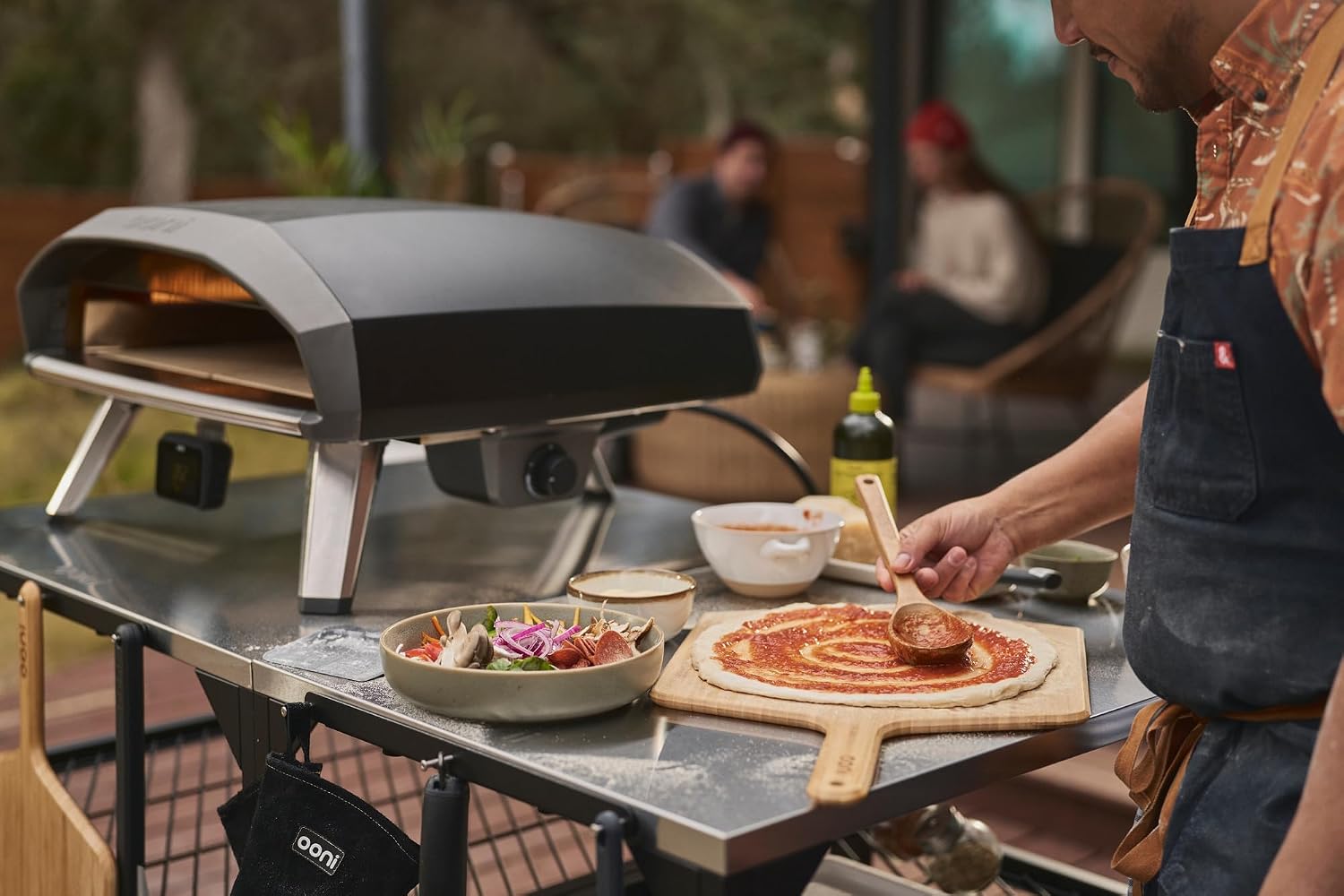
The Ooni Koda 2 Pro works best when you treat it as part of the campsite kitchen rather than as another piece of portable cookware. At 66 pounds, this is an oven you unload deliberately, position once, and leave in place while you cook. That makes vehicle-based camping the natural environment for it.
The first consideration is your cooking surface. Because of its size and weight, the Koda 2 Pro needs a stable, level setup with enough surrounding space to work safely. A crowded picnic table or improvised surface is not where this oven belongs. Give it its own cooking position and leave adequate room for preparing dough, handling toppings, and moving pizzas in and out of the oven.
Propane also changes the rhythm of camp cooking. There is no wood to split, no embers to maintain, and no need to wait for a wood fire to produce a usable cooking environment. For a family campsite, that predictability can be more valuable than the atmosphere of traditional wood-fired cooking, particularly when several people are waiting to eat.
The large cooking area becomes especially useful when dinner involves more than one pizza. An 18-inch oven gives you substantially more room to work than the 12-inch models in this roundup, although larger pizzas also demand more attention when launching, turning, and retrieving them. The Koda 2 Pro rewards a camper who is comfortable treating pizza preparation as part of the meal rather than simply throwing a frozen pizza into an appliance.
Its temperature range adds another dimension to campsite use. Ooni specifies operation from 320°F to 950°F, so the oven is not restricted to the extreme temperatures normally associated with Neapolitan-style pizza. That wider range can make it more useful for different recipes and outdoor cooking situations.
Storage is the other issue to plan for. The Koda 2 Pro is not the kind of equipment you casually tuck into a corner of a packed car. Its 66-pound weight and substantial footprint mean that your vehicle-camping layout should account for the oven before the rest of the kitchen gear is loaded. For campers who already carry tables, coolers, power equipment, and other bulky equipment, that planning matters.
Once those constraints are accepted, the oven’s size becomes much easier to appreciate. At a spacious family campsite, having a dedicated high-heat cooking station can make pizza night feel less like a compromise and more like a genuine outdoor kitchen.
CampComfortGuide Evaluation
| Evaluation Category | Editorial Assessment |
|---|---|
| Cooking Capacity | ★★★★★ An 18-inch cooking area gives families and larger groups substantially more room than compact pizza ovens. |
| Temperature Control | ★★★★★ The 320°F–950°F operating range provides useful flexibility for different outdoor cooking tasks. |
| Portability | ★★★☆☆ The 66 lb weight makes it practical for car camping but unsuitable for lightweight or carry-in setups. |
| Ease of Use | ★★★★☆ Propane power simplifies fuel management, although the large oven requires a deliberate campsite setup. |
| Overall Value | ★★★★★ A strong premium option for campers who will actually use its large cooking capacity. |
Who Should Buy This
- Families who want a large camping pizza oven for cooking substantial meals at the campsite.
- Car campers with enough vehicle space to transport a 66 lb outdoor oven.
- Larger groups that will benefit from an 18-inch cooking capacity.
- Campers who prefer propane cooking over managing wood or charcoal.
- Outdoor cooks who want a pizza oven that can operate across a wider temperature range.
Who Should Skip This
- Backpackers and campers who need equipment that can be carried any meaningful distance.
- Minimalist campers trying to keep their vehicle load as light and compact as possible.
- Couples who rarely need more than a 12-inch pizza cooking surface.
- Campers without a stable, dedicated surface for a large outdoor cooking appliance.
- Anyone whose main priority is maximum portability rather than cooking capacity.
Final Verdict
For family camping and larger group meals, the Ooni Koda 2 Pro stands out for one reason above all: cooking capacity. Its 18-inch format gives a campsite kitchen substantially more working room than the smaller ovens in this roundup.
Its 18-inch format, propane operation, and 320°F–950°F temperature range make it considerably more versatile than a basic pizza-only setup. The trade-off is equally clear. At 66 pounds, the Koda 2 Pro is a vehicle-camping oven first and a portable oven second.
For families, larger groups, and campers who build their trips around comfortable basecamp cooking, that is a worthwhile exchange. If your priority is keeping your cooking gear light and easy to move, however, there are better choices elsewhere in this guide.
Our verdict: choose the Koda 2 Pro when cooking space matters more than carrying weight.
Check today’s price and latest customer reviews on Amazon.
Related Guide
A large pizza oven works best when it has a stable cooking area around it. Our 5 Best Camping Kitchen Tables for Cooking in 2026 (Sturdy & Portable) guide looks at portable tables that can help create a more practical outdoor kitchen for preparing food, organizing ingredients, and supporting campsite cooking equipment.
2. Ooni Karu 2 Pro
Best Multi-Fuel Camping Pizza Oven
The appeal of a multi-fuel pizza oven becomes much clearer at a campsite, where cooking can be as much about the experience as the finished pizza. The Ooni Karu 2 Pro gives campers the flexibility to choose between different fuel approaches while retaining the large cooking capacity expected from a serious outdoor oven.
With a 16-inch cooking surface, the Karu 2 Pro sits just below the Koda 2 Pro in our lineup but remains a substantial oven for family camping and basecamp cooking. Its multi-fuel design also gives it a different character from the propane-only models, particularly for campers who enjoy cooking over real wood or charcoal when conditions and campsite rules allow it.
At 62.6 pounds, it is still firmly in car-camping territory rather than lightweight portable gear. Ooni specifies a maximum temperature of 950°F, giving the Karu 2 Pro the high-heat capability needed for serious pizza cooking.

Quick Verdict
The Ooni Karu 2 Pro is the most flexible choice in this roundup for campers who do not want their pizza oven tied to a single fuel source. Its multi-fuel configuration allows you to approach outdoor cooking differently depending on the trip, the available fuel, and the type of fire-cooked experience you want.
That flexibility is particularly interesting for basecamp campers. A propane setup can make practical sense when convenience is the priority, while wood or charcoal can bring a more traditional live-fire character to pizza night. The important point is that you have the choice rather than having the fuel decision made for you.
The 17-inch cooking surface also gives the Karu 2 Pro enough room for substantial pizzas and group cooking without stepping down into the compact 12-inch class represented by several other models here.
There is a clear trade-off, however. At 62.6 pounds, this is not an oven you buy for effortless portability. Like the Koda 2 Pro, it is better suited to vehicle-based camping where the oven can be transported directly to an established cooking area.
For anyone who sees pizza night as part of the outdoor-cooking experience rather than simply another way to prepare dinner, the Karu 2 Pro’s fuel flexibility becomes its defining advantage.
Camp Snapshot
| Camping Style / Best Fit | CampComfortGuide Assessment |
|---|---|
| Camping Style | Car Camping • Family Camping • Basecamp Cooking • Live-Fire Cooking |
| Trip Length | Weekend Camping • Multi-Day Trips • Extended Basecamp Stays |
| Ideal Campsite | Established Campsites • Spacious Cooking Areas • Vehicle-Based Camps |
| Ideal For | Families • Outdoor Cooks • Multi-Fuel Enthusiasts |
| Investment Level | Premium • Versatile Outdoor Cooking |
| CampComfortGuide Verdict | Best Multi-Fuel Camping Pizza Oven |
Why We Chose It
The Ooni Karu 2 Pro earned the Best Multi-Fuel Camping Pizza Oven award because it offers something the propane-focused models in this guide cannot: the ability to choose how you want to fuel the cooking experience.
That distinction matters more at camp than it might at home. Some campers want the convenience and predictability of gas, while others specifically enjoy the process of cooking with wood or charcoal. The Karu 2 Pro leaves that decision in the camper’s hands, making it a particularly versatile option for established outdoor kitchens and basecamp setups.
Its 17-inch cooking surface is another reason it stands out. It provides considerably more working room than a compact 12-inch oven, giving families and groups more flexibility when preparing pizza. At the same time, the oven remains slightly smaller than the 18-inch Koda 2 Pro, creating a useful middle position in this particular lineup.
We also considered the oven’s 950°F maximum temperature. That gives it the high-heat capability expected from a dedicated pizza oven and leaves plenty of headroom for fast, high-temperature cooking when the oven is properly preheated.
The compromise is weight. At 62.6 pounds, the Karu 2 Pro is substantial equipment, and its multi-fuel capability does not make it a lightweight camping accessory. You also need to account for the additional fuel and fire-management requirements when choosing wood or charcoal.
For campers who already travel with a vehicle-based kitchen and genuinely value fuel choice, however, that added complexity can be worthwhile. The Karu 2 Pro is less about minimizing equipment and more about giving you control over how you cook once you arrive.
Check today’s price, availability, and latest customer reviews on Amazon.

Living With It at Camp
The Ooni Karu 2 Pro is best suited to campsites with enough room for a dedicated cooking station and campers who genuinely enjoy engaging with the cooking process.This is not a set-it-and-forget-it oven when you are using wood or charcoal. Fire management becomes part of the experience, which can be an advantage for campers who enjoy live-fire cooking but a nuisance for anyone primarily interested in convenience.
Its multi-fuel capability is particularly useful at a basecamp. The oven is designed for wood and charcoal, while a compatible gas burner can be purchased separately if you want the convenience of propane. That means you can approach different trips differently instead of committing yourself to one fuel system.
The larger cooking area is valuable when several people are eating. A full-size pizza has more room to launch and turn than it would in a compact 12-inch oven, and the spacious chamber also makes the oven more practical for cooking beyond pizza. Independent testing has found that the Karu 2 Pro can produce high-temperature, restaurant-style results, while reviewers also note the learning curve associated with managing a live fire.
There is one important camping reality to keep in mind: 62-plus pounds changes how you transport this oven. It is better thought of as equipment that travels in the vehicle and gets positioned at the campsite than something you casually carry from the parking area. If your campsite requires a long walk from the vehicle, the weight becomes a genuine disadvantage.
The fuel choice also affects the character of the cooking session. Wood and charcoal can produce the live-fire flavor that makes the Karu 2 Pro appealing in the first place, but they require more attention than propane. For campers who enjoy tending the fire, that is part of the attraction. For someone trying to get dinner on the table quickly with minimum intervention, a gas-focused oven is likely the more sensible choice.
CampComfortGuide Evaluation
| Evaluation Category | Editorial Assessment |
|---|---|
| Cooking Capacity | ★★★★★ Spacious full-size cooking area gives larger groups plenty of room for substantial pizzas. |
| Fuel Flexibility | ★★★★★ Wood and charcoal are supported, with an optional gas-burner route for greater convenience. |
| Portability | ★★★☆☆ Its roughly 62-pound weight makes it better suited to vehicle-based camping than carry-in campsites. |
| Ease of Use | ★★★★☆ Strong control for a live-fire oven, although wood and charcoal require more attention than a gas-only model. |
| Overall Value | ★★★★★ A premium choice for campers who genuinely value multi-fuel cooking and large-pizza capacity. |
Who Should Buy This
- Campers who want a multi-fuel pizza oven rather than a gas-only cooking system.
- Families and groups that benefit from a large cooking surface.
- Car campers with enough vehicle space to transport a roughly 62-pound oven.
- Outdoor cooks who enjoy wood- or charcoal-fired cooking and do not mind managing the fire.
- Campers who want the option of adding gas later for greater convenience.
Who Should Skip This
- Backpackers and campers who need genuinely lightweight cooking equipment.
- Campers who want the simplest possible propane-only pizza setup.
- Anyone who does not want to monitor a wood or charcoal fire while preparing dinner.
- Small camping groups that have little use for a large cooking surface.
- Campers whose campsite requires carrying the oven a substantial distance from the vehicle.
Final Verdict
The Karu 2 Pro’s defining advantage is fuel choice. Wood, charcoal, and the optional gas-burner setup allow campers to adapt the oven to different trips and cooking preferences.
Wood and charcoal make live-fire cooking possible, while the optional gas-burner route provides another way to approach the oven when convenience matters. Add the large cooking area and high-temperature capability, and the Karu 2 Pro becomes a particularly capable centerpiece for a family campsite kitchen.
The price of that versatility is weight and complexity. This is premium camping-cooking equipment, not lightweight travel gear. If your trips revolve around car camping, established campsites, and outdoor meals that are part of the experience, the trade-off makes sense.
If you want a pizza oven that is easier to move and quicker to deploy, another model in this guide will suit you better. But if the appeal of camping pizza includes real fire, fuel choice, and the ability to cook for a group, the Karu 2 Pro is one of the most compelling options here.
Check today’s price and latest customer reviews on Amazon.
Related Guide
A versatile pizza oven can become the centerpiece of a much larger outdoor cooking setup. Our 5 Best Camping Cookware Sets in 2026 (Nesting Pots & Pans) guide covers compact cookware options that can complement pizza night with everything from sauces and sides to other campsite meals.
3. Gozney Roccbox
Best Compact High-Performance Camping Pizza Oven
For campers who want serious pizza performance without moving into the size and weight of a full-scale outdoor oven, the Gozney Roccbox occupies an interesting middle ground. It is substantially more compact than the two large Ooni models above, yet it is built around the same basic idea: bring high-temperature pizza cooking to an outdoor setting without turning the campsite into a permanent kitchen.
The Roccbox is a strong fit for couples, small families, and car campers who want a capable oven without dedicating as much space to it as a 16- or 18-inch model requires. Its compact format makes transportation and campsite setup considerably easier, while the insulated body is designed to retain heat during high-temperature cooking.
Gozney lists the Roccbox as reaching 950°F, and the oven comes configured for gas cooking, with wood-fire capability available through the appropriate accessories. Its compact cooking chamber is designed for pizzas up to 12 inches, putting it firmly in the more portable end of this roundup.

Quick Verdict
The Gozney Roccbox is the model to consider when portability matters, but you still want a genuinely high-performance pizza oven. It does not attempt to compete with the large cooking surface of the Koda 2 Pro or Karu 2 Pro. Instead, it makes a different trade-off: less cooking area in exchange for a much more manageable campsite footprint.
Its 12-inch pizza capacity is well suited to couples and smaller camping groups. Rather than hauling a large oven for a few pizzas, you get a compact cooking appliance that can be incorporated into a vehicle-based setup without dominating the rest of your gear.
The 950°F maximum temperature is another major reason the Roccbox stands out. That gives it the high-heat capability expected from a dedicated pizza oven while keeping the physical size relatively restrained.
The compact design also changes how you can use it at camp. You have more flexibility when choosing where to cook, and the oven is easier to position alongside the rest of a smaller outdoor kitchen. That makes it particularly attractive when campsite space is limited.
There is, naturally, a capacity trade-off. A 12-inch cooking surface is not the right choice for someone who wants to feed a large group with oversized pizzas. For that job, the larger Ooni models make more sense.
Compact transport, high heat, and a smaller campsite cooking footprint are the Roccbox’s strongest advantages. That combination makes it one of the most compelling options in this lineup.
Camp Snapshot
| Camping Style / Best Fit | CampComfortGuide Assessment |
|---|---|
| Camping Style | Car Camping • Weekend Camping • Basecamp Cooking • Outdoor Pizza Nights |
| Trip Length | Weekend Trips • Multi-Day Camping • Short Outdoor Getaways |
| Ideal Campsite | Compact Campsites • Vehicle-Based Camps • Organized Outdoor Kitchens |
| Ideal For | Couples • Small Families • Pizza-Focused Campers |
| Investment Level | Premium • High-Performance Compact Cooking |
| CampComfortGuide Verdict | Best Compact High-Performance Camping Pizza Oven |
Why We Chose It
The Gozney Roccbox earned the Best Compact High-Performance Camping Pizza Oven award because it solves a different problem from the larger ovens in this guide. Instead of maximizing cooking capacity, it concentrates serious pizza-making capability into a substantially smaller package.
That distinction is important for camping. More oven is not automatically better if the oven becomes difficult to transport, store, or position once you reach the campsite. A 12-inch pizza capacity is enough for many couples and smaller groups, while the reduced footprint makes the Roccbox easier to integrate into a compact outdoor kitchen.
The oven’s 950°F capability is central to its appeal. Gozney designed the Roccbox around high-temperature cooking, giving campers access to the temperatures associated with fast pizza baking rather than treating the oven as a conventional low-temperature outdoor cooker.
We also like the fact that the Roccbox does not require a large campsite footprint to be useful. When the rest of your gear already includes a cooler, cooking table, stove, food-storage containers, and other essentials, saving space at the cooking station can be more valuable than having the largest possible oven.
The limitation is straightforward: this is a compact pizza oven, not a large-group cooking platform. If you routinely cook for a big family or want to prepare oversized pizzas, the 12-inch capacity will eventually feel restrictive.
For everyone else, the Roccbox presents a strong balance between high-temperature performance and campsite practicality.

Living With It at Camp
The Gozney Roccbox fits particularly well into a campsite where cooking space is limited but pizza is still meant to be part of the trip. Its smaller footprint makes it easier to work into an established outdoor kitchen without allowing the oven to take over the entire cooking area.
The 12-inch cooking capacity is most comfortable for couples and smaller groups. Instead of trying to produce several large pizzas at once, the Roccbox encourages a more deliberate approach: cook one pizza, turn it, serve it, and keep the next one moving. That rhythm works surprisingly well for a relaxed campsite dinner.
Its high-temperature capability also changes the experience compared with a conventional camping stove. The Roccbox is designed specifically for pizza rather than requiring campers to adapt another cooking device to the job. That makes the Roccbox particularly appealing to campers who care about crust texture and fast cooking as much as simple meal preparation.
Portability is another practical advantage. The Roccbox is still substantial enough that you will want to transport it in the vehicle rather than carry it deep into a campsite, but its compact dimensions make it considerably easier to accommodate than the larger ovens in this roundup. For a weekend trip where every piece of equipment competes for vehicle space, that distinction matters.
The smaller cooking chamber does require some discipline. A 12-inch oven is excellent for individual pizzas, but it is not designed around high-volume group cooking. If six or eight people are waiting for dinner, the smaller opening and cooking surface can turn pizza night into a longer production line.
That is why we see the Roccbox less as a compromise and more as a targeted solution. It is for the camper who would rather have a compact, genuinely capable pizza oven than a much larger appliance that spends most of the trip taking up valuable cargo space.
CampComfortGuide Evaluation
| Evaluation Category | Editorial Assessment |
|---|---|
| Cooking Performance | ★★★★★ High-temperature pizza cooking gives it the performance expected from a dedicated outdoor oven. |
| Portability | ★★★★☆ Compact format is easier to accommodate in a vehicle-based camping setup than larger ovens. |
| Ease of Use | ★★★★★ A straightforward format for campers who want dedicated pizza cooking without a large outdoor kitchen appliance. |
| Cooking Capacity | ★★★★☆ The 12-inch format works well for couples and small groups but is less efficient for large gatherings. |
| Overall Value | ★★★★★ A strong premium option for campers prioritizing compact size and serious pizza performance. |
Who Should Buy This
- Couples and small families looking for a compact camping pizza oven.
- Car campers who want high-temperature pizza cooking without transporting a large oven.
- Campers with limited cooking space at the campsite.
- Pizza enthusiasts who value dedicated outdoor cooking performance.
- Weekend campers who want premium equipment without moving into the largest oven category.
Who Should Skip This
- Large families that regularly need to cook several pizzas for a group at once.
- Campers looking for the largest possible cooking surface.
- Backpackers or hikers who need equipment designed for carry-in camping.
- Anyone who primarily wants a basic camping stove rather than a dedicated pizza oven.
- Campers who prefer maximum cooking capacity over compact equipment.
Final Verdict
Compact size is what makes the Roccbox especially compelling for camping. It delivers serious high-temperature pizza cooking without requiring the footprint of the larger Ooni models.
Its 12-inch capacity is the principal limitation, but it is also part of what makes the oven practical. For couples and smaller camping groups, there is little reason to transport a huge pizza oven simply to cook one or two pizzas at a time.
The Roccbox makes more sense when you think of it as a purpose-built compact cooking station rather than a miniature version of a full-size oven. It gives you serious pizza capability without demanding the same amount of campsite or vehicle space as the larger models in this roundup.
If your priority is feeding a large group quickly, choose one of the larger ovens instead. But for campers who want premium pizza performance in a more manageable package, the Roccbox strikes an excellent balance between capability and practicality.
Check today’s price and latest customer reviews on Amazon.
A dedicated pizza oven works best when the rest of the campsite cooking system is organized around it. Our 5 Best Camping Kitchen Organizers & Chuck Boxes in 2026 (Tame the Chaos) guide covers practical ways to keep cooking tools, ingredients, and small kitchen equipment organized at camp.
4. Gozney Tread
Best Portable Camping Pizza Oven
The Gozney Tread takes a different approach to outdoor pizza cooking. Rather than simply shrinking a full-size oven, it is designed around portability, making it particularly interesting for campers who want a dedicated pizza setup that can move easily between the vehicle, campsite, and other outdoor cooking locations.
That makes the Tread a natural fit for car camping, weekend trips, tailgate-style cooking, and campers who value mobility as much as cooking performance. Its propane-fueled design also removes the need to manage a wood or charcoal fire, which can make the cooking process more predictable when convenience matters.
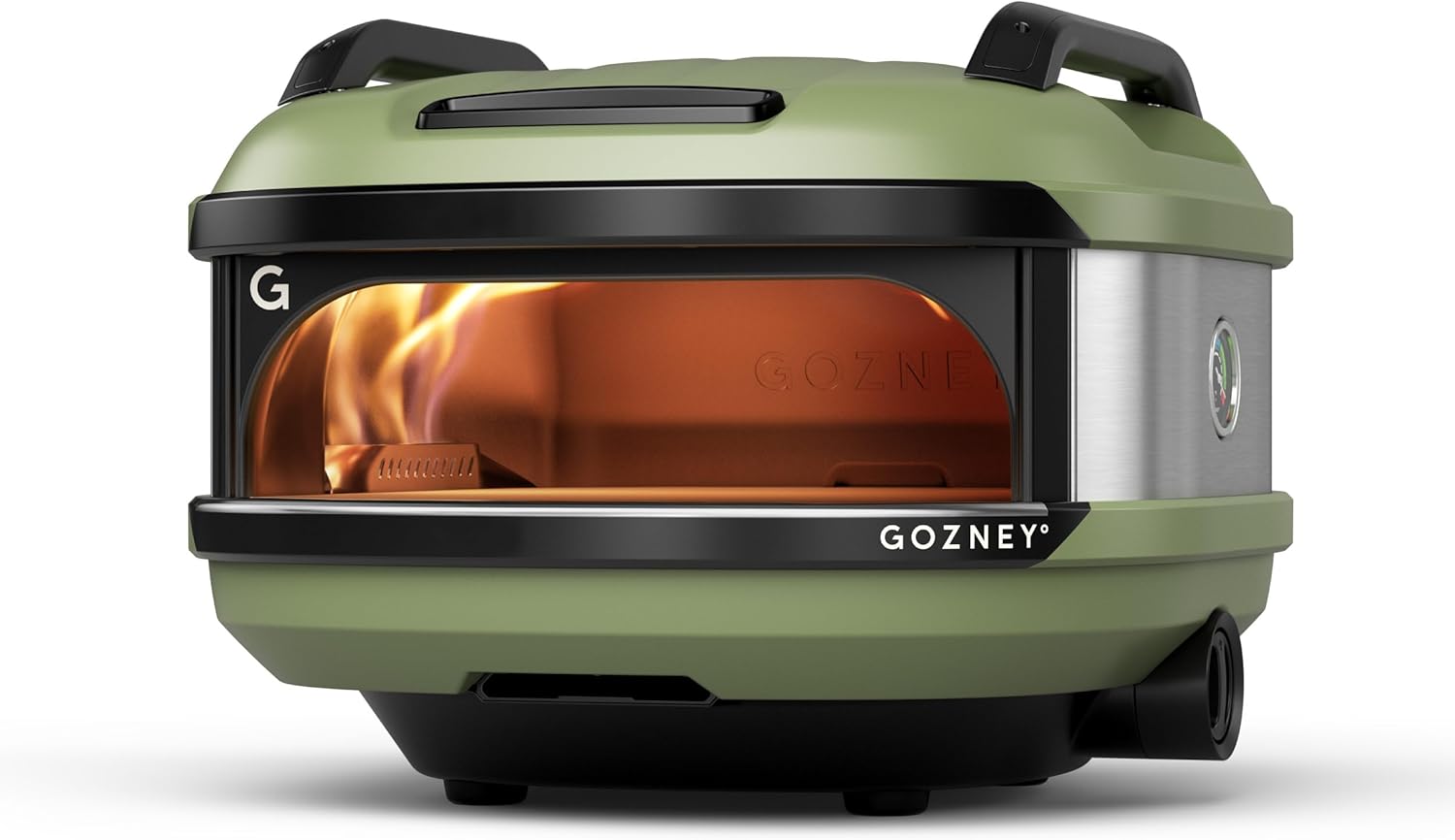
The Tread is built around a 13.5-inch cooking surface and reaches temperatures of up to 950°F, giving it more room than the Roccbox while retaining a strongly portable design. Gozney also positions the oven as a rugged outdoor cooking system intended to handle life beyond a fixed backyard kitchen.
Quick Verdict
The Gozney Tread is our pick for campers who put portability at the center of their pizza-oven decision. It offers a useful step up from ultra-compact pizza cooking while remaining focused on transportation and outdoor use.
Its 13.5-inch cooking surface gives you a little more working room than the Roccbox, which can be valuable when preparing pizzas for several people. At the same time, the propane system keeps the cooking process relatively straightforward: connect the fuel, preheat the oven, and concentrate on the food rather than tending a live fire.
That simplicity is especially useful for campers who already have enough equipment to manage. A propane pizza oven can be a more predictable addition to a busy campsite kitchen, particularly when you want dinner ready without adding another fire-management task.
The Tread’s portability is its defining characteristic. It is still a real pizza oven rather than a tiny tabletop novelty, but its design is oriented toward taking the oven with you rather than leaving it permanently installed at home.
There is a trade-off, of course. The Tread does not offer the multi-fuel flexibility of the Ooni Karu 2 Pro, and its 13.5-inch cooking area remains smaller than the large Ooni ovens in this guide. For campers who value mobility over maximum capacity, however, that is a sensible compromise.
For a mobile camping kitchen where propane convenience, dedicated pizza performance, and transportability all matter, the Tread is a particularly strong candidate.
Camp Snapshot
| Camping Style / Best Fit | CampComfortGuide Assessment |
|---|---|
| Camping Style | Car Camping • Weekend Camping • Road Trips • Mobile Outdoor Cooking |
| Trip Length | Day Trips • Weekend Getaways • Multi-Day Camping |
| Ideal Campsite | Compact Campsites • Vehicle-Based Camps • Mobile Cooking Areas |
| Ideal For | Couples • Small Families • Mobile Outdoor Cooks |
| Investment Level | Premium • Portable Outdoor Cooking |
| CampComfortGuide Verdict | Best Portable Camping Pizza Oven |
Why We Chose It
The Gozney Tread earned the Best Portable Camping Pizza Oven award because portability is not an afterthought in its design. The oven is built around the idea that outdoor cooking equipment should be capable enough to produce serious results while remaining practical to transport.
That makes it particularly well matched to vehicle-based camping and mobile outdoor cooking. If your trips involve moving between campsites, setting up and breaking down frequently, or simply keeping your cargo organized, a purpose-built portable oven can make more sense than carrying a much larger model.
The Tread’s 12-inch cooking capacity keeps it in the same general pizza-size class as the Roccbox, but its travel-oriented design and lower weight make it a more compelling choice when portability is the priority.
The propane configuration is another deliberate strength. There is no need to bring separate wood or charcoal simply to operate the oven, and there is no live fire to manage while you are cooking. For campers who want pizza to be one component of a larger meal rather than the central event of the evening, that can be a meaningful advantage.
The Tread can also reach up to 950°F, giving it the thermal capability expected from a serious pizza oven rather than sacrificing cooking performance simply to achieve portability.
What ultimately separates it from the other models is its balance. The Karu 2 Pro gives you greater fuel flexibility, the larger Ooni models offer more cooking space, and the Roccbox takes compactness even further. The Tread sits between those extremes, making it a strong choice when you want a portable oven without moving all the way down to a very small cooking surface.
Check today’s price, availability, and latest customer reviews on Amazon.

Living With It at Camp
The Gozney Tread is at its best when the oven itself needs to travel as part of the adventure. At 29.7 lb, it is not lightweight in the backpacking sense, but it is substantially more manageable than the larger ovens in this lineup and is specifically designed around mobile outdoor cooking.
Its propane-only setup keeps campsite cooking straightforward. There is no wood or charcoal to carry, and Gozney says the Tread can reach 950°F in around 15 minutes, depending on conditions. That makes it particularly convenient when pizza is one part of a broader campsite meal rather than the entire evening’s project.
The oven accepts pizzas up to 12 inches, despite the slightly larger internal dimensions. That is enough for personal pizzas and small-group cooking, but campers feeding a larger family should understand that several pizzas will need to be cooked sequentially.
One feature that deserves more attention for camping is the removable 12mm cordierite stone. It can be removed for transport and maintenance, while the oven’s adventure-oriented insulation is designed to heat quickly and cool down relatively quickly when it is time to pack up.
The Tread also has a practical advantage over simply buying a small oven and improvising the rest of the setup. Gozney has built an accessory ecosystem around it, including the Venture Stand, carrying bag, roof-rack system, and dedicated peels. You do not need those accessories to use the oven, but they make the Tread’s mobile-cooking concept considerably more complete.
CampComfortGuide Evaluation
| Evaluation Category | Editorial Assessment |
|---|---|
| Cooking Performance | ★★★★★ Reaches up to 950°F and is purpose-built for high-temperature pizza cooking. |
| Portability | ★★★★★ At 29.7 lb, it is one of the most genuinely portable full-featured ovens in this roundup. |
| Ease of Use | ★★★★★ Propane fuel, built-in controls, and rapid heat-up make campsite operation straightforward. |
| Cooking Capacity | ★★★★☆ Supports pizzas up to 12 inches, which suits small groups but limits high-volume cooking. |
| Overall Value | ★★★★★ A compelling premium option when mobility is more important than maximum cooking capacity. |
Who Should Buy This
- Campers looking for a portable propane pizza oven built specifically for outdoor use.
- Car campers who move between campsites or frequently break down their cooking setup.
- Couples and small families who are comfortable with 12-inch pizzas.
- Campers who want fast heat-up without managing wood or charcoal.
- Outdoor cooks who value a dedicated mobile cooking system.
Who Should Skip This
- Large families that need to cook several large pizzas simultaneously.
- Campers who specifically want wood-fired or multi-fuel cooking.
- Backpackers looking for genuinely lightweight equipment.
- Campers who already own a larger pizza oven and have no need for a more mobile alternative.
- Anyone who wants the largest possible cooking surface rather than portability.
Final Verdict
If portability is the first question you ask, the Tread is the easiest model in this lineup to justify. Its travel-oriented design keeps the oven substantially more manageable than the larger alternatives.
Its propane fuel, 950°F maximum temperature, 12-inch pizza capacity, and roughly 30-pound oven weight create a very specific combination: a serious pizza oven that is actually designed to move with you.
The compromise is cooking capacity. If you regularly feed a large group, the bigger Ooni models in this guide are better suited to the job. And if live-fire flexibility is important, the Karu 2 Pro has a clear advantage.
But for the camper who wants to load an oven into the vehicle, reach camp, connect propane, and start cooking without building a separate fire, the Tread is exceptionally well matched to the job.
Related Guide
Once a mobile pizza oven becomes part of your campsite kitchen, keeping the rest of your cooking equipment organized becomes equally important. Our How to Organize a Campsite (Efficient Setup That Actually Works) guide covers practical ways to arrange cooking, food, and other campsite gear so the setup remains functional throughout the trip.
5. Solo Stove Pi Prime Pizza Oven
Best Gas Camping Pizza Oven for Simple Outdoor Cooking
The Solo Stove Pi Prime takes a slightly different route from the other ovens in this roundup. While the Ooni Karu Pro gives you multi-fuel flexibility and the Gozney models emphasize portability and outdoor cooking versatility, the Pi Prime is built around the simplicity of propane-powered pizza cooking. That makes it particularly interesting for campers who want dedicated pizza performance without adding wood management to the evening.
Its rotating cooking surface is one of the features that immediately separates it from the other models here. Instead of repeatedly reaching into the oven to turn the pizza by hand, the rotating stone is designed to help keep the pizza moving through the hottest part of the cooking area. For campsite cooking, where simplicity can matter just as much as maximum specifications, that is a genuinely useful distinction.
Solo Stove rates the Pi Prime for temperatures of up to 950°F, with a cooking surface designed for pizzas up to 12 inches. It uses propane as its fuel source and is built around a compact tabletop format rather than the larger footprint of the Ooni Koda 2 Pro or Karu 2 Pro.

Quick Verdict
The Solo Stove Pi Prime is a strong choice for campers who want propane simplicity and a more hands-off approach to cooking pizza outdoors. Its rotating cooking stone is the feature that gives this oven its clearest identity in our lineup.
That matters because pizza cooking at very high temperatures is not simply a matter of putting a pizza inside and waiting. The crust can brown rapidly, and the pizza needs to be managed as it cooks. A rotating surface can make that process easier, particularly for someone who does not want to spend the entire cook watching the pizza and repeatedly repositioning it.
The 12-inch capacity keeps the Pi Prime in the same general size class as the Roccbox and Tread. It is therefore better suited to couples, small families, and smaller campsite gatherings than to large groups that need to produce pizzas continuously.
The propane-only design is another deliberate trade-off. There is no need to carry firewood or learn a multi-fuel firing routine, which makes the oven attractive for campers who prioritize predictable setup and straightforward operation. Solo Stove’s stated maximum temperature of 950°F also means convenience does not come at the expense of high-heat pizza cooking.
Where the Pi Prime becomes especially interesting is in the overall cooking experience. The rotating stone changes the interaction between the cook and the oven, making it less dependent on constantly manipulating the pizza with a peel.
It is not the obvious choice for someone who wants the largest cooking chamber, multi-fuel capability, or the most expedition-oriented design. But if your idea of a good campsite dinner is propane, high heat, a 12-inch pizza, and less active turning, the Pi Prime brings a distinctive set of advantages to the table.
Camp Snapshot
| Camping Style / Best Fit | CampComfortGuide Assessment |
|---|---|
| Camping Style | Car Camping • Weekend Camping • Basecamp Cooking • Outdoor Pizza Nights |
| Trip Length | Weekend Trips • Multi-Day Camping • Outdoor Getaways |
| Ideal Campsite | Vehicle-Based Camps • Organized Camp Kitchens • Tabletop Cooking Areas |
| Ideal For | Couples • Small Families • Campers Who Prefer Propane Cooking |
| Investment Level | Premium • Dedicated Outdoor Pizza Cooking |
| CampComfortGuide Verdict | Best Gas Camping Pizza Oven for Simple Outdoor Cooking |
Why We Chose It
The Solo Stove Pi Prime earned its place in this roundup because it offers something the other four models do not: a propane pizza oven built around a rotating cooking surface.
That distinction is more than a marketing feature. At temperatures approaching 950°F, pizza cooks quickly enough that small differences in positioning can have a noticeable effect on the crust. The rotating stone is intended to make that process more manageable, allowing the pizza to move through the heat without requiring the cook to constantly manipulate it with a peel.
The Pi Prime also benefits from a straightforward propane setup. For camping, that can be a major practical advantage. You do not need to collect or transport suitable firewood, and you do not have to manage the changing heat characteristics associated with burning solid fuel. For campers who want pizza to be predictable rather than experimental, propane is a sensible choice.
Its 12-inch pizza capacity keeps the oven compact enough for smaller outdoor kitchens. That size is well matched to couples and small groups, although it naturally means cooking multiple pizzas sequentially when more people are eating.
We also considered the way the Pi Prime fits into a broader campsite cooking system. A pizza oven does not operate in isolation: you need somewhere to prepare dough, stage toppings, place finished pizzas, and clean up afterward. The Pi Prime’s tabletop-oriented format makes it easier to incorporate into that kind of organized cooking area than a large standalone outdoor appliance.
There is a clear limitation. The Pi Prime is not the right fit for campers who specifically want wood-fired flexibility or a very large cooking surface.The Ooni Karu Pro is better suited to multi-fuel cooking, while the larger Ooni models have an advantage when group capacity becomes the priority.
But the Pi Prime does not need to win those categories. Its strength is different: high-temperature propane cooking combined with a rotating stone that makes the cooking process unusually approachable. For the camper who values that combination, it is a very compelling option.
Check today’s price, availability, and latest customer reviews on Amazon.

Living With It at Camp
The Solo Stove Pi Prime fits especially well into a campsite where the cooking area is already organized around a sturdy table or outdoor kitchen surface. It is portable enough for vehicle-based camping, but at roughly 30 lb, this is equipment you carry from the vehicle to the cooking area rather than something you would want to move repeatedly throughout the day. Independent testing has also found it practical to transport for camping and capable of producing strong pizza results outdoors.
The propane-only configuration becomes particularly convenient once dinner preparation starts. There is no wood to split, no ash to clean out afterward, and no need to keep feeding a fire while cooking. The single control also makes heat adjustment relatively intuitive, which is one reason the Pi Prime has consistently been regarded as a beginner-friendly oven.
There is, however, one part of the campsite routine that deserves attention: preheating the stone properly. Outdoor temperature and weather can affect how quickly the cooking surface reaches its working temperature. Testing has shown that insufficiently heated stone can leave the bottom of a pizza less developed even when the toppings are already finished, so rushing the preheat is one shortcut we would avoid.
The Pi Prime is also useful beyond pizza. Its high-temperature environment can handle other foods that benefit from intense heat, including roasted vegetables and cast-iron cooking. That makes the oven more versatile within a camp kitchen than its name might initially suggest.
For a campsite, we particularly like the combination of simple ignition, predictable propane control, compact cooking capacity, and relatively straightforward cleanup. You can dedicate one area of the camp kitchen to pizza preparation, keep the oven there during the meal, and avoid introducing another fuel-management task into an already busy campsite.
The limitation is capacity. The Pi Prime’s 12-inch cooking surface is well suited to personal pizzas and small-group meals, but campers feeding a large family will be cooking several pies one after another. The 12-inch cooking surface is the main practical limitation for larger gatherings, because larger groups will need to cook pizzas sequentially rather than working with a larger cooking area.
CampComfortGuide Evaluation
| Evaluation Category | Editorial Assessment |
|---|---|
| Cooking Performance | ★★★★★ High-temperature propane cooking produces excellent pizza when the stone is properly preheated. |
| Portability | ★★★★☆ Practical for car camping and vehicle-based outdoor cooking, although its roughly 30-lb weight makes it better suited to short carries than frequent repositioning. |
| Ease of Use | ★★★★★ Propane fuel and a straightforward control system make the Pi Prime particularly approachable for first-time pizza-oven users. |
| Cooking Capacity | ★★★★☆ The 12-inch cooking surface works very well for couples and small groups but requires sequential cooking for larger gatherings. |
| Overall Value | ★★★★★ A compelling choice for campers who prioritize simple propane operation, strong pizza performance, and an uncomplicated outdoor cooking routine. |
Who Should Buy This
- Campers looking for a propane camping pizza oven that is straightforward to operate.
- Couples and small families who are comfortable cooking 12-inch pizzas one at a time.
- Car campers who want high-temperature pizza cooking without carrying wood or charcoal.
- Beginners who would rather have a simple burner control than learn to manage a live-fire pizza oven.
- Campers who want an outdoor oven that can also handle other high-heat foods.
- Outdoor cooks who value predictable propane cooking and relatively simple cleanup.
Who Should Skip This
- Large camping groups that need to cook several large pizzas at once.
- Campers who specifically want wood-fired flavor or multi-fuel flexibility.
- Backpackers and minimalist campers who cannot justify carrying a roughly 30-lb oven.
- Buyers who want a built-in thermometer or more advanced electronic controls.
- Campers who prefer a larger cooking surface for family-size pizzas.
- Anyone who wants the lightest possible portable pizza oven rather than a more substantial tabletop model.
Final Verdict
The Solo Stove Pi Prime earns its place as our Best Gas Camping Pizza Oven for Simple Outdoor Cooking because it removes much of the complexity that can make outdoor pizza cooking intimidating.
Its propane-only operation means there is no wood to source or fire to manage, while the high-temperature cooking environment gives you the ability to produce genuinely impressive pizza rather than treating portability as an excuse for compromised results. Its propane-only design also keeps operation relatively straightforward, particularly for campers who do not want to manage wood or charcoal during cooking.
The 12-inch cooking surface and roughly 30-lb weight define its practical limits. This is a strong vehicle-camping oven, not a lightweight backpacking appliance or a high-volume pizza station. Larger families may be better served by a bigger model, while campers who want wood-fired flexibility should look toward the Karu Pro.
But if your priority is to arrive at camp, set up a stable cooking surface, connect propane, and make excellent pizza without turning dinner into a fire-management project, the Pi Prime makes a convincing case.
Check today’s price and latest customer reviews on Amazon.
A good pizza setup starts before the oven gets hot. Our 5 Best Camping Cutting Boards in 2026 (Clean & Safe Food Prep) guide covers practical prep surfaces that help keep ingredients organized and food preparation cleaner when cooking outdoors.
Camping Pizza Oven Safety: What to Know Before You Cook
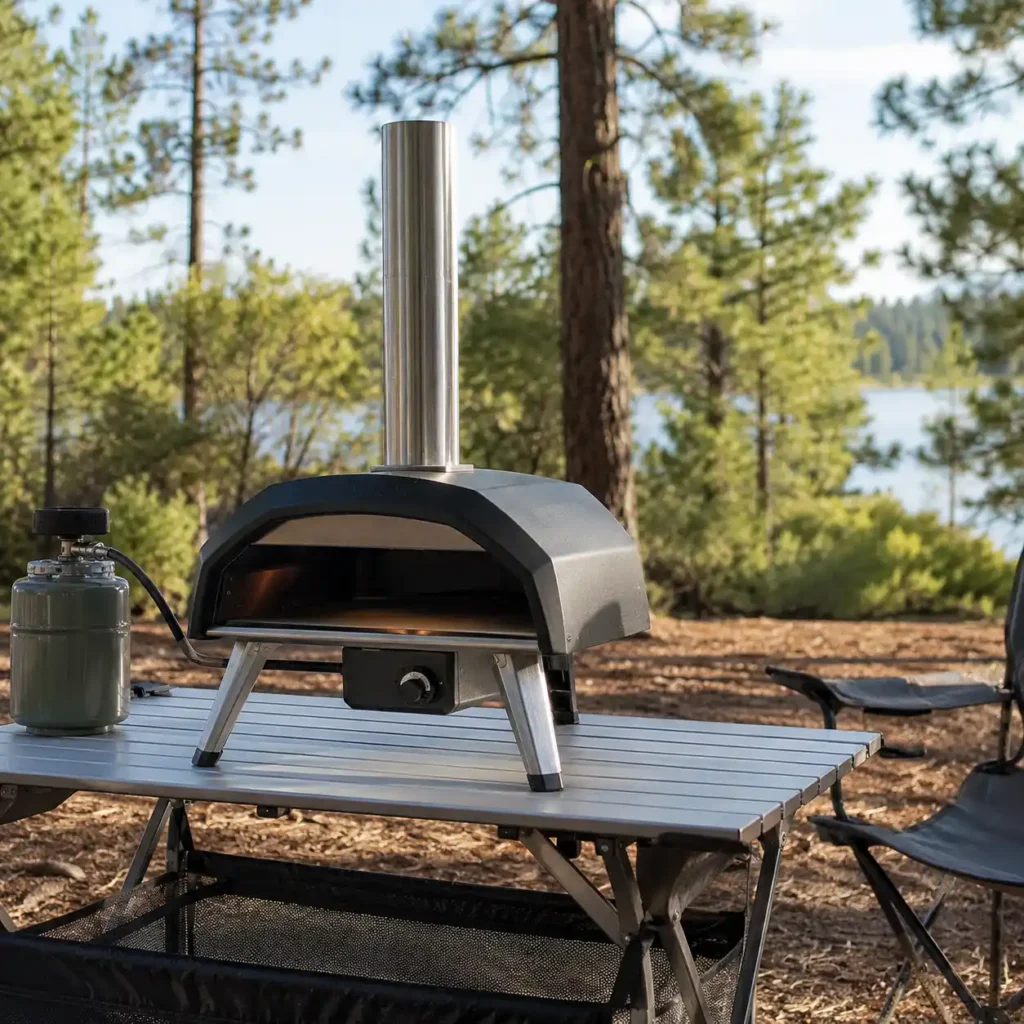
A portable pizza oven can reach temperatures around 900–950°F, so campsite safety deserves more attention than simply choosing a good cooking surface. The biggest risks are not complicated: unstable placement, inadequate clearance, incorrect fuel connections, and operating a high-temperature appliance too close to tents or other combustible gear. Current portable-oven testing and buying guides also emphasize that these appliances are best treated as serious outdoor cooking equipment rather than ordinary camping accessories.
Use a Stable, Non-Combustible Cooking Surface
Set the oven on a solid, level, heat-resistant surface that can safely support its full weight. This becomes particularly important with heavier models such as the Gozney Roccbox, which weighs about 44 lb in independent testing.
Avoid placing a pizza oven directly on a tent floor, plastic table, unstable folding furniture, dry grass, or any surface that could be damaged by concentrated heat.
Keep the Oven Well Away From Tents and Gear
The cooking area should be separated from your sleeping area, vehicle, awnings, dry vegetation, and stored camping equipment. Do not use a portable pizza oven inside a tent, enclosed shelter, vehicle, or other unventilated space.
This is especially important with propane models because combustion produces exhaust gases, while the oven and surrounding surfaces can become extremely hot.
Check Your Fuel Connection Before Lighting
For propane ovens, inspect the hose, regulator, fittings, and connection points before every trip. Make sure the connection is properly seated and follow the manufacturer’s instructions for the specific model.
Never attempt to modify the fuel system to accommodate a different cylinder or connector simply because it is convenient.
Give the Oven Time to Cool
The end of cooking is not the end of the heat hazard. Pizza ovens retain substantial heat after the flame is turned off, and the cooking stone, metal surfaces, and surrounding components can remain dangerously hot.
Allow the oven to cool completely before packing it into your vehicle or storing it alongside tents, sleeping bags, cookware, or other camping equipment.
Follow Local Fire Restrictions
A pizza oven may be permitted at one campground and restricted during a local fire ban or extreme wildfire conditions. Check the campground’s rules and current fire restrictions before using a wood- or charcoal-capable oven.
That matters particularly with multi-fuel models such as the Ooni Karu Pro and Gozney Roccbox. Having the ability to burn solid fuel does not automatically mean that solid-fuel operation is permitted at your campsite.
Keep a Safe Cooking Zone
A simple campsite layout makes a big difference. Keep the pizza oven in one defined cooking area, keep children and pets away from the immediate workspace, and avoid placing loose bags, paper packaging, towels, or other combustible items beside the oven.
The goal is not to make outdoor pizza cooking complicated. It is to give a high-temperature appliance enough space, stability, and ventilation to operate as intended.
Propane vs. Wood-Fired Pizza Ovens for Camping
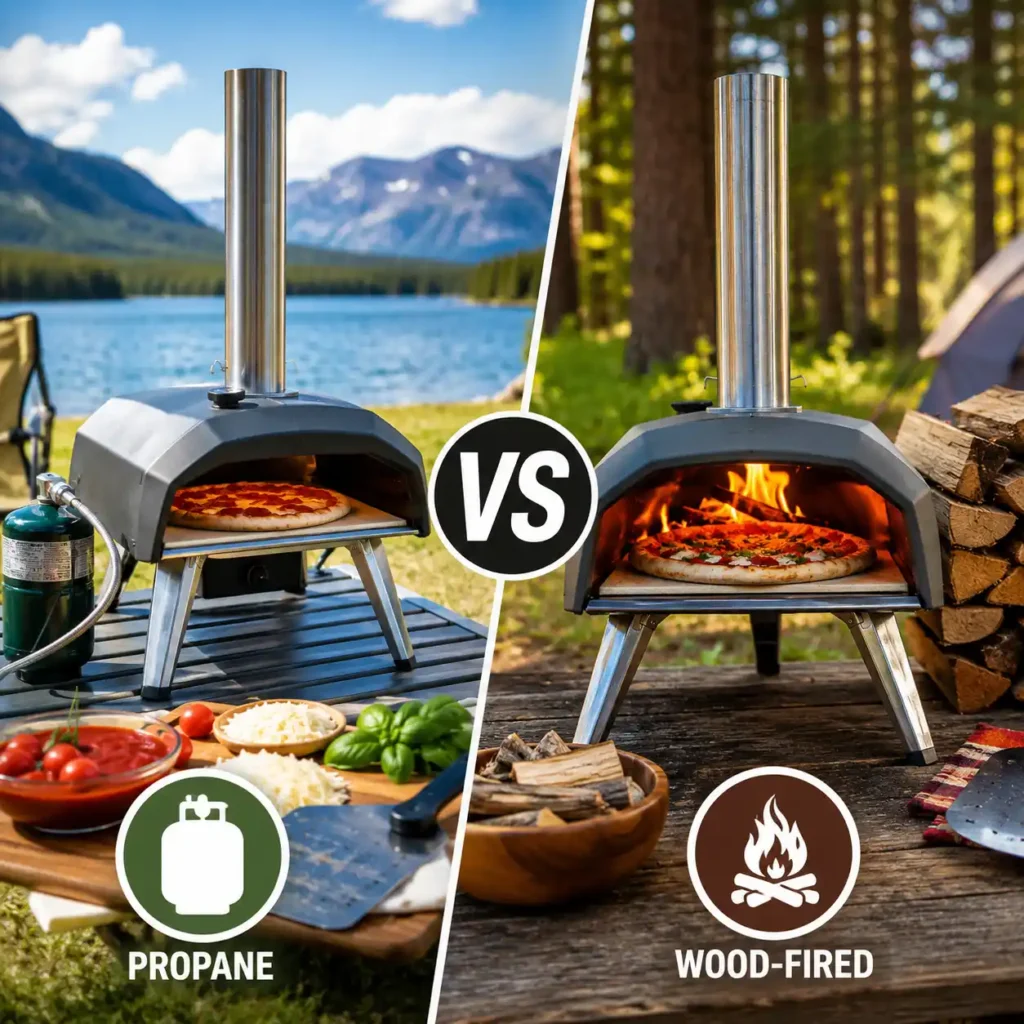
Fuel choice changes the entire cooking experience at camp. Propane prioritizes convenience and control, while wood and charcoal bring a more hands-on cooking process and the possibility of a traditional fire-cooked flavor. Neither approach is universally better; the right choice depends on your campsite, trip length, and how much effort you want to put into managing the oven.
Propane: The Practical Camping Choice
Propane is usually the easiest option for campers who want to get cooking without building and maintaining a fire.
The burner can be adjusted quickly, temperature control is more predictable, and there is no ash to clean up afterward. That makes propane particularly attractive for car camping, family trips, and campsites where convenience matters more than the ritual of cooking over a live fire.
There is also less preparation between pizzas. Once the oven has reached temperature, you can concentrate on stretching dough, adding toppings, and launching the next pizza rather than continually managing fuel.
Wood and Charcoal: More Involvement, More Fire Character
Wood-fired or charcoal cooking creates a different experience. You have to start the fire, maintain the fuel, monitor the flame, and manage the heat manually.
That additional work is not necessarily a disadvantage. For some campers, the fire itself is part of the appeal of outdoor pizza cooking. Multi-fuel ovens such as the Ooni Karu Pro give you more flexibility when you want to switch between fuel types depending on the trip.
The trade-off is logistics. Wood and charcoal take up space, create ash, and may be subject to campground fire restrictions. They also require more attention while cooking.
Which Fuel Makes More Sense for Camping?
For most campers who want fast, predictable, low-maintenance pizza cooking, propane is the easier recommendation.
Wood or charcoal makes more sense when the cooking experience itself is part of the adventure and you are comfortable managing a live fire.
The important point is to choose the fuel system before choosing the oven. A beautifully designed multi-fuel model is not necessarily the best purchase if you know you will almost always use propane. Conversely, paying for a propane-only oven may feel limiting if cooking with wood is one of the reasons you want a portable pizza oven in the first place.
How to Set Up a Pizza Oven at a Campsite
A good campsite pizza setup should make cooking easier, not turn the entire camp into a second kitchen. The oven needs a stable position, enough working space, sensible fuel placement, and a clear separation between the hot cooking zone and the rest of your campsite.
The easiest approach is to decide where everything will go before lighting the oven. Once the oven is hot, moving equipment around becomes inconvenient and potentially unsafe.
1. Choose the Right Location
Start with a level, stable, heat-resistant surface. The oven should sit securely without rocking or shifting when you launch or turn a pizza.
Keep the cooking area away from tents, sleeping equipment, dry vegetation, vehicle interiors, and other combustible materials. You also want enough open space around the oven that people can move past without accidentally brushing against hot surfaces.
A position close to your camp kitchen is usually practical because your dough, toppings, utensils, and serving area are already nearby. Just avoid overcrowding the cooking surface.
2. Build a Simple Work Zone
Think of the oven as the center of a small outdoor cooking station.
Keep the essentials within easy reach:
- Pizza dough and prepared toppings
- Pizza peel
- Infrared thermometer
- Heat-resistant gloves
- Cutting board or serving surface
- Plates and utensils
- Fuel or propane connection
Keep the immediate area around the oven uncluttered. Pizza preparation should happen beside the oven rather than directly in front of its opening, leaving you enough room to safely launch and retrieve pizzas.
3. Position Your Fuel Correctly
For propane models, keep the propane cylinder in the position specified by the manufacturer and route the hose so it cannot become a trip hazard or come into contact with hot surfaces.
For wood- or charcoal-capable ovens, keep unused fuel organized and away from the hottest parts of the cooking area. Do not pile firewood, charcoal bags, cardboard packaging, or other combustible materials directly beside the oven.
With multi-fuel ovens, decide which fuel you are going to use before you begin cooking. Switching between fuel systems at the campsite should never be improvised.
4. Preheat Before Preparing the Final Pizza
Portable pizza ovens work best when the cooking surface has had sufficient time to reach the required temperature.
Use an infrared thermometer to check the stone rather than relying only on the oven’s air temperature or the appearance of the flame. The cooking surface is what actually transfers heat into the bottom of the pizza.
Once the stone reaches your target temperature, allow the oven to stabilize before launching the first pizza. This can produce more consistent results than rushing the first bake.
5. Keep Pizza Preparation Separate From the Hot Zone
Prepare each pizza on a separate work surface rather than stretching dough directly beside the oven opening.
This gives you more control when adding toppings and reduces the amount of time the oven remains open while you are trying to get a pizza ready.
A simple workflow works well:
Prepare → launch → turn → remove → slice → prepare the next pizza.
For family camping, this rhythm becomes particularly useful because several people may be waiting for food while one person manages the oven.
6. Plan for Wind and Weather
Wind can make outdoor pizza cooking considerably more difficult. It can interfere with a gas flame, affect solid-fuel combustion, and make temperature management less predictable.
Position the oven in a naturally sheltered location when possible, while never enclosing it inside a tent, vehicle, or other unventilated shelter.
If rain is expected, consider the entire cooking station rather than only the oven. You need a dry place for dough, toppings, utensils, and finished pizzas without placing the oven underneath a combustible shelter.
7. Let the Oven Cool Before Packing
Once cooking is finished, turn off the fuel source or extinguish the fire according to the manufacturer’s instructions. Then give the oven sufficient time to cool.
This step is easy to underestimate when breaking camp. A pizza oven that feels cooler on the outside can still contain enough residual heat to damage camping equipment or create a burn hazard.
Only pack the oven once it is genuinely cool and safe to handle.
The best campsite setup is ultimately a simple one: stable oven, clear cooking zone, organized ingredients, controlled fuel, and enough space to work safely. That arrangement makes portable pizza cooking much more enjoyable—and much less chaotic—than trying to improvise the kitchen after the oven is already hot.
How to Make Great Pizza at a Campsite
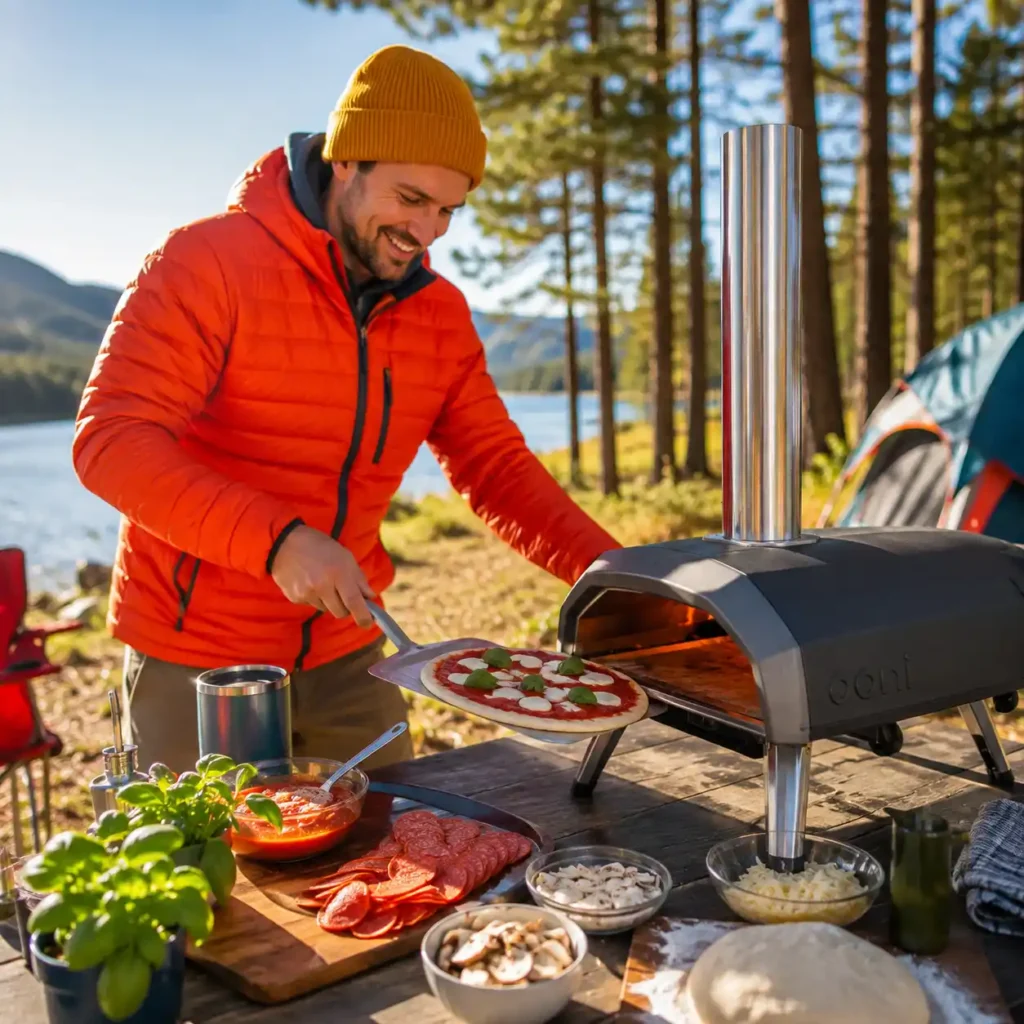
Once the oven is hot, the quality of the pizza depends less on having a sophisticated campsite kitchen and more on how you manage the dough, toppings, launch, and bake. A portable pizza oven can reach the temperatures needed for fast cooking, but those temperatures leave very little room for mistakes.
Keep the Dough Manageable
Camping is not the ideal environment for complicated dough preparation. For most trips, prepare the dough at home and transport individual portions in sealed containers.
Bring the dough to a workable temperature before stretching it. Cold dough tends to resist stretching, while dough that has become excessively warm can become sticky and difficult to handle.
Use a lightly floured or semolina-dusted work surface and avoid adding excessive flour. Too much loose flour can burn on the hot stone and leave a bitter taste.
Don’t Overload the Pizza
A common mistake is treating a small portable pizza oven like a conventional kitchen oven.
Less topping is usually better. A thin, even layer of sauce, a moderate amount of cheese, and controlled toppings allow the crust to cook quickly without leaving the center wet.
Watery ingredients deserve particular attention. Fresh vegetables, heavily sauced toppings, and excessive mozzarella can introduce enough moisture to slow the bake.
For camping, simpler combinations are often the most reliable: tomato and mozzarella, pepperoni, mushrooms, or a small selection of pre-prepared toppings.
Launch Quickly and Deliberately
Once the pizza is stretched and topped, do not let it sit on the peel for several minutes.
A properly prepared pizza should slide cleanly from the peel onto the hot stone. Shake the peel gently before launching to make sure the dough is still moving freely.
When launching, use one confident forward motion rather than slowly pushing the pizza into the oven. Hesitation can cause the dough to fold or stick to the peel.
Turn the Pizza During the Bake
At pizza-oven temperatures, the side closest to the flame can brown dramatically faster than the opposite side.
Watch the crust rather than relying exclusively on a timer. Once the outer edge begins developing color, use the peel to rotate the pizza so the remaining sections receive comparable heat.
Do not walk away while a pizza is cooking. A bake that takes only a couple of minutes can progress from beautifully browned to burned surprisingly quickly.
Give the Oven Time to Recover
If you are cooking several pizzas for a family or group, allow the stone to recover between launches when necessary.
The first pizza may cook differently from the third or fourth because opening the oven and introducing a relatively cool pizza removes heat from the cooking chamber and stone.
A quick temperature check between pizzas can help you maintain a more consistent bake. This becomes especially useful when you are cooking continuously rather than making one pizza at a time.
Make Camping Pizza Easier With Preparation
The biggest advantage you can give yourself is to prepare as much as possible before leaving home.
Portion the dough, pre-measure toppings, prepare sauces, and pack ingredients in containers that can be opened quickly. At camp, you can then concentrate on cooking rather than turning the picnic table into a full food-preparation station.
That approach also reduces food handling around the campsite and makes it easier to clean up once everyone has eaten.
A portable pizza oven is capable of producing excellent results outdoors, but the process rewards simplicity. Well-prepared dough, restrained toppings, a properly heated stone, and attentive turning will usually matter more than adding another accessory to your setup.
How to Clean and Maintain a Portable Pizza Oven
A portable pizza oven does not need complicated maintenance, but cleaning it correctly matters if you want consistent cooking performance and a piece of equipment that remains ready for the next camping trip. The biggest mistake is treating the oven like a conventional household appliance and trying to wash away every trace of cooking residue.
The correct cleaning routine depends on the fuel system and the manufacturer’s instructions, but the basic principle is the same: remove loose food debris, keep the cooking surface dry, and never expose a hot pizza oven to water.
Let the Oven Cool Completely
Start by allowing the oven to cool naturally after cooking. This is particularly important when the stone and internal metal components have reached very high temperatures.
Never pour water onto a hot pizza stone or inside a hot oven. The sudden temperature change can damage the cooking surface and create unnecessary safety risks.
For camping, this also means allowing enough time for cooling before packing the oven into your vehicle. Do not let the desire to break camp quickly determine when the oven is safe to handle.
Clean the Cooking Stone Carefully
Pizza stones generally should not be soaked or washed with soap. Instead, allow the surface to cool and then remove loose pieces of burned dough, cheese, or other food with an appropriate pizza-oven brush or scraper.
Small dark marks or discoloration are not necessarily a problem. A pizza stone naturally develops some cooking residue over time, and trying to make it look brand new can cause more harm than leaving minor staining alone.
If something is firmly stuck to the stone, let it cool completely and remove it carefully rather than attacking the surface with excessive force.
Remove Loose Ash and Food Debris
Wood- and charcoal-burning ovens require additional cleanup because combustion leaves ash behind.
Once everything is completely cool, remove accumulated ash according to the manufacturer’s instructions. A small brush can also help clear loose flour and food particles from accessible areas.
Propane-only ovens generally produce less residue, but that does not mean they are maintenance-free. Burned toppings and flour can still accumulate inside the cooking chamber.
Keep the Exterior Clean
The outside of the oven usually needs nothing more complicated than a suitable dry or slightly damp cloth once the appliance has cooled.
Avoid aggressive household cleaners unless the manufacturer specifically recommends them. A pizza oven’s exterior materials and finishes can react differently to chemicals than ordinary kitchen appliances.
Pay particular attention to grease and food residue around areas that you regularly touch during setup and cooking.
Inspect the Oven Before the Next Trip
Camping creates a useful maintenance opportunity that is easy to overlook: check the oven before packing it for the next trip, not only after the previous one.
Look for obvious damage, loose components, problems with the cooking stone, and—on propane models—any visible issues with the hose, regulator, or connections.
For a multi-fuel oven, also check the components associated with the fuel system you intend to use. If something looks damaged or does not operate as intended, resolve the issue before lighting the oven.
Store It Dry and Protected
Moisture is one of the easiest ways to turn a clean camping appliance into a storage problem.
Make sure the oven is completely cool and dry before putting it away. If you use a protective cover or carrying case, allow the equipment to dry properly before sealing it up for long-term storage.
Do not pack a damp oven into a closed vehicle or storage container and leave it there for weeks.
For campers who use their pizza oven seasonally, a dry storage location away from unnecessary moisture and physical impacts is preferable to leaving it exposed outdoors.
Clean Less, But Clean Correctly
The goal is not to make a portable pizza oven spotless after every pizza. The goal is to remove food debris, manage ash where applicable, protect the cooking surface, and keep the appliance dry and ready for its next use.
A simple post-cooking routine is usually enough: cool completely, brush away debris, remove ash when required, wipe the exterior, inspect the equipment, and store it properly. That approach keeps maintenance proportional to the way the oven is actually used at camp.
What to Look for in a Portable Pizza Oven for Camping
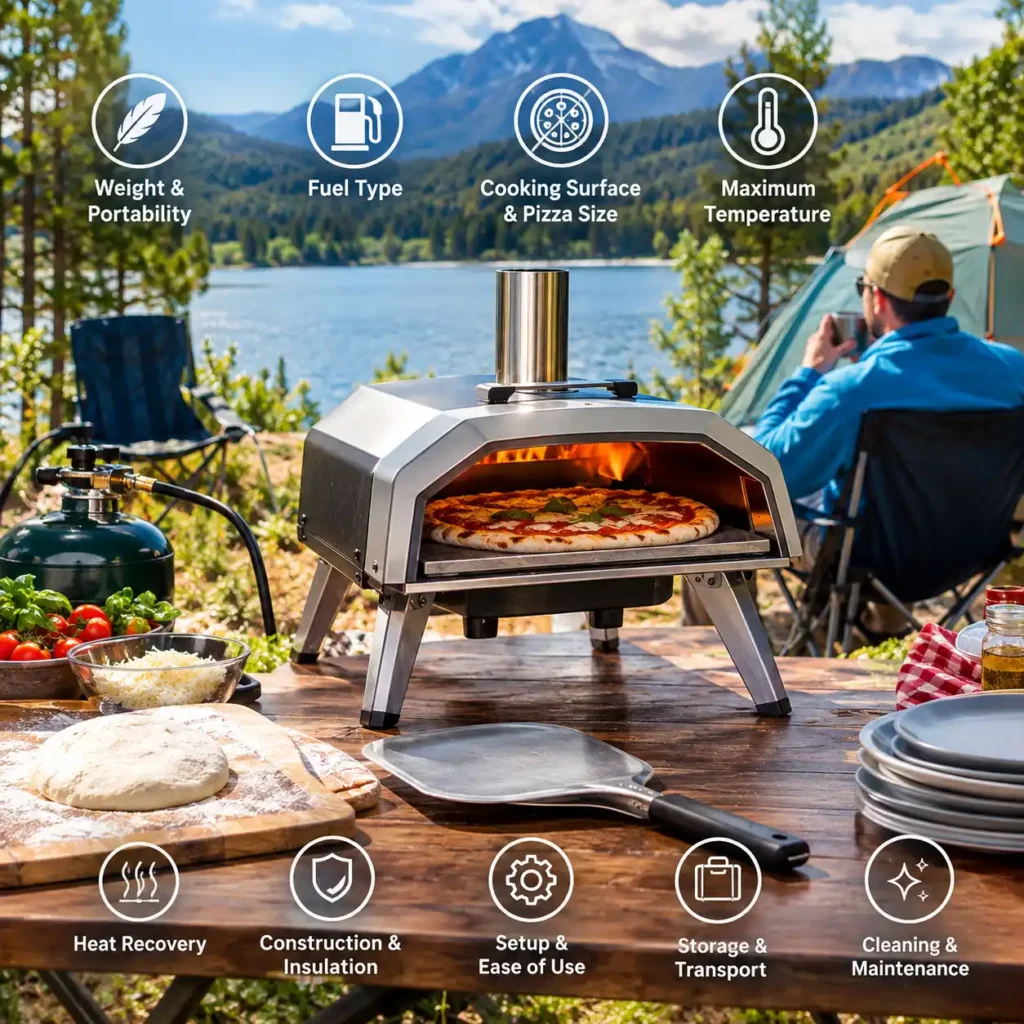
The best portable pizza oven for camping is not necessarily the hottest, largest, or most expensive model. The right choice depends on how you travel, how many people you cook for, what fuel you can realistically carry, and how much equipment your vehicle or campsite can accommodate.
A pizza oven that works beautifully in a backyard can become inconvenient when it has to be transported, unpacked, fueled, positioned, cleaned, and stored at camp. For that reason, we recommend evaluating the oven as part of your entire camping cooking system, rather than judging it from a single specification.
Weight and Portability
Weight is one of the first specifications to check, but it needs context.
If you are car camping and setting up immediately beside your vehicle, a heavier oven may be perfectly reasonable. You are moving it only a short distance, and the additional weight may provide advantages in construction, insulation, or thermal stability.
The calculation changes for dispersed camping, beach access, walk-in campsites, or any situation where the oven has to travel farther than a few steps.
Also consider the oven’s physical shape. A compact appliance can sometimes be easier to handle than a slightly lighter model with an awkward footprint.
Think about the entire carrying process: vehicle → campsite → cooking surface → vehicle. That is a much more useful measure of portability than the advertised weight alone.
Fuel Type
Fuel determines both how the oven cooks and what you have to carry.
Propane is generally the simplest choice for campers who want quick ignition, straightforward temperature control, and minimal cleanup. It is particularly convenient for family and car-camping setups where cooking needs to be predictable.
Wood and charcoal require more involvement but can appeal to campers who enjoy cooking over a live fire. They also add fuel-management considerations, including storage, ash cleanup, and local fire restrictions.
A multi-fuel oven offers greater flexibility, but that flexibility only has value if you will actually use it. There is little benefit in choosing a more complicated fuel system if propane is going to be your preferred option on every trip.
Cooking Surface and Pizza Size
Check the actual cooking area rather than assuming that a larger exterior oven automatically produces a larger pizza.
For most campers, a 12-inch pizza capacity is a practical starting point. It provides enough food for a normal individual serving while keeping the oven relatively compact.
Larger cooking surfaces become more useful when you regularly feed several people or want more room to maneuver the pizza during cooking.
There is also a practical difference between making one large pizza and cooking several smaller pizzas. If you are feeding a family, throughput can matter more than maximum pizza diameter.
Maximum Temperature
High-temperature cooking is one of the main attractions of a dedicated pizza oven.
Many premium portable models are designed to reach temperatures around 900°F or higher, allowing Neapolitan-style pizzas to cook in only a few minutes.
But maximum temperature should not be treated as a standalone quality score. What matters in real use is whether the oven can reach that temperature consistently, maintain useful heat, and recover quickly after you launch a pizza.
A slightly lower-rated oven that is easy to control may ultimately be more useful at camp than one with an impressive peak temperature but a more demanding cooking process.
Heat Recovery
Heat recovery becomes particularly important when cooking for a group.
Opening the oven and launching a relatively cool pizza inevitably removes heat from the cooking environment. A well-insulated oven with a capable burner or well-managed fire can recover that heat more effectively between pizzas.
If you regularly cook four, five, or six pizzas in one session, look beyond the first pizza. The way the oven behaves throughout a cooking session tells you more about its usefulness for family camping than its peak temperature specification.
Construction and Insulation
Construction affects more than durability.
The materials and insulation used in a portable pizza oven influence heat retention, exterior temperatures, recovery time, overall weight, and long-term handling.
For camping, construction also needs to withstand repeated transportation. An oven that is excellent when permanently installed on a patio faces a different environment when it is repeatedly loaded into a vehicle, unpacked at camp, and stored between trips.
Look for a design that balances thermal performance with the amount of weight and bulk you are willing to transport.
Setup and Ease of Use
A camping oven should not require an elaborate installation every time you arrive at a campsite.
Consider how quickly you can:
- Position the oven securely
- Connect the fuel source
- Ignite or start the fire
- Preheat the cooking surface
- Prepare the oven for the first pizza
- Shut everything down after cooking
Simple setup has real value outdoors. Weather, limited workspace, children, other meals, and the normal demands of camp life can make complicated cooking equipment frustrating very quickly.
Storage and Transport
Before buying, measure the space where the oven will actually travel.
Do not look only at the oven itself. Account for fuel, hose and regulator components, peels, covers, thermometers, gloves, cleaning tools, and any other accessories you intend to carry with it.
A portable oven that technically fits in the vehicle can still become an inefficient purchase if it forces you to sacrifice essential camping equipment.
Cleaning and Maintenance
Cleaning requirements are easy to overlook when comparing specifications, but they become obvious after the first camping trip.
Propane models generally have fewer combustion residues to manage, while wood- and charcoal-capable ovens require attention to ash and burned fuel.
The cooking stone also needs appropriate care. Avoid treating it like a household baking tray that can simply be soaked and scrubbed. Follow the manufacturer’s cleaning recommendations and allow the oven to cool completely before maintenance.
Match the Oven to Your Camping Style
Ultimately, there is no universally correct specification list.
A couple on weekend car-camping trips may value compact dimensions, propane convenience, and quick setup above everything else. A family that cooks for several people may reasonably prioritize cooking capacity and heat recovery. Someone who treats outdoor cooking as part of the camping experience may prefer the flexibility of a multi-fuel oven.
That is why our recommendations in this guide are separated by use case rather than simply ranking five ovens from first to fifth.
Choose the oven that fits your camping routine—not the specification sheet that looks most impressive.
Frequently Asked Questions About Portable Pizza Ovens for Camping
Are portable pizza ovens good for camping?
Yes. Portable pizza ovens can be an excellent choice for car camping, RV camping, family campsites, and other setups where you have enough vehicle or storage space for dedicated cooking equipment. Their main advantage is the ability to reach much higher cooking temperatures than many conventional camp cooking methods, allowing pizza to bake very quickly.
The trade-off is that a pizza oven is specialized equipment. Weight, storage space, fuel, and setup requirements should be considered before bringing one on a camping trip. For minimalist or backpacking trips, a dedicated pizza oven is usually less practical.
Can you use a portable pizza oven at a campsite?
Yes, provided that the campsite allows that type of outdoor cooking and the oven is used according to the manufacturer’s instructions and local fire regulations.
Set the oven on a stable, level, heat-resistant surface in an open outdoor area, away from tents, dry vegetation, vehicles, and other combustible materials. Gas and solid-fuel pizza ovens should never be operated inside a tent, vehicle, enclosed shelter, or other poorly ventilated space. Current camping-pizza guidance consistently emphasizes stable placement, clearance from combustible materials, ventilation, and never leaving a lit oven unattended.
Is propane or wood better for a camping pizza oven?
Neither fuel is universally better; the better choice depends on how you camp.
Propane is usually more convenient because it provides quick ignition, straightforward heat control, and less cleanup. Wood or charcoal can provide a more traditional live-fire cooking experience but require more attention to fuel management and ash cleanup.
For off-grid camping, fuel availability is particularly important. A multi-fuel oven can provide additional flexibility when propane, wood, or charcoal availability varies. Current 2026 camping guides specifically identify fuel flexibility as an important camping-specific consideration, rather than simply ranking ovens by maximum temperature.
How hot should a camping pizza oven get?
For high-temperature Neapolitan-style pizza, a portable oven should be capable of reaching very high cooking-surface temperatures, commonly around 750°F to 900°F or higher depending on the model and cooking style.
However, maximum advertised temperature should not be the only specification you consider. Heat recovery, temperature stability, cooking-surface temperature, and how easily you can control the heat are equally important in real campsite use.
Current 2026 testing guides continue to evaluate portable ovens using factors such as peak floor temperature, heat recovery, and actual cooking performance rather than maximum temperature alone.
How long does it take to cook pizza in a portable pizza oven?
Once the oven and cooking surface are fully preheated, a high-temperature portable pizza oven can cook a pizza in roughly 1–3 minutes, depending on the oven, temperature, dough, toppings, and cooking style.
Some manufacturers advertise cooking times of around 60–90 seconds, while real-world cooking can take longer. The important point is that these short cooking times are possible only after the oven has been properly preheated and the pizza is actively monitored during baking. Current 2026 sources continue to distinguish between advertised cooking times and actual cooking experience.
How much does a portable pizza oven weigh for camping?
There is no single ideal weight because portability depends on how far you have to carry the oven.
For car camping, an oven weighing 25–40 pounds may be perfectly manageable because it only needs to travel a short distance from the vehicle to the campsite. For walk-in campsites or situations involving longer carries, every additional pound becomes more significant.
You should also account for the weight of the fuel, pizza peel, thermometer, cover, and other accessories. Current portable-oven comparisons increasingly treat weight plus packed dimensions and fuel requirements as the meaningful measure of camping portability.
Can you cook other foods in a portable pizza oven?
Yes. Many portable pizza ovens can be used for more than pizza, provided the manufacturer permits the intended cooking method and cookware.
Depending on the model and temperature control, you may be able to cook foods such as flatbreads, bread, roasted vegetables, meat, or other dishes suitable for high-temperature outdoor cooking.
However, a pizza oven should not be considered a replacement for a complete camp stove. Its main strength is high-temperature cooking, while a conventional camping stove remains more versatile for tasks such as boiling water, simmering, or preparing breakfast.
What should you bring with a portable pizza oven when camping?
At minimum, plan for the equipment needed to operate, control, cook with, and safely shut down the oven.
A practical camping setup may include:
- Pizza peel
- Turning peel
- Infrared thermometer
- Heat-resistant gloves
- Appropriate fuel and fuel connections
- Dough and toppings
- Cutting board or serving surface
- Cleaning brush
- Protective cover or carrying case
The exact accessories depend on the oven. The important thing is to consider the complete setup rather than the oven alone, because fuel and accessories can significantly increase the space and weight required in your camping gear.
Final Verdict: Which Portable Pizza Oven Is Best for Camping?
After comparing the five ovens across cooking capacity, fuel flexibility, portability, heat performance, and campsite practicality, there is no single model that makes sense for every camper. The better approach is to choose the oven that solves the biggest limitation in your own camping setup.
For family camping and larger group meals, the Ooni Koda 2 Pro is the strongest choice when cooking space matters most. Its larger format makes it particularly well suited to campers who have enough vehicle space and want to make pizza a central part of the campsite kitchen.
For campers who want fuel flexibility and a more involved outdoor cooking experience, the Ooni Karu 2 Pro stands apart. Its multi-fuel design gives you more control over how you cook, but that flexibility comes with additional weight and fire-management requirements.
If you want a compact oven without giving up high-temperature pizza cooking, the Gozney Roccbox offers a strong balance between performance and campsite practicality. Its 12-inch capacity is better suited to couples and smaller groups than to large family meals, but its compact format makes it easier to integrate into a vehicle-based camping setup.
The Gozney Tread is the better fit when portability is the deciding factor. It still requires vehicle transport rather than backpack-style carrying, but its travel-oriented design makes it easier to justify when you expect to move your cooking equipment frequently.
For campers who want simple propane cooking with a distinctive cooking experience, the Solo Stove Pi Prime is the most specialized choice in the group. Its rotating cooking surface and 12-inch capacity make it particularly appealing for smaller camping setups where straightforward operation matters more than maximum cooking space or multi-fuel capability.
Our Overall Recommendation
If we had to choose one oven for the broadest range of comfortable car-camping situations, we would choose the Ooni Koda 2 Pro for campers who have the vehicle space to accommodate its size and weight. It offers the largest cooking capacity in this lineup and is particularly well matched to families and larger groups.
That does not make it the best choice for everyone.
If portability matters more than cooking capacity, the Gozney Tread is the more logical choice. If fuel flexibility is central to the experience, choose the Ooni Karu 2 Pro. For a more compact high-performance setup, the Gozney Roccbox is a strong alternative, while the Solo Stove Pi Prime makes sense for campers who prefer straightforward propane cooking and a rotating cooking surface.
The most important distinction is therefore not which oven has the highest temperature or the longest feature list. It is how much cooking capacity, weight, fuel management, and campsite space you are willing to trade for the way you actually camp.
One final point is worth keeping in mind: “portable” does not mean backpacking-friendly. Every oven in this guide is better suited to car camping, established campsites, basecamps, or other situations where you can transport the oven by vehicle. Before buying, make sure you have a stable cooking surface, enough ventilation and clearance for the specific oven and fuel system, and sufficient vehicle space for the oven and its accessories.
Ultimately, the best portable pizza oven for camping is the one that fits your normal trips rather than the most demanding trip you might take once in a while. Choose the size you will actually use, the fuel system you are comfortable managing, and the level of portability that matches how far the oven needs to travel from your vehicle to the cooking area.
The CampComfortGuide Promise
At CampComfortGuide, we evaluate camping gear by how well it works in the conditions campers actually face—not simply by the specifications highlighted on a product page.
For portable pizza ovens, that means looking beyond maximum temperature and asking more practical questions: How easy is the oven to transport? How much space does it require? How complicated is setup? Which fuel system makes sense for different camping situations? And what compromises come with each design?
We also recognize that the best camping gear is not necessarily the most expensive or most powerful option. Our recommendations are intended to help you match the right equipment to your camping style, cooking habits, group size, and available space.
Our goal is simple: help you understand what you are buying, where it fits, and where its limitations matter before you take it to camp.