
Hi, I’m Anthony.
Buying a power station was the best investment I ever made for camping, but buying a solar panel to go with it unlocked true freedom.
There is something magical about watching your battery percentage go UP while you sit in the middle of nowhere, powered entirely by the sun.
But not all panels work with all batteries. I learned about connectors and efficiency the hard way.
As an Amazon Associate, we earn from qualifying purchases.
Are you looking for the best portable solar panels for camping to stay powered up without a noisy generator? You are in the right place.
Solar technology has improved massively. Modern folding panels are lightweight, efficient, and durable enough to withstand a sudden rain shower. But the market is confusing—different connectors, different wattages, and flexible vs. rigid designs.
We tested the top panels from Jackery, EcoFlow, and Renogy to find the ones that actually deliver the power they promise.
How We Tested Portable Solar Panels for Camping
To identify the best portable solar panels for camping, I focused on real-world charging performance — not just advertised wattage.
Each panel was tested using portable power stations between 300Wh and 1000Wh under typical camping conditions, including partial shade, angled sunlight, and varying temperatures.
Our evaluation focused on:
• Real Output vs Rated Wattage
How much power the panel actually delivered compared to its advertised rating.
• Charging Speed
How long it took to add meaningful battery percentage during peak and non-ideal sun hours.
• Ease of Setup
Kickstand stability, cable management, and how quickly the panel could be repositioned as the sun moved.
• Connector Reliability
How securely the connectors held under tension and whether adapters caused power loss.
• Weather Resistance
Performance during light rain, morning dew, and dusty campground environments.
Only panels that delivered consistent, usable power — not just lab-perfect results — made this list.
Quick Summary: Top 3 Picks for Solar Power
Best Overall (User Friendly): Jackery SolarSaga 100W
Why: Incredibly easy to set up, magnetic closure, and high efficiency.
Best Efficiency (Fast Charging): EcoFlow 160W Solar Panel
Why: Premium monocrystalline cells charge faster even in less-than-perfect sun.
Best Value (Universal): Renogy 100W Foldable Solar Suitcase
Why: Rugged, affordable, and comes with a built-in controller for 12V batteries.
.
Table of Contents
1. Jackery SolarSaga 100W Solar Panel
Award: Best Overall / Easiest to Use.

If you own a Jackery power station, this is the obvious choice. But even if you don’t, the SolarSaga 100W is a masterpiece of design. It folds in half and snaps shut with magnets.
The built-in kickstands are sturdy and easy to deploy. It also features two USB ports directly on the panel, so you can charge your phone straight from the sun without a battery station.
Pros:
✅ Extremely lightweight (only 9 lbs).
✅ Magnetic handle and closure make setup instant.
✅ USB-A and USB-C output ports built-in.
✅ Durable ETFE material.
Cons:
❌ Not waterproof (splash-proof only, don’t leave in rain).
❌ Expensive compared to generic brands.
Verdict:
The most “plug-and-play” experience. Perfect for beginners and families who want zero hassle.
2. EcoFlow 160W Solar Panel
Award: Best Efficiency / Waterproof
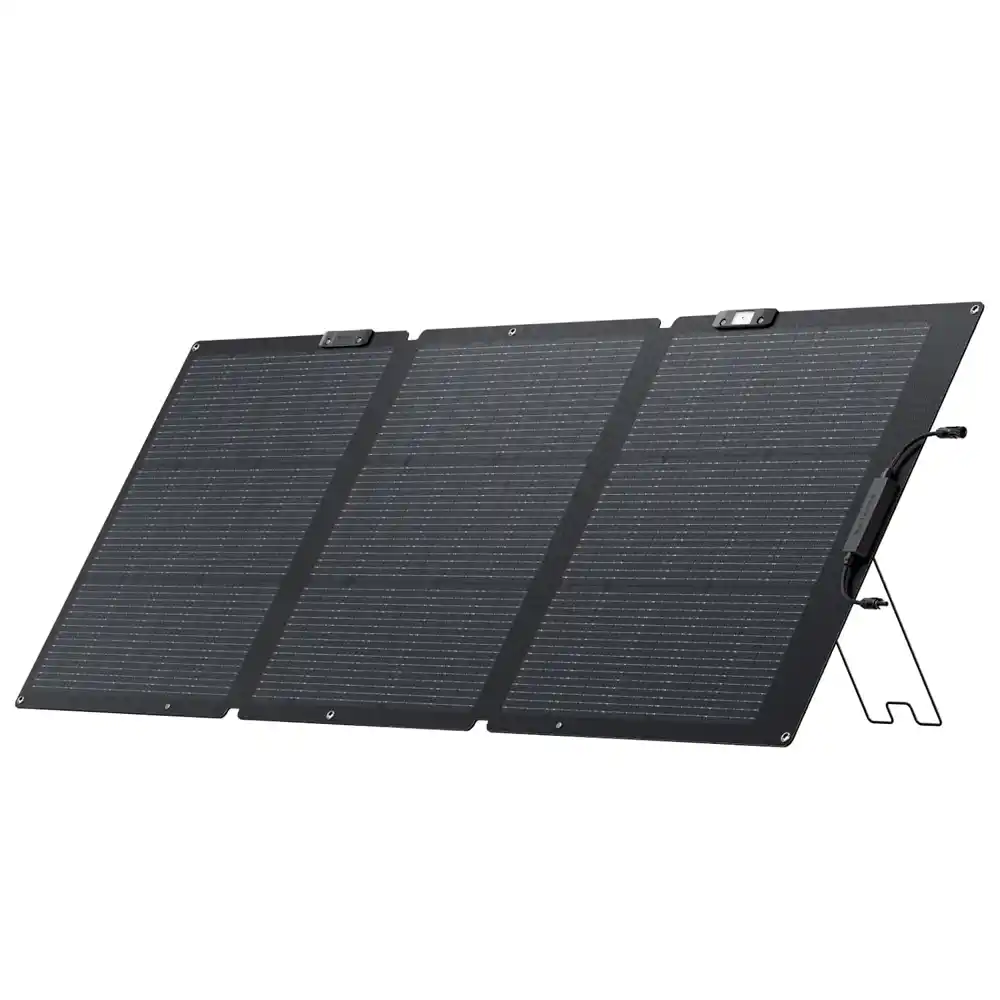
EcoFlow panels are known for their efficiency. This 160W model captures more energy per square inch than most competitors. It uses premium monocrystalline silicon cells.
Unlike the Jackery, this panel is IP68 Waterproof, meaning it can handle a downpour or even be submerged (though we don’t recommend swimming with it!). The carry case doubles as a kickstand.
Pros:
✅ IP68 Waterproof (truly weather resistant).
✅ High 160W output charges batteries faster.
✅ Universal MC4 connectors work with almost any station (with adapter).
✅ Beautiful, sleek design.
Cons:
❌ The “case kickstand” is fiddly and hard to set up perfectly.
❌ Heavier than the Jackery.
Verdict:
If you camp in unpredictable weather or need maximum power for a large battery, get the EcoFlow.
3. Renogy 100W Solar Suitcase
Award: Best Durability / Rigid Design

Most portable panels are flexible fabric. The Renogy Suitcase is different—it uses two rigid glass-covered panels hinged together. This makes it heavy but practically indestructible.
It comes with a built-in charge controller, meaning you can clamp it directly to your car or RV battery to top it up.
Pros:
✅ Bombproof glass and aluminum construction.
✅ Built-in charge controller protects batteries.
✅ Excellent adjustable metal kickstand.
✅ Cheaper than flexible folding panels.
Cons:
❌ Heavy (26 lbs) – strictly for car camping next to the vehicle.
❌ Bulky to store.
Verdict:
Perfect for RV owners, Overlanders, or anyone who wants a permanent-feeling setup that won’t blow away in the wind.
4. BLUETTI PV120 Solar Panel
Award: Best Value / Compatibility

The Bluetti PV120 offers a sweet spot: 120 Watts of power (20% more than the standard 100W panels) for a competitive price. It uses standard MC4 connectors, making it compatible with almost any solar generator on the market.
It uses a long-lasting ETFE coating and folds down into a manageable size.
Pros:
✅ 120W output gives you an edge over 100W panels.
✅ Uses standard MC4 connectors (universal).
✅ Good shading performance (keeps charging if partly shaded).
✅ Durable and scratch-resistant.
Cons:
❌ Kickstands are a bit flimsy.
❌ No USB outputs on the panel itself.
Verdict:
A fantastic all-rounder. If you have a Bluetti station or any station with an MC4 adapter, this is a great buy.
5. BigBlue 28W Solar Charger
Award: Best for Phones / Hiking

You don’t always need a giant power station. If you just want to keep your phone and GPS charged, the BigBlue 28W is perfect. It folds down to the size of a magazine and can hang from your tent or backpack.
It has a built-in Ammeter (digital display) that shows you exactly how many amps the sun is delivering, so you can angle it perfectly.
Pros:
✅ Fits in a backpack.
✅ Built-in Ammeter takes the guesswork out of aiming.
✅ Charges 2 USB devices directly.
✅ Very cheap.
Cons:
❌ Won’t charge a laptop or power station effectively.
❌ Slow charging on cloudy days.
Verdict:
Essential for light packers or as an emergency backup for your phone.
Common Solar Panel Mistakes Campers Make
• Buying panels without checking connector compatibility
• Expecting full wattage outside of perfect midday sun
• Underestimating how often panels need repositioning
• Ignoring cable length when parking in shaded campsites
Buying Guide: Choosing the Best Portable Solar Panels for Camping
Choosing the best portable solar panels for camping comes down to matching the panel to your battery.
1. Compatibility (Connectors)
This is the #1 mistake people make. Panels have different plugs:
MC4: The universal standard (EcoFlow, Bluetti, Renogy). Reliable and waterproof.
8mm (DC7909): Used by Jackery.
Anderson (APP): Used by some older EcoFlows and heavy-duty setups.
Tip: With the right adapter, most panels will work with any of the best portable power stations on the market.
2. Wattage (Size)
100W: The standard. Charges a medium station (500Wh) in 6-8 hours.
200W: For large stations. Charges twice as fast.
30W: For phones only.
3. Portability
To find the best portable solar panels for camping, decide between Folding (Fabric) and Rigid (Glass). Folding panels (Jackery) are easy to pack. Rigid panels (Renogy) are heavy but last longer and handle wind better.
Final Verdict
When searching for the best portable solar panels for camping, the Jackery SolarSaga 100W is the clear winner for ease of use.
For fast charging and weather resistance, choose the EcoFlow 160W.
For charging phones directly, the BigBlue 28W is a lifesaver.