
Hot water can make a surprisingly big difference at camp. It makes washing dishes easier, cleaning up after a muddy day more comfortable, and an outdoor shower much more practical—especially when there is no campground faucet or built-in water heater nearby.
But choosing a portable water heater for camping is not simply a matter of finding the highest BTU rating or the largest flow rate. The heater has to work with the way you actually get water at camp. A pressurized campground connection is very different from a water jug or portable tank, and an off-grid setup may require a pump, power source, propane, hoses, and a way to manage the used water.
That is why we looked beyond basic specifications when comparing these five models. We considered how each heater fits into a real campsite setup, including portability, water supply, pumping requirements, hot-water performance, controls, safety features, and overall ease of use.
In this guide, we compare five portable water heaters for camping across different price points and use cases—from compact systems designed for simple off-grid setups to higher-flow models and complete camping-oriented solutions. The goal is to show where each type of heater fits, so you can choose a model that works with the equipment and conditions you already have at camp.

Table of Contents
Quick Answer
If you want the short version, start with the water source rather than the heater itself. A portable tank, campground hookup, or pump-fed system can lead you toward very different choices.
A compact propane heater can be enough for a shower, dishwashing, or basic cleanup. Once your water comes from a jug or tank, however, the pump becomes part of the decision. Larger groups introduce another consideration: whether the heater and water supply can maintain comfortable flow over repeated use.
The lineup covers five different approaches. CAMPLUX is built around off-grid independence, GASLAND emphasizes higher flow, TOPWISH keeps the entry cost down, Ranein stays focused on a compact conventional heater, and Hike Crew packages the heater with the equipment needed for a campsite shower.
Why You Can Trust This Guide
For this guide, we evaluated the five selected models using manufacturer specifications and their practical implications for camping. The emphasis is on how each heater fits into a real water system rather than on reproducing product-page specifications.
We compared the models across water flow, heating capacity, water-source requirements, portability, pump compatibility, controls, safety features, and campsite practicality.
We use manufacturer specifications for measurable product details and then evaluate what those specifications mean in real camping situations. That distinction matters because factors such as incoming water temperature, available pressure, and the type of water source can significantly affect how a portable heater performs.
The resulting recommendations are editorial judgments about camping use, not manufacturer ratings or laboratory performance scores.
We also avoid treating marketing claims as a substitute for practical analysis. The goal is to explain where each model fits, where its limitations become important, and what type of camper is most likely to get the most value from it.
How We Selected the Best Portable Water Heaters for Camping

The selection was built around a simple question: what does a camper need the heater to do once the equipment leaves the vehicle and reaches the campsite?
We looked at each model across several practical factors:
- Heating performance — how much usable hot water the unit is designed to provide.
- Flow rate — not just the advertised GPM, but what that output means for actual camping use.
- Water supply requirements — whether the heater needs a pressurized connection, a separate pump, or can work with a more self-contained setup.
- Portability — weight, size, and how realistic the unit is to transport and store with other camping gear.
- Power and fuel requirements — including propane, batteries, 12V power, and any additional equipment needed for operation.
- Controls and usability — how easily campers can adjust and manage water temperature and flow.
- Safety features — including protections designed for conditions such as overheating, flame failure, or inadequate water flow.
- Overall campsite practicality — how well the complete setup fits common camping situations rather than how impressive the specification sheet looks on its own.
The final shortlist deliberately includes different system types rather than five near-identical heaters. That gives the comparison room to distinguish between integrated equipment, higher-flow units, budget models, conventional heaters, and complete camping systems.
This approach lets us evaluate the five models on their practical role at camp, rather than forcing every product into the same ranking criteria.
Who Is This Guide For?
This guide is for campers who want real hot water at camp without relying on a permanent plumbing system.
It is particularly useful if you:
- Camp without a reliable water hookup and need to draw water from a jug, tank, or other portable source.
- Want an outdoor shower that is more comfortable than heating water manually.
- Need hot water for dishes, muddy gear, pets, or general campsite cleanup.
- Car camp or overland and have enough vehicle space to carry a heater, propane, water, and the necessary accessories.
- Want an off-grid setup but do not want to build a complicated hot-water system from separate components.
- Are comparing different levels of portability and output rather than simply looking for the cheapest heater.
It is not primarily intended for permanent RV installations or residential hot-water systems. Those applications have different requirements and are better served by purpose-built equipment.
If your setup already includes a water container, pump, or pressurized hookup, those components should be part of the buying decision from the start. The same heater can be a good fit in one campsite and a poor fit in another simply because the supporting equipment is different.
What Makes a Good Portable Water Heater for Camping?
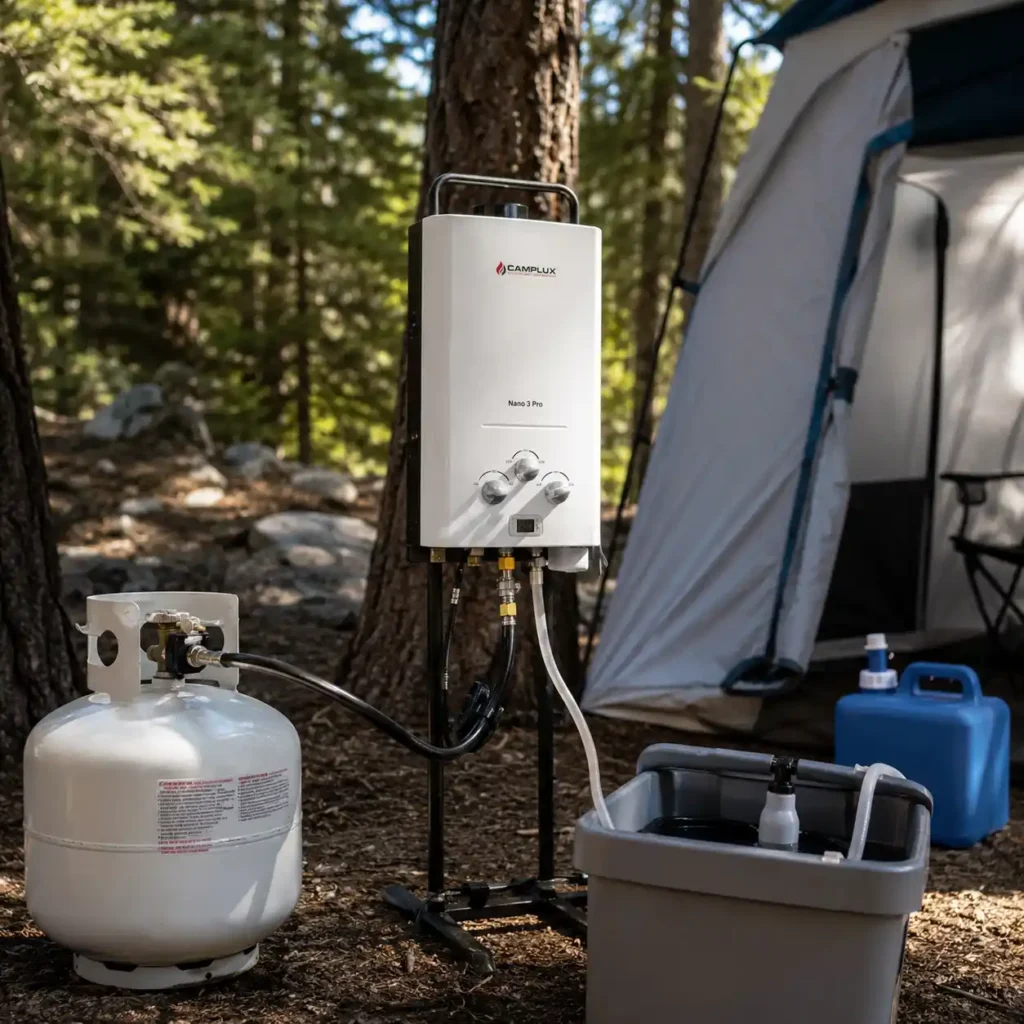
For camping, a good water heater is one that can deliver the amount of hot water you need without creating a difficult or mismatched equipment setup.
Start with the water source. A campground spigot provides pressure that a portable tank or water jug does not. If you are drawing from a container, the heater may need an integrated or external pump capable of supplying the flow and pressure required for ignition and operation.
Flow rate is another important consideration, but it needs to be understood alongside heating capacity. Higher flow does not automatically mean a better shower. When incoming water is cold, pushing more water through the heater can reduce the temperature rise available at the outlet. A lower flow rate may therefore produce more comfortable hot water in colder conditions.
Portability is also about the equipment surrounding the heater. A compact unit can still create a bulky setup if it needs several separate accessories, while a slightly larger system may be easier to live with when those components are included.
Finally, safety and operating conditions matter. Portable propane heaters are outdoor appliances, and features such as flame-failure protection, overheat protection, low-flow protection, and automatic shutoffs can provide important safeguards. The heater should always be operated according to the manufacturer’s instructions and kept in an appropriate outdoor location.
Quick Summary: Our Top Portable Water Heater Picks
If you don’t have time to read the full guide, this shortlist gives you a quick way to see how our five picks differ. We deliberately chose models that cover different camping needs rather than five versions of the same basic portable water heater.
There is no single portable water heater that makes sense for every campsite. The right choice depends on where your water comes from, how much hot water you need, whether you already have a pump and supporting equipment, and how much setup you are willing to manage.
CAMPLUX Nano 3 Pro
Award: Best Overall for Off-Grid Camping
Why It Won
The CAMPLUX Nano 3 Pro is built around a simple off-grid idea: combine the heater, water pump, and rechargeable power source in one compact unit. That makes it particularly convenient for campers drawing water from a portable container rather than a pressurized campground connection.
Choose This If:
- You want a portable hot-water setup for off-grid camping.
- You plan to draw water from a jug, tank, or other portable source.
- You want an integrated pump and rechargeable battery.
- You prefer a compact system with fewer separate components.
Best For:
- Off-grid camping
- Car camping
- Outdoor showers
- Dishwashing and campsite cleanup
- Campers using portable water containers
GASLAND BE158P60
Award: Best Value for Higher-Flow Camping
Why It Won
The GASLAND BE158P60 combines higher water flow with strong heating capacity and an included 12V pump setup. It is a practical choice for campers who want more water volume for showers and repeated campsite use without moving to a much larger or more elaborate system.
Choose This If:
- You want higher water flow for showers and cleanup.
- You need a heater that can handle more frequent hot-water use.
- You have access to a suitable 12V power source.
- You are comfortable with a more conventional portable water-heater setup.
Best For:
- Family camping
- Car camping
- Longer camping trips
- Outdoor showers
- Higher-flow hot-water use
TOPWISH Portable Propane Tankless Water Heater
Award: Best Budget for Simple Hot Water
Why It Won
The TOPWISH gives budget-conscious campers a straightforward way to add propane-heated water without paying for an integrated off-grid system. It makes the most sense when you are comfortable putting together the water source, pump, propane connection, and other supporting equipment separately.
Choose This If:
- You want a lower-cost entry into portable propane hot water.
- You already have some of the supporting camping equipment.
- You prefer a conventional heater rather than an integrated system.
- You are comfortable checking and assembling the required connections yourself.
Best For:
- Budget camping setups
- Occasional camping
- Car camping
- Simple outdoor showers
- Campers building their own water system
Ranein Portable Outdoor Tankless Water Heater
Award: Best Simple Portable for Straightforward Camping
Why It Won
The Ranein RO4K-Y keeps things focused on the heater itself. Its compact design, 1.58 GPM maximum flow, and low-pressure startup make it a practical option for campers who already have a suitable water source or pump system and simply need a portable propane heater to add to it.
Choose This If:
- You already have a water container, pump, or pressurized water source.
- You want a compact standalone propane heater.
- You prefer a straightforward setup without an integrated battery system.
- You want a lightweight heater that is easy to transport.
Best For:
- Car camping
- Overlanding
- Off-grid camping
- Outdoor showers
- Campers with existing water equipment
Hike Crew Portable Propane Tankless Water Heater & Shower
Award: Best Camping System
Why It Won
The Hike Crew takes a broader approach by combining the water heater with much of the equipment needed for an outdoor shower and washing station. The included pump hose, showerhead, regulator, power adapters, and carry bag make it particularly useful for campers who would rather purchase a coordinated setup than assemble the individual components themselves.
Choose This If:
- You want a more complete camping hot-water and shower setup.
- You do not already own the pump and shower hardware.
- You want one package for showers, washing, and campsite cleanup.
- Convenience matters more than keeping the equipment load as small as possible.
Best For:
- Family camping
- Car camping
- Outdoor showers
- Campsite cleanup
- Campers building a hot-water system from scratch
Portable Water Heater Comparison Table
The five portable water heaters below cover different camping needs, from compact off-grid systems to higher-flow propane models and complete shower-oriented setups. Compare the water supply requirements, flow rate, fuel, portability, and overall approach before choosing the right fit for your campsite.
| Model | Best For | Fuel | Flow Rate | Water Supply | Key Advantage |
|---|---|---|---|---|---|
| CAMPLUX Nano 3 Pro | Best Overall | Propane | 0.8 GPM | Integrated pump / portable water source | Integrated pump and rechargeable battery |
| GASLAND BE158P60 | Best Value | Propane | 1.58 GPM | 12V pump or pressurized supply | Higher flow with integrated pump |
| TOPWISH Portable Tankless Water Heater | Best Budget | Propane | Varies by model | Portable water supply | Lower-cost entry into portable hot water |
| Ranein Portable Outdoor Tankless Water Heater | Best Simple Portable | Propane | 1.58 GPM | Water supply with suitable flow | Straightforward portable design |
| Hike Crew Portable Propane Tankless Water Heater & Shower | Best Camping System | Propane | Portable shower system | Camping water source | Heater and shower equipment in one system |
Note: Flow rate and water-supply requirements should be considered together. A higher advertised GPM does not automatically mean hotter or more comfortable water, particularly when the incoming water is cold.
Detailed Reviews: The 5 Best Portable Water Heaters for Camping
We selected five portable water heaters that approach campsite hot water in different ways. From compact off-grid systems with integrated pumping to higher-flow propane units and complete shower solutions, each model has a specific role in this lineup. The reviews below look beyond the specification sheet to explain how each heater fits into an actual camping setup, including its strengths, limitations, and the type of camper it suits best.
1. CAMPLUX Nano 3 Pro
Best Overall for Off-Grid Camping
The CAMPLUX Nano 3 Pro takes a different approach to portable hot water. Instead of assuming that your campsite has a pressurized water connection or that you want to assemble several separate components, it combines the heater, water pump, rechargeable battery, and shower controls into one compact system.
That makes it particularly interesting for campers who carry their own water. The built-in 4,000mAh battery can power the system without a separate electrical connection, while the pump is designed to draw water from a portable source. The heater itself is rated at 20,500 BTU with a maximum flow of 0.8 GPM, putting it firmly in the compact camping category rather than the high-flow end of the market.

Quick Verdict
The CAMPLUX Nano 3 Pro is our Best Overall choice for campers who want hot water without building a system from several separate pieces. Its combination of a built-in rechargeable battery, water pump, propane heating, and shower setup makes it unusually self-contained for an off-grid camping heater.
Its 0.8 GPM flow rate is not designed for maximum water volume, but that is not necessarily a disadvantage in the situations this heater targets. For an outdoor shower, washing dishes, cleaning muddy gear, or similar campsite jobs, controlled flow can be more practical than simply pushing as much water as possible through the heater. The system can also operate from its internal battery or through 12V power, giving campers more flexibility around the campsite.
The main compromise is capacity. Campers looking for a strong, high-flow shower for several people may prefer a larger unit, while the Nano 3 Pro is better suited to situations where portability and a self-contained setup matter more than maximum output. Its compact design and roughly 13-pound weight also make it considerably easier to integrate into a car-camping or overlanding loadout than a much larger tankless heater.
Camp Snapshot
| Category | CAMPLUX Nano 3 Pro |
|---|---|
| Camping Style | Car Camping • Overlanding • Off-Grid Camping • Outdoor Showers |
| Heater Type | Portable Propane Tankless Water Heater |
| Heat Output | 20,500 BTU/hr |
| Maximum Flow Rate | 0.8 GPM |
| Fuel | Propane |
| Water Supply | Portable Water Source with Integrated Pump |
| Battery | 4,000mAh Rechargeable Li-Ion |
| Power | Battery • 12V DC |
| Weight | Approximately 13 lb |
| Key Safety Features | Overheat • Flame Failure • Low Water Flow • Tip-Over Protection |
| CampComfortGuide Verdict | Best Overall for Off-Grid Camping |
Why We Chose It
The Nano 3 Pro’s main advantage is how much of the off-grid setup is already built into the unit. A typical portable heater can require a separate container, pump, power source, propane connection, hose, and shower hardware; this model combines several of those functions in one package. CAMPLUX removes several of those decisions by putting the pump and rechargeable battery directly into the system.
That matters most when there is no campground water hookup. The pump can draw from a suitable portable water source, while the internal battery allows the heater to operate without immediately connecting to a vehicle or external power supply. For a camper who wants to arrive at a remote campsite and establish a simple washing station, that is a meaningful advantage rather than just another feature on the specification sheet.
The Nano 3 Pro also keeps the physical package relatively manageable. At roughly 13 pounds and around 15.7 inches long, it is small enough to travel with ordinary camping equipment rather than requiring a dedicated equipment compartment.
We also like that CAMPLUX has built several operating safeguards into a system intended for outdoor use, including high-temperature protection, flame-failure protection, low-water-flow protection, and tip-over protection. These features do not eliminate the need for proper outdoor operation, but they are appropriate considerations for a portable propane appliance.
That combination makes the Nano 3 Pro particularly suitable for campers who want an off-grid hot-water setup without assembling every component separately.
Check today’s price and latest customer reviews on Amazon.

Living With It at Camp
At camp, the integrated pump and battery change the setup routine. There are fewer separate components to position and connect before the heater can be used for a shower or washing station. Because the pump and battery are built into the unit, there are fewer separate components to arrange before someone can take a shower or wash dishes. For off-grid camping, that reduction in setup can be more valuable than a higher maximum flow rate.
The 0.8 GPM flow rate also suits the way many campers actually use portable hot water. This is not a system intended to flood a shower with water. It is better thought of as a controlled supply for washing, rinsing, and cleaning when your available water is stored in a portable container. That can help make a limited water supply last longer during trips where every gallon has to be carried in.
The battery-powered operation adds another layer of convenience. A camper can establish the heater away from the vehicle and avoid running a separate power source simply to operate the pump. The 12V option is useful when longer trips or repeated use make battery management more important, giving the system a second way to stay powered.
For a couple or small family, the practical benefit is straightforward: the Nano 3 Pro can turn a portable water container into a usable hot-water source without requiring a separate pump-and-power setup. Its lower flow limits how quickly you can serve multiple people, but that is a reasonable compromise for a compact off-grid system.
CampComfortGuide Assessment
| Evaluation Category | Editorial Assessment |
|---|---|
| Off-Grid Convenience | ★★★★★ Integrated pump and rechargeable battery reduce the number of separate components needed. |
| Portability | ★★★★★ Compact enough to integrate reasonably easily into a car-camping or overlanding setup. |
| Water Efficiency | ★★★★☆ The 0.8 GPM maximum flow is well suited to controlled washing and shower use, although it is not a high-flow system. |
| Setup | ★★★★★ Integrated pumping and power options simplify an off-grid installation. |
| Hot-Water Output | ★★★★☆ 20,500 BTU provides capable portable hot-water performance, while the lower flow favors controlled use over maximum volume. |
| System Flexibility | ★★★★☆ Battery and 12V operation provide useful power flexibility, while the integrated design limits component-by-component customization. |
| Overall Value | ★★★★★ Particularly compelling for campers who value a self-contained off-grid setup over maximum water flow. |
Who Should Buy This
- Campers who regularly use portable water containers instead of campground hookups.
- Car campers and overlanders who want a relatively self-contained hot-water system.
- Campers who value an integrated pump and battery rather than assembling separate components.
- Couples and small families primarily using hot water for showers, dishes, and campsite cleanup.
- Anyone who wants a portable water heater that is relatively straightforward to move and set up.
Who Should Skip This
- Large families that need sustained high-flow hot water.
- Campers who already own a pump and prefer to select every part of their water system separately.
- Anyone primarily looking for the highest possible GPM rather than a compact off-grid setup.
- Backpackers or minimalist campers for whom a propane heater is still too much equipment.
- Campers who need a permanent or residential-style hot-water installation.
Final Verdict
The CAMPLUX Nano 3 Pro is the easiest model in this lineup to recommend when the campsite has no pressurized water connection and the goal is a manageable, self-contained setup.
That does not make it the most powerful option in this lineup. Its 0.8 GPM flow rate is deliberately more modest than the higher-flow alternatives, and campers with heavy hot-water demands may have better options elsewhere. But for off-grid camping, where simplicity and independence from a campground water connection can matter more than maximum output, the balance is particularly attractive.
For off-grid campers who value simple setup over maximum water volume, the Nano 3 Pro remains our Best Overall choice.
Check today’s price and latest customer reviews on Amazon.
Related Guide
If you’re building an off-grid washing setup, our 5 Best Portable Camping Showers guide can help you compare shower systems that pair naturally with a portable water heater.
2. GASLAND BE158P60
Best Value for Higher-Flow Camping
The GASLAND BE158P60 takes a more traditional approach to portable camping hot water than the CAMPLUX Nano 3 Pro. Instead of emphasizing an all-in-one battery-powered design, it focuses on higher water flow and heating output while still including the pump and basic equipment needed for an off-grid setup.
With a rated output of 41,000 BTU and a maximum flow rate of 1.58 GPM, the BE158P60 is aimed at campers who want more water volume for showers, dishes, and general campsite cleanup. The included 12V pump allows it to draw from a portable water source, so you are not limited to using a campground spigot.
That higher output comes with a somewhat more conventional setup. You still need to manage the propane supply, 12V power, water connections, and the other components that make up the system. But for campers who are willing to carry that equipment, the payoff is substantially greater flow than the compact CAMPLUX system provides.

Quick Verdict
The GASLAND BE158P60 is our Best Value choice because it puts a lot of practical hot-water capability into a relatively straightforward portable package. Its combination of 41,000 BTU heating output, 1.58 GPM maximum flow, and included pump makes it particularly attractive to campers who need more water volume without moving into a much more elaborate hot-water system.
The 1.58 GPM flow rate is the key difference between the BE158P60 and a compact heater such as the CAMPLUX Nano 3 Pro. It gives the GASLAND more room for comfortable showering and higher-volume washing, although actual outlet temperature will still depend on incoming water temperature and the flow being used.
The included 12V pump is also important for off-grid camping. Rather than requiring a pressurized campground connection, the system can be used with a suitable portable water source when the pump can provide the required flow and pressure. That makes it more flexible for dispersed camping and other setups where running water is not available.
The trade-off is that the BE158P60 is less self-contained than the CAMPLUX. There is no comparable integrated rechargeable battery, so the pump requires a suitable 12V power source. For campers who already carry a 12V system, however, that may be a minor consideration rather than a serious disadvantage.
Overall, the GASLAND is a strong choice for campers who would rather have higher flow and heating capacity than maximum compactness. It is especially well suited to car camping and established off-grid setups where carrying a little more equipment is worthwhile for the additional hot-water performance.
Camp Snapshot
| Category | GASLAND BE158P60 |
|---|---|
| Camping Style | Car Camping • Overlanding • Off-Grid Camping |
| Heater Type | Portable Propane Tankless Water Heater |
| Heat Output | 41,000 BTU/hr |
| Maximum Flow Rate | 1.58 GPM |
| Fuel | Propane |
| Water Supply | Portable Water Source with 12V Pump |
| Power | 12V DC |
| Key Features | Digital Display • Adjustable Temperature • Included Pump |
| Safety Features | Overheating Protection • Flame-Failure Protection |
| CampComfortGuide Verdict | Best Value for Higher-Flow Camping |
Why We Chose It
The BE158P60 earns its place here primarily through its combination of flow rate and heating capacity. A 1.58 GPM maximum flow gives it substantially more capacity than the compact systems designed primarily around water conservation and portability.
That makes the BE158P60 particularly interesting for campers who expect their heater to do more than provide a quick rinse. A higher-flow setup can be useful when several people are sharing an outdoor shower, when dishes need to be washed in larger batches, or when hot water is being used repeatedly around a busy campsite.
The 41,000 BTU heating rating also gives the unit considerable heating capacity for its portable format. As with any tankless heater, however, the specification should not be interpreted as a guarantee of a particular shower temperature. Incoming water temperature, flow rate, and available water pressure all affect the result.
Another reason we selected the GASLAND is the inclusion of a 12V pump. This makes the heater more practical for campers using portable water containers rather than assuming access to a pressurized campground connection. The pump does add another power requirement, but for car campers and overlanders already carrying 12V equipment, that is a reasonable trade-off for the additional flow.
The digital display and adjustable controls also make the BE158P60 easier to manage than a basic heater with only minimal controls. Being able to monitor and adjust the operating temperature is particularly useful when the same heater is being used for different jobs, from washing dishes to taking a shower.
That combination makes the BE158P60 our Best Value pick for campers who have room for a conventional propane-and-12V setup and want more water volume from it.
Check today’s price and latest customer reviews on Amazon.

Living With It at Camp
The GASLAND BE158P60 feels most at home in a campsite where higher water flow is more important than keeping the entire system as compact as possible. Its 1.58 GPM capacity gives you noticeably more water to work with than the compact CAMPLUX, which can be useful when a portable shower needs to feel less restricted or when hot water is being used for several jobs around camp.
That extra flow is particularly useful for shared campsite use. A couple can comfortably use the heater for showers, dishes, and cleanup without the system feeling designed only for short bursts of water. It is still important to remember that maximum flow and maximum temperature are not the same thing. When the incoming water is cold, reducing the flow can allow the heater to produce a greater temperature rise.
The included 12V pump makes the BE158P60 practical for an off-grid water source, but it also changes the way you think about setup. You need to provide a suitable water container, connect the pump and hoses, and have an appropriate 12V power source available. For car campers and overlanders, that is usually a reasonable trade-off. For someone trying to minimize every piece of equipment, a more integrated heater may be preferable.
The conventional design can actually be an advantage for campers who already have a water system. Because the heater is not built around a proprietary battery-powered ecosystem, it fits naturally into a campsite where a pump, 12V supply, propane cylinder, and water container are already part of the equipment loadout.
The digital temperature display and adjustable controls are also useful once the heater is being used for different tasks. You can approach a shower differently from dishwashing, and the ability to adjust the heater rather than simply accepting one fixed operating point makes the system more practical for everyday campsite use.
CampComfortGuide Evaluation
| Category | Rating | CampComfortGuide Assessment |
|---|---|---|
| Hot-Water Performance | ★★★★★ | 41,000 BTU and up to 1.58 GPM provide strong portable output for camping use. |
| Water Flow | ★★★★★ | The higher flow is a major advantage for showers and repeated campsite washing. |
| Off-Grid Capability | ★★★★☆ | The included 12V pump allows use with a suitable portable water source, but external power is still required. |
| Portability | ★★★★☆ | Portable enough for vehicle-based camping, although the complete setup requires several components. |
| Setup | ★★★★☆ | Included equipment simplifies the system, but the pump, power, water, and propane connections still need to be arranged. |
| Controls | ★★★★☆ | Digital temperature display and adjustable controls make operation easier across different uses. |
| System Flexibility | ★★★★☆ | Works well within a conventional portable water system and suits campers who already carry 12V equipment. |
| Overall Value | ★★★★★ | Strong combination of heating output, water flow, pump capability, and included equipment for the price category. |
Who Should Buy This
- Campers who want higher water flow for showers, dishes, and general campsite cleanup.
- Car campers and overlanders who already carry a 12V power source.
- Campers using portable water containers who need a heater with pump capability.
- Couples or families who expect to use hot water repeatedly during a trip.
- Campers who prefer stronger heating and water output over the smallest possible setup.
- Anyone looking for a capable portable heater without paying for a more specialized premium system.
Who Should Skip This
- Minimalist campers who want the fewest possible components.
- Backpackers or campers with very limited vehicle storage.
- Campers who do not have a suitable 12V power source for the pump.
- Anyone primarily looking for an integrated battery-powered system.
- Campers who only need small amounts of hot water for occasional washing.
Final Verdict
The GASLAND BE158P60 earns our Best Value for Higher-Flow Camping award because its main strengths—flow, heating capacity, and included pump—address the needs of campers who use more hot water during a trip.
Its 1.58 GPM flow rate and 41,000 BTU output make it the more performance-oriented choice for campers who expect regular showers or heavier hot-water use. The included pump also means it can work with a portable water source, making it useful beyond campsites with permanent hookups.
It does require a more conventional setup than the CAMPLUX Nano 3 Pro, including a suitable 12V power source for the pump. That is the main distinction between the two: CAMPLUX prioritizes self-contained simplicity, while GASLAND puts more emphasis on water volume and heating performance.
For vehicle-based campers who have room for the equipment and want more hot-water capacity without stepping into a much more elaborate system, the BE158P60 is an excellent value.
Check today’s price and latest customer reviews on Amazon.
Related Guide:
If you are planning the complete washing setup around your heater, our How to Organize a Campsite (Efficient Setup That Actually Works) guide covers practical campsite organization and equipment placement.
3. TOPWISH Portable Propane Tankless Water Heater
Best Budget for Simple Hot Water
The TOPWISH portable propane tankless water heater is aimed at campers who want the basic benefit of hot water without paying for a more elaborate system. Its appeal is less about advanced features and more about providing a relatively straightforward propane-powered solution for outdoor washing, showers, and campsite cleanup.
The appeal is straightforward: campers who already own some of the supporting equipment can spend less on the heater itself and put their budget toward the parts of the system they still need.
For budget-conscious car campers, that can be a sensible approach. A portable propane heater does not need to become a complicated permanent installation to be useful at camp. With an appropriate water source, propane supply, hoses, and the equipment required by the specific model, it can provide hot water where a campground hookup or built-in plumbing is unavailable.
The important consideration is that budget does not mean universally better value. A lower purchase price can be offset if the heater requires additional equipment that you do not already own. For that reason, TOPWISH is best considered as an entry point into portable camping hot water rather than as a direct replacement for the more integrated systems in this guide.

Quick Verdict
TOPWISH is the budget choice for campers who need a conventional propane heater and would rather avoid paying for features they may not use.
Its strongest appeal is to campers who want to add hot water to an existing campsite setup without making a large investment. If you already have a suitable water source, propane cylinder, and the necessary connections, a straightforward tankless heater can provide useful hot water for showers, washing dishes, cleaning equipment, and other everyday campsite tasks.
The main compromise is the level of integration. Unlike the CAMPLUX Nano 3 Pro, TOPWISH does not stand out because it combines a rechargeable battery, pump, and heater into one particularly self-contained package. Instead, it fits more naturally into a conventional portable water system where the camper is responsible for putting the required components together.
That can actually be an advantage for experienced campers. You are not necessarily paying for features you do not need, and a simpler heater can make sense when the rest of your water system is already established.
At the same time, we would not choose TOPWISH simply because it has the lowest purchase price. The complete cost of a camping water-heating setup includes more than the heater itself, and water pressure, pump requirements, propane connections, and accessories all need to be considered before buying.
For a camper who wants basic propane-powered hot water at the lowest practical entry point, TOPWISH is a sensible option. For someone who wants an integrated off-grid system or higher water flow, the other models in this guide are likely to be a better fit.
Camp Snapshot
| Category | TOPWISH Portable Propane Tankless Water Heater |
|---|---|
| Camping Style | Car Camping • Off-Grid Camping • Outdoor Showers |
| Heater Type | Portable Propane Tankless Water Heater |
| Fuel | Propane |
| Water Supply | Portable Water Supply with Suitable Flow and Pressure |
| Primary Use | Showers • Dishwashing • Campsite Cleanup |
| System Approach | Conventional Portable Setup |
| Key Advantage | Lower-Cost Entry into Portable Hot Water |
| Best For | Budget-Conscious Campers |
| CampComfortGuide Verdict | Best Budget for Simple Hot Water |
Why We Chose It
TOPWISH earns a place in this lineup because price can be an important part of the decision when a camper is building the rest of the water system separately.
For someone putting together a first camping shower or washing station, the cost of the entire setup can add up quickly. Water containers, pumps, hoses, propane equipment, shower hardware, and power sources can all become additional expenses. A lower-cost heater can therefore make the idea of having hot water at camp more accessible.
We also like the fact that its basic operating concept is easy to understand. Propane provides the heat, water passes through the tankless heater, and the resulting hot water is delivered to the point of use. The system does not need to be treated as a permanent installation to provide useful benefits at camp.
The trade-off is that the exact specifications and included equipment matter more with a budget model. Unlike a clearly standardized integrated system, campers should check the particular TOPWISH configuration before purchase to confirm the advertised flow rate, pump requirements, included connections, and other equipment. Those details can determine whether the heater works with the water system you already have.
That is why we position TOPWISH specifically as a budget-oriented choice, rather than claiming that it offers the strongest performance in the group. Its role is to give campers a lower-cost way into portable propane hot water while leaving room to build the rest of the system around their own needs.
For a camper who already has some of the supporting equipment and simply needs an affordable propane heater, that can be a much better proposition than paying for an integrated system whose extra features will never be used.
Check today’s price and latest customer reviews on Amazon.

Living With It at Camp
The TOPWISH heater is easiest to appreciate when you look at it as one part of a conventional campsite water system. It does not try to eliminate every separate component. Instead, it gives budget-conscious campers a straightforward way to add propane-heated water to equipment they may already have.
That approach works particularly well for car camping. A suitable water container, pump, propane cylinder, hoses, and shower head can all be packed with the rest of the campsite equipment, allowing the heater to serve several purposes once camp is established.
For an outdoor shower, the ability to adjust both gas and water flow is more useful than it may initially seem. If the incoming water is cold, reducing the water flow can help the heater produce a greater temperature rise. The same principle applies when using the heater for washing dishes or cleaning muddy equipment: you can prioritize controlled hot water rather than simply trying to maximize volume.
The conventional setup also means that the quality of the supporting equipment matters. A weak pump, restricted hose, poor connection, or inadequate water supply can limit the heater regardless of what the heater itself is capable of producing. This is one of the reasons we would recommend TOPWISH more readily to campers who are comfortable putting together a basic water system.
Portability is another positive. The heater can be transported with vehicle-based camping gear and set up when needed, without becoming a permanent part of the campsite. That makes it useful for campers who only need hot water during certain trips rather than wanting a dedicated built-in system.
The limitation is that this simplicity comes with more responsibility for the camper. You need to make sure the water supply provides the pressure and flow the specific heater requires, and all propane and water connections must be installed and operated according to the manufacturer’s instructions.
For campers who understand that trade-off, TOPWISH offers a practical way to bring hot water to camp without turning the purchase into a major equipment investment.
CampComfortGuide Evaluation
| Category | Rating | CampComfortGuide Assessment |
|---|---|---|
| Hot-Water Performance | ★★★★☆ | Capable of providing useful hot water for normal campsite washing when matched with an appropriate water supply. |
| Ease of Setup | ★★★★☆ | Straightforward conventional setup, although supporting water and propane equipment must be arranged separately. |
| Portability | ★★★★☆ | Well suited to vehicle-based camping where there is room for the heater and supporting equipment. |
| System Flexibility | ★★★★☆ | Fits into a conventional portable water system and can be paired with the equipment appropriate to the camper's setup. |
| Controls | ★★★★☆ | Simple controls allow campers to adjust heating and water flow for different uses. |
| Safety | ★★★★☆ | Multiple protection systems are useful, but correct outdoor installation and operation remain essential. |
| Value for Money | ★★★★★ | A practical lower-cost entry point for campers who do not need a highly integrated system. |
| Overall Value | ★★★★☆ | A sensible budget choice when the rest of the campsite water system is already available or inexpensive to assemble. |
Who Should Buy This
- Campers looking for an affordable entry point into propane-powered hot water.
- Car campers who have enough vehicle space for a heater and supporting equipment.
- Campers who already own, or are willing to add, a suitable pump and water system.
- Anyone who primarily needs hot water for showers, dishes, and campsite cleanup.
- Budget-conscious campers who prefer a conventional system over paying for advanced integrated features.
- Campers comfortable assembling and managing their own portable water setup.
Who Should Skip This
- Campers who want a completely self-contained heater with an integrated pump and rechargeable battery.
- Anyone looking for the highest possible flow or heating output in this lineup.
- Backpackers and minimalist campers for whom a propane heater and supporting equipment are too much gear.
- Campers who do not want to manage a separate pump, water source, and propane setup.
- Anyone looking for a permanent or residential-style water-heating installation.
Final Verdict
The TOPWISH Portable Propane Tankless Water Heater earns our Best Budget for Simple Hot Water award because it provides a practical entry point into campsite hot water without requiring a premium integrated system.
Its real advantage is affordability combined with a conventional operating approach. If you already have a suitable water source and the supporting equipment needed to supply the heater, TOPWISH can handle the everyday jobs that make hot water valuable at camp—from outdoor showers to dishwashing and general cleanup.
It is not the heater we would choose for maximum integration or the highest level of water-handling capability. Those are precisely the areas where the CAMPLUX and GASLAND offer stronger reasons to spend more. But that does not make TOPWISH a weak choice. For the right camper, avoiding unnecessary features is part of the value.
If your priority is getting functional propane-powered hot water at camp while keeping the initial cost under control, TOPWISH is one of the more straightforward options in this lineup.
Check today’s price and latest customer reviews on Amazon.
Related Guide:
If you are building the water side of the system yourself, our 5 Best Camping Water Containers in 2026 guide can help you choose a suitable portable water source for campsite use.
4. Ranein Portable Outdoor Tankless Water Heater
Best Simple Portable for Straightforward Camping
The Ranein RO4K-Y is a compact propane heater designed to slot into an existing campsite water system rather than replace it. Rather than combining the heater with a rechargeable battery or trying to create an all-in-one washing station, it focuses on the basic job of heating water while keeping the unit relatively compact and easy to transport.
The model selected for this guide is the RO4K-Y, listed under ASIN B0DSB8CKRK. It is a propane-powered outdoor tankless heater with a rated flow of up to 1.58 GPM and a maximum temperature listed at 109°F. At roughly 9.9 pounds and 11.4 inches wide by 14.7 inches high, it is one of the lighter conventional heaters in this lineup.
That makes the Ranein particularly interesting for campers who already understand how their water system works and simply need a portable heater to add hot water to it. It does not try to replace the pump, water container, propane supply, or other equipment around it. Instead, it fits into that existing system as the heating component.

Quick Verdict
The Ranein is our Best Simple Portable for Straightforward Camping because it keeps the heater itself relatively compact while still offering the 1.58 GPM flow rate that makes it suitable for more than occasional hand washing.
Its appeal is strongest for campers who already have a suitable water supply and want a conventional propane tankless heater rather than an integrated battery-and-pump system. The unit is designed for outdoor use and includes a handle for transport, making it relatively easy to move between storage and the campsite.
The 1.58 GPM rating also gives the Ranein a useful middle ground. It has substantially more flow potential than the compact CAMPLUX Nano 3 Pro, while avoiding the larger footprint and equipment requirements associated with higher-capacity systems. That makes it a reasonable option for showers, dishwashing, and general campsite cleanup when the water supply can provide the necessary pressure and flow.
The important limitation is that this is not an all-in-one off-grid water system. The heater requires an appropriate water supply, propane connection, and supporting equipment. The manual indicates that the unit needs at least about 0.44 GPM and 3.6 PSI to operate, with substantially higher sustained pressure recommended for adequate use with a pump.
For campers who already have those pieces in place, that conventional design can actually be an advantage. You are not paying for an integrated battery or pump when what you really need is a compact heater that can slot into an existing campsite water system.
Camp Snapshot
| Category | Ranein Portable Outdoor Tankless Water Heater |
|---|---|
| Camping Style | Car Camping • Overlanding • Off-Grid Camping • Outdoor Showers |
| Heater Type | Portable Propane Tankless Water Heater |
| Maximum Flow Rate | 1.58 GPM |
| Fuel | Propane |
| Water Supply | Suitable Pressurized Water Supply or Pump System |
| Maximum Listed Temperature | 109°F |
| Weight | Approximately 9.9 lb |
| Dimensions | Approximately 11.4 × 14.7 in. |
| Safety Features | Flame Failure • Overheat • Low Water Flow • Dry Combustion • High Water Pressure • Anti-Freezing Protection |
| CampComfortGuide Verdict | Best Simple Portable for Straightforward Camping |
Why We Chose It
The Ranein’s main advantage is that it leaves the surrounding water system in the camper’s hands. If you already have a container, pump, or pressurized connection, the heater can be added without replacing the rest of that equipment.
That approach makes sense when you already have a water container, pump, or pressurized connection that you are comfortable using. Instead of rebuilding the entire setup around the heater, you can treat the Ranein as the heating stage between your water supply and the shower or washing point.
Its compact size is another practical advantage. At around 9.9 pounds, it is considerably easier to move and store than many larger tankless heaters. The built-in handle also reinforces its role as equipment that is meant to be transported rather than permanently installed.
We also like the fact that the operating requirements make the water system an explicit part of the decision. The Ranein is not pretending that a tankless propane heater can create hot water independently of adequate water flow and pressure. Its published operating information makes clear that the quality of the incoming water supply can determine whether the heater ignites and continues operating.
That is important for camping because a portable water container and a campground spigot are very different sources. Someone using a pressurized hookup may have a much easier installation, while an off-grid camper drawing from a container needs to make sure the pump can meet the heater’s requirements.
The safety package is also appropriate for a portable propane appliance. The listed protections include flame-failure, overheat, low-water-flow, dry-combustion, high-water-pressure, and anti-freezing protection. These safeguards are useful, but they do not replace the requirement to operate the heater outdoors and according to the manufacturer’s instructions.
Overall, the Ranein is not trying to win by having the most features. Its strength is that it gives campers a relatively light conventional heater that can fit into a water system they already understand.
For campers who need the heater itself rather than a complete hot-water package, that simplicity is the main attraction.

Living With It at Camp
The Ranein is at its best when it becomes one component of a campsite water system that is already familiar to you. Connect the water supply, propane, and shower outlet, and the heater can provide on-demand hot water without requiring a large dedicated installation.
That makes it particularly practical for car camping. The unit is light enough to move around camp easily, while the included handle and compact dimensions make storage less troublesome than with larger portable heaters. For a weekend trip, that can be a meaningful advantage when every piece of equipment has to earn its place in the vehicle.
The 1.58 GPM flow rate gives the Ranein enough capacity for normal outdoor showering and washing tasks, but it is still important to treat flow and temperature as connected variables. If the incoming water is cold, reducing the water flow can help the heater produce a greater temperature rise. This is especially relevant when drawing water from a portable container rather than a relatively warm campground supply.
The water source is therefore one of the biggest practical considerations. The heater can start at relatively low pressure, but the manufacturer’s operating information recommends substantially higher sustained pressure for reliable use with a pump. A camper using a portable tank should make sure the pump and hose arrangement can meet those requirements before assuming that any water container will work.
The Ranein also uses two D-size batteries for ignition rather than relying on an external electrical power supply. That keeps the basic heater independent of a campsite power connection, although you still need to carry the batteries and provide the propane and water equipment required for operation.
For showering, the included shower hardware makes the system reasonably straightforward once the water and propane connections are established. For other campsite tasks, such as washing dishes or cleaning muddy equipment, the same heater can provide hot water at the point where it is needed.
The main thing to understand is that the Ranein rewards a camper who is comfortable managing a conventional portable system. It does not hide the plumbing and water-supply requirements behind an integrated design. Instead, it gives you a relatively lightweight heater and leaves the rest of the setup flexible.
That combination makes the Ranein particularly suitable for vehicle-based campers who already carry the supporting water equipment.
CampComfortGuide Evaluation
| Category | CampComfortGuide Assessment |
|---|---|
| Portability | ★★★★★ — At approximately 9.9 lb, the heater is relatively easy to transport and store with vehicle-based camping equipment. |
| Hot-Water Performance | ★★★★☆ — 41,000 BTU and up to 1.58 GPM provide useful capacity for normal campsite showering and washing. |
| Ease of Setup | ★★★★☆ — The heater is straightforward, but water, propane, and supporting equipment still need to be connected separately. |
| Off-Grid Capability | ★★★★☆ — Battery ignition and compatibility with a suitable pumped water supply make it practical away from campground hookups. |
| System Flexibility | ★★★★★ — The conventional design works well for campers who already have their own water containers, pumps, and campsite equipment. |
| Water Flow | ★★★★☆ — 1.58 GPM provides a useful balance between shower comfort and portable-system requirements. |
| Safety | ★★★★★ — Flame-failure, overheat, low-flow, dry-combustion, high-pressure, and anti-freezing protections provide a strong safety package for a portable heater. |
| Overall Value | ★★★★☆ — A strong option for campers who want a compact conventional heater without paying for an integrated battery-and-pump system. |
Who Should Buy This
- Campers who already have a suitable water container, pump, or pressurized water supply.
- Car campers and overlanders who want a relatively lightweight propane water heater.
- Campers who prefer a conventional system with flexibility over an integrated all-in-one design.
- Couples and small families who need hot water for showers, dishes, and campsite cleanup.
- Anyone who wants useful 1.58 GPM flow without carrying a substantially larger heater.
- Campers who do not need an integrated rechargeable battery or built-in water pump.
Who Should Skip This
- Campers who want a completely self-contained hot-water system.
- Anyone who does not already have, or does not want to assemble, a suitable water supply.
- Campers looking for the highest possible flow rate in this lineup.
- Backpackers and ultralight campers for whom propane equipment is still too bulky.
- Anyone looking for a permanent RV or residential water-heating installation.
Final Verdict
The Ranein earns our Best Simple Portable for Straightforward Camping award because it concentrates on the part of the system that matters most: providing propane-heated water in a compact, transportable package.
Its 1.58 GPM flow rate and 41,000 BTU output give it enough capability for everyday camping showers and washing tasks, while its roughly 9.9-pound weight makes it easier to store and transport than many larger portable heaters.
It does not offer the self-contained convenience of the CAMPLUX Nano 3 Pro, nor does it try to compete with higher-flow systems on sheer capacity. Instead, the Ranein works best when you already have a water system and simply need a reliable portable heater to add to it.
For campers who value simplicity, low weight, and a conventional propane setup, the Ranein is a well-balanced choice.
Check Today’s Price and Latest Customer Reviews on Amazon
Related Guide
If you also want to improve the washing and cleanup side of your campsite, our 5 Best Portable Camping Sinks in 2026 (Hands-Free & Durable) guide compares portable sink systems for dishwashing, water management, and campsite cleanup.
5. Hike Crew Portable Propane Tankless Water Heater & Shower
Best Camping System
The Hike Crew Portable Propane Tankless Water Heater & Shower is the most camping-oriented system in this lineup. While several of the other heaters are designed primarily as portable water-heating appliances, Hike Crew builds the experience around the actual tasks campers want to perform: showering, washing dishes, cleaning hands, and rinsing off after a day outdoors.
That distinction is important because the heater is only one part of a useful campsite hot-water setup. Hike Crew includes a water pump and hose, showerhead, gas regulator, power adapters, and carrying bag, so the system is designed to arrive at camp as a coordinated package rather than requiring the camper to source every supporting component separately.
The system uses propane for heating and can be powered through the supplied AC or DC connections. Its digital control panel is designed to make temperature and pump operation easier to manage, while the automatic safety system shuts the burner off when the water reaches 125°F. Hike Crew also lists a tilt switch, water-flow sensor, and fuse protection as additional safeguards.
In practical terms, the Hike Crew is aimed at campers who would rather buy the main shower and hot-water components together than assemble them separately.

Quick Verdict
The Hike Crew earns our Best Camping System award because it is designed around the complete job rather than the heater alone. For campers who want to arrive at a campsite and have the basic equipment for an outdoor shower or washing station in one package, that approach has obvious practical advantages.
The included pump and shower hardware are particularly useful for off-grid camping. Instead of starting with a portable heater and then determining which pump, showerhead, regulator, adapters, and other connections are needed, Hike Crew supplies the principal components together. The package includes the water heater, gas regulator, pump hose, showerhead attachment, AC/DC adapter, 12V DC power adapter, pump-hose power adapter, carry bag, and user guide.
That completeness also makes the system more versatile around camp. The same heated water can be used for an outdoor shower, washing dishes, cleaning hands, or dealing with muddy equipment. Hike Crew specifically positions the system for these different outdoor uses rather than limiting it to showering.
The digital control panel is another practical advantage. Having the heater and pump controls together gives the camper a more centralized way to manage the system, rather than having to operate several unrelated components independently.
There are, however, trade-offs to this approach. A complete system inevitably means carrying more equipment than a heater alone, and the Hike Crew is not the obvious choice for someone who already owns a pump and prefers to build a completely customized water setup. In that situation, buying another integrated package may simply duplicate equipment you already have.
The system is also best viewed as camping equipment rather than a substitute for a permanent water-heating installation. Its real advantage is portability and the ability to create hot water at a temporary outdoor location.
For campers who want a dedicated hot-water and shower solution that requires less component-by-component planning, that is precisely what makes Hike Crew stand out.
Camp Snapshot
| Category | Hike Crew Portable Propane Tankless Water Heater & Shower |
|---|---|
| Camping Style | Car Camping • Off-Grid Camping • Outdoor Showers • Campsite Cleanup |
| Heater Type | Portable Propane Tankless Water Heater & Shower System |
| Fuel | Propane |
| Water Supply | Portable Water Source with Included Pump and Hose |
| Primary Uses | Showers • Dishwashing • Hand Washing • Campsite Cleanup |
| Temperature Control | Digital Control Panel |
| Power Options | AC • DC • 12V DC |
| Included Equipment | Pump Hose • Showerhead • Gas Regulator • Power Adapters • Carry Bag |
| Key Safety Features | Automatic Temperature Shutoff • Tilt Switch • Water Flow Sensor • Fuse Protection |
| Maximum Automatic Shutoff Temperature | 125°F |
| CampComfortGuide Verdict | Best Camping System |
Why We Chose It
Hike Crew is included for a different reason than the standalone heaters: it reduces the number of separate purchasing decisions required to build a campsite shower and washing station.
A standalone heater can be an excellent product, but it still leaves several decisions to the buyer. You need to determine how to move water from the container to the heater, how to power the pump, which shower hardware to use, how to connect the propane supply, and how everything will be transported. Hike Crew addresses much of that at the package level.
That does not necessarily make it the technically superior heater in every category. Instead, it makes the system easier to understand as a complete camping solution. The included pump and showerhead are already intended to work as part of the package, while the carry bag gives the various components a practical place for transport and storage.
We also like the versatility of the system. A dedicated camping shower is useful, but hot water at camp has more applications than personal hygiene. Hike Crew specifically lists dishwashing and hand washing alongside showering, which makes the system more useful for campers who want one piece of equipment to handle several cleanup tasks.
The power arrangement is another reason it fits the camping category well. The supplied AC and DC options mean the system does not depend on one specific type of campsite power connection. That gives vehicle-based campers some flexibility when deciding where and how to establish the washing station.
Safety is also particularly important for a product combining propane heating, water, and electrical components. Hike Crew lists an automatic burner shutoff at 125°F together with a tilt switch, water-flow sensor, and fuse protection. These features are useful safeguards, although they should never be treated as a substitute for operating the propane heater outdoors and following the manufacturer’s instructions.
This makes Hike Crew the stronger choice for campers who value a coordinated package over selecting every component independently.

Living With It at Camp
Setup is where the Hike Crew’s package approach becomes most noticeable. Water is collected, pumped to the heater, heated with propane, and delivered through the shower hardware without requiring the camper to source every component separately.
That can be especially useful when setting up camp for several days. The heater can serve as the center of a washing station, with the included pump drawing water from a suitable source and the showerhead providing the point of use. The same hot-water supply can also be used for dishes, hand washing, and other cleanup tasks around camp.
The integrated digital control panel is useful here because the system is not limited to one particular type of use. A shower, for example, calls for a different water temperature and flow than washing dishes. Having the heater and pump controls together makes those adjustments easier than managing several unrelated components.
The included power options also give vehicle-based campers some flexibility. Hike Crew supplies both AC/DC and 12V connections, so the system can be incorporated into different campsite power arrangements rather than depending on a single type of electrical source.
There is a trade-off, however. A complete system is naturally less appealing to someone who already owns a good pump, showerhead, regulator, and other water-system components. In that situation, part of the Hike Crew package may duplicate equipment you already have.
The system also requires more storage space than a heater alone because you are carrying the supporting equipment as well. That is not necessarily a problem for car campers, but it is worth considering before buying. The advantage is that the additional components are organized around one specific purpose rather than requiring you to assemble a collection of unrelated camping accessories.
Another practical consideration is the propane-and-water combination itself. The manufacturer specifies that the burner shuts off automatically when the water reaches 125°F and lists a tilt switch, water-flow sensor, and fuse protection as additional safety measures. These features add useful protection, but the heater remains an outdoor propane appliance and should be operated according to the manufacturer’s instructions.
For families and groups, the practical benefit is having one coordinated setup that can handle showers, dishes, hand washing, and routine cleanup.
That is ultimately why we see the Hike Crew differently from the Ranein. The Ranein is a good choice when you want to add a heater to an existing water system. Hike Crew is the better fit when you want the hot-water system itself to be part of the solution.
CampComfortGuide Evaluation
| Category | CampComfortGuide Assessment |
|---|---|
| Camping System Completeness | ★★★★★ — Heater, pump hose, showerhead, regulator, power adapters, and carry bag are included as part of the system. |
| Shower Convenience | ★★★★★ — The system is specifically designed around portable outdoor showering rather than treating the shower as an afterthought. |
| Versatility | ★★★★★ — Hot water can be used for showers, dishes, hand washing, and general campsite cleanup. |
| Setup | ★★★★☆ — The included components simplify setup, although the complete system still requires water, propane, and power connections. |
| Portability | ★★★★☆ — Designed for outdoor transport with a carry bag, but the complete system takes more storage space than a heater alone. |
| Controls | ★★★★☆ — Integrated digital controls make it easier to manage the heater and pump for different campsite tasks. |
| Safety | ★★★★★ — Automatic temperature shutoff, tilt protection, water-flow sensing, and fuse protection provide a useful safety package. |
| System Flexibility | ★★★★☆ — AC/DC and 12V power options provide flexibility, although the integrated package offers less component-by-component customization. |
| Overall Value | ★★★★☆ — Particularly attractive for campers who would otherwise need to purchase several separate pieces of shower and water equipment. |
Who Should Buy This
- Campers who want a complete portable hot-water and shower system rather than a heater alone.
- Families and groups who expect to use hot water for several different campsite tasks.
- Car campers who have enough storage space for the complete system and accessories.
- Campers who do not already own a suitable pump, showerhead, regulator, and related equipment.
- Anyone who wants one coordinated setup for outdoor showers, dishes, hand washing, and cleanup.
- Campers who prefer buying a ready-made system instead of selecting and connecting every component individually.
Who Should Skip This
- Campers who already own a complete portable water system and only need a heater.
- Minimalist campers trying to reduce the number of components they carry.
- Backpackers and other campers with extremely limited storage capacity.
- Anyone who prefers to select their pump, shower hardware, and other components independently.
- Campers looking for a permanent RV or residential hot-water installation.
Final Verdict
Hike Crew is the strongest choice in this lineup for campers who need more than the heater itself. The included pump, shower hardware, regulator, power adapters, and storage bag give the package a clear advantage for someone building a campsite hot-water station from scratch.
The included pump, showerhead, regulator, power adapters, and carrying bag reduce the amount of additional equipment a camper needs to source before the system can become useful. That makes the Hike Crew particularly attractive for campers starting from scratch with an outdoor shower or washing station.
Its biggest advantage is therefore convenience rather than maximum technical performance. If you already own a pump and the rest of your water equipment, a simpler standalone heater may be the better purchase. But if you want one coordinated package that can provide hot water for showers, dishes, hand washing, and campsite cleanup, Hike Crew has a strong practical advantage.
For campers who want to spend less time assembling a water system and more time actually using it, Hike Crew is our Best Camping System choice.
Check Today’s Price and Latest Customer Reviews on Amazon
Related Guide
For an easier campsite cleanup setup, see our guide to the best camping dishwashing stations, including practical options for washing dishes and managing cleanup at camp.
How a Portable Water Heater Fits Into a Camping Water System
A portable water heater is only one stage in the campsite water path. Before the heater can produce hot water, the system needs a source of water, a way to move it, fuel, and suitable connections. After heating, the water still needs a usable outlet and a plan for wastewater.
The right setup therefore depends on how you camp. A campsite with a pressurized water connection may need little more than a hose, heater, and propane cylinder. An off-grid campsite using a water container requires a different approach, usually involving a pump and a suitable power source. Understanding these connections before buying a heater can prevent compatibility problems and unnecessary equipment.
Water Source
The first question is where your water will come from.
At a developed campground, you may have access to a pressurized spigot. In that situation, water can flow directly to a compatible portable heater through a hose, making the overall system relatively simple.
Off-grid camping is different. If your water is stored in a jug, container, or portable tank, the heater cannot simply draw water from it unless the system provides the necessary flow and pressure. You will generally need a pump between the water container and the heater.
This is why two heaters with similar heating specifications can behave very differently in actual use. One may work well with the pressure available at a campground, while another setup may depend on a 12V pump to deliver consistent water flow from a portable source.
Before choosing a heater, identify your water source first. Then check whether the heater is designed to work with that type of supply and whether any additional pump, hose, adapter, or power source is required.
Pump and Water Pressure
For off-grid camping, the pump can be just as important as the heater itself.
A tankless water heater needs water to move through its internal heat exchanger at an appropriate rate. If the incoming pressure or flow is too low, the heater may not activate correctly, may shut down, or may struggle to provide the expected temperature. Some camping-oriented systems include a pump specifically to simplify this part of the setup.
Pressure also affects how much water you can realistically use. A heater rated for a particular flow rate does not automatically guarantee that your portable water system can deliver that amount. The pump, tubing, fittings, water container, and heater inlet all become part of the same system.
This is particularly important when building an off-grid shower. A weak pump may produce a disappointing shower even when the heater itself is capable of producing adequate hot water. Conversely, a suitable pump can make a compact propane heater much more practical when there is no campground water connection.
For that reason, check the heater’s minimum water-pressure or flow requirements and compare them with the specifications of the pump you plan to use. Heater compatibility and pump compatibility should be evaluated together.
Heater, Propane, and Hot-Water Output
Once water can reliably reach the heater, the next part of the system is the heat source.
Most portable camping tankless water heaters in this category use propane because it provides substantially more heating power than a small battery or electrical system can conveniently deliver in an off-grid setting. The propane cylinder supplies the burner, while water passes through the heater and is warmed as it flows.
However, BTU rating and flow rate should not be viewed independently.
The heater has to transfer enough heat into the incoming water to reach the temperature you actually want. If the incoming water is very cold, achieving a comfortable shower temperature requires a greater temperature rise. Increasing the water flow gives the heater less time to heat each portion of water, while reducing flow generally allows more heating per unit of water.
This is why a heater advertised with a higher GPM rating is not automatically the better choice. A higher flow rate can be useful for a stronger shower or faster cleanup, but the practical result still depends on incoming water temperature, available pressure, and the heater’s heating capacity.
For camping, the goal is not simply to maximize the numbers. It is to achieve useful hot-water flow at the conditions you are actually going to encounter.
Shower, Sink, or General Camp Use
Your intended point of use should also influence the system you build.
For an outdoor shower, consistent flow and comfortable temperature control are usually the priorities. You want enough water pressure for a usable shower while keeping the outlet temperature stable and safe.
For dishwashing, hand washing, and general campsite cleanup, maximum flow may be less important. You may be perfectly comfortable using a lower flow rate while benefiting from the ability to adjust the temperature and conserve water.
Some portable systems are designed around this broader range of uses. A heater with a pump, showerhead, hose, and faucet or similar accessories can function as a small mobile hot-water station rather than simply a shower appliance. That can be useful when the same setup needs to serve several jobs during a camping trip.
The important point is to choose the system around how you will actually use the water. A dedicated shower setup does not necessarily need the same configuration as a family campsite where hot water is also used for dishes, hand washing, and cleaning equipment.
Drainage and Safe Water Management
The final part of the system is often overlooked: what happens to the water after you use it.
A portable water heater can provide hot water almost anywhere, but that does not mean you can discharge wastewater wherever it is convenient. Campsites may have specific rules for greywater, and even where formal rules are limited, dumping soapy or dirty water directly onto the ground can create sanitation and environmental problems.
Plan the drainage side of the system at the same time as the water supply. A basin, portable sink, suitable greywater container, or designated campground drainage point can make the setup considerably easier to manage.
You should also think about what happens to water remaining inside the heater after use. Portable water heaters should be drained according to the manufacturer’s instructions before storage, particularly when freezing temperatures are possible.
And because these heaters commonly use propane combustion, the heater itself must be operated outdoors in an appropriately ventilated location. Never treat a tent, vehicle, enclosed shelter, or other confined space as an acceptable operating location simply because the heater is portable.
A practical camping water system is therefore more than a heater and a propane cylinder. The basic chain is:
Water source → pump or pressurized supply → heater → hot-water outlet → shower/sink/faucet → drainage
Buying Guide: How to Choose a Portable Water Heater for Camping

Once you know how the heater will be used, the buying decision becomes a matter of matching a few specifications to that setup.
Work through the following factors before comparing individual models. The order matters: water supply and required output should be settled before portability, controls, or extra features.
Start With Your Water Source
Identify the water source before looking at heater specifications.
If you normally camp at sites with a pressurized water hookup, a conventional portable tankless heater may be all you need. You can connect the water supply to the heater, connect the propane, and route the hot-water outlet to a showerhead, sink, or other point of use.
For off-grid camping, the situation is different. Water stored in a jug, container, or portable tank does not normally provide the pressure required by a tankless heater on its own. You may need a pump between the container and the heater, along with a suitable power source.
This is one reason integrated systems can be attractive for off-grid campers. A heater with a built-in or included pump can eliminate some of the guesswork involved in assembling compatible components.
Before purchasing, ask a simple question: Where will the water come from when I am actually camping? Once you know the answer, you can narrow down which heater configurations make sense.
Choose the Right Flow Rate
Flow rate tells you how much water the heater can deliver, usually expressed in gallons per minute (GPM). It is an important specification, but it should not be treated as a simple measure of overall quality.
A lower-flow heater can work very well for a single outdoor shower, hand washing, or washing dishes. A higher-flow model may be more appropriate when you want a stronger shower or expect multiple people to use hot water during the same camping trip.
However, higher flow also means the heater has to heat more water as it passes through the system. If the incoming water is cold, the available heating capacity becomes particularly important.
Choose enough flow for the task rather than treating the highest GPM figure as the goal.
Also remember that the heater’s rated flow is only useful if your water source and pump can supply it. A high-flow heater connected to an undersized pump may never operate at its advertised capacity.
Consider Temperature Rise, Not Just BTU
BTU ratings describe the heater’s heating capacity, but they do not tell you exactly how hot the water will feel at a particular flow rate.
What matters at camp is the relationship between the incoming water temperature, water flow, and desired outlet temperature.
For example, water coming from a cold mountain stream or a container sitting outside overnight may require considerably more heating than water supplied from a relatively warm campground connection. Increasing the flow can also reduce the temperature rise the heater can achieve under the same conditions.
This is why comparing two heaters solely by BTU rating can be misleading. A heater with a very high advertised output is not automatically the better choice if your intended application does not require that level of capacity.
For most campers, the more useful question is: Can this heater provide a comfortable temperature at the flow rate I actually need?
Check Pump Requirements
If you will use a portable water container, check the heater’s water-pressure and flow requirements before buying it.
Some heaters are designed to work with a relatively low-pressure water supply, while others may require more consistent pressure to activate and maintain operation. Your pump needs to meet those requirements under real operating conditions—not just produce a high maximum rating on paper.
Pay attention to:
- Minimum startup pressure or flow.
- Pump output at the pressure you will actually use.
- Whether the pump is included.
- Required voltage or power source.
- Hose and connection compatibility.
- Whether the heater can automatically shut down if water flow becomes inadequate.
If you already own a 12V pump, compare its specifications with the heater before purchasing. If you do not own one, an integrated or purpose-matched pump can make the overall system easier to assemble.
This is particularly important for off-grid camping because the pump and heater function as one system. Treat the heater and pump as a matched pair when planning an off-grid setup.
Decide How Much Portability You Actually Need
Portable does not necessarily mean lightweight or minimal.
A small standalone heater may be easy to carry, but you may still need a pump, showerhead, hoses, regulator, power adapter, and other accessories. A slightly larger camping system can sometimes be easier to use because more of those components are already included.
Think about how you travel and how often you will move the equipment.
For car camping, a somewhat larger system may be perfectly reasonable if it gives you easier setup and more convenient hot water. For dispersed camping where space and weight matter, a compact heater with fewer components may be preferable.
Also consider storage. A system that works well but requires several loose accessories can become inconvenient if everything has to be packed separately after every use.
The useful measure of portability is the total equipment load: heater, accessories, power equipment, and storage space combined. It is the one that provides the right balance between heater size, accessories, setup time, and the amount of equipment you are willing to carry.
Consider Propane and Power Requirements
Most portable tankless water heaters designed for off-grid camping use propane for heating, but that does not mean every model has the same power requirements.
The burner may use propane while the ignition, display, pump, or controls require batteries or an electrical connection. Some systems can operate from 12V DC, while others offer additional AC or DC power options.
Check the complete power arrangement rather than looking only at the fuel type.
You should know:
- What propane cylinder or connection the heater requires.
- Whether a regulator is included.
- Whether batteries are needed for ignition.
- Whether a pump requires 12V power.
- Whether an AC adapter is included.
- How the system fits into your existing campsite power setup.
The right power arrangement depends on what you already carry. A battery-ignition heater may need little electrical support, while a pump-based system can make 12V availability a deciding factor.
Look at Controls and Ease of Use
A portable heater should not require complicated adjustments every time you use it.
Basic controls for water flow, gas, and temperature can be perfectly adequate for a simple campsite setup. Digital controls can make temperature adjustment easier, particularly when the same heater is being used for showers, dishes, and other tasks.
The important consideration is whether the controls allow you to achieve stable, comfortable hot water without constant adjustment.
Also look at how the heater starts and stops. Automatic ignition, flame-failure protection, low-water-flow shutoff, and temperature controls can make operation more convenient while also providing important safety functions.
For occasional camping use, straightforward controls are often more valuable than a long list of features that you will rarely use.
Check Safety Features
Safety should be treated as a basic requirement, not a bonus feature.
Portable propane water heaters burn fuel to heat water, so they must be operated outdoors and according to the manufacturer’s instructions. Never use a propane water heater inside a tent, vehicle, enclosed shelter, or other confined space.
Look for appropriate protective systems such as:
- Flame-failure protection.
- Overheat protection.
- Low-water-flow or dry-combustion protection.
- High-pressure protection where applicable.
- Automatic temperature shutoff.
- Tip-over or tilt protection on suitable portable systems.
- Freeze protection where provided.
You should also inspect the propane hose, regulator, water connections, and fittings before each trip. A heater with good built-in safety systems still depends on correct installation and operation.
A heater’s safety features are useful safeguards, but they do not change the basic requirement for outdoor operation, proper ventilation, and correct installation.
Match the Heater to Your Camping Style
Finally, match the heater to the way you actually camp.
If you mainly use developed campgrounds, a conventional portable propane heater may give you everything you need without the extra equipment of a complete off-grid system.
If you regularly camp without water hookups, pump compatibility becomes much more important. An integrated pump or a heater designed around portable water sources can simplify the entire setup.
If several people will use the heater, consider flow rate, recovery performance, and how much water your campsite can realistically supply. If you are primarily washing dishes and hands, you may not need the same output as someone building a dedicated outdoor shower.
Those priorities point toward different products: CAMPLUX for an integrated off-grid setup, GASLAND for higher flow, TOPWISH for lower-cost entry, Ranein for a compact standalone heater, and Hike Crew for a packaged shower-and-hot-water setup.
Common Mistakes When Choosing a Portable Water Heater for Camping

Choosing a portable water heater based only on its headline specifications can lead to problems once you get to camp. These are the mistakes most likely to cause an inconvenient or poorly matched setup.
Choosing a Heater Before Checking the Water Source
A heater that works well from a pressurized campground connection may not work the same way from a water jug or portable tank. Before choosing a model, determine whether your water source provides enough pressure or whether you will need a pump.
Comparing GPM Without Considering Temperature Rise
A higher flow rate does not automatically mean better hot water. If the incoming water is very cold, the heater has to raise its temperature further, and running more water through the system can reduce the available temperature. Consider flow rate and temperature rise together.
Assuming Every Portable Heater Includes a Pump
Some camping water heaters are designed to work with an existing pressurized supply, while others include a pump or are designed around a pump system. Check exactly what is included before buying so you do not arrive at camp missing a critical component.
Ignoring Propane and Power Requirements
A portable propane heater still needs the correct fuel connection, and some models also require batteries, AC power, or 12V DC power for their pump, controls, or ignition. Make sure your campsite setup can supply everything the heater requires.
Using a Propane Heater in an Enclosed Space
Portable propane water heaters are outdoor appliances. Never use one inside a tent, vehicle, RV, or other enclosed or poorly ventilated space. Combustion produces carbon monoxide, and the heater also creates hot surfaces and exhaust gases that require open-air operation.
The easiest way to avoid these mistakes is to plan the entire water system before choosing the heater: water source, pump, heater, propane, power, hose, point of use, and drainage all need to work together.
Frequently Asked Questions About Portable Water Heaters for Camping
Choosing a portable water heater for camping involves more than comparing BTU and GPM ratings. These answers cover the practical questions campers commonly have about water sources, pumps, propane, cold water, safety, and using a heater off-grid.
What is the best portable water heater for camping?
There is no single best portable water heater for every camping setup. The right choice depends primarily on your water source, required flow, portability, and whether you need an integrated pump or a more complete system.
For off-grid camping with a portable water source, the CAMPLUX Nano 3 Pro is our Best Overall pick because its integrated pump and rechargeable battery simplify the setup. For higher water flow, the GASLAND BE158P60 is a stronger choice, while the TOPWISH is aimed at campers who want a lower-cost entry point. The Ranein is a straightforward conventional option, and the Hike Crew is best suited to campers who want a more complete hot-water and shower system.
Can I use a portable water heater with a water jug?
Yes, but the heater needs a suitable water supply. A basic water jug does not normally provide enough pressure to operate a tankless water heater by itself, so an appropriate pump is often required.
Some portable camping systems include a pump, while others are designed to work with an external 12V pump or another compatible pressurized water source. Always check the heater’s minimum pressure and flow requirements before connecting it to a portable container.
Do portable camping water heaters need a pump?
Not always. If you have a sufficiently pressurized water connection, a separate pump may not be necessary.
For off-grid camping, however, a pump is commonly needed to move water from a container or tank through the heater. The important thing is not simply whether a pump is included, but whether the water supply can provide the pressure and flow the heater requires.
How much propane does a portable water heater use?
Propane consumption varies according to the heater’s heating output, water flow, incoming water temperature, desired outlet temperature, and how long the burner operates.
A heater running at a higher output for a greater temperature rise will generally consume more propane than one operating at a lower output. Because camping conditions vary considerably, advertised fuel-consumption figures should be treated as estimates rather than a guarantee of how long a particular propane cylinder will last.
If propane efficiency matters to you, consider your actual hot-water requirements rather than choosing a heater solely by its maximum BTU rating.
What GPM is good for a camping shower?
For a typical individual camping shower, you do not necessarily need the highest available flow rate. A lower-flow system can provide a comfortable shower while using less water, which can be especially important when your campsite has a limited water supply.
Higher flow can be useful for a stronger shower or when several people will use the system, but it also places greater demands on both the heater and the water source.
The practical target is enough flow for a comfortable shower without exceeding what your pump, water supply, and heater can reliably provide.
Can I use a portable water heater for washing dishes?
Yes. Portable hot-water heaters can be very useful for dishwashing, hand washing, and general campsite cleanup in addition to outdoor showers.
For these tasks, maximum flow rate is often less important than convenient temperature control and a reliable water supply. A modest-flow heater can work well when you are washing dishes at a campsite sink or basin, particularly when conserving water is important.
Just make sure the wastewater is collected or disposed of according to the rules and practices for your campsite.
Are portable propane water heaters safe for camping?
Portable propane water heaters can be used safely when they are designed for outdoor operation and operated according to the manufacturer’s instructions.
Safety features such as flame-failure protection, overheat protection, low-water-flow protection, and automatic shutoff can provide additional protection, but they do not replace proper operation.
The most important rule is to use propane water heaters outdoors in a properly ventilated location. They should not be operated inside tents, vehicles, enclosed shelters, or other confined spaces because combustion can produce dangerous gases.
You should also inspect propane connections, hoses, water fittings, and the heater itself before use.
Can I use a portable water heater inside a tent, RV, or enclosed shelter?
No. A portable propane water heater should not be operated inside a tent, RV, vehicle, or other enclosed or poorly ventilated space.
These heaters use propane combustion and require appropriate outdoor ventilation. Moving the heater indoors simply because the weather is cold or inconvenient creates a serious safety risk.
If you need hot water inside an RV or other enclosed space, use a water-heating system specifically designed and approved for that installation rather than bringing an outdoor portable propane heater inside.
Final Verdict: Which Portable Water Heater Is Best for Camping?
After comparing the five models, the CAMPLUX Nano 3 Pro remains our Best Overall choice for off-grid camping because it combines the heater, pump, and rechargeable power source in a relatively compact package.
Which Portable Water Heater Is Best for Most Campers?
For campers who rely on a portable water source, the CAMPLUX Nano 3 Pro offers the most convenient starting point in this lineup. Its integrated pump and rechargeable battery remove several separate setup decisions, although its 0.8 GPM flow makes it better suited to controlled use than high-volume showering.
It is not the highest-flow heater in this guide, but that is not necessarily a disadvantage. For many camping situations, straightforward setup and compatibility with an off-grid water source matter more than simply maximizing gallons per minute.
The GASLAND BE158P60 is the better choice when higher flow is a priority, while the TOPWISH provides a more budget-oriented route to simple propane-heated water. The Ranein is a good fit for campers who want a conventional portable heater without an integrated system, and the Hike Crew makes the most sense for those who want a more complete camping shower and hot-water package.
Which One Should You Choose for Your Setup?
- Off-grid camping with a water container: CAMPLUX Nano 3 Pro
- Higher-flow showers and campsite cleanup: GASLAND BE158P60
- Simple hot water on a tighter budget: TOPWISH
- Conventional portable propane heater: Ranein
- Complete camping shower and hot-water system: Hike Crew
The Most Important Thing to Get Right
The decisive specification is not the largest number on the product page. It is whether the heater can deliver the flow and temperature you need with the water pressure, water volume, fuel, and power available at your campsite.
That is why our top pick is based on system fit rather than maximum output. A heater that is easy to supply, power, and use can be more useful at camp than a more powerful unit that requires equipment you do not have.
The CampComfortGuide Promise
Our product guides are built around the decisions campers have to make before buying and using gear. That means explaining not only what a product offers, but also the conditions in which its advantages and limitations become relevant.
For portable water heaters, that means considering water supply, pump compatibility, fuel, portability, controls, safety, and the equipment needed around the heater.
Our recommendations are therefore tied to specific camping situations rather than presented as a universal ranking.