
A camping shower tent solves a problem that becomes obvious the first time you have to change clothes, take a shower, or use a portable toilet at an exposed campsite. The right shelter gives you a private space without taking up the time or effort of setting up a full-size tent.
But shower tents vary more than their simple design suggests. Some are quick to open but cramped inside, while others offer enough height and floor space to make longer stays much more comfortable. Ventilation, stability, drainage, setup, packed size, and how easily the tent handles different campsite conditions can all make a noticeable difference.
For this guide, we selected five camping shower tents from different price points and with different strengths rather than treating them as interchangeable products. The goal is to help you find the model that fits the way you actually camp — whether privacy is your priority, you need extra room, or you want a shelter that can serve more than one purpose.
As an Amazon Associate, I earn from qualifying purchases.

Table of Contents
Quick Answer
The best camping shower tent depends on how you plan to use it, not simply on how quickly it pops open. For short car-camping trips, a compact privacy tent can be easier to live with, while longer stays can justify a roomier design with better ventilation, stability, and space for changing.
When comparing them, pay particular attention to interior dimensions, standing height, ventilation, stability in wind, setup and pack-down, privacy, drainage, and how the shelter fits into your overall camping setup. A shower tent that looks excellent on a product page can be frustrating if it is difficult to fold, too cramped to change comfortably, or awkward to secure at your campsite.
Our goal is not to identify one universal winner. It is to show which of these five shower tents makes the most sense for different campers, so you can choose the one that fits your trips rather than paying for features you will not use.
Why We Can Trust This Guide
A camping shower tent may look straightforward, but small differences in height, floor space, ventilation, frame design, and anchoring can have a noticeable effect on how useful it is at a campsite. A shelter that looks spacious in product photos may still feel restrictive when used for changing, while a lightweight pop-up design may require more careful anchoring in exposed conditions.
For this guide, we focused on specific camping shower tents currently available on Amazon.com and compared them as privacy shelters rather than treating them as substitutes for the shower systems themselves. We compared their intended use, physical design, available space, ventilation, stability, setup characteristics, and other practical details that affect day-to-day campsite use.
We also deliberately chose models from different price ranges and with different strengths. That matters because there is no single design that makes sense for every camper. Someone taking occasional weekend trips may value quick setup and compact storage, while a family spending several days at one campsite may be better served by a roomier or more versatile shelter.
Our recommendations therefore are not based on a single specification or on which product has the longest feature list. The aim is to identify where each model fits best, what kind of camper is likely to appreciate it, and where its design may be less suitable. That approach gives you a more useful comparison than simply ranking five similar-looking privacy tents from first to fifth.
How We Selected the Best Camping Shower Tents
Choosing a camping shower tent is less about finding the longest feature list and more about deciding whether the shelter will actually work at your campsite. A model can be quick to open yet awkward to fold, roomy but bulky to transport, or well ventilated but less private than expected. We therefore focused on the practical trade-offs that are most likely to matter during outdoor use.
For this guide, we compared the five selected models across the following areas:
- Privacy: How effectively the shelter creates a private space for showering, changing clothes, or using a portable toilet.
- Interior Space: Standing height, usable floor area, and how comfortably an adult can move around inside.
- Ventilation: Mesh panels, windows, roof openings, and other features that help release heat and moisture without sacrificing privacy.
- Setup and Pack-Down: How straightforward the shelter is to assemble, secure, take down, and return to its storage bag.
- Stability: Frame construction, anchoring options, and how well the shelter can be secured when conditions become breezy.
- Water Management: Floor construction, drainage, and the practical handling of water during shower use.
- Portability: Packed size and weight in relation to the amount of usable space the tent provides.
- Versatility: Whether the shelter can reasonably serve as a changing room, toilet enclosure, or other private campsite space in addition to showering.
- Overall Value: What you get for the price rather than simply choosing the least expensive or most heavily featured model.
We also considered the different ways campers are likely to use these shelters. A person making occasional weekend trips may have very different priorities from someone establishing a base camp for several days. For that reason, we did not force every model into the same role or assume that the largest, fastest, or most feature-heavy tent is automatically the best choice.
The five models that made our final selection represent different price points, designs, and camping needs. That gives the comparison more practical value: instead of asking which tent is universally best, we can identify where each one makes the most sense and where another model may be a better fit.
Who Should Buy a Camping Shower Tent?
A camping shower tent makes the most sense when privacy, changing space, or campsite flexibility matters more than simply having a place to rinse off. It can turn an otherwise exposed part of a campsite into a dedicated space for showering, changing clothes, or using a portable toilet without requiring a permanent bathroom facility.
For family campers, the extra privacy can be especially useful. Children can change clothes inside the shelter, adults can keep wet and dry clothing separate, and the same space can serve several purposes throughout the day. A larger two-room design can be even more practical when one side is used for showering and the other for changing or toilet use.
It is also a useful addition for car campers, overlanders, and campers staying several nights in one location. When you have enough vehicle space to carry a dedicated privacy shelter, keeping it separate from the main tent can make the campsite easier to organize. Models with taller interiors and more usable floor space are particularly worthwhile when the shelter will be used repeatedly rather than only as an emergency changing room.
For solo campers and couples, a smaller pop-up shelter may be the better choice. There is little reason to carry a large multi-room structure if the main requirement is a private place to change clothes or take an occasional portable shower. In this situation, quick setup, compact packed size, ventilation, and easy anchoring can matter more than maximum interior space.
A camping shower tent may be less useful if you normally camp at sites with clean, private shower facilities and have little need for an additional changing or toilet area. It can also be unnecessary for backpackers who have to carry their equipment over long distances, since even a relatively compact privacy shelter adds weight and bulk compared with a minimalist camping setup.
The key is to think about how the shelter will actually be used at camp. If you need one private space that can handle showering, changing, and other campsite tasks, the category offers considerable practical value. If you only need occasional privacy and already have suitable facilities nearby, a dedicated shower tent may take up valuable storage space without providing enough additional benefit.
Quick Summary: Our Top Camping Shower Tent Picks
If you don’t have time to read the full guide, this shortlist gives you a quick way to see how our five picks differ. We deliberately chose models that cover different needs rather than five versions of the same basic pop-up shelter.
There is no single camping shower tent that makes sense for every trip. The right choice depends on how much privacy and interior space you need, how often you expect to use the shelter, whether it will double as a changing or toilet tent, and how much gear you are willing to carry.
Your Choice Pop Up Shower Tent
Award: Top All-Around Choice
Why It Won
The Your Choice model offers the straightforward combination most campers are looking for: a dedicated private shelter that can be set up without turning campsite hygiene into a major project. Its practical design makes it a strong all-around option for ordinary camping trips.
Choose This If:
- You want a straightforward shower and changing shelter.
- You prefer a practical design rather than a more elaborate setup.
- You want one privacy tent for regular car-camping trips.
Best For:
- Weekend camping
- Car camping
- Showering and changing
- General campsite privacy
UNP Camping Shower Tent
Award: Best Versatile Shelter
Why It Won
The UNP is a good fit for campers who want their privacy tent to do more than provide a place to shower. Its design makes it particularly useful when the same shelter needs to serve several purposes around camp.
Choose This If:
- You want a multi-purpose privacy shelter.
- You may use the tent for changing or portable-toilet privacy.
- Flexibility matters more than having a highly specialized shower enclosure.
Best For:
- Family camping
- Longer campground stays
- Multi-purpose campsite setups
- Car camping
Coumy Instant Camping Shower Tent
Award: Best for Quick Campsite Use
Why It Won
The Coumy is aimed at campers who value convenience when setting up a private space outdoors. Its instant-style design makes it an appealing choice for trips where you want to get the shelter ready without spending unnecessary time on campsite setup.
Choose This If:
- You want a convenient privacy shelter for camping.
- Fast, uncomplicated setup is important to you.
- You want a tent that can handle more than one campsite task.
Best For:
- Weekend trips
- Car camping
- Changing and showering
- Casual outdoor use
Ann Katy Pop Up Privacy Shower Camping Tent
Award: 💰 Best Budget-Friendly Choice
Why It Won
The Ann Katy focuses on the basic job a privacy tent needs to perform: creating a private area outdoors without requiring a more substantial shelter. It makes sense for campers who use this type of gear occasionally and want to keep the setup relatively simple.
Choose This If:
- You only need a privacy tent occasionally.
- You want to keep your camping setup simple.
- Basic showering and changing privacy are your main priorities.
Best For:
- Occasional camping
- Weekend getaways
- Changing rooms
- Budget-conscious campers
KingCamp Camping Shower Tent
Award: 🏕️ Best Spacious Privacy Shelter
Why It Won
The KingCamp stands out for campers who want more than a basic shower enclosure. Its roomy design gives you enough space to shower, change clothes, or set up a portable toilet without feeling confined, while the mesh ventilation, privacy-focused fabric, storage pockets, and shower-bag hook make the shelter practical for longer stays.
Choose This If:
- You want more usable space inside a privacy shelter.
- You plan to use the tent for showering, changing, and toilet privacy.
- You camp for several days and want a more capable campsite setup.
- You prefer a shelter that can serve several purposes instead of a basic single-use shower tent.
Best For:
- Extended camping trips
- Family and car camping
- Shower and changing setups
- Portable-toilet privacy
- Base-camp style setups
Quick Comparison: 5 Camping Shower Tents
| Model | Best For | Design | Main Advantage | Main Trade-Off |
|---|---|---|---|---|
| Your Choice | Simple, practical campsite privacy | Pop-up privacy tent | Straightforward setup and versatile use | Less suited to campers who need a larger interior |
| UNP | Campers wanting more flexibility | Multi-purpose privacy shelter | More adaptable for different campsite uses | More involved than a basic pop-up shelter |
| Coumy | Quick setup and occasional use | Instant privacy shelter | Easy transition between showering, changing, and other uses | Not the first choice for maximum interior space |
| Ann Katy | Occasional campers on a simpler setup | Pop-up privacy tent | Simple approach to campsite privacy | Fewer reasons to choose it for demanding multi-day setups |
| KingCamp | Campers prioritizing space and versatility | Larger multi-use shower and privacy shelter | More capable setup for extended campsite use | More shelter than some campers need for short trips |
The 5 Best Camping Shower Tents Reviewed
Choosing a shower tent is less about finding the biggest shelter or the fastest pop-up design and more about finding one that fits naturally into the way you camp. A solo weekend camper may want something that disappears into the vehicle when it is packed away, while a family at a developed campground may care more about interior room, ventilation, and having enough space to change without feeling boxed in.
The five models below were chosen for different reasons. We looked beyond the usual claims about quick setup and privacy, paying attention to usable interior space, standing height, ventilation, stability, weather protection, packability, and how practical each shelter is for showering, changing, or other campsite needs. The result is a deliberately mixed selection rather than five versions of the same product.
1. Your Choice Pop Up Shower Tent
Best for straightforward, versatile campsite privacy

Quick Verdict
The Your Choice Pop Up Shower Tent makes the most sense for campers who want a private enclosure that can handle several jobs without turning campsite setup into a project. Its roughly 47.2-by-47.2-inch floor and 74.8-inch height give one adult useful standing room, while the pop-up frame avoids the separate pole assembly found on more conventional shelters.
What makes this model interesting is how little it asks of the rest of your camping setup. It can serve as an outdoor shower enclosure, changing room, or portable toilet shelter, and the built-in storage pocket gives small toiletries somewhere to live instead of ending up on the ground. The silver-coated polyester construction also provides privacy while helping block sunlight, which is useful when the shelter is sitting in an exposed campsite.
There are trade-offs. This is a one-person privacy shelter, not a spacious two-room cabin, and the pop-up format still needs to be anchored properly when conditions become windy. The folding process can also take a little practice even though deployment is very quick. That combination makes the Your Choice a particularly sensible option for campers who value simple setup and everyday versatility more than maximum interior space
Camp Snapshot
| Camping Style | Car Camping • Family Camping • RV Camping • Beach Camping • Weekend Trips |
|---|---|
| Shelter Type | Pop-Up Privacy / Shower Tent |
| Occupancy | 1 Person |
| Floor Size | 47.2 × 47.2 in |
| Height | 74.8 in |
| Primary Uses | Showering • Changing • Portable Toilet |
| Setup | Tool-Free Pop-Up Design |
| Protection | Silver-Coated Polyester • UV Protection • Water-Resistant/Waterproof Listing |
| CampComfortGuide Verdict | Best for Straightforward, Versatile Privacy |
Why We Chose It
Some campers simply do not need a complicated shower cabin. They need four walls, enough height to stand comfortably, a reasonably usable floor area, and a setup that does not become another chore after a long drive. That is where the Your Choice earns its place in this lineup.
Its strongest quality is versatility without excessive bulk. The same enclosure can be used for a shower, changing, or a portable toilet, so it can remain useful even when you are not carrying a dedicated shower system. The 47.2-inch square footprint is compact enough to fit into a typical campsite without demanding a large patch of ground, yet it gives a standing adult substantially more usable room than a very small privacy screen.
The ventilation setup is another practical detail. Zippered windows can be opened when you need more airflow and closed when privacy takes priority, while the roof opening provides another option for ventilation and shower-head access. That gives the shelter a little more flexibility than a completely sealed changing booth, particularly in warm weather.
We also like the fact that the design acknowledges the realities of outdoor use. The package can include stakes, supporting ropes, and sand bags depending on the version, giving campers ways to add stability on surfaces where ordinary stakes are less useful. Still, this is a lightweight pop-up shelter, so we would treat those anchoring points as essential equipment rather than optional extras whenever the campsite is exposed.
The result is not the most elaborate shower tent in this group, and that is precisely the point. Your Choice is aimed at campers who want a practical private space that can perform several jobs without taking over their vehicle or their campsite.
Check today’s price and latest customer reviews on Amazon.

Living With It at Camp
The Your Choice Pop Up Shower Tent is the kind of shelter that earns its usefulness through repetition. Once it is packed with the rest of your camping gear, it does not demand much attention until you actually need a private space. That makes it particularly convenient for campsites where the bathroom facilities are a walk away or where you simply want somewhere more comfortable to change clothes.
The square footprint is large enough for one adult to move around without constantly brushing against the walls. The 74.8-inch height is especially useful here: most adults can stand upright rather than treating the shelter like a low changing booth. For showering, that extra headroom also leaves space to move naturally while washing or reaching for a towel.
Its multi-use design is probably the biggest advantage over a single-purpose privacy screen. You can set it up for a shower in the morning, use it as a changing room later, and keep it available for a portable toilet when nighttime trips outside the tent are inconvenient. The interior storage pocket is a small feature, but a useful one when you need somewhere to keep soap, toiletries, or other personal items off the ground.
The pop-up construction makes arrival and departure relatively straightforward, although folding it back down is the part worth practicing at home. Like many spring-frame privacy shelters, getting the frame back into its compact shape is less intuitive than opening it. Once you have the technique down, the included carrying bag makes storage and transport much easier.
Wind is where sensible setup matters. This is still a lightweight privacy shelter with a relatively tall profile, so I would not rely on its own weight in an exposed campsite. Use the supplied anchoring equipment and choose a sheltered position when conditions are forecast to be gusty. That small bit of preparation makes a meaningful difference to how confidently the tent stays in place.
For a camper who wants one uncomplicated privacy shelter that can handle several jobs, that combination is hard to dismiss. It is not trying to be a luxury outdoor bathroom; it is a practical piece of campsite equipment that gives you privacy when and where you need it.
CampComfortGuide Assessment
| Evaluation Category | Editorial Assessment |
|---|---|
| Privacy | ★★★★★ Tall enclosed design provides a dedicated private space for showering, changing, or using a portable toilet. |
| Interior Space | ★★★★☆ A useful one-person footprint with enough height for comfortable standing, although it is not designed as a roomy multi-person shelter. |
| Ventilation | ★★★★☆ Adjustable openings provide useful airflow while retaining privacy when the shelter is closed. |
| Setup | ★★★★★ Pop-up construction makes initial deployment quick and straightforward. |
| Wind Stability | ★★★★☆ Supplied anchoring options help, but the lightweight, tall profile should be secured carefully in exposed conditions. |
| Versatility | ★★★★★ Shower, changing room, and portable toilet functions make it useful beyond a single campsite task. |
| Overall Value | ★★★★★ A practical choice for campers who want one compact privacy shelter to perform several jobs. |
Who Should Buy This
- Campers who want a single privacy shelter with more than one use.
- Car, RV, and family campers who have room for a dedicated campsite privacy tent.
- Anyone who prefers a standing-height enclosure rather than a cramped changing shelter.
- Campers who regularly need a private place for showering or changing away from campground facilities.
- Buyers looking for a straightforward pop-up design rather than a more elaborate cabin-style shelter.
Who Should Skip This
- Backpackers counting every ounce of carried equipment.
- Campers who need a shelter large enough for two people to use comfortably at the same time.
- Anyone looking for a premium, fully enclosed outdoor bathroom with substantially more interior room.
- Campers who regularly pitch equipment in very exposed, high-wind locations.
- Buyers who only need a basic changing screen and have no use for a full-height shower enclosure.
Final Verdict
The Your Choice Pop Up Shower Tent succeeds because it keeps the job simple. It provides a full-height private enclosure, sets up quickly, and can move between showering, changing, and portable-toilet duty without requiring a completely different piece of gear for each task.
Its limitations are mainly about scale and conditions: this is a one-person privacy shelter, not a spacious shower cabin, and its lightweight construction calls for proper anchoring when the campsite is exposed. For ordinary car camping, RV trips, beach weekends, and similar outings, however, those limitations are easy to work around.
For campers who want practical privacy without adding a complicated shelter to their gear list, the Your Choice is a strong place to start.
Check today’s price and latest customer reviews on Amazon.
💡 Related Guide
If you want to keep the rest of your campsite organized around a dedicated shower and privacy area, our How to Organize a Campsite (Efficient Setup That Actually Works) guide covers practical ways to arrange gear, shelters, and everyday camp equipment so everything remains easy to access.
2. UNP Camping Shower Tent and 2 Person Camping Tent
Best for campers who want a more substantial privacy setup with extra room
Quick Verdict
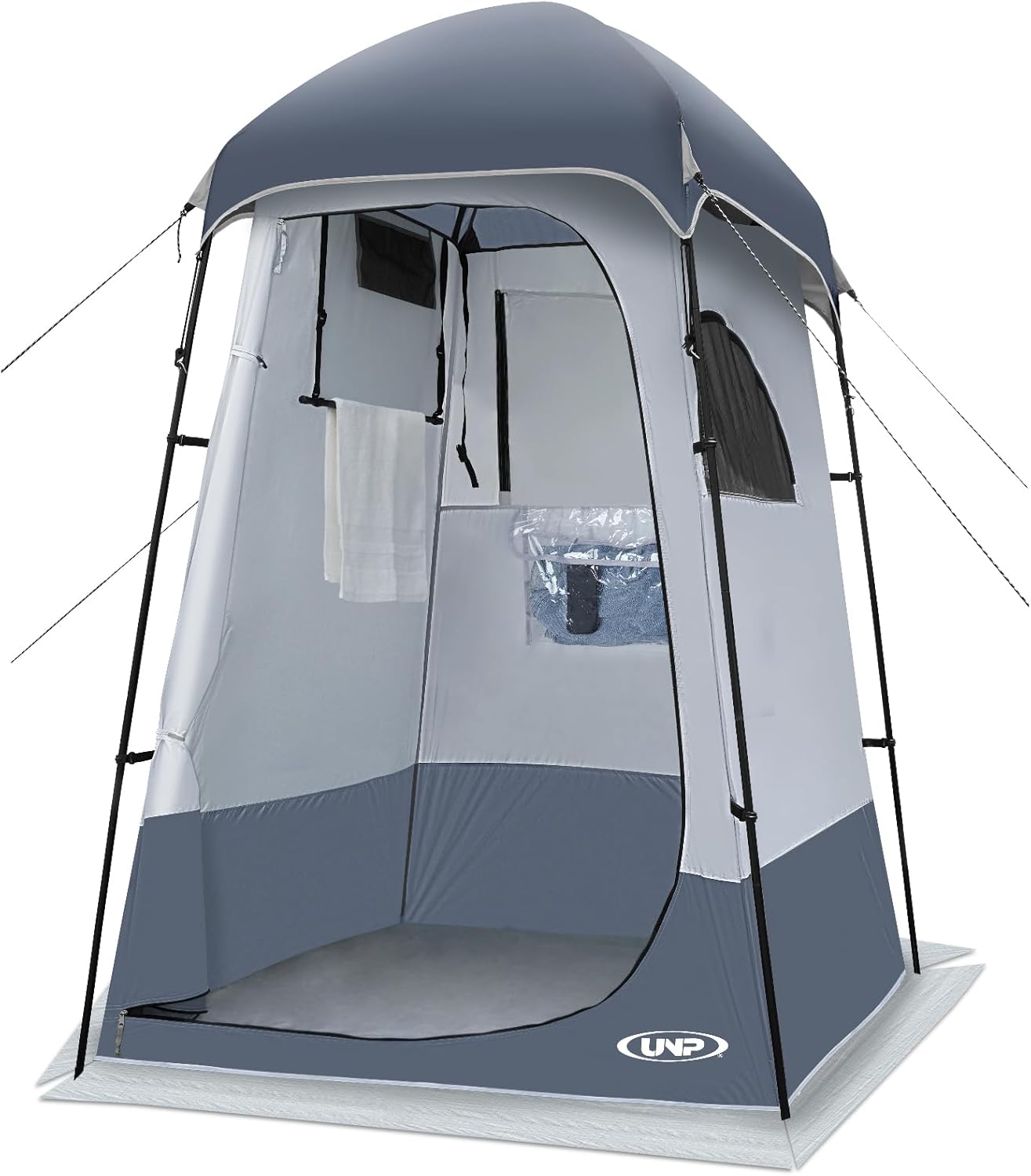
The UNP Camping Shower Tent and 2 Person Camping Tent takes a different approach from the compact pop-up shelters in this category. Instead of treating the shower enclosure as a small accessory that is only brought out when needed, UNP gives it enough interior room to function as a proper private area at camp. The shower shelter measures approximately 4.6 × 4.6 feet with a 7.55-foot height, giving one person plenty of standing and changing space without forcing everything into a tight corner.
Its appeal is particularly clear for campers who spend several days at one campsite. The 210D silver-coated material, UPF 50+ protection, removable rainfly, mesh ventilation window, interior storage pockets, and PE floor make the shelter feel more like a dedicated outdoor room than a basic privacy screen. There is also an interior pole for hanging clothes or towels, a small detail that becomes surprisingly useful when you’re dealing with wet gear.
The other interesting part of this UNP package is that it includes a separate two-person camping tent alongside the shower shelter. That makes the product notably different from the other recommendations in this guide: you are not simply buying a private shower enclosure, but a paired camping setup that can cover sleeping and personal privacy with one purchase. The included camping tent measures 7 × 5 feet and 45 inches high.
The trade-off is straightforward. This is a more substantial setup than a simple pop-up privacy tent, so it makes the most sense when space, comfort, and a fuller campsite setup matter more than minimizing every piece of gear. For a quick overnight stop, that extra equipment may be unnecessary. For a longer car-camping trip, however, the additional room and separation can make a noticeable difference.
Camp Snapshot
| Camping Style | Car Camping • Family Camping • Fishing Trips • Extended Campsite Stays |
|---|---|
| Shelter Type | Portable Shower & Privacy Shelter + 2-Person Camping Tent |
| Shower Shelter Size | 4.6 × 4.6 ft |
| Shower Shelter Height | 7.55 ft |
| Primary Uses | Showering • Changing • Privacy • Outdoor Toilet |
| Privacy Material | 210D Silver-Coated Material • Light-Blocking Design |
| Ventilation | Larger Mesh Window |
| Additional Features | Removable Rainfly • PE Floor • Storage Pockets • Clothes/Towel Pole |
| CampComfortGuide Verdict | Best for a More Complete Campsite Privacy Setup |
Why We Chose It
The reason the UNP earned a place in this guide is not simply that it has a long list of features. It solves a slightly different problem from the typical compact shower tent: how to make a private outdoor space feel usable rather than merely functional.
That starts with the interior. At 7.55 feet tall, the shower shelter gives most adults plenty of headroom, and the 4.6-foot square footprint leaves enough room to turn, change clothes, and handle a shower setup without constantly fighting the walls. That distinction matters when the shelter is being used several times a day during a longer camping trip.
The interior details reinforce that idea. A dedicated place for toiletries, a pole for towels or clothing, and a PE floor may not sound significant individually, but together they reduce the small annoyances that tend to appear when a basic privacy shelter is used as an actual changing and showering space. The larger mesh window also gives the shelter a way to release heat and moisture instead of relying entirely on an enclosed fabric interior.
Privacy is another area where UNP has clearly prioritized function. The silver-coated 210D material is designed to block light and prevent silhouettes from becoming visible through the fabric, while the removable rainfly adds another layer of protection when weather becomes a concern.
What really separates this package, though, is the second tent. The included two-person camping tent is not something we would treat as merely an accessory; it changes the value proposition of the entire package. Someone putting together a car-camping setup can have a dedicated sleeping shelter and a separate private shower/changing area rather than trying to make one tent perform every job.
That makes UNP particularly interesting for campers who establish a base at their campsite instead of arriving late, sleeping, and leaving the next morning. It asks for more space and equipment than a minimalist privacy shelter, but it gives more back in return.
Check today’s price and latest customer reviews on Amazon.

Living With It at Camp
The UNP makes the most sense once you stop thinking of a shower tent as something you put up for ten minutes and start treating it as part of the campsite. The extra height and square footprint give you room to move normally, and that matters when the shelter is being used for changing clothes as well as showering. The 7.55-foot peak also leaves useful clearance for a shower setup without forcing you to bend or duck underneath it.
Ventilation is one of the more useful details in everyday use. Showering introduces a lot of warm, humid air into a small enclosed space, so the larger mesh window gives moisture somewhere to escape. The interior pockets and hanging pole are similarly practical: wet towels, clean clothes, and toiletries can be kept off the floor instead of being piled in a corner.
The iron-pole frame also changes the character of this shelter. It is heavier and less compact than a simple pop-up privacy tent, but the more substantial frame gives it a planted feel once properly staked. That is a reasonable trade for campers who spend several nights in one location and do not need to carry the shelter on their back. One current comparison of shower tents specifically highlights the UNP’s frame stability as a distinguishing feature among lighter pop-up designs.
There is one practical detail worth knowing before buying: the PE floor is designed to keep the interior clean and separated from the ground, but it is not the same thing as a purpose-built drainage floor. If you are using the shelter for showering, think about where the used water will go rather than assuming the floor itself will handle drainage. For changing or toilet use, that solid floor becomes much more useful.
The included second tent is what makes this package unusual. You can establish a sleeping area and a separate private space instead of asking your main tent to handle changing, showering, and personal storage. That arrangement is particularly well suited to car camping, fishing trips, and longer stays where the campsite becomes a temporary base rather than just somewhere to sleep overnight.
The downside is the same feature that gives the shelter its sturdier character: this is not lightweight minimalist gear. A current comparison lists the complete shower-tent setup at about 13.2 pounds, and the frame breaks down rather than collapsing into the small disc-style package associated with pop-up models. For vehicle-based camping, that is a manageable compromise; for backpacking, it is a very different proposition.
CampComfortGuide Assessment
| Evaluation Category | Editorial Assessment |
|---|---|
| Privacy | ★★★★★ Light-blocking 210D fabric provides strong privacy for showering, changing, and portable-toilet use. |
| Interior Space | ★★★★★ The 4.6 × 4.6-foot floor and 7.55-foot height provide unusually generous standing and changing room. |
| Ventilation | ★★★★☆ Large mesh ventilation helps release heat and moisture, although airflow still depends on how the shelter is positioned. |
| Setup | ★★★★☆ The frame can be assembled by one person in a few minutes, but it requires more setup than an instant pop-up shelter. |
| Wind Stability | ★★★★★ Anti-rust iron poles, ropes, and stakes provide a more substantial structure than lightweight pop-up frames when properly secured. |
| Versatility | ★★★★★ Works as a shower, changing room, toilet shelter, and private campsite space, with a separate two-person tent included in the package. |
| Overall Value | ★★★★☆ A strong choice for car campers who can accommodate the additional weight and want a more complete shelter setup. |
Who Should Buy This
- Car campers who want a roomier private shelter than a typical pop-up shower tent.
- Campers staying several nights at one campsite rather than making quick overnight stops.
- Families or couples who value a dedicated changing and showering area.
- Campers who appreciate a sturdier frame and are willing to accept additional weight.
- Buyers who can make use of the included two-person camping tent as part of a broader campsite setup.
Who Should Skip This
- Backpackers or anyone carrying their shelter significant distances.
- Campers who want the smallest possible packed size.
- People looking for a shower enclosure that takes only seconds to deploy.
- Minimalist campers who already own a separate sleeping tent and only need basic shower privacy.
- Anyone who expects the built-in floor to provide automatic shower-water drainage.
Final Verdict
The UNP Camping Shower Tent and 2 Person Camping Tent is a different proposition from a basic privacy pop-up. Its appeal comes from the combination of generous interior dimensions, substantial framing, useful ventilation, and the additional two-person tent. It is designed for campers who have enough vehicle space to bring a more complete shelter system and intend to spend real time at their campsite.
It is heavier and more involved than a minimalist shower tent, so there is little reason to choose it for a quick overnight stop if all you need is somewhere to change. But for extended car camping, fishing trips, and established campsites, the extra room starts to justify itself.
If your priority is a proper private outdoor room rather than the lightest possible shower enclosure, the UNP is one of the more compelling choices in this group.
Check today’s price and latest customer reviews on Amazon.
A dedicated private shelter works best when the rest of the campsite is organized around it. Our Car Camping Essentials Checklist: The Ultimate Guide for Families covers the broader gear and setup decisions that help turn a vehicle-based campsite into a more functional base.
3. Coumy Instant Camping Shower Tent
Best for campers who want separate private spaces in one shelter

Quick Verdict
The Coumy Instant Camping Shower Tent is the model to look at when a single privacy compartment starts feeling limiting. Its standout feature is the two-room configuration, with a removable divider that allows the shelter to be arranged as separate spaces or opened up when you want one larger interior. That gives it a useful middle ground between a basic one-person shower tent and a much larger permanent-style shelter.
In its two-room configuration, the shelter measures approximately 82 × 42 × 88 inches and is designed to accommodate two adults. The 150D silver-coated Oxford fabric provides a strong privacy barrier, while the top vent and side windows help keep air moving through what would otherwise be a fairly enclosed space. The removable partition is particularly useful for couples or families who want separate changing or showering areas without bringing two independent privacy tents.
Coumy also pays more attention to the practical details around showering than many basic pop-up shelters. A zippered mesh floor is designed to assist water drainage, there is a concealed side opening for routing a shower hose, and the upper hook can support a shower bag weighing up to 22 pounds. Storage pockets and additional hooks give toiletries, towels, clothing, or a light their own places inside the shelter.
That extra functionality does come with a cost in weight and packed size. The two-room version is listed at roughly 12.13 pounds and folds to approximately 44 × 7 × 7 inches, so this is clearly better suited to vehicle-based camping than to carrying any meaningful distance from a trailhead.
What makes Coumy interesting for this guide is therefore not simply its size. It gives campers the ability to change how the interior is used, which can be genuinely useful when one shelter needs to serve two people or more than one purpose during the same trip.
Camp Snapshot
| Camping Style | Car Camping • Family Camping • Couples Camping • Extended Campsite Stays |
|---|---|
| Shelter Type | Instant Pop-Up Shower & Privacy Tent |
| Configuration | 1 Room / 2 Rooms with Removable Partition |
| Two-Room Size | 82 × 42 × 88 in |
| Capacity | Up to 2 Adults |
| Primary Uses | Showering • Changing • Portable Toilet • Private Campsite Space |
| Drainage | Zippered Mesh Floor Designed for Water Drainage |
| Ventilation | Top Vent • Two Side Windows |
| CampComfortGuide Verdict | Best for Flexible Two-Person Privacy |
Why We Chose It
The Coumy earned its place because it addresses a situation that smaller shower tents cannot solve particularly well: two people needing privacy at roughly the same time. Instead of putting two separate shelters in the vehicle, the removable partition lets one structure perform the job in different ways depending on the campsite.
Keep the divider in place and the interior becomes two distinct private areas. Remove it and the shelter becomes a larger open space. That flexibility is more meaningful than simply adding extra square footage because it lets the same tent adapt as the circumstances change. A couple might use separate sides for changing, while a family could dedicate one area to showering and another to clothing or a portable toilet.
The construction supports that multi-use approach. The 150D silver-coated Oxford fabric is intended to block light and preserve privacy, while the mesh sections allow ventilation without turning the shelter into an exposed changing booth. The large zippered entrance also makes moving equipment in and out easier than dealing with a cramped single-opening enclosure.
The shower-specific details are another reason we included it. The concealed hose opening means you can route a water line into the shelter without leaving the door partly open, while the top hook provides a dedicated hanging point for a shower bag. The zippered mesh floor is particularly useful because it gives water a route away from the main standing area rather than treating the shelter as a completely sealed box.
There is also a practical advantage to having two interior zones when the shelter is not being used for showering. One side can hold clean clothes and toiletries while the other is used as a changing area. That separation can make a noticeable difference at a busy campsite, where keeping dry clothing away from a wet shower area is often more important than having another few inches of floor space.
The compromise is portability. At around 12 pounds in the two-room configuration, Coumy is not competing with lightweight privacy pods. It belongs in a car-camping or established campsite setup, where the shelter can be carried from the vehicle to the pitch rather than hauled for miles.
That is ultimately why we see the Coumy differently from the first two models: it is less about having a private place to shower and more about giving two people a configurable private space without bringing two separate shelters.
Check today’s price and latest customer reviews on Amazon.

Living With It at Camp
The Coumy’s biggest advantage starts to show when two people are using the shelter in different ways. With the divider installed, you can keep one side dedicated to showering while the other remains available for changing clothes or keeping personal items dry. That separation is much more useful at a busy campsite than simply having a larger empty floor area.
For a couple, the arrangement can save a surprising amount of campsite space. One person does not have to wait for the entire shelter to become available before getting changed, and there is no need to carry two separate privacy tents. Remove the divider when you need more open floor space, and the same shelter takes on a completely different layout.
The drainage design also makes the Coumy more practical for actual shower use. The zippered mesh floor allows water to move away from the standing area, while the hose opening keeps the shower connection routed through the shelter rather than requiring the entrance to remain partially open. That is a small but meaningful difference when you are trying to keep the rest of your campsite dry and organized.
Ventilation deserves attention here too. A shower enclosure can become uncomfortable surprisingly quickly once warm water and body heat build up inside. The combination of the upper vent and side windows gives humid air somewhere to escape. You still need to position the shelter sensibly, particularly on a hot afternoon, but the design is considerably more practical than a completely sealed privacy enclosure.
The storage features are another example of Coumy thinking beyond the basic shower function. Interior pockets and hanging points give you places for toiletries, towels, clothing, or a small light. Keeping those items off the floor becomes especially valuable when the shelter is divided into two working areas.
There is, however, a reason we would not recommend this model to every camper. The 12-pound-plus weight of the larger configuration is substantial compared with compact privacy shelters. The packed dimensions also take up meaningful room in a vehicle. If your camping style involves moving every morning or trying to keep your gear footprint extremely small, the Coumy’s flexibility may not justify that extra bulk.
For established campsites, the equation changes. Once the shelter is standing beside your vehicle, its weight becomes much less important than what it allows you to do. You get a private area that can be rearranged according to the day’s needs, rather than a shelter whose purpose ends when the shower is over.
CampComfortGuide Assessment
| Evaluation Category | Editorial Assessment |
|---|---|
| Privacy | ★★★★★ Silver-coated fabric and the optional interior divider create genuinely separate private areas. |
| Interior Space | ★★★★★ The two-room layout provides considerably more usable space than a conventional single-person shower enclosure. |
| Ventilation | ★★★★☆ Upper and side mesh openings help release heat and moisture while maintaining privacy. |
| Shower Functionality | ★★★★★ Hose access, a shower-bag hook, and a zippered mesh floor make the shelter particularly well suited to shower use. |
| Flexibility | ★★★★★ The removable divider allows the interior to switch between one large room and two separate private spaces. |
| Portability | ★★★☆☆ Reasonable for car camping, but the larger configuration is too bulky for campers prioritizing minimal packed weight. |
| Overall Value | ★★★★☆ A compelling option for couples and families who can use the two-room design and have sufficient vehicle storage. |
Who Should Buy This
- Couples who want two private areas without carrying two separate shelters.
- Families who need more than one private zone at the campsite.
- Car campers with enough vehicle space for a larger privacy shelter.
- Campers who intend to use the shelter for both showering and changing.
- Anyone who values a configurable interior more than minimum packed weight.
Who Should Skip This
- Backpackers and campers carrying gear long distances.
- Minimalist campers who only need a small one-person changing shelter.
- Campers with very limited trunk or cargo space.
- Anyone who rarely stays at one campsite long enough to benefit from a larger privacy setup.
- Buyers who prefer the absolute fastest and simplest possible shelter to deploy.
Final Verdict
The Coumy Instant Camping Shower Tent earns its position by doing something the smaller models cannot: it gives you two genuinely usable private spaces in one shelter, while still allowing the divider to be removed when a larger open interior makes more sense.
That makes it particularly well suited to couples and families. The drainage-oriented floor, hose access, ventilation, storage pockets, and hanging points also show that the design was made for more than simply standing behind a fabric wall while changing clothes.
Its weight is the obvious compromise. This is equipment for car camping rather than minimalist travel, and the larger packed size needs to be accounted for before buying. But if your vehicle has the room and you regularly establish a campsite for several days, that trade-off is much easier to accept.
For campers who want a flexible private space that can serve two people at once, Coumy offers a level of versatility that a conventional single-room shower tent simply cannot match.
Check today’s price and latest customer reviews on Amazon.
💡 Related Guide
Once you start adding larger privacy shelters and separate campsite zones, efficient setup becomes much more important. Our How to Pack a Car for Camping (Efficient Gear Layout Guide 2026) guide explains how to arrange bulky camping equipment so essential gear remains accessible without wasting valuable cargo space.
4. Ann Katy Pop Up Privacy Shower Tent
Best for campers who want a lightweight privacy shelter that packs away quickly
Quick Verdict
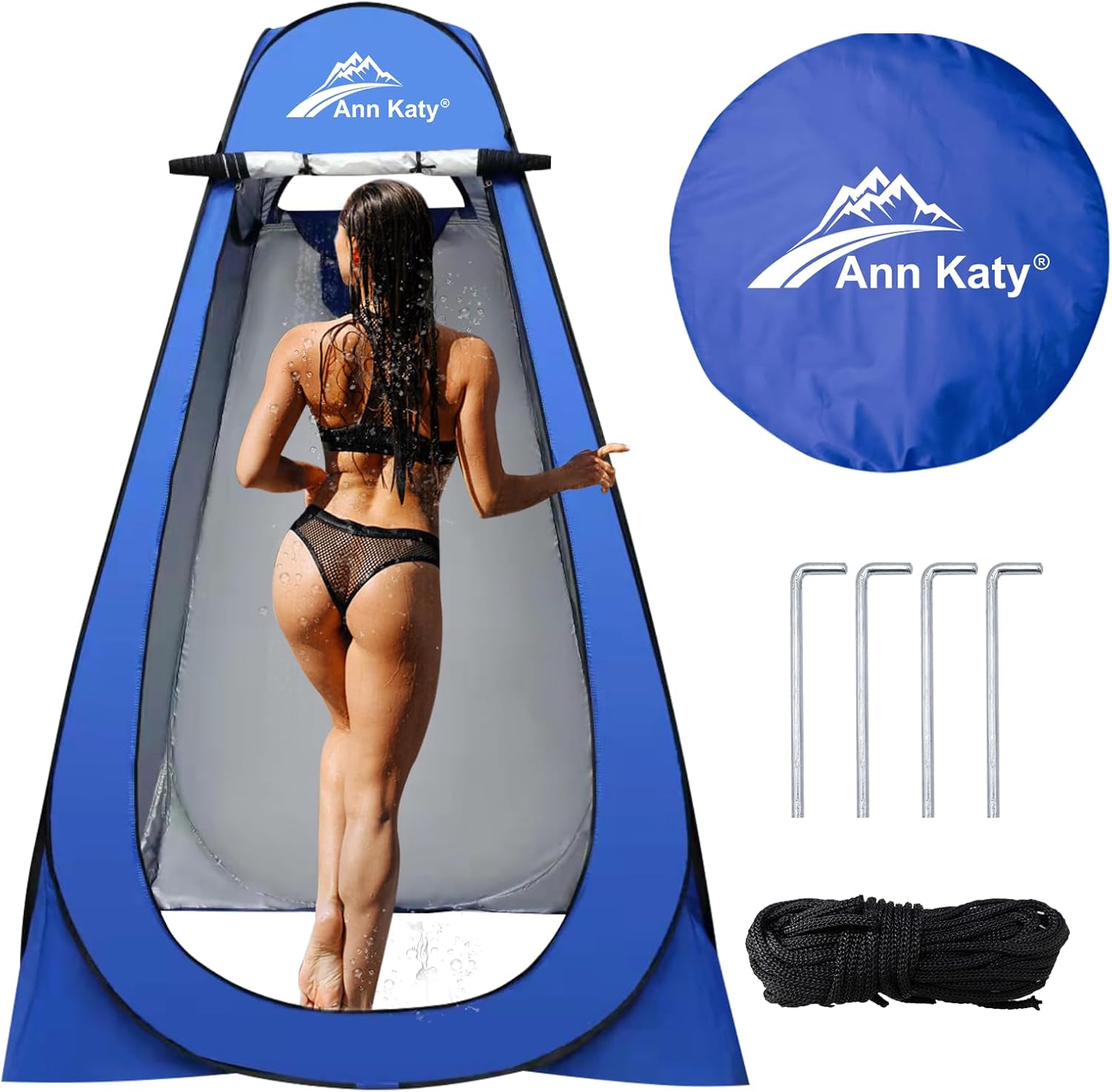
The Ann Katy Pop Up Privacy Shower Tent takes a much simpler route than the larger multi-room shelters earlier in this guide. It weighs about 4 pounds, uses an aluminum frame, and opens into a roughly 35 × 35-inch floor area with a 70-inch height. That combination makes it particularly appealing when you want a dedicated privacy shelter without giving up much vehicle storage space.
What makes this model interesting is how little commitment it asks from the camper. There is no complicated pole structure to assemble at the campsite. The spring-style frame allows the shelter to pop open, while the included stakes and reinforced guy lines give you a way to secure it once it is positioned. When the trip is over, it folds back into its carry bag rather than becoming another bulky piece of camp equipment.
Inside, the 4 × 4-foot class footprint is enough for the jobs this shelter is designed to handle: changing clothes, taking a portable shower, or creating a private toilet area. The silver-lined fabric is intended to block outside views, while the top and side windows provide ventilation without turning the enclosure into an open-sided screen.
The specifications also make this one of the more straightforward options in our lineup. Ann Katy lists polycotton fabric, UPF 30+ protection, an aluminum frame, a 4-pound weight, and a 15.52-square-foot floor area. The manufacturer listing also describes the material as waterproof, although I would treat this primarily as a privacy and shower shelter rather than a substitute for a weatherproof tent.
There is one reason to keep expectations realistic: a lightweight pop-up shelter is still a lightweight pop-up shelter. Its appeal comes from convenience and portability, not from the structural heft of a framed outdoor room. That distinction matters if you regularly camp in exposed locations or expect the shelter to tolerate harsh weather.
For campers who mostly want quick privacy, modest packed weight, and several possible uses from one inexpensive shelter, Ann Katy fills that role neatly.
Camp Snapshot
| Camping Style | Car Camping • RV Camping • Beach Trips • Weekend Camping |
|---|---|
| Shelter Type | Pop-Up Privacy Shower & Changing Tent |
| Dimensions | 35 × 35 × 70 in |
| Weight | 4 lb |
| Frame | Aluminum Tubular Frame |
| Primary Uses | Showering • Changing • Portable Toilet • Private Storage |
| Privacy | Silver-Lined Fabric with Enclosed Design |
| Ventilation | Top and Side Windows |
| CampComfortGuide Verdict | Best Lightweight Pop-Up Privacy Shelter |
Why We Chose It
Ann Katy is here for a different reason than the previous three models. It does not try to win by adding rooms, extra living space, or a more elaborate campsite structure. Its advantage is that it keeps the privacy problem small.
That matters when the rest of your camping equipment is already taking up most of the available cargo space. A four-pound shelter is much easier to justify than a large privacy cabin when you only need somewhere to change, shower, or use a portable toilet during a weekend trip. The compact folded design also makes it easier to leave the shelter packed with your regular camping gear instead of deciding each trip whether it is worth bringing.
The 70-inch height is another practical point. It is tall enough to create a genuine standing privacy area rather than forcing you to crouch inside, while the approximately four-foot square floor gives enough room for a portable shower setup without making the shelter excessively large.
Its versatility is also worth considering. Ann Katy positions the shelter for showering, changing, bathroom use, and even as a private supply or storage area. That means it can remain useful after the morning shower is finished. A family could use it as a changing room during the day, while an individual camper might reserve it for nighttime bathroom trips.
The aluminum frame is a useful choice for a shelter in this weight class. It keeps the overall package relatively light without relying entirely on a heavier conventional pole structure. At the same time, the included four heavy-duty stakes and reinforced guy lines are important rather than optional extras: the shelter’s tall, lightweight profile still needs to be secured properly when conditions become breezy.
One detail worth checking before buying is the repacking process. Available customer feedback is generally favorable, but some users have reported difficulty getting the folded shelter back into its carry bag, while others have mentioned issues involving the included shower bag or product quality. Those comments do not make the tent a poor choice, but they are relevant when assessing whether its convenience outweighs the potential trade-offs.
That balance is ultimately why Ann Katy belongs in this list. It is not the shelter I would choose for the most demanding campsite, nor is it the model for someone who wants a large private outdoor room. But if the priority is a light, uncomplicated privacy shelter that can disappear into your vehicle when you are finished with it, the design makes considerable sense.
Check today’s price and latest customer reviews on Amazon.

Living With It at Camp
The Ann Katy works best when you treat it as a grab-and-use piece of campsite equipment, not as another structure that needs a dedicated setup routine. The pop-up frame is the main reason. Its pop-up design is intended to turn the shelter into a usable private enclosure quickly, which can be particularly useful for late arrivals, changing after swimming, or situations where a more complicated shelter would be unnecessary.
The 35 × 35-inch footprint is compact enough to fit into tighter campsite spaces, while the 70-inch height gives you a genuine standing enclosure for changing and showering. It is not particularly spacious inside, but that is part of the design trade-off: Ann Katy keeps the footprint modest so the shelter remains easy to transport and store.
Privacy is handled with the silver-lined interior, which helps block outside views. The upper and side windows provide ventilation, something that becomes important when the shelter is being used for a warm shower or on a sunny afternoon. You get an enclosed space without turning it into a completely stagnant box.
I also like the fact that the shelter is not limited to showering. At a campsite, it can become a changing room in the morning, a private bathroom enclosure at night, or a temporary place to keep supplies away from the main living area. That flexibility gives a relatively small piece of equipment more value than its simple construction might initially suggest.
Where I would be more cautious is wind exposure. Ann Katy includes four heavy-duty stakes and reinforced guy lines, and they should actually be used. The lightweight pop-up construction is an advantage when carrying the shelter, but a tall, lightweight enclosure has more surface area for wind to push against. On an exposed beach or open hillside, I would choose a sheltered position and secure every available anchor point rather than relying on the frame alone.
Packing it away is another part of the ownership experience worth considering. The frame folds into a compact carry bag, which is excellent for vehicle storage, but pop-up shelters generally require you to learn the folding motion rather than simply collapse them like a conventional tent. Once that technique is familiar, the small packed footprint becomes one of the model’s strongest practical advantages.
CampComfortGuide Assessment
| Evaluation Category | Editorial Assessment |
|---|---|
| Privacy | ★★★★☆ Silver-lined fabric provides effective visual privacy for changing, showering, and bathroom use. |
| Interior Space | ★★★★☆ The compact 35 × 35-inch footprint works well for one adult but leaves limited room for moving equipment around. |
| Ventilation | ★★★★☆ Upper and side windows provide useful airflow while maintaining an enclosed private interior. |
| Setup | ★★★★★ Pop-up construction allows extremely quick deployment without a conventional pole assembly. |
| Wind Stability | ★★★☆☆ Stakes and guy lines improve stability, but the lightweight pop-up structure still requires careful anchoring in exposed locations. |
| Portability | ★★★★★ At approximately 4 pounds with a compact carry bag, it is considerably easier to transport than larger framed privacy shelters. |
| Overall Value | ★★★★☆ A practical lightweight choice for campers who prioritize quick setup, easy storage, and basic multi-use privacy. |
Who Should Buy This
- Campers who want a quick pop-up shelter without a complicated frame assembly.
- Car and RV campers with limited storage space.
- Anyone who needs one enclosure for showering, changing, and portable-toilet use.
- Beach campers, weekend campers, and travelers who value low packed weight.
- Buyers looking for a straightforward privacy shelter rather than a large outdoor bathroom.
Who Should Skip This
- Campers who need enough interior space for two adults.
- Anyone wanting a heavy-duty shelter for prolonged exposure to strong winds.
- Campers who need a dedicated drainage floor for frequent showering.
- Backpackers who still consider four pounds too much for their kit.
- Buyers looking for premium structural durability rather than convenience and portability.
Final Verdict
The Ann Katy Pop Up Privacy Shower Tent makes its case through simplicity. It is light, compact, quick to deploy, and versatile enough to handle the basic privacy jobs that come up repeatedly during camping trips.
It does not have the interior flexibility of the Coumy or the more substantial feel of a larger framed shelter. Instead, it targets campers who would rather carry less, set up faster, and store the shelter without sacrificing much vehicle space.
For weekend camping, beach trips, RV travel, and ordinary car camping, that is a sensible trade. Just secure it properly when the weather turns windy, and keep expectations realistic about the amount of space available inside.
If your priority is a lightweight privacy shelter that you can keep in the vehicle and deploy whenever you need it, Ann Katy is a practical choice.
Check today’s price and latest customer reviews on Amazon.
💡 Related Guide
If you’re choosing a compact camping shower tent because vehicle space is limited, our How to Pack a Car for Camping (Efficient Gear Layout Guide 2026) guide explains how to organize bulky camping equipment, keep essential gear accessible, and make better use of limited cargo space.
5. KingCamp Portable Outdoor Shower Tent
Best for campers who want a spacious, fully equipped private bathroom setup

Quick Verdict
The KingCamp Portable Outdoor Shower Tent is the choice for campers who are less concerned about carrying an extra few pounds and more interested in having a properly equipped private space at camp. Its roughly 66 × 66-inch footprint and 80.7-inch height create substantially more usable room than the compact shower shelters in this guide, giving an adult enough space to shower, change clothes, or use a portable toilet without feeling boxed in.
What sets this model apart is the attention to the details that become important when a shower tent stays at the campsite for more than a few minutes. KingCamp includes a PE floor with a mesh perimeter, multiple ventilation openings, storage pockets, towel storage, a water-pipe inlet, and a dedicated hook for a shower bag. Instead of being little more than a fabric privacy screen, it is designed around the way campers actually use a private bathroom area outdoors.
The 150D silver-coated Oxford fabric provides visual privacy while also offering UPF50+ protection, and the removable rainproof roof gives the enclosure additional protection from sun and light weather. The combination of screened openings and the roof is particularly useful because a large enclosed shelter can otherwise become hot and stuffy during daytime use.
There is also a clear structural trade-off. At approximately 6.2 kg (13.7 lb), this is one of the heavier options in our selection. The quick-open iron frame contributes to that weight, but it also gives the shelter a more substantial structure than lightweight pop-up privacy tents. This is therefore much better suited to car camping, RV camping, family trips, and established campsites than to situations where every pound has to be carried by hand.
For a camper staying several nights in one location, that extra weight can make sense. Once erected, the KingCamp provides enough room and built-in organization to function as a dedicated campsite bathroom and changing area rather than another piece of gear that has to be packed away after every use.
Camp Snapshot
| Camping Style | Car Camping • RV Camping • Family Camping • Beach Camping • Extended Campsite Stays |
|---|---|
| Shelter Type | Full-Size Outdoor Shower & Privacy Tent |
| Interior Size | Approximately 66 × 66 × 80.7 in |
| Weight | 6.2 kg / 13.7 lb |
| Frame | Quick-Open Iron Frame |
| Fabric | 150D Silver-Coated Oxford Cloth |
| Primary Uses | Showering • Changing • Portable Toilet • Campsite Privacy |
| Ventilation | Multiple Mesh Openings for Airflow |
| Floor | PE Floor with Mesh Perimeter |
| CampComfortGuide Verdict | Best for a Complete Campsite Bathroom Setup |
Why We Chose It
The KingCamp earned its place because it approaches the shower-tent category from a different direction. Instead of minimizing the shelter to save weight, KingCamp gives the camper more room and more dedicated features to work with. That distinction becomes valuable when the tent is going to remain assembled beside your campsite for several days.
The first thing you notice is the interior volume. An approximately 66 × 66-inch floor area combined with an 80.7-inch height gives you considerably more freedom of movement than a compact changing shelter. You can turn around comfortably, change clothes without constantly touching the walls, and position a portable shower or toilet without making the entrance unusable.
The floor is another reason this model stands apart. Rather than leaving you standing directly on the campsite ground, KingCamp provides a PE floor surrounded by mesh. That creates a cleaner defined area underfoot while allowing ventilation around the lower section. For showering, that separation from wet or muddy ground is more than a cosmetic improvement—it makes the enclosure easier to live with throughout a multi-day trip.
KingCamp also understands that privacy is only part of the problem. Once you are inside a shower tent, you need somewhere to put the things you brought with you. The integrated storage pockets, towel pocket, hanging straps, and waterproof PVC storage area give clothing, toiletries, towels, and smaller equipment dedicated places rather than forcing everything onto the floor.
The shower infrastructure is similarly well thought out. A dedicated water-pipe inlet allows a hose to enter the shelter without compromising the main entrance, while the overhead hook is designed to support a shower bag of up to 20 liters. That makes the shelter compatible with the kind of gravity-fed or portable shower systems commonly used in vehicle-based camping.
This is also where the KingCamp’s heavier construction starts to make sense. The quick-open iron frame is not trying to compete with a four-pound pop-up shelter. It is designed to create a more substantial enclosure that you can establish at a campsite and actually use as a dedicated private room.
The downside is straightforward: you have to transport it. At roughly 13.7 pounds, it takes considerably more cargo space and effort to move than the lighter alternatives in this guide. If your camping style involves constantly relocating or carrying equipment any meaningful distance from the vehicle, I would not choose it simply because it has more features.
For campers who arrive by car, establish a base, and want their shower, changing area, and portable bathroom organized in one dedicated shelter, however, the additional size is much easier to justify. KingCamp is the model here for campers who want the privacy tent to become part of the campsite—not merely something they unpack when they need five minutes of privacy.
Check today’s price and latest customer reviews on Amazon.

Living With It at Camp
The KingCamp makes the most sense when its larger footprint is treated as part of the overall campsite setup. With this much interior space, you do not have to treat the shower tent as a temporary enclosure that is used and immediately packed away. It can stay beside the main campsite as a dedicated private area throughout the trip.
That extra room changes the experience when getting ready. There is enough floor space to keep clean clothes and toiletries inside without having to squeeze around a shower setup, and the height makes changing considerably more comfortable for taller adults. For family camping, that can be especially useful because the shelter can handle several different jobs over the course of a day.
The PE floor and mesh perimeter are particularly useful when the shelter is used for showering, changing, or portable-toilet duties. Wet ground, mud, and insects are much easier to manage when the private area has its own defined floor rather than simply sitting directly on the campsite surface. The drainage-oriented construction also means you are not relying entirely on the surrounding soil to deal with every drop of water.
Ventilation becomes increasingly important as the enclosure gets larger. KingCamp uses several mesh openings to create airflow while maintaining privacy, so warm, humid air has somewhere to escape. The silver-coated fabric also helps with solar exposure, while the removable roof provides an additional barrier when the shelter is being used during bright or unsettled weather.
The built-in organization becomes more useful when the shelter is used for several campsite tasks. Towels can be kept off the floor, toiletries have dedicated storage, and smaller personal items do not have to compete for the same limited space. It makes the enclosure feel more like a small outdoor bathroom and less like a fabric box.
There is still a practical limit to what this shelter should be expected to handle. The manufacturer describes the fabric as waterproof and includes a rainproof roof, but I would not treat the KingCamp as a replacement for a storm shelter. Its primary job is privacy and campsite utility, with weather resistance supporting that purpose rather than turning it into an all-weather living space.
The frame also deserves proper anchoring. The iron construction gives the shelter a more substantial feel, but the large surface area can still catch wind. Using the supplied stakes and guy lines is important, particularly on beaches, open fields, and other exposed campsites. A few extra minutes spent securing it is preferable to discovering how much leverage a tall privacy shelter can generate after the wind picks up.
For longer stays, though, the KingCamp’s additional bulk starts to feel justified. You can leave the shelter assembled, keep your shower equipment inside, use it as a changing room during the day, and convert it into a private toilet area when needed. That multi-purpose role is what makes this model different from a basic pop-up privacy tent.
CampComfortGuide Assessment
| Evaluation Category | Editorial Assessment |
|---|---|
| Privacy | ★★★★★ Tall enclosed walls and silver-coated fabric create a strong private environment for showering, changing, and bathroom use. |
| Interior Space | ★★★★★ The approximately 66 × 66-inch footprint provides noticeably more freedom of movement than compact shower shelters. |
| Ventilation | ★★★★☆ Multiple mesh openings provide useful cross-airflow while retaining the enclosed character of the shelter. |
| Shower Functionality | ★★★★★ Dedicated hose access, a shower-bag hook, PE flooring, and drainage-oriented mesh make it well suited to regular shower use. |
| Organization | ★★★★★ Integrated pockets, towel storage, and hanging points give everyday shower and changing items dedicated places. |
| Wind Stability | ★★★★☆ The heavier iron frame provides a solid foundation, but the tall shelter should still be fully staked and guyed in exposed conditions. |
| Portability | ★★★☆☆ Its 6.2 kg weight and larger packed footprint make it best suited to vehicle-based camping rather than long-distance carrying. |
| Overall Value | ★★★★★ A strong choice for campers who want one spacious, organized shelter to handle showering, changing, and portable-toilet duties. |
Who Should Buy This
- Car campers who want a spacious private bathroom area at the campsite.
- Families and couples who value more interior room when changing or showering.
- RV campers who have enough cargo capacity for a larger privacy shelter.
- Campers staying several nights at one location.
- Anyone who wants integrated storage and shower-specific features rather than a basic privacy enclosure.
Who Should Skip This
- Backpackers who need to minimize every pound of carried equipment.
- Campers who relocate frequently and want the smallest possible packed shelter.
- Solo campers who have no use for the additional interior space.
- Anyone looking for a simple pop-up privacy tent at minimum weight.
- Campers who expect a privacy shelter to function as a severe-weather shelter.
Final Verdict
The KingCamp Portable Outdoor Shower Tent closes our lineup with a different proposition: space, structure, and campsite functionality take priority over minimum weight.
Its generous interior, integrated floor, ventilation, storage, shower-bag hook, and hose access make it one of the more complete solutions for creating a private bathroom area outdoors. You are not simply getting somewhere to change clothes; you are getting a shelter designed to remain useful throughout the day and across a multi-night camping trip.
The 13.7-pound weight is the obvious compromise. This is not equipment I would recommend for anyone counting grams or carrying gear far from a vehicle. But for car camping, RV travel, family camping, and established campsites, the additional weight is considerably easier to justify.
If your idea of a good camping shower tent is a dedicated private space that has enough room to actually use comfortably and enough built-in organization to stay functional for several days, the KingCamp is one of the strongest choices in this group.
Check today’s price and latest customer reviews on Amazon.
💡 Related Guide
If you’re planning to use a shower tent in changing weather, our Camping Temperature Guide (What Gear You Actually Need) explains how temperature affects campsite comfort and what gear can help you stay prepared throughout the trip.
How to Choose the Best Camping Shower Tent
The right camping shower tent is less about finding the biggest shelter or the one with the longest feature list. The better question is how you actually intend to use it once you are at camp. A solo camper who needs a place to rinse off and change clothes has very different requirements from a family staying at one campsite for a week.
After comparing the designs and specifications across this guide, I would narrow the decision down to a few practical considerations first: how much room you need, how the tent handles water, how private it remains when occupied, and how much effort you are willing to spend setting it up and transporting it. These are the factors that tend to make a noticeable difference once the tent leaves the product page and becomes part of your campsite.
1. Start With the Interior Space You Actually Need
A shower tent needs enough room for more than simply standing upright. You need space to turn around, reach your shower controls, hang a towel, remove wet clothing, and keep clean clothes away from the wet area. If you intend to use the shelter with a portable toilet, the required floor area increases again.
For solo showering and changing, a compact single-room shelter can be perfectly adequate. Couples and families should look at wider or two-room designs, particularly if the tent will also function as a changing area or bathroom. Taller campers should pay close attention to the actual peak height rather than relying on a generic “full-size” description; having to crouch while washing quickly becomes one of those small annoyances that you notice on every trip.
There is a practical ceiling to this, though. More interior space means a larger footprint at the campsite, a larger packed package, and usually more weight. Do not buy a two-room shower tent simply because it sounds more comfortable if you will only ever use one side. Match the interior to the job.
2. Pay Close Attention to the Floor and Drainage
This is one of the easiest specifications to overlook when comparing photographs, and one of the first you notice when water starts collecting around your feet.
A solid floor is useful when the tent doubles as a changing room or portable-toilet enclosure because it gives you a cleaner barrier from wet or dirty ground. For showering, however, that same floor needs a sensible way to move water away. Removable floors, mesh sections, zippered openings, and perimeter drainage systems can all solve the problem in different ways.
The important distinction is not simply “does it have a floor?” but “what happens to the water after you start showering?”
If the answer is nowhere, the shelter can quickly become a puddle trap. For regular shower use, I would give drainage design considerably more weight than a cosmetic feature such as an extra storage pocket or a decorative rainfly.
3. Don’t Trade Privacy for Ventilation
A shower tent has to accomplish two things that naturally work against each other: keep you hidden while allowing humid air to escape.
Mesh windows, roof vents, and screened openings are therefore more than comfort features. They help release steam and reduce the damp, stuffy feeling that develops inside an enclosed shelter. At the same time, the main fabric should provide genuine visual privacy rather than simply appearing opaque in a product photograph.
This becomes particularly important at night. Put a lantern or headlamp inside a poorly designed privacy tent and the fabric can reveal far more than you expected through shadows. A darker or silver-coated interior can help, but I would not assume that a UPF rating alone guarantees complete nighttime privacy.
The best design is not the most sealed one. It is the one that gives you a genuinely private enclosure while still allowing heat and moisture to escape.
4. Choose the Setup Style That Matches Your Camping Routine
There are two broad approaches. Pop-up shelters prioritize speed and convenience: they are attractive when you move frequently, have limited setup time, or simply do not want another conventional frame to assemble. More substantial frame-based designs take longer and usually weigh more, but they can provide a roomier and more stable structure for longer stays.
Think about how often you will actually move the shelter.
If you arrive Friday afternoon and leave Sunday morning, a fast pop-up design has an obvious advantage. If you establish a basecamp for five or seven days, spending a little longer on setup may be a worthwhile trade for additional space, stronger construction, and better organization.
There is no universal winner here. Setup speed matters most to campers who move often; structural substance matters more to campers who leave the shelter standing.
5. Check the Frame, Anchoring, and Wind Stability

A shower tent is unusually vulnerable to wind because it combines tall walls, a relatively small footprint, and a lightweight structure. That makes the frame and anchoring system more important here than they would be for some other small camping accessories. Current buying guides consistently emphasize stakes, guy lines, frame construction, and overall stability as key differences between lightweight pop-up shelters and more substantial designs.
For occasional use in sheltered campgrounds, a simple pop-up frame may be perfectly adequate. If you regularly camp on beaches, lakeshores, open fields, or exposed overlanding sites, I would give more weight to frame material, reinforced attachment points, included guy lines, and the number of usable anchoring points.
Do not judge stability from the frame alone. A good shelter can still become a problem if it is poorly anchored. Use the supplied stakes and guy lines whenever conditions allow, and position the tent where the surrounding terrain or natural windbreaks reduce direct exposure.
6. Make Sure the Tent Works With Your Shower System
The shower tent and the shower itself are two separate pieces of equipment, and they need to work together.
If you already own a portable camping shower, solar shower bag, or pressurized water system, check how the tent handles the hose or shower head before buying. A dedicated hose inlet is much more convenient than trying to route a hose through a partly open door. A strong overhead hook is equally useful if you rely on a gravity-fed shower bag. Some of the more developed shelters in our lineup specifically include these features.
Also think about where the water will go. The tent should not simply contain the water and leave you standing in it. Depending on the design, drainage may come from a mesh floor, removable floor section, open base, or dedicated drainage area. Your campsite surface matters too: a shower tent placed on naturally draining ground will behave very differently from one sitting on flat, compacted soil.
7. Decide Whether You Need a Dry Changing Area
This is where a shower tent and a true campsite privacy shelter start to diverge.
If you only need somewhere to rinse off, a single wet area may be all you need. But if the same shelter will handle showering, changing, and a portable toilet, keeping wet and dry activities separated becomes much more valuable.
A two-room design can solve this particularly well: one side becomes the wet zone while the other remains available for dry clothing and personal items. A removable divider can offer similar flexibility without permanently committing the entire shelter to a two-room layout. The trade-off is straightforward—more usable space usually means more weight, more packed bulk, and a larger campsite footprint.
For family camping or multi-day basecamps, I would seriously consider this feature. For a solo camper who showers quickly and packs up immediately afterward, it is probably unnecessary.
8. Consider Weight and Packed Size Before You Buy
The dimensions on the campsite are only half the portability equation. You also need to look at what the shelter becomes when it goes back into the vehicle.
A lightweight pop-up model can be attractive because it takes very little cargo space and is easy to move from the vehicle to the campsite. Larger frame-based shelters can provide much more comfortable interiors and stronger structures, but their packed bags can compete with chairs, coolers, kitchen equipment, and other bulky camping gear.
This is particularly important for car camping. A shower tent that looks reasonably compact on its product page can become surprisingly inconvenient when you already have a full vehicle.
Think about the entire camping system, not just the tent. If you need the extra interior space, accept the additional cargo requirement. If you simply want basic privacy, there is little reason to carry a 13-pound shelter when a much lighter option can perform the same core job.
9. Look Beyond the Feature List and Consider How You Camp
The final decision should come from your camping routine rather than from the number of features printed on the product page.
For short weekend trips, quick setup and small packed size may matter more than a heavy frame or elaborate drainage system. For longer basecamp stays, interior space, storage, ventilation, and wet-dry separation become increasingly valuable. And if you camp in exposed locations, structural stability should move much higher on your priority list.
That is why there is no single specification that makes one shower tent universally better than another. The best model is the one whose compromises match your camping style. A lightweight pop-up can be the smarter purchase for a frequent weekend camper, while a heavier multi-room shelter can make much more sense for a family spending a week at one campsite.
10. Balance Price Against Build Quality and Long-Term Value
Price is useful as a starting point, but it is a poor way to judge a shower tent by itself. These shelters are exposed to water, humidity, sunlight, dirt, wind, repeated folding, and frequent zipper use. A model that saves $30 today can become the more expensive option if the frame bends, the fabric deteriorates, or the seams and closures stop working after a season.
Look beyond the advertised waterproof rating and feature count. Fabric quality, reinforced stress points, zipper construction, frame materials, stitching, and the quality of the carry bag all tell you more about whether the shelter is built for repeated camping use. Current buying guides also place durability and weather resistance alongside privacy, drainage, setup, and portability rather than treating price as the primary differentiator.
The better way to think about value is cost per useful camping trip. If you camp regularly, spending more for a better-built shelter can make sense because you are spreading that investment across several seasons. If you only camp a few weekends a year, a simpler model may be perfectly reasonable.
There is also a point where paying more stops adding meaningful value. A heavier frame, additional room, or elaborate accessory system is worthwhile only if you will actually use it. Buy construction quality where it affects reliability, not features simply because they make the specification sheet look impressive.
11. Don’t Overlook the Small Features You’ll Use Every Trip
The most useful features are not always the ones highlighted in large product photographs. A shower tent can have excellent dimensions and good privacy yet still become frustrating if there is nowhere to put your soap, towel, clean clothes, or shower hose.
Look for practical details such as:
- Interior pockets for shampoo, soap, toiletries, and small personal items.
- Towel hooks or rails that keep wet towels away from the floor.
- Hanging loops or a shower-bag hook for gravity-fed shower systems.
- Interior lighting loops if you regularly shower before sunrise or after dark.
- A useful carry bag that makes folding and transporting the shelter less frustrating.
- Dual-access doors or adjustable openings where they improve ventilation and movement around the enclosure.
None of these features should determine your purchase on its own. They become valuable when combined with the fundamentals—adequate space, proper drainage, reliable anchoring, privacy, and manageable pack size. Outdoor Gear Lab, for example, specifically highlights features such as storage pockets, ventilation, a shower hook, and roominess when assessing privacy shelters.
12. Match the Tent to Your Entire Camping Setup
The final question is not simply “Which shower tent is best?” It is “Which shower tent makes sense with the rest of my gear?”
Consider the vehicle you use, how much cargo space remains after loading the essentials, how often you move between campsites, and which shower system you already own. A large, feature-rich shelter may be an excellent choice for a family spending five nights at one campground but a poor fit for someone changing locations every morning.
Your campsite matters too. A shower tent needs enough level ground for its footprint, suitable anchoring points, and somewhere for used water to drain without flowing toward your sleeping area or other equipment. Placement can also affect privacy and ventilation; positioning the entrance away from campsite traffic and using natural windbreaks can make a noticeable difference.
Think about the whole system rather than the product in isolation:
- Frequent campsite moves: prioritize low weight, compact packing, and fast setup.
- Family or basecamp camping: prioritize interior space, organization, and wet/dry separation.
- Windy or exposed locations: prioritize the frame, anchoring system, and guy-line points.
- Regular shower use: prioritize drainage, ventilation, hose access, and a suitable hanging point.
- Shower + changing + toilet: prioritize floor design, usable interior space, and multi-room functionality.
- Limited vehicle space: prioritize packed dimensions over impressive standing-room measurements.
That is ultimately the best way to choose between the five models in this guide. There is no advantage in carrying a larger or heavier shelter than your camping routine requires. The right one is the model that gives you the privacy and functionality you need without creating a new storage, setup, or transport problem at camp.
How to Set Up a Camping Shower Tent for Better Privacy and Drainage

Buying a good shower tent is only half the job. Where you put it and how you secure it can have just as much impact on the experience. A perfectly good shelter can become uncomfortable if the entrance faces the campsite, runoff collects underneath it, or a gust of wind catches the walls before you’ve properly anchored the frame.
1. Choose the Campsite Location Before Unpacking the Tent
Start by looking at the surrounding campsite rather than simply choosing the flattest patch of ground.
Ideally, place the shower tent on reasonably level, well-draining ground with enough clearance around the footprint to open the doors, attach guy lines, and move around it comfortably. Avoid depressions where rainwater naturally collects. If you plan to shower inside, the ground should also allow used water to move away from the shelter rather than back toward the entrance.
Privacy deserves equal attention. Position the door away from campground traffic, neighboring campsites, and common walking paths. A vehicle, hedge, rock formation, or other natural feature behind the shelter can provide an additional visual barrier and make the enclosure feel considerably more private.
Also consider the wind direction. Putting the shower tent in a naturally sheltered position can reduce movement and make the anchoring system much more effective. Current camping guidance similarly recommends considering privacy, drainage, wind exposure, and campsite traffic when choosing the position.
2. Anchor the Shelter Before Hanging the Shower
This is one step worth doing before you install the shower bag, hose, or other accessories.
Once the tent is fully extended, secure every appropriate stake and guy-line point supplied with the shelter. Tall privacy tents create considerably more wind resistance than their small floor area suggests, so even a calm campsite can become problematic when conditions change.
On loose sand or soft soil, use the anchoring method appropriate for the ground rather than relying on short lightweight stakes. On hard-packed surfaces, make sure the available anchor points are actually holding before you start using the tent.
The goal isn’t to make the shelter immovable in every possible storm. It is simply to prevent the common problem of a tall, lightly loaded privacy tent shifting, leaning, or collapsing when someone is inside. A shower tent should be secured before it becomes a shower tent.
3. Set Up the Drainage Before Turning on the Water
Before the first shower, check where the water will go.
If the shelter has a mesh floor, drain opening, removable floor, or perimeter drainage system, make sure that part of the design is positioned correctly. Do not allow the floor or surrounding ground to create a low point where water can accumulate.
For floorless designs, choose naturally draining ground whenever possible. For shelters with a solid or partial floor, inspect the drainage path before you begin rather than discovering the problem after several minutes of showering.
This matters particularly on compacted campground soil. Ground that appears dry can absorb very little water once a steady stream starts hitting the same area. A well-designed shower tent cannot compensate for poor site drainage indefinitely.
4. Keep the Wet Zone Separate From Your Clean Gear
Once the shelter is assembled, establish a simple system for wet and dry items.
Keep clean clothes, towels, and toiletries off the floor whenever possible. Interior pockets, hanging loops, towel rails, and hooks become much more useful here than they appear on a product listing.
If your tent has two rooms or a removable divider, use the layout intentionally: one side for showering and the other for changing. That arrangement reduces the amount of water transferred onto dry clothing and makes the shelter useful as a bathroom area rather than simply a place to stand under a shower.
5. Ventilate While Maintaining Privacy
Finally, open the shelter’s designated mesh vents or upper ventilation points before showering. Warm water can produce a surprising amount of humidity inside a small enclosed space.
The trick is to ventilate from the upper sections while keeping the main privacy barrier closed. Roof vents, screened windows, and elevated mesh panels are particularly useful because they allow humid air to escape without turning the entrance into an open doorway.
For nighttime showers, remember that privacy depends on more than simply closing the zipper. A bright light inside can create silhouettes through fabric that looks completely opaque during daylight. Positioning your light source away from the walls and choosing a shelter with genuinely opaque fabric can make a substantial difference.
Set up the tent for the conditions you actually have, not the conditions you had when you arrived. Wind can change, the ground can become saturated, and a campsite that looked private in daylight can feel very different after dark. That small amount of preparation is what turns a basic privacy shelter into a dependable outdoor bathroom
How to Clean and Store a Camping Shower Tent

A camping shower tent spends a surprising amount of time dealing with things that are hard on outdoor fabrics: soap residue, dampness, sand, mud, body oils, and repeated exposure to sun and humidity. None of these is a major problem on its own, but leaving them on the shelter between trips can shorten its useful life.
The most important part of maintenance is actually very simple: clean off the dirt, let every part dry completely, and only then put the tent into storage. Moisture trapped in a folded shelter is one of the main causes of mildew and can eventually damage waterproof coatings.
1. Clean the Tent After Dirty or Extended Trips
You don’t need to deep-clean a shower tent after every weekend. A quick rinse and wipe-down is usually enough when the shelter has only seen light use. Give it more attention after trips where it has been exposed to sand, mud, saltwater, sunscreen, soap, or heavy dust.
Start by shaking out loose debris while the tent is open. For stuck-on dirt, use clean water and a soft cloth or sponge rather than aggressively scrubbing the fabric. Outdoor gear manufacturers generally recommend gentle cleaning because abrasive treatment can damage coated fabrics and seams.
Avoid treating the shower tent like ordinary laundry. Do not put it in a washing machine or tumble dryer. The mechanical action and heat can stretch or damage fabric, mesh, coatings, and seams.
If soap or shampoo has accumulated inside the shelter, rinse those areas thoroughly. Residue left behind can attract dirt and leave the fabric sticky over time.
2. Pay Extra Attention to the Floor
The floor is usually the dirtiest part of a shower tent because it receives everything from wet feet to sand and muddy campsite water.
Before packing the shelter, remove loose grit and inspect the corners, seams, and drainage areas. Sand is particularly worth removing from zippers and moving components, where small particles can gradually interfere with smooth operation. REI recommends brushing dirt and sand from zipper teeth rather than forcing a contaminated zipper closed.
If your model has a removable floor, cleaning it separately is often easier. Allow both the floor and the main shelter to dry independently rather than folding a damp floor against the fabric.
3. Dry Every Part Before Putting It Away
This is the maintenance step I would never skip.
Even when the outside of the shelter looks dry, moisture can remain around floor seams, corners, zippers, folds, and coated sections of fabric. Set the shower tent up again when you get home and leave the doors and ventilation openings open so air can circulate through the entire structure.
A shaded, well-ventilated location is preferable for prolonged drying. Direct sunlight can help dry gear, but there is little reason to leave outdoor fabrics baking in strong UV exposure for hours once the moisture has gone. REI’s guidance is particularly clear on the main rule: the shelter should be completely dry before long-term storage.
If you had to pack the tent while it was raining, don’t simply wait until the next camping trip. Unpack it as soon as you get home and dry it properly. Decathlon gives the same recommendation for camping shelters, specifically warning that storing them damp can lead to odors and mold.
4. Look After the Zippers and Frame
While the tent is drying, take a minute to inspect the hardware.
Check the zippers for sand, dried mud, salt residue, or other debris. If a zipper starts feeling rough, clean the teeth rather than repeatedly forcing it. Also wipe down the frame or poles if they have been exposed to muddy or salty conditions.
This is particularly useful for shower tents because their doors and vents tend to be opened and closed frequently. A small amount of grit in a zipper is easy to deal with after a trip; leaving it there for months is another matter.
If the shelter uses a pop-up frame, follow the manufacturer’s folding procedure rather than forcing the structure into the carry bag. The objective is not to fold it as tightly as possible—it is to avoid unnecessary stress on the frame and fabric while returning it to its intended packed shape.
5. Store It Loosely in a Dry Place
Once everything is completely dry, choose a storage location that is cool, dry, and reasonably ventilated.
For long-term storage, avoid leaving the shower tent compressed in a vehicle, damp garage, basement, or other humid location. REI specifically recommends loose storage in a cool, dry place because prolonged compression and trapped moisture are both undesirable for tent fabrics and waterproof coatings.
The original carry bag is useful for transportation, but it does not necessarily need to be the permanent storage solution if the manufacturer allows another method. The important part is that the shelter remains clean and dry rather than being forgotten in a tightly packed, damp bundle.
6. Deal With Mold or Mildew Before the Next Trip
If you open the storage bag and notice a musty smell, dark spots, or visible mildew, don’t simply air the tent out and put it back into service.
Separate the affected shelter from other gear and clean the contaminated areas according to the manufacturer’s care instructions. REI recommends appropriate gear or enzyme cleaners for mildew and warns that aggressive or prolonged treatment can damage waterproof polyurethane coatings.
Different fabrics and coatings tolerate different cleaning agents, so this is one situation where the manufacturer’s instructions should take priority over a generic internet remedy. Avoid experimenting with strong household chemicals unless the product documentation specifically permits them.
After treatment, rinse where appropriate and allow the shelter to dry completely before storage. If mildew has already damaged or caused delamination of a waterproof coating, cleaning alone may not restore the original performance.
The best strategy is still prevention: never put a wet shower tent away and don’t leave dirty fabric sitting in storage for months. A few minutes of care after each trip is considerably easier than trying to rescue a neglected shelter at the beginning of the next camping season.
Common Camping Shower Tent Mistakes to Avoid
A camping shower tent can solve several campsite problems at once, but it is easy to choose or use one in a way that creates new ones. Most problems have less to do with the basic shelter itself and more to do with overlooking how it will work once it is packed into a vehicle, anchored at camp, exposed to water, and used repeatedly.
1. Choosing by Overall Size Instead of Usable Space
A tall shower tent can look spacious in product photos while still having a relatively narrow floor area. Pay attention to the actual interior dimensions, especially if you plan to change clothes inside, use a portable toilet, or store shower equipment.
Standing height matters too. A shelter that technically provides enough height may still feel awkward if the usable area is restricted by the frame, corners, or sloping walls.
2. Assuming Every Shower Tent Is Fully Waterproof
A shower tent is primarily a privacy and utility shelter. Water-resistant fabric, a removable floor, or a roof designed to shed water does not automatically make the entire structure a sealed waterproof enclosure.
Before buying, look at how the fabric, seams, roof, floor, and openings are designed to handle water. If you plan to use the shelter with a pressurized shower system, also consider where water can escape rather than assuming the floor will handle all of it.
3. Ignoring Anchoring in Wind
The taller a privacy shelter is, the more surface area it presents to the wind. A lightweight pop-up model that feels perfectly stable on a calm day can become difficult to manage when conditions change.
Use the supplied stakes, guy lines, or other appropriate anchoring points whenever conditions call for them. On exposed ground, avoid treating a shower tent like a piece of equipment that can simply be unfolded and left unsecured.
4. Blocking Ventilation for the Sake of Privacy
Closing every opening may seem like the obvious way to maximize privacy, but a shower tent still needs airflow. Warm, humid air from showering can quickly make the interior uncomfortable and increase moisture buildup.
Look for models that provide ventilation without exposing the user unnecessarily, and position the shelter so that doors and vents can be used effectively. Privacy should not come at the expense of basic airflow.
5. Expecting the Floor to Solve Drainage Automatically
An integrated floor can keep feet away from wet ground and make the shelter more comfortable, but it does not necessarily mean that shower water will drain efficiently.
Think about the complete setup: where the water enters, where it collects, and where it ultimately goes. Positioning the tent on suitable ground and avoiding low spots can make a significant difference. A shower tent should not be placed where runoff will simply accumulate underneath or around the shelter.
6. Folding the Tent Away While It Is Still Damp
One of the easiest mistakes to prevent is also one of the most damaging over time. Folding a damp shower tent and leaving it packed creates an ideal environment for mildew, unpleasant odors, and fabric deterioration.
After use, allow the shelter and any removable floor components to dry thoroughly before long-term storage. If the weather makes complete drying impossible at the campsite, unpack it again as soon as you return home.
7. Buying More Shelter Than You Actually Need
A two-room or heavily framed shower tent can be useful, but additional space also means more material, a larger packed size, and potentially more setup effort.
If you mainly need a private place to change clothes or take an occasional shower, a compact one-person shelter may be the more sensible choice. Larger designs make more sense when you will genuinely use the extra space for showering, changing, portable-toilet use, or longer stays at one campsite.
8. Forgetting About the Packed Size
The dimensions that matter at camp are not the only dimensions worth checking. A shelter that fits comfortably around a person may occupy considerably more space once folded and packed.
This is particularly important for car camping and SUV setups, where the shower tent competes with sleeping gear, cooking equipment, coolers, chairs, and other bulky items. Check the packed dimensions before buying rather than discovering the storage problem after the first trip.
9. Treating a Shower Tent as a Severe-Weather Shelter
Even a sturdy-looking privacy tent has practical limits. Its purpose is to provide a useful enclosed space at camp, not to replace a storm shelter or withstand every weather condition.
If strong winds, severe storms, or extreme exposure are expected, prioritize appropriate site selection and anchoring, and know when the conditions are beyond what a lightweight privacy shelter is designed to handle.
The best way to avoid these problems is to evaluate the shower tent as part of your entire campsite setup, rather than as an isolated piece of gear. Interior space, ventilation, anchoring, drainage, packed size, and drying requirements all become more important once the shelter is being used regularly.
.
Frequently Asked Questions About Camping Shower Tents
Are camping shower tents actually waterproof?
Not necessarily. Most camping shower tents are designed to be water-resistant or waterproof enough for showering, but the level of protection varies between models. A waterproof roof and coated fabric are useful, but seams, doors, windows, and the floor also affect how well the shelter handles water.
It is also important to distinguish between keeping rain out and containing shower water. A tent can have water-resistant walls without having a completely sealed floor. If you plan to shower inside regularly, check how the particular model handles drainage rather than assuming that “waterproof” means fully sealed.
Does a camping shower tent come with a shower?
Usually, no. A camping shower tent is primarily a privacy enclosure; the actual shower system is normally purchased separately. Depending on the design, the shelter may include a ceiling hook or hanging point for a gravity shower bag, but that does not mean a shower is included.
This distinction matters when comparing prices. A tent with a shower hook may work with a solar shower bag, pressurized camping shower, or another compatible system, while some portable showers can also be used outside the shelter. Current testing of camping shower systems shows substantial differences in pressure, capacity, heating method, and portability, so the shower and enclosure should be treated as two separate pieces of equipment.
Can you use a camping shower tent as a portable toilet enclosure?
Yes. Many privacy shower tents are designed for multiple uses, including changing clothes and providing an enclosure for a portable toilet or camp lavatory. Some models are particularly well suited to this because they offer additional floor space or separate wet and dry areas.
The important consideration is the interior footprint. A shelter that is comfortable for standing and showering may feel cramped once you add a portable toilet. For this use, look at the actual floor dimensions, door opening, ventilation, and whether the floor can handle the intended setup. Multi-use privacy shelters such as the Caddis Rapid 2-Room are explicitly designed for showering, changing, and camp-lavatory use.
How do you keep a camping shower tent private at night?
Nighttime privacy requires more than simply closing the door. Light inside the shelter can create silhouettes through fabric that appears completely opaque during daylight.
Position the shelter away from campsite traffic, keep the main privacy panels closed, and use the tent’s designated ventilation openings rather than leaving the door partially open. It also helps to position your light source away from the fabric walls.
For the strongest privacy, look for a shelter specifically designed as a privacy enclosure, with opaque fabric and screened ventilation rather than relying solely on a generic lightweight changing tent. Current 2026 guidance also emphasizes campsite positioning and sightlines as part of achieving real privacy.
Can you shower with hot water inside a camping shower tent?
Yes, provided your shower system is designed to supply hot water safely. A privacy tent itself does not heat the water. You might use a solar shower bag, a pressurized shower with manually heated water, or another camping shower system depending on your setup.
The important issue is ventilation. Hot water produces steam, and a small enclosed shelter can become humid very quickly. Keep the designated vents open while maintaining the privacy barrier. Some current privacy shelters specifically use mesh roofs or screened windows to allow humid air to escape.
Do camping shower tents need a floor?
No. A floor is useful, but it isn’t automatically better for every shower setup.
A removable or waterproof floor can keep your feet away from mud, sand, and wet ground, and it is particularly useful when the shelter is also used for changing or as a toilet enclosure. On the other hand, a floor needs a sensible way to deal with shower water.
Some designs deliberately allow water to escape through an open or drainage-oriented floor area to prevent puddling. Decathlon’s current camping bathroom guidance, for example, specifically discusses open floor space for drainage and recommends lifting the groundsheet periodically to allow complete drying.
Are camping shower tents suitable for windy conditions?
They can be, but wind stability depends heavily on the frame, footprint, guy lines, and anchoring system. A tall privacy shelter catches considerably more wind than its relatively small base suggests.
For exposed campsites, prioritize a stronger frame, multiple anchoring points, reliable stakes, and usable guy lines. Lightweight pop-up shelters can work very well in normal conditions, but they should not be treated like heavy-duty structures in strong winds.
This is one reason we considered wind stability separately when evaluating the models in this guide rather than treating every privacy tent as equally suitable for exposed camping.
How much space do you really need inside a camping shower tent?
For a single person showering and changing, a compact one-person shelter can be enough. If you also want to use it for a portable toilet, store clothing inside, or move around while showering, additional floor space becomes much more valuable.
Height matters just as much. A tall camper should check the actual standing height rather than relying on descriptions such as “large” or “oversized.” Current tested privacy shelters show how much difference this can make: the Caddis Rapid Privacy Shelter, for example, provides 84 inches of height and is specifically noted for its roomy interior.
Are camping shower tents worth buying for car camping?
For regular car camping, family camping, overlanding, or campsites without convenient shower facilities, a dedicated shower tent can be worthwhile because it creates a private space that can serve several purposes instead of being used only for showering.
The value is lower if you normally camp at developed campgrounds with clean shower facilities or if you move every day and have very limited cargo space. In that situation, the extra packed weight and setup time may outweigh the privacy benefit.
For campers who spend several nights at one site, however, a shower tent can effectively become a small outdoor bathroom and changing room. That multi-use capability is one of the strongest arguments for carrying one.
Final Verdict: Which Camping Shower Tent Is Right for You?
A good camping shower tent does more than provide a place to rinse off. It creates a private, practical space that can make changing clothes, showering, and using a portable toilet considerably easier when you’re spending time outdoors. The best designs combine useful standing height, dependable privacy, adequate ventilation, sensible drainage, and enough stability to remain comfortable when campsite conditions are less than perfect.
Every model in this guide approaches that job a little differently. The Your Choice Pop Up Shower Tent stands out as our best overall choice for campers who want a practical shelter that works across a wide range of trips. The UNP Camping Shower Tent is particularly appealing when versatility and additional campsite uses matter, while the Coumy Instant Camping Shower Tent makes sense for campers who value a straightforward setup and convenient day-to-day use. For occasional campers who want to keep things simple and affordable, the Ann Katy Pop Up Privacy Shower Camping Tent is a sensible option. At the other end of the spectrum, the KingCamp Camping Shower Tent is the better fit for campers who have the vehicle space for a larger shelter and want more room for showering, changing, and portable-toilet use.
The important thing is not to choose a shower tent simply because it has the largest dimensions or the most features. Think about how often you camp, how much space you have in your vehicle, whether you need the shelter for more than showering, and how much time you normally spend at one campsite. A compact pop-up can be the smarter purchase for frequent weekend trips, while a roomier shelter can quickly justify its additional bulk during longer family or basecamp stays.
Ultimately, the best camping shower tent is the one that becomes useful rather than burdensome. When privacy, ventilation, stability, drainage, and everyday convenience are properly balanced, a shower tent can become one of those pieces of campsite equipment you appreciate far more after a few real trips than you ever could from looking at a product listing.
The CampComfortGuide Promise
At CampComfortGuide, we look at camping gear from the perspective of what actually happens at a campsite. For shower tents, that means paying attention to the details that can make a real difference after setup: privacy, usable space, ventilation, stability, drainage, portability, and everyday convenience.
Our recommendations are not based on a product’s popularity alone. We compare models across different budgets and camping situations so that a compact weekend setup, a family campsite, and a longer basecamp stay can each have a suitable option.
Camping gear changes, and product specifications can change with it. We will review this guide as new models appear, existing products are updated, and better information becomes available, keeping the recommendations useful for campers shopping in 2026 and beyond.
Thanks for trusting CampComfortGuide. We hope this guide helps you choose a shower tent that earns its place in your camping gear and makes life at camp a little easier.