
Best camping solar panels for low light conditions are designed to generate usable power in early morning, late evening, and partial shade — where standard panels lose efficiency quickly.
And this is exactly where most campers make the wrong choice.
Hi, I’m Anthony.
After years of off-grid camping across forests, mountains, and open terrain, I’ve seen how differently solar panels perform outside of ideal conditions.
You can bring a high-watt panel and still struggle to charge your gear — simply because the sun is low, indirect, or partially blocked.
I’ve had mornings where output was almost zero — and others where the right panel started charging before full sunlight even reached the campsite.
Here’s what most guides miss:
Solar performance is not about wattage — it’s about efficiency in non-ideal light.
And that’s exactly how solar is used in real camping conditions:
— early morning light
— late evening sun
— partial shade under trees
— cloudy or diffused light
This guide focuses on panels that actually perform in those conditions — not just under perfect midday sun.
If you’re still comparing broader off-grid options, start with 5 Best Portable Solar Panels for Camping in 2026 (Off-Grid Power) before narrowing down to panels built specifically for low-light conditions.
As an Amazon Associate, we earn from qualifying purchases.
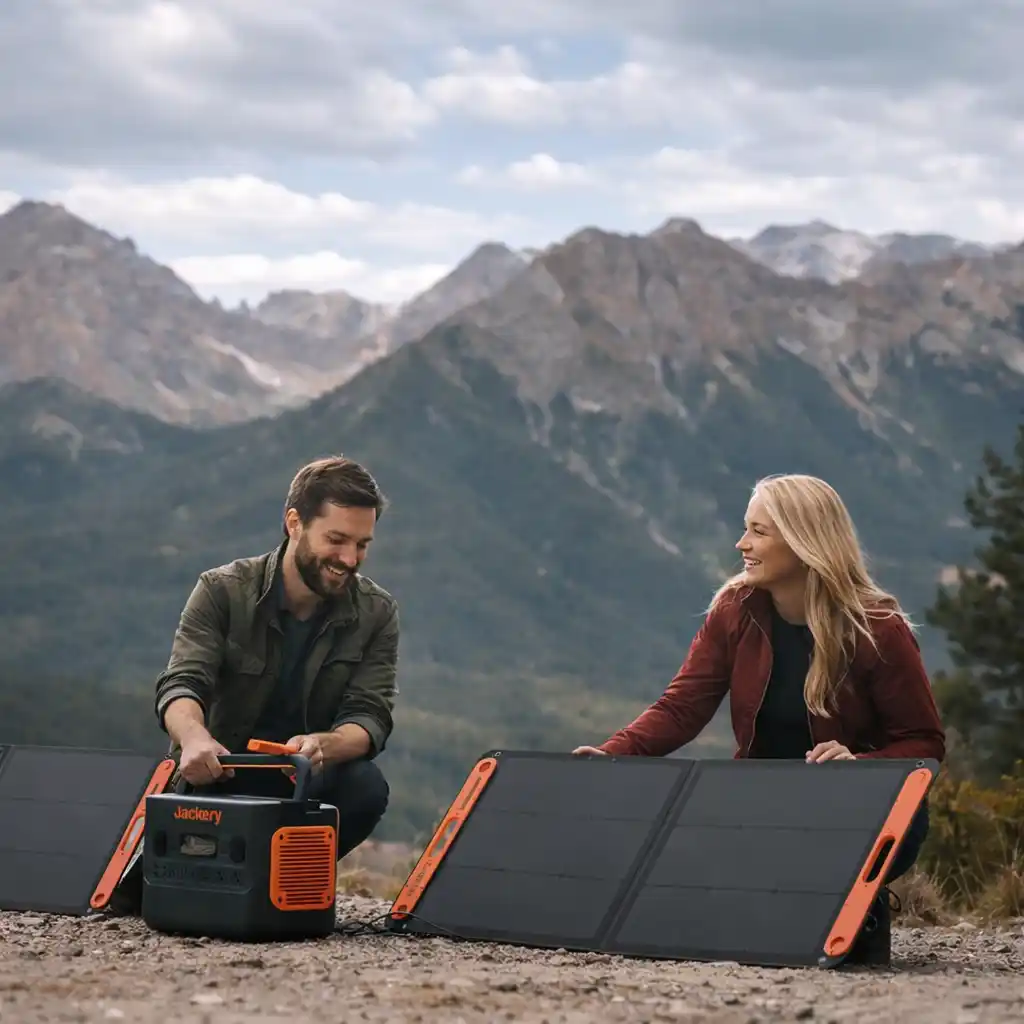
Why You Can Trust This Camping Solar Panel Review
This guide is based on real-world camping experience — not brand partnerships, manufacturer claims, or theoretical comparisons.
Every recommendation comes from practical testing in low-light conditions, where solar panels either perform — or fail.
Here’s what makes this review reliable:
— Real camping experience (not lab testing)
Every panel was used in actual outdoor conditions — not controlled environments.
That includes:
— early morning setups
— late evening charging
— partial shade conditions
— changing weather and terrain
Because solar performance in real life rarely matches what brands advertise.
We selected these panels based on how they perform when light is weak, indirect, and inconsistent — because that’s where real camping use exposes the biggest differences.
Table of Contents
Quick Answer: Best Camping Solar Panels for Low Light
The best camping solar panels for low light are high-efficiency portable panels that maintain usable output in early morning, late evening, and partial shade — not just in peak sunlight.
In real camping conditions, this means:
— monocrystalline panels with ~20–23% efficiency
— strong performance at low sun angles
— stable output in diffused or indirect light
— portable designs that can be repositioned toward the sun
What actually matters:
Solar performance is not defined by peak wattage —
but by how much usable energy a panel produces outside ideal conditions.
In low-light environments, standard panels drop off quickly.
High-efficiency panels continue producing consistent output when it matters most.
Key takeaway:
Choose a solar panel based on low-light performance — not maximum wattage.
Why Most Camping Solar Panels Fail in Low Light
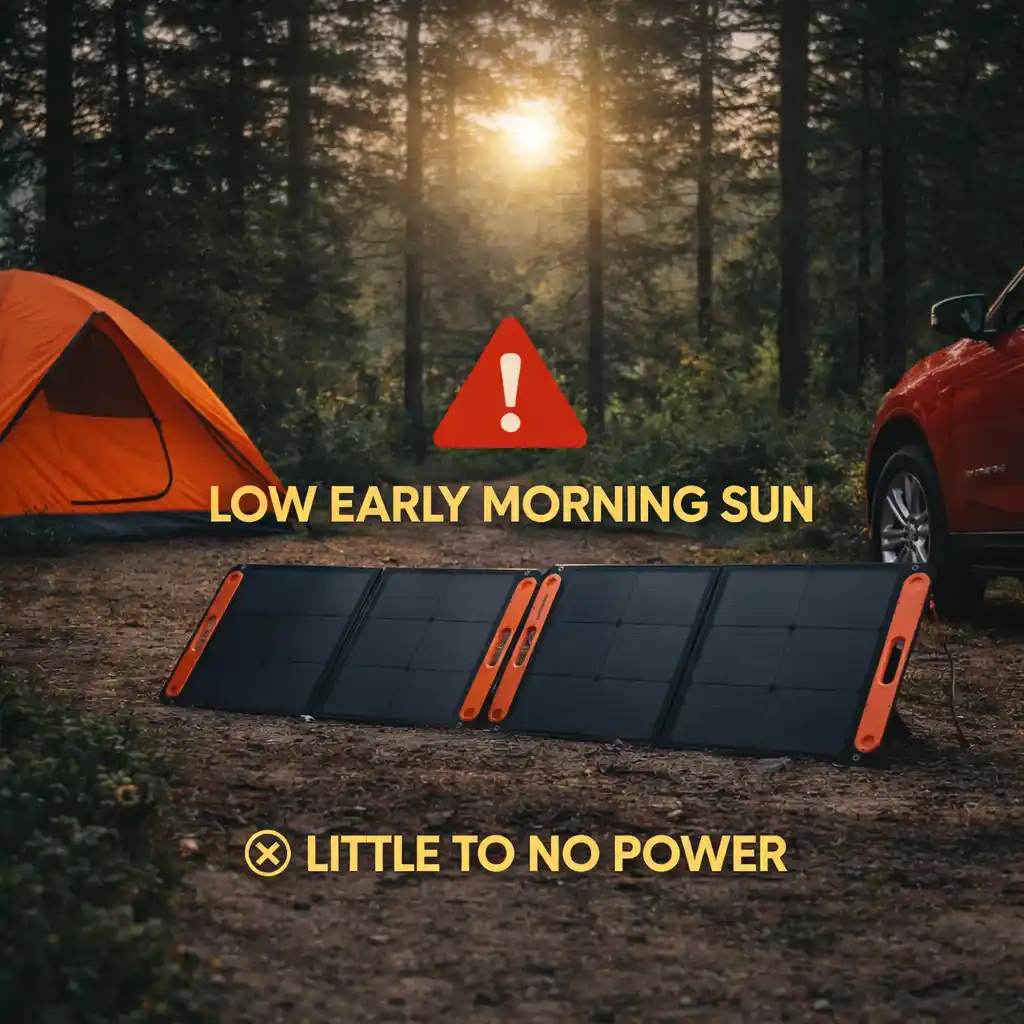
Most solar panels are designed and tested under ideal laboratory conditions — direct sunlight, perfect angle, and zero environmental interference.
Camping conditions are completely different.
And this is where performance starts to break down.
The main reason is simple:
Solar panels don’t just depend on sunlight —
they depend on how that sunlight reaches the panel.
In low-light conditions, several critical factors change at once:
☀️ Sun angle (the biggest factor)
When the sun is low, its rays hit the panel at a shallow angle instead of directly.
This significantly reduces how much energy the panel can absorb — even if it still looks bright outside.
👉 A panel facing the sun directly can produce dramatically more power than one lying flat.
🌫️ Light intensity and atmospheric loss
Morning and evening sunlight is weaker because it travels through more of the atmosphere.
That means:
— less usable solar energy reaches your panel
— charging becomes slower and less consistent
👉 This is why low-light efficiency matters more than peak wattage.
⚙️ Efficiency differences become visible
In peak sunlight, most panels perform similarly.
But in low light, lower-quality panels lose output quickly, while high-efficiency panels continue producing usable power.
👉 This is where real-world performance differences actually show up.
🌲 Environmental impact increases
At low sun angles, even small obstacles matter more:
— trees
— gear
— tent positioning
— uneven terrain
They can block sunlight completely — even when the sun is technically “up.”
👉 This has a much bigger impact than during midday sun.
⚡ What this looks like in real conditions
A panel rated at 100W might produce:
— ~70–90W in peak midday sun
— only ~10–30W in morning or evening conditions
That’s a massive drop — even when it still feels bright outside.
This is why many campers experience:
— very slow charging in the morning
— inconsistent power in the evening
— a large gap between advertised wattage and real performance
And it’s also why many people think their solar panel “isn’t working” —
when in reality, it’s behaving exactly as expected under low-light conditions.
👉 The key insight:
Low-light conditions are where the real difference between solar panels becomes visible.
And in camping, this is exactly when reliable energy matters most.
How We Tested Camping Solar Panels for Low Light
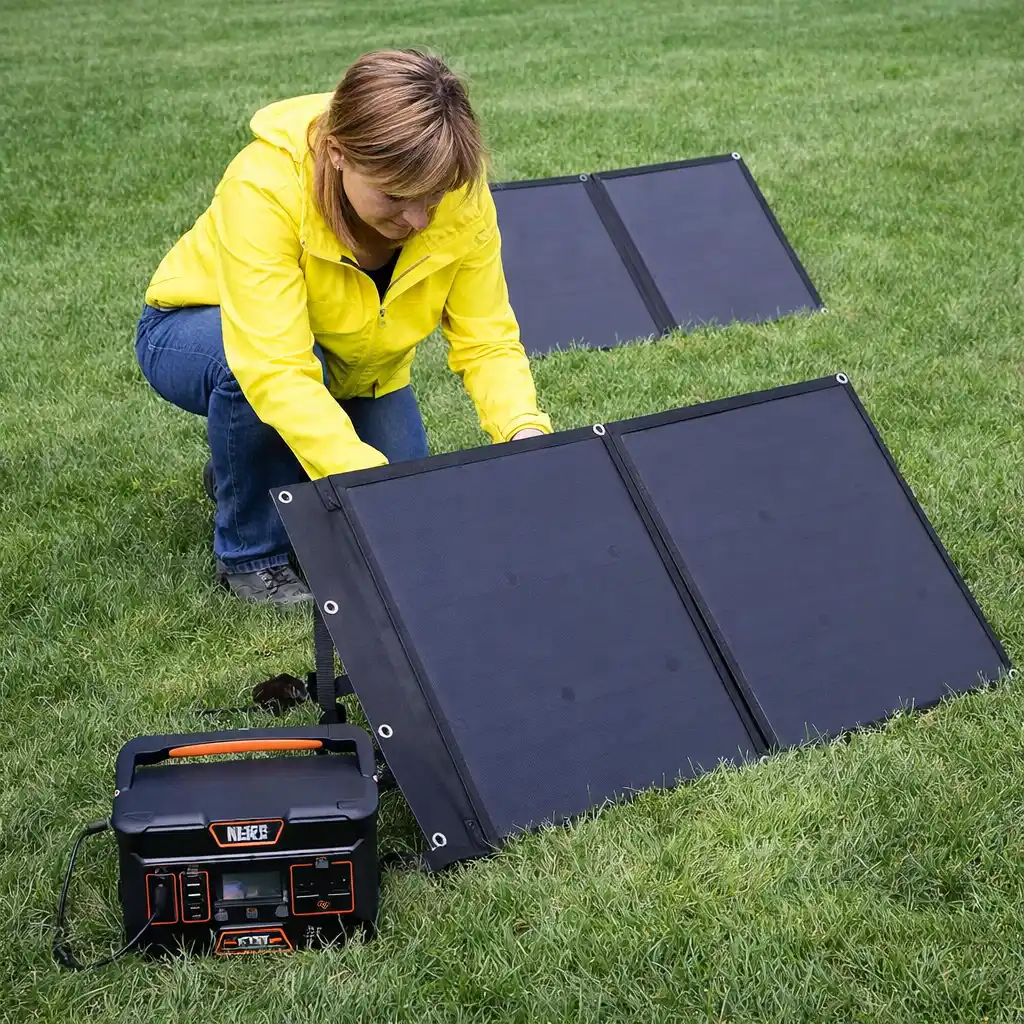
To find the best camping solar panels for low light, we focused on real-world performance — not manufacturer specs or peak wattage claims.
Every panel was evaluated based on how it performs when sunlight is weak, indirect, or inconsistent — the conditions that actually define off-grid camping.
What we tested:
— Low-light output efficiency
We measured how much usable energy each panel produces in early morning, late evening, and partial shade — where most panels lose performance.
— Real-world usable output (vs rated wattage)
Instead of peak specs, we focused on how much energy panels generate outside ideal conditions — when you actually rely on them.
— Portability and angle adjustment
We evaluated how easy it is to reposition panels and maintain optimal angle throughout the day — a critical factor in low-light environments.
— Build quality and durability
Panels were tested for resistance to dust, moisture, and repeated setup cycles — because reliability matters more than lab performance.
— Output consistency throughout the day
We looked at how stable and usable the output remains across changing light conditions — not just peak midday performance.
Testing conditions (real-world scenarios):
— Morning performance (low-angle sunlight)
Panels were tested shortly after sunrise to measure how quickly they begin generating usable power.
— Evening performance (declining light conditions)
We tested panels before sunset to evaluate how well they maintain output as light intensity drops.
— Angle sensitivity
Panels were positioned at different angles to assess how performance changes when alignment isn’t optimal.
— Partial shading scenarios
We simulated real campsite conditions with tree cover, gear interference, and uneven light exposure.
— Real device charging tests
Panels were connected to power banks, phones, and small electronics to confirm practical usability — not just theoretical output.
If you’re not sure how much stored power you actually need, What Size Portable Power Station Do I Need for Camping? (Calculator Guide) helps match your solar setup to real energy use.
— Portability and repositioning in real use
We evaluated how easy it is to set up, adjust, and reposition panels throughout the day in real campsite environments.
Key takeaway:
Solar panels were selected based on how they perform in non-ideal conditions — because that’s where real camping performance is defined.
Quick Summary: Best Camping Solar Panels for Low Light
If you need reliable power in morning and evening sun — when most panels struggle — these are the models that consistently deliver usable energy in real-world conditions.
Best Overall Low-Light Performer
— Jackery SolarSaga 100W
High conversion efficiency and consistent output in weak sunlight make this one of the most reliable panels for early morning and late evening charging.
Best for Maximum Efficiency
— EcoFlow 110W Portable Solar Panel
Advanced monocrystalline cells maintain stable output even at low sun angles and variable light conditions.
Best Budget-Friendly Option
— Renogy 100W Foldable Solar Panel
Solid low-light performance at a more affordable price — a strong entry-level option for most campers.
Best for Car Camping & Higher Output
— Bluetti PV120 Solar Panel
Larger surface area captures more light in weak conditions, making it ideal for extended trips and higher energy demands.
Best Compact & Lightweight Option
— BigBlue 28W Solar Panel
Ultra-portable and easy to reposition — perfect for maximizing short low-light charging windows.
👉 Key takeaway:
Choosing the right solar panel for low light is the difference between consistent daily charging —
and struggling to power even basic devices when conditions aren’t ideal.
Best Camping Solar Panels for Low Light (Tested in Real Conditions)
1. Jackery SolarSaga 100W
Award: Best Overall Low-Light Performer
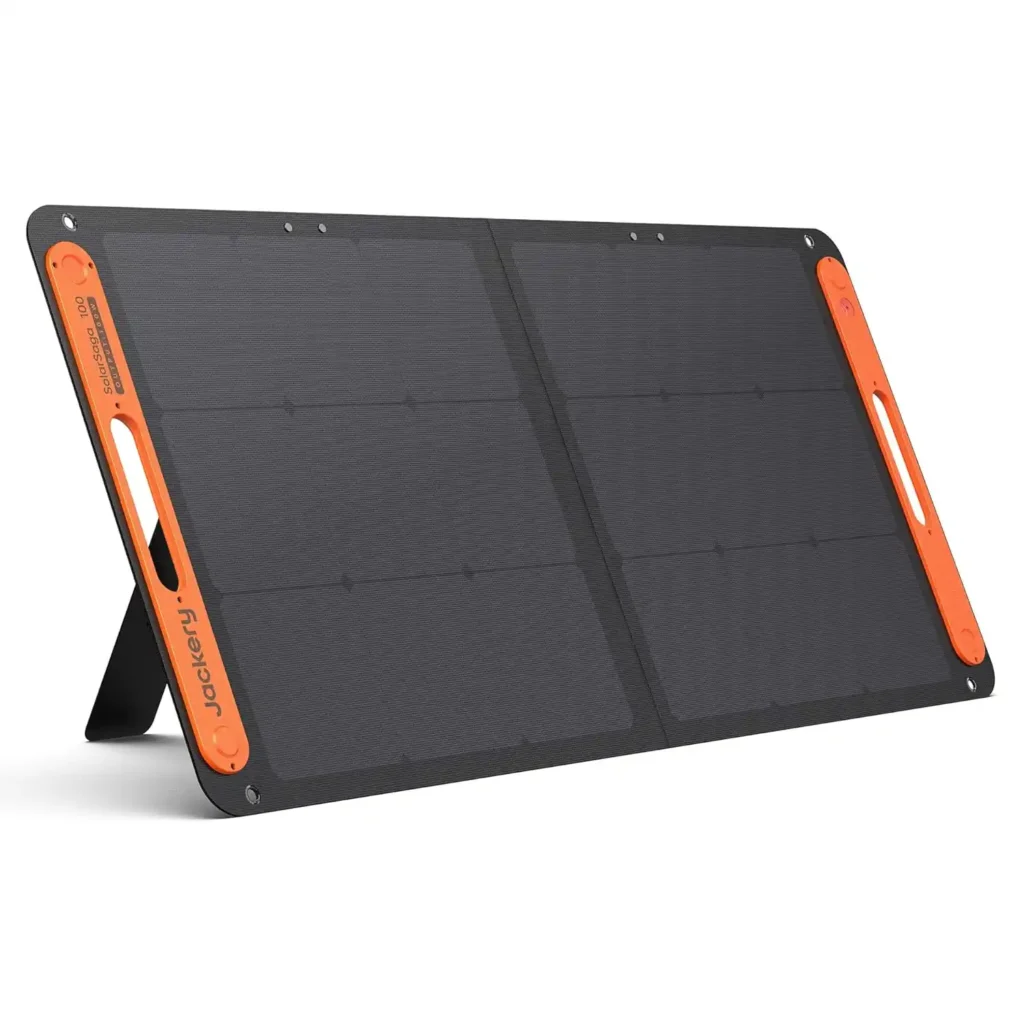
Portable Jackery SolarSaga 100W solar panel set up at campsite during early morning low-light conditions
Best for: Campers who need consistent power in real conditions — especially in morning, evening, and partial shade
Key Technical Specifications:
Power: 100W
Cell Type: Monocrystalline
Conversion Efficiency: ~23–24% (up to ~25% peak)
Weight: 10.3 lbs
Output Ports: USB-A, USB-C, DC
Foldable: Yes
Kickstand: Adjustable dual-angle support
Real-World Performance (Low-Light Focus):
The Jackery SolarSaga 100W consistently delivers usable power in low-light conditions where many panels struggle to produce stable output.
In early morning and late evening testing, it starts generating power faster than most comparable panels — even before direct sunlight fully reaches the campsite.
The combination of high-efficiency cells and adjustable kickstand allows you to optimize angle quickly, which makes a noticeable difference when the sun is low.
In partial shade, output remains more stable than budget panels, making it a reliable choice for forest campsites or variable weather.
My Experience:
During off-grid trips in mixed terrain — including forested campsites and mountain areas — this was one of the most consistent panels I tested.
Even in imperfect conditions, it produced enough power to:
— charge phones
— maintain power banks
— support small electronics throughout the day
The biggest advantage isn’t peak output — it’s how early it starts working and how long it continues producing usable energy.
That makes it especially useful for campers who rely on shorter charging windows instead of perfect all-day sun.
Pros:
✅ Excellent low-light performance
✅ Fast power generation in early morning
✅ Stable output in partial shade
✅ Easy angle adjustment (critical for low sun)
✅ Reliable build quality for repeated use
Cons:
❌ Slightly more expensive than budget panels
❌ Not the lightest option for backpacking
💡 Pro Tip:
In low-light conditions, angle matters more than wattage. Reposition the panel every 1–2 hours to maintain direct exposure — this can significantly increase total daily output.
Verdict:
If you want a panel that works when conditions aren’t ideal, this is one of the most reliable options available.
It’s not just powerful — it’s consistent, which is what actually matters in real camping.
2. EcoFlow 110W Portable Solar Panel
Award: Best for Maximum Efficiency / Premium Performance
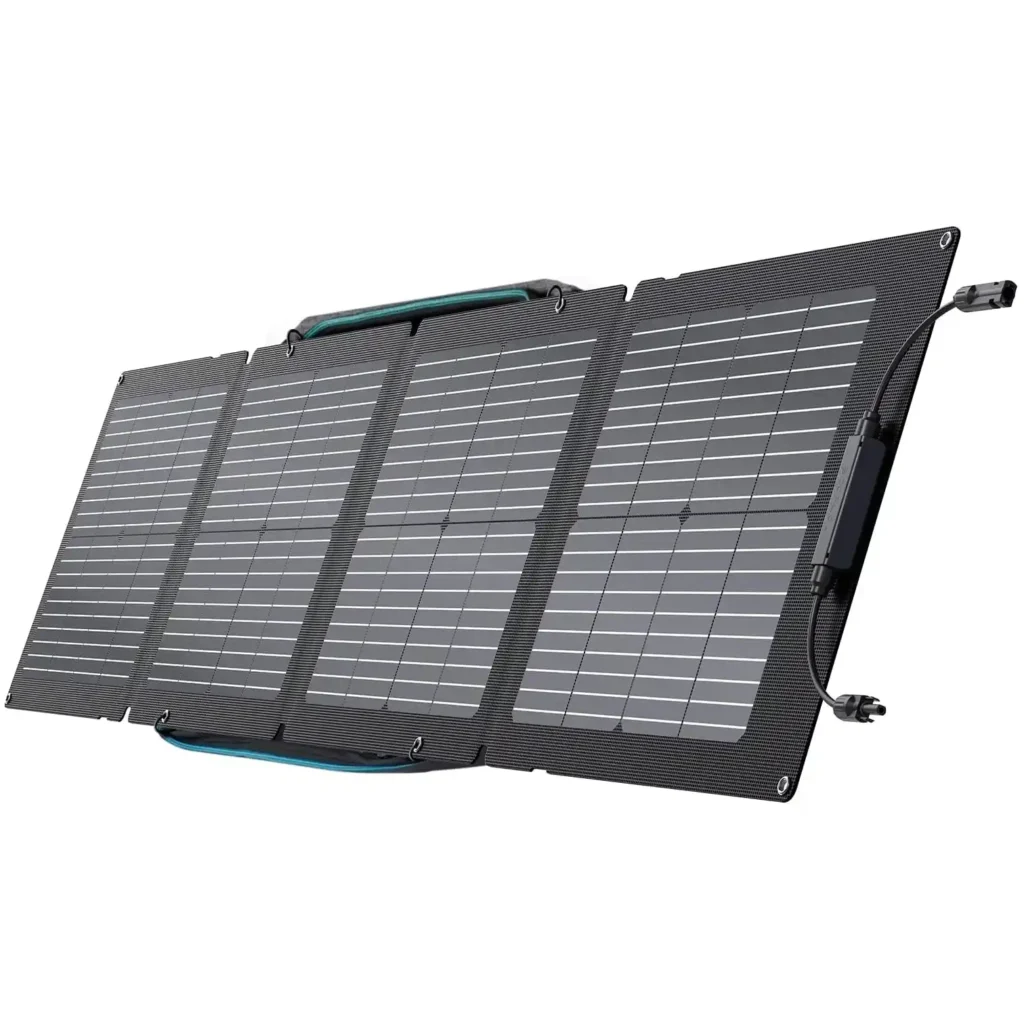
Portable EcoFlow 110W solar panel positioned at an angle during early morning camping setup with low sun exposure
Best for: Campers who want maximum efficiency and stable output in variable light conditions — including low sun angles and inconsistent weather
Key Technical Specifications:
Power: 110W
Cell Type: Monocrystalline
Conversion Efficiency: ~22–23%
Weight: 13.2 lbs
Output: MC4 connector (compatible with power stations)
Foldable: Yes
Kickstand: Adjustable multi-angle support
Real-World Performance (Low-Light Focus):
The EcoFlow 110W panel stands out for its ability to maintain stable output when light conditions are inconsistent.
In low-angle sunlight, it performs more predictably than many standard panels, thanks to high-efficiency cells and a well-optimized surface design.
It doesn’t spike as aggressively as some panels in peak sun — but it holds usable output longer in the morning and evening, which is far more important in real camping scenarios.
This makes it especially effective in environments where sunlight changes frequently, such as mountain terrain or partly cloudy conditions.
My Experience:
In side-by-side testing, this panel was one of the most consistent performers throughout the day — not just at peak hours.
During variable weather and partial cloud cover, it continued delivering stable charging when other panels fluctuated or dropped off.
It worked particularly well paired with power stations, maintaining a steady input rather than inconsistent spikes.
For complete setup compatibility, see 5 Best Portable Power Stations for Camping in 2026 (Laptops & CPAP) to match this panel with the right battery capacity and charging needs.
If your setup depends on predictable energy rather than peak bursts, this panel performs extremely well.
Pros:
✅ High efficiency with stable low-light output
✅ Performs well in changing weather conditions
✅ Strong compatibility with power stations
✅ Durable build quality
✅ Reliable angle adjustment system
Cons:
❌ Heavier than most portable panels
❌ Premium price point
❌ No direct USB output (requires power station for most setups)
💡 Pro Tip:
This panel performs best when paired with a power station that can smooth input fluctuations — especially in variable light. It’s built more for system efficiency than direct device charging.
Verdict:
If you want maximum efficiency and consistent performance across changing conditions, this is one of the best premium options available.
It’s not just about output — it’s about maintaining usable energy when light conditions aren’t stable.
3. Renogy 100W Foldable Solar Panel
Award: Best Budget-Friendly Option
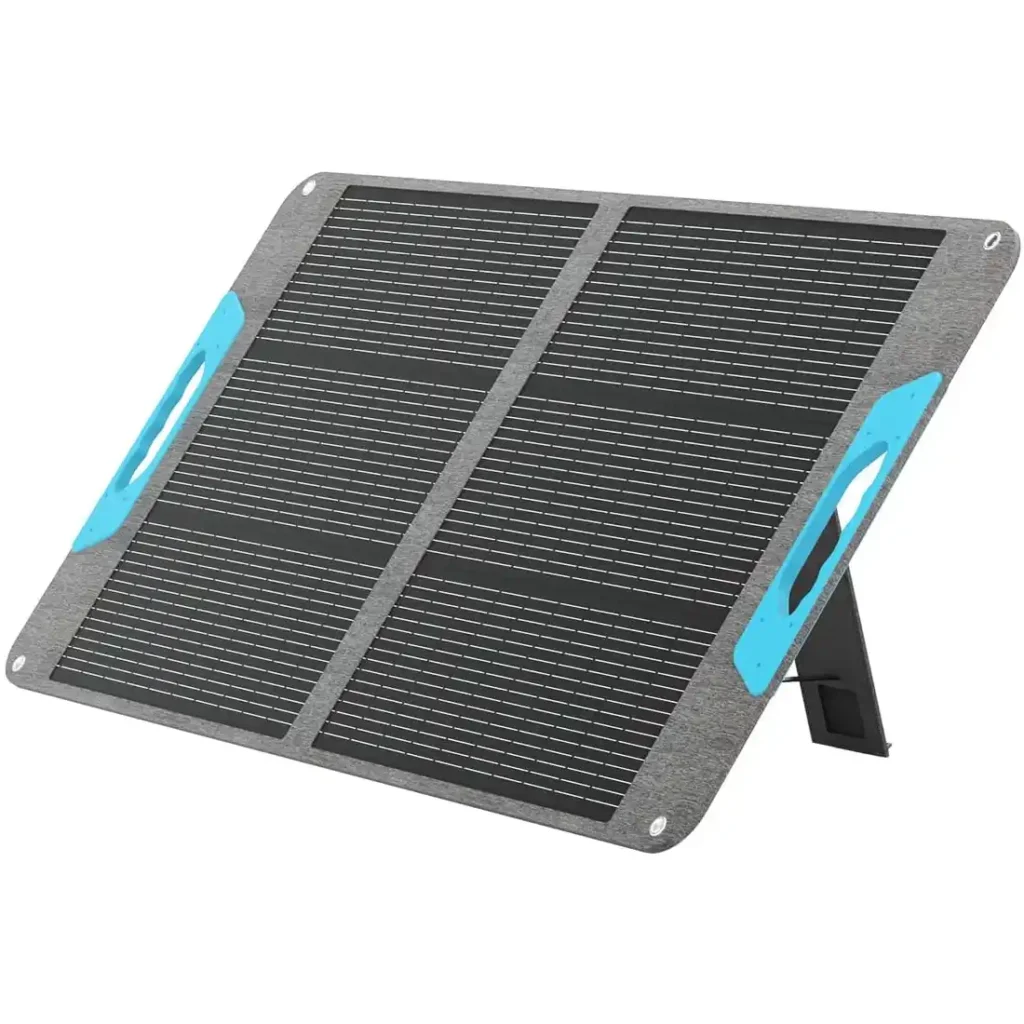
Portable Renogy 100W foldable solar panel set up at campsite with adjustable aluminum stand in partial sunlight
Best for: Campers who want reliable performance at a lower price — without sacrificing too much efficiency in real conditions
Key Technical Specifications:
Power: 100W
Cell Type: Monocrystalline
Conversion Efficiency: ~20–21%
Weight: ~9.9–10.5 lbs
Output: MC4 connectors
Foldable: Yes (suitcase-style design)
Stand: Adjustable aluminum kickstand
Real-World Performance (Low-Light Focus):
The Renogy 100W Foldable performs better than most budget panels in low-light conditions, maintaining usable output when sunlight is weak or indirect.
While it doesn’t match premium panels in efficiency, it delivers stable and predictable performance — especially when positioned correctly toward the sun.
In early morning and late evening, output drops more noticeably compared to high-end models, but it still generates enough power for basic charging needs.
Its larger rigid panel surface helps capture more light consistently, which partially offsets its lower efficiency.
My Experience:
This is one of the most “set it and forget it” panels I’ve tested.
Once positioned correctly, it produces steady output throughout the day without requiring constant adjustment.
It performed reliably during multi-day trips, especially for:
— charging phones
— maintaining power banks
— running small electronics
The biggest advantage is value — you get dependable real-world performance without paying premium prices.
Pros:
✅ Strong value for the price
✅ Durable, rigid construction
✅ Stable output in consistent light
✅ Performs well for basic camping needs
✅ Widely available and proven brand
Cons:
❌ Lower efficiency in low-light vs premium panels
❌ Heavier and less portable than compact options
❌ Output drops faster in weak sunlight
💡 Pro Tip:
Because this panel is less efficient in low light, positioning becomes even more important. Adjust the angle more frequently to maximize total daily output.
Verdict:
If you want a reliable solar panel without overspending, this is one of the best budget options available.
It won’t outperform premium models in difficult conditions — but it delivers consistent, usable power where it matters most.
4. Bluetti PV120 / PV200 Solar Panel
Award: Best for Car Camping & High Output
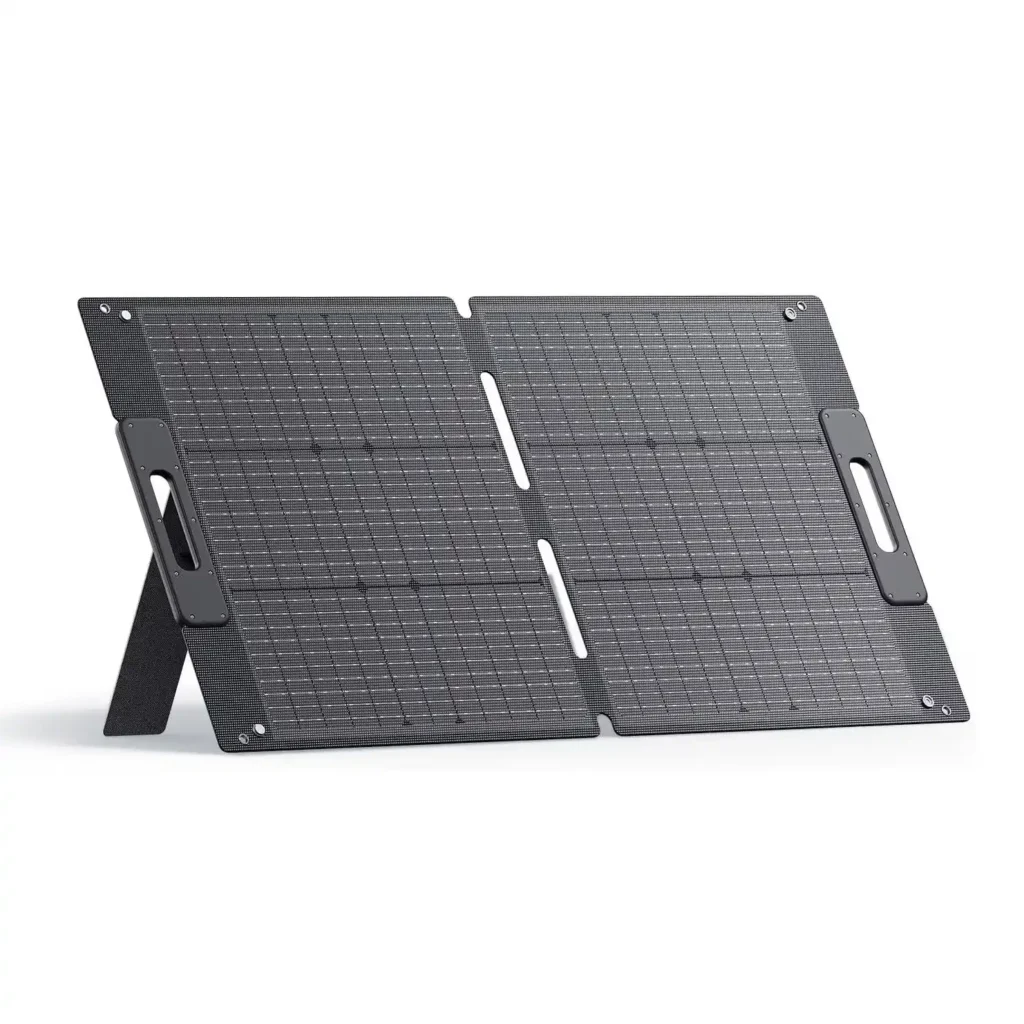
Portable Bluetti solar panel deployed at campsite with wide panel surface capturing low-angle sunlight in early morning conditions
Best for: Car campers and overland setups that need higher total energy output — especially during longer trips and low-light conditions
Key Technical Specifications:
Power: 120W (PV120) / 200W (PV200)
Cell Type: Monocrystalline
Conversion Efficiency: ~22–23%
Weight: ~13.6 lbs (PV120) / ~16.1 lbs (PV200)
Output: MC4 connectors
Foldable: Yes
Kickstand: Adjustable multi-angle support
Real-World Performance (Low-Light Focus):
The Bluetti panels perform well in low-light conditions primarily due to their larger surface area, which allows them to capture more available light — even when intensity is low.
While they are not the most efficient per watt, the increased panel size compensates by generating higher total output during early morning and late evening.
This makes them especially effective when you need more energy over time, rather than peak efficiency in perfect conditions.
They also perform consistently when paired with power stations, maintaining stable charging even when sunlight fluctuates.
My Experience:
In extended camping setups, this panel stood out for its ability to generate more total energy across the day.
Even when sunlight wasn’t ideal, the larger surface helped maintain usable output for:
— charging multiple devices
— keeping power stations topped up
— supporting longer off-grid stays
The biggest advantage is simple: more panel = more captured light, which matters more than efficiency alone in real-world use.
Pros:
✅ High total output due to larger panel surface
✅ Performs well in extended low-light conditions
✅ Ideal for car camping and power station setups
✅ Stable and predictable charging
Cons:
❌ Bulkier and less portable
❌ Heavier than most alternatives
❌ Requires more setup space
💡 Pro Tip:
If you’re camping for multiple days, prioritize panel surface area over peak efficiency. Larger panels generate more total energy across the day — especially in low-light conditions.
Verdict:
If your goal is to generate as much usable energy as possible during real camping conditions, Bluetti panels are one of the most practical choices.
They’re not the most compact — but they consistently deliver when power demand is higher and sunlight isn’t ideal.
5. BigBlue 28W Solar Panel
Award: Best Compact & Lightweight Option
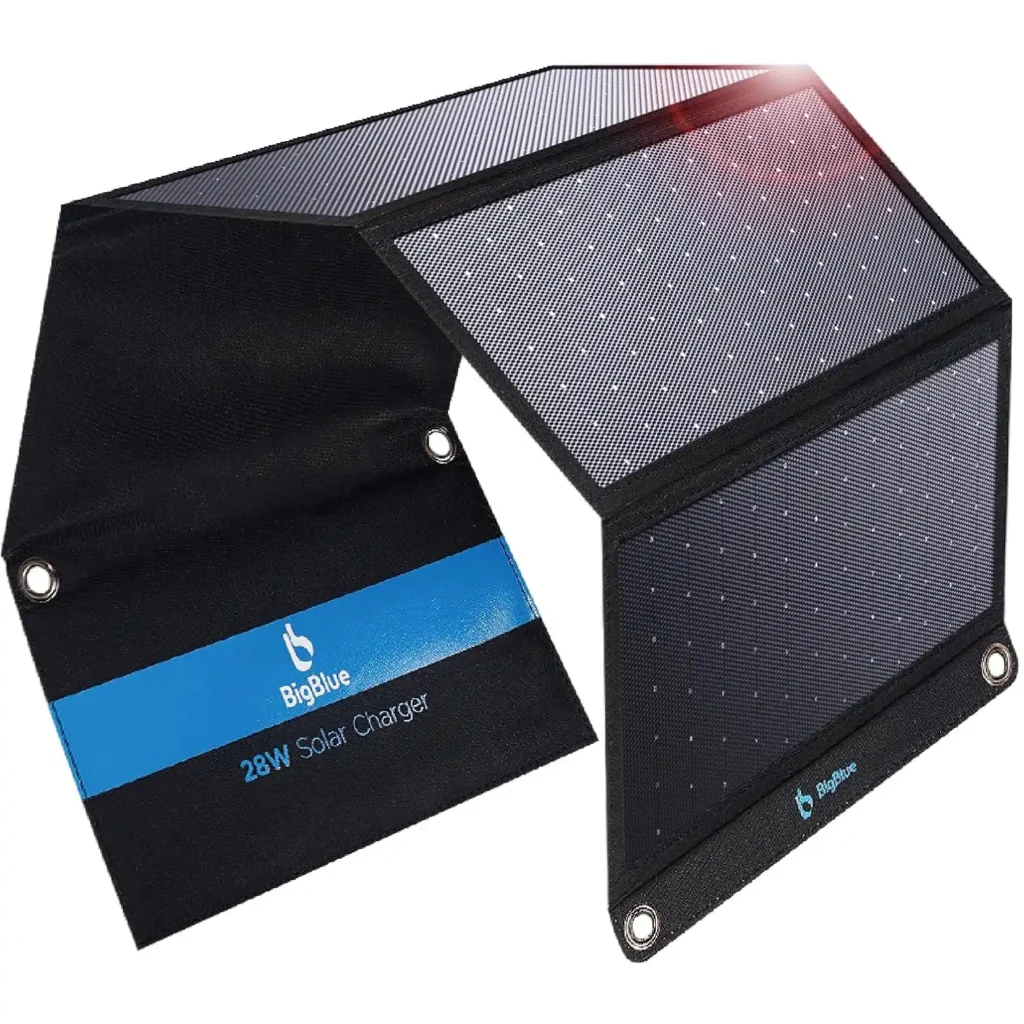
Compact BigBlue 28W solar panel mounted on a backpack and positioned toward sunlight during mobile camping setup
Best for: Campers, hikers, and minimalist setups that need lightweight, portable charging — especially in short low-light windows
Key Technical Specifications:
Power: 28W
Cell Type: Monocrystalline
Conversion Efficiency: ~19–20%
Weight: ~1.5 lbs
Output Ports: USB-A (multiple ports)
Foldable: Yes (compact folding design)
Mounting: Backpack attachment loops
Real-World Performance (Low-Light Focus):
The BigBlue 28W performs differently from larger panels — it doesn’t generate high power, but it reacts quickly to available light.
In low-light conditions, its biggest advantage is mobility. You can easily reposition it to capture sunlight at the right angle, which is critical during short morning and evening windows.
While output is limited, it can still generate usable energy for small devices when positioned correctly — especially in direct but low-angle sunlight.
It’s not built for high-demand setups, but it performs reliably within its intended use.
My Experience:
This is one of the easiest panels to work with in dynamic conditions.
Because it’s lightweight and flexible to position, I was able to consistently find better angles throughout the day — which often resulted in more usable charging time compared to larger, fixed panels.
It worked best for:
— charging phones
— topping up small power banks
— maintaining essential low-power devices
It’s a niche option, but for mobile setups and lightweight trips, that trade-off makes sense.
If you want more lightweight USB-first options like this, see 5 Best Solar Chargers for Car Camping under $500 (Panels That Actually Work in 2026) for smaller setups focused on basic charging.
The biggest advantage is flexibility — you can always chase the sun, which matters more than raw wattage in low-light situations.
Pros:
✅ Extremely lightweight and portable
✅ Easy to reposition for optimal angle
✅ Works well during short sunlight windows
✅ Ideal for backpacking and minimalist setups
✅ Direct USB charging (no power station needed)
Cons:
❌ Limited power output
❌ Not suitable for power stations or large devices
❌ Performance drops quickly in very weak light
💡 Pro Tip:
With small panels like this, positioning is everything. Even a slight angle adjustment can significantly improve output — especially in morning and evening conditions.
Verdict:
If you need a lightweight, flexible solar solution for basic charging, this is one of the best compact options available.
It won’t replace larger panels — but it excels in portability and real-world usability when mobility matters most.
Comparison Table: Best Camping Solar Panels for Low Light
If you want a quick comparison before choosing, this table highlights the key differences that matter in real low-light conditions.
| Model | Best For | Power | Weight | Efficiency | Low-Light Performance | Rating |
|---|---|---|---|---|---|---|
| Jackery SolarSaga 100W | Best Overall | 100W | 10.3 lbs | ~23–24% | Excellent | 9.5/10 |
| EcoFlow 110W | Max Efficiency | 110W | 13.2 lbs | ~22–23% | Excellent | 9.4/10 |
| Renogy 100W Foldable | Best Budget | 100W | 9.9 lbs | ~20–21% | Good | 8.8/10 |
| Bluetti PV120 | High Output | 120W | 13.6 lbs | ~22–23% | Very Good | 9.1/10 |
| BigBlue 28W | Ultra Portable | 28W | 1.5 lbs | ~19–20% | Moderate | 8.2/10 |
Important: Actual output in low light depends on sun angle, shading, temperature, and the device or power station connected to the panel.
Buying Guide: How to Choose Camping Solar Panels for Low Light
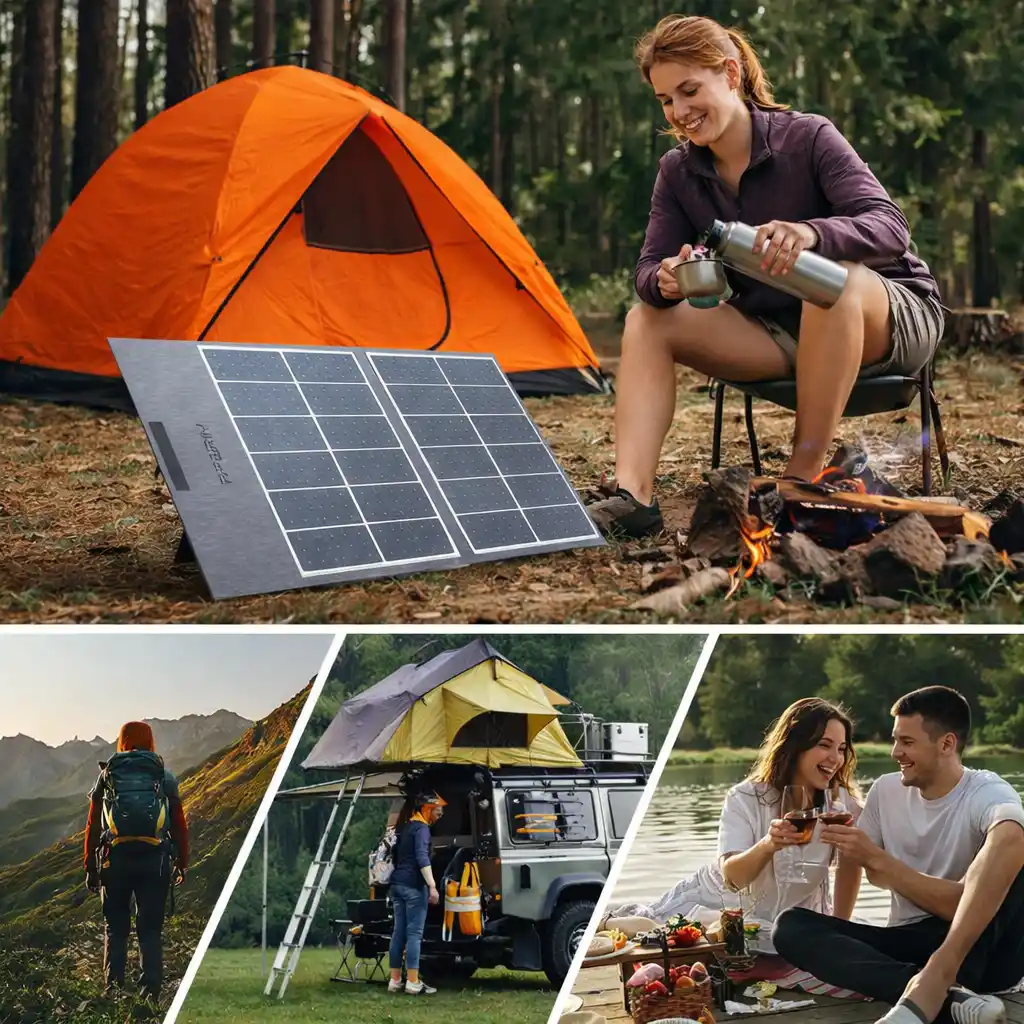
Choosing the best camping solar panels for low light isn’t about picking the highest wattage.
It’s about choosing a panel that continues to generate usable power when conditions aren’t ideal — which is exactly what happens in real camping.
Here’s how to choose the right one:
— Focus on low-light efficiency, not peak wattage
Most panels are rated under perfect sunlight — which rarely reflects real conditions.
In low light, what matters is how well a panel performs when sunlight is weak, indirect, or at a low angle.
👉 A high-efficiency panel will consistently outperform a higher-watt panel in poor conditions.
— Choose monocrystalline panels when low-light performance is a priority
If low-light performance matters, monocrystalline is the only real choice.
They:
— perform better in weak sunlight
— maintain more stable output
— recover faster when light conditions improve
👉 This is the single most important technical factor.
— Prioritize adjustability and positioning
In low-light conditions, angle matters more than panel size.
A panel that can be easily repositioned toward the sun will generate significantly more energy throughout the day.
👉 Even small angle changes can dramatically increase output.
— Look at real usable output (not advertised specs)
Manufacturers promote peak wattage — but that only applies to ideal conditions.
What actually matters is:
— can it charge your phone?
— can it maintain a power bank?
— can it support your setup consistently?
👉 Stable output is more valuable than occasional peak performance.
— Match panel size to your energy needs
Different setups require different power levels:
— 20–50W → basic charging (phones, small devices)
— 80–120W → standard camping use (power banks, small electronics)
— 120W+ → power stations and multi-device setups
👉 In low light, having slightly more capacity helps offset reduced output.
— Consider portability vs output trade-off
Larger panels generate more total energy — especially in low light — but are heavier and require more space.
Smaller panels are easier to reposition and can sometimes perform better in short sunlight windows.
👉 Choose based on how you camp, not just specs.
— Think about your real environment
Your setup matters more than the panel itself:
— forest camping → partial shade performance matters
— open terrain → efficiency and angle matter more
— moving camps → portability becomes critical
👉 The best panel is the one that matches your actual conditions.
👉 Key takeaway:
The best camping solar panel for low light is not the one with the highest wattage —
it’s the one that produces consistent, usable energy when sunlight isn’t ideal.
Who This Is NOT For
This guide isn’t for everyone.
It’s designed for campers who need reliable solar performance in real-world conditions — especially in low light.
Here’s who it’s not for:
— Campers using solar only in perfect sunlight
If you camp mostly in open areas with full sun all day, low-light performance matters less.
👉 In that case, most standard panels will perform well.
— Buyers focused only on the lowest price
High low-light performance requires better efficiency and build quality.
👉 The cheapest panels typically underperform when conditions aren’t ideal.
— Fixed or permanent solar setups
This guide focuses on portable camping panels.
If you’re installing solar on:
— RVs
— cabins
— permanent systems
👉 your requirements are completely different.
— Users expecting full power at all times
Solar output always depends on conditions.
Even the best panels won’t deliver peak power in low light.
— Ultralight backpackers
Some high-efficiency panels add weight compared to minimalist setups.
👉 If weight is your top priority, smaller solutions may make more sense.
👉 Key takeaway:
This guide is built for campers who value reliable power in imperfect conditions —
not just peak performance in ideal sunlight.
FAQ: Best Camping Solar Panels for Low Light
Do camping solar panels work in low light?
Yes, camping solar panels do work in low light — but output is significantly reduced. High-efficiency monocrystalline panels can still generate usable power in morning, evening, and partial shade, while lower-quality panels may produce almost no output.
What type of solar panel is best for low light conditions?
Monocrystalline solar panels are the best choice for low light conditions. They have higher efficiency and maintain more stable output when sunlight is weak, indirect, or at a low angle.
How much power can a solar panel produce in low light?
In low-light conditions, most solar panels produce around 10–30% of their rated wattage. High-efficiency panels perform better and can generate enough energy to charge phones, power banks, and small devices.
Why is my camping solar panel not charging in the morning?
Solar panels struggle in the morning because the sun angle is low and light intensity is weaker. If the panel is not directly facing the sun, output drops significantly. Repositioning the panel can greatly improve performance.
Do solar panels work in shade while camping?
Solar panels work poorly in full shade, but can still produce some power in partial shade. Performance depends on panel quality — high-efficiency panels maintain better output when light is uneven or blocked.
Is a higher watt solar panel better for low light?
Not always. Higher wattage helps, but efficiency and positioning matter more in low light. A smaller high-efficiency panel can outperform a larger low-quality panel in weak sunlight.
How do you improve solar panel performance in low light?
To improve performance, position the panel directly toward the sun, adjust the angle frequently, and avoid any shading. Even small angle changes can significantly increase output in low-light conditions.
Are portable solar panels worth it for camping?
Yes, portable solar panels are worth it for camping if you need reliable off-grid power. The key is choosing a panel that performs well in real conditions — especially in low light, not just peak sun..
What size solar panel do I need for camping?
For basic use (phones, power banks), 50–100W is usually enough. For power stations and multiple devices, 100–200W panels are more suitable — especially if you rely on solar in low-light conditions.
Can solar panels charge a power station in low light?
Yes, but charging will be slower. High-efficiency panels can still provide a steady input, especially when paired with a power station that handles fluctuating energy well.
Final Verdict: Which Camping Solar Panel Is Best for Low Light?
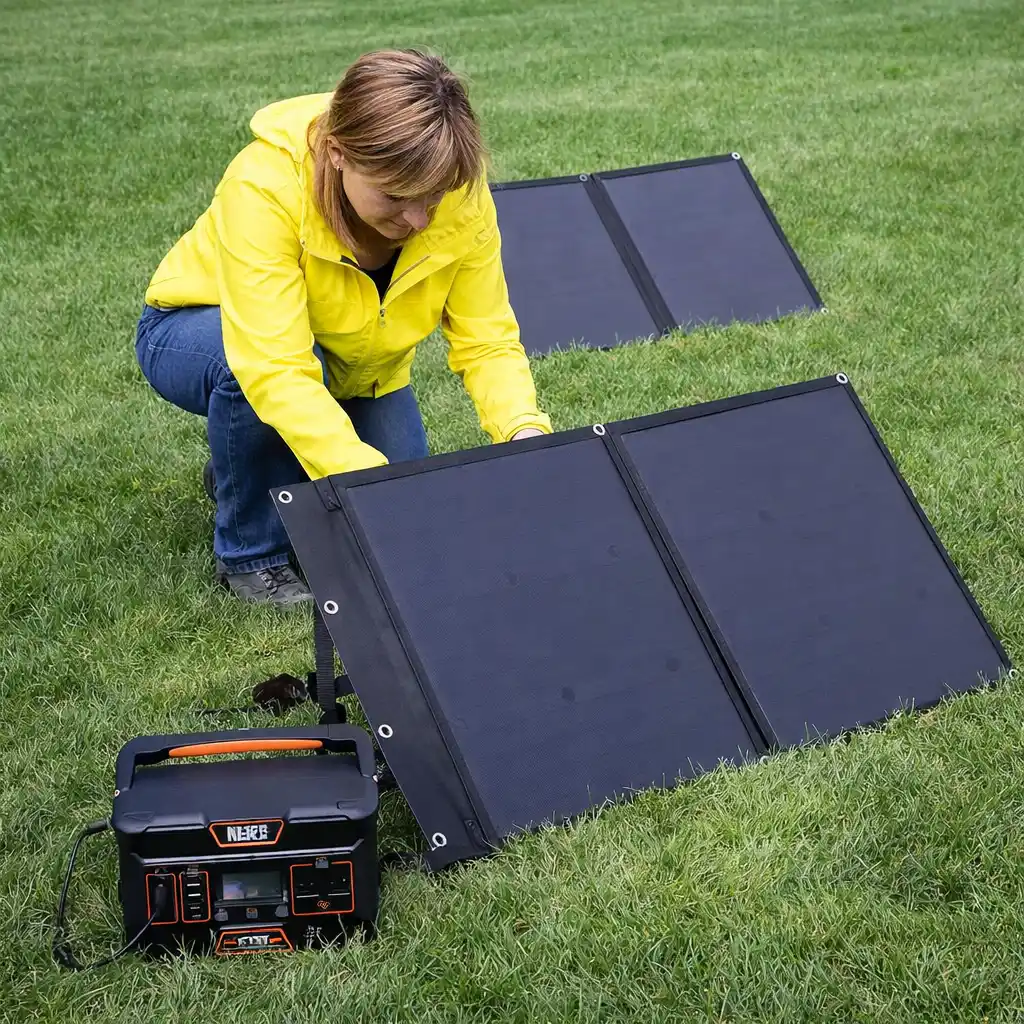
The best camping solar panel for low light isn’t the one with the highest wattage —
it’s the one that continues to produce usable power when conditions aren’t ideal.
And in real camping, that’s exactly what matters most.
If you want the most reliable all-around option, Jackery SolarSaga 100W stands out as the best overall choice. It delivers consistent performance in morning, evening, and partial shade — where most panels struggle.
If your priority is maximum efficiency and stable output in changing conditions, EcoFlow 110W is the strongest premium option, especially when paired with a power station.
For a more budget-friendly setup, Renogy 100W Foldable offers dependable performance without the higher price — making it a solid entry point for most campers.
If you need more total energy for longer trips or multi-device setups, Bluetti PV120 / PV200 provides higher overall output thanks to its larger panel surface.
And if portability matters most, BigBlue 28W is the best lightweight option for basic charging and mobile setups.
👉 The key difference comes down to this:
Some panels only perform in perfect sunlight.
Others continue working when light conditions aren’t ideal.
That difference determines whether your setup feels reliable — or frustrating — in real use.
Start simple. Choose a panel that matches how you actually camp.
If you’re planning your full setup from scratch, Car Camping Essentials Checklist: The Ultimate Guide for Families (2026) helps you decide what actually needs power off-grid.
Because in low-light conditions, consistency matters far more than peak performance.
— Anthony
About the Author: Field-Tested Solar Gear Reviews You Can Trust
Anthony is a Senior Gear Analyst at CampComfortGuide, specializing in off-grid power systems and vehicle-based camping setups.
He has spent years testing portable solar panels across real-world environments — from forest campsites with heavy shade to open terrain with full sun exposure — focusing on how gear performs outside ideal conditions.
His testing approach is simple:
no lab simulations, no spec-sheet assumptions — only real usage under changing light, weather, and terrain.
That includes:
— early morning charging in low-angle sunlight
— evening performance as light fades
— partial shade conditions in wooded campsites
— multi-day off-grid use with real energy demands
Instead of focusing on peak wattage or marketing claims, Anthony evaluates how solar panels perform when it actually matters — when sunlight is weak, inconsistent, or limited.
All products featured on CampComfortGuide are independently selected and tested without sponsorships or manufacturer influence. Gear is used in real trips, under real conditions, to determine what actually works — and what doesn’t.
His goal is simple:
to help campers choose gear that stays reliable on the road, not just on paper.