
Best sleeping tents for camping are designed to improve nighttime comfort by offering better ventilation, more space for sleep systems, and quieter performance after dark.
Most campers blame their sleeping bag or mattress when the real problem is how their tent handles airflow, moisture, and space overnight.
Hi, I’m Anthony.
I’ve been camping for years, from quick weekend car trips to longer family outings where comfort actually matters. Over time, I learned the hard way that a good night’s sleep can make or break a camping trip — and that your tent plays a much bigger role in sleep quality than most people think.
I’ve tested and used a wide range of camping tents in different conditions, paying close attention to ventilation, space for real sleep systems, nighttime temperature control, and how well a tent performs once the sun goes down. This guide focuses on tents that help you sleep comfortably, not just stay dry.
If you’re still dialing in your setup, start with our car camping sleep system guide to understand how tents, mattresses, and insulation work together at night.
Every recommendation here is based on hands-on experience, real-world use, and what actually works when you’re trying to get proper rest outdoors.
As an Amazon Associate, we earn from qualifying purchases.

🏆 Best Sleeping Tents for Camping — Quick Picks
If you just want the short answer, these tents stood out most during testing.
• Best Overall for Comfortable Sleep: MSR Elixir 4 — best balance of ventilation, interior space, and stable nighttime performance
• Best Budget Sleeping Tent: Coleman Skydome 4P — affordable, spacious enough for air mattresses, and surprisingly stable overnight
• Best for Couples: ALPS Mountaineering Camp Creek 6 — tall walls and generous floor length reduce fabric contact and sleep disturbance
• Best for Hot Weather Camping: Gazelle T4 Hub Tent — excellent airflow and tight pitch help reduce condensation and overheating
• Best for Bad Weather Sleep: CORE 6P Instant Cabin — large cabin structure provides stable interior space for families and restless sleepers
If sleep quality is your top priority, focus on ventilation, internal space, and nighttime stability — not just waterproof ratings or packed weight.
Below you’ll find the full comparison and detailed field-tested reviews.
🔍 How We Evaluated Sleeping Tents for This Guide
We evaluated each tent in this guide based on how it performs during real overnight sleep conditions, not just daytime comfort or manufacturer specifications.
Our evaluation focused on factors that directly impact sleep quality, including:
Ventilation performance at night, especially with the rainfly fully on
Interior volume versus actual sleep setup, such as air mattresses, double sleeping bags, and cots
Condensation control in humid, cool, and mixed weather conditions
Fabric tension and noise, which affect how often sleep is interrupted
Real-world sleep scenarios, including couples sharing a mattress, restless sleepers, and temperature drops after midnight
Only tents that consistently supported uninterrupted, predictable sleep across these criteria were included in this list.
🧪 Our Sleep Comfort Evaluation System

To make comparisons more consistent, each tent in this guide was evaluated using a sleep-focused scoring system based on real overnight conditions.
Instead of relying on manufacturer specifications alone, I scored each tent using five factors that directly influence sleep quality.
Ventilation Performance (25%)
How well the tent maintains airflow with the rainfly fully installed.
Interior Sleep Space (25%)
How comfortably real sleep systems fit inside the tent without touching damp walls.
Condensation Control (20%)
How effectively moisture escapes during humid or cool nights.
Noise & Fabric Stability (15%)
How quiet the tent remains during nighttime wind or shifting temperatures.
Ease of Night Movement (15%)
How easily campers can adjust positions, exit the tent, or shift gear without disturbing others.
Each tent received a Sleep Comfort Score based on these real-world performance factors.
🛏 What Makes a Tent Good for Sleeping?

A tent that’s great for sleeping isn’t defined by price or brand. It’s defined by how it performs between midnight and sunrise.
Here’s what truly matters:
🌬 Ventilation & Condensation Control
Poor airflow leads to moisture buildup, dripping walls, and damp sleeping bags.
Sleep-friendly tents prioritize:
multiple vents at different heights
mesh panels that don’t sacrifice privacy
fly designs that allow air movement even in rain
Condensation is one of the biggest sleep killers, especially in humid or cold conditions. If this is a recurring issue, see our guide on how to stop condensation in a tent.
📐 Space for Real Sleep Systems
If your tent barely fits the floor dimensions on paper, it won’t work with:
thick air mattresses
camping cots
double sleeping pads
Comfortable sleep usually requires oversizing the tent by at least one person.
🧠 Why Choosing a Larger Tent Often Improves Sleep
Many campers choose tent capacity based strictly on the number of people sleeping inside.
In practice, this often leads to cramped sleeping conditions.
A more realistic approach is to size up by one person when sleep comfort is the priority.
For example:
• Solo campers often sleep better in 2-person tents
• Couples usually benefit from 3-person tents
• Families often need one extra capacity rating
The extra interior volume reduces condensation density, prevents sleeping bags from contacting tent walls, and allows more natural movement during the night.
For campers focused on better sleep, interior space is often more important than weight savings.
🌡 Thermal Stability at Night
Night temperatures fluctuate more than daytime weather.
Good sleeping tents:
reduce drafts without trapping moisture
keep heat longer in cold conditions
avoid sauna-like buildup in warm climates
🔇 Noise & Fabric Tension
Flapping fabric, rattling poles, and loose guy lines wake you up.
Sleep-optimized tents use:
heavier fabrics
tighter pitch geometry
stable pole structures
🌙 What Actually Wakes Campers Up at Night
When campers complain about poor sleep outdoors, the cause is rarely a single factor.
In most cases, sleep disruption comes from a combination of small issues that build throughout the night.
Condensation forming inside the tent
Moisture buildup often peaks between 3–5 AM when temperatures drop.
Fabric movement during wind shifts
Even light wind can create repetitive flapping that interrupts deep sleep cycles.
Temperature swings after midnight
Rapid cooling causes heat loss through sleeping pads and tent floors.
Limited movement space
Small tents force sleepers into rigid positions, leading to discomfort over long nights.
The tents in this guide were chosen because they reduce these disruptions and maintain more stable overnight conditions.
👨👩👧 Partner & Movement Comfort
If one person rolling over wakes the other, sleep quality drops fast.
Larger floor plans and vertical walls help minimize motion transfer.
⚠️ Why Many Camping Tents Still Lead to Poor Sleep

Many campers assume that a bigger sleeping bag or thicker mattress will solve their sleep problems. In reality, the tent itself often creates the issue.
Most camping tents are designed to keep you dry, not necessarily to help you sleep well overnight.
Common design problems include:
Poor ventilation with the rainfly installed
Many tents ventilate well during the day but trap moisture once the rainfly goes on at night.
Low interior volume
Compact designs force sleeping bags and mattresses against damp tent walls.
Loose fabric structures
When wind picks up after midnight, flapping fabric and vibrating poles frequently wake campers.
Condensation traps
Without proper airflow, humidity from breathing and wet gear builds up quickly.
The result is a common camping experience: waking up damp, overheated, or repeatedly disturbed during the night.
That’s why this guide focuses on tents that perform after sunset, when real sleep conditions begin.
📊 Quick Comparison: Best Sleeping Tents
| Tent | Capacity | Weight | Peak Height | Best For | Sleep Comfort |
|---|---|---|---|---|---|
| MSR Elixir 4 | 4P | 9 lb 3 oz | 48 in | Best Overall | 9.5 / 10 |
| Coleman Skydome 4P | 4P | 10 lb | 59 in | Best Budget | 8.5 / 10 |
| ALPS Mountaineering Camp Creek 6 | 6P | 19 lb | 84 in | Couples / Space | 9 / 10 |
| Gazelle T4 Hub Tent | 4P | 30 lb | 78 in | Hot Weather | 8.8 / 10 |
| CORE 6P Instant Cabin | 6P | 17 lb | 72 in | Family Comfort | 9 / 10 |
💤 Tent Sleep Comfort Scores

To make the comparison more practical, I scored each tent based on how well it performs during real overnight conditions — not just specs.
Each score reflects how well the tent supports quiet, dry, and stable sleep across typical camping scenarios.
Sleep Comfort Score Breakdown
| Tent | Ventilation | Sleep Space | Condensation Control | Noise Stability | Overall Sleep Comfort |
|---|---|---|---|---|---|
| Coleman Skydome 4P | 8 | 9 | 8 | 8 | 8.5 / 10 |
| CORE 6P Instant Cabin | 8 | 9 | 8 | 9 | 9 / 10 |
| MSR Elixir 4 | 9 | 9 | 9 | 9 | 9.5 / 10 |
| Gazelle T4 Hub Tent | 8 | 8 | 8 | 9 | 8.8 / 10 |
| ALPS Mountaineering Camp Creek 6 | 8 | 9 | 8 | 8 | 9 / 10 |
How to Read These Sleep Comfort Scores
These scores reflect how well each tent performs during real overnight conditions rather than daytime comfort or manufacturer specifications.
Each tent was evaluated based on factors that directly influence sleep quality, including ventilation with the rainfly installed, interior space for real sleep systems, condensation control during humid nights, and how stable and quiet the tent remains during wind shifts.
A higher score indicates that a tent consistently provides more stable and comfortable sleep across different camping conditions.
🏆 Quick Summary: Best Sleeping Tents for Camping
Best Overall: Coleman Skydome 4P
Why: Near-vertical walls provide enough space for a full air mattress without fabric sagging, improving nighttime comfort for couples.
Best for Families: CORE 6P Instant Cabin
Why: The wide cabin-style layout reduces movement disturbance and gives everyone more personal sleep space.
Best Balanced Sleep & Versatility: MSR Elixir 4
Why: A stable structure and well-balanced ventilation help control condensation and maintain consistent sleep comfort across changing night conditions.
Best for Fast Setup: Gazelle T4 Hub Tent
Why: The hub-style design pitches tight and quiet in minutes, minimizing setup fatigue before sleep.
Best for Tall Sleepers: ALPS Mountaineering Camp Creek 6
Why: A longer floor length and straight walls prevent foot-end compression and improve overall sleep comfort for taller campers.
🏕 Best Sleeping Tents for Camping (Full Reviews)
1. Coleman Skydome 4-Person Tent
Award: Best for Couples Who Use Air Mattresses
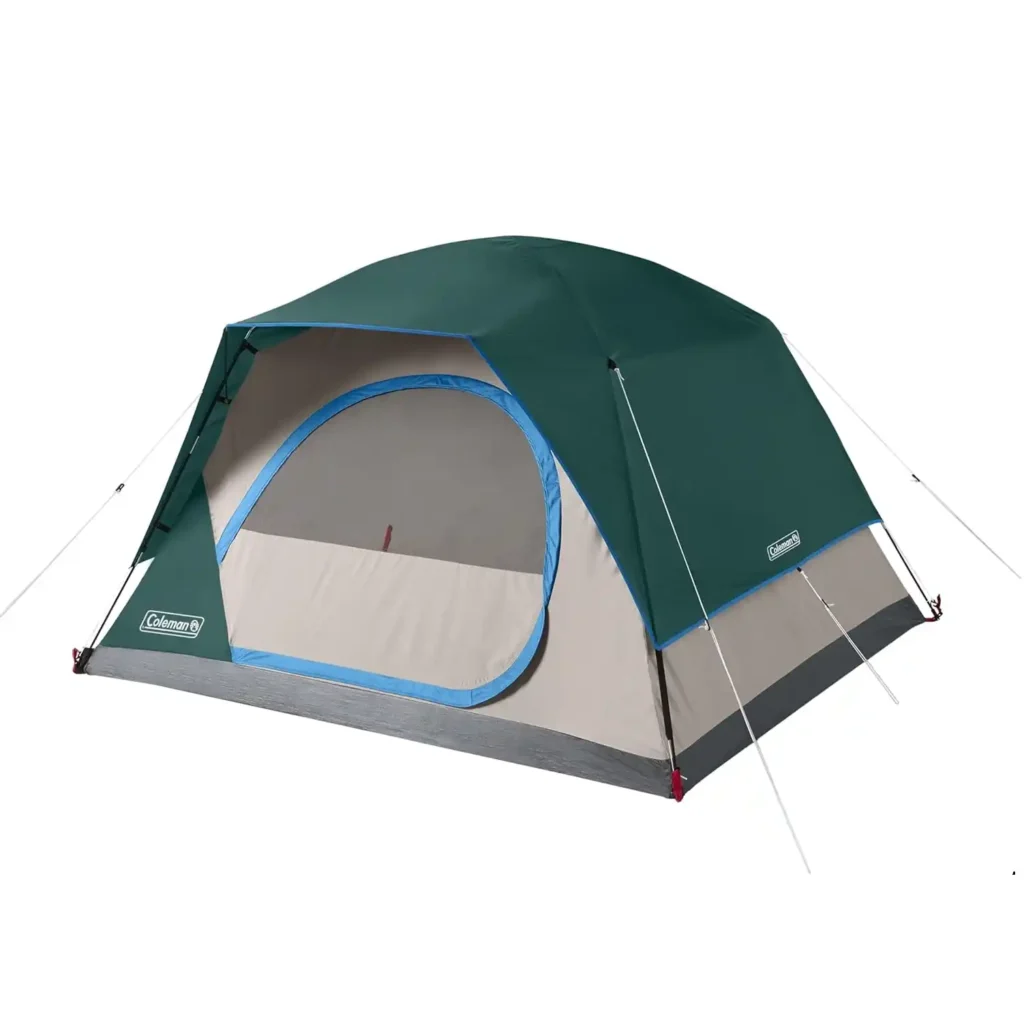
The Coleman Skydome 4P is designed for campers who prioritize sleeping comfort on full-size air mattresses without moving up to bulky cabin tents. It’s especially well suited for couples who want more usable sleeping space and fewer nighttime disturbances.
Unlike most budget dome tents, the near-vertical walls significantly reduce cold transfer from damp fabric touching the mattress.
The near-vertical wall design prevents the mattress from pressing against the tent fabric — a common cause of cold transfer and condensation during the night. Ventilation is well balanced for three-season camping, helping moisture escape without creating strong drafts while you sleep.
My Experience: After multiple weekend car-camping trips, sleep comfort remained consistent without noticeable condensation buildup.
After multiple car-camping trips, this tent consistently provided stable nighttime comfort. Even on cooler mornings, there were no noticeable cold spots along the mattress edges where condensation usually forms.
Pros:
✅ Excellent Mattress Fit: Vertical walls keep air mattresses fully inside the usable space.
✅ Low Noise Design: Taut fabric reduces flapping in light wind.
✅ Easy Setup: Simple structure minimizes setup fatigue before bed.
Cons:
❌ Limited Cold Performance: Not ideal for shoulder-season or near-freezing nights.
❌ Moderate Ventilation in Humidity: Can feel warm in very humid conditions.
- ❌ Not ideal if: You regularly camp in cold shoulder-season conditions or exposed windy sites.
💡 Pro Tip: Pair with a mattress topper or insulated sheet to reduce heat loss from below on cooler nights.
Verdict: A reliable, low-stress choice for couples who want better sleep during fair-weather car camping.
Price and availability can change depending on retailer and season. If you want to see the current listing and latest price, you can check it here.
We recommend comparing current prices and reviews before purchasing to make sure the tent fits your camping style and sleep setup.
2. CORE 6-Person Instant Cabin Tent
Award: Best for Families or Light Sleepers

The CORE 6P Instant Cabin is built for campers who need space to reduce sleep disruption, especially families or groups with restless sleepers. The cabin layout allows everyone to spread out instead of competing for floor space.
Its tall ceiling and straight walls improve airflow and make nighttime movement easier without brushing against tent fabric. While not designed for extreme weather, it performs well in typical summer and early fall conditions.
My Experience:
On family trips, the extra space noticeably reduced nighttime wake-ups caused by movement. Kids could shift positions without disturbing others.
Unlike standard family tents, the cabin layout helps isolate movement so one restless sleeper doesn’t wake everyone else.
Pros:
✅ Roomy Interior: Reduces movement transfer between sleepers.
✅ Instant Setup: Less effort after long travel days.
✅ Good Ventilation When Open: Works well in warm conditions.
Cons:
❌ Bulky Packed Size: Requires ample vehicle space.
❌ Wind Sensitivity: Needs proper staking for stable sleep.
- ❌ Not ideal if: You frequently camp in strong wind or limited-space campsites.
💡 Pro Tip: Use individual cots instead of one large mattress to further reduce movement disturbance.
Verdict: Ideal for families who value space and uninterrupted sleep over compactness.
Price and availability can change depending on retailer and season. If you want to see the current listing and latest price, you can check it here.
We recommend comparing current prices and reviews before purchasing to make sure the tent fits your camping style and sleep setup.
3. MSR Elixir 4
Award: Best Balanced Tent for Sleep Comfort & All-Around Use

The MSR Elixir 4 is a versatile, reliable four-season tent that bridges comfort and practicality for campers focused on better overnight rest. It’s designed with stable structure, good ventilation, and enough interior volume to comfortably accommodate a sleep system without fabric contact at night.
Its balanced ventilation and interior headroom help control condensation and promote consistent airflow, which are two of the biggest factors that affect sleep quality. Whether you’re using a thick air mattress, cots, or sleeping pads, the Elixir 4 provides room to spread out without feeling cramped.
My Experience: After several multi-night trips in mixed conditions, the interior remained dry and stable even as temperatures dropped overnight.
On multi-night trips in mixed conditions, the Elixir 4 maintained strong airflow without cold drafts and consistently avoided the damp fabric feeling that often interrupts sleep. Even when temperatures dipped after sunset, the interior felt stable and comfortable.
Pros
- ✅ Balanced Ventilation: Mesh panels and adjustable vents reduce moisture buildup overnight.
- ✅ Roomy Interior: Comfortable for air mattresses and cots without contacting tent walls.
- ✅ Stable Structure: Strong pole geometry helps reduce fabric flapping that interrupts sleep.
Cons
- ❌ Moderate Packed Weight: Heavier than ultralight tents, so not ideal for backpacking.
- ❌ Not for Extreme Weather: Performs well in typical camping conditions but isn’t a true four-season shelter in heavy snow.
- ❌ Not ideal if: You’re looking for an ultralight backpacking tent rather than a comfort-focused shelter.
💡 Pro Tip: Position the tent with vents facing prevailing breeze to maximize cross-ventilation during humid nights.
Verdict: A balanced, sleep-focused tent that works well for campers who want consistent overnight comfort and reliable ventilation without moving into high-end lightweight gear.
Price and availability can change depending on retailer and season. If you want to see the current listing and latest price, you can check it here.
We recommend comparing current prices and reviews before purchasing to make sure the tent fits your camping style and sleep setup.
4. Gazelle T4 Hub Tent
Award: Best for Quick Setup & Quiet Nights

The Gazelle T4 is designed for campers who want minimal setup effort and maximum nighttime quiet. Its hub design creates a tight, stable pitch that significantly reduces fabric noise.
The square floor plan works especially well with cots, making it a favorite for sleepers who prefer being off the ground.
My Experience:
Setup took only minutes, and once pitched, the tent remained quiet even with light wind overnight.
Pros:
✅ Extremely Fast Setup: Reduces pre-sleep effort.
✅ Low Fabric Noise: Tight pitch limits flapping.
✅ Excellent Cot Compatibility: Square layout fits cots easily.
Cons:
❌ Heavy & Bulky: Not suitable for compact vehicles.
❌ Higher Cost per Size: You pay for convenience.
- ❌ Not ideal if: You need a compact packed size or plan to move campsites often.
💡 Pro Tip: Add a thin foam pad on cots to improve insulation during cooler nights.
Verdict: Perfect for campers who value simplicity, silence, and off-the-ground sleep.
Price and availability can change depending on retailer and season. If you want to see the current listing and latest price, you can check it here.
We recommend comparing current prices and reviews before purchasing to make sure the tent fits your camping style and sleep setup.
5. ALPS Mountaineering Camp Creek 6
Award: Best for Tall Campers & Couples

The ALPS Mountaineering Camp Creek 6 is designed for campers who prioritize interior space and standing height for better overnight comfort. Its cabin-style structure creates a more open sleeping environment compared to traditional dome tents.
The nearly vertical walls and tall peak height allow campers to use thicker air mattresses or cots without the fabric pressing against their sleep system. This extra interior volume also helps reduce condensation density during cool nights.
My Experience:
During extended family camping trips, the extra headroom made nighttime movement significantly easier. Getting in and out of sleeping setups felt less cramped compared to lower-profile tents.
Pros:
✅ Excellent Interior Space: Tall walls provide more usable sleeping room.
✅ Great for Tall Campers: Long floor length prevents foot-end compression.
✅ Comfortable for Air Mattresses: Cabin layout works well with large sleep systems.
Cons:
❌ Large Packed Size: Requires significant vehicle space.
❌ Not Ideal for Windy Sites: Cabin structures are less aerodynamic.
❌ Not ideal if: You camp frequently in exposed, windy terrain.
Verdict: A spacious comfort-focused tent that works especially well for tall campers and couples who want more room to sleep naturally.
Price and availability can change depending on retailer and season. If you want to see the current listing and latest price, you can check it here.
We recommend comparing current prices and reviews before purchasing to make sure the tent fits your camping style and sleep setup.
🌙 How to Build a Complete Sleep System Inside Your Tent

A tent alone doesn’t determine how well you sleep. Real comfort comes from how the entire sleep system works together — the tent, insulation from the ground, airflow, and temperature control. When one part is mismatched, sleep quality drops quickly.
Below is how to build a reliable sleep system based on real nighttime scenarios, not marketing specs.
Tent + Air Mattress (Best for Couples & Car Camping)
Air mattresses provide excellent comfort, but they also amplify cold transfer from the ground if used incorrectly. The tent must have enough interior width and vertical walls so the mattress doesn’t press against damp tent fabric at night.
This setup works best in:
three-season conditions
low to moderate humidity
flat, established campsites
Common mistake: choosing a tent that fits the mattress on paper but compresses it at night, causing cold spots and condensation transfer.
Expert tip: use an insulated mattress or add a fitted thermal sheet to reduce heat loss after midnight.
Mattress choice plays a huge role in heat retention and comfort. For car campers, we break this down in our best camping mattresses and sleeping pads guide.
Tent + Camping Cot (Best for Bad Backs & Cold Ground)
Cots eliminate ground contact, which dramatically improves warmth and spinal alignment. However, they require tents with straight walls and sufficient headroom, otherwise entry and exit become uncomfortable.
This setup excels in:
cold or damp ground conditions
extended trips where back support matters
campers who toss and turn
Common mistake: using cots in low-profile dome tents, leading to restricted movement and fabric contact.
Expert tip: add a thin foam pad on the cot to prevent convective heat loss from below.
If you prefer sleeping off the ground, choosing the right cot matters just as much as the tent itself. See our best camping cots for adults comparison.
Tent + Heater or Fan (Temperature Control at Night)
Heaters and fans don’t replace a good tent — they fine-tune nighttime comfort. Their effectiveness depends entirely on ventilation and tent volume.
Use this setup when:
nights drop unexpectedly below comfort range
humidity causes poor airflow
sleeping comfort varies between campers
Safety note: heaters should only be used in well-ventilated tents designed for airflow. Blocking vents to “stay warm” often increases condensation and worsens sleep.
Expert tip: fans help more with condensation control than cooling — even in cooler weather.
Tent + Double Sleeping Bag (Best for Couples Who Share Warmth)
Double sleeping bags work best in tents with extra floor width, allowing both sleepers to move without pressing against tent walls. In smaller tents, shared bags can trap moisture and limit airflow.
This setup is ideal for:
couples who prefer shared warmth
cooler nights without extreme cold
tents designed for mattress-based sleeping
Common mistake: pairing a double bag with a tent that’s too narrow, leading to damp fabric contact by morning.
Expert tip: choose bags with separate insulation zones to prevent overheating.
🛒 Buying Guide: How to Choose a Tent for Better Sleep

If you often wake up tired, damp, or stiff after a night of camping, the problem usually isn’t your sleeping bag or mattress — it’s how your tent handles sleep conditions overnight.
A tent designed for good sleep manages airflow, interior space, and temperature stability, not just rain or wind. When choosing a tent for sleeping comfort, focus on how it performs between midnight and early morning, when condensation, heat loss, and movement matter most.
What to Prioritize for Better Sleep
When evaluating a tent specifically for sleep quality, look for the following:
Ventilation above sleeping height
Mesh panels and vents should sit above mattress or cot level, allowing moist air to escape instead of settling around your body.Ventilation that works with the rainfly on
Roof vents or fly designs that stay open in rain are critical. Tents that only ventilate with the fly removed trap moisture overnight.Interior volume, not just floor size
Taller ceilings and straighter walls reduce moisture density and prevent your sleep system from touching damp fabric.Enough space for your actual sleep setup
Always size up if you use thick air mattresses, double sleeping bags, or cots. A tent that feels “tight” during the day will feel restrictive at night.Stable structure and fabric tension
A tight pitch reduces flapping, fabric noise, and sudden drafts that interrupt sleep.
What to Avoid
Tents that focus only on waterproof ratings without addressing airflow
Low-profile designs that force sleeping systems against tent walls
Overly compact tents marketed as “lightweight” but unsuitable for real sleep comfort
🏕 Common Myths About Sleeping Comfort in Tents
“More mesh always means colder sleep”
“Condensation means your tent is leaking”
“A warmer sleeping bag fixes poor sleep”
❓ FAQ: Sleeping Comfort in Tents
Do sleeping tents actually improve sleep quality?
Yes — but only when the tent is designed to manage airflow, interior space, and nighttime temperature. A “sleeping-friendly” tent reduces condensation, fabric contact, and noise, which directly affects how well you rest.
Should I choose a bigger tent for better sleep?
Almost always, yes. If you use an air mattress, cot, or double sleeping bag, sizing up by at least one person prevents fabric contact and improves airflow around your sleep system.
Is ventilation more important than waterproofing for sleep?
For most camping, yes. Poor ventilation causes condensation even in dry weather, leading to damp walls and cold spots. Waterproofing matters for storms, but ventilation matters every night.
Are cabin tents better for sleeping than dome tents?
In most cases, yes. Cabin tents offer straighter walls and more usable interior volume, which reduces moisture buildup and movement disturbance during sleep.
Why do I feel colder at night even with a warm sleeping bag?
Heat loss often comes from below or from damp tent walls touching your sleep system. An insulated mattress, proper tent sizing, and ventilation usually solve this issue better than a warmer bag.
Do tents with more mesh sleep colder at night?
Not necessarily. Mesh improves moisture escape. Cold sleep is usually caused by poor ground insulation, not airflow, as long as the tent blocks direct drafts.
Why do tents feel colder between 3 and 5 AM?
This is when ground temperature drops and condensation peaks. Heat loss usually comes from below or from damp tent walls contacting your sleep system, not from air temperature alone.
Is condensation worse in larger tents?
Not necessarily. Larger tents often perform better because increased interior volume reduces moisture density, as long as ventilation is properly designed.
⚡ Quick Decision Guide
If you’re short on time, here’s the fastest way to choose the right sleeping tent.
• Best overall sleep comfort: MSR Elixir 4
• Best budget option: Coleman Skydome 4P
• Best for families: CORE 6P Instant Cabin
• Best for quick setup: Gazelle T4 Hub Tent
• Best for tall sleepers: ALPS Mountaineering Camp Creek 6
If sleep quality is your top priority, prioritize ventilation, interior volume, and nighttime stability over lightweight design.
🏁 Final Verdict

The best sleeping tents for camping are the ones that match how you actually sleep at night, not just how many people they’re rated for or how waterproof they claim to be.
Want the best all-around sleep comfort for couples? → Coleman Skydome 4P
Camping with kids or restless sleepers? → CORE 6P Instant Cabin
Looking for a balanced tent that sleeps well in mixed conditions? → MSR Elixir 4
Want fast setup and quieter nights? → Gazelle T4 Hub Tent
Tall sleeper or using a thick air mattress? → ALPS Mountaineering Camp Creek 6
No single tent sleeps well for everyone. The key is choosing a tent that supports your sleep system, manages airflow overnight, and gives you enough interior space to stay comfortable until morning.
Once your tent stops working against your sleep, camping nights become calmer, warmer, and far more enjoyable.
Ready to dial in the rest of your setup? Don’t stop at the tent.
See our full guide to camping mattresses and sleeping pads for car camping to complete your sleep system.
These recommendations are based on repeated overnight testing across different sleep setups, weather conditions, and camper types.
Happy camping,
— Anthony