
Are inflatable tents better than pole tents? The answer isn’t as simple as choosing the newer design. Both tent types offer clear advantages, but the better option depends on how, where, and how often you camp.
Inflatable tents have become increasingly popular for family camping thanks to their quick setup, spacious interiors, and flexible air-beam construction. At the same time, traditional pole tents continue to be the preferred choice for backpackers, budget-conscious campers, and anyone who values lightweight gear.
In this guide, we’ll compare inflatable and pole tents across the factors that matter most—including setup time, durability, weather performance, comfort, maintenance, and long-term value—so you can confidently choose the right tent for your next adventure.

Table of Contents
Quick Answer
In most cases, inflatable tents are better than traditional pole tents for family camping, car camping, and longer stays at established campsites. They offer faster setup, more usable interior space, and flexible air-beam structures that perform exceptionally well in windy conditions.
Traditional pole tents remain the better choice for backpacking, lightweight adventures, and campers with a tighter budget. Their lower weight, smaller packed size, and simpler construction make them easier to carry over long distances.
Neither tent type is universally better. The right choice depends on your camping style, travel distance, weather conditions, and how much you value comfort, convenience, or portability.
At a Glance
Inflatable Tents Excel At
- Faster setup with inflatable air beams
- Spacious interiors with near-vertical walls
- Excellent comfort for family camping
- Strong performance in windy conditions
- Easier pitching for one or two people
- Better choice for car camping and glamping
Traditional Pole Tents Excel At
- Lower purchase price
- Lighter weight for backpacking
- Smaller packed size
- Simpler replacement parts in remote areas
- Wide range of models and price points
- Better suited for long-distance hiking
Quick Take: If your camping trips usually involve driving to a campsite and staying for several nights, an inflatable tent will often provide the most comfortable experience. If you regularly hike with your gear or need to minimize weight, a traditional pole tent remains the more practical option.
Why You Can Trust This Guide
Choosing between an inflatable tent and a traditional pole tent involves more than comparing specifications or marketing claims. Factors such as setup speed, weather performance, durability, interior comfort, maintenance, and long-term ownership all play an important role in determining which design is the better fit for different camping styles.
For this comparison, we evaluated both tent types using publicly available manufacturer specifications, real-world user experiences, product design characteristics, and practical camping considerations. Rather than focusing on a single brand or model, this guide compares the strengths and limitations of each tent construction across a wide range of camping situations.
Our goal is simple: provide balanced, practical information that helps campers choose the tent that best matches how they actually camp, instead of recommending one design as the universal winner.
How We Compared Both Tent Types

To provide a fair and practical comparison, we evaluated inflatable and traditional pole tents using the factors that have the biggest impact on real camping experiences. Instead of focusing on marketing claims, we looked at how each tent design performs across a variety of camping scenarios.
Our comparison is based on the following criteria:
- Setup and pack-down time – how quickly each tent can be pitched and packed away.
- Weather performance – stability in wind, rain protection, and overall structural reliability.
- Interior living space – usable floor area, headroom, and overall comfort inside the tent.
- Weight and packed size – how easy the tent is to transport and store.
- Durability and maintenance – expected lifespan, routine care, and ease of repairs.
- Overall value – balancing purchase price with long-term performance, convenience, and camping comfort.
Rather than declaring a single winner, we evaluated how each tent type performs for different camping styles, helping you choose the option that best fits your needs instead of simply following trends.
Side-by-Side Comparison Table
| Feature | Inflatable Tent | Pole Tent |
|---|---|---|
| Setup Time | ⭐⭐⭐⭐⭐ Typically 5–10 minutes with a manual or electric pump | ⭐⭐⭐ Usually 10–20 minutes depending on the number of poles |
| Ease of Setup | Excellent for beginners, families, and solo campers | Requires assembling and threading tent poles |
| Wind Performance | Flexible air beams absorb wind gusts extremely well | Rigid poles provide excellent stability when properly pitched |
| Rain Protection | Excellent with quality fabrics, sealed seams, and correct pitching | Excellent when constructed with waterproof materials and proper setup |
| Interior Space | Near-vertical walls create significantly more usable living space | Sloping walls reduce headroom and usable interior volume |
| Weight | Generally heavier because of air beams and larger construction | Usually lighter, especially backpacking and hiking models |
| Packed Size | Bulkier when packed | More compact and easier to transport |
| Repairability | Air tubes can usually be patched or replaced individually | Broken poles can often be repaired or replaced with spare sections |
| Maintenance | Requires occasional inspection of air beams and inflation valves | Requires basic inspection of poles, sleeves, and guy lines |
| Price | Typically higher initial investment | Available across a much wider range of budgets |
| Best For | Family camping, car camping, glamping, and extended campsite stays | Backpacking, hiking, lightweight adventures, and budget camping |
| Overall Comfort | ⭐⭐⭐⭐⭐ Spacious, comfortable, and easy to live in | ⭐⭐⭐⭐ Comfortable but generally offers less interior space |
Key Takeaway
Inflatable tents excel in comfort, convenience, and quick setup, making them an excellent choice for family camping and longer stays. Traditional pole tents remain the better option when minimizing weight, packed size, and overall cost is the priority.
So, are inflatable tents better than pole tents? The answer depends on which features matter most for your camping style, making it important to understand how each design works before choosing between them.
How Each Tent Type Works

Before comparing performance, it’s helpful to understand the fundamental difference between these two tent designs. While both provide shelter from the elements, they rely on completely different structural systems to support the tent body.
Inflatable Tents
Inflatable tents replace traditional metal or fiberglass poles with air-filled beams, often called air poles or air tubes. These beams are inflated using a manual or electric pump until they reach the recommended pressure, creating a rigid framework that supports the tent.
Once fully inflated, the air beams distribute pressure evenly throughout the structure, allowing the tent to flex slightly in strong winds instead of relying on rigid poles. Many campers also find inflatable tents easier to pitch because there are no long pole sections to assemble or thread through sleeves.
If you’re considering buying one, our guide to the best inflatable tents compares the top models for family camping, comfort, and ease of setup.
Traditional Pole Tents
Pole tents use a framework made from aluminum, fiberglass, or steel poles that must be assembled before pitching the tent. The poles create the tent’s shape by bending under tension and supporting the fabric through sleeves or attachment clips.
This design has been used for decades and remains the standard across everything from lightweight backpacking shelters to large expedition tents. Because the construction is simple and well understood, replacement poles and repair kits are widely available, making pole tents a practical choice for many outdoor enthusiasts.
Campers looking for a traditional family shelter can also explore our guide to the best 6 person camping tents, where many of the top-rated models still use conventional pole construction.
Why the Construction Matters
Although both designs can provide excellent weather protection, their structural differences influence almost every aspect of camping—from setup speed and interior space to weight, portability, maintenance, and long-term durability.
Understanding how each system works makes it much easier to interpret the comparisons in the sections that follow.
No matter which design you choose, learning how to repair a tent and how to clean a moldy tent can help extend its lifespan and keep it performing at its best for years of camping.
Inflatable vs. Pole Tents: Category-by-Category Comparison
Choosing between an inflatable tent and a traditional pole tent isn’t about finding a universal winner. Each design has strengths that become more or less important depending on your camping style, the weather, and how you plan to use your tent. Below, we’ll compare both tent types across the factors that matter most to campers.
Setup Time
One of the biggest differences between inflatable and pole tents is how quickly they can be pitched.
Inflatable tents are designed for fast setup. After spreading the tent on the ground, you simply connect a manual or electric pump to the inflation valve and inflate the air beams. Most family-sized inflatable tents can be fully pitched in 5 to 10 minutes, even by one person with limited camping experience.
Traditional pole tents require assembling multiple pole sections, threading them through sleeves or attaching them to clips, and tensioning the structure correctly before securing the rainfly and guylines. Depending on the tent size, setup typically takes 10 to 20 minutes and may require two people for larger models.
While experienced campers can pitch pole tents quickly, inflatable tents generally offer a more beginner-friendly setup with fewer individual components to manage.
Winner
Inflatable Tents
For campers who value convenience and want to spend less time pitching camp, inflatable tents have a clear advantage.
Weather Performance
A tent’s ability to withstand changing weather conditions is often more important than how quickly it can be pitched. Wind, rain, and prolonged exposure to the elements all place significant stress on the tent’s structure, making overall stability a key factor when choosing between inflatable and pole tents.
Inflatable tents perform exceptionally well in strong winds because their flexible air beams can absorb and distribute wind pressure rather than resisting it with rigid components. Instead of bending permanently or snapping under heavy gusts, properly inflated air beams flex slightly and then return to their original shape. This flexibility is one of the main reasons many modern inflatable tents perform surprisingly well during stormy conditions.
Traditional pole tents also provide excellent weather protection when correctly pitched and guyed out. High-quality aluminum poles are extremely strong and have been trusted for decades in expedition and mountaineering tents. However, under extreme stress, rigid poles are generally more susceptible to permanent bending or breakage than inflatable air beams.
Rain protection depends far more on the tent’s overall design, waterproof fabrics, seam sealing, ventilation, and proper setup than on whether it uses air beams or poles. A well-designed inflatable tent and a high-quality pole tent can both keep campers dry during extended periods of rain.
Winner
Draw
Inflatable tents generally have an advantage in strong winds because of their flexible structure, while premium pole tents continue to offer outstanding reliability in demanding environments. For most campers, the overall build quality of the tent is far more important than the support system itself.
Interior Space and Comfort
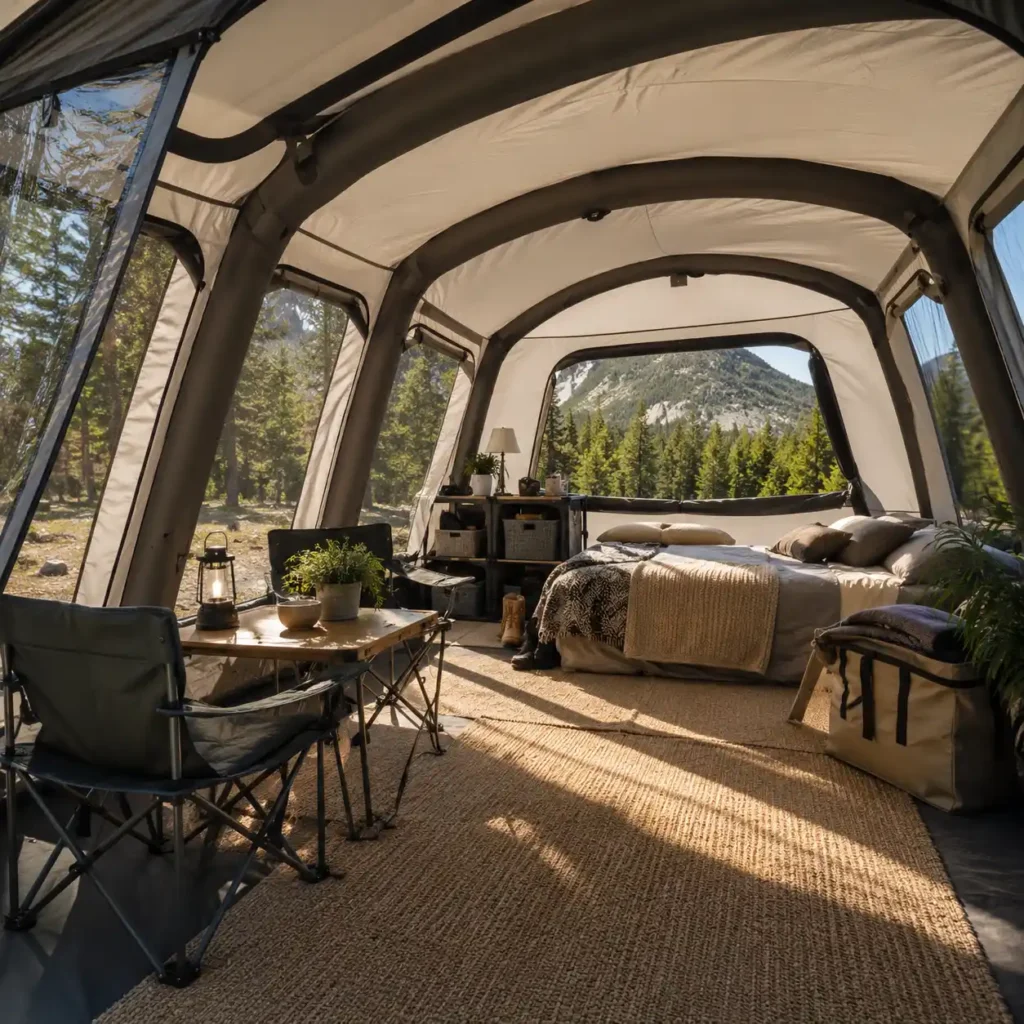
While two tents may have the same stated sleeping capacity, the amount of usable living space inside can be surprisingly different. The tent’s structural design plays a major role in determining how comfortable it feels once you’re inside.
Inflatable tents typically feature near-vertical walls created by their air-beam construction. This design provides more standing room, greater shoulder space, and a larger usable floor area. Campers can move around more easily, change clothes without crouching, and position camping furniture closer to the walls without sacrificing comfort.
Traditional pole tents often use sloping walls that reduce headroom toward the edges of the tent. Although many modern pole tents offer generous interior dimensions, a portion of the floor space is less practical for sitting, standing, or storing larger items.
For families spending several days at a campsite, the additional living space inside an inflatable tent can make daily activities more comfortable, especially during bad weather when more time is spent indoors.
Pairing a spacious tent with one of the best camping mattresses can make an even bigger difference when camping for several nights.
Comfort also extends beyond floor space. Larger windows, improved ventilation systems, and higher ceilings are increasingly common in premium inflatable tents, creating a more open and spacious camping experience.
Winner
Inflatable Tents
Weight and Packed Size
If you frequently move between campsites or have limited storage space in your vehicle, a tent’s packed size and weight deserve just as much attention as its interior comfort.
Inflatable tents use reinforced air beams instead of traditional poles, but those air beams are made from thick, durable materials that add weight. They also require a pump, whether manual or electric, which becomes another item to pack. As a result, inflatable tents are typically heavier and bulkier than comparable pole tents.
Traditional pole tents generally pack down into smaller bags and weigh less, particularly backpacking and lightweight camping models. Aluminum poles are both strong and lightweight, allowing manufacturers to reduce overall pack weight without sacrificing structural integrity. This makes pole tents easier to transport, carry, and store.
For campers who drive directly to established campsites, the extra weight of an inflatable tent is rarely a major disadvantage. However, anyone planning to hike significant distances or maximize cargo space will usually appreciate the more compact design of a traditional pole tent.
Winner
Pole Tents
For portability, packed size, and overall carrying convenience, traditional pole tents remain the better choice. Inflatable tents prioritize comfort and quick setup, while pole tents continue to offer a clear advantage when minimizing weight and storage space is important.
Durability and Longevity
Durability is one of the most common concerns among campers considering an inflatable tent for the first time. Many people assume that air beams are more fragile than traditional poles, but modern tent technology tells a more balanced story.
Inflatable tents use heavy-duty thermoplastic polyurethane (TPU) or reinforced air tubes protected by durable outer sleeves. These air beams are designed to withstand repeated inflation, changing temperatures, and demanding weather conditions. Unlike rigid poles, they can flex under pressure without permanently bending, which helps reduce the risk of structural failure in strong winds.
Traditional pole tents have earned their reputation through decades of reliable use. Aluminum poles are lightweight, corrosion-resistant, and extremely durable when properly maintained. Fiberglass poles are generally less expensive but are more prone to splintering or cracking after repeated stress or improper handling.
Neither design is immune to damage. Air beams can be punctured by sharp objects, while poles may bend, crack, or break if overloaded or incorrectly assembled. Fortunately, both systems are usually repairable, and many manufacturers offer replacement components or repair kits.
With proper care and regular maintenance, both inflatable and pole tents can provide many years of dependable service.
Winner
Draw
Both tent types offer excellent long-term durability when made from quality materials and used correctly. The overall construction quality, fabrics, stitching, and hardware often have a greater impact on lifespan than whether the tent uses air beams or poles.
Maintenance and Repairs

Regular maintenance helps extend the lifespan of any camping tent, regardless of its design. While inflatable and pole tents require slightly different care, neither system is particularly difficult to maintain with proper use.
Inflatable tents should be kept clean and completely dry before storage to prevent mold and mildew. The air beams require occasional inspection for leaks or abrasions, although punctures are relatively uncommon under normal camping conditions. If an air beam is damaged, most manufacturers provide repair patches or replacement tubes that can restore the tent without replacing the entire structure.
Pole tents also benefit from routine cleaning and careful storage. Aluminum poles should be checked for dents or loose ferrules, while fiberglass poles should be inspected for cracks or splintering. If a pole section becomes damaged, individual segments can often be replaced without purchasing a completely new pole set.
In both cases, zippers, seams, guylines, and waterproof coatings deserve regular attention. Simple maintenance after each trip can significantly increase the tent’s service life and reduce the likelihood of unexpected problems during future adventures.
The U.S. National Park Service recommends minimizing environmental impact by following Leave No Trace camping practices.
Winner
🏆 Draw
Neither tent type requires significantly more maintenance than the other. Inflatable tents focus on caring for air beams, while pole tents require occasional inspection of their frame. With routine cleaning and proper storage, both designs are straightforward to maintain for many years.
Price and Long-Term Value
Price is often one of the biggest deciding factors when choosing between an inflatable tent and a traditional pole tent. While both designs are available across a wide range of price points, inflatable tents generally require a larger upfront investment.
The higher cost comes from their specialized air-beam construction, reinforced materials, and more complex manufacturing process. As a result, inflatable tents are commonly positioned as premium camping products designed for families, car campers, and those who prioritize convenience and interior comfort.
Pole tents are available at virtually every price level, from affordable entry-level models to high-end expedition shelters. This wider selection makes it easier for campers to find a tent that fits both their budget and intended use. Whether you’re buying your first family tent or investing in lightweight backpacking gear, there are excellent pole tents available in almost every price category.
Long-term value depends on more than the purchase price alone. A tent that is easier to set up, more comfortable to live in, and durable enough to last for many seasons may justify a higher initial cost. On the other hand, campers who only head outdoors a few weekends each year may find that a well-built pole tent delivers everything they need at a significantly lower price.
Rather than asking which tent is cheaper, it’s often more useful to ask which tent offers the best value for the way you camp.
Winner
Pole Tents
Traditional pole tents provide better overall value for budget-conscious campers thanks to their broader price range and lower entry cost. However, campers who prioritize convenience, interior comfort, and fast setup may find that an inflatable tent is well worth the additional investment.
Which Tent Is Best for Different Types of Campers?
The best tent isn’t simply the one with the most features—it’s the one that matches how and where you camp. Both inflatable and pole tents excel in different situations, making each a better choice for certain types of outdoor enthusiasts.
Inflatable Tents Are Best For:
- Families who want a spacious, comfortable base camp.
- Campers who frequently set up and pack down their tent.
- Car campers who don’t need to carry their shelter long distances.
- Beginners looking for a simple, stress-free pitching experience.
- Campers staying at established campgrounds for several days.
The combination of quick setup, generous headroom, and stable construction makes inflatable tents especially appealing for relaxed camping trips where comfort is the top priority.
Pole Tents Are Best For:
- Backpackers and hikers who need to minimize pack weight.
- Campers traveling long distances on foot.
- Adventurers camping in remote or alpine environments.
- Budget-conscious buyers looking for the widest range of options.
- Campers who prioritize versatility across different styles of outdoor travel.
Pole tents remain the most adaptable choice thanks to their lighter weight, lower cost, and availability in nearly every size and design.
Winner
🏆 Depends on Your Camping Style
There is no universal winner because each design serves a different purpose. Inflatable tents shine during comfortable family camping and extended campground stays, while pole tents remain the preferred choice for backpacking, lightweight travel, and campers seeking maximum versatility.
Final Verdict: Are Inflatable Tents Better Than Pole Tents?
Are inflatable tents better than pole tents? After comparing setup time, weather performance, comfort, durability, maintenance, and overall value, the answer becomes much clearer.
Inflatable tents are not inherently better than pole tents—they’re simply designed with different priorities in mind.
If your ideal camping trip involves driving to a campground, spending several days outdoors with family, and enjoying maximum comfort, an inflatable tent is often the better investment. Fast setup, generous living space, and the absence of rigid poles make camping more convenient and enjoyable for many recreational campers.
Pole tents, however, remain the more versatile option. Their lighter weight, lower cost, and broad range of designs make them suitable for everything from weekend family trips to multi-day backpacking adventures. They also continue to dominate the market for hikers, mountaineers, and anyone who needs to carry their shelter over long distances.
The good news is that modern inflatable tents have proven themselves to be reliable, weather-resistant shelters rather than a passing trend. At the same time, traditional pole tents continue to evolve with lighter materials, stronger frames, and improved designs.
Ultimately, the best choice depends less on the tent itself and more on how you camp.
If convenience, comfort, and quick pitching matter most, an inflatable tent is likely the better fit.
If portability, versatility, and affordability are your priorities, a traditional pole tent remains difficult to beat.
Final Recommendation
| Camper Type | Best Choice |
|---|---|
| Family Campers | ✅ Inflatable Tent |
| Car Campers | ✅ Inflatable Tent |
| Weekend Campers | ✅ Either Option |
| First-Time Campers | ✅ Inflatable Tent |
| Backpackers | ✅ Pole Tent |
| Hikers & Trekkers | ✅ Pole Tent |
| Expedition Campers | ✅ Pole Tent |
| Budget-Conscious Buyers | ✅ Pole Tent |
Frequently Asked Questions
Are inflatable tents better than pole tents?
It depends on how you camp. Inflatable tents are generally better for family camping and car camping because they’re faster to pitch, offer more usable interior space, and eliminate the hassle of assembling poles. Pole tents remain the better option for backpacking, hiking, and anyone who values lightweight gear and lower costs.
Do inflatable tents puncture easily?
No. Modern inflatable tents use durable TPU or reinforced air beams designed to withstand normal camping conditions. While punctures are possible, they’re uncommon, and most manufacturers include repair kits that allow small leaks to be fixed quickly.
What happens if an inflatable tent gets a hole?
A small puncture usually affects only the damaged air beam rather than the entire tent. Most air beams are independently inflated, allowing campers to repair or replace a single tube without replacing the entire shelter.
Are inflatable tents good in strong wind?
Yes. High-quality inflatable tents often perform exceptionally well in windy conditions because flexible air beams absorb gusts instead of bending or snapping like rigid poles. Proper staking and guyline tension remain essential regardless of tent type..
Do inflatable tents lose air overnight?
A properly inflated, undamaged air tent should maintain its pressure throughout the night. Minor pressure changes can occur due to temperature fluctuations, which is normal and doesn’t necessarily indicate a leak.
Are inflatable tents heavier than pole tents?
In most cases, yes. Inflatable tents typically weigh more and have a larger packed size because of their reinforced fabrics and integrated air-beam system. This makes them better suited to car camping than backpacking.
Can one person set up an inflatable tent?
Yes. One of the biggest advantages of inflatable tents is that most models can be pitched by a single person in just a few minutes using the included pump. This is one of the primary reasons they’re popular with families and weekend campers.
Are inflatable tents worth the higher price?
For campers who prioritize convenience, comfort, and fast setup, many believe the higher upfront cost is justified. However, occasional campers or those on a tighter budget may find that a quality pole tent offers better overall value.
Do inflatable tents need electricity?
No. Most inflatable tents are supplied with a manual hand pump, so electricity isn’t required. Electric pumps are optional accessories that simply speed up inflation.
How long do inflatable tents last?
With proper care, cleaning, and storage, a quality inflatable tent can last for many years. Longevity depends more on the quality of materials and maintenance than on whether the tent uses air beams or traditional poles.
Are pole tents more reliable than inflatable tents?
Both designs are highly reliable when built by reputable manufacturers. Pole tents have a longer history, while modern inflatable tents have matured significantly over the past decade and have proven themselves in real-world camping conditions.
Which tent is best for beginners?
For most beginners, an inflatable tent is the easier option because it simplifies setup and reduces the chance of mistakes during pitching. Campers planning to backpack or hike long distances, however, may benefit more from starting with a lightweight pole tent.
Conclusion
So, are inflatable tents better than pole tents? Ultimately, the answer depends on your camping style rather than one design being universally better than the other.
If you mainly enjoy family camping, weekend getaways, or relaxing at established campgrounds, an inflatable tent offers impressive comfort, fast setup, and a more enjoyable camping experience. For many campers, those benefits easily outweigh the higher purchase price.
If you prefer backpacking, hiking, or simply want the widest range of affordable options, a traditional pole tent remains the smarter choice. Its lighter weight, proven reliability, and versatility continue to make it the go-to shelter for outdoor enthusiasts around the world.
The best tent is the one that fits your adventures—not someone else’s.
Take time to consider where you camp, how often you travel, and which features matter most to you. Once you match your tent to your camping style, you’ll be far more likely to enjoy every trip outdoors.