
How to mount a rooftop tent safely is what determines whether your setup feels stable and quiet at highway speed—or becomes something you constantly second-guess behind the wheel.
Hi, I’m Anthony.
The first time I mounted a rooftop tent, everything looked perfect in the driveway. The tent was centered, the clamps were tight, and the crossbars were rated well above the load.
But on the highway, it told a different story.
At around 65–70 mph, I started noticing subtle sway during lane changes. Then came the low-frequency wind noise—followed by that uncomfortable feeling that something wasn’t quite “locked in,” even though nothing was technically wrong.
That’s the problem most guides never explain.
Because mounting a rooftop tent isn’t just about attaching it to your roof rack. It’s about how weight is distributed, how far apart your bars are, where the tent sits relative to airflow—and how all of that behaves under real driving conditions.
Here’s what actually matters:
- A tent mounted “tight” can still shift under dynamic load
- Incorrect bar spacing creates instability—even within weight limits
- Positioning affects both wind noise and vehicle handling
- And small setup mistakes get amplified at highway speed
In this guide, I’ll show you how to mount a rooftop tent the right way—not just based on instructions, but on how these systems perform in real-world driving.
As an Amazon Associate, we earn from qualifying purchases.

Table of Contents
Quick Summary: Mount a Rooftop Tent Safely
A rooftop tent should be mounted centered, evenly balanced, and aligned with airflow—not just tightly secured.
The key to a stable and quiet setup:
- keep weight centered between crossbars
- use correct bar spacing for load distribution
- avoid forward positioning that creates drag and noise
- tighten mounts evenly—not with excessive force
- always recheck after your first drive
👉 The biggest mistake is not loose hardware—it’s poor positioning and imbalance.
A properly mounted rooftop tent should feel:
- stable at highway speeds
- predictable in crosswinds
- quiet enough to ignore during long drives
Why You Can Trust This Rooftop Tent Mounting Guide
Most guides explain how to bolt a rooftop tent onto crossbars.
That’s not enough.
I approach rooftop tent mounting as a dynamic system, not a one-time install. The real question isn’t “is it mounted?” — it’s:
👉 Does it stay stable, quiet, and predictable at highway speed under load?
Over multiple setups, I’ve mounted rooftop tents on:
- naked roof systems with clamp-based racks
- raised rail and flush rail vehicles
- modular rack platforms and aero crossbars
- short wheelbase crossovers and longer SUVs
But more importantly, I’ve tested how mounting decisions affect real-world behavior:
- stability during crosswinds and lane changes
- noise patterns at sustained highway speeds
- load shift under braking and uneven roads
- mounting integrity after 100+ miles of driving
That’s where most setups fail—not during installation, but after an hour on the road.
I’ve also compared how the same rooftop tent behaves differently depending on:
- crossbar spacing
- mounting position (forward vs centered vs rear-biased)
- bar rigidity and clamp design
👉 Same tent. Completely different driving experience.
💡 Key Difference From Most Guides
Most articles treat rooftop tent mounting as a checklist.
This guide treats it as a load management and stability problem.
That means we’re not just covering:
- how to install
- but how to avoid:
- sway
- noise
- instability
- long-term mounting issues
📌 Before you mount anything, make sure your base system is installed correctly —
How to Install a Roof Rack on Your Car (Step-by-Step Safe Setup Guide) walks through how to secure the foundation properly before adding weight on top.
Quick Answer: How to Mount a Rooftop Tent Safely

To mount a rooftop tent safely, you need to use compatible crossbars, position them at the correct spacing, center the load properly, and tighten all mounting points evenly without overtightening.
Here’s the correct process:
- Use a roof rack system rated for the combined weight of the tent and occupants
- Position crossbars according to the tent manufacturer’s recommended spacing
- Mount the tent so the weight sits centered between the bars—not overhanging
- Align the tent to minimize airflow disruption and wind resistance
- Tighten mounting hardware evenly on both sides to avoid misalignment
- Perform a manual stability test—there should be zero shifting
- Recheck all mounting points after your first drive
A properly mounted rooftop tent should feel stable at speed, quiet under airflow, and predictable under load—not something you need to constantly monitor while driving.
💡 Critical Reality Check
Static weight ratings don’t reflect real driving conditions.
At highway speed, your setup is affected by:
- wind resistance
- crosswind force
- road vibration
- shifting load dynamics
👉 That’s why correct positioning and balance matter just as much as load capacity.
A rooftop tent should never be mounted directly to the vehicle roof—it must be supported by a compatible rack system designed to carry that load safely.
Why Incorrect Rooftop Tent Mounting Causes Instability, Noise & Safety Risks
Most rooftop tent setups don’t fail because of bad gear.
They fail because of small mounting mistakes that only show up at speed.
Everything can feel solid when the vehicle is parked. But once you’re driving, airflow, vibration, and dynamic load forces expose weaknesses quickly.
Here’s what actually goes wrong:
Wind Noise That Gets Worse With Speed
Even slight misalignment or incorrect positioning can disrupt airflow over the roof.
At low speeds, you may hear nothing.
At 60–70 mph, that turns into:
- low-frequency humming
- high-pitched whistling
- constant aerodynamic drag noise
👉 This usually comes from:
- uneven bar spacing
- tent sitting too far forward
- gaps between tent base and airflow path
Micro-Movement That Turns Into Instability
A tent can feel “tight” but still move under dynamic load.
If mounting points aren’t evenly tightened or the load isn’t centered:
- the tent shifts slightly under braking
- oscillates over bumps
- reacts unpredictably in crosswinds
You won’t always see it—but you’ll feel it through:
- steering feedback
- delayed vehicle response
- subtle sway during lane changes
Uneven Load Distribution (The Most Common Problem)
Incorrect positioning puts more stress on one part of the system.
That leads to:
- increased flex in crossbars
- uneven pressure on mounting feet
- long-term loosening of hardware
👉 Even within weight limits, poor balance = unstable setup.
Mount Fatigue and Hardware Loosening Over Time
If the load isn’t distributed correctly, mounting hardware doesn’t fail immediately.
Instead, it:
- gradually loses tension
- develops micro-slippage
- becomes less predictable over time
This is why setups that feel fine on day one start causing problems after a few trips.
False Sense of Safety
This is the biggest issue.
A setup that feels secure in your driveway can behave very differently:
- at highway speed
- in crosswind
- under full load
👉 That’s where incorrect mounting becomes a real safety risk, not just a comfort issue.
💡 Key Insight Most Guides Miss
Rooftop tents don’t just add weight.
They change:
- your vehicle’s center of gravity
- how airflow interacts with your roof
- how your suspension responds under load
That’s why mounting isn’t just “installation”—it’s load control.
📌 If you want to understand how rooftop tents fit into a complete system,
Best Roof Setup for Camping (Racks, Rooftop Tents & Load Systems Explained) breaks down how racks, tents, and storage work together in real conditions.
How We Tested Rooftop Tent Mounting in Real Conditions
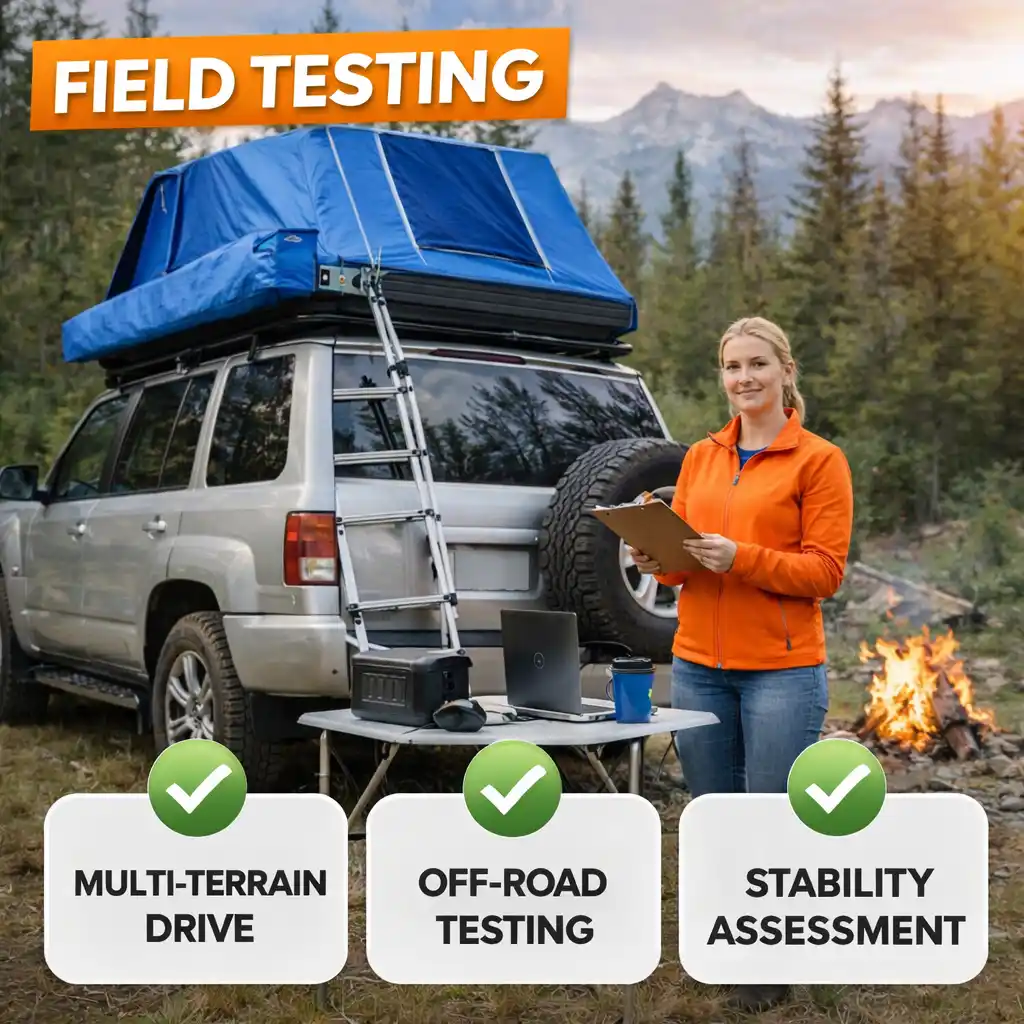
Mounting a rooftop tent correctly isn’t about following instructions—it’s about how the system behaves once it’s exposed to speed, wind, and real load conditions.
To understand what actually works, I tested multiple mounting setups across different vehicles, bar systems, and positioning configurations—focusing on performance on the road, not in the driveway.
Multiple Mounting Configurations
I mounted rooftop tents on:
- aero crossbars (low-profile systems)
- reinforced crossbars (heavy-duty setups)
- different bar spacings and widths
- forward, centered, and rear-biased positions
👉 The goal was to see how small changes affect stability, noise, and handling.
Highway Testing (Primary Benchmark)
Because this is where problems actually appear.
Test conditions:
- sustained speeds between 65–75 mph
- long-distance driving (2–4 hours)
- mixed road surfaces (smooth highway + uneven sections)
What I observed:
- wind noise behavior at different speeds
- stability during lane changes and braking
- how the tent reacts to airflow and drag
👉 Key finding:
A setup that feels stable at 55 mph can become unstable above 65 mph.
Crosswind & Load Shift Testing
I exposed setups to crosswinds and lateral pressure to evaluate:
- side-to-side movement
- mounting tension under force
- recovery after gust impact
👉 This is where poor mounting shows up fastest.
Weak setups don’t fail—they oscillate, which is worse over time.
Manual Stress Testing
After installation, I applied direct pressure to:
- crossbars
- mounting brackets
- tent base
Checking for:
- flex
- micro-movement
- uneven tension
👉 If it moves by hand, it will move more at speed.
Post-Drive Recheck (Critical Step)
After each drive, I rechecked:
- clamp tightness
- bar alignment
- any signs of shifting
👉 This is where incorrect mounting becomes obvious.
Many setups loosen slightly after the first real drive—even if they felt perfect during installation.
💡 Critical Finding
Most mounting issues are not caused by:
- weak tents
- bad racks
They’re caused by:
👉 incorrect positioning
👉 poor load balance
👉 uneven mounting pressure
📌 Mounting performance depends heavily on the bar system underneath —
Best Crossbars for Roof Racks (Weight Capacity, Noise & Fit Tested) shows which designs actually stay stable under real load.
For official safety guidelines on roof load limits and how weight affects vehicle handling, refer to the National Highway Traffic Safety Administration (NHTSA), which explains how improper loading impacts stability and braking.
Step-by-Step: How to Mount a Rooftop Tent Safely
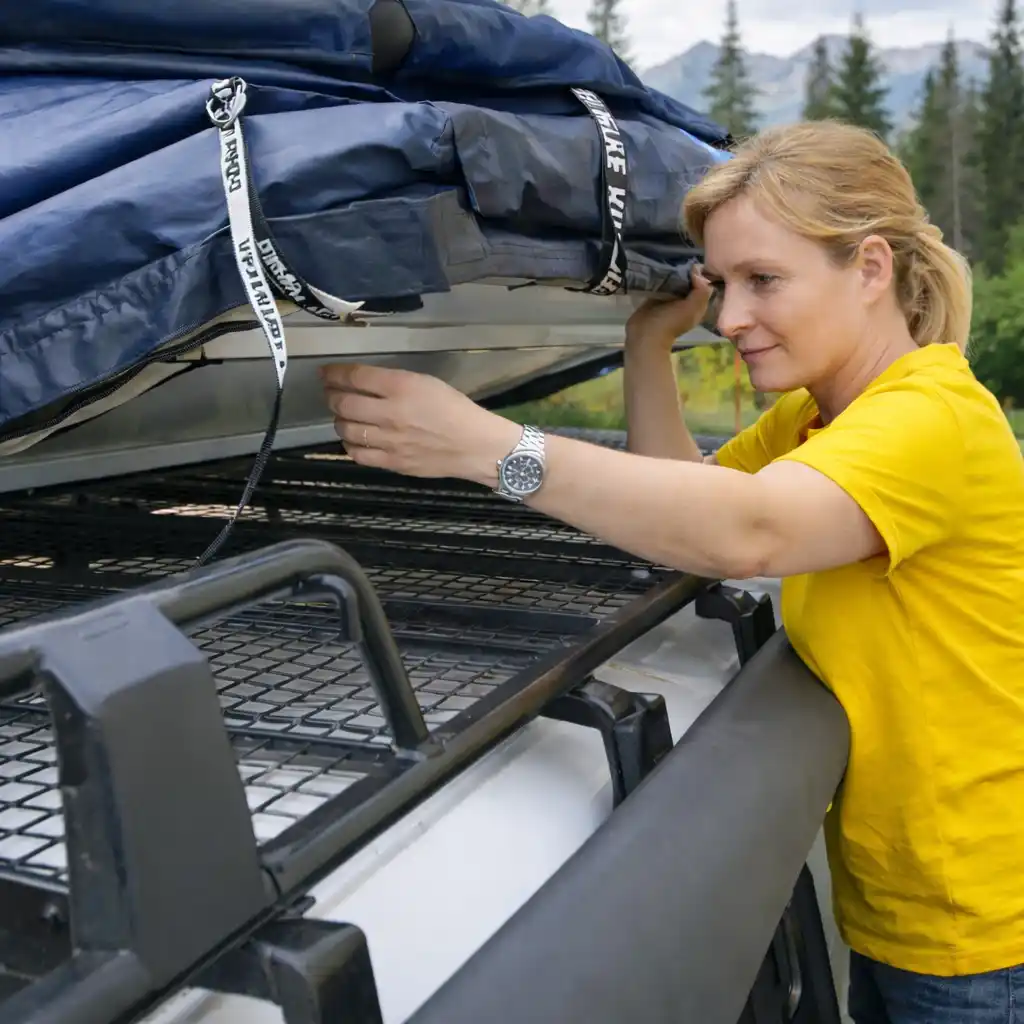
Mounting a rooftop tent correctly isn’t about speed—it’s about precision.
Small setup mistakes won’t show up immediately—but they will at highway speed.
Follow this process carefully:
Step 1: Confirm Roof Rack Compatibility and Load Capacity
Before mounting anything, make sure your system can handle it.
Check:
- dynamic load rating (while driving)
- static load rating (when parked/sleeping)
- combined weight: tent + gear + occupants
👉 Most failures happen because users rely on static ratings only.
💡 If your rack system isn’t installed or aligned correctly,
How to Install a Roof Rack on Your Car (Step-by-Step Safe Setup Guide) shows how to build a stable foundation first.
Step 2: Position Crossbars at Correct Spacing
Crossbar spacing directly affects stability.
- Follow the tent manufacturer’s recommended spacing
- Do not assume your factory bar spread is automatically compatible—measure it against the tent manufacturer’s requirements before mounting.
- Typically wider spacing = better load distribution
- Too narrow = increased flex and instability
👉 This is one of the most overlooked factors.
Step 3: Lift and Center the Tent Properly
Place the tent so the weight sits evenly between the crossbars.
Avoid:
- overhanging too far forward
- shifting weight toward the rear
- uneven left/right positioning
👉 Poor positioning changes how your vehicle handles at speed.
Step 4: Align the Tent With Airflow (Critical for Noise)
Position affects more than balance—it affects airflow.
- Avoid placing the tent too far forward into direct wind
- Keep it aligned with roofline airflow when possible
- Minimize gaps that create turbulence
👉 Misalignment = wind noise + drag + instability
Step 5: Attach Mounting Hardware Evenly
Install brackets/clamps gradually on both sides.
- do NOT fully tighten one side first
- alternate sides to maintain alignment
- ensure brackets sit flush and centered
👉 Uneven tightening creates tilt and long-term instability.
Step 6: Tighten With Controlled Pressure (Not Maximum Force)
This is where most people go wrong.
- overtightening → damages bars / creates pressure points
- undertightening → leads to movement
👉 Goal: firm, even tension—not brute force
If your system includes a torque tool—use it.
Step 7: Check Alignment and Symmetry
Before finishing, verify:
- tent sits parallel to crossbars
- equal spacing on both sides
- no visible tilt or offset
👉 Even small misalignment causes:
- noise
- uneven load stress
- long-term mounting issues
Step 8: Perform a Manual Stability Test
Push and pull the tent from different angles.
Check for:
- movement
- clicking
- flex between components
👉 There should be zero independent movement.
Step 9: Do a Test Drive and Recheck Everything
Start with a short drive:
- low speed → then gradually increase
- listen for noise
- feel for vibration
After the drive, recheck:
- mounting hardware
- bar position
- any signs of shift
👉 This is the step most people skip—and where problems show up.
💡 Pro Tip (Real-World Insight)
If your setup feels “slightly off” at speed—it is.
A correctly mounted rooftop tent should feel:
- stable
- predictable
- quiet enough to ignore
Not something you constantly think about while driving.
📌 Your mounting results depend heavily on the crossbar system underneath —
Best Crossbars for Roof Racks (Weight Capacity, Noise & Fit Tested) explains which bars actually handle rooftop tent loads without flex or noise.
Common Rooftop Tent Mounting Mistakes (And How to Avoid Them)
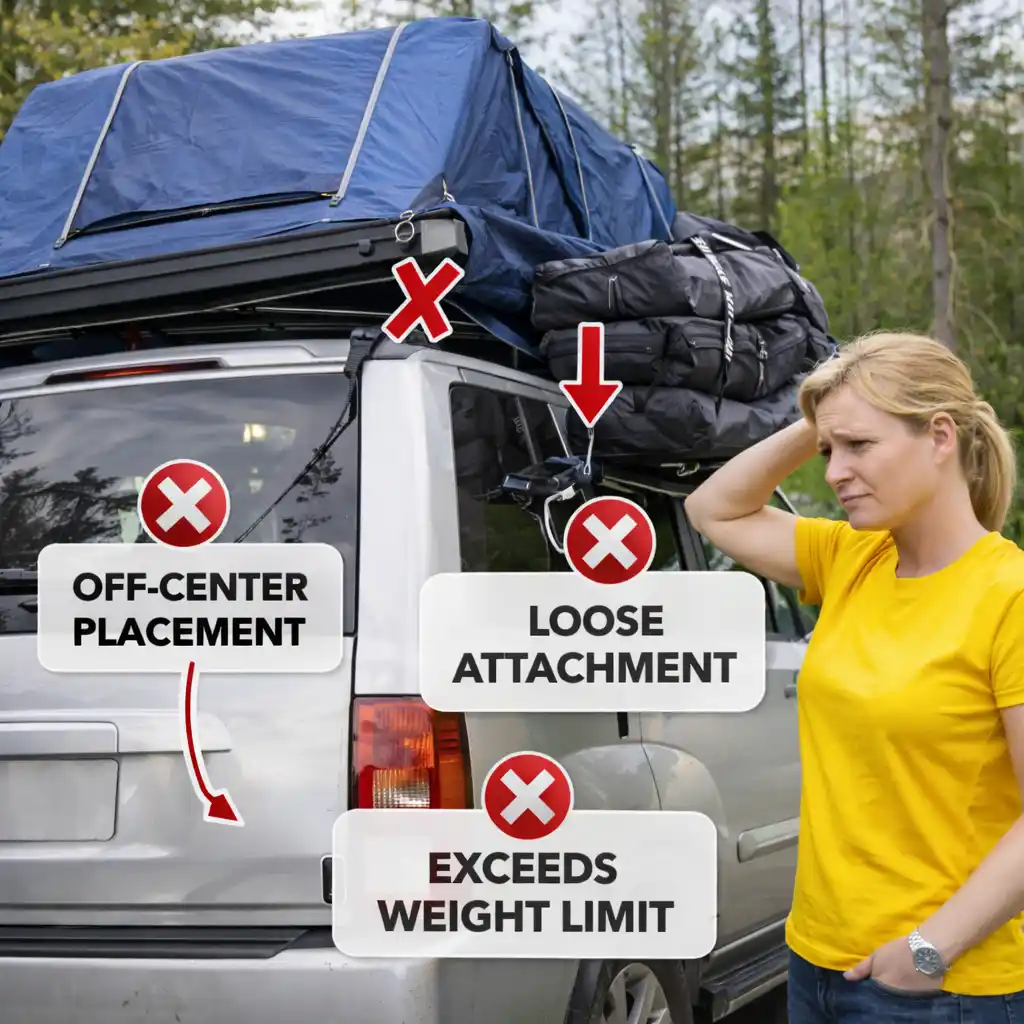
Most rooftop tent problems don’t come from bad gear—they come from small mounting mistakes that only show up once you start driving.
Everything can feel solid at installation.
But at speed, airflow and load forces expose every weak point.
Here are the most common mistakes—and how to avoid them:
Ignoring Dynamic Load Limits
Many users only look at static load ratings.
👉 That’s a mistake.
- dynamic load = while driving
- static load = when parked
A system that holds weight at camp may still be unsafe on the road.
✔️ Fix:
Always base your setup on dynamic load capacity first.
Mounting the Tent Too Far Forward
Placing the tent close to the windshield increases:
- wind resistance
- turbulence
- noise inside the cabin
👉 It also affects handling at speed.
✔️ Fix:
Position the tent slightly rearward while keeping weight centered over the bars.
Incorrect Crossbar Spacing
Too narrow spacing creates:
- flex under load
- mounting stress
- long-term instability
👉 This is one of the most common hidden issues.
✔️ Fix:
Follow manufacturer spacing—and widen within limits when possible.
Uneven Tightening of Mounting Hardware
Tightening one side first pulls the tent out of alignment.
This leads to:
- tilt
- uneven pressure
- noise and movement at speed
✔️ Fix:
Tighten gradually, alternating sides to keep the system balanced.
Overtightening the Mounts
More force ≠ more security.
Overtightening can:
- damage crossbars
- create pressure points
- weaken mounting over time
✔️ Fix:
Use controlled pressure—or a torque tool if available.
Skipping the First Drive Recheck
This is one of the biggest mistakes.
Even a perfect installation can:
- settle slightly
- loosen under load
- shift minimally
👉 And you won’t notice it until later.
✔️ Fix:
Always recheck everything after your first real drive.
Poor Weight Distribution
Placing too much weight:
- too high
- too far forward/back
- uneven left/right
👉 leads to instability and poor handling.
✔️ Fix:
Keep weight:
- centered
- balanced
- as low as possible
💡 Real-World Insight
A bad mounting setup rarely fails instantly.
Instead, it creates:
- constant wind noise
- subtle instability
- long-term wear
👉 which makes your entire trip more stressful.
📌 Most mounting issues actually start with the wrong system underneath —
if your base isn’t stable, nothing above it will be.
Best Roof Setup for Camping (Racks, Rooftop Tents & Load Systems Explained) breaks down how to build a system that stays stable at speed.
How to Check If Your Rooftop Tent Is Mounted Correctly
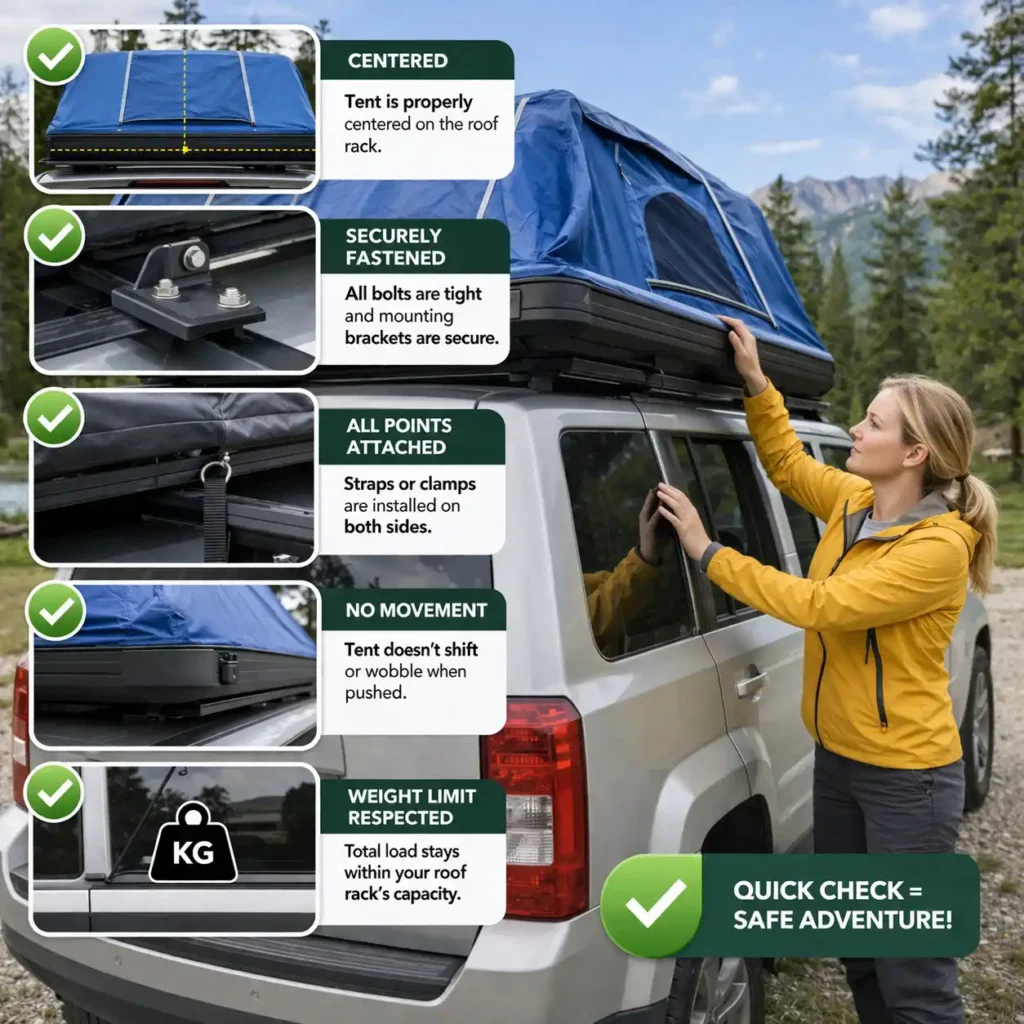
A rooftop tent that “feels secure” isn’t necessarily mounted correctly.
The only way to be sure is to check how it behaves under real pressure, alignment, and driving conditions—not just how it looks after installation.
Manual Stability Test (Before Driving)
Grab the tent and apply force:
- push side-to-side
- pull upward
- apply slight twist
👉 There should be zero independent movement between:
- tent base
- mounting brackets
- crossbars
If anything shifts, the system isn’t properly secured.
Alignment and Position Check
Step back and inspect the setup visually.
Make sure:
- the tent sits parallel to the crossbars
- weight is evenly distributed left to right
- no forward or rear bias
- no visible tilt
👉 Even small misalignment can cause:
- wind noise
- uneven load stress
- instability at speed
Mounting Hardware Inspection
Check every mounting point closely.
Look for:
- even pressure on brackets
- no gaps between mounting surfaces
- properly seated hardware
👉 Poor contact = micro-movement over time.
Low-Speed Drive Test
Start with a short drive at low speed.
Pay attention to:
- unusual sounds
- vibration
- rattling
👉 A correct setup should feel neutral and quiet.
Highway Speed Behavior (Critical Check)
Gradually increase speed to normal driving conditions.
Watch for:
- whistling or humming noise
- vibration through the roofline
- a “floating” or unsettled feeling
👉 These are early warning signs of:
- incorrect positioning
- uneven mounting
- airflow issues
Post-Drive Recheck (Most Important Step)
After your first real drive:
- recheck all mounting points
- confirm nothing has shifted
- retighten if needed
👉 This is where most hidden problems show up.
💡 Real-World Insight
A correctly mounted rooftop tent should feel:
- stable
- predictable
- consistent across all speeds
👉 If something feels “off”—it is.
📌 Your experience also depends heavily on the tent design itself —
some models handle airflow, weight distribution, and mounting stress far better than others.
👉 Best Rooftop Tents for Camping (2026 Tested: Hard Shell vs Soft Shell) breaks down which tents actually stay stable, quiet, and reliable in real-world conditions.
Where to Position a Rooftop Tent (Front vs Center vs Rear)
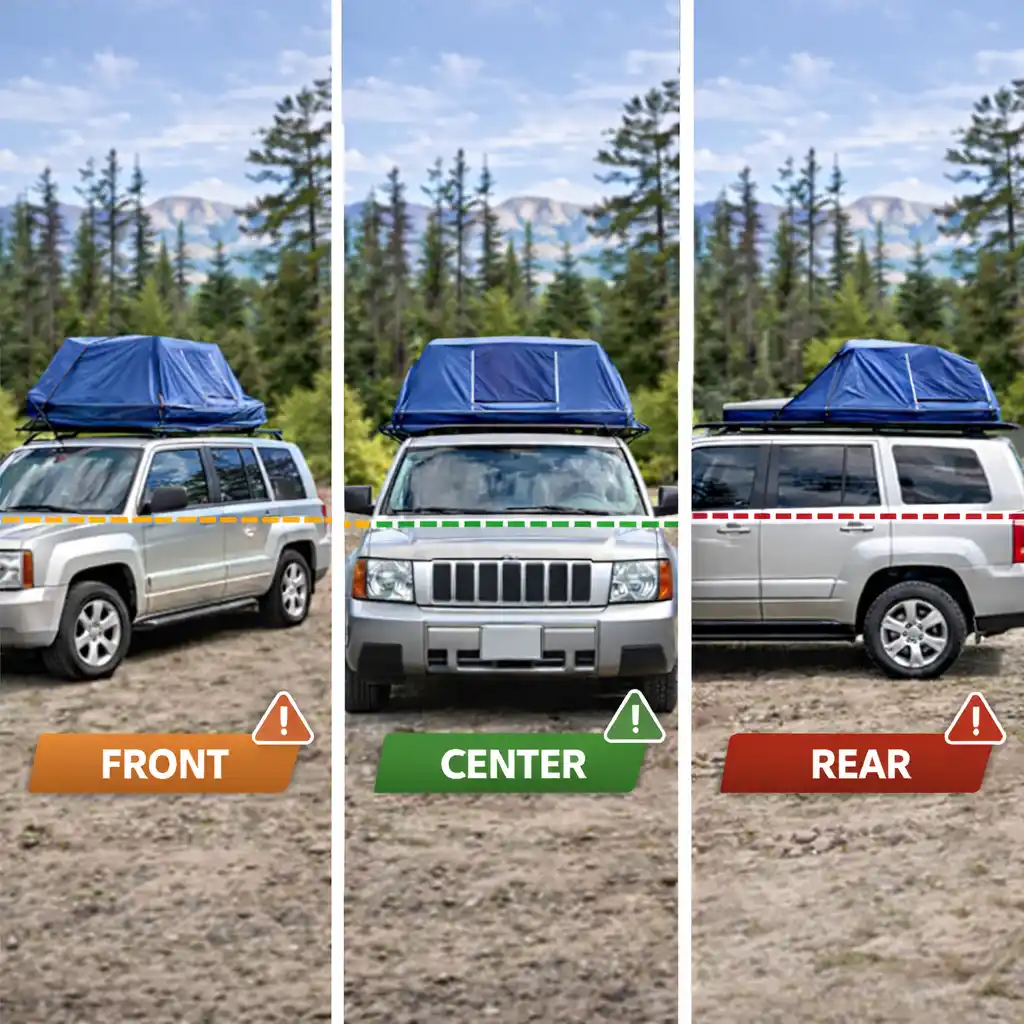
Where you mount your rooftop tent affects more than just fit—it directly impacts:
- vehicle stability
- wind noise
- fuel efficiency
- driving comfort
Most guides ignore this.
In real conditions, positioning is one of the biggest performance factors.
Center Position (Best Overall Setup)
This is the most balanced and recommended placement.
Why it works:
- even weight distribution across crossbars
- minimal impact on handling
- stable at highway speeds
- predictable under braking and cornering
👉 This is the default position for most setups.
✔️ Best for:
- long-distance driving
- daily usability
- most vehicles and rack systems
💡 If you’re unsure—choose center positioning.
Rear Position (Better Aerodynamics, With Limits)
Mounting slightly toward the rear can reduce airflow resistance.
Advantages:
- less direct wind impact
- reduced turbulence near windshield
- often quieter at speed
But there are trade-offs:
- too much rear bias = unstable handling
- affects weight distribution
- can increase rear suspension load
✔️ Best for:
- experienced setups
- vehicles with longer rooflines
- users optimizing for highway efficiency
👉 Small adjustment = good
👉 Too far back = problem
Front Position (Most Common Mistake)
Mounting too far forward creates multiple issues.
Problems:
- direct airflow impact
- increased wind noise
- higher drag
- more stress on front mounting points
👉 This is the worst position for real-world driving.
Airflow & Noise Behavior (What Actually Happens)
At speed, airflow hits the front edge of the tent first.
If positioned incorrectly:
- air gets trapped underneath
- turbulence increases
- noise becomes constant
👉 Even a premium setup becomes loud if positioned wrong.
Weight Distribution (Critical Factor)
Position affects how your vehicle handles:
- centered weight → stable driving
- forward bias → steering feels heavier
- rear bias → increased sway
👉 You feel this most during:
- braking
- lane changes
- crosswinds
💡 Real-World Insight
In testing, even a 2–3 inch shift in tent position:
- changed wind noise noticeably
- affected stability at highway speeds
👉 Small adjustments make a real difference.
Comparison Table: Rooftop Tent Position vs Real-World Effect
| Tent Position | Stability | Wind Noise | Handling | Best Use Case |
|---|---|---|---|---|
| Centered | Best overall balance | Lowest and most consistent | Most predictable | All setups |
| Slightly Rearward | Good if still centered | Lower turbulence | Stable if not overdone | Highway-focused setups |
| Too Far Forward | Reduced stability | High noise and drag | Less predictable | Not recommended |
| Too Far Rearward | Rear-biased load | Can be quiet but unstable | Affected under braking | Advanced setups only |
FAQ: Rooftop Tent Mounting Questions Answered
How to mount a rooftop tent safely on a car?
To mount a rooftop tent safely, you need a compatible roof rack system, correct crossbar spacing, and evenly tightened mounting hardware.
The tent should be centered between the bars, aligned with airflow, and tested after installation with a short drive and recheck.
How much weight can a car roof hold with a rooftop tent?
Most vehicles support around 100–165 lbs dynamic load (while driving) and 400–700+ lbs static load (when parked).
👉 Always follow the lower (dynamic) limit for safe driving.
Where should a rooftop tent be positioned on the roof?
The best position is centered between the crossbars for balanced weight distribution.
Slight rear positioning can reduce wind noise, but too much offset (front or rear) creates instability and drag.
Do rooftop tents damage your car roof?
Not if properly installed.
Problems happen when:
- load limits are exceeded
- mounting is uneven
- crossbars are incompatible
👉 A correct setup distributes weight safely across the roof system.
Why is my rooftop tent noisy on the highway?
Noise is usually caused by:
- incorrect positioning (too far forward)
- poor airflow alignment
- uneven mounting
- low-quality crossbars
👉 Even small adjustments can significantly reduce noise.
How tight should rooftop tent mounts be?
Mounts should be firm and evenly tightened, not overtightened.
Too loose → movement
Too tight → damage and pressure points
👉 Controlled pressure is key.
Can you install a rooftop tent on factory crossbars?
Sometimes—but not always recommended.
Factory bars often:
- have lower load capacity
- flex under weight
- create instability
👉 Upgrading to a stronger system is usually safer.
Do I need to re-tighten a rooftop tent after installation?
Yes.
After your first drive:
- recheck all mounting points
- confirm no shifting
- retighten if needed
👉 Many setups settle slightly after initial use.
Is it safe to drive long distances with a rooftop tent?
Yes—if properly mounted.
A correct setup should feel:
- stable
- predictable
- consistent at highway speeds
👉 If you feel vibration or instability, something is wrong.
Checklist Before Your First Trip With a Rooftop Tent
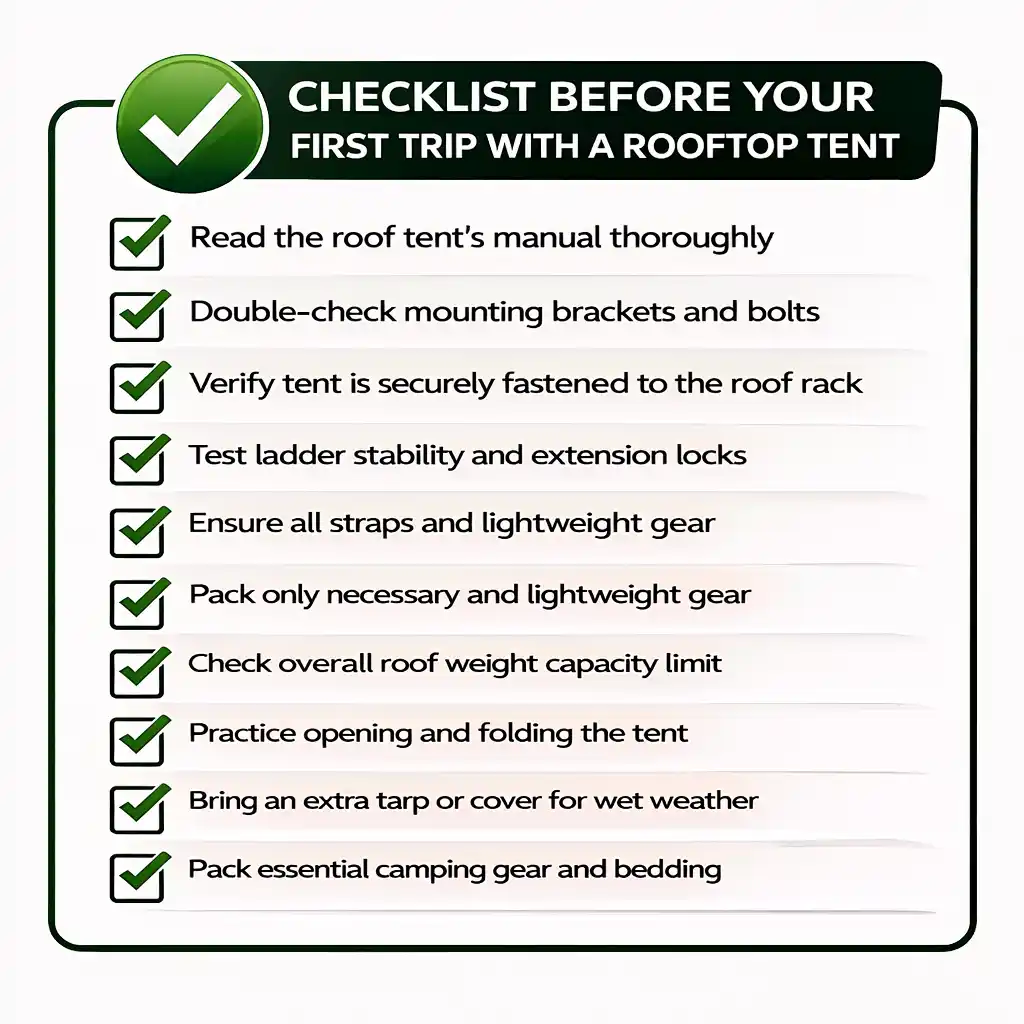
Before your first real drive, run through this checklist.
A rooftop tent that looks secure in the driveway can still behave very differently once you’re on the road.
Use this to catch the most common setup problems before they turn into noise, instability, or mounting stress.
Rooftop Tent Pre-Trip Checklist
- crossbars match the tent’s weight and mounting requirements
- bar spacing matches the tent manufacturer’s recommendations
- the tent sits centered and balanced across the roof
- mounting hardware is tightened evenly on both sides
- no visible tilt, offset, or bracket gap
- the tent does not shift under manual pressure
- all bolts, brackets, and plates are fully seated
- vehicle height is noted before entering garages or low-clearance areas
- nothing interferes with hatch opening or roof accessories
- the setup has been checked again after a short test drive
💡 Real-World Reminder
The goal is not to make the tent feel “tight.”
The goal is to make the whole system feel:
- balanced
- stable
- predictable at speed
If anything feels slightly off before your first trip, fix it before loading more gear or heading onto the highway.
📌 If you’re still deciding which tent is worth mounting in the first place,
Best Rooftop Tents for Camping (2026 Tested: Hard Shell vs Soft Shell) breaks down which models actually perform well under real-world load, airflow, and weather conditions.
Final Verdict: How to Mount a Rooftop Tent the Right Way
Mounting a rooftop tent safely isn’t about tightening bolts—it’s about building a system that stays stable, quiet, and predictable in real driving conditions.
After testing different setups across highway speeds, crosswinds, and long-distance trips, the difference always comes down to the same three factors:
Balance Over Everything
A well-mounted rooftop tent:
- sits centered across the crossbars
- distributes weight evenly
- doesn’t overload one side or position
👉 Poor balance creates instability long before anything actually fails.
Positioning Defines Performance
Even a high-end setup will perform poorly if positioned incorrectly.
- too far forward → noise and drag
- too far back → handling issues
- misaligned → constant turbulence
👉 Small positioning changes make a real difference at speed.
Mounting Precision > Tightness
Most people think “tight = safe.”
In reality:
- overtightening damages components
- uneven pressure creates instability
- improper alignment leads to long-term issues
👉 What matters is even, controlled, precise mounting.
System Over Gear
You can have:
- the best rooftop tent
- the strongest rack
- high-end components
👉 but if they don’t work together, your setup will still feel wrong.
A well-designed system always outperforms expensive gear without structure.
💡 Real-World Perspective
In real trips, what matters most is not how your setup looks—
it’s how it behaves when:
- you’re driving at highway speed
- wind conditions change
- you need reliability without constant adjustments
👉 That’s where proper mounting proves its value.
Final Takeaway
If your rooftop tent:
- stays stable at speed
- doesn’t create constant noise
- feels predictable in all conditions
👉 you’ve mounted it correctly.
If not—don’t ignore it.
Small issues become big problems over time.
📌 Your mounting result depends on the full system—not just the tent itself
👉 Best Roof Setup for Camping (Racks, Rooftop Tents & Load Systems Explained) shows how to build a setup that actually works as one structure.
About the Author
Anthony is a Senior Gear Analyst at CampComfortGuide, specializing in vehicle-based camping systems and real-world performance testing.
His work focuses on how gear behaves outside ideal conditions—on highways, under crosswinds, and across long-distance travel—where mounting quality and system design directly impact safety, comfort, and usability.
Field testing includes thousands of miles across North America, covering:
— high-speed highway driving with roof-mounted systems
— repeated installation and reinstallation of rack and tent setups
— real-world exposure to wind, rain, and uneven terrain
All recommendations are based on independent testing, with gear purchased at retail price—no sponsored placements or manufacturer bias.
👉 The goal is simple: help readers build rooftop tent setups that perform reliably in real conditions—not just look correct on paper.