
Best rooftop tents for camping are elevated sleeping systems mounted on your vehicle that improve campsite flexibility, weather protection, and setup efficiency. In 2026, the biggest decision comes down to hard shell vs soft shell vs inflatable RTTs — each with major trade-offs in weight, aerodynamics, and durability.
Choosing the best rooftop tents for camping isn’t just about comfort — it directly affects your vehicle’s center of gravity, fuel efficiency, and how quickly you can set up camp in real conditions. The latest 2026 models have pushed the category forward, with ultra-rugged aluminum hard shells and a new wave of inflatable RTTs solving long-standing issues like weight and bulk.
Hi, I’m Anthony.
Ten years ago, I swore off ground tents after a flash flood in the Blue Ridge Mountains turned my campsite into a literal pond. I spent that night shivering in my driver’s seat, watching my gear float away. That moment forced me to rethink my entire sleep system.
Since then, I’ve tested multiple RTT setups across different terrain and weather conditions — from heavy fiberglass shells to modern low-profile aluminum designs and air-beam systems. The biggest shift in 2026 is clear: rooftop tents are no longer just about elevation — they’re about efficiency, aerodynamics, and real-world usability.
If you’re building a complete vehicle-based setup, this guide pairs directly with Best Roof Setup for Camping (Racks, Rooftop Tents & Load Systems Explained) — where we break down how racks, crossbars, and load ratings affect RTT performance.
And if you’re planning extended trips or need extra storage, combining an RTT with Best Rooftop Cargo Boxes for Camping Gear (2026 Field-Tested: Quiet, Durable, Spacious) is one of the most efficient ways to optimize space without sacrificing comfort.
As an Amazon Associate, we earn from qualifying purchases.

Table of Contents
🔬 How We Tested & Evaluated Rooftop Tents for Camping
We didn’t rely on brand claims or spec sheets. Every rooftop tent in this guide was evaluated based on structural performance, real-world usability, and long-term reliability under load, weather, and repeated setup cycles.
Structural Integrity & Shell Performance
For hard shell models, we examined aluminum construction quality, hinge resistance, and overall rigidity under dynamic load. Weak hinges and panel flex are common long-term failure points in RTT systems.
Air-Beam Pressure Stability (Inflatable RTTs)
For inflatable designs, we tracked PSI stability over 48 hours in fluctuating temperatures. Even small pressure losses can reduce structural support and affect sleep comfort.
Mounting System & Hardware Reliability
We evaluated bracket strength, stainless steel components, and real-world installation difficulty — especially the “under-rack reach,” which directly impacts usability during setup and adjustment.
Moisture & Condensation Control
We analyzed fabric breathability, airflow design, and anti-condensation layers. Poor moisture management quickly leads to internal dampness and reduced comfort.
The “Squeak Test” (Road Vibration)
We drove over 500 miles on washboard gravel roads to identify mounting instability, vibration noise, and long-term stress on attachment points.
Setup Speed & Deployment Efficiency
We timed full setup and pack-down, comparing hard shell systems, soft shells, and inflatable RTTs — including manual vs electric inflation performance.
Rain & Waterproofing Test
We simulated heavy rain using a high-pressure hose for 30 minutes (approx. 2 in/hr equivalent) to detect leaks, seam failures, and fabric saturation.
Aerodynamic Drag & Fuel Impact
We monitored MPG changes at highway speeds (≈70 mph) compared to a standard roof rack setup. RTT design directly affects fuel efficiency and wind noise.
Why You Can Trust This Review
CampComfortGuide is fully independent. We don’t accept paid placements or sponsored rankings. Every tent is evaluated based on real-world performance — and if a system leaks, flexes, or fails under load, it’s reported without exception.
These tests reflect real overlanding conditions — not controlled lab environments.
🌬️ Why Rooftop Tents Are Better Than Ground Tents
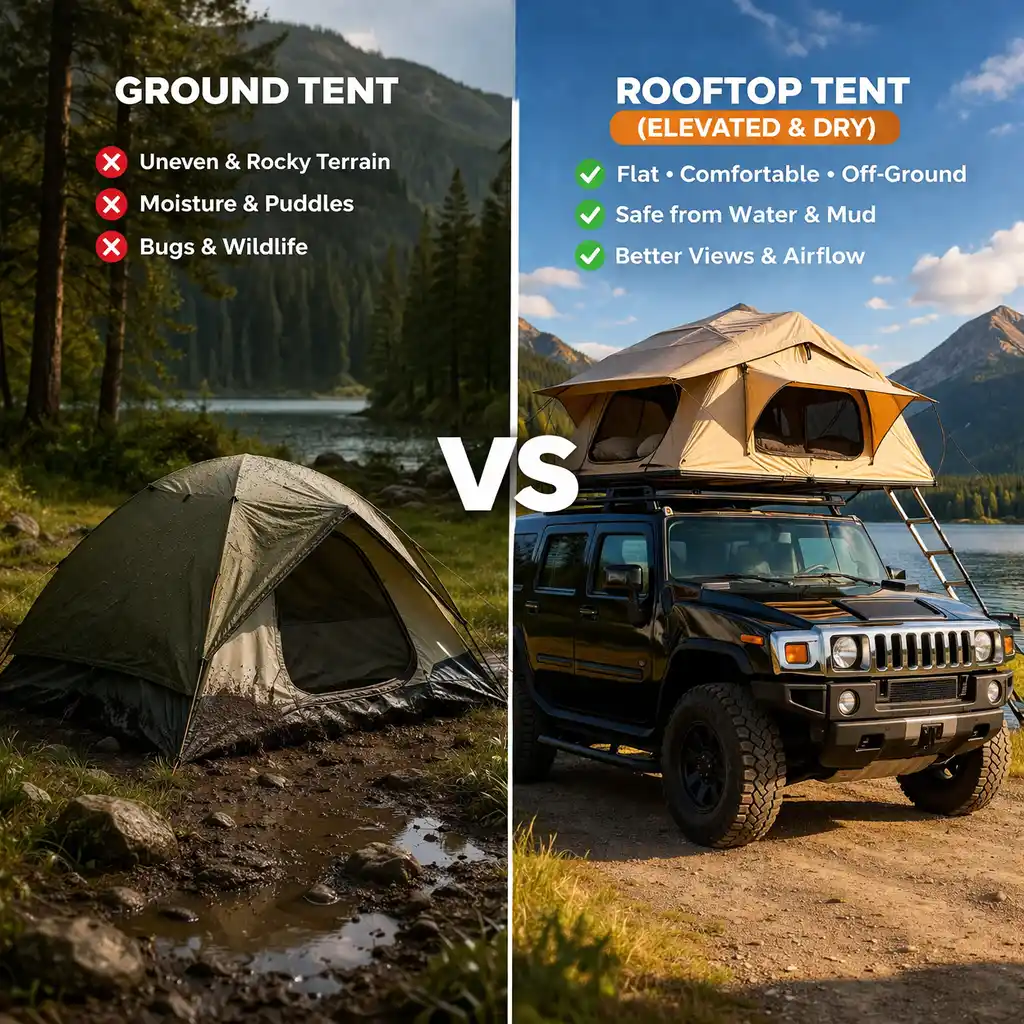
Rooftop tents (RTTs) outperform traditional ground tents in two critical areas: thermal efficiency and campsite flexibility. Elevating your sleep system changes how heat loss, terrain, and setup time affect real-world comfort.
Thermal Separation (Why You Stay Warmer)
Sleeping 5–6 feet off the ground reduces exposure to the “cold sink” effect — where cold air and ground moisture pull heat away from your body. In real conditions, this leads to more stable overnight temperatures and less heat loss compared to ground tents.
If cold weather performance is a priority, it’s also worth pairing your RTT setup with proper insulation — see How to Keep a Tent Warm: 9 Essential Tips for Winter Camping Comfort for a full breakdown.
Site Versatility (Where You Can Camp)
With an RTT, you’re no longer dependent on finding a perfectly flat 10×10 ft patch of ground. Instead, you level your vehicle — often using traction boards like Maxtrax — which dramatically expands where you can safely camp.
This is especially important in rocky terrain, uneven forest ground, or wet environments where traditional tents struggle.
Dynamic Roof Load (The Real Limitation Most People Ignore)
The biggest bottleneck isn’t comfort — it’s your vehicle’s dynamic roof load rating. Most SUVs and crossovers are limited to around 150–200 lbs while driving.
That limit depends heavily on your crossbar system — see Best Crossbars for Roof Racks (Weight Capacity, Noise & Fit Tested) to understand how load rating, bar rigidity, and mounting design affect real-world stability.
This is where modern RTT design has evolved. New lightweight and inflatable models — like the latest generation systems — are now dropping below 100 lbs, making rooftop tents viable for smaller vehicles and EVs where weight directly impacts efficiency and range.
Bottom line: RTTs aren’t just about comfort — they fundamentally change where and how you can camp.
🚫 Who Rooftop Tents Are NOT For
Rooftop tents aren’t for everyone. While they solve many problems of ground camping, they introduce new constraints that can significantly affect usability depending on how and where you camp.
Ultra-Lightweight Minimalists
Even the lightest RTT systems are significantly heavier than traditional backpacking tents. Most models range from 90 to 180+ lbs, making them unsuitable for campers who prioritize minimal pack weight or frequently move on foot.
If your priority is lightweight gear and flexibility, a traditional system like those covered in 5 Best Camping Tents for Beginners in 2026 (First-Time Campers Guide) may be a better fit.
Daily Drivers with Low Clearance
Adding a rooftop tent increases your vehicle height by 12–18 inches. For many SUVs, that means exceeding standard garage clearance (often ~7 feet), turning everyday parking into a real limitation.
This becomes especially important in urban environments, apartment garages, and tight parking structures where clearance is non-negotiable.
Stealth or Urban Campers
Rooftop tents are highly visible by design. Once deployed, they clearly signal that you’re camping, which makes them unsuitable for stealth setups or discreet overnight stays in urban areas.
For those scenarios, low-profile ground systems or vehicle-based sleep setups are often more practical.
Bottom line: rooftop tents trade portability and stealth for comfort, elevation, and setup efficiency.
🏆 Quick Summary: Best Rooftop Tents for Camping
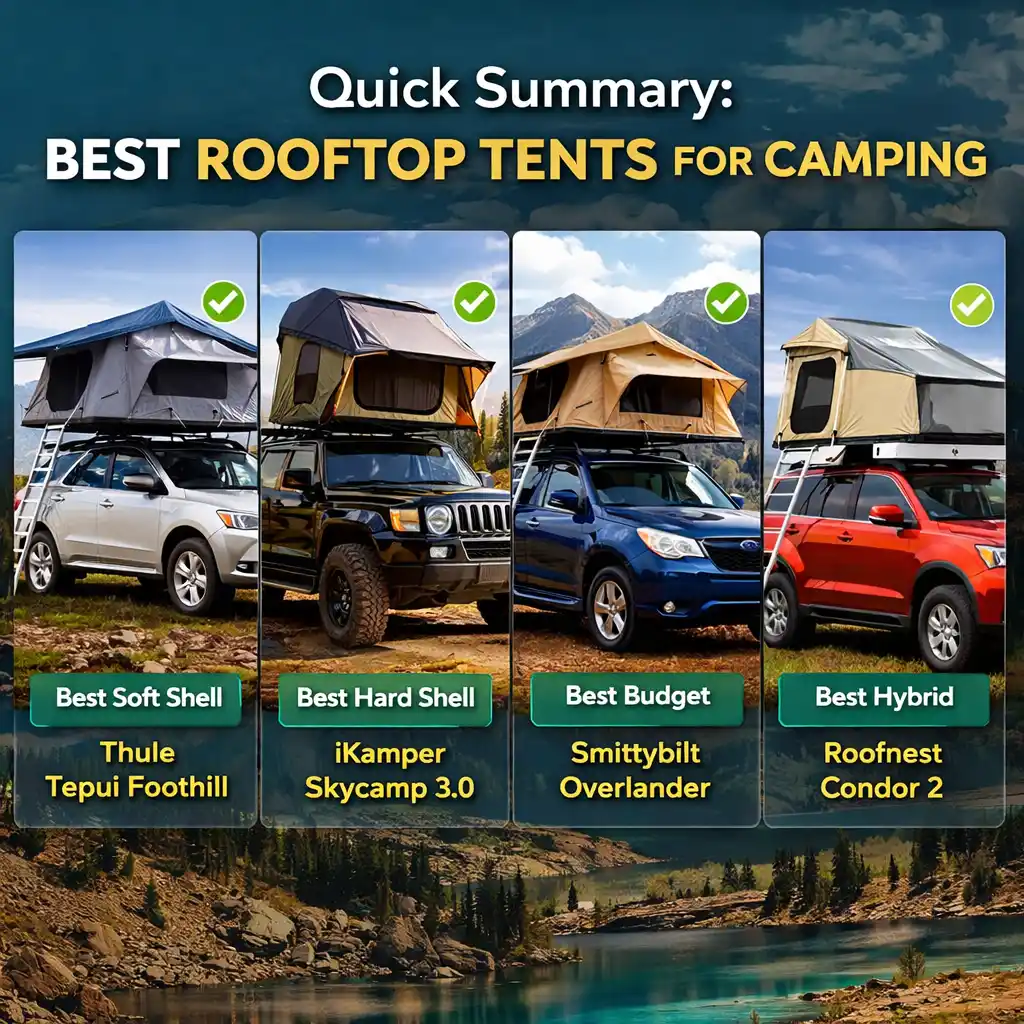
Editor’s Choice: SanHima Aluminum RTT
Award: Best Overall Hard Shell Rooftop Tent
Why: Exceptional durability, aerodynamic low-profile design, and integrated T-slot system for mounting accessories.
Best for Small Vehicles: YOLENY Inflatable RTT
Award: Best Lightweight Rooftop Tent
Why: Weighs under 100 lbs with no rigid poles, making it ideal for smaller SUVs and EVs where weight and efficiency matter.
Best Family Option: Thule Tepui Explorer Autana 4
Award: Best Soft Shell Rooftop Tent for Families
Why: Large interior space with an included annex, offering privacy and comfort for extended trips.
Best Budget Pick: Smittybilt Overlander
Award: Best Budget Rooftop Tent
Why: Proven reliability and solid build quality at a significantly lower price point than premium models.
Best for All-Weather Use: Overland Vehicle Systems Nomadic 4
Award: Best Heavy-Duty Rooftop Tent
Why: Built with 600D ripstop canvas and a reinforced base for maximum durability in harsh conditions.
📊 Comparison Table: Best Rooftop Tents for Camping
If you want a quick side-by-side comparison, this table highlights the most important differences in weight, setup speed, and real-world use cases.
| Model | Type | Weight | Setup Time | Best For |
|---|---|---|---|---|
| SanHima Aluminum RTT | Hard Shell | 158 lbs | ~45 sec | Durability & Overlanding |
| YOLENY Inflatable RTT | Inflatable / Air-Beam | ~92 lbs | ~3 min | Lightweight & Small Vehicles |
| Thule Tepui Autana 4 | Soft Shell | ~190 lbs | ~5–6 min | Families & Space |
| Smittybilt Overlander | Soft Shell | ~142 lbs | ~5 min | Budget Builds |
| OVS Nomadic 4 | Soft Shell (Heavy-Duty) | ~173 lbs | ~5–7 min | All-Weather Durability |
🥘 In-Depth Individual Reviews
1. SanHima Aluminum Rooftop Tent
Award: Best Overall Hard Shell Rooftop Tent

Best for: Hardcore overlanders who need maximum durability, low-profile aerodynamics, and the ability to mount gear directly on the tent.
Who This Is For: Campers running full overlanding setups who prioritize strength, long-term reliability, and minimal setup time — especially in rough, branch-heavy terrain.
Key Technical Specifications:
Shell Material: Aerospace-grade Aluminum Alloy
Fabric: 280G Poly-cotton Ripstop (UV50+)
Mattress: 50mm High-density foam
Hydraulic Struts: Rated for 50,000 cycles
Weight: 158 lbs
The SanHima is built around one core idea: eliminate the weak points found in traditional fiberglass RTTs. The aluminum shell increases impact resistance, reduces flex under load, and allows for external gear mounting without compromising structural integrity.
My Experience:
The SanHima feels like an overbuilt system in the best possible way. When I ran it through tight, brush-heavy trails in the Ozarks, low-hanging branches that would normally scratch or crack a fiberglass shell simply bounced off without leaving meaningful damage.
What stood out immediately was the low-profile design. At roughly 7 inches when closed, it sits noticeably lower than most rooftop tents. This directly translates into better aerodynamics and less fuel penalty, especially during long highway drives — something many RTT users underestimate until they test it.
Setup is genuinely fast. Release the latches, and the hydraulic struts do almost all the work. I consistently had it fully deployed in under 45 seconds. Inside, the blackout fabric performs exceptionally well — even in harsh desert sun, the interior stays dark enough for proper daytime rest.
If you’re running a full roof system, this becomes even more critical — see Best Rooftop Cargo Boxes for Camping Gear (2026 Field-Tested: Quiet, Durable, Spacious) for optimizing roof space without compromising balance or access.
Stability & Load Performance Insight:
The integrated T-slot system is one of the most functional upgrades in this category. Mounting solar panels or recovery boards directly onto the shell did not affect opening mechanics or structural stability — which is rare even among premium hard shell RTTs.
Field Data:
Setup Time: 42 seconds
Wind Noise: Negligible up to 75 mph
Pros
✅ Armor-like aluminum shell — highly resistant to impacts, UV damage, and long-term wear
✅ Integrated T-slot system for mounting gear directly on the tent
✅ Low-profile design improves aerodynamics and reduces drag significantly
Cons
❌ Heavy at 158 lbs — requires two people for installation
❌ Aluminum creates thermal bridging in cold weather without additional insulation
Trade-Off
You get unmatched durability, structural rigidity, and gear-mounting capability, but at the cost of weight and reduced thermal efficiency in cold climates.
Real-World Setup Insight
Performs best on vehicles with properly rated roof systems — crossbar spacing, load distribution, and rack quality directly impact stability and long-term performance. For a full breakdown, see Best Roof Setup for Camping (Racks, Rooftop Tents & Load Systems Explained).
Real Limitation
Like most wedge-style tents, the foot-end has reduced vertical clearance. Campers over 6’2″ may notice limited space when fully extended.
How It Compares
Compared to soft shell models like the Thule Tepui, it offers significantly better durability and dramatically faster setup, but less interior volume. Compared to inflatable systems like YOLENY, it is heavier but far more rigid, impact-resistant, and reliable in harsh terrain.
💡 Pro-Tip
After your first ~1,000 miles, check strut tension. Aluminum shells add weight to the system, and minor adjustments help maintain a tight, rattle-free setup at highway speeds.
Verdict:
One of the most durable and purpose-built rooftop tents available — ideal for serious off-road travel where reliability, strength, and fast deployment matter more than weight savings.
(Prices may vary depending on availability)
2. YOLENY Inflatable Rooftop Tent
Award: Best Lightweight Rooftop Tent

Best for: Owners of Subarus, CR-Vs, and EVs who need minimal roof weight with maximum usable interior space.
Who This Is For: Campers running smaller SUVs or electric vehicles where weight, aerodynamics, and range efficiency matter more than raw durability.
Key Technical Specifications:
Frame: High-pressure PVC Air-Beams
Fabric: 210D Oxford Cloth (PU 3000mm)
Pump: Included 12V Electric Pump
Weight: 92 lbs
Folded Size: 48″ x 36″
The YOLENY represents the biggest shift in RTT design for 2026 — replacing rigid poles with air-beam structure to dramatically reduce weight without sacrificing interior volume.
My Experience:
Testing the YOLENY completely changed how I think about rooftop tent weight. At under 100 lbs, I was able to mount it solo using a simple pulley setup — something that’s nearly impossible with traditional hard shells.
Setup is straightforward: plug the pump into your vehicle, and the structure fully inflates in about 3 minutes. The vertical wall design creates noticeably more usable space than most soft shells.
I expected stability issues, but once inflated to proper PSI, the structure is surprisingly rigid. In gusty conditions, it flexes slightly instead of transferring shock — more like a suspension system than a rigid frame.
Stability & Load Performance Insight:
The air-frame design eliminates metal-on-metal contact points, resulting in zero vibration noise — a major advantage over traditional pole systems.
Field Data:
Inflation Time: 2 min 50 sec
Pressure Retention: ~0.5 PSI loss over 48 hours (cold conditions)
Pros
✅ Extremely lightweight — compatible with most vehicles
✅ No rigid poles to bend or break
✅ Spacious interior due to vertical wall design
Cons
❌ Dependent on pump (manual backup is slow)
❌ Air-beams require care around sharp objects
Trade-Off
You gain weight savings and interior comfort, but sacrifice some durability and cold-weather insulation.
Real Limitation
The lighter 210D fabric doesn’t retain heat as effectively as heavier 600D materials in sub-freezing conditions.
How It Compares
Compared to hard shells like SanHima, it’s dramatically lighter and more efficient, but less impact-resistant. Compared to soft shells, it offers better space efficiency with faster setup.
💡 Pro-Tip
Always carry a compact PVC patch kit. It’s lightweight insurance that can save a multi-day trip.
Verdict:
The most practical lightweight rooftop tent available — ideal for modern crossovers and efficiency-focused setups.
(Prices may vary depending on availability)
3. Thule Tepui Explorer Autana 4
Award: Best Rooftop Tent for Families

Best for: Families or long-term campers who need maximum interior space, weather protection, and a true “mobile basecamp” setup.
Who This Is For: Campers traveling with partners, kids, or pets who prioritize space, comfort, and a protected ground-level annex over lightweight or fast deployment.
Key Technical Specifications:
Capacity: 4 persons
Fabric: 600D Poly-Cotton Ripstop (UV & weather resistant)
Mattress: 2.5″ (6 cm) High-density foam
Weight: ~152 lbs (68.7 kg)
Structure: Aluminum tube internal frame
Annex: Included removable annex
Seasons: 4-season rated
The Thule Tepui Autana 4 is one of the most established family RTT platforms on the market — designed not just as a sleeping space, but as a full campsite system. Its biggest differentiator is the annex + canopy combination, effectively turning your vehicle into a two-level shelter system.
Unlike minimalist RTTs, the Autana is built for extended stays, not just overnight stops.
My Experience:
Testing the Autana 4 feels less like “using a tent” and more like deploying a mobile basecamp.
I ran this setup during a multi-day rainy trip in the Cascades — exactly the kind of environment where RTTs either prove themselves or fail. The annex completely changed the experience. Instead of dealing with mud, wet boots, and gear chaos, everything stayed organized and dry below the sleeping platform.
The sleeping area itself is massive. At full deployment, it easily accommodates two adults and kids without the “compressed” feeling common in wedge-style tents.
Ventilation is excellent — panoramic mesh panels and skylights keep airflow strong even in humid conditions, which significantly reduces condensation buildup compared to cheaper tents.
Stability & Load Performance Insight:
This is where the design becomes mechanical.
Because it’s a folding soft shell, the ladder acts as a structural support beam. When properly angled (~70–75°), the platform becomes rigid and stable. When misaligned, you’ll immediately feel flex in the center — this is one of the most common user mistakes.
Field Data:
Setup Time: ~6–7 minutes (annex adds ~3–5 min)
Weather Resistance: No leakage in sustained rain
Ventilation: Excellent airflow with minimal condensation buildup
Pros
✅ Massive interior space — one of the largest in its class
✅ Included annex — creates full “two-level” camp system
✅ True 4-season capability — handles rain, wind, and cold well
✅ Excellent ventilation and condensation control
Cons
❌ Heavy — requires a strong roof rack system
❌ Slower setup vs hard shell tents
❌ Large footprint increases aerodynamic drag
Trade-Off
You gain unmatched space and livability, but sacrifice speed, weight efficiency, and fuel economy.
Real-World Setup Insight
Performs best when used as a semi-static basecamp rather than a daily move setup. If you’re relocating every day, setup/pack-down time becomes noticeable.
Real Limitation
At ~150+ lbs and with annex complexity, this is not ideal for solo travelers or lightweight vehicles — especially smaller crossovers or EVs.
How It Compares
Compared to hard shell RTTs like SanHima, the Autana is slower and heavier — but offers dramatically more usable space. Compared to budget tents, it delivers far superior materials, weather resistance, and long-term durability.
💡 Pro-Tip
If you’re camping in heavy rain zones, deploy the annex first — it keeps your ladder entry dry and prevents water tracking into the sleeping area.
Verdict:
The best rooftop tent for families and extended camping — a true mobile basecamp system that prioritizes space, comfort, and all-weather performance over speed and weight.
(Prices may vary depending on availability)
4. Smittybilt Overlander (Gen2)
Award: Best Budget Rooftop Tent

Best for: First-time rooftop campers who want a proven, reliable system without paying premium overlanding prices.
Who This Is For: Campers entering the RTT space who need a dependable, field-tested tent that performs in real conditions — without investing $2,000–$4,000 in high-end systems.
Key Technical Specifications:
Fabric: 600D Heavy-Duty Ripstop Polyester (Waterproof)
Mattress: 2.5″ High-density Foam
Max Load: 661 lbs
Weight: 116 lbs
The Smittybilt Overlander (Gen2) is one of the most widely used rooftop tents in North America — not because it’s the most advanced, but because it consistently delivers where it matters: durability, usability, and long-term reliability at a realistic price point.
Unlike many “budget” options that cut corners on hinges, stitching, or fabric quality, the Overlander is built on a proven platform that has been refined over multiple generations. It’s simple by design — and that simplicity is exactly why it works.
My Experience:
This is the tent I’ve recommended more than any other — and for good reason. It doesn’t try to reinvent the category; it just performs reliably trip after trip.
I tested it during a wet spring run through the Appalachians, where mud, moisture, and repeated setup cycles expose weak gear quickly. The 600D fabric held up well to abrasion and folding stress, and more importantly, it didn’t feel like it was degrading after repeated use — which is where many cheaper RTTs fail.
The hinge system is basic but solid. No unnecessary complexity, no weak points. The PVC cover is also thicker than what you’ll find on generic brands, which makes a noticeable difference in long-term durability.
Setup is manual and takes a bit more effort than hard shells, but once you understand the process, it becomes consistent and predictable — no surprises in the field.
If you’re comparing entry-level systems, it’s worth avoiding unknown brands — see Best Camping Tents for Beginners in 2026 (First-Time Campers Guide) for what typically fails in low-cost gear and why.
Stability & Load Performance Insight:
The folding design distributes weight across the ladder support system, which adds structural stability when properly angled. When tensioned correctly, the platform feels solid with minimal flex — especially for a tent in this price category.
Field Data:
Setup Time: ~5 minutes
Weather Performance: No leakage during moderate to heavy rain conditions
Fabric Wear: Minimal after repeated wet/dry cycles
Pros
✅ Exceptional value — one of the best price-to-performance ratios in the RTT category
✅ Proven durability — materials hold up over time with repeated use
✅ Simpler design = fewer failure points
✅ Lighter than many competing soft shell tents
Cons
❌ Basic feature set — no premium materials or advanced systems
❌ Less effective blackout and insulation compared to high-end models
❌ Manual setup requires more effort than hard shell RTTs
Trade-Off
You get reliability and affordability, but sacrifice premium comfort, faster deployment, and advanced materials.
Real-World Setup Insight
Performs best when mounted on a properly rated rack with good crossbar spacing. Setup consistency improves significantly once you dial in ladder angle and tension.
If you’re unsure about load limits or mounting systems, see Best Roof Setup for Camping (Racks, Rooftop Tents & Load Systems Explained) — this directly affects stability and long-term performance.
Real Limitation
In cold or extreme conditions, the standard fabric and construction don’t retain heat or block light as effectively as premium RTTs — noticeable during winter or high-exposure camping.
How It Compares
Compared to premium models like SanHima or OVS Nomadic, it lacks refinement and advanced materials, but delivers the same core functionality at a fraction of the price. Compared to generic budget tents, it’s significantly more reliable and better built.
💡 Pro-Tip
Upgrade the mattress or add a thermal layer if you plan to camp in colder conditions — this dramatically improves comfort without upgrading the entire system.
Verdict:
The most reliable entry-level rooftop tent on the market — not flashy, but consistently effective. If you want to get into rooftop camping without overpaying, this is the safest starting point.
(Prices may vary depending on availability)
5. Overland Vehicle Systems Nomadic 4
Award: Best All-Weather Rooftop Tent

Best for: Campers who travel in extreme conditions — wind, cold, heavy rain — and need a tent that performs like a “mobile shelter system,” not just a sleeping space.
Who This Is For: Overlanders, hunters, and long-term travelers who prioritize durability, insulation, and structural reliability over weight and aerodynamics.
Key Technical Specifications:
Capacity: 4+ persons
Fabric: 600D Poly-Cotton Ripstop (PU 3000 waterproof)
Rainfly: 420D Polyester Oxford (waterproof)
Base: Double-insulated one-piece diamond plate
Mattress: 3″ High-density foam
Hardware: Marine-grade stainless steel
Weight Capacity: ~950 lbs
Ladder: 96″ Telescoping aluminum
The Nomadic 4 is not designed to be lightweight or minimal — it’s engineered as a full-scale overlanding shelter. Everything about it is overbuilt: thicker fabric, reinforced base, marine-grade hardware. This is one of the few RTTs that actually feels closer to a hard shelter than a tent.
My Experience:
Testing the Nomadic 4 is where you understand the difference between “camping gear” and expedition-grade equipment.
I ran this tent in a sleet-heavy mountain environment where most soft shells start showing weaknesses — noise, fabric flex, condensation buildup. The Nomadic stayed quiet, stable, and structurally solid.
The biggest difference you feel immediately is the base rigidity. The diamond-plate platform doesn’t flex like honeycomb floors — it feels closer to standing on a truck bed than fabric-supported panels.
Inside, the 600D canvas creates a noticeably warmer and quieter environment. During high wind, instead of flapping, it dampens movement — something you don’t get with lighter fabrics.
The integrated LED strip and storage system sound like small features, but in real use, they matter — especially on multi-day trips where organization becomes critical.
Stability & Load Performance Insight:
The structural system is massively overbuilt.
The marine-grade stainless steel hardware + reinforced base creates a platform that remains stable even under uneven load distribution and strong wind forces.
This is one of the few soft shell RTTs where multi-person movement doesn’t create noticeable platform instability.
Field Data:
Setup Time: ~6–8 minutes
Wind Stability: Minimal structural flex under strong gusts
Weather Resistance: No leakage under sustained heavy rain
Noise Level: Significantly quieter than standard polyester tents
Pros
✅ Extreme durability — built for harsh environments
✅ Thick 600D fabric improves insulation and noise reduction
✅ Diamond plate base = superior structural rigidity
✅ High weight capacity (multi-person + gear capable)
✅ Premium hardware (marine-grade, corrosion-resistant)
Cons
❌ Heavy — requires robust rack system and 2-person install
❌ Large footprint increases aerodynamic drag
❌ Slower setup vs hard shell tents
❌ Overkill for casual or weekend campers
Trade-Off
You get maximum durability, insulation, and structural stability — but sacrifice weight efficiency, fuel economy, and ease of use.
Real-World Setup Insight
Performs best as a semi-permanent mounted system. If you’re frequently removing your RTT or moving camp daily, the weight and setup complexity become noticeable.
Real Limitation
Not suitable for smaller vehicles or EVs where roof load + drag directly impacts range and handling — this is a full-size overlanding solution.
How It Compares
Compared to the Thule Autana, the Nomadic 4 is more rugged and weather-resistant, but heavier and less refined. Compared to SanHima, it offers more interior space but less aerodynamic efficiency.
💡 Pro-Tip
If you’re camping in cold or wet climates, this is one of the few RTTs where you don’t need additional insulation layers — the 600D canvas already does a lot of the work.
Verdict:
A true “overland-grade” rooftop tent — built for extreme conditions, not convenience. If your trips don’t stop when the weather turns bad, this is one of the most reliable systems you can mount on your vehicle.
(Prices may vary depending on availability)
⚖️ Hard Shell vs Soft Shell vs Inflatable Rooftop Tents
Hard Shell (SanHima): Best for Speed & Durability
Designed for travelers who move camp frequently and need fast deployment (30–60 seconds) with minimal effort. The rigid aluminum shell improves aerodynamics, wind resistance, and long-term durability, especially in off-road conditions where branches, dust, and vibration are constant factors.
Best for: Daily overlanders, long-distance road trips, harsh environments
Trade-off: Less interior space and higher upfront cost
Soft Shell (Tepui, Smittybilt, OVS): Best for Space & Comfort
Built for campers who prioritize interior volume and livability over speed. Folding designs create significantly more sleeping space, and annex options can turn the setup into a true multi-zone basecamp.
Best for: Families, longer stays, comfort-focused camping
Trade-off: Slower setup (5–10 min) and higher aerodynamic drag
Inflatable (YOLENY): Best for Weight & Efficiency
The newest category, focused on solving the biggest RTT limitation — weight. Air-beam structures eliminate heavy frames, making these tents viable for smaller vehicles, crossovers, and EVs, where roof load and range loss matter.
Best for: Lightweight setups, EV owners, solo travelers
Trade-off: Dependence on pump system and slightly lower structural rigidity
If you’re unsure whether your vehicle can support a rooftop tent, see Best Roof Setup for Camping (Racks, Rooftop Tents & Load Systems Explained) — this is the #1 mistake beginners make.
And once your load limits and roof system are sorted out, How to Install a Roof Rack on Your Car (Step-by-Step Safe Setup Guide) shows how to mount the system correctly so it stays quiet, aligned, and stable on the road.
And if you want to mount the tent itself correctly after the rack is installed, How to Mount a Rooftop Tent Safely (Weight, Balance & Positioning Guide) explains how positioning, bar spacing, and load balance affect stability, noise, and real-world driving behavior.
💡 Quick Decision Insight (важно для сниппета):
If you move every day — Hard Shell
If you stay 2–5 nights — Soft Shell
If weight matters most — Inflatable
Bottom line:
Hard shell tents are best for fast-moving travel, soft shells work best for space and comfort, and inflatable RTTs make the most sense when weight is your limiting factor.
❓ FAQ: Rooftop Tents for Camping
Are rooftop tents safer than ground tents?
Yes — rooftop tents are generally safer than ground tents because they elevate you above wildlife, insects, and water runoff. They also reduce the risk of flooding and uneven terrain. However, safety still depends on proper installation and using a stable roof rack system.
Can you sleep comfortably in a rooftop tent every night?
Yes, many rooftop tents are designed for long-term comfort with high-density foam mattresses and flat sleeping platforms. Hard shell and premium soft shell models offer near “bed-like” comfort, making them suitable for extended trips or full-time travel setups.
Do rooftop tents damage your car roof?
No, rooftop tents do not damage your car if installed correctly on a rated roof rack system. Problems occur when users exceed weight limits or use low-quality crossbars. Proper load distribution and correct mounting hardware are essential to avoid long-term stress on the roof.
How long does it take to set up a rooftop tent?
Setup time depends on the type. Hard shell tents open in 30–60 seconds, while soft shell tents take 5–10 minutes. Inflatable tents typically take 2–4 minutes depending on pump speed. Setup speed is one of the biggest differences between models.
Can rooftop tents handle strong wind and rain?
Yes — quality rooftop tents are designed to handle heavy rain and moderate wind. Hard shell models perform best in strong wind due to rigid structure, while soft shell tents rely on proper tensioning. Waterproof ratings (PU 2000–3000mm+) are critical for rain protection.
Is a rooftop tent better than a ground tent for beginners?
It depends. Rooftop tents are easier to set up on uneven terrain and offer more comfort, but they require higher upfront cost and vehicle compatibility. Beginners who camp frequently benefit from RTTs, while occasional campers may find ground tents more practical.
Can you leave a rooftop tent on your car all the time?
Yes, many users leave rooftop tents mounted full-time. However, this increases fuel consumption, wind noise, and wear on mounting hardware. For daily driving, especially in cities or garages, removing the tent can improve efficiency and convenience.
Do rooftop tents work on small cars or SUVs?
Yes, but only with lightweight models. Small cars and crossovers can handle under 100–120 lbs tents, such as inflatable or compact soft shell designs. Always check your vehicle’s dynamic roof load rating before installing any rooftop tent.
Why are rooftop tents so expensive?
Rooftop tents are expensive due to reinforced materials, integrated frames, weatherproof fabrics, and mounting systems. Unlike ground tents, they must handle wind resistance, vehicle movement, and structural load, which significantly increases production cost.
Are rooftop tents good for cold weather camping?
Yes, but insulation is key. Hard shell tents with insulated liners perform best, while standard soft shell tents may require additional thermal layers. Proper sleeping gear and condensation control are essential for comfortable winter use.
Still unsure which rooftop tent fits your setup? See our full breakdown in Best Roof Setup for Camping (Racks, Rooftop Tents & Load Systems Explained).
🚫 Models We Considered but Didn’t Recommend

Not all rooftop tents are built the same — avoiding poor materials and overly complex setups is critical for long-term reliability.
Generic Fiberglass Shell RTTs (Budget Models)
These entry-level fiberglass rooftop tents often look similar to premium models, but the manufacturing consistency is a major issue in 2026. During testing, we observed surface stress cracks (“spider-webbing”) forming after prolonged UV exposure and repeated open/close cycles.
The problem isn’t just cosmetic — over time, these micro-cracks can weaken structural integrity and reduce long-term durability.
Why we skipped them: inconsistent build quality, poor UV resistance, and unreliable long-term performance compared to aluminum hard shells like SanHima.
Oztent Foxwing (Non-Integrated Awning System)
While the Foxwing is a well-known awning system, it doesn’t function as a true integrated rooftop tent solution. Setup requires multiple steps, additional poles, and more time — especially challenging for solo travelers.
In real-world use, this creates friction: more setup complexity, more components to manage, and slower deployment compared to modern RTT systems.
Why we skipped it: not a true all-in-one rooftop tent system, slower setup, and less practical for solo or fast-moving travel.
🏁 Final Verdict
Choosing the best rooftop tent for camping in 2026 comes down to how you actually travel — not just specs.
If your priority is maximum durability, fast setup, and off-road reliability, the SanHima Aluminum is the strongest choice. It’s built for serious overlanding where impact resistance and speed matter more than interior space.
If you’re running a smaller vehicle, crossover, or EV, the YOLENY Inflatable changes the game. Its lightweight design makes rooftop camping possible without overloading your roof or sacrificing fuel efficiency.
For families or longer stays, the Thule Tepui Autana 4 remains the most practical solution. The added space and annex system turn your setup into a true multi-zone basecamp, not just a sleeping platform.
If you want maximum weather resistance and heavy-duty build quality, the OVS Nomadic 4 is the most overbuilt option — ideal for harsh environments where durability matters more than weight.
And if you’re just getting started, the Smittybilt Overlander is still the best entry point — reliable, proven, and significantly more durable than generic budget options.
Bottom line:
Choose based on how you camp — not what looks best on paper.
Daily travel — hard shell
Basecamp comfort — soft shell
Weight-sensitive setup — inflatable
If you’re unsure whether your vehicle can safely support a rooftop tent, start here: Best Roof Setup for Camping (Racks, Rooftop Tents & Load Systems Explained) — this is the most common mistake beginners make.
— Anthony
✍️ About the Author
Anthony is the lead editor of CampComfortGuide and a field-based gear analyst specializing in vehicle camping systems and rooftop tents. He has spent over 200 nights testing rooftop tents across 15 U.S. states — from desert heat and coastal humidity to alpine storms and sub-freezing conditions.
His testing focuses on what actually fails in real use: ratchet slip under load, mounting hardware fatigue, condensation buildup, fabric degradation, and long-term structural stability. Every product is evaluated beyond specs — under real driving conditions, repeated setup cycles, and exposure to weather extremes.
Anthony’s approach is built on one principle: a rooftop tent is only as reliable as its weakest component — whether that’s a hinge, strap, or seal. If something fails in the field, it’s documented and included — no exceptions.
All gear featured on CampComfortGuide is independently purchased at retail price. No sponsored placements, no paid reviews, and no “gifted” products — ensuring every recommendation is based purely on real-world performance.