
Best Rooftop Cargo Boxes for Camping are hard-shell models that combine low wind noise, strong weather sealing, and stable mounting at highway speeds. In real-world testing, the best options keep your gear dry, reduce drag, and don’t compromise driving comfort—even on long-distance trips.
Hi, I’m Anthony.
I’ve tested rooftop cargo boxes on 500+ mile highway drives, in crosswinds, and during sustained rain, and the differences between models are bigger than most people expect.
Some boxes stay quiet and stable at 70+ mph. Others create constant wind noise, shift under load, or let moisture in after a few hours of rain. Specs don’t show that—but real use does.
If you’re not sure what gear actually needs roof storage, this car camping essentials checklist breaks down what typically doesn’t fit inside your vehicle.
IIn this guide, I break down the models that performed best in real road testing—not just on paper—so you can choose a rooftop box that works reliably every time you load up and head out.
As an Amazon Associate, we earn from qualifying purchases.

Table of Contents
🔬 How We Evaluated Performance on the Road
To identify the best rooftop cargo boxes, I focused on real-world performance—not spec sheets. These tests reflect how each box behaves under actual driving conditions, not ideal lab scenarios.
Across all models, I compared five things most drivers notice immediately: wind noise, mounting confidence, weather sealing, usable shape, and how stable the box feels once fully loaded.
Aerodynamic drag & wind noise — The “whistle test” at 65–75 mph to identify turbulence, vibration, and sustained cabin noise.
Latch & locking security — Checked for true lock engagement, resistance to forced opening, and reliability of lock indicators.
Mounting versatility — Tested fit across factory, aero, and square crossbars, including ease of installation and stability under load.
Weatherproof sealing — Evaluated during sustained high-speed rain to detect moisture ingress at seams and latch points.
Material rigidity — Assessed resistance to lid flex and “flutter” at highway speeds, especially under crosswind conditions.
🔬 How the Road Test Was Run
To find the best rooftop cargo boxes for camping, I ran a 500-mile road test across changing elevations and weather conditions in the Pacific Northwest. This wasn’t controlled testing—it was real driving with a full load on the roof.
Freeway noise test — Measured interior cabin noise at 70 mph using a decibel meter to identify which box shapes create the least turbulence and sustained wind noise.
High-pressure water test — Ran each box through an automated car wash and heavy rain to check for moisture ingress at seals, hinges, and latch points.
One-handed operation test — Simulated solo use, timing installation and checking whether the box can be opened and securely locked with one hand while standing on a tire.
These tests expose issues you won’t see in product specs—but will notice immediately on the road.
🔬 Why You Should Trust This Review
CampComfortGuide operates independently—no sponsored placements, no manufacturer influence. Every rooftop cargo box in this guide was tested on a real vehicle under highway speeds and rough forest-road conditions, not in controlled environments.
I don’t rely on spec sheets. I inspect hinge quality, stress-test locking systems, and measure actual usable internal length to confirm whether gear like skis or long tent poles truly fit—not just in theory, but in practice.
🌬️ Why a Rooftop Cargo Box Is Worth It (Safety, Space & Fuel Efficiency)
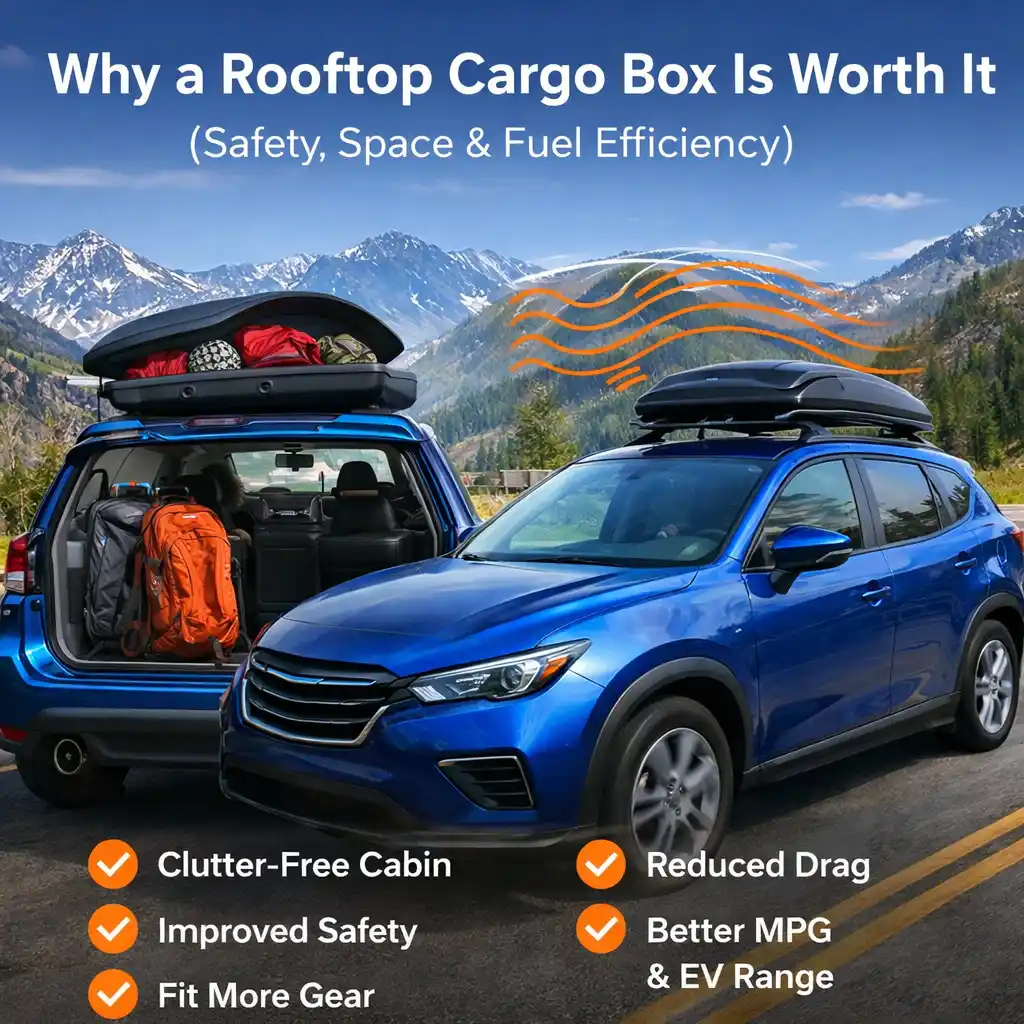
Vehicle cabins are built for passengers—not loose, bulky gear. Moving camping equipment to the roof frees up interior space and reduces the risk of projectile hazards during sudden stops, especially on long highway drives.
It also improves overall comfort. With less gear packed inside, visibility increases, movement inside the cabin becomes easier, and long trips feel less cramped—something that matters more than most people expect after a few hours on the road.
From an efficiency standpoint, a hard-shell rooftop cargo box is significantly more aerodynamic than an open roof rack with exposed gear. Instead of disrupting airflow, it helps streamline it—reducing drag, wind noise, and the impact on fuel economy or EV range.
Not sure if a cargo box is the right choice for your setup? We break down all roof storage options — including racks, rooftop tents, and load systems — in our complete guide to the best roof setup for camping.
For longer trips, food storage also affects how you use roof space—especially if you’re packing one of these camping coolers for ice retention.
⚖️ What Actually Matters in a Rooftop Cargo Box
Not all features are equally important in real-world use. After testing multiple boxes on highways and rough access roads, a few details consistently made the biggest difference.
Dual-side opening — One of the most useful real-world features, especially in tight campsites or roadside parking.
Torque-limiting mounts — These “click” when properly tightened, preventing both over-tightening and loosening over time. This directly impacts stability at highway speeds.
Internal tie-down points — Integrated anchor points or tracks keep heavier gear from shifting during braking or cornering, reducing noise and improving overall stability.
Keeping gear from shifting becomes even more important when you’re transporting cooking equipment—especially if you’re using a camping kitchen organizer or chuck box.
⚖️ Materials & Finishes: ABS Plastic vs. Matte vs. Gloss
Most rooftop cargo boxes are built from ABS plastic with UV-resistant coatings, but the finish has a bigger impact on real-world use than most people expect.
Gloss finishes look clean out of the box but show scratches immediately—especially after driving through low branches or tight forest access roads.
Matte and textured finishes (often marketed as “carbon-style”) are far more forgiving. They hide scuffs, dust, and wear much better, which makes a noticeable difference after a few trips.
In practice, durability isn’t just about the material—it’s about how well the surface handles repeated exposure to branches, road debris, and constant loading and unloading.
🚫 Who Should NOT Buy a Rooftop Cargo Box

A rooftop cargo box isn’t the right solution for every setup. In some cases, it can create more problems than it solves.
Vehicles with low roof load limits — Always check your manufacturer’s roof weight rating (including crossbars). Exceeding it affects handling, braking, and long-term structural safety.
Low-clearance garages or parking — Adding a box can increase your vehicle height by 30–45 cm. Forgetting that once is enough to damage both the box and your garage.
Ultra-minimalist campers — If all your gear fits in a backpack or a small trunk setup, a rooftop box adds unnecessary drag, cost, and complexity.
If you’re unsure about your roof rating, it’s safer to assume the limit is lower than you think—especially once the box is fully loaded.
🏆 Quick Picks: Best Rooftop Cargo Boxes for Camping
If you want to free up cabin space, keep your gear dry, and avoid wind noise on the highway, these are the models that performed best in real-world testing.
These five stood out specifically for camping use, where weather sealing, long-item fit, mounting confidence, and highway noise matter more than generic cargo capacity alone.
Best Overall — Thule Motion XT (XL)
Why: Excellent balance of aerodynamics, low wind noise, and a reliable locking system that works consistently under load.
Best for Aerodynamics & EVs — Yakima SkyBox Lo
Why: Low-profile shape reduces drag and wind resistance, making it the best option for maintaining fuel efficiency or EV range.
Best for Security & Premium Build — Thule Vector Alpine
Why: Reinforced lid, tight sealing, and high-end construction designed for protecting expensive gear at highway speeds.
Best Budget Option — JEGS Rooftop Cargo Carrier
Why: Large internal capacity with solid durability at a significantly lower price point than premium brands.
Best for Compact SUVs — Yakima RocketBox Pro 14
Why: Shorter footprint fits smaller rooflines without interfering with rear hatch access or antenna clearance.
📊 Rooftop Cargo Box Comparison
This table highlights the key differences that matter most in real-world use—cargo space, wind noise, and usability.
| Model | Best For | Volume | Noise | Opening |
|---|---|---|---|---|
| Thule Motion XT (XL) | Best Overall | 18 cu ft | Very Low | Dual-Side |
| Yakima SkyBox Lo | Best for Aerodynamics | 15 cu ft | Low | Dual-Side |
| Thule Vector Alpine | Best for Security | 13 cu ft | Very Low | Dual-Side |
| JEGS Cargo Carrier | Best Budget | 18 cu ft | Moderate | Passenger-Side |
| Yakima RocketBox Pro 14 | Best for Compact SUVs | 14 cu ft | Moderate | Dual-Side |
🥘 Best Rooftop Cargo Boxes (In-Depth Reviews)
1. Thule Motion XT XL
Award: Best Overall Cargo Box

Best for: Families who need maximum storage without the “whistling” noise typical of large boxes
Key Technical Specifications:
- Volume: 18 cubic feet
- External Dimensions: 84.5 x 36 x 17 inches
- Mounting System: PowerClick (quick-mount)
- Mounting Time: ~5 minutes (tool-free)
- Max Load: 165 lbs (always check your vehicle roof rating)
- Locking: SlideLock system (separate lock/open functions)
- Opening: Dual-side
The Thule Motion XT stands out because it balances internal volume with real aerodynamic efficiency. Larger boxes usually create noticeable wind drag, but this one stays controlled at highway speeds. The SlideLock system is one of the most reliable I’ve tested—it clicks into place with clear feedback, so you’re not second-guessing whether it’s secure before driving.
My Experience:
During a 500-mile test, this was the quietest cargo box I’ve used. Even at 75 mph, wind noise stayed minimal. The PowerClick mounting system is genuinely fast—I installed it in under 5 minutes without tools. Once mounted, it feels stable, with no noticeable shift even in crosswinds.
Pros
✅ SlideLock system: Clear visual and audible confirmation
✅ Fast, tool-free setup: One of the easiest mounting systems available
✅ Excellent hatch clearance: No rear door interference on most SUVs
Cons
❌ Premium price: One of the most expensive options
❌ Added height: Can limit access to parking garages
💡 Pro Tip: Place lighter gear (sleeping bags, pads) at the front to reduce turbulence, and keep heavier items centered over the crossbars for better stability.
If you’re packing bulkier sleep systems, these camping mattresses and sleeping pads for car camping take up more space than expected and often work best in a rooftop box.
Verdict:
The best choice for campers who want maximum storage, minimal noise, and zero hassle during installation. It’s the closest thing to a “set it and forget it” rooftop box.
2. Yakima SkyBox Lo
Award: Best for Aerodynamics & EVs
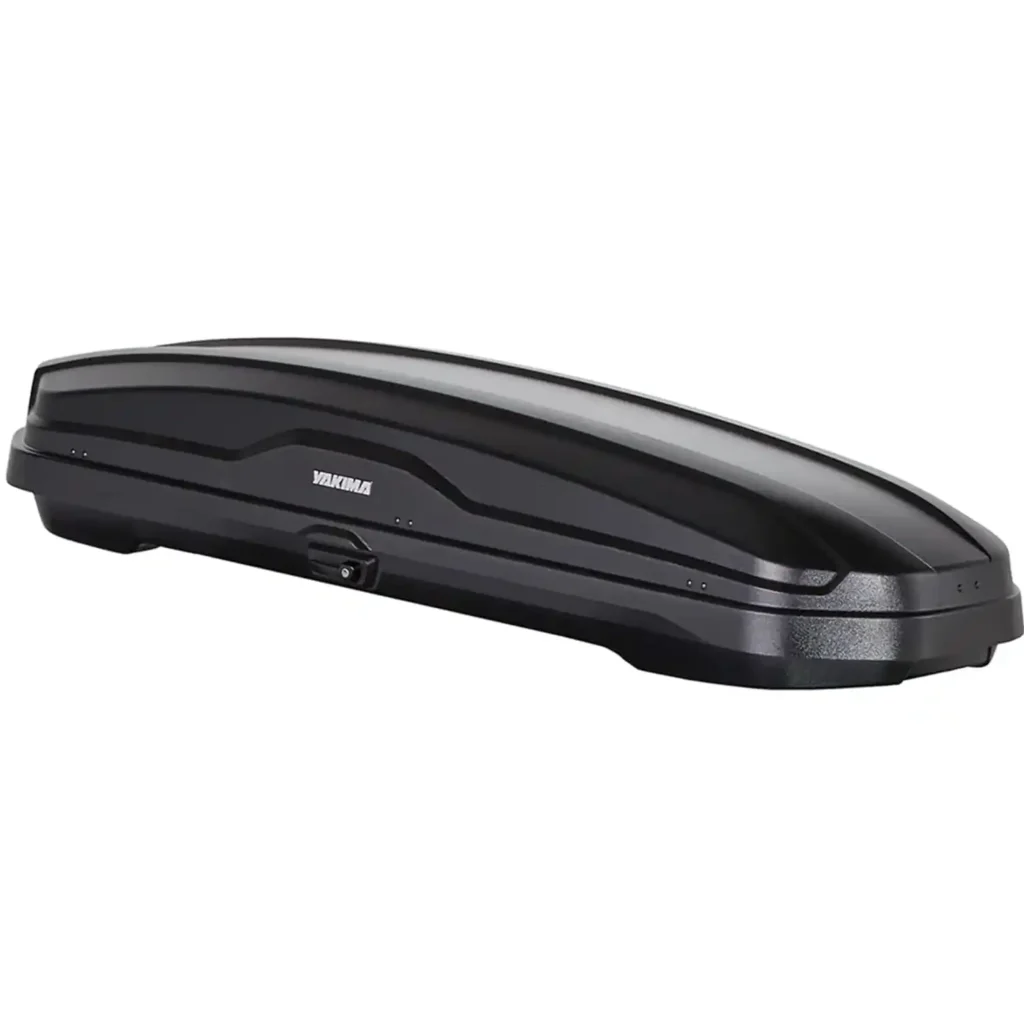
Best for: EV drivers and low-clearance vehicles that need to minimize drag, noise, and height impact
Key Technical Specifications:
- Volume: 15 cubic feet
- External Dimensions: 92 x 36 x 11.5 inches
- Material: Carbonite (textured ABS)
- Mounting Time: ~7 minutes
- Max Load: 165 lbs (always limited by your vehicle’s roof rating)
- Opening: Dual-side
The Yakima SkyBox Lo is designed to stay long and low, reducing the aerodynamic penalty that typically comes with rooftop storage. Unlike taller boxes, it keeps airflow more stable over the vehicle, which directly impacts both fuel efficiency and EV range.
My Experience:
I tested this on a Tesla Model Y specifically to measure efficiency loss. Because of its low-profile design, the range drop stayed around 5–7%, compared to roughly 10–12% with taller boxes. On the road, it also produced noticeably less wind noise, especially above 65 mph. The Carbonite textured finish holds up well against gravel and branch contact—it doesn’t show wear the way glossy boxes do.
This type of low-profile setup pairs well with lightweight gear—like using portable solar panels for camping without adding unnecessary drag.
Pros
✅ Low drag profile: One of the most efficient designs for highway driving
✅ Scratch-resistant finish: Hides wear from real-world use
✅ Reduced wind noise: Noticeably quieter than taller boxes
Cons
❌ Limited internal height: Not suitable for bulky items like large coolers
❌ Extra length: May affect rear hatch clearance on smaller vehicles
💡 Pro Tip: This box works best for long, low-profile gear—camp tables, tents, folding chairs, or canopies—while keeping overall vehicle height manageable.
Verdict:
The best option for campers who care about efficiency, low noise, and maintaining vehicle aerodynamics—especially if you’re driving an EV or a lower-profile SUV.
3. Thule Vector Alpine
Award: Best for Security & Premium Build
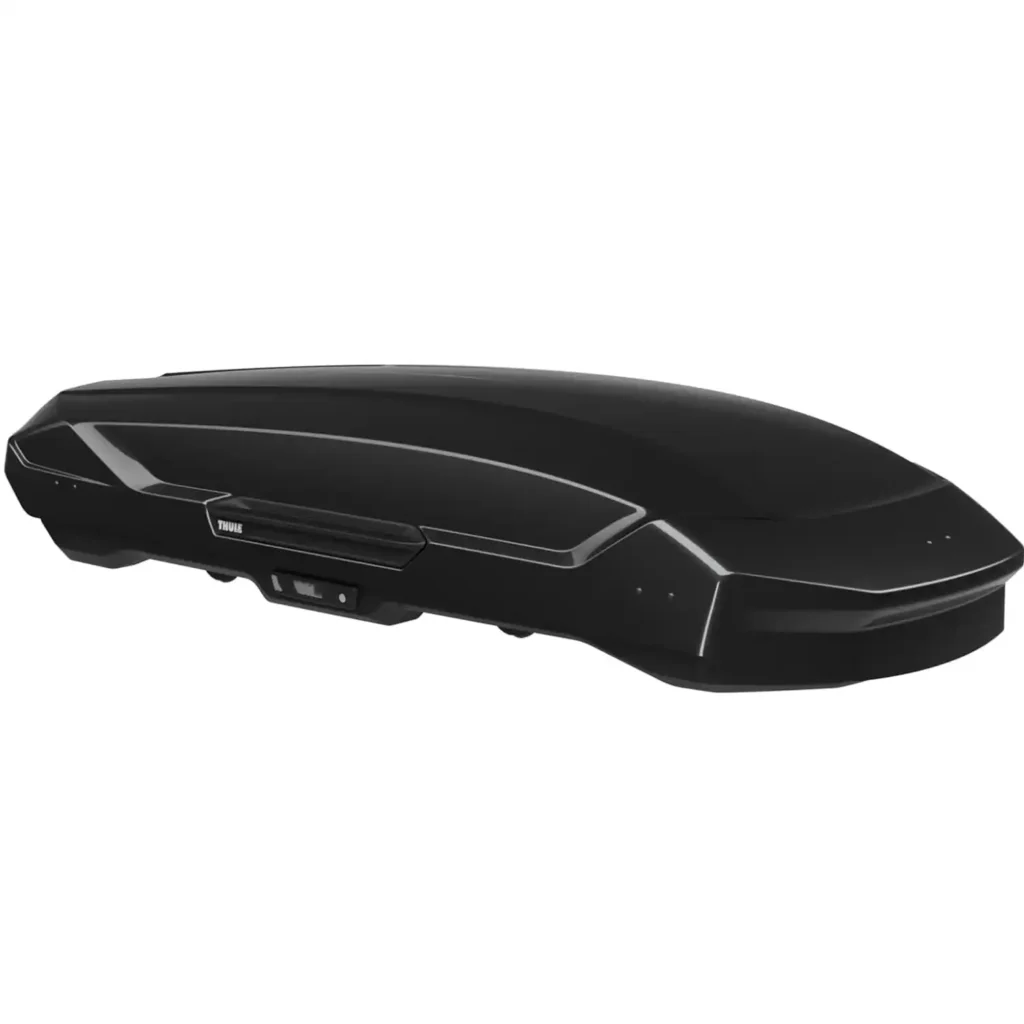
Best for: Campers carrying high-value or fragile gear who need maximum rigidity and protection
Key Technical Specifications:
- Volume: 13 cubic feet
- Interior: Felt-lined base for gear protection
- Lighting: Integrated LED for night access
- Mounting System: PowerClick (torque-limited)
- Mounting Time: ~5–7 minutes
- Max Load: 165 lbs (vehicle roof rating may be lower)
- Packed Weight: 66 lbs
- Opening: Dual-side
The Thule Vector Alpine is built with a focus on structural rigidity and high-speed stability rather than maximum storage. The reinforced lid design creates a tight, unified shell that eliminates the flex and vibration you typically get with larger, lighter boxes.
My Experience:
This is the most solid-feeling cargo box I’ve tested. Even at higher speeds, there’s no lid movement or vibration—what many users describe as “flutter.” The felt-lined interior makes a real difference for sensitive gear. I loaded camera tripods and premium fishing rods, and nothing shifted or rattled, even on rough forest access roads. The integrated LED lighting isn’t just a gimmick—it’s genuinely useful when loading gear in low light.
If you’re carrying electronics or sensitive gear, pairing it with a reliable portable power station for camping helps keep everything protected and functional on the road.
Pros
✅ Exceptional rigidity: No lid flex or vibration at highway speeds
✅ Gear protection: Felt lining reduces movement and prevents scratches
✅ Integrated lighting: Makes night access significantly easier
Cons
❌ Heavy: At 66 lbs, mounting usually requires two people
❌ Lower volume: Prioritizes protection over maximum storage capacity
💡 Pro Tip: Apply a dry silicone lubricant to the lock cylinders periodically. Constant exposure to wind and rain can affect smooth operation over time.
Verdict:
A premium choice for campers who prioritize gear protection, build quality, and high-speed stability over raw storage space.
4. JEGS Rooftop Cargo Carrier
Award: Best Budget Option

Best for: Occasional campers who need maximum storage at a lower cost without paying for premium features
Key Technical Specifications:
- Volume: 18 cubic feet
- External Dimensions: 57 x 38 x 19 inches
- Material: UV-resistant HDPE
- Mounting Time: ~15 minutes (manual U-bolt system)
- Max Load: 110 lbs
- Opening: Passenger-side only
The JEGS Cargo Carrier is built around a simple idea: maximum space for the lowest price. It skips premium features like dual-side access and quick-mount systems, but still delivers the same usable capacity as higher-end models.
My Experience:
Its wider, shorter “bubble” shape makes it easier to pack bulky items like duffel bags and sleeping bags compared to long, narrow boxes. During testing, it stayed dry under heavy water exposure, but installation took noticeably longer due to the manual U-bolt hardware. On the road, it’s stable, but you’ll notice more wind resistance and noise compared to aerodynamic designs.
Budget setups often require smarter packing—especially if you’re managing cooking gear. A proper camping cookware set for car camping can help reduce wasted space.
Pros
✅ High capacity for the price: One of the most affordable 18 cu ft boxes available
✅ Better for bulky gear: Wide shape fits irregular loads more easily
✅ Lightweight shell: Easier to handle during installation and removal
Cons
❌ Single-side opening: Limits access depending on how you’re parked
❌ Manual mounting system: Slower and less convenient than quick-mount designs
❌ Higher wind drag: Less efficient at highway speeds
💡 Pro Tip: Add rubber washers to the U-bolt mounts to reduce vibration and protect your crossbars from scratches over time.
Verdict:
The best choice for campers who prioritize space and affordability over convenience and aerodynamics—ideal for occasional trips where budget matters more than refinement.
5. Yakima RocketBox Pro 14
Award: Best for Compact SUVs

Best for: Owners of compact SUVs and crossovers (RAV4, CR-V, Crosstrek) who need extra storage without sacrificing hatch clearance
Key Technical Specifications:
- Volume: 14 cubic feet
- External Dimensions: ~74 x 33 x 16 inches
- Mounting Time: ~5 minutes (tool-free system)
- Max Load: 165 lbs (vehicle roof rating may be lower)
- Mounting System: Universal quick-mount
- Opening: Dual-side
The RocketBox Pro 14 strikes a better balance between capacity and fit than smaller compact boxes. It’s still short enough for most crossover rooflines, but adds noticeably more usable space for real camping gear.
My Experience:
Mounted on a Subaru Crosstrek, it maintained rear hatch clearance without contacting the spoiler, while offering more flexibility than smaller boxes. The extra volume makes a difference—you can fit a tent, sleeping pads, camp chairs, and additional soft gear without overpacking. The dual-side opening also makes organizing gear much easier in tight parking spots.
Pros
✅ Balanced size: More capacity without going full-length
✅ Hatch-friendly design: Works well on most compact SUVs
✅ Dual-side access: Easy loading from either side
Cons
❌ Still limited for families: Not ideal for 4-person setups
❌ Moderate rigidity: More flex compared to premium models like Thule
💡 Pro Tip: Before buying, measure the distance from your rear hatch hinge to the front crossbar. The Pro 14 usually clears compact SUVs, but fit depends on bar position.
Verdict:
A smart upgrade over smaller compact boxes—ideal if you want more usable space without losing hatch access or daily practicality.
⚖️ Soft-Shell Bag vs. Hard-Shell Cargo Box: What Actually Works
Not all rooftop storage solutions perform the same in real conditions. The difference between a soft-shell bag and a hard-shell box becomes obvious once you’re driving at highway speed or dealing with bad weather.
Choose a soft-shell bag if:
- You need something that folds flat for storage
- You only use it occasionally
- You’re traveling in consistently dry conditions
Choose a hard-shell cargo box if:
- You want reliable waterproofing in sustained rain
- You need locking security for gear
- You care about aerodynamics, noise, and fuel efficiency
- You’re driving long distances at highway speed
In real-world use, hard-shell boxes consistently outperform soft bags. They stay stable, keep gear dry, and reduce wind noise instead of amplifying it.
My Experience:
Soft bags work in ideal conditions, but they tend to shift under load, absorb water over time, and create noticeable drag. A well-designed hard-shell box solves all three problems at once.
Bottom line:
A soft bag is a short-term solution. A hard-shell cargo box is a long-term upgrade to your vehicle’s usability, safety, and comfort.
That difference becomes even more obvious on wet, high-speed trips where poor sealing and extra drag create problems fast.
If you often camp in wet conditions, understanding how to waterproof your tent properly becomes just as important as choosing the right cargo storage.
❓ FAQ: Rooftop Cargo Boxes for Camping
Do rooftop cargo boxes affect fuel economy?
Yes. Most rooftop boxes reduce fuel efficiency by 5–15% depending on size and shape. Low-profile models create less drag, while taller boxes increase resistance at highway speeds.
Are rooftop cargo boxes fully waterproof?
High-quality hard-shell boxes are weather-resistant and can handle sustained rain, but no box is completely waterproof under extreme conditions. Seal quality and latch design make the biggest difference.
How fast can you drive with a rooftop cargo box?
Most manufacturers recommend staying under 75–80 mph (120–130 km/h). Stability, wind noise, and fuel consumption all increase significantly at higher speeds.
Will a cargo box fit my vehicle?
Fit depends on your crossbar spacing, roof length, and hatch clearance. Compact SUVs need shorter boxes to avoid rear hatch interference.
Can I install a rooftop cargo box alone?
Yes, but it depends on the model. Lighter boxes with quick-mount systems can be installed solo in under 10 minutes. Heavier or longer boxes usually require two people.
What size cargo box do I need for camping?
- 11–13 cu ft → solo or minimalist setups
- 15–18 cu ft → couples or standard camping gear
- 18+ cu ft → families or bulky gear
Internal shape matters as much as volume—long boxes fit tents, while wider boxes fit duffel bags.
For a full packing breakdown, this car camping gear checklist helps match your storage needs to your actual setup.
Are soft cargo bags worth it?
Only for occasional use in good weather. They are less secure, less aerodynamic, and more prone to leaks compared to hard-shell boxes.
Do rooftop boxes create a lot of noise?
It depends on the design. Aerodynamic boxes stay relatively quiet, while poorly shaped ones can produce constant wind noise above 60 mph.
🧠 Buying Guide: How to Choose the Right Rooftop Cargo Box

Choosing the right cargo box comes down to how you actually use your vehicle, not just specs.
1. Aerodynamics vs Capacity
Larger boxes offer more storage, but increase wind drag, noise, and fuel consumption.
Low-profile boxes trade volume for efficiency and quieter driving.
👉 If you drive long highway distances → prioritize aerodynamics
👉 If you need space for bulky gear → prioritize volume
2. Box Length vs Vehicle Size
This is one of the most overlooked factors.
- Long boxes → better for skis, tents, long gear
- Short boxes → better for compact SUVs (no hatch interference)
👉 Always check rear hatch clearance before buying
Choosing the right tent size directly affects how much storage you’ll need—this guide explains how to choose camping tent size without overpacking.
3. Mounting System Matters More Than You Think
Quick-mount systems (like torque-click clamps) are:
- faster to install
- more secure under load
- easier to use solo
Manual U-bolt systems are:
- cheaper
- slower to install
- less convenient for frequent removal
4. Noise and Driving Comfort
4. Noise and Driving Comfort
Not all boxes are quiet.
At highway speeds:
- poor designs create constant whistling and turbulence
- better designs stay controlled and barely noticeable
👉 Shape matters more than brand here.
5. Weather Protection & Sealing
Look for:
- tight seals
- reinforced lid construction
- reliable latch alignment
Water usually gets in through:
- weak seal edges
- misaligned latches
- lid flex under sustained rain and speed
6. Real Usable Space (Not Just Liters)
Two boxes with the same volume can perform very differently.
- Long + narrow → better for tents, skis
- Wide + short → better for bags and bulky gear
7. Weight & Roof Limits
Always consider:
- box weight
- gear weight
- your vehicle’s roof rating
👉 Exceeding those limits affects handling, braking, and long-term safety.
8. Security & Build Quality
Premium boxes offer:
- reinforced shells
- better locks
- less flex at high speeds
Budget boxes:
- less rigid
- more vibration under load
🚫 What We Skipped (and Why)
Not every option is worth considering—some designs introduce more problems than they solve once you’re on the road.
No-name “universal” cargo boxes (eBay / generic brands)
These often use lower-grade plastic that becomes brittle in cold temperatures. Under load and at highway speeds, that increases the risk of lid flex, cracking, or latch failure—especially after repeated use.
Uncovered rear-hitch cargo trays
While they keep weight off the roof, they expose your gear to road spray, dust, exhaust heat, and theft. In real conditions, that means dirty, sometimes damaged gear by the time you reach your destination.
In practice, both options fall short in the areas that matter most: protection, durability, and security.
🔥 Quick Decision Guide
- Best overall performance → Thule Motion XT
- Best for efficiency / EV → Yakima SkyBox Lo
- Best for gear protection → Thule Vector Alpine
- Best budget option → JEGS Cargo Carrier
- Best for small SUVs → Yakima RocketBox Pro 14
🏁 Final Verdict: Which Rooftop Cargo Box Should You Choose?
The best rooftop cargo box for camping isn’t the one with the most features—it’s the one that performs quietly, securely, and consistently at highway speed.
Best overall choice — Thule Motion XT XL
If you want a box that does everything well—low noise, reliable locking, and fast installation—this is the safest, no-compromise option.
Best for efficiency and EV range — Yakima SkyBox Lo
For drivers who care about aerodynamics, fuel economy, and a quieter ride, this is the most efficient design on the road.
Best budget option — JEGS Rooftop Cargo Carrier
If your priority is maximum storage at the lowest cost, this delivers—just be prepared for a slower setup and slightly higher wind noise.
Best for premium security and build quality — Thule Vector Alpine
If you’re carrying expensive or fragile gear and want maximum protection at highway speed, this is the most rigid and secure option available.
Best for compact SUVs — Yakima RocketBox Pro 14
The right choice if you need rear hatch clearance and a shorter footprint without sacrificing usability.
Final expert advice:
Before your first trip, note your new total vehicle height and keep it visible in the cabin. It’s a small step that prevents one of the most common—and expensive—mistakes with rooftop boxes.
— Anthony
✍️ About the Author: Field-Tested Gear Reviews You Can Trust
Anthony is a Senior Gear Analyst at CampComfortGuide, specializing in vehicle-based camping and rooftop storage systems. He has logged thousands of miles testing cargo boxes and roof setups across a wide range of conditions—from desert heat to alpine snow.
His approach is simple: test gear in real driving conditions, not controlled environments. That means evaluating how rooftop boxes perform at highway speed, in crosswinds, and during extended exposure to rain and rough roads.
His goal is to help campers find the right balance between storage capacity, vehicle stability, and long-distance comfort—so your gear arrives intact, and your drive stays quiet and predictable.
His reviews focus on how gear performs after hours on the road—where wind noise, weather exposure, and mounting stability matter far more than spec-sheet claims.