
Hi, I’m Anthony.
There is something primal and satisfying about chopping your own firewood. But using a dull or poorly balanced axe is exhausting and dangerous.
I’ve gone through cheap hatchets that chipped on the first log. Once I upgraded to a proper camping axe with a good steel head and shock-absorbing handle, processing wood became fun, not a chore.
Here are the tools I trust to keep the fire burning.
As an Amazon Associate, we earn from qualifying purchases.
Always follow basic axe safety rules and wear protective gloves when processing firewood.
Are you looking for the best camping axe to split firewood and clear brush without wearing out your arm? Balance is everything.
For car camping, you don’t need a massive lumberjack felling axe. You need a hatchet or a small axe that fits in your trunk but still has enough weight to split logs.
Not sure whether you need a camping axe or a hatchet?
Here’s the quick rule:
• Splitting firewood → Small axe (13–17″)
• Kindling & light camp chores → Hatchet (10–14″)
• Backpacking → Compact hatchet under 1 lb
We tested the sharpest and most durable options to help you build the perfect campfire.
Quick Summary: Top 3 Picks for Chopping
Best Overall (The King): Fiskars X7 Hatchet
Why: Unbeatable price, razor-sharp edge, and virtually unbreakable handle.
Best Classic Style (Steel): Estwing Sportsman’s Axe
Why: Forged from one solid piece of steel with a beautiful leather grip. Made in the USA.
Best Compact (Backpacking): Gerber Pack Hatchet
Why: Tiny, lightweight, and sharp. Perfect for kindling and small branches.
Table of Contents
1. Fiskars X7 Hatchet (14 Inch)
Award: Best Overall / Best Value
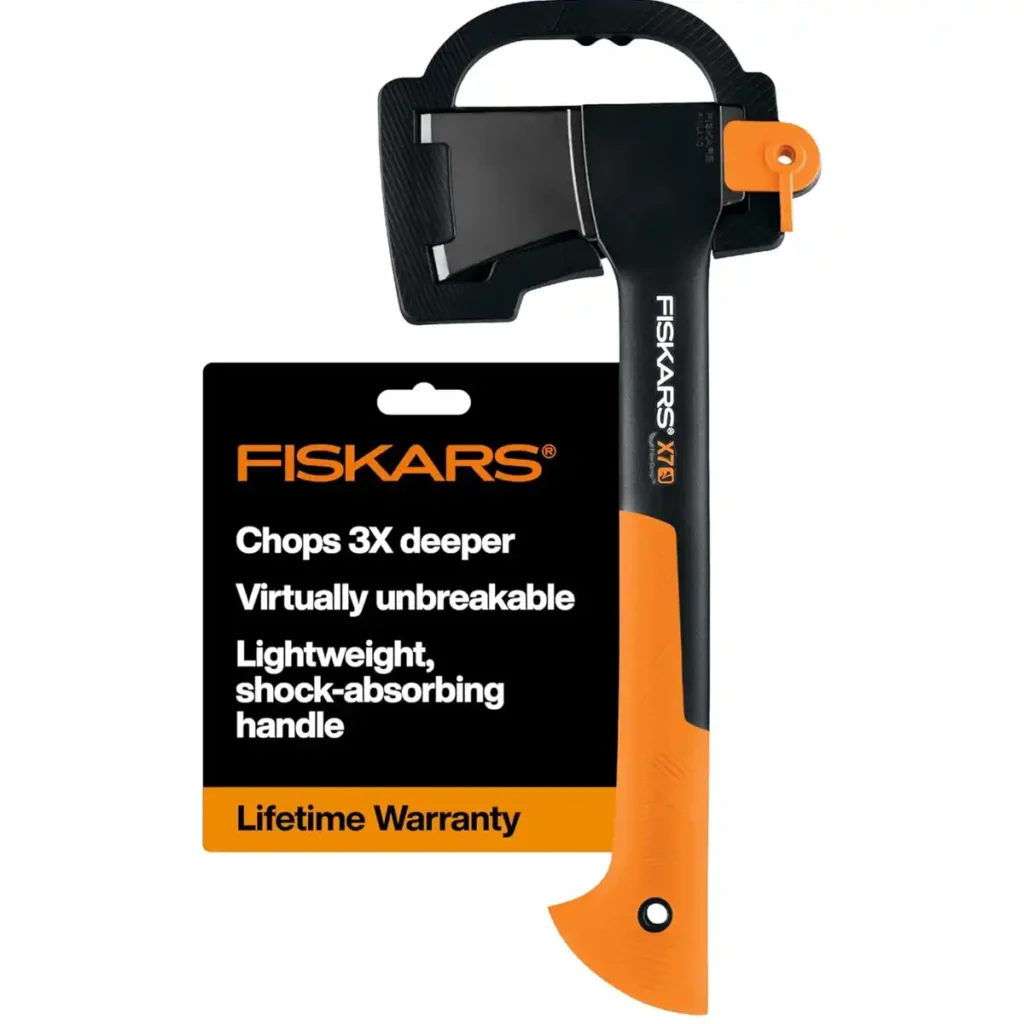
The Fiskars X7 is widely considered the best camping hatchet for the money. It looks modern because it is. The handle is made of FiberComp (a fiberglass composite) which is lighter and stronger than steel.
The blade is coated to slide through wood without getting stuck. It comes razor sharp and holds an edge incredibly well.
Pros:
✅ Insane cutting power for its size.
✅ Lightweight and unbreakable handle.
✅ Coating prevents the blade from getting stuck in logs.
✅ Very affordable.
Cons:
❌ The plastic sheath is a bit flimsy.
❌ The back (poll) is not designed for hammering tent stakes (it can break).
⭐ Best for: Campers who want maximum chopping efficiency with minimal effort.
This hatchet performs best for splitting firewood and processing camp logs during car camping trips.
It is not ideal if you need a traditional hammer poll or prefer classic wooden handles.
Verdict:
If you just want to chop wood efficiently and don’t care about “classic looks,” this is the best tool on the market.
2. Estwing Sportsman's Axe
Award: Best Durability / Classic Look

This is the axe your grandfather used. The Estwing Sportsman is forged from one single piece of solid steel. There is no head to come loose or handle to break.
It features a genuine leather grip that is hand-sanded and lacquered. It looks beautiful and is virtually indestructible.
Pros:
✅ One-piece steel construction (cannot break).
✅ Beautiful leather grip.
✅ Made in the USA.
✅ The back can be used for hammering.
Cons:
❌ Heavier than the Fiskars.
❌ Transmits more shock to your hand when chopping.
⭐ Best for: Campers who value durability, classic design, and long-term reliability.
This axe excels at general firewood processing and hammering tent stakes thanks to its solid steel construction.
It may feel heavy and transmit more vibration during extended chopping sessions.
Verdict:
A true heirloom piece. It looks great in photos and will last a lifetime.
3. Gerber Pack Hatchet
Award: Best Compact / Lightweight

If space is tight, the Gerber Pack Hatchet is tiny. It’s designed for precision work: making kindling, clearing shooting lanes, or trimming branches.
It features a full-tang construction and a rubberized handle for excellent grip, even when wet. It comes with a nylon sheath that can hang on your belt.
Pros:
✅ Extremely compact and portable.
✅ Finger grooves allow for precise control (choking up).
✅ Grippy rubber handle.
✅ Good for hiking or emergency kits.
Cons:
❌ Too small for splitting large logs.
❌ Requires more effort for big jobs.
⭐ Best for: Backpackers and minimalists who need a compact tool for light camp tasks.
This hatchet works best for kindling, trimming branches, and precision cutting where weight matters.
It is not designed for splitting thick logs or heavy-duty firewood processing.
Verdict:
Perfect for light tasks and saving space. Throw it in your Camping Kitchen Organizer for kindling prep.
4. Husqvarna 13" Wooden Hatchet
Award: Best Premium / Bushcraft

If you love the feel of wood, Husqvarna makes incredible Swedish-style axes at a reasonable price. The head is hand-forged in Sweden, and the handle is American Hickory.
It bites into wood deeply and holds a sharp edge. It feels balanced and traditional, perfect for bushcraft enthusiasts.
Pros:
✅ Hand-forged Swedish steel.
✅ Beautiful hickory wood handle.
✅ Comes with a leather edge cover.
✅ Great balance and feel.
Cons:
❌ Wood handles require maintenance (oil).
❌ Pricey compared to Fiskars.
⭐ Best for: Bushcraft campers who appreciate traditional tools and fine edge control.
This hatchet shines when splitting small logs and performing controlled woodcraft tasks around camp.
It requires more care and maintenance than composite-handled alternatives.
Verdict:
For the camper who appreciates craftsmanship and traditional tools.
5. SOG Camp Axe
Award: Best Tactical / Multi-Tool

The SOG Camp Axe is a tactical tool designed for durability. It features a stainless steel head bolted to a glass-reinforced nylon handle.
The unique feature is the flat back of the axe head, which is specifically designed as a hammer. This makes it a great dual-purpose tool for pounding in tent stakes.
Pros:
✅ Designed to be used as a hammer.
✅ Lightweight and durable.
✅ Sheath protects the blade well.
✅ Modern tactical look.
Cons:
❌ Steel is a bit softer (might need sharpening more often).
❌ Not the best splitter for hardwoods.
⭐ Best for: Campers who want a versatile axe with built-in hammer functionality.
This axe performs well for light chopping and pounding tent stakes with a single compact tool.
It is not the best choice for frequent hardwood splitting or long chopping sessions.
Verdict:
A great utility tool. Chop wood and hammer your tent stakes with one item.
How to Get the Best Performance from Your Camping Axe
1 Match the Axe to the Task
Choose your tool based on what you actually do at camp.
Splitting firewood requires more weight and leverage, while kindling and light prep are safer and faster with a compact hatchet.
2 Keep the Edge Sharp
A sharp axe cuts cleaner and requires less force.
Dull blades increase fatigue and are more dangerous because they tend to glance off wood instead of biting in.
3 Use a Proper Chopping Surface
Always split wood on a stable chopping block or flat log.
Never swing an axe directly into the ground — this is the fastest way to damage the blade and lose control.
4 Let the Tool Do the Work
Good camping axes rely on balance, not brute force.
Controlled swings improve accuracy, reduce fatigue, and prevent handle shock over long sessions.
5 Store and Transport Safely
Always use a sheath when packing your axe.
A covered blade protects your gear — and your hands — when reaching into a packed trunk or gear bin.
Buying Guide: Choosing the Best Camping Axe
1. Handle Material
To pick the best camping axe, look at the handle.
Composite (Fiskars): Light, absorbs shock, unbreakable.
Steel (Estwing): Durable, heavy, vibrates more.
Wood (Husqvarna): Classic feel, but can break if you miss a swing.
2. Length (Leverage)
10-14 inches (Hatchet): One-handed use. Good for kindling and small logs. Easy to pack.
17-24 inches (Small Axe): Two-handed use. Better for splitting larger logs, but harder to fit in a trunk.
Longer axes reduce fatigue when splitting thicker logs but require more storage space.
3. The “Poll” (Back of the Axe)
Do you need to hammer stakes? Look for an axe with a flat, hardened poll (like the SOG or Estwing). The Fiskars is not designed for hammering.
4. Axe vs Hatchet (Quick Choice)
If you split logs thicker than your wrist, a full camping axe is usually the better and safer choice.
If you mostly make kindling or clear brush, a hatchet is safer and more efficient.
5. Safety Matters
A dull axe is more dangerous than a sharp one.
Always use a chopping block and keep your swing below knee height.
Final Verdict
For most campers looking for the best camping axe, the Fiskars X7 remains the undefeated champion.
For durability and style, get the Estwing Sportsman.
For compact tasks, the Gerber Pack Hatchet is handy.
The best camping axe depends on how you camp.
Car campers benefit from heavier, more powerful tools.
Backpackers should prioritize weight and control over raw power.
When searching for the best camping axe, safety is key. Always chop on a stable surface and keep your blade sharp!